KWBaker
Shared posts
10 Key Trends For Italian Wines In U.S. Restaurants
Use the Five Folder System to Finally Organize Your Email Inbox

We’ve come a long way from the simple “trusted trio” method of organizing our inbox, and for many of us our email is as disorganized as it’s ever been. To beat back the tide, this five folder system gives you a bit more flexibility to clean things up, but still keep everything you need just one click away.
How Companies Use Your Data Even When You’re Not Logged In

It’s not news that companies mine and sell your data, but the ins and outs of how it works aren’t always clear. The Federal Trade Commission recently published a report that explains how it works in a little more detail.
Uber's latest option is a personal chauffeur
Filed under: Etc.,Transportation Alternatives,Technology
 It's launching in several cities in India.
Continue reading Uber's latest option is a personal chauffeur
Uber's latest option is a personal chauffeur originally appeared on Autoblog on Mon, 06 Feb 2017 12:40:00 EST. Please see our terms for use of feeds.
Permalink | Email this | CommentsEarthships, the Ultimate in Off-Grid Architecture
Artist Roxanne Fonder Reeve never imagined that she would find herself dumpster-diving in the industrial areas of Seattle, Washington.
On drives around the city, she’ll pull over when she sees interesting objects people have cast away, collect them, and use them as building materials for a futuristic, architectural experiment.
She’s building a miniature Earthship in her driveway in Columbia City.
Earthships are a self-sufficient alternative to the conventional home. Instead of relying heavily on outside organizations to receive utilities, they allow people to live off-the-grid, independent of the economy and government.
“I’m not a hardy, outdoor construction type of person,” says Fonder Reeve, who calls herself 'the Queen of Trash Fairies,' “so all this collecting of old tires and pounding dirt with sledgehammers was unexpected.”

Since 2012, Fonder Reeve and volunteers in the community have been building Trash Studio, a sustainable, zero-waste structure made out of recycled and natural materials. It’s the first Earthship structure of its kind in Seattle. Inspired by the work of American architect Michael Reynolds in New Mexico, Fonder Reeve’s 120-square-foot driveway serves as a laboratory to showcase elements of Earthship architecture and bring awareness to the self-sustaining lifestyle.
“I think now, with climate change and economic insecurity, people—especially young people—are realizing we need to live differently, tread more lightly on the planet, and be much more capable and self-sufficient,” says Fonder Reeve. “Earthships embody that in every way.”

The concept of the Earthship was first described by Michael Reynolds in 1971. In Taos, New Mexico he began to build homes out of empty aluminum soda and beer cans, bottles, and tires. He completed his first Earthship home in 1988, and has continued his quest in spreading his sustainable living ideals globally.
While some may perceive Earthships as an outdated practice born out of 1970s environmentalism, Fonder Reeve believes the idea has never faded.
“I would say that the Earthship community is actually much stronger than it was in the 1970s,” she says. “I think it’s consistently grown because the design has changed from the ‘70s. It’s gotten better and better.”

Today there are Earthships in every state in America and in more than 20 countries, appearing as homesteads in Guatemala and an emergency shelter in post-earthquake Haiti. And people live in these Earthships. There’s an entire Earthship community in Taos that supports 70 residences and allows overnight visitors.

Earthship enthusiasts can attend the four-week Earthship Biotecture Academy in Taos. Over 1,300 students have been educated on the design principles, construction methods, and philosophy of Earthships. Founder of Earthship Seattle, Florian Becquereau, attended the academy in 2013 and spent six weeks living in an Earthship.
“You’re more in touch with the natural world,” he says. “You rely on what you get from nature so you have to be more conscious of what you use. You can’t leave everything on, like all your electric appliances, all the time. It’s wasteful anyways.”

In addition to being built entirely out of natural and recycled materials, these structures are powered by thermal, solar, and wind energy. Earthship architects have created systems to harvest water, produce food, and maintain sewage. Some Earthships now have vents to allow for air-conditioner use and greenhouse space that creates better temperature regulation, says Becquereau.

The creativity and ingenuity involved in creating these self-sustaining structures have given way to diverse architecture that is both functional and artistic. Windows perpendicular to the winter sun and roofs that can catch water are all design features that help make an Earthship work, while glass bottles and sculptures give a futuristic, alien aesthetic.
“The design has evolved over time, but the concept and philosophy is still the same,” says Becquereau. Now, Becquereau is leading the design of the Trash Studio.

Becquereau and Fonder Reeve are building the Trash Studio without any money, using only materials left behind or donated to them. The added challenge forced them to find creative ways to construct the shed-sized Earthship, from packing 150 old tires with dirt to collecting clay unearthed from a housing project.

For insulation, Becquereau came up with a plan to use 400 old phonebooks in the two-foot-wide curving wall constructed out of the tires. But when they could only find five, Becquereau had to improvise. Instead, they used Styrofoam boxes that were being discarded by a medical facility.
“It’s a little bit of planning and making requests, and a little bit of just creatively using whatever happens to be around,” says Fonder Reeve.

The Trash Studio is an on-going construction project. Currently, Fonder Reeve is designing an intricate mosaic for the exterior of the structure, coming up with different ways to attach objects to the cob walls. They are also hoping to install an oven to accompany their biochar stove to cook for the volunteers. However, the size of Fonder Reeve’s driveway limits how much they can build.
“It would be nice eventually to have a full-on Earthship, maybe a 2,000-square-feet center well-placed in Seattle,” Becquereau says, but for now projects like the Trash Studio is a first step in the right direction.

“Our current housing system is not sustainable, so I don’t have a lot of faith that it will be in tact in 50 years,” Becquereau says. “I know that Earthships are gaining more and more popularity. More and more people are looking for alternatives and Earthships play a big part in that.”
See and learn more about the Trash Studio in-person on February 12 with Atlas Obscura.
Lady Gaga Halftime Drone Show Was Pre-Taped Due to FAA Regulations
 Viewers who stuck around for last night's Super Bowl half-time show got to see a first—a synchronized drone routine at the start of the Lady Gaga performance, with 300 Intel Shooting Star drones executing complex maneuvers over the stadium.
Unfortunately, because of Federal Aviation Administration (FAA) regulations, the drone display was pre-taped. The FAA actually made the area more than 34 miles surrounding the stadium a no-drone zone between 4pm and midnight on game day. Wired reports that Intel and show organizers were able to acquire other exemptions from the FAA that made the feat possible at all. Those exemptions were for regulations such as those requiring operators maintain visual contact with their drones or that limit how high drones can fly (400 feet), as The Verge reported.
The FAA rolled out registration rules concerning personal drones at the end of 2015—requiring, retroactively, that owners of all drones weighing more than about half a pound be registered. As of last summer nearly half a million people registered as drone owners. The registration requirement is currently being challenged in court. The FAA also put out new regulations last summer—dropping a requirement for mandatory federal approval of small drones for commercial use, but adding the line-of-sight rule that, as Wired notes, is preventing adoption of drones for tasks such as search and rescue and operations in other zones into which it's dangerous to send people. Rules elsewhere are less strict. As Eric Boehm noted when reporting on last summer's FAA regulations, it's already possible to have pizza delivered to your home by drone, if you live in New Zealand.
Check out Reason TV's 2013 segment on the Drone Boom:
How Many Hours Will You Need to Work to Afford That Expensive Thing You Want?
This calculator translates big expenses into time spent working.
Blaser Creates a Custom Safari Rifle for Tony Makris
Things About America That Make No Sense to People in Other Countries

America's a big place and it's also kind of weird in some ways. TopTenz has collected ten strange things about the US that might actually seem normal to Americans, but seem very odd from an outsider's perspective. For example, beastiality is still legal in nine US states but premarital sex or co-habitating before marriage is still illegal in four states. Also, 30% of Americans would rather save money than get necessary medical treatment.
Perhaps most strangely, the American government has official advice for those who want to report Elvis sightings.
So check out the whole list at TopTenz.
Why are Boss 302 and Bullitt Mustangs lurking in Ford marketing?
Filed under: Rumormill,Ford,Coupe,Performance
 Are two of the Mustang's iconic special models set for a return?
Continue reading Why are Boss 302 and Bullitt Mustangs lurking in Ford marketing?
Why are Boss 302 and Bullitt Mustangs lurking in Ford marketing? originally appeared on Autoblog on Mon, 06 Feb 2017 09:32:00 EST. Please see our terms for use of feeds.
Permalink | Email this | CommentsHow to Save Hundreds on Your Insurance

There’s no getting around it: insurance is really expensive. Health insurance, auto insurance, home insurance… all of it can cost thousands of dollars every year. Saving even a little bit each month can add up to huge amounts of money back in your pocket over time. But how can you get better rates on insurance? It might seem impossible, but there are a number of things you can do to stop paying so much. Some depend on your circumstances. Some have specific requirements. But there’s almost certainly something you can do to save some money. Assess Your Needs This is important,...
Read the full article: How to Save Hundreds on Your Insurance
Eight Off-Season Rifle Drills That’ll Make You a Better Marksman

When Someone Copies Your Photo for Commercial Purposes…

At what point does something go beyond inspiration? Edward McGowan is a California based photographer who has an interesting situation in his hands.
Back in 2011, McGowan shot this photo that has since become quite popular (You can also see it on Flickr here):

McGowan seen his fair share of people trying to steal it for YouTube song cover photos, but so far nothing has come close to what he just found out.
He recently received a message from a photographer friend who happened to notice McGowan’s image in Germany. But something didn’t look right… On closer inspection, it turned out it wasn’t actually McGowan’s image, but a seemingly blatant copy!

It turns out that it was an advertisement for some sort of bladder infection medication for a company. I guess nothing says bladder infection like sitting on a rainy sidewalk in shorts!
McGowan says the photo was apparently produced by the ad agency Strategas. The distribution appears to be quite wide.


McGowan says he’s unsure of what (if anything) he’s going to do. What does one do when someone seemingly steals your vision without actually stealing your photograph (in another country)? Perhaps it was just sheer coincidence? What would you do?
What’s your take on McGowan’s situation?
You can find more of McGowan’s work on his website, Flickr, and Instagram.
(via Retouchist)
About the author: Pratik Naik is a photo retoucher specializing in commercial and editorial work. To see his work, head over to his website or give him a follow on Instagram and Facebook.
How Pelican Cases Are Made (and How Durable They Are)
Pelican brand hard cases are a popular choice for photographers who need to safely transport camera and lighting gear from photo shoot to photo shoot. BrandmadeTV made the 6.5-minute video above that offers a behind-the-scenes look at how these durable hard cases are manufactured.
Founded in an avid diver’s garage in 1976, Pelican now employs over 1,300 people and is the largest maker of protection cases in the world. The airtight and watertight cases are both crushproof and dustproof.
Just how rugged are these cases when it comes to protecting your camera gear? The folks over at B&H decided to find out by torture testing a new Pelican Air case with drops from various heights, a hammer, fire, and a paintball gun.
Impressive.


On The Fast Track: 25 Ways to Learn a New Skill Quickly
Step one: Warm up your brain.


What Happened to Model Trains?

In the 19th century, the railroad was the biggest thing going. Like the internet, it connected people across long distances, promoted exploration of new places, and captured the popular imagination. The fascination with trains gave birth to the craze for model trains and the worlds they traveled. Whether they came pre-assembled or you built your own, it was a hobby that reigned for around 100 years. But times have changed.
In recent decades, selling model trains to children of either gender has been equally challenging, as author and self-described “recovering model railroader” Gerry Souter explained to me recently. He and his wife, Janet, have written a half-dozen or so books on the hobby. “I have breakfast every Tuesday with some friends of mine who run trains,” he says, “and I still have all the kits I built. I love model trains, and I enjoy going to conventions to sell our books.”
Unfortunately, Souter doesn’t see a lot of children at those events. “The average age of a model railroader is 40-plus,” Souter says with a sigh. That may be optimistic: According to a “Wall Street Journal” article published just last year, the average age of the National Model Railroad Association’s 19,000 or so members is 64, up alarmingly from 39 in the mid-1970s.That’s too bad, because today’s analog model trains have plenty to offer 21st century’s digital kids. Though many trains are sold pre-assembled, there are still a lot of do-it-yourself kits out there, making them a good fit for those inspired by Maker and DIY culture. In addition, despite the historic image of locomotives belching black smoke everywhere they go, real trains are surprisingly efficient in terms of their energy consumption, making them one of the greenest modes of transportation going. As for train layouts, they can be as traditional or as far-fetched as a child’s imagination will allow, snaking through everything from forests of living dwarf conifers to cityscapes constructed entirely of LEGOs.
Read about the rise and fall of model trains at Collectors Weekly.
Sheriff: Man sets bus driver's hair on fire, commandeers bus

Coastal Navigation and Tidal Planning Orientation Day with Andy Stamp!
Il primo corso che ho seguito, proprio il giorno successivo al mio arrivo nel Devon, è stato quello che dà il titolo a questo post: un corso di orientamento per diventare insegnante di navigazione costiera.
Quando si chiede alla British Canoeing di poter diventare insegnante di 4* kayak da mare (Provider 4*, in inglese), percorso che ho iniziato lo scorso anno e che non ho ancora terminato (leggi la spiegazione nel post dedicato!), si riceve insieme al logbook anche una letterina di benvenuto in cui si viene fortemente invitati a registrarsi anche come insegnanti di navigazione costiera, visto che il CNTP è uno dei pre-requisiti per accedere all'esame finale da 4* Sea Leader.
Quasi tutti i corsi 4*, infatti, sono proposti in tre giorni, due di pratica in acqua, per meglio comprendere le regole di conduzione del gruppo, ed uno di teoria in aula, il corso di Coastal Navigation and Tidal Planning. E' un corso che include la corretta lettura delle carte nautiche e delle mappe topografiche, la comprensione delle correnti di marea, l'interpretazione delle previsioni meteorologiche e la pianificazione ragionata di un'escursione giornaliera lungo costa. E' tutto pensato per offrire al 4* Leader gli strumenti teorici per organizzare, gestire e condurre un'escursione in kayak in condizioni di mare moderato, cioè con vento forza 4 e stato del mare 3, con 2 nodi di corrente e 2 miglia di possibili traversate, con sbarchi sicuri ogni 1-2 miglia oppure ogni ora...
Il CNTP è quindi il corso ideale per imparare a diventare dei buoni Leader 4*. Ed è il anche corso che un Provider 4* deve poter offrire ai propri studenti: deve però diventare prima un Provider CNTP, cioè un insegnante qualificato a tenere i corsi di navigazione costiera secondo gli standard della British Canoeing... ed eccoci arrivati al motivo per cui sono andata a seguire questo corso!
In tutta l'Inghilterra, ci sono soltanto due insegnanti abilitati a tenere il corso di orientamento sulla navigazione costiera: Andy Stamp e Howard Jeffs. Il primo è stato il mio insegnante nel corso di orientamento svolto domenica 24 aprile presso il centro velico di Plymouth. Il secondo ho avuto la fortuna di incontrato a Holyhead la domenica successiva (il Primo Maggio!) e ho così colto al volo l'occasione di seguire anche il suo CNTP!
Sono entrambi degli insegnanti fantastici, competenti ed appassionati. Kayaker e velisti, insegnanti universitari e qualificati insegnanti Level 5 BCU, sanno parlare di mappe sinottiche e correnti ascensionali con estrema confidenza e possono correggere ogni esercizio di rotte vettoriali in un battito di ciglia. Sono chiari nelle spiegazioni, estremamente organizzati ed altamente professionali. Insomma, valeva proprio la pena di seguire i loro corsi!
Ma non è finita così: per poter completare la formazione come "Provider CNTP" occorre seguire almeno quattro corsi di navigazione costiera tenuti da diversi insegnanti, sia in veste di mero osservatore che nel ruolo più impegnativo di assistente. Alla fine del percorso, si è raggiunta la competenza e confidenza necessarie per tenere un corso completo di CNTP in totale autonomia. A quel punto si rispedisce indietro il logbook e la British Canoeing certifica di avere un nuovo insegnante abilitato al CNTP. Che è il mio prossimo obiettivo (insieme a tanti altri!).
Il lunedì 2 maggio, quindi, mentre fuori imperversava una tipica burrasca inglese, con tanto di pioggia orizzontale e raffiche di vento da piegare gli alberi, io sono rimasta rintanata nella sala centrale dell'Anglesey Outdoor per assistere al terzo corso di navigazione costiera in poco più di una settimana. Stavolta dietro la cattedra c'era l'insegnante statunitense Greg Paquin, giunto alla sua prova finale come "Provider CNTP". Era quindi presente in aula anche un altro super-mega-iper insegnante di CNTP, Rowland Woollven, deputato a supervisionare il corso per poter alla fine certificare la "promozione a Provider" di Greg. Che infatti è stato promosso!
Insomma, si tratta di un iter complesso ed articolato, anche molto impegnativo (per non dire faticoso!) ma che ogni volta mi lascia sempre molto soddisfatta: il kayak da mare è trattato dalla British Canoeing come una vera e propria disciplina, una scienza marinara che va studiata in maniera approfondita e che merita il giusto rispetto, da parte sia dei praticanti che degli stessi insegnanti.
Il sistema didattico adottato dalla federazione inglese è un metodo piramidale e costruttivo, di trasferimento diretto delle conoscenze, volto a garantire uniformità di standard e soprattutto sicurezza in mare... Una scuola all'avanguardia che sono sempre più contenta di avere scelto di seguire: ho avuto la fortuna di entrare nell'università del kayak da mare!
 |
| Andy Stamp running the CNTP Orientation Day - Monday, April 24th |
 |
| The Almanac, one of the main resource for navigating with small craft and sea kayak |
 |
| The "Rule of Twelfths" easily explained on the white-board |
 |
| How to put in practise a vector! |
 |
| The final chat about our action plan |
 |
| Howard Jeffs in action - Sunday, May 1st |
 |
| Greg Paquin and his assistant Johan Wagner - Monday, May 2nd |
 |
| Lots of practical exercises with a special assistant: Jim Krawiecki! |
 |
| The most interesting slide of the course |
 |
| The "interactive balls" made by Rowland Woollven |
I've been back to UK for the nth time to follow a series of courses with the Britich Canoeing, to meet my mentor Lee Pooley and to take part in the annual Anglesey Sea Kayak Symposium (I will talk more about that in the following two post...)
The first course was exactly the course that give the name to this post: the Coastal Navigationa and Tidal Planning Orientation Day. It is needed to become a CNTP Provider.
When you decide to became a British Canoeing 4* Sea Provider, as I've started to do last year - and the process is not finished yet, see explanation in the dedicated post! - you usually receive a logbook with guidance notes, where is "strongly advised that 4* Providers are also registered as providers of the relevant safety training course, e.g. CNTP".
Many 4* Sea Training courses are delivered as an inclusive package of two practical days on the water and one more day of theory-based course, called Coastal Navigation and Tidal Planning. It is the right course to give the students the tools to enable them to plan and navigate effectively on coastal journeys in moderate sea conditions. The CNTP is the ideal course to learn how to become a good 4* Sea Leader. And it is also the course that a 4* Provider must be able to offer to the participants involved in the 4* Sea Training...
This is the reason why I've decided to take part to this Orientation Day!
There are only two Home Nation Approved Trainers: Andy Stamp and Howard Jeffs.
The first one has been my teacher during the Orientation Day on Sunday, April 24th, in the Tamar River Sailing Club based in Plymouth. The second one was in Holyhead for the Anglesey Symposium, running a CNTP on the following Sundays (May 1th!): I have so had the great chance to also follow his own course!
They both are fantastic, competent and impassioned coaches: kayakers and yachtsmen, teachers at the university and qualified BCU Level 5 coaches, they both are able to speak of synopitc charts and vectors with extreme confidence. They are clear in explanations, extremely organized and highly professional. In short, I was really happy to be one of their students!
But this is not the end of the story: to be able to complete the process to become a "CNTP Provider", you must observe and co-deliver at least four CNTP courses run by different coaches. Once the action plan is complete, the potential CNTP Provider must gain a recommendation from a registrered CNTP and they must be confident that the potential Provider have run courses clearly showing all round competence and ability in accordance with the stated criteria.
This is my next step!
On Monday, May 2nd, during a perfect British thunderstorm, I've decided to remain in the main room itno the Anglesey Outdoor to take part of the third CNTP course in few more than one week (and gain one more signature for my CNTP logbook!). This time the coach was the American Greg Paquin, involved in his last course for the last signature. For this reason, in the classroom there also was Rowland Woollven, in the role of observer of Greg's course. Finally, Greg became a CNTP Provider!
It is a complex and articulated process indeed. Despite that, I find myself very satisfied, every time and always: the British Canoeing is the University of the sea kayaking and I'm very proud to have had the chance to join the system. I'm a very lucky girl!
Grab Pre-Orders Meals for You at the Airport

No one wants to spend $15 on a sandwich, but when you’re hungry and want something more than a tiny bag of pretzels, you surrender to expensive airport food. If you’re in a rush, Grab is a free app that pre-orders this food for you so you don’t have to worry about a missed flight.
The Sunken Lanes of Europe
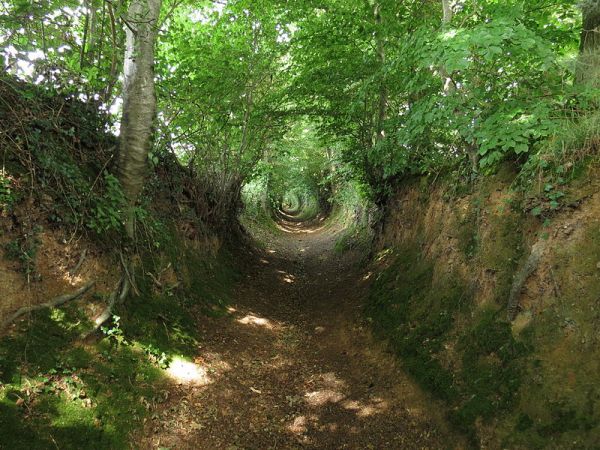
Do you know what happens when you use a road for hundreds of years without paving it? Foot traffic, horses, and vehicles wear away the soil, sinking the road down into the ground. Europe has many of these holloways, although a casual traveler might not see them because they aren't the well-maintained highways that will get you from here to there in a hurry. Instead, they are attractions in themselves.
Appearing as trenches dredged through the earth or tunnels cleared through forests, these ancient pathways called holloways or sunken lanes are found all across the European countryside. They originally began at the ground level, but over the centuries, under the tread of a million feet and hooves encompassing thousands of journeys, the floor of these roads have worn away and eroded down to the bedrock, creating ditches that lay beneath the level of the surrounding landscape. With high banks on either side, many of these ancient thoroughfare then became temporary waterways during rains, which further deepened and widened the paths making them permanent features of the landscape. Some of these paths are twenty to thirty feet deep, and look more like gorges than roads.
You can see plenty of photographs of the different holloways of Europe at Amusing Planet. -via the Presurfer
(Image credit: Romain Bréget)
The Cities You Should Be Most Drawn To Based On Your Myers-Briggs Personality Type

We’ve all heard of the stereotypes about people who live in different parts of the country; New Yorkers tend to be loud and fast-paced, while Californians are generally laid-back & environmentally conscious. Although these stereotypes may seem accurate to some people, there hasn’t been any science to support these broad claims about cities and the personalities of the people who choose to occupy them. That is, until now, and it turns out that cities do in fact have a “personality”.
According to new research from CPP, the exclusive publisher of the Myers-Briggs Type Indicator® (MBTI®) assessment, there are certain cities in the U.S. that are made up of the majority of residents having a clear preference for extraversion as well as cities where a majority of the population have a preference for introversion. The study found that people in cities such as New York, Boston and Miami have preferences for extraversion. Meanwhile, cities such as Colorado, Albuquerque and Oklahoma City have majority introversion-preferring populations.
This is not to say that the data supports the aforementioned perception that more people on the east coast have a preference for extraversion versus those on the west coast, though the study found that of the largest U.S. cities surveyed, six out of the top 10 are located in the eastern regions of the country. It gets even more interesting when we look at the top 100 most “livable” cities, as identified annually by Livability.com. While all of these cities – Miami Beach, Scottsdale, AZ – may be very attractive, those thinking of relocating to one of these destinations may want to consider how their own personality preferences fit with those of the residents.
Let’s say you are considering the move to Miami Beach or Scottsdale, AZ, but your personality preferences are for introversion rather than extraversion. Since these are among the most heavily populated cities by those who prefer extraversion, your notion of “ideal living” may be very different from the people who live in these cities. For example, if curling up in a quiet coffee shop with a good book sounds like the perfect way to spend your free time, you might want to take that into account before moving to one of these places. Conversely, Missoula, MT and Monterey, CA are majority Introversion-preferring cities, so if something more along the lines of a party or large social gathering is more in-line with your ideal living, these activities may be harder to come by within introvert-leaning populations.
When we you look at how people take in information (indicated by Sensing and Intuition on the MBTI too), some interesting things emerge:
Overall, the most livable cities have a much higher than average preference for “Intuition”, meaning that residents tend to be more visionary and big-picture oriented.
Among the most livable cities, Berkeley and Palo Alto – famous for incredible technology breakthroughs – also rank high with people who prefer Intuition. On the opposite end of the spectrum, the more practical, fact-minded Sensing preferences make up solid majorities in some of America’s top manufacturing cities such as Detroit and Wichita.
Personality type can tell you a lot about a person and as shown through CPP’s new study, it can tell you a lot about a city as well. MBTI Type can even show correlation to certain political preferences in America’s biggest cities, and given the current political climate of the nation, this could be important to where you choose to live.
Below is the full breakdown of MBTI Type as identified in two categories; the most livable cities as identified by Livability.com and the largest U.S. cities. Take a peek to see where else your personality might match the cultural norms around the country:
Most Livable Cities –– Largest U.S. Cities
| Highest Extroverted Preference Population | Highest Extroverted Preference Population | |
| Miami Beach, FL | New York, NY | |
| Goleta, CA | Boston, MA | |
| Boca Raton, FL | Miami, FL | |
| Newton, MA | Hialeah, FL | |
| Scottsdale, AZ | Chicago, IL | |
| Iowa City, IA | Atlanta, GA | |
| Bloomington, IN | Tampa, FL | |
| Brookings, SD | Dallas, TX | |
| Columbia, MO | Scottsdale, AZ | |
| Madison, WI | Tulsa, OK | |
| Highest Introverted Preference Population | Highest Introverted Preference Population | |
| Helena, MT | Stockton, CA | |
| Missoula, MT | Albuquerque, NM | |
| Casper, WY | San Bernardino, CA | |
| Monterey, CA | Oklahoma City, OK | |
| Loveland, CO | Sacramento, CA | |
| Ashland, OR | Colorado Springs, CO | |
| Davis, CA | Aurora, CO | |
| Richland, WA | Santa Ana, CA | |
| Ames, IA | Durham, NC | |
| Billings, MT | Honolulu, HI | |
| Highest Sensing Preference Population | Highest Sensing Preference Population | |
| Aberdeen, SD | Chesapeake, VA | |
| Dickinson, ND | Detroit, MI | |
| Watertown, SD | Hialeah, FL | |
| Sioux Falls, SD | Corpus Christi, TX | |
| Bismarck, ND | North Las Vegas, NV | |
| Rapid City, SD | Stockton, CA | |
| Billings, MT | Santa Ana, CA | |
| Greenville, NC | Anaheim, CA | |
| Fredericksburg, VA | Wichita, KS | |
| Stillwater, OK | Laredo, TX | |
| Highest Intuitive Preference Population | Highest Intuitive Preference Population | |
| Berkeley, CA | Oakland, CA | |
| Boulder, CO | Seattle, WA | |
| Ashland, OR | New York, NY | |
| Cambridge, MA | Portland, OR | |
| San Rafael, CA | Denver, CO | |
| Palo Alto, CA | San Francisco, CA | |
| Newton, MA | Washington, DC | |
| Menlo Park, CA | Austin, TX | |
| Lafayette, CO | Philadelphia, PA | |
| Ann Arbor, MI | Madison, WI | |
| Highest Thinking Preference Population | Highest Thinking Preference Population | |
| Arlington, VA | Jersey City, NJ | |
| Alexandria, VA | Wichita, KS | |
| Fremont, CA | Arlington, VA | |
| Fredericksburg, VA | Laredo, TX | |
| White Plains, NY | Washington, DC | |
| Bismarck, ND | Fremont, CA | |
| Billings, MT | North Las Vegas, NV | |
| Stamford, CT | San Francisco, CA | |
| Midland, MI | Miami, FL | |
| Cambridge, MA | New York, NY | |
| Highest Feeling Preference Population | Highest Feeling Preference Population | |
| Corvallis, OR | Stockton, CA | |
| Brookings, SD | Lubbock, TX | |
| San Luis Obispo, CA | Anaheim, CA | |
| Goleta, CA | Santa Ana, CA | |
| Bountiful, UT | Sacramento, CA | |
| Monterey, CA | Reno, NV | |
| Bend, OR | Nashville, TN | |
| Ashland, OR | Tucson, AZ | |
| Grand Forks, ND | Saint Paul, MN | |
| Portland, OR | Saint Louis, MO | |
| Highest Judging Preference Population | Highest Judging Preference Population | |
| White Plains, NY | Corpus Christi, TX | |
| Manhattan, KS | Hialeah, FL | |
| Columbia, MO | Chesapeake, VA | |
| Fremont, CA | Durham, NC | |
| Rochester, MN | Fremont, CA | |
| Dickinson, ND | Tulsa, OK | |
| Pleasanton, CA | El Paso, TX | |
| Alexandria, VA | Miami, FL | |
| Cedar Rapids, IA | Laredo, TX | |
| Fredericksburg, VA | Wichita, KS | |
| Highest Perceiving Preference Population | Highest Perceiving Preference Population | |
| Goleta, CA | Reno, NV | |
| Bend, OR | Anchorage, AK | |
| Corvallis, OR | Santa Ana, CA | |
| Ashland, OR | Tucson, AZ | |
| Santa Barbara, CA | Stockton, CA | |
| Brookings, SD | Phoenix, AZ | |
| San Luis Obispo, SD | Scottsdale, AZ | |
| Bellingham, WA | Oakland, CA | |
| Portland, ME | Anaheim, CA | |
| Bloomington, IN | Sacramento, CA |


You'll Never Guess How The Super Bowl Gatorade Bath Started


Photler: The Website Builder for Travel Photographers by a Travel Photographer
When Polish Web designer and travel photographer Piotr Kulczycki set out to display his photos online, he was pretty disappointed by his options. So he built his own.
The whole story is that Kulczycki built his own website—World in My Lens—and was immediately flooded with questions from fellow travel photographers about what service he used and how much he would charge to build these sites custom. Instead of building travel site after travel site for his friends, he created Photler:
Photler’s main draw is its specificity—it’s the only portfolio site built specifically for travel photographers, by a travel photographer. All of its features evolve from there.
As with all website builders you’ve got drag-and-drop functionality, simple customization tools, blogging functionality, various templates and ways to display your photos, and 24/7 support in case you run into issues. Unlike the other options, this one was made with photographer’s needs and best interests at heart.
All the templates feature an interactive world map where you can pin your galleries, your menu breaks down galleries by continent, and Photler takes 0 commissions on any sales you make through the site… you set your price, you set your terms, and you make 100% of the revenue.
Finally, the last piece of the puzzle is a community component that can help get your photos seen. The so-called “Photler portal” is where the company’s team hand-picks and shares the best travel photos Photler users generate, and the Photler blog includes educational content targeted at travel photographers.
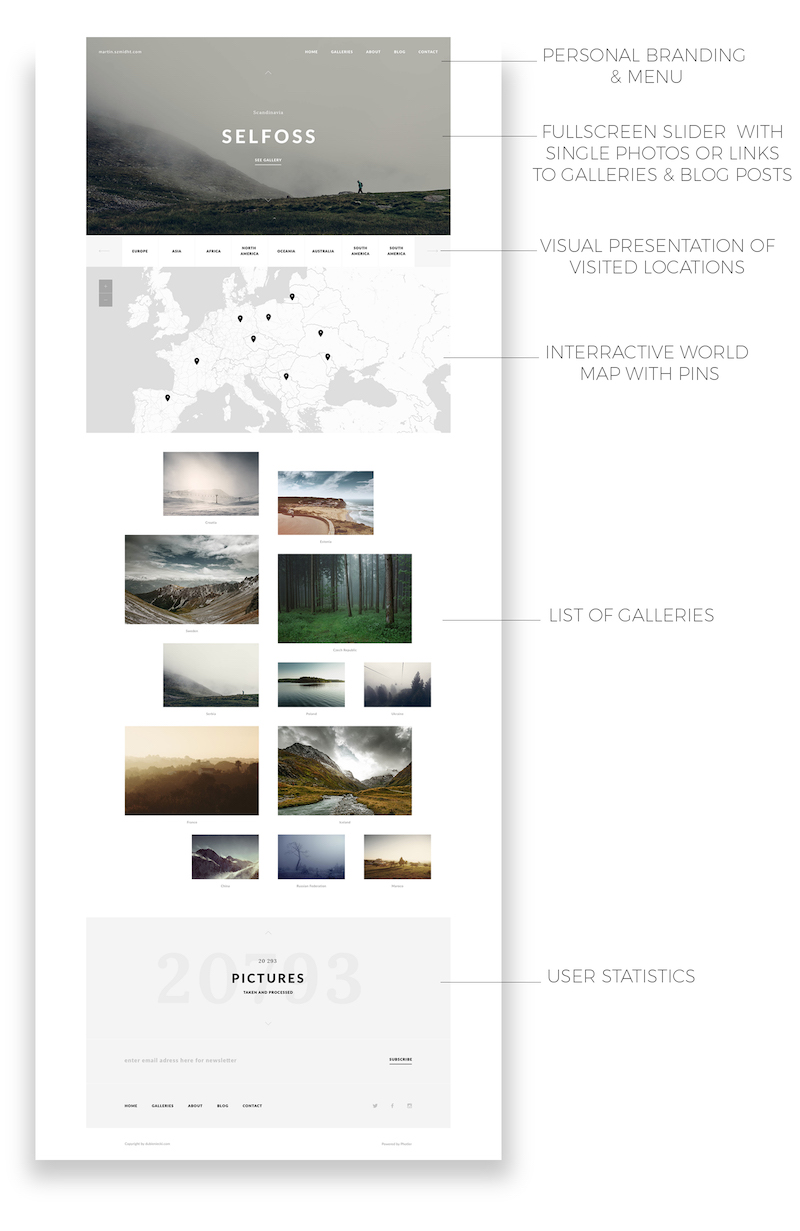
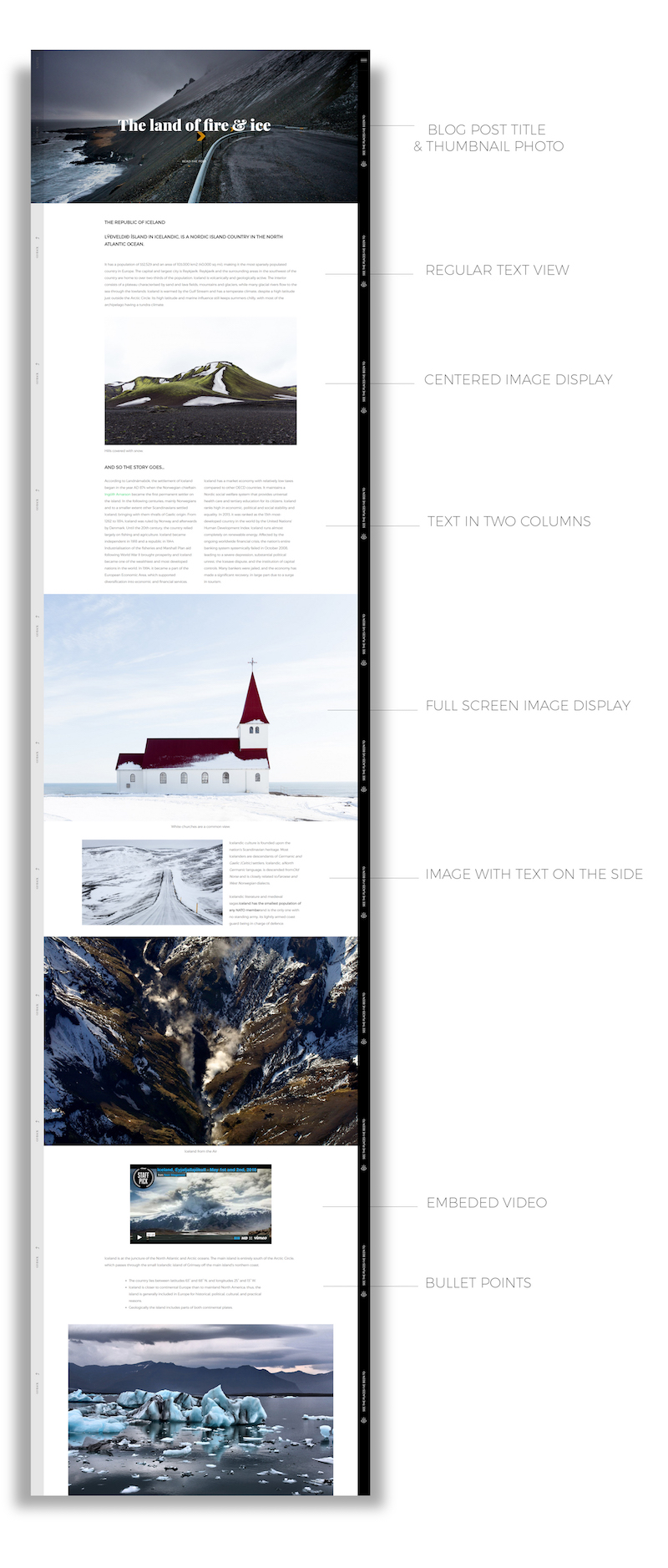


Photler does a lot of things right, and any misses can be attributed to age. The young portfolio site still only features 4 templates—#5 is almost out and #6 is in development—payment for photo sales is currently only available through PayPal, and customization options are a bit thin compared to, say, Squarespace.
Even still, travel photographers will be hard-pressed to find an online experience better tailored to their specific needs, or a team more dedicated to its small-but-passionate user base. That, too, is a result of being a young company without the millions of users others boast—they’re paying attention.

To find out more about Photler or give it a shot for yourself, head over to their website. All their plans offer a 14-day free trial so you can see what you’re getting into; after that, Basic, Standard, and Premium memberships with a variety of features differentiating them (see above) go for $3, $15, and $30 per month, respectively.
How to Build the Ultimate Movie and Music Server

If you’re like me, you’ve got hundreds of gigabytes of digital media files, everything from movies, to music, to TV shows, stored across portable hard drives, old laptops, and various PCs. Wouldn’t it be great if all of that media could live in one place and be able to be easily accessed by your other computers and…
The Most Effective Ways to End an Email So That You Get a Response

We all send and receive a deluge of emails every day and no one wants their messages to be ignored, but what’s the best way to end a message so that you actually get a reply? “Thanks,” “best wishes,” or something else?