Shared posts

22 Aug 18:31

How to Back Up and Restore Your Mac’s iTunes & Photos Library

by Dan Price
itunes-photos-backup-restore

Creating regular backups of your media should be an important aspect of basic computing hygiene for everyone. Oddly, for many people, backing up data isn’t something they take seriously until they’re the victim of a failed hard drive. Chances are if you’ve lost all your music, photos, and videos once, you’ll make sure it never happens again. If you use iTunes and Photos to manage your media, creating backups and restoring old data is a straightforward process. Don’t be the victim of data loss. Follow this guide to make sure your media is safe. Manual or Automatic? You can back...

Read the full article: How to Back Up and Restore Your Mac’s iTunes & Photos Library

22 Aug 18:27

How to Buy Great Suits on eBay for Nothing

by Jeffrey A. Tucker

Last week I picked up two suits, one from Brooks Brothers and one from Ralph Lauren, for $25 each. They are gorgeous and perfect. One required just $14 in tailoring, and that’s it. Otherwise the fit is flawless. The money I saved is now earning money in the crypto markets. I’ve been doing this for years. I don’t score every time but most times, the results are great. Here is how. 

22 Aug 18:21

Here's Why Your Brain Doesn't Want To Tackle Big Projects In The Afternoon

by David DiSalvo, Contributor
You know that brain fatigue that sets in around 2:00 p.m.? Brain science offers a way to explain the drain.
22 Aug 18:20

The Uncertain Future of North Ronaldsay's Seaweed-Eating Sheep

by Karen Gardiner

North Ronaldsay, the most northerly of Scotland’s Orkney Islands, shares several properties in common with the country’s other remote northern isles. There’s the Neolithic-era standing stone, for example, and the lighthouse built by members of the famed Stevenson engineering clan. But look out to the shoreline and you’ll spot something altogether more particular to this island. Small sheep—wrapped in thick fleeces of brown, black, white, and gray—nimbly pick their way across sand and wet rocks. As waves break close behind them, they pass basking seals and munch on seaweed, thick pieces of brown kelp trailing from their mouths.

A primitive breed, part of the North European short-tailed sheep group, and smaller than most modern breeds, North Ronaldsay sheep have evolved in isolation since their arrival on the island, possibly as far back as the Iron Age. There are currently around 3,000 on North Ronaldsay, grazing all along the coastline and eating seaweed at low tide. Aside from the Galapagos marine iguana, they are thought to be the only land animals able to survive solely on seaweed. This is not just a quirk, but the result of necessary evolution.

article-image

In 1832, the island’s laird, or landowner, cleared the land for more valuable cattle and crops. He banished the sheep to 271 acres of shoreline, encircled by a roughly 13-mile-long stone wall known as the sheepdyke. Left with no choice but to adapt to this new stark environment, the sheep survived by feeding on the abundant seaweed they found. They have remained on the sea-facing side of the dyke ever since, fattening up in winter when storms throw plentiful seaweed onto the shore.

Semi-feral, they roam freely but tend to keep to their own patch, or “clowjoung.” For a few days each summer, when the moon is full and high tides limit the space to which they can flee, the island’s sheep are rounded up to be shorn in an event called “punding.” Thought to be one of the last examples of community agriculture in the U.K., the punding sees the islanders help one another to chase their sheep off the shore and into the nine stone “punds,” or pens, dotted around the island.

article-image

Once thought to be a burden, the sheep are now crucial to all three main strands of North Ronaldsay’s economy: wool, meat, and tourism. Wool from their double-layered fleeces—coarse on the outside, fine and soft on the inside—is spun at the island’s mini mill and sold around the world as yarn or knitwear. Succulent North Ronaldsay mutton is considered a delicacy for its strong, gamey flavor, even making it onto the Queen’s plate at the start of her Diamond Jubilee tour. Tourism marketing for the island invariably mentions the "iconic seaweed-eating sheep." The animals are mutually dependent upon humans for their survival, as the U.K’s Rare Breeds Survival Trust lists them as “vulnerable.”

Sheep management is overseen by the Sheep Court. Established in 1839, the Sheep Court was made up of 11 elected crofters (small scale tenant farmers), known as “Sheepmen.” The Court is responsible for managing the grazing, deciding which bits of the dyke need to be rebuilt, and counting the sheep—every household on the island has a certain number they are allowed to keep.

article-image

Kevin Woodbridge, a crofter and councilor who arrived on North Ronaldsay in 1977 to work as the island’s doctor, says there is “a need for a revision of how the whole thing is managed.” The island’s dwindling human population—from 500 in the 19th century to around 50 today—means there aren’t enough people in each township to even nominate a Sheepman. In the early 2000s, the laird reconstituted the court so that simply everyone who kept sheep was a member. “But that’s dwindled and now less than 10 people actively keep sheep, and not all of them will come to the Sheep Court anyway.”

When he arrived, Woodbridge says, he was one of only three non-native islanders out of a total population of 160. Now native islanders are outnumbered by newcomers, some of whom have little interest in the sheep. Historically, says Woodbridge, the sheep “glue the island together” because people have to work communally during the punding. “Even though these sheep are individually owned, grazing and building the dyke has always been a communal activity.”

article-image

The dyke is critical to the survival of the breed. The sheep do eat some grass from time to time, but their bodies have so adapted to their seaweed diet that eating too much can cause copper poisoning (seaweed inhibits copper absorption). The dyke keeps them off the grassy fields inland and also prevents gene-pool pollution through crossbreeding with other types of sheep kept on the island. In-breeding, however, has not been a concern because fertile rams tend to cross the clowjoung boundaries to mate, according to Peter Titley, Secretary of the Orkney Sheep Foundation.

But this important piece of livestock infrastructure needs constant care. Winter storms batter the dyke yearly and so, historically, the islanders worked together to rebuild the parts that had been blown down. Now, as with the Sheep Court, depopulation is forcing a change to the system.

The island once had a pool of able-bodied people capable of undertaking the hard physical labor of rebuilding the dyke, but now there are only about half a dozen fit enough people left, “and some of them are in their eighties,” says Woodbridge. “The numbers are now so few that it’s difficult to maintain the old system. We need to find a new way of keeping it going forward.”

article-image

A solution of sorts has been found in the two-week-long North Ronaldsay Sheep Festival, which brings volunteers to the island to rebuild the dyke. The festival was launched in 2016 and, over the past two iterations, “more than half a mile has been re-built, from scratch, by the festival volunteers,” writes Kate Traill Price, one of the organizers and a descendant of the original laird who banished the sheep, in an email.

Some come for as little as a few hours or as long as both weeks, some with dyke-building experience but many with only an affection for the sheep. The festival coincides with punding so visitors have the opportunity to immerse themselves in the community by helping chase the sheep and clip them before enjoying more relaxed island activities, including traditional dancing.

article-image

“The festival is about celebrating the past and looking to the future,” writes Traill Price. But that future remains unclear. This summer, the island’s school lost its only student. Twelve year-old Teigan Scott is moving to secondary school on Orkney’s main island and so, with no other school-age children left, the school has been put on “standby.” Scott told the BBC she felt “sadness because the school will be closing and the island might fall apart" as it becomes more difficult to attract the young families the island needs.

If the island were to depopulate completely, a plan would need to be put in place to maintain the sheep. The island would become “some sort of reserve,” says Woodbridge, “where you have to employ people just to make sure the breed is maintained.” But, he says, “I can’t see that happening. There’s been people living on this island since prehistoric times and things have always gone up and down. It’s going to go up again.”

Regardless, if the festival, held in early August this year, is any indication, the future of the sheep is in committed hands. Volunteers from as far away as Vancouver made the long trip to spend up to six hours a day rebuilding the dyke in ever-changing weather patterns of rain, wind, and sun, their only reward the satisfaction of helping to conserve this very special breed.

22 Aug 18:20

Stossel: Government-Run Schools Crush Innovation [New at Reason]

by John Stossel

America's public schools fail our kids, and bureaucrats suffocate even the best teachers.

The late Andrew Coulson, a leading advocate of free-market education and a former senior fellow at the Cato Institute, partnered with the Free to Choose Network to create the recent PBS film School, Inc., which examines the problems with America's government-run schools and how to fix them.

But School, Inc. is three hours! So John Stossel made a two-part short-attention-span version. Part one of our abbreviated treatment explores why government-run schools are incapable of innovating, and retells the story of superstar teacher Jamie Escalante (made famous by the 1988 film Stand and Deliver), who was forced out by jealous colleagues.

In part two, which will run tomorrow, Coulson travels the world in search of ideas to fix America's public schools.

Coulson passed away in 2016 following a 15-month battle with brain cancer. For more on his contribution to the field, read his classic 1999 book, Market Education: The Unknown History.

Stossel on Reason

Watch above or click here for full text, links, and downloadable versions.

Subscribe to our YouTube channel.

Like us on Facebook.

Follow us on Twitter.

Subscribe to our podcast at iTunes.

View this article.

22 Aug 18:19

What To Do If You Win The Lottery

by Zack Friedman, Contributor
What should you do if you actually win the lottery? Here's your game plan in 7 steps.
22 Aug 16:52

Repairing Willie Nelson’s Trigger: A Good Look at How a Luthier Gets America’s Most Iconic Guitar on the Road Again

by Josh Jones

Many guitarists are of two minds about tribute models. In some cases, they seem like shameless cash grabs, particularly when the artist is no longer with us and can’t consent to the process. Fender’s “Jimi Hendrix Stratocaster” (registered trademark) is in no way, after all, Jimi Hendrix’s Stratocaster. His white Strat was a right-handed guitar he modified himself, turning it upside down to play as a lefty. Born of necessity, it was nonetheless a brilliant mechanical innovation that defined his sound. The mass-market version flips everything over on a left-handed guitar for the more numerous righty customers, undermining the purpose of the design, mass-producing Hendrix’s handmade alterations, and turning a one-of-a-kind historical artifact into a commodity.

Fellow lefty Kurt Cobain’s ingenious Jag-Stang—a mashup of Fender’s Mustang and Jaguar guitars—seems more legit, on the other hand, since Fender made prototypes for Cobain from a design he himself sent to the company (or rather from two Polaroids he taped together). There’s a proprietary relationship here between artist and guitar maker, a prior arrangement. We don’t see that relationship between another famous player and his guitar’s famous maker. Like Hendrix and Cobain and their Fenders, Willie Nelson has inspired generations of players to pick up Martin acoustics. But I very much doubt that Martin would ever produce a replica based on Trigger, Nelson’s stalwart classical ax, even if such a thing were possible.

That’s for the best. Trigger is and should remain an entirely unique object. It has an aura of its own, much of it emanating from a huge hole in the middle of the guitar. Like its owner, Trigger is weathered and worn, and instantly recognizable. It has been with Nelson since he restarted his career in Austin after his first bout of Nashville fame, and it represents Nelson’s transformation from traditional crooner into the outlaw troubadour who emerged in the early seventies to change the course of country music. (Read the story of the man and his guitar here.) To really appreciate Trigger's ragged mysteries, you don’t need to hear from Martin guitars, but from one of the instrument’s elite hostlers, so to speak. Respected luthier Mark Erlewine takes care of Trigger when it's at home in Austin and can explain, as he does in the video above, every one of the guitar’s peculiarities.

“There are a number of things wrong with it,” says Erlewine, “but they’re just minor repairs to keep it going.” As for that hole and the craters surrounding it, he seems unconcerned. Though it looks like it might cave in at any moment, Erlewine has kept it structurally sound. “Willie is not concerned about the looks of this guitar so much as the playability and functionality of it.” How did Trigger come to take on its distinctive wounds? Not in the way you might expect. Rather than a stage accident or tour mishap, the way these things can happen, Nelson’s guitar became damaged through the sheer passion of his fingerstyle playing. Over the years his fingernails would “often chip into the wood and pull out wood as he plays.”

In perfect condition when he bought it, Trigger has recorded in its beaten-up top the motor memories of “over 10,000 shows and recording sessions" in the deep impressions of only its owner's fingers and personality. There is no way to duplicate this phenomenon for mass consumption. Stick with the video, from guitar tool and parts giant Stewart-MacDonald, and see how Erlewine keeps Trigger healthy, "alive," and "shored up over the years."

via Uncrate

Related Content:

Willie Nelson and His Famous Guitar: The Tale of Trigger: Watch the Short Film Narrated by Woody Harrelson

Willie Nelson–Young, Clean-Shaven & Wearing a Suit–Sings Early Hits at the Grand Ole Opry (1962)

Mark Knopfler Gives a Short Masterclass on His Favorite Guitars & Guitar Sounds

Josh Jones is a writer and musician based in Durham, NC. Follow him at @jdmagness

Repairing Willie Nelson’s Trigger: A Good Look at How a Luthier Gets America’s Most Iconic Guitar on the Road Again is a post from: Open Culture. Follow us on Facebook, Twitter, and Google Plus, or get our Daily Email. And don't miss our big collections of Free Online Courses, Free Online Movies, Free eBooksFree Audio Books, Free Foreign Language Lessons, and MOOCs.

22 Aug 16:36

Herrera Bladeless Drone

Winner of a 2016 Red Dot Design Concept award, the Bladeless Drone from Mexico's Edgar Herrera takes on the two biggest problems with traditional drones: blades and the noise they...

Visit Uncrate for the full post.
22 Aug 16:33

NASA’s Best Photos of the Great American Eclipse

by Michael Zhang

Countless photographers tried their hands at capturing the Great American Eclipse yesterday, but leave it to NASA to nail some truly incredible shots. The agency has begun sharing some of its best work, giving us a different perspective of the awe-inspiring phenomenon.

The photos above and below show the moments of totality as seen from Idaho Falls, Idaho, and Madras, Oregon, respectively.

Photo by NASA/Aubrey Gemignani.

One amazing sight NASA photographers were able to capture was the International Space Station passing in front of the Sun as the eclipse was underway.

Photo by NASA/Bill Ingalls
Photo by NASA/Joel Kowsky

7 photos of the ISS transit were combined to create this beautiful composite image:

Photo by NASA/Joel Kowsky

Kowsky also shot the transit at 1,500 frames per second using a high-speed camera. Here’s the slow-motion video:

2017 Total Solar Eclipse

While photographers on Earth had their cameras pointed at the ISS, NASA was also shooting photos of the moon’s shadow covering the United States from the perspective of the space station:

NASA’s DSCOVR satellite captured this same shadow passing over Earth from 1 million miles away:

This 11-photo composite shows the progression of the eclipse as observed from Madras, Oregon:

Wide-angle composites were also used to beautifully capture this same progression across the sky:

Photo by NASA/Bill Ingalls
Photo by NASA/Aubrey Gemignani
This photo shows the last glimmers of sunlight as the moon heads toward totality. Photo by NASA/Aubrey Gemignani.

Finally, here’s what the total solar eclipse looked like from a jet flying at 25,000 feet above Oregon:

Photo by NASA/Carla Thomas

Image credits: Header photo by NASA/David Cantillo

22 Aug 16:32

The A-Z of Netflix: The Best TV Shows to Binge-Watch

by Mihir Patkar
netflix-az

Netflix is the best video streaming service around, especially if you prefer watching TV shows over movies. It has such a wide variety of content available, we saw fit to make an A-to-Z list of the best shows to binge-watch on Netflix.

All of these shows are available on Netflix USA, while most of them should be available worldwide. And if you can’t access them in your country, you can always watch Netflix through a VPN.

A is for Altered Carbon

  • Seasons: 2
  • Episode Runtime: 45-60 minutes
  • Genre: Science Fiction, Action, Thriller

Altered Carbon mixes a murder mystery with science fiction to make for compelling binge-watching. In the year 2384, anyone’s memories and consciousness can be transferred to a new body. To investigate his own death, a wealthy man in a new body recruits a rebel soldier. It’s a story full of twists and turns.

B Is for Black Mirror

  • Seasons: 5
  • Episode Runtime: 48-60 minutes
  • Genre: Science Fiction, Thriller

Charlie Brooker’s Black Mirror is a bleak look at how the gadgets you take for granted are shaping your present and future. Each episode is self-contained, with the common theme of looking at how science and technology affects society.

You don’t need to watch episodes in order, so you can start with the best Black Mirror episodes to mess with your head. Once you’re done with the series, watch the interactive movie, Black Mirror: Bandersnatch.

C Is for The Crown

  • Seasons: 3
  • Episode Runtime: 60 minutes
  • Genre: Drama, History, Period

Queen Elizabeth II has overseen some of the most tumultuous times in modern history. The Crown takes a deep look at how she came into power, the early years of her reign, and her relationships with important political figures of the 20th century.

The actors deliver stunning performances, with Claire Foy leading the first two seasons and Olivia Colman taking over from the third. John Lithgow is especially great as Sir Winston Churchill.

D Is for Daredevil

  • Seasons: 3
  • Episode Runtime: 52 minutes
  • Genre: Action, Superhero, Crime

It doesn’t matter whether you’re into comic book heroes or not. Daredevil is one of the best Marvel shows on Netflix. The world has gone gaga over the show’s breathtaking action scenes, and the acting performances by the villains.

Make sure you start watching this on a long weekend though, as you won’t be able to stop binge-watching it. Unfortunately, Netflix pulled the plug after the third season for corporate reasons, but it remains one of the best action shows you’ll watch.

E Is for Easy

  • Seasons: 3
  • Episode Runtime: 30 minutes
  • Genre: Comedy, Drama

Easy is one of the Netflix originals everyone should be watching. Set in Chicago, it tells the stories of different people in each episode, usually played by recognizable actors like Orlando Bloom, Emily Ratajkowski, and others.

Easy has finished its three-season run, so you can get through all the 25 episodes in one weekend. Easy is a slice of life comedy that will appeal to fans of shows such as Master of None.

F is for Fauda

  • Seasons: 3
  • Episode Runtime: 45 minutes
  • Genre: Action, Thriller

Israeli series Fauda is among the best TV shows on Netflix, earning critical acclaim across the world. The New York Times even voted it as the best international show of 2017. Fauda is set in the Israel-Palestine conflict, with Israeli counter-terrorist forces tracking down a mysterious Hamas terrorist.

With high production values, Fauda exposes the nuances of the conflict while being packed with action, drama, and politics. It’s hands-down one of the best foreign Netflix shows worth watching.

G Is for GLOW

  • Seasons: 3
  • Episode Runtime: 30-35 minutes
  • Genre: Comedy, Drama, Sport

In the 1980s, during the peak of the pro-wrestling culture, an ambitious entrepreneur launched the Glamorous Ladies Of Wrestling (G.L.O.W.). This is the story of the women of GLOW, told with panache, dollops of humor, and plenty of throwbacks to 80s glam culture. Alison Brie is incredible as the lead, ably supported by the rest of the cast. The show gets Emmy nominations every year, and wins the stunt coordination award.

H is for Hemlock Grove

  • Seasons: 3
  • Episode Runtime: 45-60 minutes
  • Genre: Horror, Fantasy, Mystery

The small town of Hemlock Grove is full of secrets: supernatural beasts, psychological and biological experiments, superpowered humans, and mysterious murders. Poor werewolf Peter must now uncover these secrets to clear his name, aided by his rich friend Roman. Hemlock Grove wrapped up its three seasons, so you can binge-watch it from start to finish.

I Is for Iron Fist

  • Seasons: 1
  • Episode Runtime: 60 minutes
  • Genre: Action, Superhero

Iron Fist is, in some ways, “Batman Lite”. The heir to a billion-dollar company returns after being missing for years, with mystical powers and insane kung-fu skills. He is “Iron Fist,” tasked with the solemn duty of stopping the evil forces of “The Hand”. This is another collaboration between Marvel and Netflix, so superhero geeks will have a good time with it.

J Is for Jessica Jones

  • Seasons: 3
  • Episode Runtime: 52 minutes
  • Genre: Drama, Action, Superhero

While Jessica Jones is also a part of the Marvel-Netflix franchise, it’s not only for those who like comic book characters. The show is far more nuanced, with plenty of commentary on feminist issues. Of course, there is also plenty of butt-kicking thrown in for good measure.

With its three seasons wrapped up, you can binge-watch the adventures of Krysten Ritter in the titular role with plenty of guest appearances from other Marvel characters.

K Is for The Kominsky Method

  • Seasons: 2
  • Episode Runtime: 22-30 minutes
  • Genre: Comedy

Michael Douglas and Alan Arkin star in this buddy comedy that anyone who wants a lighter, sitcom-ish show will enjoy. Douglas plays the titular Kominsky, a grouchy acting coach, with a grumpy best friend in Arkin, who is also his agent and a recent widower.

The show has an excellent star cast of supporting actors in Nancy Travis, Jane Seymour, Paul Reiser, Lisa Edelstein, and Sarah Baker. It’s perfect binge-watching for some light fun.

L Is for Last Chance U

  • Seasons: 4
  • Episode Runtime: Around 60 minutes
  • Genre: Sports, Reality, Drama

Last Chance U is like one of the typical American sports movies coming to life. A team of talented athletes, who come from challenging backgrounds, struggle with their academic performances. A tutor has to get them to graduate on time. The coach has temper issues.

Spread across four seasons with different cases, by the end of it you’ll start believing in the old adage that reality is stranger than fiction.

M Is for Making a Murderer

  • Seasons: 2
  • Episode Runtime: 60 minutes average
  • Genre: True Crime, Thriller, Documentary

This documentary series focused on Steven Avery is like no other. Wrongly imprisoned for a crime, Avery finally got justice when DNA testing proved his innocence. But just as he celebrated his freedom, a new case was filed against him, and it seems like the authorities don’t want him free. Is the evidence against him real or planted?

Critics and fans laud Making a Murderer as one of the best true crime documentaries on Netflix.

N Is for Narcos

  • Seasons: 3
  • Episode Runtime: 50 minutes average
  • Genre: Crime, Biography, Drama

Colombia is notorious for its cocaine exports, and drug lord Pablo Escobar was the kingpin. Narcos is a recreation of his infamous lifestyle and control over the country, and how American and Colombian forces took him down. It’s a gripping series for anyone who loves crime dramas. And once you’re done with it, watch the Narcos: Mexico spin-off about the drug trafficking world of Mexico.

O Is for Orange Is the New Black

  • Seasons: 7
  • Episode Runtime: 52-60 minutes
  • Genre: Crime, Comedy, Drama

Piper Chapman, just another New Yorker, is convicted of an old crime and sentenced to 18 months in prison. Orange Is the New Black is a look inside women’s prisons, and the trials and tribulations of an outsider trying to adjust. That’s just the first season though; Chapman adjusts by season two, and the series then takes new twists and turns. Look out for “Crazy Eyes” Warren, the show-stealer.

P Is for The Punisher

  • Seasons: 2
  • Episode Runtime: Around 50 minutes
  • Genre: Action, Thriller

After his debut in the Daredevil series, Frank Castle AKA The Punisher quickly became a fan favorite and got his own show. Jon Bernthal stars as The Punisher who is here to take out bad guys without any mercy. It received particular praise for its portrayal of PTSD and war veterans, a recurring theme in the grimy action-thriller series.

Q for Queen Sono

  • Seasons: 1
  • Episode Runtime: 30-45 minutes
  • Genre: Action, Spy, Thriller

Are you looking for a good ol’ action-packed spy thriller? Queen Sono doesn’t reinvent the wheel, but instead gives it a new world. Set in Africa, the titular spy played by Pearl Thusi is full of attitude, action, and allure.

She and her geeky partner, both spies in a South African firm, will do what they can to rid the continent of violence. And behind it all, Queen Sono is out to find the person who killed her mother.

R Is for Riverdale

  • Seasons: 4
  • Episode Runtime: 42 minutes
  • Genre: Drama, Young Adult, Mystery

Archie Andrews and the gang are back in this new take on the lives of the teenagers from the famous comic books. Apart from getting a 21st century makeover, Riverdale is also dark and gritty, unraveling a murder mystery in this small town. There are some consistent mature themes throughout this series, so it’s not exactly kid-friendly like the comics.

S Is for Stranger Things

  • Seasons: 1
  • Episode Runtime: 50 minutes
  • Genre: Fantasy, Horror

Set in 1983, Stranger Things takes you back to an innocent time, reminiscent of how Steven Spielberg’s E.T. did. One among a group of 12-year-old friends goes missing, and his buddies will do anything to rescue him.

Enter a world of supernatural monsters and experimental mad scientists, as Stranger Things takes you on the ride of your life. And once you’ve finished it, here are some other shows for fans of Stranger Things.

T Is for Trailer Park Boys

  • Seasons: 23-30 mins
  • Episode Runtime: 50 minutes
  • Genre: Comedy

Originally a TV series, Trailer Park Boys was saved by the internet and now resides on Netflix. Set in a fictional trailer park, the show follows the lives of three pals who frequently find themselves on the wrong side of the law. It’s an endless cycle of one scheme after another, but somehow it never gets old. Once you finish the series, check out the three mini-movies and the animated series.

U Is for Unbreakable Kimmy Schmidt

  • Seasons: 4
  • Episode Runtime: 25 minutes
  • Genre: Comedy

Kimmy Schmidt was held captive for 15 years in a bunker, conned into thinking the world had ended. Finally freed at 29-years-old, she is now trying to adjust to life in the 21st century, with her actor roommate and socialite employer. Created by 30 Rock’s Tina Fey, Unbreakable Kimmy Schmidt has finished its four season run so you can binge it from start to end.

V Is for Versailles

  • Seasons: 3
  • Episode Runtime: 52 minutes
  • Genre: Drama, History

King Louis XIV, the king of France in 1667, decided to make the grandest mansion in the world. But while the Palace of Versailles is a historical landmark today, there were a lot of complications that went into building it. As noble families had to adjust to rural life, politics, intrigue, and drama weren’t too far away. Revisit this fascinating history through the now-finished series.

W Is for The Witcher

  • Seasons: 1
  • Episode Runtime: 47-67 minutes
  • Genre: Fantasy, Action

Henry Cavill stars as Geralt of Rivia in a Netflix adaptation of the popular book and video game series. The Witcher is a “monster of the week” show with high production values and inspired action sequences. This is a show for mature viewers only, with unabashed gore, strong language, and nudity. Catch up on the first season now, with the second season slated to release in 2021.

Y Is for You

  • Seasons: 2
  • Episode Runtime: 45 minutes
  • Genre: Psychological Thriller

Bookstore manager Joe Goldberg becomes obsessed with a customer, writer Guinevere Beck. In an exposition of how little privacy we have, You shows how Goldberg feeds his obsession by using technology to stalk Beck and get close to her. If you want to see how your gadgets can lead to a slow unraveling of your identity, while following a thriller storyline, You is for you.

Z Is for Z Nation

  • Seasons: 5
  • Episode Runtime: 42 minutes
  • Genre: Action, Horror, Drama

A zombie virus has spread across America, and only one man has survived being bitten by a zombie. The man is in New York, and he needs to make his way to the last functional lab in California to help them create a cure with his sample. The remaining uninfected humans across the U.S. must help mankind’s last hope travel across the country, through hordes of zombies.

The five-season series has wrapped up, so get ready for a zombie-hunting binge-watch.

Binge-Watching Beyond Netflix

As you may have noticed, X is missing from our A-Z list of shows to binge-watch on Netflix. Simply because we couldn’t find a show worth recommending. However, if you know of one, feel free to recommend it in the comments below.

And remember, Netflix isn’t the only streaming service in town. An Amazon Prime subscription comes with Prime Video, and Disney+ is the hottest new streaming app on the market. All of which provide ample opportunity to binge-watch TV shows.

For more recommendations, check out our list of the best TV shows to binge-watch across streaming services.

Read the full article: The A-Z of Netflix: The Best TV Shows to Binge-Watch

22 Aug 16:32

Why Dressing Nicely for a Flight Is Worth the Effort

by Patrick Allan

When you’re suffering through a long flight in cramped seats the last thing you probably want is to be dressed to the nines, but skipping out on those pajama pants and tank tops does have its advantages. You might even get a better seat.

Read more...

22 Aug 16:31

Are We Living In the Good Old Days?

by Bret Wonnacott
Nostalgia tends to paint the past in bright colors, but were the 1950s really better for Idaho bird hunting than the present day?
22 Aug 15:41

The Fitz Sandwich

The Fitz Sandwich
Not too many recipes actually call for multiple episodes of Frasier, but there's a first time for everything. For his latest video, Binging with Babish's Andrew Rea re-creates the Fitz...

Visit Uncrate for the full post.
22 Aug 12:29

Get Over Analysis Paralysis By Asking Yourself These 15 Questions

by Forbes Coaches Council, CommunityVoice
Answering these questions should give you clarity about what you are trying to achieve.
22 Aug 11:54

This Is How Much It Costs Every Time You Use Your Turn Signals

by Jason Torchinsky on Jalopnik, shared by Virginia K. Smith to Lifehacker

It’s always been a goal of mine to make Jalopnik the best source for turn indicator-related information and commentary on the internet. That’s why I’m both so impressed at the work that went into this video and a bit ashamed it didn’t occur to me to think this through. Finally, someone has done the math to show…

Read more...

18 Aug 13:57

Popular Hack Used by Whisky Snobs Actually Works, Says Science

by Rae Paoletta on Gizmodo, shared by Virginia K. Smith to Lifehacker

There are plenty of people who enjoy the warm sadness cowboy drink known as whiskey. While some might have a John Wayne instinct to drink it neat, the real aficionados know that adding a few drops of water to the drink can improve and expand its flavor profile. Now, in the great whiskey war of whether or not one…

Read more...

18 Aug 13:54

Scientists Discovered Helium During A Total Solar Eclipse

by K.N. Smith, Contributor
Helium is named after Helios, the Greek name for the Sun, because scientists discovered the element thanks to a total solar eclipse.
18 Aug 13:51

Do You Copy?

by Ernie Smith
Do You Copy?

Today in Tedium: It seems so quaint now, but there was a time when the walkie-talkie was the coolest possible toy you could own (barring, perhaps, Power Wheels). But the invention of the walkie-talkie, which is often used by consumers as either a fun tool or a simple communications device, is a great reminder that this technology used to be so much more fundamental for both businesses and the military. Sure, your phone probably usurped your need for one, but it still maintains both a kitsch value and a niche value into the present day. And in a lot of ways, the modern mobile phone wouldn’t exist without it. Today’s Tedium explains how. 10-4, good reader. — Ernie @ Tedium

Do You Copy?

Struggling to keep up with the tsunami of tech news? Need to improve your signal to noise ratio? One email a day, five must read tech news stories, sent in time for your commute home. Stay in the loop without burning all your free time. Read the first two weeks for free.

Today's issue is sponsored by The Sizzle. (You can support us, too.)

“[O]nly the bounds of human imagination will place a limit on the usefulness of the ‘walkie-talkie.’ Its value will prove incalculable in reaching physicians while en route in automobiles to patients’ homes, in providing contact for hunters with a central lodge, in directing delivery trucks while they are in transit. All these services and many more are assuredly going to make life both more efficient, enjoyable and in many instances downright fun.”

New York Times writer Jack Gould, describing the excitement around walkie-talkie rulemaking on the part of the Federal Communications Commission around 1945, at the tail end of World War II. Much like drone technology in recent years, the interest in walkie-talkies was such that the public was outpacing federal regulators, leading to situations where consumers would purchase and use the devices well before regulations were fully set.

Do You Copy?

A signaler with the SCR-536 walkie talkie, the first hand-held model. (Wikimedia Commons)

The walkie-talkie has its roots in World War II

Early on, radio technology was an area full of excitement, as inventors would come up with novel uses for the airwaves that would create new ways of thinking about how people interacted. (Of course, a lot of behind-the-scenes lobbying for spectrum followed.)

The portable two-way radio, eventually known as the walkie-talkie, was the perfect example of this in action. Before the cell phone, it changed the dynamic of communication into something where you could talk to someone a long distance away while still having the flexibility of mobility.

And it had its original moment in the sun around World War II. That we know for sure. More complicated is the question of who invented it—with credit being given to both individual inventors, Galvin Manufacturing Corporation (later known as Motorola), and the U.S. Army, which popularized it among an audience of soldiers who used it to communicate in the field.

It was an idea that a lot of people had around the same time, and all added their own twist on the equation.

The person with the strongest case for inventing the walkie talkie, though, is perhaps Donald L. Hings, an employee of a Canadian mining company who came up with the device as a way to help workers in remote areas communicate with one another. (He didn’t come up with the walkie-talkie term, instead calling it a “pack set.”)

A website dedicated to Donald Hings’ memory suggests that there were examples of Hings’ invention in use as early as 1937, predating a similar invention by Canadian-American inventor Al Gross, who built his own ham radio in the early 1930s, but expressed a desire to create a portable version—which he successfully built in 1938, soon handing his idea to the U.S. military.

“Without taking anything away from Gross’ accomplishment, Hings' CM&S field radios were already in production at that time,” the Hings website states.

(Gross also invented the pager and wireless phone, so even if he wasn’t the outright inventor, he has other claims to success.)

Galvin Manufacturing, which had made its claim to fame a few years earlier with the invention of the car radio (known, of course, as the Motorola), created two notable innovations in the legacy of the two-way radio, first inventing the self-contained SCR-536 “handie-talkie” in 1940, and then creating an FM-band two-way radio technologies—first showing up in police cars in 1941 and on the battlefield in 1943. (It wasn’t self-contained, it should be noted, as its apparatus was 35 pounds and contained in a backpack.)

Do You Copy?

(Pixabay)

But no matter who invented the device, it was pretty clear that it was a bit of a game-changer.

A 1943 Toronto Star article describes the military advantage as such:

To infantrymen the walkie-talkie is like giving a football team a quarterback. Before the walkie-talkie, battalions in today's swift moving warfare, often would be like a football team without a signals-calling quarterback because of inadequate or broken down communication lines.

Today with the walkie-talkie, battalion headquarters can direct units over wide stretches of battlefront the way a quarterback sends his team plunging into action, and in addition the headquarters will know all the time what is developing in each area of operations.

The sheer existence of the walkie-talkie in the 1940s likely saved a whole lot of lives. But it’s the civilian world where walkie-talkies really had a chance to shine.

1977

The year that the Federal Communications Commission formally moved the official frequency for unlicensed “toy” walkie talkies from 27 MHz to 49 MHz. The idea behind the move, which had been bandied about as early as 1967, was because the low-powered walkie talkies were getting “clobbered” by the more powerful Citizens Band radio, according to a 1977 Popular Electronics report.

Do You Copy?

The Motorola i570, a notable Nextel phone. (Varias Personas/Flickr)

The quiet-but-important role that walkie-talkie communication played in the wireless revolution

If you subscribed to Nextel back in the day, you probably remember what their killer feature was on their old phones. It’s hard to forget, really.

Basically, Nextel phones, generally produced by Motorola, had this function where you could press a button and use it as a walkie talkie for your group of friends or co-workers. At a time when everyone else had a dumb phone, push-to-talk was a pretty novel feature, and it was particularly effective for logistical purposes compared to text messages or phone calls. But in the time of smartphones, it fell on the back-burner—in no small part due to Sprint’s 2005 acquisition of Nextel, a $35 billion buyout which has been described as one of the worst-ever acquisitions.

The fun part about this is that the feature actually was what the entire company was built around in the late ‘80s and early ‘90s. The company’s roots were not with mobile phones, as it turns out, but taxi and trucking fleets. And this is reflected by Nextel’s awesomely awkward original name, Fleet Call. That’s right. Friggin’ Fleet Call.

Now Fleet Call (which, again, is an awesomely cheesy name), took advantage of specialized mobile radio (SMR), a wireless technology that had been allocated by the Federal Communications Commission in the 1970s for the purposes of two-way radio systems. At the time of its 1987 formation, Fleet Call worked to acquire many of the niche players that had been built around this technology at the time, which were mostly working on analog systems.

During the early years, the company spent time putting together the chess pieces and working with the FCC to allow it to expand the technology’s reach. And starting in 1991, it teamed with Motorola on a digital variation of SMR that could hold more bandwidth. The technology, originally called Motorola Integrated Radio System, would allow six times the number of users on a single part of the bandwidth compared to the analog version of SMR.

In other words, Motorola and Fleet Call had figured out a way to replace an analog radio protocol with a mobile phone protocol, and Fleet Call was well-positioned to take advantage of the market shift. The company was buying out competitors left and right for pennies on the dollar compared to the acquisitions that comparable cellular companies had to make to build out their networks, and this made the company a stock market darling in the early ‘90s.

"Two years from now we're talking about Fleet Call as the MCI of mobile communications," stock analyst John L. Bauer told The New York Times in 1993.

Basically, the only thing that needed to change was the company’s name. In 1993, Fleet Call planned to launch a mobile phone service that August in Los Angeles under the name Nextel, and soon changed its name to reflect the shift. Also around this time, the FCC changed its rules, allowing companies to be licensed nationally to use the spectrum, rather than regionally.

By leveraging a mobile technology that had been seen as less attractive compared to cellular phones and reinventing it, Nextel had earned a huge leg-up when it entered the market and launched its iDEN mobile network—and it did so, of course, with a killer feature no other mobile phone had. The only downside, and one that took a little while to solve, was the fact that phones with the walkie-talkie-style push-to-talk technology cost a little more at first.

As YouTuber (and former Nextel employee) Michael “MrMobile” Fisher noted earlier this year, Nextel fostered an interesting reputation among mobile companies, using its ties to the original fleet technology to sell itself as a business-oriented company that didn’t care so much about games on phones.

But there were problems with this setup that appeared over time—particularly with emergency systems that greatly relied on the same 800 MHz frequency that Nextel’s cellular functionality did. A 2004 Firehouse piece noted that more than 1,000 reports of interference with police, fire, and ambulance systems had been reported due to the Nextel system’s close proximity to the public services.

“The co-location of commercial wireless vendors and public safety radio systems within the 800 MHz radio spectrum is where the problem begins,” the article noted. “Often the two systems frequencies are too closely positioned within the 800 MHz radio spectrum. Unfortunately, there is no where to move public safety radio frequencies as the spectrum available to public safety has been exhausted.”

This caused a lot of problems for SprintNextel, which had to figure out a way to move its spectrum to a completely different part of the 800MHz spectrum, closer to the 900MHz section, another portion of the spectrum allocated to iDEN. It cost the company billions, but they eventually pulled it off. (That spectrum is now a key element of the company’s LTE service, as the iDEN network was shut down in 2013.)

Push to talk phones still exist, but they’ve become extremely niche. It’s worth pondering whether walkie-talkie phones would still be popular had the Sprint/Nextel merger never happened.

Recently, Mark Cuban turned some heads when it was announced that he was trying to buy the Broadcast.com domain back, 18 years after he sold the domain—and a large company—to Yahoo! for $5.7 billion dollars.

The co-founders of Nextel, in a lot of ways, did exactly the same thing three years ago. Under the corporate umbrella of Pacific DataVision, the co-founders of what was one of the largest mobile providers in the country bought out all of Sprint’s 900 MHz spectrum in 2014, which they then used to launch a new push-to-talk radio platform, which is now known as pdvWireless.

The technology is basically the modern-day form of the technology they were selling to taxi operators and municipalities nearly 30 years ago, except without the desire of pretending to be a cell-phone network. (It does have smartphone support, however.)

In some ways, though, the true lineage of the walkie-talkie is phone, not the walkie-talkie proper. It’s the basic idea Donald L. Hings and Al Gross had generations ago, except on steroids.

Of course, maybe some of the personal conventions of using a walkie talkie are a bit convoluted compared to how we use our phones, but at the same time, they have charm that no emoji could recreate.

Case in point: Over and out.

17 Aug 17:47

Action Bronson's Special Chicken Parm

Action Bronson's Special Chicken Parm
Action Bronson has a new cookbook out called, appropriately enough, F*ck, That's Delicious. To mark the occasion, Action went to the Munchies test kitchen to share his unique take on...

Visit Uncrate for the full post.
17 Aug 17:46

Here's the last Dodge Viper

by John Beltz Snyder

Filed under: Plants/Manufacturing,Dodge,Automotive History,Coupe,Performance,Supercars

The company will keep the final car for its heritage collection.

Continue reading Here's the last Dodge Viper

Here's the last Dodge Viper originally appeared on Autoblog on Thu, 17 Aug 2017 10:20:00 EDT. Please see our terms for use of feeds.

Permalink |  Email this |  Comments
17 Aug 17:40

Henry Ford's 33' classic boat Evangeline is for sale in Monterey

by Greg Rasa

Filed under: Etc.,Ford,Auctions

The woman for whom it is named sounds even more interesting than the boat.

Continue reading Henry Ford's 33' classic boat Evangeline is for sale in Monterey

Henry Ford's 33' classic boat Evangeline is for sale in Monterey originally appeared on Autoblog on Thu, 17 Aug 2017 11:55:00 EDT. Please see our terms for use of feeds.

Permalink |  Email this |  Comments
17 Aug 16:27

When you have making money skills over 9999

17 Aug 16:23

When Hippies Used Snickers As Currency

The emergence of “Snickers-money,” within the hippie "Rainbow Gathering" movement is ironic and perhaps comical given it clashes with the anti-commercial goals of the group’s founding ideology.

17 Aug 07:00

Pork Carnitas Tacos with Salsa Fresca

by Monica Michael Willis
“In Rhode Island, we’ve got the best of everything right at our doorstep come summer,” says Jake Rojas, chef-owner of Tallulah’s Taqueria in Providence.So for this seaside dinner, hosted by Walrus and Carpenter in July 2016, he sourced nearly every ingredient from producers within a 50-mile radius. Yet the resulting menu hopscotches the globe, incorporating Southeast Asian and Argentine influences—not to mention Rojas’ own Mexican roots. Turns out big flavors pair perfectly with the bounty of the country’s smallest state. Read more about Rojas’ ocean-to-table dinner at Rhode Island’s Walrus and Carpenter in “On Ninigret Pond” from the Summer 2017 issue of Modern Farmer. And don’t miss his other recipes, either! Pork Carnitas Tacos with Salsa Fresca At the Walrus and Carpenter dinner, Rojas grilled whole pig heads from Blackbird Farm in Smith eld, then shredded the tender cheek meat. “Tacos enable me to utilize every part—nose to tail—of the animals we buy from farmers,” says the chef. This simpler stovetop variation substitutes pork shoulder and belly. 5 tablespoons olive oil (plus more for grilling avocados)3 pounds boneless pork shoulder (cut into 2-inch cubes)1 pound pork belly (cut into 2-inch cubes)1 large yellow onion (chopped (about 2 cups))6 dried guajillo chiles (stems removed 8 cloves garlic, chopped
3 tablespoons kosher salt
2 teaspoons dried Mexican oregano)2 bay leaves3 avocados (halved, pitted, and peeled 
18–24 corn tortillas (6-inch round), warmed)1 medium yellow onion (minced (about 1 cup), for garnish)1 bunch fresh cilantro (stems removed and chopped (about 11⁄2 cups), for garnish)3–4 limes (cut into wedges, for serving)Salsa Fresca (recipe linked below)Heat 3 tablespoons oil in a large pot over medium heat. Sear pork shoulder and belly in batches, adding remaining 2 tablespoons oil as needed, until all cubes are browned on
all sides. Remove from oil with a slotted spoon and reserve.Drain all but 2 tablespoons fat from pot into a heatproof bowl and reserve. Return same pot to medium heat; add chopped onion, chiles, and garlic and sauté until fragrant, 4 to 5 minutes. Return reserved pork to pot and add salt, oregano, and bay leaves. Add enough water to cover pork mixture by
1 inch and bring to a boil. Reduce heat to low and simmer until meat is fork tender, about 11⁄2 hours, adding more water to cover as needed, and skimming off any scum that forms
on surface. Drain water from pot and discard bay leaves.
Add a few tablespoons of the reserved fat and raise heat to high, allowing pork to sear until crispy and browned, about
5 minutes. When pork is cool enough to handle, use two forks to gently pull the meat apart. Set aside.Heat a grill to medium-high heat and lightly oil grates (or heat a grill pan over medium-high heat and lightly oil it). Grill avocados at side down until char marks form, 2 to 3 minutes. Transfer to a cutting board and cut each half lengthwise into 6 slices.To assemble, divide reserved pork and avocados evenly among tortillas. Top each with a sprinkle of minced onion and cilantro and a spoonful of Salsa Fresca. Serve immediately with any remaining salsa and lime wedges on the side.The post Pork Carnitas Tacos with Salsa Fresca appeared first on Modern Farmer.
16 Aug 17:39

The Hollow Steel Ball That Changed Ocean Exploration Forever

by Lida Tunesi
article-image

In the spring of 1930, a group of scientists and artists sailed to a tropical island called Nonsuch in Bermuda. They awaited a submersible called the “bathysphere,” which would bring the team of men and women deeper into the ocean than humans had ever gone before and permit the first studies of deep-sea creatures in their natural waters.

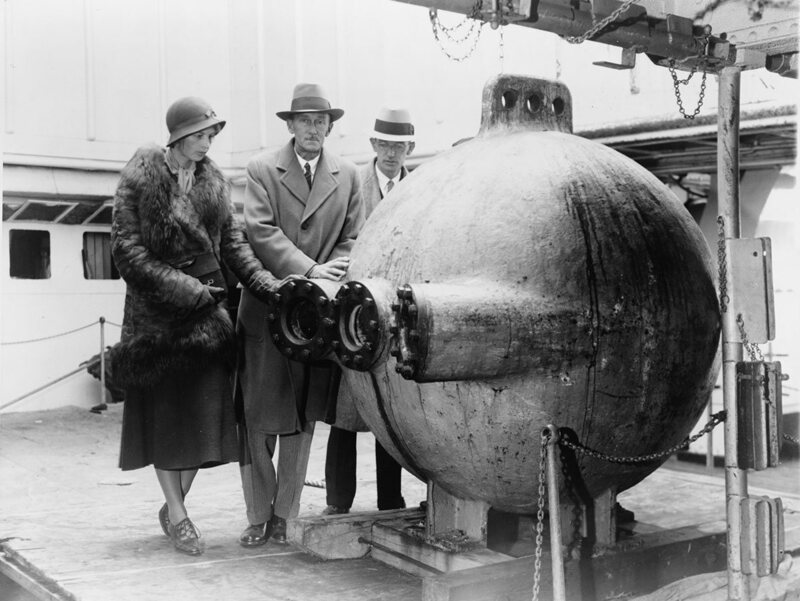
The bathysphere—“bathy” meaning “deep” in Greek—was a hollow, steel ball less than five feet in diameter with three small windows and a steel cable to tether it to a ship. Engineer Otis Barton and boat architect John Butler designed it for an expedition led by William Beebe, a naturalist with the New York Zoological Society’s Department of Tropical Research. The record human aquatic descent at the time was a mere 525 feet and Beebe wanted to see what life was hidden further beneath the waves.

In May, the completed bathysphere arrived at the research station. After several unmanned test dives and a short, manned descent to 45 feet, it was deemed ready for a plunge.

article-image

On June 6, a tug towed a barge bearing the sphere out to sea. Beebe and Barton wriggled through the pod’s 14-inch opening, arranged themselves on the cold, curved floor, and the crew tightened the lid. As reported in Descent by Brad Matsen, oxygen flowed from two tanks, trays of soda lime and calcium chloride absorbed exhaled carbon dioxide and moisture, and the men waved palm leaf fans about for circulation.

Slowly the crew cranked the winch to raise the bathysphere up, over the ship’s deck, and down into the cerulean sea. Gloria Hollister, the chief technical associate for the Department of Tropical Research, stood on deck with a telephone in her hand. She served as the passengers’ only line of communication to the world above—copying down Beebe’s every observation, relaying their depth, and passing on orders to raise or lower the sphere—via a telephone line clamped to the steel cord.

Down the bathysphere sank. Fanged and bioluminescent animals swam before the window. The blue ocean light was a strangely brilliant hue that the English language could not account for, Beebe wrote in his account of the expedition, entitled Half Mile Down. He and Barton were witnessing the gradual disappearance of each color in the rainbow as they were absorbed by the water above, an optical effect that produced nameless shades. They stopped at 803 feet that day, getting a glimpse of a previously secret realm.

article-image

As summer rolled on the crew made more descents and meticulously recorded each lanternfish, eel larva, and sea sapphire that floated past the pod. The world’s knowledge of deep-sea fish came mostly from the practice of dragging nets through the water, but some fish could escape the nets and others exploded as the pressure dropped on the way up, leaving scientists with an imperfect picture of what lay below. Now they watched the creatures in their homes and were surprised to find that large fish could exist under the crushing pressure of deep water.

After dives, nature artist Else Bostelmann took to her studio on Nonsuch and transformed Hollister’s notes and Beebe’s recollections of the animals into paintings. Her technical illustrations would be the primary visual documentation of the work in Bermuda, and would appear alongside Beebe’s words in National Geographic Magazine in 1931 and 1934.

Though she painted much of what floated past the bathysphere’s windows, the “greatest fun,” Bostelmann said, “was actually to paint at the bottom of the ocean.” Some days Bostelmann donned a copper diving helmet with air hose attached, climbed down a ladder into the sea, and had her canvas and oil paints, which wouldn’t mix with the water, sent down after. Standing in sandy clearings under the waves Bostelmann painted “tall coral reefs, swaying sea-plumes, slender gorgonians, purple sea-fans”—what she called her own underwater “fairyland.”

article-image

In July another female researcher, named Jocelyn Crane, arrived fresh from college graduation. Critics chastised Beebe for hiring women in science, calling him “unprofessional. ” Beebe responded that he hired based on “what’s above the ears” and that he had chosen Crane and Hollister for their “sound ideas for scientific research.” Hollister and Crane continued to study sea creatures and dive in the bathysphere, and Bostelmann continued to paint in spite of these criticisms.

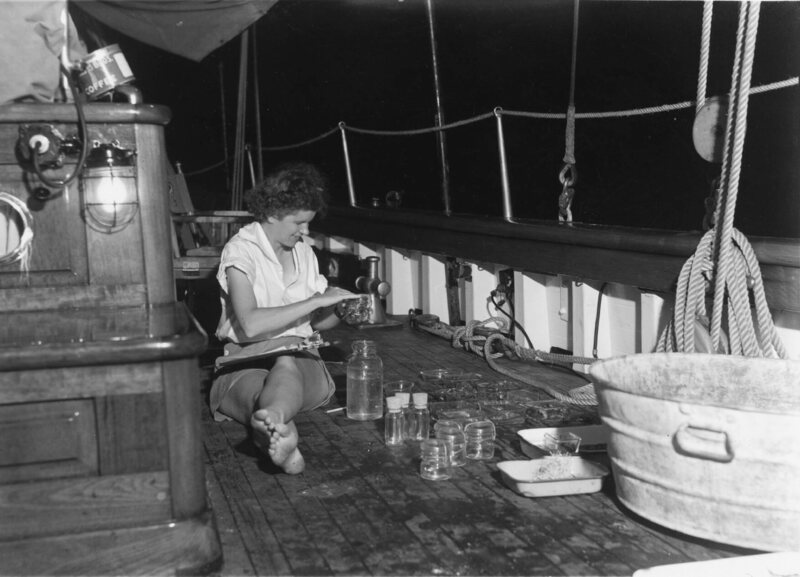
On days the sphere didn’t descend, the team studied dredged fish in the lab. Hollister often used her own system of chemical baths, dyes, and ultraviolet light, to decolor fish organs until they became translucent. This revealed the red-stained skeleton and allowed her to study tail structures.

The team left the tropics in autumn and when the following summer came, bad weather and a broken winch prevented the bathysphere from diving, though other research continued.

article-image

The sphere dove again into the world of languid siphonophores and flying snails in 1932, and on one descent, the National Broadcasting Company invited all of America into the deep sea, transmitting right from Hollister’s phone line. On another eventful dive Beebe reported two six-foot fish he did not recognize. They resembled barracudas, he wrote, but with bioluminescent lights down their side and two long tentacles, each with lights on the end. Beebe dubbed the creature Bathysphaera intacta—the untouchable bathysphere fish—but it was eventually reclassified as a new species of dragonfish.

The bathysphere did not always lend itself to glamorous discovery. Dives were thwarted by bad weather and a roiling ocean. More than once the sphere came up full of water, releasing jets of dangerously pressurized water. When, on one occasion, the telephone line up to Hollister failed, Beebe described a feeling of sudden, true isolation, “as if hose, cable, and all had gone. We had become veritable plankton.”

After exhibiting at the 1933 Chicago World’s Fair, the bathysphere returned to Bermuda in 1934. That summer, Hollister set a women’s world record during a dive to 1,208 feet. On August 15, 1934, Beebe and Barton sat in the cramped steel sphere 3,028 feet below sea level. They rested about a tenth of the distance underwater that Mount Everest towers above sea level. Beebe described the region as akin to “naked space itself, out far beyond atmosphere, between the stars.” They peered out at an unfamiliar fish, about 20 feet long, that the Chicago Tribune described as “illuminated by myriads of tiny lights glittering like a diamond tiara.”

article-image

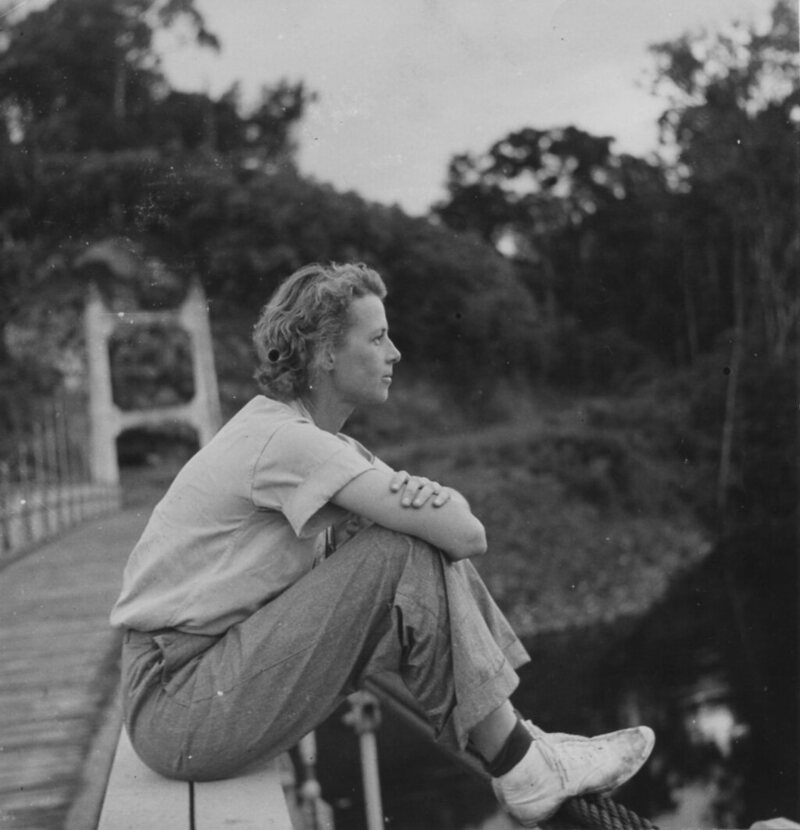
Submerged excursions proved too expensive to continue past 1934 given the sad state of the U.S. economy. Hollister took off to lead scientific treks in the jungles of British Guiana (now Guyana), while Bostelmann illustrated children’s books and painted for National Geographic. Crane and Beebe continued to work together and she took over as Director of the Department of Tropical Research when Beebe passed away. Barton the engineer turned to filmmaking with Titans of the Deep, a flop of a film that combined footage taken in Bermuda with invented drama.

The bathysphere itself now sits on display at the New York Aquarium while remotely operated submersibles like the Deep Discoverer descend almost four miles into watery darkness. The Alvin can carry passengers down nearly three miles, untethered. But before them came a little steel sphere in Bermuda, the submersible that carried science into a new domain.

16 Aug 17:37

Why Northern Long-Eared Bats Love Nantucket

by Cara Giaimo
article-image

Like many of her neighbors, Danielle O'Dell of Nantucket, Massachusetts, has some strong opinions about local architecture. As more and more people discover the island, old houses keep coming down to make room for the new. O'Dell has watched dozens of homey little cottages, their shingles gray with age, get replaced by fresh-built summer mansions, and she doesn't necessarily like it.

Unlike many of her neighbors, though, O'Dell's concerns aren't driven by aesthetics, or an attachment to history. As a biologist with the Nantucket Conservation Foundation, she spotlights one thing about the old-style houses: with their eaves, attics, nooks and crannies, they make better homes for bats. Northern long-eareds, the species she's been tracking, prefer drafty crawlspaces to airtight finished basements. "Everything's brand-spanking new here now," O'Dell says. "I worry a little bit."

There's a reason the bats haven't been invited to recent zoning meetings: they're brand-spanking new, too. Until a couple of years ago, no one knew they were there—Nantucket, an island small enough that it once scrupulously regulated shingle colors, had somehow missed them. What's more, they seem to be thriving, a contrast with the mainland that intrigues local biologists. "We live in this tiny little place, and we think we know everything that's going on," says O'Dell. "And here we found a new species of mammal. It's crazy."

article-image

Nantucket has plenty of seasonal inhabitants: vacationers whose summer homes stand empty in the winter, and tourists who take the ferry over for a week or two. For years, biologists assumed any bats people saw on Nantucket were the same way—that they stopped over in the fall, en route to hibernating grounds farther south, and then again in the spring on their way back. "We don't have that many in the collections," says Emily Goldstein Murphy, the director of science at the Maria Mitchell Association. She adds that historically, the island's naturalists have been more interested in birds and insects. "No one was really looking for bats."

That changed in the summer of 2015, when the researcher Zara Dowling, who was monitoring bat populations on nearby Cape Cod and Martha's Vineyard, decided to check Nantucket, too. "I thought, 'What the heck, it's worth a try,'" Dowling says. She set up some acoustic detectors, which picked up a near-continuous chorus of high and low-pitched calls—evidence of a variety of species. "It was a total shot in the dark," she says, and the denizens of the dark shot back.

Once they were on the scientists' radar, bats started showing up all over the place. Because it can be hard to identify bat types by sound alone, in the summer of 2016, O'Dell and her fellow researchers went out to see the newcomers for themselves. "We set up a net, and within 90 minutes we had caught 10 northern long-eared bats," she says.

article-image

Over the last year, the researchers have engaged in further detective work, tracking individual bats with radio transmitters. They've concluded that although some of the bat species may just be passing through, the northern long-eareds, at least, aren't tourists: they spend the whole year on Nantucket, where they hibernate, mate, and raise their pups.

What's more, they seem to be enjoying the island's many comforts: although they're generally considered to be forest-dwelling bats, their squeaks have been detected near the ocean, over the island's famed sandplain grasslands, and even on the golf course driving range. "It's like, 'What are you doing there?'" says O'Dell. "We're getting them everywhere."

It's hard to blame them for having some fun. On much of the rest of the East Coast, northern long-eared bats have been hit hard by white nose syndrome, an itchy fungal disease that rouses bats early from hibernation and forces them to scratch themselves instead of sleeping, essentially exhausting them to death.

article-image

White nose thrives in cold, crowded environments: if one infected bat brings it into a cave, it can knock out up to 90 percent of the colony hanging inside. There are no bat caves on Nantucket, though, and so far, no sign of killer fungus, either. "We're really hopeful that we don't have it," says O'Dell. "Maybe the population here could be a refugium"—a place where the bats can hold on, despite dire circumstances elsewhere.

It's a cautious kind of hope. Martha's Vineyard—another of Cape Cod's islands, 38 miles from Nantucket as the bat flies—has been seriously tracking their own population of northern long-eareds since 2012. They too have seen pups, and evidence of full-time residency. They too have felt optimistic about their bats' cave-free lifestyle. And then, earlier this year, they found one of their tagged bats dead on the ground, hidden underneath some leaf litter. When they sent it out for a postmortem, it tested positive for the fungus that causes white nose syndrome.

The diagnosis "suggests that Martha’s Vineyard is not the safe haven for bats that researchers had suspected it was," the Vineyard Gazette wrote at the time. As those researchers are quick to point out, though, one bat does not an epidemic make. "There are still a lot of unanswered questions," says Liz Baldwin of BiodiversityWorks, Martha's Vineyard's chief conservation organization. "We don't actually know where the bat came from." Did it fly over from Cape Cod and spend its last days on the island? Did it have white nose, but die of something different?

article-image

"These are all just theories," says Baldwin. Still, it's true that the case doesn't mesh with the standard mainland trajectory, in which one case of white nose means an instant plague. Plus, certain aspects of island life do seem promising for vulnerable bats. For one thing, Nantucket and Martha's Vineyard have slightly shorter winters than the mainland, which could spell briefer hibernations, leaving less time for the fungus to wreak havoc.

For another, small-group living might mean that even if some individuals do get white nose, they won't spread it to their brethren quite so quickly. "Maybe we lose a few each year, but we're not losing our entire population," says Baldwin.

Then there are those creaky old New England houses—the ones that are left, at least. O'Dell and her team are still trying to figure out exactly where Nantucket's bats are hibernating, but when they managed to follow one group home, it brought them right to a crawlspace.

article-image

Last but not least, the bats have a welcoming committee. They're a bit hard to keep up with—they tend to chew or groom off their own transmitters—so O'Dell has been talking up their presence aggressively, recruiting locals and visitors alike to call in signs and sightings.

"People are fascinated," she says, especially once they learn that the island's small colonies may be escaping disease. A few weeks after she manned a bat-themed table at the island's annual science festival, one young enthusiast—who happens to live in an old house—recognized the fluttering shapes he had been seeing in the evening sky.

"'He saw bats flying from under their shingles and said, 'Mom, you have to call the bat lady,'" says O'Dell. So she did. After all, it's not every day you meet a new neighbor.

16 Aug 17:37

The Masterful Photo Compositions of Henri Cartier-Bresson

by Michael Zhang

Ever wonder what it is that makes Henri Cartier-Bresson’s “decisive moment” photos “work”? Photographer Tavis Leaf Glover put out a two-part video series in which he explores Cartier-Bresson’s famous photos and shows how they conform to various ideas and principles of composition.

These videos show “how Henri Cartier-Bresson used dynamic symmetry, or geometry, in his photography,” Glover writes. “I’ll talk in depth about many composition and design techniques he used in some of his best work.”

Glover’s exploration goes well beyond the popular Rule of Thirds and Golden Ratio — Glover teaches concepts such as Dynamic Symmetry, Root Rectangles, Major Area Divisions, and more. Last year, Glover shared a guest post discussing “10 Myths About the Rule of Thirds.”

These lesser-known rules of composition are the subjects of much debate, but the idea isn’t that Cartier-Bresson had these grids, lines, and rules in his mind when he shot his photos, but rather that these aesthetic concepts may be possible explanations to why he selected those photos out of many and why we now consider them to be masterful, beautiful compositions.

Here are a handful of the examples explored by Glover showing how Cartier-Bresson’s composition prowess can be explained by a “1.5 Rectangle Basic Armature”:

Watch the two videos above for a closer look at these and more photos with explanations by Glover.

(via Tavis Leaf Glover via ISO 1200)


Image credits: All photos by Henri Cartier-Bresson/Magnum Photos, and grid lines by Tavis Leaf Glover

16 Aug 17:35

Chasing Totality: A Look Into the World of Umbraphiles

by Andy Wright
article-image

Bill Kramer was a boy in 1970 when he raced outside to witness a partial solar eclipse. The act itself wasn’t out of character for a kid who was already an astronomy buff, aside from the fact he was gearing up for a swim meet and wearing only his Speedo.

But that was only the beginning of his obsession with a darkened sun. Kramer is an eclipse chaser—also known as an “umbraphile” for the Latin word “umbra” meaning “shadow.”

“I’ve seen 15 total solar eclipses and it’s easier to say I have not gone to the Antarctic and I have not been in South America, although I’ve been close,” says Kramer, in lieu of ticking off the numerous locales he has visited in pursuit of eclipses. Kramer is a freelance computer programmer who runs Eclipse-Chasers.com and organizes viewing expeditions.

article-image

Solar eclipses occur when the moon passes between the Earth and the Sun. During most solar eclipses, only part of the sun is obscured. Total solar eclipses, during which the sun is completely obscured and “totality” occurs, happen around every 18 months. And unless you live in their “path”—a thin band of around 100 miles (give or take) circling the Earth, you won’t witness totality. So eclipse chasers go to the eclipse.

As the Earth, Sun, and Moon move across the sky, so does the path. In 2009 it traipsed across Asia. In 2012, Australia. In 2017, it will slice across the United States, from Oregon to the Carolinas. But often the best place to see the path isn’t a vacation hotspot. In 2015 crowds amassed to witness totality on the remote Faroe Islands, halfway between Iceland and Norway. And sometimes the most desirable viewing spots aren’t even on land but in the ocean. For those times, chasers can partake of the niche travel industry that has sprung up around the craze and buy passage on an eclipse cruise.

But how do you know when an eclipse is going to happen? That’s the easy part, thanks to the internet and computers that crunch out calculations. Many sites, including one run by NASA, provide dates and maps. It’s figuring out where to go once you’ve got the information that presents a challenge—eclipse chasers take into account many factors, from weather to politics, when it comes to picking the ideal place.

article-image

“Chasing? Nah, nah, nah,” says Kramer. “We tend to do a heck of a lot of homework and figure out exactly where we want to be.”

Homework alone could be enough to turn anyone off from eclipse chasing. Throw in time and money and the uninitiated may wonder: Why?

It’s a question that Kate Russo, a clinical psychologist and author of three books about the psychology of eclipse chasers, has asked herself a lot. Russo witnessed her first total eclipse in 1999 in France.

She didn’t expect to feel the rush of adrenaline that coursed through her body or to break into tears or feel overwhelmingly connected to something bigger than herself.

“At the end of it, I just couldn’t make sense of it,” says Russo, who lives in Ireland. “I knew that I needed to see it again.”

Since then she has witnessed nine solar eclipses over 15 years. A self described “eclipse nerd,” she has traveled in all-terrain vehicles across Outer Mongolia and on a cruise ship 800 miles off the coast of the Galápagos Islands to reach totality. She also often works with local communities to help them prepare for eclipses, including planning for crowds.

“I love looking at eclipse maps,” says Russo. “Because I just look at possibility and adventure and my eyes light up and I think, ‘Wow, the world is out there and it’s just amazing.’”

article-image

Here is what you might see if you get totality and clear skies: As the Moon, Earth, and Sun align, a shadow pours over the Earth and the Moon gradually devours the Sun, which sends out flares of bright light around the black orb. Twisted filaments spill out in every direction as the Sun’s corona is revealed. The temperature drops, the wind slows, and darkness falls.

“There’s a whole roller coaster of emotions that happen and these emotions are really quite intense,” says Russo. “Awe is at the central part of the eclipse experience, but there’s something I’ve termed ‘primal fear,’ this eerie feeling in the environment. The primitive parts of our bodies are picking up that things aren’t quite right in the natural order of the world.”

Kramer also describes the experience grandly.

“The total solar eclipse,” he says, “it’s like the eye of God is staring down on you from the sky.”

article-image

Eclipses trigger a range of physical responses in viewers, according to Russo, including weeping, crying out, goosebumps and chills. It can be literally hair-raising.

It’s hard to pinpoint how large the eclipse-chasing crowd is. Eclipses are witnessed by many people, particularly if they are visible from an easily accessed area. The 2009 total eclipse visible from the southeast coast of Asia is estimated to have been seen by millions. But when it comes to the hardcore chasers who travel to multiple eclipses, Russo estimates that number is anywhere from 200 to 500. For her book, Total Addiction: The Life of an Eclipse Chaser, Russo conducted a survey to which 80 chasers responded, and 67 completed. The survey was a means to find interviewees, writes Russo, and a “brief snapshot” that is not necessarily representative of the whole. But she does include data for “those who enjoy reading statistics.”

The average age of the responders was 46, the majority (39 percent) hailed from the United States, and 92 percent were male. The number of total eclipses seen ranged from 0 to 29; the average was 7.

A common uniting factor in serious eclipse chasers is a stronger desire for experiences than material possessions, says Russo.

article-image

Over the years, Kramer has become familiar with many flavors of eclipse experiences.

Ravers congregate to party under the spectacle. Photographers live to snap the most dramatic picture. Some reverent viewers prefer to watch far from the crowds. Casual observers pop a tallboy and wait for the show. There’s the dude who stinks because he used scant packing space for extra binoculars instead of an extra T-shirt. One thing that an eclipse always offers is commonality, an experience that can be shared concurrently and through time.

When Kramer looked on in astonishment at his first total eclipse, he wondered what the ancients must have made out of someone turning out the celestial lights.

“If you weren’t already religious you might easily be swayed,” he says. “When you got home and the wife is sitting there asking if you’ve been reading the Good Book lately: Nah, give it to me, man, I just saw the sun go freaking out in the middle of a cloudless day.”

This story originally ran June 29, 2015, and has been updated.

16 Aug 17:35

This made my day

16 Aug 17:32

The Fallout From Sportswriting's Filthiest Fuck-Up

by Jeff Pearlman

The article hangs on a wall in my office. I am actually staring at it as I write this—it is taped, slightly crooked, to the white paint above my desk, positioned between a Chicago Blitz bumper sticker, a picture of my mother’s late Uncle John, and a photograph from the 1987 Mahopac High School freshman class trip to…

Read more...