Shared posts

25 Sep 17:46

Horrible Things You Learn Working At A Convenience Store

by Zeon Santos

It takes a lot of hard work and perseverance to keep a convenience store up, running and "convenient" for customers, but do those customers respect all your hard work? NO.

For some reason they all think of convenience stores as a right rather than a privilege, and "customers" don't consider the employees at all when they trash the place, or pay for a pack of cigarettes with 650 pennies, exclaiming "Hey, it's money, honey!"

As a budding psychiatrist turned convenience store manager Cracked's Jason Iannone also saw some s#%t go down in the bathroom sink, and some people who use the bathrooms as their own mini drug den.

But mostly he saw the bad side of human nature- people acting like pigs and assuming convenience stores are at their disposal, folks treating convenience store stock like trash, and the lottery zombies who scratched the day (and their money) away.

Read 5 Horrible Things You Learn Working At A Convenience Store here (NSFW language)

25 Sep 17:44

How to Make Your iPhone Shoot JPEGs Again After iOS 11

by Michael Zhang

After updating your iPhone to iOS 11, you may have noticed that your photos are all .heic files instead of the ubiquitous .jpeg. If you’re rather go back to shooting JPEG for now until you feel more ready to make the switch, it’s actually extremely easy to do.

“If you’re an iPhone and Adobe Lightroom user and have updated to iOS 11, you might want to cripple your iPhone’s image quality so Lightroom can read your stills and videos,” writes photographer Eric Cheng. Otherwise, when trying to import your iPhone photos into Lightroom, you may run into this:

To switch back from .heic (pronounced “heek”), simply open up your iPhone’s Settings and hit Camera.

In the Camera settings, tap the Formats option.

On the Formats screen, select Most Compatible instead of High Efficiency.

High Efficiency makes your camera shoot HEIF and HEVC formats, which can cut your storage in half without sacrificing image quality. The problem is, JPEG is much more universally compatible with popular photo software.

“Hopefully, this is only something we will have to do in the short term,” Cheng writes. “An OS-level change this big should encourage major software and service providers to finally support new file types and codecs.”

Until things catch up with Apple’s switch, you can switch to Most Compatible to continue shooting in JPEG for photos and H.264 for video, allowing you to continue using your existing workflow.

If you’d like to stick with the new efficient formats, there are free programs and websites that can help you convert .heic to .jpeg.


Update: Apple has a JPEG converter built into iOS 11 photo transferring as well. If you go to Settings and then Photos, make sure the “Transfer to Mac or PC” option is set to Automatic. This should make your iPhone photos transfer to your computer in a compatible format (e.g. JPEG). We’ve reached out to Apple to see why this conversion doesn’t seem to be working properly with certain programs for certain people (e.g. Lightroom importing).

25 Sep 17:42

This Extremely Rare Backpack Is Outdoor eBay Gold

Outdoor gear tends to get shredded before it becomes vintage. This pack is an exception.

Read More »
25 Sep 17:39

Trin Cabin

Nestled on a mountainside in Switzerland, the Trin Cabin gives the traditional Swiss chalet a modern new facade. The structure upholds the classic silhouette with a gabled roof but is...

Visit Uncrate for the full post.
25 Sep 11:04

Firecracker Tuna Tacos

by David Gladow

The seafood masters at GW Fins run the New Orleans seafood restaurant like a high-end steakhouse, with fish as the star of the show. Chef/owner Tenney Flynn let us into his kitchen to give us a quick demonstration of one of the restaurant’s popular appetizers, Firecracker Tuna Tacos. Try this spicy, flavorful spin on tacos for your next “Taco Tuesday.”

GW Fins’ Firecracker Tuna Tacos

Firecracker Sauce Recipe:

14  oz.  sriracha

1 1/2 oz.  Katso Mirin Furikake

3 oz.  Shrimp paste — 1 Jar

1 oz.  sesame seeds

1 oz.  black sesame seeds

1 teaspoon garlic powder

.5  cup  sesame oil

Rub furikake between hand to break up, add sesame seeds and garlic powder, mix well

Add sriracha and shrimp paste, slowly wisk in sesame oil.  Mix with 10 pounds diced  #1 Yellowfin Tuna.


Ginger Dressing Recipe:

2 cups  water

2 cups  sugar

1 cup pickled ginger — finely diced

1 cup pickled ginger juice

3/4 cup rice wine vinegar

1 tablespoon salt

Add 2 cups of hot water to the sugar and salt then stir until dissolved.  Cool slightly then add remainder of ingredients.


Napa Cabbage Slaw Recipe:

1 head Napa cabbage- thinly sliced

1 red pepper- thinly sliced

1 yellow pepper – thinly sliced

2 bunches green onion- thinly sliced

2 bunches cilantro- thinly sliced

4 carrots- fine julienne

Combine all ingredients and rough chop.  Add ginger dressing and toss.

Avocado Aioli Recipe:

10 each ripe avocados

2 each  jalapeno

2 bunches cilantro

4 limes juiced

1 small white onion diced

Teaspoon salt

2 cups mayonnaise

Place all ingredients in robo coupe and puree smooth.

Other ingredients:

1 pound wasabi tobiko

300 Pieces house made mini white corn taco shells

Taco Assembly:

To assemble tacos, place 1 tablespoon fire cracker tuna inside taco shell, top with 1 teaspoon aioli, top with ginger slaw, finish with 1 teaspoon wasabi tobiko. Repeat.

Recipe courtesy of Chef Tenney Flynn at GW Fins

You may also like:

Scales & Ales: Audubon Aquarium’s Premier Party After Dark

10 Great Spots for Fried Fish

Salmon Deviled Eggs from Shaya


The post Firecracker Tuna Tacos appeared first on The Southern Weekend.

21 Sep 19:03

5 Hidden Tips and Tricks in Photoshop That Save Time and Speed You Up

by Jayphen Simpson

Photoshop is such a hugely featured application that much of its feature set can be overlooked by even seasoned veterans. This 25-minute video tutorial from photographer Jake Hicks explores some of the less intuitive features that Photoshop offers.

The video is broken down in the following sections:

#1. Fade Function (0:42)

The ‘Fade’ feature allows you to reduce the opacity of the most recent filter applied to an image. If you’re not working with non-destructive filters, this can be very useful.

#2. Content Aware Filling (3:55)

Hicks runs through his workflow with content-aware fill. This feature allows you to fill sections of your image with dynamically-generated content – Photoshop will do its best to generate a fill that looks natural. This can be useful for filling in areas of gradient, for example.

Hicks shows how he uses content-aware fill to rotate and re-crop an image, filling in empty areas around the borders of an image. He also shows how to use the patch tool and liquify to clean up any areas that aren’t perfectly generated.

#3. Mask Stacking (11:27)

This is a clever trick if you want to apply multiple masks to the same layer. Apply your mask as usual to your layer, and then group it. You can then apply another mask to the group itself, allowing you to stack masks on a single layer.

#4. Multi-Document Layer Dragging (16:47)

If you have a series of images and would like to apply the same adjustments to each of them, you can simply drag the adjustment layers directly from one document and drop them into another. This works for any kind of layer, groups, or masks.

Hicks notes that by holding down shift as you drag-and-drop, you can ensure that the layers are placed on the target image in the same position as the source.

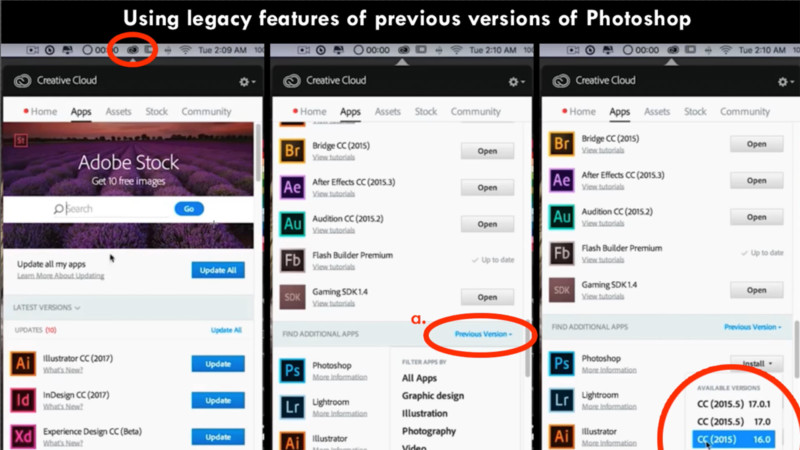
#5. Accessing Legacy Versions of Photoshop (22:48)

Did you know that if you have a Creative Cloud subscription you can access many previous versions of Photoshop, and run them in parallel with the version you have installed? Perhaps you prefer the layout of CS6 or are used to ways that certain tools used to work.

Access to older versions is a little hidden away in the Creative Cloud app, so check the video for instructions on how to find them.

21 Sep 19:02

The Mad Pooper Is Not Alone: Your Best Stories Of Crapping On The Run

by Patrick Redford

A jogger known as the Mad Pooper has caused an uproar across Colorado Springs with the public turds that she’s been dropping in and around one family’s yard, and allegedly a few other places too. Colorado Springs police are on the case, although a particularly exasperated public information officer told me Wednesday…

Read more...

16 Sep 01:19

Harry Dean Stanton (RIP) Reads Poems by Charles Bukowski

by Dan Colman

Variety is reporting tonight that Harry Dean Stanton has died in Los Angeles, at the age of 91. He's best remembered, of course, for his roles in David Lynch's Twin Peaks, HBO's Big Love, Alex Cox's Repo Man, and Wim Wender's Paris, Texas. Over a 60 year career, Stanton made appearances in 116 films, 77 TV shows, and several music videos. He also lent his voice to an Alien video game and recorded poems by Charles Bukowski. Above and below, hear him read "Bluebird" and "Torched Out." Both recordings come from the 2003 documentary, Bukowski: Born Into This. Back in 2012, Stanton headlined an L.A. tribute to the Los Angeles poet.

Follow Open Culture on Facebook and Twitter and share intelligent media with your friends. Or better yet, sign up for our daily email and get a daily dose of Open Culture in your inbox. 

If you'd like to support Open Culture and our mission, please consider making a donation to our site. It's hard to rely 100% on ads, and your contributions will help us provide the best free cultural and educational materials.

Related Content:

900 Free Audio Books: Download Great Books for Free

Three Charles Bukowski Books Illustrated by Robert Crumb: Underground Comic Art Meets Outsider Literature

Tom Waits Reads Two Charles Bukowski Poems, “The Laughing Heart” and “Nirvana”

Watch “Beer,” a Mind-Warping Animation of Charles Bukowski’s 1971 Poem Honoring His Favorite Drink

Harry Dean Stanton (RIP) Reads Poems by Charles Bukowski is a post from: Open Culture. Follow us on Facebook, Twitter, and Google Plus, or get our Daily Email. And don't miss our big collections of Free Online Courses, Free Online Movies, Free eBooksFree Audio Books, Free Foreign Language Lessons, and MOOCs.

15 Sep 21:22

Tax Haven Cash Rising, Now Equal To At Least 10% Of World GDP

by Kenneth Rapoza, Contributor
Researchers suggest that nobody really knows who has what and where, or how much money is really out there in off shore bank accounts.
15 Sep 21:19

Is This The New Way To Find The Best Museums In The World?

by Juyoung Seo, Contributor
In an age where museums are more than a physical space to house artworks, The Leading Culture Destinations Awards seems to have relevance in helping the public to identify new cultural experiences.
15 Sep 21:18

Lexington Barbecue named an iconic US restaurant - Lexington Dispatch


Lexington Dispatch

Lexington Barbecue named an iconic US restaurant
Lexington Dispatch
Included with high-priced and elite establishments from New York, California and Chicago, Lexington Barbecue has been named as one of the 50 most iconic restaurants in the United States by Rave Reviews. Rave Reviews is a ranking website that uses ...

15 Sep 21:15

The Perfect Kid’s Rifle: The Browning BL-22

by Aram Von Benedikt

I can still remember the days when I longed for my first rifle; the thought of a long shiny blued steel barrel and glossy walnut stock of my very own almost more than I could stand. Now I saw the same look in my little son Josiah’s eyes as he stood, hands shoved deep in his pockets, gazing with earnest shyness into my face as he answered my question. I had asked what he wanted more than anything for his upcoming ninth birthday. His answer? “A gun!”

The post The Perfect Kid’s Rifle: The Browning BL-22 appeared first on GunsAmerica Digest.

15 Sep 00:11

How to Make Fried Buttermilk Quail

by Jonathan Miles
fried buttermilk quail

What happens when small, ­delicious birds meet hungry Southern hunters

What happens when small, ­delicious birds meet hungry Southern hunters…
14 Sep 18:19

Elvis Karate Fight Plaque in Madison, Wisconsin

The plaque

Elvis once broke up a street fight in Madison, Wisconsin.

On June 24, 1977, Elvis Presley, while riding to Madison from the airport, noticed a street fight in progress at what was then a Skyland service station. While his limo was stopped at the nearby red light, the King ran from the car and threatened the combatants with a classic karate stance.

The young men recognized Elvis and stopped fighting in favor of shaking hands with the star. Elvis reportedly left after ensuring that everything was settled and taking time to shake hands with several onlookers. Elvis died 52 days later. The incident was reported by Thomas Still for The State Journal, who called it Presley’s biggest brawl since Jailhouse Rock.

A plaque to commemorate the event is installed where the gas station once stood. It shows Elvis with a guitar and in a pseudo-karate stance and describes the incident. 

14 Sep 18:18

How Much Should You Tip Hotel Housekeeping?

by Quora, Contributor
Do you leave a tip for housekeeping in a hotel (like a W or Hilton), not a motel? If so, how much? This question was originally answered on Quora by Bruce Claver.
14 Sep 18:16

Book Lunch Box

by swissmiss
14 Sep 17:59

Be The Last To Speak

by swissmiss

14 Sep 17:59

4 Lessons in Creativity for Photographers

by Isabel Lea

Creativity in any discipline is about finding new and original ideas. When they strike, creative thoughts seem to appear out of nowhere — light bulb moments. Sometimes it seems like creativity is something intangible that we can’t control. But are there ways you can nurture your own creativity? How can we better create the conditions for those moments of inspiration to strike?

In her 17-minute TED talk above, radio host Julie Burstein, an expert in creative thought, offers insight into how creativity grows out of everyday experiences. Her stories revolve around various creative disciplines, but her key four ‘lessons’ are ones that we can embrace as photographers.

Her full TED talk is worth watching, but in this post, we wanted to explore in-depth some of her key points and discuss how these may be applicable for photographers.

Photo by Riccardo Annandale

#1. Embrace everyday experience.

Modern life is full of distractions designed to take us away from the reality in front of us. Viewing images or reading articles of distant countries allow us to detach from our own reality. We become desensitized to our lives and what is right in front of us. Burstein strongly believes that creativity can come out of a break in the everyday.

Instead of looking for a means of escape from the mundane, sometimes it’s important to embrace our reality. Our experiences can change us if we take the time and pay attention to the world around us. It seems simple, but in fact, it is something we often overlook. Creative ideas are around us, but they are only revealed by looking in a different way.

Spanish photographer Ricardo Cases’ ‘El Porque La Naranjas’ (loosely translated as ‘The Reason of Oranges’) is a perfect example of how something so simple can be the catalyst for a dynamic creative photo project. Having moved to Levante to recover from a tragedy, he wanted to build a visual narrative about his new home. He used the region’s symbol of the orange as a starting point.

With that open brief in mind, he set about capturing obscure and almost absurd images of his new hometown. His playful use of color and light help create a unique visual narrative about a place. This required him to look in a different way at the ‘mundane’ objects he observed on his walks. Through re-framing, juxtaposition and color, the mundane comes to life in his photographs.

#2. Challenges, conditions, and restrictions can foster the most creative solutions

We always see challenges as something to be overcome. Yet, there is room to find creativity in situations like this. The trick, according to Burstein, is to embrace the challenge rather than fight it. Sometimes, what we perceive as difficulties or restrictions can become a unique way of seeing a situation. They prevent us from taking the well-trodden-path. Through embracing these restrictions, we have to adapt and learn from the situation. This challenge can act as a catalyst for more creative results. Working within certain parameters, be they geographical, thematic or technical, can lead you to discover different subject matter and new ways of working.

Doug Dubois’ photo project ‘My Last Day at 17’ is a perfect example of embracing challenges and restrictions for a more creative end result. Invited for a five-month residency at the Sirius Arts Centre in Cobh, Dubois admits that at the start, he had no idea how to make a photography project out of the small Irish town. A lack of progress led him to ask a group of kids to show him around their council estate, Russell Heights. This estate eventually became the focus of his photo series.

Still, at the beginning, he faced hostility from the community. This resulted in him returning each summer for five years until he gained acceptance. A compelling and complex set of photographs, the dialogue he built with this tight knit community shows through as a key part of the project. The title of the book itself ‘My last day at 17’ is a quote direct from Erin, one of the girls whose life he photographed.

The book ends with a transcription of an argument over the meaning of the image he shot with her. The integration of dialogue, along with comic illustrations from the teenager’s stories, results is a unique photo book. The honest portrayal of the tensions and emotions of coming of age shows the nuanced understanding he gained from the people whose lives he depicted. This would not have been possible without the initial challenges and the geographic restriction.

#3. We have to embrace our limits and make mistakes to find our true creative voice

Sometimes to find the areas in which we succeed, we also need to fail and embrace our mistakes. The best photographers will try everything and be willing to fail. Only through exploring all avenues, including the blind ones, can we find out more about our strengths and our weaknesses. It is in the moments where we push up against our own limits that we embrace our creative potential. Sometimes we surpass our own limits, and sometimes they are what we expect – limits. Mistakes are key on the journey to finding out what you’re good at. Mistakes help you to step out of your comfort zone and explore different results – both good and bad.

A photographer who embraces this lesson is Keith Carter, whose ethereal style is the result of experimenting with the imperfections of the process. At the start, Carter was working with a traditional documentary style of photography. It was a ‘mistake’ which he attributes to opening a whole new world for his photography practice. He muses that all the elements that made his image ‘fireflies’ an imperfect photograph (such as the lack of focus) were what gave it a poetic ambiguity, and which drew people to it time and time again. This image, along with life-saving melanoma operation which deteriorated his vision, sparked a more experimental approach to creating prints.

Through the use of silver gelatin, Carter experiments with adding manual textures to his documentary images. In his own words “most of these were not successful, but every now and then one good thing came out”. In this way, through embracing his own weakness and imperfections he started a process which resulted in the emotive body of work he is now known for.

#4. Embrace loss

Embracing loss means standing in that space between what we see in the world and what we hope for. This void in between is something educator Parker Palmer calls “the tragic gap”. He labels it tragic not because it’s sad, but because it’s inevitable. This can come in the form of loss, rejection, heartache, disaster among many things. We have all experienced loss and grief. But sometimes in the darkest hour, this tension can lead to something beautiful. Creative pursuits can be a way of understanding, processing and responding to loss.

Within her talk, Burstein highlights the work of influential street photographer Joel Meyerowitz. One of the revolutionizing forces in New York street photography, Meyerowitz embraced this ‘tragic gap’. Visible from his studio, the World Trade Centre was the subject of many of his photographs. In the devastating events of 9/11, he captured some of the most powerful images of the aftermath. The loss he felt not only for the building itself as a subject but the grief for America, drove him to create his now iconic images.

In an interview, he discusses how the chaos, brutality, and tragedy of the site made him feel compelled to capture it in photos. It was a tragic sense of urgency and the need for a record which inspired ‘Aftermath’. The loss fuelled him to create images that were powerful, true, and yet still beautiful.

Conclusion

While not only intended for photographers, it’s clear that Burstein’s messages of creativity are themes that also underpin the work of many great photographers. Sometimes letting go of the process and responding to what’s around you can reignite your creativity. Through embracing these four lessons as we deal with day to day life, we lay the groundwork to let our creativity flourish.


About the author: Isabel Lea is a writer for Intrepid Exposures, a company that specializes in photography tours and training. This article was also published here.

13 Sep 13:56

Singapore Travel Tips From An Insider

by Jennifer Kester, Contributor
A top concierge tells Forbes Travel Guide about the new art attraction that you need to visit, the restaurants people are flocking to and how to survive the notorious heat.
13 Sep 13:25

Hurricane Warnings in ASL

by Miss Cellania

The right person for the right job is exceedingly important in times of crisis. Florida governor Rick Scott's press conference warning citizens about Hurricane Irma included a CDI (certified deaf interpreter) who "stole the show," according to many stories on the web. He may look funny, but every facial expressions adds meaning and nuance to the signs he makes with his hands.

(YouTube link)  

Contrast this event with a Manatee County press conference in which the ASL interpreter was not a trained professional. Jane Smith added captions to show us what words ASL speakers would see.

(YouTube link)

How did this happen? According to the Bradenton Herald, the man is not an interpreter, but has a deaf brother, so he knows a little ASL. He works for the county as a marine rescuer, and was drafted by the county to do the press conference, under protest. He's just doing the best he could. Imagine how difficult it would be to listen to one language and speak another language at the same time, even if you were fluent in both, without the proper training and practice. Certified interpreters are not only crucial, but under appreciated.-via Boing Boing

13 Sep 11:53

The Axman’s Jazz: The Axeman of New Orleans

by Miss Cellania

Neatorama is proud to bring you a guest post from history buff and Neatoramanaut WTM, who wishes to remain otherwise anonymous.

In the spring of 1918, New Orleans, Louisiana (NOLA) was not exactly a city known for banking its fires. Although WWI was still in effect, the city’s motto then was as it is now – ‘Laissez les bons temps rouler’ – let the good times roll. And roll they did. NOLA had culture, a storied history, the country’s first movie theater, a booming financial district, any and all kinds of vice, Jax beer, jazz music, fine cuisine, the French Quarter, and Mardi Gras. NOLA was one of the nation’s busiest seaports, had a curious mix of wealth and poverty but relative overall prosperity, and was possessed of a diverse international citizenry and surprisingly good race relations for the day, thanks to its Cajun and Creole heritage. To its inhabitants, NOLA had all that one could want - and now it was about to have a serial killer.


For all its splendor and romance, NOLA, the ‘Big Easy’, had a dark side.  It was the site of the largest mass lynching in American history, had some organized crime connections, including the Mafia, and an active voodoo culture. As in any large city, there was crime, and the NOLA police department was kept busy, although in truth most of its calls were in the red-light district, where there was frequent trouble at one or other of the city’s many bordellos or saloons. There were murders, of course, but these were generally of the ‘typical’ variety – robbery, jealous suitors, cheating spouses, public insults, and so forth. Yet nothing in its dark side’s long history had prepared the NOLA metropolitan area for what was to become one of the greatest unsolved crimes of the 20th Century – that of the Axeman of New Orleans.

Beginning in May 1918 and lasting through October 1919, a series of horrific assaults and murders engulfed the NOLA metropolitan area, the obvious work of a serial killer.  These crimes were never solved, and they stopped as mysteriously as they had started. The murders became infamous not only for their blood-spattered violence but also for the bizarre modus operandi (MO) of the perpetrator. Each of the ‘canonical’ victims was Italian, and either a grocer or a baker. Family members were sometimes not spared; men, women, and even small children were mercilessly slaughtered, a most unusual behavior for a serial killer. While it is impossible to ascertain whether or not a single perpetrator was responsible for all of the atrocities ascribed to the Axeman, and there has never been any consensus as to the exact number of the Axeman’s victims (there were probable copycat murders), it is a fact that at least twelve people across metropolitan NOLA were attacked by the Axeman over a 17 month period, at least seven of who died from their injuries.

Like Jack the Ripper 30 years earlier and the Cleveland Torso Killer 15 years later, this unknown criminal had several nicknames - the Boogeyman, the Axeman of New Orleans, or simply and most commonly, the Axeman (or Axman). But, unlike Jack the Ripper and the Cleveland Torso Killer, the Axeman would leave behind some survivors of his attacks, some eyewitnesses to his crimes, and all of his implements of murder. But for all that, he was never officially identified, much less apprehended.

It all began on May 23, 1918, when an Italian grocer named Joseph Maggio and his wife were butchered while sleeping above their store. The police discovered that a panel in the rear door had been chiseled out, providing an entry point for the killer. The murder weapon, an axe belonging to the Maggios, was found in their bathtub. Nothing had been stolen, including jewelry and money that were in plain sight.

NOLA police investigators began looking through old cases for similar crimes and discovered that three axe murders of Italian grocers had occurred in 1911. These crimes bore a strong resemblance to the Maggio crime and had been thought to be a Mafia vendetta against fellow Italians. All were unsolved.
One of the most baffling aspects of the Axeman’s crimes was that of his MO; he entered his victims’ homes by chiseling a single panel out of the rear exterior door. This method of entry in particular is quite surprising, given the amount of time and work (and risk) that it would take to chisel a panel out of a thick wood door and the relatively small size of the opening in the doorway that would be created. Yet, he apparently managed to fit through these rather small entry points, even though it seemed that no adult male could possibly gain entry through them, most especially as most eyewitnesses later described the Axeman as a tall, dark-skinned, heavy-set man. After entering, he would then attack his victims in their sleep and bludgeon them with an axe. Curiously, the weapons he employed (axes, but upon occasion also knives and straight razors) were always abstracted from the houses he entered, and they were always left behind at or near the scenes of the crimes along with the chisels that he had used for removing the panels from the doors.  So far as is known, he never robbed any of his victims. 

NOLA being NOLA, with its ingrained voodoo culture, some maintained that the Axeman was a creature from the world beyond. How else, they said, could eyewitnesses describe the killer as being a large man when only a small person could have slipped through the chiseled-out panels in the doors? The killer must have entered by supernatural means, as each door was still locked when the crimes were later discovered. In addition, his ability to quickly flee the scene “as if he had wings” led the citizens of New Orleans to wonder if the Axeman were even human or instead some sort of ungodly demon. If there were any skepticism about the latter, it was quickly dispelled by what was soon to follow.
In March of 1919, the Axeman revealed himself as much as he ever would. A letter received by the NOLA Times-Picayune newspaper, purportedly from the Axeman, revealed that he loved jazz music and thus would spare anyone who played jazz through the night of Tuesday, March 18. This letter follows in full.

Hell, March 13, 1919 

Esteemed Mortal: 

They have never caught me and they never will. They have never seen me, for I am invisible, even as the ether that surrounds your earth. I am not a human being, but a spirit and a demon from the hottest hell. I am what you Orleanians and your foolish police call the Axeman.

When I see fit, I shall come and claim other victims. I alone know whom they shall be. I shall leave no clue except my bloody axe, besmeared with blood and brains of he whom I have sent below to keep me company. 

If you wish you may tell the police to be careful not to rile me. Of course, I am a reasonable spirit. I take no offense at the way they have conducted their investigations in the past. In fact, they have been so utterly stupid as to not only amuse me, but His Satanic Majesty, Francis Josef, etc. But tell them to beware. Let them not try to discover what I am, for it were better that they were never born than to incur the wrath of the Axeman. I don‘t think there is any need of such a warning, for I feel sure the police will always dodge me, as they have in the past. They are wise and know how to keep away from all harm. 

Undoubtedly, you Orleanians think of me as a most horrible murderer, which I am, but I could be much worse if I wanted to. If I wished, I could pay a visit to your city every night. At will I could slay thousands of your best citizens, for I am in close relationship with the Angel of Death.

Now, to be exact, at 12:15 (earthly time) on next Tuesday night, I am going to pass over New Orleans. In my infinite mercy, I am going to make a little proposition to you people. Here it is: 

I am very fond of jazz music, and I swear by all the devils in the nether regions that every person shall be spared in whose home a jazz band is in full swing at the time I have just mentioned. If everyone has a jazz band going, well, then, so much the better for you people. One thing is certain and that is that some of your people who do not jazz it on Tuesday night (if there be any) will get the axe. 

Well, as I am cold and crave the warmth of my native Tartarus, and it is about time I leave your earthly home, I will cease my discourse. Hoping that thou wilt publish this, that it may go well with thee, I have been, am and will be the worst spirit that ever existed either in fact or realm of fancy. 

The Axeman

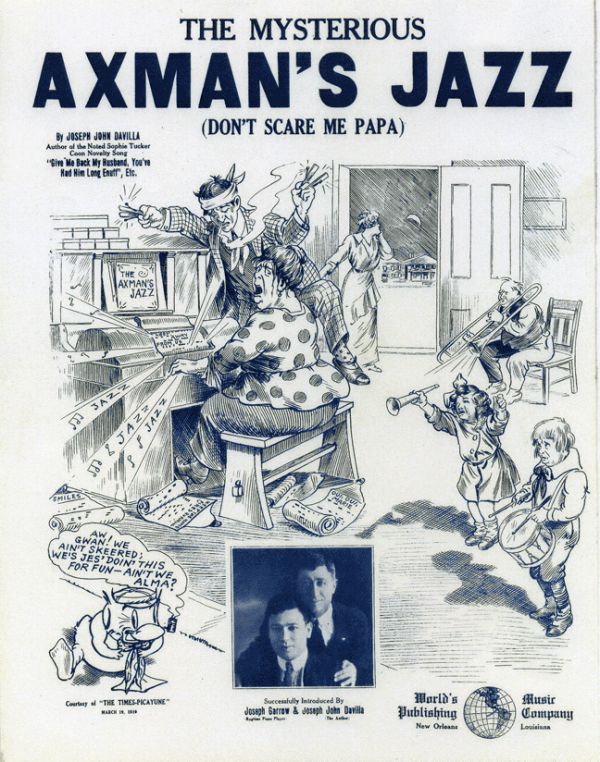
The citizens of metropolitan NOLA did their best to follow the Axeman’s instructions to the letter. Although many later claimed that they had participated just for the fun of it, it was clear that the populace as a whole was terrified. The night of March 18, people in NOLA partied as if their lives depended on it. Restaurants and clubs all over town that offered jazz music were jammed; friends and neighbors gathered in homes to “jazz it up”, and every musician in the city had been engaged in some venue. By midnight, practically every house in the city was alive with jazz, many of them pounding out a composition by a well-known local composer, Joseph Davilla, entitled “The Mysterious Axman’s Jazz”, which, NOLA being NOLA, soon became a smash hit. Listen to it here.

As promised, no one playing jazz that night died at the hands of the Axeman.

But the Axeman had been pushing his luck. There had been several aborted attempts at other of his crimes, one of which nearly got him shot. Households and entire communities began organizing such that someone armed was always on watch at night while others slept. Bands of vigilantes armed with shotguns conspicuously roamed the streets after dark. Some few even openly dared the Axeman to come calling, providing their addresses through newspaper ads.

On October 27, 1919, the Axeman conducted his final slaughter, perhaps because NOLA was becoming too hot for him. An Italian grocer named Mike Pepitone (or Pipitone) was butchered, but his wife and children, asleep in another room, went unharmed.

The horror then came to an abrupt end. This was the last canonical murder attributed to the Axeman. He was never seen or heard from again. No one would ever learn the identity of the Axeman - or would they? 

A year after the Pepitone murder, a man named Joseph Mumfre (also Momfre and other variant spellings) was shot and killed on the west coast, allegedly by Mike Pepitone’s widow, Esther Albano. She had been eyewitness to his murder and was said to have recognized Mumfre as her husband’s killer. Mumfre had years earlier been ringleader of a blackmail gang which preyed on NOLA’s Italian community. He was sent to prison in 1911, just after the first series of axe murders. He was paroled in 1918, around the time that the Axeman’s murders began. Immediately after the Pepitone murder, Mumfre left NOLA for the west coast, and the Axeman vanished as well. In spite of all this circumstantial evidence, there was no actual evidence to link him to any of the Axeman’s crimes.

Did Esther Albano really recognize the Axeman? And if she really knew his identity, why did she not inform the NOLA police? Had the Axeman then been apprehended and identified by Albano and the other eyewitnesses, he would either have quickly been tried, convicted, and executed or seized by a mob and lynched. But would even such an end have satisfied a bereaved widow and mother of six children, especially one of Italian heritage? After all, revenge is a dish best served cold.

Was Joseph Mumfre really the Axeman? Was the Axeman instead someone who remains unknown today? Or was the Axeman actually what he claimed to be all along – a supernatural entity from the depths of Hell? Only one thing is certain after the passage of nearly a century; whoever – or whatever – the Axeman was, he is today legend, and legends never die.

Sources and Further Reading

13 Grisly Facts About the Axeman of New Orleans
The Axeman serial killer of New Orleans (1918-1919)
The New Orleans Times-Picayune
Fresh light on the Axeman of New Orleans
The Axeman's Jazz
When Hell Came to Earth: The Axeman of New Orleans
The Axeman of New Orleans Murders
The Axeman Murders of New Orleans
The Murderous Axeman Of New Orleans May Sound Like A Myth, But It's Far From It
Axeman of New Orleans
25 Blood-Chilling Facts About The ‘Axeman Of New Orleans’ That’ll Make You Scream
Joseph Maggio at Find A Grave
Katherine Maggio at Find A Grave
Mary Cortimiglia at Find A Grave
Joseph Mumfre at Find A Grave

13 Sep 11:48

We're Running Out of Widgets

by Ernie Smith
We're Running Out of Widgets

Editor’s note: Apple’s revelation on Tuesday that it was rethinking its approach to stores into something akin to a “town square” got me thinking about an old piece I wrote a while back—one that I, ironically, was just interviewed about for Ozy. In lieu of a fresh one, here’s a lightly refreshed 2015 piece that still feels pretty relevant.


Today in Tedium: When physical objects can be turned into a series of bits and bytes and streamed over the airwaves, the result is that stores start running out of things to sell. That's what the laymen call disruption, and it's something that threatens entire industries and lifestyles. In recent years, we've seen companies famous for selling products—some for generations—go the way of the dodo. Was their problem that they ran out people interested in their widgets, and as a result, they didn't have a plan B to make up for the fact that physical objects don't matter so much anymore? If all our stuff's going digital, where does this leave all the brick and mortar stores that used to sell these widgets? This rant is a little different from your traditional Tedium issue—it's something inspired by a little thought monster I had in a back-and-forth with news blogger Jim Romenesko a while back on Facebook. For the internet's sake, I thought it was important that I finish the thought. — Ernie @ Tedium

We're Running Out of Widgets

Keep Us Moving! Tedium takes a lot of time to work on and snark wise about. If you want to help us out, we have a Patreon page where you can donate. Keep the issues coming!

We accept advertising, too! Check out this page to learn more.

6.6%

The decline in quarterly sales that Barnes & Noble—a company that sells a lot of books in a relaxed big-box environment—recently reported. While the company has managed to hold on a lot longer than many big-box bookstore chains of its type—in part because it tried to play Amazon's electronic reader game by selling Nook devices—but it's faced a lot of trouble competing. Nook had earnings of just $0.6 million in the most recent quarter, mainly as a result of cutting costs. Pushing physical products in a digital age, simply put, sucks.

We're Running Out of Widgets

(Pierre Metivier/Flickr)

Why Barnes & Noble should turn its stores into for-profit libraries

Barnes & Noble has a big problem—like many bookstores, it gives away its best product as long as you're hanging out inside its big-box walls. In fact, those walls are kind of its selling point: Buy a coffee, get lost inside a book, maybe take it home with you.

But weaknesses in that model are leading some to question whether the company will survive its fight against Amazon, and even to speculation it might be sold off at some point.

But like the defunct Borders before it, it doesn't make any money off of you sitting around dilly-daddling. That's why Amazon is starting to win the war against specialized try-before-you-buy places like B&N and Best Buy: Once you know what you're getting, why stick around?

Perhaps it's because Barnes & Noble is in the wrong business. Instead of selling books, it should literally sell that experience. Barnes and Noble has a yearly membership program, but I’d like to propose that Barnes & Noble turn itself into a brick-and-mortar version of Spotify. Pay $20 a month, and you become a "member" of the bookstore: you get access to everything that's inside for free, as long as you stay in the door. If you want to take a book home with you on a digital device, you can—but only one at a time so you're not sucking the life out of the store. If you want to put that book on your shelf, the option remains available for you to buy it, but you're by no means required to do so.

If this sounds basically the same as a library, it pretty much is, but there's a big difference here: Your average library isn't a for-profit corporation, but Barnes & Noble is. As a result, it has to work hard to convince the average person that paying $20 a month is a worthwhile investment.

The way they do that is by constantly making the experience that you find at its stores better by the day. It should continue to have that endless sea of books that it's known for, but it should also focus on having employees who are better at recommending a good read than any algorithm. It should have events not every once in a while, but every day. They should buy more comfortable seats.

And they should find ways to encourage social engagement between people who go there—think book clubs, mentoring, and study buddies.

The problem with Barnes & Noble is that it aspires to be a "third space"—a place where people go when they're not at work or home. However, because its ultimate business is selling books rather than one of life's basic needs—food, water, or shelter–it's not properly optimized to be a place where you can go when you don't want to stay at home.

And as a result, the benefits of the competitive advantage fall by the wayside as the business gets disrupted, and when Barnes & Noble downsizes or goes out of business, an important community resource is lost.

What if, instead of monetizing the books, they monetized the important community resource? Amazon can't beat that experience, no matter how many Kindles it sells.

“Life without community has produced, for many, a life style consisting mainly of a home-to-work-and-back-again shuttle. Social well-being and psychological health depend upon community. It is no coincidence that the ‘helping professions’ became a major industry in the United States as suburban planning helped destroy local public life and the community support it once lent.”

— Sociologist and public space advocate Ray Oldenburg, discussing the advantages of the "third space" in our society, which he argues have significant value as social centers, venues for democracy, and vital community elements. Oldenburg is one of the leading advocates of the "third space," thanks to his authorship of the books The Great Good Place and Celebrating the Third Place.

We're Running Out of Widgets

(Dave Dugdale/Flickr)

How Blockbuster could've beat Netflix at its own game

To highlight the bigger point I'm getting at with that whole Barnes & Noble idea, let me throw another theoretical your way: Rather than shutting down its wide network of physical locations as its business model faltered, Blockbuster should have converted its old stores into tiny movie theaters.

Now, I'm not suggesting they should've taken their small-box buildings and turned them into giant multiplexes. But there was a big opportunity that the company missed by not seeing the potential of replacing the rows of DVDs and Xbox games with a half-dozen wide-screen TVs, some comfy couches, a couple consoles, and a small concession stand. The model would simple to manage, wouldn't cost a lot of money to convert, and—just like my theoretical for-profit library idea above—would monetize the experience, rather than the widget.

While Blockbuster could make money from selling food, the true secret sauce of this model is that it's driven by a membership model. In this alternate scenario, Blockbuster would charge a monthly fee to its members for the promise of a wide selection of movies, killer sound, and the possibility of meeting new people.

The signs may say that these physical locations are "movie theaters," but in reality, they're "community centers."

Now, you wouldn't be required to go; if you wanted to stay home, you could get most (but not all) of the movies Blockbuster had available on your Apple TV, but this strategy would turn streaming into a perk, rather than the whole pie.

The reason this model has potential is twofold: First, as awesome as your living room is, the odds are pretty good that Blockbuster—having had deals with every major movie studio—probably can score a better selection of movies than you can, and can afford nicer furniture than you can. Second, it creates a physical social space at a time when face-to-face interaction is becoming more important to our society. And because Blockbuster locations generally were more common in your average city than a movie theater, odds are that if you were to make it a Blockbuster night, you'd be actually interacting with people that live in your neighborhood, rather than getting in a car for half an hour, watching a movie in a dark room—not interacting with anyone next to you—and then driving home.

The truth is, movies are a social experience. And that isn't appreciated enough by the modern movie theater, which constantly shushes you for talking too loud. As much as Alamo Drafthouse hates it, there is in fact an audience that wants to talk and text during a movie—and Blockbuster would've been in just the spot to win that audience over.

And the economic model is a lot better, too: They may only get twelve people for a single showing, but those twelve people would be friends by the end of the film—and since Blockbuster already had their money anyway, it doesn't matter if not every member shows up on a given day.

Membership is the thing that makes Netflix work; it could have been the thing that made Blockbuster work, had the company chosen to take advantage of all the brick and mortar it owned, turning it instead to competitive advantage over its digital-only rival.

And this idea translates effectively to a lot of other companies, too: Radio Shack shouldn't have sold cell phones; it should have offered electronics instruction classes to its underserved root techie audience. Circuit City shouldn't have sold disposable DVD alternatives; it should have figured out a way to get the movie buffs buying those DVDs talking to one another, sharing war stories about the home theaters they were building. Newspapers shouldn't just sell newsprint; they should run event centers that allow for direct community interaction with journalists and newsmakers.

And the list goes on.

In a world where objects are becoming commodities, we should focus on building something that isn't quite so easy to throw in a box and ship via FedEx. Communities and experiences are far harder to ship than any DVD.

What if our problem as a society is that we've failed to properly give value to experiences? Where we've allowed raw materials to drive the way that we live, even though it's the social and emotional experiences of our lives that truly give them value?

The reason Radio Shack and Circuit City and Blockbuster and Borders and so many other companies in their position have failed is that they treated their relationship with the customer as a means to an end, with the end goal to sell you more stuff you don't need. We ultimately go to these places to scratch an itch and fulfill an interest.

The reason why we're so obsessed with our phones is that our favorite apps have figured out that we're using them because we want to scratch an itch, not just buy a product. Social experiences scratch itches and build memories; stuff is just stuff with a limited shelf life.

The second a company loses sight of this is when their model is in danger of falling apart. Widgets matter less than why we want those widgets.

13 Sep 11:28

More Proof We Don't Need The National Endowments For The Arts And The Humanities

by George Leef, Contributor
Through the National Foundation for the Arts and Humanities, the government subsidizes a huge array of things, such as a "Stand with a Saguaro" theater program. There's nothing wrong with spending a night with cacti, but the federal government has no authority to spend money on the arts.
13 Sep 11:24

How to Find Parking Using Google Maps

by Nancy Messieh

Google recently introduced some awesome features making it easier for folks to find parking spaces in major cities. It’s currently limited to 25 U.S. cities and only works on the Android app, but may expand to other cities and devices in coming years. If you’ve spent any time circling urban streets for an elusive parking spot, try this. Parking Help in Google Maps The feature, announced in late August, makes it easy for anyone in the following U.S. cities to find a parking spot: Atlanta Boston Charlotte Chicago Cleveland Dallas/Fort Worth DC Denver Detroit Houston Los Angeles Miami Minneapolis/St. Paul...

Read the full article: How to Find Parking Using Google Maps

13 Sep 11:23

Hemingway’s Cats Survive Hurricane Irma

by Sporting Classics Daily
The six-toed felines are still alive and well at Papa's former Key West home.
12 Sep 16:47

Top 5 Affordable Mechanical Watches for EDC

submitted by Ed Jelley

You may have heard the term “automatic” thrown around a lot when talking about watches. On the most basic level, it means that the watch runs without a battery. Instead, it's powered by you! Essentially, there’s a tiny machine that’s “charged up” by a spinning rotor, completely driven by the movement of your wrist throughout the day. They keep running as long as you wear it, and the work that's involved in designing an accurate time telling machine is equally impressive. Fortunately, you can find a few solid watches featuring this fascinating movement that actually stand up to daily use without costing an arm and a leg. In this guide, we'll highlight our top 5 automatic mechanical watches for EDC on a budget.


Best Mechanical Watches on a Budget


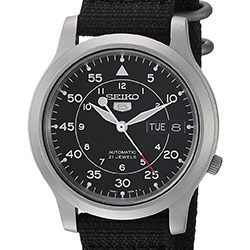
Seiko SNK809
Orient Bambino V2
Hamilton Khaki Field
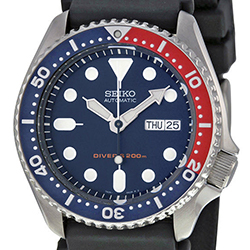
Seiko SKX009
Orient Defender


★★★★
★★★★
★★★★★
★★★★★
★★★★
Case Size: 37 mm
Case Size: 40.5 mm
Case Size: 38 mm
Case Size: 43 mm
Case Size: 42 mm
Water Resistance: 30M
Water Resistance: 30M
Water Resistance: 50M
Water Res.: 200M
Water Res.: 100M
Origin: Malaysia
Origin: Japan
Origin: Switzerland
Origin: Thailand
Origin: Japan
Pro: Value
Pro: Office wear
Pro: Reliability
Pro: Diving
Pro: Daily wear
View on Amazon

View on Amazon
View on Amazon
View on Amazon

Why EDC an Automatic Watch?

With all of the quartz and digital watch options out there, why invest in and wear an automatic watch?

  • No Batteries to Change: An automatic watch can run for years without requiring service. If the movement runs out of power, simply give it a little shake (or wind, depending on the movement) to get it running again.

  • A Watch for Life: Automatic watches can be serviced, repaired, and worn for decades without giving out. A quartz watch with a PC board and battery doesn’t have the potential to last quite as long without issues.

  • Cool Factor: At the heart of the watch is a tiny, complex machine with dozens of moving parts that all work in conjunction to tell the time. It’s just plain cool.

Now that you have an idea of why an automatic watch works well for EDC, here are 5 great options to choose from that won't cost you a fortune.


Seiko SNK809

The Seiko 5 SNK809 represents the best value in mechanical watches today. This feature-packed time piece has a ton of useful features bundled into a classic looking field watch package. To be a part of Seiko’s “5” line, the watch must be water resistant, shock resistant, have an automatic movement, have a day/date display, and a recessed crown at the 4 o’clock position. The best part? This watch will only run you right around 80 bucks.

View on Amazon


Orient Bambino Gen 2, V3

Orient’s Bambino dresses things up a bit. This take on the classic dress watch adds in a little bit of Bauhaus-inspired minimalism to the design. The sleek hour and minute markers pop out against the contrasting black face, while the squared-off hour and minute hands stay discreet yet legible. The domed mineral crystal adds a touch of vintage flair and wrist presence that’s typically found on watches several times the price of the Bambino. Of course you get an automatic movement, steel case, and leather strap as well.

View on Amazon


Hamilton Khaki Field

When talking about automatic watches, it’s hard to leave Switzerland out of the discussion. This country is known for their high level of detail and precision in watch manufacturing, and the watches hailing from Switzerland typically have the price tag to match. Hamilton’s Khaki Field is one of the most affordable Swiss watches out there. This 38mm field watch wears well on almost any wrist thanks to the conservative size.

View on Amazon


Seiko SKX009

When looking for an automatic watch, you're bound to come across one of these legendary divers from Seiko’s SKX line. These ISO-certified dive watches are built like tanks, with plenty of welcomed features inside. In addition to the automatic movement, there’s a day/date display, a sturdy screw down crown, and a stainless steel case that will hold up to years of use and abuse. The watch comes on a rubber dive strap, but switching to a nylon nato style, or bracelet can add a level of personalization to really make the watch yours.

View on Amazon


Orient Defender

The Defender is Orient’s unique entry into the field watch category. What stands out about the Orient Defender is the grey dial and day, date, and 24 hour sub dials. It’s not often that you see that much complexity on an affordable mechanical watch. It’s got an in-house (“made by the brand” in watch speak) automatic movement, hardened mineral crystal, and 100M of water resistance. The Defender makes for an excellent everyday watch, whether you’re in the office or out in the field.

View on Amazon


What's your favorite budget mechanical watch tough enough for EDC duty? Let us know in a comment below!

12 Sep 16:46

The 5 Best Call Recording iPhone Apps You Can Rely On

by Rohan Naravane
call-recording-apps

There are times where recording a phone call is handy. But it also poses a major security issue—if you can record your calls, a malicious app developer may be able to as well. Both iOS and (more recently) Android have built-in security measures that make recording calls difficult.

That’s not to say recording calls on your iPhone is impossible, though. While you can’t do it directly within iOS, there are several call recording apps that use workarounds in order to get the job done.

Why Would You Want to Record Phone Calls Anyway?

There are a few reasons you may want to use a call recording app. Maybe you are having an important discussion with someone and want to reference it later. A journalist conducting a telephone interview might find an audio recordings of the call useful for transcribing it later. Some of these apps even offer optional transcription services to make this part easier.

Before you start searching for the best app to record calls on your iPhone, ask yourself whether you need to. If you just want to record a conversation for posterity, apps like Zoom may be better-suited to the task. In fact, one of the coolest ways to use Zoom is recording a podcast or similar, since the app lets you record each call participant separately.

Is Using Call Recording Apps Legal?

While privacy is a large part of the reason Apple and Google don’t want to include call recording in their operating systems, it’s probably not the only reason. The decision likely has to do with its legal implications as well.

For instance, in the US, some states require both parties to be aware of the call recording, while others need only one party’s knowledge for a legal recording.

So while call recording apps themselves aren’t illegal, the way you use them may be. You’ll want to check local laws before you start recording phone calls. And for courtesy’s sake, it’s always fair to inform the other person before starting the conversation if you’re recording a call.

Now, let’s look at the best call recording apps for the iPhone.

1. Rev Call Recorder

Rev Call Recorder is often mentioned as the best app to record calls on the iPhone, and it’s easy to see why. While you need to jump through the same hoops as many other call recording apps, Rev Call Recorder makes it easy. It’s also completely free of charge, assuming you only need a recording of the call.

The company makes its money by offering transcription and other services on the recordings. This means that the provider can access your conversation and listen to it, as this is required in order to offer transcription. That said, most of these services have the same privacy implications.

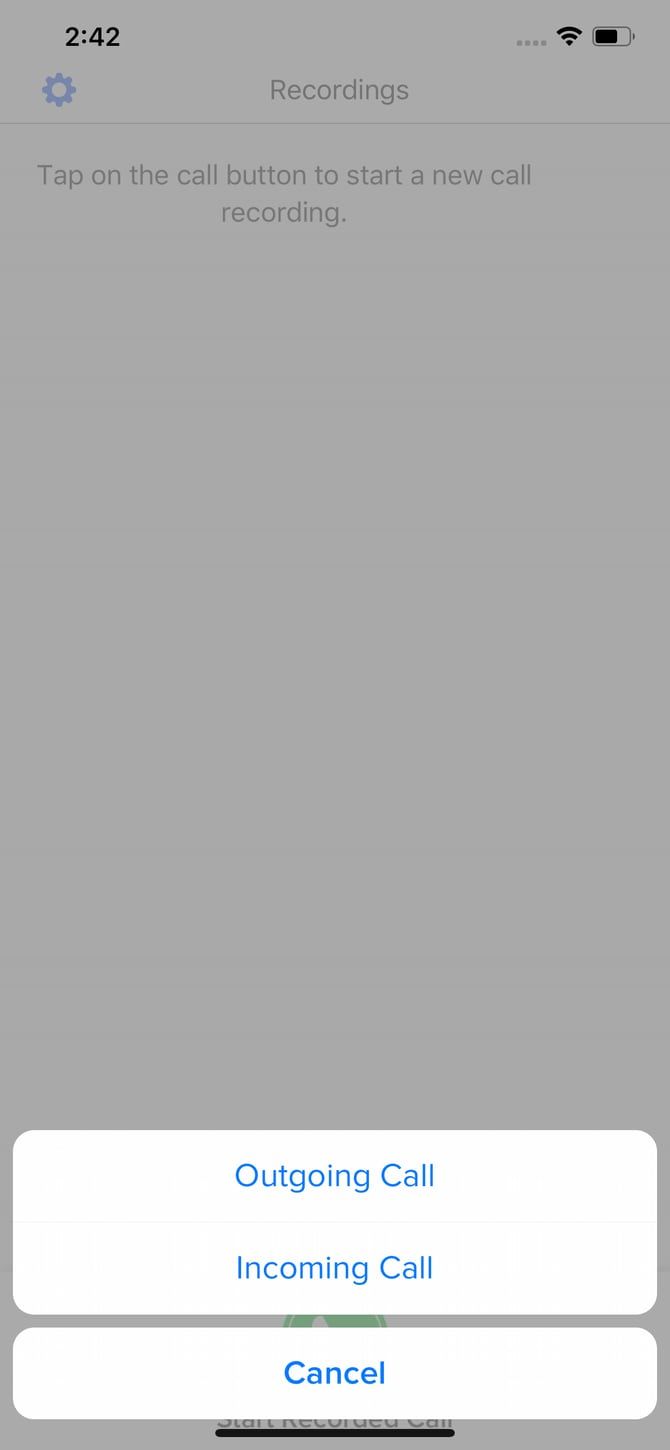
When you launch Rev Call Recorder, it walks you through the steps of recording a call, which differs slightly depending on whether you’re making or receiving a call. Either way, it works by making a call to the company first and then adding the other person as a group call. Fortunately, Rev Call Recorder’s built-in tutorial makes this easy.

Once the call is done, you’ll get an email with a link to download the audio file containing your call.

Download: Rev Call Recorder (Free)

2. IntCall

As with Rev Call Recorder, IntCall developer TeleStar is technically capable of storing your conversations. However, it claims not to.

In the About section of IntCall, one of the first points mentioned is that the app doesn’t save your conversations on its servers. The terms clarify that the file is temporarily saved on the server, but only until it downloads to your phone.

Unlike Rev Call Recorder, IntCall places two calls for outgoing numbers: one to the person you’re calling and one to its own recording service. This is the server that records the call, then delivers the audio file to your phone. Using the app is simple and straightforward.

On the other hand, its monetization strategy isn’t exactly straightforward. You can either use the app via subscription or by buying credits. When you sign up, however, it automatically starts a three-day free trial period of the subscription.

If you don’t remember to cancel in time, you’ll be charged $6.99 per week. This can add up quickly, so make sure you cancel if you don’t need more than a few days of recording.

Download: IntCall (Free, in-app purchases available)

3. WeTalk Pro

WeTalk Pro started as a simple call recorder app; while it still records calls, its focus has shifted somewhat. Now, the app advertises itself mainly as an affordable way to get a second phone number and make cheap calls. This is either a plus or a minus, depending on what you’re looking to do.

WeTalk lets you sign up for a second number, then make calls over Wi-Fi. It’s similar to Google Voice (and Skype, to a lesser extent). That said, WeTalk Pro advertises lower rates than Skype for international calls, so if you frequently need to make and record calls outside your area, this could be a great option.

If you’re simply looking for call recording, though, WeTalk Pro may be overkill. It also doesn’t use the three-way calling method, which means caller ID won’t show your standard phone number.

Download: WeTalk Pro (Free, in-app purchases available)

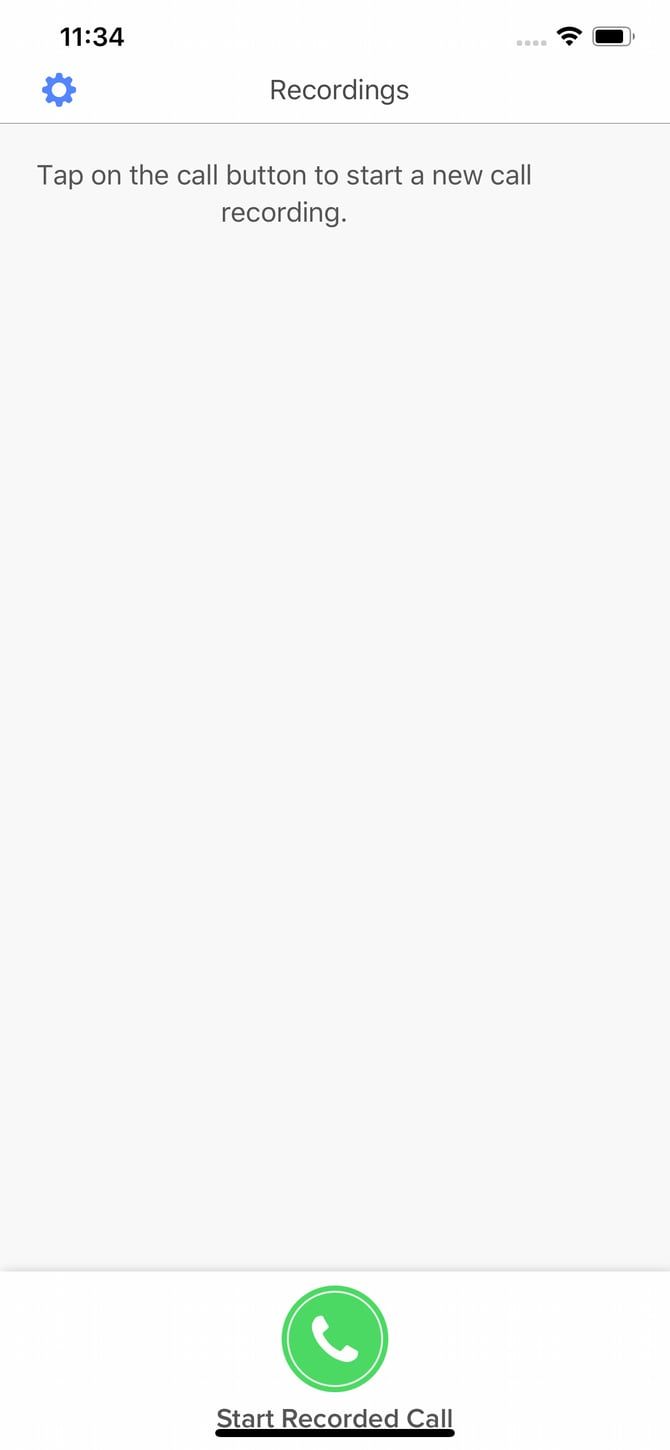
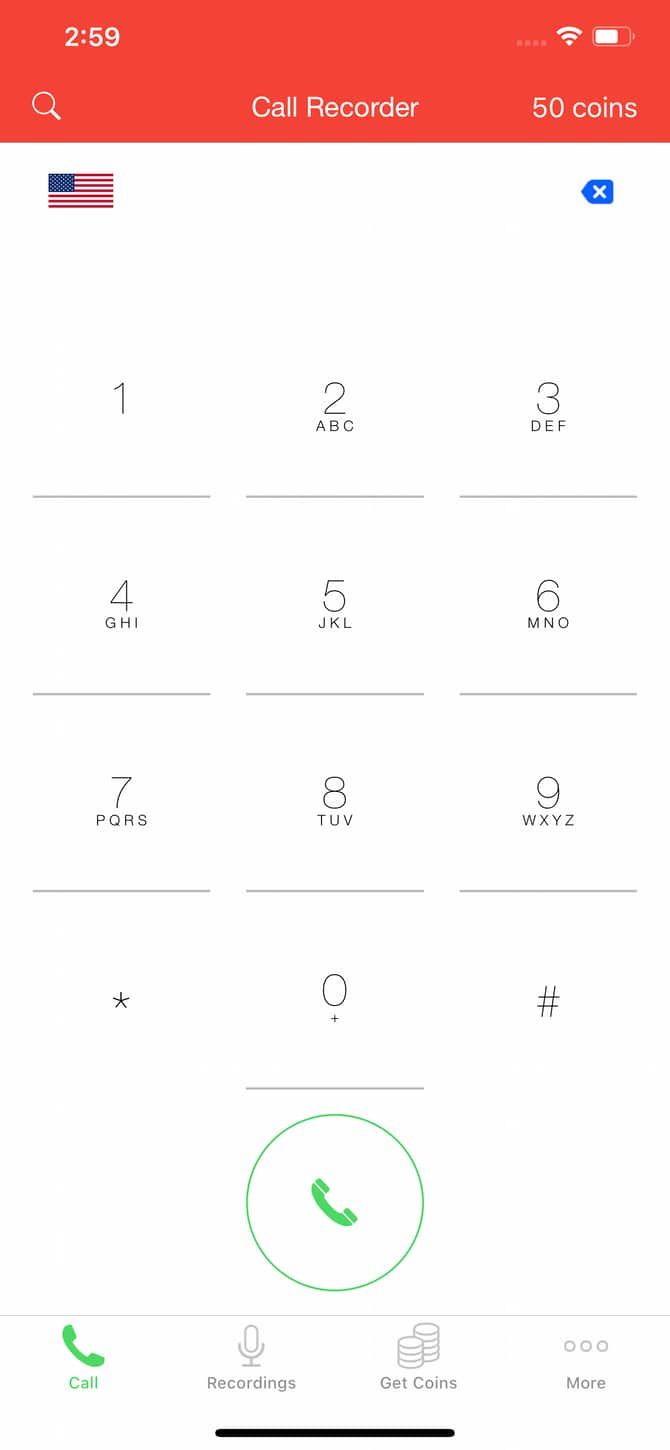
4. Call Recorder

This app has an incredibly generic name, and it turns out there are a lot more like it in the App Store. These generic names help the app with visibility when people search for generic terms like “call recorder” or “record phone call.”

This app from developer David Kang is relatively better-designed than many others. It’s simple to understand and use: instead of dollar-per-minute pricing, it uses a sort of virtual currency called coins. You stock up on these credits, then use them to record calls.

While it’s easy to record with it, given the free or cheap alternatives on this list, you may want to look around before deciding on this one. On the other hand, this is a solid reliable app by an independent developer that’s worth supporting.

Download: Call Recorder: Record Calls (Free, in-app purchases available)

5. TapeACall Pro

Though it obviously doesn’t use tape, this is otherwise an app that does exactly what its name says. You’ll find two listings on the App Store: one for TapeACall and another for TapeACall Pro. Both include in-app purchases, but TapeACall Pro removes many of the limitations found in TapeACall.

You can try out TapeACall first to make sure the app works, then purchase the Pro version so you don’t need to mess with as many in-app purchases. This is a popular option for recording calls on the iPhone because, like Rev Call Recorder, it makes setting up the three-way calling used to record calls easy.

With the Pro version of TapeACall, you don’t need to worry about per-minute fees for recording calls. Despite this, the app does offer in-app purchases for transcriptions and other features.

Download: TapeACall (Free, in-app purchases available) | TapeACall Pro ($10.99, in-app purchases available)

Do You Need to Use an App to Record Calls?

While using one of these iPhone call recording apps is often the easiest way to record calls, it’s not the only option. Dedicated apps and services are handy, but you may not want to deal with the hassle of setting them up and using them every time.

If you’re looking for another option to record calls, take a look at our full guide to recording calls on your iPhone.

Read the full article: The 5 Best Call Recording iPhone Apps You Can Rely On

12 Sep 16:46

9 Great Safari Browser Alternatives for Mac Users

by Michael McConnell
mac-safari-alternatives

On the Mac, there are many browsers beyond Safari: some common, some more obscure. It is not that Safari is a bad browser, or that it has a limited feature set. Safari is Apple’s vision of the web browser and targeted at general users. Not to mention most of its feature releases tie into releases of macOS. So you may want a different focus, or want major updates more than once a year. Here are a few good alternatives to try out. Common Browsers None of these are going to be too far off your radar. One has become one...

Read the full article: 9 Great Safari Browser Alternatives for Mac Users

12 Sep 16:43

How to Erase Your Social Media Presence: Facebook, Twitter, Instagram and Snapchat

by Megan Ellis
disappear-from-social-networks

There are a various reasons why you might want to delete your social media accounts. You may miss the days of anonymity, you might want to reclaim your privacy from companies, or maybe you just aren’t interested in the platform any more.

Unlock the free "Facebook Security Checklist" now!

This will sign you up to our newsletter

Enter your Email
Unlock

Whatever your reasons, there are several ways to delete your social media accounts. From traditional avenues to useful tools, here’s an in-depth look at how to delete your social media accounts on Facebook, Twitter, Instagram, and Snapchat.

Deleting Accounts Through the Platforms

All of the major social media sites allows you to deactivate or delete accounts. However, how easy this process is to complete depends on the site. In fact, BackgroundChecks.org provides a directory called JustDelete.Me that lists how easy or difficult it is to delete an account across different platforms.

Whether the negative effects of social media have got you down, or you just want to improve your online privacy, here’s how to delete your accounts on the major social media platforms…

How to Delete Facebook

delete or deactivate facebook information page

Facebook provides two options for getting rid of your account and profile: by either deactivating it or deleting your account completely.

As the wording implies, the first option is an account deactivation and not technically a deletion. It leaves you the option to restore your account at a later date, meaning that your data is still stored somewhere.

deactivate facebook account option

To deactivate your Facebook account, go to Settings > Your Facebook Information and select Your Facebook Information. Choose Deactivation and Deletion and then select the option to Deactivate Account. Click the Continue to Account Deactivation button to launch the process.

Deactivating your account disables your profile and removes your name and photos from posts you’ve shared. Other people won’t be able to find your account when they search for it on Facebook. However, your name might still appear in posts from others. Your messages with others will likely also continue to exist.

Furthermore, your Messenger account stays active too—but you can deactivate Facebook Messenger separately.

The second option is permanently deleting your Facebook account. According to Facebook, this means your account cannot be restored. To delete your Facebook account permanently, go to Settings > Your Facebook Information and select Your Facebook Information. Choose Deactivation and Deletion and select the option to Delete Account. Then click on the Continue to account deletion button to proceed.

delete facebook account option

The process of deleting your data takes 90 days. This removes much of the same information that deactivating your account does, but removes this data permanently. You will also no longer be able to use Facebook Messenger. However, certain data, like messages in other people’s inboxes, cannot be deleted.

How to Delete Twitter

twitter delete account menu

Deleting your account on Twitter requires you to first deactivate it. After 30 days, the account is deleted completely.

To delete your Twitter account, click on the menu icon with three dots to the left of your Twitter homepage and select the Settings and privacy option. At the bottom of this page, you will see the option to Deactivate your account.

Twitter will then take you to a confirmation menu. To confirm that you want to delete or deactivate your Twitter account, click Deactivate.

deactivate twitter account confirmation

According to the company, your data will only be stored for 30 days. During this time you will be able to reactivate and restore your account. Once the 30-day period is complete, your data and account are permanently deleted.

How to Delete Instagram

Instagram lets you to either temporarily disable or permanently delete your account.

To disable your Instagram account, go to your Settings menu and select Edit Profile. At the bottom of the page, you will see a link to Temporarily disable my account.

instagram disable account menu

This essentially hides your account and allows you to reactivate it at a later date.

To completely and permanently delete your Instagram account, you need to sign in on Instagram through your web browser and use the Delete Your Account request link. You will then need to re-enter your password. Finally, click on Permanently delete my account to remove your Instagram account from the platform.

instagram delete account permanently option

This option removes your account permanently—with no option to reactivate or recover your account and photos.

How to Delete Snapchat

snapchat manage and delete account page

You can delete your Snapchat account using the Snapchat account portal. This webpage allows you to manage your data and apps, but more importantly, gives you the option to delete your account.

Simply open the webpage, log into Snapchat and select Delete My Account. This will take you to a page explaining the deactivation process. Like Twitter, once 30 days have passed, your account will be permanently deleted.

To confirm that you would like to delete your Snapchat account, you need to re-enter your username and password, then select Continue.

snapchat delete account page

Websites That Help You Delete Social Media Accounts

There are certain websites dedicated to helping you delete your social media presence. From sites that send account deletion requests on your behalf to sites that give you instructions to delete accounts, here are some websites you can use…

Deseat.me

deseat me website unsubscribe and delete accounts

Deseat.me uses either your Google account or your Outlook account to generate a list of your online and social media accounts. It then gives you the option to sort through and delete these accounts.

A great aspect of the service is the sheer extent of what it covers. It will find accounts linked to your email that you have long forgotten about. It also identifies newsletters that you can choose to unsubscribe from.

However, Deseat.me requires access to your emails to do this, which can be a dealbreaker for many users. If you do choose to use the tool, we recommend immediately revoking access once you are done cleaning up your social media accounts. We would also not recommend using this service for email accounts with sensitive content.

When you select an account for deletion, Deseat.me generates a data removal request that it sends from your email address to the relevant platform.

deseat me deletion request

The option to request removal is not available for all accounts. Deseat.me will note whether this option is unavailable and provide instructions for how to delete an account on the specific platform.

More Websites to Help Delete Your Social Media Accounts

If you don’t want to use a tool like Deseat.me, you can use sites like JustDelete.Me and AccountKiller.com.

These sites don’t require any permissions since they don’t access your specific accounts. Rather, they aggregate account deactivation links for various websites. You will need to search for specific sites relevant to you.

Are Some Social Media Profiles Impossible to Delete?

According to JustDeleteMe, there are some profiles that are impossible to delete. Luckily for social media users, none of these impossible sites are among the major public social media platforms. Most websites now support account deletion due to GDPR regulations and other privacy laws.

Netflix, for example, now lets users request earlier deletion of a canceled account via email. It now also automatically deletes accounts that have been canceled for over 10 months.

Other sites that previously didn’t include a delete option, such as Pinterest and Steam, have now also introduced this functionality.

How to Do a Social Media Detox

If deleting accounts permanently feels a bit too drastic, you can choose to take a break from social media instead. This helps you get away from the pressures and adverse effects of certain platforms without losing data that you’ll want to use again one day.

To find out how to do this effectively, take a look at our guide detailing how to do a social media detox.

Read the full article: How to Erase Your Social Media Presence: Facebook, Twitter, Instagram and Snapchat

12 Sep 16:06

Three Presentation Tips From ABC's 90-Second Hurricane Tutorial

by Carmine Gallo, Contributor
Scientists, teachers, entrepreneurs and leaders who deliver complex information might want to take some lessons from a 90-second video on how hurricanes form, produced by ABC News.