
Visit Uncrate for the full post.


Just like things you should not put on your resume, there are ways not to answer job interview questions. The problem is that often times people are unprepared, overly nervous, or do not do their homework. To make sure you don’t say the wrong thing on your next job interview, take a look at these common questions and bad answers. Tell Me About Yourself Not technically a question, your interviewer will likely begin by asking you to tell them about yourself. You may be tempted to tell your life story, provide details about your family life, or bring up your...
Read the full article: How Not to Answer Common Job Interview Questions

You have a love for music and a desire to make your own melodies. But you just don’t know where to begin. Maybe you are interested in rocking a guitar like Eric Clapton or striking the ivory keys like Liberace. Does this sound like you? Using online lessons means you can learn to play an instrument at your own pace and when you have the time. Whatever your musical taste or instrument of choice, this list of sites is the perfect start to creating those sweet sounds. Learn Music Theory and Sheet Music Reading notes, learning musical terms, and understanding...
Read the full article: The BIG List of the Easiest Music Learning Websites Today

Is smartphone addiction a problem for you? Maybe you spend too much time browsing social media, or can’t rip yourself away when you have friends around. You can combat this with several handy apps, but there’s another method that could help. Both Android and iOS have settings you can flip that let you turn the entire screen grayscale. This black-and-white theme is included for accessibility purposes, but enabling it has a surprisingly negative affect on your desire to use your phone. Gorgeous wallpapers and icons, social media pictures, and videos don’t look nearly as good in grayscale. iOS 11 users...
Read the full article: This Smartphone Trick Could Actually Curb Your Addiction

Scientists have long thought that mountain lions are majestic loners—only spending time with their fellow big cats when raising young or breeding, and otherwise roaming around their vast ranges by themselves. So researchers were surprised when cameras trained on animal carcasses spotted cats sharing meals. It turns out that the solitary pumas are actually somewhat social.
A team from the University of California, Davis, the conservation group Panthera, and the American Museum of Natural History used data from mountain lions wearing GPS collars and motion-activated cameras in Wyoming to learn more about cat interactions. They found that every single mountain lion they tracked ended up feeding from a carcass at the same time as another cat, and some were repeat dining partners.
They also discovered that the cougars had a hierarchy, with male cats ruling over a territory, and other cats forming a network within that region. Dominant male cats also got the best deal—when other cats tolerated their presence, they were able to feast on carcasses they didn't have to hunt down themselves. This, the researchers write in their report, suggests "males might be cheating in a cooperative system" based on reciprocating tolerance.
And when it comes to cougars, social doesn't mean friendly. In videos, included with the report in Science Advances, the cats come off as confrontational at times.
While it's nice that these cats apparently get to hang out with others on occasion, the fact that they're social could change how they're protected. If a male cat is killed by a trophy hunter, the social network could be affected and hurt other mountain lions. And if mountain lions socialize, then biologists may need to reconsider what they think they know about how other solitary cats, like snow leopards, interact. The world's big cats could have a hidden life.

Whether you’re a pro photographer looking for a new income stream or a hobbyist photographer hunting for a side income, selling shots on stock photography websites could be a valuable tool in your arsenal. Although there are plenty of ways to earn a living from photography, selling stock photography is one that’s often overlooked. It’s unlikely to provide you with a full-time income. But it could be a great way to earn some extra cash to cover the cost of your gear without taking up too much of your time. To learn more about what it takes to earn some...
Read the full article: What It Takes to Make $500 per Month Selling Stock Photos

What would your childhood photos look like if you could travel back in time right now and be there when they were shot? Photographer Conor Nickerson decided to use his photography and Photoshop skills to find out. For his new project Childhood, Nickerson seamlessly inserted himself in old childhood snapshots from nearly 20 years ago.
“Myself hanging out with myself, c. 1997-2005,” the project’s description says.


Nickerson says he originally got the idea for the project while working on a “Then and Now” series last year that showed the same locations across time.
“So when I was looking through my old photos I must have thought of that, because I decided I wanted to see if I could pull off the same thing with my own childhood photos and I went for it,” Nickerson tells PetaPixel.


It was a time-consuming project. Working on the editing in his spare time, Nickerson took about 6 months completing the series.
“There was a lot of trial and error involved so I was often going back to retouch older photos with techniques I learned from editing newer ones,” he says.


The biggest challenge was matching the look and feel of the old images, which required blurring, sharpening, and adding artificial noise.


You can find more of Nickerson’s work on his website, Facebook, and Twitter.
Image credits: Photographs by Conor Nickerson and used with permission

In October 2017, Roku announced a complete refresh of its entire hardware offering. It was a sensible decision by the company. Ever since the introduction of the Roku Express, Roku Premiere, and Roku Ultra in 2016, the range of products has proved confusing for consumers. In the latest refresh, Roku has dropped the mid-range Premiere and Premiere+ and slimmed down its range to five distinct standalone products. The company has also announced a brand-new operating system, Roku OS 8. In this article, we’re going to briefly explain what new features are available in the new operating system, before introducing you...
Read the full article: A Brief Guide to the New Roku Hardware for 2017

Very few people get to bring their childhood fantasies to life. If those fantasies involve unique, monstrous creatures that earn national recognition while staying your friend forever, you might as well forget about it. That is, unless you're Adrian Mann, creator of one of the world's largest pianos. After adventures all across New Zealand, the Alexander Piano—an nearly 19-foot behemoth Mann started building at age 15—has recently returned to its creator's workshop.
It all began in 2004, when Mann stumped his piano teacher with a question. In pianos, the bass strings are wrapped with copper wire in order to deepen the sound without requiring extreme length. He wanted to know: without the copper, how long would the bass strings have to be in order to sound the right notes?
"She didn't know the answer," he says, and Mann—who, as a child, built a treehouse with running water and a working phone system—was used to figuring things out on his own. "So I thought, 'Well, I'll find out.'" He bought some piano wire, strung it up in his backyard in Timaru, New Zealand, and started plucking. "The length was so long—22 feet or something—but the sound was so amazing," he says. Right then, he knew what he wanted to do. He wanted to build an enormous piano.

Like all dreams, Mann's required a lot of help. A neighbor lent him her garage for building space. ("I had been wanting to build a small clavichord," he says. "[But] she said go for gold.") Others donated tools, timber, cash, and—when it became necessary—more building space.
The project also required a fair amount of luck. "I was building something I had no idea how to build," he says. For instance, he made the case early on, before taking some measurements he now knows to be crucial. The fact that it ended up the right size was "really a fluke."
When he finished the piano, in 2009, he was twenty years old. His creation measured 18 3/4 feet, more than double the size of an ordinary nine-foot concert grand. He invited his piano teacher over to see it, and he named it the Alexander Piano, after his great-great-grandfather. Then he started holding concerts.
Over the years, the piano has bopped around a lot, enjoying the hands of a number of notable local musicians, who generally admire its flexibility and rich tone. It's done stints at a shipping terminal, in a number of schools and performance spaces, and in a church in Timaru.
At one point in 2011, Mann struck a deal and had it installed in the foyer of the Otaga Museum in Dunedin, hoping Elton John would play it when he came through on a tour. They were stymied by an endorsement deal: "[Sir Elton] is contracted to Yamaha," Mann says. "So he can't play in public on anything else."

Mann is now 28, and restores pianos for a living. About two years ago, he set up his own workshop in Dunedin. More recently, he decided it was time to bring the piano there. "I just wanted to have it here with me," he says. So on September 21—late at night, with a fire department escort—Alexander came home.
Mann plans to keep holding concerts, and he hopes people will come and see the piano. He also loves to play it himself, when he has a free minute. But he's got something else in mind, too. He's learned so much about the instrument in the interim years, he says, that he's come up with a lot of new ideas: "I really want to build another one."
Every day, we track down a fleeting wonder—something amazing that’s only happening right now. Have a tip for us? Tell us about it! Send your temporary miracles to cara@atlasobscura.com.

Mansplaining has become one of the defining phenomena of the 21st century, and its pedantic tentacles touch everything from the last presidential campaign to online riffs about how women just can’t “get” Rick and Morty. While we’ve come a long way towards naming and shaming the mansplainers in our midst, on the flip…

The most obvious use for an anthology of quotations is as a source of a cleverly-worded phrase that summarizes an idea you are trying to convey to an audience or reader. But there’s a second use that seems to me to be far more valuable. A really good book of quotations is the result of some editor’s lifetime habit of carefully collecting the best-worded tidbits of wisdom that he or she has encountered. The best collections are therefore always published, late in life, by editors who are themselves voracious readers. In essence, they are the distillation of all the wisdom that these editors have ever encountered.
The very best anthology I’ve ever used is H.L. Mencken’s “New Dictionary of Quotations on Historical Principles, from Ancient and Modern Sources,” first published in 1942. This anthology is so useful that I own two copies — one at home, and one at work. I keep my copies in a convenient spot, and peruse them whenever I have a few idle minutes.
Mencken, who died in 1956, is nearly forgotten today. But in his own day, he was America’s leading literary critic, and was astonishingly well-read. He published the Dictionary after forty years as a writer and critic, selecting 25,000 snippets for his 1347-page book. Unlike most anthologies, this one is organized alphabetically, by keyword. Within each keyword, entries are organized chronologically, by the year in which they were written or spoken. Thus, for example, the fifty-two quotations under the heading “Youth and Age” start with ten from the ancient Greeks and Romans, followed by several from Shakespeare and his contemporaries, eight each from 18th and 19th-century authors. Nine undated proverbs from different national traditions round out the selection.
The keyword arrangement is genuinely useful, since it captures many thought-provoking ideas in capturing in one place.
Here, for example, are a few selections from the “Youth and Age” section:
– Euripides: “If we could be twice young and twice old we could correct all our mistakes”
– Shakespeare (Henry IV): “A man can not more separate age and covetousness than he can part young limbs and lechery”
– John Ray (1670 AD): “They who would be young when they are old, must be old when they are young”
– Robert Browning: “What youth deemed crystal, age finds out was dew.”
– French proverb: “Forty is the old age of youth; fifty is the youth of old age.”
The most recent reprint, from about thirty years ago, was $50 when it was new, but used copies at Amazon can be found for as little as $8. [Price for used copies on Amazon has shot up to $40 since we ran this review. If you wait a while, the price will likely drop. — MF]
It has one disadvantage: Having never been updated, it contains no material less than seventy-five years old. That’s not a problem for subjects like love or death, which were the same to the Ancients as they are to us. But for subjects of more recent vintage, like most technologies and much science, the Dictionary is of no use at all.
-- Scott Reid
[Archive.org will loan this book to you for free, in a variety of ebook formats.]
A New Dictionary of Quotations on Historical Principles from Ancient and Modern Sources
by H.L. Mencken
1352 pages, 1942
Available from Amazon

Everyone should own at least one cast iron pan. With one, you can roast whole chickens, bake a pie (of the fruit or pizza variety), or broil up a pan of cheesy dip. Cast iron does, however, require a little bit of care.

Career advice
80,000 hours is the typical length of the average career. 80,000 Hours is a blog that dispense free career advice based on science, rather than on hunches. As much as possible this non-profit (Cambridge University) gives advice based on the latest academic and scientific research into the nature and economics of work, careers, happiness and the economy. When I am asked for career advice, I point candidates here to their Career Guide. — KK
Google Similar Pages
A couple weeks ago I recommended using “related:url” in your google search bar to find related websites. That’s before I knew the Google Similar Pages chrome extension existed. It does the same thing but quicker. — CD
Great movies for families
75 Classic Movies Teens Should See has a terrific selection of movies for family movie night. My daughter marveled at the young hackers in War Games, and I enjoyed watching it for the third or fourth time. — MF
Make better decisions
Upgrade your pros and cons list by assigning additional value. Rate how important each list item is to you from 1 to 5, and when you’re done add them up to find out which has more points. You might find that even if you listed more items in one column the other might affect your life more. — CD
Selfie helper
We got our teenage daughter a LuMee iPhone case. It has LEDs embedded in the perimeter to illuminate your face when you take a selfie. She loves it and the photos really are a lot better looking. — MF
Legal images
I use Google Image Search anytime I need pictures for a talk, website, presentation, or idea scrapbook. It’s not obvious, but you can filter the search results for those images that let you legally reuse them. Click the Tools button (to the right of Settings) beneath the Google search box, select “Usage Rights” and then choose your filter. (You can also filter by color, size, type, etc. in addition to license directly from Advance Image Search page.) The results will be a pile of select images that have Creative Commons or other fair use status. — KK
Get the Recomendo weekly newsletter a week early by email.
-- Kevin Kelly, Mark Frauenfelder, Claudia Dawson
Q. We’re fighting about grits. Can you share the ultimate recipe to settle this?
No, and God help you, because your fight will never end. We might think a simple corn-based porridge would be just that, but the grits wars are long-running precisely because the humble grain is so straightforward when ground and cooked as mush. To place that mush in the Southern culinary pantheon, we can turn to the ancient Greeks, who posited the four fundamental elements of all matter and phenomena: earth, air, fire, and water. Southerners think there are five: earth, air, fire, water, and grits. In fact, if you assemble the last three of those building blocks properly, they make the dish. Grits are philosophical bedrock in the South, but in war, everyone’s a damn genius. No matter what grits camp one might be fighting in, or for, all combatants think they have the “right” answer, be it the coarseness of the grind, the species of the corn, the water, or, no water, just chicken broth. A raving lunatic of my acquaintance suggested to me the other day that I try adding Monterey Jack. Really? The most flavorless cheese ever made, and from California to boot? I had to restrain myself from calling 911 for him. I have a nephew who insists on mule-ground grits. Not merely stone-ground, but ground in a gristmill that he found in the deep countryside, powered by a mule. Fine, but what about the rest of us mortals, with limited access to draft animals? I prefer to attack grits with naked simplicity—water, salt—but we must overthrow the paradigm: Do not, ever, look for an “ultimate” recipe. If by definition nothing can be right, then no tweak or improvisation would, necessarily, be wrong. Instead, celebrate the immense flexibility of grits. Throw it all in there, though perhaps not all at once. Mascarpone. Jalapeños. Heavy cream. Gruyère. Marjoram. What the hell, chicken broth. Embrace the grits war because, as Thucydides taught us in his writings from the Peloponnese, war on this front is all we will ever know.
Q. I’ve lived in Birmingham for fifteen years—do I qualify as Southern yet?
What? The answer is no. First, Southern residencies, no matter how long or heartfelt, don’t automatically confer citizenship status in the nation’s premier region. There’s a slippery scale for that—dwelling in some places, like the Atchafalaya Basin, or Vicksburg, Mississippi, or Mobile, if you want to stay in Alabama, can do it over time. I’m not here to crush your dreams of attaining formal acceptance, but do allow me to explain your home’s curious inability to deliver. Birmingham was begun in 1871 not by explorers or founders in the traditional sense, but rather by a faceless land company whose directors wanted a new city at the great north-south and east-west railroad junction. A good, if not particularly soulful, economic idea. In the mere 146 years since, the city grew up Southern, and produced plenty of native Southerners, but its leading industries of coal, steel, and medicine have drawn nationally and internationally, so that the town, today, resembles little else in the South, except perhaps the Research Triangle. My beloved, unbreakably Southern mother, my cousins, and other native Birminghamians, from Courteney Cox to Gucci Mane, will disagree. But: Though the city is a great asset to the region and the nation, it has a harder time these days conferring Deep South credentials.
Q. We’ve been invited to a blessing of the hounds in hunt country. Dress?
No slight intended, but you mean turnout, don’t you? The chase has a bit of a foxy vocabulary attached to it, so head to the woodshed and study up. It’ll keep you in the social swim if you speak fluent ratcatcher (the straight, high collar) and shadbelly (the dark formal hunting jacket). The blessing of the hounds is the annual start-of-season benediction—a word directed upward before months of high-risk contest for man and beast—held on Thanksgiving Day, before the season’s first hunt.We don’t know whose hounds you’ll be helping to consecrate, but some hunts still make an appeal to St. Hubert of Liège, the eighth-century patron of all hunters, whose invocation was thought to prevent the scourge of rabies. As to turnout, err on the side of caution, but strap on no business attire; rather, some sporting tweeds you’d wear to a country house. Make sure your shoes are good barn wear, jodhpurs or chukkas. As the Queen does in the country, you’ll want to scrape off the horse shit without fuss.
The post The Ultimate Grits Recipe? appeared first on Garden & Gun.
Beretta and Blaser made good on their promises to introduce shotguns for women during the recent Ladies Fall Fashion Preview fundraiser at Gordy & Sons Outfitters in Houston. Little-known gun maker Zoli, meanwhile, brought a pleasant surprise from Italy, unveiling its new Bella for ladies.
Beretta’s entry, the 690 Sporting I Vittoria, is the company’s first over-and-under tailored to the female anatomy. Blaser’s F16 Intuition is a second act for the German gun maker. In 2014 Blaser started selling a women’s version of its tournament-grade F3, but the F16 Intuition is about one pound lighter, half the price, and sleek as a Porsche.

photo: Courtesy of Beretta
The Beretta 690 Sporting I Vittoria women’s shotgun.
According to Christian Socher, the CEO of Blaser USA, the F3 women’s gun “was our stepping stone to the F16 Intuition. The women’s market is growing and we want to be part of it with a proper women’s shotgun.”
The new introductions do indeed join a growing number of shotguns designed for women in the field that have hit the market in recent years, including models from Syren, Fausti, Rizzini, CZ, Perazzi, and Ithaca.

photo: Courtesy of Blaser
Blaser’s F16 Intuition.
By contrast, typical off-the-shelf shotguns are manufactured to fit an average man, and fit matters when it comes to gaining an accurate down-field target picture and controlling recoil. Women have different facial structures and body shape, and trying to make do with a sloppy-fitting 12 gauge can often lead to a bruising experience.
So what’s the difference between these three new ladies’ shotguns? Stylewise, the Vittoria has classical engraving compared with the lean, high-tech appearance of Blaser’s F16 Intuition. The Zoli Z-Sport Bella is red carpet all the way, with a constellation of tiny Swarovski crystals in the receiver and grip cap.

photo: Courtesy of Zoli
The Zoli Z-Sport Bella shotgun for women.
Otherwise, the 12-gauge Intuition, Vittoria, and Bella fundamentally share the same approach. All three are appointed with female-friendly stocks and slender forends. All have 30-inch barrels with interchangeable chokes. The walnut stocks are shorter for women’s smaller frames yet higher and offset outward to accommodate raised cheekbones, longer necks, and chest profiles. Downsized pistol grips for smaller hands enable better control. Recoil pads angled inward recognize female contours. Zoli’s Z-Sport Bella is lightest at 7.2 pounds, the F16 weighs in at 7.3 pounds, and the Vittoria at 7.6 pounds.
Beretta’s Vittoria costs $3,000, the Blaser F16 Intuition starts at about $4,200, while Zoli’s Bella is $7,650. Both the F16 Intuition and Bella include small add-on weights to personalize balance for optimum handling, while the Bella also adds an adjustable comb, which is a cutout at the top of the stock that can be raised for comfort and accuracy.
When it comes to writing the check, though, it’s always best to try out a shotgun before you buy to make sure it feels comfortable. But the increasing number of manufacturers recognizing the need for guns designed with women in mind is good news all around for pain-free days in the field.
The post Field Notes: Three New Women’s Shotguns appeared first on Garden & Gun.

You (a fool): “Reminders are for good things.” Me (wise): “Reminders are for bad things.”

Just 20 minutes northwest of downtown Las Vegas, a private horse ranch and equestrian center is surrounded by whimsical, tasteful artwork. Bombs and cut-metal flowers decorate the property's side gate, while sheetmetal cowboys and cowgirls can be seen atop various inner structures.
Old farm implements and horseshoes have been converted into decorations, with repeating silhouettes of horses, sunflowers and other designs added to the fences and buildings within. Much of it is painted in a white and blue color scheme.
Signs on the West Gowan side state the Johnston Stable has been there since 1961. The city has long since grown around the ranch, transforming into an outpost of desert country life now surrounded by the suburbs.
It's best to view the unusual fence decorations from the road. The stables are a private boarding facility and trespassing is not permitted.

More than 100 years ago, New Orleans was on the forefront of urban infrastructure.
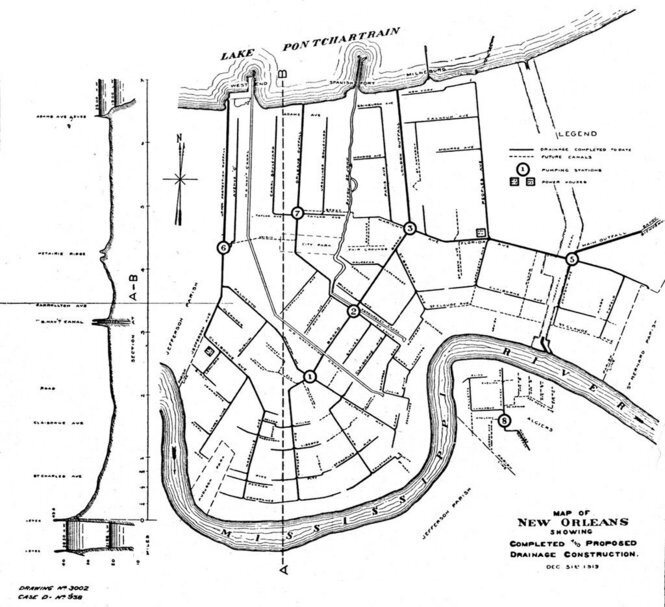
Since its founding in 1718, between the natural levee of Mississippi River banks and higher land along the shores of Lake Pontchartrain, the bowl-like city has never had adequate drainage. In its early days, New Orleans’s system of drainage ditches and canals “was totally inadequate, even for a town with as little runoff as early New Orleans,” according to a 1999 Army Corps of Engineers report on the city’s drainage history. During storms, each of the city’s blocks became an island surrounded by flood waters. One year, Mardi Gras parades waded through flooded streets. The soggy city was a breeding ground for mosquitoes and the diseases they carry.
In the 1890s, the city council decided to deal with the “extraordinary disastrous condition” of the city’s drainage. By the turn of the century, the city had built giant drainage canals (today mostly hidden underneath the streets, so big that a truck could drive through them).
But moving water out required pumps to get it up and over the higher land rimming the city. The canals carried water from pumping station to pumping station, until the end of the line, where it was pumped into Lake Borgne or, if necessary, Lake Pontchartrain. There were pumps built into the original drainage system, but in the 1910s, a local engineer, Albert Baldwin Wood, built New Orleans better pumps than any city had ever had.
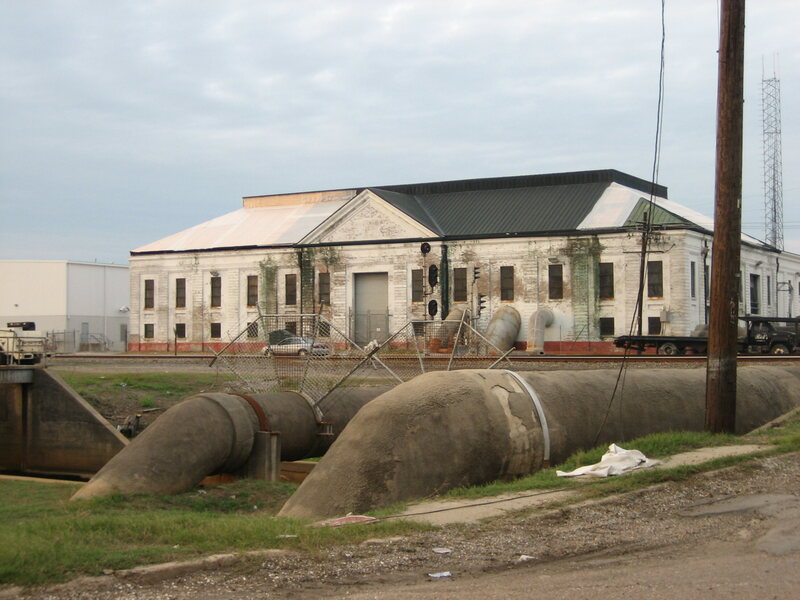
“For their time, they were a real mechanical marvel. The real backbone of the current system is these historic pumps, and they work extremely well,” says Benjamin Maygarden, a historian and lead author of the Army Corps report. One early Wood pump is still working as a constant duty pump—for day-to-day drainage, rather than pulses of storm water—at Drainage Pumping Station No. 1, says Maygarden, who's now a project manager at Gaea Consultants in the city. “It’s still in almost daily use. They’re really remarkable mechanical things.”
Wood’s innovative pumping system made it possible for New Orleans to thrive and expand, despite the city’s less-than-ideal location. A century after their creation, his pumps are still engineering wonders. But they come with a caveat. Many of the pumps use an outdated electrical standard, and the city generates power just for them, with turbines that are difficult and costly to maintain. They're unreliable enough that this past summer a rainstorm caused the city to flood for days, and whenever hurricanes threaten—like Tropical Storm Nate, which is heading through the Gulf of Mexico this weekend—the system's weak spots are put to the test.

Albert Baldwin Wood was a New Orleans native, so dedicated to the city that he rarely left, even after other cities starting clamoring for his help. He started working for the Drainage Commission in 1899, as Assistant Manager of Drainage, and spent 55 years with the city’s Sewerage and Water Board, which had merged with the commission in 1902.
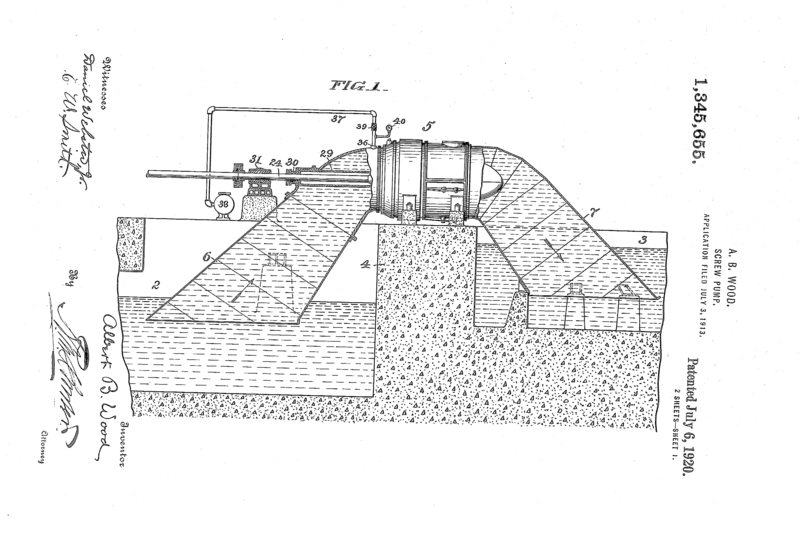
Wood’s original job was to address the city’s overwhelming and increasing drainage needs. He started designing pumps, and by 1915 had created the giant, horizontal screw pumps—the largest and most advanced pumps of their time—that are his legacy.
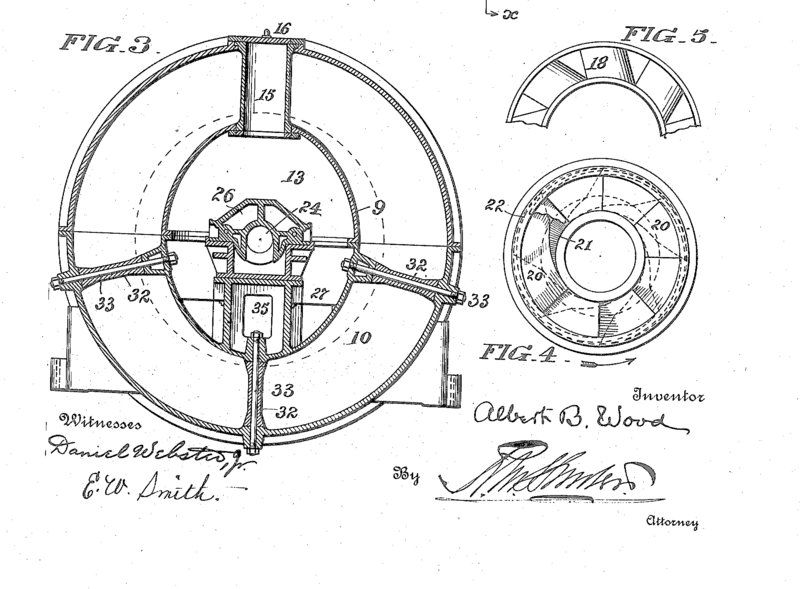
He had started small, by designing an experimental pump just a foot long. Whereas New Orleans's prior pumps had been vertical, this one lay on its side. A vacuum pipe sucked the water into the pump’s rotating center and through to the next canal or the lake at the end of the line. Wood scaled the original model up to 30 inches, then 12 feet. One of the genius aspects of Wood’s design is the ease by which the interior could be accessed for maintenance: Hatches on top let people pop inside, and the space was big enough to fit multiple people. The city ordered 13 of them.
In 1915, four of Wood’s 12-foot screw pumps went into action. “Getting the pump castings from the nearest railroad siding to the pumping stations, and then erected, was an engineering feat in itself,” Maygarden and his colleagues wrote in their report. Each pump, on its own, was 100 tons. Most importantly, though, they worked. An independent evaluator from Tulane University wrote, “Emergency service is probably the weak point of the old pumps. It is the forte of the new. Results show that the pumps easily answer all requirements and that they are the largest and most efficient low-lift pumps in the world.”
Wood’s system was so successful that it was replicated all over the world, from the Netherlands to China. The pumps only got larger, too: In 1929, 14-foot pumps started duty, with the aim of doubling New Orleans’s drainage capacity. By then, the original 12-foot pumps had been going for 10 years. In 1924, Wood wrote that the pumps didn’t show “any signs of wear or deterioration.”
That very first 12-inch screw pump is still in New Orleans, in Drainage Pumping Station No. 1. While that small pump is displayed as a relic, Wood’s pumps have been working to keep floods at bay for years. The city today has 120 pumps, and dozens of them are Wood screw pumps.
The electrical system that powers these older pumps, however, is a different matter. Older pumps, installed before the 1970s, run on 25-cycle power, which has long fallen out of use in favor of 60 Hz electricity. To make 25-cycle electricity, New Orleans is still running decades-old steam boiler turbines that require specially trained machinists to maintain them. When the turbines need repairs, the city often has to either order a bespoke part from an outside company or have it made specially, in-house. As the people who know how to keep these turbines running have retired, they’ve been hard to replace, and inadequate staffing has forced employees to work overtime.
The upshot of this is that, of the city’s four 25-cycle generators, one has been under repair since 2012. When they opened it up for refurbishment, “engineers kept finding more parts that need to be fixed and others that had to be built from scratch,” The Times-Picayune reported. This past summer, two more turbines were already offline when a fire shut down electricity in the fourth. In early August, a storm dumped nearly 10 inches of rain on the city and, without enough power, the drainage system couldn’t handle the storm. Neighborhoods flooded, and it took days for the working pumps to dry the city out.

There have been some rumblings about replacing these old turbines. A 2012 report, commissioned by a task force dedicated to reforming the system, recommended that the Sewerage and Water Board stop putting money into the old system, and instead convert to modern 60 Hz power. “The pumps are amazing, volumetrically, at what they can take on,” says Jeffrey Thomas, whose consulting company put together the 2012 report. “The Achilles heel is the power.” The type of flooding experienced in August, he says, was inevitable. Eventually the day would come when heavy rainfall coincided with problems with the pumps' power supply.
Right now, though, there are no workable long-term plans to change the technology. The Wood pumps were designed in “the age of over-engineering,” says Maygarden, which is why they're still chugging. Wood and the engineers of his day could not have anticipated the massive amount of runoff, from pavement and rooftops, that the pumps would have to deal with, but they were well-made enough to handle it. Some pieces of urban infrastructure do last hundreds of years. If the Wood pumps are hooked up to a more reliable power source, who knows how long they could last?

After nine weeks of poking, prodding, and drilling, a group of international scientists recently made waves when their research confirmed the existence of the lost continent of Zealandia. They unearthed its hidden history and revealed that the submerged terrain is the world’s eighth continent, having sunk beneath the Pacific Ocean after breaking off from Australia millions of years ago.
Yet people have actually been exploring Zealandia for ages in the places where it peeks above the water, albeit unaware they were treading on a long-lost landmass. Even after most of Zealandia slipped beneath the sea, six percent of its land managed to remain above the surface. These places are currently home to approximately 5 million people.
New Zealand and its outlying islands make up a whopping 93 percent of Zealandia’s total land area, including the continent’s highest point, Aoraki (Mount Cook). But the towering peak isn't the only awe-inspiring Zealandia location worth visiting. Here are eight fascinating places you can visit to witness the wonder of Earth's rediscovered continent.

When glaciers carved through the granite cliffs along the edge of the Tasman Sea, they created a magnificent waterway called Milford Sound. The water here is home to an abundance of unique flora and fauna. The remains of ancient clams are buried beneath the fjord’s floor, and the world’s largest population of black coral trees also lives under the water's surface. Visitors can take a boat ride through the watery wonder, where they may be accompanied by seals, dolphins, penguins, and even perhaps the occasional whale.

The depths of the caves in Waitomo, New Zealand, come alive with the blue-green glow of bioluminescent bugs. Riding atop an inflatable raft through the dark caverns is like floating within a surreal subterranean cosmos. Though the mass of twinkling lights looks almost otherworldly, it's actually just a bunch of fungus gnat larvae clinging to the rock walls. They use long strings of sticky mucus to attract and trap their food, and, subsequently, dazzle the tourists who pass through.

Much like the surviving lands of Zealandia, this stalwart tree refused to sink. It pierces through the surface of Lake Wanaka against the stunning backdrop of the Southern Alps. Called "the lone tree of Lake Wanaka," it's said to be among the most photographed trees in all of New Zealand. But it's actually a fairly secluded spot, accessed only by wandering off the beaten path.

This small volcano is bursting with bright colors, despite its bland English name. Yellows, greens, teals, and reds paint the terrain, hidden beneath swirls of pearly smoke. Though the Māori called it "The Dramatic Volcano," the landscape earned its second name after Captain Cook sailed by in 1769 and found the island blanketed by white clouds. The Māori name is perhaps a bit more accurate: The small landmass is actually the tip of a much-larger submerged volcano, which still spews the colorful sulfur that adds to the island's rich palette.

Lying 370 miles east of mainland Australia, this South Pacific island chooses to mark its time a bit differently. It’s the only Daylight Savings Time-observing region in the world that switches its clocks forward by 30 minutes instead of a full hour. The governor, fueled by an unknown personal desire to briefly share a timezone with New South Wales, organized a referendum to set his unconventional time preference into law. In addition to its quirky way of keeping time, Lord Howe Island was also home to a century-long war against rats.

This barren sea spire is home to the world’s rarest insect, the Lord Howe Island stick insect (also called “land lobsters” and “walking sausages”). They were believed to be extinct until 2001, when scientists found a colony of the elusive bugs living under a single bush about 100 feet up the otherwise entirely infertile islet. Somehow, a few of the weird wingless insects had been able to escape a rat-induced extinction on Lord Howe Island and made their way over 14 miles of open ocean to settle on the spiky rock.

This tiny, uninhabited islet is just under half a mile from Norfolk Island, an Australian territory in the South Pacific. Yet unlike its neighbors, this chunk of land isn’t the tip of a submerged volcano. It was actually formed by a mixture of sand blown from dunes and rock fragments, all glued together by dissolving limestone. Though many of the island’s trees were felled by the European settlers of nearby Norfolk Island, the roughly 25-acre landmass is now a haven for locally endemic wildlife.
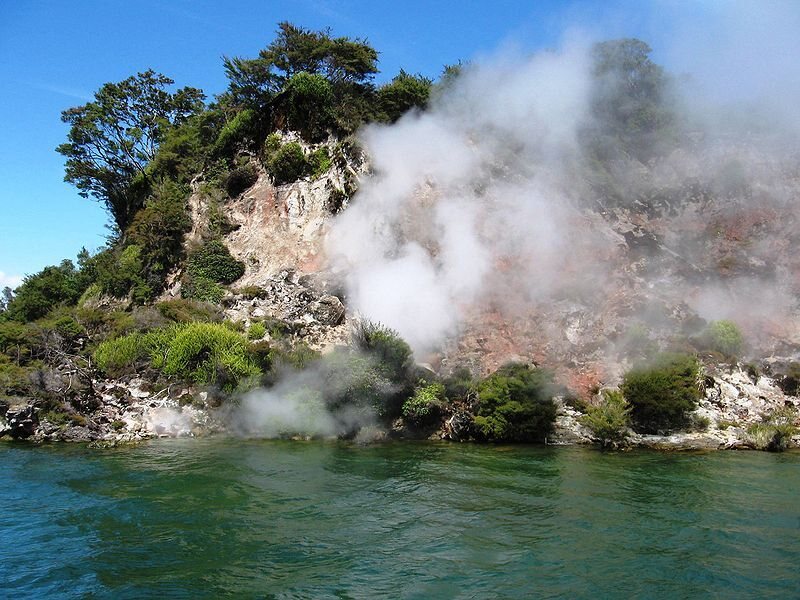
Zealandia, a lost wonder in itself, was home of another lost wonder once dubbed the “Eighth Wonder of the World." The famous Pink and White Terraces of New Zealand were a hot spot for British tourists during the Victorian era until they were annihilated in a cataclysmic volcanic eruption in 1886. Though the rose-tinted terraces were believed to be gone for good, recent research has suggested that some fragments are hidden within the waters of Lake Rotomahana, buried beneath layers of ash.

With disaster relief efforts still in crisis mode in Puerto Rico, a number of private companies and citizens are doing what they can to help the island's residents. While some are providing food and other necessary materials, Project Loon, a division of Alphabet’s X lab (formerly Google X), is trying to set up temporary internet and cell service using giant balloons.
As Futurism is reporting, Project Loon has received expedited approval from the FCC to launch wireless data-providing balloons over Puerto Rico and the U.S. Virgin Islands as soon as possible. The goal of Project Loon is to provide internet coverage to inaccessible or less developed parts of the world by floating large balloons in the stratosphere, at about 65,000 feet. The balloons carry signal relay points capable of communicating with service providers on the ground—in a sense they are more or less floating cell towers. According to Project Loon's website, the balloons can stay up for as long as 190 days at a time.
Once they're in place, the Loon balloons would be able to provide emergency cell service and high-speed internet to rescuers, workers, and citizens on the ground. Project Loon has provided similar disaster relief and testing in places ranging from France to Indonesia to Peru.
The exact number of balloons that will be deployed over Puerto Rico is still unclear, as they must first establish an on-the-ground base from which to transmit to the balloons. But with luck, Project Loon’s simple solution could speed recovery efforts and help save lives.
Although it was a flourishing metropolis in the 1700s and 1800s, Naples, Italy, then a kingdom in its own right, was home to multitudes of the poor, many of whom lived in one-room dwellings and were often on the move. In need of cheap, quickly consumed food, they relied on flatbread garnished with toppings of […]
The post 10 Tantalizing Facts About Pizza appeared first on Listverse.