Shared posts

17 Nov 13:58

The Naked Pig Meat Co.

by Liz Mitchum

Recognizing the superiority of a lard—lard!—may seem a bit ambitious, but do this: Try cooking with it first. Like an understated set in a Tony-winning play, a good lard quietly
improves whatever you decide to feature center stage—baked goods, omelets, fried chicken. The Naked Pig Meat Co., run by Shawn and Jenny Hatley—members of a fourth- generation North Carolina farming family—follows in the footsteps of earlier generations who got rendered pork leaf fat right. That starts with raising meat “we would want to feed our kids,” Shawn says, “which means no funk, no junk.” Their hogs are allowed to root around in pastures, and are free of chemicals and antibiotics. The lard gets processed in small batches, then triple filtered and hand bottled in glass jars. In its classic form, it imbues a luxurious layer of umami to whatever it touches. And it gives off a bright, clean aroma while positively shimmering in the pan.

>Kettle-rendered pork leaf fat, $9 from thenakedpig.com


MORE MADE IN THE SOUTH:

> Food winner: Milton’s Local
> Food runner-up: The Naked Pig Meat Co.
> Food runner-up: Congaree and Penn
> Food runner-up: ’Chups Craft Condiments

See all winners and runners-up

The post The Naked Pig Meat Co. appeared first on Garden & Gun.

17 Nov 13:58

Overall Winner: Alabama Sawyer

by Liz Mitchum

If you’ve never heard of hackberry, you’re not alone. A
durable wood that looks like a sophisticated hybrid of pine and ash, it’s often neglected by commercial furniture manufacturers in favor of more common tree species. But in Birmingham, it happens to be abundant—exactly the reason Leigh and Cliff Spencer, the founders of the local woodworking company Alabama Sawyer, love to showcase the timber. For their planked dining table, which takes about six weeks to complete, they turned four large boards into a 90″-by-36″ eye-catching, understated design, sealed with a subtle hand-rubbed oil that allows the natural grain to stand out. The signature wishbone-shaped iron legs, which Cliff initially modeled out of foam and wood, are cast at the city’s iconic Sloss Furnaces—a campus of blast furnaces from the 1880s that’s now a National Historic Landmark.

photo: JASON WALLIS

Birmingham furniture maker Cliff Spencer atop a log waiting to be milled in Bessemer.

That emphasis on local materials and manufacturing makes up the core of the Spencers’ design philosophy: Playing off the farm-to-table ethos, the husband-and-wife team dubs it “field to studio.” They first started rescuing urban trees that would otherwise be destroyed while running a custom cabinetry and furniture business in Los Angeles. After Cliff gave a lecture on the subject at Design Week Birmingham in 2014, the couple decided to launch Alabama Sawyer, before moving their new business (and their two children) to his hometown two years later.

When they arrived, they discovered that almost a hundred trees were being cut down in the city every week. Working with local wood services and developers—who were more than happy to reduce disposal costs by handing the logs over to the Spencers—they began designing and selling pieces of various sizes, from cutting boards to writing desks. As Alabama Sawyer’s reputation grew, city arborists and timber-loving neighbors added their own fallen trees to the supply. “It would be complicated enough to focus on just the fieldwork or just the design process,” Leigh explains. “But we’re very dedicated to doing both—figuring out ways to make sure this wonderful resource is not wasted.”

photo: JASON WALLIS

Dried slabs of city-sourced post oak.

For one of their first projects in Birmingham, the Spencers worked with a local Montessori school that was forced to cut down a group of red oaks to expand, transforming the trees into paneling for classroom ceilings and funky stumps for play groups. A couple of months ago, the pair took on a similar venture for the Birmingham Zoo, this time converting a massive 7′-by-5′ cherry stump into the centerpiece of a new amphitheater.


Watch: An interview with Alabama Sawyer’s Cliff Spencer


Collaborating with each other comes easily. Leigh, a graphic designer, handles the business’s day-to-day operations. “I come in with an initial idea based on what the market is asking for and what materials we have,” she explains. After a bit of brainstorming, she and Cliff hone the design and its technical requirements. Cliff, who has a woodworking background—past projects include shop windows for Saks Fifth Avenue and movie sets in L.A.—then crafts the look of each piece. The initial steps of air-drying and milling the wood take place on a lot just out-side of town. Everything else happens at the large-scale wood shop they rent inside the Make Birmingham coworking space. “We’re surrounded by jewelry makers and painters, which is very inspiring,” Leigh says.

Three years in, the Spencers aim to grow the business, ideally putting out a new collection every six months. They also hope to begin working with other metals produced in Birmingham, such as brass, as well as marble mined from a nearby quarry. In the meantime, they’ll continue to spotlight neglected tree species like the hackberry—as they have with this seriously handsome table.

> Planked dining table, $6,700 from alasaw.com 


MORE MADE IN THE SOUTH:

>Home category and overall winner: Alabama Sawyer
>Home runner-up: Mollie Jenkins Pottery
>Home runner-up: ME Speak Design
>Home runner-up: Moore & Giles

See all winners and runners-up

The post Overall Winner: Alabama Sawyer appeared first on Garden & Gun.

17 Nov 12:38

How To Ace Your Self-Assessment

by Georgene Huang, Women@Forbes
It's getting close to that time of year again.
16 Nov 18:32

An Illustrated Look at the Terlingua Chili Cook-off

by Miss Cellania

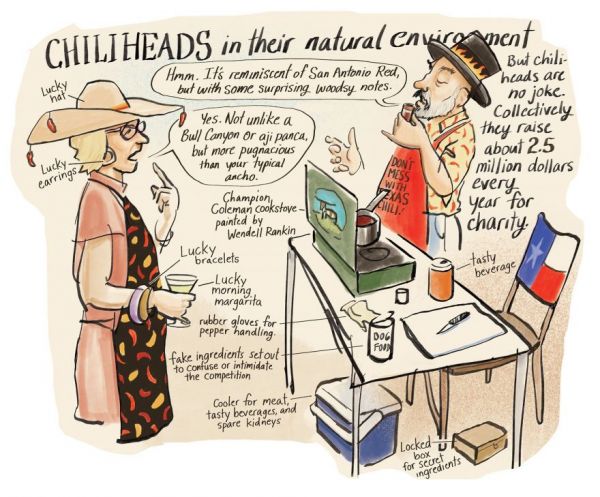
The town of Terlingua, Texas, has been hosting a chili cook-off for over 50 years now. In a state where chili cook-offs are thick as thieves, this one is the biggie, and it comes with a ton of history. The founders split into rival cook-offs (now held at the same time), the rules were established, and there were controversies along the way.

Terlingua, Texas. It’s the Super Bowl of chili cook-offs. You can’t compete unless you’ve gotten yourself qualified by winning smaller competitions, and you have to show picture ID on account of what happened in 2003. A fella by the name of Don Eastep, a Yankee no less, snuck into the proceedings posing as his brother, who’d qualified but couldn’t attend.

As if that wasn’t bad enough, take a listen to this. Picture a desert scene with pickup trucks and campers and about a hundred folks in straw hats and aprons cooking chili on camp stoves. Now, our friend here, he’d set up his cooking area, but he wasn’t cooking. He was strolling around sipping a koozie-clad cold one and chitchatting. He’d eventually ask folks for a taste of their chili in a Styrofoam cup, and most of the cooks obliged. He took those samples and dumped them into his own pot. He got enough to enter the contest. And he won. Yep. He won the whole dang deal.

That certainly wasn't the first, or the last spectacular controversy at the Terlingua Chili Cook-off. Matthew Diffee attended the 50th Terlingua Chili Cook-off in 2016 and brings us a condensed but lavishly illustrated explanation and history of Texas' premiere chili event at Texas Monthly. -Thanks, Walter!

(Image credit Matthew Diffee)

PS: If you want a deep dive into the founding and first split of the Terlingua Chili Cook-off, here is the story as it happened, from 1967, part one and part two.

16 Nov 18:32

Your Complete Timeline for Getting Thanksgiving Dinner Cooked, Served, & Cleaned Up 

by Amanda Blum on Skillet, shared by Virginia K. Smith to Lifehacker

Thanksgiving dinner is a dance. Due to family and the National Dog Show—which is just a drinking game sponsored by Purina—it’s a dance we usually perform while distracted. The key to nailing this particular dance is to have a written timeline. A plan gives you freedom, because even if you’re soused, you can just look…

Read more...

16 Nov 15:42

How to Photograph Star Trails: Here’s a Beginner’s Guide

by Will Nicholls

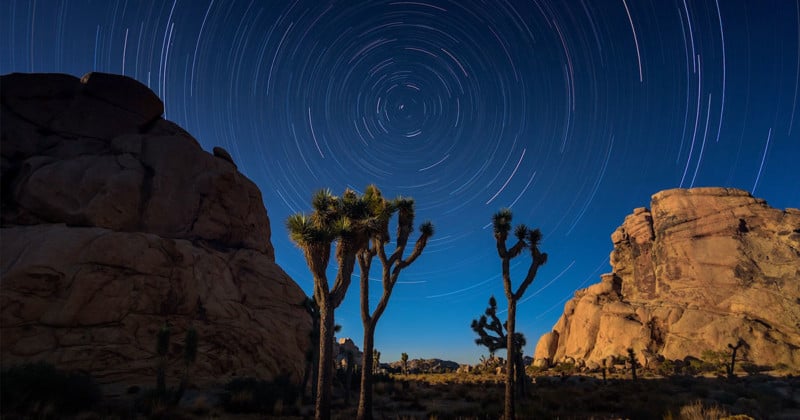
Here’s an 8-minute tutorial from Nature TTL and astrophotographer Matthew Saville about how to photograph star trails. Considered by some as the holy grail of astrophotography, this technique harnesses the rotation of the Earth for captivating images.

Photos like this can be created by those brave enough to stand in the cold throughout the night with their cameras pointed upwards:

Saville starts by reminding photographers not to use in-camera noise reduction for star trails or you might start seeing stars disappearing from the shot. If you’re shooting in a cold environment, the temperature will reduce the amount of color noise you’ll see from a long exposure time.

Make sure you have a good battery too, as if you run out of juice during the shoot then you’ll see gaps in your trails while you’re changing over and not shooting.

Saville also swears by using a higher ISO speed and a wider aperture. These are two factors which will give you brighter and more obvious stars in the shot.

Check out the full video above for more tips for photographing star trails, and subscribe to the Nature TTL channel for weekly nature photography tutorials.


Disclaimer: I own and operate the Nature TTL YouTube channel.

15 Nov 19:15

Nova Scotia Is Streaming Its Favorite Local Meat Log

by Cara Giaimo

There's that famous quote by Jean Anthelme Brillat-Savarin: "Tell me what you eat, and I shall tell you what you are."

The same goes, these days, for webcams: Tell me what you're streaming at all hours from your local tourism page, and I shall tell you where you live. Over the past few years, 24/7 video feeds have become a conduit for hometown pride. They're a way for particular areas to show off what makes them special, whether that's a talent for building log fires or simply a nice-looking downtown intersection.

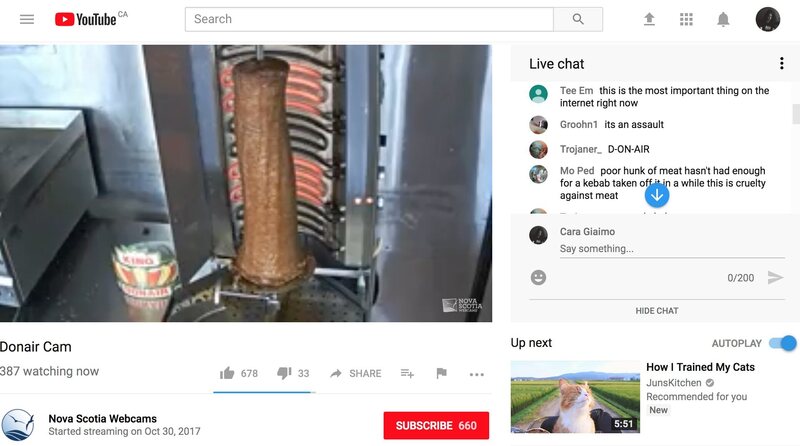
These two truths collide, finally, in Donair Cam: a 24/7 view of a log of spicy beef, slowly rotating and roasting in a fast food restaurant in Halifax.

Donair Cam, which went live earlier this week, is taking the Canadian internet by storm. It's a collaboration between chain restaurant King of Donair and the ever-popular Nova Scotia Webcams, the auteurs behind such past hits as LobsterCam and Merlin the Talking Parrot.

As of press time, nearly 400 people were watching the meat tube spin. A hunk of this group was also contributing to the live chat, offering up observations such as "That looks like the front wheel of Fred Flintstones [sic] car" and "OH MY GOD LOOK AT THAT BAD BOY COOK."

article-image

So what exactly is this particular carne-column? As discerning eaters may have noticed, the donair bears a close resemblance to other sandwiches made with twirling cylinders of meat, including the shwarma, the gyro, and the similarly-named doner kebab. According to Food Network Canada, it was introduced to the area in the 1970s by a pizza shop owner named Peter Gamoulakos, who had immigrated from Greece.

After a standard lamb gyro failed to resonate with customers, Gamoulakos remixed the dish for the Nova Scotian palate, swapping lamb for spiced beef and adding onions, tomatoes, and a garlicky "donair sauce." It caught on, and in 1973, he opened the first King of Donair, and began slinging the meaty pitas to Halifaxians at all hours of the day and (mostly) night.

Forty-odd years later, the donair has become—in the words of the CBC—"arguably Halifax's most iconic dish." There is at least one video game about it, and a special-edition scratch ticket, called "Mucho Donair-o," once offered a year's supply. It was even declared the province's official food in 2015, after a controversial vote. (One pro-donair city counselor pointed out to his colleagues that if the measure didn't pass, "Won't we all falafel?")

If you want to see what all the fuss is about, tuning into this webcam probably isn't the best strategy. True appreciation requires feasting more than just your eyes. But there is something soothing about watching the meat spin lazily, comfortable in the knowledge that everyone loves it.

15 Nov 19:14

See Salary Ranges and Commute Times with Google’s Improved Job Search Tool

by Patrick Lucas Austin

Looking for work is stressful, especially when you think about toggling between the various job sites you’ll have to scour for the right gig (not to mention all the attendant resume tweaking) . To help, Google’s updating its recently launched Google for Jobs service, allowing job seekers to glean more information…

Read more...

15 Nov 19:13

The Secret Chord That Makes Pop Music Sound Happy

by Natasha Frost
article-image

With all due respect to the Neptunes, Max Martin, and Jack Antonoff, there's really no such thing as a pop music machine. But there might be a secret formula for happy pop songs. A recent journal article in the Royal Society Open Science compares the emotional resonance of lyrics with their corresponding musical elements across nearly 90,000 pop songs. Cheery language, the researchers say, might include "baby," "sweet," or "good." Unsurprisingly, "pain," "fight," "die," and "lost" fall into the opposite camp. They found a very strong correlation between those happy lyrics and a single, particular type of chord: the humble seventh.

Seventh chords are among the first you learn when you're new to the piano. They're simple, melodious, and hard to mess up. And they're all over pop music: David Bowie's Young Americans, Marvin Gaye's What's Goin' On, Good Vibrations by The Beach Boys, and countless others. Researchers downloaded songs—including all three above—from Ultimate Guitar, a community-based website where users upload transcriptions of music. Next, they downloaded crowdsourced data from labMT and used it to analyze the "emotional valence" of the lyrics. Some of their results were, to anyone with even a passing knowledge of music, fairly self-explanatory. Major chords match positive words, negative ones go with minor chords. More unexpected, however, was the emergence of seventh chords (which come in both varieties), which have four different notes rather than the usual three, and their surprisingly robust association with positive words. And this seems to transcend whether they are major or minor.

Also from the not-so-surprising file: The study, and its reduction of music and emotion to data points, has garnered a mixed response. At least one musicologist claims that it bears no real resemblance to how chords and notes work. "We should beware the lazy assumption that words carry the true meaning of a song and music and the rest are just feelings, to be applied like cake decorations," wrote Alan Marsden on The Conversation. "Music has its own elements and structures, and speaks in many ways." But, in a sense, this seems to be precisely what the study is suggesting—that chord progressions can work like adjectives or nouns in a way that creates the same kind of emotional resonance in our brains. Perhaps the lyrics of A Hard Day's Night are unimportant—if that minor seventh so clearly communicates how we're supposed to feel.

15 Nov 19:08

The Best Potato Ever? Smoke-Roasted Hasselback Potatoes

by Nancy Loseke

Steven calls them “potato chips on a bone.” That’s as accurate a description as I’ve heard for these accordion-cut potatoes, delectably crispy on the outside and creamy on the inside with an alluring hint of wood smoke.

Invented by a chef at Stockholm’s venerable Hasselbacken restaurant in Sweden (founded in the 1700’s and still in business), hasselback potatoes are one of the trendiest spuds to come down the pike in years. And they only take a few minutes more to prepare than plain baked potatoes. Anyone with modest knife skills can create these starchy works of art.

Start with a good baking potato—russets and Yukon Golds are widely available, but you can use any starchy potato. Scrub the outside well, or peel, if desired. (The skin carries nutrients like vitamins B-6 and C as well as thiamin and niacin, so we leave it on. Plus, we like the textural contrast.)

Place the potato between two chopsticks. Or use a nifty hasselback potato guide like this one for professional-looking results. Using a sharp but comfortable-feeling knife, make a series of parallel cuts 1/8 to 1/4 inch apart down the length of the potato, being careful not to slice all the way through the bottom. The hasselback guide or the chopsticks will prevent you from doing that. Repeat for the remaining potatoes. (If doing more than four, submerge the sliced potatoes in cold water to prevent them from oxidizing.)

Rub the potato all over with extra virgin olive oil, melted butter, or your favorite fat. Season the outside with coarse salt and fresh coarsely ground black pepper, if desired.

Set up your grill for indirect grilling and preheat to 425 degrees. (Don’t worry if you can’t maintain that temperature exactly; just don’t let the temperature go above 450 degrees or the potatoes may scorch.) Brush or scrape the grill grate and oil with vegetable oil. Arrange the potatoes on the grill grate. Throw a handful of soaked, drained wood chips on each mound of coals. Lower the lid.

Smoke-roast the potatoes for 45 minutes; the slices should fan slightly. Baste the potatoes with more olive oil or butter, forcing it between the cuts. At this point, you can also tuck bits of cheese in the interstices and sprinkle more on top. Continue to smoke-roast the potatoes until they are tender, the cheese has melted, and the tops are golden brown; 20 to 30 minutes more. Serve with chopped fresh herbs.

You can find the full recipe here, which will appear in Steven’s newest book, Project Fire (preorders are now being accepted).

In the meantime, here are tips and variations you’ll want to try once you master the simple art of hasselbacking.

  • Instead of white potatoes, substitute sweet potatoes or yams. When stuffed with butter, brown sugar, cinnamon, and miniature marshmallows, they make a great Thanksgiving dish.
  • Small B-size potatoes can be hasselbacked and served with a dip and cocktails or as a prelude to an autumnal dinner.
  • Come up with your own flavor combinations. For example, stuff the potatoes with blue cheese and bathe in a Buffalo-style wing sauce made with melted butter and Frank’s RedHot or your favorite hot sauce. “Loaded” hasselback potatoes with cheese, sour cream, bacon, and chives are real crowd-pleasers. Take the pomme de terre in a French direction with caramelized onions and slices of Gruyère cheese. Or finish with thinly sliced mozzarella, crisped prosciutto, and pesto sauce. Next on my agenda is a purple Peruvian potato finished with a Peruvian cheese sauce called huancaína. (The sauce recipe will be in Steven’s new book, too!)
  • Rub the potatoes with duck, goose, or bacon fat before roasting.
  • After oiling or rubbing with fat, season the potatoes with your favorite rub. We’re partial to Steven’s new Project Smoke line of rubs.
  • Try the hasselback preparation on other vegetables. I’ve used zucchini, which was a big hit, but have recently seen the technique used on butternut squash halves.

Have you tried hasselback potatoes for yourself? Have another favorite potato preparation? Tell us about it in the comments or on Instagram, Facebook, or Twitter.

The post The Best Potato Ever? Smoke-Roasted Hasselback Potatoes appeared first on Barbecuebible.com.

15 Nov 19:02

Pulled Pork in a Hurry: Introducing 3-2-1 Pulled Pork

by Nancy Loseke

If you have six hours of daylight, you can barbecue a pork shoulder and sit down to an incredible meal before the sun slips below the horizon. Tough, now that we’ve gone off Daylight Savings Time. But doable.

This was all Steven’s idea. Buoyed by the success of 3-2-1 ribs, one of our most popular blogs, Steven wondered what would happen if we treated a pork butt (aka, shoulder) to 3 hours of smoke, 2 hours wrapped in butcher paper, foil, or parchment paper, and 1 hour unwrapped.

If you have any experience with it, you know pork butt is one of the most forgiving meats there is, absolving you of most sins you could ever commit against it. It’s the poster child for “low and slow,” often taking 8 to 10 hours to reach 195 degrees—the threshold temperature for pulling. Anything less, and you’ll have to resort to chopping it or slicing it.

But let’s say you don’t want to chop or slice it. You want textbook, Instagram-ready, Pinterest-worthy pulled pork. And you want it fast.

Enter 3-2-1 pulled pork. Yes, we’ve found a way to speed it up by manipulating the time and the temperature. Here’s how it goes.

3-2-1 Pulled Pork

At 10 a.m. I generously seasoned a 4-pound pork butt on all sides with Steven’s Project Smoke Carolina Pit Powder. A great alternative is his All-Purpose Rub (find the recipe here). If you want, slather the pork with mustard (cheap yellow mustard or Dijon) before seasoning.

Pork Butt

I intended to use my trusty Weber Performer, but the relentless rain disabused me of that idea. My back-up plan was my Traeger, which lives on a big screened-in porch. As a bonus, I can set the exact temperature and use the pellets of my choice—hickory, in this case. I set the smoker to 275 degrees—on the outer edge of smoking temperatures. I then set my seasoned pork butt on the grill grate.

At 1 p.m., I wrapped the pork—now bronzed with smoke—in butcher paper and reset my iPhone alarm for 2 hours. The meat was looking beautiful when those hours were up. But 1 more hour (unwrapped) was needed to firm up the bark. By 4 p.m., the pork was ready to pull. I always let it rest for 20 minutes, then don rubber insulated food gloves to pull the meat into large chunks and remove the bone. While you can use table forks, meat claws make quick work of pulling the chunks into meaty shreds.

Meat claws and pulled pork

I was a little skeptical when Steven suggested this unorthodox method. But now I’m sold. The key is to barbecue the pork at a slightly higher temperature (275 degrees), and then wrap it in butcher paper, parchment, or foil. And the pork butt I used was relatively small—4 pounds. If you need to feed a crowd, barbecue multiple pork butts. Your grill or smoker can likely accommodate several. I can’t guarantee this method would work on an 8 pound pork shoulder because I haven’t tried it yet. The pork butt I barbecued (bone-in, by the way) was about 3 inches thick.

For more information on barbecuing perfect pulled pork, click here.

Pulled Pork Recipes:

Check out our 1000+ Recipes section here on Barbecue Bible.Com

Also, sign up for our Up in Smoke newsletter so you don’t miss any blogs and receive some special offers! PLUS get Raichlen’s Burgers! PDF for free!

Follow Steven on Facebook, Instagram, YouTube, TikTok, Reddit, and Pinterest!

Check out our store powered by BBQGuys!

The post Pulled Pork in a Hurry: Introducing 3-2-1 Pulled Pork appeared first on Barbecuebible.com.

15 Nov 18:51

Cardiff Tower in Los Angeles, California

The "synangogue's" tower.

Nestled in a quiet, largely Orthodox community just south of Beverly Hills, this stately synagogue doesn't appear out of place, until you look closer...

Though it towers over the other synagogues, schools, and small homes and businesses that surround it, the beige and white structure at the corner of West Pico Boulevard and South Doheny Drive does an admirable job of blending into its sleepy environs. In this sense, the building's designers achieved their goal of creating a building that was largely invisible.

Observing the "synagogue," questions emerge. Where are the windows? Why is there a loading dock? Visitors arriving at the right time may even catch a glimpse of the building's tower moving.

The mysterious features have a simple, if bizarre explanation: The “synagogue” is actually an active oil well site containing 40 functioning wells. It was designed to resemble a synagogue to allay the fears of concerned community members.

Built by Occidental Petroleum in 1966, the Cardiff Tower was hailed as the first “architecturally designed oil derrick.” The ribbon-cutting ceremony was attended by the mayor of Los Angeles himself, who remarked that the building was "an outstanding contribution to civic beauty.”

Despite the praise, few developers considered it worthwhile to follow the Cardiff Tower's example in disguising unsightly oil derricks. Nevertheless, the Cardiff Tower is a pleasant monument to a timely truce between corporate interests and a self-sustaining community.

14 Nov 15:29

Here's Why You Shouldn't Store Precious Metals Yourself (Hint: It's More Than The Risk Of Theft)

by Olivier Garret, Contributor
Precious metals are a critical asset class in every portfolio but that doesn't mean you should keep them stored under your bed. Here's why.
14 Nov 15:21

Fix Your Slow Internet With These Networking Options

by Patrick Lucas Austin

If you’re sick of suffering from poor Wi-Fi connections or slow streaming speeds in your house or brick-lined apartment, that one router tucked away in a corner may not be capable of effectively covering your home. In that case, you may need not just a new router, but a new type of router. To spare yourself the…

Read more...

14 Nov 15:13

These Credit Cards Give You Free Airport Lounge Access

by Susan Shain on Two Cents, shared by Virginia K. Smith to Lifehacker


Free booze! And snacks! So many outlets! It’s not a stretch to say the Chase Sapphire Reserve has ruined me.

Read more...

13 Nov 15:22

These Are the Things Restaurant Workers Wish You Knew

by Patrick Allan

Recently, we asked people who worked in the food service industry if there were any insights about their job they wished restaurant patrons would know, and we got some great answers. Whether it’s about tipping, food orders, or how you should and shouldn’t treat the wait staff, these are the secrets to being a good…

Read more...

13 Nov 15:18

Here’s How to Find and Store Your Account Recovery Passcodes

by Patrick Lucas Austin

Losing (or breaking) your phone is never fun. Yes, there are the complications that come from it being covered in fragile glass, but the issue that’ll ultimately cause your more grief is this: your phone is the key to your online identity. If you’re using two-factor authentication on your devices, you may rely on the…

Read more...

13 Nov 15:12

Pasture Guru Sarah Flack Shares How to Grow a Better, Greener Pasture

by Modern Farmer
Sarah Flack has spent nearly all of her 48 years surrounded by cows, sheep, goats, and chickens—first on her family’s Vermont farm, then studying pasture management at the University of Vermont and, more recently, traveling the world as a consultant to livestock outfits looking to do the right thing. Last year, Flack distilled her experience into a guide, The Art and Science of Grazing, so authoritative that both Joel Salatin and Allan Savory blurbed the book.Of course Flack’s approach is anti-feedlot, but she doesn’t believe it’s enough to simply turn animals out on the same patch of grass season after season. “Rotational Grazing,” in which livestock is circulated among several paddocks, represents a step up, though it’s not ideal because the pastures’ “recovery periods are kept the same length, even when plant growth slows,” writes Flack. “Pasture quality will decrease each year due to overgrazing damage, increased weeds, and rejected forage.”Instead, she advocates for the “Management Intensive” method. Despite the intimidating name, the system is basically rotational grazing with the “of course” twist of paying close attention to plant health. Animals are rotated among paddocks more frequently and in a carefully considered way that allows pasture to recover and sprout anew. And livestock isn’t merely grass-fed, but nourished by a diverse mix of annual and perennial grasses (crabgrass, Kentucky bluegrass, fescue), legumes (a category that contains beans, as well as alfalfa and clovers), and forbs (pretty much everything else, including weeds like dandelions).We’ve excerpted Flack’s detailed diagnostic (below) to help you recognize and address a whole host of problems that can a affect your pasture—and ultimately your animals and the environment. As Flack puts it: “When done well, grass-based livestock farming is a beautiful way to have a positive effect on a parcel of land and on a small part of the planet.”A chart for troubleshooting pasture management from Sarah Flack’s book, The Art and Science of Grazing. Click to enlarge.Adapted from Sarah Flack’s book The Art and Science of Grazing: How Grass Farmers Can Create Sustainable Systems for Healthy Animals and Farm Ecosystems (Chelsea Green Publishing, 2016) and printed with permission from the publisher.The post Pasture Guru Sarah Flack Shares How to Grow a Better, Greener Pasture appeared first on Modern Farmer.
13 Nov 15:10

The 10 Best Lightroom Alternatives (Free and Paid)

by Andy Betts

Adobe Lightroom is the default photo management and editing app for many photographers. But where you could once buy the program and use it for as long as you wanted, it’s now only available through a subscription. Which is a model that doesn’t work for everyone.

What are the best Lightroom alternatives? Can you get the best features of Adobe Lightroom free of charge, or at least for just a single, one-off price? Here are your best options.

The Best Lightroom Alternatives in 2019

Adobe Lightroom isn’t for everyone. So, if you’re searching for another option, here are the best Lightroom alternatives in 2019.

1. Capture One Pro

lightroom best free alternatives no subscription

Capture One Pro is the closest thing to a direct replacement for Lightroom, although the starting price of $299 makes it a tool for professionals and very serious hobbyists only.

The feature set is impressive. You can migrate your catalogs over from Lightroom. There’s support for RAW files from more than 400 cameras. The editing tools are comprehensive, and presented in a very visually appealing manner. And there are lots of pro-level functions, including support for tethered shooting, with live view.

Capture One Pro is likely to be overkill for many users. But there is a trial available, so you can easily test it out for yourself.

Available for: Windows, Mac

More Information: PhaseOne ($299, Free trial available)

2. DarkTable

lightroom best free alternatives no subscription

At the opposite end of the spectrum to Capture One, there’s DarkTable. It’s free and open source, but still replicates the core functionality of Lightroom.

DarkTable offers detailed asset management and decent editing options. Its RAW processing support for over 400 cameras is well regarded by its users. It also includes tools that have been omitted from Lightroom CC, including split toning and curves adjustments.

On the downside, DarkTable’s interface lacks the finesse of its commercial counterparts.

Available for: Mac, Linux, Windows

More Information: DarkTable (Free)

3. Adobe Bridge

lightroom best free alternatives no subscription

Long before Lightroom, Bridge + Photoshop was the setup of choice for many photographers. Adobe Bridge is the asset management part of that combination.

It’s still available, it’s still a good Lightroom alternative, and it’s one of the best free Adobe apps you can use. You need an Adobe account to download it, but a basic, non-paid account is fine.

Bridge handles all your cataloging needs. You can organize your images into folders and collections, add star ratings, apply keywords, view metadata, and so on.

Adobe Camera Raw isn’t included in the free version, so you do need to add your own RAW processor if you’re shooting RAW. You also need to add your own editing app—GIMP is a great free Photoshop alternative, or take a look at Affinity Photo as an affordable paid option.

Available for: Windows, Mac

More Information: Adobe (Free)

4. DxO PhotoLab

dxo photolab

Formerly called OpticsPro, PhotoLab is a pro-level image editing app that competes with Capture One and comes at a similar price to Lightroom 6. The feature set is comparable, too, with the inclusion of full asset management, so you can import and organize your images. This was missing in the old version of the software.

The editing features from Lightroom are all in place, and it’s easy to use and very responsive. The noise reduction capabilities in particular are highly rated. On top of that are some basic local adjustment tools, and RAW support extends to 400 cameras. It all adds up to a quality tool and is a viable alternative to Lightroom for most users.

Available for: Windows, Mac

More Information: DxO ($99–$149, Free trial available)

5. RawTherapee

lightroom best free alternatives no subscription

RawTherapee is primarily a standalone RAW processor with wide camera support. It’s as much an alternative to Adobe Camera Raw as Lightroom, but with some basic digital asset management features it’s still worth considering.

RawTherapee won’t import your images and sort them into folders for you—you need to do that some other way. But once they’re there you can apply colors and ratings to help keep track of your best images.

The RAW capability has a strong reputation among the enthusiast crowd. This is especially true for users of Fuji cameras, which produce notoriously challenging RAW files. There is a certain learning curve to the app, but it rewards the time you put in.

Available for: Windows, Mac, Linux

More Information: RawTherapee (Free)

6. Skylum Luminar 3

Luminar is one of the most affordable Lightroom alternatives, but that doesn’t make it light on features. It includes AI tools that recognize the content of your images, and allow you to make selective adjustments far more easily. You can change the exposure of the sky, for instance, without touching the people in the foreground.

There are bags of filters, powerful sharpening options, ways to reduce noise in your photos, and most of the retouching tools you’d expect from Lightroom. The Gallery lets you import, organize, and manage a large library of photos, too. It’s a great app and well worth a look.

Available for: Windows, Mac

More Information: Skylum Luminar 3 ($69, Free trial available)

7. ON1 Photo RAW

lightroom best free alternatives no subscription

ON1 Photo RAW is a relative newcomer to the market. It combines the best of Lightroom—cataloging and organization tools plus fast RAW processing—with a few concepts from Photoshop, including layer support. This enables you to composite images together in a way you cannot do in other Lightroom alternatives.

It’s fast, and has strengths in making local adjustments and working with effects and filters. But it does suffer a little from a cluttered interface that hides important tools while also causing you to rethink your workflow.

Available for: Windows, Mac

More Information: ON1 ($119, Free trial available)

8. ACDSee Photo Studio Professional

ACDSee Photo Studio Professional is a Windows program that has clearly got Lightroom in its sights. Priced at $99.99, it has all the main features of Adobe’s app, plus some extras of its own.

You get comprehensive cataloging and organizing tools, and a thorough RAW editing mode with support for more than 500 cameras. But you also get things like a Liquify tool that enables you to retouch photos by moving groups of pixels without altering them. You’d normally have to switch to Photoshop for that.

Available for: Windows

More Information: ACDSee ($99, Free trial available)

9. Apple Photos

apple photos

Finally, what of Apple and Google’s Photo apps? The chances are you are already use either of them on your phone. Can they give you the best features of Lightroom for free?

Apple Photos is very good for photo management, and it plays nicely with your third-party editor of choice. The addition of tools like a tone curve and definition slider have made it easier to get the kinds of results you’d expect from Lightroom. RAW support is built into macOS, so the app works with a large number of cameras.

Photos includes cloud storage for all your images. See our guide on how to use iCloud Photos to learn how to get the most from that.

Available for: Mac

More Information: Apple Photos (Free)

10. Google Photos

lightroom best free alternatives no subscription

Google Photos is entirely cloud-based, and runs in the browser on your desktop. That may make it a total non-starter for you. But the processing capabilities are excellent. It benefits from the technologies carried over from apps like Snapseed, as well as from Google’s machine learning algorithms. It also has some limited support for RAW files.

Google is great for organizing your shots. You don’t need to worry about adding keywords, as it automatically identifies things in your shots and produces them upon a simple search. It isn’t so good for managing big shoots, though.

Available for: Windows, Mac, Linux, Chrome OS

More Information: Google Photos (Free)

Take Your Pick of Lightroom Alternatives

Lightroom got to the top for a reason. Whatever quirks it may have, it is the best at what it does. But the competition is catching up. If you don’t want to pay for a Lightroom subscription, you’ve got some fantastic options that you can either pay for outright or get for free.

One of the main considerations when picking your Lightroom alternative is how good the RAW processing is. Not all apps are as good as one another in this regard, and some will produce better results with certain cameras than others.

For this reason, you should definitely download and test the trial versions where they’re available. See how they well fit both your gear and your workflow.

Want more free replacements for expensive software? Check out our guide to the best free alternatives to Lightroom, Photoshop, and Illustrator for a comprehensive rundown.

Image Credit: clearviewstock/Depositphotos

Read the full article: The 10 Best Lightroom Alternatives (Free and Paid)

13 Nov 14:36

H & H Restaurant – Macon, GA

by willoughbyandy

Heading to the beach for Labor Day weekend, we left early enough in the day that lunch would be in Macon. That meant finally making it to H&H Restaurant.  H& H is somewhat of a legend in Georgia restaurant and music circles, as one of the founders of the restaurant, “Mama Louise” Hudson,  first fed the young Allman Brothers when they were living in Macon (splitting a meal six ways) and then went on tour with them in 1972 to cook, although she, purportedly, never fixed a meal on the road.

H&H has been in business since 1959, when Inez “Mama Hill” began serving breakfast, joined in the business by her god daughter and cousin “Mama Louise”.   They were partners in the business until Mama Hill’s death in 2007.  Mama Louise continued operating the restaurant, shutting it down in 2013, then selling to new owners who re-opened after re-modeling in August 13, 2014. 

We arrived a little early for lunch and were seated at a table near the rear of the restaurant.  The walls are decorated with album covers and band photos from much of Phil Walden’s Capricorn label’s roster, including Wet Willie and Sea Level, along with memorabilia from the Allman Brothers. 

We both ordered the fried chicken – my beloved, above with fried okra and mashed potatoes and gravy, and myself, below, with mac-n-cheese and mashed potatoes (and my chicken smothered in white gravy).

The chicken was good (not great) and the white gravy was better.  The mac-n-cheese and fried okra were both above average and I really liked the semi-sweet yellow cornbread (which always reminds me of the Jiffy-mix cornbread that we had in elementary school.  About two thirds of the way through our meal, Mama Louise came in and took her seat near the kitchen, after visiting with all the servers.  Apparently, even in her 80s, she just wanted to check and make sure everything was being done up to her standards.


H & H Soul Food Menu, Reviews, Photos, Location and Info - Zomato


13 Nov 14:35

Weaver D’s Delicious Fine Foods – Athens, GA

by willoughbyandy

Standing in the doorway, looking both at the sign on the sidewalk that said open 11-6 on Saturday and the closed sign in the window, I’m sure I looked like a dog that had just heard a high pitched noise.

Since “the game was out of town and he had to cook for a funeral”, Dexter Weaver had decided to not open today.  That’s what he told me as he walked out the door, encountering my quizzical face.  He went on to say that he had delivered the food to the church and had come back to cook for an auction house, where he had bought a bed.  I told him we had driven up from Atlanta, exactly because there was no game and I thought traffic and the crowds would be lite.

As we chatted – I had followed him inside by this point – he said he “probably” had an extra piece of chicken with what he was frying for the auction crew.  I looked around as we talked through the window, with him at the stove and me standing out front.  That’s mac-n-cheese in the pan on the right, browning butter in the pan on the left and green beans in the boiler behind it.

The walls were decorated with articles, posters and photos, including one for Automatic25 – celebrating the 25th anniversary of REMs “Automatic for the People”.  (You may recognize that slogan from the signage out front).   After he found he had cooked an extra roll (yay! for me), he threw it into the pan of browning butter to warm and told me that they had just had the Automatic25 party at the 40 Watt and that for that “silver” anniversary, a lot of the folks had gone silver, gesturing toward his graying hair.

I didn’t have a chance to order from the menu, above, I just happened to be there at the right time to get the seventh plate from a meal for six he was preparing for the folks at the auction house, adding a glass of lemonade to the fried chicken, green beans and mac-n-cheese.  While I was waiting the young man from the auction house came by and Dexter put him to work, draining the cooler and then asking him to wash up before dipping ice for the drinks he would take with him.    

At one point, he said he thought had added too much cheese to the mac, but I told him that I didn’t think that was really possible.  I paid him for the plate, put some more money in the tip jar and and walked out to the truck, before I opened the styrofoam container.

The mac n cheese, definitely did not have too much cheese – it was creamy and salted and peppered perfectly.  The green beans were boiled almost as gelatinous as my mom always made them – with a pressure cooker.   And if they had sat in a warmer and you were late for lunch, I’m sure that they would seem almost soup-like.

The chicken was still steaming when we opened the tray.  I took the thigh and gave my beloved the breast, which she (lovingly) shared.  The breading appeared to be corn-meal, was light and came off in big strips, as opposed to breaking and shattering into pieces.  The meat was moist and tender.  I loved it. 

I know that my lunch today, was an exception – and a blessing, as I saw several folks come up (as we sat in the truck and ate) and then leave, so I’m counting myself lucky.  

How did I feel about the meal?  To quote a Zomato review: “If this place has 77% likes, then 23% are Damn Yankees!”

Weaver D's Delicious Fine Food Menu, Reviews, Photos, Location and Info - Zomato


13 Nov 14:34

Biscuit Love – Nashville, TN

by willoughbyandy

On a Saturday trip to Nashville, we spent the morning at the flea market (one of the best in the South and worth the trip, IMO) and were looking for lunch.  I had one particular place in mind and found a parking place right across the street.  Only to find a line of 45-50 people on the sidewalk, waiting to get in.  That wasn’t going to work (it was 2:30 Atlanta time and had been a LONG time since breakfast), so I decided that we would try Biscuit Love, in the Gulch.  We parked across the street and were heading towards the door when we saw 60-80 people in line, on the sidewalk.  Not again! 

Never mind – they were all lined up to take their photo in front of a chalk drawing of angel wings that were 10-12 feet high.  We passed by that, and waited outside the restaurant itself for about ten minutes.

Starting as a food truck in 2012, it evolved into a brick and mortar location in 2015 (a second location has opened since and a third is in the works).  Following the lead of the food truck model, this is a walk-in and order, then take a table kind of place and our delay was with having a spot to sit, not speed of service.  The menu is fairly simple and we arrived near the end of their day (they’re open every day from 7:00 am to 3:00 pm), but were at the table less than ten minutes before we got our food.  Focusing on sourcing the best quality ingredients, they use two of my favorites – Benton’s ham and Nueske’s bacon.

We started with John’s Ham Bar – a sampler of local ham and local cheese with biscuit wafers.  My bride ordered the Wash Park –

a biscuit, with 2 beef burger patties, pimento cheese, bacon jam and a fried egg.  The pimento cheese was excellent and the burgers were griddled perfectly, with crispy edges.  I chose the East Nasty – a chicken biscuit with sausage gravy.  

The gravy was good without too many herbs (people tend to get wild with gravy these days) and the sausage was spicy without being too hot.  The fried chicken had a crisp skin and was tender and moist.  In fact, the tip that took us to Biscuit Love actually came from a Garden ‘N Gun article about the best fried chicken in the South, in a reference from the chef at Acre, in Auburn, Alabama.

But here’s the crazy thing – neither of us was crazy about the biscuits.  For a place with “biscuit love” as the name, maybe bar was set too high.  They weren’t bad biscuits, but I’ve had better, on many occasions.

Biscuit Love Brunch Menu, Reviews, Photos, Location and Info - Zomato


10 Nov 13:21

1960 Porsche Diesel Junior Tractor

Although it's no secret that Dr. F Porsche made diesel tractors, it's still strange to see the iconic name attached to such a utilitarian machine. The Junior is the smallest...

Visit Uncrate for the full post.
10 Nov 13:20

Reflex 1 SLR Film Camera

Mixing modern engineering with classic looks, the Reflex 1 SLR Film Camera is the first newly-designed SLR system in over two decades. It uses a modular design to provide flexibility,...

Visit Uncrate for the full post.
10 Nov 13:18

5 NASA Sites to Explore Earth, Space, and Science

by Mihir Patkar
nasa-sites-explore

As the leader of space exploration, NASA has a unique perspective on the world. The key for us, as regular folk, is to gain some of that perspective. And NASA has some ways to do that. The geeks at NASA made some educational and entertaining sites with interactive features. The aim of these is to tell people what’s happening on the earth and in the great beyond. Importantly, many of these try to spark a love for space in children. Who knows, your child might become an astronaut for real. 1. NASA’s Eyes (Windows, Mac): “Google Earth” for Space How...

Read the full article: 5 NASA Sites to Explore Earth, Space, and Science

10 Nov 12:47

Hide And Seek

by Ernie Smith
Hide And Seek

Editor’s note: Tonight’s issue is a slightly expanded rerun of a classic issue of Tedium with some additional info added in spots where it makes sense. Enjoy!


Today in Tedium: We gained a lot when albums went fully digital, but we also lost a bunch of stuff along the way. Among the things we lost: Record sleeves, media towers, and Tower Records. We have digital equivalents of all these things, so it's not like we necessarily miss them. But perhaps the one thing we lost that we'll never get back is the hidden track. It was one of the few things about an album that couldn't easily be converted to MP3 or Spotify. Why is that? Simple: When everything's a file and Siri can dig it up for you if you ask nicely enough, there's simply nowhere to hide anymore. And it's a shame, because the hidden tracks were the only interesting part of some albums. Today's Tedium analyzes the artform of the hidden track. — Ernie @ Tedium

Tonight's GIF features a spinning Beatles album. Can you guess which one?

Hide And Seek

Keep Us Moving! Tedium takes a lot of time to work on and snark wise about. If you want to help us out, we have a Patreon page where you can donate. Keep the issues coming!

We accept advertising, too! Check out this page to learn more.

23

The length, in seconds, of The Beatles' "Her Majesty," a song that's widely considered the first "hidden track." The brief acoustic ditty, written and performed by Paul McCartney, was supposed to be part of Abbey Road's lengthy medley on its back side. The problem was, there was nowhere good to put it, so McCartney ordered engineer John Kurlander to remove it from the album. He did, but—in a happy act of defiance—later added it to the end of the album after a few seconds of silence. “The Beatles always picked up on accidental things. It came as a nice little surprise there at the end, and he didn’t mind," Kurlander later recalled.

Hide And Seek

Why CDs had more interesting hidden tracks than vinyl records

The compact disc was such a forward-thinking format when it first came out that it needed its own bible. That bible was called the Red Book.

The book, formulated by Philips and Sony, explains the detailed technical specifications of the format, including the maximum length of a CD (74 minutes), the maximum number of tracks there can be (99), the minimum length of a single track (4 seconds), and the standard sampling rate (44.1 kHz).

(If you would like to read a copy of the Red Book, good luck with that: being a book that describes the innards of a proprietary material, it'll cost you a solid $295.)

The Red Book also hid within its specifications a number of quirks that bands would later discover and take advantage of. They introduced a number of opportunities to do really interesting things with albums that you couldn't do during the vinyl era. For one thing, you could mess with the track listing by adding a few seconds of silence between tracks; for another, you could actually put music before the official start of the album, in an area called the pregap. It's a spot so hidden—only accessible by rewinding the CD as far back as possible—that most computers to this day still can't access these hidden tracks.

For the most part, hidden tracks at the end of the album tend to hide full songs, most famously "Endless, Nameless" at the end of Nirvana's Nevermind, an album which many observers believe popularized the hidden track for compact discs.

(Per a 1996 Los Angeles Times article, the idea for the track may have come from a prank that Cobain pulled on his friend Jesse Reed, in which he put a long gap of silence on a tape, but then included a stretch of audio that featured Cobain, using a scary voice, saying he was going to get his roommate.)

Meanwhile, hidden tracks in the pregap area tend to hide introductory music—with one notable exception to that rule being the Northern Ireland band Ash, whose album 1977 included the band's pre-album single, "Jack Names the Planets," in the pregap.

To this day, new albums are taking advantage of these tricks—even though most buyers are most likely never hearing them in this form. A good example of this is the Arcade Fire’s album Reflektor. The first disc of the double album includes a ten-minute pregap track of reversed instrumental music culled from other parts of the album.

Problem is, the pregap was a better trick when we were using five-disc players. Computers, for the most part, don't recognize pregaps, and modern DVD and Blu-Ray players don't recognize them either, as one Arcade Fire fan learned when his Blu-Ray treated the pregap as part of the first track of the album.

Oops. Sounds like someone should go look over the Red Book again.

“We had these visions of stoned fans, of which there were a lot in the early '70s, having the shock of their lives when brand new material was playing on a record they had had for months. Some people thought there was an alternative version because they would hear talk of these mysterious sketches that they had never heard on their record. It drove people mad. This was precisely why we did it, of course.”

— Monty Python's Michael Palin, discussing the comedy troupe's reasoning for creating a three-sided record. The Monty Python Matching Tie and Handkerchief, which came out in 1973, featured a record with concurrent grooves, an impressive technical feat pulled off by recording engineer George Peckham, who had experience with tricks like this, having worked on numerous Beatles records in the past. The goal of the trick was confusion: both sides of the record were labeled "side 2," and they basically wanted people to trip upon the third side by accident. Peckham later invented another vinyl phenomenon, the "run-off groove," in which hard-to-see messages are placed onto the dead area of the wax.

Five examples of "hidden tracks" that transcended their "hidden" status

  1. Train in Vain,” the final track on The Clash's London Calling, was added to the album after the sleeves had already been printed, but nonetheless was a calling card for the band, becoming one of the band's two Top 40 hits in the United States.
  2. Can't Take My Eyes Off You,” as performed by Lauryn Hill for her 1998 album The Miseducation of Lauryn Hill, was such a critical success that it received a Grammy nomination that year—one of ten that she received for the album that year. It was one of the album's two hidden tracks.
  3. Bitches Ain’t Shit,” an unlisted track on Dr. Dre's landmark 1992 album The Chronic, found a second life on the pop charts in 2005 after Ben Folds made a version that … well, made it whiter.
  4. Euro-Trash Girl,” a 1994 hit by Cracker, was one of three hidden tracks at the tail end of the band's 1993 album Kerosene Hat, and (thanks to the help of numerous blank tracks) it was listed at track number 69. The band added the song at the last minute due to positive fan reaction to the song.
  5. Mr. E's Beautiful Blues,” one of the most popular singles released by Mark Oliver Everett (better known as Eels), was put on his album Daisies of the Galaxy essentially because his record company told him he had to. He put it at the end of the album because it ruined the flow of the record anywhere else. They made it the single, and essentially forced him to put the song in a Tom Green movie.

“In the beginning, it was kind of a verbal thing to put that track at the end. Maybe I misconstrued their instructions, so you can call it my mistake if you want. Maybe I didn't write it down when Nirvana or the record company said to do it. So when they pressed the first twenty thousand or so CDs, albums, and cassettes, it wasn’t on there.”

— Howie Weinberg, the man who had mastered Nirvana’s Nevermind, explaining how he accidentally left the song “Endlesss, Nameless” off of the first pressing of the album—effectively making that first pressing valuable as a collectible. Per a 2003 book on the album’s creation, Cobain apparently was quite upset that the song was missing from the pressing, and the amount of time between the song and the end was decided upon by Weinberg.

The hidden track these days is seen as a relic of the past, something that we didn't appreciate while we had it.

But back in the late '90s, they had been overdone to the point that people were starting to get sick of them. A 1999 New York Times essay by Scott Sutherland made the case that such gimmicks were transparently wearing thin.

"It's time for musicians and labels to rethink why they hide what they hide," he wrote. "If most artists have a hard enough time filling even half the space on a 74-minute CD with compelling material, why bother hiding something equally uncompelling? And if a song is good enough to be the best thing on the disk, why hide it at all?"

As annoying as they were for the listener, they could often be just as annoying for the label. A 2014 Wondering Sound piece on hidden tracks noted how They Might Be Giants really peeved off their label by including a pregap track on their 1996 album Factory Showroom.

The reason for this is that such tracks require a more detailed production process, meaning that the label has to do more work to ensure that the discs are up to snuff during the pressing process.

These days, we just call these extra pieces of art what they are: bonus tracks. No hiding necessary. It's not like Spotify will let us hide them anyway.

06 Nov 17:33

The 8 Best Sites for Quality HTML Coding Examples

by Ryan Dube

The very first thing to learn when studying web development is how to code with HTML. More importantly, being able to code in HTML5 using all the latest techniques.

Everything you see on a website is built with HTML and CSS (with some JavaScript sprinkled in). There is a lot to learn, so what are the best resources to get started?

There are some awesome websites that offer well-designed HTML coding examples and tutorials that can show you the most effective ways to code.

Here are eight sites that offer good HTML code examples and help you become an HTML expert.

1. HTML Dog

HTML Sandbox for HTML Coding Example

HTML Dog has an offering of tutorials, techniques, references, and examples of HTML code. They also offer CSS and JavaScript, which is an added bonus if you’re a web developer. HTML Dog uses HTML5 so you’re getting up to date information.

Their HTML examples cover all kinds of syntax with demonstrations for each.

Clicking on any of the elements will open an interactive coding page. HTML Dog provides examples in code boxes that you can copy and paste into your own HTML code. It’s a good way to merge learning and working.

You can see the live HTML output of the sample code on the pane on the right. It’s a neat sandbox to play around with all kinds of code.

2. W3Schools

W3Schools HTML Code Example

W3Schools is widely regarded as a top resource for web developers, boasting coding examples, from PHP to JavaScript (what is JavaScript?) You’ll also find a section with basic HTML coding examples.

Just like HTML Dog, they’ve incorporated a split-screen tool to try coding in. You can test out the HTML you learn in each lesson and experiment with different pieces of code. Code your HTML, click Run, and you’ll see how the code would look on a real HTML page.

3. Mozilla MDN

MDN HTML Guide With Examples

The Mozilla Developer Network (MDN) has documentation for web developers. There is a comprehensive list of HTML tutorials and code examples to try. Most of examples are built into their tutorials, so working through their path will give you lots of opportunities to learn.

MDN is highly regarded by developers for its detail. They cover web development in great detail, which works to your advantage as their sections tie into each other. You’ll learn good behavior so that when you start coding CSS or JavaScript everything runs smoothly.

The detail can be a little daunting at first. The sections are very thorough, but you’ll get the hang of it! This is a great resource to keep around as you get more advanced, you’ll never really outgrow the tutorials.

4. freeCodeCamp

freeCodeCamp HTML Coding Examples

freeCodeCamp is known for its online courses and training guides for coders. They have a great section of HTML examples as well. The pictured tutorial covers code examples from beginner elements like headers to advanced concepts like semantic markup.

Each section has examples of HTML so you can see the element in action. It’s a great resource to come back to as you learn to code.

5. Codecademy

HTML web page code sample

One of the most well-known websites for learning programming is Codecademy. When it comes to learning HTML, Codecademy doesn’t disappoint with an HTML training course.

The course is around nine hours of content and covers most of the language. Four sections are covered in-depth: elements, tables, forms, and semantic HTML.

The course work area is quite advanced and gives you the flexibility to play around in the sandbox. You can also switch it to full screen to see what your website looks like in a full browser window.

The nice thing about this course is that it also incorporates learning about using CSS to format your pages. This is helpful since HTML and CSS work hand-in-hand to create web apps.

6. HTML.com

HTML.com Coding Examples

HTML.com is a website dedicated to all things HTML. Opening the site you will see a beginner’s guide to learning the language from ground zero. It’s worth a read before diving into the syntax.

Once you’re ready to learn HTML.com has many tutorials for various subjects. Tutorials like HTML document structure, using links in HTML, and working with images. Their tutorials are good reads with lots of code examples throughout to keep you sharp. You will also find an alphabetized list of HTML elements if you want to choose one to learn more about.

7. BitDegree

HTML Coding Examples on BitDegree

BitDegree focuses on interactive code learning so it’s very valuable as an HTML guide. You can read guides on every HTML element. Each guide explains what the element does and shows you a piece of code using it.

Each piece of code can be opened in their sandbox to try out. It’s a dictionary for HTML elements! You can spend plenty of time here experimenting with a quick reference for what everything does.

8. Tutorials Point

Tutorials point HTML Coding Examples

Tutorials Point is a no-frills HTML resource. It’s easy to navigate and pinpoint HTML elements for coding examples. Much like the rest of these examples, it’s a good choice to bookmark and have on hand when you’re writing code.

More HTML Code Examples and Resources

There is nothing quite as exhilarating as spending some time coding your own website and revealing your masterpiece to the world. If you study HTML you’re on your way to joining the ranks of web developers who have built their own apps. These 8 sources of HTML coding examples are all nice to save for when you need them.

If you want to dive further into HTML check out 17 simple HTML code pieces you can learn in minutes. Learning the basics of HTML is a great place to start writing web apps. Once you get far enough with the language it can do some amazing things.

Check out our guide to understanding the basics of HTML code, it goes hand in hand with a lot of these examples.

Read the full article: The 8 Best Sites for Quality HTML Coding Examples

06 Nov 17:18

Provisions: The Great North Woods

Featured header

When we're in Portland, Local 188 is always on the top of our list for grub — no matter the time of day. With an eclectic and unfailingly delicious mish-mash of tapas, American standards and a killer brunch (be sure to ask for the home made Apple Maple Jam), there's nothing on the menu that doesn't merit a second helping — or a third. When we heard that only one cocktail was great enough to earn a year-round spot on said menu, we had to learn how to make it for ourselves. As you might expect, The Great North Woods is a humdinger — built in large part from just two quintessential Maine ingredients: Canadian Club whiskey and maple syrup. Bottoms up!


Ingredients

2 oz Canadian Club Whiskey

1/2 oz Lemon Juice

1/2 oz Maple Syrup

6-7 Dashes Angostura Bitters

Splash of Soda Water

Lemon Slice

Mint
 

Directions

1. Combine maple syrup, lemon juice, and whiskey.

2. Shake and strain over ice.

3. Add dash of soda water on top for fizziness.  

4. Finish with bitters, slice of lemon and mint.


06 Nov 17:15

Provisions: Molly’s Cast Iron Crisp

by Huckberry Staff
Featured header

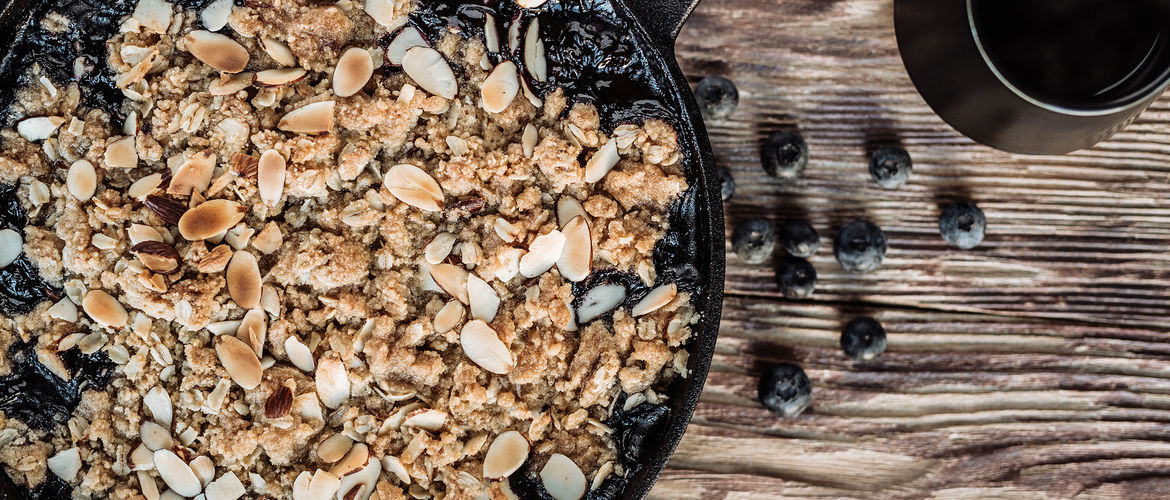
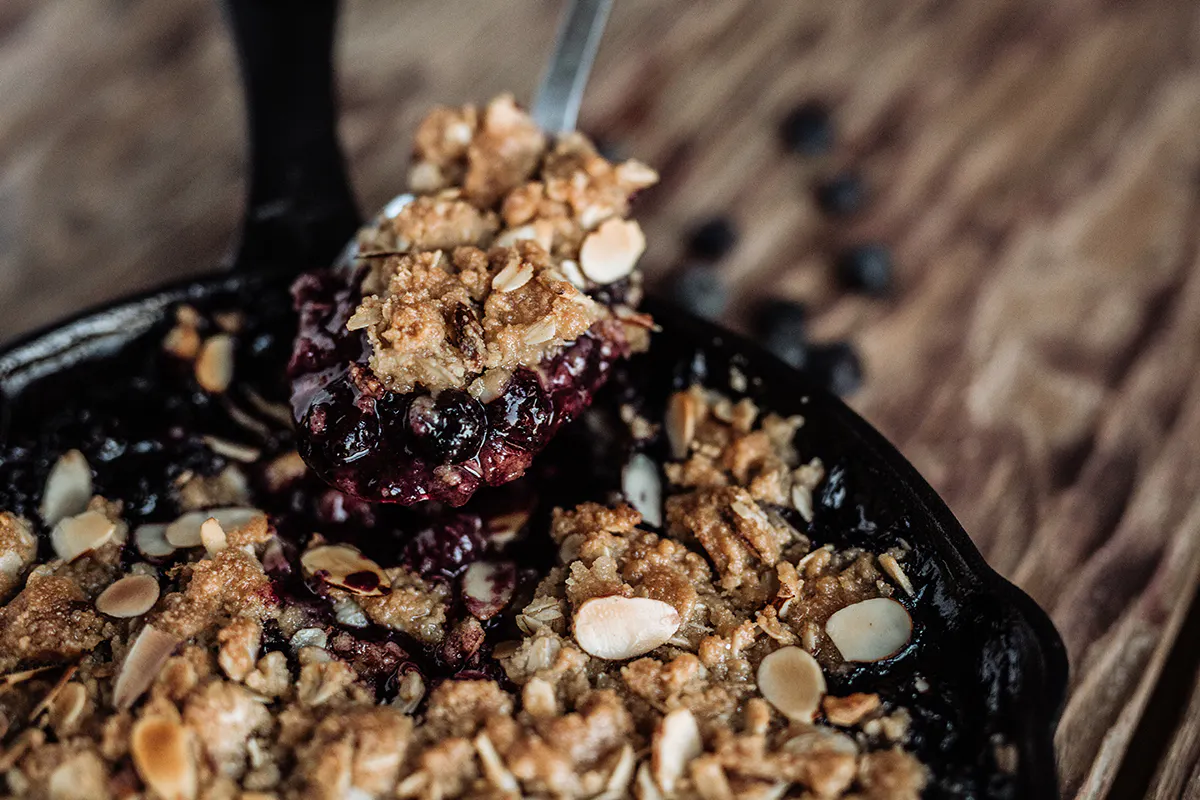
Made with wild Maine blueberries, Molly LaVecchia’s go-to dessert had young Leo passed out on the couch and the Huckberry catalog crew scrambling for seconds. Serve it with vanilla ice cream to impress the in-laws after dinner, or pair it with a cup of coffee for the perfect afternoon snack in a questionably balanced diet.

Blueberry Filling Ingredients

- 6 cups blueberries

- ⅛  cup white sugar

- 1 tbsp lemon juice

- 1 tbsp potato starch

- ¼ tsp cinnamon


Crumble Topping Ingredients

- 2 cups all purpose flour

- 3/4 cup white sugar

- 1/2 cup brown sugar

- ½ cup sliced almonds

- 1 ½ cup rolled oats

- 1 ½ sticks butter, room temperature

- ½ tsp almond or vanilla extract

Directions

1. Preheat oven to 375°  

2. Make Topping

     - Cream butter and sugar

     - Add almond extract

     - Add dry ingredients and mix

     - Set Aside

3. Make Filling

     - Gently mix all ingredients in a bowl

4. Butter Cast Iron Skillet

5. Pour in blueberry filling mixture

6. Top with crumble mixture and spread evenly

7. Bake 30-35 min until bubbly and top is golden brown


[H]

06 Nov 17:15

Building Out a Van with Chris Burkard

Featured burkard header

If you've spent much time in the outdoors, odds are pretty good that you've heard the name Chris Burkard before. We've been drooling over his photos for the past few years, and have even been lucky enough to help launch a few of his projects like his most recent film — "Under an Arctic Sky." That's why, when he told us he was working with the folks at Advanture Company to build out a custom adventuremobile worthy of some serious rig-envy, we knew we had to be a part of it. This new film does some soul-searching about what it is that draws us to trade the comforts of home for the freedom of the open road. We hope you enjoy, and if this leaves you wanting to rip the backseats out of an old Ford and get building, you can check out some of the gear Chris uses to equip his van in his Ambassador Shop.  


"There are road trips that define us, that change who we are as a person and how we see the world. My early ones with my grandpa driving in a van from the Sierras to New Mexico every summer were just that. Life changing. Especially for a kid who had never left California. I built a van to carry on the tradition. This is the “Road to Inspiration" — a short film about how we are defined by people in our lives and the places we love, and of course, the open road. A van buildout that is 30 years in the making."
 

— Huckberry Ambassador Chris Burkard