Shared posts

25 Oct 17:28

Know Your State's Most Pressing Environmental Issues Before Election Day

by Beth Skwarecki

Pollution is killing oysters in Oregon. So much of New Jersey is paved that its storm water has nowhere to go. And in Nevada, the federal government wants to turn a mountain into a storage site for nuclear waste. You should know your state’s most pressing environmental issues before you head to the polls, and Popular…

Read more...

25 Oct 15:56

These Three-Ingredient Instant Pot Yams Are Almost Too Easy

by Claire Lower on Skillet, shared by Claire Lower to Lifehacker

Last night, as I was taking my first test turkey of the season out of the oven, it occurred to me that I had not prepared a side of any sort to go along with the roasted bird. I needed something that could come together while the turkey rested, and all I had was three yams.

Read more...

25 Oct 15:55

5 tips for choosing better beer at the grocery store

by Kate Bernot on The Takeout, shared by Virginia K. Smith to Lifehacker

Last weekend, I approached the beer coolers at my regular grocery store and chuckled to myself at the hushed line of people assembled there, awash in the fluorescent-white glow. Eyes glazed, slightly slack-jawed, shoppers of all ages stared at the hundreds of options with expressions of lobotomized bewilderment.…

Read more...

25 Oct 15:26

How Does Money Laundering Work?

by Alicia Adamczyk on Two Cents, shared by Alicia Adamczyk to Lifehacker

You’re likely familiar with money laundering as a concept from your favorite TV show or the news. Whether it’s Walter White legitimizing meth money via a carwash or Al Capone using literal laundromats to clean his cash (that’s where the term reportedly originated, in fact), it’s the stuff of pop culture and criminal…

Read more...

25 Oct 15:25

Introduce Your Kid to This Database of Paper Airplanes  

by Michelle Woo on Offspring, shared by Michelle Woo to Lifehacker

Making paper airplanes isn’t just a great low-tech boredom killer—it’s highly educational, too. Yep, all that time you spent folding spiral notebook paper into cool gliders in 11th grade economics, you were actually getting a lesson in design engineering. Neat, huh?

Read more...

25 Oct 15:25

Can't Draw Worth Shit? Try These Exercises

by Nick Douglas

Drawing is hard. Even after a lesson with a New Yorker cartoonist, I get spooked by the simplest drawing exercises. If you’re also easily scared off, but you want to get better, try these basic drawing exercises at Envato. They address issues like “I can’t draw a circle” or “my proportions are all off.”

Read more...

25 Oct 15:25

How to Clear Your Search History Off of Google's Servers With the Company's Latest Update

by Mike Epstein

Google, one of the biggest stashers of our personal data, just updated Google Search—Aka Google-dot-com—to make it easier for you to review and edit what search data the company stores. The Google Search page now features a link below the search bar that will take you directly to a new data privacy hub that let’s you…

Read more...

25 Oct 15:20

Here's a Handy Cheat Sheet for Which Alternative Therapies Actually Work

by Beth Skwarecki on Vitals, shared by Beth Skwarecki to Lifehacker

Apple cider vinegar doesn’t shine your hair or rev your metabolism. Yoga is good exercise but not a miracle cure. Homeopathy is useless. On the other hand, light therapy can help seasonal depression. Alternative medicine is kind of a grab bag, and it can be tough to remember what’s what.

Read more...

25 Oct 15:19

Roast a chicken right on the oven rack and let its delicious fat baste your vegetables

by A.E. Dwyer on The Takeout, shared by Virginia K. Smith to Lifehacker

This technique was inspired by an episode of Jamie Oliver’s 5 Ingredients—Quick and Easy Food in which he plonked his whole chicken right on the rack in the oven. I did a double-take. Was this okay to do? No pan? No intricate arranging of carrots like Lincoln Logs to support the chicken in the roasting dish? Would…

Read more...

25 Oct 13:12

Taking on the Baja 1000 in a stock 1970 Volkswagen Bug - Roadshow

by Emme Hall
Three driving teams and 14 people in seven chase vehicles guided No. 1137 down the Baja peninsula on an epic adventure.
25 Oct 13:10

How I Became a Libertarian

by Katherine Mangu-Ward

Reason's 50th anniversaryEditor's note: Reason's December issue—an extra-long celebration of 50 years of free minds and free markets—is on its way to subscribers as we type. To accompany that commemorative edition and kick off our golden anniversary, Reason staff writers were asked to share their libertarian "origin stories." Their responses are below.

Want to receive early access to magazine content like the 50th anniversary issue in the future? Subscribe here!

Objectivism: The Gateway Drug

Katherine Mangu-Ward


If it weren't for Ayn Rand, I might not exist at all.

The (semi-apocryphal) story goes like this: It was the early 1970s in Florida. My mom had recently finished reading The Fountainhead when she met my dad, an architecture student. Rand had—perhaps for the first time—made the profession seem sexy and dangerous, so my mom agreed to a date.

Fast forward to me at age 15, growing up surrounded by good liberals in a suburb of Washington, D.C. My mom gave me a copy of the book, intending it as little more than a historical curiosity. It was a move she has since come to deeply regret. What followed was a summer of voracious reading of Rand's oeuvre—which was at the time my only exposure to ethics, aesthetics, metaphysics, or political theory—then a couple of years as a rather insufferable teenage Objectivist.

On my first day as an undergrad, I came across an Objectivist study group and immediately signed up. What I didn't know was that it was essentially a front group, with the goal of introducing students like me to a wider slate of political thinkers. Their evil scheme worked, and I quickly left the ranks of the orthodox Objectivists in favor of German Romanticism, the Scottish Enlightenment, and Austrian economics. I picked up a copy of Reason magazine for the first time a year or two later, and the rest is history.

I no longer call myself an Objectivist, but it's no easy task to rouse a fairly complacent kid to care about the world of ideas. Rand did it for me, and she's still doing it for thousands of people every year.


Big Brother Made Me a Libertarian

Nick Gillespie


Big brother is literally the reason I'm not just a libertarian but a Reason employee. My brother John, who is four years older than me, discovered Reason in the bookstore at Rutgers University (coincidentally, Rutgers is the undergraduate alma mater of Milton Friedman, whose old dorm served as the headquarters for the economics department and whose top floors were condemned as unsafe for many years).

John was in college between 1978 and 1981 and started sending the mag to me. What a time! The September '78 issue featured a cover story on "France's Philosophical Superstars" that praised Jacques Lacan, a renegade psychologist whom I would later encounter in grad school as a darling of the post-structuralist left. A February '81 story about the Love Canal environmental disaster in upstate New York exposed the government, not private industry, as the culprit, completely reversing the mainstream narrative. In a period that was long on apocalypticism, Reason was describing a world of free expression and experiments in living, of truth and optimism, of belief in the abilities of regular people and super-geniuses to not only solve all the problems of the world but have fun doing it.

By the time I started college in the fall of '81, I was a subscriber and had started calling myself a libertarian. After working at music, movie, and teen magazines for a few years in Manhattan, I went to grad school for literary and cultural studies. Michel Foucault (whose first American gig was teaching at University at Buffalo, from where I took my doctorate) had kind words for and clear sympathies with Hayek, Ludwig von Mises, and Reason Contributing Editor Thomas Szasz, but even still, the experience showed me I didn't want to live in such an intellectually constipated and conformist space as academia.

When Reason ran an ad for an assistant editor I applied, partly on the strength of interviews with everyone from Jerry Mathers, who played the title character on Leave It To Beaver, to Ozzy Osbourne, who played a satanic, bat-biting rock star. I got the job, and, well, here I am, 25 years later. Unlike Winston Smith, who had to learn to love Big Brother, I've never been alienated from my big brother. But my gratitude to him for stamping my passport into an ever-expanding universe of "free minds and free markets" grows with each day.


Losing Showed Me the Value of Tolerance

Scott Shackford


Though I identified as a liberal for much of my early adulthood, I kept company with libertarians throughout my journalism career. The first publisher who hired me right out of college was a libertarian (and a Reason donor), although the newspaper itself was a reliably liberal alternative weekly.

In 2002 I found myself working at a small California daily owned by Freedom Communications, a now-defunct media chain founded by noted libertarian R.C. Hoiles. There were no purity tests for a news editor like myself, but the opinion pages were reliably focused on libertarian responses to pressing news issues. I was resistant but constantly exposed to libertarian ideas.

I took a break from journalism in 2004 to try to make it into television writing. While entrenched in low-level reality show post-production work, I was also surrounded by fellow liberals heavily invested in preventing President George W. Bush's re-election. As a gay man, I watched as the Republican Party made me and people like me the villains that summer and fall, using fear of same-sex marriage to get out the vote. I held my nose and voted for John Kerry (even when I was a liberal, I rarely had much respect for the Democratic Party's flag-bearers).

Kerry lost, Hollywood was crushed (my workplace the day after the election was as silent as a library), and I ended up crawling back to my old job at the newspaper. But it left me with a realization: I thought I needed to "win" the election and control the government so that I could use the power to get what I wanted. Didn't it logically follow that if the "other side" won, they should use the power to do the same?

That logic would mean that I would be treated as a second-class citizen whenever people who opposed gay rights were in charge. I found that untenable. And then I slowly began to understand that in order to convince conservatives not to use the power of the government against me, I had to agree not to do the same to them. That recognition became the bedrock of my own libertarian transformation.

My libertarianism comes from a deep place of humility. I don't want to use the government to control how other people pursue their own happiness. I ask others to afford me the same consideration.


Zig-Zagging Past Guns and Pot

Jesse Walker


I first heard the word libertarian in 1980. Someone had erected a big "Ed Clark for President" sign alongside the 15-501 Bypass, and my family drove past it regularly. My 10-year-old self had heard of Jimmy Carter and Ronald Reagan and John Anderson, but I didn't know who this Clark guy was, so I asked my father (a Carter man) about him.

"He's with the Libertarian Party," Dad told me.

"What's that?" I asked.

"You know how the far right loves guns?" He affected a southern drawl even more pronounced than the one he grew up with: "You'll get mah GUN from mah COLD, DEAD fingers!" Normal voice again: "And the far left, they love pot." Now he switched to an obnoxious-hippie David Crosby/Cheech and Chong tone: "I want my mariWAna, MAAANNNNN. I want my mariWAna."

"Um, OK," I said.

"Well," he concluded, "the Libertarian Party is for both." I'd like to report that at this moment Boy Jesse shouted "Cool!" and declared himself a libertarian, but that actually took a few more years.

As I grew more interested in politics in my teens, my anti-war, anti-authoritarian, hyper-tolerant outlook led me to the left. This was an anarchistic Whole Earth Catalog kind of left that at that point seemed to be fading away, but it was quite definitely the left. It wasn't until I started reading economics in my last year of high school that I realized that radically freer markets didn't have to mean mass poverty or immutable corporate hierarchies. (Quite the opposite.)

I read a variety of explicitly libertarian texts, from The Machinery of Freedom to Illuminatus!, and that helped seal the deal. And then, of course, there was the near-complete set of Reason back issues that I found in my college library my freshman year.

My thinking has evolved in all sorts of zig-zaggy ways since then, but I'm still some sort of libertarian. I never really got into either guns or marijuana, though. As best as I can remember, it's been about a decade since I last shot at a target or smoked any pot. If you ever think I've deviated from the correct line in some way, you can blame those lapses.


Thank God for Reason's Bastard Children

CJ Ciaramella


It's not quite accurate to say Reason saved my political soul, but one of its bastard children did.

As a student at the University of Oregon, I had dabbled in leftist politics, but my interactions with actual campus leftists quickly convinced me I wanted nothing to do with them. So I was skeptical but intrigued when the editor of a student libertarian magazine invited me to write for it.

The Oregon Commentator (RIP) had started in the '80s as a red-meat conservative mag, but by the time I came along, it had dropped most of its social conservatism. The magazine's tagline was "Free Minds, Free Markets, Free Beer," and it had a daily blog full of snark and news. It was irreverent, frequently ridiculous, but also capable of strong reporting on subjects other media ignored. Sound familiar?

As a writer for the Commentator I began covering the University of Oregon student senate, and my anti-government leanings began to increase at a startling rate. Nothing turns you into a libertarian faster than watching a room full of 20-year-olds manage a $12 million annual budget, all of it collected through mandatory student fees.

In the context of university politics, libertarianism meant we were opposed to spending gobs of money to send student senators to conferences in Hawaii, and in favor of free speech and debate. Years before the phrase "social justice warrior" became a cliché, the university was a petri dish for the sort of illiberal campus activism that now makes national headlines.

There was a copy of Choice: The Best of Reason in the magazine office that I would thumb through while skipping class or waiting for drunk staffers to file stories. Reading Reason showed me that the petty authoritarians I saw on campus were part of the larger society. It also showed me there was a coherent ideology beyond dead-end outrage politics and the two-party consensus that government power must be checked, but only when the other side is in charge.

And it was through Reason that I discovered Radley Balko's reporting, which profoundly influenced my views on the criminal justice system and the sort of journalism I wanted to do.

I eventually left college to join the booming newspaper industry (sorry, Mom and Dad), but I had a framework for looking at the wider world, thanks in no small part to Reason and one of its boozy offspring.


Slowly Losing My Republican Roots

Zuri Davis


When I was younger, I read a Time Kids profile of then–Secretary of State Condoleezza Rice. From that moment I decided I wanted to work in the White House under a GOP administration. This and other influences led me to become a die-hard young Republican.

I was reeling in emotions after Mitt Romney's election loss to Barack Obama in 2012 when I was introduced to the libertarians at my college. Seeing as I previously believed that libertarians only wanted to smoke weed and walk around naked, my new friends shattered my biases. They found common ground with me and slowly began to challenge my beliefs on interventionist foreign policy, the death penalty, and the drug war, and they educated me on issues like occupational licensing, criminal justice reform, and constitutional privacy around the time of Edward Snowden's National Security Administration leaks. I was also influenced by a campus visit from whistleblower Daniel Ellsberg during my freshman year.

I eventually became annoyed that I was the least knowledgeable person in the room. I began conducting research so that I could better participate in discussions and defend my beliefs; this led me to Reason.

Things significantly changed when I encountered Frédéric Bastiat's "The Law" and Barry Goldwater's Conscience of a Conservative. I still had a few of my strong Republican roots at the time. But after reading those works, it occurred to me that the "freedom" rhetoric I embraced as a Republican did not translate consistently to policy. This became even more apparent during the 2016 election, as I watched people I once respected beg for more government in the name of security, racial identity, and vague anti-leftism.

These experiences solidified my transition to libertarianism. Because of them, I hope to always be a consistent champion of smaller government and a freer society for all.


A More Consistent Liberalism

Jacob Sullum


As a student at Cornell in the mid-1980s, I was annoyed by leftish activists who hissed during politically incorrect movie scenes, circulated petitions urging the stockpiling of cyanide pills in case of nuclear war, and built ersatz shantytowns to protest the university's investments in companies with ties to South Africa. I therefore eagerly enrolled in political historian Isaac Kramnick's course on "Liberalism and Its Critics" during my sophomore year, thinking it would cover rebuttals to the ideological orthodoxy that prevailed on campus.

The class was, of course, about a different sort of liberalism, one that I somehow had not encountered until that point. To my surprise, I found myself identifying not with the critics (people like Karl Marx and Sigmund Freud) but with the liberals (people like John Locke, Adam Smith, and John Stuart Mill). I previously had thought of myself as a moderate, since I did not feel comfortable on the left or right. But I began to discern a thread of consistency running through my political instincts, something that was sorely lacking in the perspectives conventionally described as "liberal" and "conservative," which seemed like weird hodgepodges of arbitrarily selected positions.

Consistency, it seemed to me, was important, because politics should be based on moral principles, which don't mean much if they are discarded whenever they prove inconvenient. Taking that idea seriously sometimes required me to abandon positions to which I had a strong emotional attachment. I struggled with myself to justify, for instance, government support for space exploration and bans on private forms of racial and religious discrimination.

After graduating, I worked as a newspaper reporter in my hometown, Wilkes-Barre, Pennsylvania, where I picked up my first copy of Reason at a newsstand. The magazine and the authors it mentioned continued my education in classical liberalism.

While I was reading F.A. Hayek, Milton Friedman, and Ayn Rand, I was also covering local government. It is hard to say which was the bigger push toward libertarianism. I realized that politics gives people of limited ability the power to forcibly interfere with the lives of their fellow citizens, and I concluded that it was best to limit that power as much as possible.


From Hillbilly Socialist to Rootless Cosmopolitan

Ronald Bailey


In 1972, I voted for George McGovern. As an earnest 18-year-old at the University of Virginia, I was pushed toward progressive, even socialist, ideals by the prevalent rhetoric and activism against the Vietnam War and in favor of civil rights for black Americans (not to mention the expanding sexual freedom and exuberant recreational drug use). Additionally, growing up poor in Appalachia made me intellectually susceptible to assertions that the federal government could win a war on poverty.

Fortunately, I had signed up for Economics 1 taught by Professor Kenneth Elzinga. While I did well in the class, I intensely disliked its policy implications. Free markets work better than intelligently designed, well-intentioned government programs at achieving social goods? Impossible! With the casual arrogance of youth, I decided to take more economics classes and prove to myself that the free market paradigm of social and political progress was wrong.

In search of an alternative theory, I took several courses from Marxist professors and studied such lefty classics as Paul Sweezy's The Theory of Capitalist Development and William Hinton's Fanshen: A Documentary of Revolution in a Chinese Village. I even read most of Karl Marx's Das Kapital. Studying philosophy, I found myself attracted to the liberal political and epistemological thinking of John Locke, David Hume, and, of course, John Stuart Mill. At the same time, I found the deductive lucubrations of Immanuel Kant and Georg Hegel implausible.

I eventually double-majored in economics and philosophy, and that combination led me ineluctably toward libertarian conclusions. In 1975, Professor Laurence Moss introduced me to such Austrian economists as Carl Menger, Eugen von Böhm-Bawerk, Ludwig von Mises, and Friedrich Hayek. Reading von Böhm-Bawerk's devastating review of Das Kapital, "Karl Marx and the close of his system, a criticism," ended any residual interest I had in Marxism.

I ended up writing a long paper critiquing Mises' assertion that economic theory consists solely of a priori propositions. On the other hand, I was persuaded by Hayek's empirical argument that it is through undirected social and political experimentation that some societies hit upon institutions that enable human flourishing. Those liberal institutions include free markets, private property, free speech, religious toleration, and the rule of law. Liberal capitalism is the only system that has made it possible for billions of people to rise above humanity's natural state of abject poverty and violent ignorance.

Much against my initial inclinations, by 1975 I had become and remain a self-conscious libertarian.


Trump Turned Me Into a Libertarian

Joe Setyon


As a young Christian conservative, there was a time when I didn't much care for libertarians, particularly those running for president. Sure, they might have some good ideas, but in my mind, they were siphoning votes away from solid Republican candidates. Plus, why did they have to be so stubborn? Maybe more Americans would support them if they moderated their stances on illegal immigration, gay marriage, abortion, and war.

So I stayed conservative—and a diehard one at that. Though I wasn't old enough to vote until 2014, I was a big supporter of traditionalists such as Mike Huckabee in 2008 and Rick Santorum in 2012.

Then came the 2016 election, and everything changed. I wasn't going to support Donald Trump—he made true conservatives look terrible with his giant ego, crude language, and endless controversies. Instead, I flip-flopped between Marco Rubio and Ted Cruz.

I wasn't alone. For months, many prominent conservatives—politicians, pundits, and columnists—battled against the reality star. But soon Trump was the only one left, and I watched my fellow conservatives coalesce around their new leader.

I stopped being a conservative because I saw the true motives behind the movement. Right-wing commentators and media outlets knew they could make big bucks by jumping on the Trump Train, and lawmakers realized they could benefit politically from defending the president. They didn't really care about conservative policies; they were terrified of becoming irrelevant.

Disillusioned, I started searching for an authentic alternative. Say what you will about libertarians, but they don't lie or change their loyalties to make people like them. Once I started listening to what they had to say, I realized I actually agreed with a lot of it. If we really want to cut government spending, we need to be less willing to go to war at the drop of a hat. And if we want the government out of our wallets, we should live and let live on gay marriage as well. I'll never stop being pro-life, but on most other issues, I think the government should stay out.

So in a way, I can thank Trump for helping to turn me into a libertarian.


I Was Always a Libertarian

Peter Suderman


To be honest, I am not quite certain when I became a libertarian. Was it when George W. Bush launched an ill-advised war with no clear objectives against a country that had not attacked the United States? Was it during the financial crisis and the ensuing bailouts? Was it the first time I was forced to remove my shoes at a Transportation Security Administration checkpoint? Or was it much earlier, growing up in a deeply conservative small town, where it often seemed as if community and conformity were emphasized over individual idiosyncrasies and achievements?

Perhaps it happened the first time I looked up the word on Wikipedia—and followed that by reading Milton Friedman and Friedrich Hayek. (Eventually, I discovered Reason.)

It's not that the precise moment has strayed from my memory. It's that I don't think it really exists.

While in college, I was as annoyed by conservative social dogma as by liberal groupthink. I tried calling myself both a conservative and a liberal at times, but neither really fit. Team sports bored me. So did partisan politics. Conventional left and right political ideologies seemed stifling and incoherent. Whatever I was, it was something else.

I suspect I have a hard time identifying exactly when and how I became a libertarian because I never really became one. Although some of my particular opinions about politics and policy evolved (as they continue to evolve today), what happened wasn't really a transformation or a shift. Instead, it was an act of self-discovery. I was an individualist, a skeptic, an anti-authoritarian who despised violence and valued mutual consent. I was more focused on building the future than preserving the past. A libertarian, I came to realize, is what I always was.


Thank You, New York City, for Making Me a Capitalist for Life

Todd Krainin


I'm tempted to say that because our political beliefs are deeply shaped by our genes, a few fortunately placed strands of DNA predisposed me toward individualism at conception. But if I had a decisive libertarian moment, it came 13 years post-insemination, when the New York City Department of Education unintentionally convinced me of the value of free markets and consumer choice.

Based on nothing more than my home address, I was zoned for one of the most violent schools in the city. Hillcrest High boasts such notable alumni as Aaron Alexis (class of '97), the perpetrator of the Navy Yard mass shooting that took a dozen lives in 2013, and Fran Drescher (class of '75), whose voice could mortally wound a man at 10 paces.

I can joke about it now. But back in the mid-'80s, the idea of me, a sensitive teenager, spending four years at an institution affectionately known as Rikers Island Prep, was unthinkable. Anxiety about my future inevitably led to my first ideas about politics. Citizens, I realized, were allowed to choose their own toothpaste, their own car, and just about everything else—but for some strange reason, education was too important to be left to us.

I recognized this as unfair and I wanted no part of it. Instead of going to Hillcrest, I became determined to attend an elite public magnet school. To that end, my parents generously provided me with a private tutor and a summer at a fancy theater camp. Along with some hard work, I won entry to an arts school on Manhattan's posh Upper West Side.

For every kid who got into one of New York's four "specialized" public schools, administrators told us, 25 others did not. The unlucky masses, most of whom didn't have private tutors and theater camps, were assigned a school of the city's choosing. I was part of an enviable few, and I was never allowed to forget it.

If my public high school experience wasn't enough to make me libertarian, a family trip to Berlin clinched the deal. After spending a week in the cosmopolitan west half of the city, I crossed Checkpoint Charlie in the summer of '87 and found life in communist Germany as bleak, as gray, and as interminable as a New York City public education.

That was enough for me. Two years before the Berlin Wall fell, I was already a capitalist for life.


The Old White Man Who Led Me to Liberty

Shikha Dalmia


Yes, it began with Ayn Rand.

I read her in high school in India, where I grew up. Her heady message that my life belonged to me, not the society or state, gave me the strength to question the stultifying demands and arbitrary conventions of the world around me. But it also bred alienation from it.

A lovely elderly Southern white gentleman, John Calhoun Merrill, sowed the seeds of a rapprochement after I landed in America. He was the journalism professor who taught media ethics at Louisiana State University. A libertarian himself, he sensed that this off-the-boat foreigner was actually a natural fit for his "tribe." But I sorely needed an education, and he was about to retire. So he unloaded his library, showering me with the works of other great, white, male thinkers: John Locke, John Stuart Mill, Joseph Schumpeter, Karl Popper—and F.A. Hayek.

If Rand's normative individualism, with its injunction to judge and be judged, bred righteous censoriousness, Hayek's methodological individualism, which sought to understand ordinary human behavior on its own terms, cured it. Methodological individualism meant using individual behavior (the micro) as the central analytic window into the broader economy and culture (the macro), rather than vice versa. In other words, it involved examining individual action in light of broader socio-cultural incentives in order to understand its inner rationality, not setting up a lofty, asocial, ahistorical external standard of rationality and trying to hold individuals to it, as in Rand.

Two of Hayek's works were particularly eye-opening for me. His article "The Use of Knowledge in Society," an abstract work with the sex appeal of octogenarians in a geriatric ward, was at one level an analysis of the central problem of centrally planned economies—namely, that without a price mechanism, planners couldn't coordinate the dispersed knowledge of far-flung economic actors. At another level, however, it was a celebration, contra Rand, of ordinary schmucks hustling their very particular knowledge of "time and place" into a living.

Meanwhile, Hayek's book The Road to Serfdom developed with precision and power how government coercion in the economic realm devolves into all-out tyranny. It was a warning against socialism. But it also applies to democratic capitalist polities that trample individual liberty to achieve collectivist ends, whether liberal (banning God and guns) or conservative (banning drugs, immigrants, and sex work).

Those insights help me daily. So it started with Rand but it has ended with Hayek. At least so far.


A Conspiracy Against the State

Brian Doherty


The seeds of my libertarianism can be found in the science fiction/conspiracy trilogy Illuminatus! by Robert Shea and Robert Anton Wilson. One of the specific purposes of that work, according to Wilson, was to do to the state what Voltaire did to the church—that is, reduce it to an object of contempt for all thoughtful people.

From how that book blew my mind and inspired me, through a series of connections I cannot be precisely certain of—I was just 12 years old at the time—I wound up mail ordering a copy of the Principia Discordia, the founding religious document of the Discordian Church discussed in Illuminatus! I tracked down this volume in the rich, fascinating, and frightening catalog of the bookseller Loompanics. Afterward I delved deeper into its offerings of forbidden or hated ideas, eventually ordering a copy of Henry Hazlitt's Economics in One Lesson. That book's version of economics matched the ethical conclusion that felt undeniable to me after reading Illuminatus!: that shaping the human social order primarily by granting one set of people working under an institutional cover the poorly restricted right to rob, assault, and kill others at their will seemed like a bad idea.

From there I became interested in exploring alternatives in which people got to do what they wanted with their lives and property as long as they were not directly harming others' lives and property. Over the next few years I read Mises, Hayek, and Rothbard, who suggested that the free exchange of human effort and property might be the best way to approximate a world that met most people's desires and needs and increased human wealth. That made sense to me both intellectually and emotionally.

That reading behind me, when I met some congenial and hilarious people manning a booth for the University of Florida College Libertarians in the autumn of 1987, I was primed to want to go even deeper into their intellectual and social world. The personal affinity and access—necessary in an age before all words ever written or said were available on a magic box on your desk—cemented my growing appreciation of the literature and mentality of libertarianism.


A Boring Evolution

Robby Soave


I was born on a seasteading platform. My mother was a noted Austrian economist and my father was the CEO of a private militia.

Just kidding. My story is a lot more boring than that. I was raised in a Republican household by parents with socially liberal tendencies, and after I went to college I discovered there was a word for that. My college years overlapped with the rise of Ron Paul and the birth of Students for Liberty (check out my feature story on the group's founding in this month's print edition), which helped me meet other libertarians, one of whom told me about this neat little magazine called Reason.


Economics Showed Me Where I Belong

Stephanie Slade


For years I identified reluctantly as a moderate Republican. It never felt quite right. Supportive of gay marriage recognition and concerned with protecting the environment, I really wasn't a conservative. But as a pro-lifer who favored a dramatic reduction in the size and scope of government, I sure wasn't a liberal, either. Even moderate was a misnomer, and I knew it—if anything, my views straddled the mushy middle. But there didn't seem to be a word for that.

Two experiences changed my perspective. First was studying economics in college. In class, we learned to carefully graph out key concepts of the discipline, which often crystallized some point I had until then only vaguely grasped. I saw that free trade leads to both consumer and producer surplus—the actual creation of new value in society. I saw that some government interventions—taxes on goods and services, say—capture a slice of that value and transfer it to the state. And I saw that many government interventions—imposing a price floor such as a minimum wage, for example—result in a glaring triangle marked "deadweight loss," a reference to the value no one gets to enjoy as a result of the policy.

I left the University of Florida pretty well convinced of the ability of free markets and solid property rights to efficiently solve most problems in the economic sphere. But it wasn't until I attended a summer seminar hosted by the Institute for Humane Studies that I discovered there was an entire political worldview built out of the insights I had begun to acquire while doing problem sets in college.

It didn't take long for me to realize that arguments anathema to most Republicans—for legalizing drugs and prostitution, for opening the border, for reining in America's presence overseas—flowed from lessons contained in my Principles of Micro and Public Choice Econ textbooks. I also became ever-more-acutely disappointed in how willing the GOP was to sell out its alleged principles and accept bigger government whenever it seemed to be in the party's short-term political interests. For the first time, I found that I wasn't alone in holding an idiosyncratic mix of far-left and far-right positions. Libertarianism offered a rich intellectual tradition from which to learn and with which to identify. Finally, I had a home.


25 Oct 12:13

This Is the Motorcycle the Triumph Scrambler Always Should Have Been

Triumph turned up the off-road eccentricities and gave the new Scrambler 1200 the capabilities it deserves and then some.

25 Oct 12:09

Travel Safely: 13 Common Sense Tips From A Former FBI Special Agent

by Irene S. Levine, Contributor
Forbes.com spoke with security expert James Hamilton, a former FBI Special Agent, drawing upon his expertise to provide some common sense reminders for ordinary travelers:
25 Oct 12:07

Science May Have Just Uncovered Why Binge Drinking Is So Seductive For Many, And That Could Be Big

by David DiSalvo, Contributor
New research shows for the first time why some people may be more prone to alcohol binging than others, and the implications for alcohol abuse treatment could be huge.
25 Oct 12:07

PropTech Startup OpenFrame Acquires 360-Degree Camera Pioneer Giroptic To Create Virtual Home Tours

by Jean Baptiste Su, Contributor
The OpenFrame app allows homeowners and real-estate agents to create an immersive 3D video tours of their homes in minutes, with just their iPhones and the Giroptic iO 360-degree camera.
25 Oct 12:05

Chuck Leavell, Rolling Stones Keyboardist and Musical Director

by Margie Goldsmith, Contributor
This is Part 2 of the career of musician Chuck Leavell who has played with The Rolling Stones for 35 years and is also their musical director.
24 Oct 18:06

How to Make the Smoked Beef Tacos of Your Dreams

by Nancy Loseke

A buddy of mine—Dallas-based food and travel writer extraordinaire Mike Hiller—recently posted a photo on Facebook of a taco that stopped me in my tracks: It was composed of tender shards of chorizo-spiced beef plate ribs and flame-roasted salsa verde and topped with crunchy chicharrones (fried pork rinds). He encountered this sexy taco while judging an event called Chefs for Farmers. The taco’s creator was talented chef Cody Sharp of Dallas’ Wheelhouse restaurant.

Mike made online introductions, and within a day, Chef Cody generously sent a working recipe to my inbox.

The most challenging ingredient to find is bone-in beef plate ribs, NAMP number 123A. The fact is, I couldn’t find them, and because I was traveling, couldn’t special-order them. Good substitutions for this beefy-tasting, gelatinous cut are bone-in chuck ribs. But I couldn’t find those, either. So I used boneless blade steaks, which are cut from the chuck—the same muscle as flat-iron steaks. Believe me, I will be seeking out this cut again as the meat was rich and tender with minimum waste. (And a bargain at $4.99 a pound. The NAMP number is 114D.)

If you are lucky enough to get your hands on beef plate ribs, follow Steven’s smoking instructions here.

I admit I tweaked Cody’s recipe to make it easier for home-based pit masters. You may want to make your own tweaks.

CHORIZO-SPICED SMOKED BEEF TACOS WITH FLAME-ROASTED SALSA VERDE

Source: Recipe adapted from Chef Cody Sharp of Wheelhouse, Dallas, Texas
Method: Smoking/indirect grilling, braising, grilling in the embers
Makes: 12 tacos

For the rub:
1/4 cup kosher salt
1/4 cup coarsely, freshly ground black pepper
1/8 cup smoked Spanish paprika (pimenton)
2 teaspoons cayenne
2 teaspoons ground cumin
2 teaspoons granulated garlic
2 teaspoons dried oregano, preferably Mexican

For the salsa verde:
6 Anaheim or Hatch chile peppers
2 to 3 jalapeno peppers
8 tomatillos, husked and rinsed
1 medium onion, unpeeled
4 pickled pepperoncini, stemmed
1/4 cup juice from pepperoncini
3 cloves garlic wrapped in aluminum foil
Juice of 1/2 lime, or more to taste
1 bunch cilantro
1 1/2 teaspoons of rub (see above), or more to taste

For the meat:
4 pounds boneless beef chuck blade steaks, or the equivalent (see above)
2 cups low-salt beef broth, preferably homemade

For serving:
12 8-inch flour tortillas
8 ounces queso fresco (Mexican fresh cheese), crumbled
4 ears sweet corn, husked, boiled or grilled, sliced from the cob (optional)
1 1/2 cups chicharrones, coarsely crushed

You’ll also need: Wood chips, preferably hickory (though you could use mesquite), soaked in water to cover for 30 minutes, then drained; a large disposable aluminum foil pan; heavy-duty aluminum foil

1. Combine the ingredients for the rub. (You’ll likely have more than you’ll need; store any leftovers in a covered jar away from heat and light for up to 3 months.) Place the meat in a disposable foil pan and generously season all sides with the rub. Cover with aluminum foil and refrigerate for up to 24 hours. Remove from the pan; wash and reserve the pan.

2. Set up your grill for indirect grilling or your smoker according to the manufacturer’s instructions. Heat to 250 degrees. Add a handful of soaked, drained wood chips to the coals.

3. Smoke the ribs for 2 to 3 hours, adding fuel and wood chips as needed. Return the ribs to the aluminum foil pan and pour in the beef broth. Cover tightly with aluminum foil.

4. Remove the grill grate and roast the Anaheim chile peppers and jalapenos, tomatillos, onion, and garlic directly in the coals until the skins are blistered or blackened, 5 to 10 minutes. (Watch the tomatillos carefully as you don’t want them to collapse. They will need 5 minutes or less.)

5. Replace the grill grate and place the ribs in their foil pan on the grate. Grill indirectly until the meat is very tender, another 2 to 3 hours, or until the internal temperature is at least 195 degrees. (If desired, you can do this step in an oven preheated to 250 degrees.)

6. In the meantime, peel, stem, and seed the chile peppers and jalapenos. Remove the blackened skin from the onion and cut into wedges. In a blender jar, combine the chile peppers, jalapenos, tomatillos (no need to peel), pepperoncini and juice, garlic cloves (remove from the foil), lime juice, and cilantro and blend to a puree. If the puree seems thick, add a spoonful of water. Add the rub and taste for seasoning, adding more rub or lime juice as needed. The salsa should be very flavorful.

7. Let the meat cool slightly in its juices. Break or slice into coarse pieces.

8. To assemble the tacos, warm the tortillas on the grill or in a frying pan on the stovetop. Top with the meat, corn (if using), the salsa verde, and crumbled queso fresco. Garnish with fresh cilantro, if desired, and chicharrones. Serve immediately with additional salsa verde on the side.

Did you try the recipe? Let us know what you think! Share your story and photos with us on Twitter, Facebook, Instagram, and the Barbecue Board.

The post How to Make the Smoked Beef Tacos of Your Dreams appeared first on Barbecuebible.com.

24 Oct 18:04

Steak and Potatoes: First Up, Tomahawks and Hasselbacks

by Nancy Loseke

Welcome to the first installment of “Steak and Potatoes,” a new series by BarbecueBible.com celebrating the beautiful, enduring relationship on the plate of carnivores’ favorite meat and that humble starch, the potato.

Yes, steak—especially one of the generously marbled, more tender cuts—qualifies as a financial indulgence, but not when compared to what you’d spend at a high-end steakhouse. It can almost be considered economical to prepare steak at home. If you own a grill, that is. Even a cast-iron hibachi. And as we all know, your grill is the best tool you have for achieving ultra-hot steakhouse temperatures. All the better if it’s wood-fired. But gas grills work, too.

Whether it’s a luscious rib-eye, New York strip, porterhouse, flank steak, T-bone, or even beefy-tasting flat-iron or skirt steak, we’ll have you covered. And will suggest accompanying potato preparations (triple-smoked baked potatoes, smoke-roasted potatoes, and tailgate potatoes, for starters) that will put you and your tablemates in a swoon. Compound butters? Yes, we’ll share our best combinations. Like Blue Cheese Butter (see a link below).

We’ll not only draw from classic American favorites, but introduce you to some of the sensational steak and potato combinations Steven has encountered in his extensive travels. Armed with the information we’ll send, you’ll cruise your local meat counter with new purpose, or challenge your favorite butcher shop to produce exquisite, little known cuts for your live-fire soirees. There will be tips galore from the country’s iconic steakhouses. Even links to our favorite sources of steaks.

Launching this exciting series is a recipe for what Steven calls a “noble steak”—one of the most extravagant forms of the rib steak—an appropriately named beef tomahawk. Picture a monster 24-ounce steak cut from the rib roast with an extra-long section of rib bone attached. It doesn’t take much imagination to see a tomahawk. In our opinion, it tastes even richer than a T-bone. When meat is this extraordinary, you want to keep the preparation simple—good coarse salt (sea or kosher salt), freshly and coarsely ground black pepper, and wood smoke—with a disk of unctuous Blue Cheese Butter seductively melting into the meat for extra flavor and richness.

We present “Reverse-Seared Tomahawk Steaks with Blue Cheese Butter” from Project Fire.

Two steaks will generously serve four people.

And the potato? One of our most popular recipes has inexplicably been the Smoke-Roasted Hasselback Potato, which debuted on our website nearly a year ago. (Steven calls them “potato chips on a bone.”) Since then, the recipe has been widely shared. And huge numbers of people have purchased nifty “Hasselback Potato Cutting Guides” to ensure their potatoes are as Instagram-worthy as Steven’s. Yup. This is one kitchen gadget we need. These potatoes are the bomb. This is a recipe dinner guests will be begging you for.

Do you have a favorite steak preparation you’d like to share with us on Facebook, Instagram, Twitter, or the Barbecue Board?

The post Steak and Potatoes: First Up, Tomahawks and Hasselbacks appeared first on Barbecuebible.com.

24 Oct 17:56

What Hurricane Michael Did to Quail Country

by Dacey Orr

Hurricane Michael’s fury was well documented by news reports of the tragic damage along the Florida Panhandle coast. But after the storm ravaged Gulf beaches, it moved north into hallowed Southern quail hunting country. The brunt of the storm skirted to the west of the famed Red Hills region between Tallahassee, Florida and Thomasville, Georgia, arcing toward the Albany quail plantation belt, which comprises about a half-dozen counties south of Albany, Georgia, and is known as a stronghold for wild quail. Along its path it pounded pine forests that had been carefully stewarded for decades. Many plantations lost 50 percent or more of their soaring conifers.

Michael’s eye passed just a few miles west of Georgia’s Pine Hill Plantation, an Orvis-endorsed and Beretta-Trident-certified lodge that offers classic horseback and mule-drawn wild bird hunts. “There were 115 mile-per-hour straight-line winds in Donalsonville, twenty miles north of here,” says Doug Coe, the plantation’s owner. “Honestly, we’re lucky things weren’t worse.” The roofs on two of Pine Hill’s four lodges will have to be replaced, but structurally, the buildings are fine. Still, Coe says, there’s a lot of downed timber.

That’s the story across the area: A general sigh of relief that plantation lodges were largely spared debilitating structural damage, but grieving over the pummeling meted out to these ancient and famed pine savannahs.

“Some of these plantations will take generations to recover,” says Jon Kohler, a leading plantation broker in the Red Hills region. “There are financial losses—unbelievable losses in some places. But it’s the years of diligence and the hard work these owner-stewards put into their properties that make the losses so painful. It’s hard to see our friends who have such a passion for the land face the challenges of the next few years.”

photo: Michael-Gabriel Hanway

Downed and broken trees in a South Georgia pine savannah.

For hunting outfitters such as Coe, the challenge of the next few months is top of mind. Pine Hill Plantation already has several timber crews at work, removing downed trees around structures and from roads and the miles of hunting paths that lattice the property. As for the birds, at Pine Hill Plantation, hunters mostly gun for wild quail, which have evolved with hurricanes, wild fires, and other natural challenges. “They are survivors,” Coe says. “They tunnel down in the thick mats of native wiregrass and hunker down. We have an abundant gopher tortoise population as well, and the birds will head to the den burrows in heavy weather, just like they do when there’s a fire.”

Bill Palmer, the president and CEO of the quail research facility Tall Timbers, reports that the three quail plantations in the area whose birds Tall Timbers monitors with radio-telemetry devices remain healthy. “The quail fared fine,” he says, “and that’s something to be thankful for. We didn’t have the thirty inches of rain of Hurricane Florence, which really hurts these birds. But it’s terrible timing, coming right here at the beginning of the hunting season.”

Coe expects Pine Hill Plantation to be up and running in ten days or so, and he’s not overly concerned about cancellations. Most of his hunters are repeat customers, and his phone and email have been burning up with clients who tell him they are still hunting Pine Hill, hurricane or no hurricane, and could he let them know what they can do to help.

Which they’ll be doing already, just by packing their bags. “Get down here and hunt,” Coe says, of the needs the area’s hunting lodges face short-term. When it comes to hurricane relief work, that’s about as good as it gets.


More on Michael:

>> Dispatch from St. Marks, Florida

>> A fishing guide sees devastation first-hand in Mexico Beach

>> An Old-Florida raw bar finds hope after Michael

>> How to help those affected by the hurricane

The post What Hurricane Michael Did to Quail Country appeared first on Garden & Gun.

24 Oct 16:43

Leica M10-D: A Minimalist Analog-style Body with Wi-Fi Instead of an LCD

by Michael Zhang

Leica has announced the new M10-D, a rangefinder with “a digital heart and an analog soul.” From the outside, it looks like Leica’s digital M rangefinder line has gone back to the world of film photography.

The Leica M10-D is the closest Leica has come to offering digital photography with an analog shooting experience. You won’t find an LCD on the back of the camera.

Instead, live view, reviewing photos, and adjusting settings can be done on a smartphone through Leica’s FOTOS app for iOS and Android.

“The Leica M10-D combines the benefits of a digital M camera with an unprecedented approach to rediscovering the magic of an analog photographic experience, now augmented with mobile connectivity,” Leica says.

Where the LCD screen usually is on M cameras, you’ll now find a new control ring that’s used to turn the camera on and off, activating Wi-Fi, and making exposure compensation adjustments.

The new mechanical exposure compensation dial is “a first for digital M models, harkening back to the ISO film sensitivity dial seen on classic analog M-Cameras,” Leica says.

All the essential exposure settings you’ll need are adjusted with mechanical controls found right at your fingertips.

One curious design feature of the camera is the presence of the new “classic” film advance lever.

When photos of the M10-D leaked recently, there was speculation that the new lever might be used to manually cock the shutter. But the camera doesn’t go that far — the lever is simply a fold-out thumb rest that is designed to improve ergonomics, especially when shooting one-handed.

In terms of other features and specs, the Leica M10-D is identical to the standard $7,295 M10: a 24-megapixel full-frame CMOS sensor, the Leica Maestro II image processor, a 0.73x optical viewfinder, ISO 100-50000, 5fps continuous shooting, no video features, and a weather-resistant brass build.

The Leica M10-D is available now with a price tag of $7,995.


Image credits: Images by Leica and via DPReview and Leica Rumors

24 Oct 15:06

Here's Everything Coming To Netflix In November (2018) And What To Watch

by Erik Kain, Contributor
Here are all the TV shows, movies and Netflix Originals coming to Netflix in November 2018 and what you should watch.
23 Oct 15:26

5 Deals You Can Get Now to Upgrade Your Kitchen

by Forbes Finds, Contributor
For anyone looking to instantly upgrade their kitchen, here are the five countertop kitchen appliances you need to check out.
23 Oct 15:26

Hack My House: ZoneMinder’s Keeping an Eye on the Place

by Jonathan Bennett

Hacks are often born out of unfortunate circumstances. My unfortunate circumstance was a robbery– the back door of the remodel was kicked in, and a generator was carted off. Once the police report was filed and the door screwed shut, it was time to order cameras. Oh, and record the models and serial numbers of all my tools.

We’re going to use Power over Ethernet (POE) network cameras and a ZoneMinder install. ZoneMinder has a network trigger capability, and we’ll wire some magnetic switches to our network of PXE booting Pis, using those to inform the Zoneminder server of door opening events. Beyond that, many newer cameras support the Open Network Video Interface Forum (ONVIF) protocol and can do onboard motion detection. We’ll use the same script, running on the Pi, to forward those events as well.

Many of you have pointed out that Zoneminder isn’t the only option for open source camera management. MotionEyeOS, Pikrellcam, and Shinobi are all valid options.  I’m most familiar with Zoneminder, even interviewing them on FLOSS Weekly, so that’s what I’m using.  Perhaps at some point we can revisit this decision, and compare the existing video surveillance systems.

Cameras and Installation

Zoneminder generally works with any camera that follows the modern standards.  I’m using a handful of four-megapixel Trendnet  TV-IP314PI cameras, which seem to be the sweet spot for cost and quality. These cameras have a particularly odd quirk that took me several days to understand. To get motion detection running on the camera itself, I needed to update the camera firmware, but the browser interface simply refused to select a firmware file to upload. Many IP cameras make use of a browser plugin to view the live stream, and older firmware on the Trendnet units also require that plugin in order to upload the firmware update. I finally turned to a Windows 7 VM, installed the browser plugin, and got the firmware updated.

Camera placement takes planning to be effective. Coverage of the front and back doors is a must, and seeing whether your garage door is open is quite useful as well. I also decided to cover all the windows. If you can manage, it’s useful to stretch the Ethernet cable around the outside of the house, and hold the camera in place while you or a buddy pulls it up on a cell phone, in order to find the best placement. All told, I hung nine cameras.

Ethernet in Living Color

Ethernet, lots of Ethernet.

If you’re keeping track, that’s a grand total of many Ethernet cables. To help when sorting them out, I bought several colors of cabling: red, green, yellow, blue, and white. I highly recommend a color code. Mine goes like this: PoE cameras use yellow Ethernet, Raspberry Pis use red. Each room of the house gets two more cables, white for a VoIP phone and blue for a generic connection to the network. The green cable is for running something other than Ethernet over Cat 5, like a door or temperature sensor.

When I finish the interior, I’ll terminate these Ethernet cables on a set of patch panels, using color matching keystone jacks. The colors are more than just a novelty– when you’ve run a bunch of cables, it’s far too easy to lose track of which one is which.

Some ports need PoE and some don’t. I’m also planning to use VLANs to separate the various networks. Once it’s all done, we can take a deeper dive into selecting and configuring the smart switches that run the house. Keeping the Ethernet cabling as neat as possible will make the eventual configuration task much more manageable.

Zoneminder

Zoneminder has some great documentation on how to get an install up and running, so rather than cover that ground again, we’ll look closer at how to use the Raspberry Pi network to link door sensors and ONVIF motion detection into the loop. To this end, I’ve put together the zmhelper service, and made the code available on GitHub. Well look at the more interesting snippets below.

Zmtrigger is the Zoneminder component we’ll be talking to, and it listens on TCP port 6802. On the Zoneminder server, we’ll need to open that port in the firewall, and then enable the OPT_TRIGGERS option through the web interface. This allows our service, running on a Pi, to inform Zoneminder that something important happened, and that it should start recording. Zoneminder can do motion detection natively, but offloading that work can be helpful when trying to run multiple cameras.

Speaking GPIO

A door sensor is just a simple magnetic switch installed into the door jamb. When the door is closed, the magnet in the door pulls the switch closed, completing the circuit. The Pi’s GPIO ports are perfect to monitor this. One wire from the sensor goes to ground, the other to the GPIO pin. It’s best to put a resistor between that pin and the switch, to protect in the case of accidentally powering it. Some of the GPIO pins go high or low during the boot process, and shorting a hot GPIO directly to ground is a BAD THING(tm). Some of you might be thinking about pull-up resistors. The Raspberry Pi has software configurable pull-up and pull-down resistors that are already built in, so we don’t need the external resistors.

GPIO event detection isn’t limited to just door sensors. Motion detectors are the other interesting possibility. I hope to eventually look at this in more detail, in the context of retooling an old security system to be powered by a Pi.

Rather than poll that GPIO pin every few seconds, we set up an interrupt handler.  This allows the event reporting code to trigger more quickly, and allows us to watch for ONVIF events at the same time. The other bit of magic going on here is the debouncing logic. The GPIO library does well at filtering out the bounces when there is a legitimate trigger, like the door opening. It fails at filtering out the bounces generated by the switch closing. To overcome this, we sleep for the bouncetime and check the GPIO status again.

  GPIO.setmode(GPIO.BOARD)
  GPIO.setup(gpio_pinnum, GPIO.IN, pull_up_down=gpio_resistor)
  def handler(pin):
      time.sleep(gpio_bouncetime/1000)
      if GPIO.input(gpio_pinnum) == gpio_active_state: #Debounce check.  If we're still active, it's a real event.
          s = socket.socket(socket.AF_INET, socket.SOCK_STREAM)
          s.connect((zmip, zmport))
          s.send(gpio_mid +'|on+20|' + gpio_escore + '|' + gpio_ecause + '|' + gpio_etext)
          s.close()
          print("DOOR opened!")
  GPIO.add_event_detect(gpio_pinnum, gpio_edge, handler, bouncetime=gpio_bouncetime)

ONVIF Events

If ONVIF is configured, then we connect to the camera, pull any events in the cue, and wait for new events. The code here is blocking– it stops and waits for the response from the camera. That response is intentionally delayed until a new event is ready. The code then scans through the event data looking for whether there was motion detected.

  mycam = ONVIFCamera(camIP, 80, username, password, wsdl_dir='/home/pi/.local/wsdl/')
  event_service = mycam.create_events_service()
  pullpoint = mycam.create_pullpoint_service()
  req = pullpoint.create_type('PullMessages')
  req.MessageLimit=100
  while True:
    messages = Client.dict(pullpoint.PullMessages(req))
    if 'NotificationMessage' in messages:
      try:
        messages = messages['NotificationMessage']
        for x in messages:
          message = Client.dict(Client.dict(Client.dict(Client.dict(Client.dict(x)['Message'])['Message'])['Data'])['SimpleItem'])
          if message['_Name'] == 'IsMotion' and message['_Value'] == 'true':
            if time.time() - last_trigger > 15:
              print("Triggering!")
              last_trigger = time.time()
              s = socket.socket(socket.AF_INET, socket.SOCK_STREAM)
              s.connect((zmip, zmport))
              s.send(onvif_mid +'|on+20|' + onvif_escore+ '|' + onvif_ecause + '|' + onvif_etext)
              s.close()
            break
      except:
        print('Error fetching event')

We’ve looked at our first real use of the Raspberry Pi, feeding events into a Zoneminder instance. There’s more to come, like breaking the proprietary protocol on a garage door opener, building a touchscreen thermostat, and looking at how to securely access everything remotely. As always, sound off below about what you want to see in the future. Until next time, Happy Hacking!

23 Oct 15:06

You Shouldn’t Get Power Tools on Amazon — Here’s Why

The Home Depot has an overstock sale going on and your tool box needs in on it.

18 Oct 16:51

Dutch fisherman accidentally hauls up two gold bars in his catch. 12,5kg bars, worth around €850K together


902 points, 129 comments.

17 Oct 13:00

This Award-Winning Light Bulb Is Even Better Now

One of the best designs of the last decade was an elegant, British-made light bulb, and it just got a bit better.

17 Oct 13:00

The 2019 Ducati Scrambler Icon Cannot Be Beat In Terms of the Joy-to-Cost Ratio

With the addition of an impressive Bosch cornering ABS system that's trickled all the way down from the flagship Panigale V4S, the Ducati Scrambler Icon has raised the bar for entry level bikes.

16 Oct 18:10

What Is a Virtual Mailbox? (And Why You Should Get One)

by Ryan Dube

If you’ve never heard of them, a virtual mailbox is a service that provides you with a physical mailing address anywhere in the United States.

There’s an obvious benefit for international shoppers who want to buy products from businesses that only ship to addresses in the United States. But there are not-so-obvious benefits even if you already have a physical US mailing address.

What Is a Virtual Mailbox?

A virtual mailbox is a service that receives all your physical mail for you.

Here’s a quick rundown of the features you can expect from a virtual mailbox.

  • You can have a single US physical address that never changes no matter where you live
  • When mail arrives, the service scans the outside of envelopes and packages
  • You view the scans of your incoming mail and tell the service whether to shred, hold, or ship the items to you
  • Some services will also open the mail and scan the contents for you
  • You may also be able to ask for incoming checks to be deposited (via mail) to any US bank

These set of features provide unique opportunities for different people, even if you live inside the U.S and have a physical postal address.

How Digital Nomads Use a Virtual Mailbox

Have you ever wondered how traveling journalists or globe-trotting executives manage their mail when they’re away from home for weeks at a time?

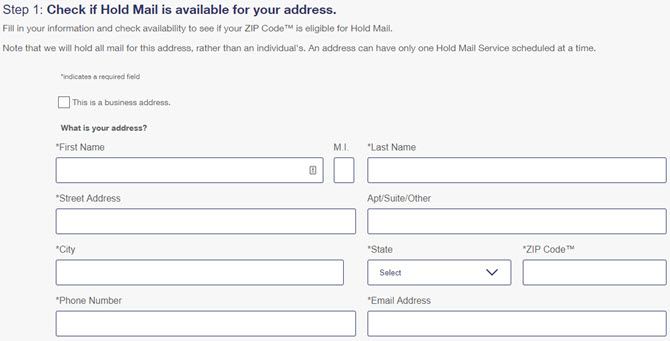
With the US postal service, you can put your mail on hold by filling out a form on their website.

Virtual Mailbox Address

This works for 30 days at a time. Beyond that, you need to switch to long-term mail forwarding.

If you’re a digital nomad or an executive who travels frequently, remembering to enable and disable USPS mail forwarding would be a real hassle.

This is when a virtual mailbox would really come in handy. No matter where you are, whether it’s in an airport waiting for a flight, or in an Airbnb rental in Amsterdam, you can “receive” your physical mail.

checking virtual mailbox

This is much more convenient than letting mail pile up in your mailbox or having to remember to enable or disable USPS mail holding.

And if you’re staying in one location for more than a week, you can even ask the virtual mailbox service to ship only important mail to you.

Since virtual mailbox services ship such a high volume of mail, they receive discounted shipping rates. You can also request that they box multiple items up in a single box to save even more on shipping costs.

Hike the Appalachian trail for six months. Hitchhike across Europe. No matter where you travel, you always have access to your incoming mail.

So let’s take a look at three core benefits that can tempt you to sign up for a virtual mailbox service today.

1. Get Rid of Mail Clutter

Even if you live in the US and don’t move frequently, a virtual mailbox is still very useful.

According to NYU School of Law, in the US junk mail makes up 5.6 million tons of paper and plastic that end up in landfills.

“The average American household receives 848 pieces of junk mail per household, equal to 1.5 trees every year—more than 100 million trees for all US households combined.”

You may find that you waste precious minutes every day dealing with that pile of useless mail that arrives in your mailbox.

With a virtual mailbox, you wouldn’t even have to open your mailbox anymore.

All you have to do is take a few minutes during your lunch break to log into your virtual mailbox account. Scan through all of the received items, and just click whether to shred or save each piece.

Many virtual mailbox services will even open individual letters (if you ask them to) and scan the documents.

This provides you with a digital copy of any bills or correspondence, and you don’t have to deal with the leftover waste.

Most of the virtual mailbox services also shred hundreds of thousands of letters every day, so they’ve streamlined the recycling process.

2. Saves Time and Enjoy Security

There are endless opportunities to save time with a virtual mailbox service.

  • Have incoming paper checks forwarded to your bank for deposit (many virtual mailbox services offer this feature)
  • Read your scanned correspondence and respond to it immediately, then have it shredded.
  • You’ll never have to waste time going to the post office or checking your mailbox
  • Have gifts you want to send to someone forwarded directly without having to touch the package yourself
  • Check incoming mail from your office, while commuting, or while you’re on vacation

A virtual mailbox also boosts your personal security.

  • Thieves can’t swipe credit card numbers of statements like they could with ones sent to a physical mailbox
  • Private investigators can’t search through your mailbox looking for information about you
  • There’s no risk of trash thieves recovering sensitive information about you from discarded mail
  • No one you’re living with will see the addresses of your personal correspondence

By having all of your mails shipped to a remote location and handled by trained, professional staff, you can better protect your privacy.

3. Stop Changing Addresses When You Move

If you’ve ever had to deal with changing your physical mailing address through the US Postal Service, then you know what a pain it can be.

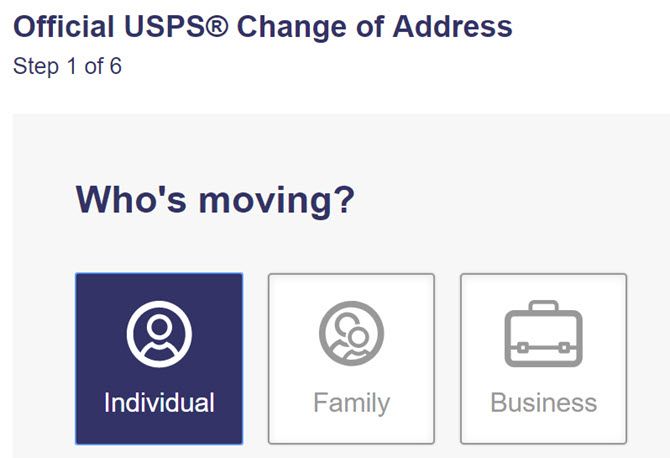
Change address when you move?

You can launch the change of address process online through the USPS website, which triggers their mail-forwarding service for 12 months.

This means you have 12 months to ensure every single company you’ve ever dealth with has your new address.

That’s fine if you don’t move too frequently. But if you’re in the military, or you work for a company that moves you around alot, this can become a real hassle.

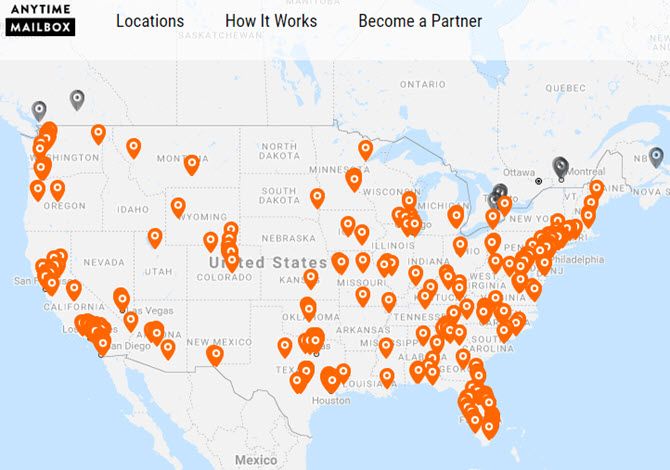
The best virtual mailbox services out there have locations all across the country.

Virtual Mailbox Locations

You just pick the state that you want to consider your “home state”, receive your physical address, and you never have to change your address again. It doesn’t matter how often you move, or where you move to.

The 5 Best Virtual Mailbox Services

If you’re ready to sign up for a virtual mailbox, there are a few that have been around a while. Any of these would be a good choice.

For any of these services, you’re looking at costs ranging from $10 to $40 depending on whether you also want to include extra services.

1. US Global Mail

US Global Mail

One of the longest-running virtual mailbox services is US Global Mail. It’s especially popular among US expatriots.

Like most virtual mailbox services, it’s also very popular among international shoppers who need a US address to buy products from many US companies.

Services they offer include:
  • A physical address in the US (not a PO box)
  • Scans of every envelope or package that arrives
  • Open-mail scanning available
  • Package forwarding to any address in the world
  • Reduced shipping rates

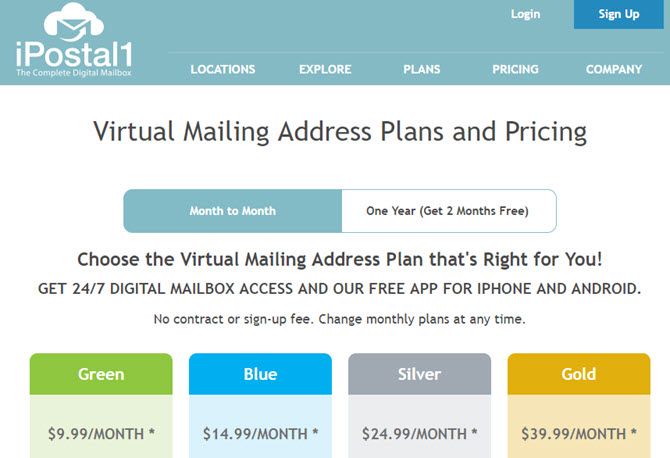
2. iPostal1

ipostal1 virtual mailbox

iPostal1 offers roughly the same rates as US Global Mail, depending on the volume of items you receive each month.

Services they offer include:

  • Over 500 street addresses available throughout the US.
  • A free mobile app to check your mail, available for iPhone or Android
  • Scanned incoming envelopes and packages with 2 GB free cloud storage
  • Phone or faxing available
  • Check depositing offered if the bank accepts mail-in deposits

3. Anytime Mailbox

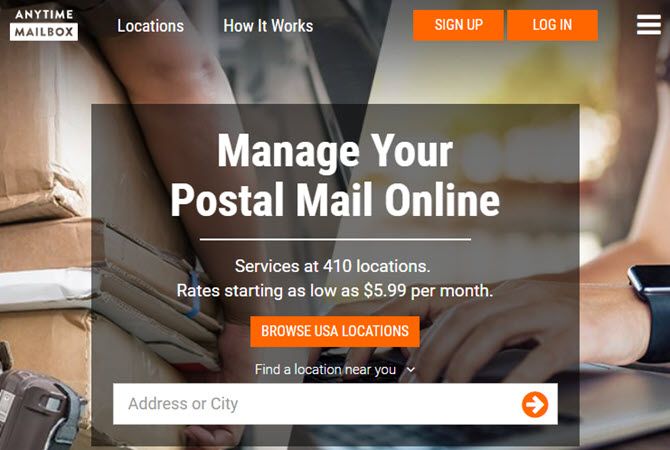
Anytime Mailbox

Anytime Mailbox is a virtual mailbox service that lets you choose from any of 410 street addresses around the country.

Rates are some of the lowest in the industry, at roughly half the cost of other services.

Services they offer include:

  • Access to your virtual mailbox via multiple devices
  • Opening and scanning of your mail contents
  • Free cloud storage (no limits)
  • Forwarding of any envelopes or packages
  • Mail-in check depositing to any bank

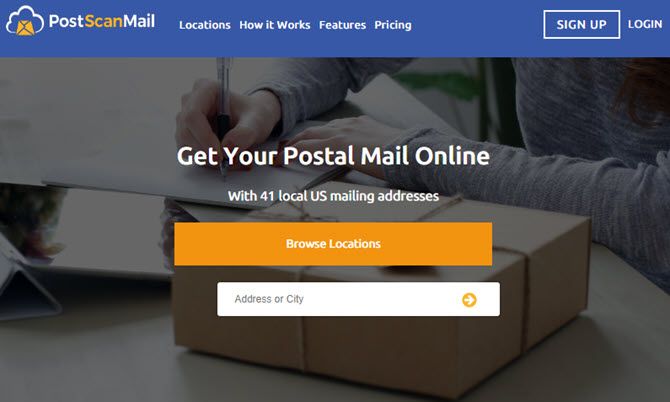
4. PostScanMail

postscanmail virtual mailbox

PostScanMail offers most of the same services as others listed above. But there are fewer physical street locations to choose from. Most of the addresses are in major cities.

Rates are slightly higher than other services and depend on the number of incoming items every month.

Services they offer include:

  • Access your scanned email from any device
  • Mail opening and scanning available
  • Envelope and package forwarding
  • 30 days free storage of physical items
  • Online mail management filters for organizing your scans

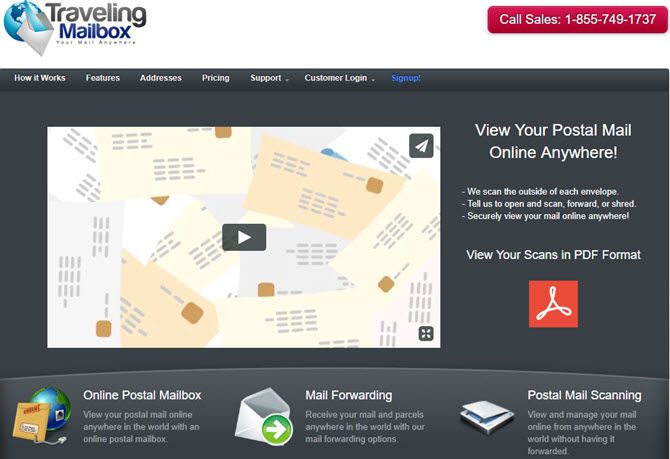
5. Traveling Mailbox

traveling mailbox

Traveling Mailbox is priced on the high end of the other services offered here, but allow for more items received per month than many others.

Also, while other plans limit the basic plan to one user, this one allows up to three. It also features a “junk mail filtering” option where your junk mail isn’t scanned or counted toward your plan.

Services they offer include:

  • Open and scan the contents of mail to PDF format
  • Mail forwarding anywhere in the world
  • Integrated with other services like Evernote and Bill.com
  • Unlimited cloud storage
  • Mobile access via iPhone or Android
  • Deposit check via snail mail

Choosing Your Virtual Mailbox

With affordable pricing, owning a virtual mailbox would be useful for anyone whether or not you travel much.

Snail mail doesn’t appear to be going away any time soon. But by using a virtual mailbox, you can transform your physical mail into a digital format. Not only is it convenient, but it lets you store your correspondence on the web just like all your regular email.

If a virtual mailbox is too expensive for your taste, there are other solutions for international shoppers. We’ve offered a list of online shopping sites that ship internationally for free as a great alternative.

Read the full article: What Is a Virtual Mailbox? (And Why You Should Get One)

16 Oct 17:53

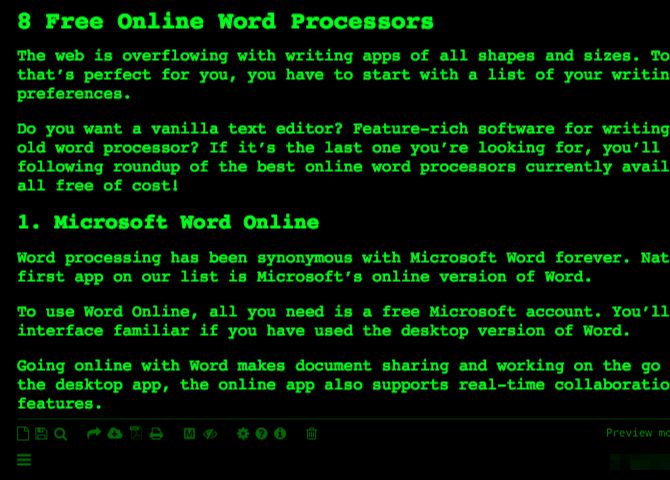
The 8 Best Free Online Word Processors

by Akshata Shanbhag

The web is overflowing with writing apps of all shapes and sizes. To find one that’s perfect for you, you have to start with a list of your writing needs and app preferences.

Do you want a vanilla text editor? Feature-rich software for writing novels? A good old word processor?

If it’s the last one you’re looking for, you’ll appreciate our following roundup of the best web-based online word processors currently available. The apps are all free of cost!

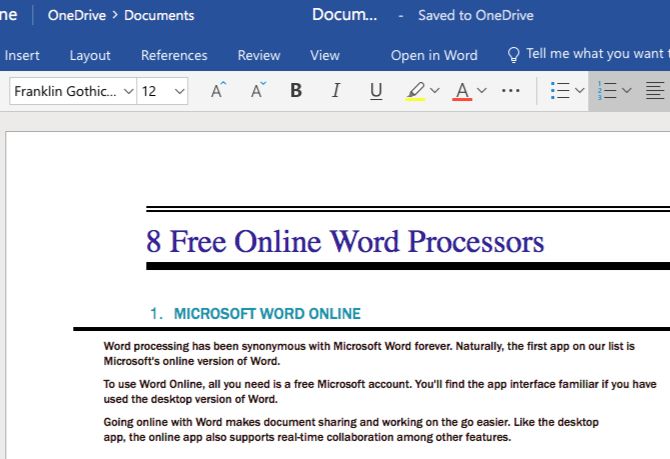
1. Microsoft Word Online

word-online-document-view

Word processing has been synonymous with Microsoft Word forever. Naturally, the first app on our list is Microsoft’s online version of Word.

To use Word Online, all you need is a free Microsoft account. You’ll find the app interface familiar if you have used the desktop version of Word. Going online with Word makes document sharing and working on the go easier. Like the desktop app, the online app also supports real-time collaboration among other features.

Word Online is a lighter version of the desktop client, so you might have to do without a few features such as split views and style creation. Also, you can save files only to the default MS Office file format, DOCX. But you can still view and edit documents in other Office file formats.

Visit: Microsoft Word Online

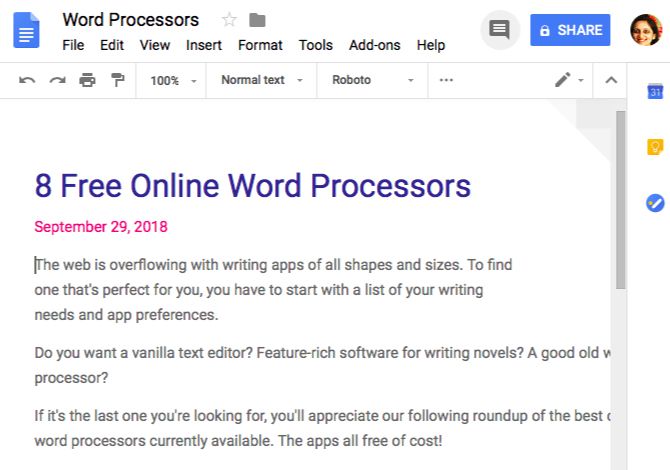
2. Google Docs

google-docs-document-layout

Google Docs works anywhere and for everyone. Apart from the expected basic tools you need for creating and editing stylish documents, Google Docs gives you many more.

You can start off with beautiful templates, get back to older file versions, and share documents easily. The collaboration tools bring in comments and real-time editing options. And thanks to autosaving, you don’t have to worry about saving your writing manually.

Plus, with Google Docs add-ons, you can sign documents, create charts and mind maps, insert text snippets, and so on.

Google Docs has an edge over Word Online thanks to its cleaner interface, better collaboration tools, and free voice typing.

Visit: Google Docs

3. Zoho Writer

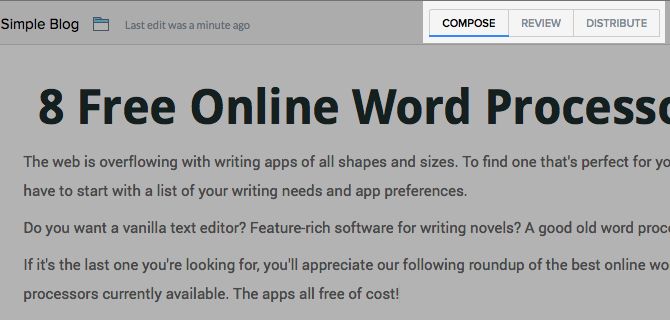
zoho-writer-document-view-compose-tab

Zoho Writer is sturdy enough to compete with Word Online and Google Docs. When we compared the three apps, Zoho Writer came out on top.

Besides the usual document editing and collaboration tools, the app has separate views for each stage of the writing process. This makes for a minimalist interface, because the tools you need at each stage are the only tools you’ll see.

Zoho lets you save your documents to other cloud services like Google Drive, Dropbox, and OneDrive. But by default, it saves your documents to its own cloud storage, Zoho Docs.

Visit: Zoho Writer

4. Pages for iCloud

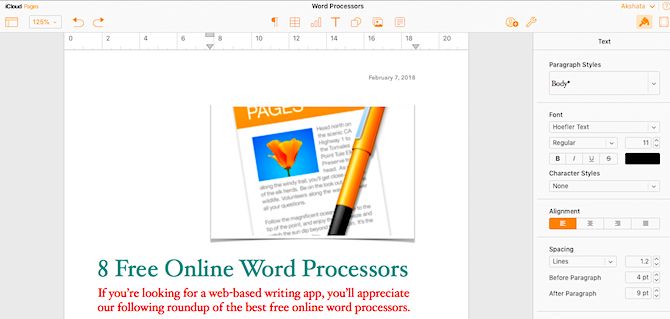
pages-for-icloud-document-layout

If you’re a Mac user, Pages for iCloud is the perfect solution for word processing. It’s the cloud-synced version of Pages, which is part of iWork, Apple’s native office suite.

The good news is that you don’t need a Mac to use Pages for iCloud. If you sign up for an iCloud account, you can use Pages anytime, anywhere.

The app has a clean and easy-to-use setup, so you should have no trouble using it from the get-go. It also supports real-time collaboration, but there’s a catch. The people you’re collaborating with need to have an iCloud account or create one to view and edit documents. If you don’t consider this a dealbreaker, go ahead and get yourself Pages for iCloud.

Visit: Pages for iCloud

5. Quip

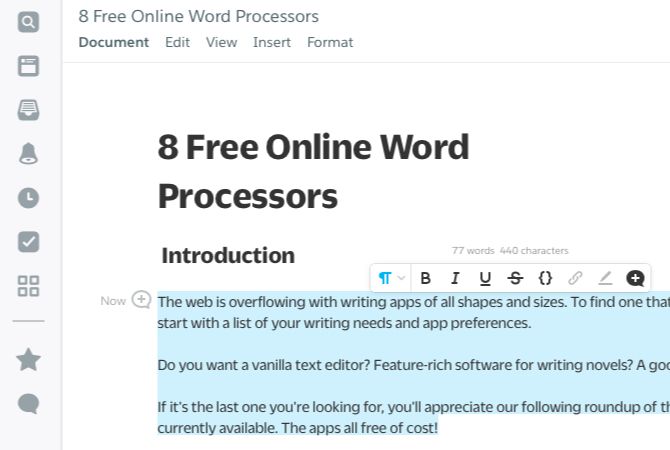
quip-document-view

With Quip’s structure and functionality, you might find yourself in unfamiliar territory. But the minimalist interface will help you orient yourself quickly.

Start off with one of the in-built templates to save time. If you begin with a blank document, you can still insert useful elements like a checklist, calendar, a Kanban board, and a project tracker. Formatting options show up in place when you select text.

Keep in mind that Quip is free only for personal use (and comes with unlimited documents). For collaboration with a group or a company, you’ll have to pay up.

Visit: Quip

6. Dropbox Paper

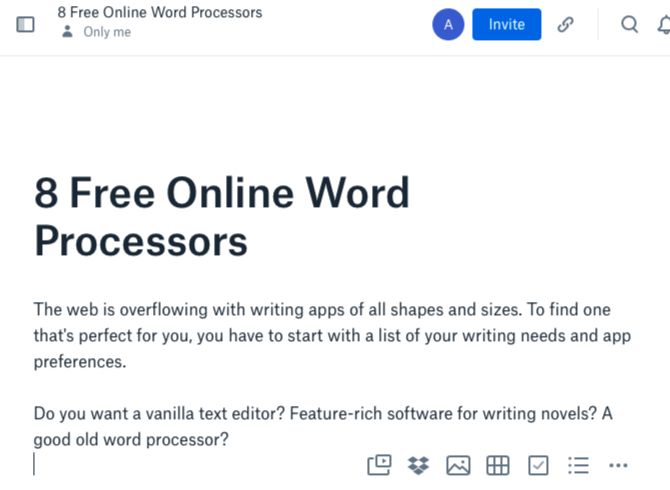
dropbox-document-view

You’ll find many compelling reasons to try Dropbox Paper, but the strongest one is probably its tight integration with Dropbox. The beauty of it is that Paper documents don’t count toward your Dropbox storage.

Paper wins another point for Markdown support. Markdown, after all, is now the fastest way to write for the web. Unlimited documents and versions, rich media support, and collaboration tools make Paper even more attractive.

Visit: Dropbox Paper

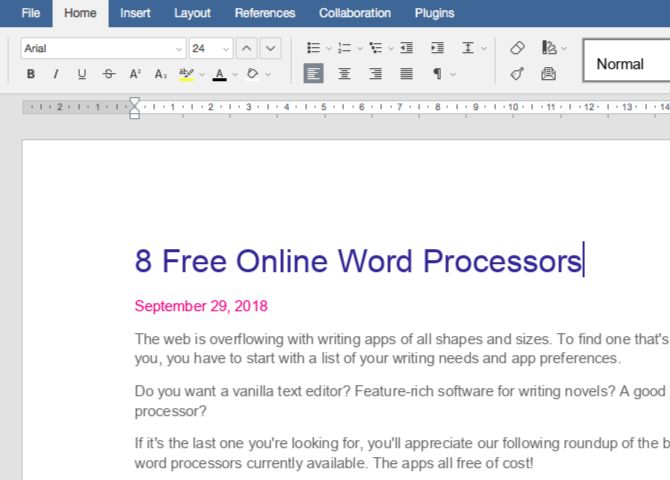
7. OnlyOffice Document Editor

onlyoffice-document-view

OnlyOffice is open source, which is not the same as free. It’s one of the lesser-known online word processors, but it’s no less capable than the other apps on our list. Actually, in terms of layout and features, it’s reminiscent of Microsoft Word.

You can upload documents from your computer or bring them in from other cloud storage services like Google Drive and Dropbox. It’s quite handy that you can collaborate in real time with anyone and not just OnlyOffice users.

Visit: Only Office

8. Writer

writer-document-view

Word processors typically give you rich text formatting options. That makes Writer, plain-text writing software, a misfit on our list. But it’s too good an online word editor to pass over.

Writer gives you a distraction-free setup, which means no toolbars and icons in sight unless you want them. Throw in autosaving, offline support, unlimited documents, a word counter, and you have a reliable place to store your words.

No rich text support here, but keeping up with the times you have Markdown formatting and preview options. And you can not only download your documents to TXT, PDF, and HTML formats, but also publish them directly to platforms like WordPress and Tumblr.

Feel free to change the look and feel of the editor to suit your tastes.

Visit: Writer

The Best Online Word Processors to Use Anywhere

A free online word processor may not come with the advanced options built into desktop word processing apps. But it can still work out well for you.

Finding a satisfying solution depends on the feature complexity you need. And now you have several great online options to choose from. While you’re exploring them all, you might also want to take a look at a few other browser-based tools for writing and related activities.

Read the full article: The 8 Best Free Online Word Processors

16 Oct 17:53

5 Websites to Find Weird, Cool, or Discounted Amazon Products

by Mihir Patkar

Everyone tries to sell their products on Amazon, so it’s no surprise when a few items go under your radar. But once you know where to look, you can always find the weirdest, coolest, best, or even the most discounted products on Amazon.

Right now, Amazon’s database is so huge that it feels cluttered, and you need different clutter-free websites to browse the catalog. You essentially need to change the interface, ditching the regular Amazon site for something new. Whether that new interface is by Amazon itself or a third-party, it’s a good way to uncover products that you don’t easily see otherwise.

Amazon Scout (Web): Made by Amazon, for Recommendations Based on Likes

Amazon Scout is a pinterest-like recommendation system for likes and dislikes

You know how this works with other sites now. You press a thumbs-up or a thumbs-down icon to show if you like or dislike something. Based on that, a smart algorithm shows other things you might like. It’s how Netflix knows what you want to watch, and Amazon is now using it to show you products you might like.

A new site, Amazon Scout, uses the like-dislike mechanism to figure out which kind of items you like in your home. Currently, the categories include furniture, home decor, bedding, lighting, kitchen and dining, patio, and women’s shoes. Scroll, click the like or dislike buttons, and Scout will show you new items based on that.

The big difference from shopping on Amazon is that Scout is completely visual. You don’t view the details of the item, you only judge it by its looks. As the machine learns your aesthetic senses, it will serve up better matches.

CRwatchdog (Web): Consumer Reports Recommendations on Amazon

CRwatchdog shows Consumer Reports recommendations without subscription

Consumer Reports is known for its no-nonsense, unbiased recommendations. But you need a subscription to read their list of items to buy. CRwatchdog has taken that list and turned it into a handy resource for anyone.

Currently, the site covers four topics: electronics, appliances, home and garden, and car deals. That last one is particularly important given Consumer Reports is well-respected in that field, and has one of the best YouTube channels for automotive enthusiasts. You can search CRwatchdog, or quickly browse the “all recommendations” article for each category.

Note that you won’t find why Consumer Reports is recommending these items. Instead, you’ll only get a list with a small description of each product. If you want to know why it’s the best, you’ll still need that subscription.

JungleFlip (Web): Hourly “Open Box” Deals on Amazon

JungleFlip has the best Amazon open box deals to save money

Like any seller, Amazon wants you to pay the highest price it can get. But if you’re smart, you can save some big bucks. This is why Amazon hides some deals and discounts, putting them in hard-to-find parts of the site.

One such type of deal is an “open box” item. “Open box” items are things that are returned by users and the original packaging is damaged. Typically, these are unused items, often listed as “Like New” since it wasn’t used but was pre-owned.

JungleFlip tracks down these items in good quality so that there’s one place for you to look at them all. New products are added every hour in a clean interface. You’ll see the item’s picture, its retail price, and its discounted price. From a $175 air conditioner selling for $30, to $200 jackets for $50, you’ll find some incredible deals here if you check regularly.

Lightning Drops (Web): Find Amazon Products Reaching Their Lowest Ever Price

Lightning Drops have the lowest ever price for amazon products

Price comparison apps like CamelCamelCamel will let you track price drops on any item, and see its price history. It’s one of the best tricks to shop on Amazon, but if you aren’t tracking the item, you won’t know about it. That’s why you need Lightning Drops.

Lightning Drops is automatically tracking every single item on Amazon and has an excellent “Lowest Observed Price” section. In here, you can see which products have reached their lowest price in history. The products are categorized by those found in the past 24 hours, the past three days, or the past week.

Now that you have this cheat sheet of items that have dropped in price, you might be able to pick up some amazing deals. Most of these are not limited-time deals either, they are long-term price cuts.

Isn’t This Weird? (Web): Weird and Bizarre Products on Amazon

Isn't This Weird has the most bizarre and weirdest products on Amazon

Sometimes, you see a weird item and go, “Why would anyone make that?” Well, DIY projects can be weird, it’s all about personal taste. But then some companies decide everyone is that weird, so they turn it into a bizarre product and sell it on Amazon.

Come, my fellow weirdos, and gaze upon the hand-curated collection of wonderful weirdness at Isn’t This Weird? (ITW) Try your hand at three-player chess on a circular board. Gift your grumpy friend a “smile maker” to teach them how to smile. Get yourself an avocado saver so that you don’t waste half of it. These are the things you know you don’t need, but you still want.

ITW also makes it easy to browse, in case you don’t have an insane keyword to search. Look for gifts under $20, the most popular weird items, or gifts for men/women separately. There are a few other category-based listings too.

Overcome Amazon’s Limits With Advanced Search

Between these five sites, you should be able to find something useful or kooky without being overwhelmed by Amazon’s cluttered design. In fact, even if you search for things on Amazon, you might not get some of the items listed on these websites.

That’s partly Amazon’s fault because it has made the search function weaker than it needs to be. But as always, it’s about knowing where to look. If you learn how to use Amazon’s Advanced Search, you will almost always find exactly the item you are looking for. It’s not too difficult either, so spend some time reading this article if you’re a regular shopper on Amazon.

Image Credit: thisisbossi/Flickr

Read the full article: 5 Websites to Find Weird, Cool, or Discounted Amazon Products