Once a week we’ll send out a page from Cool Tools: A Catalog of Possibilities. The tools might be outdated or obsolete, but the possibilities they inspire are new. Sign up here to get Tools for Possibilities a week early in your inbox.
To cut your own boards from a felled tree, you need either an expensive bandsaw mill, circular saw or a bad-ass chainsaw and a bracket to hold the chainsaw parallel to some reference surface. The Alaskan mill attaches to the saw’s chain bar and keeps the chainsaw in line with a flat surface, allowing you to cut slabs as thin as ½ inch thick. The Alaskan is easy to set up. There is really only one way the saw can fit into the mill. Then, you adjust the two posts on either end to the desired clearance (make sure both posts read the same distance). To make sure your first cut is straight, you use a slabbing bracket; I used the aluminum slabbing rails made by Granberg. Then, you just adjust the clearance to the width of your slab and use the surface of the previous cut to guide the next cut, and the next, and so forth.
After moving into a new house in a wooded area, I realized a dead, 100-foot Red Oak was just 50 feet from the house. Following a few spells of high winds, I knew it was just a matter of time before it might give out, so I hired a local arborist who methodically cut off the upper part of the tree (a 20-ft. section), then worked his way down, cutting more of the tree into 8-ft sections. We had a nice surprise when we finished: the wood looked to be in great shape and seemed like it might make nice flooring. But I soon discovered the professional sawmills near us won’t touch a log less than 9 feet long. Instead of hiring someone with a sawmill to come to my property, I decided to get my own rig.
There are three different kinds of sawmills: circular saw, bandsaw, and chainsaw. I looked at the Lucas Swing blade, several different bandsaw mills and other chainsaw mills. If you have plenty of space and lots of money, Timberking makes some good mills. Most bandsaw mills and circular saws are portable in the sense you can hook them up to your pickup truck and tow them to the site, but they are not portable in the sense you can pick them up and haul them down the hill and through the woods. My number one consideration for the mill was that I should be able to take the saw to the log since I didn’t think I could take the log to the saw. One thing to consider about a chainsaw mill is that it wastes a lot of wood. If you’re going to build a fixed installation, a bandsaw or circular saw is the way to go. As I’ve learned, though, Red Oak is *heavy*, especially when it is wet. Getting the log to the rig wasn’t an option, so I went with a chainsaw mill. I chose the Husqvarna 385XP saw with a 28-inch bar, along with a 30-inch Alaskan mill. That means the mill can be adjusted to fit any bar up to its maximum size, in this case 30 inches. You can install basically any size bar into a chainsaw. I chose 28 inches since it would be big enough to work with any of my logs (my largest log was about 20 inches in diameter).
What’s impressed me about the Alaskan mill is its simplicity, sturdiness and the geometry of the bracket. The bracket on the mill allows the user to keep the mill flat against the log. With other mills, like the more expensive Logosol system for instance, you attach a bracket to either end of the log and use it to index down through the log. This is probably a better system for indexing, but seems like a lot more work; plus the Logosol also supports the chainsaw only from one end. The Alaskan bracket provides support at both ends of the bar, and it comes in a size as short as 24 inches and as big as 56 inches. Granberg also makes a kit with a bar to allow you to attach *two* 385 power heads to the saw. They also offer an oiler kit to increase the amount of oil on the chain, and they manufacture special ripping chains that make cleaner cuts (I used one). I read one guy’s review where he said you needed three sharp chains before starting a days worth of cutting. Maybe that’s about right; I could never last more that one sharp chain worth of work before petering out. Some reviewers have mentioned the effort that goes into sharpening the chains makes a chainsaw mill unacceptable. I didn’t really find it to be onerous. Since the Alaskan mill is basically the same size as the saw, storage isn’t an issue. I just leave the saw mounted in the mill. (NOTE: I learned the hard way, that it is important to store the saw upright. When I stored the saw on its side one time, the next time I used the saw, it took me about 5 hours to get the saw started.)
A few things to remember about chainsaw mills: This is hard work and the going is slow. On my best day, I only managed to finish two logs. Had I been cutting 1- inch boards (instead of 2-inch ones), this would have been much slower. Admittedly, though, my wood was Oak; maybe, just maybe, pine is easier. Also, the saw vibrates a lot. I exchanged my saw’s plastic handle for a foam grip, which helped some. Lastly, while the Alaskan rig makes the saw safer, you can never forget there is a lethal weapon in your hands. Although I’ve given up on the flooring idea, I still have all this good lumber which I’ll certainly use for a woodworking project. – Jack Tomlinson
With the price of lumber going up all the time, I’m recycling wood more than ever. But I ruined a blade on my circular saw after hitting an old nail I’d missed when cleaning the wood (my eyes ain’t what they used to be). The Lumber Wizard is a lot less expensive than those security metal detectors, and it’s saved my new blade a couple times. It takes less than a minute to check a big sheet of ply. If it finds something and I still can’t see it, I use the Little Wizard (when I purchased my Lumber Wizard, this came bundled with it).
I guess you could just use the Little Wizard to scan lumber, but it would take longer since it only covers a few square inches at a time. The bigger Lumber Wizard covers about a 6″ x 6″ area, so sweeping it over a big ply or 2 x 4 goes pretty darn quick (for thicker wood, I usually flip over the lumber and scan both sides just to be sure). The battery life is pretty good, too. I went three months on a single nine-volt battery, using it several times a day, three to four days a week. The Lumber Wizard also has a vibrate setting, which is helpful if other machines are going in the shop, since my hearing ain’t what it used to be. – Robert Palembas
I’ve been using chainsaws for many years. Over the decades I have probably owned 5 or 6 different ones. In the 1960s and ‘70sI used chainsaws extensively, cutting up redwood (from the beaches or windfallen trees in the woods) into bolts, and which I then split into shakes for roofs and siding. These days I use a Stihl Woodboss MS270, 24” bar for firewood. Every year I find wind-felled oak on country roads, haul it home, cut it into stove-size lengths, then rent a splitter for a day and stockpile a year’s or more worth of firewood. Point is, I’ve had a lot of chainsaw experience.
The other day I was sawing through a piece of wood on the woodpile and as I finished the cut, the blade hit a log below it and snapped back towards my face. It sent a chill of adrenaline that I somehow felt in my ears. Very scary.
BUT I was wearing my Husqvarna helmet, which combines skull protection, ear guards, and a metal mesh facemask. I’ve only been using the helmet the last few years, prompted by a log rolling down the hill and knocking me down. I felt then I should have had one of these helmets all along. Good thing. This time the blade didn’t reach my face, but if it had, the mask would have blocked it from carving up my flesh.
I urge you chainsaw users: get one of these. $40 or so. Play it safe, please. The more hours you’ve operated chainsaws, the more the chance of a freak accident. Experience doesn’t make you invulnerable. – Lloyd Kahn
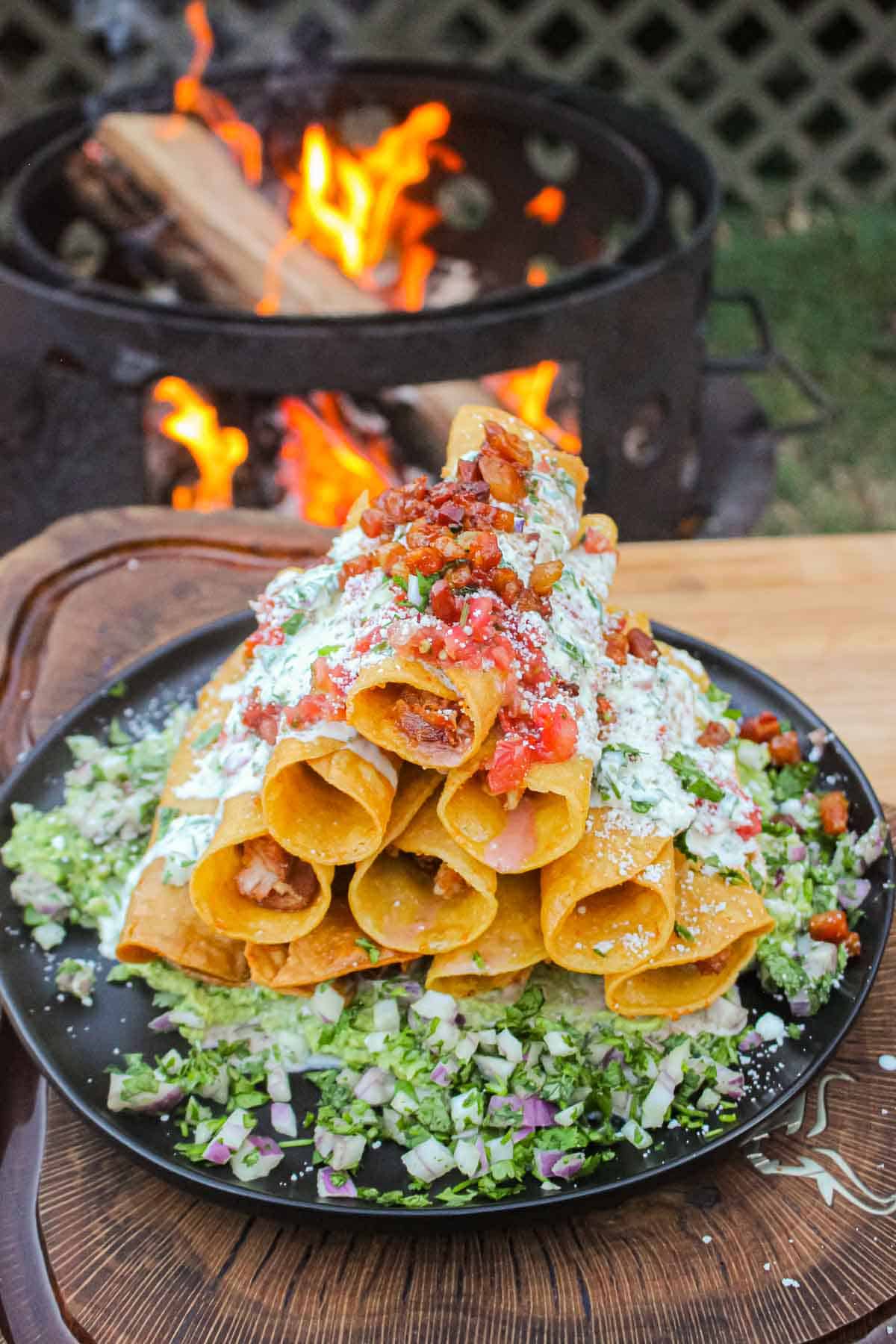
These Chicken Bacon Ranch Taquitos are insanely good. I’ve been dying to make some taquitos for a while now. I finally got around to it, and wow.
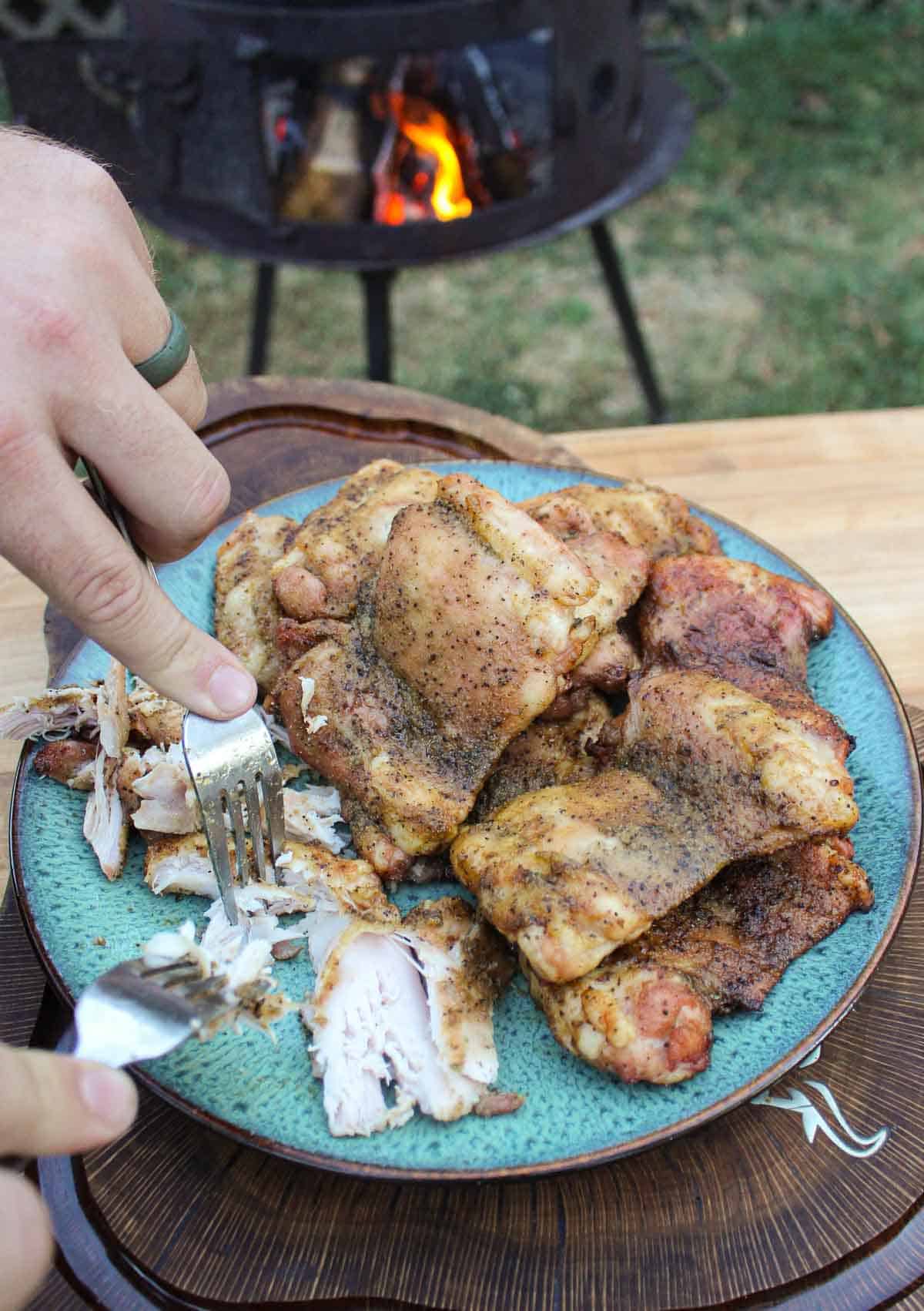
Smoked chicken thighs with my Jalapeño Lime Pilsner rub, rolled with bacon and cheese into a warm tortilla. Fried them over the coals and served with a spicy jalapeño lime ranch, salsa, guacamole, and more.
The perfect easy dinner recipe or game day appetizer the whole family will love.
What are Chicken Bacon Ranch Taquitos?
Taquitos are a Mexican dish consisting of small rolled-up tacos, usually filled with chicken and cheese, fried until crispy, and dipped in various sauces.
You may be familiar with the ones you can buy frozen from the grocery store… I know I’m not the only one munching on these as a midnight snack…
Anyway, these homemade chicken taquitos are so much better, plus they’re super simple to make. We took the original recipe and added a couple Over the Fire twists to make these freakin delicious taquitos.
If you love Mexican food, you’ll love these Chicken Bacon Ranch Taquitos.
We have a decent amount of prep and cooking to do for this recipe, but don’t let that scare you away! Each step is simple in execution and there’s a lot that can be completed while the chicken thighs are smoking.
You could even prep the chicken and chop the other ingredients beforehand so that those busy weeknights wont’s be spent doing a ton of cooking.
These elevated chicken taquitos pack a ton of flavor, not to mention delicious crispy bacon. The tortillas turn into a crunchy exterior, making them an easy handheld treat to dip into our jalapeno lime ranch and salsa.
Or, if you’re not a big fan of heat, guacamole, or even sour cream.
How to Make Chicken Bacon Ranch Taquitos
Chicken Bacon Ranch Taquitos Ingredients
Chicken:
Chicken Thighs (chicken breasts or rotisserie chicken will work too)
Jalapeño Lime Pilsner
Canola Oil
Jalapeño Lime Ranch:
Chopped Cilantro
Sour Cream
Mayonnaise
Puréed Jalapeños
Limes juiced
Buttermilk
Salt
Taquitos:
Cooked Bacon Bits (I made mine, but to save time you could purchase pre cooked bacon bits)
Shredded Jack Cheese (or shredded cheddar cheese if you prefer)
Corn Tortillas
Toothpicks
Frying Oil
Serving:
Guacamole
Salsa Fresca
Cotija Cheese
Chopped Cilantro
Diced Red Onions
Let’s Get Cooking
Prep
Begin this Chicken Bacon Ranch Taquitos recipe by building a low-heat fire (about 225F) in your grill/smoker for indirect cooking. Then add some wood chips or wood chunks if you desire.
Next, grab a mixing bowl and combine all the ingredients for the Jalapeno Lime Ranch and set it in the fridge until you’re ready to use it.
Time to Cook the Chicken
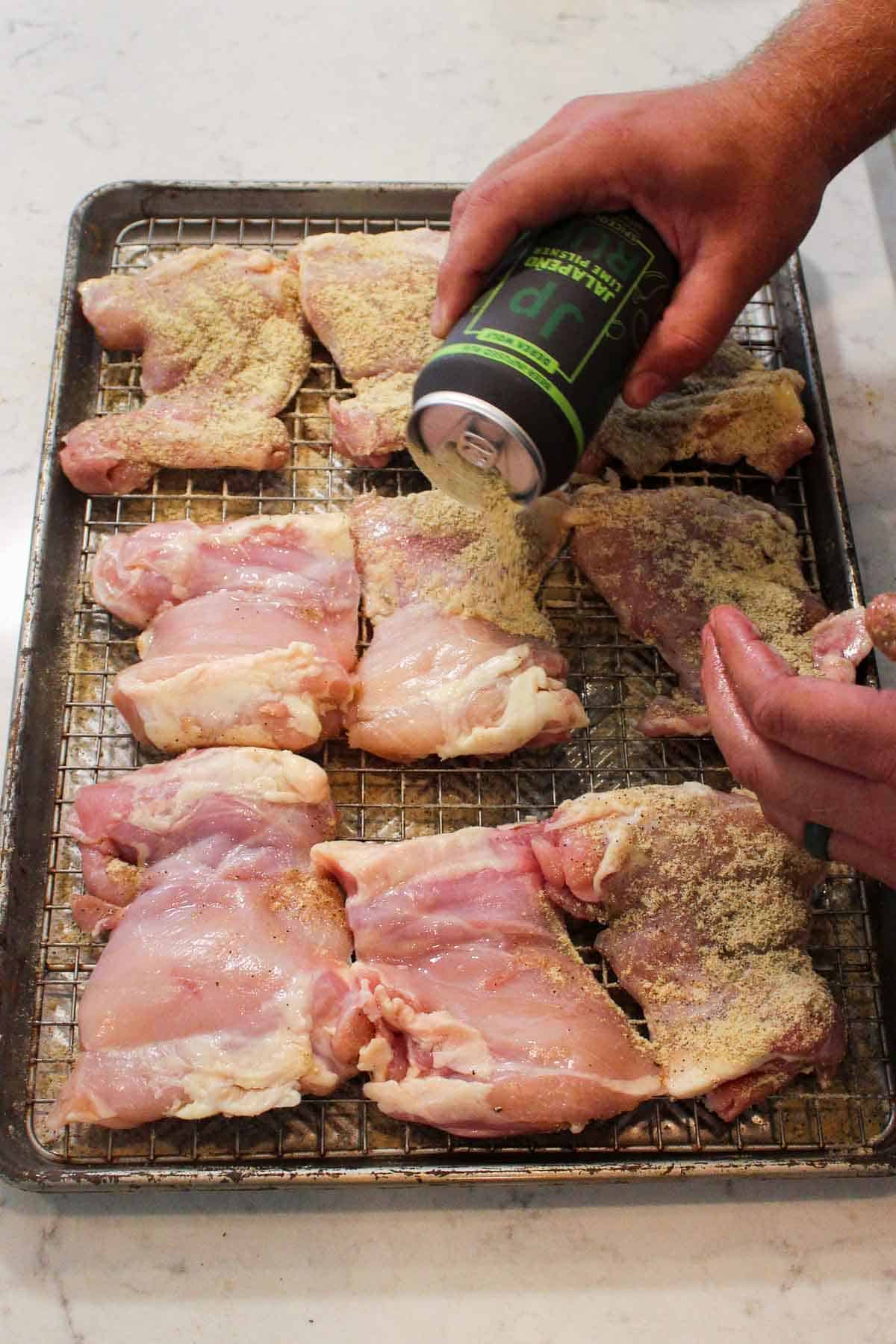
Now, it’s time to lather the chicken thighs with oil and generously season them with my Jalapeno Lime Pilsner Rub (or your favorite chicken seasoning).
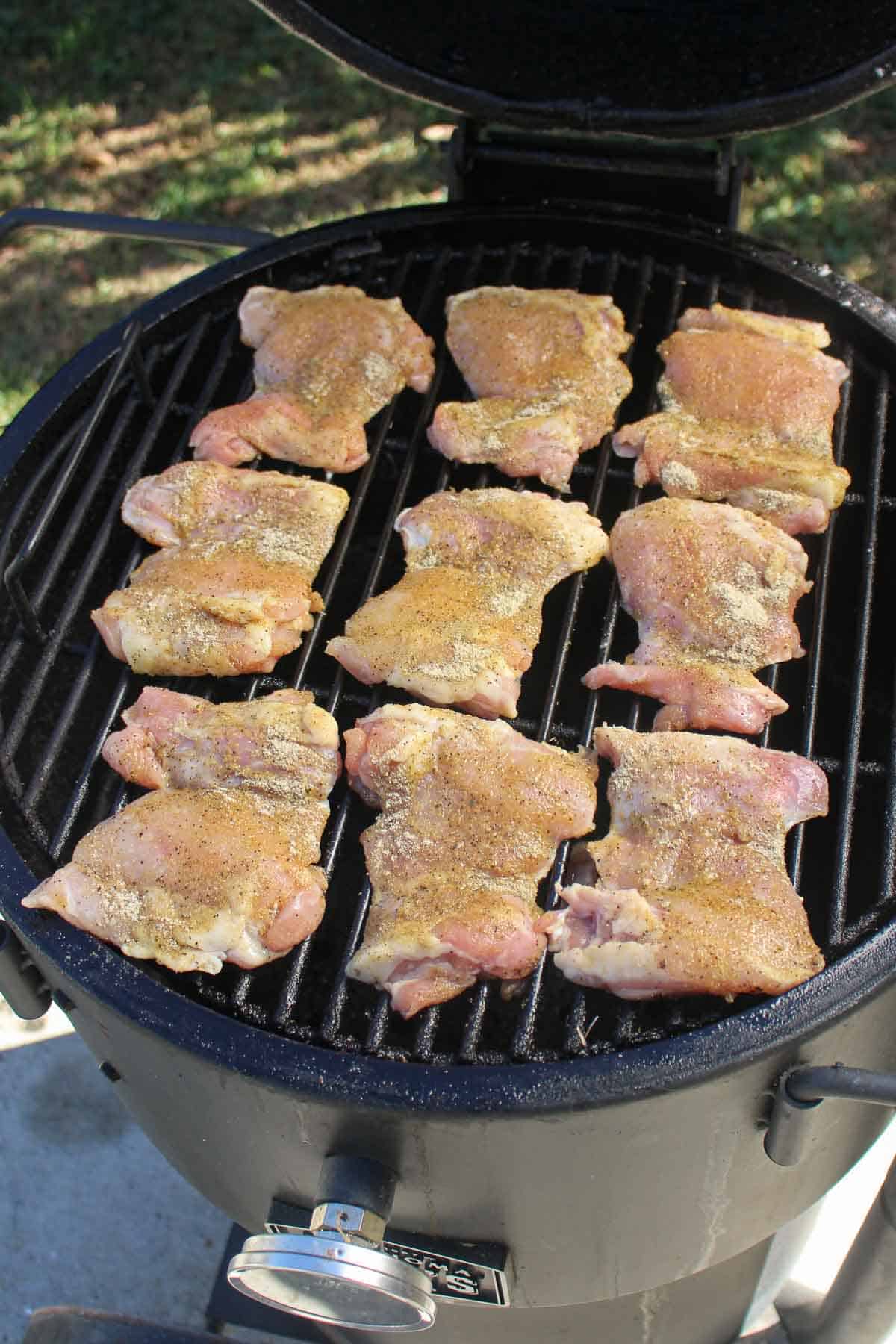
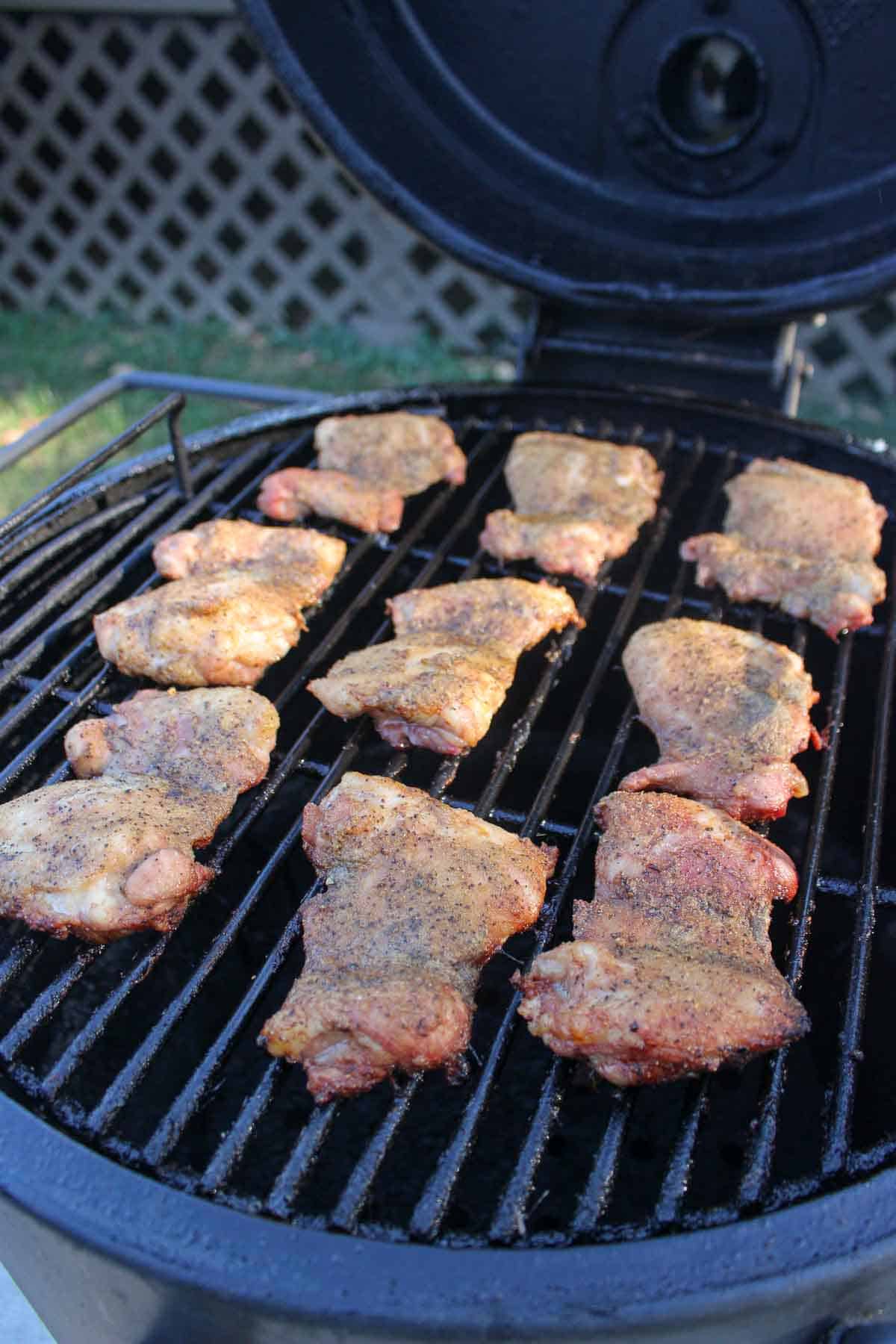
Next, place them on the smoker and let them cook until they reach 175F internal (about 2.5-3 hours).
Once the chicken is done, add it to a tray and cover it in aluminum foil. Let the chicken rest for 15 minutes, then pull the chicken apart.
Pro tip: you want to end up with tender chicken, not necessarily shredded chicken. Your chicken should easily pull apart so you can place it into your soft tortilla, but there’s no need to completely shred it.
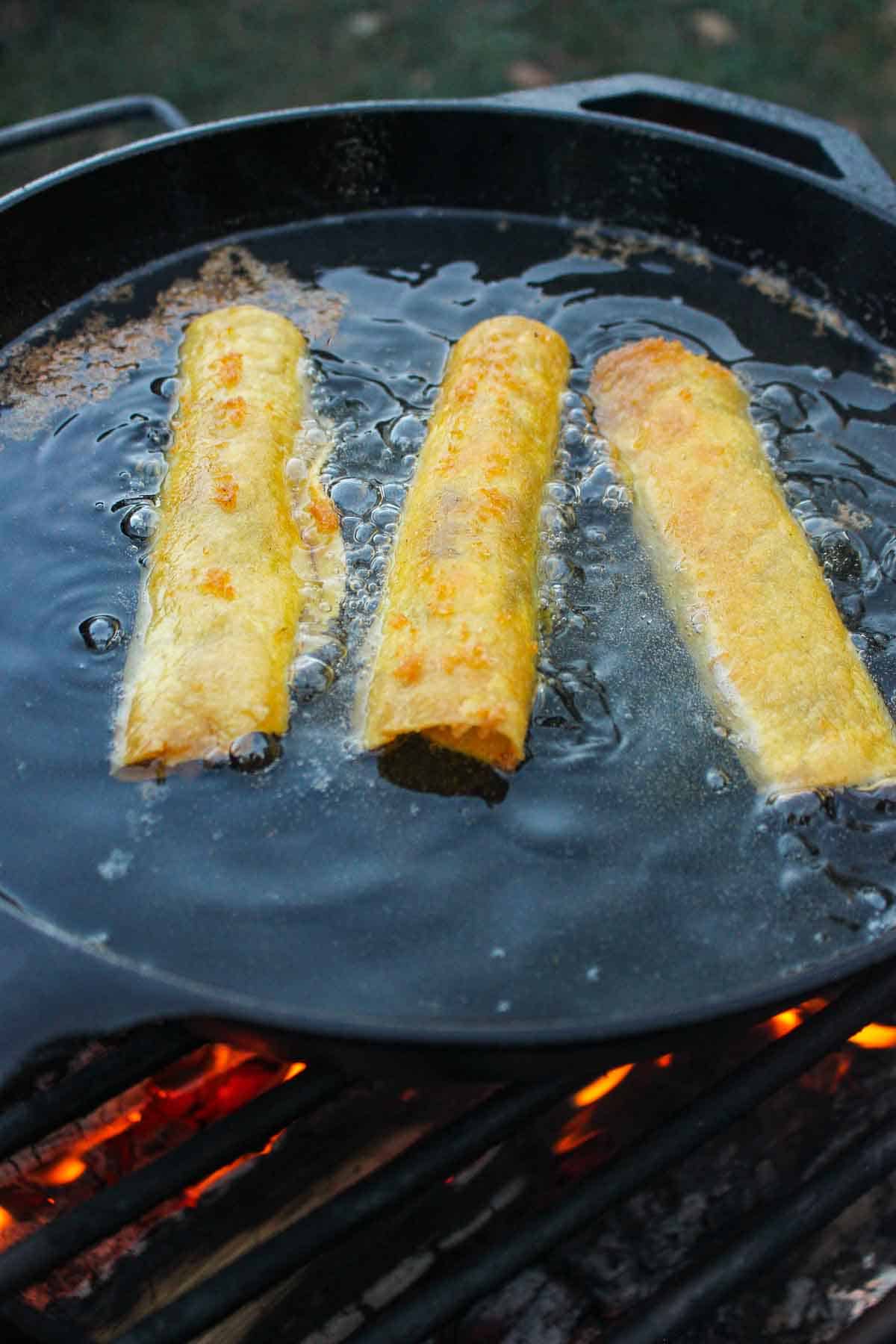
For the next step, build a high-heat fire in your grill (about 400 F). Then add a cast iron skillet/dutch oven with frying oil to preheat to 350 F. Make sure you leave at least 2″ of separation from the lip on the cast iron to prevent flare-ups or grease fires.
Assembly
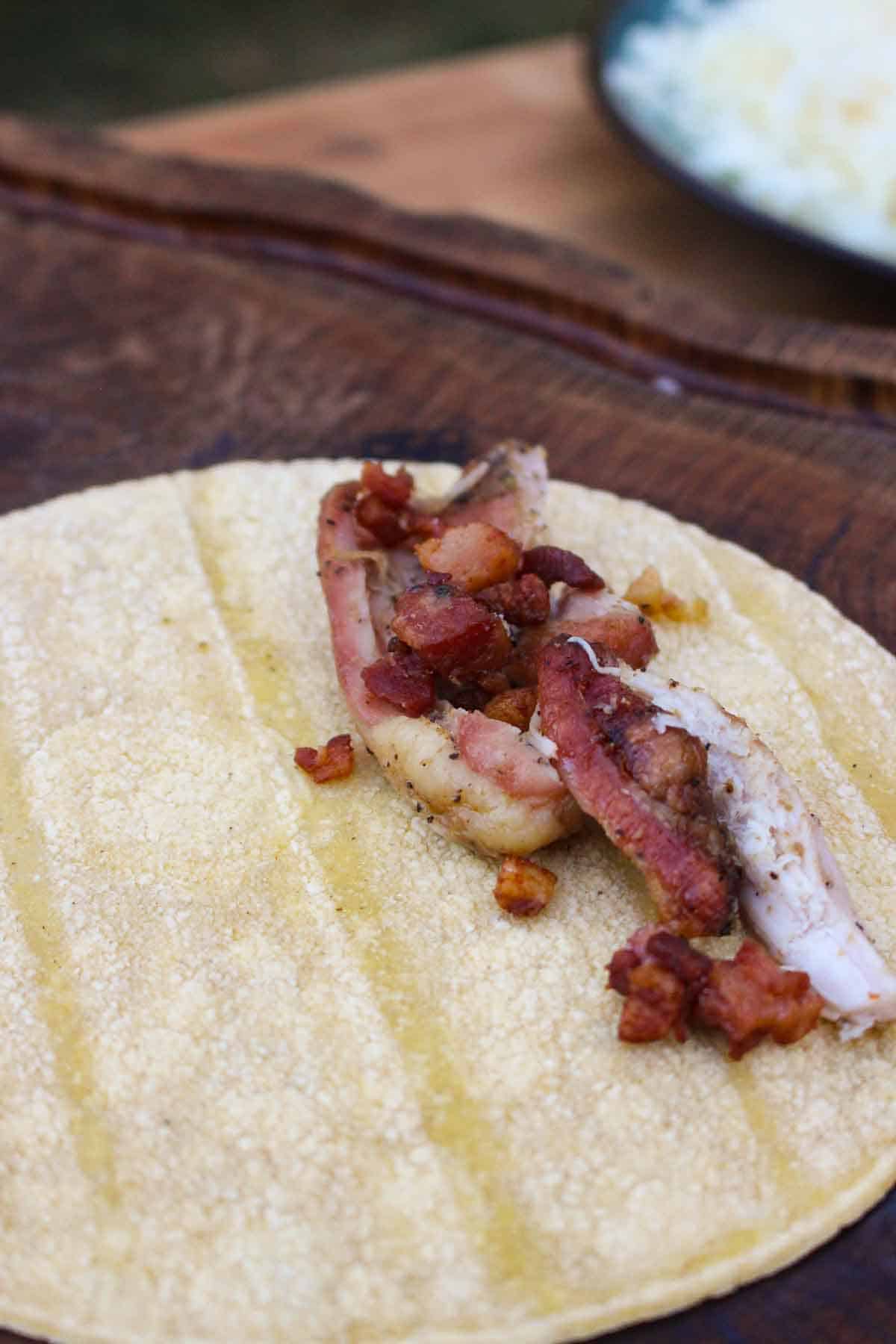
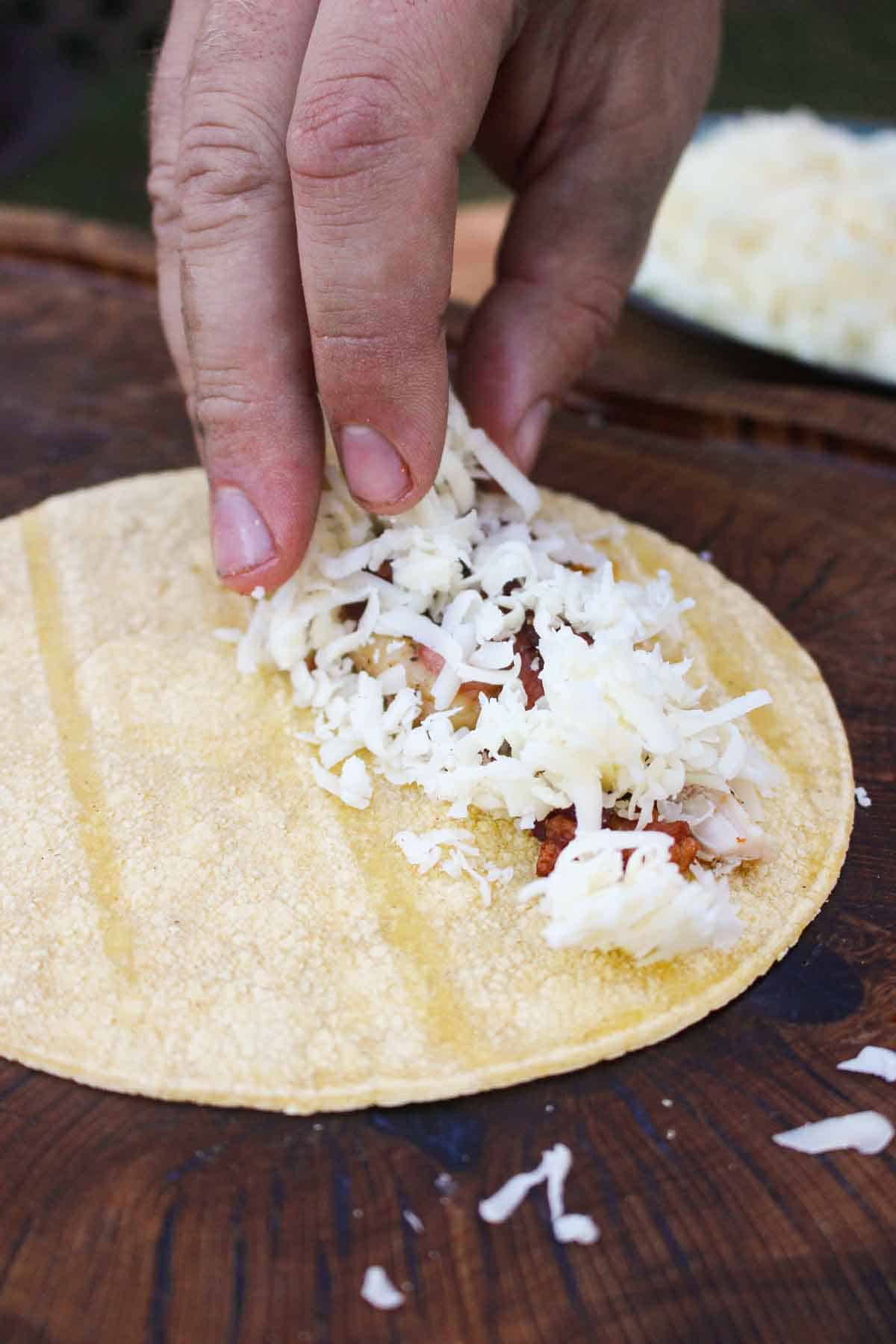
Using warm flour tortillas, add your pulled chicken, bacon bits, and shredded cheese, then roll up tightly. Secure the tortilla with a toothpick and set it to the side.
Make sure to keep them warm, as the coldness could cause the tortillas to rip. Also, make sure you avoid overstuffing your taquitos because that can cause breakage too.
Repeat the wrapping process for all your tortillas or until you have created enough taquitos.
Final Steps
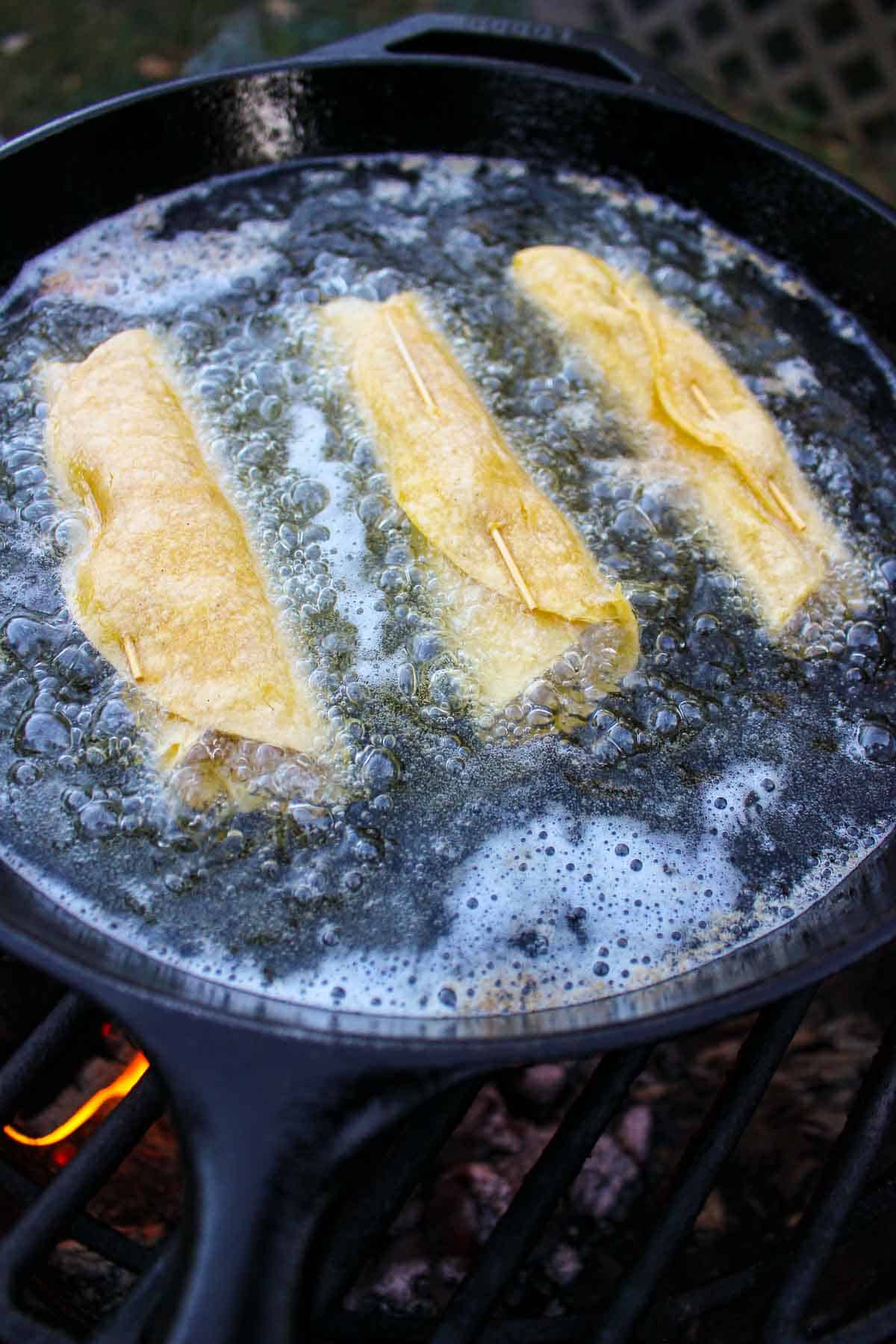
Lastly, add your taquitos to the frying oil and cook for about 4-4.5 minutes in total or 2 minutes per side. Do this in batches so you don’t overcrowd the cast iron pan.
Once the tortillas are a crispy golden brown, pull them out and let them cool for 5 minutes.
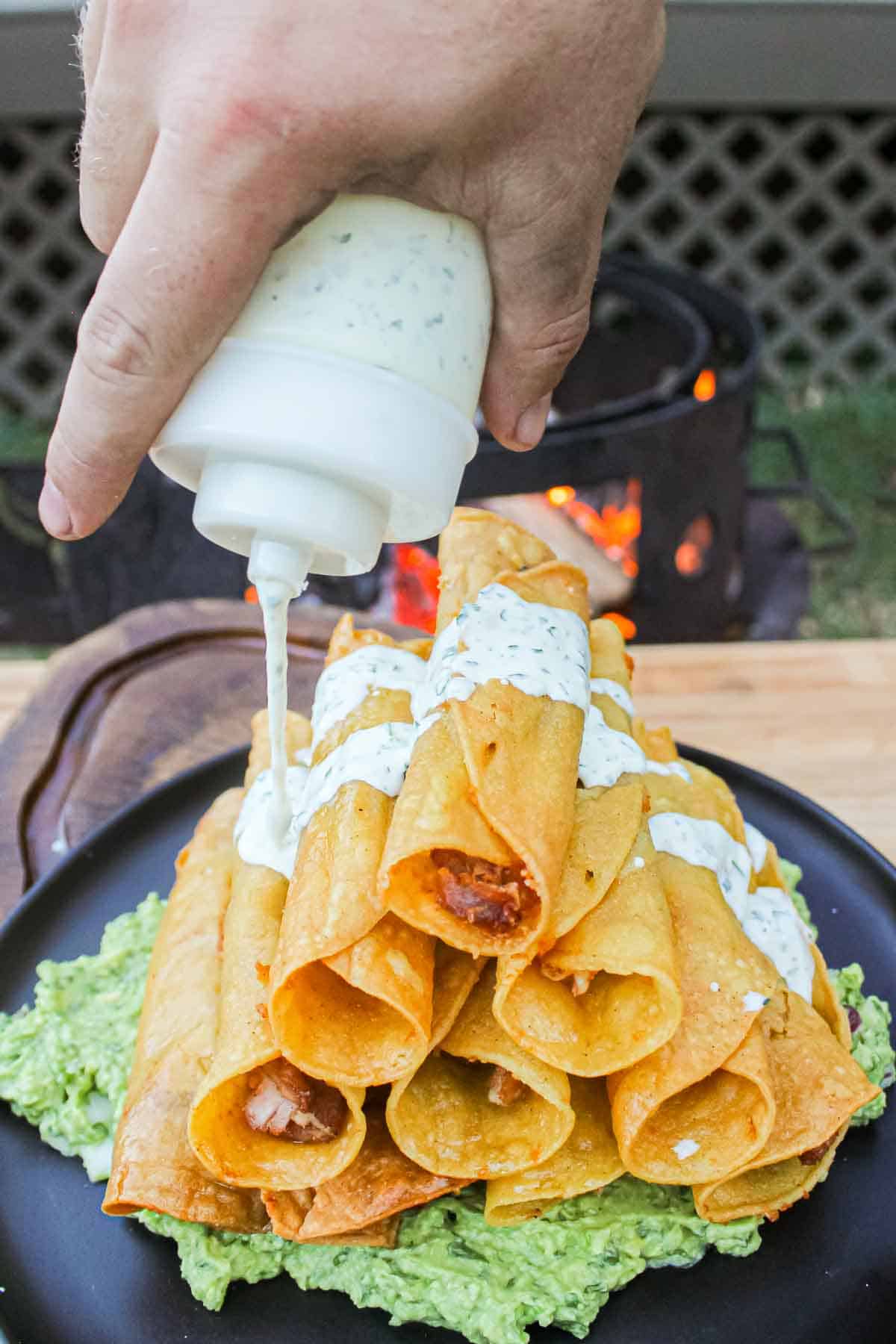
When all the taquitos are done, serve them on a bed of guacamole. Finally, add Jalapeno Lime Ranch, salsa Fresca, cotija cheese, chopped cilantro, diced red onions, and maybe even a dash of your favorite hot sauce to the tops of the taquitos. Enjoy!
The best part about taquitos is that you can easily store leftovers or make them ahead of time and store them in a freezer bag until you’re ready to eat them. It makes them one of those easy recipes you can prep and pull out whenever you need something quick to eat.
If you don’t want to freeze them, you can keep them in an airtight container in the fridge for 2-3 days.
Reheating/leftovers
To reheat your leftover taquitos arrange them on a cookie sheet or greased baking sheet and set them in the oven at 350 degrees F until they are warm. If your taquitos are frozen, place them in the oven for about 15-20 minutes at 400F.
With so many delicious flavors packed into a crispy baked flour tortilla, these taquitos are top-tier Mexican food.
For your next dinner, or even a fun side dish, give these Chicken Bacon Ranch taquitos a try. You won’t be disappointed.
For more delicious recipes, check out my second cookbook Flavor X Fire or my first cookbook Food X Fire!
Chicken Bacon Ranch Taquitos for a fun dinnertime delight or shareable starter.
Course Appetizer, Main Course
Cuisine American, Mexican
Keyword Chicken Bacon Ranch Taquitos
Prep Time 30 minutes
Cook Time 3 hours
Servings 4 People
Calories 1134kcal
Author Derek Wolf
Ingredients
Chicken:
6-8 Chicken Thighs
3 tbsp Jalapeño Lime Pilsner
Canola Oil as needed
Jalapeño Lime Ranch:
2.5 tbsp Chopped Cilantro
2.5 tbsp Sour Cream
2 tbsp Mayonnaise
1 tbsp Puréed Jalapeños with juice
2 medium Limes juiced
Buttermilk to desired consistency
Salt to taste
Taquitos:
1 cup Cooked Bacon Bits
2 cups Shredded Jack Cheese
8-10 6 ” Corn Tortillas
Toothpicks
Frying Oil
Serving:
Guacamole
Salsa Fresca
Cotija Cheese
Chopped Cilantro
Diced Red Onions
Instructions
Begin by building a low heat fire (about 225F) in your grill/smoker for indirect cooking. Add some wood chips or wood chunks if you desire.
In a bowl, mix together all the ingredients for the Jalapeno Lime Ranch and set in the fridge until ready to use.
Lather the chicken thighs with oil and generously season with my Jalapeno Lime Pilsner seasoning (or your favorite chicken seasoning). Place them on the smoker and cook until they reach 175F internal (about 2.5-3 hours). Once the chicken is done, add to a tray and cover in foil. Let rest for 15 minutes, then pull the chicken apart.
Build a high heat fire in your grill (about 400F) adding a cast iron skillet/dutch oven with frying oil to preheat to 350F. Make sure you have at least 2” of separation from the lip on the cast iron to prevent flare ups or grease fires.
Using warm tortillas, add some pulled chicken, bacon bits and shredded cheese then roll up tightly. Secure the tortilla with a toothpick and set to the side. If the tortilla rips, make sure to keep them warm as the coldness will cause them to bread. Repeat the wrapping process for all your tortillas or until you have created enough taquitos as desired.
Add your taquitos to the frying oil and cook for about 4-4.5 minutes in total or 2 minutes per side. Do this in batches so as to not overcrowd the cast iron. Once the tortilla is crispy golden brown, pull the taquitos out and let cool for 5 minutes.
When all the taquitos are done, remove the toothpick and serve them on a bed of guacamole topped with the Jalapeno Lime Ranch, salsa fresca, cotija cheese, chopped cilantro and diced red onions. Enjoy!
EVANSTON, Ill. — The occasional midnight snack can be a tasty change of pace, but doctors and nutritionists agree late-night eating isn’t a healthy habit on a regular basis. Now, researchers from Northwestern University may have uncovered why evening eating often leads to weight gain and diabetes. The intricate relationship between when we eat, when we…
by Lesley Stockton, Sharon Franke, and Michael Sullivan
A cast-iron skillet is great for everything from searing a T-bone or roasting a chicken to baking cornbread. And unlike Teflon-coated nonstick pans, a good one will become more nonstick with use, not less. We’ve tested 16 skillets since 2017, and we think the Lodge Chef Collection 12 Inch Cast Iron Skillet is the best. It's lighter than other cast-iron skillets, better at searing, comes with a good factory seasoning, and has easy-to-grip handles.
If you’re looking for a lighter nonstick alternative, you may want to consider a carbon steel pan. It’s still not quite as light as a nonstick-coated aluminum pan, but like cast iron, it will only become more nonstick with use, and can last you a lifetime.
HOUSTON — Motorcycles may be sleek and stylish, but they’re also undeniably dangerous. The average motorcycle driver is an astounding 27 times more likely to be killed in an accident than a passenger car driver. Riding on a motorcycle is especially dangerous at night; evening driving accounts for nearly half of all fatal crashes. Now, new research…
A photograph can reveal some deep human truths, but even the most intricate images may not divulge in a self-referential way. A deeply intimate scene could have been made from very impersonal practices, and similarly one could use a respectful, peaceful photographic approach to produce something obscene.
This sweet treat combines two of the most beautiful things ever created - chocolate and Guinness - serves them up in one sinfully scrumptious adults-only dessert, then tops them with Bailey's.
When the leaves change color in New England, I know Thanksgiving is right around the corner. Thanksgiving might be my favorite holiday. It is chance for me to see family and eat a delicious meal. My mother has mastered Thanksgiving dinner and I’ve only missed one Thanksgiving cooked by her since I was born. Not that I remember the first few.
If you are not as excited about turkey as I am, it’s probably because the turkey was dry and lacking in flavor. Here, I’ll suggest three strategies to prevent a dry and bland turkey.
Thanksgiving Turkey Tips
Brining a turkey is a classic technique to maintain moisture in the turkey. Seasoning the outside of the turkey with a spice rub and adding aromatics to the cavity guarantees a flavorful turkey.
For years I’ve heard Steven Raichlen say, “Where your food comes from is just as important as how you cook it.” So true. In the test kitchen I am spoiled by all the premium ingredients and products I get to cook. Today is no different. D’Artagnan sent me one of their Green Circle turkeys. It weighed 22 pounds.
The Green Circle turkeys are humanely raised, allowed to forage naturally, and are fed a special diet of vegetables. The birds are air-chilled to guarantee they have no additional water weight, which leads to better post-cooking yields, with a deeper flavor profile and crispier skin.
D’Artagnan has been providing professional chefs and home cooks with high quality ingredients since 1985. Like Steven, D’Artagnan believes that food raised right tastes better. They work with family farms and ranches that meet their high standards and guarantees that no antibiotics or hormones are used. D’Artagnan is committed to free-range, natural production and sustainable farming practices.
I started by removing the giblets and the neck and then made a brine. The brine consisted of kosher salt, bourbon, maple syrup, and allspice berries. The turkey brined for 12 hours and then I rinsed and dried it.
Next, I made a spice rub that would complement the natural flavor of the turkey. The spice rub included lemon zest, kosher salt, freshly cracked black pepper, chopped sage, and fresh thyme. I also added one quartered onion, one halved lemon, and five peeled garlic cloves to the cavity.
I set up my Big Green Egg (BGE) for indirect grilling and heated it to 350 degrees. I also added two apple wood chunks to create wood smoke. I inserted a remote digital thermometer so I could monitor the temperature of the turkey without repeatedly opening the grill and impacting the temperature. The turkey was placed in a roasting pan to catch the turkey drippings to add to my gravy.
After two hours of cooking, I basted the turkey with a combination of melted butter, lemon juice, white wine, and sage. The turkey continued to cook for an additional two and half hours. Once the internal temperature of the turkey reached 170 degrees, I removed it from the grill and let it rest for thirty minutes before carving. Don’t skip this step or your turkey will be dry and your cutting board will be juicy.
There are so many sides dishes that pair well with turkey that it was difficult for me to narrow down what to make. I decided to keep the sides traditional. But select your favorites when you make your turkey. My favorite side dish for turkey is stuffing and I only eat it once a year. In addition to the stuffing, I made mashed potatoes, butternut squash, and green beans. To tie the whole meal together I made homemade gravy from the turkey drippings.
The D’Artagnan Green Circle turkey came with the neck inside the cavity, so I used it to create a turkey stock for my gravy. I roasted it with celery, carrot, onion, and fresh herbs and then deglazed the pan with chicken stock. I let it simmer for an hour and then strained the liquid. It tasted like turkey soup. The turkey stock boosted the flavor of my gravy.
The outside of the turkey developed a golden-brown color due to basting and high heat of the BGE. The spice rub created a crispy and delicious turkey skin. The white meat was succulent and full of flavor due to the brining and the aromatics. The dark meat was even more tasty than the white meat. The natural flavor of the turkey came through and was not overpowered by the brine or the seasonings. The turkey was so juicy that the turkey gravy wasn’t needed, but it made the turkey and side dishes even better.
Of course, I invited my mother to enjoy the turkey I made. It might not be as good as her Thanksgiving spread, but it runs a close second. So, if you are cooking for Thanksgiving this year, try a Green Circle turkey from D’Artagnan… Your family will thank you. If you’re not cooking, be sure to help with the dishes!
Over the last year I have had the opportunity to sample most of the world-class steaks Holy Grail Steak offers. Just when I thought I had tried all their steaks, I received another one, their Santa Carota Prestige Carrot-Finished Top Sirloin.
The cattle for Santa Carota Prestige steaks from Holy Grail Steak are grass-fed and carrot-finished. The carrots infuse the meat with added vitamins and minerals, including B12 and beta-carotene. The meat is always hormone- and gluten-free, non-GMA, antibiotic-free, and organically raised.
Top sirloin is cut from the primal or sub-primal loin. The top sirloin has had the bone, the tenderloin, and the bottom sirloin removed. It is a lean, thick cut of steak with a beefy flavor. It is great for grilling and is an affordable cut of steak for any day of the week.
To cook the top sirloin, I decided to take a “London broil” approach. London broil refers to broiling or grilling a lean cut of steak and slicing it. across the grain to obtain a tender bite. Think of London broil as a technique, since there is not actually any cut of steak called London broil. Originally made with flank steak, London broil is often made with top sirloin or top or bottom round steak. Steak for London broil is often marinaded prior to cooking. I applied a dry marinade and finished the top sirloin with a red wine sauce.
To season the top sirloin, I created a rub consisting of kosher salt, freshly cracked black pepper, and mushroom powder. I let the steak dry brine in the refrigerator for an hour.
I know it only takes 15 minutes to get charcoal ready, but I realize most people use their gas grill during the week to make a quick dinner. So, I used the gas grill to cook the top sirloin since it is the perfect steak for any night of the week. I heated the grill to high and left one zone off in case there were flare-ups and I needed to move the steak to keep it from burning.
The steak cooked for two and half minutes and then I gave it a quarter turn and cooked it for an additional two and half minutes. I repeated the process on the opposite side. I removed the steak from the grill to rest once the internal temperature reached 130 degrees.
Let the steak rest on a wire rack over a sheet pan. Do not skip the resting step or your cutting board will be juicy and your steak will be dry. Prior to grilling the steak, I prepared a red wine mushroom sauce. I sautéed sliced button mushrooms in butter and fresh thyme and set them aside. Next, I sautéed diced shallot in butter with fresh rosemary and added red wine. I let the wine reduce by half. Once the sauce thickened, I added the mushrooms.
The high heat of the grill and seasoning created a flavorful crust on the outside of the top sirloin. The inside of the sirloin was juicy. The sirloin had a delicious beef flavor. It was tender like a filet. The inside and the crusty exterior created a contrast of textures I enjoyed. It was not needed based on the flavor and tenderness of the steak, but the wine and mushroom sauce put the steak over the top.
Top sirloin might be considered the everyday steak, but I felt as if I was eating a special meal! If you are looking to impress your family or friends any night of the week, try the top sirloin from Holy Grail Steak Company.
Summer is over and we’ve all had our fill of hamburgers. I like to experiment with seasonings, cheeses, topping, and buns for my burgers. If you read my blog “Battle of the Grilled Beef Burgers,” then you have seen the unique burgers I created this summer.
It’s not just beef hamburgers these days. There’s turkey, bison, veggie, and even plant-based burgers. But have you ever tried a pork burger? Today, I’m going to share with you my twist on a pork burger. Holy Grail Steak Company sent me their Mangalitsa pork burger patties.
Mangalitsa, nearly extinct as recently as 1989, belongs to that coveted class of heritage pork—old time varieties raised for their distinctive flavor. (We’ve extolled the virtues of Berkshire and Red Wattle hogs in previous blogs.). Native to Hungary, wooly Mangalitsas are prized for their generous marbling of luscious creamy fat. (They’ve been called the porcine equivalent of Kobe beef.) The meat—reddish compared to more common breeds, is packed with unctuous flavor.
So, what’s the twist? Due to the marbling and the rich flavor of the Mangalitsa pork I thought I could make it feel like a pulled pork sandwich.
Pulled Pork Burger
My plan was to season the pork patties with barbecue rub just like you would apply a rub to a pork butt. You can’t have a burger without cheese, and I wanted to incorporate a smoky flavor, so I planned to top the burger with smoked gouda cheese. I realize cheese isn’t usual part of a pulled pork sandwich, but felt it was worth a try. I enjoy the tang of pickles and how they cut the richness of pork, so pickle chips were part of the plan. A pulled pork sandwich isn’t complete without slaw so I added a carrot and red cabbage slaw for additional crunch. I also swapped out the ketchup for barbecue sauce.
One of the key elements of a pulled pork sandwich is the smoky flavor that comes from the long slow cooking process. I didn’t think just adding smoked gouda cheese would achieve the smoky flavor you get from pulled pork.
To incorporate a smoke flavor on the pork burgers I decided to cook over a wood fire. I filled a chimney starter with apple wood chunks.
Once they were hot, I added them to a kettle grill. I set up a two-zone fire to cook the pork burgers. The cool zone allowed me to move the burgers in case of flare-ups and prevents the burgers from burning.
I cooked the burgers for two and half minutes. Then I gave them a quarter turn and cooked an additional two and half minutes. I repeated the process on the opposite side. At then end of the cooking process I topped the burgers with the smoked gouda cheese. I placed each burger on a toasted brioche bun. Each pork burger was then topped with pickle chips and slaw, and I painted the top bun with barbecue sauce.
The pork burgers were juicy and bursting with flavor. The pork burgers even had a smoky aroma from the wood fire. I enjoyed the crunch from the slaw and pickle. The slaw and pickles also balanced the texture of the tender pork burger. The tang of the pickles cut the richness of pork burger and the gouda cheese. The barbecue sauce was a nice touch but wasn’t necessary since the burgers were far from dry.
Portable projectors make it easy to view content anywhere. They're small and light, and some don't require external power. Read on for the best portable projectors you can buy today.
Blood often leaves the body in unexpected ways, like when you accidentally grate your knuckles instead of a carrot. Hopefully the injury is minor, and the worst outcome is a blood stain. You can find plenty of advice online about how to remove blood from various types of fabric, but we decided to perform some actual tests. Taking a cue from Carrie, we got our hands on a couple of tubs of pig blood—a close approximation to human blood in terms of coagulation and red-blood-cell size—and applied drops to swatches of common fabrics used in clothing and bedding. We learned that most fresh blood stains vanish with cold water and inexpensive household cleaning products, and that acting fast is a crucial part of the process.
Cordless drills are more powerful than they’ve ever been. Yet they’ve also gotten so compact and lightweight that you can probably handle one even if you’ve never picked up a drill in your life.
Manufacturers like to market them to pros, but don’t be put off: For all of those slightly more involved home tasks — from hanging a baby gate to mounting shelving — a drill will make the work faster, easier, and more enjoyable. And you’ll be more likely to achieve solid, professional-looking results than if you used hand tools alone.
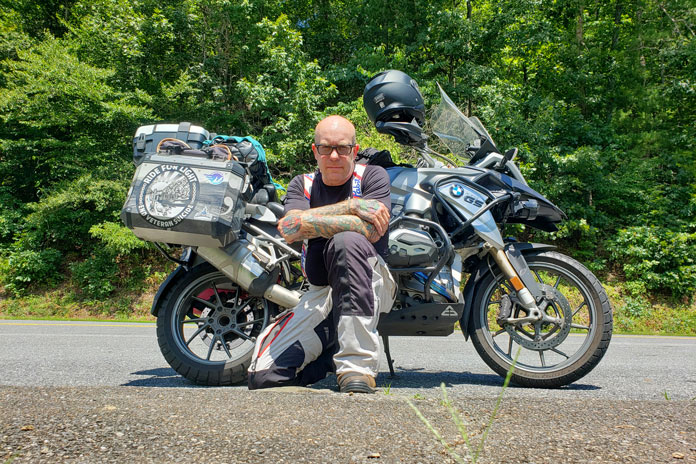
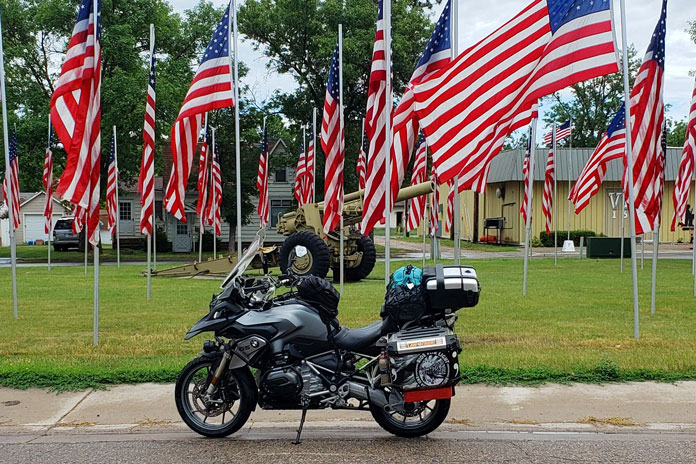
Former Army paratrooper Perry Steed with his 2013 BMW R 1200 GS on the Ride for Light. Steed departed Wilmington, North Carolina, on May 20 and returned home August 14.
In his intro video on the Ride for Light Facebook page, former Army paratrooper Perry Steed says there has been something he has been unable to do for the last 10 years – an obstacle he hasn’t overcome.
“That obstacle has been going to collect one of my very best friend’s ashes,” he says with solemnity in his voice.
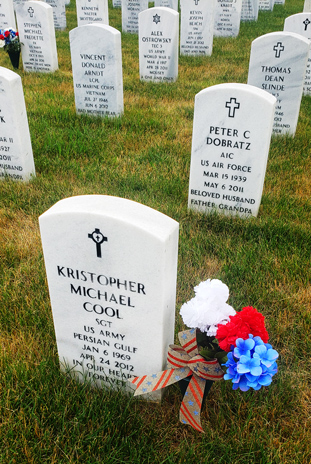
On April 24, 2012, Sgt. Kristopher Cool took his own life. Steed says he has known several people who died by suicide both before and since Cool, but his friend’s death has been “the worst one for so many reasons.”
I can relate to Steed’s struggles. I’ve never been any good with death, whether it was from old age, a tragic accident, or suicide. But it’s a little harder in the case of suicide because of the conflicting feelings for those left behind. In 2014, a good friend of mine who was a veteran took his own life, and I still get choked up thinking about the pain he must’ve been feeling and the times we haven’t been able to share since.
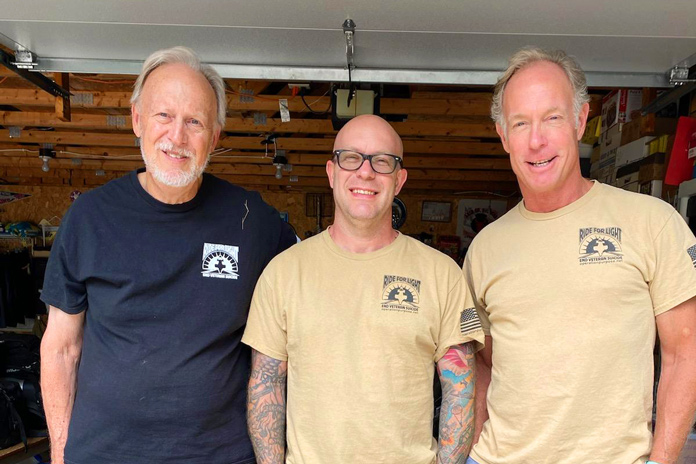
Steed with Sgt. Kristopher Cool’s father, Mike Cool (left), and uncle Paul Cool (right).
According to the website for Steed’s nonprofit, Operation: Purpose, veterans are 50% more likely to die from suicide than those who haven’t served, and what started as a mission to retrieve his friend’s ashes in Minnesota and take them to Fort Bragg to spread on Sicily Drop Zone became a “rally cry for support.” On May 20, Steed departed Wilmington, North Carolina, on a 2013 BMW R 1200 GS for a 48-state trip covering more than 15,000 miles. He returned home August 14.
“This ride is meant to provide Kristopher a final resting place,” the Operation: Purpose website states, “while also illuminating the issue of veterans’ mental health.”
When I first contacted Steed in June, he had made it to my neck of the woods in the southeastern corner of Utah.
“None of us can save the 22 that died yesterday,” he told me, referring to the Veterans Affairs statistic that 22 veterans take their own lives each day. “But if we can save one today, maybe they can help save two tomorrow. And then we can get this thing under control.”
More Than a Promise
Steed served as a forward observer in the Bravo 1st Battalion, 319th Field Artillery Regiment, 82nd Airborne Division from 1994 to 1997. He met Cool at the 82nd replacement. Steed was coming from jump school, and Cool was working the change of quarters desk. “We got to chitchatting about music, and we had similar tastes.”
The two men served together in the 82nd Airborne Division. Cool left the service a year before Steed, but the two stayed in contact over the years, including a stint when they lived in the same town.
“For a long time, he and I were pretty much inseparable.” Steed paused, and his next words were heavier. “Those were good times.”
In April 2012, Steed got a call he said he was expecting. “But I couldn’t hear it. My friend had died by suicide.”
The news hit him hard, and he formulated the plan to gather the ashes.
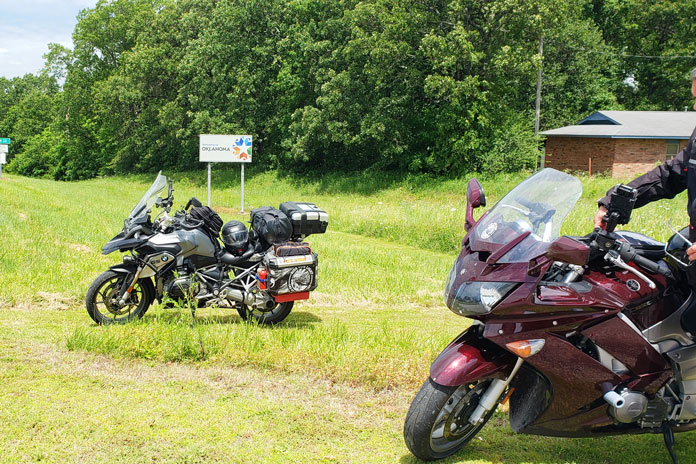
Seneca, Missouri, on the Oklahoma border.
“But every time it came around for me to do it, I just couldn’t seem to make it happen.”
Steed said he struggled with his own instabilities for several years, and when he heard the news about Cool, he was trying to focus on his family.
“In fact, when I got the call, I was waiting for my wife to come home so we could go to childbirth class for our middle child,” he said. “So I focused on trying to be there for them. But I haven’t been there for myself.”
But the tragedies kept “building and building,” he said, including the deaths of more than two dozen family members and friends from various causes.
“They’re not all old people that had lived a full life. A lot of these people were cut down in their prime, and there have been a few suicides.”
He tried to keep motoring on, but everything came crashing down when his father-in-law died of cancer in 2019.
“He was the glue keeping me together,” Steed said, “because I had been focusing on getting him to his treatments, to his doctor’s appointments – just being there and doing things.”
Earlier in our interview, Steed said he had left from Fruita, Colorado, that morning, taking U.S. Route 191 and visiting Arches National Park, one of five national parks in Utah, and was talking to me from one of his father-in-law’s favorite spots in Mexican Hat, Utah, on U.S. Route 163.
“I’m actually sitting in the motel that he talked about for years and years, and wanting to come back,” he said. “I’m here to spread some of his ashes tonight. I carry him with me everywhere. I was raised by a good family, but when I met this man and asked if I could marry his daughter, he turned into my dad.”
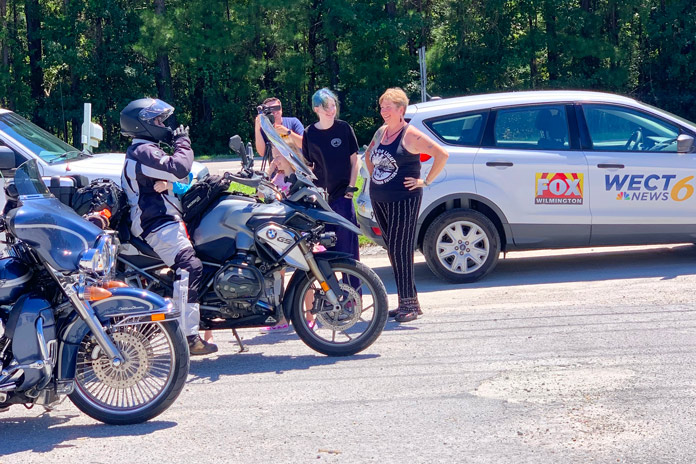
Steed’s wife, Liz, and oldest child, Ella, greet him at the welcome home event, which included a police escort, 60-70 other bikes, and two news crews.
Once his father-in-law died, “everything spiraled out of control for my family and me. And then Covid hit.”
He said the pandemic felt like a reset for a lot of people, himself included. He started using VA grief counseling tools and “put in a whole lot of work to get myself to where I could honor the promise I made when Kris passed away to go get his ashes.”
Before Christmas 2021, Steed spoke with his wife, who encouraged him to do it. The idea of the trip got him thinking about a friend in Oklahoma he had served with and who had been difficult to reach for quite a while.
“People don’t pop into my head for no reason,” he said. “So if someone pops into my head, there’s a higher calling for me to reach out to that person. I’m going to find them and I’m going to call them and I’m going to check on them.”
At that point, the purpose of the trip evolved.
“It’s me checking on battle buddies, guys I served with, friends of guys I served with, complete strangers.”
Over the course of reaching out to people, Steed reestablished a connection with a friend he served with who lives in San Luis Obispo, California.
“I told him, ‘Hey man, I’m getting ready to do this crazy thing. Hell, I might even come to California.’”
When Steed explained the impetus for his trip, the friend asked if Steed would also retrieve the ashes of his brother, Specialist David J. Howard.
“I haven’t physically seen this guy in California in over 20 years, and he still thinks enough of me to trust me with some of his brother’s remains knowing that I’m going to do exactly what I told him I would do and spread those ashes on Fort Bragg.”
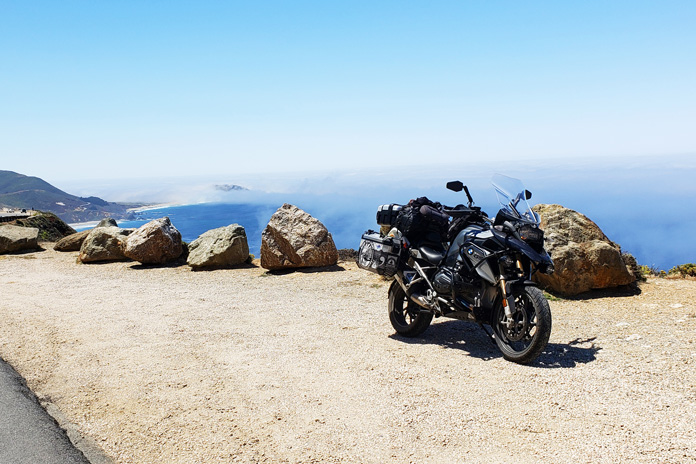
The Pacific Coast Highway, near Big Sur, California.
The Pros and Cons of15,000 Miles of Helmet Time
Steed has been riding motorcycles for about 13 years. While the 1200 GS is his chosen mount for this mission – a bike he said was a holdout for him, even with the rave reviews – it’s not the only bike in his stable. His first motorcycle was an ’84 BMW R 80 RT.
“I spent a ton of money getting that thing right,” he said. “I still have it.”
He also owns an ’81 Yamaha XS 650, an ’84 BMW R 100 RT, a ’74 Moto Guzzi Eldorado, and a 2015 Suzuki V-Strom 650XT. A full stable indeed.
After more than a decade in the saddle, he’s no stranger to helmet time, but the Ride for Light provided more of a challenge. For one, it was longer than any rides he had previously taken.
“I did a mini trip last summer,” he said. “I rode 2,500 miles, just around North Carolina and Virginia and those areas, to see if I could even handle being in my head that long.”
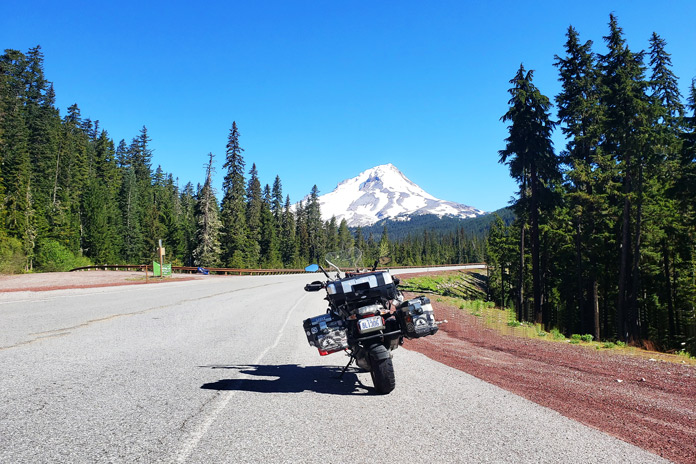
On U.S. Route 26 in Oregon approaching Mount Hood, which Steed said was huge. “I rode for a long time, and it didn’t look like it got any closer.”
Steed originally planned on doing the trip solo, but he was joined along the way by various friends and family. When he set out from North Carolina, he had a friend who is also a veteran ride along with him for the first five days and then split off in Georgia, at which point Steed was joined by a cousin who rode with him about 1,100 miles to the Oklahoma state line.
“He’s been riding for a long time,” Steed said of the cousin, “but as far as long stretches in the saddle, that’s the longest he’s ever done.”
In addition to the distance, his cousin had also never ridden with anyone else, which provided Steed some opportunities for coaching and helped break up the monotony. But more than that, Steed was glad for the cousin to come along because he is a veteran as well.
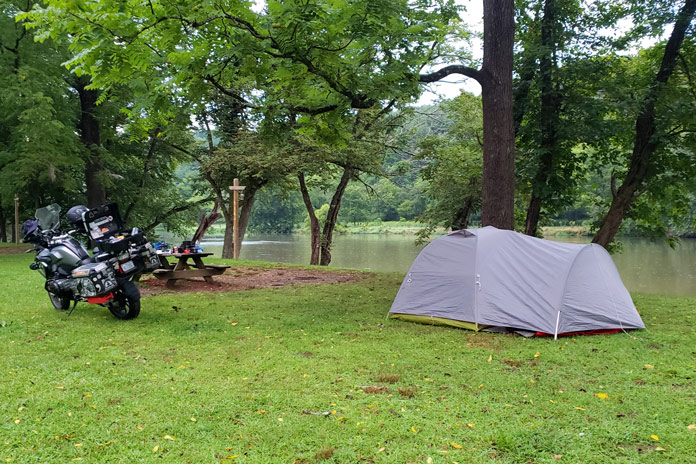
New River State Park in North Carolina. Steed camped for about 80% of the trip, which allowed him to be alone, regroup from each day, and do a mental check-in. He said the camping setup and takedown routines were comforting.
“He downplays his military service, but he still signed a blank check. He’s a good dude.”
And Steed ultimately connected with that friend in Tulsa, Oklahoma. They rode together to Fort Sill, where Steed had completed basic and advanced individual training. The two rode about 700 miles together.
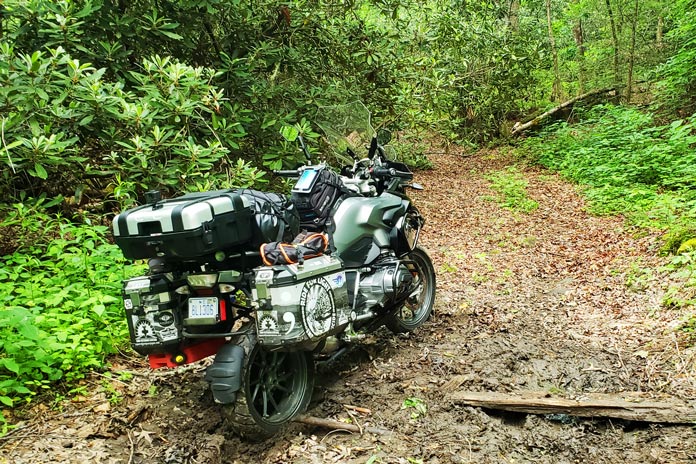
Besides the camaraderie, the other advantage to having someone else along is in case of a mishap. After riding the Tail of the Dragon in Tennessee with the friend who had been with him from the start, Steed separated a rib doing some off-roading on a forestry road. At that point in the trip, he had become used to having someone tag along. He felt like he could push himself, take a few more chances, and do a little more off-roading. When his friend split off, that changed.
Another 20 yards down this trail, just off the Tail of the Dragon in Tennessee, is where Steed had the accident that separated his rib.
“All that stuff was gone,” he said. “I had to come to grips with no guarantees of anybody doing it with me.”
When you get used to someone being around – even if just for a short time – it makes it harder when they’re gone, like when a good friend comes to visit and you feel a little bit lonely when they leave.
Or when a friend you’ve known for many years takes his own life.
In the late 1970s, psychiatrist Dr. Bessel Van Der Kolk started working with Vietnam veterans. Interestingly, his first patient would ride his Harley to bring himself down from moments of rage brought on by his trauma.
“The vibrations, speed, and danger of that ride helped him pull himself back together,” Van Der Kolk wrote in his 2014 book The Body Keeps the Score.
Van Der Kolk’s original work took place before post-traumatic stress disorder was an official diagnosis. These days, his contributions are considered pivotal in the field of trauma. He says one area of difficulty shared by those dealing with trauma is the inability to live in the moment. This capacity is the foundation of meditation and the somewhat recently coined term of “mindfulness.”
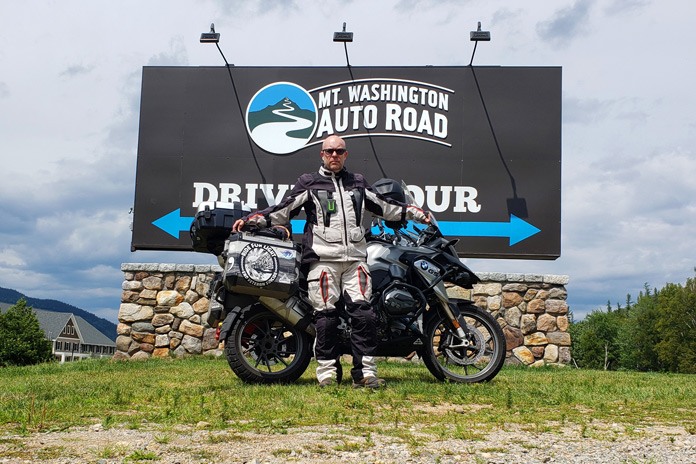
The scenic Mount Washington Auto Road off New Hampshire Route 16.
Personally, I appreciate the fact that when I’m on my bike, I’m only on my bike. Preoccupied with operating the machine, there isn’t much room to think about a troubling situation at work or home. The past and the future don’t matter nearly as much as the present moment.
For Steed, that wasn’t always the case on this trip.
“I’m stuck in my head and in my helmet all day,” he told me in June. “It’s like when you’ve got two kids who don’t get along, you lock them in a room together and say, ‘You guys are going to be getting along before you walk out of this room.’ That’s me, man. Some days my biggest fights are with myself.”
But this was a battle he was determined to win.
“Just today, I got in my head this morning,” he said. “I didn’t want to ride. I didn’t want to go anywhere. I was fumbling around getting ready, and I was awake almost all night for no reason.”
Steed said that as men, we try to find out the rationale, to get to the “why” for everything.
“But it’s just me,” he said. “It’s how I am. It’s how I’m wired. A success for me is going to be if I can get out of this trip being able to live in my head better.”
Steed said he could’ve chosen to fly to all these places to retrieve the ashes, maybe checked in on friends that way, “but I have things I also need to work out.”
“I need to be a better person for myself. I need to be a better husband for my wife, a better father for my children. I need to be a better friend, a better brother, a better son. With all these demons lurking over me, I’m out here trying to just pay all the kindness forward that I can, check on these folks, talk some stuff out with people I haven’t seen in a long time, and try to have some fun of my own.”
And there have been good times.
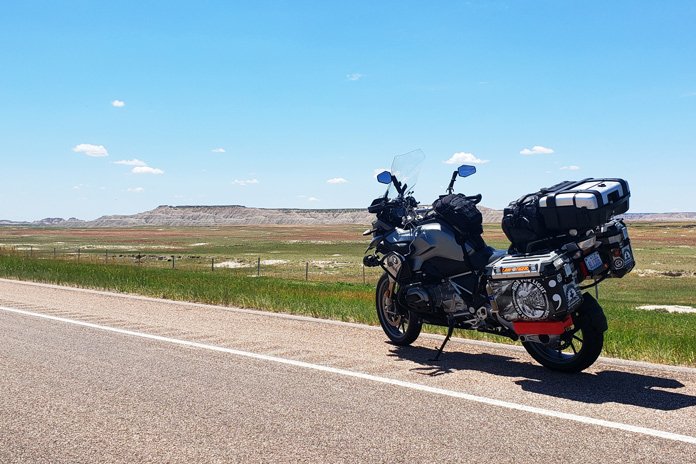
The temps were so high near Badlands National Park that Steed’s GPS on his phone stopped working. When it cooled off, he snapped this photo.
When you hit 48 states on a bike, you can’t list all the spots, but there are some eye-poppers worthy of mention. Although Utah is definitely beautiful, it was hot when he came through my home state, with temps in the triple digits. People in the Southwest like to say, “but it’s a dry heat,” to which Steed replied, “The only difference between a wet heat and dry heat is that with a dry heat, you don’t know you’re dying. Even though this GS is a waterhead, it was still not liking it.”
I can’t imagine Amarillo, Texas, was much cooler, but he has some great pics and videos of his stop at the Cadillac Ranch on his Facebook page. He rode in some “hellacious storms” along the way, and he stuck his feet in the Gulf of Mexico – “with my riding boots on.” There was a spark in his voice when he spoke of riding the Tail of the Dragon. After a couple days’ rest following his off-road crash and waiting out the rain, he rode it again.
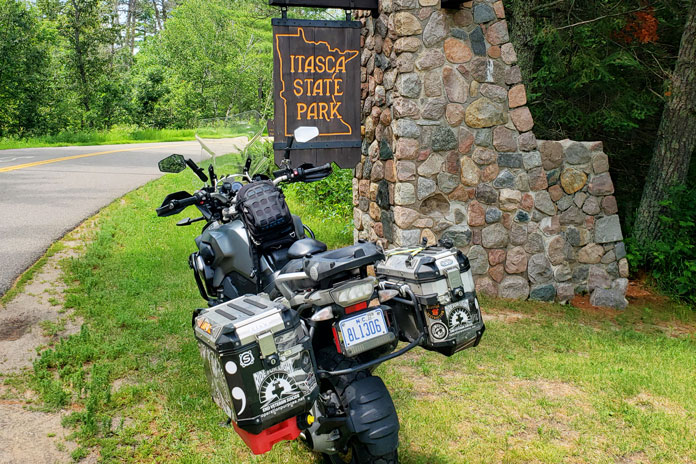
Itasca State Park, the headwaters of the Mississippi River.
Then there are the people, of course. Beyond visiting friends and family, he’s met a slew of strangers.
After a mishap with his bike in Oklahoma, Steed stayed an extra day and got to meet some friends of his buddy who were also veterans, some of whom had pulled “some pretty serious duty.”
He also mentioned a 20-year military veteran who was particularly inspiring. Steed said the man, who had been hospitalized twice for mental issues, had been rudderless until he started volunteering in a VA nursing home after retiring from the service.
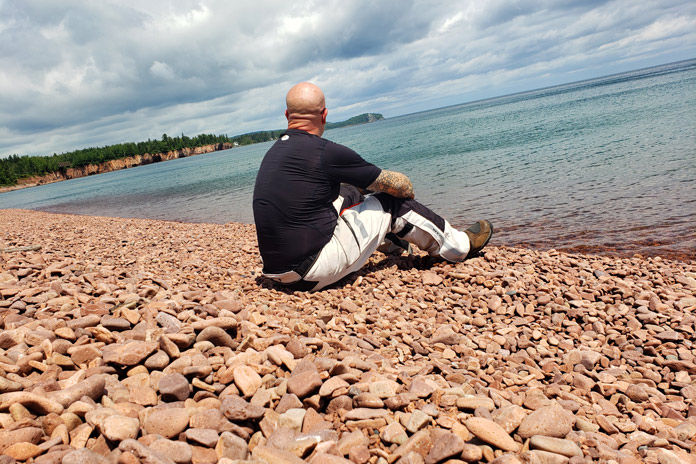
On the shore of Iona’s Beach at Lake Superior.
After seeing the lack of attention paid to a couple of soldiers who had died under VA care, the man went to school to become a mortician and a funeral director, Steed said, with the mission of giving veterans the best burial they deserve.
“That is a fantastic thing to do for someone,” he said. “That really touched me. Because it’s not just Iraq and Afghanistan veterans I’m trying to help. A huge segment of our population that never received any kind of help were Vietnam vets.”
He said that, 50 years later, Vietnam veterans are still trying to figure out their place in this world.
“They were spit on or ridiculed when they got home. A lot of the veterans that end up committing suicide are from that theater of conflict and age demographic. Veterans often feel like they can’t help anybody and all they’re doing is hurting other people, so that’s why they do it.”
Steed’s GS on July 2 in Madison, Minnesota.
Steed said the people he’s met kept him going.
“Every positive reaction I get from telling people about what I’m doing makes me want to talk to somebody else,” he said. “This has been an exercise in me stretching my capabilities as far as reaching out to folks.”
Then there were the people waiting back home, namely his wife and three kids.
“If it wasn’t for my wife and children, there’s no way I could do this,” he said. “My wife has been the biggest cheerleader I’ve had.”
He said when he was having a difficult day, one that started with depression or anxiety, his wife was his support.
“It puts a lot of pressure on her, and I feel terrible about it sometimes, but if I’m having a rough day, I have to call her. She’s the one who has kept my head right for so long.”
Finally, he said he believes he’s getting help from those he’s lost over the last 10 years.
“Somebody’s watching out for me,” he said. “Of all the people I’ve buried that meant so much to me, I think they’re all having a huddle upstairs and saying, ‘Dude, we gotta get this guy straight.’”
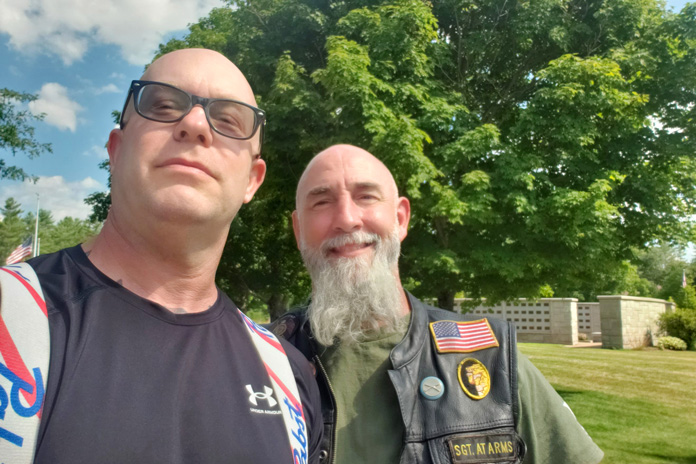
Steed and Staff Sgt. Paul Tower at New Hampshire State Veterans Cemetery.
The Road Keeps Rolling
In the 1994 movie Shawshank Redemption, two of the main characters reference a choice: Get busy living or get busy dying.
Steed’s mission will be over at some point. As of this writing, he has ridden 48 states and rolled back home to his family, and plans are in the works to spread the ashes of Cool and Howard at the Sicily Drop Point. But he’s determined not to make that the end of the road. This wasn’t just a trip about death; it’s about life.
Steed said that while he has been helped by the VA in many ways, he also recognizes its deficits. He has been researching various organizations that help veterans and is working on his 501(c)(3) status for Operation: Purpose, as well as accepting donations on his website.
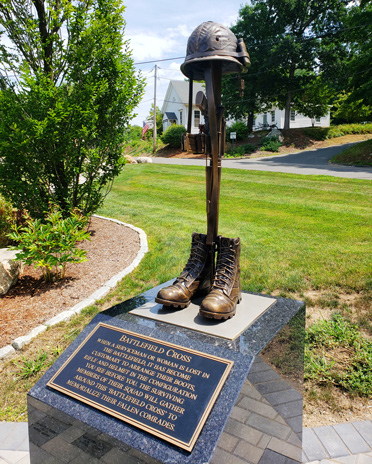
Battlefield Cross sculpture at Veterans Monument Park, Andover, Connecticut.
“The real disconnect is placement for veterans in crisis and their families,” he said. “Who do you call? What do you do? Everyone knows the suicide hotline, but what happens after that? The goal is to create an education program for families and veterans.”
Steed knows some therapists willing to donate their time, and he is working with someone to apply for grants for Mental Health First Aid training, which helps someone who encounters another in a mental health crisis.
“You have skills available to talk them down, calm them down, and get them somewhere where they can think more rationally, or you can get them help without them harming themselves.”
Steed wants veterans to feel like they have another option besides ending their lives.
Sgt. Kristopher Cool’s headstone at Fort Snelling Veterans Cemetery, Minnesota.
His long-term goal is to ultimately create a multiuse space similar to those seen on military installations, but in the immediate future, his first step is to create a database of key people in his area. He compared it to the military term “interlocking fields of fire.”
“I’ve got guys who are spread out in the greater Wilmington area, and it’s a network of people who know the veterans,” he said, adding that there are a lot of retired or ex-military in Wilmington, as well as several military bases in North Carolina in general. “We know a lot of people. We can be there for each other. We can be the ear and the shoulder and can offer redirection if that’s feasible.”
This support is what Operation: Purpose is all about.
“We may wake up tomorrow morning and the VA won’t be there anymore, but we still need to help each other. We didn’t have the VA when we were in [the service], but we had each other, and I need to reestablish that line of thinking, to bring the camaraderie and the unity and help each other get our dignity back and a hope for a better day.”
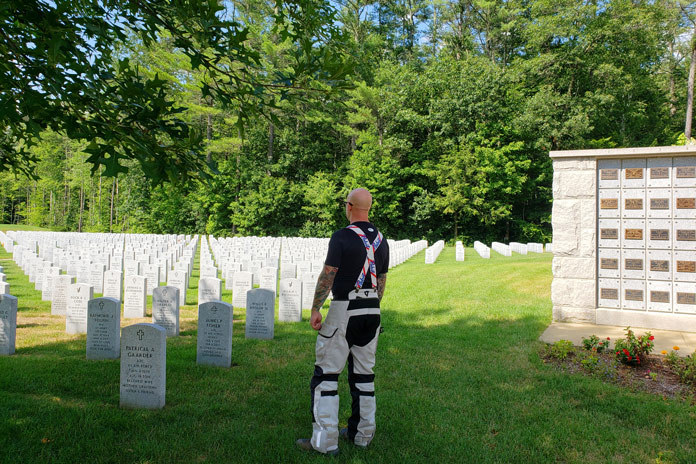
The New Hampshire State Veterans Cemetery in Boscawen, New Hampshire. The week after Steed’s visit, he learned that the state is creating a monument recognizing the issue of veteran suicide.
For more information, to make a donation, or to buy Operation: Purpose merchandise that supports veterans in crisis, visit OperationPurpose.net.
This article first appeared in the October issue of Rider. All photos courtesy of Perry Steed. Paul Dail joined the Rider staff as Associate Editor in June. This is his first story for the magazine. He also wrote the Exhaust Note for the October issue.
Each year (Covid years excepted), vintage motorcycle enthusiasts gather on a large island in the Puget Sound near Seattle to ride, watch and generally bathe in the vintage goodness of the Isle of Vashon TT. This year, I rode to Vashon on a bike that looks old, but isn't.