Everyone and their Aunt Josephine seems to be talking about self-driving cars… but despite receiving more than $80B in investment (so far), the self-driving car industry has yet to put the autonomous pedal to the metal.
But while self-driving cars continue to idle, other types of vehicles — ranging from cargo ships to tractors — are pulling into the fast lane.
Now, self-driving bulldozers are joining the family
Yesterday, a startup called Built Robotics raised $33m to expand its self-driving construction equipment.
The company does not build its own vehicles. Instead, it creates conversion boxes — lidar, GPS systems, and other gizmos — that give normal bulldozers an autopilot mode.
Like other autonomous vehicles, Built’s ’dozers are equipped with a number of sensors that pull the plug if the machines lose their balance or something gets in their way.
In many cases, specificity is the key to successful autonomy
General-use self-driving cars are a cool idea, but they are really hard to build. Instead, it’s smarter to make self-driving vehicles that accomplish specific, well-defined tasks — like scooping dirt.
And the backhoeing of the autonomous vehicle market doesn’t stop there: Other startups also developing highly specific self-driving machines: Sea Machines has raised more than $12m to build self-driving ships; Bear Flag Robotics has raised $3.5m to build self-driving tractors; and Skydio has raised $70m to build autonomous drones.
Permission to be wiped from the world’s leading search engine… Fuggetaboutit.
Yesterday, Google won a years-long legal battle in Europe over the EU’s “right to be forgotten” ruling, allowing the search giant to refrain from filtering search results for Europeans outside of the continent.
In case you forgot…
The ruling follows 2014’s “right to be forgotten” act in Europe that allows European citizens the right to ask search engines to remove “sensitive” or “outdated” skeletons from their digital closets.
The case was brought to the European Court of Justice after the French data watchdog, CNIL, ordered Google to nix all search results for people who wanted their history scrubbed from Google searches, not only in France or the EU but globally.
Google wasn’t down with CNIL veering from its lane, and, as of yesterday, European justice officials agreed with Google’s level of hatorade.
A ruling to remember
Europe’s top court ruled that EU law requires Google to scrap the outdated or irrelevant search results about a user only within the EU.
The ruling states, “The operator of a search engine is not required to carry out a de-referencing on all versions of its search engine… It is, however, required to carry out that de-referencing on the versions corresponding to all the Member States…”
That could’ve been an indelible can o’worms
As of March 2018, Google had received a grand total of 655k requests from individuals demanding the removal of more than 2.4m links in Europe alone — and it wasn’t just from your European conspiracy theorist uncle. A large percentage of those requests came from corporations, politicians, and public figures.
The decision is a big victory for free-speech advocates, who struggled to see the line of such censorship.
Had the court not sided with Google, many feared that it could’ve resulted in a global domino effect of countries dictating all search results for their citizens.
No, literally. SeaBubbles, the creators of the battery-powered watercraft, hopes to provide a sustainable, aquatic alternative to traffic-congested roadway travel with their four-person “flying taxi.”
The vehicles (or “bubbles) will offer shared rides up and down the Seine River, silently doing the electric glide a couple of feet above the water — so you can leave your motion sickness patches at home.
The on-demand travel market is getting increasingly congested
Companies are racing to provide sustainable traffic solutions. In recent years, tech improvements have empowered established rideshare giants and new startups alike to scan the skies, bike paths, and tunnels in search of innovative mobility solutions. But so far no one’s really been able to crack the code.
SeaBubbles hopes to lead the way
The company’s plan is to enter 50 cities globally in the next 5 years. Parisians may even be able to open the mobile app by next year and order a glide.
Let’s just hope no bubbles get blown away by the epic break dancing we’re going to see during the 2024 Summer Olympics.
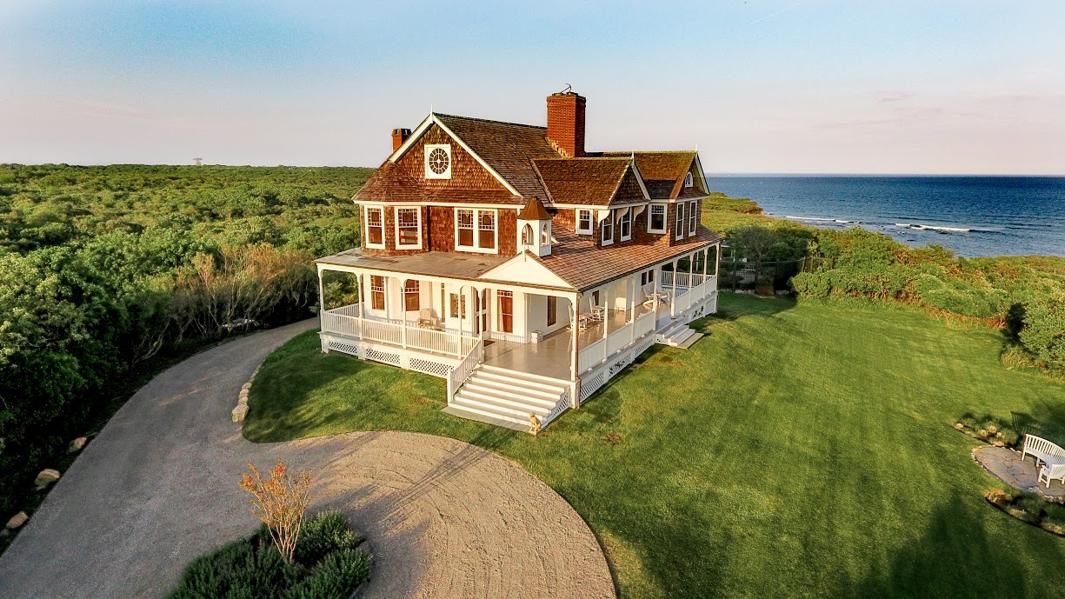
Montauk’s Tick Hall, one of the fabled “Seven Sisters” and the longtime home of talk show host and author Dick Cavett, is on the market for $33,950,000 million.
Every morning in the valley of Jerte, deep in Spain’s remote Extremadura region, 40-year-old Alfonso Hernández Saguero makes a pilgrimage to a lonely hilltop to keep a dying tradition alive.
Hernández arrives before dawn to unlock the low-slung stone barn partially built into the hillside. It’s January, with frost on the grass, but inside it’s almost cozy, thanks to the 200-some black, long-horned goats curled up sleeping. They are Veratas, a breed indigenous to Extremadura and now considered endangered.
Hernández grabs a bucket and starts milking. Many goat farmers use a milking table, a platform with feed boxes and restraints that keep goats from fleeing or kicking. But Hernández simply squats down behind each goat. The milk zings against the side of the bucket; the goats don’t kick or fuss. Maybe this is because Hernández is a fourth-generation goatherd, and some of these goats are descendants of the ones he began taking care of at such a young age that he can’t remember when he first started doing the work. “You could say I was born a goat,” he jokes.
The milking finished, Hernández leads the Veratas out of the stable with a high-pitched whistle, two collie mixes barking eagerly at his side. The goats move along the barren mountainside, making do with what’s available in winter. They gobble up ivy, blackberry brambles, and cantueso, a wild herb that smells like lavender and rosemary. Hernández is relaxed but alert. “You have to go with your sixth sense in front of you,” he says, intuiting where the goats are headed next.
For thousands of years, this type of pastoreo extensivo, the grazing of goats on broad areas of wild land and pasture, has been a mainstay of rural life in Spain. It has left a deep mark on both national and Extremeño cuisine, from the wide variety of Spanish goat cheeses to the roast cabrito (kid) eaten at Christmas. But in the 21st century, traditional goatherds such as Hernández have become as endangered as his Veratas, even in Extremadura, where agriculture is still king. According to local records, from 1960 to 2019, the number of goats being raised in the Valley of Jerte dropped from 26,000 to 3,000.
As the sun rises, the landscape appears in all its eye-popping glory: the Garganta de los Infiernos (in English, the Gorge of Hell), a stunning natural reserve that draws more than 300,000 tourists each year. Most come in summer, to swim in Los Pilones, a series of crystalline natural pools carved in the river bed’s pale granite. On a winter day like this one, Hernández will be lucky to encounter the odd hiker. But when he was a child, about a dozen families led their herds each day along the steep slopes of the Gorge of Hell. “You even had to change your route so you wouldn’t run into another herd,” he says. “Here I am [now], and it’s just me. Because everyone else has disappeared.”
In a clearing even higher up than the barn, Hernández and his herd pass signs of this lost community—ruins of round stone huts which goatherds have built and lived in for centuries. But these are relics of a recent past, not an ancient one. Until he was a teenager, Hernández, his parents, and three siblings drove their goats over backroads and trails from the warmer dehesa, or pasturelands, farther south to spend summer and autumn in one of these chozos. His grandparents built it by laying flat stones to form a floor and arranging branches to make a conical roof. Every summer, the family added a new layer of piorno, a kind of brush, to keep out the rain. The single room served as living room, bedroom, and kitchen. The bathroom? “In the street,” Hernández jokes.
Under those thatched roofs, the Hernándezes and other goatherding families whipped up dishes now considered delicacies in Extremadura. They ate sopas canas, a “white-haired soup” based on goat milk thickened with breadcrumbs and flavored with pimenton de la Vera, a strong paprika that now enjoys the European Union’s Protected Designation of Origin status. For dessert, they fried egg-and-bread-crumb dumplings and cooked them in goat milk to make sapillos, or boiled rice with goat milk and orange peel to make arroz con leche.
For the main course, goatherding families made use of every part of the cabrito. When Hernández makes a stew with wine and local bay leaves, he uses his grandmother’s trick of finishing the broth with pureed liver. He stews the feet in sauce, or makes them with rice. His mother used to sauté the brains and add them to the quintessentially Spanish tortilla de patata. Hernández’s favorite way to eat brain: Slice the young goat in half down the middle, from head to tail, tie laurel leaves around each half of the skull to keep the brain inside, and make a stew. Even the intestines—thoroughly washed—are delicious. Hernández cooks them with salt and bay leaves, chops them up finely, and sautés them with onion, bell pepper, and the goat’s own blood. They’re known as chanfaina.
From his parents and grandparents, Hernández learned not only how to cook with goat milk and meat, but how to play the many roles required of a goatherd. In summer, when his goats give birth, Hernández is a midwife. He’s a veterinarian year round, fixing broken legs and saving overly curious baby goats whose heads are stuck between large boulders that dot the hillside. When the goats are tranquil, he sits on a boulder with a view of the gorge and carves new bell-clappers from Holm oak, using one of his grandfather’s clappers as a reference.
In 2016, the cooperative founded what they call a “Shepherd’s School.”
For a few years, he documented these adventures, along with his cooking, on Facebook. He ended up with more than 1,000 followers, and Jerteños still know him as El Cabrero del Infierno, or the Goatherd of Hell. But he gave up posting because he didn’t want to be on his phone. He wanted to be with his goats.
As the light fades, Hernández leads his Veratas back down the hill to the stone stable. When Hernández was a child, his parents made their own cheese, sometimes smeared with olive oil and pimenton, and aged in their chozo. Every week, the Gorge of Hell goatherds loaded up their horses and rode down to Jerte, the nearest village, to sell their cheese. Villagers who are old enough still reminisce about this weekly market day.
The thermoses of milk in Hernández’s Land Rover, on the other hand, are destined for a large cheesemaker in a nearby town. Due to modern sanitary regulations, Hernández says he can’t afford the facilities to make his own cheese. (Don’t even mention the paperwork.) He jokes that if he looked too closely at his profits from milk, he might give up the job. That’s why, he says, he’s the only one left in the Gorge of Hell.
“[Others] get tired of it, abandon it. They take other alternatives.”
Hernández himself has been tempted to leave. At 19, he spent nine months doing voluntary military service in Madrid, and then nine years working around Jerte in forestry and agriculture. As a teenager, he had resented the long, grueling days of herding, but his time away, he says, “proved that this is what I wanted.” At 28, he started his own herd. Yes, he works 365 days a year, in rain, sun, and snow, but, he says, “I’m more satisfied, more happy than I would be in any other place.”
Hernández is not the only one trying to save this lifestyle, its animals, and its foods. About an hour southeast of Jerte, in the town of Casar de Cáceres, a group of Extremeños is working to transmit the pastoral tradition to the next generation. Their goal is to keep young people from fleeing rural areas, and to save a local delicacy from disappearing.
“We have a grave problem of generational loss,” says Mariangeles Muriel, director of the Fundación Cooprado, which was started by the agricultural cooperative Nuestra Señora del Prado Casar de Cáceres. Shepherds and cattle ranchers are aging out of the business, she says, and, unlike Hernández, the next generations are choosing to leave for cities and easier work. Rural depopulation is a problem throughout Extremadura, Spain’s poorest region, but Casar de Cáceres has serious skin in this game. It’s home to the Torta del Casar, a Protected Designation of Origin cheese that can only be made with milk from local Merino or Entrefina sheep. Every Christmas, Spaniards from all over the country clean out the supply. Muriel says local sheep milk production already can’t keep up with demand for the delicacy, and without new shepherds to replace the older generation as they retire, Torta del Casar will disappear.
In 2016, the cooperative founded what they call a “Shepherd’s School,” a five-month program combining classroom time and fieldwork to teach students everything about raising cows, goats, or sheep, from genetics and reproduction to cheesemaking. Some students are urbanites coming back to the land, while others come from farming families, says Enrique Izquierdo, the school’s coordinator and the grandson of a cattle farmer. With 12 to 15 full-time students a year, the school has graduated 57 people, and 70 percent of them have entered the field. Hoping to modernize their techniques, local shepherds and cattle ranchers have also been attending class.
Izquierdo thinks the future for traditional goatherds such as Hernández is in forming cooperatives that can share the burdens of physical labor and bureaucracy.
“Under the umbrella of a cooperative, we can cover the needs of our business while also being able to attend to our families,” Izquierdo says. That means more free time and a better quality of life. He adds, “We can’t be in the field all day long like our grandparents were.”
“They could be right,” says Hernández about the advantages of cooperatives. In the past few years, there was talk of creating a cheesemaking cooperative in the valley, and he considered joining, although the plans never materialized.
But, as you might expect from someone who insists on carrying out a 10th-century practice in the 21st century, Hernández ends the conversation by affirming, “But independently, it can work, too.”
When a goat gives birth, she produces an extra-thick milk known as calostro, full of nutrients for her kid. If you live in Jerte and are on good terms with Hernández, then, when one of his Veratas gives birth, he might offer to make you a culinary treat. In a pot over a low flame, Hernández mixes calostro with regular goat milk and sugar, stirring constantly until the mixture is about to boil, at which point he takes it off the stove.
Hernández echoes Izquierdo when thinking about his own legacy. His 16-year-old daughter, Cristina, loves the outdoors and joins him with the herd on weekends. But he doesn’t want her to take over the family business. It’s too grueling, he says. “I’d like her to have a better quality of life than I have.”
After a moment, realizing how he’s contradicted himself, he adds, “I’m here because I want to be. I carry it here in my blood, and that’s that. I don’t care if it’s 365 days a year. Because if you really do a thing with love … ” He doesn’t finish the sentence.
Left to cool, the calostro will thicken into a pudding-like consistency that can only be described as spiritual. In one bite, you’ll swear you can taste the entire valley: the aromatic cantueso, the blackberry brambles, the hard-earned nourishment of winter.
The Brisbane Water National Park on the Central Coast of Australia is such a beautiful place to be, and Somersby Falls is one of the most popular destinations. It’s not hard to see why. So when I stumbled across a 108-year-old picture of one of my favorite waterfalls in the park, I and decided to try and recreate it to see what had changed, and what had stayed the same.
I’ve visited the Brisbane Water National Park a number of times over the years and fallen in love with the lush green landscape and powerful water. Whenever there’s rain around Gosford my first thought is how and when can I get to the valley to see the falls.
A hike into the valley takes you to a waterfall which I’ve been obsessed with ever since I realized it was there. The water cascades over the rock shelf and forms a sheet of water. You can walk behind it and capture from every angle.
Out of curiosity, I occasionally look into old record and picture archives from the Central Coast area to see what everything looked like way back when, and just recently, I came across this little picture of the waterfall. Even crazier, this picture was taken 108 years ago, in 1911! It’s amazing to think of what an absolute trek it would have been to get down to those falls—bush bashing and abseiling their way through. Now, we have stairs, suspended platforms and paths amongst the trees to help us along.
I decided to go back to this waterfall after a downpour and try and capture a picture from the same angle of the same place to see what’s changed over the last 100 years and what they look like side by side.
Capturing the Image
After hiking down to the waterfall, I found a bank of sand that looked like a vantage point very similar to where the image would have been taken. It got me thinking about how easy it was to get there with wooden steps, platforms and a pre-formed path through the bush. Compare that to what I imagine was an absolute trek back in 1911, using ropes—and probably a great deal of ingenuity—to get down the cliff and into the valley.
Back to the image: I setup the shot and did the best I could to frame and replicate the shutter speed in the original image. I managed to mostly match up the composition, though because of the recent rainfalls the conditions were a little wetter then they were in the original photo.
ISO 50, 27mm, f/16, 1/3sec and snap!
The Question is what’s changed in the last 108 years?
After capturing the shot I was able to clearly see what has changed since 1911 and, to my surprise, there were a few things.
The trees had grown, of course:
The log at the bottom of the waterfall was exactly the same! Yep that big old hunk of wood hadn’t moved all that time.
But the biggest impact of all was from humans, and not in a good way.
People have etched their initials onto trees, sprayed graffiti on rocks, snapped branches for fun, and left crap all around the falls, like beer bottles, tins of food, even nappies!
As the popularity of a place increases, so will the number of people doing stupid things. Once beautiful locations like the Figure 8 pools in Sydney, Helensburgh Glowworm tunnel and wedding cake rock, have been overrun and damaged. The latter two have even closed down in recent years—now everyone misses out. These are only places local to me in Australia, but the issue is global.
Personally, I follow leave no trace principles and I think it’s helpful to promote and educate people about this philosophy. We should leave these beautiful places better (or at least the same) as we found them, but I’m not sure how we prevent these places getting trashed and reduce the amount of litter just left around.
I set out to take a photo and compare it to the natural landscape 100 years apart, but in the end, I asked myself a different question: What will the falls look like after another 100 years?
About the author: Dale Gribble is a landscape photographer from the Central Coast of Australia. You can find more of his work on his website, or by following him on Instagram. This post was also published here, and is being republished with permission.
Precision time is ubiquitous today thanks to GPS and WWVB. Even your Macbook or smartphone displays time which is synchronized to the NIST-F1 clock, a cesium fountain atomic clock (aka the ‘Atomic Clock’) that is part of a global consortium of atomic clocks known as Coordinated Universal Time (UTC). Without precise timing there would be train collisions, markets would tumble, schools would not start on time, and planes would fall out of the sky.
But how was precision timing achieved in the 19th century during the era of steam, brass, and solenoids? One of the first systems of precision timing kept trains running safely and on time, rang the bells at school, and kept markets trading by using a special clock designed by the Self Winding Clock Company. Through measurements of celestial objects by the US Naval Observatory, and time synchronization pulses broadcast by the Western Union telegraph network, this system synchronized time across the United States in an era where the speed of our train system was out-pacing by the precision of our clocks.
Those clocks were designed so well that many of them are still around and functioning. One of these 100-year-old self-winding clocks made its way onto my workbench. I did what any curious hacker would do, figured out how the synchronization worked and connected it to a clock source with atomic precision. Let’s take a look!
Clock Synchronization That Was Ahead of Its Time
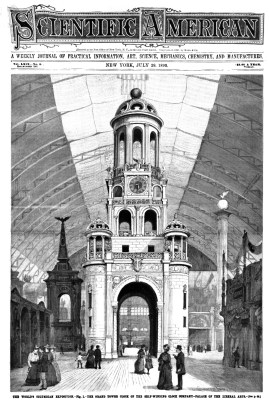
Self Winding Clock Company, Grand Tower Clock, displayed at the Palace of Liberal Arts at the 1893 Columbian Exposition, image from Scientific American, July 29, 1893.
The world changed at the 1893 Columbian Exposition; electricity came of age, tens of thousands of lightbulbs adorned buildings, AC won the battle of the currents, and a system of precisely synchronizing clocks across the entire United States was introduced by the Self Winding Clock Company.
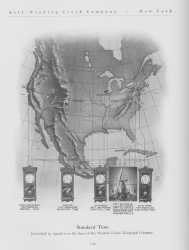
Day-to-day precise timing was provided by the US Naval Observatory in Washington DC who would measure the solar transit of either Mercury or Venus to synchronize the observatory master clock (there were three of them to check the others). This served as the master clock of the entire United States. This official time was transmitted to Western Union for re-transmission via the Western Union network to the regional and local offices.
A time synchronization pulse would be transmitted from the local Western Union office once per hour at the ‘top of the hour’ to customers who were subscribed to the synchronization service. Each customer would pay $1.25 per month per self-winding clock — some subscribers would only synchronize one clock but there were also entire buildings, offices, factories, schools, and train stations connected to the service.
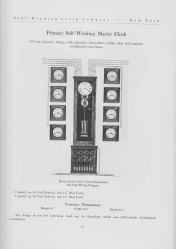
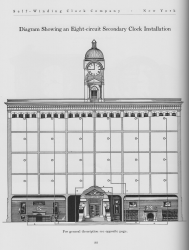
The block diagram below shows a master clock receiving synchronization signals from Western Union. With precise timing, the master clock controls a plurality of secondary clocks.
Secondary clocks were electronic repeaters that would simply repeat the time indicated on the master clock using electromagnetic solenoids, updating the time displayed on their clock faces every 30 seconds. Any number of secondary clocks could be used in large scale installations. This clock system and its precision timing service was very popular. Shown below are many prominent examples of Self-Winding-Clock installations as of 1908.
You’ve Probably Seen These Self-Winding Clocks
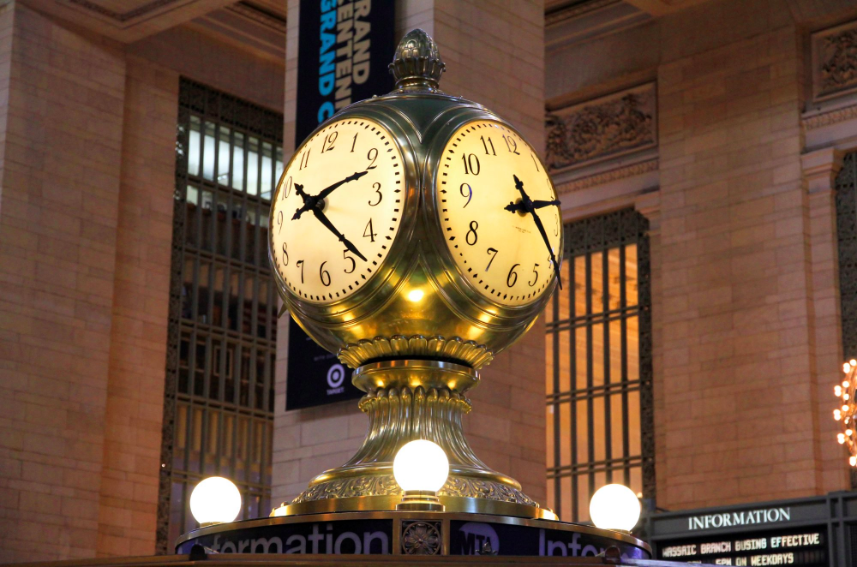
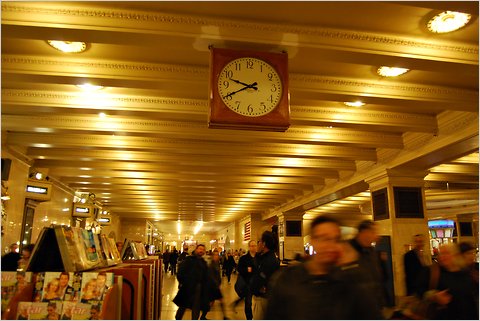
Although the Western Union time service ended in the 1960’s, Self Winding clocks are still in operation all over the country, including several at Grand Central in NYC:
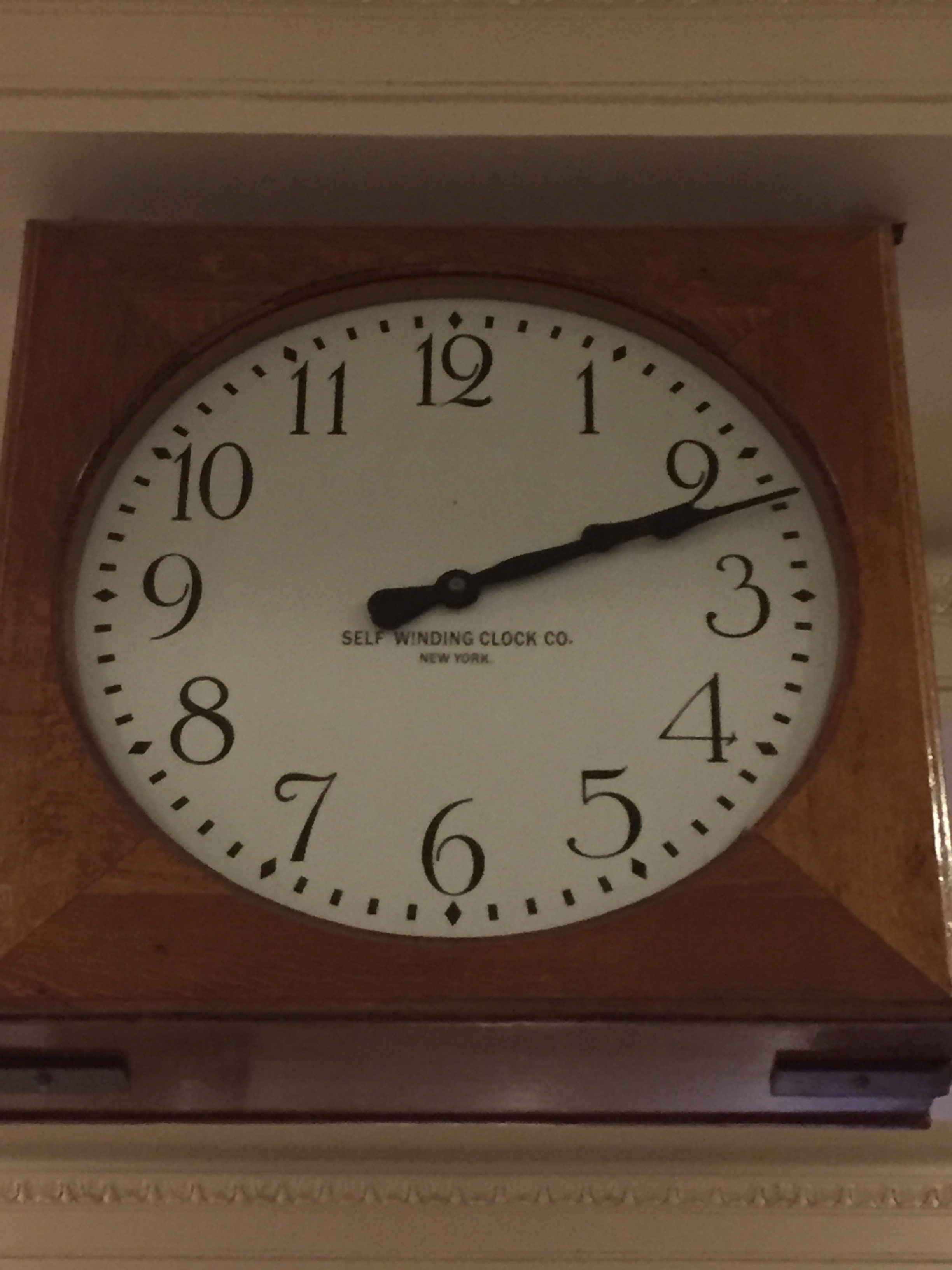
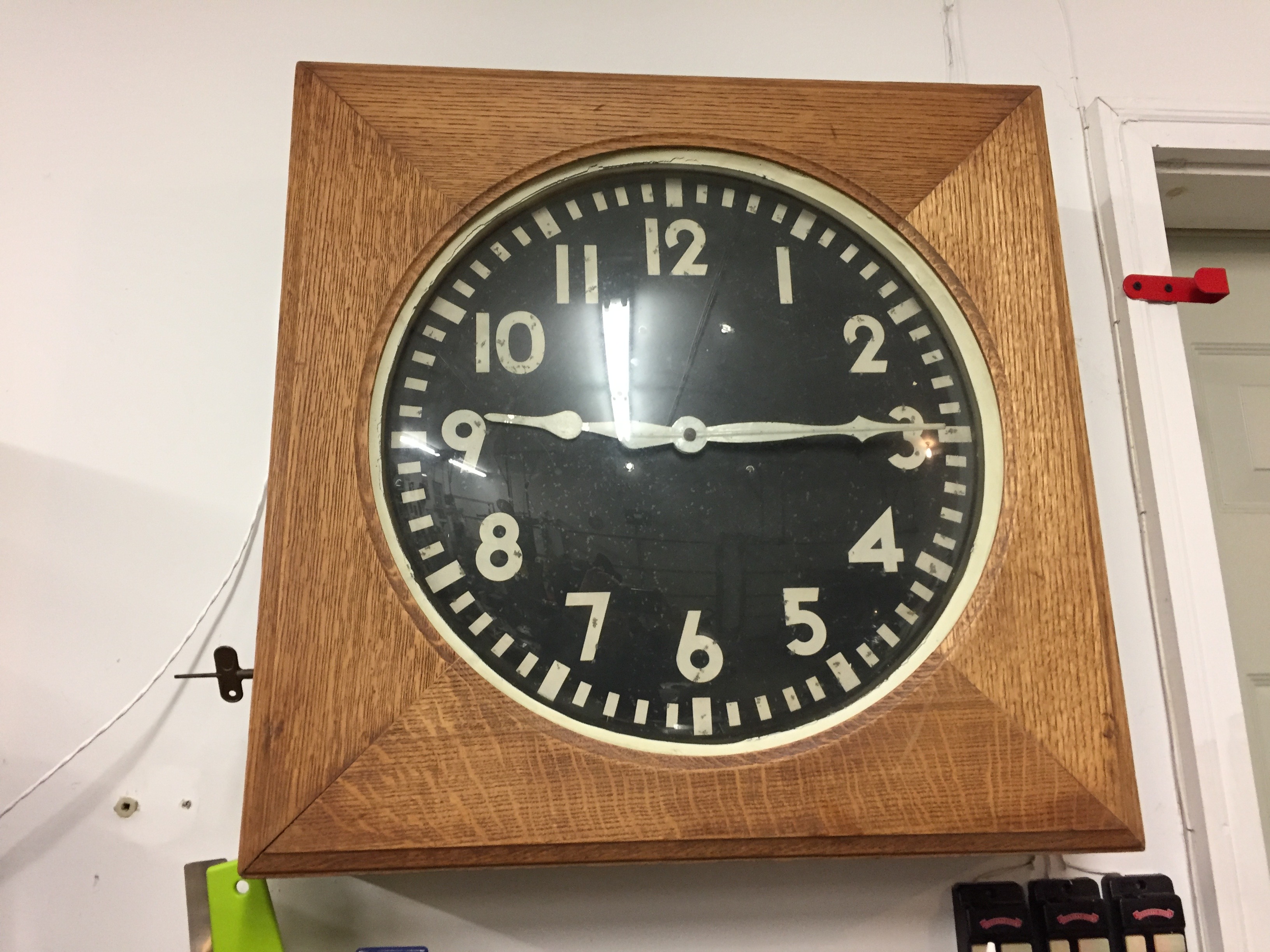
Similar in appearance to the oak cased clock at Grand Central, I was fortunate enough to be given a Self Winding Clock by a friend of mine Josh Levine. Another friend of mine, Larry McGlynn, helped me to date the movement to between 1910 and 1930 based on its serial number. So I consider this to be a 100 -year-old clock.
Usually I expect to spend some serious repair time when I acquire an old clock. This means disassembling, cleaning, oiling, and re-assembling the entire movement to get it working like new. I was lucky here because Josh had already serviced the movement and it was running strong. But after starting the movement it died within the hour. That was weird, usually pendulum wall clocks last for 8 days on a wind and I’d certainly expect it to go for more than an hour after such a strong start.
It turns out that this was a feature not a bug. I learned that the main spring barrel for this clock movement could only support 1 hour of output before the clock would stop. It self-winds using battery power and it deliberately only puts one hours worth of tension into the mainspring to maintain a consistent torque on the gear train for the purpose of maintaining accuracy and minimizing wear on the pivots. It runs for just one hour on a wind.
How Self-Winding Clocks Work
Here is how it works; the clock winds up and runs for about an hour. After an hour a cam closes a circuit and turns on the self-winding motor which winds the main spring until another cam shuts off the motor. The winding tension is good for about 1 hour then the entire process starts over again.
This is not a spinning motor with brushes and a stator. Instead, it is a pair of solenoids that pulls a lever arm with a paw gear which pushes a gear wheel. As soon as the lever arm is raised by the solenoids the electrical connection to the solenoids is broken, causing the lever arm to immediately fall back down again. This action repeats itself over and over again in a jack-hammer-like motion winding the main spring until the switch on the mainspring stops the motor. Chug chug chug!
Using a pair of 1.5V dry cells in series this clock will operate for at least 1 year before the batteries die. Interestingly enough, modern D-cells are functionally equivalent to the old dry cells, so expect 1 year of operation out of a pair of D cells.
The engineers of this clock movement could have used a DC motor with brushes but they choose this motor. I can only guess that a decision was made to use this motor architecture for long-term reliability. I can tell you that my motor still works reliably at 100 years old. By contrast, I’ve found that even mil-spec brushed DC motors from 75 years ago require a great deal of care to make them spin again.
Synchronization a 100-Year-Old Clock with GPS
For a while I was subscribed to Hackerboxes to force myself to learn how to use Ardunio and other easy-to-use embedded controllers. One of the projects was called ‘Clockwork’ and included a GPS module. I wrote a simple sketch feeding GPS time to the 7 segment display and put all of that together into a nice project box resulting in this Arduino-controlled GPS clock which covers two time zones and displays GMT.
This Arduino-GPS clock came in handy for controlling my 100-year-old Self Winding Clock synchronization solenoid. To synchronize the Self-Widing Clock I added a relay board and wrote a sketch to emulate the Western Union time protocol, thereby making the big clock synchronized to GPS. The protocol is simple, and well-described in this video by J. Alan Bloore. At the top of the hour a three-volt pulse is sent to the synchronization solenoid for less than one second. The synchronization solenoid then pulls the minute hand straight up to the 12 o’clock position.
I choose to use a 5V pulse to give it extra torque and decided to leave the pulse on for 500 mS. I put together a video overview of this entire project. If you’d like to jump to the demo of my clock synchronizing itself to GPS, start about fourteen minutes into the video.
After Nearly 1 Year of Operation
Every hour there’s a chugging noise that kind of sounds like a sewing machine, this is the self-winding action. At the top of every hour there is a loud and satisfying clunk-clunk which is the synchronization solenoid pulling the minute hand into position. If I leave my R390A comm receiver tuned to 10 MHz then the clunk-clunk happens at precisely the same time as the long beep transmitted from WWV at the top of the hour. All of this makes for an impressive horology demo for our house guests.
This clock was put back into continuous service just before new years 2018 and continues to give reliable and accurate service to this day without incident. Not only does it serve as the shop clock, I also use it to synchronize my various other clocks and watches that I tinker with.
I’d love to hear from those of you that have your own self-winding clocks in the comments below. And if you are interested in precision timing in general then I suggest joining the Time Nuts email list. From here you will receive numerous email discussions about precisely measuring time, oscillator frequencies, oscillator drift, phase noise, and many other topics.
Chris Shepherd went a long way to find home. Born in Nebraska and raised in Oklahoma, he found the heart of his cooking in Houston, one of the most diverse metropolitan areas in America. As a young chef in 1995, he started following other line cooks and dishwashers out after their shifts, usually landing at one of Houston’s huge collection of small, international restaurants: Tucking into pho, wrapping his hands around tacos, searing his face off with Korean gochujang wings.
No other city, he says, compares.
“You tell people Houston is the most culturally diverse city in the country and they’re like, ‘What?’ Yeah. We’re not a European-based city. We’re everywhere else. It’s Southeast Asian and Middle Eastern and South American and Central American and African. It’s a lot of that. The food is GREAT.”
Shepherd began showcasing this side of Houston at his signature restaurant, Underbelly. Though he closed it in 2018, he maintains a slate of others, including Hay Merchant, the steakhouse Georgia James, UB Preserv, and One/Fifth Houston, a sort of restaurant-development laboratory that changes the concept every year. (He calls it “a testing ground for what I want to do when I grow up.” Right now, the focus is on the Gulf Coast.) Shepherd went on to win the James Beard Award as the best chef in the Southwest in 2014. He also became a passionate fan of international food, haunting Houston’s small kitchens and befriending family cooks, learning everything he could about Japanese shoyu, Vietnamese fish sauce, and spices from allepo chile to za’atar.
His new book, Cook Like a Local: Flavors That Can Change How You Cook and See the World, is arranged just like that. Instead of the usual chapters of types of dishes, he goes in really close on ingredients—how they’re made, how they’re used, and recipes that go beyond the traditional. It’s a mouthful of flavor, from a chef whose appetite takes in the whole world.
It’s a big mouthful of flavor, from a guy whose appetite takes in the whole world.
This is a quirky approach, focusing on ingredients and putting them in unexpected recipes…
It’s about showcasing people. This is Houston in a nutshell, but it’s every city in the country. There’s so much you can learn from other people and share with other people. It’s the way this country is heading. You can be afraid of it, but you probably should embrace it. It’s learning these ingredients, like fish sauce and soy. Traditionally, these are ingredients that (Americans) are a little bit shy from, that need to be celebrated.
There are dishes that are completely unexpected, like fried chicken in tamales and deviled eggs from soy sauce–pickled eggs. In all that experimentation, did you find any combinations that just didn’t work?
These are all dishes that we did at Underbelly. If it wasn’t right, we fixed it. But there’s an idea you go forward from. Like, the soy sauce–deviled eggs. I wanted to redefine a deviled egg. I love deviled eggs, but how we can make them in a way that we want to eat and pay homage to a different ingredient? The fried chicken tamale—my butcher’s wife makes the best tamales on the face of the planet. We did a big event and we had a lot of fried chicken left over. So I pulled it and put it in a tamale. Cold fried chicken is one of my favorite things.
Deserted island question: If you going to be stranded somewhere, what’s the one ingredient you’d take with you?
Probably a jalapeño. Or a serrano. Some kind of chile. We went to Paris a couple of months ago and the food was great and beautiful and amazing. But I was like, man, nobody knows what a jalapeño is. There is no spice. So I would say chiles.
Cultural appropriation is a tricky issue in the food world today. Did you worry about mixing up these traditional ingredients in less traditional ways?
I’m telling the story with them, and bringing them to the forefront. I don’t do this alone. We do this together—having family members from each of these cultures teach me and work through it with me, giving them 100 percent of the credit for it. I’m not going to cook a pad Thai, I’m going to get people to understand that flavor. Go try it on your own. Go to these restaurants and have these conversations. You might be the only person of your nationality in there, but don’t be afraid of that. Enjoy it, embrace it, and learn from it. We’re all on the same journey here. Let’s celebrate each other.
What’s an ingredient you wish every kitchen in America contained?
Fish sauce. Red Boat—it’s my only one. I know it’s ten times the price, but you look at the ingredient list and it’s two things. It’s salt and black anchovies. There’s no caramel coloring, no anchovy extract. I put it all to the test. I sat down —I’m going to tell you, there’s one thing you should never do as a human being and that’s do a fish sauce tasting and turn around and do a soy sauce tasting. To sit down and take six fish sauces, smell them, taste them blind, and figure out which one you really like . . . There was a fire of sodium running through my veins. But for most of the people buying this book, how much fish sauce can a human being consume in a year? You’re talking about two gallons a year for a household in Vietnam, that’s a lot of fish sauce. The average American is going to go through maybe a cup. So if you’re going to do that, you might as well use what is really good. You can use fish sauce in a brine or a marinade. A few drops doesn’t give a funk flavor, it gives a really delicious flavor.
What do your friends ask you to bring to every party?
I just did it for Labor Day—the Tater Tot Casserole with poblanos. That’s one of the easiest things. That and Lamburger Helper (a pasta casserole with ground lamb, sambal oelek, and Crystal hot sauce). Those are game changers. And Grilled Herb Chicken marinade—I’ll do that on everything and grill it. Pork chops, everything.
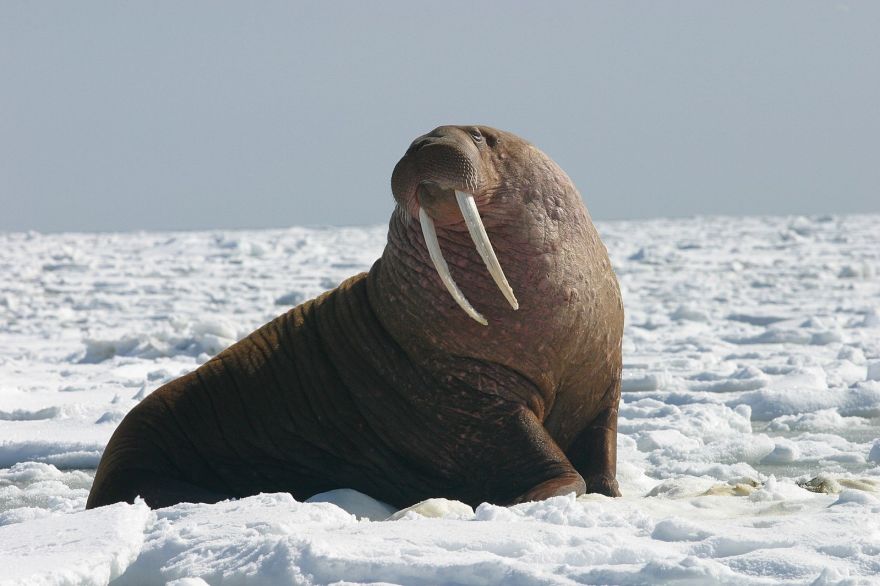
It is inadvisable to mess with Mother Nature. It is something we humans have known for quite a while. Some researchers from the Russian Geographical Society learned a new lesson during their expedition in the Arctic Ocean: don’t mess with a mother walrus either, or you’ll face undesirable consequences.
The scientists were aboard a Russian Navy tugboat known as the Altai on an expedition to the Franz Josef Land archipelago in the Arctic Ocean this week right before the unusual human-animal interaction occurred. They boarded a small rubber landing craft and were en route to the shore to study its flora and fauna when a female walrus attacked, sinking the vessel.
"During the landing at Cape Heller, a group of researchers had to flee from a female walrus, which, protecting its cubs, attacked an expedition boat," the Russian Military's Northern Fleet said in a press release.
J. Kenji López-Alt is mostly a stay-at-home dad responsible for all the meals in his household. As an essential part of his planning, he relies on a supply of boiled eggs in the refrigerator.
During one of the years in his egg-citing cooking adventures, he became curious and asked himself, “What's the best way to boil an egg?” This question would then lead to a multi-decade endeavor.
Check out these dinner recipes which only take five or fewer ingredients but still look like expensive dishes you order at restaurants. What’s more, if ever you have leftovers, you can eat them at lunch the next day as they store well!
<strong>Comp</strong>: Computer Kestrel ballistics calculators are common at long-range matches. (Ralph Smith/)
freely confess that I have shot at steel plates on the range and enjoyed myself. It’s diverting, but will it make you a better distance shooter? Maybe. A little. Or not.
What will make you a better shot, or else drive you to beach volleyball instead, is NRA bull’s-eye competition. I’m referring to F‑Class and its tactically inclined cousin F-TR, which stands for Target Rifle. In F‑Class, either brand, you can shoot at 300 to 600 yards, which is Mid Range, or 800 to 1,200 yards, which is Long Range. F-Class is fired prone with a pedestal rest. F‑TR is shot prone with a bipod. Having competed in F‑TR since 2016, I can say that it will do a number of things for your shooting that ringing steel and assassinating boulders, on your own, will not.
First, it will expose you to people who can really shoot. This will be both inspirational and depressing. Inspirational, because you’ll say to yourself, I didn’t know you could do that with a rifle. Depressing, because you will also realize that you are a long, long way from being able to shoot with that kind of precision, and you may never be able to. As to the latter, take heart: You may never be ranked a High Master, but you can still become a hell of a lot better than you are.
Second, if you watch and listen to the people who can really shoot, you’ll learn what you’re doing wrong and how to do it right. It will dawn on you that moving up from Marksman, which is the lowest ranking, is not a matter of buying a new rifle every six weeks, but of making dozens of small changes in the way you prepare and shoot, and acquiring all sorts of knowledge you didn’t have before you started shooting competitively.
If you were to tell me that you rang a steel plate 20 times out of 20 shots at 600 yards, I’d say: “Isn’t that special? How big was the steel plate? As big as a wristwatch? As big as a Chevy Suburban? Where on the steel plate did the bullets land?”
But if you said that you scored 200-12X out of 200 at 600 yards in an F-Class match, I’d know that you put all 20 shots for record in a 6-inch circle in the center of the target, and that 12 of those shots went into the X-ring, or precise center, which is 3 inches in diameter. Then I would offer to shake your hand.
That’s precision shooting. You attain it by competing. One of the good things to come out of our protracted bout of long-range madness is a proliferation of shooting matches. Take advantage. Blazing away at defenseless steel plates, or boulders, or hunks of Tannerite is fun, but it won’t teach you a damn thing.
A hunting knife has to gut, skin, possibly butcher, and possibly cape whatever unfortunate animal got in the way of your bullet. It must also be able to do a wide variety of odd jobs such as whittling fuzz sticks, chopping poles for a stretcher, cutting a switch for a lazy horse, and chopping onions in camp.
Although butcher knives work best for butchering, and scalpels are preferred for caping, and just about anything can work on any job if you’re skillful enough, some designs simply work better than others.
The hunting knives listed here made the cut, as it were, because they were revolutionary in their time or because they worked so well that they influenced knife design thereafter. There are only five of them, because only five truly deserve the designation “best ever.”
1. Marble's Ideal Hunting Knife
A stacked-leather, <a href="https://www.amazon.com/Marbles-120-Anniversary-Ideal-MR443/dp/B07K86VX99/ref=as_li_ss_tl?ie=UTF8&linkCode=ll1&tag=fsmag-20&linkId=e3ff80b78b8db6b860a237a30290c65f&language=en_US" rel="nofollow" title="">120-year anniversary edition of the Marbles Ideal</a>. (Amazon.com/)
Once upon a time, there was no such thing as a hunting knife. If you hunted, you did it to feed your face, and not for sport, and if you needed a knife you stole one from a kitchen, or bought a butcher knife and made a sheath for it. But then the idea of hunting as recreation caught on, and in 1898, a Michigander named Webster Marble hit on the idea of a dedicated knife for this new breed of outdoorsman. He called his new knife the Ideal model.
The Ideal had a 6-inch clip-point blade made of good steel with a wide fuller, or groove, to save weight. Marble added a stacked-leather or stag handle, aluminum pommel, double brass crossguard, and asked a list price of $1.25. The sheaths were pretty wretched, but that didn’t stop anyone. Whatever the job, the Ideal would do it, and the knife was in production from 1899 to 1974.
Reintroduced in 2007, the Ideal is now a high-grade knife with a blade of A2 steel, all sorts of handle options, and a list price that can go over $300. That’s because now, in its third century, the Ideal is still ideal, and if you have a job to do, it will do it.
2. D.H. Russell Canadian Belt Knife
The <a href="https://www.amazon.com/D-H-Russell-Folding-Lockback-Rosewood-Handle/dp/B001BYP52M/ref=as_li_ss_tl?keywords=D.H.+Russell+Canadian+Belt+Knife&qid=1568918752&s=sporting-goods&sr=1-1&linkCode=ll1&tag=fsmag-20&linkId=94b86245edc7ed587ad14d3e6c85ff01&language=en_US" rel="nofollow" title="">D.H. Russell Canadian Belt Knife</a> #1 Original Design goes for $112 from Grohmann Knives. (Grohman/)
One of the most imitated knife designs of all time (at least 16 companies are copying it), this is the brainchild of a Canadian cutlery-store owner named Dean Russell. To produce his knife, in 1958, Russell chose Grohmann Knives in Pictou, Nova Scotia, and they have produced it ever since. The Canadian Belt Knife has an elliptical blade and a distinctive offset handle that was originally made of rosewood and is now available in stag as well.
In use, the RCBK is as close to a scalpel as you are going to find. You can hold it in any position, control it to a fare-thee-well, and you’ll see that it’s one of the very few designs that is equally capable at gutting, skinning, and caping. Warren Page, who was forever taking animals apart, had one and doted on it.
Grohmann makes the RCBK in stainless- and tool-steel models. I detest the former; I’ve never been able to get one sharp. The tool-steel knives take an edge just fine. Grohmann now makes all sorts of variations on this theme, but what you want is the #1 Original Design. It’s a tool of astonishing versatility, a design of authentic genius.
3. Randall Model 3
The Randall Model 3 Hunter with stacked-leather handle retails for $415. (Randall Made Knives/)
In 1936, a young Florida outdoorsman named Walter Doane “Bo” Randall watched a boat hull being scraped with an unusual-looking hunting knife. He bought it on the spot, tracked down its maker—an eccentric Michigander named William Scagel—and asked him how to make knives. Scagel told him, and in 1937 Randall made his first knife for sale. Today, 82 years and thousands and thousands of knives later, Randall Made Knives in Orlando, Florida, has never caught up with its orders.
Randall produces several dozen designs, but the Model 3, which is billed as its heavy-duty all purpose outdoor knife, is not only the first model, but the most popular. It is one of the most copied knives in the world. Every custom smith either began by imitating the Model 3 or currently does and calls it by another name.
Aside from its fit and finish, which are infinitely better than they used to be, the Model 3 has changed very little over the years. Randall began by using automobile leaf springs for blades, but soon switched to Swedish-made 01 tool steel, and that’s still what they use. The stacked-leather handle is still standard, although there are all sorts of options available, and the stainless-steel dome nut, which used to hold the handle in place, has been replaced by one that fits flush with the buttcap.
A Randall will not hold its edge forever and ever. Bo thought it best to make something that could be re-sharpened easily. If you know how, you can get a razor-like edge on a Randall. The first one I ever bought, in 1957, nearly took my finger off in the first five minutes I owned it. I fell desperately in love.
4. Diamondblade Summit
The Summit is available in six handles styles, ranging from $225 to $469. (DiamondBlade Knives/)
The Summit looks like a modest-sized, well-thought-out hunting knife, and not much more. The blade is ground from D2 steel, which was designed for die-making, has a lot of chrome in it, and is noted for its toughness and edge-holding ability. Lots of makers use D2. What sets the Summit, and all DIamondBlade knives apart, is what happens to that D2 blank on its way to becoming a blade.
This brings us to nuclear submarines. The way you build a nuclear sub is to make the hull in sections, stuff in all the neat machinery and electronics, then weld the sections together. Those welds need to be very strong, for obvious reasons. And for this the shipyards use a machine whose business end looks like the rolling ball on a deodorant bottle. As it passes over the steel of the hull sections, it subjects them to enormous heat and pressure, fusing them together forever.
In 2003, Charles Allen, who runs DiamondBlade, got together with metallurgists from Brigham Young University to see if this technique could be adopted to knife blades. It could, and it became known as Friction Forging. It results in a blade whose edge is off-the-charts hard at Rc 65-69, while the spines are Rc 40.
Where conventional forging rearranges steel down to the molecular level, Friction Forging works at the subatomic level. So what you get is a blade that is almost impossible to dull, is not hard to re-sharpen, and can be bent double and bent straight again without breaking. I’ve spoken to elk guides who have field-dressed three of the awful mud-caked beasts with a DiamondBlade and never so much as touched up the edge. For a conventional knife this is unthinkable.
No one else is doing what DiamondBlade does. There are other knives that will take as sharp an edge, but nothing will hold it nearly as long. Your hand will give out long before the blade does.
5. Loveless Drop Point
This Loveless Drop Point with ironwood-burl scales sold for $4,250. (Arizona Custom Knives/)
Now here is a tale: In December, 1953, a young Merchant Seaman named Robert Waldorf Loveless went into Abericrombie & Fitch in New York City to buy a Randall knife. When told that there was a nine-month wait, he did what anyone would do and went to a junkyard in Newark, New Jersey, where he found a leaf spring from a 1937 Packard, forged it into a blade on his ship’s galley stove, and then took the finished knife back to A&F;, who said, “Make more. We’ll sell them.”
Loveless did. Between 1954 and 1960, he made around a thousand knives, essentially Randall copies, that sold under the name Delaware Maid. They outsold Randalls, and today if you happen across one, you’re looking at somewhere between $7,000 and twice that.
Then in 1972, Loveless introduced the knife that would bring him immortality. It was called the Drop Point Hunter, or simply the Drop Point, so called because the point was ground down below the spine, and when you held the knife upside down to gut an animal, the point stayed clear of the guts.
The Drop Point is the embodiment of form following function. It is a minimalist masterpiece. The 3.5-inch blade was deeply hollow ground and made of an exotic semi-stainless steel called 154-CM that no one had used for knives before. Loveless tapered the tang down to 1/16-inch, which put the balance of the knife right at the hilt. He passed up the narrow-tang handles Randall used and went to full tangs because epoxy was now available and could hold a stag or micarta scale in place forever.
He etched his trademark rather than stamp it, because he believed that stamping weakened the blade. His hunting-knife sheaths had no snaps, because he didn’t believe snaps could be counted on. The list goes on and on.
Loveless was a showman and a personality, and his knives, good as they were, soon commanded prices all out of proportion to their value. As Loveless himself put it, his $250 knives sold for $650, and the extra $400 was the price of his trademark on the blade. He was also an uneven workman. There are Loveless knives that are jewel-like in their fit and finish, and some that cause you to wonder how they got out of the shop.
So be it. Loveless is probably the most-imitated knifemaker of all, exceeding even Randall. This is fortunate, because if you can’t afford the $4,000-$5,000 price of the real thing, there are plenty of excellent copies that cost a lot less.
Google is famous for its no-frills approach to displaying search results. At various times, it has tried introducing extra features (the Discussion button and Instant Preview, anyone?), but they’ve always fallen by the wayside eventually.
But that doesn’t mean you can’t change both the look and the functionality of Google’s search results. You just need to head to the Chrome Web Store and download some extensions.
So, here are the best Chrome extensions for customizing your search results.
1. Google Search Filter
Most people have a selection of sites that are their go-to domains for specific types of content (such as MakeUseOf for technology, hint hint!). Similarly, you probably have a few sites that you’ve mentally blacklisted (like certain newspapers or domains with low-quality content).
Google Search Filter is a way to make sure that your favorite sites are always noticeable in your list of results. It also simultaneously hides any results from the sites you dislike. Your preferred sites will be highlighted in green.
In the configuration file, add a + before a domain to highlight it, add a # to take no action, and type the domain “as is” to remove it.
Until a few years ago, Google used to offer a Discussions tab at the top of its list of results (alongside Images, Videos, News, etc.). It used to filter your results so they only showed hits from forums, message boards, blog post comments, and other similar content. Then, in typical Google fashion, it mysteriously disappeared.
The Discussions Button for Google Search extension brings back that tab. It doesn’t work in the same way as the original tab; Google has completely removed the feature from its backend. Instead, the extension uses a selection of filters and Boolean operators to find search matches from discussion-based sites.
Remember when you used to be able to see a preview of a site directly from the list of search results merely by hovering your mouse over the entry? Google Results Previewer restores that functionality. If you’re a tab hoarder, it’s a must-have extension.
To make the preview appear, hover your mouse over the link in the list of results. Note that to make the preview disappear, you’ll need to click elsewhere on the screen manually. Presumably, this is to make sure previews aren’t constantly opening and closing based on small mouse movements, but we do wish there was an option to disable it.
Note: You may need to clear your cookies to make it work.
Look, we like Pinterest. It’s a great way to find inspiration for DIY projects, interior design, meals, and a whole lot more.
But due to the site’s popularity, it now dominates the list of Google Image Search results in certain topics. At times, that can be annoying, especially considering you can’t do much with the images you find unless you have a Pinterest account.
Unpinterested! removes all Pinterest pages from your search results—in both image searches and regular searches. The filter can be enabled and disabled with a simple toggle, so if there are times when you want to see the Pinterest results, it is easy to do so.
Dark modes and night modes are becoming increasingly popular among users. They help to reduce eye strain, especially if you’re using your machine in the small hours.
If you use dark modes on your operating system and apps, it can be jarring when an app that doesn’t offer night modes suddenly presents you with a light screen. Google Search is one of the biggest culprits.
Night Mode for Google Search fixes the problem. There’s a switch to quickly toggle between a light and dark display, and various settings you can adjust to customize your experience.
Sometimes, it’s useful to know when you last visited a webpage. It makes it easy to recognize a site that you found valuable if you want to revisit it in the future.
WhenX for Google Search provides an elegant solution to the issue. It simply adds a tag with your last visit on the right-hand side of the link in the search results. The label contains both the time and date. And importantly, WhenX for Google Search works with sites that you visited before you installed the extension.
All the extension’s browsing history data is saved locally; nothing is sent to WhenX’s servers.
Are you tired of clicking through endless pages of results to find the answer to the question you’re researching? Infinite Scroll for Google could be the answer.
When you get to the bottom of the first page of results, the extension will automatically load the next page below, all without any input from you.
When you’re researching something, you might want to find something from a specific period. Content such as old articles and new stories spring to mind.
Natively, Google provides a date filter, but you have to click on Tools to open it, and the list of preset ranges is quite limited.
If you install the Google Search Date Range Shortcut extension, two things happen. Firstly, the Tools menu will always be open and visible. Secondly, you can add additional date ranges to the dropdown menu and customize the existing ones.
If you do a lot of Google Images searches, you will be familiar with how Google opens a preview of the image rather than the original source when you click on a thumbnail.
The Straight to Full-Size for Google Images extension kills that intermediate step. If you click on an image result, Chrome will automatically load the image’s URL.
We end with myGoogle. It is a fun extension that adds a dash of personality to your search results; it doesn’t have any practical benefit.
The extension simply lets you replace the Google name with a word or phrase of your own choosing. The word(s) you choose will follow Google’s famous blue, red, yellow, and green branding.
The Chrome extensions we’ve discussed will help you to make Google work exactly the way you want. If we’ve missed your favorite extension for customizing Google Search results, make sure you let us know in the comments.
To pay tribute to the CB750, Honda is building a run of 80's enduro-inspired CB1100 RS bikes. Odd? Sure. But who cares when the end result looks this good?
What if you could take the best aspects of every culture and bring them into your everyday life? After dating a German for nearly seven years and paying a visit to his homeland, here are some aspects of German life that would make the world a better place if implemented everywhere. Beer gardens with playgrounds When the sun is shining, many German parents flock to beer gardens that have picnic...
How would Babe Ruth, Lou Gehrig, and other famous ballplayers of bygone eras fare if put on the diamond today? Variations on that question tend to come up in conversation among enthusiasts of baseball and its history, and different people bring different kinds of evidence to bear in search of an answer: statistics, eyewitness accounts, analogies between particular historical players and current ones. But the fact remains that none of us have ever actually seen the likes of Ruth, who played his last professional game in 1935, and Gehrig, who did so in 1939, in their prime. But now we can at least get a little closer by watching the film clip above, which shows both of the titanic Yankees at batting practice on April 11, 1931.
What's more, it shows them moving at real-life speed. "Fox Movietone sound cameras made slow-motion captures of Babe Ruth and Lou Gehrig at batting practice during an exhibition practice in Brooklyn, New York," writes uploader Guy Jones (whose other baseball videos include Ruth hitting a home run on opening day the same year and Ruth's last appearance at bat a decade later). "With modern technology, we can witness this footage adjusted to a normal speed which results in a very high framerate."
In other words, the film shows Ruth and Gehrig not just moving in the very same way they did in real life, but captured with a smoothness uncommon in newsreel footage from the 1930s. For comparison, Jones includes at the end of the video "more footage of the practice (shot at typical fps) and the original un-edited slow-mo captures."
Unfortunately, what this film reveals doesn't impress observers of modern baseball. "Ruth and Gehrig in no way look like a modern ballplayer," writes The Big Lead's Kyle Koster. "Ruth is off-balance, falling into his swing. Gehrig routinely lifts his back foot off the ground. Again, it’s batting practice so the competitive juices weren’t flowing. But even by that standard, the whole exercise looks sloppy and inefficient." Cut4's Jake Mintz gets harsher, as well as more technical: "Tell me Ruth's cockamamie swing mechanics would enable him to hit a 98-mph heater." As for the Iron Horse, his "hack is a little better," but still "absurdly low" by today's standards. It goes to show, Mintz writes, that "these two legends, while undeniably transcendent in their time, would be good Double-A hitters at best if they played today." We evolve, our technologies evolve, and so, it seems, do the games we play.
Based in Seoul, Colin Marshall writes and broadcasts on cities, language, and culture. His projects include the book The Stateless City: a Walk through 21st-Century Los Angeles and the video series The City in Cinema. Follow him on Twitter at @colinmarshall or on Facebook.
We’re excited to announce that adventure photographer and documentarian Chris Burkard will be headlining day one of Gear Patrol’s upcoming event, Stocked.
Got lots of stuff to keep charged? A power inverter for your car or truck will help keep them juiced up on the go. (Photo by Claudio Schwarz on Unsplash/)
A power inverter works by converting your car battery’s DC current into AC current, which is the type of electricity available in typical home power outlets. That means you can keep all of your devices charged up when you’re on the road. Some inverters can power household devices, meaning you can either bring them with you on a trip where outlets won’t be available, or you can use your vehicle to power those devices at home in the event of a power outage.
Power inverters vary in both output and ability. Here’s what you need to know before you buy one:
1. A low-wattage inverter can charge up devices and run some small appliances directly from your vehicle’s accessory port.
The Bestek 300-watt power inverter plugs into your vehicle’ accessory outlet, and has both USB ports and standard 110-volt AC outlets. (BESTEK/)
Cigarette smoking overall may be decreasing, but the ports that were originally designed to heat up a car’s cigarette lighter are still common, and have found a secondary use as a power port. That means you don’t have to open the hood and access the vehicle’s battery in order to use a low-wattage inverter. Those that provide 300 watts can be used to charge up tech devices like cell phones, tablets, and laptops, and also operate low-wattage devices such as small air compressors.
2. A high-wattage inverter can power some typical household appliances.
A high-wattage inverter, such as the Ampeak 2000-watt model, will power coffee makers, light-duty power tools, and similar devices. (Ampeak/)
If you want to run devices such as a television, coffee maker, or power tool, get a high-wattage inverter. These must be wired directly to your vehicle’s battery terminals, because the cigarette lighter port isn’t designed to handle a heavy load of electricity. While not as convenient, an inverter rated for 2000 watts can power larger devices and even some small refrigerators. (While many large refrigerators may be rated lower than 2000 watts, the power needed to get their motors going is typically much higher than the power needed to keep them running.)
3. A pure sine wave inverter will produce less device noise, and is safe to power sensitive devices.
The 300-watt Bestek Pure Sine Wave inverter runs off of the vehicle’s accessory port and will safely power tech devices such as laptops. (BESTEK/)
Such an inverter provides more stable current than a typical modified sine-wave inverter. This translates to several advantages. One is less noise in devices such as fans, microwave ovens, fluorescent lights, and audio equipment. It also provides a level of protection for electronic devices that might not be compatible with a modified sine-wave inverter. If you intend to power a laptop with an inverter, verify that it can be powered with a modified sine-wave inverter. You can find this out from the manufacturer. If not, go with a pure sine wave inverter, which produces current similar to that available from a household outlet.
Robert Frank, one of the most influential documentary photographers of our time, passed away on Monday on Cape Breton Island in Nova Scotia. He was 94 years old.
With his seminal work The Americans, Frank changed the course of documentary photography, pioneering a raw, candid, and honest style that remains popular to this day. He turned his camera on moments and subjects that had been largely ignored by the posed photojournalistic style of the time; as a result, he became known as the father “the snapshot aesthetic” and “the Manet of the new photography.”
With just 83 grainy, black-and-white images, Robert Frank redefined a genre.
Born on November 9th, 1924 in Zürich, Switzerland, Frank turned to photography in the 1940s, training with various photographers and graphic designers in Switzerland and releasing his first photo book in 1946. His professional career began in earnest when he moved to New York City in 1947 and became a fashion photographer for Harpers Bazaar.
For the next ten years, he travelled broadly while working for Fortune, LIFE, Vogue and others; all the while, he was honing his craft and developing his worldview, both of which would be critical when, in 1955, he embarked on the roadtrip that would result in The Americans. With the financial backing of the Guggenheim Fellowship, he travelled over 10,000 miles “in an old used car” and captured some 27,000 pictures, before culling that collection to that iconic set of 83.
First published in 1958 in France as “Les Americains” alongside various essays, the American edition of the book that we know today—complete with an introduction by legendary poet and kindred spirit Jack Kerouac—was finally published as a pure photo book in 1959.
Following the publication of The Americans, Frank turned his skills towards documentary filmmaking. But while he brought the same unblinking honesty to his work in film, earning praise for his motion work and continuing to create striking stills, he will be remembered best for his photographic masterwork and the impact it had on the United State’s willingness to turn a critical eye inward.
As Sean O’Hagan wrote for The Guardian on the eve of Frank’s 90th birthday, “[Frank]caught what Diane Arbus called the ‘hollowness’ at the heart of many American lives, the chasm between the American dream and the everyday reality.”
He paved the way for a new documentary photography, and while he would eventually lament that “The kind of photography I did is gone,” we are confident that Mr. Frank’s work will endure, inspiring millions more in the years to come.
Building a better boat takes experience and fine skills, but it’s a passion for the industry that will set it apart.
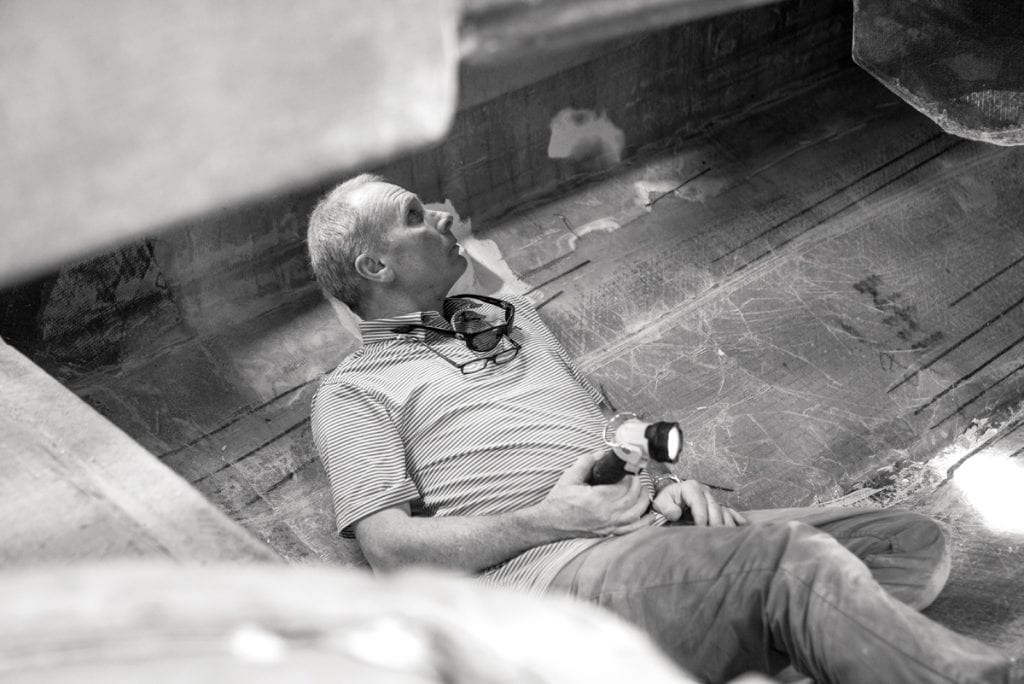
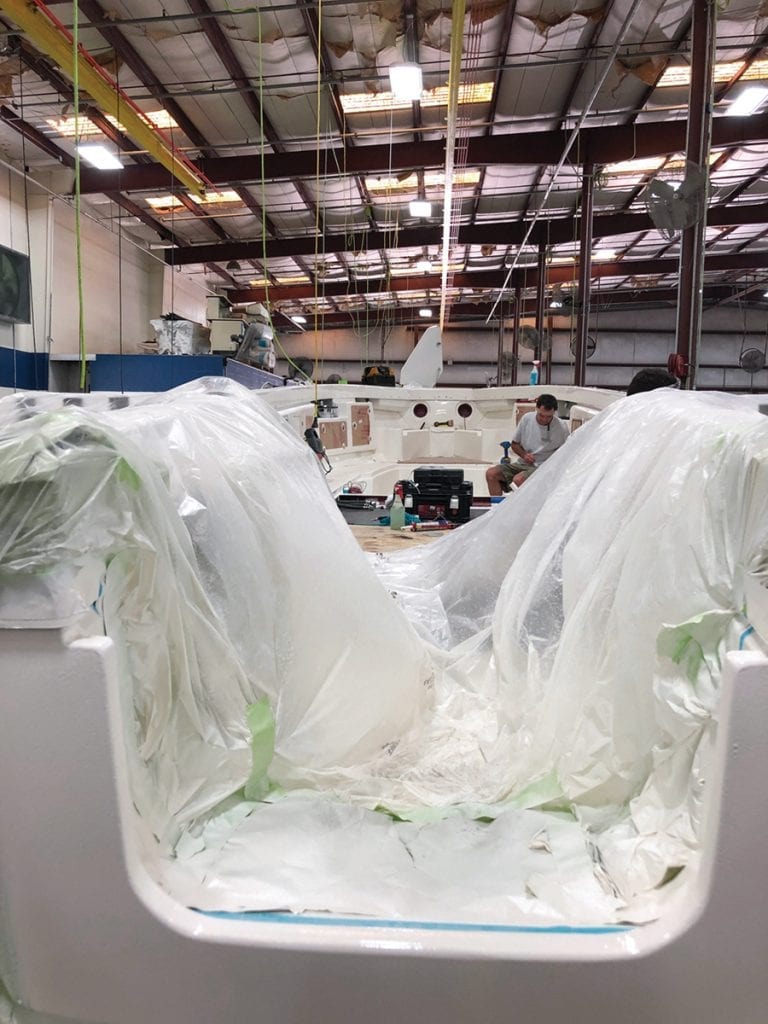
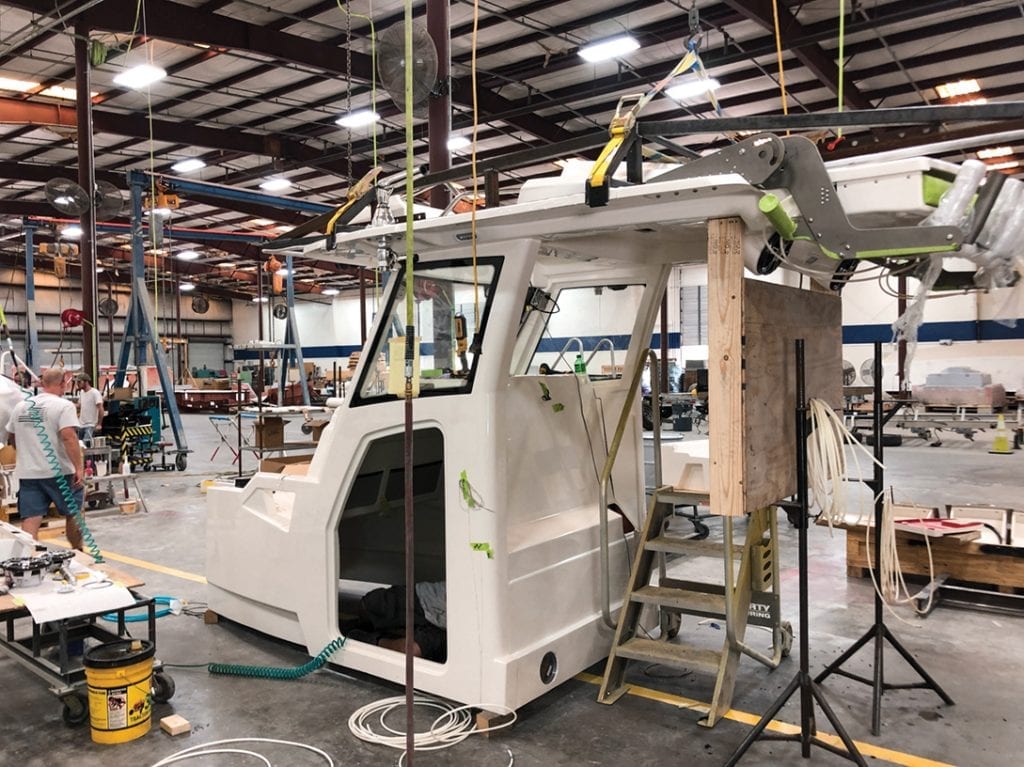
Stephen Dougherty doesn’t take things lying down, unless he’s inspecting in great detail the hull mold for his new SOLACE 345 center console. The first model in a new line of boats in the 30-foot range, the design is a culmination of a lifelong passion for boatbuilding.
SOLACE isn’t a name that came out of distress or sadness, it’s a testament to finding comfort in your strengths and abilities learned throughout a lifetime. “When I was a kid, the thirteen-foot Boston Whaler was a stand-up console for me. That’s when I started driving a boat,” says Dougherty. “I would go out with my dad up in Massachusetts, and we would test boats in the middle of the winter when I was seven years old. That was a regular thing for me. That was normal. We’d break ice at the launching ramp, put the boat in and go out and test it.”
Stephen Dougherty rarely takes thing lying down. Unless he’s inspecting a hull.
Runs in the Family
His father, Bob Dougherty, a former senior vice president and chief engineer for Boston Whaler, was a positive and meaningful influence. “I would go to boat shows, I would go to Boston Whaler on Saturdays and go to the pattern shop and work with the guys on the floor,” he recalls. He built things. It was his way of life and didn’t think anything different.
The “Dougherty Difference” was strengthening. His dad was instrumental in the design and techniques that created Boston Whaler’s innovative hulls in the 1960s. He refined Dick Fisher’s and C. Raymond Hunt’s unibond construction technique of the famed unsinkable boats. He was a creator, a teacher, a builder and did things the best way possible without cutting corners. He treated his fellow workers like family which nurtured his son’s progression into the industry.
At 19, after years of “playing” in the shop and honing his manufacturing skills, Stephen Dougherty joined his father at Boston Whaler. The Dougherty Difference of cutting-edge designs, original ideas, and a strong commitment to the customer and family was set.
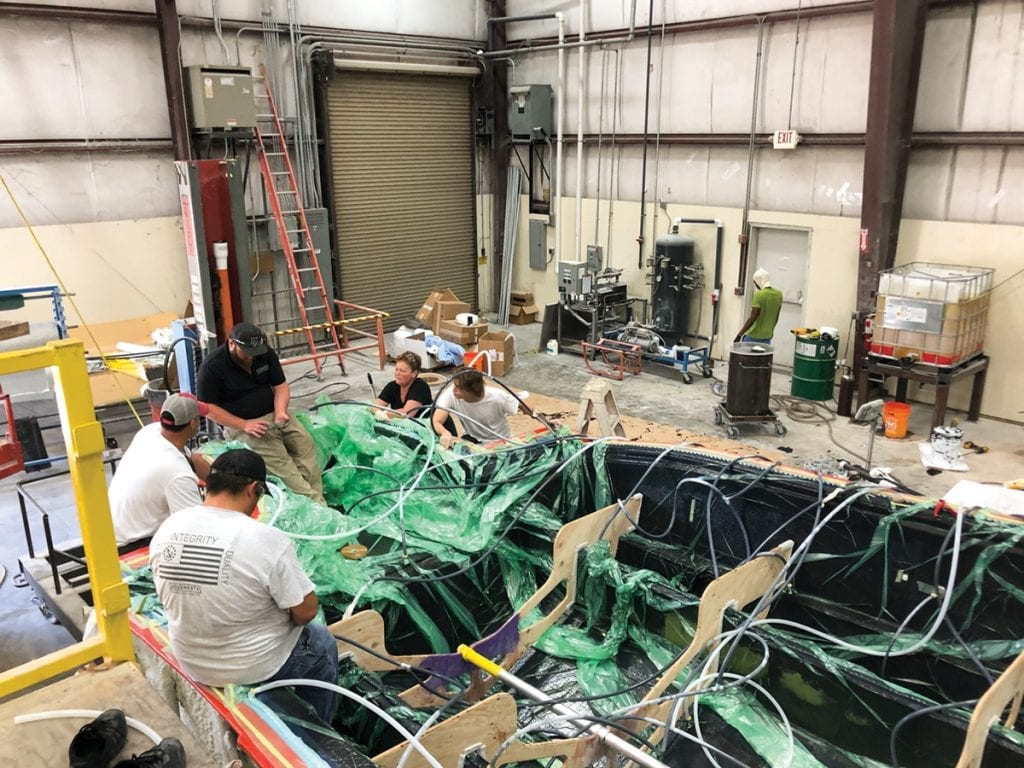
A teachable moment during hull construction.
“I grew up in a boat factory building boats. I knew I wanted to do that since I was very young,” says Dougherty. “It was in my dad’s blood for years as well and when he was young, he wanted to build boats. He was a schoolteacher first and was teaching industrial arts and lots of different things, but he wasn’t making enough money, so he ended up going into building boats.”
Movin’ On Up
Times in Massachusetts were tough for manufacturing companies and Boston Whaler had to relocate. “My father had to find a new home and found a plant in Edgewater, Florida, that was manufacturing lifeboats,” recalls Dougherty. “Schat Watercraft was on the water. They moved in, built an addition and moved the entire facility down. My job coming to Florida was to set up and train people how to assemble every Boston Whaler. I and about six other guys opened the Boston Whaler facility.”
Teaching local fishermen and farmers how to build boats was a big job for several years. Boston Whaler went through a few owner transitions after the move that restricted new development which led Dougherty and his dad to start a new company.
The 200,000 square foot Solace factory.
Dougherty Marine along with RJ Dougherty and Associates conceived and manufactured a new design for boat windshields, and Dougherty expanded his interest in learning how to work with and create parts from Starboard, a new marine-grade polymer product that is resistant to saltwater, UV, chemicals, sunshine, and corrosion. Around that time, his dad said, “We’re going to build a boat.”
On the Edge
Dougherty had never gone through the entire process of building a wooden pattern, lofting and full-size molds, so he learned. “We built a boat, and that eventually became EdgeWater Powerboats,” he explains. “We built that company up to 100 or so people with eight models.” They took on some partners, who were sailboaters, and ended up selling their stock to them and moved on to start Everglades Boats.
“We built up Everglades pretty quickly,” says Dougherty. “A brand new hundred and twenty-five thousand-square-foot facility and it was a very efficient, a great company.” At Everglades, the team was able to design and build what they wanted and incorporated his dad’s Rapid Molded Core Assembly Process, which won a Marine Manufacturers Innovation Award in 1999, into every hull.
The family decided to cash out of Everglades in 2012, and Dougherty suddenly found himself with nothing to do. “My passion is building boats, and I earned a living out of building boats,” he says. Like his father, Stephen Dougherty wanted to build a great company for his family “…so my kids could stay around here in Florida and work for the company and stay together. That’s been my life’s dream.”
Building the Dream
His dream started with the purchase of a 30,000-square-foot facility. Dougherty started building things again and within a year, outgrew the complex. The City of Everglades
convinced him to buy a 200,000-square-foot building that was empty and run-down knowing he’d do something with it and put people to work. “When we bought the facility and were headed into the direction of manufacturing, our goal, in the end, was to be in the boat business,” says Dougherty.
There was a no-compete clause for three years after leaving Everglades, so instead of building boats, he worked on various large-scale fabrication projects, including those for numerous theme parks. One such project involved receiving only the concept and artist renderings, so Dougherty had 10 engineers work on the design and then the company manufactured the build. “Our capabilities are very diverse as a result of doing all that work for other companies,” says Dougherty, which greatly improved his team’s skills.
SOLACE
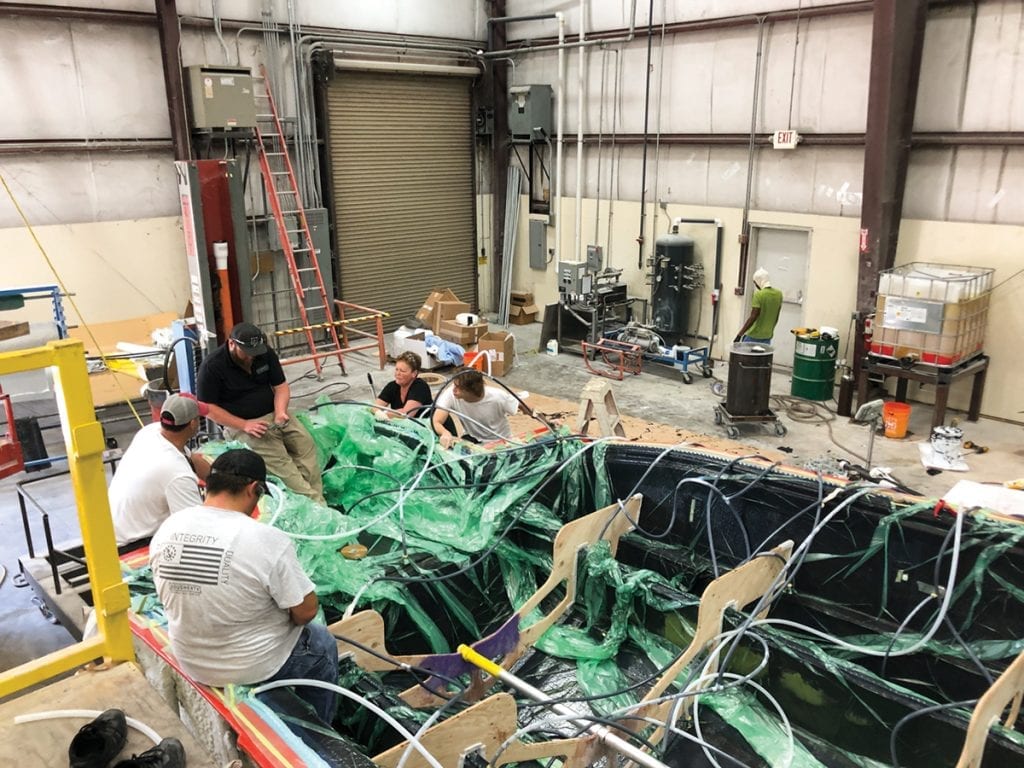
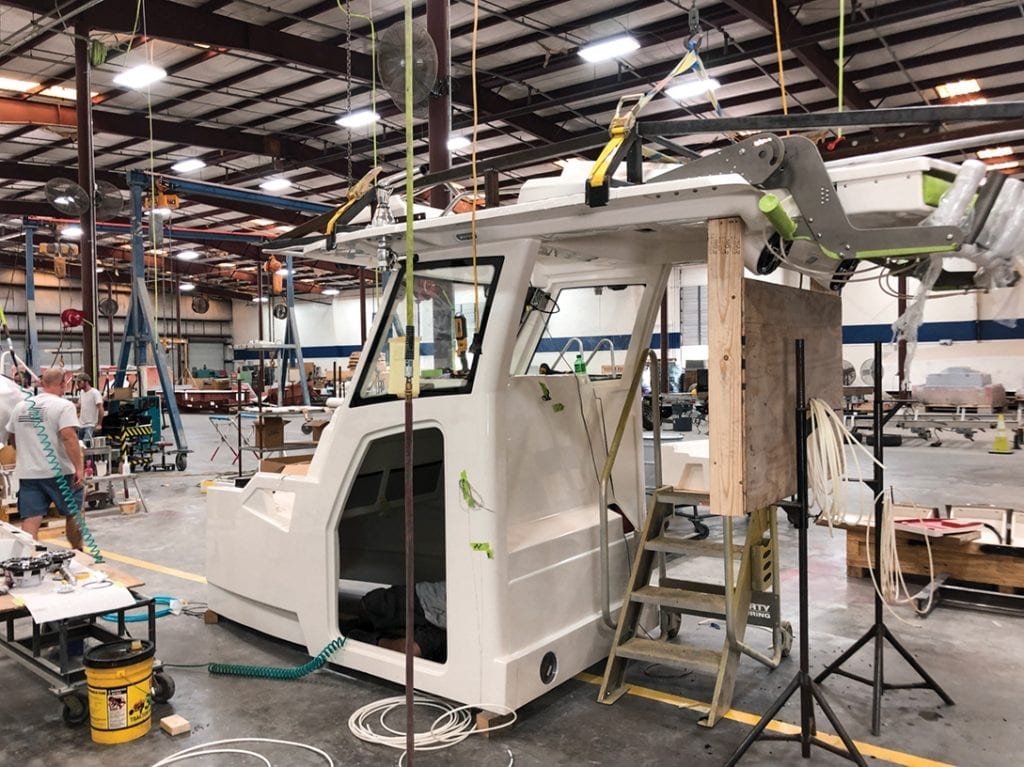
Progress is made of the console for the SOLACE 345.
Finally able to build his innovative center console design, Dougherty got SOLACE in gear. “We knew we wanted to do everything in-house,” says Dougherty. “We already had an engineering team and a facility, so we bought two five-axis routers; one of them is capable of building a boat sixty feet long and the other is for small parts.” The SOLACE facility includes a welding fabrication shop, a brand-new, state-of-the-art Haas machine shop, paint facility, and a very modern lamination facility—a full-blown boatbuilding operation where the family heritage continues and his son now “plays” in the metal fabrication shop.
The SOLACE 345 is the culmination of his life’s work in engineering, building boats, turning ideas into practical designs, and trusting his instincts. “As far as building a boater’s boat, that’s what I do, and that’s what my dad has always done,” says Dougherty. “My wife and I and the kids go out on the boat every weekend. We’re boaters… That’s how I look at things differently than other boatbuilders look at things. People build ski boats, and people build fishing boats, and people build flats boats and pleasure boats. I build a boat for boaters…They go to the fireworks, they go to the picnic, they go to the beach, they go fishing, they go waterskiing, they do everything with a boat.
The Lesson
“My dad taught me a long time ago that there are two ways you can go when building, designing and selling a boat,” says Dougherty. “You can build an okay boat and do a load
of marketing, or, and this is how my dad put it, ‘you build a badass boat and people are going to buy it.’ Our philosophy is about building a better boat. In order to do that, you need to make every single aspect of the boat better.”
What’s better than a weekend boating and fishing trip? Not much in our book. Whether you like rivers and creeks, or the open ocean, the Southeast has something to offer every angler. We’ve put together a list of what we think are the top 5 fishing spots in the Southeast. Have we missed one of your favorites?
5. Louisiana Bayou, Louisiana
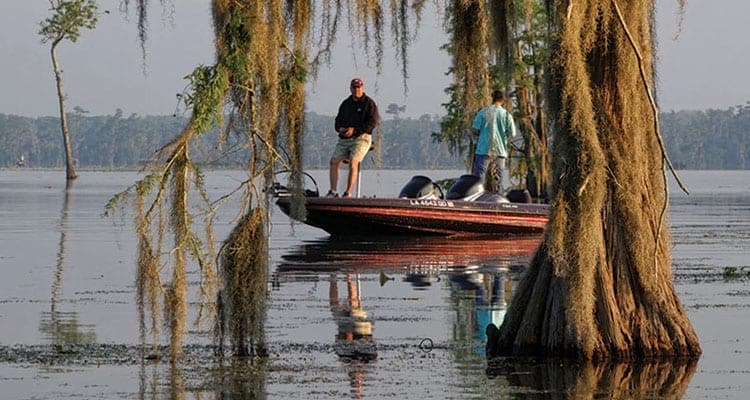
The Bayou is unique in that it offers anglers both freshwater and saltwater settings to fish. This region of Louisiana offers wetlands, shallows, waterways and off-shore and deep-sea fishing into the Gulf of Mexico. When it comes to freshwater fishing, Louisiana’s system of waterways is unmatched in the United States.
4. Lake Guntersville, Alabama
Lake Guntersville offers 70,000 acres of beautiful open water. This area is host to many of the top fishing tournaments including the Bassmaster fishing series. There are lots of bass in this lake and plenty of local guide services who would love to help you catch a trophy.
3. Lake Okeechobee, Florida
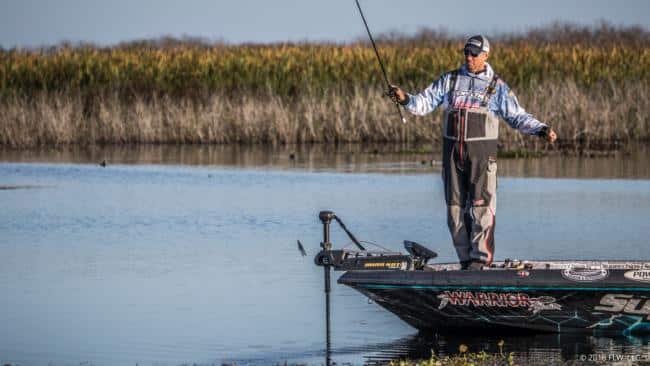
“The Big O” has been a bucket list lake for bass anglers for decades now. Lake Okeechobee is a lot like an enormous pond with its miles and miles of healthy grass and shallow water. The Sunshine State is the Fishing Capital for trophy bass fishing, as well as other sports fishing. Simply put, Lake Okeechobee is one of the premier fishing destinations in the world.
2. Pamlico Sound, North Carolina
With North Carolina’s mainland to the west and a string of narrow islands to the east, Pamlico Sound is the perfect breeding and feeding water for a wide variety of saltwater fish. From shallow flats to offshore fishing, the area is a haven for anglers who want a variety of options. It’s one of the best places in the world to catch mullet, sheepshead, redfish, and shark.
1. The Florida Keys, Florida
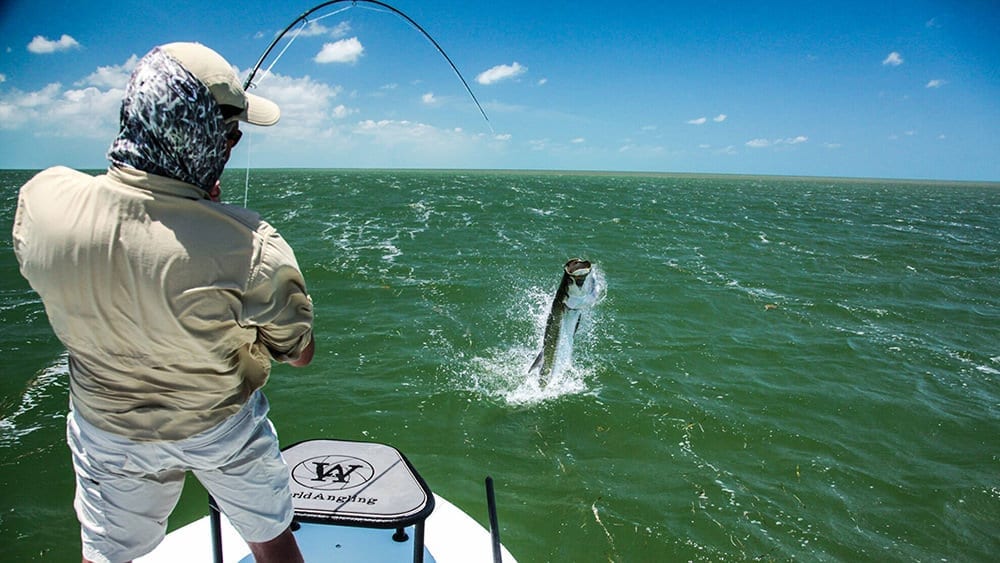
The Florida Keys are one of the most stunning, vibrant, and action-packed fishing locations in the world. The year-round warm and tropical temperatures and beautiful scenery all add to this Floridian fishing experience. With a 125mile long arc of islands to that make up the keys to explore, there’s a trophy fish for any angler. Here you’ll delight in Bonefish, Redfish, Yellowtail, Barracuda, and in the deep sea for Dolphinfish, Marlin, and other open-water predators.
Did we miss any of your favorite fishing sites? Let me know in the comments!
I was only given a day’s notice about whether I wanted to write about this book called The Most Spectacular Restaurant in the World, but since September 11th was fast approaching, and I still vividly remember the extraordinary experiences I had dining at Windows of the World atop the World Trade...




















.jpg)