Tags: Alan H Kahn, Ben Zurawski
643 points, 54 comments.

The rise of shopping malls and department stores as we know them began in Paris. Once upon a time, it was illegal for a shop to sell more than one kind of product. French vendors got around this by congregating different stores in one location to make purchases easier for the public, creating a prototype for the shopping mall. Eventually, it became possible for one entity to sell a variety of items, which led to the concept of the department store.
The first on the market–and in the world–was Au Bon Marché. Founded in 1838, it survived the competition of the other novelty magazines by shrewd display tactics and remained the leader in innovations. The genius behind modern shopping science was Au Bon Marché’s next owner, Aristide Boucicaut who took over the magazine in 1852. He had many tricks up his sleeve, including placing related merchandise at the opposite ends of the store. You bought fabric in one corner, and to get a sewing thread to put the fabric together, you had to cross the store passing seductive displays of fashion accessories that would enhance the new dress. Nearly all the shopping strategies, including the orgiastic sales that influence us today, were invented by Boucicaut and his clever followers in these early days of mass shopping.
(Note the word “magazine” in this context means a retail store.) Being first had its rewards. When Boucicaut died 1887, Au Bon Marché was the biggest retail business in the world. Read about the development of mass shopping concepts at Victorian Paris. -via Strange Company

Gangster movies have always been popular, because they present a lifestyle full of risk, violence, riches, and disdain for lawful authority, which audiences enjoy vicariously without having to actually deal with such dangerous people. You can relive the thrills of gangster movies in a chronological list starting in 1931. The selections may evoke your disagreement, but it presents a lot of films you may not have already seen, and it doesn't limit itself to the theme of organized crime in America. There are gangsters, real and cinematic, all over the world. Read up on twenty of those movies at Mental Floss.

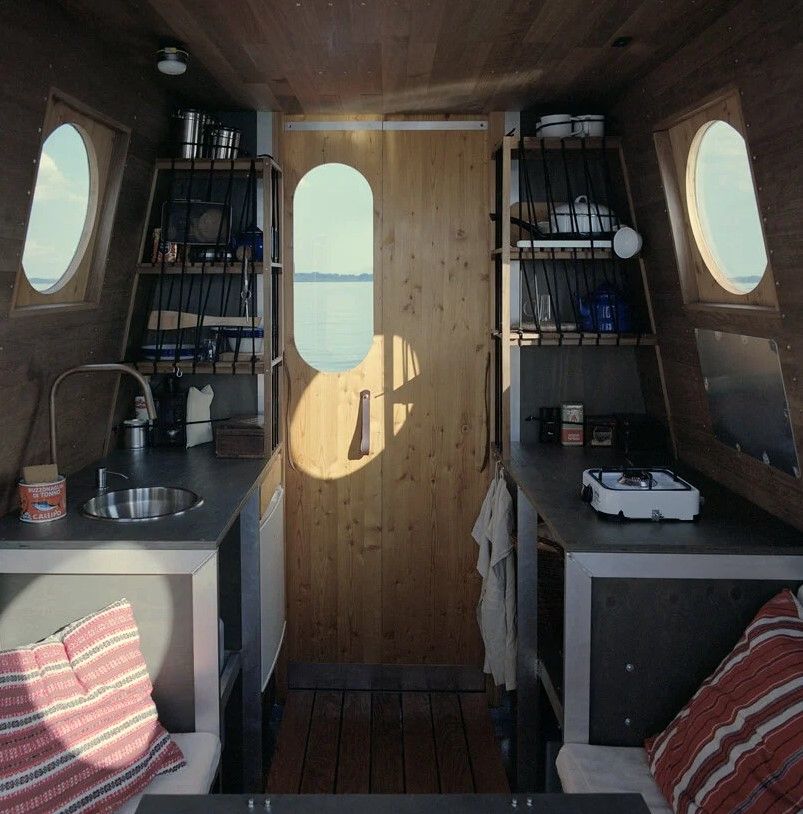
Hungary — Réka and Balázs wanted a summer getaway that would get them closer to nature, not something “grounded” or “fixed” like their normal lives in an apartment in Budapest. And so, In October last year, the two approached the architect Tamás Bene and asked him to design a boathouse so that they can explore Lake Tisza, the largest artificial lake in Hungary.
The project pays homage to their love of the region, and their desire to learn more about it and experience it on a more intimate level.
Lake Tisza is a vast, artificial body of water that owes its natural ecosystem to River Tisza, which passes through it. Tamás Bene found it interesting to conceptualize and design a dwelling that has no tangible groundwork or foundations. The point of vehicles – their primary function – is to transport. However, the movement of this compact living space intends to enable its inhabitants to experience the natural environment as closely as possible. The boat provides an opportunity to spend time, eat, drink, sleep and awaken nearly anywhere.
See the pictures of the tiny boathouse over at DesignBoom.
Cool!
(Image Credit: Balázs Máté/ DesignBoom)
Travel vlogger Drew Binsky was wandering the streets of Kabul, Afghanistan, recently when he came across an older photographer named Haji. In this 9-minute vlog, Binsky tells the story of Haji and how he has been shooting for 65 years using a 100-year-old box camera.
After meeting Haji, Binsky visited the photographer at his house and was invited to sit down in front of the ancient camera for a portrait.

Binsky also receives an inside look at how Haji’s photo process works. The camera is both a capture device and a darkroom — once a photo is exposed, Haji sticks his arm into the camera body, picks up the exposed paper, and puts it through chemical baths inside the same chamber.
According to Haji, the camera he uses may be the very last of its kind in use in Afghanistan.



After 21 years, Yamaha has announced the venerable YZF-R6 will be discontinued after the 2020 model year. This coming on the news today of the V Star 250, Bolt R-Spec, XSR700 and XSR900, Super Ténéré ES, FJR1300ES, Star Venture, and XMAX all continuing on for 2021 with what basically amounts to, as we say in the moto-journo biz – Bold New Graphics (BNG).
However, the shock announcement of the R6 coming to an end may not be such a shock after all considering looming Euro5 regulations and the languishing state of sportbike sales, especially in the 600cc supersport category. It appears as though Yamaha brass didn’t see it worthwhile to update and/or upgrade the Euro4 R6 in order to meet the more stringent Euro5 requirements.

Such a move is not entirely new, as Honda went through a similar phase already, discontinuing the CBR600RR for much of the world circa 2017 (although remaining stock is still being sold in North America) primarily due to emissions regulations. And even though Honda has released an updated CBR600RR, it will only be sold in Japan and Australia and still doesn’t meet Euro5 regulations anyway.
Ever since its introduction in 1999, the YZF-R6 has been a formidable force in supersport racing, even winning for the first time in only the second race of the 1999 World Supersport season. Since then, the R6 has racked up more wins and championships around the globe than we can count – so should racers and race teams be worried about the R6’s discontinuation?

Yamaha’s now calling this the 2021 R6 Race. What’s the difference between this and the 2020 R6? Nothing as far as we can tell.
Not exactly. Nevermind the fact that used R6s are a dime a dozen, Yamaha is respecting the bike’s racing heritage and will still be making new versions going forward. Now the bike we know as the R6 will be called the Yamaha R6 Race – a non-homologated, track-only motorcycle Yamaha will be happy to sell you – as long as you’re in Europe. Here in the US, you can expect dealers to slash prices on R6s until the inventory is gone. Even still, Yamaha’s literature was unclear on whether the R6 Race will ostensibly be the current R6, complete with lights, mirrors, and turn indicators, even if none of those things are necessary for a track-only vehicle.
Sweetening the pot for European customers anyway, opt for Yamaha’s R6 GYTR kit and you’ll get all the usual bits one would do to their R6 to get it truly track-worthy, including:
What’s more, additional GYTR and Öhlins bits are still available if the above isn’t enough.

There’s another legendary Yamaha name approaching its final curtain call. The outlandish Yamaha VMAX, first introduced as the V-Max in 1985 before getting a big overhaul in 2009 that made it so bombastic its name changed to ALL CAPS, is finally seeing the end of the line.
Arguably the original power cruiser, the VMAX’s anime-like styling was an eye-turner in 1985, and its 1197cc V4 engine – and later the 1679cc redesigned version – was revered for its ability to rip your arms off. Though it never came with a turbo, the original V-Max came with a feature called V-Boost that imitates turbo boost by opening butterfly valves at high rpm to send a rush of fresh air to the combustion chambers.

It’s surprising that from its start in 1985 until 2008 the V-Max was essentially the same motorcycle. The 2009 VMAX makeover was clearly long overdue, and though it was thoroughly modernized, there was no denying its status as a VMAX. The inspiration was the same, but everything about the VMAX was bigger – the engine, the bodywork, everything.
Like the R6 though, the VMAX simply didn’t make sense for Yamaha to update to meet Euro5. So, away it goes, marking the end of a very legendary lineage. In fact, the VMAX wasn’t Euro4 compliant either and was only sold in North America for the last few years. This truly is the end of the road.

Other Yamaha models getting the axe for 2021 include the WR250R – “probably the most performance-focused model out of the plated 250 class,” says a mildly dejected Ryan Adams, and the urban-friendly SMAX scooter. The full press release is below.
Yamaha Motor Corporation, USA, today announced several 2021 Sport Heritage, Adventure Touring, Sport Touring, Transcontinental Touring and scooter models to join the recently released full line of Hyper Naked MT motorcycles.
From riding around town to long-distance touring, the Super Ténéré ES, FJR1300ES, Star Venture and XMAX scooter will continue their reign of Yamaha’s legendary performance. Returning to the 2021 motorcycle lineup, the Sport Heritage bikes including the Bolt R-Spec, V Star 250, XSR700 and XSR900 return with a mix of old-school classic looks and modern technological features.
2021 V Star 250

The light and nimble 2021 V Star 250 is the only V-Twin in its class. Coupled with a seat that is just 27 inches from the pavement, the V Star 250 is the perfect choice for riders who want fun in a small package.
The 2021 V Star 250 will be available in Raven for an MSRP of $4,499 and will be available at authorized Yamaha dealers beginning in December.
2021 Bolt R-Spec

With its electronic fuel injection and Transistor Controlled Ignition (TCI), the 2021 Bolt R-Spec delivers class-leading performance. The compact, stable chassis and the unique Bolt persona round out the Bolt R-Spec’s urban performance and style.
The 2021 Bolt R-Spec will be available in Raven for an MSRP of $8,499 and will be available at authorized Yamaha dealers beginning in December.
2021 XSR700 and XSR900

With timeless neo-retro style and performance-driven technology, the 2021 XSR700 and XSR900 are modern classics. The XSR700’s standout style and compact twin-cylinder engine not only give the bike unique power characteristics but a unique look while the XSR900 blends world-class engineering, a thrilling triple-cylinder engine and cutting-edge electronics with retro-influenced bodywork for a nostalgic yet modern ride.
The 2021 XSR700 will be available in Radical White/Rapid Red for an MSRP of $8,499 and the 2021 XSR900 will also be available in Radical White/Rapid Red for an MSRP of $9,499. Both models will begin arriving at authorized Yamaha dealers in December.
2021 Super Ténéré ES

Rugged, durable and built for superior long-distance adventure touring, the 2021 Super Ténéré ES is made for exploring beyond the pavement. With its exceptionally compact 1199cc engine and electronically adjusted suspension, the Super Ténéré ES’s features are designed for riding across town or for riding across the continent.
The 2021 Super Ténéré ES will be available in Matte Raven Black for an MSRP of $16,299 and will be available at authorized Yamaha dealers beginning in December.
2021 FJR1300ES

The 2021 FJR1300ES puts the “sport” in Supersport touring. The 1298cc, DOHC, 16 valve, liquid-cooled inline four-cylinder engine delivers superb, smooth-running power and torque for unequaled muscular acceleration across the rpm range.
The 2021 FJR1300ES will be available in Liquid Graphite for an MSRP of $17,999 and will be available at authorized Yamaha dealers beginning in January 2021.
2021 Star Venture

The “top-of-the-line” transcontinental tourer, the 2021 Star Venture features a high torque, 1854cc V-Twin engine. Combined with cutting-edge comfort- and technology-focused rider aides, the Star Venture features GPS navigation, SiriusXM®, additional speakers and Yamaha’s exclusive Dual Zone audio control as well as standard LED fog lights, additional onboard storage and a security alarm.
The 2021 Star Venture will be available in Intensity White or Impact Blue for an MSRP of $26,999. The Venture will be available at authorized Yamaha dealers beginning in December.
2021 XMAX

The 2021 XMAX is the ultimate sport scooter with its fuel efficient and performance-proven engine, convenience and technology and the luxurious, comfortable yet practical features.
The 2021 XMAX will be available in Matte Midnight Blue for an MSRP of $5,699 and will begin arriving at authorized Yamaha dealers in April 2021.
With deep consideration of evolving global market trends and regulations that limit production volumes on certain models, the following Yamaha models will be discontinued after model year 2020: YZF-R6, VMAX, WR250R and SMAX.
Yamaha understands the iconic history of these models. Regarding the future, Yamaha is continuously looking at new ideas and concepts to support and expand the market, as well as enhance our customers’ experiences.
Consumers can contact their local Yamaha dealer on the remaining model year 2020 availability of these discontinued models.
To learn more about these models, as well as Yamaha’s complete lineup of 2021 motorcycles, visit https://www.


















































































The post Yamaha Is Discontinuing The R6 and VMAX After 2020 appeared first on Motorcycle.com.
Ducati revealed a new Monster with a 937cc engine, modern electronics and, in a departure from the line’s history, replaced the traditional steel trellis frame with an aluminum alloy frame.
The new model will simply be called the “Monster” with no displacement numbering, and it replaces both the air-cooled Monster 797 and liquid-cooled Monster 821 in Ducati’s lineup. The Monster 1200 and 1200 S will return for 2021 as the only holdover from the previous generation. Like the 1200, the new Monster is liquid-cooled, meaning there will no longer be any air-cooled Monsters in Ducati’s lineup.

The switch away from the steel trellis may be a bit of a shock to some purists, but in retrospect, the move is not a complete surprise. The trellis frames in the 821 and 1200 Monsters were noticeably smaller than in previous generations, mounting only to the engine heads. In this respect, the new Panigale V4-derived aluminum front frame is similar, with the added benefit of weighing 10 pounds less than the Monster 821’s frame.
Further contributing to weight reduction is a new glass fiber reinforced polymer subframe and a new double-sided aluminum swingarm design that resembles the unit on the Multistrada V4. According to Ducati, the new Monster has a claimed curb weight of 414 pounds, about 40 pounds lighter than the Monster 821.
With the new frame, Ducati had to reposition some components such as the radiator. This allowed the Monster to offer a 36° steering angle, 7° more than the Monster 821 lock to lock. Combined with a slightly shorter wheelbase, the new Monster should be more agile than the 821.

The new Monster is powered by Ducati’s liquid-cooled 937cc Testatretta 11° V-Twin engine with four desmodromic valves per cylinder. The Euro 5-compiant engine is similar to the one powering the SuperSport 950, claiming 111 hp at 9,250 rpm and 69 lb-ft. at 6,500 rpm. Those numbers are higher than the Monster 821’s claimed 109 hp at 9,250 rpm and 63 lb-ft. at 7,750 rpm, but Ducati claims there’s a 20% improvement in torque at 6,000 rpm. Ducati also says the engine requires oil services at every 9,000 miles while valve inspections are needed every 18,000 miles.
Ducati equipped the new Monster with an assist and slipper wet clutch, claiming a 20% lighter pull than the previous clutch design. An up-and-down quick shifter comes standard.

The electronics package includes cornering ABS, traction control, launch control and wheelie control. The Monster offers three selectable ride modes: Sport, Touring and Urban. Each mode adjusts the throttle response, traction control, ABS and wheelie control systems to suit the different riding styles.

A 4.3″ color TFT display shows the necessary on-board information. It also works with the optional Bluetooth-equipped Ducati Multimedia System.
The suspension system appears similar to the Monster 821’s setup, with a 43mm inverted fork with 5.1 inches of travel and a preload-adjustable rear shock offering 5.5 inches of travel. Twin Brembo M4-32 radial-mount four-piston monoblock calipers are matched with 320 mm discs up front while the rear wheel uses a 245 mm disc and two-piston caliper. Both clutch and brake levers are adjustable.

The Monster is equipped with an egg-shaped daytime running light that surrounds the main LED headlight. Ducati introduces a novel design for the turn signals, shaping them in line with the bodywork. The indicators light up in a swiping pattern, flowing outwards toward their respective directions. The signals are also self-canceling, a convenient feature that really should be more common-place.

Compared to the 821, the new Monster’s handlebars are 2.8 inches closer to the rider for a more upright riding position. The footpegs are positioned 0.4 inches lower and 1.4 inches farther back for a slightly less cramped leg position. The seat has a new shape and uses an exclusive foam material Ducati claims is more comfortable than the previous saddle. The standard seat height is 32.3 inches, but Ducati offers an accessory lower seat at 31.5 inches as well as a suspension lowering kit that further reduces the height to 30.5 inches.
The 2021 Ducati Monster will be available in three colorways: Ducati Red with black wheels, Aviator Grey with red wheels, and Dark Stealth with black wheels. Ducati will also offer a selection of sticker kits for further customizing the Monster’s look. There’s also a Monster Plus version that adds a flyscreen and passenger tail cover.
U.S. pricing starts at $11,895 for the Monster, which is $100 less than what Ducati asked for the Monster 821. The Monster Plus will set you back $12,195.

| 2021 Ducati Monster Specifications | |
|---|---|
| Engine Type | Testatretta 11°, V2 – 90°, 4 valves per cylinder, desmodromic valvetrain, liquid cooled |
| Displacement | 937 cc (57 cu in) |
| Bore x Stroke | 94 mm x 67.5 mm |
| Compression Ratio | 13.3:1 |
| Power | 111 hp (82 kW) @ 9,250 rpm (claimed) |
| Torque | 9.5 kgm (93 Nm, 69 lb ft) @ 6,500 rpm (claimed) |
| Fuel Injection | Electronic fuel injection system, Ø 53 mm throttle bodies with Ride-by-Wire system |
| Exhaust | Pre-muffler and twin muffler, catalytic converter and 2 lambda probes |
| Transmission | 6 speed |
| Primary Drive | Straight cut gears, ratio 1.85:1 |
| Gear Ratios | 1=37/15, 2=30/17, 3=28/20, 4=26/22, 5=24/23, 6=23/24 |
| Final Drive | Chain, front sprocket z15, rear sprocket z43 |
| Clutch | Slipper and self-servo multiplate wet clutch with hydraulic control |
| Frame | Aluminum alloy front frame |
| Front Suspension | Ø 43 mm usd fork, 5.1 inches of travel |
| Rear Suspension | Progressive linkage, preload adjustable monoshock, aluminum double-sided swingarm, 5.5 inches of travel |
| Front Wheel | Light alloy cast, 3.5″ x 17″ |
| Rear Wheel | Light alloy cast, 5.5″ x 17″ |
| Front Tire | Pirelli Diablo Rosso III 120/70 ZR17 |
| Rear Tire | Pirelli Diablo Rosso III 180/55 ZR17 |
| Front Brake | 2 x Ø 320 mm semi-floating discs, radially mounted Brembo M4.32 monobloc 4-piston callipers, radial master cylinder, Cornering ABS |
| Rear Brake | Ø 245 mm disc, Brembo 2-piston floating calliper, Cornering ABS |
| Instrumentation | 4.3″ TFT colour display |
| Dry Weight | 166 kg (366 lb), claimed |
| Curb Weight | 188 kg (414 lb), claimed |
| Seat Height | “820 mm (32.3 in) 800 mm (31.5 in) (accessory low seat) 775 mm (30.5 in) (accessory low seat + low suspension kit)” |
| Wheelbase | 1,474 mm (58.0 in) |
| Rake | 24° |
| Trail | 93 mm (3.7 in) |
| Fuel Tank Capacity | 14 l (3.7 US gal) |
| Number Of Seats | 2 |
| Safety Equipment | Riding Modes, Power Modes, Cornering ABS, Ducati Traction Control, Ducati Wheelie Control, Daytime Running Light |
| Standard Equipment | Ducati Quick Shift, Ducati Power Launch, 4.3″ TFT colour display, Full LED headlight and lighting system, Dynamic turn indicators, USB power socket |
| Ready For | Ducati Multimedia System, Heated grips |
| Warranty | 24 months, unlimited mileage |
| Maintenance Service Intervals | 15,000 km (9,000 miles) / 12 months |
| Desmoservice | 30,000 km (18,000 miles) |












































































































Become a Motorcycle.com insider. Get the latest motorcycle news first by subscribing to our newsletter here.
The post 2021 Ducati Monster First Look appeared first on Motorcycle.com.

Why would I spend $130 on a pillow? Because this is the best pillow I have ever slept on, and the last pillow I will ever buy. I have tried a lot of pillows over the years, but none of them were quite what I wanted. I’ve tried buckwheat, memory foam, shredded memory foam, and various combinations and down-substitutes. Nothing compares. I should point out that I am a side sleeper, and I have had neck surgery, so I am acutely aware of whether my pillow is adequate.
For a long time, I was reluctant to buy a pillow that cost over a hundred dollars. I’m a frugal shopper, but this purchase does not seem extravagant when I consider that I’ve spent $40 – $60 several times over on pillows that didn’t work for me. The buckwheat was too heavy, the memory foam felt like it was fighting back, and the shredded memory foam and down substitutes all had to be rearranged any time I got up or rolled over. I finally broke down and paid the premium price, partly out of frustration, and partly to end the speculation about whether a high-quality down pillow was worth the money. It was.
The thing about down is that it’s not possible to find “pure” down pillows. This high-quality pillow states that it’s 90% down, but you can tell that the other 10% is not feathers. A down pillow that includes feathers will eventually start pricking you with little quills. I’ve tried a number of down/feather mix pillows, and they all turn into porcupine pillows over time, with tiny (but sharp) feathers working their way through the cover and the seams. These little barbs can be very annoying, and difficult to pin down and remove; they will ruin a night’s sleep.
I’ve been sleeping on this East Coast Bedding European 800 Fill Power White Goose Down Pillow for over a year, and have not had one single prick from a quill. Moreover, this pillow is like laying your head on a giant marshmallow, it is incredibly soft but also firm, providing all the support I need. To adjust the pillow, just sock it a few times to fluff the down. The down filling has an almost “fluid” quality. Lift your head a little and give the pillow a quick sock in the side, and “poof,” the down is rearranged instantly. I have spent a lot of money trying to find a pillow that suits me, and this one is absolutely the most comfortable pillow I’ve ever slept on.
*So how can you tell if you’re getting real down and not a down/feather mix? When it comes to down pillows, you get what you pay for, and price is a good indicator. But you can also compare the weight of the filling to the fill power. Fill power is a measure of the amount of loft (in cubic inches) per ounce of down filling. You can also get an idea of the down quality by comparing the weight of the filling to the fill power. Feathers are heavier for the same amount of loft, so a pillow filled with 25 ounces of 800 fill power down will be firmer than a pillow that has 27 ounces of 700 fill power down because feathers don’t provide as much loft as pure down, even though the pillow has more filling by weight.
-- Runciblefish
East Coast Bedding European 800 Fill Power White Goose Down Pillow
Available from Amazon
Motorcycle.com’s Best Of (MOBO) award season is finally here! In a typical year, this would have happened a while ago, just before the motorcycle show season began, and now, we’d be in the thick of the new model introduction season, delivering you our first impressions of the new motorcycles scheduled for release in 2021. However, we don’t have to tell you that 2020 is an unusual year. In response to the unique nature of this model year, we decided to push back our MOBO celebration to fill part of the gap left by the lack of new model introductions. Now, just in time for the end of the calendar year, we’re going to wrap up the 2020 riding season in the best way possible – before diving headlong into the 2021 season.
So, while the 2021 season is just a twinkle in a rider’s eye, we will pause to reflect on what has occurred in the motorcycling world in 2020. As is tradition, we gathered the MO staff – this year in a socially-distanced video conference (oh wait, we do that every year!) – to hash out what our choices were for ten categories of motorcycles. You may notice a couple of categories are missing this year, cutting the festivities down to an even 10 days. This is because, in classes like Best Touring Motorcycle, there were essentially no changes. However, we will bring them back when something changes. What you can expect over those days is that we’ll reveal our MOBOs and the runner-ups, culminating with the Motorcycle.com Motorcycle of the Year. Some of these choices you are sure to love and agree with. Others, not so much. That’s the way of award selections.
This year we had big fun on both large- and small-displacement motorcycles, and you’ll see them well represented here. Adventure touring is still going strong, particularly in the middleweight segment, but the lightweight segment also received some love. Big dollar bikes and penny pinchers were considered. Our requirements for eligibility are pretty straightforward: MO must have tested the bike during the model year, and the bike must be available to the public at the time of publication.
We’ll begin Monday with the MOBO for Best Technology and follow on Tuesday with the Best Lightweight. Every weekday thereafter, we’ll unveil a new winner plus the runner-up. The celebration will come to a conclusion on December 18th with the announcement of the 2020 Motorcycle of the Year. Just in time for the Holidays!
Grab your riding gear. Let the festivities begin.
 |
 |
 |
 |
 |
 |
 |
 |
 |
 |
||
Become a Motorcycle.com insider. Get the latest motorcycle news first by subscribing to our newsletter here.
The post Motorcycle.com Best Of 2020 appeared first on Motorcycle.com.
Amigo Bob Cantisano, instantly recognizable with his waist-length dreadlocks and handlebar mustache, can often be found searching for treasure in the California mountains. But he’s not looking for the gold which drew droves of miners to the area in the mid-1800s. Instead, Cantisano hunts for what those early migrants left behind—a trove of long-lost crops, from grapes to chestnuts and everything in between.
This journey has taken him across the region’s abandoned homesteads, where he’s found trees and vines that have grown for generations, producing fruit all the while. “These are old, and they’re delectable,” says Cantisano. When news of California’s gold swept the world in 1848, fortune-seekers flocked to the future state’s Sierra Nevada mountain range. Following them were horticulturalists, who would soon import fruit trees and produce seeds from around the world to sustain the new boomtowns. Yet even after the gold was gone, a curated cache of crops has withstood generations of blazing heat and drought in the crannies of the mountains.

Not only are these hardy cultivars tastier and often more nutritious than their later grocery-store counterparts, their resilience may contain an arsenal of valuable genes in the battle against the changing climate. “Looking into the future, I’ve got a huge range of challenges,” says Thomas Gradziel, a plant geneticist and breeder at the University of California, Davis. Gradziel is currently searching for peach and almond varieties that can withstand the increasing stresses of heat, drought, and disease, all while meeting market demands for taste, nutrition, and shelf life.
But the development of commercial agriculture in the 20th century means that only a few varieties of fruits and nuts are widely grown, leaving horticulturalists with a limited gene pool to work with. People such as Cantisano, who work to rediscover old heirlooms, provide Gradziel with a bigger “toolbox” of genetic talent, he says.
Cantisano has sported the nickname “Amigo” since high school, and he’s been a farmer for nearly as long. And while he’s undeniably a friend to California’s horticulturists, he’s also one of the trailblazers of the state's organic farming movement. He’s glad that horticulturists can use his finds. “What’s essential to the future is to learn from the past,” he says.
But he never set out to expand the agricultural gene pool. His search for Gold Rush-era crops began serendipitously in 1970. “A group of friends and I were out driving around on dirt roads in the Sierra,” he says. “We came up atop of this knoll and here, completely unlike the forest, was an orchard.” The abandoned orchard had a dazzling collection of over 130 different fruit trees. “It was kind of ours for the taking,” says Cantisano. “There wasn’t anybody close by, so we just decided to go back in the fall each year to harvest it.”
Cantisano began looking around other abandoned farmsteads near his home in Nevada City. The town, founded during the Gold Rush, turned out to be surrounded by them. “The more I looked, the more I found,” he says.

One day, around a decade after happening upon his first vintage orchard, an acquaintance told him about an old nursery nearby that had existed since the 19th century. After befriending the property owners, Cantisano discovered an on-site plaque in honor of the horticulturist Felix Gillet. Spending years of research on the mysterious Gillet, Cantisano slowly began to piece together the biography of one of California’s most prolific nurserymen.
Gillet, originally from France, made several trans-Atlantic voyages before landing in Nevada City in 1859. “He had a barbershop for around 10 years, and during that time, he somehow got the bug to get into the nursery business,” says Cantisano. Simultaneously, a “plant mania” was gripping California, with horticulturalists competing with each other to offer the most diverse selection of crops. According to Cantisano, “Felix wanted to be known as the guy with the biggest selection of nursery stock in California.”
Based on decades of plant catalogues left at Gillet’s old home, Cantisano estimates that the nurseryman imported over a thousand different varieties of fruits, nuts, and ornamental plants from over 30 different countries. “He’d have 30 varieties of walnuts for sale,” says Cantisano, who also counted 241 varieties of grapes. Many of Gillet’s imports went on to become the precursors of wildly successful crop varieties. His Napoleon bigarreau cherry became one of the parents of the Bing cherry, and his Kishmish grapes led to the development of the Thompson seedless grape.

Remnants of Gillet’s venerable selection of heirlooms are still scattered around California today, which is why Cantisano formed the Felix Gillet Institute to rediscover, propagate, and disseminate the unique cultivars brought from afar to feed the growing population of the Golden State.
“Some of what we find might not be the biggest, but they’re the tastiest,” says Cantisano. One of his favorite fruits, the blushing, rose-kissed yellow Napoleon bigarreau cherry, is similar to the Rainier variety, but a bit smaller. Cantisano adds that it’s “better than any other ones we’ve tasted, and it's also bird-resistant.”
After finding an old tree, Cantisano and his small team at the Felix Gillet Institute bring home samples of the fruit for identification. Cantisano’s wife, Jenifer Bliss, then takes notes on the fruit’s properties and painstakingly tries to match it with a known variety from Gillet’s catalogs or other historical resources. Bliss recalls the discovery of an elusive Calville Blanc tree, which grows yellowy, bulbous cooking apples. After keeping an eye out for the rare heirloom for years, the team finally uncovered a single tree growing in the shadows of the Sierra Buttes. “I did a little happy dance when I figured that one out!” she says.

But the Felix Gillet team still has their work cut out for them. So far, they’ve created a database of over 3,000 plant varieties and have only identified around 10 percent of them. “It can be overwhelming,” Bliss says.
While some of the plants they’ve discovered grow in orchards and old garden beds, occasionally the Institute uncovers a wildcard. “Sometimes, we find trees that are in strange places, like a creek bed, and you can just imagine somebody was sitting there eating something and then threw the core out,” says Bliss. Trees that grow from seeds are genetically distinct from their parent, so they’re one-of-a-kind.
Cantisano and his team take the liberty to name these “wildling” trees. The Vanilla Ice Cream apple, for instance, has soft, rosy-red streaks and a sweet, creamy vanilla taste. When the team discovers cultivars with promising traits—like impressive shelf-life or resistance to pests—they occasionally send cuttings to the USDA plant repository, so breeders and geneticists such as Gradziel can draw upon its genetic material. The lime-green and scarlet Annie Elizabeth apple, for example, has such a high vitamin C concentration that slices can sit for days before turning brown. The tree has also proven completely resistant to pesky codling moths.

But there’s no need to search the mountains for your own Vanilla Ice Cream and Annie Elizabeth trees. The Institute sells cuttings of particularly palatable varieties in their own nursery. This fall, the Institute stocked around 90 different varieties of figs, pears, persimmons, pomegranates, plums, cherries, mulberries, walnuts, apples, grapes, cranberries and almonds, as well as flowers such as roses, lilacs, and myrtle. They’re excited to showcase new additions to the nursery, such as the potato pear—which looks like its namesake, but has an assertively fruity taste—and Leland’s green plum, an especially sweet Japanese variety of mysterious origin, found growing in nearby Camptonville.
“He left us a treasure,” says Cantisano about Gillet. “The Gold Rush came and went, and yet the orchards are here. The green gold is still here.”

In the congested traffic along a prominent Decatur thoroughfare, commuters may notice an unusual garden of giant metal sculptures, and a man playfully encouraging them to wake up from their lulled complacency. According the Clark Ashton, the exhibition's sculptor and designer, the commuters are part of the "mechanical river," and his garden, towers, and metal throne are all part of his Mechanical Riverfront Kingdom.
Ashton has been creating giant metal sculptures in his yard since 1989, when he welded his first metal man, Adam, from scrap iron. Since then he has dedicated his efforts to building art that captures the attention of commuters. Over time, his installations grew more daring and now include two-story towers such as the Sky Saw, with a metal windmill at the top designed to cut a hole in the sky (so we can access the other side of consciousness). Nearby, Sky Stitcher is designed to then heal the hole to avert any negative consequences. Visitors are invited to climb to the top of Control Tower, and even sit in the metal throne that overlooks the mechanical river.
The interactive sculptures that fill Ashton's front and back yards are meant to evoke reflection and stun people out of their routine thought patterns—especially when combined with his morning performance art. As if that wasn't enough, Ashton also operates his home as an Airbnb, listed as Druid Hill, for people who want to experience the kingdom from within.
FYI. The language in this video is not safe for work. And, now, on with the show.
In the last couple years of his life, Stan Lee was ill, his health failing, but he stayed engaged and remained his old wisecracking self. His handpicked successor for editor-in-chief at Marvel, Roy Thomas, tells the story of the last time he saw Lee and showed him his then-new biography of the comics legend, The Stan Lee Story. They talked about the Spider-Man comic strip they’d written together for two decades until a couple years back. Other familiar subjects came and went. Lee “was ready to go” and seemed at peace, Thomas says.
“But he was still talking about doing more cameos. As long as he had the energy for it and didn’t have to travel, Stan was always up to do some more cameos.” Lee’s cameos continue after his death in 2018, as is the way now with deceased icons. He has made three live-action appearances posthumously, in footage shot before his death, one posthumous appearance in an animated superhero film, and another in a Spider-Man video game. Soon, these vignettes may be all popular audiences know of him.
Who knows how much footage–or willingness to create CGI Stan Lees—Disney has in store for future Marvel films. But a memorial in scripted one-liners seems to miss out on a whole lot of Stan Lee. The man could be counted on to make the set on time. (According to Jason Mewes, Lee had dinner with his wife every single night without fail at 6:00 pm sharp.) But he could also be unpredictable in some very delightful ways.
Thomas tells a story, for example, of visiting Lee in the 80s in a California house with marble floors. “At one point he excused himself, and he came back on roller skates…. I’d never seen anyone roller-skating on a marble floor.” The short film above animates another of these unscripted moments, when Lee literally went off-script to deliver an extemporaneous monologue on the f-word. Of course, “I don’t say it, ‘cause I don’t say dirty words,” he begins, before letting it rip in an argument for the f-word as “the most useful word in the English language.”
Lee’s off-the-cuff George Carlin routine rolls right into his reason for being in the recording booth: getting a take of his signature exclamation, “Excelsior!”—the word the creator or co-creator of Spider-Man, Thor, Iron Man, Ant Man, Black Widow, Black Panther (and most the rest of the Marvel Universe) reserved for emphasis in his heartfelt, wholesome letters to fans over the decades. After he says his catchphrase, James Whitbrook writes at io9, he goes “right back into having a laugh with everyone around him. It’s a lovely, if profane, remembrance of an icon,” and, unfortunately, not the kind of thing likely to make it in future cameo appearances.
Related Content:
Stan Lee (RIP) Gets an Exuberant Fan Letter from 15-Year-Old George R.R. Martin, 1963
The Great Stan Lee Reads Edgar Allan Poe’s “The Raven”
Josh Jones is a writer and musician based in Durham, NC. Follow him at @jdmagness
An Animated Stan Lee Explains Why the F-Word Is “the Most Useful Word in the English Language” (NSFW) is a post from: Open Culture. Follow us on Facebook, Twitter, and Google Plus, or get our Daily Email. And don't miss our big collections of Free Online Courses, Free Online Movies, Free eBooks, Free Audio Books, Free Foreign Language Lessons, and MOOCs.
The most desired Christmas gift of 2020? A chess set. It’s certainly desired, at any rate, by the rapt viewers of The Queen’s Gambit, the acclaimed Netflix miniseries that debuted in October. Created by screenwriter-producers Scott Frank and Allan Scott, its seven episodes tell the story of Beth Harmon, an orphan in 1950s Kentucky who turns out to be a chess prodigy, then goes on to become a world-class player. During the Cold War, the intellectual and geopolitical prospect of American and Soviet masters going head to head stoked public interest in chess; over the past month, the surprise success of The Queen’s Gambit has had a similar effect.
Whether or not you feel a sense of kinship with the series’ unrelentingly chess-obsessed young protagonist, you may well feel an urge to learn, or re-learn, to play the game. If so, all the resources you need are online, and today we’ve rounded them up for you.
To get started, Chess.com has produced “Everything You Need to Know About Chess,” a series of Youtube videos “designed to give every aspiring chess player the ‘one chess lesson of their life’ if they were only to get one.” Watch them, or explore these web-based tutorials. And even if you don’t have a chess set of your own, you can get started playing immediately thereafter: create an account at Chess.com and you can play against the computer or real players around the world matched to your skill level, all for free.
To shore up your knowledge of the game’s fundamentals, watch this five-video series by instructor John Bartholomew on topics like undefended pieces, coordination, and typical mistakes. The Chess Website’s Youtube channel covers even more, and its basics playlist teaches everything from opening principles to the nature of individual pieces, pawn, rook, knight, and beyond.
But nobody with a taste for chess can stop at the basics, and the supply of instruction has grown to meet the demand. The St. Louis Chess Club offers a series of lectures from national masters and grandmasters geared toward beginning, intermediate, and advanced players.
At Chess School, you’ll find videos on”the greatest chess games ever played, the immortal chess games, the best games from the latest tournaments, world champion’s games, instructive chess games, famous players games and much more.” Among serious players you’ll find many fans of Agadmator, whose extensive playlists examine current masters like Magnus Carlsen, past masters like Garry Kasparov, and examples of techniques like the English Opening and the Sicilian Defense, the later of which enjoyed quite a moment in the era of The Queen’s Gambit. The series has hardly gone unnoticed in the chess world: on channels like Chess Network, you’ll even find videos about the strategies employed by Beth Harmon, whose style has been programmed into chess-playing AI “bots.” They also have a “Beginner to Chess Master” playlist that will continually build your understanding of the game in a step by step manner.
The character’s personality, however, remains a creation of Walter Tevis, author of the eponymous novel The Queen’s Gambit. Tevis’ other works famously brought to the screen include The Hustler and The Man Who Fell to Earth: works of literature concerned, respectively, with mastery of a deceptively complex game and the condition of the social outsider. These themes come together in The Queen’s Gambit, whose author also described it as “a tribute to brainy women.” Perhaps you plan to give such a person in your life a chess set this year. If so, you know which book to wrap up with it — apart, of course, from Ward Farnsworth’s 700-page Predator at The Chessboard: A Field Guide To Chess Tactics. Or Bobby Fischer Teaches Chess. If you have other favorite resources, please feel free to add them to the list below…
Related Content:
A Free 700-Page Chess Manual Explains 1,000 Chess Tactics in Straightforward English
A Beautiful Short Documentary Takes You Inside New York City’s Last Great Chess Store
A Brief History of Chess: An Animated Introduction to the 1,500-Year-Old Game
Vladimir Nabokov’s Hand-Drawn Sketches of Mind-Bending Chess Problems
The Magic of Chess: Kids Share Their Uninhibited, Philosophical Insights about the Benefits of Chess
Garry Kasparov Now Teaching an Online Course on Chess
Based in Seoul, Colin Marshall writes and broadcasts on cities, language, and culture. His projects include the Substack newsletter Books on Cities, the book The Stateless City: a Walk through 21st-Century Los Angeles and the video series The City in Cinema. Follow him on Twitter at @colinmarshall, on Facebook, or on Instagram.
Learn How to Play Chess Online: Free Chess Lessons for Beginners, Intermediate Players & Beyond is a post from: Open Culture. Follow us on Facebook, Twitter, and Google Plus, or get our Daily Email. And don't miss our big collections of Free Online Courses, Free Online Movies, Free eBooks, Free Audio Books, Free Foreign Language Lessons, and MOOCs.
You can call Quentin Tarantino a thief. Call him unoriginal, a copycat, whatever, he doesn’t care. But if you really want to get him going, call him a tribute artist. This, he insists, is the last thing he has ever been: great directors, Tarantino declares, “don’t do homages.” They outright steal, from anyone, anywhere, without regard to intellectual property or hurt feelings.
But great directors don’t plagiarize in the Tarantino school of filmmaking. (Pay attention students, this is important.) They don’t take verbatim from a single source, or even two or three. They steal everything. “I steal from every single movie ever made,” says Tarantino, and if you don’t believe him, you’ll probably have to spend a few years watching his films shot by shot to prove him wrong, if that’s possible.
But, of course, he’s overstating things. He’s never gone the way of blockbuster CGI epics. On the contrary, Tarantino’s last film was an homage (sorry) to an older Hollywood, one on the cusp of great change but still beholden to things like actors, costumes, and sets. Maybe a paraphrase of his claim might read: he steals from every movie ever made worth stealing from, and if you’re Quentin Tarantino, there are a lot of those most people haven’t even heard of.
The Cinema Cartography video essay above, “The Copycat Cinema of Quentin Tarantino,” begins with a reference not to a classic work of cinema, but to a classic album made two years before the time of Once Upon a Time in Hollywood. The cover of the Beatles’ Sgt. Pepper’s Lonely Hearts Club Band is “a signifier of the artist’s status as an icon within a social milieu… this image more than anything explores the social ambiance in which someone lives in pop culture before becoming pop culture themselves.”
To suggest that the Beatles weren’t already pop culture icons in 1967 seems silly, but the visual point stands. On the cover of Sgt. Pepper’s they eclipse even their earlier boy band image and freshly insert themselves into the center of 20th century cultural history up to their present. “Understanding this idea,” says narrator Lewis Michael Bond, “is fundamental to understanding the cinema of Quentin Tarantino.” How so?
“All artists, consciously or unconsciously, take from their influences, “but it’s the degree of self-awareness and internal referencing that would inevitably bring us to the concept of postmodernism.” Tarantino is nothing if not a postmodern artist—rejecting ideas about truth, capital T, authenticity, and the uniqueness of the individual artist. All art is made from other art. There is no original and no originality, only more or less clever and skillful remixes and restatements of what has come before.
Tarantino, of course, knows that even his postmodern approach to cinema isn’t original. He stole it from Godard, and named his first production company A Band Apart, after Godard’s 1964 New Wave film Band of Outsiders, which is, Pauline Kael wrote, “like a reverie of a gangster movie as students in an espresso bar might remember it or plan it.” Tarantino’s films, especially his early films, are genre exercises made the way an adrenaline-fueled video store clerk would make them—stuffing in everything on the shelves in artful pastiches that revel in their dense allusions and in-jokes.
In this school of filmmaking, the question of whether or not a filmmaker is “original” has little meaning. Are they good at ripping off the past or not? When it comes to exquisite, bloody mash ups of exploitation flicks and the revered high classics of cinema, no one is better than Tarantino.
Related Content:
Quentin Tarantino Picks the 12 Best Films of All Time; Watch Two of His Favorites Free Online
An Analysis of Quentin Tarantino’s Films Narrated (Mostly) by Quentin Tarantino
Quentin Tarantino Explains How to Write & Direct Movies
Josh Jones is a writer and musician based in Durham, NC. Follow him at @jdmagness
Quentin Tarantino’s Copycat Cinema: How the Postmodern Filmmaker Perfected the Art of the Steal is a post from: Open Culture. Follow us on Facebook, Twitter, and Google Plus, or get our Daily Email. And don't miss our big collections of Free Online Courses, Free Online Movies, Free eBooks, Free Audio Books, Free Foreign Language Lessons, and MOOCs.
Triumph has announced its latest addition to the Tiger family: the 2021 Triumph Tiger 850 Sport. As the aluminum cast 19/17-inch wheel combo would suggest, the 850 Sport is a more road-focused version of the adventurous Triple, aimed at newer riders and/or simply riders who don’t feel the need for all of the fancy tech and high-performance bits and bobbles found on the other Tiger trims (and the associated cost).
What caused Triumph to discard its previous base model Tiger 900 for this new “850”? I’ll let the folks in Hinckley tell you for themselves: “We have identified that there is a significant customer base who are looking for a manageable and accessible option, where the price, package of specification, and performance all play a key part in their decision-making.

An example of this customer segment can be seen with the sales of the two different performance/specification options available with the BMW F750 GS and the F850 GS, where the F750 GS is potentially purchased in preference to the F850 GS for its more manageable set-up and performance, as well as its comparatively more accessible price. This could be the case for people who are buying their first big bike or adventure bike, where the appeal of maximum power and specification is not their main motivation.”
If that doesn’t tell you who the Brits are gunning for, I can’t help you. Triumph is clearly acknowledging the success BMW has had offering two similar models aimed at entirely different riders. The Tiger 850 Sport follows suit in that regard with an electronically detuned engine that is otherwise mechanically the same as the powerplant found in the Tiger 900s. For European riders, the new “850” will meet A2 licensing requirements making it available to a larger audience of interested parties.

Triumph says the new model will make 83.8 hp at 8500 rpm with 60.5 lb-ft of torque at 6500. That’s down from Hickley’s claim of 93.9 hp at 8750 and 64 lb-ft of torque at 7250 for the other Tigers. For reference, when we last had the Tiger 900 Rally Pro on the dyno it made 84 rear-wheel hp at 8900 rpm and 57.1 lb-ft of torque at 6300.

LED lighting is used throughout the Tiger 850 Sport.
The price of the Tiger 850 Sport will be just over $500 less than the outgoing base model with a U.S. MSRP of $11,995. For an in depth look at the Tiger range, check out my First Ride review from last February. A quick recap of some of the things we’re happy to see still on the 850 Sport include the five-inch TFT display, Marzocchi suspension, and Brembo Stylema calipers. ABS cannot be disabled and is not lean sensitive, while traction control can be adjusted with the two included ride modes (Road and Rain) or disabled entirely.

Stylistically, the 850 looks nearly identical to the rest of the Tiger lineup – mostly because it is – however, the Sport receives two new color options: Graphite and Diablo red or Graphite and Caspian blue. The 850 Sport will also come with Triumph’s two-year unlimited mile warranty and service intervals of 10,000 miles. Expect to see this new model hitting dealership showrooms in late January 2021.
After testing the Tiger Rally Pro and GT Pro model in Morocco as well as spending some time on the Rally Pro here at home in California, we’re sure this latest addition to the streak will be an equally great motorcycle. Having the same “bones” as the previous 900s, the Triumph Tiger 850 Sport seems poised to be just that.
| 2021 Triumph Tiger 850 Sport Specifications | |
|---|---|
| Engine Type | Liquid-cooled, 12 valve, DOHC, inline 3-cylinder |
| Displacement | 888 cc |
| Bore x Stroke | 78.0 mm x 61.9 mm |
| Compression | 11.27:1 |
| Maximum Power | 84 hp at 8,500 rpm (claimed) |
| Maximum Torque | 60.5 lb-ft. at 6,500 rpm (claimed) |
| Fuel System | Multipoint sequential electronic fuel injection |
| Exhaust | Stainless steel 3 into 1 header system, side mounted stainless steel silencer |
| Final Drive | O-ring chain |
| Clutch | Wet, multi-plate, slip & assist |
| Gearbox | 6 speed |
| Frame | Tubular steel frame, bolt on sub frame |
| Swingarm | Twin-sided, cast aluminum |
| Front Wheel | Cast alloy, 19 x 2.5 in |
| Rear Wheel | Cast alloy, 17 x 4.25 in |
| Front Tire | 100/90-19 |
| Rear Tire | 150/70R17 |
| Front Suspension | Marzocchi 45mm upside down forks |
| Rear Suspension | Marzocchi rear suspension unit, manual preload adjustment |
| Front Brakes | Twin 320mm floating discs, Brembo Stylema 4 piston Monobloc calipers. Radial front master cylinder, ABS |
| Rear Brakes | Single 255mm disc. Brembo single piston sliding caliper, ABS |
| Instruments | 5″ TFT screen |
| Length | 88.50 inches (2248 mm) |
| Width (Handlebars) | 32.67 inches (830 mm) |
| Height Without Mirrors | 55.51-57.48 inches (1410-1460 mm) |
| Seat Height | 31.88-32.67 inches (810-830 mm) |
| Wheelbase | 61.25 inches (1556 mm) |
| Rake | 24.6 ° |
| Trail | 5.24 inches (133.3 mm) |
| Dry weight | 423 lbs (claimed) |
| Fuel Tank Capacity | 5.28 gallons |



















































The post Everything You Want to Know About the 2021 Triumph Tiger 850 Sport (Except What It’s Like to Ride) appeared first on Motorcycle.com.
In the 1960s, a Viking settlement was discovered in Newfoundland, Canada that predated Christopher Columbus’s famous voyage by about 500 years. The discovery shattered the notion that Columbus was the first person to discover the New World (outside of the indigenous people who had been living there for millennia, of course). So if the Norse […]
The post 10 Peoples That Might Have Discovered America Before Columbus – 2020 appeared first on Listverse.

“THE DTs IN HIGH DEFINITION”
By Raymond Benson
In 1945, Billy Wilder’s The Lost Weekend was a big deal. If it wasn’t the first Hollywood movie to portray alcoholism as a serious problem, then it was certainly the most visible and influential one.
In the latter 1940s, Hollywood’s output changed from the sunshine-feel good-entertainments that the Golden Age had produced in the 30s and early 40s. American GIs came home from the war, and many were disillusioned and cynical. The war was the catalyst for Americans to “grow up.” They were ready to accept more serious, darker fare. Thus, we got film noir—crime pictures that were full of angst and betrayals—and we got the “social problem film.” The latter tackled subjects that Hollywood had previously never touched—alcoholism, racism, anti-Semitism, government corruption, and drug abuse. Titles like Gentleman’s Agreement, All the King’s Men, Pinky, and The Lost Weekend, which kick-started the trend.
Starring Ray Milland in a harrowing performance as Don Birnam, a hopeless drunk in Manhattan, the picture presents a “realistic”—for the time—depiction of a weekend bender, a binge complete with DTs and night terrors. Jane Wyman costars as Birnam’s long-suffering girlfriend, Helen. From the get-go, she sympathizes with Birnam and haplessly attempts to help him with his problem. Birnam’s brother, Wick (Phillip Terry), also indulges him, although he’s at the point of giving up.
The movie’s gritty wake-up call was likely the reason it won the Academy Awards for Best Picture, Best Director, Best Adapted Screenplay (by Wilder and Charles Brackett, based on the novel by Charles R. Jackson), and Best Actor (Milland).
That said, today The Lost Weekend has problems. Billy Wilder was one of the great Hollywood writer-directors, and his handling of the material is fine. Milland deserved his Oscar win, although he’s often over the top—which perhaps underscored the horror of the film’s subject matter. The difficulty that today’s audiences will have with the film is its naivete. For one thing, Helen must be nuts and a glutton for punishment to stick around Birnam for over three years. The biggest sin is the abrupt “everything’s going to be okay” ending, which will assuredly cause one’s eyes to roll.
In many ways, there’s not too fine a line between The Lost Weekend and some of the better cheap exploitation films about drug abuse and teen sex that were made outside of Hollywood and were exhibited in the manner of a sleazy sideshow. The difference is that Weekend had a big budget, stars, and the benefit of being backed by a major studio and was made in Hollywood. The sensationalism and morality-play aspects, though, are the same.
Kino Lorber’s new high definition restoration looks darned good, despite some visual artifacts here and there. The audio commentary by film historian Joseph McBride delves into the production history and offers interesting anecdotes. The supplements include the complete radio adaptation starring Milland and Wyman, plus a “Trailers from Hell” segment with Mark Pellington narrating. Theatrical trailers for this and other Kino Lorber releases round out the package.
Make no mistake—The Lost Weekend is an important American picture that broke new ground. One must always judge a movie within the context of when it was made and released. Nevertheless, 75 years has not been kind to the film.
For fans of Billy Wilder, cinema history, and a stiff drink.
CLICK HERE TO ORDER FROM AMAZON

It's a big wide Universe out there...
As we sit down to enjoy Thanksgiving dinner, whether around a table or with loved ones online, most of us won’t pause to wonder where those favorite family dishes come from. Yet each stalk of celery in your stuffing, each roasted turnip in grandma's dutch oven, and every apple in your uncle's famous pie connects us to the time, place, and climate where they grew—and to the people who harvested them.
Your average grocery store customer may know that Brussels sprouts are good for them, but “They have no idea what a Brussels sprout looks like when it’s growing,” says Elizabeth Strater, Director of Alternative Organizing for United Farm Workers. To address this gap, Strater posed a question to UFW’s Twitter followers: “Tell us your favorite Thanksgiving dish, and we’ll share some of what we know about the work behind the ingredients.”

The thread blew up, garnering more than 50,000 likes in a couple of days. It’s full of mesmerizing videos of highly skilled agricultural workers tossing turnips, parceling parsley, and harvesting radishes, hands moving with impossible quickness, blades swinging fast enough to take off a less-skilled person’s finger.
Yet the images don’t just reveal the immense skill most of us take for granted: They also reveal the often dangerous conditions, and lack of compensation, that agricultural workers endure. Most farm workers are paid by piece rather than hourly, a few cents a bundle, meaning they need to pick quickly, in physically grueling conditions, to make above minimum wage. Almost a third of farm workers live in poverty, often in cramped, impermanent housing, with no ability to work from home. This has left agricultural workers particularly vulnerable to COVID-19 infection.

“This has just been a brutal, brutal summer to be a farm worker,” says Strater. “We’ve heard so much about how their work is so essential—no matter what the cost you’ve got to keep it open, keep production running. But few people are thinking about the human cost.”
At one point earlier this year, following a particularly devastating outbreak, Strater found herself on the front lines. "It became my job to engage with the county coroner, and explain to these workers' families why they weren’t even going to get their dads' bodies back," she says.
And then in late summer, when things seemed they couldn’t get worse, wildfires broke out on the West Coast. The fields were filled with a thick, dangerous coat of smoke. “There were farm workers working in the fields while their homes were burning,” Strater says.

In the midst of this devastation, Strater sees the advocacy of her fellow workers and activists as the biggest source of light. “Everyone who has been working in that community has been feeling really privileged to know these people,” she says. She hopes the public will see these images and not only be grateful for farm workers' skill, but join them in advocating for just working conditions and living wages.
Here is a glimpse of some of the people behind the food on your Thanksgiving table. All videos and photos are courtesy of United Farm Workers.

If your stuffing recipe includes celery and parsley, you likely have workers in California and Arizona to thank. Most workers are paid piece rate, meaning that harvest speed and skill must be maximized to earn a living wage and avoid injury.
California accounts for 80 percent of the U.S.'s celery supply. Here, workers cooperate to harvest, process, and stack the long stalks in a few deft movements. According to Strater, celery juice can irritate exposed skin, so workers must completely cover themselves during the harvest—a difficult prospect in the harsh California heat.
According to Strater, parley harvesting pays around $1.90 for a crate of 60 to 65 bundles. "The skill of the worker here is astonishing," she wrote in a Tweet.
We typically hear descriptions of agricultural work as "unskilled." This, says Strater, is misleading: It takes immense skill to pull up rows of root vegetables and slash through Brussels sprouts' woody stems. "At the end of the day, a skill is valued alongside the class view of that work," Strater says.
Piece rate for turnips is around $1.50 for every two buckets. The worker featured below, Charlie, can harvest up to 26 buckets in an hour, making him the fastest in his crew.
While spending hours hunched over rows of produce, workers must balance the financial need to harvest quickly with safety considerations. "There’s a line to walk between celebrating the skill without glossing out the harsh realities involved," says Strater.
To cut through Brussels sprouts' tough, woody stems, workers must wield a knife with incredible dexterity.
The United States gave rise to an incredible diversity of regional apple cultivars. Today, however, just a handful of high-yield hybrid varieties dominate American supermarket shelves. Workers climbing ladders to reach all the fruit engage in a literal balancing act between safety and profit.