
Visit Uncrate for the full post.


This dog just saved an infant’s life! Junrell Fuentes Revilla was chased by a dog trying to get his attention while he was riding through the mountains of Cebu in the Philippines. Revilla’s curiosity won over and he followed the dog as it led Revilla to the top of the mountain. It’s a good thing that he followed the dog, or else he would have failed to find an abandoned infant at the dump site on top of the mountain!
Revilla immediately lent his assistance to the newborn and got it to the local police station. From there, the Department of Social Welfare got involved.
The local news story soon spread and caught the attention of Hope For Strays volunteers who were touched by the heroic dog’s actions in saving the abandoned newborn. They sent a group of searchers to the site in order to see if they could find the dog. And they did.
But what they weren’t expecting, was that the dog, named Blacky, wasn’t a stray at all. He actually lived with a family who loved him. Their family even had three other dogs.
Image via The Animal Rescue Site
When it comes to personal and home security, there’s one very important thing to understand: most criminals are criminals of opportunity. In my podcast with security expert Dave Young, he says that every bad guy adheres to a “bad guy equation”: the lower the effort and the higher the reward, the more likely they are to make you the target of a crime.
Thus, to discourage would-be criminals from choosing you as their next victim, you want to raise their effort, and lower their reward.
When it comes to preventing home invasions, one way to increase the effort part of the equation is by making the outside of your house as well-lit as possible. Would-be home invaders like to hit houses with shadowy exteriors, so they won’t be seen when they make their approach.
Now most homes already have exterior lights to some degree, but if your house is like mine, I had to remember to flip the switch to turn them on every night and then remember to flip the switch to turn them off every morning. Some nights I’d forget to do this, and if I did remember to turn them on at night, I’d forget to turn them off in the morning, needlessly wasting electricity during the day.
I was tired of trying to remember to perform this twice-daily task. Thankfully, I got an idea from my father-in-law on how to permanently cross it off my to-do list: install an automatic timer switch.
Duh.
But the specific automatic timer switch he recommended wasn’t just your typical automatic timer switch, which has a weakness: you program it to come on/off for the specific times, on that particular date, at which darkness falls and daylight returns. But then the seasons, and the time the sun rises and sets, changes. In December, it’s dark at 5:30 p.m., but in June, there’s still daylight at that time. You don’t need your light to come on automatically at 5:30 p.m. year-round.
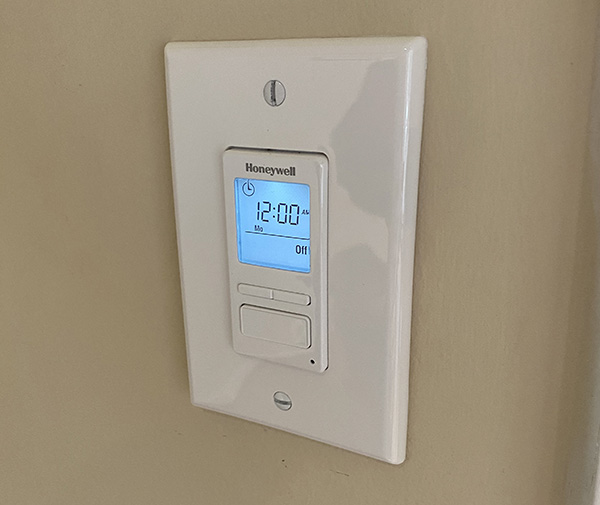
Enter the Honeywell Econoswitch (a product to which I have no connection, and simply use myself). What makes this switch different is that it has a solar timetable: enter your longitude and latitude into the Econoswitch, and it will turn on your exterior lights at dusk and turn them off at sunrise, automatically adjusting these on/off times as the timing of sunrise/sunset changes throughout the year.
You do need to do a little installment project to get the Econoswitch in place in your home. But it’s not hard to do (it will take you around 15 minutes), and it’s a game changer; you’ll never have to think about turning your exterior lights on and off again.

You don’t want to zap yourself while replacing the switch. Go to your breaker box and turn off the power to the light switch you’re replacing.
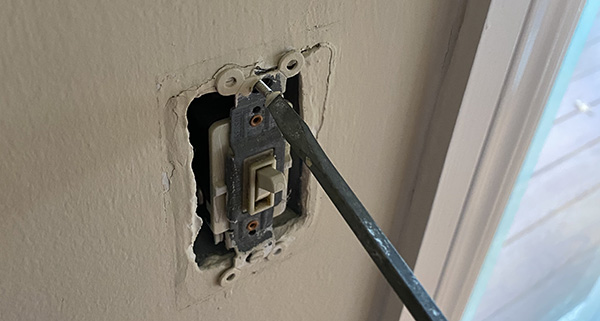
Remove the light switch plate and then unscrew the light switch from the electrical box in the wall. You just need a flathead screwdriver for this job.
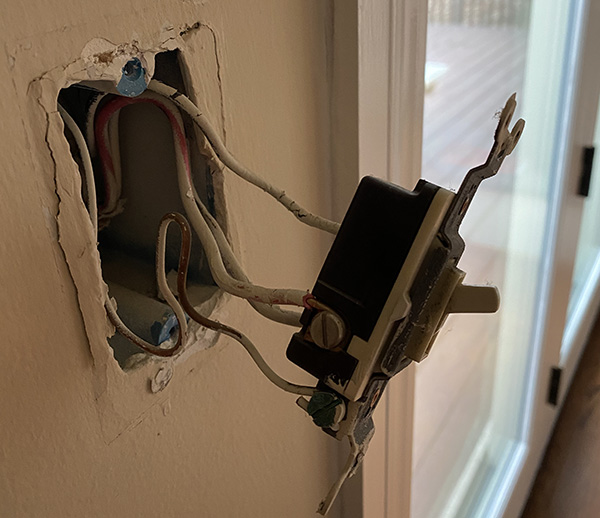
Pretty easy: Just use your flathead screwdriver to loosen the connectors on the switch. My old switch was a three-way switch which means I can turn on/off the light it’s connected to from a different switch as well. So my old switch had a bunch of wires connected to it: two black wires, a red wire, and a ground wire.
Yours might look different than this. You might just have a black, blue, and white wire. Whatever the case may be, disconnect them all from the old light switch.
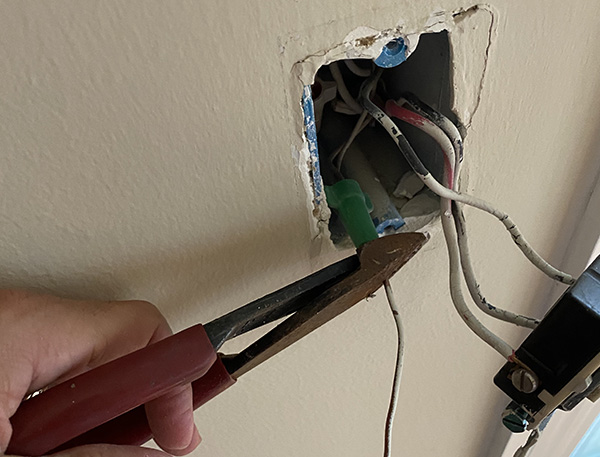
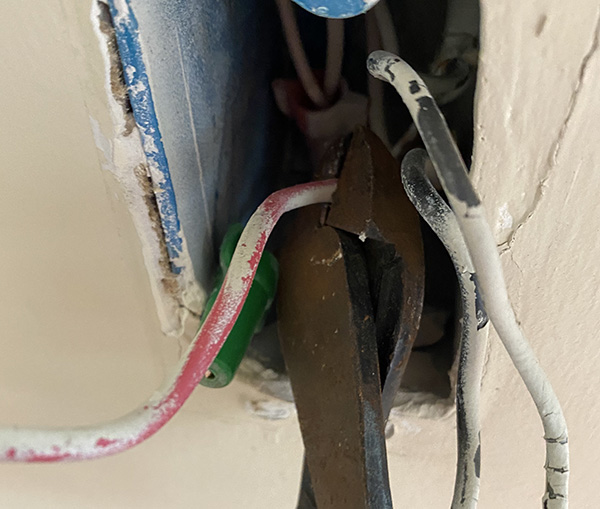
If you have a three-way switch like I do, go ahead and cut your ground and red wires down. You won’t be using them anymore and it will make stuffing the wires back in the box a lot easier later on. Be sure to cap the wires off with a wire nut.
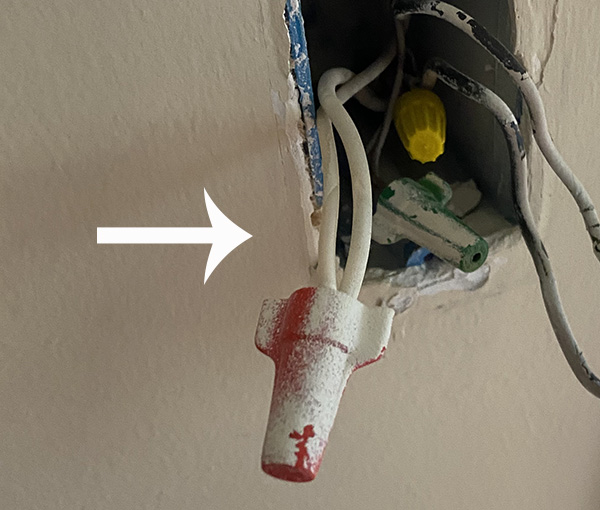
You’ll be needing to connect a white wire from the wall to a white wire on the new switch. The first time I replaced a regular light switch with a timer switch, this step confused the heck out of me because my old three-way switch didn’t use white wires and I couldn’t see it in the electrical box at first glance.
But they’re there. Stuffed way in the back. Pull them out. Mine had two white wires capped off together. You’ll just need to use one of those wires. Pull one out and re-cap the unused one.
If your old switch was already using a white wire, you don’t need to do this step.
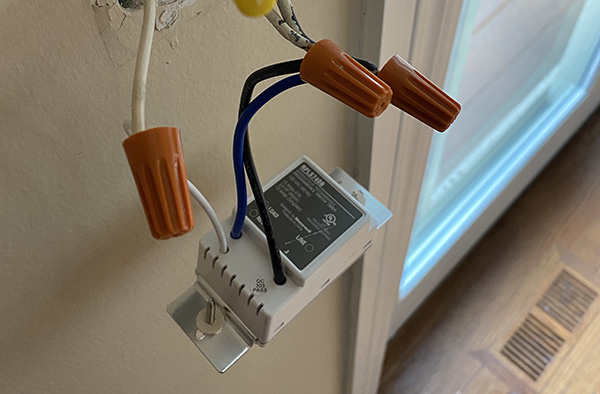
Should be simple: Connect white to white, blue to blue, and black to black.
The tricky thing for me is that I didn’t have a blue wire coming out of my wall. I had two black wires. It will still work. I just had to test the light switch to make sure I had the right wires from the wall connected to the right wires on the timer switch. If you have the wrong ones connected, the light won’t come on when you turn the power back on at the breaker box.
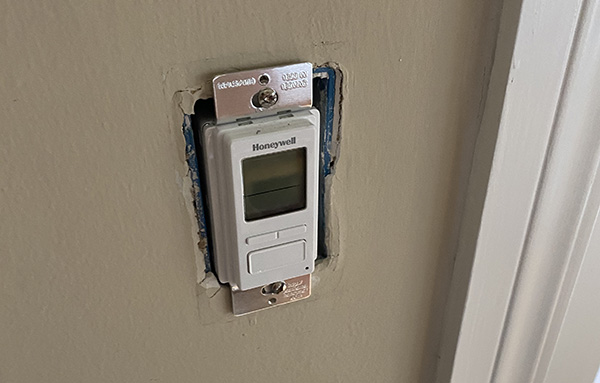
Easy peasy.
Bam! Done. Now just turn the power back on at the breaker box and program your switch.
You’ll enter the date and time and then your longitude and latitude. From here on out your outdoor lights will turn on at dusk and turn off at dawn, no matter the time of year. You’ll never have to think about it again. And when bad guys drive past and scope out your house, they’ll hopefully keep on driving.
For more tips for preventing a home invasion, listen to our podcast with security expert Dave Young:
The post Protect Your Home By Installing a Solar Timetable Light Switch appeared first on The Art of Manliness.
We often use the words “nice” and “kind” synonymously.
But it can be helpful to distinguish between the two qualities, as Eric Kapitulik, Marine special operator and leadership coach, does.
Being nice means making people feel good in the short-term. Behaving politely. Offering a smile and a pat on the back. Exchanging pleasantries. Avoiding arguments.
Being kind, on the other hand, means doing what’s best for someone in the long-term, even when it might not make them feel great in the moment.
Oftentimes, we can, and should, be both nice AND kind. But sometimes, the two qualities conflict.
Buying your kid a toy to soothe his tantrum might be nice, but depriving them of the chance to practice delayed gratification isn’t kind.
Not saying anything when a teammate starts slacking off might be nice, but allowing them to squander their potential isn’t kind.
Not breaking up with someone with whom you know there’s no future might be nice, but robbing them of the time they could be spending finding a better match isn’t kind.
Acting like you agree with a friend’s misguided beliefs might be nice, but tacitly encouraging them to continue down a destructive path isn’t kind.
It’s nice to be nice, but it’s more important to be kind. And as Kapitulik observes, choosing the latter requires sacrifice.
Oftentimes, when we say we want to be nice to someone, it isn’t really about them at all. It’s all about us. We don’t want to have the hard conversation. We don’t want to incur the consequences of holding people accountable. We don’t want to make things “weird.”
When we choose to be nice instead of kind, we’re choosing our own comfort over helping someone else find real happiness and become their best self. Which, when you think about it, really isn’t so nice after all.
The post Sunday Firesides: Don’t Confuse Niceness With Kindness appeared first on The Art of Manliness.
If the stock market’s wild fluctuations in 2020 weren’t evidence enough, a group of Reddit day traders showed us this past week how easy it is to manipulate share prices in a way that bears little connection with the true state of affairs at a company. It’s clear that traditional indicators such as the stock market’s performance, employment data and GDP growth rate, while important, are nowhere near enough to tell us how the economy is faring. As we’ve seen in recent months, they can even point in opposite directions. This Sunday Magazine probes new gauges of economic health that make more sense today, explores fresh ideas and surprising economic revelations, and brings you insights into how China and other economies are preparing for the future.
Could they fundamentally reset our economic approach?
Back to the Moon. We’re conditioned to think of the government and private sectors as antagonistic forces within the economy, with opposing motives. But leading economist Mariana Mazzucato argues against that assumption. The most efficient way for the world economy to recover from setbacks like COVID-19 might be to replicate America’s moonshot strategy from the 1960s. Success in the race to the moon was a result of public-private collaboration, as were cutting-edge technologies from GPS to the internet. Countries need to channel that spirit to rebuild their economies most effectively, she argues in a new book, Mission Economy: A Moonshot Guide to Changing Capitalism. READ OZY’S 2018 PROFILE OF MAZZUCATO
Teach Trading in Schools. Google searches for “short squeeze” rose by more than 800 percent this past week, as Americans tried to decode an ambush by Reddit traders on Wall Street hedge fund managers who had bet against brick-and-mortar video game firm GameStop. By collectively buying GameStop shares, the group of traders on Reddit forced a surge in the firm’s stock price, leading to nearly $20 billion in losses for those who expected the value to plummet, and prompting commission-free online brokerages like Robinhood to pause trading in GameStop shares. The controversy — and the frenzy on Google’s search engine — proves one thing: It’s time to teach the basics of stock trading to all students in school. The good news? A bunch of apps and services are already looking to tap that demand, which has grown amid the pandemic. READ MORE ON OZY
Pay Transparency. It’s a good idea to help fight hidden biases within companies and organizations. Sharing payroll data works even better as a means of economic incentive, some experts argue. A fair firm gives employees a true picture of where they stand and what they need to do to rise. The concept is picking up in the U.S. tech sector. And starting this year, all job postings in Colorado are required by law to include a salary range. The state also mandates gender pay equity for similar jobs and bars employers from punishing workers for discussing their salaries with each other.
African Free Trade Area. On Jan. 1, while much of the world was recovering from a hangover and Europe officially lost the U.K. from its single market, Africa launched its most ambitious economic idea ever. The African Continental Free Trade Area will be twice the size of the European Union, covering 1.3 billion people. It could raise the continent’s GDP by 7 percent. Can it replicate — or even surpass — the success of the EU by finally improving connectivity and trade among Africa’s 54 nations?
Pay-If-You’re-Cured Health Care. For decades, Americans and their insurers have generally paid for each medical procedure (with more bills for resulting lab work), whether it’s effective or not. Now a growing movement within the medical community sees advantages for both hospitals and patients in an alternative model called value-based care, where you pay for an outcome rather than a procedure. And the benefits to the economy are hard to overemphasize: medical expenses contribute to two-thirds of U.S. bankruptcies, while nearly $1 trillion is wasted on health care each year — from failed procedures to needless bureaucracy. READ MORE ON OZY
New Thinking About Taxes. As the global economy changes, countries are devising creative new tax regimes to catch up. Indonesia and Kenya have introduced taxes on global digital firms. With the embrace of electric vehicles threatening the gasoline taxes many countries depend on, multiple Australian states have introduced an alternative plan: Electric vehicle drivers would need to pay based on the distance they drive. And Barbados, Costa Rica and Greece are slashing income taxes for digital nomads who want to live and work in their nations. READ MORE ON OZY
Are these new indicators better barometers of where the economy is headed?

Mobility Data. With traditional economic indicators like GDP or employment, there’s always a lag before the data is collected and processed. One indicator that’s up-to-the-second and might just be the smartest measure to track in a post-coronavirus world? Mobility data. Using anonymized cellphone location data, researchers and authorities alike are already tracking potentially contagious foot traffic. But such data can also highlight economic hot spots and commercial deserts — in real time. But can we trust governments or private firms not to misuse such a gold mine of data?
Bounceback Potential. As countries scramble to rebuild economies battered by the worst slowdown in nearly a century, some are poised to do better than others. A detailed measure of the resilience of different economies rates Norway at the top overall, while Singapore has the most robust supply chains to withstand crises. Haiti, Venezuela and Ethiopia sit at the bottom. Economic resilience might be just as important a metric for the future as economic growth.
Fossil Fuel Withdrawal. If phasing out fossil fuels is a critical element of securing our future, countries best positioned to do so have an edge that will only grow as the shadow of climate change lengthens. At the front of the pack is Uruguay, whose economy is now driven almost 100 percent by renewable energy after a conscious government push in recent years: Clean energy sources contributed only 40 percent of the country’s power mix as recently as 2012. Others just behind Uruguay include Scotland, Costa Rica, Nicaragua, Sweden and Morocco.
Living Standards Framework. Since 2011, New Zealand has used this measure — which tracks everything from levels of trust and rule of law to the state of the environment, incomes and housing — to shape its policies and determine budget allocations. The country’s success against the coronavirus has already won it plaudits. But even before the pandemic, the Living Standards Framework had helped the 5 million-strong country emerge as the perfect bolt-hole for the world’s wealthiest to escape to when catastrophe strikes.
Lipstick Test. Just how much in the red is the economy? Strictly speaking, this isn’t a new measure. But the pandemic has inverted how it’s interpreted. Traditionally, lipstick sales go up during an economic recession, as people spend on relatively inexpensive acts of self-indulgence when they can’t afford more. But the current economic crisis has seen lipstick sales crash, with masks eliminating much of their purpose, to say nothing of the smearing. READ MORE ON OZY
These trends will determine whether China emerges as the world’s top dog.

Challenging Reputations. China’s shifting economic landscape is creating new opportunities in the world’s largest consumer market, challenging the country’s reputation for fake goods and food scandals. As more members of China’s middle class enjoy higher disposable incomes, they are willing to pay for protection from counterfeiting. That, in turn, is supporting companies that provide blockchain tech for meat producers and services that root out fake handbags on Chinese e-commerce platforms. Cities are also embracing a “slow economy,” moving away from the high-intensity, fast-paced living China’s become known for. READ MORE ON OZY
Buzzword: Innovation. Beijinger Sam Wong, 35, recalls that when he was young, the country’s media “highlighted vast production figures from China’s factories as proof of economic success.” Now, they tout China’s world-leading technologies as evidence of the nation’s “journey from Made in China to Created in China,” he says. Building on that shift is central to China’s post-pandemic and post-Donald Trump economic strategy. For instance, Beijing hopes to use its carbon-cutting transportation tech to forge collaboration with the Biden administration on fighting climate change.
Money Wars. Tech giants Alibaba and Tencent have dominated digital payments through Alipay and WeChat Pay. Now, as the Chinese Communist Party targets the country’s fintech behemoths with regulations aimed at curtailing their influence, Beijing is also expediting the launch of its own virtual currency through the People’s Bank of China. Rumors are circulating that it is unsafe to store currency on Alibaba and Tencent platforms, and the PBOC has rolled out limited trials of the state-controlled digital currency in Shenzhen and Shanghai.
Impressive (But Uneven) Growth. After its initial stumbles, China’s relative success in containing COVID-19 has allowed it to register 2.3 percent GDP growth in 2020, a year that saw all other major economies shrink. China also became the world’s leading recipient of foreign direct investment as it dropped 42 percent globally. But this success hasn’t been distributed evenly, and China’s wealth gap has widened further.
The stories behind some unexpected lessons.

Cash Handouts Help Forests. Green shoots for the economy can go hand in hand with literal green shoots. Researchers have found that a cash payment program targeted at the rural poor in Indonesia also led to a 30 percent reduction in deforestation, as struggling communities tend to clear more farmland. But scientists point out that the approach could also have unintended consequences: Different research in Mexico showed that farmers used cash payments to buy more cattle, then cleared more trees to create pastureland. Either way, the roots of deforestation often lie in poverty. Tackling that is a good start.
Migration Loop. America was deporting migrants it didn’t want long before Donald Trump arrived in the White House in 2017. But sometimes, what seems smart in the moment can create a feedback loop that only accentuates the problem. Under the Illegal Immigration Reform and Immigrant Responsibility Act of 1996, the U.S. dramatically ramped up deportation of members of Salvadoran criminal gangs. But that fueled a spike in crime in El Salvador, pushing Salvadoran migrants toward the U.S. Maybe trying the criminals in U.S. courts would have helped? (Or, if we’re going further back, not meddling in El Salvador’s politics to prop up its brutal regime in the 1980s.)
Obama’s Backfire. Want more recent evidence of bad economic policy driven by good intentions? The Dodd-Frank Act signed by President Barack Obama in 2010 included a section that made it mandatory for companies to disclose the presence of any “conflict minerals” from African nations in their supply chains. The aim was to dry up funding for violent groups and force an end to civil wars. Instead, the law dramatically reduced trade in even non-conflict minerals from the Democratic Republic of Congo, drying up incomes for entire populations. The result? Even more conflict in the DRC. Researchers have also observed a similar pattern in neighboring Burundi and the Central African Republic.
UBI Doesn’t Breed Laziness. Some of the biggest economic debates of our time focus on automation, the threat of robots replacing workers and whether societies should introduce a universal basic income. It turns out some of our concerns might be overblown. Researchers have found that workers don’t become less efficient when they’re guaranteed an income or protected (via taxes on automation) from losing their jobs to robots. Meanwhile, the threat of being displaced by machines doesn’t improve worker efficiency.
Kids Rule. It’s a simple rule of economics: Families cut expenses during slowdowns and periods of rising unemployment. But 2020 revealed an exception. Parents can avoid buying themselves new clothes and books, but their growing children can’t wait. They might not fit into the jeans they wore six months ago and their developing brains need fresh stimulation. Add lockdowns to the mix, and you have parents struggling to think of new ways to engage their children at home, making industries that target kids not just recession-proof, but booming sectors amid the broader economic crisis. READ MORE ON OZY
Burnout Business. It’s not just kids whose needs have fueled economic spending in this era of tumult. Work-from-home has erased the already blurry lines between office hours and our own time, leading to a dramatic spike in workers struggling with burnout, surveys suggest. Some startups are approaching this opportunity with workshops, counseling and app-based services, with California’s Coa offering the “world’s first gym for mental health.” READ MORE ON OZY
These countries are ahead of the game.

Estonia. No country was better prepared for 2020’s disruptions than this tiny state that made an early commitment to digital government after it emerged from the Soviet Union. It offers e-residencies — documents that allow entrepreneurs to remotely set up businesses in the country, even if they’re actually lounging in the Bahamas. When the pandemic hit, 99 percent of government services were already online and so remained available, 87 percent of schools were already using e-learning, and digital health records meant patients could access their treatment while leaving doctors to focus on COVID-19.
Rwanda. It’s the country that’s best positioned to utilize the launch of the African Continental Free Trade Area. Rwanda already has an online business registration system that allows entrepreneurs to start businesses in less than half the time it takes in rich Western countries. Can it replicate Estonia’s success with a similarly integrated Europe?
Chile. While the big daddies of global trade continue to bicker over tariffs, Chile joined hands with New Zealand and Singapore in January 2020 to finalize a pact under which they’ll devise common rules for digital trade. Chile is already ahead of much of Latin America in perceived e-commerce safety and online privacy. Now it could show the Western hemisphere what a future digital free trade zone might look like.
The post Beyond GameStop: Are You Ready for an Economic Moonshot? appeared first on OZY.

After hundreds of hours of research and testing over the past seven years, we’ve concluded that Apple’s 11th-generation iPad—with all the performance and features most people need for watching video, browsing the internet, and staying on top of email and social media feeds—is the best all-around tablet. But we also have recommendations for people who want an Android tablet, a basic ebook reader, or a more powerful tablet for gaming, for handling design and creative tasks, or for replacing a laptop computer.

The price of GameStop's stock has been sent soaring by rocket emojis in the Reddit forum r/wallstreetbets. The rally has captured the attention of the world, including regulators and the White House. At the market's close on January 28, GameStop shares were worth about $198, up about 400 percent from a week ago, but down from their meteoric height of over $400. Everyone from Bernie Sanders to Jon Stewart is saying that this is evidence that Wall Street is broken or rigged. What's really going on?
A lot of Wall Street hedge fund money was tied up in betting that GameStop, which has suffered as consumers increasingly make purchases online, would continue to decline.
There are a number of ways to bet against a company's success, but a popular strategy is to "short sell." The mechanics of a short sale are a bit complicated: A trader doesn't actually own the stock, but "borrows" it for a specified amount of time and then sells it when either the agreed-upon price is reached or the time period expires. But this is risky. A short sale executed without a hedge could expose a trader to unlimited losses.
The underlying risk in short sales is what retail investors turned into an opportunity. Unlike traditional stock rallies, GameStop's rise (and the rise of other stocks caught up in the moment, like AMC) grew from the actions of individual retail investors who have recently gained greater market access through the availability of low-cost trading apps.
Because retail traders are not a monolith, it's often difficult to discern their exact motivation. Some hypothesize that GameStop's rise began by identifying an undervalued stock. Others hypothesize that retail traders were exercising their muscle, seeing how much they could move the market. And others, in what is becoming the dominant narrative, hypothesize that traders identified GameStop specifically to target Wall Street's short positions.
Regardless of the motivation, by executing trades in GameStop, these retail investors created what is known as a "short squeeze," where the fast-rising price of the stock caused the holders of short positions to buy the stock in order to limit their losses—pushing the stock price even higher, creating a type of feedback loop. This left a number of hedge funds high and dry, possibly causing billions in losses.
Because a lot of the trading was in options, there was also a "gamma squeeze," which created another feedback loop. Market makers who sell call options (bets that the stock price will rise) often buy some underlying stock to hedge their exposure, pushing the price up even further.
As more investors jumped on the bandwagon, whether retail or institutional, the price continued to soar to new heights. GameStop's price has stabilized some on Thursday after online trading platforms limited investors' abilities to open new trading positions.
There may be no problem at all. Markets and bubbles go together. The Dutch tulip craze of the 1600s is just one example of the time-honored tradition of bubbles.
Retail traders riding the rally would tend to agree that there's no problem. For Main Street, this is a success story, albeit one that may have a sad ending for those taking losses when the stock price inevitably descends. It illustrates the power of retail investors and sends a shot across the bow of Wall Street, who often calls them "dumb money."
Wall Street, on the other hand, is shaken. Short selling is a textbook trading strategy. Indeed, despite those who argue it is morally unacceptable to bet against a company's success, short selling generally improves market efficiency by helping to guide price discovery and capital allocation. Although it's not unusual for short sellers to lose big, few would have predicted a short squeeze coming from retail traders.
Given the attention GameStop trading has received, regulators undoubtedly will try to ascertain whether there are any legal problems. The most common question is whether the retail traders manipulated the market. They seem to have acted with some degree of concert to change the stock's price. But that's not the definition of illegal market manipulation. In fact, most of us hope others will follow suit when we buy a stock, pushing the price higher. There are even legitimate investment strategies aimed at helping to push the stock in your favor.
For there to be illegal market manipulation, there generally needs to be some sort of fraud or deception. But here, little suggests that investors were being misled. The online forum was refreshingly (if vulgarly) transparent. Making a market manipulation case here may prove to be challenging.
There's no shortage of criticism about the current situation. While Wall Street searches for solutions to protect its own bets from what it views as the unpredictable "retail horde," retail traders decry online trading platforms' decisions to halt trading as being in cahoots with the hedge funds. But it's not a stretch to see GameStop as part of the normal functioning of markets. The brokerages' decisions to limit trading reportedly stemmed from requirements imposed by parts of the market infrastructure, which left brokerages scrambling to find the capital to keep trading open. When viewed through the lens of the extensive regulation of brokerages' financial operations, a trading halt is not a surprising outcome.
The fact that GameStop is now trading far above fair estimates of the company's value is not an incontrovertible sign that the market is broken. Stock prices move in and out of alignment all the time. It's likely that GameStop is due for a correction, but some stocks (like Tesla) have remained overvalued, according to conventional metrics, for extended periods.
With the huge trading volume and increase in value, it's easy to forget that GameStop remains a very small part of the market as a whole. GameStop's trading is an extreme example, but standing alone—or even with the few other stocks that have been driven up during this time—it is not enough to show that the theories underlying market operation have failed.
A viral story like this may catch attention, but newsworthy headlines themselves do not justify new regulations. Easy access to the markets for retail investors is a good thing. It allows those traditionally left out, like the young or those with modest savings, to find opportunities to grow their wealth. While the GameStop trading is not what anyone would suggest as a prudent path to building long-term wealth, the expanded market access opportunities that helped fuel this rally are exactly those that we should be excited to support for retail investors.
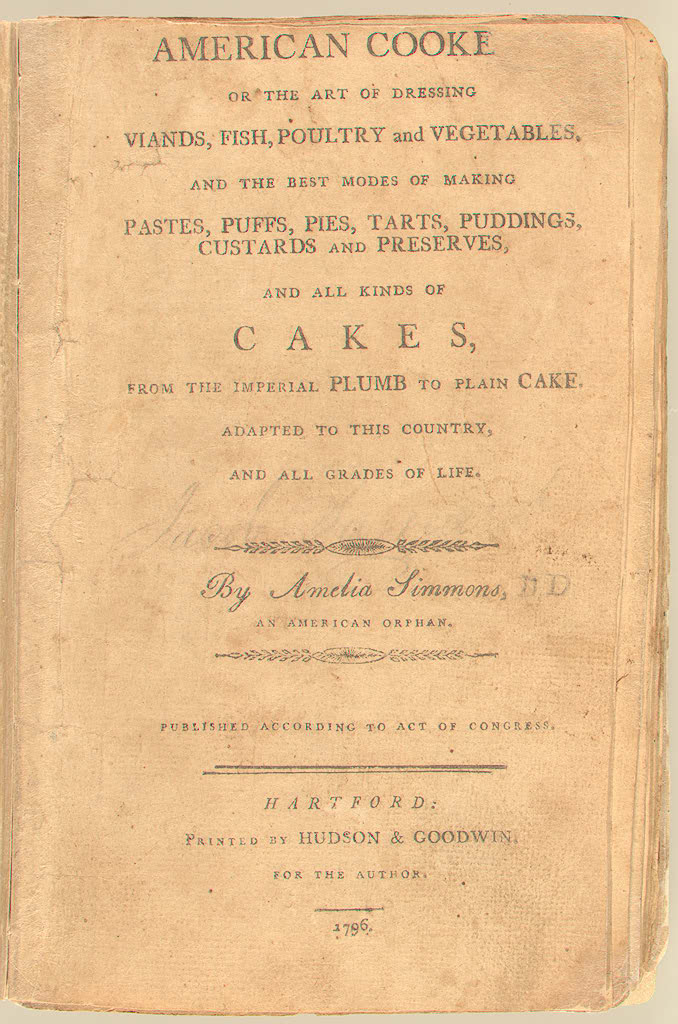
Image via Wikimedia Commons
On the off chance Lin-Manuel Miranda is casting around for source material for his next American history-based blockbuster musical, may we suggest American Cookery by “poor solitary orphan” Amelia Simmons?
First published in 1796, at 47 pages (nearly three of them are dedicated to dressing a turtle), it’s a far quicker read than the fateful Ron Chernow Hamilton biography Miranda impulsively selected for a vacation beach read.
Slender as it is, there’s no shortage of meaty material:
Calves Head dressed Turtle Fashion
Soup of Lamb’s Head and Pluck
Fowl Smothered in Oysters
Tongue Pie
Foot Pie
Modern chefs may find some of the first American cookbook’s methods and measurements take some getting used to.

We like to cook, but we’re not sure we possess the wherewithal to tackle a Crookneck or Winter Squash Pudding.
We’ve never been called upon to “perfume” our “whipt cream” with “musk or amber gum tied in a rag.”
And we wouldn’t know a whortleberry if it bit us in the whitpot.
The book’s full title is an indication of its mysterious author’s ambitions for the new country’s culinary future:
American Cookery, or the art of dressing viands, fish, poultry, and vegetables, and the best modes of making pastes, puffs, pies, tarts, puddings, custards, and preserves, and all kinds of cakes, from the imperial plum to plain cake: Adapted to this country, and all grades of life.

As Keith Stavely and Kathleen Fitzgerald write in an essay for What It Means to Be an American, a “national conversation hosted by the Smithsonian and Arizona State University,” American Cookery managed to straddle the refined tastes of Federalist elites and the Jeffersonians who believed “rustic simplicity would inoculate their fledgling country against the corrupting influence of the luxury to which Britain had succumbed”:
The recipe for “Queen’s Cake” was pure social aspiration, in the British mode, with its butter whipped to a cream, pound of sugar, pound and a quarter of flour, 10 eggs, glass of wine, half-teacup of delicate-flavored rosewater, and spices. And “Plumb Cake” offered the striving housewife a huge 21-egg showstopper, full of expensive dried and candied fruit, nuts, spices, wine, and cream.
Then—mere pages away—sat johnnycake, federal pan cake, buckwheat cake, and Indian slapjack, made of familiar ingredients like cornmeal, flour, milk, water, and a bit of fat, and prepared “before the fire” or on a hot griddle. They symbolized the plain, but well-run and bountiful, American home. A dialogue on how to balance the sumptuous with the simple in American life had begun.
(Hamilton fans will please note that the cake for the 1780 Schuyler-Hamilton wedding leaned more toward the former than anything in the johnnycake / slapjack vein…)
American Cookery is one of nine 18th-century titles to make the Library of Congress’ list of 100 Books That Shaped America:
This cornerstone in American cookery is the first cookbook of American authorship to be printed in the United States. Numerous recipes adapting traditional dishes by substituting native American ingredients, such as corn, squash and pumpkin, are printed here for the first time. Simmons’ “Pompkin Pudding,” baked in a crust, is the basis for the classic American pumpkin pie. Recipes for cake-like gingerbread are the first known to recommend the use of pearl ash, the forerunner of baking powder.
Students of Women’s History will find much to chew on in the second edition of American Cookery as well, though they may find a few spoonfuls of pearl ash dissolved in water necessary to settle upset stomachs after reading Simmons’ introduction.
Stavely and Fitzgerald observe how “she thanks the fashionable ladies,” or “respectable characters,” as she calls them, who have patronized her work, before returning to her main theme: the “egregious blunders” of the first edition, “which were occasioned either by the ignorance, or evil intention of the transcriber for the press.”
Ultimately, all of her problems stem from her unfortunate condition; she is without “an education sufficient to prepare the work for the press.” In an attempt to sidestep any criticism that the second edition might come in for, she writes: “remember, that it is the performance of, and effected under all those disadvantages, which usually attend, an Orphan.”
Read the second edition of American Cookery here. (If the archaic font troubles your eyes, a plainer version is here.) A facsimile edition of American Cookery can be purchased online.
Listen to a LibriVox audio recording of American Cookery here.
Related Content:
An Archive of 3,000 Vintage Cookbooks Lets You Travel Back Through Culinary Time
Historic Mexican Recipes Are Now Available as Free Digital Cookbooks: Get Started With Dessert
Recipes from the Kitchen of Georgia O’Keeffe
Ayun Halliday is an author, illustrator, theater maker and Chief Primatologist of the East Village Inky zine. She most recently appeared as a French Canadian bear who travels to New York City in search of food and meaning in Greg Kotis’ short film, L’Ourse. Follow her @AyunHalliday.
The First American Cookbook: Sample Recipes from American Cookery (1796) is a post from: Open Culture. Follow us on Facebook, Twitter, and Google Plus, or get our Daily Email. And don't miss our big collections of Free Online Courses, Free Online Movies, Free eBooks, Free Audio Books, Free Foreign Language Lessons, and MOOCs.
Even the grittiest, hardest-hitting TV dramas require willing suspension of disbelief to enjoy. This is especially true if you, the viewer, happen to be an expert on such subjects as emergency medicine, police procedures, criminal law, FBI profiling, crime scene investigation, etcetera. Those of us who don’t know anything about these fields may have an easier time of it, provided the writers do their diligence and make the actors sound convincing. I never much questioned the science of Breaking Bad, for example. Surely, the hit show accurately depicted how a desperate high school chemistry teacher would build a meth lab in the desert? How should I know otherwise?
I might watch the show with a chemist, for one thing, like Professor Donna Nelson or the University of Nottingham’s Sir Martyn Poliakoff, who had himself refused to watch Breaking Bad until “one day when I’m old.” That day has come at last: he finally sat down with the pilot and discussed his impressions on YouTube channel Periodic Videos. Poliakoff approached the experiment with almost no preconceptions. He knew the show was about a chemistry teacher who made “some sort of drug, I didn’t know which one,” and that “there were a lot of episodes.”

He also knew that “at some point, HF, hydrogen fluoride, played a part.” But before the chemistry critique begins, Poliakoff notices that Walter White’s pants floating through the desert air in the pilot’s iconic opening are a physical impossibility given their origination. Bummer. He loved the opening sequence spelling out the show’s title with elements from the periodic table, and even imagined how his own name (including “Sir”) might be spelled the same way.
As you might expect, Poliakoff has some nits to pick with the lesson White gives his students in the first few minutes. For one, White—who shows himself to be very safety-conscious, if not risk-averse, later in the episode—wears no safety gear while spraying chemicals into an open flame. The director can be forgiven for not wanting to obscure Bryan Cranston’s expressive face in this crucial scene of character development. But what of the lesson itself? Overall, he says, it’s “quite good.” He likes White’s definition of chemistry as “the study of change,” but thinks it should more fully be “the way that matter changes.”
The discussion prompts Poliakoff to reflect that no one’s ever asked him to define chemistry before. (When asked to define “inorganic chemistry” in high school, his son answered, “it’s what my dad does.”) We quickly begin to see the benefits of watching a well-crafted show like Breaking Bad with an expert. The drama of the show, and its unusual approach to what we normally consider a dry subject, draws out our chemist’s enthusiasm and helps us make connections we might not otherwise make, such as Walter White’s resemblance to well-known British scientist and science communicator Robert Winston.
Hearing Poliakoff discuss the Breaking Bad pilot turns out to be so entertaining that TV executives should take note—this could become a new, easy-to-produce genre when we finally run out of shows, provided there are enough eminent professors willing to offer commentary on hit series of the past. But as we can surmise from Professor Poliakoff’s general lack of interest in TV, and from his thriving career as a chemistry professor, he’s probably busy. He’s already done more than enough to make chemistry interesting to us layfolk by contributing to Periodic Videos for over a decade now.
Further up, see a fun demonstration of exploding hydrogen bubbles (“the title pretty much says it”). Just above and below, see Professor Poliakoff enlighten us on the properties of elements 35 and 56, Bromine and Barium, and watch Periodic Videos full series on the periodic table here.
Related Content:
The Science of Breaking Bad: Professor Donna Nelson Explains How the Show Gets it Right
The Breaking Bad Theme Played with Meth Lab Equipment
How Breaking Bad Crafted the Perfect TV Pilot: A Video Essay
Josh Jones is a writer and musician based in Durham, NC. Follow him at @jdmagness
Watch the Pilot of Breaking Bad with a Chemistry Professor: How Sound Was the Science? is a post from: Open Culture. Follow us on Facebook, Twitter, and Google Plus, or get our Daily Email. And don't miss our big collections of Free Online Courses, Free Online Movies, Free eBooks, Free Audio Books, Free Foreign Language Lessons, and MOOCs.
Try these fly fishing tips to help you get the most out of your time on the water by learning to improvise, try new approaches and stop following the herd. Around twenty years ago, when I was still floating anglers down the Henry’s Fork and making my living on the oars, I followed a long…
The post Tips for Finding New Fly Fishing Locations appeared first on Sporting Classics Daily.










.jpg)