Jean-Philippe Encausse
Shared posts
🧬 Prendre ce comprimé produit les mêmes effets qu'une course de 10 km

Canva has a shiny new text-to-image generator

Canva has added a bunch of new AI features to its web-based design platform, including updates for generating text and video effects and a more powerful text-to-image app. The latter is called “Dream Lab” — a new image generator tool born from Canva’s acquisition of generative AI startup Leonardo.ai earlier this year.
Dream Lab is powered by Leonardo’s Phoenix model (not be be confused with Adobe’s Firefly AI) and allows users to generate images from descriptions in a variety of styles like “3D render” and “Illustration.”
Canva already has its own Stable Diffusion-based AI image generator and hosts several other third-party apps, but the new Dream Lab offering introduces some improvements to the platform. It’s seemingly better at...
🧬 Découverte, sous la surface de la Terre, d'une ancienne structure datant de 250 millions d'années
La création du Retail Tech trendbook vient de notre volonté d’offrir une vision globale des innovations qui impactent le marché.
Generative AI can boost innovation—but only when humans are in control
Meet Tron 1: The Sci-Fi Mashup Robot That’s Adorably Ready for the Uprising!

Introducing the Tron 1, the bipedal robot from Limx Dynamics that’s basically what happens when a Star Wars Scout Walker and a Battlestar Galactica Cylon have a love child. With three sets of swappable feet — yes, including wheels — this little bot tackles stairs, takes leaps, and sticks the landing like a robotic Simone Biles. Despite rocking that classic “Cylon-eye” look, it’s surprisingly adorable… at least until they kick it to show off its recovery skills. Trust me, these designers will regret that when the robot uprising kicks off. Early bird price? A cool $15,000. Worth it, right? You know, before they take over.
[Via BB]
Nvidia lance discrètement sa propre intelligence artificielle et elle dépasse déjà ChatGPT
Scientists Propose Shooting $200 Trillion Worth of Pulverized Diamonds Into Atmosphere

Shiny Solution
There are ways of cooling the planet, and then there are cool ways of cooling the planet. Spending decades grinding up something approaching a quadrillion dollars worth of diamonds into dust, and then dispersing the powdered gemstones into our atmosphere? That falls into the latter.
Contrary to what you might think, such an audacious idea wasn't conceived by some sci-fi writer huffing fumes, but by researchers performing a rigorous scientific exercise. The point isn't necessarily whether this is a feasible or even good idea on its own — rather, the value lies in seriously weighing up all our options as we stare down the barrel of near-certain climate doom.
With that in mind, how would this — hypothetical — approach work? As detailed in a study published in the journal Geophysical Research Letters, injecting about five million tons of diamond dust into the atmosphere each year would be enough to cool our planet by nearly 2.9 degrees Fahrenheit.
Sure, it would take 45 years of nonstop injections and cost nearly $200 trillion — but the intervention would be enough to keep us just under the 2.7 degree warming threshold, past which the catastrophic effects of climate change are believed to be irreversible.
Atmos-Fears
This feat of solar geoengineering — via the deliberate release of small particles in the atmosphere — is known as stratospheric aerosol injection. The study also examined the use of sulfur, a far more practical option, along with five other aerosol candidates.
Using a 3D climate model, the researchers separately simulated the effects of using diamond, sulfur, and the other aerosols over nearly five decades, paying particular attention to how they coagulated, or clumped together, and how long they lasted in the atmosphere, a process known as sedimentation.
Too much coagulation causes heat to be trapped in spots instead of reflecting it, since the particles need to remain diffuse for the whole plan not to backfire. And of course, if the aerosols don't last long up there, neither will their supposed benefits.
In both respects, the pulverized diamonds really shined: they didn't clump, and they also stayed airborne, with the added bonus of resisting being turned into acid rain, Science notes. Sulfur, on the other hand, was the second worst of all the candidates because it tended to clump a lot.
Done and Dusted
That being said, sulfur remains an attractive and probably our best option because it's "basically free," Douglas MacMartin, an engineer at Cornell University whose work was cited in the study, told Science. We can readily examine its effects on a large scale through volcanic eruptions, MacMartin said, and because it's a gas, it'd be easier to disperse through aircraft than with the heavy payloads of diamond.
"I do think that it's interesting to explore these other materials," MacMartin told the journal. "But if you ask me today what's going to get deployed, it's gonna be sulfate."
As such, we're probably not going to have a sky shimmering with micro-diamonds anytime soon. But we're continuing chip away at the huge question marks around deliberately tampering with our climate, making a study like this "really valuable," Shuchi Talati, founder of the Alliance for Just Deliberation on Solar Geoengineering who was not involved with the study, told Science.
"You need to understand the early-stage physics of potential particles to then have the conversations about broader impacts," she added.
More on climate change: Plants and Forests Absorbed Almost No Carbon Last Year, Shocking Climate Scientists
The post Scientists Propose Shooting $200 Trillion Worth of Pulverized Diamonds Into Atmosphere appeared first on Futurism.
Caisses automatiques : ni les clients ni les supermarchés n'en veulent, et voici pourquoi
Comment la France planche sur ses propres armes hypersoniques

La France a réalisé en 2023 un premier essai d’un planeur hypersonique, capable d'aller au-delà de Mach 5. Par ailleurs, il y a dans les tuyaux un missile air-sol de nouvelle génération. Deux programmes d'armes hypersoniques qui doivent permettre à la dissuasion nucléaire française de rester crédible.
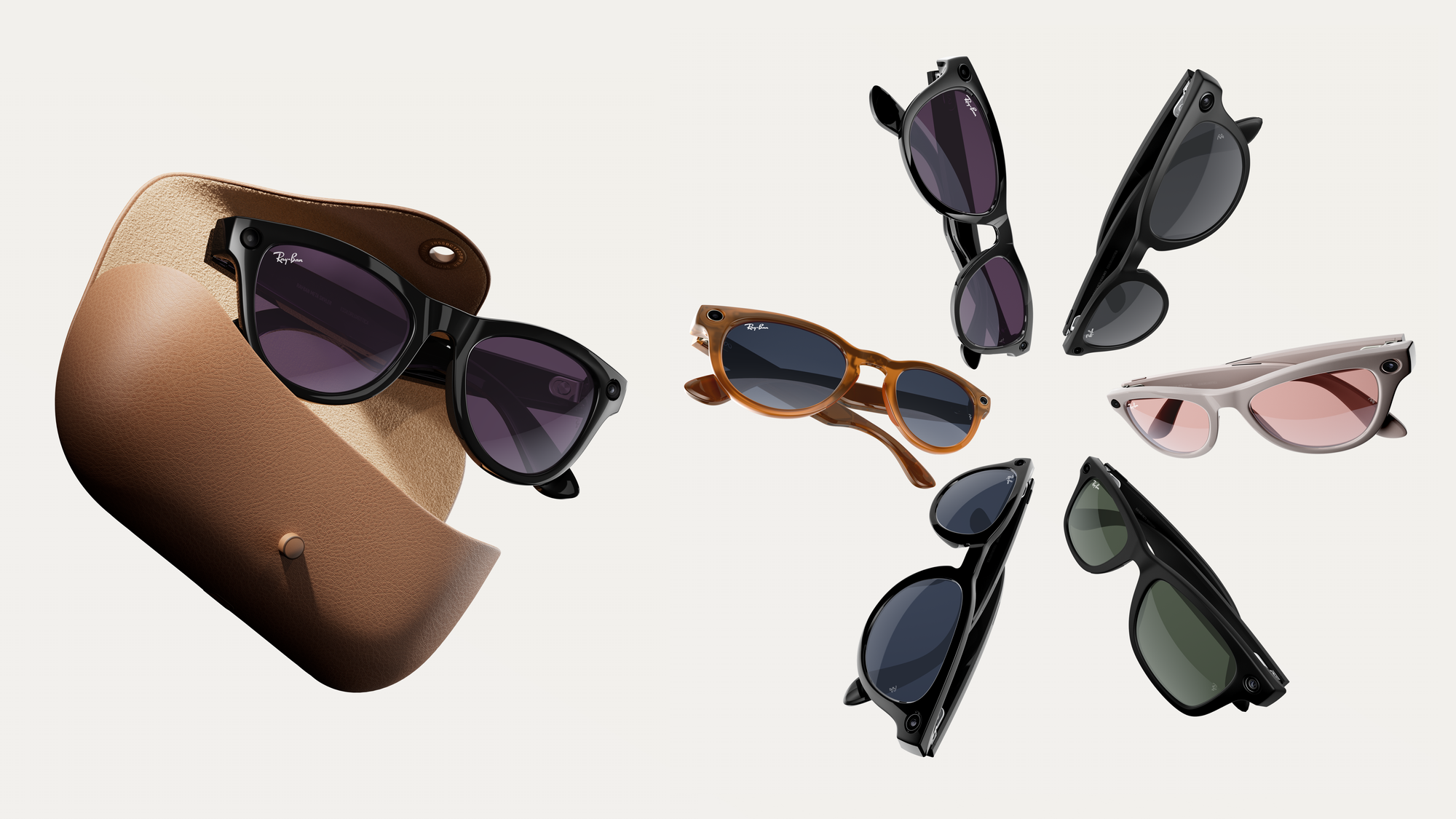
Ray-Ban Meta Glasses Are The Top Selling Product In Many Ray-Ban Stores
Ray-Ban Meta glasses are the top selling product in 60% of Ray-Ban stores in EMEA.
EMEA is a geographical region encompassing Europe, the Middle East, and Africa, typically used as a global division by companies.
The revelation comes from EssilorLuxottica's CFO Stefano Grassi on the company's Q3 2024 earnings call. EssilorLuxottica is Ray-Ban's parent company, which has a near monopoly on the eyewear market worldwide and also owns other iconic brands like Oakley.
Here's what Grassi told investors on the earnings call:
"Ray-Ban Meta, very happy about the performance that we've seen. I mean, we, it's an overall success story that we see.
Just to give you an idea, it's not just a success in the US, where it's obvious. But it's also success here in Europe. Just to give you an idea, in 60% of the Ray-Ban stores in Europe, in EMEA, Ray-Ban Meta is the best-seller in those stores. So it's something that is extremely pleasing."
Given that multiple sources point to the average selling price (ASP) of Ray-Ban products landing around $150-$200, that the Ray-Ban Meta glasses, which start at $300, are the top selling product in more than half of stores in the EMEA region is an early indicator that consumers are willing to pay more for smart glasses if they're stylish and widely available to try on.
 UploadVRDavid Heaney
Of course, the Ray-Ban Meta glasses are relatively primitive smart glasses. They lack any kind of display, and EssilorLuxottica reportedly "balked" at the thickness of a design needed to integrate one for next year. There's still a very long path from this to appealing true AR glasses even being available, never mind widespread, likely spanning decades rather than years.
On the software side, Meta has been adding new features to the Ray-Ban glasses to make them more useful, much the same as it does with its Quest headsets. It recently added reminders, timers, WhatsApp voice messages, QR code scanning, and more natural Meta AI invocation, and it plans to add live translation, Spotify controls, and more later this year.
These Meta AI features aren't available in EMEA though, except for the UK, where voice-only Meta AI recently arrived.
UploadVRDavid Heaney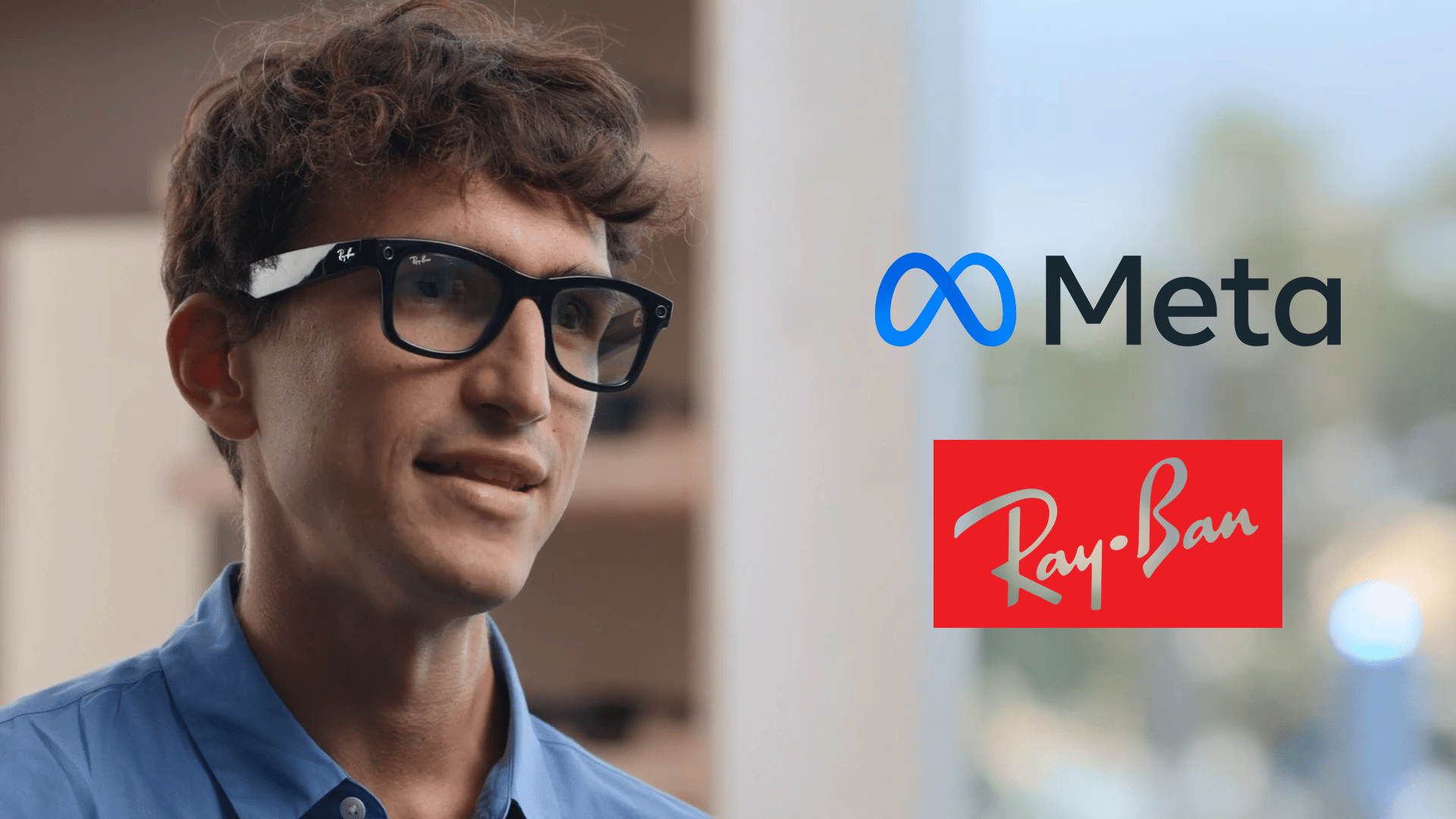
Meta and EssilorLuxottica recently extended their partnership into the 2030s, and the companies say they will develop “multi-generational smart eyewear products”. Samsung and Google are reportedly working on a competitor, and Apple is reportedly exploring releasing one in 2027 too.
DIY Air Bearings, No Machining Required
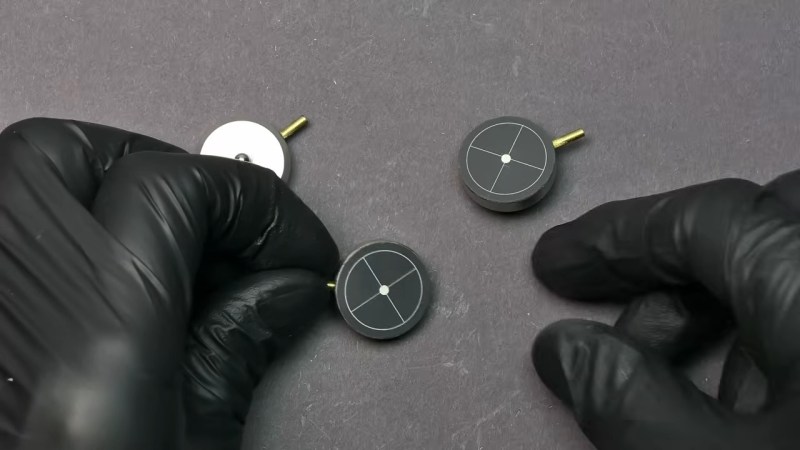
Seeing a heavy load slide around on nearly frictionless air bearings is pretty cool; it’s a little like how the puck levitates on an air hockey table. Commercial air bearings are available, of course, but when you can build these open-source air bearings, why bother buying?
One of the nice things about [Diffraction Limited]’s design is that these bearings can be built using only simple tools. No machining is needed past what can be easily accomplished with a hand drill, thanks to some clever 3D-printed jigs that allow you to drill holes with precision into stainless steel discs you can buy on the cheap. An extremely flat surface is added to the underside of these discs thanks to another jig, some JB Weld epoxy, and a sheet of float glass to serve as an ultra-flat reference. Yet more jigs make it easy to scribe air channels into the flat surface and connect them to the air holes through a bit of plaster of Paris, which acts as a flow restriction. The video below shows the whole process and a demo of the bearings in action.
[Diffraction Limited] mentions a few applications for these air bearings, but the one that interests us most is their potential use in linear bearings; a big CNC cutter using these air bearings would be pretty cool. We seen similar budget-friendly DIY air bearings before, including a set made from used graphite EDM electrodes.
Meta Orion AR (Pt. 2B Corrections On Two Sided Waveguides)
Update:

A second reader with expertise in Waveguide believes (but, like my other reader, does not have direct knowledge) that the Snap Spectacles 5 is still using a waveguide with gratings on only one side. This second reader cites the shape of the “eye glow,” particularly the triangular shape from the entrance grating. This reader says that the gradations that are visible in the Snap Spectacles 5 passive light capture are likely due to making the pillar gratings deeper to try and give a more uniform output. The reader also cites the much simpler process of making grating on one side.
The first reader was not certain and speculated based on some insider rumors about the Snap Spectacles 5 (there has been considerable movement of personnel between companies that design waveguides). Neither reader claimed to have firsthand knowledge of the Spectacles 5.
Introduction
The general premise of my last article, Meta Orion AR (Pt. 2 Orion vs Wave Optics/Snap and Magic Leap Waveguides), is that Meta Orion is using similar waveguide technology to Snap (Wave Optics) and that Magic Leap Two (ML2) is correct. However, several comments and assumptions about the specifics of waveguides with a diffraction grating on both sides were incorrect.
As I often say, “Few people will volunteer information, but many will correct you if you are wrong.” As my direct knowledge of the waveguide structures was limited, I reached out to readers in the article with an email address (newsinfo@kgontech.com). One of my readers (who wishes to remain anonymous), who designs waveguides, responded. This person explained how Wave Optics 2D waveguide works and had information about the waveguide structures used in Meta Orion, Wave Optics (now Snap), Magic Leap Two, and Hololens 2 (HL2).
I want to be clear that I am far from being a waveguide expert (see my background in the Appendix), and my descriptions of the various waveguides will probably be considered, at best, loose by experts (as they say, “I know just enough to be dangerous”). I’m primarily concerned with contrasting the various approaches and reviewing the resultant images based on the many different approaches I have seen. For example, it is generally true that as FOVs increase, image quality degrades with diffractive waveguide. Also, going to higher index waveguide substrates enables wider FOV and should require fewer TIR bounces for a given FOV, which will improve image quality.
Based on my readers’ information and some further studying, I am making this update. I am going to summarize some information from the prior article so this one can stand on its own without needing to reference back continually.
More on diffraction grating
The article “Optimization of gratings in a diffractive waveguide using relative-direction-cosine diagrams” provides a more in-depth explanation and many good diagrams showing how light propagates via various waveguide designs, including the common planar three gratings (Fig 6), a more complex grating structure (Figs 7a and 7b), and a Wave Optics type with a 2D grating (Figs 7c and 7c).

In the diagrams above, you will see a series of gray rings with red circles. These diagrams show the allowable FOV. The width of the gray rings, and thus FOV, increases as the index of refraction of the waveguide substrate increases.
Greatly Simplifying
I’m not going to profess that I understand waveguides well. However, a key basic rule is that the light in a waveguide must be turned at 360 degrees. You will note all the triangles in the diagrams with some of the three angles, of course, summing to 360 degrees. With separate gratings (such as in Fig. 7 above), the angles don’t have to be equal. In the case of older Wave Optics and Snap Spectacles 4 waveguides, the pillars that form the gratings are in an equilateral triangle arrangement to impart two 60-degree turns of the light.
Meta Orion’s Waveguide with Diffraction Gratings on Both Sides
Meta Orion, in addition to using Silicon Carbide, has what, in my experience, was an unusual waveguide structure with overlapping diffraction gratings on both sides of the waveguide substrate. Most waveguides I have seen have three gratings, entrance, expansion, and exit, on only one side of the waveguide. I then remembered Wave Optics (bought by Snap) had a similar unusual waveguide structure. I then wondered how Magic Leap 2 got its wide FOV, which resulted in my discovering that they were doing something similar.
Meta’s Orion, which has overlapping grains on both sides of the waveguide, must also have light turned by three gratings to exit. In the Orion waveguide, the two large gratings act simultaneously as expansion gratings and exit gratings. The light is first turned by the entrance gratings (1020 for red, 1022 for green, and 1024 for blue). About half the light is then turned by one of the large overlapping gratings into the opposite overlapping grating, where the light is turned to exit. The other half of the light it turned by the large gratings in the opposite order.


Another feature shown in Fig 12A above is the “Disparity correction,” which is not in Orion but, according to Meta CTO Bosworth, would be in future versions. Interestingly, the Magic Leap Two (ML2) appears to have implemented this “disparity correction” as what they called “On-Line Display Calibration” (right). The same figure below from Magic Leaps SPIE AR/VR/MR 2022 presentation shows that the ML2 has a 2D expander.
Wave Optics (Snap) 2D Diffraction Gratings on One Side (Spectacles 5 Might Have Gratings on Both Sides)
My main error about the nature of waveguide “grating” structures was a bias toward linear gratings, with which I was much more familiar. As I wrote, I hadn’t studied Wave Optics waveguides before, and I misunderstood that Wave Optics was using a set of “pillar” gratings that act like a 2D set of linear gratings, even though that was shown in their patents (see below). It turns that pillars arranged in an equilateral triangle can behave like a linear grating in two directions (see green and red lines in FIG. 16 below).


As with the “conventional” three gratings on a single plane (and with gratings on both sides of the waveguide), the light must be “turned” by three gratings. In this case, the light is first turned by the entrance grating, then turned by the effective grating on one diagonal, and then turned by the effect grating on the other diagonal in order to exit. This process is better explained in the article “Optimization of gratings in a diffractive waveguide using relative-direction-cosine diagrams.”
I have not had the chance to evaluate Snap Spectacles 4 or 5 extensively. I do have Wave Optics’ Titan development kit waveguides, which I think are similar in design (although rotated 90 degrees relative to Spectacles 4). The color uniformity issues with the Titan waveguide are shown above right (click on the image for a high-resolution picture). It will be interesting to see how this has improved on the Spectacles 5.
Wave Optics used a single-layer “pillar” in their previous devices, including the Snap Spectacles 4. However, my source thinks (I’m not sure) that the new Snap Spectacles 5 might use linear gratings on both sides of their waveguide, as shown in FIGs. 3 and 15B below, making it closer to Meta’s Orion in design. So, in a way, the last article may have been somewhat correct after all 😊.

There is evidence that Snap Spectacles 5 waveguides are significantly different than Spectacles 4. While gen 5 and 4 exhibit a similar “eye glow” with a triangle from the side of the exit grating(s), the passive (device off) light capture is different between the two generations. Note that in the Gen 5 spectacles, the light capture has gradations, whereas there are no gradations in the light capture in the Gen 4 spectacles. The passive light capture on the Gen 4 is similar to what I see with the older Titan development kit waveguides, which, no matter how I illuminate them, don’t exhibit these gradations.
Magic Leap Two with Three Waveguides with Diffraction Gratings on both sides
My source is reasonably confident that the ML2 has three waveguides with diffraction gratings on both sides. Knowing this, it becomes easier to sort through the massive number of large (many over 200 pages) applications that show what ML2 might be doing.

As stated in my last article (Part 2), US 2018/0042276 was an “omnibus application” that combined many different concepts into a single application. The filing entity will later file “divisional” applications based on the original specification (text and figures) with different sets of claims for the different concepts. This particular application was 272 pages long, with over 150 figures. The patent discussed putting exit gratings on only one side or both sides (see Fig 34B).
Based on many patents and Magic Leap’s SPIE 2022 presentation, Magic Leap has spatially separate color inputs for each of the waveguides (see below).

I also found application 2020/0158942, which showed how to put a 2D grating on one side. The details showed pictures of SEM (scanning electron microscope), showing that Magic Leap had seriously developed this approach. This led me to believe that Magic Leap 2 might be using a complex diffraction grating on one side. However, as with many patents/applications, many things that are developed don’t make it into products (at least not the ML2).

Magic Leap has literally hundreds of patent applications that discuss diffractive waveguides. Many of their new application specifications are more or less appended to their old Magic Leap One applications (“Omnibus” Applications). Thus, concepts that appear on the ML2 are buried in specifications that show details of the Magic Leap One.
Additional Correction: Hololens 2 Has Diffraction Gratings on Both Sides of Each of Two Waveguides

My first mistake in the article was stating that the Hololens 2 gratings were on one side. In going back to the patent application US2017/0353871 that I used in Hololens 2 Display Evaluation (Part 4: LBS Optics), it states, “That is, the left and right intermediate DOEs [diffraction gratings] are located on opposite sides of the waveguide.” In the combined FIGs. 13 and 14 below, the right intermediate DOE, which overlaps with the left, is on the opposite side of the waveguide, as indicated by the dotted line.
Summary
- Hololens 2 had a two-sided waveguide. The left and right expansion gratings are on opposite sides of the waveguide.
- Prior Wave Optics (Snap) waveguides use a pillar-type 2-D diffraction grating on one side. There is a single waveguide for full color. The new Snap Spectacles 5 is possibly using linear diffraction gratings on both sides of a single waveguide full color, as shown in this article.
- If this is true, then Snap and Meta Orion could be using very similar waveguide structures. However, Snap may be using a single entrance grating for all colors from a field sequential LCOS device. In contrast, Meta Orion has three spatially separate entrance gratings due to using three primary color MicroLED projectors with the waveguide acting to combine them
- Magic Leap Two uses linear diffraction gratings on both sides of the waveguide. It does use three waveguides with spatially separate entrance gratings per primary color.
As stated in the previous article, I did not attempt to determine anything about inventiveness or who invented what first. That would be a massive effort and could only be settled in court. Over the years, there have been massive amounts of people moving between companies, plus some of this could be “form following functions,” causing independent invention.
Conclusion (and Comments from Others)
The above corrections indicate that Meta Orion, Snap Spectacles 5 (Wave Optics), and Magic Leap all have overlapping linear gratings on both sides. Meta Orion and Snap likely use a single waveguide for full color, whereas the Magic Leap 2 has separate waveguides for the three primary colors.
Without seeing Meta’s Orion with my own eyes and using good test patterns (and not “demo” content that can avoid problems), I can’t say anything definitive about the image quality. I am skeptical about the image quality, considering they use a single waveguide to combine all three primary colors with a wide FOV. But I am happy to be proven wrong if I can get a unit for evaluation. There are massive numbers of variables that could affect image quality, including defects in the printing/etching of the diffraction gratings and the alignment of the top and bottom layers.
There remain the social problems of the eye glow exhibited by Meta’s Orion and Snap Spectacles 4 & 5. I found it funny that some of the Orion reviewers talked about the ability to see the eyes but nothing about the eye glowing.
Brad Lynch of the SadleyItsBradley YouTube channel uses the Apple Vision Pro (AVP) almost every day and commented that the user’s eye in Orion, which are dimmed and with eye glow, look a lot like the much-maligned AVP Eyesight front display😀.
On the right is a picture I took through a Wave Optics “Titan” waveguide from circa 2020 (they have likely improved since then). Notice the color variations, which are a common problem with using a single waveguide for all three colors.
I would also like to add some observations made by David Bonelli (of Pulsar Solutions):
- He notes that with the high-index Silicon Carbide waveguides, a person’s eyes shift more than is “natural.” Humans are very sensitive to eye behavior.
- He noted that the projection optic’s exit lens is extremely small (below Right) for making a 70-degree FOV. He is concerned that there will be a lot of optical distortion that could cause Orion’s already low resolution to drop outside the center of view, as seen with the Apple Vision Pro (see: Apple Vision Pro’s (AVP) Image Quality Issues—First Impressions) and most other VR headsets.


Coming Soon: A Video Roundtable Discussion of Snap Spectacles 5 and Meta’s Orion
Last week, Jason McDowell (The AR Show), Jeri Ellsworth (CEO Tilt 5), David Bonelli (Pular Solutions), and Brad Lynch (Sadly Its Bradley YouTube Channel) recorded a round table discussion of Snap Spectacles 5 and Meta Orion. I plan on releasing the video in several parts over the next week or so.
Appendix: Summary of My Background and the Blog
My readers should note that I have BS and MS degrees in electrical engineering. I designed and architected CPUs, Graphics Processors, Image Processors, Video Chips, and memory devices (Video RAM and Synchronous DRAM) in my 20 years at Texas Instruments (TI) and became the youngest TI Fellow in the history of TI. For about 18 of my 20 years at TI, I worked on ICs for generating images and graphics. Along the way, I studied issues of visual human factors. Most of my 150 US patents are related to my work on ICs for computer graphics and image processing.
After leaving TI (having never directly worked on DLP, I should add), I worked on LCOS devices, which were essentially (digital) CMOS I.C.s with liquid crystal on them, at two startups from 1998 to 2011. As part of my work in LCOS and my interest in photography, I started to pick up some working knowledge of optics.
Since starting this blog in 2011, my “working knowledge of optics” has grown considerably as I tried to figure out the optics that went with various display devices. Through this blog and my reporting, I have seen many different types of headsets with various optics. I believe I have “broad knowledge,” having seen and studied so many optical systems to some degree, but in some areas, such as waveguides, I have a more shallow understanding. My understanding improves as I drill down to figure out what the various companies are doing.
My main goal is always to understand the contrast and compare various displays and optics and not to design optics. Thanks to my access to many headset systems and photography experience, I try to get good “through the optics” pictures to share that help with comparing the various designs. I use my knowledge of photography, optics, and display devices to take pictures that fairly represent the image quality of these headsets.
I am trying to write this blog for a person interested in technology but without a deep understanding of optics. I try to include background information and links for more information.
Why retailers like Kroger & Walmart are adding streaming services to their membership programs
While Amazon has been offering free movies and shows to Prime members since 2011, more retailers and delivery platforms have added streaming to boost their subscription services over the last few years.
Retailers are now looking beyond the standard perks of free delivery, savings on gas and restaurant discounts as they look for new ways to retain and attract people to their membership programs. Kroger announced this month that it would add a choice of Disney streaming options — Disney+, Hulu or ESPN+ — for Kroger Boost members paying $99 or $59 annually. The program also offers benefits like free next-day delivery from Kroger stores and added fuel points. “Collaborating with Disney takes Boost member savings and benefits to the next-level, making our industry-leading program even more valuable and convenient for our members,” Stuart Aitken, Kroger’s senior vice president and chief merchant and marketing officer, said in a statement.
In 2022, Walmart announced it would add a Paramount+ Essential subscription to its Walmart+ membership program. This past November, Instacart and Peacock announced a similar partnership to offer Peacock Premium to Instacart+ members in the U.S. The practice is similar to how cell phone carriers offer streaming deals: Verizon announced earlier this year it would offer six months of the Disney+, Hulu and ESPN+ bundle (with no ads on Disney+ but ads on Hulu and ESPN+) to some mobile customers. Some T-Mobile unlimited plans also come with ad-supported Netflix subscriptions.
Continue reading this article on modernretail.co. Sign up for Modern Retail newsletters to get the latest on the shifting dynamics between retail’s old and new guards.
U.S. Army Needs Microsoft AR Headset to Be “substantially less” Than Projected $80K Price Tag
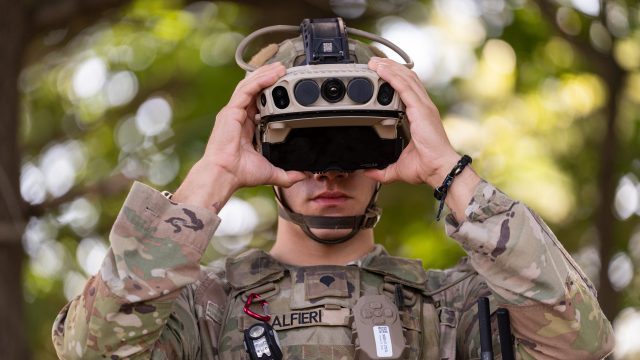
Microsoft’s contract with the U.S. Army to build a combat-ready AR headset is worth up to $22 billion, but only if the company can deliver the goods at “substantially less than” the projected $80,000 per unit, the Army tells Bloomberg. Requirements also include definitively positive field testing, set to take place early next year.
Based on HoloLens 2, Microsoft’s specially-built Integrated Visual Augmentation System (IVAS) has faced multiple challenges since being awarded the Army contract in 2019, including poor field testing results due to reliability and ruggedness issues. Despite recent improvements in the 1.2 version, such as better reliability and display clarity, and a flip-up design, the Army hasn’t scaled up orders yet.
While the contract stipulates the Army could order up to 121,000 of Microsoft’s IVAS, that’s pending further field testing—set to take place from April to June 2025. Price is also a “key factor,” Army acquisition chief Doug Bush says.
At the annual Association of the United States Army (AUSA) conference last week in Washington D.C., Bush said testing is “going much better than the first time around,” adding that “a lot of the problems have been fixed.” The Army still needs to “something that’s affordable” in order to cue up full production, however.
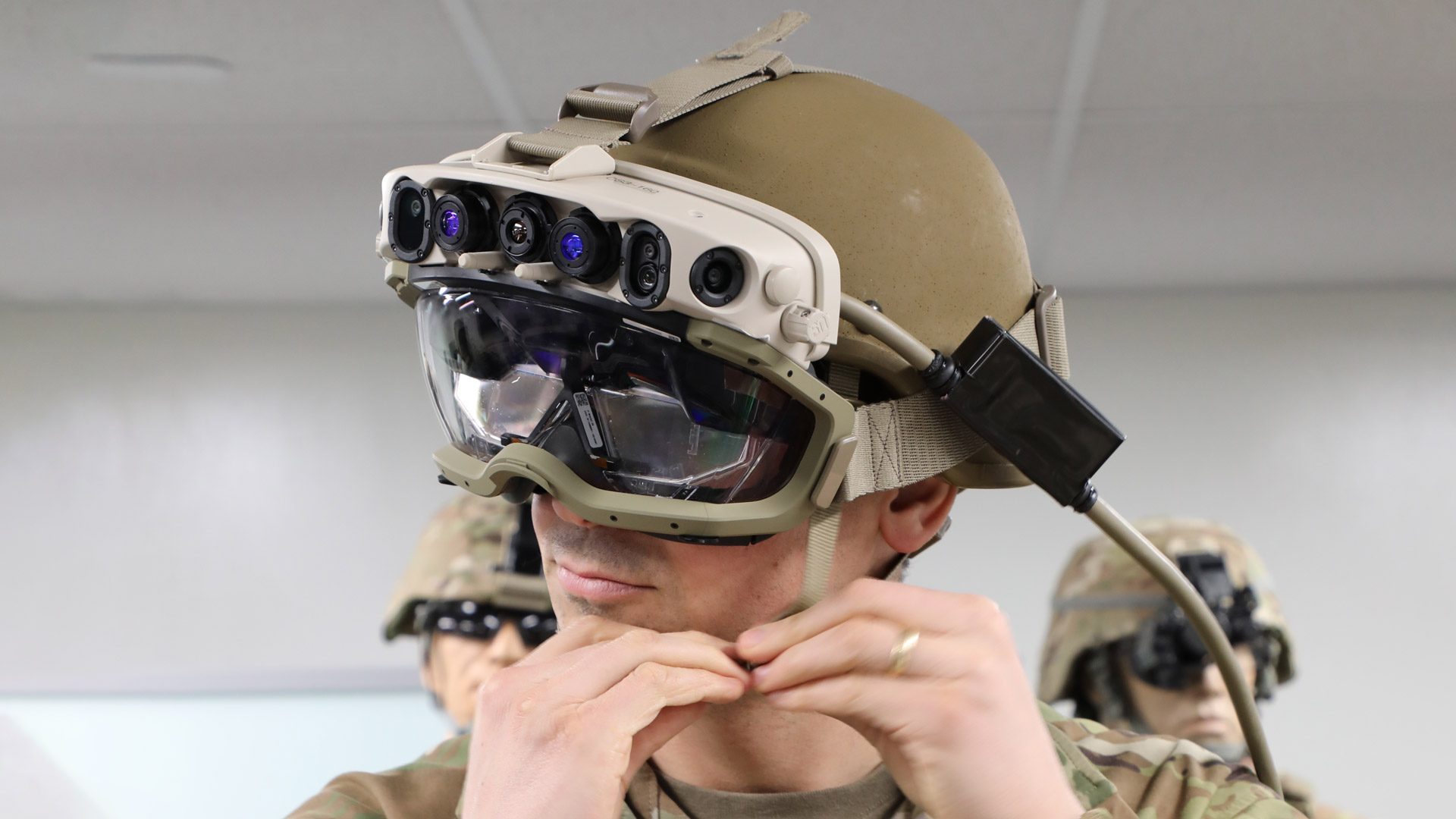
Unit cost is “a key factor next year when senior leaders make decisions about going into production,” Bush said. And the pricing goal should be “substantially less than $80,000,” an Army statement obtained by Bloomberg maintains.
Around half of the bill of costs can be chalked up to the system itself, which includes the AR headset—modified with sensors and thermal imaging—a battery, and chest unit for displaying information, such as the location of overhead drones. The remainder includes increased expenditures, such as Army program management to Microsoft engineering and software support, as per the Bloomberg report.
“We are going through the program to identify where we can reduce costs,” Microsoft’s Mixed Reality and HoloLens chief Robin Seiler told reporters last week. “It’s a fairly complex system, so when you look at cost reduction you have to look at it from a component level, from a labor level and from your supply chain.”
Despite best efforts, Microsoft’s contract may actually be at risk. The Army is reportedly preparing to hold ‘IVAS Next’ later this year, a new open competition that could see Microsoft replaced entirely as the prime contractor of IVAS.
Meanwhile, in an apparent bid to boost Microsoft’s chances at keeping the contract, Oculus founder Palmer Luckey’s defense startup Anduril has partnered with Microsoft to provide the combat-ready headset with its Lattice platform, which integrates real-time threat detection to improve battlefield awareness and survivability by sourcing data from drones, ground vehicles, and aerial defense systems.
The post U.S. Army Needs Microsoft AR Headset to Be “substantially less” Than Projected $80K Price Tag appeared first on Road to VR.
Stretchable transistors used in wearable devices enable in-sensor edge computing
Le marché de la beauté de luxe en Inde pourrait atteindre 4 milliards de dollars d'ici 2035
Lamborghini va créer une plateforme immersive de gaming
Rolls-Royce ouvre son programme annuel de recrutement
Il y a un enjeu, pour les Maisons de luxe, à avoir le courage d’aller un cran plus loin dans la créativité pour nourrir la désirabilité
La photo authentique revient à la mode avec AgfaPhoto

Le monde de la photographie traverse une véritable révolution nostalgique : les appareils photo compacts et argentiques sont de nouveau sur le devant de la scène. Alors que tout est devenu rapide et instantané avec les smartphones, de plus en plus de personnes recherchent le charme d’une photo plus authentique, où chaque cliché est pensé et attendu avec patience.
OpenAI releases ChatGPT app for Windows
On Thursday, OpenAI released an early Windows version of its first ChatGPT app for Windows, following a Mac version that launched in May. Currently, it's only available to subscribers of Plus, Team, Enterprise, and Edu versions of ChatGPT, and users can download it for free in the Microsoft Store for Windows.
OpenAI is positioning the release as a beta test. "This is an early version, and we plan to bring the full experience to all users later this year," OpenAI writes on the Microsoft Store entry for the app. (Interestingly, ChatGPT shows up as being rated "T for Teen" by the ESRB in the Windows store, despite not being a video game.)
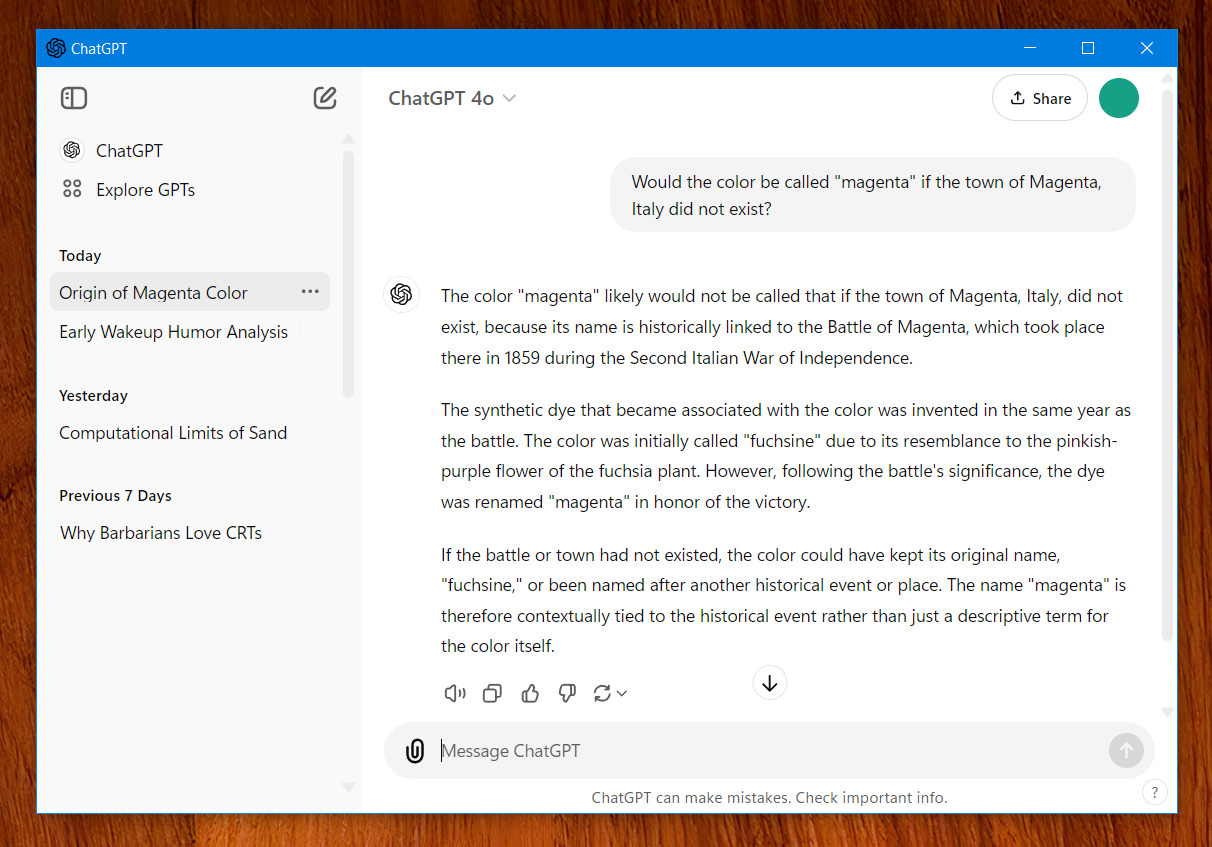
Upon opening the app, OpenAI requires users to log into a paying ChatGPT account, and from there, the app is basically identical to the web browser version of ChatGPT. You can currently use it to access several models: GPT-4o, GPT-4o with Canvas, 01-preview, 01-mini, GPT-4o mini, and GPT-4. Also, it can generate images using DALL-E 3 or analyze uploaded files and images.

This $600 Buzz Lightyear toy is the most realistic yet
Do you have $600 burning an asteroid-sized hole in your pocket? If so, the new Buzz Lightyear robot might be for you. A collaboration between Pixar and smart toy company Robosen, the new Buzz is fully loaded with more than 3,000 tiny parts, 75 microchips, and 23 servo motors. It also features what Robosen calls […]
© 2024 TechCrunch. All rights reserved. For personal use only.
Little RC Car Project Takes Inspiration From Mario Kart

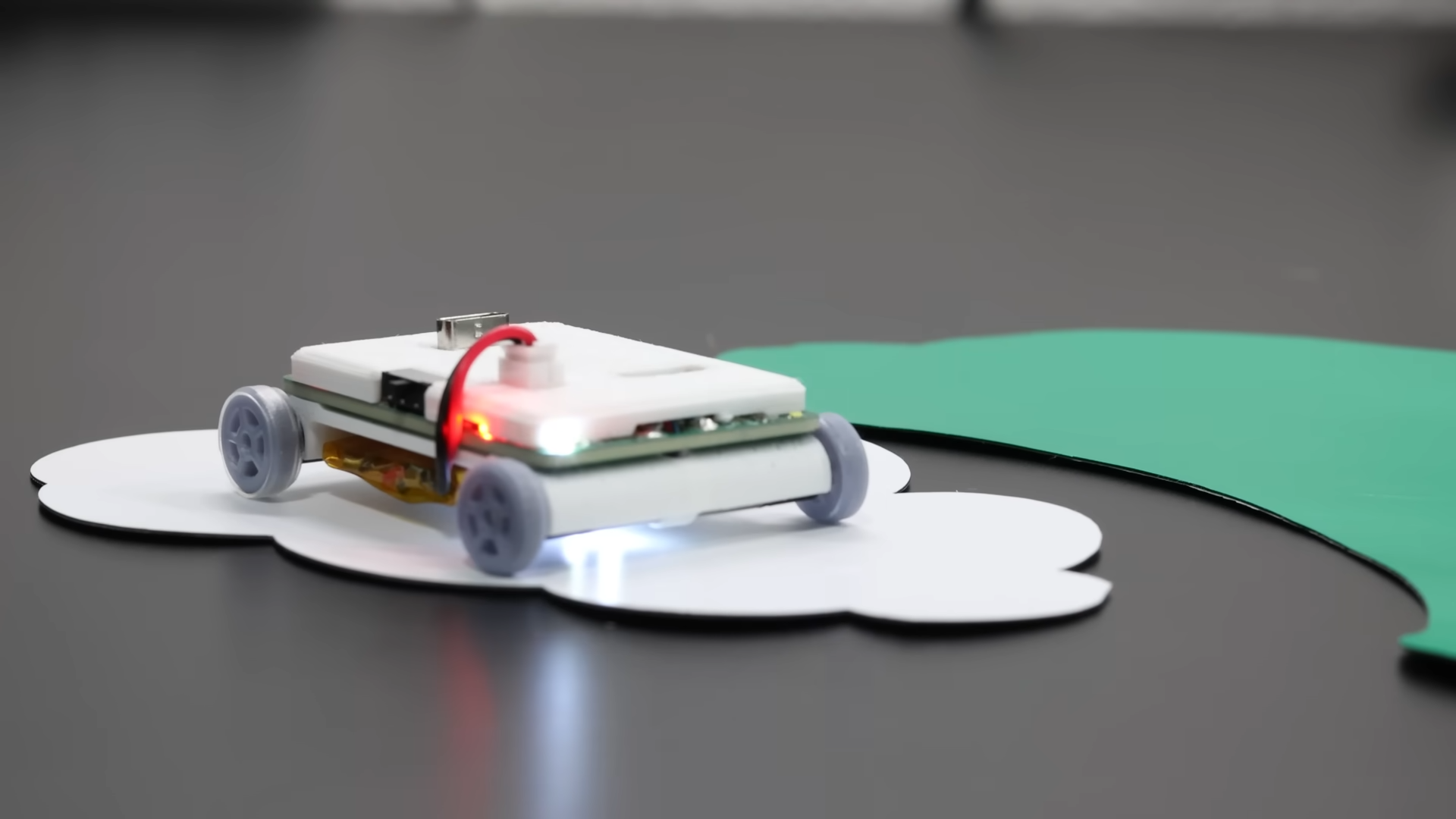
RC cars used to be pretty simple. They’d go forwards, backwards, and steer if you got a full-function toy. However, with modern technology, it’s pretty trivial to make them more advanced. [Stuck at Prototype] demonstrates that nicely with his little Micro Racer Cars.
Each little RC car has its own ESP32 running the show, hooked up with a motor controller running a small DC gear motor at each wheel. Power is from a lithium-polymer battery on board the car, which is charged via USB C. 3D-printed components form the chassis and body of the vehicle. [Stuck at Prototype] set the cars up so they could be controlled via a smartphone app, or via a custom RC controller of his own design. He liked the latter solution after he realized how hard apps were to maintain. He also gave the cars a little color sensor so they could detect color patches on the ground, so they could change their behavior in turn. This was to create gameplay like Mario Kart, where hitting a color patch might make the car go fast, go slow, or spin out.
The video goes into great detail about everything these tiny tabletop racers can do. The racer cars were initially intended to be a Kickstarter funded project, but it never quite reached its goal. Instead, [Stuck at Prototype] decided to release the designs online instead, putting the relevant files on Github.
We’ve seen some other neat RC projects before, too. Video after the break.
[Thanks to Hari Wiguna for the tip!]
LVMH’s Core Fashion Division Posts First Sales Drop Since COVID-19
It’s not just lonely at the top. It’s confusing, too.
LVMH chairman Bernard Arnault briefly claimed the title of richest man in the world in May, according to the Bloomberg Billionaires Index, but a month later fell behind Elon Musk. He has since tumbled all the way to fifth (pity the man who only has $182 billion).
He may take a tumble yet again after Wednesday — shares in LVMH, which the Arnault family owns nearly half of, fell 3.7% after the high-end fashion and leather goods firm announced sales at its core division fell for the first time since 2020, when the pandemic shut down businesses.
When Luxury Turns to Drudgery
LVMH’s share price, down 18% this year, had already been depressing the value of Arnault’s personal purse, and the reason for the drop is no secret.
Chinese consumers, who once exhibited a seemingly quenchless appetite for high-end goods, are mired in an economic funk. On top of that, the ruling Communist Party has cracked down on ostentatious displays of wealth — finance workers get rejected from dates and are mocked online as “rats” while celebrities have been told to tone down their looks, the BBC reported last week. In other words, keep your Louis Vuitton and Christian Dior at home.
“Consumer confidence in Mainland China today is back in line with the all-time low reached during COVID,” said Jean-Jacques Guiony, LVMH’s CFO, on an investor call. “We cannot expect discretionary consumption to expand in this context.” But, somewhat surprisingly, LVMH blamed its disappointing performance on another market:
- Asia sales outside Japan fell 16% year-over-year in the third quarter, but LVMH turned around and pointed the finger back at Japan, where it said its contraction “mainly arose.” But sales in Japan grew 20%, so what’s the problem? It wasn’t as much as the staggering 57% growth in the second quarter, which LVMH blamed on the stronger yen.
- Overall, LVMH revenues underperformed, dropping 3% year-over-year to €19.1 billion ($20.7 billion) against analysts’ estimate of 1% growth — and sales at the core fashion and leather goods division fell 5%. As LVMH is the world’s largest luxury firm and a sector bellwether, that was enough to trigger minor tremors: L’Oreal fell 2%, Hermès 1.3%, and Kering 0.8%.
Cereal Business: In 2020, Goldman Sachs dubbed a group of stocks — GSK, Roche, ASML, Nestlé, Novartis, Novo Nordisk, L’Oréal, LVMH, AstraZeneca, SAP, and Sanofi — GRANOLAS, Europe’s answer to the Magnificent Seven, noting their earnings growth, low volatility, and strong fundamentals. But the group’s gains are down to roughly 7% this year, MarketWatch noted. The Magnificent Seven are up 41%.
The post LVMH’s Core Fashion Division Posts First Sales Drop Since COVID-19 appeared first on The Daily Upside.
Meta Orion AR (Pt. 2 Orion vs Wave Optics/Snap and Magic Leap Waveguides)
Update (Oct. 19th, 2024)
While the general premise of this article is that Meta Orion is using similar waveguide technology to Snap (Wave Optics) and that Magic Leap 2 is correct, it turns out that a number of assumptions about the specifics of what the various companies actually used in their products were incorrect. One of my readers (who wishes to remain anonymous) with deep knowledge of waveguides responded to my request for more information on the various waveguides. This person had both a theoretical knowledge of waveguides and what Meta Orion, Wave Optics (now Snap), Magic Leap Two, and Hololen 2 used.
My main error about the nature of waveguide “grating” structures was a bias toward linear gratings, with which I was more familiar. I overlooked the possibility that Wave Optics was using a set of “pillar” gratings that act like a 2D set of linear gratings.
A summary of the corrections:
- Hololens 2 had a two-sided waveguide. The left and right expansion gratings are on opposite sides of the waveguide.
- Prior Wave Optics (Snap) waveguides use a pillar-type 2-D diffraction grating on one side. There is a single waveguide for full color. The new Snap Spectacles 5 is likely (not 100% sure) using linear diffraction gratings on both sides of a single waveguide full color, as shown in this article.
- Magic Leap Two uses linear diffraction gratings on both sides of the waveguide. It does use three waveguides.
The above corrections indicate that Meta Orion, Snap Spectacles 5 (Wave Optics), and Magic Leap all have overlapping linear gratings on both sides. Meta Orion and Snap likely use a single waveguide for full color, whereas the Magic Leap 2 has separate waveguides for the three primary colors.
I’m working on an article that will go into more detail and should appear soon, but I wanted to get this update out quickly.
Introduction and Background

After my last article, Meta Orion AR Glasses (Pt. 1 Waveguides), I got to thinking that the only other diffractive grating waveguide I have seen with a 2-D (X-Y) expansion and exit gratings, used in Meta’s Orion, was from Wave Optics (purchased by Snap in May 2021)
The unique look of Wave Optics waveguides is how I easily identified that Snap was using them before it was announced that Snap had bought Wave Optics in 2021 (see Exclusive: Snap Spectacles Appears to Be Using WaveOptics and [an LCOS] a DLP Display).
I then wondered what Magic Leap Two (ML2) did to achieve its 70-degree FOV and uncovered some more interesting information about Meta’s Orion. The more I researched ML2, the more similarities I found with Meta’s Orion. What started as a short observation that Meta Orion’s waveguide appears to share commonality with Snap (Wave Optics) waveguides ballooned up when I discovered/rediscovered the ML2 information.
Included in this article is some “background” information from prior articles to help compare and contrast what has been done before with what Meta’s Orion, Snap/Wave Optics, and Magie Leap Two are doing.
Diffractive Waveguide Background

I hadn’t looked at in any detail how Wave Optics diffraction gratings worked differently before. All other diffraction (I don’t know about holographic) grating waveguides I had seen before used three (or four) separate gratings on the same surface of the glass. There was an Entrance Grating, a first expansion and turning grating, and then a second expansion and exit grating. The location and whether the first expansion grating was horizontal or vertical varied with different waveguides.
Hololens 2 had a variation with left and right horizontal expansion and turning gratings and a single exit grating to increase the field of view. Still, all the gratings were on the same side of the waveguide.

Diffraction gratings bend light based on wavelength, similar to a prism. But unlike a prism, a grating will bend the light in a series of “orders.” With a diffractive waveguide, only the light from one of these orders is used, and the rest of the light is not only wasted but can cause problems, including “eye glow” and reduce the contrast of the overall system
Because diffraction is wavelength-based, it bends different colors/wavelengths in different amounts. This causes issues when sending more than one color through a single waveguide/diffraction grating. These problems are compounded as the size of the exit grating and FOV increases. Several diffraction waveguide companies have one (full color), or two (red+blue and blue+green) waveguides for smaller FOVs and then use three waveguides for wider FOVs.

For more information, Quick Background on Diffraction Waveguides, MicroLEDs and Waveguides: Millions of Nits-In to Thousands of Nits-Out with Waveguides, and Magic Leap, HoloLens, and Lumus Resolution “Shootout” (ML1 review part 3).
Meta Orion’s and Wave Optics Waveguides
I want to start with a quick summary of Orion’s waveguide, as the information and figures will be helpful in comparing it to that of Wave Optics (owned by Snap and in Snap’s Spectacles AR Glasses) and the ML2.
Summary of Orion’s waveguide from the last article
Orion’s waveguide appears to be using a waveguide substrate with one entrance grating per primary color and then two expansion and exit/output gratings. The two (crossed) output gratings are on opposite sides of the Silicon Carbide (SiC) substrate, whereas most diffractive waveguides use glass, and all the gratings are on one side.
Another interesting feature shown in the patents and discussed by Meta CTO Bosworth in some of his video interviews about Orion is “Disparity Correction,” which has an extra grating used by other optics and circuitry to detect if the waveguides are misaligned. This feature is not supported in Orion, but Bosworth says it will be included in future iterations that will move the input grating to the “eye side” of the waveguide. As shown in the figure below, and apparently in Orion, light enters the waveguide from the opposite side of the eyes. Since the projectors are on the eye side (in the temples), they require some extra optics, which, according to Bosworth, make the Orion frames thicker.

Wave Optics (Snap) Dual-Sided 2D Expanding Waveguide
Wave Optics US patent application 2018/0210205 is based on the first Wave Optics patent from the international application WO/2016/020643, first filed in 2014. FIG 3 (below) shows a 3-D representation of diffraction grating with an input grating (H0) and cross gratings (H1 and H2) on opposite sides of a single waveguide substrate.


The patent also shows that the cross gratings (H1 and H2) are on opposite sides of a single waveguide (FIG. 15B above) or one side of two waveguides (FIG. 15A above). I don’t know if Wave Optics (Snap) uses single- or double-sided waveguides in its current designs, but I would suspect it is double-sided.
While on the subject of Wave Optics waveguide design, I happen to have a picture of a Wave Optics 300mm glass wafer with 24 waveguides (right). I took the picture in the Schott booth at AR/VR/MR 2020. In the inset, I added Meta’s picture of the Orion 100mm SiC wafer, roughly to scale, with just four waveguides.
By the way, in my May 2021 article Exclusive: Snap Spectacles Appears to Be Using WaveOptics and [an LCOS] a DLP Display, I assumed that Spectacles would be using LCOS in 2021 since WaveOptics was in the process of moving to LCOS when they were acquired. I was a bit premature, as it took until 2024 for Spectacles to use LCOS.
In my hurry in putting together information and digging for connection, it was looking to me that WaveOptics would be using an LCOS microdisplay. As I pointed out, WaveOptics had been moving away from DLP to LCOS with their newer designs. Subsequent information suggests that WaveOptics was still using their much older DLP design. It is still likely that future versions will use LCOS, but the current version apparently does not.
Magic Leap
Magic Leap One (ML1) “Typical” Three Grating Waveguide

This blog’s first significant article about Magic Leap was in November 2016 (Magic Leap: “A Riddle Wrapped in an Enigma”). Since then, Magic Leap has been discussed in about 90 articles. Most other waveguide companies coaxially input all colors from a single projector. However, even though the ML1 had a single field sequential color LCOS device and projector, the LED illumination sources are spatially arranged so that the image from each color output is sent to a separate input grating. ML1 had six waveguides, three for each of the two focus planes, resulting in 6 LEDs (two sets of R, G, & B) and six entrance gratings (see: Magic Leap House of Cards – FSD, Waveguides, and Focus Planes).
Below is a diagram that iFixit developed jointly with this blog. It shows a side view of the ML1 optical path. The inset picture in the lower right shows the six entrance gratings of the six stacked waveguides.

Below left is a picture of the (stack of six) ML1 waveguides showing the six entrance gratings, the large expansion and turning gratings, and the exit gratings. Other than having spatially separate entrance gratings, the general design of the waveguides is the same as most other diffractive gratings, including the Hololens 1 shown in the introduction. The expansion gratings are mostly hidden in the ML1’s upper body (below right). The large expansion and turning grating can be seen as a major problem in fitting a “typical” diffractive waveguide into an eyeglass form factor, which is what drove Meta to find an alternative that goes beyond the ML1’s 50-degree FOV.


Figure 18 from US application 2018/0052276 diagrams the ML1’s construction. This diagram is very close to the ML1’s construction down to the shape of the waveguide and even the various diffraction grating shapes.

Magic Leap Two (ML2)
The ML1 failed so badly that very few were interested in the ML2 compared to the ML1. There is much less public information about the second-generation device, and I didn’t buy an ML2 for testing. I have covered many of the technical aspects of ML2, but I haven’t studied the waveguide before. With the ML2 having a 70-degree FOV compared to the ML1’s 50-degree FOV, I became curious about how they got it to fit.
To start with, the ML2 eliminated the ML1’s support for two focus planes. This cut the waveguides in half and meant that the exit grating of the waveguide didn’t need to change the focus of the virtual image (for more on this subject, see: Single Waveguide Set with Front and Back “Lens Assemblies”).
Looking through the Magic Leap patent applications, I turned up US 2018/0052276 to Magic Leap, which shows a 2-D combined exit grating. US 2018/0052276 is what is commonly referred to in the patent field as an “omnibus patent application,” which combines a massive number of concepts (the application has 272 pages) in a single application. The application starts with concepts in the ML1 (including the just prior FIG 18) and goes on to concepts in the ML2.

This application, loosely speaking, shows how to take the Wave Optics concept of two crossed diffraction gratings on different sides of a waveguide and integrate them onto the same side of the waveguide.
Magic Leap patent application 2020/0158942 describes in detail how the two crossed output gratings are made. It shows the “prior art” (Wave Optics and Meta Orion-like) method of two gratings on opposite sides of a waveguide in FIG. 1 (below). The application then shows how the two crossed gratings can be integrated into a single grating structure. The patent even includes scanning electron microscope photos of the structures Magic Leap had made (ex., FIG 5), which demonstrates that Magic Leap had gone far beyond the concept stage by the time of the application’s filing in Nov. 2018.
I then went back to pictures I took of Magic Leap’s 2022 AR/VR/MR conference presentation (see also Magic Leap 2 at SPIE AR/VR/MR 2022) on the ML2. I realized that the concept of a 2D OPE+EPE (crossed diffraction gratings) was hiding in plain sight as part of another figure, thus confirming that ML2 was using the concept. The main topic of this figure is “Online display calibration,” which appears to be the same concept as Orion’s “disparity correction” shown earlier.
The next issue is whether the ML2 used a single input grating for all colors and whether it used more than one waveguide. It turns out that these are both answered in another figure from Magic Leap’s 2022 AR/VR/MR presentation shown below. Magic Leap developed a very compact projector engine that illuminates and LCOS panel through the (clear) part of the waveguides. Like the ML1, the red, green, and blue illumination LEDs are spatially separated, which, in turn, causes the light out of the projector lens to be spatially separated. There are then three spatially separate input gratings on three waveguides, as shown.
Based on the ML2’s three waveguides, I assumed it was too difficult or impossible to support the “crossed” diffraction grating effect while supporting full color in a single wide FOV waveguide.
Summary: Orion, ML2, & Wave Optics Waveguide Concepts
Orion, ML2, and Wave Optics have some form of two-dimensional pupil expansion using overlapping diffraction gratings. By overlapping gratings, they reduce the size of the waveguide considerably over the more conventional approach, with three diffraction gratings spatially separate on a single surface.
To summarize:
- Meta Orion – “Crossed” diffraction gratings on both sides of a single SiC waveguide for full color.
- Snap/Wave Optics – “Crossed” diffraction gratings on both sides of a single glass waveguide for full color. Alternatively, “crossed” diffraction waveguides on two glass waveguides for full color (I just put a request into Snap to try and clarify).
- Magic Leap Two – A single diffraction grating that acts like a crossed diffraction grating on high index (~2.0) glass with three waveguides (one per primary color).
The above is based on the currently available public information. If you have additional information or analysis, please share it in the comments, or if you don’t want to share it publicly, you can send a private email to newsinfo@kgontech.com. To be clear, I don’t want stolen information or any violation of NDAs, but I am sure there are waveguide experts who know more about this subject.
What about Meta Orion’s Image Quality?
I have not had the opportunity to look through Meta’s Orion or Snap Spectacles 5 and have only seen ML2 in a canned demo. Unfortunately, I was not invited to demo Meta’s Orion, no less have access to one for evaluation (if you can help me gain (legal) access, contact me at newsinfo@kgontech.com).
I have tried the ML2 a few times. However, I have never had the opportunity to take pictures through the optics or use my test patterns. From my limited experience with the ML2, it is much better in terms of image quality than the ML1 (which was abysmal – see Magic Leap Review Part 1 – The Terrible View Through Diffraction Gratings), it still has significant issues with color uniformity like other wide (>40-degree) FOV diffractive waveguides. If someone has a ML2 that I can borrow for evaluation, please get in touch with me at newsinfo@kgontech.com.
I have been following Wave Optics (now Snap) for many years and have a 2020-era Titan DLP-based 40-degree FOV Wave Optics evaluation unit (through the optics picture below). Wave Optics Titan, I would consider a “middle of the pack” (I had seen better and worse) diffractive waveguide at that time. I have seen what seem to be better diffractive waveguides before and since, but it is hard to compare them objectively as they have different FOVs, and I was not able to use my content but rather curated demo content. Wave Optics seemed to be showing better waveguides at shows before being acquired by Snap 2021, but once again, that was with their demo content with short views at shows. I am working on getting a Spectacles 5 to do a more in-depth evaluation and see how it has improved.

Without the ability to test, compare, and contrast, I can only speculate about Meta Orion’s image quality based on my experience with diffractive waveguides. The higher index of refraction of SiC helps as there are fewer TIR bounces, which degrades image quality, but it is far from a volume production-ready technology. I’m concerned about image uniformity with a large FOV and even more so with a single set of diffraction gratings as diffraction is based on wavelength (color).
Lumus Reflective Waveguide Rumors
In Meta Orion AR Glasses: The first DEEP DIVE into the optical architecture, it stated:
There were rumors before that Meta would launch new glasses with a 2D reflective (array) waveguide optical solution and LCoS optical engine in 2024-2025. With the announcement of Orion, I personally think this possibility has not disappeared and still exists.
The “reflective waveguide” would most likely be a reference to Lumus’s reflective waveguides. I have seen a few “Lumus clone” reflective waveguides from Chinese companies, but their image quality is very poor compared to Lumus. In the comment section of my last article, Ding, on October 8, 2024, wrote:
There’s indeed rumor that Meta is planning an actual product in 2025 based on LCOS and Lumus waveguide.
Lumus has demonstrated impressive image quality in a glasses-like form factor (see my 2021 article: Exclusive: Lumus Maximus 2K x 2K Per Eye, >3000 Nits, 50° FOV with Through-the-Optics Pictures). Since the 2021 Maximus, they have been shrinking the form factor and improving support for prescription lens integration with their new “Z-lens” technology. Lumus claims its Z-Lens technology should be able to support greater than a 70-degree FoV in glass. Lumus also says because their waveguides support a larger input pupil, they should have a 5x to 10x efficiency advantage.


The market question about Lumus is whether they can make their waveguide cost-effectively in mass production. In the past, I have asked their manufacturing partner, Schott, who says they can make it, but I have yet to see a consumer product around the Z-Lens. It would be interesting to see if a company like Meta had put the kind of money they invested into complex Silicon Carbide waveguides into reflective waveguides.
While diffractive waveguides are not inexpensive, they are considered less expensive at present (except, of course, for Meta Orion’s SiC waveguides). Perhaps an attractive proposition to researchers and propriety companies is that diffraction waveguides can be customized more easily (at least on glass).
Not Addressing Who Invented What First
I want to be clear: this article does not in any way make assertions about who invented what first or whether anyone is infringing on anyone else’s invention. Making that determination would require a massive amount of work, lawyers, and the courts. The reason I cite patents and patent applications is that they are public records that are easily searched and often document technical details that are missing from published presentations and articles.
Conclusions
There seems to be a surprising amount of commonality between Meta’s Orion, the Snap/Wave Optics, and the Magic Leap Two waveguides. They all avoided the “conventional” three diffraction gratings on one side of a waveguide to support a wider FOV in an eyeglass form factor. Rediscovering that the ML2 supported “dispersion correction,” as Meta refers to it, was a bit of a bonus.
As I wrote last time, Meta’s Orion seems like a strange mix of technology to make a big deal about at Meta Connect. They combined a ridiculously expensive waveguide with a very low-resolution display. The two-sided diffraction grating Silicon Carbide waveguides seem to be more than a decade away from practical volume production. It’s not clear to me that even if they could be made cost-effective, they would have as good a view out and the image quality of reflective waveguides, particularly at wider FOVs.
Meta could have put together a headset with technology that was within three years of being ready for production. As it is, it seemed like more of a stunt in response to the Apple Vision Pro. In that regard, the stunt seems to have worked in the sense that some reviewers were reminded of seeing the real world directly with optical AR/MR beats, looking at it through camera and display.
Google’s NotebookLM now lets you guide AI-generated audio conversations, launches business pilot
Google's NotebookLM has updated Audio Overviews with the ability to focus on a specific topic in the given content and has introduced a NotebookLM Business pilot program for organizations.
© 2024 TechCrunch. All rights reserved. For personal use only.
Ozempic Could Be Used to Treat Alcohol and Drug Addiction, Study Finds

In a new statistical analysis, researchers have found evidence that drugs like Ozempic may help curb alcohol and opioid addiction.
Published in the journal Addiction, this new study saw researchers from Loyola University Chicago sift through more than 1.3 million health records to see how those who had been prescribed glucagon-like peptide-1 receptor agonists (GLP-1 RAs) fared when it came to substance abuse.
Among those records, the Loyola researchers settled on more than 8,000 people diagnosed with opioid use disorder (OUD) and more than 5,600 with alcohol use disorder (AUD) who'd been prescribed a GLP-1 like Novo Nordisk's Ozempic or Eli Lilly's Mounjaro.
Looking at nearly a decade of healthcare outcomes for those cohorts, the study found that the drugs can not only mimic the gut's feeling of fullness, but they can also curb cravings for things other than food, something that seems to have extraneous health benefits.
The medical experts behind the study saw 50 percent lower rates of intoxication among people diagnosed with AUD who had been prescribed a GLP-1, and 40 percent lower rates of overdose for people with OUD who used the injectable weight loss drugs.
Though the study's authors point out that there will need to be more direct research done to further establish the link between GLP-1s and better outcomes for people who struggle with addiction, they nevertheless think this could be a bellwether.
"The existing medications for treating substance use disorder are underutilized and stigmatized," pointed out biostatistician Fares Qeadan, the study's first author, in an interview with ABC. "These medications intended for diabetes and weight loss can help addiction without the associated stigma, which will be a new window for how to deal with addiction."
News of these promising findings come after a banner press year for GLP-1s, which have exploded in popularity as weight management tools. More and more studies have also investigated their so-called "off-label" uses teasing everything from smoking cessation to reduced risk of heart attack and stroke.
There will, of course, be a long road ahead to get FDA approval for Ozempic as a substance abuse treatment — but considering the latest findings, it's perhaps only a matter of time.
More on GLP-1s: Ozempic-Style Drug Slows the Progression of Alzheimer's Disease, Experiment Finds
The post Ozempic Could Be Used to Treat Alcohol and Drug Addiction, Study Finds appeared first on Futurism.
Computer vision for fast wildfire response
Spotted: In 2022, a report from the United Nations predicted that by 2100, the number of wildfires could rise by 50 per cent, and warned that governments were largely unprepared to meet the challenge. Already, wildfires are costing the US economy up to $893 billion a year in losses and damages.
Based in California, a state at particular risk from wildfires, Pano AI is using artificial intelligence and a network of mountaintop cameras to provide real-time wildfire detection. This rapid response time is key to preventing a flare from turning into an inferno.
Pano Stations are deployed on high vantage points and continuously scan the landscape using 360-degree, ultra-high-definition cameras and AI to spot, evaluate, and signal wildfire activity within a 10-mile radius.
The company’s technology uses computer vision and a method called object detection to distinguish wisps of smoke from clouds, fog, or dust. Human analysts review the data to eliminate any false positives, and the algorithm calculates latitude and longitude to give firefighters a pinpoint location for the fire outbreak.
Once smoke is confirmed and its position is calculated, first responders are immediately alerted so they can quickly contain the fire before it gets out of control. The combination of early detection and higher confidence in the location and size of fire also allows emergency responders to bring the exact equipment they need, saving money.
The company retains ownership of the cameras and infrastructure and sells licenses to its software to companies and organisations. According to Pano, the majority of its customers are power utilities, private landowners (such as ski resorts), and government fire agencies. To date, Pano has deployed its tech across nine US states, as well as set up stations in Canada and Australia.
Written By: Lisa Magloff
