Alexis Conneau thinks a lot about the movie “Her.” For the last several years, he’s obsessed over trying to turn the film’s fictional voice technology, Samantha, into a reality. Conneau even uses a picture of Joaquin Phoenix’s character in the movie as his banner on Twitter. With ChatGPT’s Advanced Voice Mode, a project Conneau started […]
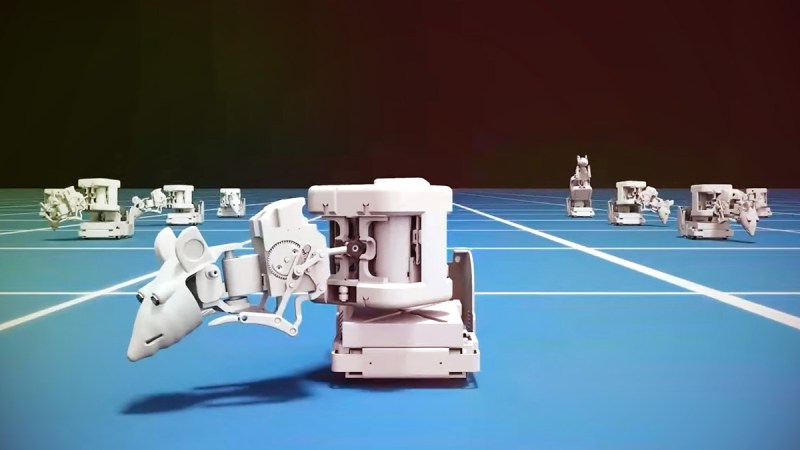
What sets SMEO apart is its rat-like adaptability. Equipped with a flexible spine, realistic forelimbs, and AI-driven behavior patterns, it doesn’t just mimic a rat — it learns and evolves through interaction. Researchers used video data to train SMEO to “think” like a rat, convincing its living counterparts to play, cower, or even engage in social nuzzling. This degree of mimicry could make SMEO a valuable tool for studying animal behavior ethically, minimizing stress on live animals by replacing some real-world interactions.
For builders and robotics enthusiasts, SMEO is a reminder that robotics can push boundaries while fostering a more compassionate future. Many have reservations about keeping intelligent creatures in confined cages or using them in experiments, so imagine applying this tech to non-invasive studies or even wildlife conservation. In a world where robotic dogs, bees, and even schools of fish have come to life, this animatronic rat sounds like an addition worth further exploring. SMEO’s development could, ironically, pave the way for reducing reliance on animal testing.
Meet the Furless Furby, your childhood friend stripped bare – literally. With 100% less fur and 1000% more nightmare fuel, it’s the perfect blend of nostalgia and chaos. Gift it, meme it, or just let its folds haunt your decor.
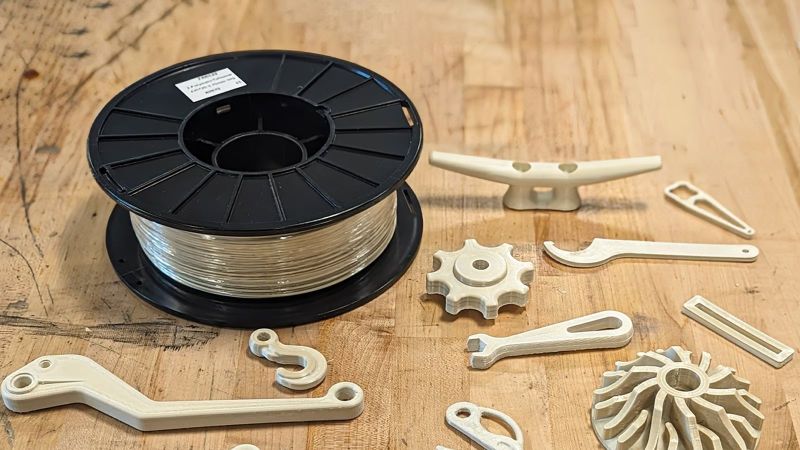
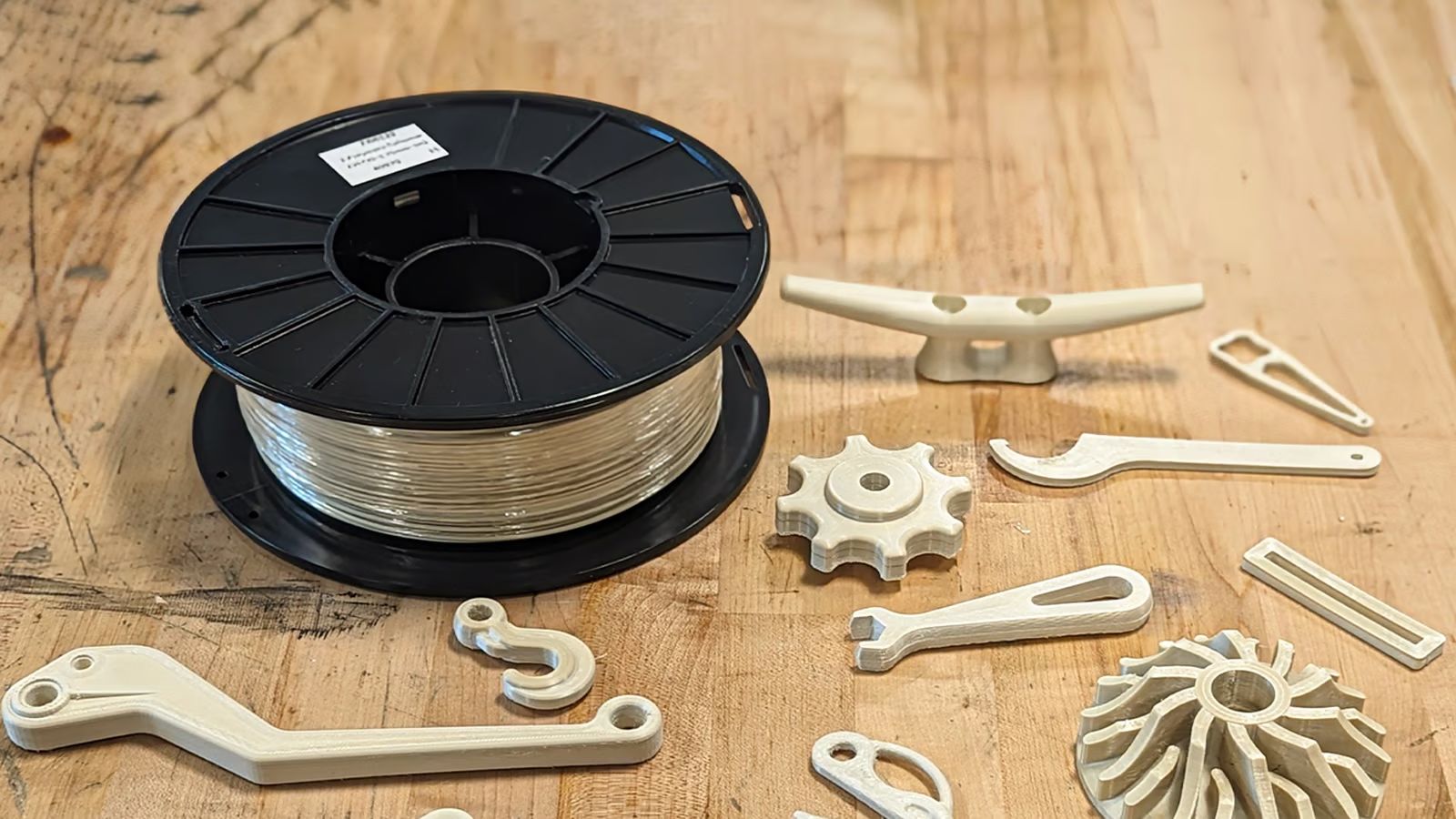
Recently a company called Z-Polymers introduced its new Tullomer FDM filament that comes with a lofty bullet list of purported properties that should give materials like steel, aluminium, and various polymers a run for their money. Even better is that it is compatible with far lower specification FDM printers than e.g. PEEK. Intrigued, the folks over at All3DP figured that they should get some hands-on information on this filament and what’s it like to print with in one of the officially sanctioned Bambu Lab printers: these being the X1C & X1CE with manufacturer-provided profiles.
The world of engineering-grade FDM filaments has existed for decades, with for example PEEK (polyether ether ketone) having been around since the early 1980s, but these require much higher temperatures for the extruder (360+℃) and chamber (~90℃) than Tullomer, which is much closer (300℃, 50℃) to a typical high-performance filament like ABS, while also omitting the typical post-process annealing of PEEK. This assumes that Tullomer can match those claimed specifications, of course.
One of the current users of Tullomer is Erdos Miller, an engineering firm with a focus on the gas and oil industry. They’re using it for printing parts (calibration tooling) that used to be printed in filaments like carbon fiber-reinforced nylon (CF-PA) or PEEK, but they’re now looking at using Tullomer for replacing CF-PA and machined PEEK parts elsewhere too.
It’s still early days for this new polymer, of course, and we don’t have a lot of information beyond the rather sparse datasheet, but if you already have a capable printer, a single 1 kg spool of Tullomer is a mere $500, which is often much less or about the same as PEEK spools, without the requirement for a rather beefy industrial-strength FDM printer.
A Russian spacecraft launched higher than most satellites has long had the Pentagon worried — and new revelations about what it contains have made those concerns all the greater.
Launched in February 2022 just a few weeks before Ukraine was invaded, Russia's Cosmos 2553 spacecraft is nominally built to test out "newly developed onboard instruments and systems." According to new reporting from the New York Times, however, the mysterious satellite system contains a "dummy warhead" — a precursor of what could come should the Russians decide to arm the craft for real.
As scary as the concept of a space nuke sounds, it wouldn't necessarily harm life on Earth — unless you consider eliminating all satellites in its vicinity harm, in which case the people down on the planet below would be seriously screwed.
ASAT Stats
Back in 1962, the US military actually did detonate a nuclear weapon in space, though the damage from the electromagnetic pulse it emanated seems mostly to have been limited to streetlights dimming in Hawaii, which was below the test.
Scientists learned from that formerly-classified test that doing so was probably a pretty bad idea, and in 1967, both Russia and the United States signed the Outer Space Treaty to prevent, essentially, space warfare. In the years since, however, concerns have grown that Russia may violate the treaty — especially as more and more communications satellites began littering our planet's orbit.
After Russia released Cosmos 2553 some 250 miles above the planet's surface, military experts became concerned that it might be a secret nuclear weapon. As the NYT's new reporting reveals, the US Space Force and a group of intelligence agencies have quietly been looking into the satellite to try to figure out its real purpose.
Throughout 2024, more and more information about the alleged anti-satellite weapon began to trickle out of Washington. In response, Russian President Vladimir Putin has repeatedlydenied that it's any such thing — though notably, it doesn't appear he's made any such denial since the NYT reported that Cosmos 2553 contains a dummy warhead.
Despite those refutations, Russia vetoed in April a United Nations resolution that would bar nuclear weapons in space. If the NYT's reporting holds up, we may know why.
EPFL’s RAVEN drone trades traditional landing gear for a pair of legs that function similar to a bird’s. | Image: Alain Herzog
Researchers from the École Polytechnique Fédérale de Lausanne (EPFL) in Switzerland and UC Irvine have developed a drone capable of landing and taking off in areas that would otherwise leave a fixed-wing aircraft stranded. Their Robotic Avian-inspired Vehicle for multiple ENvironments (RAVEN) trades traditional landing gear for a pair of bird-inspired articulated legs that allow the drone to walk around, hop over obstacles, and even leap into the air to take flight without the need for a runway.
Quadcopter drones may offer more flexibility when it comes to where they can take off and land, but most rely on four motors which are less energy-efficient than fixed-wing drones that use a single motor paired with gliding for flight. To expand the capabilities of fixed-wing drones, the researchers took inspiration from birds like crows and ravens which can easily maneuver on the ground using a scrawny pair of legs, as detailed in a paper published in Nature this week.
Image: Alain Herzog
RAVEN’s legs and feet use a simplified design but still offer enough articulation for the drone to maneuver on the ground.
Recreating the strength and capabilities of a bird’s legs mechanically without adding significant weight to a drone and reducing its operating range required a mix of “mathematical models, computer simulations, and experimental iterations.”
The final design for the legs uses a combination of springs and motors to mimic “powerful avian tendons and muscles” while its simplified feet use “two articulated structures” plus toes with a passive elastic joint. The toes not only prevent RAVEN from constantly face planting, they’re also critical for walking and positioning the drone at the right angle of attack for an effective takeoff.
Fixed-wing drones that take advantage of legs for short takeoffs and landings aren’t an entirely new idea. In 2019, a South African startup called Passerine demonstrated a drone called Sparrow that used a pair of spring-loaded legs to leap into the air and take flight from a standstill. What sets RAVEN apart is the complexity of its legs that allow the drone to walk across rough terrain, jump over gaps, and hop onto obstacles as high as 10 inches — in addition to being able to leap into flight.
RAVEN’s operations aren’t limited to airports or areas with smooth surfaces, which traditional wheeled landing gear requires. It also doesn’t require human intervention to get airborne again. It’s capable of landing and exploring areas that may be dangerous or restricted to humans, and then repositioning itself to an area that’s safe for takeoff. And it does it all using less power than a quadcopter drone would, giving it a larger operational range.
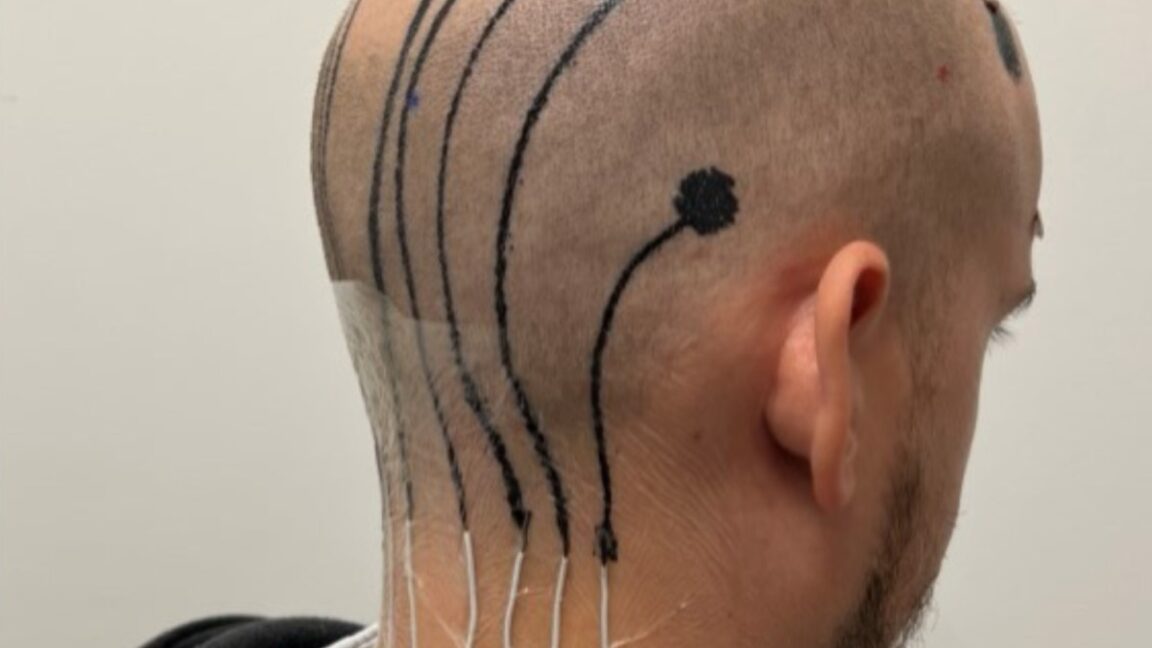
A 3D-printable EEG electrode e-tattoo. Credit: University of Texas at Austin.
Epidermal electronics attached to the skin via temporary tattoos (e-tattoos) have been around for more than a decade, but they have their limitations, most notably that they don't function well on curved and/or hairy surfaces. Scientists have now developed special conductive inks that can be printed right onto a person's scalp to measure brain waves, even if they have hair. According to a new paper published in the journal Cell Biomaterials, this could one day enable mobile EEG monitoring outside a clinical setting, among other potential applications.
EEGs are a well-established, non-invasive method for recording the electrical activity of the brain, a crucial diagnostic tool for monitoring such conditions as epilepsy, sleep disorders, and brain injuries. It's also an important tool in many aspects of neuroscience research, including the ongoing development of brain-computer interfaces (BCIs). But there are issues. Subjects must wear uncomfortable caps that aren't designed to handle the variation in people's' head shapes, so a clinician must painstakingly map out the electrode positions on a given patient's head—a time-consuming process. And the gel used to apply the electrodes dries out and loses conductivity within a couple of hours, limiting how long one can make recordings.
By contrast, e-tattoos connect to skin without adhesives, are practically unnoticeable, and are typically attached via temporary tattoo, allowing electrical measurements (and other measurements, such as temperature and strain) using ultra-thin polymers with embedded circuit elements. They can measure heartbeats on the chest (ECG), muscle contractions in the leg (EMG), stress levels, and alpha waves through the forehead (EEG), for example.
If OpenAI has its way, the next online course you take might have a chatbot component. Speaking at a fireside on Monday hosted by Coeus Collective, Siya Raj Purohit, a member of OpenAI’s go-to-market team for education, said that OpenAI might explore ways to let e-learning instructors create custom “GPTs” that tie into online curriculums. […]
CES is just a few weeks away (January 7-10, 2025). If you or your company want to schedule a meeting with me at CES 2025, please email meet@kgontech.com.
In addition to Brad’s YouTube channel, Brad and I have made several videos together, including our roundtable discussion of Meta Orion and Snap Spectacles (AR Roundtable Video Part 3, AR Roundtable Video Part 2, Snap Spectacles 5, and Meta Orion Roundtable Video Part 1).
Diffraction gratings have a line spacing based on the wavelengths of light they are meant to diffract. Supporting full color with such a wide FOV in a single waveguide would typically cause issues with image quality, including light fall-off in some colors and contrast losses. Unfortunately, there are no “through the optics” pictures or even subjective evaluations by an independent expert as to the image quality of Orion.
Fast Company has the first and only pictures I have seen with a view through Meta Orion’s waveguides. The pictures, taken by Meta and provided to Fast Company, are not of high quality (they look like they were taken hand-held by a smartphone), but they do show the poor color uniformity provided by Orion’s waveguides. Below are the pictures as published by Fast Company:
For the next set of pictures, I have adjusted the contrast to show the color variation better.
Quoting from the Fast Company Article (with my bold emphasis:
Instead, its lenses encase the thinnest film of silicon carbide. Twice as refractive as glass, light doesn’t just bounce off the silicon, but actually flows through micro etched channels in the material to ultimately be viewable only to the wearer. It also means that wearing Orion gives the outside world the faintest iridescent glow.
This writing seems to suggest that there is also some amount of colorization of real-world view as well.
Meta embracing color issues – Hiding it in plain sight
The article cites Meta as trying to design the user interface to hide the color issues in plain site by designing icons with similar colors as caused by the waveguides variation.
Aerogel
This glow isn’t enough to transform someone’s face (IRL or on a call) into a confetti cake, but it is an aesthetic that the UX team leaned into across the entire interface. Or as Pujals puts it, “We embraced the boundaries.” The app icons themselves use jewel-like color gradients.And its “Aero” UI was inspired by aerogel—the world’s lightest, semi-opaque material—with panels that shimmer with color. Think of Orion as the Miller Extra Light of hyper reality.
There are also the remarks (below) that Meta is experimenting with fonts to reduce readability issues cause by the waveguide.
In AR, subtle is trickier than overt. While Orion’s rainbow world is something of a punchdrunk buzz, a year ago, it was more like drunk goggles. Much of Pujals’s UX work has been technical in nature. Simply to make the screen legible, she’s worked alongside hardware and software engineers to render pixels properly in silicon carbide, smoothing out rough edges, eliminating strange aberrations. (The company is also working on a new version of its sans serif typeface, Optimistic, with fewer curves and deeper ink pools to be more legible in the product.)
The article also discusses the design and human factors trade-offs between resolution and FOV.
One of the biggest decisions Meta needs to make before shipping the product is around a technical tradeoff of its own screen: Will they prioritize field of view or resolution?
Meta already has a version of Orion running with twice the resolution of the demo I tested. But much like a projector works in your home, the bigger the image, the fuzzier it gets. And Meta is still mulling just how to tune their technology to consumers, to balance image expansion with clarity. (Technically, they call this measurement “pixels per degree.”)
Comparison to Jade Bird Displays Compensation Demo with Diffractive Waveguides
The color variation with Orion appears to be worse, but the brightness variation appears to be less than in my recent study of the Jade Bird Display’s (JBD) compensation demo. The JBD demo only had a 30-degree FOV versus Orion’s reported 70-degree. With diffractive waveguides, it becomes harder to support uniformity with a wider FOV.
Below are high-resolution pictures I took through JBD’s diffractive waveguide correction demo, which was used in Jade Bird Display’s MicroLED Compensation. I took these pictures against a black background to give high contrast.
Conclusion and Memories of Hololens 2
The pictures of the view through Orion’s waveguides are about what I would have expected with a 70-degree FOV single (for all colors) diffractive waveguide; in other words, they’re not very good. This also explains why I was skeptical of the reports from people given access to Orion when they didn’t mention the image quality (and a problem I have had with reports on other AR/MR products, including the Apple Vision Pro). Often, the people given access, either due to a lack of understanding or the desire to keep access to the big companies, don’t report on image quality issues.
The images through the Meta Orion optics make one wonder what Meta was trying to prove with the Silicon Carbide waveguides. In the end, it proved that with a lot of money, they could produce a low-quality image. There seems to be a lot of “non-invented-here” and a desire to do interesting research. I’m all for big companies doing interesting research, but when it comes to making something for demonstration, I think they would be better off using the best available technology.
It reminds me of Microsoft’s Hololens 2 program, which spends huge amounts of money to produce a terrible image with a laser-scanning display (see my series on Hololens 2 image quality problems) with their “butterfly” diffractive waveguide. Below is a comparison of the Hololens 2 with laser scanning and diffractive waveguides to Lumus’s Maximus with reflective waveguides using LCOS microdisplays (from Exclusive: Lumus Maximus 2K x 2K Per Eye, >3000 Nits, 50° FOV with Through-the-Optics Pictures). The image on the right likely cost hundreds of millions more to develop.
The League of Legends universe is expanding once again — this time with a physical card game. Riot Games announced today that it’s developing a physical trading card game set in the League universe. The game is currently known as “Project K,” and Riot says it’s working with an unnamed partner in China to release the game there in early 2025. As for a global release, Riot says, “We are taking our time to find the right publishing partners.”
There aren’t a lot of details available about Project K. According to Riot, the game “has unique gameplay and is best when played with friends and in person,” and development is being led by director Dave Guskin and producer Chengran Chai. You can get a sense of the game in the images below:
Of course, this is far from the first spinoff from League. So far, that has included mobile games like Teamfight Tactics and Wild Rift, the Netflix series Arcane, and the competitive fighting game 2XKO, which is expected to launch next year. Not all of these bets have paid off. In January, Riot announced that it was cutting more than 500 jobs, which included shutting down Riot Forge Games, a publishing label for indie games set inside of League. Also impacted was Legends of Runeterra, a mobile card game that launched in 2020, which Riot said “hasn’t performed as well as we need it to.”
Spotted: Companies across virtually every industry will, at some point, need to make sense of complex location-based data. However, traditional Geographic Information System (GIS) software – which integrates relevant information onto digital maps to help users visualise the data – can be expensive and inaccessible, compromising an organisation’s ability to act on information and make decisions effectively. Now, Atlas.co wants to change that.
The Norwegian startup, which was founded back in 2021 by a group of then-university students, wants to make geospatial analysis simple and accessible with its browser-based platform. Technical GIS tools may be powerful, but they tend to be too cumbersome and complicated for non-experts to install and use. Atlas.co, on the other hand, is user-friendly and requires no specialised hardware or software installation.
The cleanly designed interface features a builder tool where users can easily drag and build spatial maps and interactive dashboards. Users can then upload and layer on the data they want to visualise and style it accordingly. As Co-founder Vegard Løwe explained to Springwise: “We wanted to build a solution that anyone could use to unlock the potential of geospatial data, enabling impactful outcomes like improved infrastructure planning and sustainability efforts.”
And as well as being easier to use, Atlas.co was also built with collaboration in mind: multiple users can create, share, and update maps together in real time. This kind of approach could transform the way teams and individuals tackle various challenges, including resource optimisation, disaster response, and sustainable planning. It’s also applicable across industries, whether that’s helping retailers better understand their customers in a specific location, speeding up the development of renewable energy projects, or helping to predict potential habitats for endangered species.
The company recently completed a $2 million pre-seed funding round, and Løwe shared that Atlas.co next plans to expand integrations with popular tools and refine its AI-driven features to make mapping even smarter and faster.
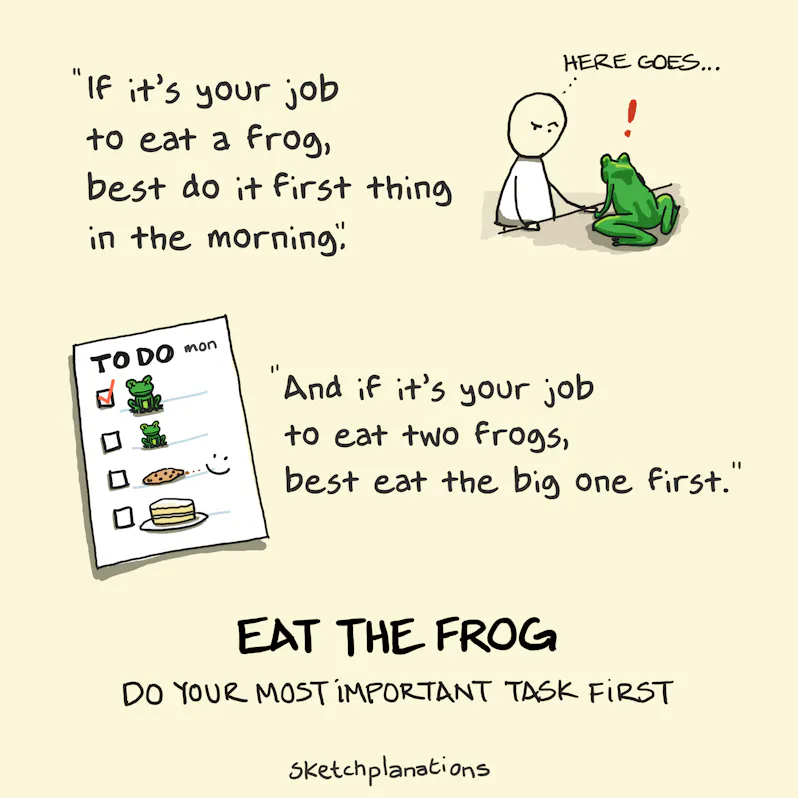
Eat the Frog is a memorable, if rather gross, metaphor that means choosing the most important thing you must do today and doing that first.
It derives from a variant of a quote that Mark Twain never said, "If it's your job to eat a frog, it's best to do it first thing in the morning. And if it's your job to eat two frogs, it's best to eat the biggest one first." — Not Mark Twain
Another way to think about it is that if you first Eat the Frog, everything else will be easier for the rest of the day. And won't that feel nice?
Many tools in Tracy's book are based on the general premise that there will always be more to do than you can do. So, find the things that will have the most impact and do those first. The others will drift on by.
Why is Eat the Frog helpful?
I once saw someone ask for advice on getting motivated to clean the house. One person answered: "Write a book."
Sometimes, our most significant and impactful goals are those on which we so readily procrastinate. Often, these will be in the important, not urgent, bucket.
The Eat the Frog approach helps if:
You are prone to procrastination 🙋
You have a lot of things that need to be done or that you want to do
You work well in the morning
One of the nice things about eating the frog first thing is that getting it done feels really good. It helps build momentum for the rest of the day with a nice endorphin rush of ticking off something significant.
Decide on your Most Important Task (MIT) to tackle, ideally the night before. If it's too big and you can't finish it in one sitting, divide it into manageable chunks. Then start on the first chunk and leave everything else.
And sometimes, the hardest thing to do is to start. So consider doing just 5 minutes. Once you've started, very often, keeping going becomes easy.
Challenges when Eating the Frog
Questions that come up regularly in Tracy's book "Eat That Frog", including for the Eating the Frog principle, are variations of:
What is the most important thing you could be doing?
What is the highest-value activity?
What activity will have the most impact?
If you weren't already doing this, would you start doing this?
What skills will take you furthest in your career?
What are you able to do best that others can't?
It all looks pretty straightforward when I read questions like these. But I have found that answering them is usually much harder.
Our goals are often interrelated. For example, earning more may require you to increase your skills first. And getting clear on what your most important goals are first is a prerequisite and also not always straightforward.
Then, what activities are the most important or will have the most impact can be unclear. And, sometimes, small actions such as an unexpected event or connection may have out-sized benefits. Or neglecting a seemingly minor task could lead to losing a significant client. But does it still make sense to try to work on the most important task first thing in the morning? Yes.
Don't Drag it Out
Like a child leaving a brussel sprout at the side of the plate to get cold while they eat the roast, it's easy to leave our most impactful and daunting tasks until after the easier stuff is done. But it doesn't usually help to wait.
As the saying goes, if you have to eat a live frog, it doesn't pay to look at it for long.
Related Ideas
Face it, you'll never get caught up, so perhaps think about Oliver Burkeman's Rivers not Buckets
OpenAI’s “12 days of shipmas” event doesn’t kick off for a while, but the first big announcement might’ve been revealed early. A “feature gated” web page on OpenAI’s website refers to a “ChatGPT Pro” plan that includes all the benefits of ChatGPT Plus, as well as new goodies. Recall that ChatGPT Plus is an upgraded […]
During a recent flight from Los Angeles to New York City, I put a headset on my face to watch a movie.
I wasn’t wearing the Vision Pro or a Meta Quest. I was trying the latest pair of AR glasses from Xreal, a Chinese startup taking an unusually focused approach to face computers.
To call the Xreal One, which is available for preorder starting on Wednesday for $499, a pair of AR glasses feels like a stretch. While they do technically overlay graphics onto your field of vision, they really just function as a display mirror for your phone, laptop, or gaming console. But given the display advancements in the One over Xreal’s last Air 2 glasses, that may be enough.
The Xreal One uses a custom birdbath lens system to achieve what the company says is equivalent to a 1080p display with a 50-degree field of view. Practically, based on my experience watching Netflix’s Rebel Ridge from my plane seat (a very good movie), that translates to a fairly immersive viewing experience.
It’s not like watching something in the Vision Pro. But the fact that I was wearing an 84-gram pair of glasses that didn’t fully occlude my vision more than made up for the difference. The only time I felt the...
The year was filled with impressive technological leaps and useful new tools, endless hype and frequent misfires, and implications for the future that range from truly exciting to unpredictable. This is the year we got a sense of what AI might actually do — and just how unprepared we still are to grapple with it.
Here at The Verge, we thought a lot about AI’s impacts on the industries and people we cover. From strikes across industries like gaming to its impact on our climate to the desire for policy protections for Hollywood and the AI Act, AI is already reshaping nearly every area of our lives.
So let’s take a look back at some of the biggest, boldest, weirdest AI stories from the last year — and look ahead to what could be in store for 2025.
World energy demand is continuing to soar as cities grow, technology advances and industries develop. Buildings make up about 30%-40% of the total—even more than industry or transport. This comes largely from heating, cooling and ventilation systems, with air conditioning especially energy-hungry.
Alibaba International Digital Commerce Group has announced the US launch of Pic Copilot, an artificial intelligence driven e-commerce design tool tailored for small and medium-sized enterprises (SMEs).
This features 12 tools aimed at making tasks such as swapping image backgrounds, perfecting images and videos, conducting virtual try-ons, and generating ads a hassle free experience.
Leveraging real-life e-commerce data from Alibaba International, Pic Copilot aims to improve product imagery and videos. The application of its first two versions revealed that SMEs and key opinion leaders prioritise graphics that drive sales rather than merely focusing on aesthetics.
The latest iteration of the model is built on 250 million parameters and utilises a data annotation method centred around sales metrics. By analysing how various background elements in images influence click-through rates across 240 product categories, the AI model has been trained not only on visual appeal but also to enhance sales performance.
The US launch introduces features such as virtual try-on tailored for multiple skin tones and body types, featuring more than 160 models across four major skin tones.
The platform allows users to upload personal images, enabling fashion entrepreneurs and KOLs to serve as models in their own product try-on photos. This feature eliminates the need of hiring professional models or conducting photoshoots.
Additionally, Pic Copilot has introduced US specific graphic theme templates tailored to national holidays and celebrations such as Independence Day, Thanksgiving, and St. Patrick’s Day.
During the Black Friday trial period, over 35,000 users worldwide leveraged Pic Copilot to create marketing materials. Black Friday related content generated by entrepreneurs and KOLs using Pic Copilot was subsequently utilised more than 200,000 times, providing average savings of over $200 per user.
Meanwhile, the virtual try-on feature assisted over 10,000 merchants in generating more than 80,000 model images, saving each merchant thousands in shooting expenses.
Pic Copilot now offers 50 free credits to newly registered US SMEs, supporting them to refresh marketing materials for up to 15 products without any cost.
Our 2024 hall of fame entrants were revealed during an event which took place at RIBA’s 66 Portland Place HQ in Central London on 21st November, and consisted of a drinks reception, three course meal, and awards ceremony presided over by comedian Lucy Porter.
In his welcome speech, Scott Thompson, Founder and Editor, RTIH, said: “The event is now into its sixth year and what a journey it has been. The awards started life as an online only affair during the Covid outbreak, before launching as a small scale in real life event and growing year on year to the point where we’re now selling out this fine, historic venue.”
He added: “Congratulations to all of our finalists. Many submissions did not make it through to the final stage, and getting to this point is no mean feat. Checkout-free stores, automated supply chains, immersive experiences, on-demand delivery, next generation loyalty offerings, inclusive retail, green technology. We’ve got all the cool stuff covered this evening.”
“But just importantly we’ve got lots of great examples of companies taking innovative tech and making it usable in everyday operations - resulting in more efficiency and profitability in all areas.”
Congratulations to our 2024 winners, and a big thank you to our sponsors, judging panel, the legend that is Lucy Porter, and all those who attended last month’s gathering.
Bitcoin broke $100,000 for the first time Thursday as traders cheered Donald Trump's decision to pick a crypto fan to head the US securities regulator, reinforcing optimism the new president will push through measures to deregulate the sector.
Le 19 novembre dernier, un établissement de santé français affilié au groupe Aléo Santé a été victime d’une cyberattaque massive. Le hacker a mis en vente les informations personnelles de près de 750 000 patients. D’après Damien Bancal, spécialiste en cybersécurité, les données volées incluent des informations sensibles telles que noms, adresses, dates de […]
Alors que le retail media digital est au coeur de nombre de stratégies des e-commerçants, les distributeurs physiques peinent à suivre le mouvement. Pourtant, le magasin offre une quantité importante de points de contacts avec les clients.
Scientists and engineers from the University of Bristol and the UK Atomic Energy Authority (UKAEA) have successfully created the world's first carbon-14 diamond battery.
There’s a new connected fitness device in town and it’s called Growl. Inspired by hardware companies like Peloton and Tonal, Growl is building a boxing bag that you can attach to your wall at home. Users can then start immersive, gamified boxing classes from the comfort of their home. It also looks like the team […]
As far as tech goes, 2024 was a strong year for some innovative, interesting, and unforgettable moments.
We kicked off the year with the Apple Vision Pro — Apple’s long-awaited entry into the world of “spatial computing.” It was impressive, with The Verge’s editor-in-chief, Nilay Patel, describing the device as “magic, until it’s not.” But it still remains to be seen if Apple’s first MR device can kick off this new age of computing.
Meta also showed us what it developed after investing billions into its metaverse division. Deputy editor Alex Heath got a demo of Project Orion — a pair of AR glasses that won’t make you look like a super dork (okay, maybe a little). More importantly, though, we got a sense of where AR is heading, which arguably puts Meta in pole position in this space.
This was also the year of wearable AI assistants. At CES 2024, we were introduced to the cute Rabbit R1 that stole our hearts. And we got to see Humane’s highly anticipated AI Pin. Even though the devices were big disappointments when they finally released, they do represent a turning point in the future of AI interactions.
We can never go a year without the biggest smartphone upgrades. Samsung,...
Happy holidays from OpenAI. The AI startup plans to kick off a “shipmas” period of new features, products, and demos for 12 days, starting on December 5th. The announcements will include OpenAI’s long-awaited text-to-video AI tool Sora and a new reasoning model, sources familiar with OpenAI’s plans tell The Verge.
OpenAI CEO Sam Altman confirmed the 12 days of announcements onstage at The New York Times’ DealBook conference on Wednesday morning, though he didn’t say exactly what was coming. OpenAI plans to launch or demo something every day for 12 days straight.
12 days. 12 livestreams. A bunch of new things, big and small.
Just ahead of the launch, a few OpenAI employees began teasing the coming releases on social media: “What’s on your Christmas list?” a member of the technical staff posted. “Got back just in time to put up the shipmas tree,” another staffer wrote. Sora lead Bill Peebles responded to a staffer who posted that OpenAI is “unbelievably back” with one word: “Correct.” The startup’s senior vice president also responded with IYKYK (if you know, you know).
Software engineer Vishnu Mohandas decided he would quit Google in more ways than one when he learned that the tech giant had briefly helped the US military develop AI to study drone footage. In 2020 he left his job working on Google Assistant and also stopped backing up all of his images to Google Photos. He feared that his content could be used to train AI systems, even if they weren’t specifically ones tied to the Pentagon project. “I don't control any of the future outcomes that this will enable,” Mohandas thought. “So now, shouldn't I be more responsible?”
Mohandas, who taught himself programming and is based in Bengaluru, India, decided he wanted to develop an alternative service for storing and sharing photos that is open source and end-to-end encrypted. Something “more private, wholesome, and trustworthy,” he says. The paid service he designed, Ente, is profitable and says it has more than 100,000 users, many of whom are already part of the privacy-obsessed crowd. But Mohandas struggled to articulate to wider audiences why they should reconsider relying on Google Photos, despite all the conveniences it offers.
Then one weekend in May, an intern at Ente came up with an idea: Give people a sense of what some of Google’s AI models can learn from studying images. Last month, Ente launched https://Theyseeyourphotos.com, a website and marketing stunt designed to turn Google’s technology against itself. People can upload any photo to the website, which is then sent to a Google Cloud computer vision program that writes a startlingly thorough three-paragraph description of it. (Ente prompts the AI model to document small details in the uploaded images.)
VTT Technical Research Center of Finland, in collaboration with Aalto University and Finnish industrial partners, has developed a new technology for shaping cardboard in a unique continuous process to create reel-to-reel, origami-inspired structures for fiber-based packaging materials.
Researchers from Tokyo Metropolitan University have used measurements of skin conductance over time to tell emotions apart. Volunteers were shown videos depicting fearful scenes, family bonding, and humor, while their skin conductance trace was recorded.
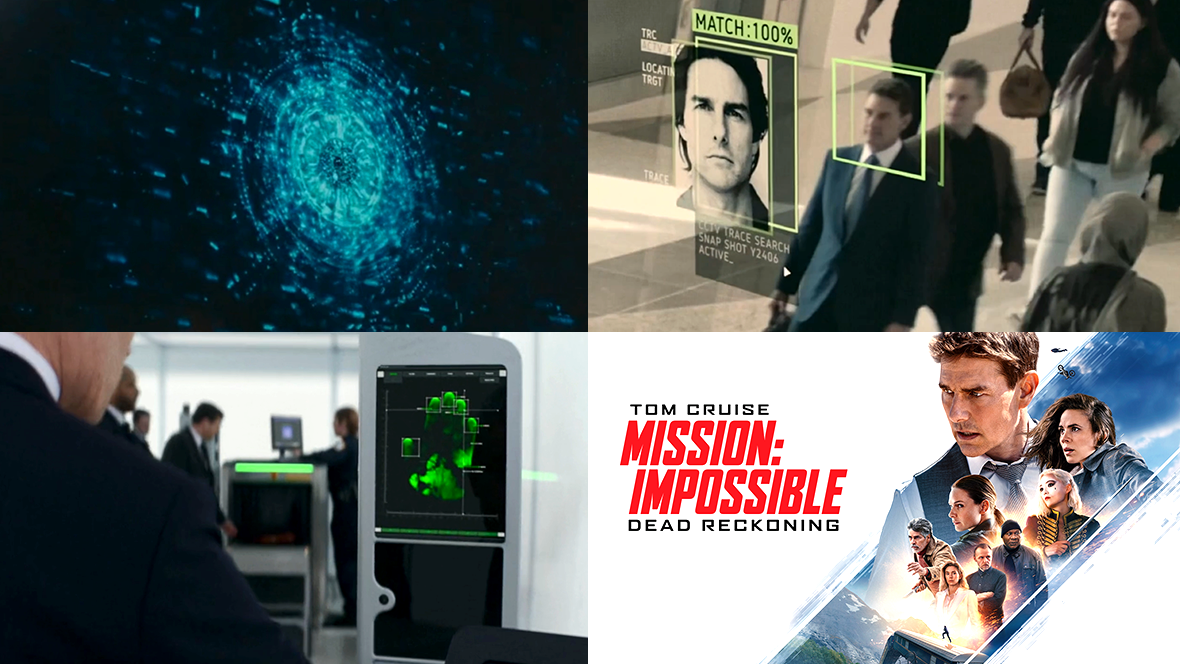
Mission: Impossible – Dead Reckoning revolves around artificial intelligence, which seems to be a common theme lately (see Heart of Stone). The film does a great job of exploring the powerful implications of a weaponised AI. So as you’d expect there’s plenty of nice examples of FUI in this latest instalment but this time with a deeper focus on AI.
Artificial Intelligence
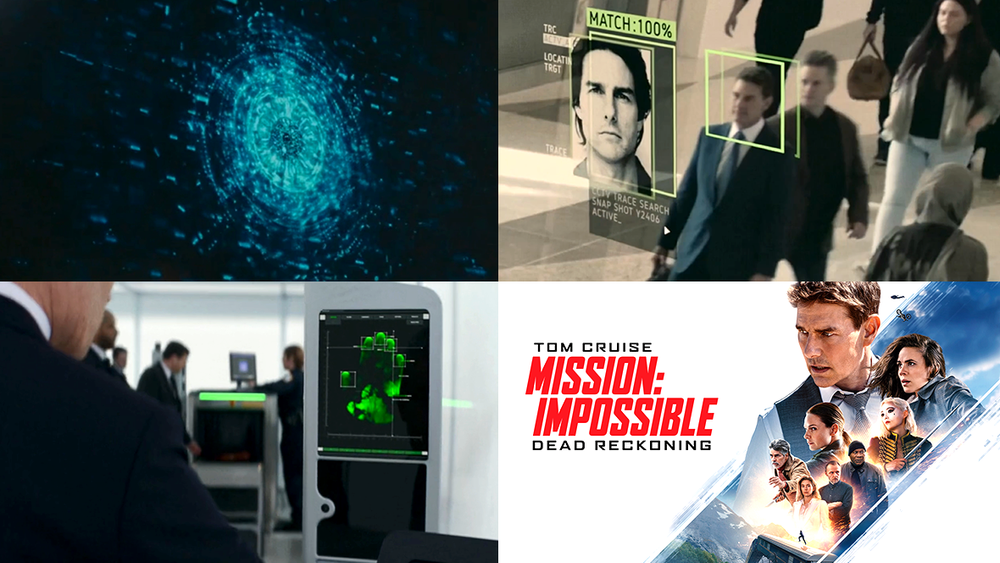
An AI model can be visualised in so many different ways and in Mission: Impossible – Dead Reckoning it’s presented as a constantly shifting data cloud with an undulating core. This interpretation is quite simple but really effective. The erratic, ever-changing outer edges convey relentless activity, while the steady, glowing core exudes a sense of ominous power and control. It’s a thought-provoking representation that perfectly complements the AI’s mysterious and formidable nature.
Tracking
This sequence is really fun as it shows two opposing sides tracking Hunt at the airport, each using distinctly different interfaces. The government’s interface is clean and orderly, while the Mission Impossible team’s system feels intentionally raw and hacker-like.
The MI team’s interface has a no-frills, engineering-led aesthetic - everything is neatly arranged and functional. Yet, it’s peppered with those slight visual touches that add a bit of flair without sacrificing utility.
The tracking of Hunt’s photo in the security footage is also worth noting, in particular the extra layer of rectangles that sits behind his figure. This tiny detail gives depth to the tracking and really completes the design.
What’s most interesting about this sequence though, is the concept behind it. The idea that AI could manipulate security footage in real-time is quite unsettling,
Hacked interface
Here’s a nice little example of an interface glitching and being hacked.
ID Scan
A simple visualisation of a fingerprint and facial scan that allows the story and camera to flow nicely.




/cdn.vox-cdn.com/uploads/chorus_asset/file/25776421/EPFL_raven_drone2.jpg) Image: Alain Herzog
Image: Alain Herzog