Jean-Philippe Encausse
Shared posts
Henry Cavill shares exciting update about Warhammer 40,000 TV show at Amazon

The dream comes true: I’m going to CES 2025!
One of my dreams has always been the one of going to the CES, which is one of the biggest tech exhibitions in the world. Well, in a month this dream is coming true because I’m going to attend the CES for real!
Since when I got passionate about technology, I’ve heard about the CES, this huge event where a lot of innovative gadgets are showcased and a lot of new products are launched. When I started working in VR, I became even more interested in this event, and I started covering it on my blog in 2017. Since I couldn’t go there in the beginning because I did not have enough money, I started covering it by reading all the news I could find online about it. These last years, even if I could afford the trip, I had other problems that prevented me from going, either personal, or work-related, so I kept the format of talking about the event by “virtually attending it” by reading the reports of the others. Every year, I was like “Maybe next year I will go”. This December, while I was thinking that “maybe next year I will go”, a friend proposed to attend the event and have fun together, and after thinking of all the issues for which I couldn’t go, I realized that there will never be a year without problems, so I said, “fuck it, let’s do it!”.
And here I am, happy like a little kid knowing that I will fulfill one of my dreams. A kid with a kidney less, because the ticket from Milan to Las Vegas was damn expensive. I’m staying just three full days + 1 press day at the event (from January 6th to January 9th), and I will try to make the most of it. I’m already taking some appointments with AR/VR companies to try some new hardware, but I also want to leave some time to just hang around and enjoy technology. I’m also trying to see what parties I can attend, because these events are also a great occasion to have fun with the VR gang. And, the most important thing of them all when I attend any event: I will see what are the occasions to get free food. Because I mean, why attend events if there is no food?
In general, I will try to do my true personal best CES!

Of course, since I know myself how important it is to inform people who can not attend this massive event, I will report to you the most important XR gadgets I try, either here on this blog, or on my Youtube channel. So stay tuned for all my updates, I will try to make you feel as if you were there with me! And since the friend with which I will meet there is the VR Youtuber Tyriell Wood, I guess you may also see some crossover episodes between us… (By the way, he is one of my favorite VR Youtubers, so I suggest you subscribe to his channel!)
If you are going to CES, too, let me know! I am always open to meeting interesting people and trying innovative products. I’m also open to speaking about collaborations, not only for my blog but also regarding my development work: if you need a trusted team to develop some XR applications or some worlds inside platforms like VRChat or Roblox, I am here to help. Contact me with whatever means and let’s see how we can collaborate!
I’m also open to suggestions: since it is my first CES, if you have some pieces of advice for me, I would be glad to listen to them (Charlie Fink, since you are a veteran there… tell me something!). The same if you have suggestions on products to see or people to meet with.
In the end, I’ve just written this post to say that I’m super happy to go to CES in January 2025 and I hope to meet you there. And I’m also obliged to say a huge thank you to all my Patrons: if I can make this investment and go there and fulfill this dream of mine, it is because of the donations you have made me all over 2024. Thank you from the bottom of my heart (and if someone else wants to support my trip to Las Vegas for blackjack and hook… ehm, to talk about VR, please pledge on my Patreon page!)
See you in Las Vegas! If you meet me, give me a pinch so that I know I’m not dreaming!
(Header image by CTA)
The post The dream comes true: I’m going to CES 2025! appeared first on The Ghost Howls.
Cops Say CEO Shooter's Pistol and Silencer Were Both 3D-Printed

Rare Bird
Police now sound confident that the handgun and suppressor found in possession of Luigi Mangione, the suspect charged with the fatal shooting of UnitedHealthcare CEO Brian Thompson, were fabricated with a 3D-printer, The New York Times reports.
Initially, authorities had only suggested that the weapon may have been 3D-printed, but were certain that it was a variety of "ghost gun": a homemade firearm assembled from parts sourced outside regulated channels that come with no serial numbers and are almost impossible to trace.
However, police have not determined whether the 26-year-old Mangione printed or assembled the gun parts himself or if he purchased the weapon from someone.
In any case, law enforcement experts say it is exceedingly rare to recover a 3D-printed gun used in a crime, nevermind a suppressor (though enthusiasts have previously 3D printed those components, also known as silencers, which mute the sound of a gunshot.)
"If the gun used in the New York assassination really was 3D-printed, it would certainly be the highest-profile crime ever committed with one, and it would be one of a small number overall," Tom Chittum, a former associate deputy director of the US Bureau of Alcohol, Tobacco, Firearms, and Explosives, told the NYT.
Parts to Play
3D-printed guns and gun parts are generally legal in the US, allowing owners to skirt federal oversight when obtaining these weapons. This is especially useful with a gun's lower receiver, or "lower," because it's the only individual gun part that federal law requires background checks to buy from licensed dealers. Other parts, like the slide, barrel, and trigger mechanism, aren't regulated and can be bought from aftermarket vendors, according to Chittum.
Firearms produced this way are popularly packaged as do-it-yourself gun kits. Some of these kits are considered easy to assemble, but others may require more expertise, depending on how many metal components an owner decides to use.
In Mangione's case, authorities say the recovered pistol had a plastic handle, a metal slide, and a metal barrel that was threaded to allow the attachment of a suppressor. They also say it's a visual match to the gun seen in security footage of the shooting, and that it's capable of firing the 9mm round recovered at the scene.
Some experts believe that the weapon is a Chairmanwon V1, a variant of a popular 3D-printed Glock clone known as the FMDA 19.2, according to Wired.
Black Market
3D-printed firearms and other ghost guns have proved difficult to crack down on, due not only to their murky provenance, but also the lax gun control for traditional firearms in this country.
In 2022, the Biden Administration introduced stronger regulations on gun kits, requiring that they were sold with serial numbers — but the law is in limbo and is currently being challenged in court.
Nevertheless, the popularity of ghost guns — 3D-printed or otherwise — has surged in the past decade, and as of 2022, the Department of Justice says that over 25,000 of these weapons have been seized domestically. Due to their untraceable nature, however, there's a dearth of reliable data in how many ghost guns are in circulation, or how often they're involved in crimes.
More on the CEO shooting: AI Completely Failed to Catch CEO Killer, With Cops Instead Relying on Random McDonald’s Employee
The post Cops Say CEO Shooter's Pistol and Silencer Were Both 3D-Printed appeared first on Futurism.
Russia takes unusual route to hack Starlink-connected devices in Ukraine
Russian nation-state hackers have followed an unusual path to gather intel in the country's ongoing invasion of Ukraine—appropriating the infrastructure of fellow threat actors and using it to infect electronic devices its adversary’s military personnel are using on the front line.
On at least two occasions this year, the Russian hacking group, tracked under names including Turla, Waterbug, Snake, and Venomous Bear, has used servers and malware used by separate threat groups in attacks targeting front-line Ukrainian military forces, Microsoft said Wednesday. In one case, Secret Blizzard—the name Microsoft uses to track the group—leveraged the infrastructure of a cybercrime group tracked as Storm-1919. In the other, Secret Blizzard appropriated resources of Storm-1837, a Russia-based threat actor with a history of targeting Ukrainian drone operators.
The more common means for initial access by Secret Blizzard is spear phishing followed by lateral movement through server-side and edge device compromises. Microsoft said that the threat actor’s pivot here is unusual but not unique. Company investigators still don’t know how Secret Blizzard obtained access to the infrastructure.

CES 2025 : découvrez Element®, lauréat d’un Innovation Award
La startup grenobloise LIFE 01 présentera, en janvier 2025, son purificateur d'air Element® au CES Las Vegas. Cette première participation au salon technologique le plus médiatisé au monde s'accompagne d'une reconnaissance prestigieuse. Element®, qui s'intègre facilement dans les environnements intérieurs, a décroché un CES Innovation Award 2025 dans la catégorie Smart Home. Cette récompense confirme l'intérêt de la scène internationale pour cette solution de purification d'air conçue et fabriquée en France.
Un purificateur qui se fond naturellement dans l'habitat
La force d'Element® réside dans sa capacité à s'adapter à différents types d'espaces. C'est le cas qu'il s'agisse de logements, de bureaux, de crèches ou d'établissements de santé. Cet appareil s'installe discrètement au plafond pour une filtration continue et silencieuse, mais également un éclairage LED modulable de 2500 lumens. Cet éclairage crée une ambiance sur mesure, sans jamais perdre de vue sa mission première : assurer la qualité de l'air. LIFE 01 a plus de 40 ans d'expertise dans la maîtrise de la contamination. Cela garantit une efficacité totale contre virus, bactéries, particules et gaz nocifs. L'ensemble se gère via une application mobile pour permettre de suivre en temps réel le taux de particules, les COV, le CO2, la température et l'humidité.
Un tremplin vers l'international au cœur de la capitale mondiale de la tech
La présence de LIFE 01 au CES Las Vegas marque un moment stratégique. Element® sera exposé dans le Pavillon Auvergne-Rhône-Alpes, Hall G stand #G0711, au CES Unveiled Las Vegas le 5 janvier 2025. Elle sera aussi au sein de l'espace dédié aux CES Innovation Awards, Hall A stand #50043. Cette vitrine planétaire offre à la jeune entreprise l'opportunité de se faire connaître auprès des marchés américain et international. Thomas Faure, CEO de LIFE 01, évoque la nécessité de séduire de nouveaux investisseurs afin d'accompagner une montée en puissance de la production et de répondre efficacement aux commandes futures. Grâce à ce salon, LIFE 01 espère accélérer la commercialisation de sa technologie, déjà présente dans le secteur de la construction et prête à conquérir des marchés plus vastes.
Une solution française au service d'un air plus sain
Au-delà de l'aspect technique, Element® illustre une démarche globale. Conçu et fabriqué en région Auvergne-Rhône-Alpes, il bénéficie du label Origine France Garantie. Les solutions LIFE 01 offrent un service clé en main, depuis la définition des besoins jusqu'à la maintenance, afin d'assurer une qualité d'air maîtrisée partout où cela est nécessaire. L'entreprise répond aux problématiques de contamination de l'air dans des environnements divers afin de contribuer au bien-être et à la santé de tous.
Cette reconnaissance au CES 2025, sous la forme d'un prestigieux Innovation Award, représente une étape clé pour LIFE 01. Elle validera le potentiel technologique et commercial de la startup française. À terme, cette visibilité renforcée devrait permettre à LIFE 01 d'étendre sa présence sur de nouveaux marchés pour faciliter l'adoption d'un purificateur d'air dernière génération, pensé pour s'intégrer harmonieusement dans nos modes de vie.
Article basé sur un communiqué de presse reçu par la rédaction.
Cet article CES 2025 : découvrez Element®, lauréat d’un Innovation Award est apparu en premier sur OBJETCONNECTE.COM.
[Actu] Sora, l'IA vidéo qui va nous rendre fous
Sora, le nouveau service d'OpenAI pour la création de vidéos par intelligence artificielle, est désormais disponible (sauf en Europe). Très attendu, ce nouvel outil repousse encore les limites de l'IA générative.
Disponible dans 160 pays - sauf en Europe pour raisons règlementaires, Sora est enfin là. Sora se distingue par sa capacité à générer des vidéos courtes à partir d'instructions simples. Les images sont visuellement impressionnantes, mais les premiers utilisateurs signalent des erreurs notables. Au-delà, c'est la question de l'impact d'un tel outil qui est posée. Le potentiel de Sora à révolutionner des secteurs comme la publicité et le cinéma est immense, sans oublier les risques en matière de désinformation et de propagation de deepfakes. Malgré des garde-fous, ce nouvel outil repousse les limites encore plus loin. Sora représente une avancée majeure en IA générative, mais annonce aussi un paquet d'ennuis, sans oublier les questions environnementales liées à la consommation électrique.
-----------
🎙️ Formez-vous au podcast : https://www.formationpodcastpro.com
♥️ Soutenez Monde Numérique : https://donorbox.org/monde-numerique
🌏 Site Web : https://mondenumerique.info
📹 YouTube : https://www.youtube.com/@mondenumerique
🗞️ Newsletter : https://mondenumerique.substack.com/
💬 Chat : https://substack.com/chat/2638412
-----------
-----------
🎧 L'Hebdo Premium : https://m.audiomeans.fr/s/S-xylotlSe
🌍 Web : https://mondenumerique.info
🗞️ Newsletter : https://mondenumerique.substack.com
📹 YouTube : https://www.youtube.com/@mondenumerique
♥️ Soutien : https://donorbox.org/monde-numerique
Distribué par Audiomeans. Visitez audiomeans.fr/politique-de-confidentialite pour plus d'informations.
AI's human-like traits: Are we blurring the line between man and machine?
Apple Vision Pro Gets Ultrawide Mac Virtual Display in visionOS 2.2 Release
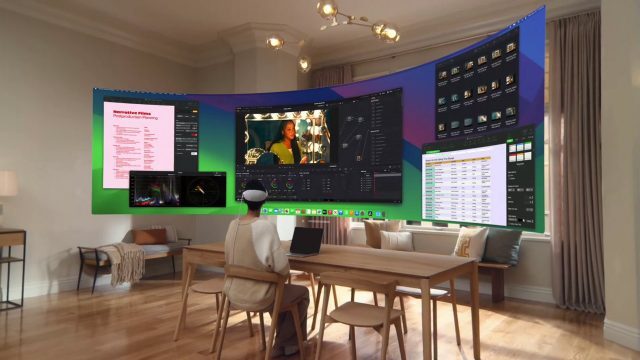
Previously only available in beta, Apple has now pushed its panoramic display feature to all Vision Pro users, bringing the choice of three virtual screen sizes when using Mac Virtual Display.
Mac Virtual Display initially launched with a single virtual screen size back in February, which also allowed users to have multiple app windows, although screen real estate was somewhat limited for a device opining to be a general computing machine first, entertainment device second.
Now, in visionOS 2.2, all Vision Pro users have access to two new display formats: ‘Wide’ (21:9) and ‘Ultrawide’ (32:9), the latter of which is said to allow for max resolutions “equivalent to two 4K monitors, side by side,” Apple said at its unveiling in June. Mac-side dynamic foveated rendering also keeps content “sharp wherever you look,” the company added.
In our hands-on test of the feature, we found it to be a huge value-add to the headset.
The feature requires a Mac computer with macOS Sequoia 15.2, which covers a pretty wide range of devices, including everything from 2017-era iMac Pros to the company’s latest M4 chip MacBooks.
Additionally, the visionOS 2.2 update also includes support for iOS’s Personal Hotspot feature, which the company says now lets you share the cellular data connection of your iPhone or iPad with other devices, including Vision Pro, effectively giving you access to 5G download speeds.
The post Apple Vision Pro Gets Ultrawide Mac Virtual Display in visionOS 2.2 Release appeared first on Road to VR.
Sora’s AI video revolution is still a ways off

The first version of OpenAI’s Sora can generate video of just about anything you throw at it — superheroes, cityscapes, animated puppies. It’s an impressive first step for the AI video generator. But the actual results are far from satisfactory, with many videos so heavily plagued with oddities and inconsistencies that it’s hard to imagine anyone finding much use for them.
Sora was released on Monday after almost a year of teasers heralding its capabilities. There are a few hurdles before you get to the video generation features, though. For one, account creation was closed within hours of launching due to the overwhelming demand. Those who did manage to sign up will find that its features also require a subscription to unlock: a $20 monthly “Plus” membership will let you generate videos at 480p or 720p, capped at either five or 10 seconds in length depending on the resolution. To unlock everything, including 1080p quality and 20-second-long videos, you need to cough up $200 a month for the “Pro” Sora subscription.
Weight loss drugs may also treat addiction, Alzheimer’s, and heart disease
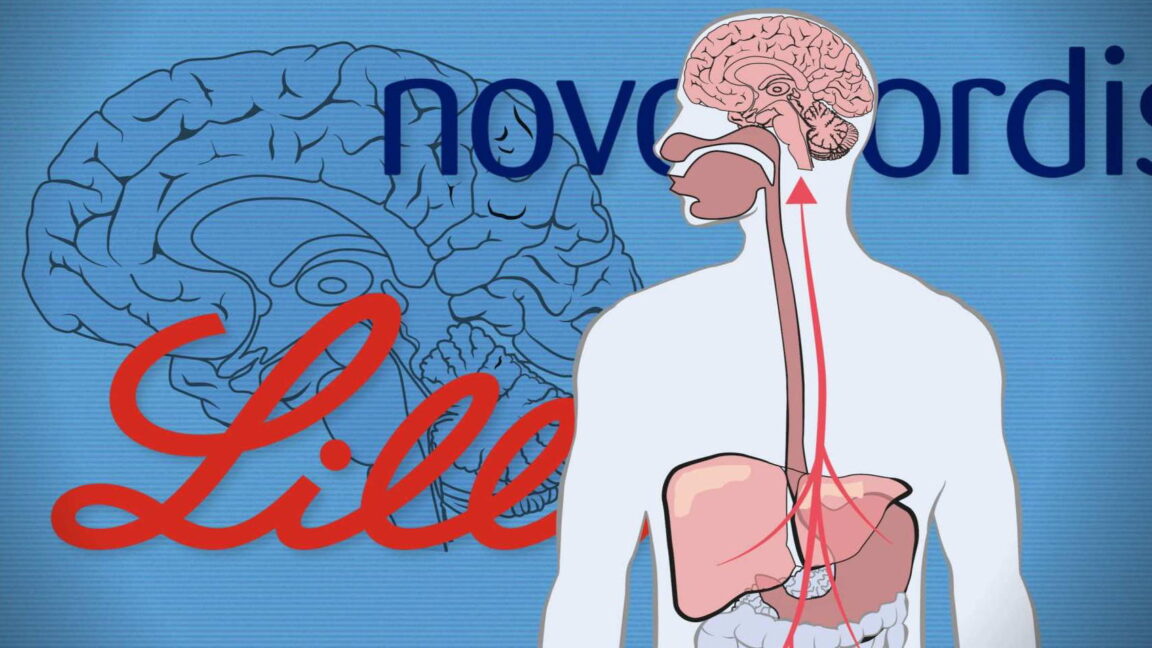
One of Dr. Mo Sarhan’s patients was experiencing intense cravings for opioids and alcohol when the Florida-based doctor offered him a striking solution: the Eli Lilly weight-loss drug Mounjaro.
“Within days, all of his cravings were gone and he was much more effective in his engagement and treatment. He’s done great since,” Sarhan says.
Sarhan and his colleague Steven Klein at the Caron Treatment Centers in Florida and Pennsylvania have prescribed a range of so-called glucagon-like peptide-1 receptor agonists (GLP-1s) to treat addictions, using them alongside traditional therapies, to around 75 patients.
Startup will brick $800 emotional support robot for kids without refunds
Startup Embodied is closing down, and its product, an $800 robot for kids ages 5 to 10, will soon be bricked.
Embodied blamed its closure on a failed “critical funding round." On its website, it explained:
We had secured a lead investor who was prepared to close the round. However, at the last minute, they withdrew, leaving us with no viable options to continue operations. Despite our best efforts to secure alternative funding, we were unable to find a replacement in time to sustain operations.
The company didn’t provide further details about the pulled funding. Embodied’s previous backers have included Intel Capital, Toyota AI Ventures, Amazon Alexa Fund, Sony Innovation Fund, and Vulcan Capital, but we don't know who the lead investor mentioned above is.

YouTube’s new auto-dubbing feature is now available for knowledge-focused content
YouTube announced on Tuesday that its auto-dubbing feature, which allows creators to generate translated audio tracks for their videos, is now rolling out to hundreds of thousands more channels. YouTube first introduced its AI-powered auto-dubbing tool at Vidcon last year, which was only being tested with a limited group of creators. This tool could help […]
© 2024 TechCrunch. All rights reserved. For personal use only.
Where Health Insurance Comes From in the United States
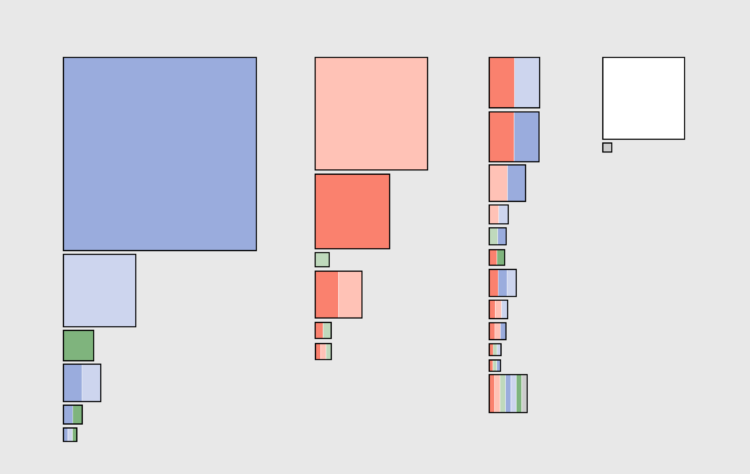
About half of people have private health insurance through an employer. However, the other half get their insurance from elsewhere or through a combination of sources. This is where everyone gets their coverage from.
Actualité : La Chine a conçu un implant cérébral bluffant pour concurrencer Neuralink

Solos challenges Meta’s Ray-Bans with $299 ChatGPT smart glasses

Solos’ camera-equipped smart glasses have arrived to provide some much-needed competition against Meta’s Ray-Bans. The AirGo Vision is available now starting at $299 — the same price as the Ray-Ban Meta eyewear tech — and features integration with OpenAI’s GPT-4o AI model to identify and answer questions about the people, objects, and text seen by the camera.
That allows the AirGo Vision to do things like translate text into different languages, provide directions to nearby locations or landmarks, and give the wearer more information about what they’re looking at. Solos says the glasses can also be integrated with other AI models like Google Gemini and Anthropic’s Claude, something the company previously teased when it announced the AirGo Vision in June.
Like the Ray-Ban Meta Smart Glasses, the AirGo Vision camera can capture photos on demand. A swappable frame system means that you can wear the glasses with or without the camera — the battery and touch sensors used to control the device are housed in the frame’s USB-C chargeable hinges, providing an audio-only option when paired with the standard, no-camera-included AirGo frames.
“One thing we promised to deliver on was allowing consumers to have control of their experience with AI and smart technology, particularly with privacy options in mind,” Solos co-founder Kenneth Fan said in the announcement. “That’s why we developed frames that can easily be changed to decide when and where a camera may be appropriate without sacrificing any of the fun features.”
/cdn.vox-cdn.com/uploads/chorus_asset/file/25783293/1_R1.png) Image: Solos
Image: Solos
/cdn.vox-cdn.com/uploads/chorus_asset/file/25783298/1_R1__1_.png) Image: Solos
Image: Solos
Soros says the Vision comes “with the option to purchase the frame only for $149 or bundle a camera frame with a regular frame for enhanced privacy, priced at $349.” It’s available in seven colors and two frame styles: Krypton 1, which sports a large square design with prominent nose pads, and the slimmer Krypton 2.
Smart TVs collect viewing data even when used as external screens, according to research
The creator of ChatGPT’s voice wants to build the tech from ‘Her,’ minus the dystopia
Alexis Conneau thinks a lot about the movie “Her.” For the last several years, he’s obsessed over trying to turn the film’s fictional voice technology, Samantha, into a reality. Conneau even uses a picture of Joaquin Phoenix’s character in the movie as his banner on Twitter. With ChatGPT’s Advanced Voice Mode, a project Conneau started […]
© 2024 TechCrunch. All rights reserved. For personal use only.
Microsoft’s AI boss and Sam Altman disagree on what it takes to get to AGI

Microsoft AI CEO Mustafa Suleyman disagrees with OpenAI CEO Sam Altman’s recent claim in a Reddit AMA that artificial general intelligence, or AGI, is possible on today’s hardware. While AGI is “plausible,” he tells The Verge’s Nilay Patel in the latest Decoder episode that it could take as long as 10 years to achieve.
With current hardware defined by Nilay as “within one or two generations of what we have now, I would say,” Suleyman replied, explaining why he thinks that’s unlikely:
I don’t think it can be done on [Nvidia] GB200s. I do think it is going to be plausible at some point in the next two to five generations. I don’t want to say I think it’s a high probability that it’s two years away, but I think within the next five to seven years since each generation takes 18 to 24 months now. So, five generations could be up to 10 years away depending on how things go.
“The uncertainty around this is so high,” Suleyman said, “that any categorical declarations just feel sort of ungrounded to me and over the top.”
He’s also drawing a line between AGI and the “singularity”:
It depends on your definition of AGI, right? AGI isn’t the singularity. The singularity is an exponentially recursive self-improving system that very rapidly accelerates far beyond anything that might look like human intelligence.
To me, AGI is a general-purpose learning system that can perform well across all human-level training environments. So, knowledge work, by the way, that includes physical labor. A lot of my skepticism has to do with the progress and the complexity of getting things done in robotics. But yes, I can well imagine that we have a system that can learn — without a great deal of handcrafted prior prompting — to perform well in a very wide range of environments. I think that is not necessarily going to be AGI, nor does that lead to the singularity, but it means that most human knowledge work in the next five to 10 years could likely be performed by one of the AI systems that we develop. And I think the reason why I shy away from the language around singularity or artificial superintelligence is because I think they’re very different things.
The challenge with AGI is that it’s become so dramatized that we sort of end up not focusing on the specific capabilities of what the system can do. And that’s what I care about with respect to building AI companions, getting them to be useful to you as a human, work for you as a human, be on your side, in your corner, and on your team. That’s my motivation and that’s what I have control and influence over to try and create systems that are accountable and useful to humans rather than pursuing the theoretical super intelligence quest.
Last week, during The New York Times DealBook Summit, Altman set out a lower set of goalposts for AGI than the superintelligence-style phenomenon he’s described in the past.
Now, Altman says AGI will arrive “sooner than most people in the world think and it will matter much less.” And when it comes to superintelligence, “a lot of the safety concerns that we and others expressed actually don’t come at the AGI moment. AGI can get built, the world mostly goes on in mostly the same way, things grow faster, but then there is a long continuation from what we call AGI to what we call superintelligence.”
This is a relationship that appears strained only one year after Microsoft helped reseat Altman as OpenAI’s CEO. After confirming that Microsoft is working on its own frontier AI model capable of competing at the “GPT-4, GPT-4o scale,” Suleyman also commented on the tension between Microsoft and OpenAI:
Every partnership has tension. It’s healthy and natural. I mean, they’re a completely different business to us. They operate independently and partnerships evolve over time... partnerships evolve and they have to adapt to what works at the time, so we’ll see how that changes over the next few years.
Visual Positioning Systems: what they are, best use cases, and how they technically work
Today I’m writing a deep dive into Visual Positioning Systems (VPS), which are one of the foundational technologies of the future metaverse. You will discover what a VPS service is, its characteristics, and its use cases, not only in the future but already in the present. As an example of a VPS solution, I will give you some details about Immersal, which is one of the leading companies for what concerns this technology. There is a lot to say and I’m sure you will find this article super informative, so let’s go!
[Disclaimer: this is a paid article built in collaboration with Immersal. In this blog, paid articles maintain the same objectivity, passion, and detail as non-paid ones. They are also completely written by me. A company can pay for an article just to be sure that I mention its product and I publish the post within a certain timeframe. That’s why I don’t call them “sponsored” articles, but “paid”: I’m not here to sell you anything, just to inform you, as usual.]
What is VPS?

VPS stands for Visual Positioning System. Slightly modifying Niantic’s definition, we can say that “a VPS is a cloud service that enables applications to localize a user’s device at real-world locations. Usually, this is used to let users interact with persistent AR content“.
If you want a more technical definition, Immersal has a good one for you: “A Visual Positioning System (VPS) utilizes sophisticated computer vision methods to determine a device’s position and orientation within an environment in real time. It works by processing camera images and analyzing the resulting data together with a database of spatial maps. By recognizing visual cues in the data and understanding their relationship to each other, VPS can accurately localize the device and its orientation within the environment“.
Putting it in layman’s terms, a VPS is a service that detects what is the exact position and rotation of your device (e.g. your phone) in relation to a physical place, so that you can correctly interact with AR content that is put in that place. Let’s make an example to explain it better: imagine that you want to create an AR experience in the middle of a park in your city so that a big virtual dragon comes out from a certain fountain. You want all users to see the dragon coming out from the middle of the fountain, no matter where they are in the park. So the devices the users are using, either phones or AR glasses, must have a way to know their exact position and orientation with regard to the fountain so that they all can put the dragon in exactly the same physical location. The best solution you have for this is to use a VPS service.
Why do we need VPS?

I can hear some of you saying “Why do we need VPS when we have other technologies to map where the users are in a place?”. You are right, we have many tracking technologies, and every one has its own use case, with VPS being unbeatable to accurately find the pose of your device with regard to a large physical location:
- GPS is great for giving the user coarse information about his/her geographical location. GPS together with the sensors on the phone is all that we need to orient ourselves on a 2D map like Google Maps that we use every day. The problem with GPS is that it gives a coarse location: the usual error in the detection is 1-5m, which is irrelevant on a 2D map, but becomes a problem when for instance I want to put some information in AR on the window of a shop. 5 meters of errors means that the info could be added to the next-door shop, instead;
- AR libraries like ARKit, ARCore, or even Meta Insight on Quest, are fantastic for local tracking. If you are playing an AR experience in a room, they are the way to go. But first of all, usually, they do not detect in what place they should start (unless some cloud anchor is used), they just start in the user’s room and use some local surfaces as a reference system. Then they are made for narrow places, and if you start moving very distant from the initial position, the tracking starts to drift and the virtual elements start moving away from their initial positions, detaching from the physical world;
- 2D Markers… I mean, they feel a bit old. If your experience is tailored to a specific planar image, they are the way to go, but this is not a common scenario outdoors for instance. Unless you want to put a huge textured blanket in the park, you can not use markers to show the dragon on the fountain in the above example. Furthermore, users should always frame the marker to see the augmentations, and this is annoying because it forces users to always look down;
- 3D Markers: better than the above scenario, but they need you to have an accurate 3D mesh reconstruction of the element to augment and then train some ML classifier to detect the object (which may take a lot of time). Augmentations work only if the 3D element to use as a 3D marker is currently visible. They are very useful if your purpose is to augment a specific physical object, but are still pretty cumbersome and sometimes pretty expensive.
All the above technologies have their specific use cases, but VPS services are the best technology available to guarantee that the device detects its absolute position and orientation in a certain indoor or outdoor location, even a pretty large one. It is the technology to use when you want to augment a specific place for multiple people in a coherent way.
Use cases of VPS
Before digging into the details of how a VPS system works under the hood, let’s evaluate its use cases.
The first one that comes into mind when talking about having the users know their position in the space, is building an indoor navigation system. Imagine being in a big shopping center, looking for a specific shop: personally, when I do this, if I try to follow the indications of the maps scattered around the place, I get lost 100% of the time. It would be great if you could have an AR system that would show on your phone screen some arrows that tell you the way from where you are to the shop you want to reach. VPS systems can help build exactly that: since they can localize the position and rotation of every device, they know where the user is and can guide him/her until destination. Immersal has in fact developed a similar solution for Mall of Tripla, an 85000 m2 shopping mall in Helsinki. But we can think about other situations where indoor navigation may be very helpful, like hospitals or airports.
Another use case is the superimposition of virtual elements on a building for industrial use cases. For instance, a pretty common request for AR applications is being able to see the network of pipes superimposed on the floor or ceiling of buildings, or even outside in the streets, to facilitate the work of maintenance workers. The right technology to do this is again VPS because it can track the pose of your phone across a large area and so it can help in superimposing the pipe system over the physical location. Immersal powered the AR4FM app by Granlund to provide this use case. Caverion AR by FlyAR had a similar function of overlaying BIM data on top of a real building for maintenance use cases.
Talking about more fun things, we can mention also entertainment and marketing. What if every child could see their favorite cartoon character in a specific place in a city? What if you could see augmented reality information overlayed on a stadium while you watch the match, no matter what seat you are in? What if there could be some virtual show happening in the middle of a commercial center to make your shopping experience more amusing? All these experiences need VPS to make sure the virtual elements are attached to the physical location they are augmenting.
What. A. Round!!!
— Mike Katz (@Mike_Katz) July 11, 2023Julio’s record-breaking @TMobile #HomeRunDerby performance made even better with the brand new @MLB Next app
pic.twitter.com/0W95ZYc4Hi

Seeing things more long term, a clear use case of VPS services is the metaverse, the forbidden M-word that now companies like to call “large-scale spatial computing”. The metaverse requires that all our reality becomes augmented and that we all consistently see the same augmentations in the same locations of the physical world. So if I could see an AR popup that informs me of some discount on a shop, everyone else should see it in the exact same location. The same if I saw a huge dragon in a fountain in the park: all the other people should see it in the exact same physical place, doing the exact same things. To make sure that we all can see these virtual elements in a consistent way all around our cities, we need a system that is able to accurately detect the position and rotation of the devices at city-scale. And this is exactly what a VPS service does.
VPSes are already useful now for some specific use cases, but long term they are the foundation of our long-term shared mixed-reality future, that is… the metaverse.
How does a VPS work?
If you are a tech guy like me, at this point, you are probably thinking “Ok Tony, I got that VPS can track the pose of my phone everywhere in a location, but how is this possible?”. Let me go a bit deeper into the technical details and explain to you all the process that makes a VPS service work.
Feature Detection
As in many modern functionalities based on computer vision, VPS relies on feature detection. According to the definition given by Immersal, a “Feature Point is a distinct, high-contrast visual feature in an image. A corner of a poster on the wall, the grain on a wooden floor or a detail in the facade of a building”. Trying to put also this definition in layman’s terms, we can say that a feature point is a point in an image showing a little corner. The more an area is textured, the more there will be feature points, because the more the texture, the more corners will be depicted in the image.

There are various types of feature points and many algorithms to detect them: if you are into computer vision, for sure you are familiar with terms like KLT, SIFT, SURF. The reason why it is important to detect these “corner” features is because corners have distinctive characteristics both on the X and the Y axes. Imagine being in front of a wall that is fully white in a room with no shadows, and even lighting. If I show you a video recorded with a phone moving in front of this wall, you just see full white in every frame, so you have no idea about how the phone is moving. Now imagine that there are vertical black stripes on the white wall: if the phone moves vertically, you see again the same striped pattern every frame, so you have no idea at what vertical speed I’m moving. But if I move horizontally, now you can detect the movement because of the vertical stripes moving in the video. If there are no stripes, but checkers, now you can spot both vertical and horizontal movements, but you still lack info about the absolute positioning of the phone. But if some of the checkers are blue, other red, other yellow, and they form a specific pattern, now you can detect exactly where is the phone because your brain can identify some specific patterns of the drawing on the wall and match them with the image that is portrayed in the video. This is why it is important to have some features with strong components on the X and Y axes: they are easier to uniquely identify and they can help spot movement on all axes.
VPS systems work in a similar way: they memorize the unique features in your space and then they localize your device by matching the features that the camera of the device is seeing with the features that the system knows that there are in that space.
Mapping
Now that it is clear what a feature is, we can examine the steps through which a VPS service functions. The first step that a VPS service should undergo to work in a specific space is mapping, that is the system should memorize what are the feature points that are available in the space inside which tracking should work. To do this, you usually need a companion app for mobile: Immersal has for instance the Immersal Mapper, which I tried in its offices in Helsinki.
Immersal Mapper looks a bit like the camera app of your phone: you have to walk around the place where navigation should happen, and shoot pictures of it from different points of view so that the system can reconstruct the whole place. Immersal App has also an automatic mode, where you just walk around the place as if you were recording a video, and the system automatically shoots a new picture every time it thinks it is a good place to take it. After you have shot enough pictures, you can upload the data (which is a collection of images, and metadata associated with them, like the pose of the phone when the picture was shot) and let the cloud crunch it to reconstruct a point cloud of the place where you were in.

The cloud will extract the feature points of every picture and then merge the data of all these feature points to create a reconstruction of the place. I’m not going to describe here how the reconstruction algorithm works to not make you fall asleep out of boredom (the more geeky readers may look for “multiview stereo” online to read more about this, though), but you can imagine that a few things happen:
- Only the feature points that are truly reliable are used for the reconstruction: all the feature points that appear in only one picture but disappear in the next ones are probably just the result of noise, so they are discarded;
- The remaining “stable” feature points are matched the one with the others using the overlapping regions of the various images to reconstruct the shape of the whole place. For instance, if in an image the system detects the feature points of a door on the left to the ones of a desk, and in another image, there are the feature points of a desk on the left of the ones of a bookshelf, the system can use the desk overlap of the two images to reconstruct that on the side of the room there is a door, then a desk, then a bookshelf. Performing similar reasonings on all the images, the system gradually reconstructs the whole 3D shape of the space. This operation is similar to the “stitching” done with multiple flat videos that have to be merged into a 360 video.
Usually, there is a limit on the size of the maps that can be reconstructed with this operation, but the cool thing is that multiple maps can also be stitched together using the features of their overlapping areas. Thanks to this, VPS services can also work in big environments like university campuses or commercial centers. Actually, Immersal already aims at having city-scale mapping, that is having a big map of a whole city where a VPS tracking system may work.

All VPS systems perform mapping in a similar fashion, but not all of them have this operation done in an explicit way for the user. For instance, Google’s Geospatial VPS system does not ask the user to map the space, because it is Google itself that has already mapped many cities using the images it acquired for Google Maps. Niantic does the mapping under the hood using Pokemon Go players: players are encouraged to scan a new part of the city to have some reward inside the game, without being aware that they’re doing a mapping operation for a VPS system. I think that gamifying the mapping operation has been a genius idea by Niantic.
The result of the mapping operation is a point cloud of stable features that reconstructs the whole place. This can be used in the next step, which is the one of Localization.
Localization
Once the map is ready, most of the work has been done. You just have to run your application powered by VPS and make it confront the current images seen by the camera with the model of the place we have reconstructed with the mapping operation.

At every frame, the system will grab a frame from the camera of the device, extract the features from it, and then confront the found features with the features of the model. Using some trigonometry magic (I could have said “boring stuff”, but “magic” sounds more exciting), it is possible to reconstruct the rotation and position of the camera by matching the pixel positions of the features found in the current frame with the 3D data characteristics of the same features recorded in the 3D model of the current place. Once the system has this absolute pose, it knows exactly where the user is in the place, and so it can show augmentations at exact physical positions. This can also be done for every user in the same location, guaranteeing that they are all seeing a consistent augmented reality.
When I tried Immersal in its offices, I remember that after scanning the room we were in and having the cloud reconstruct the point cloud of the place, we proceeded to visualize on the tablet the feature points cloud of the room super-imposed on the room itself. This was a good way to test the localization: if the tracking was working correctly, we could see the point cloud perfectly superimposed to the physical elements that compose it. And I can say that the system was working very well because the virtual points replicated exactly the shape of the physical room.

AR tracking
Once localization works, you can superimpose virtual elements to the room you are in, so as to offer augmented reality to the user. But doing VPS every frame is a very intensive operation for a mobile device, so usually the tracking of the device is performed with more lightweight standard SLAM technologies (e.g. ARKit, ARCore), but then every 1-5 seconds the tracking is corrected with the absolute pose offered by VPS. This creates a good combination of performance and reliability.
How do you develop an application using VPS?
If you want to implement VPS in your application, you usually rely on existing VPS services like Immersal, Google Geospatial, or Niantic Lightship. These services already take care of all the heavy lifting for what concerns the mapping and reconstruction algorithms, together with all the localization logic.
You usually have just to import the SDK of the platform you have chosen, and then use its scripts to do a couple of things:
- Load the map of the place that you have recorded during the mapping operation. Usually, it is either a file that you downloaded from the mapping service, or it is a reference to a map that you have created in your user account of that VPS service;
- Place the virtual objects. These services usually show inside the game engine that you have chosen a preview of the place you are going to augment, and they let you put the virtual 3D elements wherever you want.
Immersal, for instance, has a Unity SDK that lets you preview in the editor the point cloud of the place you have mapped, so you can put the virtual elements in the 3D scene in a visual way. Then the scripts of the SDK simply do the magic of performing the localization and tracking every frame, alone or in combination with other services like AR Foundation.
If you want to go more low-level and use just the map to do some custom code about it yourself, you can still do it. From the Immersal servers, it is possible to download the following things for every saved map:
- The map file with .bytes extension. This is the actual map file used by the SDK for localization.
- A sparse point cloud representation of the map as a .ply file.
- A dense triangle mesh representation of the map as a .ply file.
- A textured triangle mesh representation of the map as a .glb file.
This gives the developer the maximum flexibility to develop the experience that he/she wants.
VPS Systems Characteristics
There are many VPS systems out there, and all of them have their own peculiarities. Let’s see some important characteristics to watch out for when you are looking for the system you should use.
Device compatibility
Not all VPS systems are compatible with all devices and before choosing a service, you should check if it works with the hardware you intend to use.

Compatibility concerns both the mapping and the localization operations. Mapping may be done with different pieces of hardware: I told you about the mobile phone, but actually it can also be carried out with 360 cameras, Matterport scanners, LiDAR scanners, or drones. Immersal is compatible with all of these. It actually is also compatible with custom solutions: it is not even necessary for the client to use the official Immersal Mapper app.
As for localization, compatibility means understanding which devices may run the applications powered by VPS. Immersal here is very strong because it can work on:
- Mobile devices that run ARKit, ARCore, or Huawei AR Engine
- AR glasses like Magic Leap, HoloLens, XReal, Rokid
- Mixed reality headsets like Pico 4E (a Vision Pro version is in the works)
- All devices compatible with WebAR, including mini applications inside WeChat
The compatibility for Immersal with so many pieces of hardware is possible because the VPS servers just work with REST APIs, and these are platform-independent. If a new type of glasses is released, it is just necessary to make it communicate with the Immersal servers using these REST APIs to make it compatible with the system.
On-device vs on-cloud localization
Some VPS systems need a connection to the cloud to work. These systems perform all the heavy lifting on the cloud so that the application on the client can be more lightweight. Notice that I’m not talking about the mapping, which almost always needs the cloud to be performed, I’m talking about the localization. Localization on the device is lag-free and can work even in parts of the world with a bad internet connection, but it puts the local device under heavy stress (which also means faster battery consumption). Many VPS systems just work with on-cloud localization because it’s easier to manage for the provider (updates to the localization algorithms must only be delivered on the server) and allows the client to be more lightweight.
Immersal supports both of them and in fact, when you develop an application with its SDK, you are asked how to retrieve the map of the place that must be navigated. Since industrial clients care a lot about their private data and do not want to put the data about their factories on a random server on the Internet, Immersal also offers the possibility of having a local deployment of the VPS services inside the cloud space of the customer.

Indoor vs Outdoor
Some services work better indoors, while others perform better outdoors. Some may have been more optimized for gaming scenarios, so to track elements that are close to the users, while others are more oriented toward navigation in larger spaces.
Indoor and outdoor tracking offer different challenges. Outdoor scenes are affected more by lighting, so performing localization at night when the scene was mapped during the day may present complications, because the features may appear differently in different light conditions. Indoor scenes have more uniform lighting, but they usually contain many challenging surfaces, like transparent glasses or mirrors that make tracking algorithms become confused.
Map scale
Some systems may work better in small spaces, while others may be oriented towards big areas. I’ve mentioned before the “city-scale” mapping that Immersal aims to and that is obtained by stitching many smaller maps together. Of course, this is also the mission of big players like Google and Apple.
Going city-scale introduces various challenges, like the fact that the whole map of a city can’t be contained by the host device, and anyway, the tracking can’t be done by comparing every time the current features with the one of the whole city. That’s why the map has to be broken into smaller chunks, that have to be quickly streamed (preferably via 5G) to the tracking device so that the user does not perceive any disruption of the service while he/she moves from one chunk to another one. Immersal demonstrated that its city-scale approach works by mapping a roughly 1,000,000m² area of Helsinki city center with 120+ separate maps that were aligned.

Openness
Some VPS systems just have their own pre-made maps, while others are open to you supplying your own maps of the places by scanning the environments. Some of them also let you connect to open systems like the Open AR Cloud, which is an open-source 3D map of the world.
Google Geospatial has for instance the handicap that you are in the hands of Google: you can not scan a place yourself, either Google mapped a location well or it has not.
Immersal claims to be a fairly open system, a toolbox that the customers can use as they want, even mixing their own tools with the one of Immersal.
Pricing
VPS solutions have different prices: usually, they are free to start with, but then there is a monthly fee to pay in case you want to build more professional applications. Immersal is free to experiment with, but a Pro license costs $99/month and an Enterprise one requires a private negotiation. (I also obtained that you readers can have one free month of Pro subscription if you use the special code SKARREDGHOST at checkout!)
When evaluating the solution that fits you, you should also verify which one is ideal for your budget capabilities.
Available VPS Systems

If you want to know some names of famous VPS systems to investigate, here are a few:
- Apple ARKit Geotracking
- Google Geospatial
- Niantic Lightship VPS
- Snap Landmarker
- … and of course, Immersal!
When I asked Immersal engineers for an honest comparison of their system with the other ones available, I was told that Google Geospatial is usually very good for outdoor locations with meter-accuracy, but its performances depend on how Google has mapped the place where the app should run. But for outdoor locations that are not tracked well, or for indoor locations, or if you need to customize the map, or you need centimeter-accuracy, Immersal should offer better performances.
Niantic Lightship, instead, works well for gaming use cases, and thanks to the fact that the map of the world is crowdgenerated, it always expands to new locations. However, industrial companies may not be very happy with seeing their industrial factories being mapped and inserted in the public 3D map of a gaming company. So for B2B use cases, Immersal should offer more data safety.
I have not personally verified these claims with a personal objective test, so take this opinion with a grain of salt. As usual, my suggestion is to try things by yourself: if you need a VPS service, choose three of them that on paper fit better with the needs that you have and then try them on the field and see what works better in your actual conditions.
Conclusion
VPS systems are foundational for our future, which will be made of a shared persistent mixed reality. The technology that powers them is not easy to develop, but luckily there are already existing SDKs that do the heavy lifting for us. Immersal is one of the companies offering these services and I have been able to verify with my own eyes that it does a pretty good job.
I hope that this article has been able to foster in you some curiosity about VPS and will entice you to use this kind of service for some applications that are useful for you. And if you have any questions, of course, you can ask them in the comments and I will do my best to support you!
(Header image by Immersal)
The post Visual Positioning Systems: what they are, best use cases, and how they technically work appeared first on The Ghost Howls.
Obesity rates are down. Is that because of weight-loss drugs?
Earlier this fall, the Centers for Disease Control and Prevention reported data showing that adult obesity rates—long trending upwards—had fallen modestly over the past few years, from 41.9 to 40.3 percent. The decline sparked discussion on social media and in major news outlets about whether the US has passed so-called “peak obesity”—and whether the growing use of certain weight-loss drugs might account for the shift.
An opinion piece in the Financial Times suggested that the public health world might look back on the current moment in much the same way that it now reflects on 1963, when cigarette sales hit their high point and then dropped dramatically over the following decades. The article’s author, John Burn-Murdoch, speculated that the dip is “highly likely” to be caused by the use of glucagon-like peptide-1 receptor agonists, or GLP-1s, for weight loss.
It's easy to see why one might make that connection. Although GLP-1s have been used for nearly two decades in the treatment of type 2 diabetes, their use for obesity only took off more recently. In 2014, the Food and Drug Administration approved a GLP-1 agonist named Saxenda specifically for this purpose. Then in the late 2010s, a GLP-1 drug named Ozempic, made from the active ingredient semaglutide, began to be used off-label. The FDA also authorized Wegovy, another semaglutide-based GLP-1 medication, explicitly for weight loss in 2021.

Où se cache Bachar al-Assad ? La traque de son avion sur les réseaux sociaux sème le doute

Selon les agences de presse russe, l'autocrate syrien Bachar al-Assad serait arrivé en Russie après la chute de son régime. Plusieurs avions ont été localisés dans le ciel syrien, avec des trajets suspects, qui ont fait émerger de nombreuses théories.
John Deere Announced Nearly 200 More Layoffs at Its Iowa Plants During the Holidays. Here’s Why
OpenAI has finally released Sora

OpenAI launched Sora, its text-to-video AI model, on Monday as part of its 12-day “ship-mas” product release series, as The Verge previously reported it would. It’s available today on Sora.com for ChatGPT subscribers in the US and “most other countries,” and a new model, Sora Turbo. This updated model adds features like generating video from text, animating images, and remixing videos.
With a ChatGPT Plus subscription, OpenAI says you can generate up to 50 priority videos (1,000 credits) at resolutions up to 720p with 5-second durations. The $200 per month ChatGPT Pro subscription that launched last week comes with “unlimited generations” and up to 500 priority videos while bumping the resolution to 1080p and the duration to 20 seconds. The more expensive plan also allows subscribers to download videos without a watermark and perform up to five generations simultaneously.
OpenAI first teased its text-to-video AI model, Sora, in February, and earlier today, Marques Brownlee, aka MKBHD, confirmed the launch with a preview based on his experiences testing Sora so far.
During the livestream, OpenAI showed off Sora’s new explore page with a feed of AI-generated videos created by other community members. The company highlighted a feature called “storyboards” that let you generate videos based on a sequence of prompts, as well as the ability to turn photos into videos. OpenAI also demonstrated a “remix” tool that lets you tweak Sora’s output with a text prompt, along with a way to “blend” two scenes together with AI.
OpenAI says videos generated with Sora will have visible watermarks and C2PA metadata to indicate they’re made with AI. Before uploading an image or video to Sora, OpenAI prompts you to check off an agreement that says what you’re uploading doesn’t contain people under 18, explicit or violent content, and copyrighted material. It says the “misuse of media uploads” could result in an account ban or suspension.
“We obviously have a big target on our back as OpenAI,” Sora product lead Rohan Sahai said during the livestream. “We want to prevent illegal activity of Sora, but we also want to balance that with creative expression. We know that... will be an ongoing challenge, we might not get it perfect on day one. We’re starting a little conservative, and so if our moderation doesn’t quite get it right, just give us that feedback.”
If you don’t have a ChatGPT subscription, you’ll still be able to browse through the feed of AI-generated videos created by other people using Sora. While the model will become available in the US and many other countries today, OpenAI CEO Sam Altman said that it may “be a while” for a launch in “most of Europe and the UK.”
The release of Sora comes just a week after a group of artists, who claimed to be part of the company’s alpha testing program, leaked the product in protest of being used by OpenAI for what they claim was “unpaid R&D and PR.”
Correction, December 9th: The quote previously attributed to Aditya Ramesh was actually said by Rohan Sahai.
Scientists create AI that 'watches' videos by mimicking the brain
Offensive du Crédit Mutuel sur FIDA


Video: In Europe, new highway tech and robots could soon fix roads and protect lives
Meta’s new Quest update has faster hand tracking and at-a-glance PC connections

Meta has announced the v72 Quest update, and it’s packed with features like faster hand tracking, an easier way to pair your headset with a Windows 11 PC, and better support for showing your keyboard while you’re in full virtual reality. The update is rolling out gradually, which also goes for certain features so you may not be able to use them immediately.
Meta says you can now connect to a paired PC with the Quest’s Remote Desktop feature simply by looking at it and tapping the “Connect” button that appears above your keyboard. That’s similar to how it works on the Vision Pro, but here, you’ll need the Mixed Reality Link app installed on your computer before you can pair the devices together from within your Quest headset’s Settings app. The feature requires Windows 11 22H2 and newer.
/cdn.vox-cdn.com/uploads/chorus_asset/file/25782300/Meta_Quest_PC_connect.png) Image: Meta
Image: Meta
Also, in Quest v72, the company says it’s “rolling out a more general keyboard tracking system” that should detect and let any keyboard around you appear through a passthrough “window” while you’re in a virtual environment, similar to the Vision Pro. Quest headsets have had a feature that shows a virtual version of your keyboard where your real one is since 2021, but that has only ever worked with specific keyboards.
Meta also says it has made the hand cursor more stable when navigating, pinching to select things, and pinching and dragging windows. The company also says it’s now easier to use your hands while in confined spaces and that it added a “hand ray visualization” to help find and target things with the cursor.
There is a little bit more in the update, too, including new live captions for calls from the People app and the addition of direct messaging in the Instagram app. Meta also added a Media Gallery app for viewing your images, videos (spatial included), and screenshots.
Google reveals quantum computing chip with ‘breakthrough’ achievements

Google’s quantum computing lab just achieved a major milestone. On Monday, the company revealed that its new quantum computing chip, Willow, is capable of performing a computing challenge in less than five minutes — a process Google says would take one of the world’s fastest supercomputers 10 septillion years, or longer than the age of the universe.
That’s a big jump from 2019 when Google announced its quantum processor could complete a mathematical equation in three minutes, as opposed to 10,000 years on a supercomputer. IBM disputed the claim at the time.
Along with more powerful performance, researchers also found a way to reduce errors, something Google calls “one of the greatest challenges in quantum computing.” Instead of bits, which represent either 1 or 0, quantum computing uses qubits, a unit that can exist in multiple states at the same time, such as 1, 0, and anything in between.
As noted by Google, qubits are prone to errors because they “have a tendency to rapidly exchange information with their environment.” However, Google’s researchers discovered a way to reduce errors by introducing more qubits to a system and were able to correct them in real time. Their findings were published in Nature.
“This historic accomplishment is known in the field as ‘below threshold’ — being able to drive errors down while scaling up the number of qubits,” Google Quantum AI founder Hartmut Neven writes on Google’s blog. “You must demonstrate being below threshold to show real progress on error correction, and this has been an outstanding challenge since quantum error correction was introduced by Peter Shor in 1995.”
Introducing Willow, our new state-of-the-art quantum computing chip with a breakthrough that can reduce errors exponentially as we scale up using more qubits, cracking a 30-year challenge in the field. In benchmark tests, Willow solved a standard computation in <5 mins that would…
— Sundar Pichai (@sundarpichai) December 9, 2024
Willow, which has 105 qubits, “now has best-in-class performance,” according to Neven. Microsoft, Amazon, and IBM are working on quantum computing systems of their own.
Google’s next goal is to perform a first “useful, beyond-classical” computation that is both “relevant to a real-world application” and one that typical computers can’t achieve. Going forward, Neven says quantum technology will be “indispensable” for collecting AI training data, eventually helping to “discover new medicines, designing more efficient batteries for electric cars, and accelerating progress in fusion and new energy alternatives.”
Google dévoile GenCast : un modèle d’IA révolutionnaire pour la prévision météorologique

Avec GenCast, Google réinvente la prévision météorologique en utilisant l’intelligence artificielle pour des résultats plus précis.
Furless Furby

Meet the Furless Furby, your childhood friend stripped bare – literally. With 100% less fur and 1000% more nightmare fuel, it’s the perfect blend of nostalgia and chaos. Gift it, meme it, or just let its folds haunt your decor.
$19.98