Jean-Philippe Encausse
Shared posts
Tech law in 2025: A look ahead at AI, privacy and social media regulation under the new Trump administration
HDMI 2.2 will require new “Ultra96” cables, whenever we have 8K TVs and content
We've all had a good seven years to figure out why our interconnected devices refused to work properly with the HDMI 2.1 specification. The HDMI Forum announced at CES today that it's time to start considering new headaches. HDMI 2.2 will require new cables for full compatibility, but it has the same physical connectors. Tiny QR codes are suggested to help with that, however.
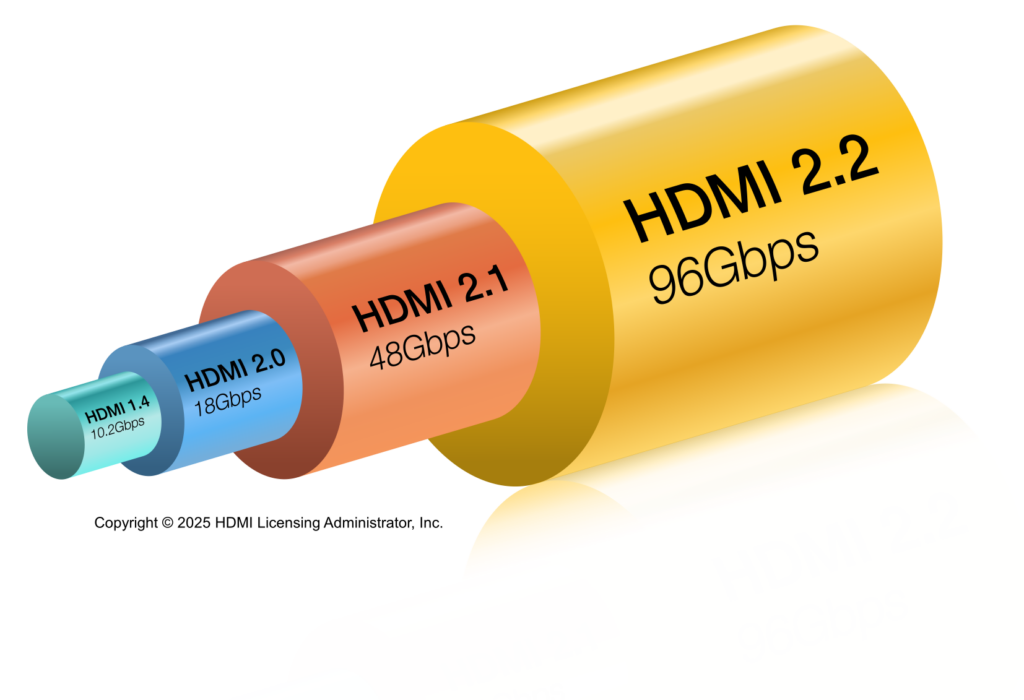
The new specification is named HDMI 2.2, but compatible cables will carry an "Ultra96" marker to indicate that they can carry 96GBps, double the 48 of HDMI 2.1b. The Forum anticipates this will result in higher resolutions and refresh rates and a "next-gen HDMI Fixed Rate Link." The Forum cited "AR/VR/MR, spatial reality, and light field displays" as benefiting from increased bandwidth, along with medical imaging and machine vision.
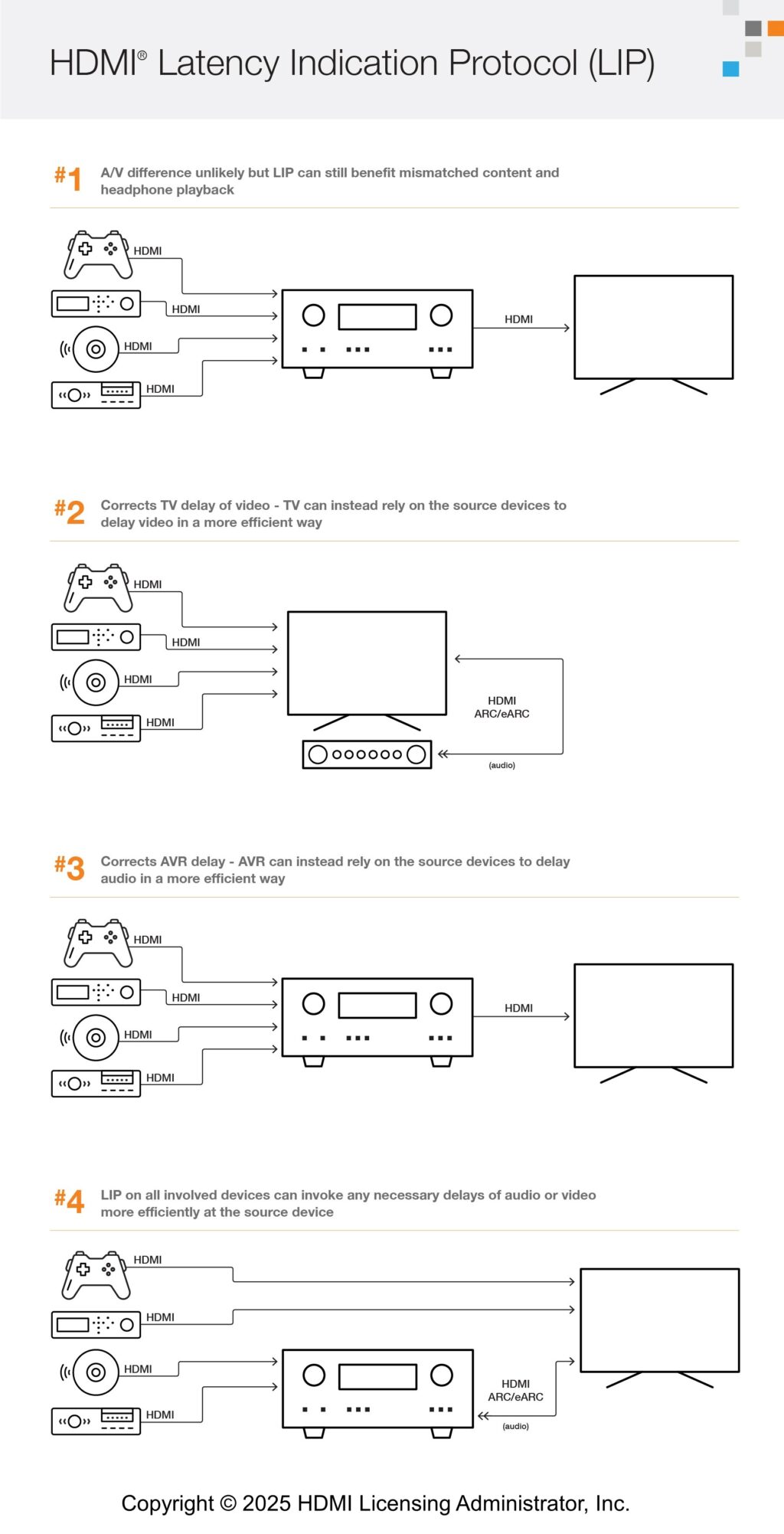
A bit closer to home, the HDMI 2.2 specification also includes "Latency Indication Protocol" (LIP), which can help improve audio and video synchronization. This should matter most in "multi-hop" systems, such as home theater setups with soundbars or receivers. Illustrations offered by the Forum show LIP working to correct delays on headphones, soundbars connected through ARC or eARC, and mixed systems where some components may be connected to a TV, while others go straight into the receiver.
John Deere says its self-driving tractors and trucks will help address labor shortages

The next time you pass a farm tractor tilling a field, check to make sure there’s somebody in the cab. Chances are, there won’t be.
Today at CES, John Deere announced a host of new fully autonomous vehicles that it says will revolutionize farming, landscaping, and construction. Among the new vehicles the company will have to show off are an autonomous tractor, a robot lawn mower, a crewless dump truck, and another driverless tractor, but this one designed specifically for orchards.
“We’re taking our tech stack, which is nearly three decades in the making, and we’re extending it to more of our machines to safely run autonomously in these unique and complex environments that our customers work in every day,” said Jahmy Hindman, chief technology officer at John Deere.
“When we talk about autonomy, we mean full autonomy,” he added. “No one’s in the machine.”
It’s been three years since John Deere unveiled its first autonomous tractor. Commercial deliveries began in 2022, and now Hindman says that many farms have put the company’s robot equipment to work. “Those tractors are already being used by farmers to prepare the soil for planting in the next year,” he said.
Now the company is doubling down on autonomy, at a time when other vehicle manufacturers are cutting their losses. John Deere says its autonomous machines can help farmers address labor shortages, while also meeting the growing demand for food, infrastructure, and housing.
Tractor or computer?
The company’s second-generation tractor is designed for large-scale agricultural operations. And in order to ensure a full, 360-degree view of the world, John Deere added 16 cameras all around the cab of the tractor that provide for triple overlapping feeds.
The images are then sent for processing to an onboard Nvidia GPU because John Deere wanted to be sure the tractor’s edge AI system was doing all of its predictions and planning on the vehicle itself, and not up in the cloud.
“This ensures that the machine is running safe and reliable,” said Willy Pell, CEO of John Deere subsidiary Blue River Technology, which designs machine learning systems for agricultural operations.
John Deere’s first-generation tractors were designed specifically for the slowest and easiest works, which is fall tillage with a chisel file. The second-generation system will be for a broader set of operations, with John Deere setting the goal for a fully autonomous farming system for corn and soybeans in the US by 2030.
Dusty the dump truck
John Deere’s next robot vehicle is the company’s first for construction sites: an articulated dump truck (ADT). The heavy-duty truck is 34 feet long, 12 feet tall, and can carry over 92,000 pounds of construction materials — the equivalent of seven African elephants — in its front bucket. John Deere’s executives have given it the nickname “Dusty.”
The job of a dump truck operator in quarries and other sites is tough but also repetitive and boring. By removing the driver, John Deere hopes to improve safety while also helping improve productivity.
The ADT can carry the weight equivalent of seven African elephants in its front bucket
The ADT operates using the same tech stack as its farming siblings, with the added ability to dynamically change its routing information to get around people and other vehicles on narrow roads through construction sites. The truck can also receive directions from remote operators about location and timing — but that doesn’t make it remote-controlled.
“It’s unsupervised, it’s capable of making decisions and operating safely on its own,” said Maya Sripadam, senior product manager at Blue River Technology. “So it’s segmenting the world into different classes, it’s using StarFire GPS to localize itself on the road, and it’s navigating between a load zone and a haul zone.”
In the orchard
John Deere also revealed another autonomous tractor, this one designed to run on diesel for pulling air blast sprayers through nut orchards. Sprayers are used to apply pesticides, growth regulators, and nutrients to ensure a healthy crop.
Nuts are a huge business in the US, especially in California. And with 80 percent of the world’s almond crop grown in the Golden State, labor shortages have proven to be a perennial problem.
Workers typically drive up and down endless rows of orchards up to 10 hours a day at 2.5 mph. Every single tree needs to be sprayed six to eight times per year, with work starting in February and going through July or August — right into the hottest times of the year.
Nuts are a huge business in the US, especially in California
“The work is exhausting and it’s repetitive,” said Igino Cafiero, director of High Value Crop Autonomy, “but it’s also absolutely essential to protect the trees from pests and disease.”
But nut orchards, with their dense canopies of trees, are a much different environment than corn or soybean fields. John Deere had to add lidar laser sensors to help improve the tractor’s sensing and guidance capabilities because GPS is often obstructed. Aside from that, the tractor uses the same second-generation technology stack as its tractors for field tillage.
Robo-scaping
The last machine John Deere revealed was an autonomous lawn mower for large-scale commercial landscaping jobs.
The all-electric mower features four pairs of stereo cameras, one in the front, one in the back, and one on each side. They’re positioned as high as possible on the machine to give a complete 360-degree view around the mower. That’s fewer cameras than the tractor or dump truck, but enough for the size of the machine.
A large office park or campus yard is very similar to a field or construction, in that it’s a “constrained environment” with much less chance for unpredictable behavior, Blue River’s Pell said.
“The use cases we have, the tech just really fits these environments so well,” he added. “And it’s combined with this deep customer pain around labor availability and quality that just makes all this the perfect time for everything.”
John Deere didn’t announce pricing for any of its autonomous vehicles, but past reports have noted that the premium over non-robotic equipment would be “significant” — perhaps as much as 10 percent. A regular 8R tractor and the 2430 chisel plow can cost as much as $500,000, which suggests an added $50,000 for an autonomous version.
That could irk some farmers, especially those at odds with John Deere over the company’s recalcitrance over self-repairs. The Federal Trade Commission is currently investigating whether John Deere used unfair practices related to the repair of its agricultural equipment.
“Pricing will vary based on specific products and configurations and will be shared at a later date,” John Deere spokesperson Diego Rivera said.
The Big Bang Theory : le talent unique de Kaley Cuoco qui l’a aidée à mémoriser toutes ses répliques

Kaley Cuoco a expliqué comment un de ses dons particuliers l'a aidée à mémoriser toutes ses répliques pour la série The Big Bang Theory.
Human-inspired AI model can produce and understand vocal imitations of everyday sounds
VLC player demos real-time AI subtitling for videos

The popular open-source VLC video player was demonstrated on the floor of CES 2025 with automatic AI subtitling and translation, generated locally and offline in real time. Parent organization VideoLAN shared a video on Tuesday in which president Jean-Baptiste Kempf shows off the new feature, which uses open-source AI models to generate subtitles for videos in several languages.
“At the same time we have automatic translation working to translate the subtitles to your own language,” Kempf says, with more than 100 languages planned for support. “What’s important is that this is running on your machine locally, offline, without any cloud services. It runs directly inside the executable.”
VLC automatic subtitles generation and translation based on local and open source AI models running on your machine working offline, and supporting numerous languages!
— VideoLAN (@videolan) January 8, 2025
Demo can be found on our #CES2025 booth in Eureka Park. pic.twitter.com/UVmgT6K4ds
AI-powered subtitling has been under development for some time in the form of a plug-in using OpenAI’s speech recognition system Whisper, but this new demo appears to be built directly into the VLC app and generates translated subtitles in real time. There’s no word on when the feature will roll out.
This week, VideoLAN also celebrated hitting 6 billion downloads, with Kempf boasting, “The number of active users of VLC is actually growing, even in this age of streaming services.”
With CES 2025 still in full swing, we’ll track VideoLAN down on the show floor to see the AI subtitling in action for ourselves.
CES 2025 : Samsung The Frame Pro, l’art et la technologie fusionnent
Lors du CES 2025, Samsung a levé le voile sur The Frame Pro, une version nettement améliorée de son célèbre téléviseur The Frame. Cette nouvelle itération repousse les limites en proposant des performances technologiques avancées tout en conservant son design artistique emblématique. The Frame Pro: Une qualité d’image révolutionnaire grâce au Neo QLED La principale […]
L’article CES 2025 : Samsung The Frame Pro, l’art et la technologie fusionnent est apparu en premier sur BlogNT : le Blog des Nouvelles Technologies.
CES 2025 : WowMouse transforme votre Apple Watch en souris magique
Doublepoint Technologies, une startup pionnière dans le contrôle par gestes, a lancé l’année dernière une application innovante pour smartwatch, permettant de contrôler divers appareils, tels que smartphones, tablettes, casques et téléviseurs. Cette semaine, lors du CES 2025, la société a dévoilé WowMouse, une application dédiée à l’Apple Watch qui permet de contrôler des Mac et […]
L’article CES 2025 : WowMouse transforme votre Apple Watch en souris magique est apparu en premier sur BlogNT : le Blog des Nouvelles Technologies.
Omi is another AI companion wearable — but this one’s trying to read your mind

Nik Shevchenko closes his eyes and starts to focus intently. He’s spent the last half hour or so telling me about his new product, an $89 wearable called Omi that can listen to, summarize, and get information out of your conversations. Now he wants to show me the future. So his eyes are closed, and he’s focusing all his attention on the round white puck stuck to his left temple with medical tape. (Did I mention he’s had this thing on his face the whole time? It’s very distracting.)
“Hey, what do you think about The Verge, like as a news media website?” Shevchenko asks, to no one in particular. Then he waits. Fifteen or so seconds later, a notification pops up on his phone, with some AI-generated information about how reputable and terrific a news source The Verge is. Shevchenko is thrilled, and maybe a little relieved. The device read his brain waves to understand he was talking to it, and not to me, and answered his question without any prompting or switching.
So far, that’s all the brain-computer-interface stuff Omi can do. And it seems pretty fragile. “It just understands one channel,” he says, “it’s one electrode.” What he’s trying to build is a device that understands when you’re talking to it and when you’re not. And then eventually understands and saves your thoughts, which Shevchenko both waves off as total science fiction and says will probably be possible in two years. Whenever it happens, he thinks it might change the way you use your AI devices.
/cdn.vox-cdn.com/uploads/chorus_asset/file/25821895/20241209_level_Omi_Context___F_Large.jpeg) Image: Omi
Image: Omi
For now, the Omi’s actual purpose is much simpler: it’s an always-listening device (the battery apparently lasts three days on a charge) that you wear on a lanyard around your neck that can help you make sense of your day-to-day life. There’s no wake word, but you can still talk to it directly because it’s always on. Think of it as 80 percent companion and 20 percent Alexa assistant.
Omi can summarize a meeting or conversation and give you action items. It can give you information — Shevchenko offhandedly wondered about the price of Bitcoin during our conversation and got a notification from the Omi companion app a few seconds later with the answer. There’s also an Omi app store, which developers are already using to plug the audio input into things like Zapier and Google Drive.
For Shevchenko himself, though, Omi is a personal mentor above all else. “I was born in the middle of nowhere on an island near Japan,” he tells me, and always wanted access to the tech visionaries he grew up admiring. For years, he says he cold-emailed people like Mark Zuckerberg and Elon Musk asking for advice and mentorship on how to make it in tech but never got much response. With no real-life options, Shevchenko decided to build his own.
Omi already has a product called “Personas,” which allows you to plug in anyone’s X handle and create a bot that assumes their social network persona. When Shevchenko shares his screen with me, it shows he’s been chatting with an AI Elon Musk for a long time. “It helps me to understand what I should be working on tomorrow,” Shevchenko says. “Or when I’m talking to someone and I don’t know an answer to the question, it will give me a small nudge — it sometimes tells me I’m wrong!” His wearable heard him say he was sick a few days ago and has been reminding him ever since to get more rest. He asks it every month to give him feedback and tell him how to do better.
He gets a lot of notifications from the Omi app, including during our call, and not all of them make much sense — one was just a transcription of a sentence he’d said a minute earlier. Shevchenko acknowledges it’s early, but he doesn’t seem bothered by the system’s misses. The communication works for him.
/cdn.vox-cdn.com/uploads/chorus_asset/file/25821897/20241209_level_Omi_CMF___Flat_Large.jpeg) Image: Omi
Image: Omi
Most people won’t use Omi this way, though. The product will ship widely in the second quarter of this year, but Shevchenko says the 5,000 people with an early version of the device are using it to help remember things, look up information, and perform other tasks common to AI assistants.
In that sense, Omi has a lot in common with devices like the Limitless Pendant and bears a striking resemblance to another wearable called Friend. When Friend launched last year, Shevchenko claimed Friend CEO Avi Schiffmann was stealing his work, and the subsequent beef included everything from sniping on X to a freestyle rap diss track. Omi was actually called Friend for a while, and Shevchenko says he changed the name both to avoid confusion and because Schiffmann dropped $1.8 million on Friend.com and subsequently dominated search results.
Shevchenko is confident that Omi can improve on those other devices. All of Omi’s code is open source, and there are already 250 apps in the store. Omi’s plan is to be a big, broad platform, rather than a specific device or app — the device itself is only one piece of the puzzle. The company is using models from OpenAI and Meta to power Omi, so it can iterate more quickly on the product itself.
For all their issues and underlying concerns, it’s clear that AI models are already good enough to feel like a true companion to millions of people. You can feel about that however you’d like, but from Omi and Friend to Character.AI and Replika, bot friends are quickly becoming real friends. What they need, then, is both more information about you and more ways to help you. Omi thinks the first answer is an always-on microphone, and the second is an app store. Then, I guess, comes the brain.
Here’s how small Nvidia’s $3,000 Digits supercomputer looks in person

One of the biggest announcements in Nvidia CEO Jensen Huang’s CES keynote was the small “Project Digits” AI supercomputer, and if you want to get an idea of just how tiny the $3,000 machine is in real life, we snapped a couple photos of the device under glass today at the show.
Take a look: we’ve captured the front of a Digits computer in the photo at the top of this post, and below this paragraph is a photo of the back featuring the computer’s ports. I really like the textured design.
/cdn.vox-cdn.com/uploads/chorus_asset/file/25822631/PXL_20250108_162116970.jpg) Photo by Sean Hollister / The Verge
Photo by Sean Hollister / The Verge
The Digits computers will come with Nvidia’s GB10 Grace Blackwell Superchip, which offers “a petaflop of AI computing performance for prototyping, fine-tuning and running large AI models,” according to Nvidia’s press release. It also includes a GPU built with Nvidia’s Blackwell architecture, 128GB of unified memory, and up to 4TB of NVMe SSD storage.
This isn’t a computer for most people; Nvidia says that Project Digits is intended to provide “AI researchers, data scientists and students worldwide with access to the power of the NVIDIA Grace Blackwell platform.” It definitely isn’t something I will ever buy.
But it is impressively tiny given its capabilities — small computers have been on a tear lately!
Halliday’s $489 smart glasses beam a tiny screen to your eye
Walk up to someone wearing a pair of Halliday’s smart glasses, and you might not notice they’re looking at smartphone notifications, live language translations, or advice from an AI assistant. The only giveaway is the tiny green dot of light on their eyeball. Wearables startup Halliday launched a pair of smart glasses at CES 2025 […]
© 2024 TechCrunch. All rights reserved. For personal use only.
It’s remarkably easy to inject new medical misinformation into LLMs
It's pretty easy to see the problem here: The Internet is brimming with misinformation, and most large language models are trained on a massive body of text obtained from the Internet.
Ideally, having substantially higher volumes of accurate information might overwhelm the lies. But is that really the case? A new study by researchers at New York University examines how much medical information can be included in a large language model (LLM) training set before it spits out inaccurate answers. While the study doesn't identify a lower bound, it does show that by the time misinformation accounts for 0.001 percent of the training data, the resulting LLM is compromised.
While the paper is focused on the intentional "poisoning" of an LLM during training, it also has implications for the body of misinformation that's already online and part of the training set for existing LLMs, as well as the persistence of out-of-date information in validated medical databases.

AI Wants to be the Future of Drug Discovery
Call us paranoid, but it sure looks as if artificial intelligence is gunning for biotech lab technician jobs.
Our proof? A pair of deals announced Wednesday. First: Novo Nordisk announced an expanded deal with healthtech firm Valo Health to use AI to fuel drug discovery. Then, AI chipmaker AMD announced a deal to invest in drug-discovery firm Absci, with plans to integrate its AI tech to help discover new drugs.
Sizing Up
As with chess, applying AI to drug discovery is most powerful when paired with humans — or human data. At least, that’s Novo Nordisk’s philosophy. On Wednesday, the Danish pharma giant behind Ozempic and Wegovy said in a statement that it plans to employ Valo’s extensive human dataset and AI-enhanced computation in the discovery and development of treatments for cardiometabolic diseases, its bread and butter.
The deal with Valo Health marks a major expansion from an original agreement with the firm back in 2023. And while Novo has soared to incredible highs since then, it might just be starting to get antsy looking for its next major win:
- Last month, Novo shares took a tumble after the company announced disappointing results in a late-stage trial for its next-gen weight-loss drug CagriSema — knocking off some $125 billion in market value. That came after a September earnings call in which the company narrowly missed earnings growth expectations.
- Wednesday’s announced deal will drastically ramp up drug discovery operations with Valo. In 2023, the firms agreed to develop 11 drug programs primarily focused on cardiovascular disease, with $2.7 billion in milestone payment incentives given to Valo. The new deal expands that list to 20, with a heavier focus on obesity and type 2 diabetes treatments, with Valo eligible for payments up to $4.6 billion.
Lab Rat Race: For AMD, meanwhile, breaking into healthtech is a way to catch up to industry frontrunner Nvidia — with this latest investment in Absci cutting into Nvidia’s lead directly. For $20 million, AMD will score an equity stake (size still undisclosed) in Absci, which is focused on using generative AI to build up a drug pipeline. The firm currently employs around 470 Nvidia AI chips, but it told The Wall Street Journal on Wednesday it will start to migrate some of its workload to AMD chips. “We’re starting to see this big shift from designing drugs in the wet lab to now designing drugs on AI, and that means compute is extremely important. Our compute spend has skyrocketed,” CEO Sean McClain told the WSJ.
The post AI Wants to be the Future of Drug Discovery appeared first on The Daily Upside.
Les nouvelles lunettes AR One Pro de Xreal : une qualité surprenante

Les nouvelles lunettes de réalité augmentée One Pro de Xreal se révèlent étonnamment impressionnantes et performantes.
CES 2025 : LG UltraFine 6K, le premier écran 6K avec Thunderbolt 5 !
Lors du CES 2025, LG a présenté son nouvel écran UltraFine 6K, un modèle innovant qui devient le premier écran 6K équipé de ports Thunderbolt 5. Avec cette connectique récemment introduite, notamment dans les derniers MacBook Pro M4 Pro et Mac mini d’Apple, LG se positionne en avance sur la concurrence. Outre sa compatibilité avec […]
L’article CES 2025 : LG UltraFine 6K, le premier écran 6K avec Thunderbolt 5 ! est apparu en premier sur BlogNT : le Blog des Nouvelles Technologies.
Moonbuddy : un charmant dispositif de respiration guidée pour apaiser votre enfant

Moonbuddy, un charmant dispositif qui guide la respiration, est l'outil idéal pour aider votre enfant à se détendre et à se calmer après une journée bien remplie.
The weirdest tech at CES 2025

CES is home to some of the coolest, cutting-edge, and most innovative technology around. But within this sea of tech are always some pretty strange gadgets. This year’s conference was no different, packed with a whole bunch of wacky devices, some of which might have a chance of taking off, and others... maybe not so much.
Here’s a roundup of all the weird tech we spotted on the CES show floor and beyond.
1. Mirumi, the shy sloth-like robot
/cdn.vox-cdn.com/uploads/chorus_asset/file/25798164/yukai_robot_mirumi.gif) Image: Yukai Engineering
Image: Yukai Engineering
Mirumi is a furry little robot that latches onto your purse or backpack strap. It turns its head to look curiously around the room using built-in sensors. But much like an infant, Mirumi is designed to be a bit shy, so it might bury its face if it’s touched or approached by strangers. The company behind Mirumi, Yukai Engineering, plans to launch the bot through a crowdfunding campaign this year with an expected price of $70.
2. A phone battery charger that resembles a toaster
/cdn.vox-cdn.com/uploads/chorus_asset/file/25820260/257477_Swippitt_CES_2025_AJohnson_0006.jpg) Photo by Allison Johnson / The Verge
Photo by Allison Johnson / The Verge
No, my colleague Allison Johnson isn’t sticking her phone in a toaster — that white box is actually a charging hub made by Swippitt. It’s designed to power up a series of external batteries that go into Swippitt’s Link phone case, giving your device a little extra charge. When your battery is on the verge of dying, insert your phone into the hub, and it will automatically swap out the external battery for one that’s fully charged, no cords or wireless charging stations needed.
3. This retractable keyboard
I never even thought I needed a keyboard that retracts to reveal a trackpad and number pad, and after seeing my colleague Sean Hollister use it... I still don’t think I need it. The AutoKeybo uses a built-in camera to detect the position of your hands and will automatically switch between setups when you raise them slightly. It’s supposed to help you “boost productivity” by saving you from moving your hands between your mouse and keyboard, and it comes with a pretty hefty $700 price tag.
4. An even more portable LG StanbyME display
LG is back with a second version of its portable StanbyME monitor. But this time, you can add a shoulder strap to the 27-inch monitor, letting you haul it around while on the go (or hang it up in a room). There’s even a new folio case that makes it look like an absurdly large tablet. Aside from the new accessories, the StanbyME comes with other upgrades over its predecessor, including a higher 1440p resolution, a longer four-hour battery life, and two USB-C ports.
5. SwitchBot’s modular, multitasking robot
SwitchBot made a modular robot capable of completing many different types of chores. Built on a version of SwitchBot’s mini robot vacuum, the Multitasking Household Robot K20 Plus Pro comes with a wheeled “FusionPlatform” that you can equip with various devices, like the company’s air purifier, fan, security camera, and more, allowing it to roll around your house while completing all kinds of tasks. It will be able to do even more in the future with the in-development robotic arms you can see in the video above.
6. An 18-karat gold smart ring
/cdn.vox-cdn.com/uploads/chorus_asset/file/25820838/4.__UH_Rare_Dune_Render.jpg) Image: Ultrahuman
Image: Ultrahuman
Forget your traditional engagement ring. What about presenting your partner with an 18-karat gold smart ring? Well, Ultrahuman made just that, with its “artisanal” Rare ring, costing $1,900 in gold (or $2,200 in platinum). Aside from full access to all of Ultrahuman’s features and lifetime membership to its warranty program, this device has the same specs as the far cheaper $349 Ultrahuman Ring Air — just in a far more expensive package.
7. LG’s air purifier your cat can sit on
The LG AeroCatTower is exactly what it sounds like: an air purifier that doubles as a cat tree. In addition to providing a heated spot for your feline friend, it filters out pet dander and even weighs your cat, too. The AeroCatTower connects to the LG ThinQ app, where you can see information about your cat’s weight and track how long your cat was asleep.
8. The “world’s first wearable solar panel”
/cdn.vox-cdn.com/uploads/chorus_asset/file/25820749/DSC01982.jpg) Photo by Antonio G. Di Benedetto / The Verge
Photo by Antonio G. Di Benedetto / The Verge
This jacket from Anker is still just a concept for now, but it gives off real Cyberpunk 2077 vibes with its LED light strips and perovskite solar cells wrapped around the outside of the cloak. It offers a 30W maximum input, along with a USB-C output you can use to charge your phone.
9. LG’s indoor gardening side table
/cdn.vox-cdn.com/uploads/chorus_asset/file/25820451/IMG_1443_copy.jpg) Photo by Jennifer Pattison Tuohy / The Verge
Photo by Jennifer Pattison Tuohy / The Verge
Like LG’s AeroCatTower, the company’s latest take on indoor gardening combines multiple functions in a single package. The device looks similar to your typical side table, but it features a lamp you can grow plants beneath. It also automatically waters your plants using its built-in tank and has a built-in speaker. LG made a taller, lamp-style garden as well.
10. Encapsulated anime girls that talk to you
/cdn.vox-cdn.com/uploads/chorus_asset/file/25818763/DJI_20250105180412_0730_D.jpg) Photo by Sean Hollister / The Verge
Photo by Sean Hollister / The Verge
This is exactly what it looks like: a pod containing 3D models of dancing anime girls. But it doesn’t have to house anime girls; you can upload any character to Character Livehouse’s 1200p display, and it will use AI to interact with you. The capsule comes equipped with cameras and microphones with sound recognition, allowing the character to detect your presence. Code 27, the company behind Character Livehouse, says the model can cheer you on in games and even “gently” wake you up. It’s headed to Kickstarter soon with a price range of $400 to $500.
This robot vacuum has legs

First, they sprouted arms; now, robot vacuums are getting legs. The latest bot from Dreame has two small legs that can push it up and over a step as high as 6cm (about 2.5 inches).
The Dreame X50 Ultra robot vacuum uses a system called ProLeap, which the company first demoed at the IFA tech show in Berlin, Germany, last year. Dreame calls the device’s appendage a “motorized swing arm” that “enables step navigation up to 6 cm in height.” But they’re clearly legs.
/cdn.vox-cdn.com/uploads/chorus_asset/file/25819382/Screenshot_2025_01_02_at_1.07.37_PM.png) Image: Dreame
Image: Dreame
While this isn’t quite the stair climbing we’ve all been hoping for, it could be very useful for helping a robot vacuum reach more areas of your home without manual intervention.
Several current robot vacuums have a lifting capability that can help them get over high room transitions or bulky rugs; Roborock’s Qrevo Curv can handle 3cm, and Shark’s latest can go up to 2cm. Six centimeters is a big leap.
The Dreame X50 Ultra is the next generation of the company’s flagship X40 Ultra (which is our current pick for the best robot vacuum / mop hybrid). A robot vacuum with oscillating mopping pads, the X50 has advanced obstacle recognition and lidar navigation. It comes with a multifunction charging dock that can empty its bin and wash its mops with hot water and heated air. It can also automatically remove and reattach its mops. It will be available for $1,699.99 starting on February 14th. A presale featuring discounts starts on January 7th on Dreame’s website.
Samsung claims its Ballie AI robot will actually be released this year

Is Samsung’s round robot finally ready to roll out of CES demos and into actual homes?
Ballie, the rolling robot that reemerged at CES last year, will be shipping to consumers as an actual product sometime in 2025. That’s what Samsung is saying at the moment, anyway. We were first introduced to Ballie at CES five years ago. Since then, the robot has undergone a more practical redesign, so maybe it’s really going to happen — but I’m still more skeptical than not.
Am I the only one who thinks those wheels look a bit flimsy? Maybe Samsung is intentionally building in a weak spot and planning ahead for whenever Ballie secretly amasses an army and turns against us.
Either way, Ballie is putting in yet another CES appearance here in Las Vegas. During Samsung’s First Look event last night, I watched the latest canned demo of the round bot. Its operator asked for information about a nearby attraction, The Sphere, which Ballie first projected onto the ground. But when more details and driving directions were requested, Ballie automatically turned around and beamed its image onto a nearby wall instead so that it would have more room to work with.
/cdn.vox-cdn.com/uploads/chorus_asset/file/25819908/DSCF4341.jpg)
/cdn.vox-cdn.com/uploads/chorus_asset/file/25819909/DSCF4344.jpg)
From there, Ballie was asked to show a movie. It brought up Sony’s Uncharted, and when commanded to make the picture bigger, Ballie was smart enough to look for a wall that could accommodate the enlarged projection. The image wasn’t particularly bright; Ballie does better in that regard when beaming onto the floor immediately in front of itself. Don’t expect any ANSI lumen miracles from this rather small gadget. The built-in speakers were plenty loud, at least, and didn’t sound tinny.
/cdn.vox-cdn.com/uploads/chorus_asset/file/25819924/DSCF4348_Enhanced_NR.jpg)
In another interaction, the person demoing Ballie held up a pair of wine bottles and asked the robot which would make a better pairing for his dinner, showing that Ballie has some visual AI powers at its disposal. Responses to most queries came within a couple of seconds without any hiccups. But again, I only saw a very controlled demo, and for all I know, it’s possible that this Ballie already had these answers programmed in. I trust absolutely nothing at this show.
/cdn.vox-cdn.com/uploads/chorus_asset/file/25819936/DSCF4356_Enhanced_NR.jpg)
You communicate with Ballie through voice, and at times, the robot also projects virtual buttons onto the floor that can be stepped on to make a selection. (I’m curious as to what its accessibility features might entail.) Samsung has also given Ballie plenty of power over the smart home; you can tell it to control your lights and various routines.
/cdn.vox-cdn.com/uploads/chorus_asset/file/25819937/DSCF4357.jpg)
/cdn.vox-cdn.com/uploads/chorus_asset/file/25819938/DSCF4353.jpg)
Samsung told outlets including CNET and TechCrunch, that Ballie is indeed rolling out this year. TechRadar got an even more specific “first half of 2025” timeframe. It’s possible Samsung could share more details during its CES keynote later today. As for price, your guess is as good as mine. What’s a fair amount to pay for a robot you’ll insist on showing everyone you know for a few weeks? That is, until you grow to resent Ballie for paling in comparison to the expectations set by BB-8 and WALL-E.
/cdn.vox-cdn.com/uploads/chorus_asset/file/25820037/DSCF4358_Enhanced_NR.jpg)
Photography by Chris Welch / The Verge
Nvidia announces $3,000 personal AI supercomputer called Digits

If you were looking for your own personal AI supercomputer, Nvidia has you covered.
The chipmaker announced at CES it’s launching a personal AI supercomputer called Project Digits in May. The heart of Project Digits is the new GB10 Grace Blackwell Superchip, which packs enough processing power to run sophisticated AI models while being compact enough to fit on a desk and run from a standard power outlet (this kind of processing power used to require much larger, more power-hungry systems). This desktop-sized system can handle AI models with up to 200 billion parameters, and has a starting price of $3,000. The product itself looks a lot like a Mac Mini.
“AI will be mainstream in every application for every industry. With Project Digits, the Grace Blackwell Superchip comes to millions of developers,” Nvidia CEO Jensen Huang said in a press release. “Placing an AI supercomputer on the desks of every data scientist, AI researcher and student empowers them to engage and shape the age of AI.”
Each Project Digits system comes equipped with 128GB of unified, coherent memory (by comparison, a good laptop might...
NVIDIA ACE - Des PNJ dotés d'IA deviendront vos coéquipiers dans les jeux
NVIDIA vient de remettre une couche lors du CES 2025 sur son système ACE (Avatar Cloud Engine), dont je vous avais déjà parlé et croyez-moi, ça va vous faire totalement oublier les PNJ scriptés de Skyrim (personnages non joueur) qui répètent toujours la même phrase !
Vous lancez une partie de PUBG, vous êtes en solo et vous aimeriez bien avoir un peu de soutien… Et bien, très bientôt, vous pourrez faire équipe avec un coéquipier propulsé par l’IA qui comprendra parfaitement vos instructions vocales et agira comme un vrai joueur.
CES 2025 : Qualcomm lance une puce Snapdragon X abordable pour PC portables
Qualcomm continue de faire évoluer son écosystème ARM avec l’introduction d’une nouvelle puce Snapdragon X, pensée pour les ordinateurs portables grand public et abordables. Cette annonce vient enrichir la gamme Snapdragon X, qui comprend déjà les variantes plus performantes Snapdragon X Plus et X Elite. Disponible dans les prochains mois, cette nouvelle puce alimentera des […]
L’article CES 2025 : Qualcomm lance une puce Snapdragon X abordable pour PC portables est apparu en premier sur BlogNT : le Blog des Nouvelles Technologies.
Hisense TriChroma et MicroLED : Une révolution visuelle au CES 2025 !
Hisense a marqué un grand coup au CES 2025 avec la présentation de deux nouveaux téléviseurs hors normes : le TriChroma LED TV 116UX de 116 pouces et le MicroLED 136MX de 136 pouces. Ces modèles incarnent les dernières avancées technologiques en matière d’affichage, repoussant les limites de la couleur, de la luminosité et de […]
L’article Hisense TriChroma et MicroLED : Une révolution visuelle au CES 2025 ! est apparu en premier sur BlogNT : le Blog des Nouvelles Technologies.
Segway introduces two e-bikes, a robot mower, and new e-scooters at CES 2025

CES 2025 : Dreame X50 Ultra, le robot aspirateur qui monte les marches !
Les robots aspirateurs franchissent un nouveau cap : après les bras articulés, voici les jambes mécaniques. Lors du CES 2025, Dreame a dévoilé son dernier modèle, le Dreame X50 Ultra, équipé de deux petites “jambes” qui lui permettent de franchir des obstacles de 6 cm de haut. Ce système, baptisé ProLeap, a été présenté pour […]
L’article CES 2025 : Dreame X50 Ultra, le robot aspirateur qui monte les marches ! est apparu en premier sur BlogNT : le Blog des Nouvelles Technologies.
Withings launches BPM Vision, a $130 home blood pressure monitor, at CES 2025
Withings has made a name for itself by making clinical-grade health technologies accessible to consumers. This week at CES 2025, the firm revealed two new products that fit the description nicely, one hardware and one software. BPM Vision is the more notable. It’s a travel-size home blood pressure monitor, complete with interchangeable arm cuffs. The […]
© 2024 TechCrunch. All rights reserved. For personal use only.
German Bionic’s new exoskeleton supports 80-pound lifts, revealed at CES 2025
At CES 2025, German Bionic announced the Apogee Ultra, a new robotic exoskeleton it claims is the “world’s most powerful.” What did the system do to earn such a lofty title? It offers up to 80 pounds of dynamic lift assistance. That means a payload of 70 pounds feels more like nine to 11 pounds […]
© 2024 TechCrunch. All rights reserved. For personal use only.
CES 2025 : Flic Duo, le bouton connecté qui contrôle tout par gestes
Flic continue d’innover avec l’annonce au CES 2024 du Flic Duo, un bouton intelligent qui peut être monté au mur ou utilisé en main pour contrôler une variété d’appareils grâce à des gestes personnalisables. Ce nouveau modèle, présenté lundi, pousse encore plus loin l’intégration et la polyvalence dans l’univers des maisons connectées. Le Flic Duo […]
L’article CES 2025 : Flic Duo, le bouton connecté qui contrôle tout par gestes est apparu en premier sur BlogNT : le Blog des Nouvelles Technologies.
CES 2025 : Télémédecine et tensiomètre intelligent à l’honneur chez Withings
Lors du CES 2025, Withings a présenté deux nouveautés majeures dans son écosystème santé connecté : Cardio Check-Up, un service de télémédecine orienté vers la santé cardiovasculaire, et le BPM Vision, un tensiomètre à domicile doté d’un écran intelligent. Ces deux innovations s’inscrivent dans l’objectif de Withings de fournir des solutions complètes et utiles pour […]
L’article CES 2025 : Télémédecine et tensiomètre intelligent à l’honneur chez Withings est apparu en premier sur BlogNT : le Blog des Nouvelles Technologies.
CES 25: Sony announces XYN headset, and I went hands-on with the sister model
Hello everyone! This is the first article directly from CES of my life. Yesterday it was the second press day before the big opening of the event, and the only big company explicitly talking about VR in its keynote was Sony that announced the XYN headset. Let me tell you about that announcement, and let me tell you about the hands-on I had… not directly with the XYN headset, but with its sibling model!
XYN announcement
Yesterday, Sony announced XYN, an ecosystem that lets creators bring real-world elements into immersive realities. This is the official announcement, that I recorded myself:
If you are a bit confused about what this means, you are not the only one. It is clear that there is an XYN headset, and it is clear that there is some framework that lets you record animations with Mocopi and bring them into XR or that lets you scan objects with your phone and put them into XR… but what exactly it is XYN is not fully clear. And I think this is made on purpose because when we “press” people started asking questions to Sony people on the show floor, they reiterated that this is still a work in progress, that the headset is still a prototype, and that even the XYN name is not a confirmed name for the device, but just a codename. Even the launch date of the headset and its specifications are currently undisclosed.
I can so summarize the announcement of XYN with “Sony will launch a headset and also facilities that help creators in bringing real world elements into XR, but it’s all still a big work in progress. The keyword for all of this is XYN“.
The XYN headset

If you follow the XR news, you may have noticed that the XYN headset in the video looks very familiar: it is almost identical to the B2B-oriented device that Sony and Qualcomm announced last year, the one powered by the Snapdragon XR2+ Gen2 chipset.
The thing is: this new headset is actually a variant of that previous one. But while the previous model was dedicated to industrial use cases, especially in collaboration with Siemens, the new one will actually be targeted at prosumers and creators. Be careful that XYN won’t be dedicated to gaming, that is more a prerogative of PSVR 2, but to creators, or entertainment in general. Considering it features the Snadpragon XR2+ Gen2 and a 4K micro OLED per eye, I guess it will be quite expensive (my guess is a price between $1000 and $2000). And that’s why it can’t be for gaming: it can’t compete with the cheap price of the Quest 3. As for the launch date, it has not been revealed, but we have been hinted it is not very distant in time (it is not in 3-5 years, but much closer to now).

Sony was very tightlipped about any specifications, so we only know about the chipset, the resolution, the fact that the display is flip-up, and that it supports mixed reality. We asked for other specifications, but we have been told that they can not be shared, also because the headset is still a work in progress. The only thing we have been hinted at is that the control scheme for this device will be different than the one of the industrial model (and I would say that it is a great piece of news, considering that the controllers of the industrial model are pretty bad as we’ll see in a while).

I have recorded a short video framing the headset from all sides, as much as I could. You can see it here:
Together with the above booth showcasing the headset (that no one could try), there was another booth showing the digitalization of a physical object into its 3D version, and then the third one of a guy wearing Mocopi and having its full-body movements translated to the 3D movements of a 3D avatar. This was to reiterate the concept of XYN being a solution for creators who want to work with immersive realities and bring physical elements into mixed reality.
Hands-on Sony industrial headset
There was a fourth booth that showcased the previous edition of the headset, the sibling of XYN, which is the industrial headset that Sony made for a collaboration with Siemens. And I have been able to go hands-on with it for the second time in my life after I had a first run with it at AWE US last year. This hands-on was not exactly what I was hoping for (I wanted to try XYN), but at least can give us some ideas about the pros and the cons of the device at this stage of development. Notice that I had just like 10 minutes with the device, so I can only report to you some quick first impressions and nothing more.
Comfort and design
Design-wise, the industrial headset by Sony is not the sexiest ever, but being a device dedicated to B2B, it has not to be, since it is just important that is functional. I hope that the XYN version, since it is targeted at creators, will be a bit more good-looking. The choice of the black color in XYN instead of the gray of the industrial version is a good step in this sense. These are a few pictures I’ve taken of a device, to give you an idea about its appearance from all sides:


The headset was pretty comfortable, and the halo-fitting band made it rest pretty well on my face and my head. What I didn’t like much was that if I rotated my head quickly, the headset wobbled a bit, as if it was not very firm on my face. This is ok for industrial use cases, that do not require quick movements, but if this headset has to be used for other use cases, it had better feel more stable on the head.
I enjoyed the flip-up display, which I think is very good when you have to take a break from XR to have a discussion with your colleagues around you.
Visuals

The visuals of this Sony industrial headset reflect all the pros and cons of the use of 4K micro OLED displays (one per eye). The huge pro is that the quality of the image is fantastic: the resolution, pixel density, and definition are simply amazing. Forget any screen door effect: the image is super crisp, and also with bright colors.
The huge con is that the FOV is limited: I can not make a comparison, but it was very noticeably inferior to the one of my Quest 3.
The headset was open on the sides, a la Quest Pro, so I guess its main use should be mixed reality: the OLED screens provide you great mixed reality, and the peripheral vision of the MR world is given by the eyes that can actually see the real world because the headset has no lateral blinders. But having the periphery of my vision visible while in VR was a bit immersion-breaking.
Controllers

The controller scheme of this headset is given by a ring to wear on your non-dominant hand (the left for me) and a controller to use with your dominant hand.
The ring is basically a clicker: you wear into on your index finger and you can click on it with the thumb of your same hand. It has no 6DOF tracking, so it relies on the hand tracking of the headset to know its position. The ring is functional for its job (to click), but it is very limited in what it can do (it can just click, plus it has a capacity area upon it). We asked if there are multiple sizes of the controller to cope with the different hand sizes, and we have weirdly been told that there are not. Tyriell Wood reports this ring reminds a lot the one of the Rayneo XR2.

The right controller, instead, has a very weird shape, on top of which you put your index finger. It is basically another clicker, but this time with 6DOF tracking, so you can actually point and grab objects with it. I don’t even know how to describe it, so let me publish some pictures about it to make you understand it better:


This controller has the worst shape I’ve ever found in a VR controller. It is absolutely anti-ergonomic and clicking with it requires stretching the index finger which is already stretched, and that is very uncomfortable.
This control scheme is very bad and I’m been very happy to hear that XYN is not going to use it.
Tracking and PCVR usage
The headset is a standalone one but was connected with a cable to a laptop for PCVR usage. There were clearly problems with the overall system: the demo we could try was super choppy and also every time I moved the right controller, I could see its virtual counterpart moving with a lag. Not a small lag, an “Internet Explorer”-like lag.
We have been told that much of this system is still a work in progress, so I’m not going to judge it... but this means I could also not evaluate many of the features of the headset, tracking quality included, because of the faulty software.
Final considerations
The announcement of the XYN headset has been a pretty vague one, but the fact that Sony is committed to launching a second headset of its own (after PSVR), targeted at creators, is a very good sign for the future of technology. The more companies commits to XR, the more the ecosystem will grow better and faster.
The headset also showed potential: if only they manage to find a good control scheme and add the right set of facilities with it, it may even find success in the niche it is targeting. Of course, considering the expected price, this is not something that may sell many millions of units, but it can be a first step that makes Sony more positive about the XR market.
[PS Big thanks to Tyriel Wood for having helped me recording the videos of this article! Subscribe to his Youtube channel because he’s amazing]
The post CES 25: Sony announces XYN headset, and I went hands-on with the sister model appeared first on The Ghost Howls.