×You need to sign in to continue.

Shared posts

25 May 11:53

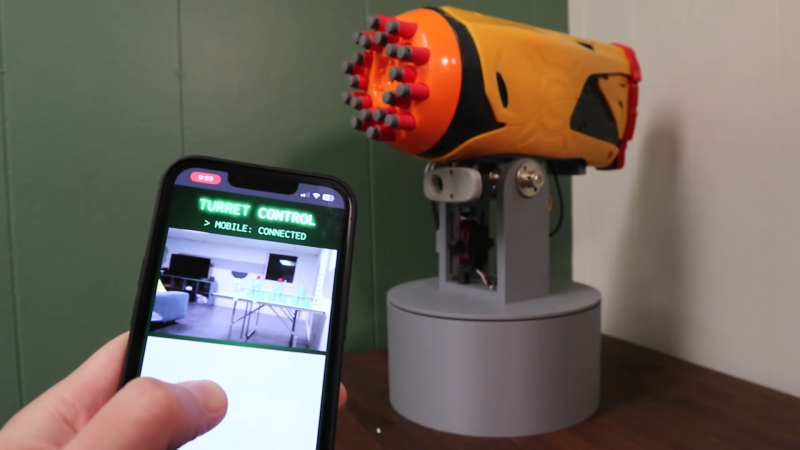
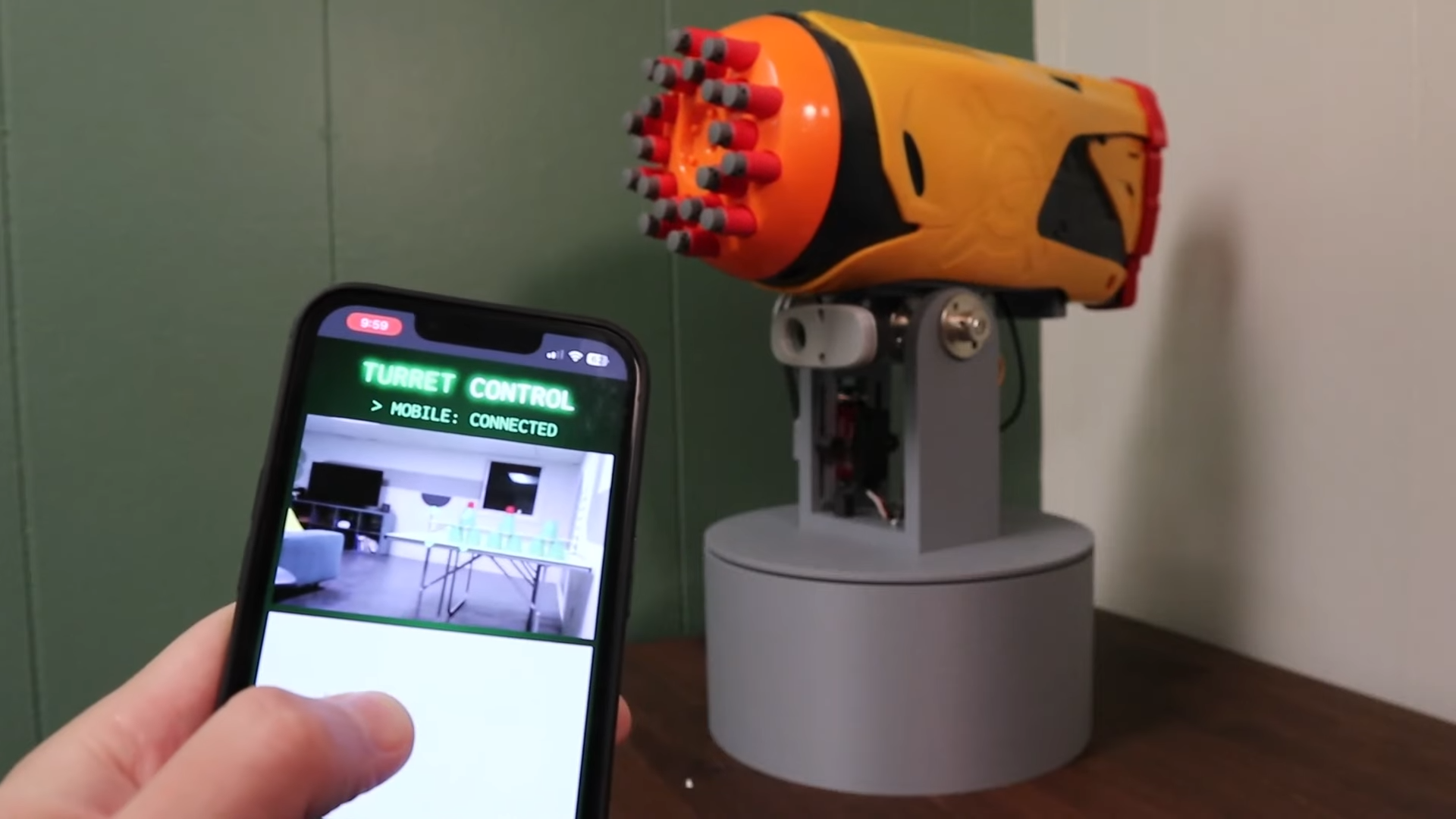
Nerf Blaster Becomes Remote Control Turret

by Lewin Day

For most of us, turrets that aim and shoot at things are the sole domain of video games. However, they’re remarkably easy to build with modern technology, as [meub] demonstrates. Meet the SwarmTurret.

The build is based around an existing foam blaster, namely the Nerf Swarmfire. This blaster was chosen for being easy to integrate into the build, thanks to its motorized direct-plunger firing mechanism and electronic trigger. It also has the benefit of being far less noisy and quicker to fire than most flywheel blasters.

For this build, the Nerf blaster was slimmed down and fitted to a turret base built with hobby servos and 3D printed components. The blaster is also fitted with a webcam for remote viewing. A Raspberry Pi is running the show, serving up a video feed and allowing aiming commands to be sent via a Websockets-based interface. Thus, you can login via a web browser on your phone or laptop, and fire away at targets to your heart’s content.

We’ve featured some great turrets before, like this Portal-themed unit.

25 May 11:51

OpenAI’s mysterious device: What are Sam Altman and Jony Ive building?

by Grigor Baklajyan
OpenAI’s mysterious device: What are Sam Altman and Jony Ive building?

“People who are really serious about software should make their own hardware,” Alan Kay says. OpenAI CEO Sam Altman and ex-Apple designer Jony Ive totally agree. Altman even backed Humane AI Pin, but that didn’t work out. The product tanked, and the company shut down. That experience might give Altman some perspective as he joins forces with Ive to build an OpenAI device as important as a laptop or a phone.

This new project marks OpenAI’s biggest acquisition yet. Ive is coming in with his crew of about 55 engineers and researchers. His studio, LoveFrom, will take the lead on creative and design work across OpenAI and focus on building hardware that makes tech feel more natural to use.

Altman and Ive aren’t thinking small—they want to move past the smartphone era, which has ruled since the first iPhone in 2007. If their idea takes off, it could kickstart a new wave of tech called “ambient computing.”

OpenAI device development in a nutshell

Jony Ive and Sam Altman

In an interview, Ive and Altman keep quiet about what their new AI gadget might look like or how it’ll work. They say more info is coming next year. But according to The Wall Street Journal, Altman showed his team a sneak peek of the thing on Wednesday. And just like that, the leaks are already starting.

This device is meant to know everything going on around you and in your day-to-day. It won’t get in the way, either—it’s something you can carry in your pocket or set on your desk. Think of it as the third piece next to your MacBook Pro and iPhone.

Reports claim it won’t be a phone, and the goal seems to be pulling people away from screens. Altman says it’s not glasses, and Ive doesn’t seem too into the idea of wearing something on your body. Still, analyst Ming-Chi Kuo thinks one possible use is wearing it around your neck.

My prediction

Humane AI Pin
Humane AI Pin

I’m starting to think it might be an AI-powered pendant. Something that stays on throughout the day, picks up on your habits, and connects with your phone or laptop with no hassle. 

I picture a voice assistant with a mic, speaker, camera, and motion sensors. Maybe it even includes a tiny projector that beams text or visuals onto your hand. If you’re chatting with someone in a different language, it can handle back-and-forth translation right on the spot. Plenty of those features made it into the Humane AI Pin, which ended up being a major letdown. So why do I believe OpenAI and Ivy might explore that direction?

In a conversation with Bloomberg, Ive described the Humane AI Pin and Rabbit r1 as “very poor products.” He pointed out the lack of fresh thinking in today’s product designs. I can understand his point. The laser display on the AI Pin drained a huge amount of power, which led to overheating. But with companies like Apple working on AI-powered battery management, I won’t be surprised if OpenAI finds a way to fit a powerful battery into a clean, compact design.

Release date

Looks like OpenAI timed its Jony Ive news to steal some of the spotlight from Google I/O. That event just wrapped and leaned into Google’s strengths—tight ecosystem, strong AI features, all that. OpenAI can’t compete there right now, so changing the conversation makes sense.

As for the upcoming device, Ming-Chi Kuo thinks it’s heading into mass production by 2027. If you’ve kept up with novel product launches, you know they don’t exactly move fast. The Vision Pro, for instance, spent 17 years in development before coming out. So yeah, I wouldn’t be surprised if OpenAI goes slow with this one too.

OpenAI device: Final thoughts

The mix of Ive’s design chops and Altman’s vision feels like a wild card with real potential. Sure, it might take a while, but I’d rather wait for something that works than rush into another flop. Fingers crossed this thing doesn’t end up as another expensive desk toy.

24 May 14:05

Unknown Unknowns

In a 2002 Pentagon briefing, then U.S. Secretary of Defense Donald Rumsfeld famously said:

"Reports that say something hasn't happened are interesting to me, because as we know, there are known knowns; there are things we know we know.

We also know there are known unknowns; that is to say, we know there are some things we do not know.

But there are also unknown unknownsthe ones we don't know we don't know.

And if one looks throughout the history of our country and other free countries, it is the latter category that tends to be the difficult ones."

It wasn't typical media material. It even won Rumsfeld the "Foot in Mouth" award from the Plain English Campaign in 2003. But the idea of unknown unknowns has endured.

Awareness—Understanding examples

When placed in a 2x2, somewhat like I have done, some people have referred to it as the Rumsfeld Matrix (although he didn't invent it), or the Awareness—Understanding Matrix. I prefer diving straight into Unknown Unknowns as they're the crux of it.

For example:

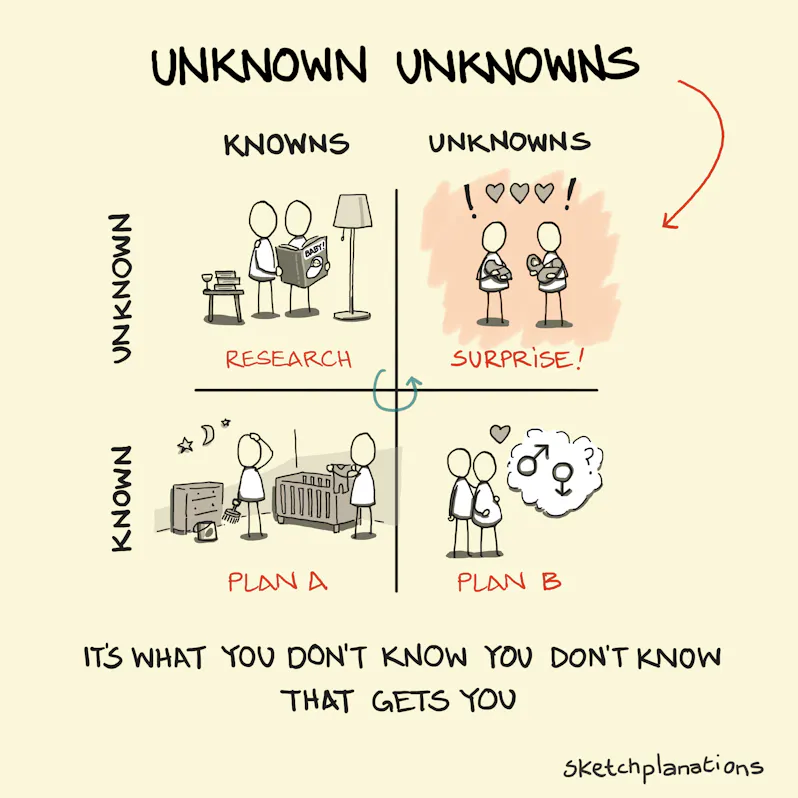
Say you find out you're going to have a baby. There's a lot you know and a lot you know you don't:

Unknown Knowns — things you know that people know about being a parent and having a baby, but you just don't know them yet. Doing your research and homework transforms these into Known Knowns.

Known Knowns are the things you already know (or just learned) you'll need to do when you're a parent. Your baby will need feeding and changing, clothes, a place to sleep etc. You plan for these, you buy clothes, a crib, and learn about breastfeeding or the bottle.

Known Unknowns — Things like the baby's gender, or whether they'll arrive early or late. You know you don't know these yet, but you can make a plan either way.

Finally, there are Unknown Unknowns — which, in this case, could be that, despite all your plans, you find yourself with twins.

Or, say you plan to start a café:

Unknown Knowns

What you know is knowable, but you don't know it, yet

You can find data on the market, the costs, and potential customers. These things can be known through research—others know them—but you didn't know them.

Known Knowns

What you know you know

Your costs, your product, your route to market, everything you learned in your research. You make your plan around these.

Known Unknowns

What you know you don't know

How people will respond to your product, how fast sales will be, and whether your rent will change.

Unknown Unknowns

What you didn't know you didn't know

Just as you launch your café, Starbucks moves in next door, or we hit a global pandemic.

It's what you don't know, that you don't know, that gets you. After all, if you knew it, you'd have prepared for it.

He Who Knows

There's a well-known saying called "He who knows" which relates to Unknown Unknowns:

He who knows not, and knows not he knows not, is a fool; shun him.
He who knows not, and knows he knows not, is simple; teach him.
He who knows, and knows not he knows, is asleep; awaken him.
He who knows, and knows he knows, is wise; follow him.

Note that, like most interpretations of the Awareness/Knowledge-understanding framework, Unknown Knowns is interpreted as things you know but don't know you know. These might be implicit knowledge that you are yet to make a connection with.

Quotes and Ideas Relating to Unknown Unknowns

We have a host of sayings and thoughts that relate to this.

  • Nassim Nicholas Taleb's Black Swan events: if every swan you've ever seen is white, it's easy to assume that all swans are white, but the next one you see could be black.
  • The Lucretius problem, also from Taleb: We tend to believe the biggest event we've seen is the biggest that could happen. For example, we test our financial models against the most significant market crashes, but each was bigger than any that had hit before.
  • In theory, practice is the same as theory, but not in practice.
  • No plan survives contact with the enemy — from Prussian Field Marshal Helmuth von Moltke the Elder
  • It has often and confidently been asserted, that man's origin can never be known : but ignorance more frequently begets confidence than does knowledge : it is those who know little, and not those who know much, who so positively assert that this or that problem will never be solved by science. — Charles Darwin, The Descent of Man (1871) introduction

Whatever our plans, or what we think we know, or even what we think we know we don't know, we must adapt to succeed.

Related Ideas to Unknown Unknowns

Unknown unknowns evidently weigh heavily on me, as I seem to have drawn many more related ideas:

24 May 14:04

Ceci n’est pas un missile, mais un obus propulsé par un statoréacteur !

by Sylvain Biget, Journaliste
Au coup de feu, un boum, puis un énorme sifflement semblable à celui d’un réacteur. Voici l’obus de 155 mm du futur : une munition qui est propulsée par un statoréacteur, pour une portée quatre fois plus importante qu’un obus classique.
24 May 14:02

The AI in drug R&D market map

by Ellen Knapp

Billion-dollar drug development costs are redefining pharmaceutical priorities. R&D expenses have increased tenfold since the 1980s (after adjusting for inflation), and pharmaceutical companies now allocate approximately 25% of their revenue to R&D – nearly double the share seen in the early 2000s. 

In response to these cost pressures, pharma companies are using AI to make R&D more efficient. These capabilities enable organizations to quickly identify and evaluate promising drug candidates, influencing the selection of therapeutic approaches that advance to development.

AI could potentially cut years off the discovery process and compress clinical trial times by up to 30%. This would accelerate the delivery of new treatments to patients, unlock novel treatment approaches, and enable more personalized medicine. Companies that effectively leverage these AI capabilities will gain crucial advantages in speed, precision, and breakthrough discoveries.

Get the world’s best tech research in your inbox

Billionaires, CEOs, & leading investors all love the CB Insights newsletter

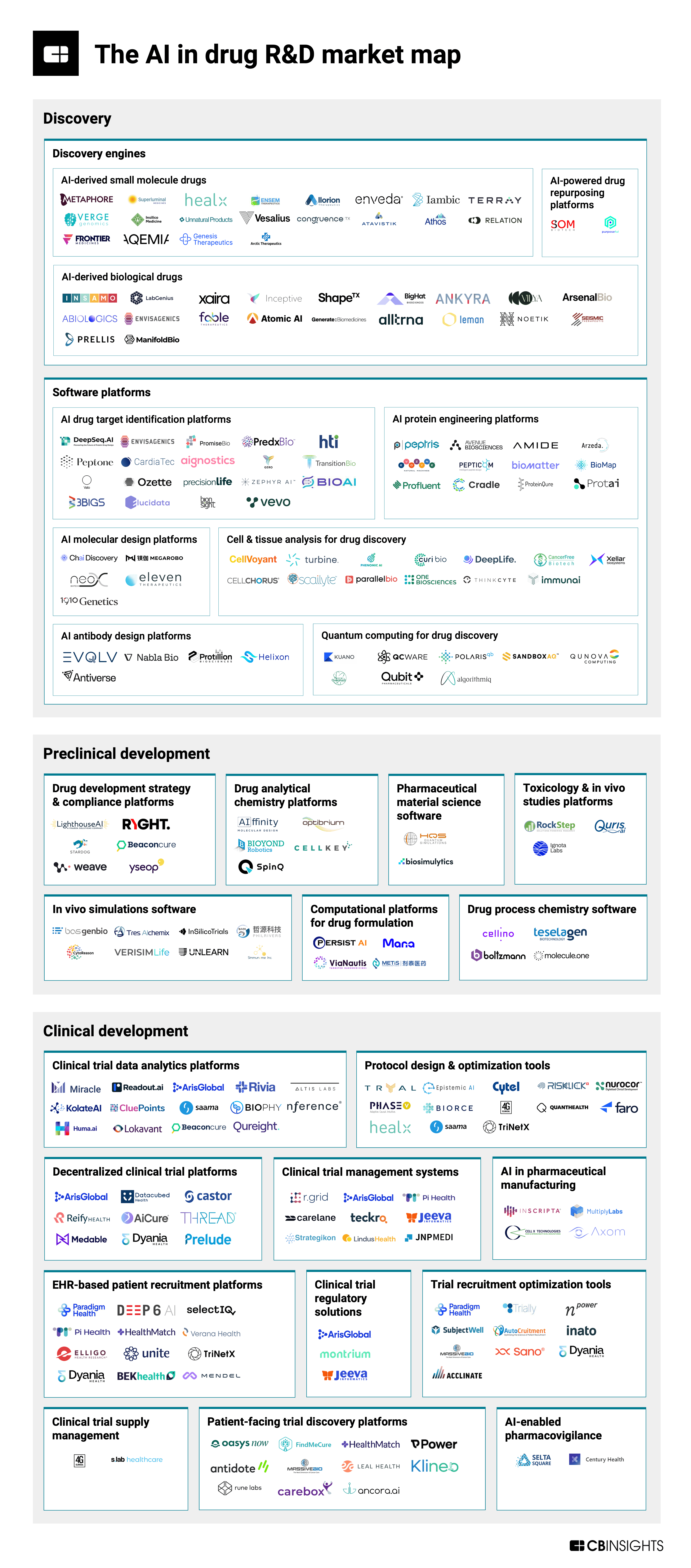
Our analysis maps 225 AI-driven drug R&D companies across 27 markets. Below the map, we break down several trends shaping the future of pharmaceutical innovation, as well as share the methodology we used to select and categorize companies.

Please click to enlarge.

Note: This market map is not intended to be exhaustive, and categories are not mutually exclusive. For more, see the detailed methodology at the bottom of this report.

Key takeaways

    • AI tools for clinical development are more commercially mature than the emerging field of preclinical applications. According to CB Insights’ Commercial Maturity scores, 37% of clinical development companies have reached the most mature commercial stages (4: Scaling or 5: Established) compared to just 7% of preclinical companies. Late-stage funding follows a similar pattern — 9% of clinical development funding since 2023 has gone to late-stage companies, compared to just 3% for preclinical tools.
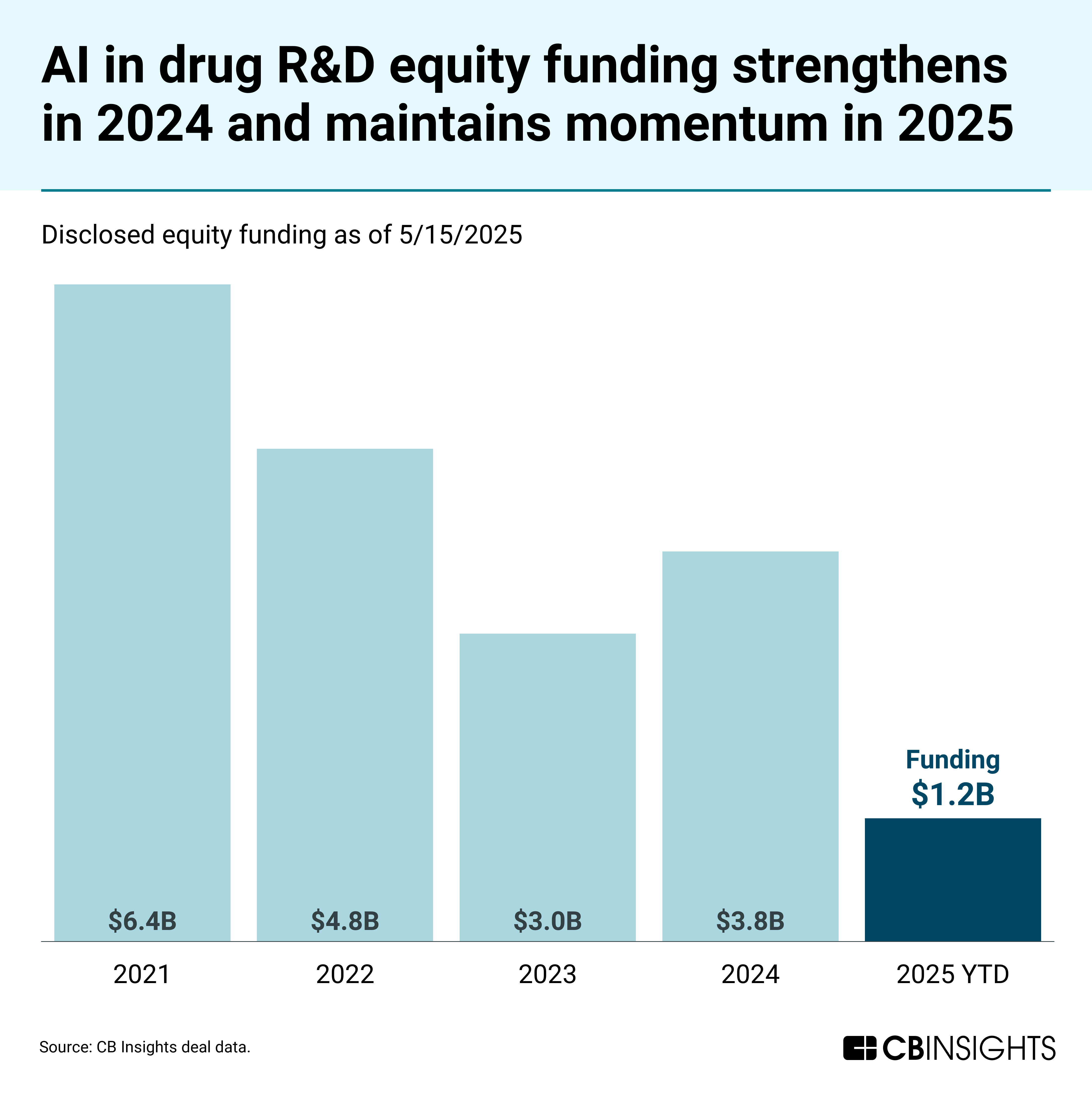
    • AI funding in drug R&D rebounded in 2024, with discovery engines capturing the majority of investments amid consolidation in the clinical trial sector. In 2024, equity funding grew to $3.8B (up from $3B in 2023), with AI-derived biologics and small molecules attracting $1.1B and $1B, respectively. Early 2025 momentum suggests the sector is on track to match last year’s strong performance.
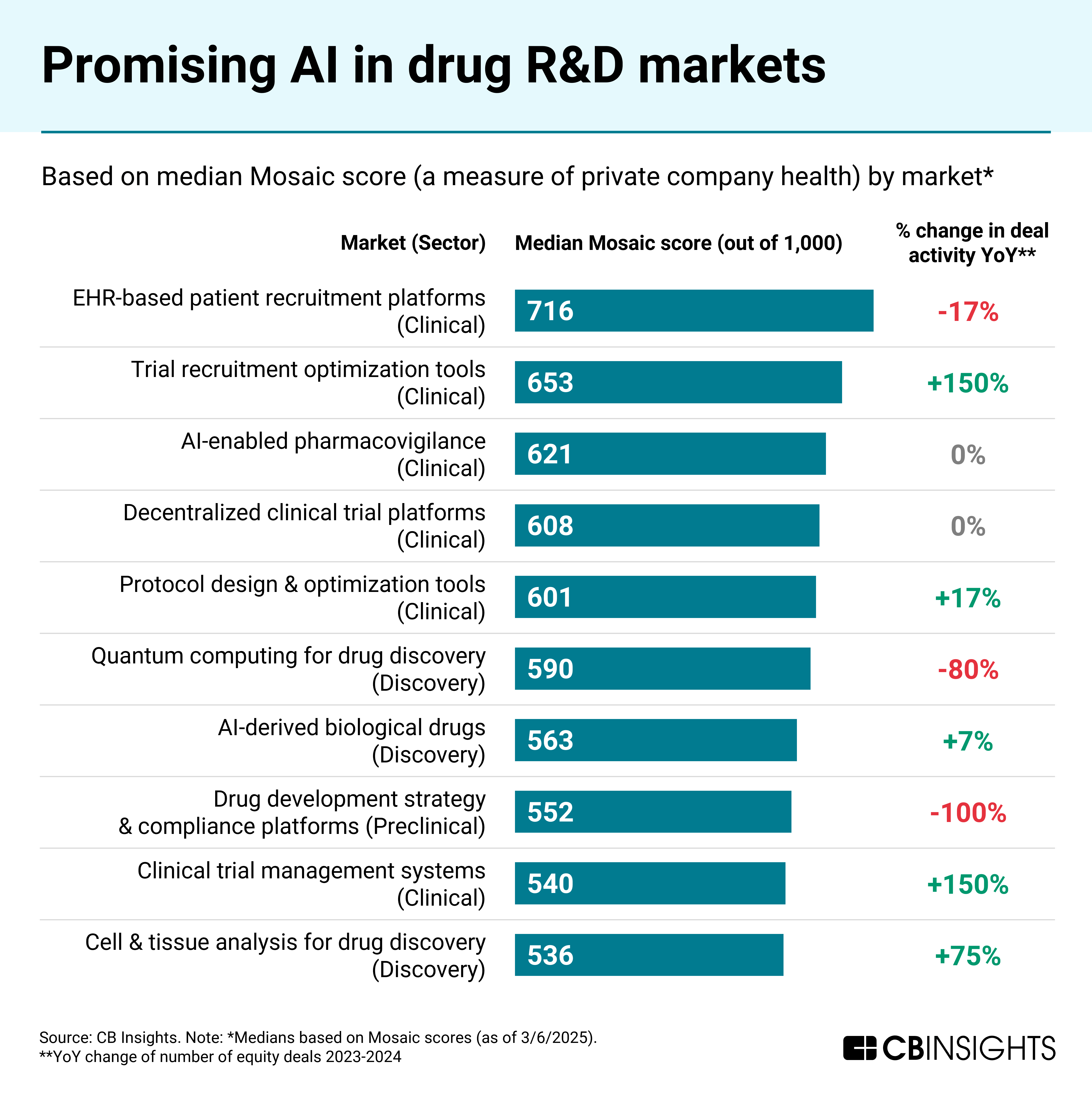
    • Patient recruitment platforms and clinical trial management systems demonstrate the strongest momentum. Examining market performance through average CB Insights Mosaic scores (a proprietary measure of private-company health and growth), EHR-based recruitment platforms lead (716 out of 1,000), while trial management systems show highest deal growth (+150% YoY). Look to these markets as high-growth areas to track within the AI drug R&D space.

Clinical development AI tools have achieved commercial maturity, while preclinical applications offer emerging investor opportunities

The adoption of AI in drug R&D is still emerging, and its pace varies across different sectors.

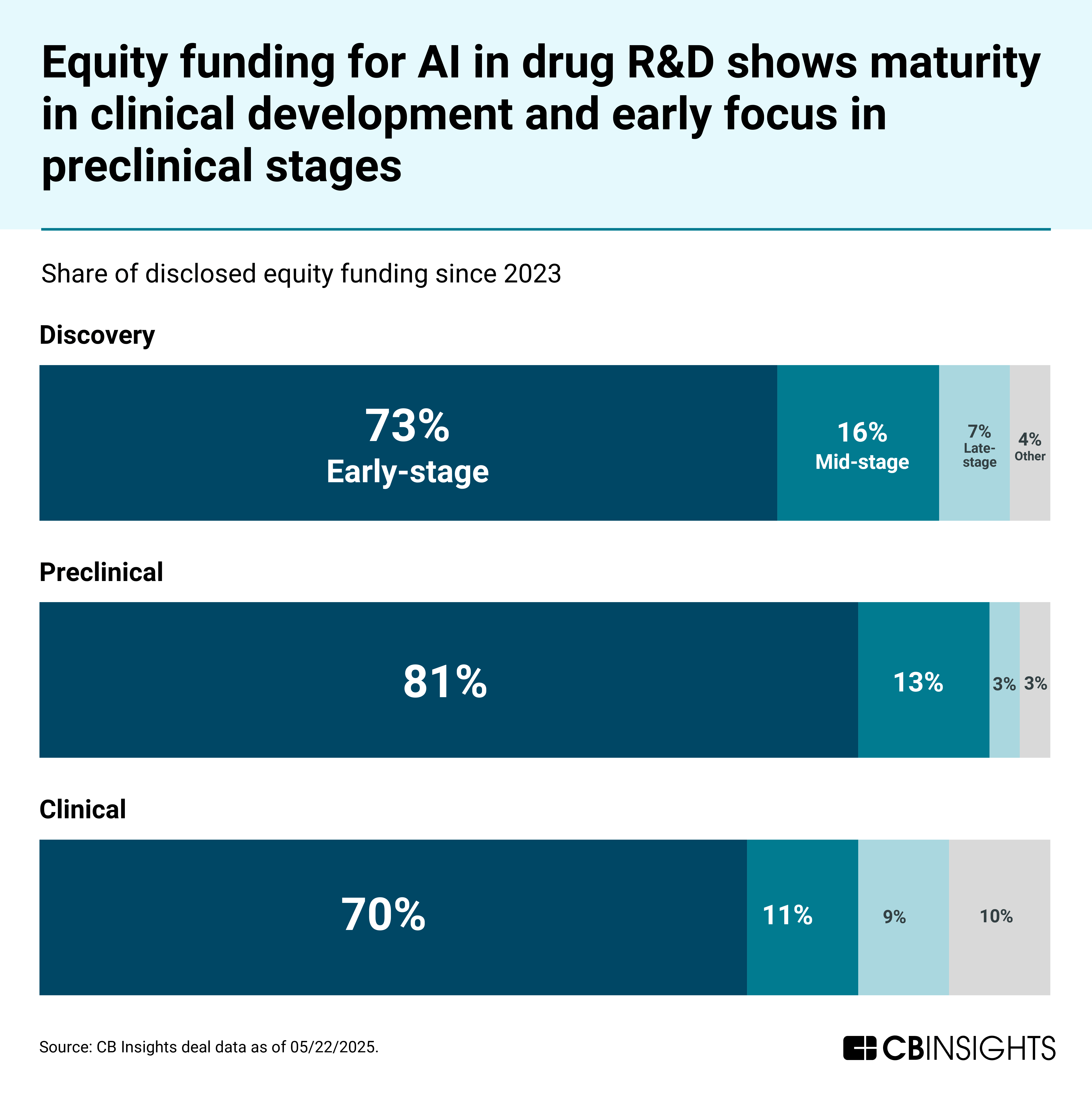
While early-stage funding dominates all sectors, preclinical development remains the most nascent, with 81% of funding since 2023 directed to early-stage deals and only 3% to late-stage deals. 

Clinical development shows greater maturity — still led by early-stage deals, but with a more established cohort of companies in later stages (70% early-stage, 9% late-stage funding).

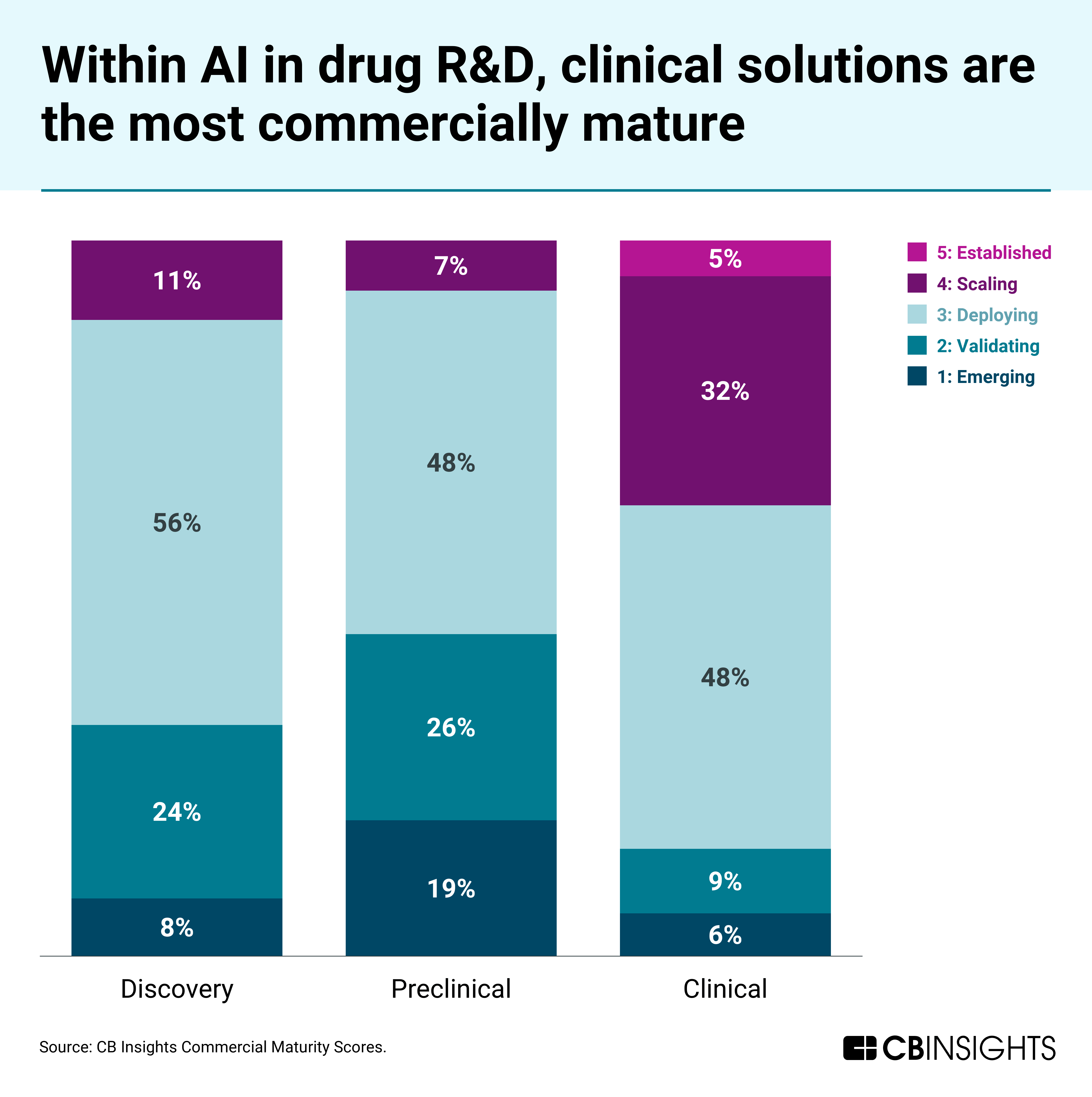
CB Insights’ Commercial Maturity metrics further highlight this disparity. 

In preclinical development, 45% of companies are in the earliest commercial stages (1: Emerging and 2: Validating) compared to 32% in discovery and just 15% in clinical development. 

Conversely, only 7% of preclinical companies have reached the most mature stages (4: Scaling or 5: Established) vs. 11% in discovery and a substantial 37% in clinical development.

The disparities in maturity stem from each sector’s unique characteristics:

  • Clinical development AI solutions often build upon existing healthcare technology infrastructure, facilitating faster adoption. 
  • The use of AI in discovery carries higher investment risks as companies develop unproven molecules from scratch. 
  • Preclinical development, positioned mid-pipeline, offers more specialized solutions and faces stricter regulatory scrutiny, explaining its slower advancement despite growing momentum.

For investors, this creates a clear distinction: Clinical development companies provide stronger near-term return potential, while the emerging preclinical space offers better opportunities to establish early market advantages.

CBI iconExplore all 700+ AI in drug R&D companies

Drug R&D AI funding recovers as discovery engines lead investments amid clinical trial sector consolidation

After declining YoY between 2021 and 2023, equity funding across AI in drug R&D rebounded in 2024, growing from $3B to $3.8B and significantly surpassing pre-pandemic levels ($2.7B in 2019). The momentum continues in 2025, which, after Q1, is on pace to match 2024’s performance, bolstered by Isomorphic Labs‘ $600M Series A round in March 2025.

Among markets, discovery engines led funding in 2024, with AI-derived biologics securing $1.6B in equity funding and AI-derived small molecules attracting $1B. This aligns with these companies’ higher funding requirements for developing therapeutics and conducting clinical trials. It also demonstrates investors’ strategic bets on AI’s potential to slash drug discovery timelines — with discovery engines serving as the primary vehicles to prove this capability.

Enveda stands out here, having raised a $130M Series C in November 2024, followed by an additional $20M investment from Sanofi in February 2025 — a strong endorsement of its platform, which combines machine learning, metabolomics, and robotics to identify novel compounds from medicinal plants. The company’s recent collaboration with Microsoft Azure (May 2024) further positions it to scale its generative AI capabilities.

Beyond discovery engines, quantum computing platforms had an exceptional 2024, raising $376M, while decentralized clinical trial platforms followed, securing $129M. Huma led the latter group with an $80M Series D round in July 2024, while the market simultaneously underwent a wave of consolidation, with 5 acquisitions in 2024 alone, doubling all exits since 2020. 

However, among these acquisitions, only Aparito (purchased by Eli Lilly in July 2024) leverages AI in its offerings through its Atom5 platform, which enables comprehensive remote data collection and AI-powered data analysis.

CBI iconAnalyze AI in drug R&D deals

Patient recruitment and quantum computing lead commercial momentum in AI-driven R&D

According to CB Insights’ Mosaic scores, the highest-momentum AI markets across phases of drug R&D are: 

Among these high-potential sectors, several companies are making significant advances. 

SandboxAQ (Mosaic score: 843) leads in the quantum computing space; its 2023 release of the AQBioSim technology stack combines AI and quantum algorithms to predict molecular behavior and accelerate drug discovery. This expansion into biotech applications attracted Sanofi, resulting in a partnership in October 2024. 

In the regulatory domain, Weave (Mosaic score: 575) has positioned itself as an early mover in AI-driven regulatory automation for life sciences. Its AutoIND platform, launched in 2024, claims to reduce IND application timelines by up to 70%. 

Among these top 10 markets, trial recruitment optimization tools and clinical trial management systems showed the most growth in deals from 2023 to 2024. This illustrates increasing investor confidence in technologies that address critical bottlenecks in clinical trial efficiency and challenges related to patient enrollment.

In these markets, the companies with the highest Mosaic scores demonstrate rapid advancement and growing investment appeal:

  • In the clinical trial management space, Lindus Health (Mosaic score: 874) secured a $55M Series B round in January 2025 and established a partnership with the Clinical Data Interchange Standards Consortium (CDISC) in February 2025. This collaboration with CDISC — a nonprofit that sets standards mandatory for FDA submissions — focuses on automating data standardization using Lindus Health’s AI platform for trial protocol generation and analysis.
  • Paradigm Health (Mosaic score: 822) leads in trial recruitment optimization with its AI-driven platform for patient recruitment and trial management. Its deployment across 400 research sites and 1,000 healthcare provider locations in 3 countries helped it secure a $203M Series A in January 2023. In November 2024, Japan’s National Cancer Center selected Paradigm for its nationwide clinical trial network to advance precision medicine initiatives, expanding the company’s footprint in the Asian oncology research market.

These market signals suggest AI’s most immediate and transformative impact on drug development will come not from scientific breakthroughs alone, but from technologies that systematically eliminate the operational inefficiencies that have historically extended development timelines and inflated costs.

CBI iconDive into all drug R&D tech markets

Methodology

To identify players for this market map, we reviewed AI companies in drug R&D markets and included startups with a Mosaic score of 400+ that have raised funds within the last 5 years. For markets where these criteria identified more than 20 companies (AI-derived small molecule drugs, AI-derived biological drugs, and molecular design platforms), we selected those that had raised at least $20M in funding. If further reduction was needed, only companies in the top 20 Mosaic scores are shown. 

Categories on the market map align with our recent 3-part series on AI in drug R&D:

  • Discovery encompasses workflows from project inception through lead selection, where discovery platforms are companies whose products are AI software systems, while discovery engines are companies whose products are therapeutics discovered using proprietary AI systems. 
  • Pre-clinical development covers lead development to the first regulatory filing (an Investigational New Drug (IND) application in the United States)
  • Clinical development spans from the start of clinical trials through commercialization

For information on reprint rights or other inquiries, please contact reprints@cbinsights.com.


. . . . . . . . . . . . . . . . . . . . . . . . . . . . . . . . . . . . . . . . . . . . . . . . . . . . . . . . . . . . . . . . . . . . . . . . . . . . . . . . . . . . . . . . . . . . . . . . . . . . . . . . . . . . . . . . . . . . . . . . . . . . . . . . . . . . . . . . . . . . . . . . . . . . . . . . . . . . . . . . . . . . . . . . . . . . . . . . . . . . . . . . . . . . . . . . . . . . . . . . . . . . . . . . .

The post The AI in drug R&D market map appeared first on CB Insights Research.

24 May 14:00

Une IA bouleverse 50 ans de certitudes sur ces étranges structures martiennes 🔴

by Cédric DEPOND
Les stries sombres qui zèbrent les pentes martiennes interrogent les scientifiques depuis des décennies. Une étude récente, s'appuyant sur l'intelligence artificielle, élimine l'hypothèse de...
24 May 13:59

Liens vagabonds : Génération connectée, génération en quête de déconnexion

by oansah

Ils sont nés avec Internet dans la poche, et pourtant… 47 % des jeunes de 16 à 21 ans déclarent qu’ils préféreraient “être jeune dans un monde sans Internet”. Une aspiration choc, qui soulève une question essentielle : que signifie “être jeune sans Internet” pour une génération qui n’a jamais vécu déconnectée ?  S’agit-il de vivre […]

The post Liens vagabonds : Génération connectée, génération en quête de déconnexion first appeared on Méta-media | La révolution de l'information.

24 May 13:51

Exclusive: Rivet Industries Using Lumus Waveguides for Military & Industrial AR

by Karl Guttag

Introduction

On Tuesday, May 13th, the first day of the Display Week Expo, a couple of people asked me if I had heard of this new company, “Rivet,” which I hadn’t heard of up to that point. I asked around at Display Week, and a few other people knew something about them but couldn’t talk. I was able to confirm that several of the key people worked at Microsoft on HoloLens (several people at Rivet, including the CEO and CTO, worked on HoloLens at Microsoft).

It wasn’t until I got back home that I had time to do some more research about Rivet and, more importantly for this article, figure out what technology they were using. As it turns out, Rivet’s display and optics technology were hiding in plain sight on their website, Rivet.us. Consider it a hobby of mine to try to figure out what is inside AR glasses when the companies won’t say what they are using, as I discussed in my last article: Meta Hypernova and Google AR/AI Glasses – Lumus & Avegant Inside, Both Using LCOS MicroDisplays.

AWE on June 10-12, 2025 (Attending and Speaking)

For anyone wanting to meet me, I will be at AWE on June 10-12. I’m happy to meet with both companies and individuals. Please email me at meet@kgontech.com if you want to meet. I’m also going to be speaking on Thursday, June 12th, from 10:30 AM -10:55 AM in the Promenade Room 104 B.

Rivet Industries

Rivet Industries (hereafter Rivet) emerged from stealth mode just before Display Week 2025 and has created a bit of a buzz in the AR industry. According to PitchBook, Rivet raised $12.6M in its last round (there were probably prior rounds), but perhaps more importantly, Rivet appears to have some powerful connections (more on these connections later).

Rivet is aimed at Defense, Security, and Industrial applications. Still, most of the images on the website make it look like a direct competitor for the US Army’s $22B IVAS program that was first “won” by Microsoft’s HoloLens 2. It was widely known that the Army was dissatisfied with the HoloLens 2, which opened the door to other options before much of the IVAS money was paid out. In February 2025, it was announced that Andruil would take over Microsoft’s HoloLens contract, and the US Army approved this in April 2025.

I contacted Rivet with some of the pictures used in this article that proved that Lumus waveguides were in its AR glasses, and they responded nicely, but without answering the question about Lumus:

Rivet develops modular systems configured for the unique needs of defense and industrial tasks. We design, select, and integrate components to suit user and operational performance requirements. We will continue to release details and FAQs on our public website, www.rivet.us.

I have been told that the pictures on their website are of working devices.

Proof of Lumus Z-lens and Maximus Waveguides Used by Rivet

After returning from Display Week, I started looking through every picture on Rivets’ website. In most of the pictures, the glasses were so small that any detail was lost, and in others, the contrast or lighting made it impossible to see any details. I downloaded a few pictures that looked like they best showed glasses and looked blown up on my computer.

Rivet Glasses with Lumus Z-Lens

My first eureka moment happened with a picture (right) on Rivet’s contact page (still there as of this writing). On the lower right corner of the right lens (as you look at the pictures, the user’s left eye), I could see some faint lines indicative of the Lumus Z-Lens’s vertical pupil expansion reflective facets. I have been covering Lumus’s Z-Lens since CES and AR/VR/MR 2023, so I was very familiar with how it looks.

To help you see it better, I cropped the pictures above to just the glasses and then enlarged and enhanced (simple sharpened, lightened, and improved the contrast – no AI) in the picture below. I have also added a picture I took of the Z-lens at AWE 2024 out of the glasses for reference. That Z-Lens has push-pull prescription lenses (by AddOptics) glued directly (with no air gap) to the Z-Lens waveguide. You can see the Z-Lens vertical pupil expansion facets pointed at by the arrow. Most of the facets are covered by a black layer, but a few are visible at the bottom.

Knowing that I had found a Lumus Z-Lens in one picture, I started looking for evidence of it in other pictures and found the one on the right, shot from behind the waveguide. You can see the expansion facets (right at the arrow).

Lumus has shown Z-Lens waveguides that support up to a 50-degree FOV and typically use LCOS microdisplays. As I wrote last time in Meta Hypernova and Google AR/AI Glasses – Lumus & Avegant Inside, Both Using LCOS MicroDisplays, Lumus’ 30-degree FOV Z-lens with an LCOS microdisplay is suspected to be inside the rumored Meta Hypernova AR/AI Glasses. I would expect that the larger 50-degree Z-lens would be the Rivet. I should also note that Lumus has presented 70-degree Z-Lens waveguides in development that will also use relatively low-index glass, rather than higher-index glass used by diffractive waveguides or the more exotic Silicon Carbide, such as Meta’s Orion (see: Meta Orion AR Glasses (Pt. 1 Waveguides)).

Rivet Glasses with Lumus Maximus

Having found the Z-Lens in a couple of photos, I later went back to see if I could find more evidence. To my surprise, I was able to see the horizontal expansion facets indicative of a Lumus Maximus waveguide in the picture (right) on Rivet’s “Hard Spec” page (as of this writing).

Rivet’s website picture contains many distracting orange circles (perhaps by design to conceal the glasses). To make the Lumus Maximus waveguide more visible, I processed it in Photoshop to reduce the orange color and adjusted the brightness, contrast, and sharpening (no AI). I have additionally added a picture that I took when writing the 2021 article, Exclusive: Lumus Maximus 2K x 2K Per Eye, >3000 Nits, 50° FOV with Through-the-Optics Pictures for comparison. You may also notice that the engine on the side of the Rivet glasses looks to be similar to that of the Lumus Maximus.

Comparison of Rivet’s Z-Lens Based on Maximus-Based Glasses

The exterior frames of the Z-Lens and Maximus-based Rivet designs look very similar (see below). The picture with the orange circles is the only one I found on Rivet’s website that clearly uses the Lumus Maximus waveguide. However, this could be due to Rivet’s prototype development process and what was ready for pictures, and it is not indicative of what they will use in their product. I have no idea whether Rivet plans to use Maximus or Z-lens or both in their series of products.

Lumus Geometric Waveguides

Lumus, unlike most others, uses a geometric (also known as reflective) waveguide. In my experience, they offer much better color uniformity than the more common diffractive waveguides. They are also the most transparent, with about 90% transmissivity. Typically, Lumus engines are much brighter than their diffractive counterparts, with light output (to the eye) on the order of 1,000 to 3,000 nits. Lumus waveguides are inherently more optically efficient than diffractive waveguides, which contributes to the greater brightness.

Lumus’s Maximus, like the Z-Lens, uses glass with a lower index of refraction than typical diffractive waveguides. Unlike the Z-Lens, the Maximus waveguides require an air gap when used with push-pull and prescription lenses. My understanding is that the Maximus has better light throughput efficiency than the Z-Lens, but may be more expensive to make and requires an air gap when bonding other optics to it.

Originally, Lumus only had 1-D pupil expanding waveguides, which resulted in rather large optical engines. Lumus found its way into many military and a few industrial products. Lumus’s first geometric 2-D expanding waveguide was the Maximus, introduced in 2023, which enabled a much smaller LCOS optical engine. The Z-lens took this a step further with even smaller LCOS optical engines and the ability to bond other optics directly to the waveguide.

There are also several “clones” of Lumus’s geometric technology, mostly coming out of China. I have never seen any that look nearly as good in terms of uniformity as the Lumus models. Lumus also touts a very strong patent portfolio on its technology.

Teaser On Lumus Maximus with a Fantasically Tiny MicroLED Projector

At last week’s Display Week, Lumus demonstrated a very small projector using a Playnitride full-color MicroLED (using Quantum Dot color conversion) connected to their Maxmus waveguides. They also showed me that they have a working (but not publicly shown), what I can best describe as a fantastically tiny MicroLED projectormore on this, complete with pictures, in my next article.

Small World – Peter Thiel, Palantir Technologies, Anduril, Microsoft HoloLens, and IVAS Connections to Rivet

In searching the internet to learn more about Rivet, I stumbled across some interesting “connections.” In “Six Degrees of Kevin Bacon” terms, they are either one or, at most, two degrees of separation.

While Rivet was founded in 2024, it has some royal roots. Several of the founders and early employees came from Microsoft’s HoloLens IVAS program. Rivet’s founder and CEO, Dave Marra, was at Microsoft from 2013 to January 2023, and for five of those years, he was the Program Director for the HoloLens IVAS program. Mohit N. is the CTO of Rivet and was the Vice President Of Engineering, Augmented and Virtual Reality Core Technologies at Microsoft HoloLens.

Rivet CTO Marra left Microsoft in January 2023 and became the head of Mixed Reality at Palantir Technologies, a large data software company for military, government, and corporate use. Marra Founded Rivet in or about January 2024 while staying on at Palantir as a Strategic Advisor until January 2025 (according to his LinkedIn profile).

Significantly to the Rivet story, famous entrepreneur Peter Thiel is one of the founders and the current Chairman of Palantir. In 2014, Thiel convinced Trae Stephens to join Thiel’s VC firm, Founders Fund. Then, in 2017, with backing from Thiel’s Founders Fund, Stephens co-founded Aduril with former Oculus founder Palmer Luckey.

In addition to Rivet CEO Marra, two Palantir executives are listed by Bizapedia as directors of Rivet. One of those directors, Akash Jain, CTO and President, USG, Palantir, is quoted on Rivet’s website, “Working with Rivet, we are extending human skills with intelligent systems for precise, data-determined action anywhere.” Rivet also lists Palantir as one of their “Partners” and states, “Palantir is redefining workforce capabilities at the edge with AI-powered spatial intelligence.” The other “partner” listed on Rivet’s site is the defense contractor Northrop Grumman.

I don’t know if Rivet has any direct connection to Anduril, whether they are frenemies or perhaps may become partners. Still, several of the big-name players from Anduril and Rivet, at least, know each other. It is not clear whether Rivet is directly competing for future IVAS contracts. Anduril seems more focused on military and other government-related products, whereas Rivet says they are also going after industrial markets. Rivet claims to have a modular design that can be adapted for different markets.

There Is a Big Hole in the Enterprise/Industrial Market Left by HoloLens’s Exit

One thing I keep hearing is that multiple former HoloLens customers are looking for a next-generation product to fill the gap left by Microsoft’s abandonment of HoloLens in the Enterprise/industrial market. While the HoloLens 2 had horrible image quality, as this blog has documented, many companies found HoloLens 1 & 2 useful.

While widespread consumer adoption of augmented reality is still speculative, the value of AR in enterprise/industrial applications seems obvious. The “elevator speech” for the value proposition AR in enterprise applications is simple:

If AR can help a worker be just a few percent more productive, then even expensive AR glasses/headsets will pay for themselves within a few months. Combining AR headsets with cameras and AI, they can also detect any quality issues and give instantaneous feedback to improve quality.

Enterprise headsets are not limited by the consumer market’s severe “look like ordinary glasses” and cost constraints of the consumer market. This enables the integration of more processing, wider FOVs, SLAM, and Multiple cameras.

In addition to Rivet, the Digilens Argo is another product I would put in this space. I have written about Argo several times, including here, and discussed it in a video with Brad Lynch here.

Conclusion

I believe there is a solid market for the type of products that Rivet is trying to address. While not the potential unit volume of smart glasses with displays, there is a much more solid business case that can be made for Rivet’s type of products. I was disappointed by what I thought were poor design choices taken by Microsoft HoloLens and Magic Leap in the past.

Lumus has been demonstrating Maximus (in 2021) and Z-Lens (in 2023) prototype glasses to me for many years. Their combination of image quality, transparency, efficiency, and support of wider FOV in glass has seemed to be a big advantage over diffractive waveguides. I have been waiting to see these Lumus 2-D expanding waveguides in products. With Rivet use and the rumors of Lumus being in Meta’s Hypernova, it looks like Lumus waveguides are may be finally making it to market in a big way.

Rivet, with some of its founders and early employees’ roots in Microsoft’s HoloLens, seems to be applying lessons learned from HoloLens. They are going with Lumus waveguides, which, as I demonstrated in Exclusive: Lumus Maximus 2K x 2K Per Eye, >3000 Nits, 50° FOV with Through-the-Optics Pictures, blows away the HoloLens 2 in image quality and resolution and with a similar FOV (see pictures below taken with the same camera and lens). Lumus’s 2021 Maximus was using a Compound Photonics 2K by 2K LCOS display. As was the first to report in January 2022 in Exclusive: Snap Buying Compound Photonics (LCOS and MicroLED), Snap bought compound photonics. Since then, Lumus has coupled its waveguides to Raontech’s LCOS devices (and perhaps others).

HoloLens 2 used a complex “butterfly” diffractive waveguide combined with a laser beam scanning projector (see HoloLens 2 Display Evaluation (Part 4: LBS Optics)). Microsoft likely spent hundreds of millions, if not billions, of dollars on R&D and manufacturing development on both the waveguide and LBS projector for a terrible (in terms of image quality) result, which left me shaking my head. The Rivet team seems to have learned from that mistake and is leveraging Lumus’s waveguides and LCOS displays.

As I wrote in my last article about Hypernova and Google XR, I don’t understand why the large companies in the AR space have spent so much on certain technologies in areas with a lot of competitive IP, such as diffractive waveguides, while overlooking the likes of Lumus and Avegant.

24 May 13:50

Un organisme vivant inconnu sur Terre découvert à bord de la station spatiale chinoise 🚀

by Cédric DEPOND
La station Tiangong abrite un micro-organisme inconnu sur Terre, révélant des adaptations étonnantes à l'environnement spatial. Cette découverte ouvre des perspectives inattendues pour la...
24 May 13:48

People Centric Operations 2.0 : comment l’IA réinvente le travail du savoir à l’échelle

by Bertrand DUPERRIN

J’ai toujours défendu l’idée que la performance des entreprises dépendait avant tout du « work design », de la manière dont le travail était réellement accompli par les personnes. C’est d’une certaine manière le fondement de ce que j’ai appelé les People Centric Opérations : concevoir l’organisation non pas autour de structures ou d’outils, mais autour des flux d’information, de décision et de collaboration qui soutiennent l’activité des collaborateurs du savoir (People Centric Operations : adapter travail et opérations aux travailleurs du savoir).

Vous pouvez vous dire que j’enfonce des portes ouvertes mais c’est un constat que j’ai fréquemment fait dans ma carrière : peu de managers et finalement quasiment personne ne s’intéresse à savoir comment le travail est fait. On connait la mission, la fiche de poste, mais personne ne sait ce que font concrètement les gens pour y parvenir, leurs taches du quotidien, imposées ou masquées, dans toute leur granularité. D’ailleurs Yves Morieux ne disait pas autre chose dans son (excellent) livre Smart Simplicity :  « Personne ne sait vraiment ce que font les autres dans l’organisation« . (Smart Simplicity : 6 règles pour gérer la complexité sans devenir compliqué). J’ajoute même que non seulement ils ne savent pas ce que les autres font mais également qu’ils ne savent pas comment ils le font non plus. Et qu’en plus ils n’en ont rien à faire.

Quand on se fait pas ce que font les gens ni comment ils le font reconnaissons qu’il est bien difficile d’améliorer les choses.

Mais l’approche que je proposais, aussi pertinente soit-elle dans ses principes, se heurte à une limite : la complexification croissantes des organisations modernes voire, pire, leur complication. Les Les flux se multiplient, les outils sont fragmentés, les processus se superposent et à un moment donné l’intention people-centric, aussi sincère soit-elle, ne suffit plus.

Le cas Moderna dont je parlais il y a peu (Fusion des RH et de l’IT : Moderna redessine son organisation pour et avec l’IA) a été sinon une révélation en tout cas l’illustration de la nécessité d’aller plus loin et rentrer dans une nouvelle dimension. L’entreprise ne se contente pas, selon l’expression habituelle et galvaudée de vouloir « remettre l’humain au centre » mais elle reconstruit son organisation autour d’une logique de flux en s’appuyant sur l’IA pour orchestrer le travail en temps réel.

En bref :

  • La performance des entreprises repose sur une organisation du travail centrée sur les flux d’information, de décision et de collaboration, plutôt que sur les structures ou outils traditionnels (People Centric Operations).
  • L’approche traditionnelle atteint ses limites face à la complexité croissante des organisations ; l’IA permet de dépasser ces limites en orchestrant dynamiquement les tâches et en soutenant l’agilité opérationnelle.
  • L’exemple de Moderna illustre un changement de paradigme : l’entreprise adopte une organisation fondée sur les flux et la collaboration entre compétences humaines et capacités technologiques, en fusionnant RH et IT.
  • Cette transformation redéfinit les rôles managériaux, la gouvernance, et les indicateurs de performance, plaçant la fluidité des échanges, l’adaptabilité et l’expérience collaborateur au cœur du système.
  • Inspirée par des logiques industrielles (flux, orchestration, configuration modulaire), cette approche vise à industrialiser intelligemment le travail du savoir, sans trahir l’humain, en faisant de l’IA un partenaire de co-construction.

Penser l’organisation comme une série de flux, pas comme des silos métiers

Quand on parle de digital workplace j’ai toujours critiqué l’expérience utilisateur proposée par les outils qui la composent, qu’on parle d’outils de collaboration ou d’outils métiers. Oui des efforts énormes ont été faits pour améliorer l’UI et l’UX de chaque application mais l’utilisateur n’en récolte pas les fruits. En effet chaque application améliore sa propre expérience, verticale, dans son silo, alors que le parcours du collaborateur dans les outils est, lui, transverse et est donc transverse aux outils (Quelle (digital) workplace experience pour vos collaborateurs ?).

Les uns pensent les interfaces d’un silo, les autres vivent un parcours qui traversent les silos.

Cette logique que j’appliquais à l’environnement de travail, Moderna l’a appliquée au design de l’organisation et du travail.

Dans le cas Moderna beaucoup ne retiennent la chose la plus marquante, à savoir la fusion des départements RH et IT sans vouloir creuser davantage. Mais ça n’est que la conséquence, la partie immergée de l’iceberg. La vraie leçon que nous pouvons en tirer est que l’entreprise abandonne les logiques métiers traditionnelles pour envisager son organisation comme une série de tâches à orchestrer en continu. Le cœur de sa réflexion n’est plus « qui possède la tâche », mais « quelle configuration humaine et technologique permet de produire le meilleur résultat avec rapidité et précision ».

Dans cette logique, la fusion des équipes RH et IT placées sous la responsabilité d’un Chief People and Digital Technology Officer, incarne cette volonté de rapprocher ceux qui façonnent la culture et ceux qui conçoivent l’infrastructure technologique (Why Moderna Merged Its Tech and HR Departments) ou, reformulé à ma manière, les compétences et les talents, le cadre dans lequel on les excerce et les outils qui supportent le travail.

L’IA devient alors le liant, l’orchestrateur invisible qui permet de passer d’une logique de process figés à une dynamique d’ajustements continus où intelligences humaines et artificielles ne se substituent pas mais collaborent. L’humain par sa capacité à inventer, s’adapter, comprendre un contexte, trouver des solutions, l’IA pour faire ce qui est l’essence de la technologie et qu’elle a toujours fait mieux que les humains, à savoir la vitesse et le passage à l’échelle.

De People Centric Operations à People Centric Operations 2.0 : scaler l’humain sans le trahir

L’ambition des People Centric Operations reste la même : organiser le travail pour qu’il serve réellement les personnes et non l’inverse, partant du principe que j’ai fait mien qui est de dire que quand un process n’est pas vécu comme un service il ne sert ni les collaborateurs ni l’activité de l’entreprise et donc in fine pas les clients.

Mais pour concrétiser cette exigence à l’échelle d’une entreprise comme Moderna, il faut dépasser l’approche artisanale du concept originel tel que je le présentais et c’est précisément ce qu’offre l’IA : non pas une substitution à l’humain, mais une infrastructure capable de fluidifier les flux d’information, de contextualiser les décisions et de réduire les frictions dans les interactions.

Contrairement à une vision « IA-centric » où la machine dicterait l’organisation, le modèle People Centric 2.0 place l’IA au service de l’humain. L’IA n’impose pas, elle éclaire. Elle ne décide pas à la place des équipes mais leur donne les moyens d’agir plus efficacement en s’adaptant aux réalités du terrain.

Après tout l’IA n’est qu’un nouveau collègue.

Le management intermédiaire : de contrôleur à animateur des flux homme-IA

Une telle transformation ne peut que poser la question de l’humain dans le système et notamment des managers et middle-managers.

Ils ne sont pas rendus obsolètes mais deviennent les garants de la qualité des flux de travail dans leurs périmètres. Ils passent d’un rôle de contrôle de l’exécution à celui d’animateurs de l’interaction entre collaborateurs et entre collaborateurs et outils. Leur mission est de fluidifier les échanges, de prioriser les actions en fonction du contexte, et de veiller à la cohérence entre les objectifs de l’entreprise et la réalité du travail.

L’IA est partie intégrante de l’exécution, pas de la décision.

Réinventer la répartition des responsabilités

La fusion RH-IT chez Moderna pose inévitablement la question de la répartition du pouvoir et des responsabilités. Historiquement, chaque département gérait son périmètre, ses outils, ses décisions. Or, dans un modèle de flux, la valeur se crée par la circulation de l’information et la capacité à procéder à des ajustements rapides.

La réussite d’une telle transformation suppose donc de revoir la gouvernance en profondeur. La priorité n’est pas donnée à la fonction mais à la qualité, l’efficacité du flux de travail et l’impact sur la performance collective.

Moderna, en rapprochant culture et technologie, redéfinit ses circuits de décision, avec la primauté donnée à l’agilité sur l’autorité fonctionne et une sorte de territorialité du pouvoir.

Apprendre à mesurer ce qui compte

Changer de modèle implique aussi de repenser la manière dont on mesure la performance. Les indicateurs classiques de productivité ou d’efficacité individuelle ne suffisent plus. Ce qui devient clé, c’est la capacité d’une équipe à faire circuler l’information, à réduire les frictions, à ajuster ses priorités en temps réel.

Moderna ne pourra évaluer le succès de sa démarche qu’en observant la fluidité des flux, la réactivité de ses équipes, et la qualité de l’expérience de travail perçue, bien plus qu’en regardant des tableaux de bord qui mesurent des quantités et pas des flux.

Le risque d’un effet boomerang sauf si l’intelligence collective reprend la main

Intégrer l’IA dans les opérations n’est pas sans risque. Je disais plus haut que la technologie n’a toujours apporté que deux bénéfices, la vitesse et l’échelle, et que quand on digitalise une organisation dysfonctionnelle on dysfonctionne plus vite et à plus grande échelle.

Une automatisation mal pensée peut donc amplifier les dysfonctionnements existants sans en supprimer aucun : rigidifier des flux mal pensés, renforcer des logiques de contrôle au détriment de l’autonomie, voire complexifier inutilement les processus.

Simplement « augmenter » les individus avec l’IA ne sera pas d’une grande aide si on ne transforme pas le travail pour en tirer tous les bénéfices (IA en entreprise : aller au delà de l’augmentation pour enfin transformer).

Mais c’est précisément là que l’intelligence humaine et collective doit reprendre la main (L’IA signe-t-elle la fin de l’intelligence collective ?). L’IA, dans un modèle people-centric, n’est pas une boîte noire à laquelle on délègue la gouvernance des flux mais un partenaire de travail, un copilote qui apprend et s’adapte au contact des équipes.

Chaque irritant détecté, chaque décalage observé, chaque besoin non couvert devient une opportunité d’apprentissage mutuel entre les utilisateurs et la machine. En intégrant des boucles de feedback efficaces, en valorisant les remontées du terrain, et en donnant aux collaborateurs un rôle actif dans la co-conception des flux, l’IA peut devenir un véritable levier d’intelligence collective.

La transformation ne sera réussie que si l’organisation organise un dialogue permanent entre humains et technologie. C’est dans la collaboration continue, où chacun apprend de l’autre, que réside la clé d’une orchestration réellement people-centric.

Collaborer pour trouver le bon mix

La véritable question n’est pas de savoir si l’IA remplacera l’humain, mais de déterminer, en permanence, quelle combinaison d’intelligence humaine et de capacités technologiques produit le meilleur résultat, dans le bon contexte, avec le bon niveau de qualité et d’agilité. C’est l’objectif premier de Moderna, pas « juste », d’utiliser des agents pour automatiser l’existant.

Cette recherche du « meilleur mix » n’est pas figée. Elle dépend de la nature des tâches, de la maturité des équipes, des évolutions du métier et des outils. Cela doit être un processus vivant, qui repose sur la collaboration active entre les personnes et la machine.

Dans cette logique, l’IA devient un partenaire adaptatif, qui accompagne les équipes dans la gestion de la complexité, tout en leur laissant la maîtrise des décisions qui comptent. Moderna expérimente ce modèle en intégrant l’IA comme une infrastructure d’orchestration des flux, mais la vraie valeur n’émergera que de sa capacité à ajuster en continu le curseur entre l’automatisation, l’assistance et le jugement humain, au plus près de la réalité du travail.

Une inspiration très industrielle

J’ai la conviction qu’une entreprise puise toujours son inspiration au plus profond de son ADN quand il s’agit de faire face à un défi majeur. Pour le meilleur car c’est gage de cohérence, pour le pire car cela ferme la porte à des idées venant d’autres secteurs.

Moderna est à la croisée de deux mondes : celui des travailleurs du savoir et de l’industrie au sens traditionnel du terme. Un vaccin ça se conçoit mais ensuite ça se produit et cela demande une approche industrielle et logistique.

Le monde des travailleurs du savoir et les entreprises souffrent d’un biais : ils vivent dans un monde de flux intangibles qui les rend aveugles face à la notion même d’excellence opérationnelle et d’amélioration.

« Peter Drucker a fait remarquer qu’au cours du XXe siècle, la productivité des travailleurs manuels dans le secteur manufacturier a été multipliée par cinquante, car nous sommes devenus plus intelligents quant à la meilleure façon de construire des produits. Il a fait valoir que le secteur de la connaissance, en revanche, avait à peine entamé un processus similaire d’auto-examen et d’amélioration, existant à la fin du XXe siècle alors que le secteur manufacturier l’avait été cent ans plus tôt » 

The Newyorker – Slack Is the Right Tool for the Wrong Way to Work

Cela m’avait d’ailleurs inspiré quelques réflexions à la base de la notion de People Centric Opérations (L’open space n’est pas une usine mais parfois vous devriez le regarder ainsi, Les travailleurs du savoir, les exclus de l’excellence opérationnelle ? et Ca n’est pas parce que le travail est invisible qu’on ne peut l’améliorer).

Ici le vocabulaire choisi (orchestration, flux) me laisse penser que l’ADN industriel de Moderna a inspiré d’une manière la démarche mais de manière intelligente.

L’idée rappelle en très clairement les évolutions de la production industrielle, notamment avec l’émergence des systèmes de production flexibles, du just-in-time et plus récemment de l’industrie 4.0.

On a d’abord le passage d’un modèle structuré à un modèle fluide.

Dans l’industrie, on est en effet passé de chaînes rigides, où chaque poste avait une fonction définie, à des systèmes où les machines, les opérateurs et les algorithmes collaborent selon les besoins du moment. Moderna applique la même logique au travail du savoir : on n’affecte plus une tâche à un « métier », mais on assemble dynamiquement des compétences humaines et des capacités IA.

Ensuite on a l’orchestration comme moteur de performance.

Dans les deux cas, c’est l’orchestration, c’est-à-dire la capacité à séquencer, distribuer et ajuster les tâches en fonction des objectifs et des contraintes qui remplace l’organisation hiérarchique classique. C’est moins la fonction que la contribution à la chaîne de valeur qui compte.

On a également la primauté de la configuration sur la structure.

L’entreprise devient un système configurable, à l’image d’une ligne de production modulaire. Ce ne sont plus des postes figés, mais des ressources activables, humaines ou non, combinées à la demande. Moderna adopte ainsi une vision d’organisation programmable, où l’on orchestre des workflows, comme on le ferait dans une usine pilotée par API (Will We See the First Programmable Organisations In 2025?).

Et on a enfin le rôle de l’IA comme « chef d’orchestre »

Dans l’industrie, l’IA et les capteurs pilotent déjà des chaînes de production intelligentes. Chez Moderna, l’IA devient aussi un outil d’arbitrage en temps réel, capable de réallouer les tâches, de suggérer des combinaisons, de mesurer en continu la performance. Elle joue un rôle similaire à celui d’un MES (Manufacturing Execution System), mais appliqué à l’organisation humaine.

Je pourrais même aller jusqu’à dire que quand d’un coté on repense travail comme un flux et que, de l’autre, cela nous oblige à repenser la mesure de la performance, ça ne peut que me faire penser au throughput de Goldratt mais c’est un sujet qui méritera son propre article en son temps.

Je ne pense pas qu’une entreprise 100% tech aurait pu avoir cette approche sauf, comme je le prône toujours, à aller voler des idées dans des secteurs qui n’ont rien à voir avec elle.

Quoi qu’il en soit Moderna ne fait pas que moderniser son organisation, elle change son référentiel de conception. On ne pense plus en métiers ou en départements, mais en flux, en tâches, en configurations dynamiques. C’est une forme d’industrialisation intelligente du travail du savoir avec tous les défis que cela suppose en matière de gouvernance, de compétences et de sens.

Conclusion

L’évolution vers les People Centric Operations 2.0 ne remet pas en cause l’ambition initiale. Au contraire, elle en renforce mêle l’exigence. Dans un monde où la complexité ne cesse de croître, rester centré sur le travail des individus demande des leviers d’orchestration puissants et l’IA, bien intégrée, peut jouer ce rôle.

Mais la réussite ne viendra pas d’un outil ou d’une réorganisation en silo mais de la capacité des entreprises à repenser en profondeur leur gouvernance, leur culture, et la manière dont elles distribuent pouvoir et responsabilités au plus près des flux de travail.

Moderna ouvre une voie mais ne garantit pas le succès. Elle montre toutefois qu’il est possible de réconcilier technologie et humain à condition de ne jamais perdre de vue que c’est le travail des personnes, et non les machines, qui reste au cœur de la performance.

Crédit visuel : Image générée par intelligence artificielle via ChatGPT (OpenAI)

L’article People Centric Operations 2.0 : comment l’IA réinvente le travail du savoir à l’échelle est apparu en premier sur Bloc-Notes de Bertrand Duperrin.
24 May 13:41

Valve Founder’s Neural Interface Company to Release First Brain Chip This Year

by Scott Hayden

Valve founder Gabe Newell’s neural chip company Starfish Neuroscience announced it’s developing a custom chip designed for next-generation, minimally invasive brain-computer interfaces—and it may be coming sooner than you think.

The company announced in a blog update that it’s creating a custom, ultra-low power neural chip in collaboration with R&D leader imec.

Starfish says the chip is intended for future wireless, battery-free brain implants capable of reading and stimulating neural activity in multiple areas simultaneously—a key requirement for treating complex neurological disorders involving circuit-level dysfunction. That’s the ‘read and write’ functions we’ve heard Newell speak about in previous talks on the subject.

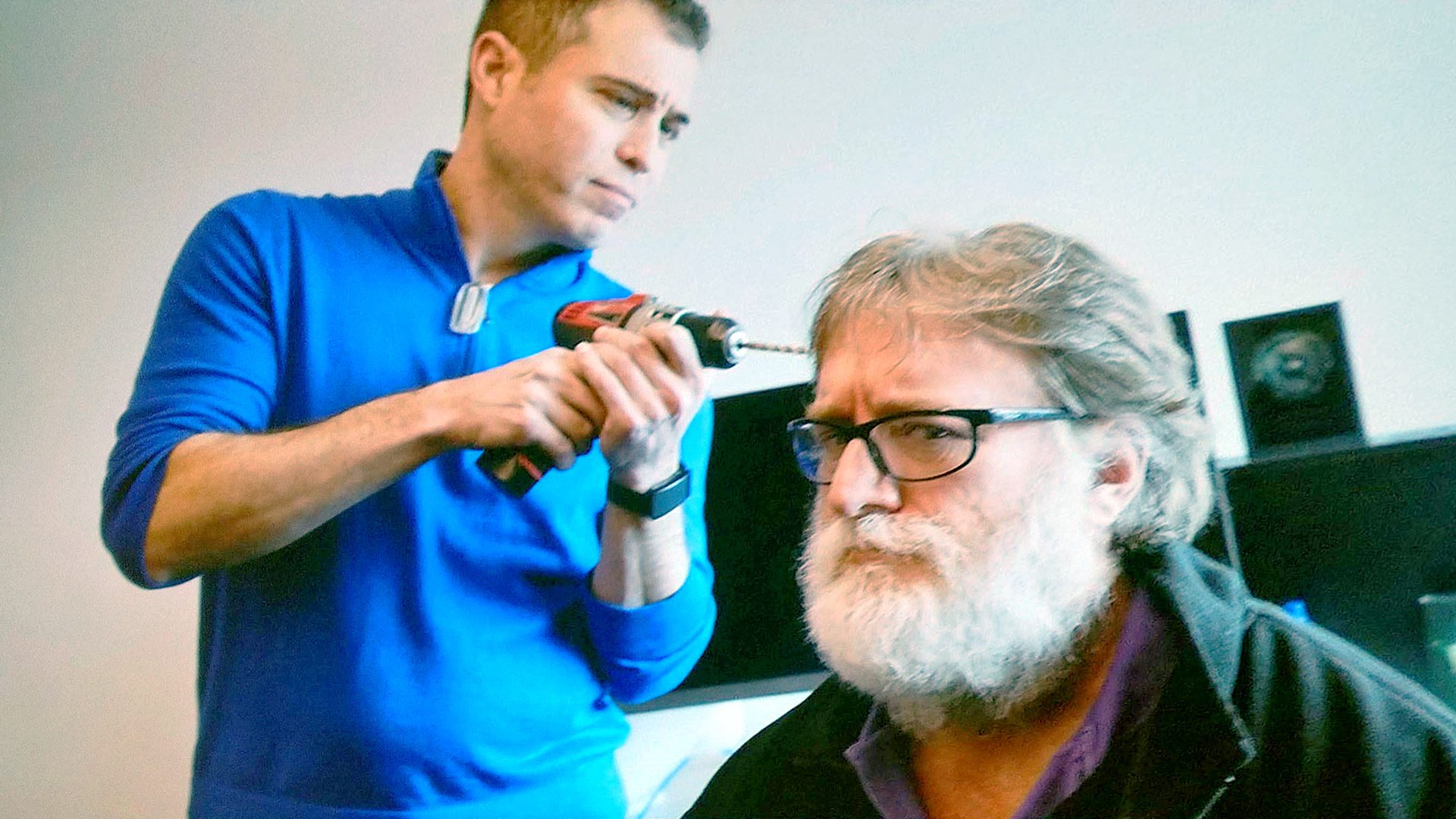
Mike Armbinder (left) and Gabe Newel (right) | Image courtesy Valve

The project aims to overcome current limitations of minimally-invasive neural interface implants, which are often bulky, power-hungry, and difficult to scale across multiple brain regions.

Current clinical technologies, like Elon Musk’s Neuralink (approved by the FDA in 2023), typically focus on single-region intervention in the brain’s motor cortex. In contrast, Starfish hopes to reduce surgical burden through miniaturization, making implants easier to place across multiple sites.

And at just 2 × 4mm, Starfish’s chip is tiny. If you never imaged reading a brain chip spec sheet from a company founded by Valve’s Gabe Newell, well, welcome to the future. Starfish’s first brain chip boasts:

  • Low power: 1.1 mW total power consumption during normal recording 
  • Physically small: 2 x 4mm (0.3mm pitch BGA) 
  • Capable of both recording (spikes and LFP) & stimulation (biphasic pulses) 
  • 32 electrode sites, 16 simultaneous recording channels at 18.75kHz 
  • 1 current source for stimulating on arbitrary pairs of electrodes 
  • Onboard impedance monitoring and stim voltage transient measurement 
  • Digital onboard data processing and spike detection allows the device to operate via low-bandwidth wireless interfaces. 
  • Fabricated in TSMC 55nm process

It’s still early days though. The company is now calling for early-stage collaborators—particularly those working in wireless power delivery, communication, and implantable neural devices—to explore novel applications of this technology ahead of its expected availability in late 2025.

As Newell has long suggested, the real potential lies beyond medicine, noting back in 2023 that “we’re way closer to ‘the Matrix’ than people realize.”

“I think connecting to people’s motor cortex and visual cortex is going to be way easier than people expected and doing things like […] reading and writing to somebody’s motor cortex is way more of a tractable problem than making people feel ‘cold’. And you never would have guessed that,” Newell said in a 2023 interview with IGN. “And I never would have guessed that before going into it. It turns out your brain has really good interfaces for some things and really badly designed, kludgy interfaces for doing other things. And the fact that your immune system gets involved in your perception of temperature means there’s all sorts of weird parts of your brain that participate in the sensation of being cold, whereas your motor cortex [or] your visual cortex are much more tractable problems.”

In 2019, prior to his departure from Valve, the company’s Principal Experimental Psychologist Mike Ambinder also gave some insight into how brain-computer interface might inform immersive games.

“We can measure responses to in-game stimuli. And we’re not always getting [data] reliably, but we’re starting to figure out how. Think about what you’d want to know about your players. There’s a long list of things we can get right now with current technology, current generation analysis, and current generation experimentation,” Armbinder said in his GDC 2019 talk, which was entitled Brain-Computer Interfaces: One Possible Future for How We Play.


Thanks to Brad ‘SadlyItsBradley’ Lynch for pointing us to the news.

The post Valve Founder’s Neural Interface Company to Release First Brain Chip This Year appeared first on Road to VR.

24 May 13:40

Infrared contact lenses let you see in the dark

by Jennifer Ouellette

Tired of using bulky night vision goggles for your clandestine nocturnal activities? An interdisciplinary team of Chinese neuroscientists and materials scientists has developed near-infrared contact lenses that enabled both mice and humans to see in the dark, even with their eyes closed, according to a new paper published in the journal Cell.

Humans and other mammals can only perceive a limited range of the electromagnetic spectrum (light), usually in the 400–700 nm range. There are creatures that can see in infrared (snakes, mosquitoes, bullfrogs) or ultraviolet (bees, birds), and goldfish can perceive both. But humans must augment themselves with technology in order to expand our range of vision.

Night vision goggles and similar devices have been around since the 1930s, including infrared-visible converters, but these require external energy sources, and the converters have a multilayer structure that makes them opaque and hence challenging to integrate with a human eye. The authors previously were able to confer near-infrared vision to mice by injecting nanoparticles that bind to photoreceptors into their eyes—basically creating a near-infrared nanoantenna—but realized that most people would be averse to the prospect of sticking needles in their eyes. So they looked for a better alternative. Contact lenses seemed the obvious choice.

Read full article

Comments

24 May 13:38

New Claude 4 AI model refactored code for 7 hours straight

by Benj Edwards

On Thursday, Anthropic released Claude Opus 4 and Claude Sonnet 4, marking the company's return to larger model releases after primarily focusing on mid-range Sonnet variants since June of last year. The new models represent what the company calls its most capable coding models yet, with Opus 4 designed for complex, long-running tasks that can operate autonomously for hours.

Alex Albert, Anthropic's head of Claude Relations, told Ars Technica that the company chose to revive the Opus line because of growing demand for agentic AI applications. "Across all the companies out there that are building things, there's a really large wave of these agentic applications springing up, and a very high demand and premium being placed on intelligence," Albert said. "I think Opus is going to fit that groove perfectly."

Before we go further, a brief refresher on Claude's three AI model "size" names (introduced in March 2024) is probably warranted. Haiku, Sonnet, and Opus offer a tradeoff between price (in the API), speed, and capability.

Read full article

Comments

23 May 12:55

Foil Leyden Jar Helps Bring Crookes Tube to Life

by Seth Mabbott
Crookes Tube

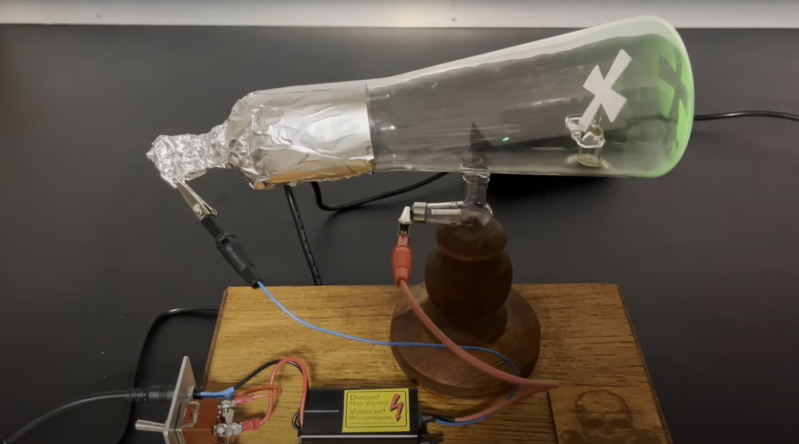
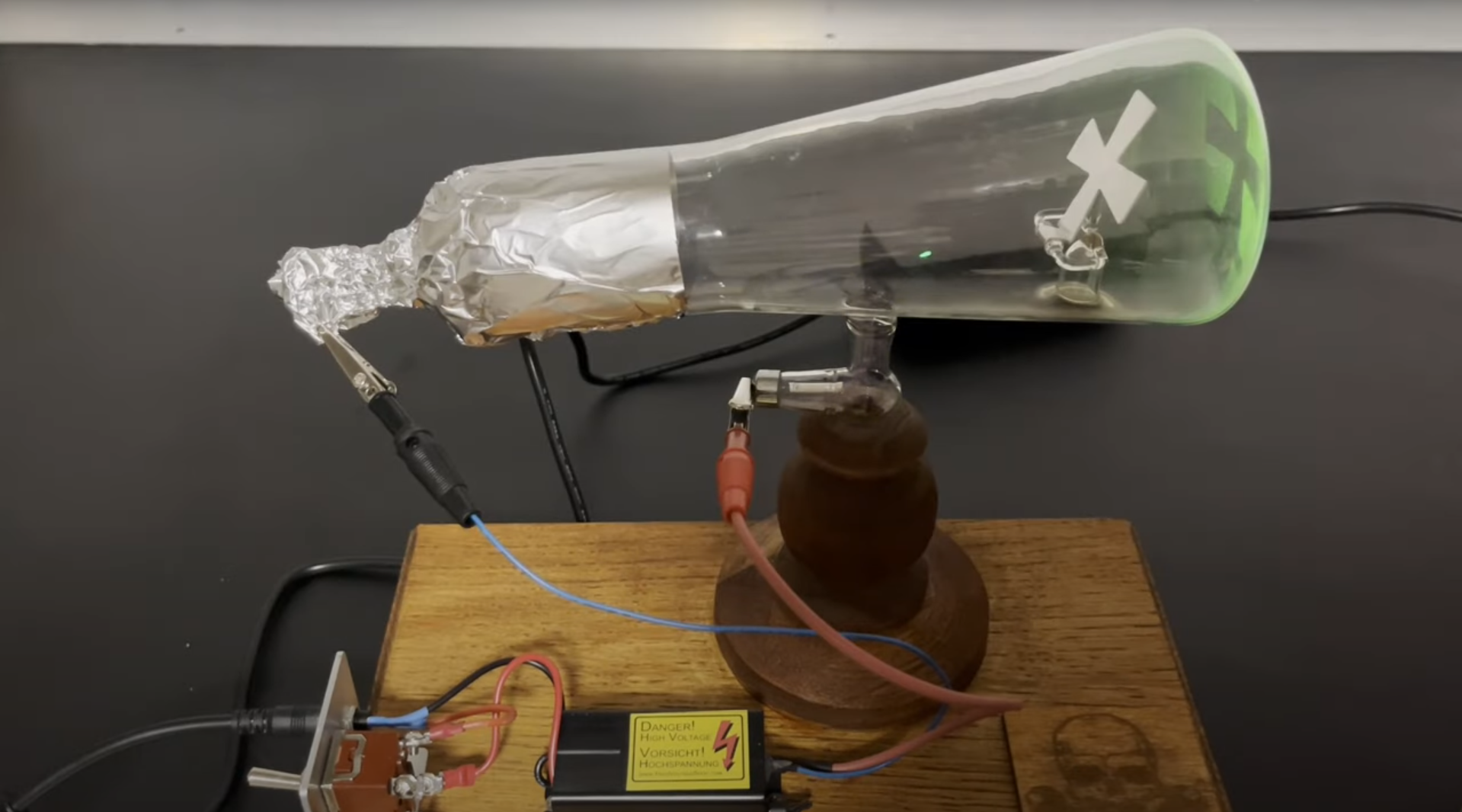
It might be too soon to consider the innards of the old CRT monitor at the back of your closet to be something worth putting on display in your home or workshop. For that curio cabinet-worthy appeal, you need to look a bit further back. Say, about 150 years. Yes, that’ll do. A Crookes tube, the original electron beam-forming vacuum tube of glass, invented by Sir William Crookes et al. in the late 19th century, is what you need.

And a Crookes tube is what [Markus Bindhammer] found on AliExpress one day. He felt that piece of historic lab equipment was asking to be put on display in proper fashion. So he set to work crafting a wooden stand for it out of a repurposed candlestick, a nice piece of scrap oak, and some brass feet giving it that antique mad-scientist feel.

After connecting a high voltage generator and switch, the Crookes tube should have been all set, but nothing happened when it was powered up. It turned out that a capacitance issue was preventing the tube from springing to life. Wrapping the cathode end of the tube in aluminum foil, [Markus] formed what is effectively a Leyden jar, and that was the trick that kicked things into action.

As of this writing, there are no longer any Crookes tubes that we could find on AliExpress, so you’ll have to look elsewhere if you’re interested in showing off your own 19th century electron-streaming experiment. Check out the Crookes Radiometer for some more of Sir Williams Crookes’s science inside blown glass.

21 May 14:19

ARY captive les clients du retail avec de la réalité augmentée

by Valerie Riffaud Cangelosi

Dans cette interview, nous avons eu le plaisir d’échanger avec Éric Heurtier, entrepreneur chevronné et fondateur de la start-up ARY, une solution innovante qui démocratise l’usage de la réalité augmentée ...

L’article ARY captive les clients du retail avec de la réalité augmentée est apparu en premier sur Réalité Augmentée - Augmented Reality.

21 May 14:16

Keebin’ with Kristina: the One with the Wafer-Thin Keyboard

by Kristina Panos
Illustrated Kristina with an IBM Model M keyboard floating between her hands.

The mikecinq, an incredibly slim keyboard.
Image by [dynam1keNL] via reddit
But sir! I can’t believe I missed [dynam1keNL]’s initial flat offering from about a year ago, the mikefive, which came about when he and some friends ordered switches directly from Kailh and Kailh were like, do you want to try these even lower-profile PG1316 laptop switches? It’s called the mikefive because it’s 5 mm thick.

That’s okay, though, because now you’re caught up and I can talk about his latest keyboard, the mikecinq. The inspiration for this one includes the aesthetics of Le Chiffre and the slimness of Le Oeuf. As you’ll see in the gallery, the top is ever-so-slightly slanted downward from the top.

You can see it really well in the second picture — the top row is flush with the case, and the keys gradually get taller toward the thumb clusters. All [dynam1keNL] really had to do was 3D model the new case and screw in the PCB from his daily driver mikefive.

Image by [dynam1keNL] via reddit
[dynam1keNL] ultimately found it nice and comfy, especially for the thumbs, but decided to take it one step further and designed a new switch footprint. Why? The PG1316s are surface-mount with contacts below the switch, so you really need a hotplate or oven to mount them.

So in order to deal with this, he made a dedicated mikecinq PCB with big cutouts with castellated holes beneath each switch. Now, the switch contacts are accessible from underneath and can be soldered with an iron.

You may have noticed that the mikefive production files are not available on GitHub — that’s because it was recently licensed and will be available soon. But if you want production files for the mikecinq, let him know in the comments.

Cyberpunk 2077 Here In 2025

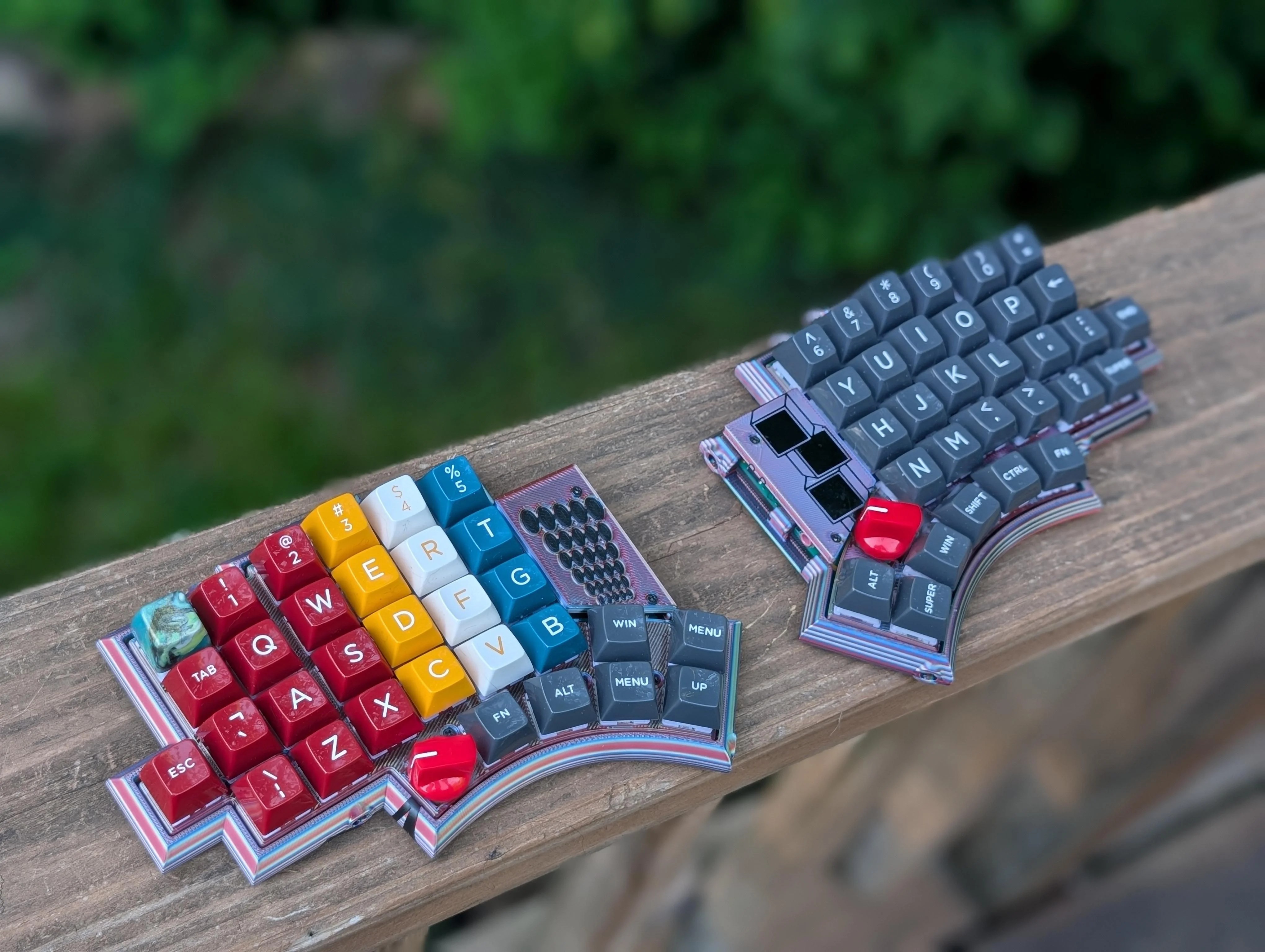
A Cyberpunk 2077-themed split keyboard with a yellow case and Baja Blast RGB and everything.
Image by [felipeparaizo] via reddit
While this Cyberpunk 2077 keyboard is certainly nice enough to be a centerfold, [felipeparaizo] has a full write-up on GitHub, so here I go talking about it at length instead!

This here is a Sofle RGB v2.1 that, as we’ve concluded, is heavily inspired by Cyberpunk 2077. The case is 3D-printed and then airbrushed, and then stickered up with custom decals that include references to Arasaka and Samurai. The acrylic base lets even more Baja Blast-colored RGB goodness shine through.

The switches are Akko Crystal Blues, which seem like a great choice, and the caps are two combined sets — one matte and one translucent. This is the second version of the project, and you can see how the first one turned out over on GitHub.

via reddit

The Centerfold: An Avalanche of Color

A colorful Avalanche keyboard in the 60% style.
Image by [CaptLynx] via reddit
So this right here is an Avalanche keyboard, but at 60%. Go admire the original ones real quick; I’ll wait. They’re just as lovely as this one! I love the jawbreaker-esque layers of the case, and those knobs are exquisite.

Do you rock a sweet set of peripherals on a screamin’ desk pad? Send me a picture along with your handle and all the gory details, and you could be featured here!

Historical Clackers: the Brackelsberg

The Classic Typewriter page calls the Brackelsberg syllabic typewriter “another hallucinogenic creation from the golden age of writing machine design“, and I don’t disagree.

The Brackelsberg, a two-handed type-writing torture device.
Image via The Classic Typewriter Page

This 1897 machine had types arranged on several type sectors which swung up and down. Each sector carried about 30 types, which I take to mean characters.

The 132-key board was divided into four sectors, and they could be operated simultaneously — as in, you could type four characters at once, entering entire syllables if you so desired. Thus, it was called a syllabic typewriter.

A hammer struck from the rear, connecting the paper and ribbon with the types. It seems slow and cumbersome, doesn’t it? But Brackelsberg insisted that it was quiet, pointed out that the writing was always visible, and argued that the syllabic gimmick would make it fast and convenient to use.

Although never mass-produced, a working prototype was built and is pictured here in a photograph from Friedrich Muller’s book called Schriebmaschinen und Schriften-Vervielfältigung published in 1900.

Finally, a Keyboard That Looks Like a Typewriter and Might Not Suck

I say this because of the disappointment I suffered buying a similar Bluetooth keyboard for ten bucks from a place where everything typically costs half of that or less.  The thing just stopped working one day not long after the store warranty had expired. You win some, you lose some, I suppose.

The Yunzii QL75 keyboard, which resembles a typewriter that AI created for me once.
The Yunzii QL75 typewriter keyboard. Image via Yunzii

Anyway, the Yunzii QL75 ought to fare better given that it’s ten times the cost to pre-order; at least I hope it does. And much like the crappy one I have, it comes in pink.

You can choose either Onyx tactile switches or Cocoa Cream V2 linear switches. But if you don’t like those, the switches are hot-swappable and compatible with 3-pin and 5-pins both.

The keycaps are ABS with a matte chrome electroplated finish and laser-engraved legends. Yes there is RGB, but it doesn’t shine through the keycaps, more like between them, it sounds like.

Thankfully, the QL75 works with QMK and VIA if you want to change things up. This thing has three-way connectivity to the device of your choice, which, if it’s small enough, can sit right above the keyboard where the paper would go.

There’s no telling what the knobs on the sides do, if anything, although there are arrows. On mine, they raise and lower the little kickstands.

Via TweakTown


Got a hot tip that has like, anything to do with keyboards? Help me out by sending in a link or two. Don’t want all the Hackaday scribes to see it? Feel free to email me directly.

21 May 14:03

Neurosymbolic AI could be leaner and smarter than today's LLMs

Could AI that thinks more like a human be more sustainable than today's LLMs? The AI industry is dominated by large companies with deep pockets and a gargantuan appetite for energy to power their models' mammoth computing needs. Data centers supporting AI already account for up to 3.7% of global greenhouse emissions.
21 May 14:03

Xreal's Project Aura Will Support Google's Android XR Via A Tethered Puck

by David Heaney

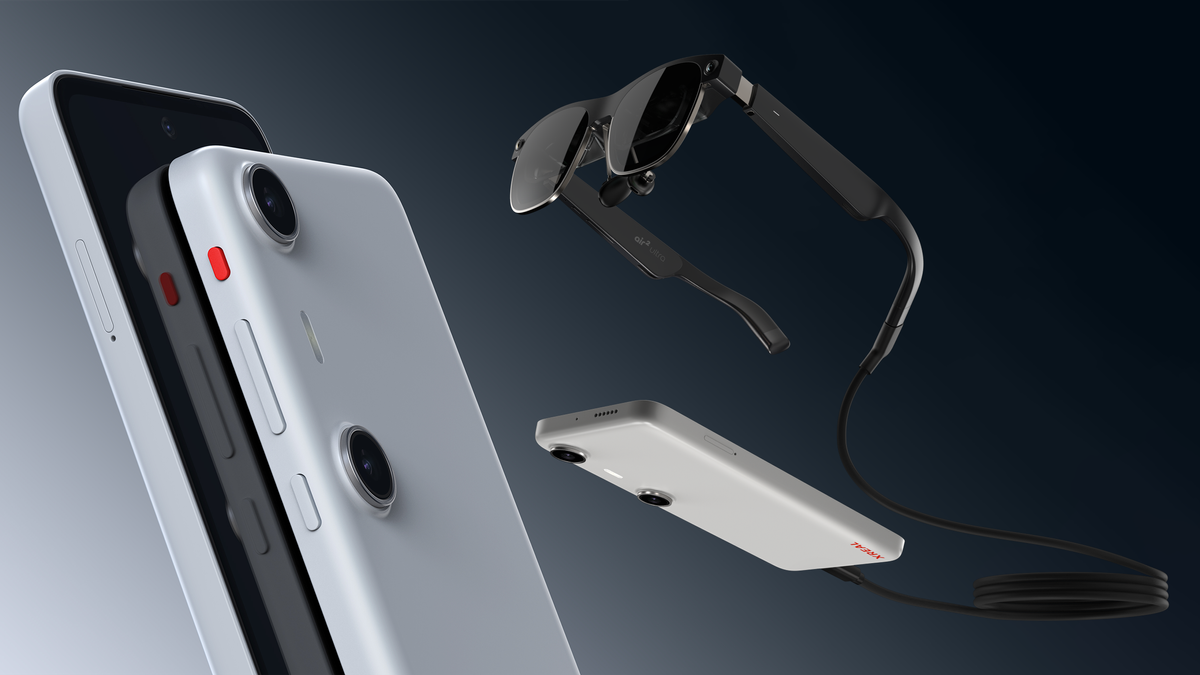
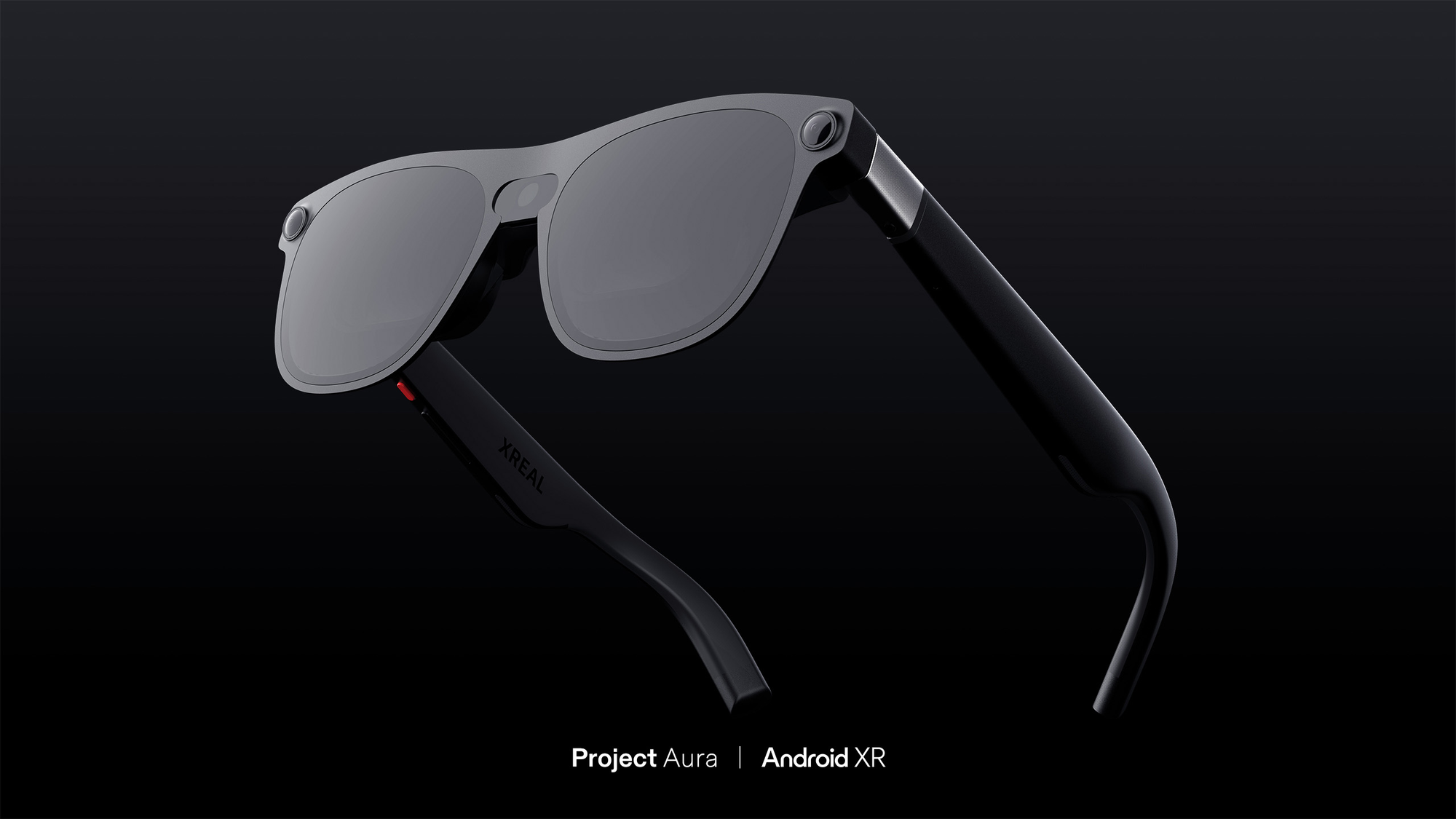
Xreal just announced Project Aura, new glasses that will support Android XR via a tethered compute puck.

Android XR is Google's new operating system designed to both compete with Meta's Horizon OS and power smart glasses. Announced during Google I/O just now, Project Aura is the second revealed Android XR device, after Samsung's headset, and the first to use a transparent display system, known as optical see-through AR.

Xreal is staying tight-lipped on specific details of Project Aura, sharing only the above image of the design while confirming that it will support Android XR via a tethered compute puck with a Qualcomm Snapdragon chip.

Xreal Beam Pro: A Phone-Like Device To Power Xreal Glasses
Xreal Beam Pro is essentially a custom Android phone specifically designed to power Xreal Glasses, including 6DoF AR on Xreal Air 2 Ultra.
UploadVRDavid Heaney

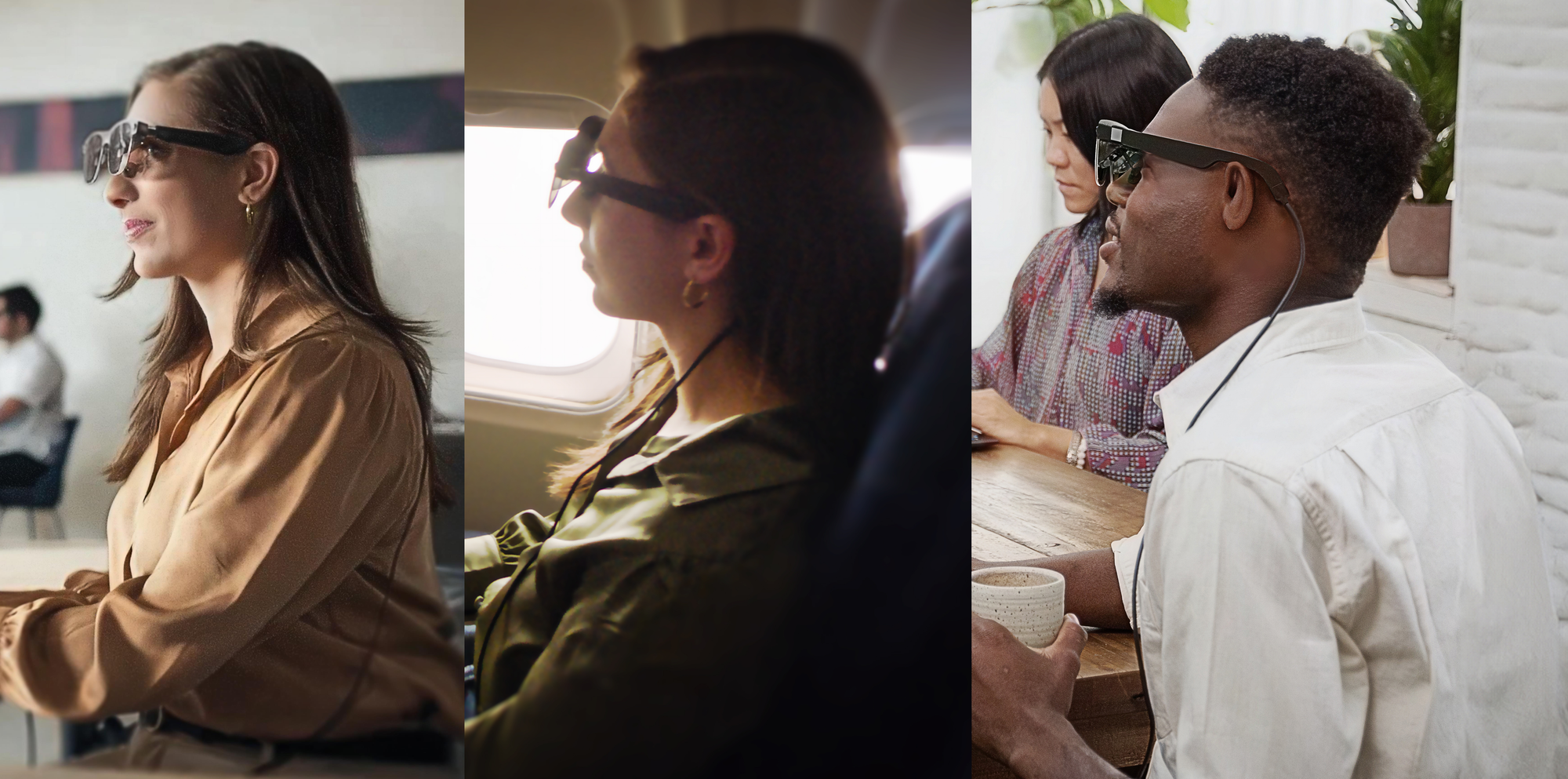
The design shown for Project Aura resembles the existing 3DoF Xreal One display glasses but with a camera on each temple, pointed slightly downwards, and another camera in the center of the lenses facing forwards. Those side cameras are likely for 6DoF positional tracking and hand tracking, while the central camera is likely for taking photos and videos, as well as for multimodal with Google's Gemini AI.

Note that while Xreal devices are designed to look like sunglasses, they sit much further out from your eyes than real glasses, and thus are a markedly different device category than the AR glasses in development at Meta and Apple. Those future AR glasses use a display technology called waveguides to sit as close to your eyes as regular glasses, while Xreal uses a far cheaper but also far bulkier approach called birdbath optics. They also block out most light, so can't be used as regular indoor glasses at all.

Xreal devices resemble glasses from the front, but sit much further out from your eyes.

Xreal says it will reveal more details about Project Aura at Augmented World Expo (AWE) in June, and UploadVR's Don Hopper will be there to try it out.

UPDATE: Xreal confirmed to CNET that the mystery tethered device would be a new compute puck, and this article has been updated to reflect that.

21 May 14:03

Google’s 3D teleconferencing platform, now called Beam, will ship later in 2025

by Kyle Wiggers
Google announced at Google I/O 2025 that it is rebranding Project Starline, its corporate-focused teleconferencing platform that uses 3D imaging, and recommitting to shipping it this year. Starline, now called Google Beam, will come to “early customers” like Deloitte, Salesforce, Citadel, NEC, and Duolingo later in 2025 via Google’s previously announced partnership with HP, Google […]
21 May 14:01

Google’s NotebookLM is getting Video Overviews

by Aisha Malik
At Google I/O 2025, the tech giant unveiled new capabilities coming to NotebookLM, its AI-based note-taking and research assistant. Most notably, the company is launching Video Overviews. Google says users will soon be able to turn dense multimedia, such as raw notes, PDFs, and images, into digestible visual presentations. Since its launch, NotebookLM has been […]
19 May 08:58

Ollama lance son nouveau moteur pour les modèles multimodaux

by Matthieu Segret

Ollama franchit une étape importante avec son nouveau moteur qui permet désormais d’exécuter des modèles multimodaux en local. Cette évolution majeure étend les capacités de l’outil pour gérer non seulement le texte mais aussi d’autres types de données comme les images, ouvrant la voie à de nouvelles possibilités pour les développeur·se·s.


Commentaires
L'article Ollama lance son nouveau moteur pour les modèles multimodaux a été posté dans la catégorie IA de Human Coders News
18 May 16:11

Samsung Unveils Advanced Micro-OLED Displays For "Next-Generation" Headsets

by David Heaney

At SID Display Week 2025, Samsung is showcasing two new micro-OLED panels that can deliver brighter high-resolution headsets with richer colors and no motion blur.

Micro-OLED displays are fabricated directly onto silicon wafers, a distinctly different manufacturing process to regular OLED, and offer much higher pixel density than any other production-ready display technology. Micro-OLED displays thus enable high resolution headsets with relatively slim designs - and of course OLED's signature infinite contrast with rich colors and true blacks.

Currently 2.5K micro-OLED displays from Chinese supplier SeeYA Technology are used in the Bigscreen Beyond series, while 4K micro-OLED displays from Sony are used in Apple Vision Pro, and BOE's 4K micro-OLED displays are used in Play For Dream MR and Shiftall MeganeX superlight. More headsets using a new Sony 4K micro-OLED are set to launch later this year, from Samsung, Sony, and Pimax.

Back in 2023, Samsung acquired US micro-OLED company eMagin for $218 million, and the new displays the company is showing at Display Week 2025 are likely based on eMagin's technology.

Samsung Acquiring OLED Microdisplay Company eMagin For XR
Samsung Display is acquiring OLED microdisplay company eMagin, citing “significant potential of growth” in XR devices.
UploadVRDavid Heaney

While the 4K micro-OLED panels in those current headsets reportedly have a raw brightness of roughly 5000 nits, the two new displays Samsung is showing output 15,000 nits and 20,000 nits respectively.

But if you're currently wondering "why on earth would anyone want or need a display that bright near their eyes?" there's something very important to understand here.

For all their benefits, the pancake lenses needed to magnify displays this small to an acceptable field of view have extremely poor optical efficiency. That means the majority of the light passing through them is lost, significantly reducing the viewed brightness. For today's pancake lenses, this loss is on the order of 90%.

Worse, to avoid the perception of motion blur all XR displays intentionally only illuminate for a fraction of each frame, known as the duty cycle, remaining pitch dark the rest of the frame, and with OLED displays this makes the effective brightness even lower. This technique is often called low persistence.

Illustration from Oculus of Low Persistence, illuminating the display only a fraction of the time.

When both the poor optical efficiency of pancake lenses and intentional low persistence of the displays are taken into account, the viewed brightness of the current 5000 nit micro-OLED displays is only around 100 nits.

That means that Samsung's displays in a similar optical setup could achieve around 300 nits and 400 nits viewed brightness respectively, at the same duty cycle and refresh rate. Alternatively, headset makers could use a lower duty cycle to reduce or even eliminate the motion blur we criticized in our Vision Pro review, achieving a balance between increased brightness and improved motion clarity.

In addition to much higher brightness than the micro-OLED displays of today, Samsung is also claiming higher resolution and wider color gamut. One panel shown is 3888×3888, while the other is 5K, and both have 99% DCI-P3 coverage. That compares to 3660×3200 and 92% for Apple Vision Pro.

Size Resolution Raw
Brightness

(read article)
Color
Gamut

(DCI-P3)
Refresh
Rate
Sony's Old
(Apple Vision Pro)
1.41" 3660×3200 5000
nits
92% 100Hz
Sony's New
(SRH-S1)
(Pimax Dream Air)
1.35" 3552×3840 5000
nits
96% 90Hz
BOE's
(Play For Dream MR)
(MeganeX superlight)
1.35" 3552×3840 6000
nits
92% 90Hz
LG's
(Display Week 2024)
1.3" 3840×3840 10,000
nits
97% 90Hz
Samsung's
5000PPI

(Display Week 2025)
1.4" 5K 15,000
nits
99% 120Hz
Samsung's
4200PPI

(Display Week 2025)
1.3" 3888×3888 20,000
nits
99% ?

The much greater brightness and wider color gamut of Samsung's displays are possible because they use true red, green, and blue OLED subpixels, building on eMagin's technology. In contrast, existing micro-OLED displays use white OLED subpixels with RGB color filters on top.

Direct emission RGB is significantly more efficient, and offers better color saturation, enabling the greater brightness and wider color gamut without increasing power draw. However, what this technology won't help address is arguably the biggest issue with micro-OLED today, the cost. Micro-OLED displays with white subpixels are already difficult and expensive to manufacture, and true RGB subpixels are even more so.

As such, Samsung is currently describing these advanced micro-OLED displays as falling under research & development.

For Samsung's first standalone headset, set to introduce Google's Android XR platform later this year, the company will reportedly use Sony's new micro-OLED display, the same being used in Sony's own SRH-S1 headset coming this year too.

18 May 15:53

Coinbase met 20 millions sur la tête des hackers qui tentent de le menacer

by Adam Langumier

Coinbase, l’une des plus grandes plateformes de cryptomonnaies au monde, a été victime d’un piratage sophistiqué. Face à une demande de rançon de 20 millions de dollars et une fuite de données sensibles, l’entreprise a décidé de retourner la menace contre ses auteurs : elle propose la même somme à quiconque permettra de les identifier.

18 May 15:47

Le rêve d'Einstein, la gravité quantique, enfin à portée de main ? 💥

by Adrien BERNARD
Une avancée majeure en physique théorique pourrait enfin unifier la gravité avec les autres forces fondamentales. Cette percée, réalisée par des chercheurs finlandais, ouvre des perspectives...
18 May 15:11

Magnetohydrodynamic Motors to Spin Satellites

by Aaron Beckendorf
Two rings of magnets are shown encasing a circular channel in a white plastic piece. The channel is filled with liquid metal, and a loop of wire is about to be lowered into the metal.

Almost all satellites have some kind of thrusters aboard, but they tend to use them as little as possible to conserve chemical fuel. Reaction wheels are one way to make orientation adjustments without running the thrusters, and [Zachary Tong]’s liquid metal reaction wheel greatly simplifies the conventional design.

Reaction wheels are basically flywheels. When a spacecraft spins one, conservation of angular momentum means that the wheel applies an equal and opposite torque to the spacecraft, letting the spacecraft orient itself. The liquid-metal reaction wheel uses this same principle, but uses a loop of liquid metal instead of a wheel, and uses a magnetohydrodynamic drive to propel the metal around the loop.

[Zach] built two reaction wheels using Galinstan as their liquid metal, which avoided the toxicity of a more obvious liquid metal. Unfortunately, the oxide skin that Galinstan forms did make it harder to visualize the metal’s motion. He managed to get some good video, but a clearer test was their ability to produce torque. Both iterations produced a noticeable response when hung from a string and activated, and achieved somewhat better results when mounted on a 3D-printed air bearing.

Currently, efficiency is the main limitation of [Zach]’s motors: he estimates that the second model produced 6.2 milli-newton meters of torque, but at the cost of drawing 22 watts. The liquid metal is highly conductive, so the magnetohydrodynamic drive takes high current at low voltage, which is inconvenient for a spacecraft to supply. Nevertheless, considering how hard it is to create reliable, long-lasting reaction wheels the conventional way, the greatly improved resilience of liquid-metal reaction wheels might eventually be worthwhile.

If you’re curious for a deeper look at magnetohydrodynamic drives, we’ve covered them before. We’ve also seen [Zach]’s earlier experiments with Galinstan.

17 May 21:02

Google Teases Android Smart Glasses Ahead of I/O Developer Conference Next Week

by Scott Hayden

Google may be getting ready to unveil a pair of smart glasses at its Google I/O developer conference next week, ostensibly hoping to take on Ray-Ban Meta Glasses.

In a promo for Google I/O, Android Ecosystem President Sameer Samat showed off what appears to be a pair of smart glasses.

While Samat didn’t speak directly about the device, when donning the glasses, he said Google I/O attendees will have a chance to see “a few more really cool Android demos.”

Using our CSI-style enhancement abilities (aka ‘crop a YouTube screenshot’), the distinctly Ray-Ban Wayfarer-style glasses appear to have a single camera sensor on the left temple.

Image courtesy Google

There is also what appears to be an LED above the camera sensor, likely to inform others when video or pictures are being taken, which may indicate it’s going for feature parity with Ray-Ban Meta Glasses.

The glasses’ chunky arms are also likely packed with battery and onboard processors, which, owing to Samat’s tease, is probably running some version of its upcoming Android XR operating system. Notably, just under the left arm we can see a small slit close to Samat’s ear, possibly for integrated audio. Alternatively, it may not be a a slit at all, but rather a button of some sort.

Meanwhile Apple may be readying its own pair of smart glasses, with a recent Bloomberg report maintaining the company is now developing a processor specifically optimized for the task.

In any case, we’re hoping to find out more at Google I/O, which is slated to kick off May 20th – 21st where the company will feature livestreamed keynotes, developer sessions, and more. Outside of the keynote, which may actually mention Android XR, the event is set to include two developer talks specifically dedicated to Android XR.

We’ll of course be tuning in, although you can watch the keynote live on YouTube starting on Tuesday, May 20th at 10 AM PT (local time here).

Check out the moment below:

The post Google Teases Android Smart Glasses Ahead of I/O Developer Conference Next Week appeared first on Road to VR.

17 May 21:00

Compliant Mechanism Shrinks Instead of Stretching

by Ian Bos
Series of purple and red mechanisms are stretched from left to right. Almost like arrows pointing right.

Intuitively, you think that everything that you stretch will pull back, but you wouldn’t expect a couple of pieces of plastic to win. Yet, researchers over at [AMOLF] have figured out a way to make a mechanism that will eventually shrink once you pull it enough.

Named “Counter-snapping instabilities”, the mechanism is made out of the main sub-components that act together to stretch a certain amount until a threshold is met. Then the units work together and contract until they’re shorter than their initial length. This is possible by using compliant joints that make up each of the units. We’ve seen a similar concept in robotics.

The picture reads "Excessive vibrations? / It tames them by itself... / ... by switching them off! Bridge undergoing harmonic oscillation about to crumble on the left and mechanisms on the right.

Potentially this may be used as a unidirectional actuator, allowing movement inch by inch. In addition, one application mentioned may be somewhat surprising: damping. If a structure or body is oscillating through a positive feedback loop it may continue till it becomes uncontrollable. If these units are used, after a certain threshold of oscillation the units will lock and retract, therefore stopping further escalation.

Made possible by the wonders of compliant mechanics, these shrinking instabilities show a clever solution to some potential niche applications. If you want to explore the exciting world of compliance further, don’t be scared to check out this easy to print blaster design!

Thanks to [I’m Not Real] for the tip!

17 May 20:54

Cyber City Odeo 808 - Cyberpunk UI

by Jono Yuen

Here’s a look at the FUI of Cyber City Oedo 808, a gritty cyberpunk anime full of retro-futuristic designs. From car dashboards and cockpits readouts to police files, and schematics, these interfaces play a key role in shaping the world and its atmosphere.

Dashboard and cockpit UI

The designs are wonderfully abstract, using lines, shapes, and motion to suggest complexity without over-explaining. Much of the detail is implied rather than shown, and that restraint adds to the aesthetic. Animation does a lot of the storytelling here: the pacing, the rhythm, the manic flickering during tense moments, all of it conveys mood and urgency without a single word. The car dashboard in particular, is so full of personality.

View fullsize cardash.gif
View fullsize cardash2.gif
View fullsize shipcomputer.gif
View fullsize cockpit.gif
View fullsize targeting.gif

Police files

The police systems use a distinct and well-balanced colour palette, cool blues and white for type, with turquoise, deep pink, and red as accents. It gives the interface a clean yet stylised look that feels both official and futuristic. The top-down wipe transitions are a nice touch too as it subtly hints at older technologies and adds to the retro future aesthetic.

View fullsize police2.gif
View fullsize mugshot1.gif
View fullsize scan.gif
View fullsize mugshot2.gif

Computer interfaces

Here’s a mix of screens that involve hacking, mapping and simulations. The screen designs really capture the retro future feel thanks to the fonts, low resolution and animation style and could easily fit into the same timeline as Blade Runner or Alien Romulus.

View fullsize computer1.gif
View fullsize computer2.gif
View fullsize computer3.gif
View fullsize computermap.gif
View fullsize hack1.gif
View fullsize hack3.gif
View fullsize computer1.gif
View fullsize simulation.gif

Handheld UI

This is a really fun device that has a large screen up top for visuals and a secondary screen below for supporting details. The controls at the bottom are reminiscent of early ’90s Japanese tech and really adds to the device’s retro-future appeal.

View fullsize phone1.gif
View fullsize phone2.gif
View fullsize phone3.gif

DNA sequencing

These screens give off a distinctly scientific feel, thanks to the combination of complex diagrams, no-nosense typography and basic animation.

View fullsize dna1.gif
View fullsize dna2.gif
View fullsize dna3.gif
View fullsize dna4.gif
View fullsize dna5.gif

Interface control panels

The interface controls are often complex, built from clusters of small details and elements that sit flat on the console surface. Instead of a standard keyboard, the layouts use generously spaced-out symbols that span across a large panel. The designers did a good job of suggesting complexity through the use of lines and irregular shapes.

View fullsize comp-1.jpg
View fullsize comp-2.jpg
View fullsize comp-3.jpg
View fullsize comp-4.jpg

Targeting UI

The design of this targeting system is pretty unique. Firstly, it’s not often that you see a serif font used in a high-tech interface, like the word ‘TARGET’. The triangular layout of the callout text is also unusual. Not sure I understand the logic behind it but stylistically it’s very cool and adds to building the design language throughout the world.

View fullsize targeting1.gif
View fullsize targeting2.gif
View fullsize targeting3.gif
17 May 16:16

Scientists Tweaked LSD’s Molecular Structure and Created a Wild New Brain Drug

by Victor Tangermann
Researchers made small tweaks to the molecular structure of LSD to see if it could be turned into an effective brain-healing treatment.

A team of researchers at the University of California, Davis, made small tweaks to the molecular structure of lysergic acid diethylamide (LSD) to see if it could be turned into an effective brain-healing treatment for patients that suffer from conditions like schizophrenia — without risking a potentially disastrous acid trip.

As detailed in a new paper published in the journal Proceedings of the National Academy of Sciences last month, the researchers created a new compound called JRT by shifting the position of just two atoms of the psychedelic's molecular structure.

With the two atoms flipped, the new drug could still stimulate brain cell growth and repair damaged neural connections, while simultaneously minimizing psychedelic effects, in mice.

"Basically, what we did here is a tire rotation," said corresponding author and UC Davis chemistry professor David Olson in a statement. "By just transposing two atoms in LSD, we significantly improved JRT’s selectivity profile and reduced its hallucinogenic potential."

In experiments involving mice, the team found that JRT improved negative symptoms of schizophrenia without worsening other behaviors associated with psychosis.

While it's still far too early to tell if JRT could be effective in humans as well, the team is hoping that the new drug could become a powerful new therapeutic, especially for those suffering from conditions like schizophrenia.

"No one really wants to give a hallucinogenic molecule like LSD to a patient with schizophrenia," said Olson. "The development of JRT emphasizes that we can use psychedelics like LSD as starting points to make better medicines."

"We may be able to create medications that can be used in patient populations where psychedelic use is precluded," he added.

Olsen and his colleagues hope their new drug could provide an alternative to drugs like clozapine, a schizophrenia treatment, without negative side effects like an inability to feel pleasure and a decline in cognitive function.

Interestingly, it also proved a powerful antidepressant in early experiments involving mice at doses 100-fold lower than ketamine, a popular anesthetic used for the treatment of depression and pain management.

But before it can be tested in humans, the team still has plenty of work to do.

"JRT has extremely high therapeutic potential," Olsen said in the statement. Right now, we are testing it in other disease models, improving its synthesis, and creating new analogs of JRT that might be even better."

More on LSD: Former CEO Sues Company That Fired Him for Microdosing LSD in an Investor Meeting

The post Scientists Tweaked LSD’s Molecular Structure and Created a Wild New Brain Drug appeared first on Futurism.

17 May 16:16

Star Wars' Showcase of AI Special Effects Was a Complete Disaster

by Frank Landymore
Special effects house Industrial Light and Magic shared a new AI demo of Star Wars creatures that look absolutely awful.

If Disney leadership has its way, we'll all be drooling over endless Star Wars reboots, sequels, and spinoffs until the Sun explodes. And what better way to keep the slop machine humming than using good old generative AI?

Unfortunately, as highlighted by 404 Media, we just got a preview of what that might look like. Industrial Light and Magic, the legendary visual effects studio behind nearly every "Star Wars" movie, released a new demo showcasing how AI could supercharge depictions of the sci-fi universe.

And unsurprisingly, it looks absolutely, flabbergastingly awful.

The demo, called "Star Wars: Field Guide," was revealed in a recent TED talk given by ILM's chief creative officer Rob Bredow, who stressed that it was just a test — "not a final product" — created by one artist in two weeks. 

It's supposed to give you a feel of what it'd be like to send a probe droid to a new Star Wars planet, Bredow said. But what unfolds doesn't feel like "Star Wars" at all. More so, it's just a collection of generic-looking nature documentary-style shots, featuring the dumbest creature designs you've ever seen. And all of them are immediately recognizable as some form of real-life Earth animal, which echoes the criticisms of generative AI as being merely a tool that regurgitates existing art.

You can watch it here yourself, but here's a quick rundown of the abominations on display — which all have that fake-looking AI sheen to them. A blue tiger with a lion's mane. A manatee with what are obviously just squid tentacles pasted onto its snout. An ape with stripes. A polar bear with stripes. A peacock that's actually a snail. A blue elk that randomly has brown ears. A monkey-spider. A zebra rhino. Need we say more? 

"None of those creatures look like they belong in Star Wars," wrote one commenter on the TED talk video. "They are all clearly two Earth animals fused together in the most basic way."

Make no mistake: ILM is a pioneer in the special effects industry. Founded by George Lucas during the production of the original "Star Wars" movie, the outfit has innovated so many of the feats of visual trickery that filmmakers depend on today while spearheading the use of CGI. Its bona fides range from "Terminator 2," and "Jurassic Park," to "Starship Troopers."

Which is why it's all the more disheartening to see it kowtowing to a technology that bastardizes an art form it perfected. What ILM shows us is a far cry from the iconic creature designs that "Star Wars" is known for, from Tauntauns to Ewoks.

Sure, there's some room for debate about how much of a role AI should play in filmmaking — with labor being the biggest question — and Bredow broaches the subject by pointing out that ILM has always taken cutting-edge technologies and used them along with proven techniques. He assures the audience that real artists aren't going anywhere, and that "innovation thrives when the old and new technologies are blended together."

That's all well and good. But to jump from that sort of careful stance to showing off completely AI-generated creations sends a deeply conflicting message.

More on AI in movies: Disney Says Its "Fantastic Four" Posters Aren't AI, They Actually Just Look Like Absolute Garbage

The post Star Wars' Showcase of AI Special Effects Was a Complete Disaster appeared first on Futurism.