En France, plusieurs anciens dirigeants d’Ubisoft ont été reconnus coupables par la justice. Ce verdict marque une étape importante dans une affaire qui visait la gouvernance et les pratiques internes au sein du géant français du jeu vidéo.

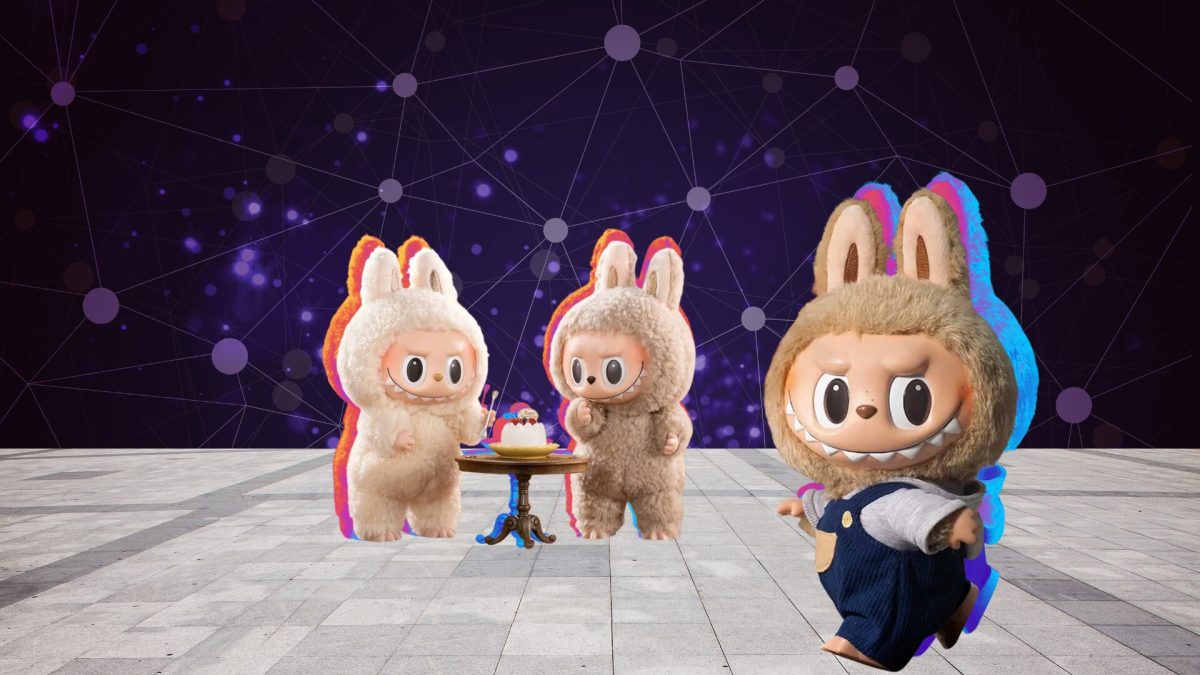
Les poupées Labubu, un phénomène marketing originaire de Hong Kong, continuent de faire sensation sur les réseaux sociaux. Malheureusement, cette popularité attire également des escrocs. Certains profitent de l’engouement pour piéger parents et collectionneurs, en créant de faux sites web imitant la boutique officielle.
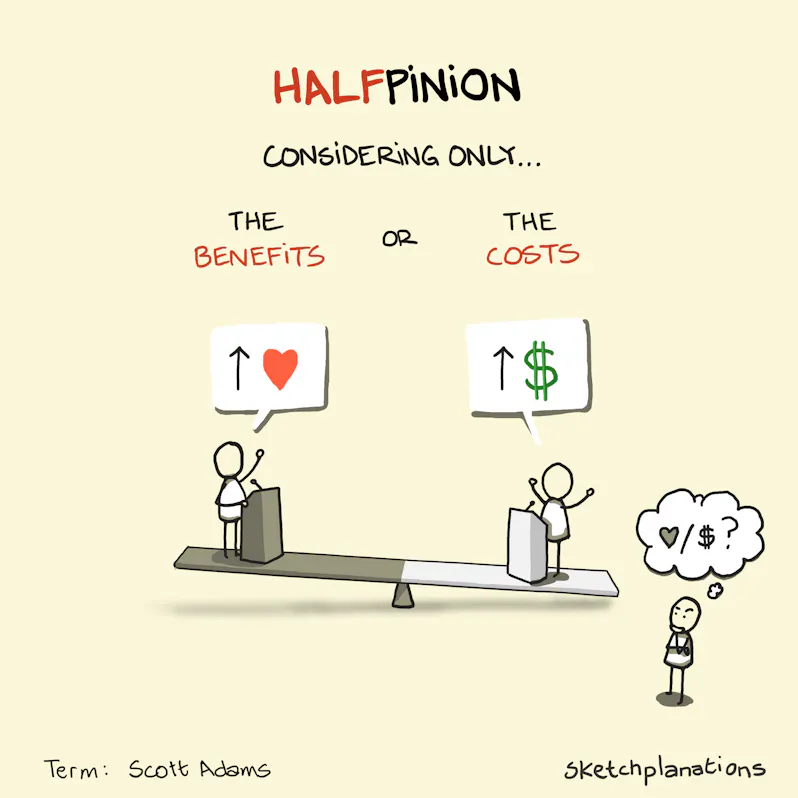
Governing sometimes seems easy from afar. We should spend more on education. We should pay hospital staff more. We should fix the roads. More police. Everyone should work harder. These would all be great if they were free. Unfortunately, doing more in one area often means taking from another.
The reality is that most actions have benefits and costs. A halfpinion is a handy term for when someone is ignoring one half of a topic—either the costs or the benefits. When you only consider one side of an issue, often just the benefits, you don't have a full opinion, you just have a halfpinion, and can't make an informed decision.
Getting a pet, having a child, moving to the country, working remotely, working in-house versus working at an agency, going freelance, banning plastics, staying up all night, or launching a new feature — each of these has benefits and also costs.
It applies to values, too. If your company values speed, it might mean that you have to accept that not everything will be perfect. If you value quality, it won't always be the cheapest. Valuing speed while tacitly assuming that quality won't be affected is a halfpinion.
If you don't consider both aspects, you might find the grass isn't always greener. Providing a credible perspective requires comparing the full benefits of a choice to the full costs.
Now, you don't have to accept a trade-off—the benefits or the costs, or somewhere in between. In design, I learned that we innovate through resolving contradictions. In the progression of ideas, this might follow thesis, antithesis, synthesis.
Perhaps there's a creative solution to be found that gets the benefits without most of the costs. But considering only one or the other is just a halfpinion.
Also see:
Halfpinion is a term coined by Scott Adams. I read about it in his book Loserthink. An example he gives is one group of people saying, "We can't do this, it's too expensive," and another responding, "But children are our future." The groups aren't so much disagreeing as pointing out one side of the issue: children are our future, and education is expensive.

Une étude de la société de cybersécurité Netcraft révèle que des cybercriminels exploitent les errances des LLMs comme ChatGPT ou Perplexity. Cette nouvelle méthode de piratage repose sur les faux liens renvoyés par les IA génératives.
Recently, Vuzix made two key announcements, solidifying sales and market presence, just as the AR smart glasses foresee incredible growth.
Firstly, Vuzix announced that TranscribeGlass is continuing to place follow-on orders for Vuzix smart glasses to support the increasing demand for its AI-powered real-time transcription service.
Madhav Lavakare, Founder and CEO of TranscribeGlass, said:
These follow-on orders reflect the strong market response we’ve received since our solution launch. TranscribeGlass empowers individuals with hearing impairments by delivering real-time closed captions directly into their field of view, fundamentally improving accessibility and communication. With growing demand for our solution, the Vuzix Z100 enables us to offer a seamless, all-day wearable experience that’s accelerating adoption and expanding our impact.
The TranscribeGlass solution is a patient care XR device that utilises the Vuzix hardware platform to enhance accessibility for individuals who are deaf or hard of hearing. This innovative product employs AI to provide real-time speech-to-text transcription. It also features Bluetooth connectivity for smartphones and tablets and advanced speaker identification, making it easier to follow conversations in group settings.
Paul Travers, President and CEO of Vuzix, also said:
Vuzix Z100 smart glasses offer a perfect foundation for TranscribeGlass’s advanced AI transcription technology. By working together, we aim to accelerate the use and development of smart eyewear, further solidifying Vuzix’ position at the forefront of AI-driven wearable tech.
In addition to the TranscribeGlass news, Vuzix confirmed its addition to the Russell 3000 Index.
“Vuzix is at the forefront of next-generation wearable displays, and our leadership in advanced waveguide optics is helping to define what’s possible in augmented reality,” said Paul Travers.
Travers also noted:
Our inclusion in the Russell Indexes is a meaningful acknowledgment of the progress we’ve made. We see this as both validation of our strategy and a catalyst for broader institutional engagement as we continue to push the boundaries of AR innovation on a global scale.
Vuzix has announced receiving a second tranche investment of $5 million from Quanta Computer, a leading global ODM and strategic partner. This new funding brings Quanta’s total investment in Vuzix to approximately $15 million, following earlier contributions over the years.
Additionally, Vuzix recently formed a partnership with Ramblr. This collaboration is a significant step toward the company’s projected success in 2025 and will enhance Vuzix’s efforts to integrate artificial intelligence into its augmented reality hardware portfolio. This trend is noteworthy as the smart glasses market approaches a crucial convergence this year, as highlighted by Google.
In a strategic move, Vuzix acquired a waveguide research and development facility in Milpitas, California. This acquisition will improve Vuzix’s waveguide tools, vital for its next-generation, AI-driven smart glasses, benefiting both its products and ODM/OEM partners. The acquisition centralises Vuzix’s innovation efforts within Silicon Valley and involves securing advanced equipment, further solidifying its position as a key player in the smart glasses market.
Moreover, Vuzix is strengthening its OEM partnerships with recent developments. The company has shipped its latest order of XanderGlasses, a private-label version of the Vuzix Shield smart glasses designed to assist individuals with hearing loss. This advancement signifies a significant milestone for Vuzix, especially following a strong start to 2025. XanderGlasses aims to support approximately 48 million people in the U.S. who experience hearing loss, and the devices are currently being distributed nationwide.
The Vuzix Shield smart glasses can display real-time captions of in-person conversations directly within the wearer’s field of view, allowing users to remain fully engaged in social and professional settings. Xander has received recognition for its product, earning a CES 2024 Innovation Award Honoree in the Accessibility and Ageing Tech categories.
This news comes during a crucial growth period for Vuzix, as the market gains momentum, indicating a promising future for this veteran in the smart glasses industry.

Crunchyroll, the massively popular anime streaming service and distributor, just got caught using obvious AI slop in its subtitles.
The slipup was made in the premiere episode of a new series called "Necronomico and the Cosmic Horror Show" — and trust us, there's no guesswork involved in sniffing out the AI here.
Around the 19:12 mark, the show's German subtitles feature a big fat "ChatGPT said:" jammed into the dialog. A classic, lazy error. (We double checked, and it's still there as of this morning.)
The fans who spotted this shoddy work didn't hold back in expressing their disappointment.
"This is not acceptable," wrote a user on Bluesky who was among the first to flag the AI usage. "How can we be expected to pay for a service that clearly doesn't care about the quality of its products?"
Not just the German subs btw lol pic.twitter.com/25kUWtXexP
— CheeseGX (@CheeseGX_) July 1, 2025
This might not come as a surprise to astute anime fans who've long complained about the quality of some of the service's subtitles. In late 2023, Crunchyroll infamously was forced to take down the first episode of the series "The Yuzuki Family's Four Sons" after the subs turned out to be outrageously bad. Errors ranging from random punctuation to straight up getting a character's name wrong raised the specter of machine translation.
Recently, some fans have found that the errors typically arise from the English closed captions — designed to be watched with the English dub — which show telltale signs of automation in how the text would incorrectly transcribe names or refer to characters that don't exist.
Pinning the blame for this latest incident is a bit tricky, though, since translations come from a variety of sources — sometimes from the production company, or the show's license holder, or from Crunchyroll's team.
Regardless, it won't help Crunchyroll's case that it's openly flirted with — and flip-flopped on — AI for some time now.
In an interview with The Verge last year, CEO Rahul Purini said that using AI to put out subtitles faster was "definitely an area where we are focused on."
"AI is definitely something that we think about at a lot of different workflows within the organization," Purini said in the interview. "Right now, one of the areas we are very focused on testing is our subtitling and closed captioning, where we go from speech to text and how do we improve and optimize our processes where we can get the subtitles done in various languages across the world faster so that we can launch as close to the Japanese release as possible."
Purini has since changed his tune. In an interview with Forbes in April, he insisted that the company is"not considering AI in the creative process, including our voice actors."
"We consider them to be creators because they are contributing to the story and plot with their voice," Purini added.
Fans were quick to declare victory at the time. Maybe it was premature.
More on AI: In Further Assault on Cinema, Amazon Is Deploying AI-Aided Dubs on Streaming Movies
The post Crunchyroll Accidentally Left AI Slop in Anime Subtitles appeared first on Futurism.
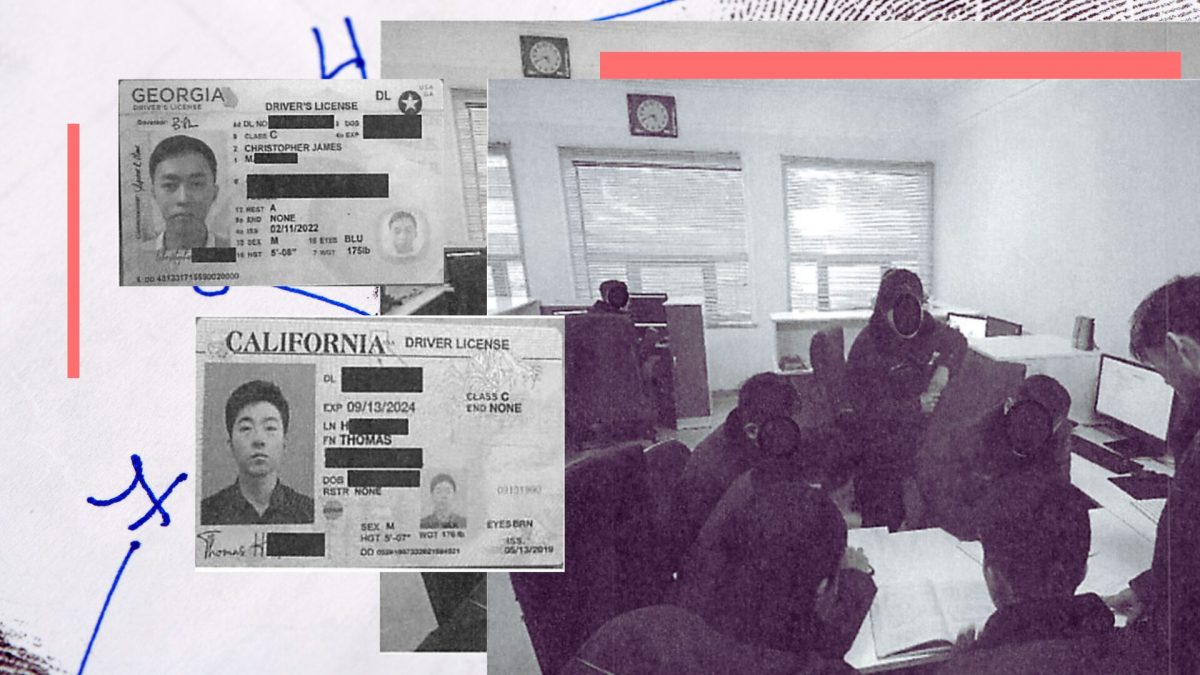
Fin juin 2025, la justice américaine a dévoilé l’opération DPRK RevGen, une initiative des principales agences de sécurité du pays (NSA, FBI, contre-espionnage) visant à démanteler un vaste réseau de travailleurs informatiques nord-coréens.
On June 28th, Beijing hosted its first Robotic Soccer Tournament, and yes, it was everything you hoped it would be: awkward running, dramatic falls, and robots giving 110%… processing power.
In the semi-finals, Team Vulcan from Tsinghua University took on Team Blaze Light from Beijing Info & Sci-Tech U. Picture this: six humanoid bots on a soccer field, moving like toddlers in cosplay armor, kicking with the precision of a cat wearing socks.
And this is only the beginning. It’s all leading up to the World Humanoid Robot Games this August, where teams will battle for glory, honor, and maybe a firmware update. Check it out!
Click This Link for the Full Post > Robo-Soccer is Now Real, and It’s Gloriously Weird

Un de mes crédos en termes d’expérience employé, qui s’inscrit d’ailleurs également dans des logiques d’expérience opérationnelle, est que la simplification est à la base de tout. Le travail et son organisation doivent être fluides, lisibles, logiques afin de permettre aux collaborateurs de se concentrer sur leur mission sans être constamment freinés par la complexité inutile du quotidien.
Mais, à ma grande surprise, mon idée est souvent mal comprise. On m’a déjà répondu plusieurs fois « On ne va tout de même pas payer des gens à faire des choses simples, si on les paie c’est justement parce que c’est compliqué« .
Comme si simplifier les conditions de travail revenait à appauvrir le travail lui-même ou à gâcher les talents.
Remarquez que c’est une piste qui mériterait peut être d’être explorée : et si la raison pour laquelle on recrutait des gens hyper expérimentés et qualifiés n’était que pour faire face à une complication (La complication organisationnelle : irritant #1 de l’expérience employé ) et une dette organisationnelle (How to Tackle the Biggest Threat to Your Team’s Growth ) qu’on a pas la volonté ou le courage de régler ?
Mais en fait le sens original de mon propos est tout autre.
En bref :
Ce qu’ils veulent c’est qu’on simplifie ce qui n’a aucune raison d’être compliqué !
Il ne s’agit pas de transformer les métiers en tâches triviales mais de supprimer les obstacles inutiles, ceux qui parasitent l’attention, usent la motivation et consomment l’énergie sans créer de valeur.
La complication inutile est partout dans les entreprises :
Elle est le fruit de la dette organisationnelle dont je parlais plus haut mais aussi du travail des managers dont l’appétence pour le contrôle n’a d’égal que leur peu d’intérêt pour l’amélioration du travail.
Tout cela finit par détourner les collaborateurs de l’essentiel. On les recrute pour leur intelligence, leur capacité d’analyse, leur créativité et on les enferme dans des systèmes qui les empêchent de les mettre en œuvre.
Simplifier c’est, au contraire, augmenter le niveau de concentration, de qualité et donc de qualité sur les sujets qui comptent vraiment.
Il faut en effet permettre aux équipes de se consacrer à des problèmes complexes, à forte valeur ajoutée, en les libérant de la pagaille organisationnelle. Déjà parce cette pagaille ne devrait pas exister et que les collaborateurs n’ont pas à en payer le prix mais également parce qu’avec l’essor de l’IA ce c’est de plus en plus pour gérer la complexité (et non la complication !) qu’on va embaucher des gens.
Et non, l’IA ne va pas régler le problème seule sans qu’on s’en occupe (AI Reasoning Is Cool, But First How Can We Tackle Organisational Debt?).
C’est ce qu’on attendrait naturellement d’un bon designer d’expérience utilisateur : faire en sorte que l’interface disparaisse, pour que l’usager se concentre sur son objectif
Mais pourquoi ce principe serait-il réservé aux clients, et pas aux collaborateurs ?
La simplification en effet est au croisement des opérations, de l’expérience employé et des RH (RH et Opérations : le seul duo viable pour mener l’expérience employé
et L’humain est partout dans l’entreprise mais, dans le travail, les RH ne sont nulle part).
On l’a oublié, ou on n’a jamais voulu le comprendre, mais l’expérience employé n’est pas une affaire de bien-être cosmétique ou de programme RH déconnecté du rée (Baromètre 2023 de l’expérience collaborateur : l’expérience employé face à ses contradictions). C’est un levier de performance (L’expérience collaborateur : un levier de transformation au service de la performance), au même titre que la qualité, la satisfaction client ou la maîtrise des coûts.
Et comme tout levier de performance, il exige une approche rigoureuse : observer, comprendre les irritants, supprimer les frictions, alléger ce qui peut l’être.
Cela demande une vraie culture de l’amélioration continue (Ca n’est pas parce que le travail est invisible qu’on ne peut l’améliorer) mais avant tout et surtout du courage managérial.
Pas pour rendre le travail « plus agréable » , mais pour le rendre plus efficace, plus intelligent, parfois digne. Le reste n’est qu’une conséquence.
Simplifier, ce n’est pas simplifier les missions mais simplifier l’environnement et le contexte du travail pour que chacun puisse utiliser tout son potentiel là où il est réellement utile.
C’est créer les conditions d’un travail exigeant, stimulant, valorisant mais sans surcharges inutiles ni complexité gratuite.
On ne paie en effet pas les gens pour faire des choses simples mais pour résoudre des problèmes complexes, prendre des décisions, faire avancer les choses.
Cela fonctionne très bien mais encore faut-il leur en laisser le temps, l’espace et l’énergie.
Et pour cela les organisation n’ont qu’un et un seul problème à régler : la complication.
Illustration : générée par IA avec ChatGPT, OpenAI, 2025.
L’article Simplifier le travail ne revient pas à sous-exploiter les talents est apparu en premier sur Bloc-Notes de Bertrand Duperrin.
This week, Meticulous Research published its “Industrial Metaverse Market—Global Opportunity Analysis and Industry Forecasts to 2032”, highlighting how the industrial metaverse market is experiencing extraordinary growth, reaching roughly $48.2 billion in 2025.
The report also noted that the industrial metaverse market is expected to grow to $600.6 billion by 2032, with a compound annual growth rate of 20.5% during the 2025-2032 forecast period.
Industrial metaverse, or in short, shared RT3D immersive applications, assets, and services, are leveraged broadly in sectors such as manufacturing, transport, and oil & gas, where high-quality simulations are finding a home as a tool to save capital during complex projects and operations.
But what hardware will the industrial metaverse be consumed on? If current trends are to be believed, it will most likely be smart glasses. The International Data Corporation (IDC) reported a significant recovery in headset purchases in its Worldwide Quarterly Augmented and Virtual Reality Headset Tracker. The latest report indicates that the AR/VR headset market grew by 18.1% year over year in the most recent quarter, with Meta leading the resurgence, capturing 50.8% of the market share.
Ramon T. Llamas, Research Director with IDC’s AR/VR team, noted that “the worldwide AR/VR headset market is reaching a critical tipping point.”
Llamas added:
Pure VR was once the darling of the market with companies like Meta, HTC, and Sony accounting for the vast majority of volumes. Now we have it on track to wind down in the next few years. Likewise, pure AR had strong promise with the help of Microsoft, but now we anticipate volumes to hold a small place in the overall market.
XREAL is currently the second-leading market player, partly due to its sales of smart glasses. In contrast, Viture, another smart glasses vendor, reported an impressive 268.4% year-over-year growth, while TCL saw an increase of 91.6%. Interestingly, the IDC noted that Apple did not appear in the market’s top rankings this quarter. The reporting firm observed a shift towards optical see-through glasses.
Jitesh Ubrani, research manager for IDC’s Worldwide Mobile Device Trackers, also added:
The market is clearly shifting toward more immersive and versatile experiences. While Meta continues to lead, the rise of brands like Viture and XREAL shows that innovation in form factor and user experience is resonating with consumers. The next wave of growth will be driven by mixed and extended reality, especially as AI and Android XR platforms mature.
IDC reports that although AR/VR/MR device shipments are expected to decline by 12% in 2025 due to delayed product launches, the firm anticipates significant growth in 2026. They project an approximate increase of 87%, and from 2025 to 2029, the market is forecasted to grow at a compound annual growth rate of 38.6%.
Llamas concluded:
Meanwhile, we anticipate MR to experience a strong reception with many of those VR companies pivoting there and gaining entrants like Apple. ER headsets will continue to gain traction primarily among gamers. Not to be overlooked is the impact that Google’s Android XR can have across both MR and ER, and we look forward to seeing more vendors leverage the new platform in much the same way that numerous smartphone vendors embraced Android.
The XR market is maturing, though it is progressing slowly and often repetitively. However, this suggests that paradigm-shifting technology is on the horizon. While widespread adoption and utilisation will take time, upcoming events like Meta Connect will likely serve as platforms for reaffirming long-term visions of XR innovation.

Le National Health Service (NHS) britannique a confirmé, le lundi 26 juin 2025, un fait tragique et inédit : la mort d’un patient, officiellement liée à une cyberattaque. Retour sur une affaire qui illustre la réalité des cybermenaces sur les infrastructures critiques.

For NYT’s the Upshot, Emily Badger, Aatish Bhatia, and Ethan Singer accounted for 900+ canceled federal grants and describe how the cancelations break the feedback loop of government-funded research.
The money the government sends to Harvard is, in effect, not a subsidy to advance the university’s mission. It’s a payment for the role Harvard plays in advancing the research mission of the United States.
This is the science model the U.S. has developed over 80 years: The government sets the agenda and funds the work; university scientists design the studies and find the answers. The president’s willingness to upend that model has revealed its fragility. There is no alternative in the U.S. to produce the kind of scientific advancements represented by these grants.
A tour through a treemap highlights specific grants and an interactive version at the end lets you poke around.
Tags: funding, government, Harvard, Upshot
Aeris, un leader mondial dans les solutions IoT et cybersécurité, a lancé un podcast audacieux : « IoT Real Talk ». Ce podcast, animé par des experts de l’industrie, promet de fournir des conversations honnêtes et non filtrées sur l’avenir de l’Internet des objets (IoT). Avec des invités influents du secteur, le podcast propose une vision complète et brutale des défis et des opportunités que présente l’IoT à l’échelle mondiale. « Ils osent tout dire ! » devient ainsi un cri de ralliement pour ceux qui souhaitent comprendre l’IoT sous tous ses angles.
L’IoT est souvent perçu comme une technologie en constante évolution, mais cette série de podcasts va bien au-delà des clichés. Loin de la simple discussion sur les appareils connectés, « IoT Real Talk » aborde des questions critiques, souvent ignorées, mais essentielles pour l’avenir de l’industrie. Le podcast est destiné à ceux qui souhaitent comprendre comment les technologies IoT affectent notre vie quotidienne et les défis non résolus derrière l’innovation technologique.
https://t.co/tjx8rycOwF #IoT »Aeris’s “IoT Real Talk” podcast brings unfiltered conversations around what’s next for global IoT spotlights« https://t.co/AOEQNYOeQg #Semiotik #Smart #InternetOfThings
— IoT ⚛️ Semiotik.IT (@Semiotis) June 23, 2025
« IoT Real Talk » ne se contente pas d’analyser les tendances actuelles, mais va directement au cœur des problématiques. Les animateurs, Susanna Song et Jon Connet, utilisent leurs expériences respectives pour poser des questions percutantes, plongeant ainsi dans les aspects les plus complexes de l’IoT. Avec des invités prestigieux, ils dévoilent les coulisses de l’industrie de l’IoT, et abordent les erreurs, les réussites et les leçons apprises dans le développement de solutions IoT.
Le podcast couvre une large gamme de sujets allant de la cybersécurité aux défis d’interopérabilité entre les appareils. Les auditeurs découvrent des discussions sur des projets innovants, comme l’utilisation de l’IA dans l’IoT et les défis de l’eSIM. Ces épisodes offrent en effet un éclairage unique sur un secteur en pleine expansion, mais aussi sur les obstacles réels qui ralentissent son adoption mondiale.
Les discussions de « IoT Real Talk » révèlent aussi l’importance de l’IoT dans la transformation numérique des entreprises. Chaque épisode explore comment l’Internet des objets devient un moteur pour l’innovation dans des secteurs aussi divers que la logistique, la santé, et la gestion de l’énergie. En rendant l’IoT plus accessible, les entreprises peuvent utiliser ces technologies pour améliorer leur efficacité opérationnelle et stimuler leur croissance à l’échelle mondiale.
Cependant, le podcast ne se contente pas de parler des solutions IoT. Il soulève également des questions sur la gestion des données et la protection de la vie privée. Comment garantir que les informations collectées par des milliards d’appareils sont sécurisées ? Ces conversations ouvrent alors la voie à des solutions novatrices et, espérons le, à une réglementation plus claire pour accompagner cette technologie omniprésente.
Aeris a bien compris que l’IoT est plus qu’une simple technologie. C’est un catalyseur de changement dans la manière dont les entreprises et les individus interagissent avec leurs environnements. Avec son podcast « IoT Real Talk », Aeris veut ouvrir la porte à des discussions honnêtes sur la transformation numérique à travers l’IoT. En dévoilant les défis et les succès de l’IoT, Aeris crée un espace où l’industrie peut partager des informations critiques pour sa croissance.
Ce podcast est bien plus qu’une simple source d’informations; il devient un lieu de réflexion où les leaders du secteur peuvent échanger sur l’avenir de l’IoT et des technologies connexes. « IoT Real Talk » se positionne donc comme une référence pour quiconque souhaite comprendre l’impact réel de l’IoT sur le monde moderne. Des informations concrètes et des analyses approfondies sont au cœur de cette série d’épisodes. Les discussions sans filtre feront sans doute date dans le monde de l’IoT.

Ce podcast ne se contente pas de partager des analyses techniques. Il permet aux auditeurs de découvrir des histoires fascinantes sur les personnes qui façonnent le futur de l’IoT global. Les invités sont des experts, des entrepreneurs et des acteurs de l’industrie qui ont vécu des défis réels et trouvé des solutions concrètes. Ces témoignages donnent un aperçu rare de ce qui se passe réellement dans les coulisses de l’Internet des objets.
« IoT Real Talk » offre une compréhension de l’IoT au-delà des chiffres et des tendances marketing. Il expose les aspects humains de cette révolution numérique. Il souligne l’importance de la collaboration et de la résilience dans un secteur en constante évolution. C’est un podcast qui dépasse les attentes, offrant des perspectives uniques sur l’avenir de l’IoT.
Cet article “Ils osent tout dire !” Ce podcast révèle l’avenir inattendu de l’IoT mondial est apparu en premier sur OBJETCONNECTE.COM.

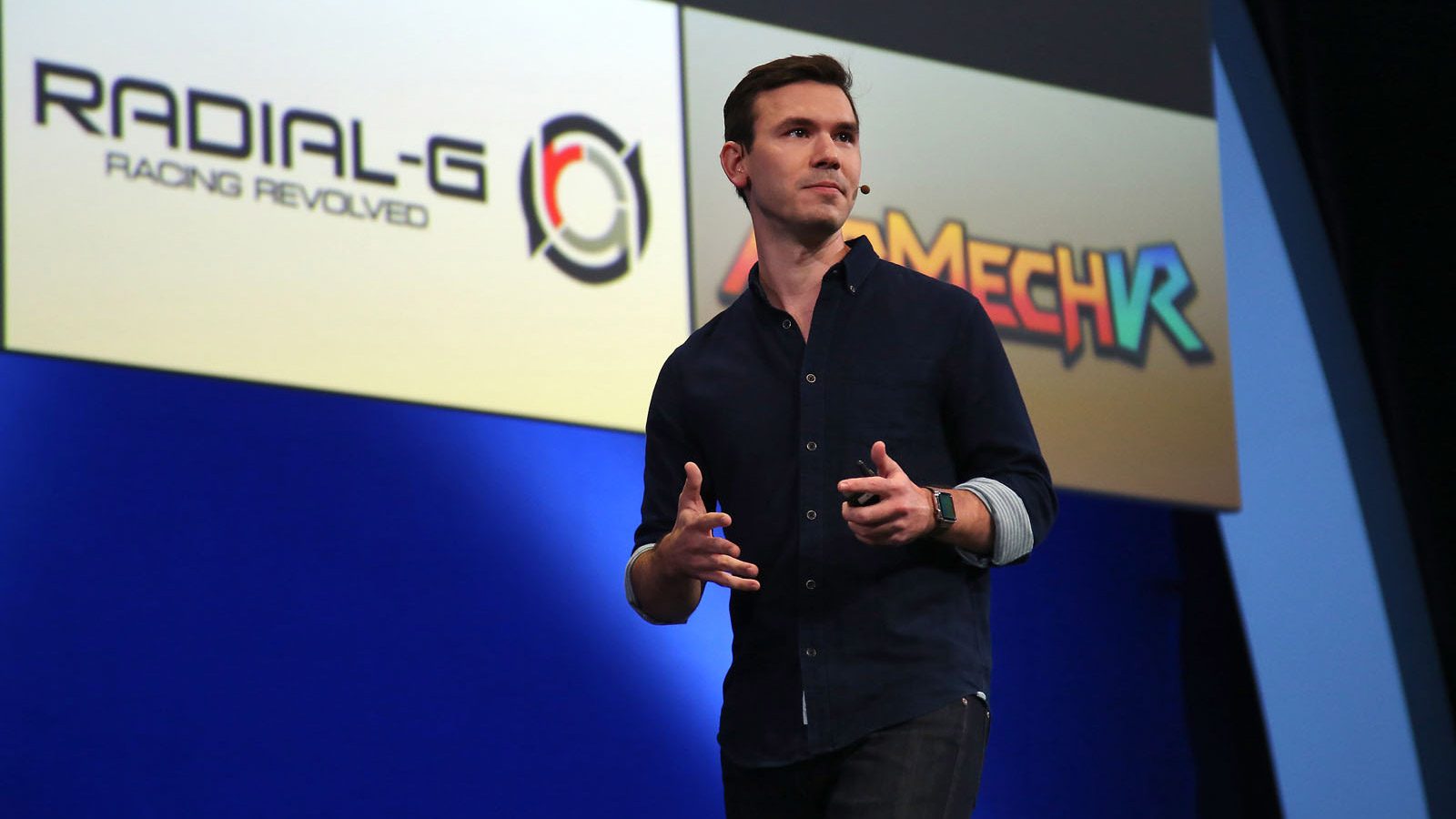
Oculus co-founder Nate Mitchell announced he’s joining former CEO Brendan Iribe and hardware architect Ryan Brown at Sesame, the smart glasses startup that exited stealth earlier this year.
Mitchell announced in a LinkedIn post that he’s joining Sesame as Chief Product Officer, noting his mission is to “help bring computers to life.”
“Getting the band back together with Brendan Iribe, Ryan Brown, and many of the original Oculus crew. Building the future together again,” Mitchell says in the post.
Sesame is currently working on an AI assistant along with a pair of lightweight smart glasses, which the company says is “[d]esigned to be worn all day, giving you high-quality audio and convenient access to your companion who can observe the world alongside you.”
Mitchell, who co-founded Oculus along with Palmer Luckey, Brendan Iribe, and Michael Antonov in 2012, served as VP of Product for a number of years, later leading Rift and Meta’s (ex-Facebook’s) broader VR product strategy. Mitchell departed the company in 2019 as the last remaining founder.
In 2020, Mitchell announced he was founding Mountaintop Studios and leading the company as CEO. The studio went on to release free-to-play tactical shooter Spectre Divide (2024) on PC and console, however within six months of release, the studio announced it would be shuttering the studio and taking Spectre Divide offline following tepid response to the game’s first big DLC drop, ‘Season 1: Flashpoint’.
Founded in 2023, Sesame is backed by a number of former Oculus investors, including Anjney Midha and Marc Andreessen at Andreessen Horowitz, Spark Capital, and Matrix Partners.
The company completed its most recent Series A funding round in November 2023 to the tune of $47.5 million, making for a total of $57,624,975 invested in the company to date, according to data obtained by Crunchbase.
The post Former Oculus Execs Are Jumping Back into Wearables with Sesame Smart Glasses appeared first on Road to VR.
At AWE, I have been able to sit down with Lumus in a private meeting room. There, I had a short interview with them, and I’ve also been able to try their waveguide-based optical engines! Discover everything about them by reading this article!
Lumus is a company that works on display systems for augmented reality. It has been active for around 20 years now (WOW!), and it worked for more than 15 years with the military, building AR visualization systems for airplane pilots, for instance.
Lumus’s specialty is working with reflective geometric waveguides. The visual engine is made of a tiny projector that emits the virtual image and a lens with two sets of partially reflective mirrors that spread the image across the horizontal and vertical axes. The transparent lens lets you see the real world, while the mirrors carry the virtual image to your eyes: the mix of the two is an augmented reality. When you see one of their lenses, you can also see these mirrors, which appear as sets of parallel lines.

The company claims that since they use reflective waveguides, they can preserve the colors and brightness of the images they project on the lenses. Their products also have very high luminance: from 3000 to 7000 nits, which means they are not only good to wear inside, like the other AR glasses like HoloLens, but they are also great with outside ambient light.
Reflective waveguides can also be merged with a prescription layer, meaning that it is possible to create an optical engine that projects AR elements, and at the same time features prescription lenses to make you see the real world better.

Lumus also claims that its battery efficiency is up to 10 times greater than any other waveguide on the market: this is a very important datum for AR glasses, where energy consumption should be reduced to its minimum.
When I arrived at the booth, the first thing that Lumus teased me was its upcoming visual system featuring 70° of FOV. Yes, 70°, the same as Meta Orion, but using only glass as a material and not something exotic (and very expensive) like silicon carbide. They had a prototype of the lens and the projector there, but they could not let me try it. Theoretically, they should launch it at the next CES, which is close enough to be excited about.

They had two other systems for me: one with a 50° field of view, and the other with 30°, which was the new product just announced at AWE. I was a bit confused as to why offering a new product with a reduced field of view, but actually, after they explained it to me, it made a lot of sense. The 30° module is much more power efficient, meaning that it is less aggressive on the battery of your AR glasses and smartglasses. At this moment, the devices that are getting the most popularity are smartglasses that either do not have a display or just need a simple one to show notifications. These glasses do not need to provide immersive content, they just show small 2D content, sometimes in a monocular and other times in a binocular fashion. So it is useless to have a full 50° FOV: a 30° one suffices, and it allows for a longer battery life.

I have been able to go hands-on with Lumus’s AR systems. Notice that the company does not want to build its own glasses, but just be a provider of the optical engine for the firms making AR glasses or smartglasses. For this reason, at the booth, there were no commercial glasses to try. But Lumus built a prototype to let people try its products and at the same time have an idea of how small the glasses using this system may be.
The glasses were pretty small and had a fashionable blue frame. They were connected with a cable to a PC that was controlling the visuals projected on the lenses. Since they were not selling standalone glasses, there was no need to make a wireless demo, and a cabled demo of the optical system was fine to me.
Both the 30° and 50° models had a similar output, so I will just describe them once. Of course, the 50° model had a wider field of view, but rest assured, the rest was almost identical.

Since the optical systems were small, the test glasses were very lightweight, too. And it was cool to see that the lenses was very transparent, and not darkened out like it happened in the past with glasses like HoloLens. As I’ve explained while talking about LetinAR, this is a great thing because when seeing the person wearing the glasses, you can see his/her eyes and for us humans, it is very important to see the eyes of the people we are interacting with.
The first thing that surprised me when I was shown some images was the shape of the field of view: it was square-shaped, so its form factor was mostly 1:1. This was quite good because I remember reading somewhere that for our brain, having a good vertical field of view is very important. The form factor contributed to giving the impression that the FOV was actually bigger than 30°.
As for the colors, I can state that the claims of the company are correct. I have been shown some images with very bright colors, like the photo of a parrot, and the colors appeared very vivid. I also wanted to test the high luminance (up to 7000 nits), so I started looking at the lights on the ceiling. If I put the virtual image exactly superimposed on a light, of course, I couldn’t see much, but if I still looked up and put the virtual elements close to a light, I could still see everything. This quick test showed me that these waveguides are much brighter than what I’m used to, and remain visible also in bright light conditions. I couldn’t go outdoors with the glasses, unluckily, so I can’t confirm that they could be used outside… but from my indoor tests, I can confirm that potentially they could (I’m not 100% sure because the sun is much more powerful than any artificial light used to illuminate a room, so I still need to do a real test).
I was then shown various optical patterns, including some test images that I’ve seen multiple times in the articles written by Karl Guttag (whom I love, btw). The text was readable, and the white background appeared as just white. This may seem obvious, but it is not: it is very easy to have color artifacts on a white square. HoloLens had a lot of “rainbows” appearing when you were looking at a white element, for instance.

Of course, no current AR system is perfect. And one thing that I noticed when I tried Lumus is that sometimes I had some horizontal grayish bars appearing on the image. They were much more evident when I was closing or opening the eyelid. The company spokesperson told me that it usually does not happen, so it probably depends on the shape of my face. But still, if I have seen them, other people will see them for sure.
The name Lumus is very famous in the AR space, but it was the first time for me to finally speak with the company and try the product. I have come out of the meeting with them with a very positive impression: they seemed very professional, and they showed me a product that was working great. The bright colors and the high luminance were the two biggest highlights for me. And the fact that in a few months, they will be able to do 70° of FOV is impressive, too.
Before we parted, the Lumus spokesperson told me to “expect to see our tech in some glasses in the near future”, meaning that pretty soon we will see some real product using these optical systems. I can’t wait to try it!
The post Hands-on with Lumus waveguides appeared first on The Ghost Howls.

Dans l’ombre du conflit armé entre l'Iran et Israël, la cyberguerre ne connaît pas de cessez-le-feu. Selon Check Point Research, un groupe de hackers iraniens, connu sous le nom d’« Educated Manticore » (alias Charming Kitten ou APT42), mène une campagne d’espionnage d’une rare sophistication contre des experts israéliens de la cybersécurité et du monde académique.

You, like me, probably dislike being stuck in traffic. If you live in a densely populated area, it's likely that for at least some of the day, a number of the major roads around you are congested, i.e. there's a lot of traffic, and it tends to go slowly. Unfortunately, as I learned with the phrase "Congested equilibrium," from UCL Professor David Metz, there's no magic wand to wave for roads that will run smoothly and get you to your destination with minimal hassle.
It's easy to assume that there's a fixed amount of traffic on the roads. So if your local road agency widens, improves, or adds alternative fast roads to get to your destination, you might think that traffic will improve. And it does, but only briefly. Then somehow the traffic jams return.
The reality is that in densely populated areas, traffic congestion tends to be self-regulating. When driving is slow and somewhat painful, people who would have driven make other choices:
After millions in road investment—perhaps widening roads or building a bypass or extended stretch of motorway—traffic runs faster, for a time.
But when people realise that roads are again a good option for travel, some of those who had chosen not to drive or didn't use that route before, jump back in the car and make use of the new, improved roads. And the increased traffic once again leads to congestion that gets progressively worse until people decide to make other choices once again.
Traffic congestion is a feature of road networks that is very hard to avoid because densely populated areas have a vast reserve of these suppressed trips—people who would drive if the traffic was better—ready to make use of an improved road network when it arrives.
From congested equilibrium comes the maxim in travel planning circles: "You can't build your way out of congestion."
I learned about congested equilibrium and the general trials and challenges of travel planners in the book Good to go? Decarbonising Travel After the Pandemic by Professor David Metz. Although the book had less to do with decarbonising than I expected, it did teach me a great deal about the challenges and considerations of travel planning.
For the last half a century or so, the average daily travel time has remained unchanged. This is despite huge investments in road networks in urban areas.
When I find myself stuck in and complaining about traffic, my mind flashes back to a memory of a billboard in San Francisco that read, "You are not stuck in traffic. You are traffic." Then I feel better about my fellow drivers.
What people like least is uncertainty about journey time. So digital navigation, as exemplified by Google Maps, is doing an amazing job at giving us peace of mind here. Until ChatGPT, I put Google Maps as the best app out there.
In European cities you tend to find either high public transport use (like London), or a lot of cycling (think Copenhagen). But you don't tend to find high levels of both. Copenhagen's proportion of car journeys is similar to London's. The car has an appeal when the roads allow it. Improving cycling tends to pull people from public transport and vice versa rather than pull people from their cars.
Of David Metz' points that stick with me is also that the most effective way to reduce car usage in city centres, in conjunction with improving other means of travel, is to reduce the availability of parking.
Also, each city is different: some cities like London are spread wide and the distances are large, some have more cooperative weather, some have a lot of hills, and some are in countries where cars are a significant status symbol. There's no one-size-fits-all.



The United Kingdom's health regulator is investigating weight loss jabs like Ozempic and Mounjaro after linking it to hundreds of severe illnesses and even a handful of deaths.
As the Independent reports, the UK Medicines and Healthcare products Regulatory Agency (MHRA) is asking residents to submit their own experiences with glucagon-like peptide-1 (GLP-1) receptor/agonist drugs after the release of new data linking them to nearly 300 cases of pancreatitis and at least 10 pancreatitis-related deaths.
Earlier in the month, the pharmacy news site Chemists and Druggists reported that a whopping 111 people in the UK had died after taking GLP-1 drugs, though as the government noted, those figures do "not necessarily mean that [a death] was caused by the medicine" and that the fatalities could have been caused by underlying conditions. Instead, it appears that the authorities who reported those deaths to the health regulator suspected that the drug played a part.
Of those 111 deaths, at least 10 were related to pancreatitis. UK outlets are now reporting on them thanks to the government's new push for residents to flag any pancreas issues after taking GLP-1s to the MHRA's "Yellow Card" campaign, which urges residents to report adverse drug events.
Official warnings about this potential link between GLP-1s and pancreatitis also comes just days after the country's National Health Service began allowing doctors offices to prescribe Mounjaro, the Eli Lilly weight loss jab that uses the drug tirzepatide, a compound similar to the one underlying Novo Nordisk's Ozempic and Wegovy.
As the NHS notes, general practitioners in the UK will only be able to prescribe Mounjaro based on a very selective list of eligibility criteria that includes being diagnosed with at least four obesity-related illnesses and, strangely, having a body mass index (BMI) rating that's adjustable based on race or ethnicity.
While doctors maintain that GLP-1s are safe for most people to take, some have begun to voice caution based on real-world data like those recently released by the MHRA — especially because an estimated 1.5 million people in the UK are now taking them.
"The percentages for pancreatitis seen in clinical trials was small, but we know that many people are now purchasing these medications privately," explained Simon Cork, a physiology teacher at Anglia Ruskin University, in an interview with the Indy. "Small percentages in large numbers means an increasing number of people developing these conditions, although they still remain rare."
The MHRA's new guidance is meant more to help doctors and patients decide what is best rather than to sow panic, Cork insisted.
"For the vast majority of people, these drugs will help with weight loss and are overwhelmingly safe," he continued. "For a small number of people, significant side effects will occur, and it’s important to ensure that people are being monitored by their healthcare professionals."
More on Ozempic: Doctors Concerned By Massive Uptick In Teens Taking Ozempic
The post Ozempic-Style Drugs Linked To Hundreds of Illnesses and Deaths appeared first on Futurism.
At AWE US, I have been able to go hands-on with the newest LetinAR optical system for AR glasses. In the following, you can find my impressions!
It is not the first time I have gone hands-on with LetinAR. I had already met the company two years ago, always at AWE US, so I am quite familiar with its product. The idea behind LetinAR is to offer a display system for AR glasses and smart glasses that use micromirrors. You have a transparent lens that lets you see the real world in front of you, and then on the lens, you have some tiny mirrors that reflect into your eyes the image of the virtual elements projected by a light emitter (basically a display). Theoretically, since the mirrors are very tiny, you don’t notice them, as you don’t notice the eyelashes that you have in front of your eyes. And theoretically, the little pieces of the virtual image reflected by all the single micromirrors compose into a single cohesive image onto your eyes. The result is so augmented reality, with the view of the real world and then some virtual elements imposed on top of it.
LetinAR claims that this approach can offer many advantages, for instance:


I have been shown all the advantages of this system in a presentation. You can read them too on this page, if you want to go further.
LetinAR has many variants of its optical system, each one of them with its advantages and disadvantages. I have been told that its optical systems can be used for the whole gamut of see-through devices, from smart glasses to AR glasses.

Notice that the company does not aim at building its own glasses, but at providing its technology to other manufacturers. In fact, I remember last year I tried at the Qualcomm booth some Japanese AR glasses whose optical engine was provided by LetinAR.
When I tried a prototype of the LetinAR system a couple of years ago, I found it promising, but I also found that the system was not always working as expected. The first prototype I tried was made with pinholes, that is, tiny circular mirrors, and I found that sometimes I could still see the halo of the holes, but at least the colors were bright. Then I tried a new evolution of the system, with semitransparent little “mirror bars” and found that the image was a bit less bright than the first model.
Fast forward two years, what was the “new evolution of the system” is actually the current technology: I was given some glass frames with the LetinAR system inside, and I could grab it and take it close to my eyes using my hand to enjoy augmented reality. The eye module clearly featured some horizontal little lines, which were the semitransparent mirrors.

The first test I was provided with was a static image, as if the glasses were used to provide a virtual display, a la XREAL One. I was positively surprised by the image quality: the resolution was good and the colors were very bright. The problems of the image being a bit transparent and washed out a couple of years ago had totally disappeared. The field of view was also pretty ok for the current status of augmented reality: I have been told it was around 45°. As for the image consistency, it was pretty good, as you can see from the through-the-lens picture, but still, I could notice some dark-ish horizontal halos of the mirrors. In certain conditions, I could see the image, but also some gray-ish horizontal lines superimposed on it. These were for sure artifacts created by the horizontal semitransparent mirrors, whose reflections did not combine into a single cohesive image.

After this demo, the LetinAR representative also let me try something related to augmented reality, so we started a new demo that showed me some 3D cubes floating in the air at a distance of about 3 meters from me. What was cool about this demo was that at that moment, all the visual artifacts disappeared from my view. It was like black magic: no more gray lines, and I could just see a cohesive, bright 3D augmented reality application. But how was that possible? Well, there are a couple of things that contributed to this “miracle”. One is that my eyes started to get used to the visual system, so my brain started to ignore the grey lines. The second is that while the 2D image of the first demo forced me to focus on a close distance, the AR demo let me focus on more distant elements, so all the disturbances close to my eyes became more blurred and unnoticeable.
It was pretty cool because for the first time, I could see what the final goal of LetinAR is: I’ve seen all these tiny mirrors disappear and just give me pure AR.

The company showed me the roadmap for the next months, and there are pretty cool things coming. I can not share the details, but two things they are working on are improving the field of view and also making the “lines” less noticeable from the outside. Currently, if you wear some LetinAR lenses, you see the eyes of the wearer with some bright lines in front of them… which is very cyberpunk, but not very natural. So the company is trying its best to let you clearly see the eyes of the person with the glasses you have in front of you.
I came out with a good impression from the LetinAR demo. You know me: when I see progress, I’m always happy. And I’ve seen that in these two years, the company improved its technology, creating glasses with a decent field of view and bright colors. And in some conditions, I have even seen all the artifacts disappearing, which was mindblowing to me.
Of course, there is still some work to do: the FOV should be larger, and especially, the artifacts should always disappear, not only in some conditions. They should disappear both from inside the lenses (for the user) and outside the lenses (for the people looking at the user). The company showed me they are working on all of this, so I can’t wait to try the next model that is coming in the future.
The post Hands-on LetinAR optical system appeared first on The Ghost Howls.