Un Thermomix qui perd la tête et affiche des messages étranges, ce n’est pas une panne. C’est un hack volontaire, orchestré par un expert français pour alerter sur les failles des objets connectés.
Baptiste Moine, ingénieur chez Synacktiv, a piraté un Thermomix pour démontrer ses limites de sécurité. Ce modèle TM5, doté d’un écran tactile et d’une connexion internet, a servi de terrain d’expérimentation. À travers une faille présente sur le port magnétique latéral, il a simulé une mise à jour piégée. « J’ai bluffé le système en contournant les mécanismes de sécurité », résume le chercheur. Il ne s’agit pas d’un acte malveillant, mais d’une démonstration éthique, validée par la marque Vorwerk.
Des résultats très parlants pour l’ensemble du marché
« Ce Thermomix piraté ne représente pas un danger direct, mais il montre ce qu’on peut faire », prévient Moine. L’appareil reste globalement bien protégé pour un objet sorti en 2014. En revanche, des équipements plus récents, parfois moins bien conçus, sont bien plus vulnérables. Caméras connectées, babyphones, enceintes vocales, aspirateurs : tout ce qui communique peut être ciblé. Certaines caméras à 15 euros stockent mal les données ou négligent les protocoles de sécurité.
En 2024, le piratage à distance d’un robot aspirateur a généré un scandale au Minnesota. Le pirate n’avait pas ciblé la machine, maisles identifiants client volés via une ancienne fuite de données. Le phénomène touche de plus en plus d’objets du quotidien : on parle désormais de 48 milliards d’appareils connectés dans le monde. Et certains, comme ce Thermomix piraté à des fins de test, deviennent symboliques des limites du secteur.
Les bons gestes pour protéger ses appareils connectés
L’expert recommande de toujours appliquer les mises à jour proposées par les fabricants. Vorwerk, suite à ce test, a corrigé les failles observées sur le Thermomix piraté par Baptiste Moine. Mieux encore, l’entreprise collabore désormais avec lui pour renforcer la sécurité des futurs modèles. Enfin, il pose une vraie question : « Est-ce bien utile de connecter une machine à laver au Wi-Fi ? » À méditer.
In a paper in Nature, Meta detailed some of the sEMG wristband gestures you'll use to control its HUD glasses & AR glasses.
The peer-reviewed paper, titled "A generic non-invasive neuromotor interface for human-computer interaction", describes in scientific detail the device which Meta has been developing since at least 2019, when it acquired a startup called CTRL Labs.
CTRL Labs was co-founded and led by computational neuroscientist Thomas Reardon, who still leads the project at Meta today.
0:00
/0:47
1×
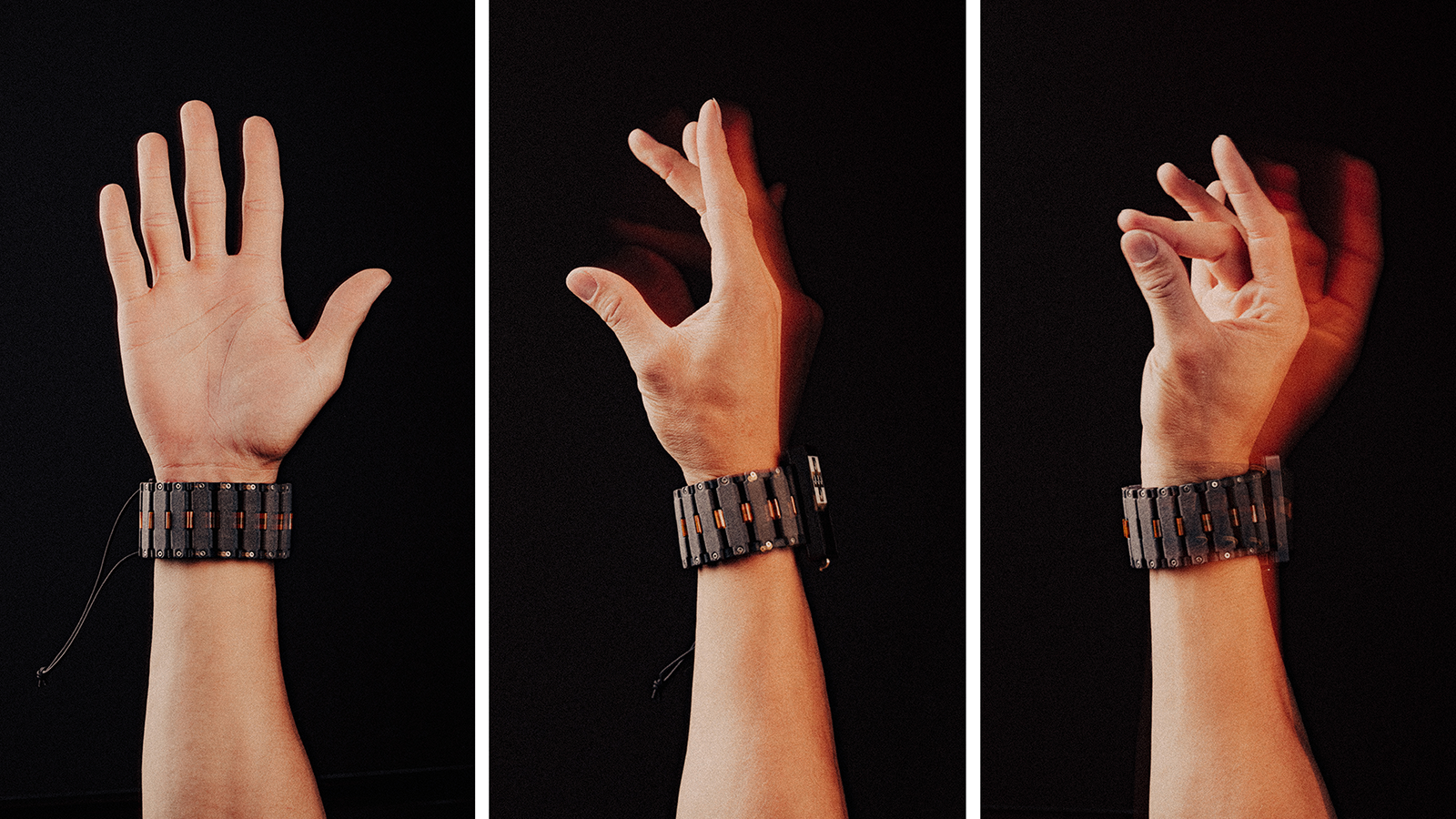
The wristband works by sensing the activation of the muscles in your wrist which drive your finger movements, a technique called surface electromyography (sEMG). It enables precise finger tracking with very little power draw, and without the need to be in view of a camera.
This means you can control virtual interfaces using subtle finger movements while your arm is at rest, instead of needing to raise your hands or speak out loud.
The video released alongside the paper shows four types of gestures:
Writing individual characters on a surface using your index finger, which are converted to digital characters for text entry.
Rotating your hand, using your wrist, to control a 1-dimensional cursor.
Swiping your thumb against the side of your index finger.
Tapping your thumb against your index finger, or holding, as a tap/click.
The paper also claims that Meta's sEMG technology can now generalize to new users, without the need for a per-user trained model, and the company has released over 100 hours of sEMG recordings for use by the scientific community, which it says should help advance accessibility technology around the world.
The hardware shown in the paper is a research prototype, strongly resembling one first shown in 2021. But at Meta Connect 2024, the company publicly demoed a sleek seemingly-productized version of the wristband, codenamed Ceres, as the input device for the Orion AR glasses prototype.
Swiping your thumb against the side of your index finger was introduced as a Meta Quest SDK feature in March, called microgestures, and was a key part of the Orion demo.
Renders of Ceres, and footage of a similar-looking device in use, were discovered inside leaked early firmware for the simpler HUD glasses that The Verge, The Information, The Financial Times, and Bloomberg's Mark Gurman have all previously reported that Meta intends to release later this year, codenamed Hypernova and seemingly named Meta Celeste.
Gurman has reported that Meta intends to include the wristband with Hypernova, with the total package priced "over $1000 and as high as $1300 to $1400".
The leaked firmware included tutorial videos for some of the same gestures seen in the Nature paper, as well as others, including pinching your thumb to your index finger and "pulling" horizontally or vertically.
Meta Connect 2025 will take place from September 17, and we expect Meta to announce Celeste then and open preorders for shipping in October, assuming it doesn't get delayed.
In April, Mark Gurman reported that some Meta employees were working weekends to ship the HUD glasses on time. In just under two months, we should know whether these efforts succeeded.
by Sylvain Biget, Journaliste, télépilote professionnel de drones et réalisateur de documentaires
Inquiétant. Parmi les victimes de la cyberattaque liée à la vulnérabilité SharePoint, il y a l’agence américaine qui stocke l'arsenal d'armes nucléaires. L’attaque semble provenir de groupes de hackers chinois affiliés à l’État et ils viennent déjà de passer à l’étape suivante…
Google is following through on recent promises to add more generative AI features to its photo and video products. Over on YouTube, Google is rolling out the first wave of generative AI video for YouTube Shorts, but even if you're not a YouTuber, you'll be exposed to more AI videos soon. Google Photos, which is integrated with virtually every Android phone on the market, is also getting AI video-generation capabilities. In both cases, the features are currently based on the older Veo 2 model, not the more capable Veo 3 that has been meming across the Internet since it was announced at I/O in May.
YouTube CEO Neal Mohan confirmed earlier this summer that the company planned to add generative AI to the creator tools for YouTube Shorts. There were already tools to generate backgrounds for videos, but the next phase will involve creating new video elements from a text prompt.
Starting today, creators will be able to use a photo as the basis for a new generative AI video. YouTube also promises a collection of easily applied generative effects, which will be accessible from the Shorts camera. There's also a new AI playground hub that the company says will be home to all its AI tools, along with examples and suggested prompts to help people pump out AI content.
On est tous d’accord, les smartphones sont au cœur de notre quotidien. Avouez-le, il est impossible de s’en passer une seule journée. Mais cette technologie, si pratique, peut nous coûter cher si elle est mal protégée.
En effet, une faille eSIM peut devenir une menace sérieuse pour la sécurité d’un smartphone. Et pour cause, cette vulnérabilité ouvre la porte à des attaques capables de compromettre les communications… et même la vie privée. Mais comment en est-on arrivé là ?
Les pirates peuvent exploiter une faille eSIM pour espionner les communications
Cette faille eSIM ouvre une porte aux pirates pour écouter discrètement les échanges. En effet, en exploitant ce défaut, les malfaiteurs interceptent les communications sans que personne ne s’en rende compte. Cette vulnérabilité se trouve dans les anciennes versions du profil de test GSMA, utilisées sur de nombreux smartphones.
Le problème concerne la carte eUICC, un élément clé de la eSIM. Car les attaquants peuvent insérer un logiciel malveillant directement dans cette puce. Et cette intrusion leur donne un accès secret aux appels, messages et données mobiles. Face à cette menace, la sécurité classique des smartphones ne suffit plus.
Les malfaiteurs peuvent prendre le contrôle total d’un profil mobile
Au-delà de l’espionnage, cette faille eSIM permet aux malfaiteurs de manipuler un profil mobile. Avec un accès physique au téléphone, ils peuvent installer un applet malveillant qui va prendre le contrôle complet de la gestion des profils. Puis, ils modifient, ajoutent ou suppriment facilement des profils comme bon leur semble.
Cette prise de contrôle entraîne une perte totale d’autorité sur la ligne. En effet, même les opérateurs ne peuvent plus désactiver ou surveiller les profils piratés. À ce stade, on comprend comment une faille ouvre la voie à des fraudes graves. Car il ne s’agit plus seulement de vol de données mais d’un contournement complet du système.
Sans correctif de sécurité, la menace risque de devenir incontrôlable
Malheureusement, cette faille eSIM reste active sur les anciennes versions du profil GSMA. Aucun correctif global n’a encore été appliqué. Les pirates peuvent donc continuer à l’exploiter sur des millions de smartphones dans le monde. Et tant que les mises à jour ne sont pas installées, le risque reste entier.
Mais le danger est encore plus grave car cette vulnérabilité peut servir à glisser des portes dérobées dans la puce eSIM. Ces logiciels cachés permettent des attaques silencieuses, difficiles à repérer. Par conséquent, sans correctif rapide, cette faille eSIM pourrait devenir incontrôlable. La sécurité mobile est clairement en jeu.
Yesterday, German startupGixel came out of stealth mode to announce it is working on a new type of optical engine for AR glasses and smartglasses. It also announced a €5M funding round led by several business angels, including the Oculus co-founder Brendan Iribe. Ah, and I also had a secret meeting with them at AWE. Discover all of this, with some information EXCLUSIVE to this blog, by reading this article!
What is Gixel?
The Gixel team (Image by Gixel)
Let’s start from the basics: Gixel is a startup based in Germany that is working on a new optical engine for smartglasses and AR glasses. It’s the third time I’ve repeated this sentence, so I guess this is already overly clear to you. You may be aware of other AR optical engines, like waveguides (used e.g. in HoloLens), birdbath (e.g. XREAL), or pinhole (e.g. LetinAR). Gixel is using another approach, which is based on micromirrors. And since it is a new, intriguing mode, it has just gained the trust of some relevant investors.
How does the Gixel optical engine work?
The Gixel optical engine (which may be used in smartglasses and AR glasses, never forget about it :P) works as shown in this picture:
This image makes the basic principles very clear (Image by Gixel)
Before describing the inner workings, let’s focus for one moment on the lenses in the Gixel system, because they are not the standard glass/plastic lenses of AR glasses, but they are definitely special. These lenses contain some micromirrors. These micromirrors, thanks to some optoelectrical magic, can change their optical properties, so, for instance, they can be commanded to change the direction they reflect the light to. Inside the lenses, there is some liquid, which has the same refraction index as the elements that mount and move these mirrors, which means that, optically speaking, these control elements do not alter how the light passes by compared to the rest of the lens. The result is a transparent lens with some quasi-transparent micromirrors that can reflect light rays as we wish.
Now that we’ve seen how the lenses are, let’s see the intended behavior of the whole optical system. There is a tiny microOLED projector that projects the image of the virtual elements onto the lenses of the glasses. Remember that on the lenses there are the micromirrors, whose purpose is exactly to reflect these light rays emitted by the projector. On the glasses, there is also an eye-tracking system, able to always detect where your pupil is. The control system of the glasses takes the input of the eye tracking and commands the micromirrors to rotate so as to make sure that the light rays from the projector are reflected into the eyes. So we have a transparent lens that makes you see the real world, and a system of projectors and micromirrors that cast a virtual image into your eyes: the result is that you see augmented reality.
This explains the overall workings. Unluckily, at this stage of the project, the company has not unveiled more details about how its system works, but probably more information is coming in the future.
What are the advantages of this approach?
According to the company, “Gixel’s approach enables optical see-through displays with smartphone-level quality, stellar transparency when the display is off, and extremely energy-efficient, low-weight, low-heat operation. Designed for industrial-scale manufacturing, it supports curved lenses for sleek form factors, variable focal planes for correct depth placement, and a scalable field of view, from small zones to the entire lens. Its scalable design gives OEMs freedom to choose the field of view and place displays anywhere on the lens.”
With Gixel techology, it is possible to build glasses with variable FOV (Image by Gixel)
Long story short, the Gixel team is convinced that its technology ensures more power-efficient AR glasses with a much larger FOV than the current technology. The other interesting advantage is that, depending on how many micromirrors you add to the lenses, you can have different configurations with different FOVs, so with this optical engine, it is possible to make many different products with different characteristics.
And the lenses used by these glasses can be very transparent, and not feel darkened like it happened, for instance, with the first Magic Leap.
The company also prides itself on bringing significant advancements not just in one area but in several at once (FOV, power efficiency, clarity, etc…), which is, to their say, quite unusual.
What are the potential disadvantages?
Gixel people working in the lab (Image by Gixel)
Making a system like this may be tricky. First of all, the micromirrors should be positioned so that the eyes do not notice them. I know they are two different optical systems, but to me, the approach by Gixel has some similarities with the one by LetinAR. In both cases, many small points reflect the virtual image to the eyes of the user, and in both cases, this image should appear as a single cohesive image and not as many small points. The first prototype I tried from LetinAR still made me see the various holes as halos in the image, while the latest one I tried at AWE showed huge progress in improving this. I think Gixel has a similar challenge in trying to transform these reflections from all these micromirrors into just one single virtual image.
Some artifacts I saw when trying an old prototoype of LetinAR. Gixel has to ensure that the image you see has not artifacts like this
Furthermore, the fact that the micromirrors have to modify their properties to follow the eyes may be a concern. The eyes move continuously and move very fast, so the mirrors should continuously change themselves. Not to mention the fact that to ensure the eyes see the image correctly every time, the mirrors should be able to move with very low latency. All these fast electromechanical operations, executed for a long time, may put the mirrors under strain, and I have some questions about the durability of the system. Long and detailed tests are necessary to ensure the mirrors can last for years. I also have the concern of repairability: what if just one mirror breaks? May the surrounding ones supply to their purpose? Can it be repaired?
Finally, when the glasses are turned off, you should just see the world around you with no distortions and artifacts given by the presence of micromirrors.
These are all concerns that are known to the company. The team is actively working on them.
Gixel got €5M of investment
The intriguing technology developed by Gixel (which is useful for AR gl… ok, you know it) has just got the trust of some very important investors from our industry. They are: “Oculus VR co-founder Brendan Iribe; former Chief Futurist at 20th Century Fox and Paramount, and founding team member at RED Digital Cinema, Ted Schilowitz; FlixBus founders Jochen Engert, Daniel Kraus, and André Schwämmlein; Germany’s Federal Agency for Disruptive Innovation (SPRIND); and early-stage VC firm LEA Partners”. You may have recognized some names, like Brendan and Ted: if these people who have been in our industry for ages decided to invest in this company, it means that it has something interesting to offer.
While €5M may seem a lot of money, they are nothing if you are building hardware, especially if we are talking about a new type of hardware for which there are no established manufacturing pipelines. This money will be used to improve the current technology, solve its potential issues, and evaluate how to manufacture it at scale.
If all these steps prove to be successful, the company aims to raise a much bigger Series A next year to scale manufacturing and meet industry demand.
Hands-on with Gixel prototype
When I was at AWE, I was able to have a friendly meeting with the CEO of Gixel, Felix Nienstaedt, and the Director of Strategy & Partnerships, Marcus Kuehne. Since you all like disclaimers, I’ll say that they offered me a breakfast… which, considering they just raised €5M, it is pretty disappointing… they could have taken me to eat caviar and Champagne on a yacht full of strippers, but you know, these Germans all work seriously.
Jokes apart, this is the first thing that I appreciated about the Gixel CEO: the meeting had no bullshit, no big claims. He just pointed out what he thinks are the advantages and disadvantages of their approach, what the milestones are, what they need, etc… It was all very serious and practical. This gave me a lot of confidence in the company, because it gave me the impression that these are people who know what they are doing. They know they are trying a new, different approach, they are confident in it, but they know the difficulties and are not overpromising anything. I personally think this is very important.
Talking about the product, I was able to try the current early prototype. I was given a little black cube with a single lens and a single mirror on it. You can see it in the image below:
The prototype (on the left) and the virtual flower I was able to see. If you look very closely at the first image, you may see a small circular darker halo: that is the micromirror (Image by Gixel)
I put these half-glasses close to my right eye until I could see what was in that single micromirror: the small image of a small animated flower. The thing that I can comment on is that the flower had a great definition and very bright colors. And the lens it was mounted on was very transparent, so I could see that small flower in augmented reality. So I can confirm that at least with one single static micromirror, the system works very well. Of course, we all know that the real problems start with many mirrors, but the fact that they took a working prototype is another sign of reliability to me.
Final impressions
A render of how AR glasses using the Gixel system may look like (Image by Gixel)
I’m not as smart as Karl Guttag when we are talking about optical systems, but I know a thing or two about XR systems. So while we wait for Karl to write a post about Gixel, the thing I can say is that I find this startup very interesting. It is proposing a new approach for AR optical systems, its current basic prototype works, and it has the money and a clear roadmap for the next steps. Plus, as a European, I’m happy that it is an XR hardware company based in Europe, which is not something very common.
Now that the company has received this investment, the hardest moment begins, because it has to prove that its idea can truly deliver, that the multiple moving micromirrors approach works, and can scale to potentially millions of units. I wish good luck to the team, and I’ll keep following its developments.
Sharp announced it’s releasing a prototype VR haptic controller in Japan, which aims to reproduce the sense of touch in VR while serving a familiar button layout.
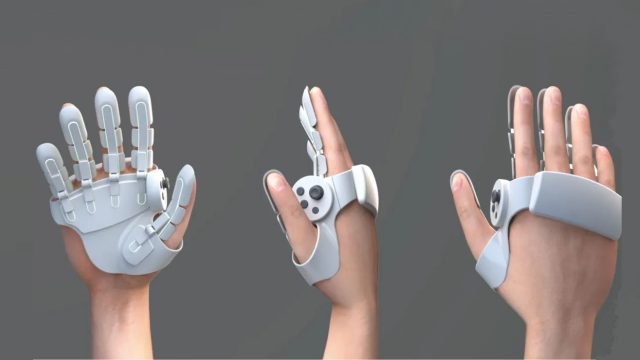
Japan-based Sharp says its VR haptic controllers can let users sense texture thanks to “multi-segmented tactile elements” placed on the device’s fingertips. Various vibration patterns on the surface are meant to convey different textures, such as smooth, rough, etc., the company says.
“Although the haptics are not at a level that reproduces the real thing, by changing the parameters we have been able to achieve a variety of tactile sensations,” Sharp says on the project’s Japan-facing website. “Rather than leaving it in-house until the developers are satisfied with it, we plan to work with our users to improve the quality of the content.”
Image courtesy Sharp
Sharp says the device, which will arrive in a left and right pair, “does not allow for delicate finger tracking like glove types.” It also lacks force feedback, or any sort of temperature feedback.
The prototype is supposed to also function like a standard controller, including sticks and buttons, the company says. One thing that isn’t clear though is how the gloves will be tracked, which Sharp says could include mounts for “high market share” tracking standards.
Sharp says the device is currently undergoing demonstration experiments, so it’s not clear whether it will eventually be commercialized; we haven’t seen anything beyond renders at this time. The company is aiming to put early iterations of the device in the hands of the paying public though, at least in Japan.
The company recently closed pre-registrations through its Japan-facing website, pricing units at ¥100,000 (~$680). “Please note that development or release may be canceled,” the company warns.
Granted, Sharp has more experience in XR than you might think. As the leading OEM supplier of high-end VR displays, at one time Sharp was the top display supplier for Meta Quest 2. In late 2024, Sharp and Japan’s largest telecom NTT Docomo also launched a pair of AR glasses, called MiRZA.
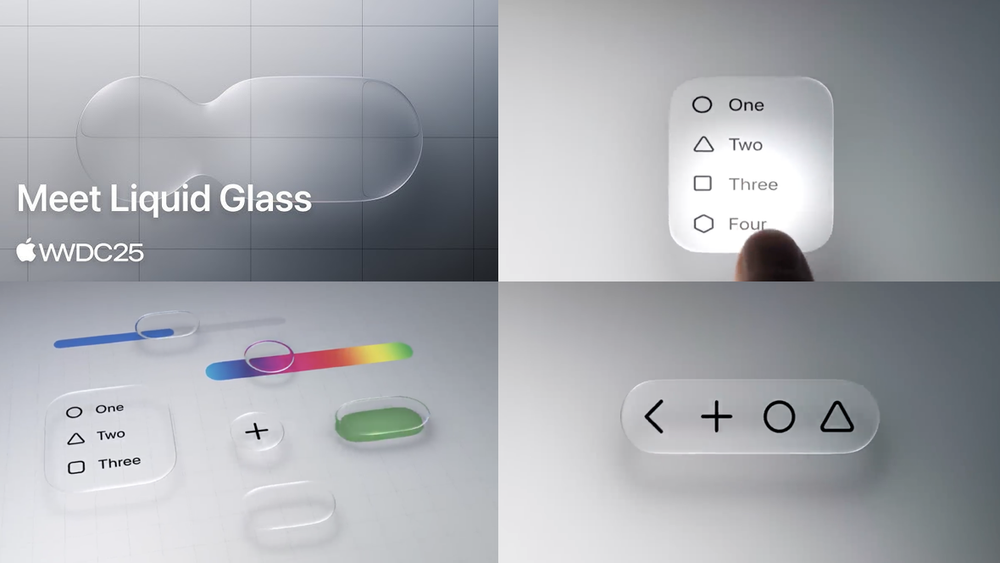
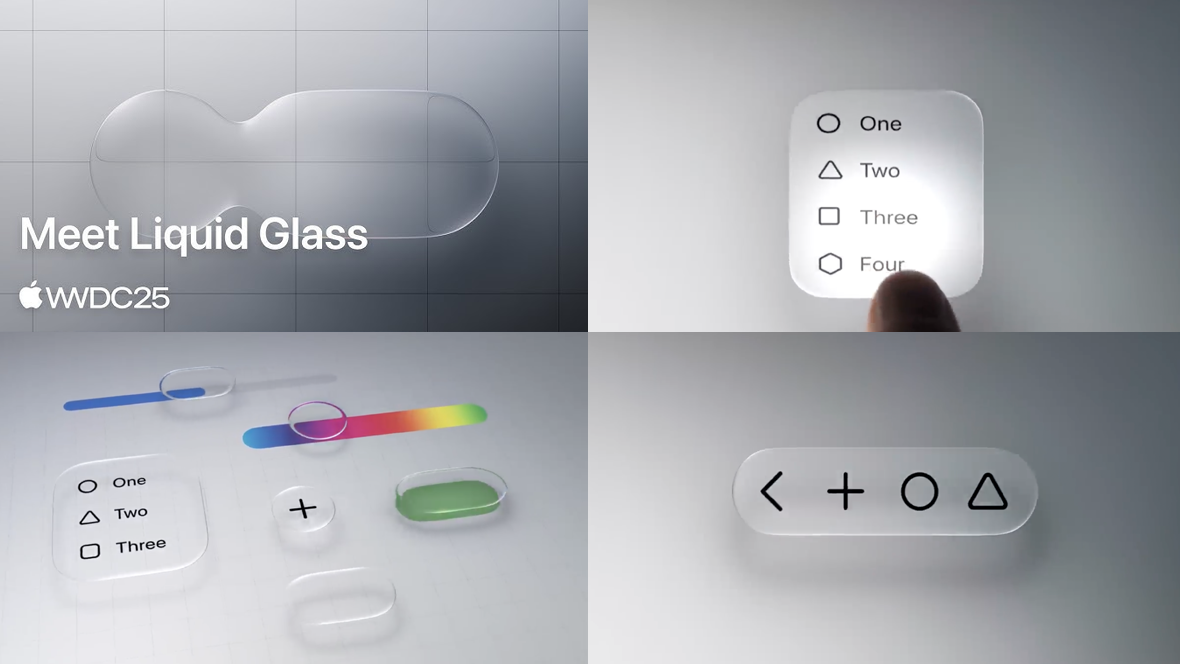
Here’s a look at Apple’s Liquid Glass UI, showcased at WWDC 2025. Reviews have been mixed, with some praising its visual ambition and others highlighting accessibility concerns, even likening it to Windows Vista. Whether you're a fan or not, there’s no denying it has sparked important conversations in UI design.
Personally, I see it as a promising move. It’s encouraging to see a major industry leader putting renewed value on visual expression. Over the past few years, UI design has become highly standardised, heavily influenced by established systems like Google’s Material Design. As a result, many interfaces have started to look predictable and, frankly, a bit boring.
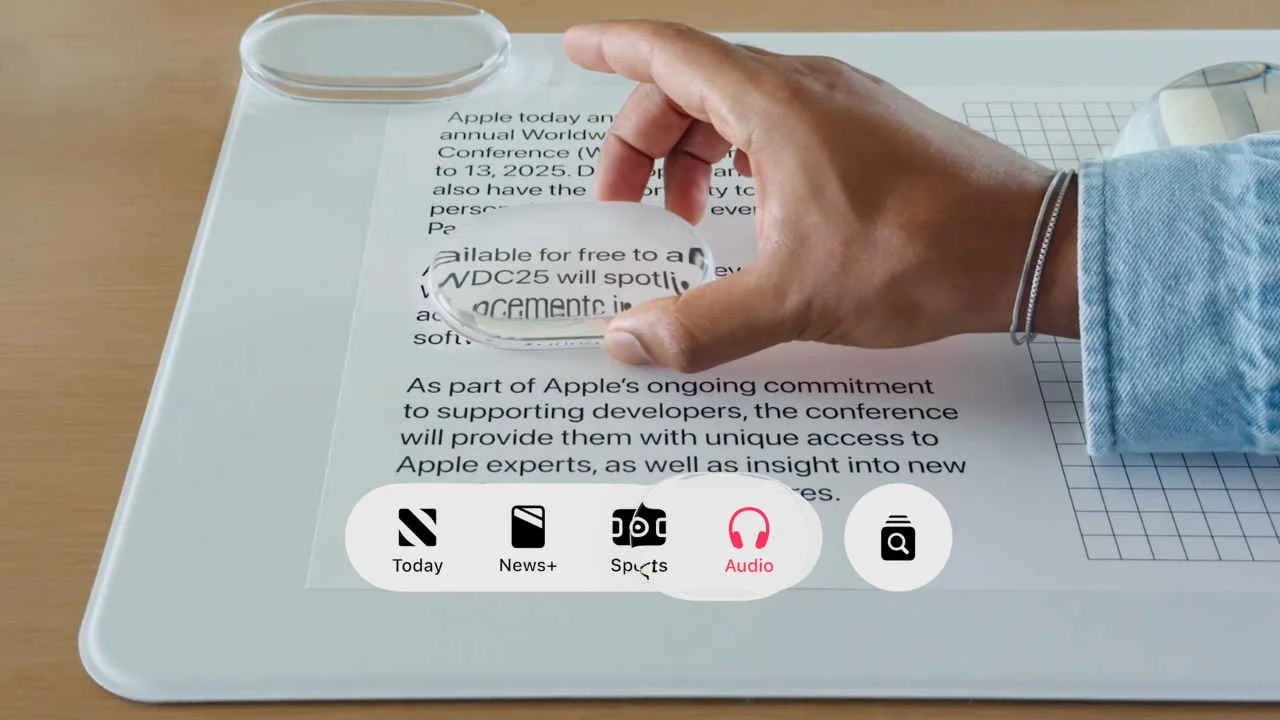
It’s helpful when an influential company does something differently. It sets a precedent and opens up new conversations. For instance, the dynamic corner radius would rarely make it into serious design and development discussions. The value is hard to quantify compared to the effort required to implement it. But now, Apple has made it tangible, shifting what’s considered impossible into the realm of the plausible.
Liquid Glass also signals a shift away from older technical constraints. Remember the rise of flat design? It was a direct response to the limitations of early smartphones, chosen for its scalability and lightweight performance demands. In contrast, Liquid Glass showcases real time light rendering, something not feasible on consumer hardware a decade ago.
This brings up some interesting questions. For example, will we be seeing more UI that's inspired by what you would normally find in game engines, reacting dynamically to its environment? As spatial interfaces become more common, especially on platforms like Apple Vision, it seems likely that game like UI could shape the next evolution of interface design.
(UPDATE) - In light of Apple’s Liquid Glass, Figma has released new Glass effects. Check out this Glass Effects Playground file to play around with it.
Xreal's closest competitor announced four new display glasses, including one with a 58° diagonal field of view and 1250 nits brightness.
What Are Display Glasses?
Display glasses essentially act as head-worn monitors, displaying video input (via DisplayPort or HDMI to USB-C) on a large virtual screen. For example, you can connect your phone and view Netflix, or your Steam Deck to play games.
Until fairly recently, all display glasses were head-locked when used with the majority of input devices. But now, many include built-in 3DoF tracking, meaning the screen stays in place when you rotate your head, and some even include 6DoF tracking via accessories.
All display glasses to date magnify a tiny micro-OLED display to a roughly 40-60 degree diagonal field of view using a curved mirror or prism block. The former is called "birdbath" optics, and the latter is technically called flat-prism, though it's often grouped with birdbath.
Unlike the waveguides used in AR glasses, display glasses optics are inherently thick, and noticeably sit out from your face. They also block out around 80% of real-world light at minimum, so can't be used as general eyewear when not in use.
While we've covered Xreal before on UploadVR, the leading display glasses company by global market share, we haven't yet covered Viture, which holds second place. That's partially because we lack the time to report on everything we'd ideally want to, and partially because there haven't been significant differences - until now.
Back in December, Xreal launched the Xreal One series with built-in 3DoF, and the Xreal One Pro with industry-leading 57° diagonal field of view. Now, this month, Viture has announced its response.
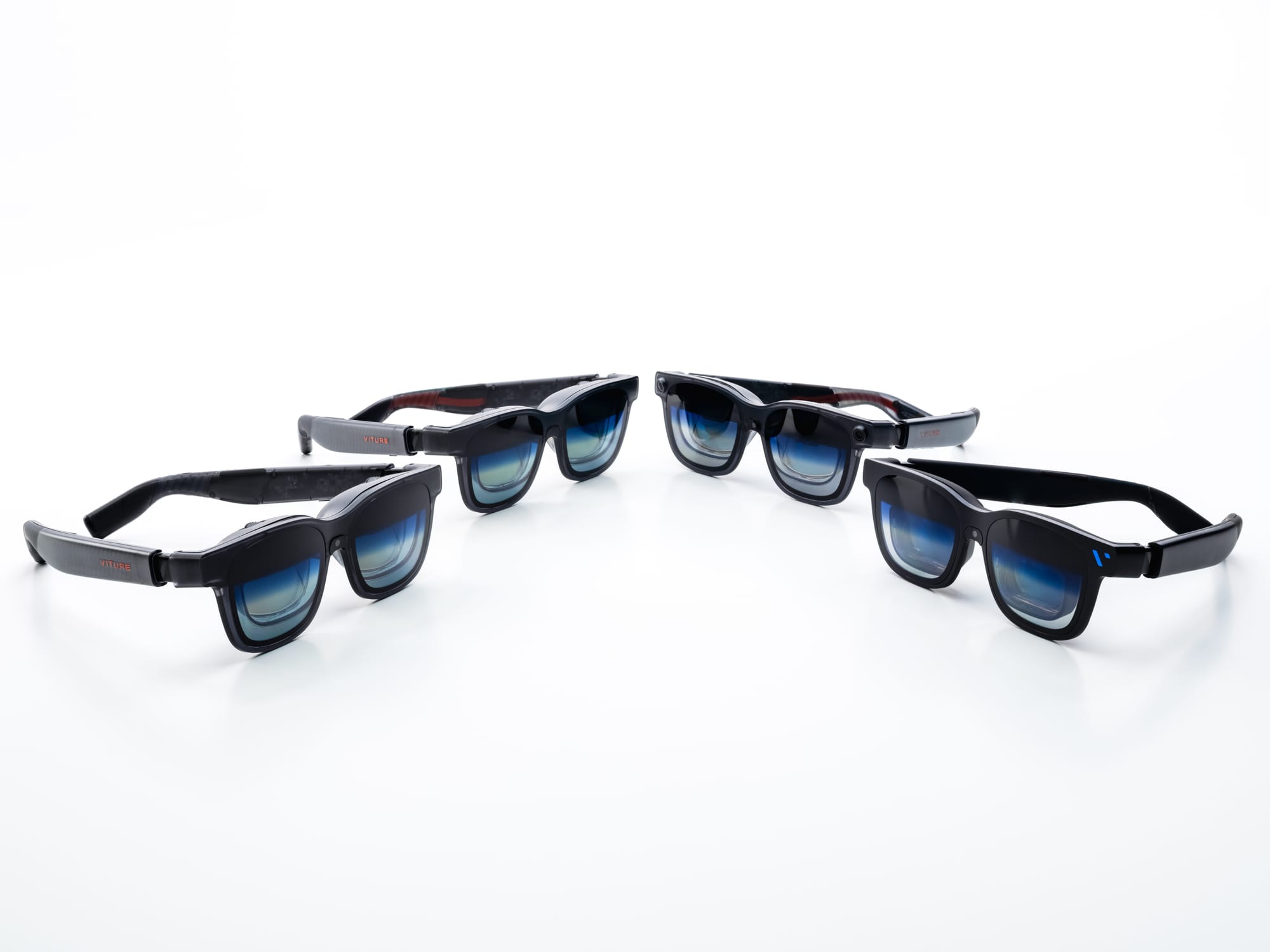
Over the next few months, Viture is launching a whopping four different display glasses models: Luma, Luma Pro, Luma Ultra, and one it simply calls The Beast.
All four new Viture glasses have higher resolution than Xreal, 1200p compared to 1080p, as well as higher brightness, between 1000 and 1250 nits compared to 600-700 nits.
I tried all four models at AWE 2025 last month, and came away thoroughly impressed, particularly with the brightness. It made for a noticeably more vibrant virtual screen than Xreal One Pro, and reinforced my view that brightness is a deeply underappreciated specification for head-mounted displays.
FOV (Diagonal)
Resolution
Brightness
Price
Xreal One
50°
1080p
600 nits
$500
Xreal One Pro
57°
1080p
700 nits
$600
Viture Luma
50°
1200p
1000 nits
$400
Viture Luma Pro
52°
1200p
1000 nits
$500
Viture Luma Ultra
52°
1200p
1250 nits
$600
Viture The Beast
58°
1200p
1250 nits
$550
What's somewhat confusing, though, is the situation when it comes to tracking.
None of the Luma models have built-in 3DoF, meaning if you simply plug your phone in and open Netflix, the display will be fully head-locked. The exception is if you buy the Viture XR Charging Adapter and stay within Viture's SpaceWalker app.
Luma Pro does have a central color camera that supports basic 6DoF in SpaceWalker too, somewhat similar to Xreal Eye but limited to Viture's app. And Luma Ultra uniquely also has greyscale fisheye cameras on the temples for high-quality 6DoF head tracking and hand tracking, but only in Windows, Mac, and the Viture Pro Neckband, an optional compute unit running a fork of Android.
Meanwhile, The Beast has true built-in 3DoF, just like the Xreal One series, as well as a central color camera for the basic 6DoF in SpaceWalker, but lacks the fisheye cameras on the side.
Built-In 3DoF
Central Color Camera
Side Tracking Cameras
Xreal One
✅
$100
❌
Xreal One Pro
✅
$100
❌
Viture Luma
❌
❌
❌
Viture Luma Pro
❌
✅
❌
Viture Luma Ultra
❌
✅
✅
Viture The Beast
✅
✅
❌
Here's when the four new Viture glasses will be available to purchase:
At AWE I was also able to try an early prototype of a roughly 70° diagonal system that Viture hopes to ship next year. I've long been a critic of the field of view of display glasses, pointing out that the marketing claims of "massive" virtual displays were misleading, but what I saw crossed a threshold where I can see these devices becoming a vital part of our industry.
That 70° figure matches what Xreal is teasing for its Project Aura glasses, set to arrive next year with a tethered compute puck running Google's Android XR. While Viture has its own Viture Pro Neckband compute unit, it doesn't currently have any announced plans for Android XR, though I'd be shocked if the company wasn't in talks with Google already.
You can add another name to the thousands of employees leaving NASA as the Trump administration primes the space agency for a 25 percent budget cut.
On Monday, NASA announced that Makenzie Lystrup will leave her post as director of the Goddard Space Flight Center on Friday, August 1. Lystrup has held the top job at Goddard since April 2023, overseeing a staff of more than 8,000 civil servants and contractor employees and a budget last year of about $4.7 billion.
These figures make Goddard the largest of NASA's 10 field centers primarily devoted to scientific research and development of robotic space missions, with a budget and workforce comparable to NASA's human spaceflight centers in Texas, Florida, and Alabama. Officials at Goddard manage the James Webb and Hubble telescopes in space, and Goddard engineers are assembling the Nancy Grace Roman Space Telescope, another flagship observatory scheduled for launch late next year.
Un nouveau matériau de type mémoire de forme vient d'être mis au point à base de cuivre. Conçu au Japon, il est capable de conserver ses propriétés physiques jusqu'à une température glaciale de -220 °C, ce qui semble très prometteur pour les voyages spatiaux.Présenté à la communauté scientifique, ce matériau peut par exemple libérer de l'énergie de t...
As a reminder, each week, every Friday, we’re sending out this overview of content in the Stratechery bundle; highlighted links are free for everyone. Additionally, you have complete control over what we send to you. If you don’t want to receive This Week in Stratechery emails (there is no podcast), please uncheck the box in your delivery settings.
On that note, here were a few of our favorites this week.
The Economic Future of the Web. One reason why I love writing is that it, more than any other medium, forces me to challenge and validate my initial reactions to a piece of news, and this week provided a perfect example. My initial reaction to Cloudflare’s Content Independence Day, when they blocked AI crawlers by default, was discomfort at the advantage this provided Google, along with the audacious exercise of power on Cloudflare’s part. When I thought about it more deeply, however, I realized that realizing vision I painted in May’s The Agentic Web and Original Sin would actually require audacious action like Cloudflare’s. —Ben Thompson
Greatest of All Talk in Las Vegas. One would think that basketball news slows down in the summer, but in fact, the news continues well into July, it just gets much nerdier. NBA Summer League is the epicenter of the nerdery, and Greatest of All Talk has been on the scene in Las Vegas for the past week. For those interested in a scouting report of number one pick Cooper Flagg, Ben Golliver and I spent 45 minutes talking through his performance on an episode Sunday. As for everything else—speculation surrounding LeBron’s future, whether the league will expand to Las Vegas and Seattle, misgivings with the current CBA among NBA players, and a mid-summer league “Chesstival” hosted by Magnus Carlsen and Derrick Rose (I told you it was nerdy)—Ben and I covered the scene from top to bottom on two more episodes later in week. Whether you come for Cooper Flagg or chess, GOAT is a great listen for the weekend. —Andrew Sharp
How We Cool Computers. Since the dawn of computing, engineers have been struggling to keep computers from overheating. This week’s episode of Asianometry traces that history, beginning with an era of vacuum tubes that were literally cooled with air conditioning, and arriving at the Gen AI era, when Nvidia’s H100 and B200 accelerators now emit 700 to 1,000 watts of heat apiece and companies all over the world are experimenting with hybrid methods to cool chips. Altogether the episode was a great look at the history underlying a challenge that most people never think about, and one that will be central to the future of AI infrastructure, energy costs, and the tension between performance and efficiency that has defined computing from the beginning. Check out the YouTube video here, or if you’re on the move this weekend, all Stratechery subscribers can listen to the episode as a podcast. —AS
Le 10 juin 2025, la commission d’enquête sénatoriale sur la commande publique a reçu Microsoft France pour une audition très attendue. Ce qui s’y est dit n’a laissé aucune place à l’ambiguïté : le droit américain s’impose, même lorsque les données sont hébergées à Paris ou Marseille. Et l’aveu n’est pas venu d’un militant ou d’un expert extérieur, ma...
The speed of light is a mighty ~300,000 km/s. But even at that speed, because the distances in space are so vast, sometimes it has to settle in for the ride. When we see the light from a distant star or galaxy, we're not seeing it as it is now—we're seeing it as it was when the light first left on its journey to Earth.
Why Looking at Stars Is Like Looking into the Past
When you hear a thunderclap after seeing lightning, you know that you're hearing something that happened some time ago. Looking into the night sky is similar—except here, it's light that causes the delay, not sound.
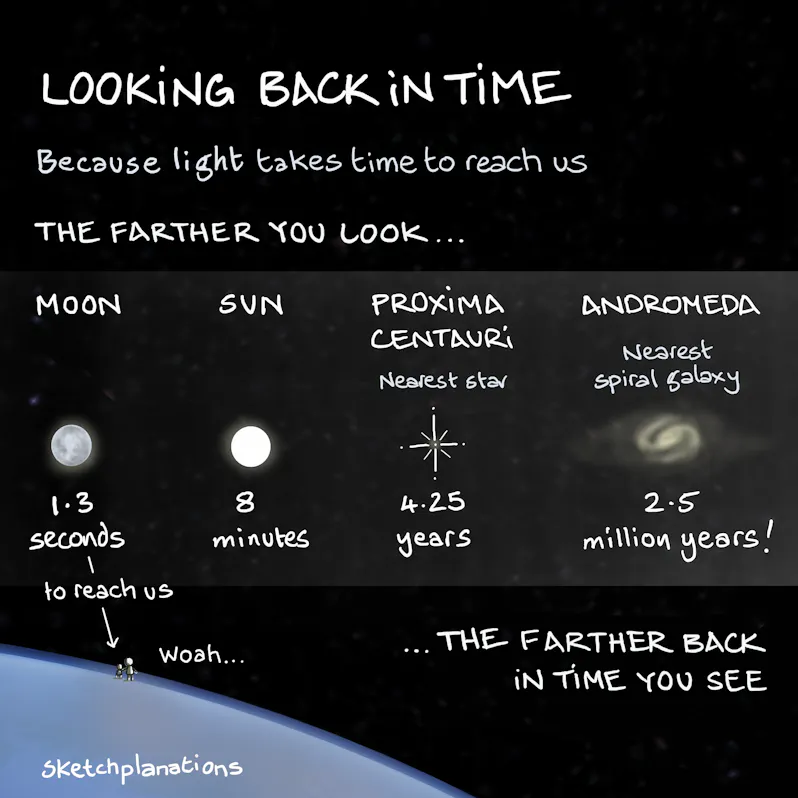
Take the moon, for instance. At a little under 400,000 km away, light that has reflected off the moon takes around 1.3 seconds to reach us.
But the sun is much further. At around 150 million km away, it takes a little over 8 minutes for light from the sun to reach us. So what we are seeing at the sun, for example, a solar flare, happened 8 minutes ago. (The distance from the sun to Earth is called 1 AU - Astronomical Unit).
As soon as you look at more distant objects, you realise that looking up at the night sky is looking way back in time. To measure these distances, we use light years—the distance light travels in one year. So, the number of light years an object is away from us is how far back in time we are seeing.
Our nearest star system is Proxima Centauri at around 4.24 light-years away. What we see on Proxima Centauri happened over four years ago.
Here are a few stars you can spot at night (in the northern hemisphere) and how long ago the light from each started its journey:
Polaris (the North Star): 433 years ago, around 1590 AD
Pleiades (Seven Sisters): 444 years ago, around 1580 AD
Betelgeuse: 548 years ago, around 1480 AD
Put another way, if you were in Betelgeuse right now, you’d be looking at light from our sun around the time Leonardo da Vinci was pioneering sketchplanations.
The Andromeda Galaxy, the nearest spiral galaxy to our Milky Way, is a staggering 2.5 million light-years away. This means the light we see from Andromeda today set off on its journey 2.5 million years ago — around the beginning of the Pleistocene, the most recent ice age era, when early mammoths and sabre-toothed cats were emerging.
Seeing the Early Universe
As we look with increasingly larger telescopes at more distant objects, scientists gather clues about the Universe's earliest days. The farther we look, the farther back in time we see. In 2024, the James Webb telescope detected a galaxy so far away that the light we see started travelling when the Universe was just 2% of its current age.
So, as you look up in the sky, it's also like looking at a map of different times. Crazy.
L’Airbus A400M, connu depuis ses débuts comme une référence mondiale du transport militaire, s’apprête à endosser de nouveaux rôles. Parmi eux ? Celui de « vaisseau mère » pour les drones de combat.
Ride-hailing giant Uber announced Thursday it will acquire $300 million worth of shares in US electric vehicle maker Lucid Motors as part of an ambitious plan to build its own fleet of robotaxis.
Le télescope spatial James Webb a récemment observé une galaxie lointaine surnommée « Infinity Galaxy ». Cette découverte offre de précieuses informations sur les premiers stades de formation des trous noirs dans l’Univers primitif.
The timeline for scaling quantum might be murky, but the tech is being put to use in the here and now.
IBM and Moderna released research on Thursday advancing the use of quantum computing in the development of mRNA medicines, a rapidly growing field that was used in the development of the Covid-19 vaccine. The research uses both classical computing and quantum computing methods to tackle increasingly complex problems.
Quantum computing was used to complement and extend the capabilities of classical algorithms in identifying “biological mechanisms involved in a disease” as a means of developing mRNA medicines, according to the report. That involved “mapping” the astronomical number of ways that mRNA proteins can fold, Sarah Sheldon, senior manager of applied quantum science at IBM, told CIO Upside.
“While they have very good solutions for this today with classical computers, it’s something that gets harder and harder as you look at more complex problems,” Sheldon said. “As this mRNA sequence link gets longer, it gets exponentially harder.”
The work, she said, plays well to quantum’s strength in optimization:
In the context of medicine, this means that quantum can more rapidly tackle exponentially complex research in drug discovery. “We’re pushing the boundaries of the size of the problems we can look at with quantum,” said Sheldon.
And quantum is an “interdisciplinary field,” she added. The next step is figuring out how to translate these optimization and efficiency gains into other domains. The tech is a natural fit for things like chemistry, materials science and high-energy physics, she noted.
“It’s really about finding the right problems for the algorithms that we have,” she said.
There are still plenty of barriers to scaling this tech, including its sensitivity to environmental factors such as temperature and “noise” that can knock it out of the delicate superposition on which it depends. But as the tech develops at an increasingly fast rate with the attention of tech giants like Google, Amazon, Microsoft and IBM, the job now is to figure out how to best put it to use.
“We work in parallel,” she said. “We always are trying to build bigger and better hardware, improving the quality as well as the size of our systems … And then, at the same time, we keep working on algorithm development.”
French AI lab Mistral introduced a range of new features to its Le Chat chatbot on Thursday that bring it closer to the capabilities of rivals like OpenAI and Google. The new update includes a “deep research” mode, native multilingual reasoning, and advanced image editing.
Bigscreen Beyond 2e is getting a limited-time VRChat Edition with an 'Atomic Purple' shell.
Following recent news that Bigscreen Beyond 2 has started shipping to customers, Bigscreen announced that it's releasing a VRChat Edition inspired by “the nostalgia of iconic products from the 90s and 2000s.” Using a slightly translucent look that shows the circuitry underneath, Bigscreen states this shifts in color depending on your lighting and comes in a custom-designed box.
As seen in a new blog, Bigscreen revealed that anyone that purchases the VRChat Edition will receive access to exclusive digital items, stickers, and badges in VRChat. What these specific items are has not been confirmed, and the blog states more features are planned for the VRChat Edition “in the future.”
It's worth noting that the VRChat Edition is only for the Bigscreen Beyond 2e variant, which differs from the standard Beyond 2 by including built-in eye tracking support through tiny sensors. If you've already ordered the 2e model, Bigscreen states you can email support@bigscreenvr.com to switch to the VRChat Edition, though doing so “may affect your order ship date.”
While the standard Bigscreen Beyond 2e model starts at $1219, the VRChat Edition matches the price of the 2e 'Nuclear Orange' edition at $1269, and it's expected to ship by September 2025. This also includes the choice of either a custom-fit face pad or the Halo Mount, though choosing the latter means you'll currently be waiting until October for delivery.
This isn't the first time we've seen Bigscreen collaborating with VRChat. Last year saw it release a VRChat-themed storage can designed to look like an energy drink, which remains available to purchase. The interior includes a foam lining to protect it from scratches, though this is only intended for decorative headset storage for the original Bigscreen Beyond.
Much like the original Beyond, Bigscreen Beyond 2 and 2e are both tethered PC VR headsets that use SteamVR Tracking. This requires a capable PC alongside at least one (preferably two or more) tracking base stations from Valve or HTC. These headsets also require your own input device, such as Valve Index controllers.
You can find more details on the features and specifications of Beyond 2 and Beyond 2e here, as well as our hands-on impressions from GDC here.
The game of bingo has come a very long way from its origins as a lottery style game in 16th century Italy. It is now a form of entertainment enjoyed by millions of people around the world.
While the game was once confined to bingo halls and community centres, it has evolved greatly to become more accessible and attracts a much wider audience than it once did. In the digital age, bingo has thrived and experienced a significant boom thanks to digital advancements.
In this article, we explore the factors that have influenced the surge in bingo’s popularity and the vast range of options now available to players online.
What are the driving forces behind bingo's rise in popularity?
One reason that bingo has survived and thrived in the modern world is its ability to seamlessly transition into the online world. While players would once need to find the time to visit a local bingo venue in order to play, they can now log on to online bingo platforms and enjoy their favourite games from home. Online bingo has made the game even more accessible and convenient, enabling players to play at a time and location that best suits them.
In the last couple of decades there has been a steep rise in smartphone usage and most people now have access to high speed internet connections on their phones or tablets. This has helped to attract players that would not be interested in visiting a traditional venue.
Digital bingo platforms offer players a wide variety of game choices
While traditional bingo halls mainly offer games of either 75 ball bingo or 90 ball bingo, online platforms are able to have a much more diverse game offering for their players.
Speed bingo is one type of game commonly played online. In this variant, the pace of the game is much quicker with names being called out at a much faster rate. This keeps players engaged in quick rounds.
Lots of online bingo games have fun themes to help make the experience even more enjoyable. You can find games that are themed around popular television shows, movie characters, seasons and many other interesting categories.
There is also jackpot bingo that can give players the chance of winning some big prizes. Progressive jackpots are one style of game, in these games the prize fund continues to grow with bets until there is a winner and then it resets to a predetermined value.
While traditional bingo is considered a social occasion, online platforms have worked hard to be able to replicate the social element of the game. In social online bingo, you can feel part of a community with integrated chat rooms that allow players to chat with other players throughout game play.
Having a diverse range of bingo game offerings online ensures that there are games to suit all interests and ability levels. New games are released on a very regular basis, ensuring that there is always something new to try.
The social element of bingo is central to the game
Live chat rooms are not the only way that online bingo players can socialise and celebrate their wins together. Some platforms also host virtual events, special promotions and loyalty programs which help to add to the sense of camaraderie. The ability to engage with other players adds to the experience, making it more enjoyable and sociable overall.
Other reasons online bingo is growing in popularity
Aside from the convenience and game choice available online, internet bingo players are noticing the quality of gaming online has improved in recent years. For example, bingo platforms are becoming more mobile friendly and have user friendly interfaces that help to ensure seamless gameplay.
Mobile bingo platforms all offer players generous welcome bonus offers and loyalty programs. The industry is very competitive for game providers. These deals help to attract new players and encourage them to return to the site to play more games in future. Offers can include deposit bonuses, free bingo tickets and access to exclusive games and deals.
What can we expect from the future of bingo gaming?
As technology continues to evolve at a rapid pace, we can expect bingo platforms to continue to utilise technology to enhance their games and provide new experiences to players.
One technology that is likely to be explored in the bingo space is virtual reality (VR). This will create immersive bingo experiences where players can play and interact with one another as if they were in a real bingo hall through VR headsets.
Artificial intelligence or AI is already being used by bingo providers, as it continues to advance we can expect more personalised experiences and enhanced chat interactions. These technological advancements are likely to attract even more new players to the bingo world.
SoundHound AI and Peter Piper Pizza, a fast food and family entertainment specialist, have announced a collaboration that allows guests to place phone orders for pick-up through a conversational voice AI agent.
The new system understands natural speech and is trained on Peter Piper Pizza’s full menu.
Now live across all of its locations in Arizona and Albuquerque, NM, the platform ensures that every phone call is answered no matter how busy the restaurant is. The voice AI agent handles multiple calls simultaneously, freeing up in-store teams to focus on preparing food and customer service.
“With families juggling busy schedules, convenience is key - but so is great food,” says Genaro Perez, Chief Marketing Officer at Peter Piper Pizza. “This new AI powered voice ordering experience gives our guests a fast, reliable way to place orders over the phone just by speaking naturally. Whether it's our made from scratch pizzas, bold flavoured wings, sweet treats or fan favourite Piper deals, this innovation makes it easier than ever to get the food they love, without the wait.”
“Peter Piper Pizza has implemented innovative AI agent technology that puts convenience and speed at the centre of every guest interaction,” says James Hom, Chief Product Officer at SoundHound AI. “We’re proud to partner with them to bring a smarter, faster ordering experience to their customers.”
As we witness a digital transformation revolution across all channels, AI tools are reshaping the omnichannel game, from personalising customer experiences to optimising inventory, uncovering insights into consumer behaviour, and enhancing the human element of retailers' businesses.
With 2025 set to be the year when AI and especially gen AI shake off the ‘heavily hyped’ tag and become embedded in retail business processes, our newly launched awards celebrate global technology innovation in a fast moving omnichannel world and the resulting benefits for retailers, shoppers and employees.
Our 2025 winners will be those companies who not only recognise the potential of AI, but also make it usable in everyday work - resulting in more efficiency and innovation in all areas.
Winners will be announced at an evening event at The Barbican in Central London on Wednesday, 3rd September.
CamThink NeoEyes NE101 is a battery-powered, low-power Vision AI Camera powered by an ESP32-S3 wireless module, featuring event-triggered image capture, and suitable for real-time vision control.
By default, the camera supports WiFi 4 and Bluetooth 5.0 connectivity, and ships with a 5MP OV5640 camera module with an LED flash. However, the ESP32-S3 camera has a modular design, and it is offered with 4G LTE Cat 1 or WiFi HaLow connectivity, supports replaceable lenses, optional housing, and custom mounting options.
CamThink NeoEyes NE101 specifications:
Wireless Module – ESP32-S3-WROOM-1
MCU – ESP32-S3 dual-core Tensilica LX7 up to 240 MHz with 512KB SRAM, up to 8MB PSRAM
Storage – 16MB flash
Wireless – WiFi 4 and Bluetooth LE 5
PCB antenna
Optional wireless features
NE101-L01GL – LTE Cat 1 with global support
NE101-HL00 – WiFi HaLow 868 MHz
NE101-HL01 – WiFi HaLow 915 MHz
Storage – MicroSD card slot
Camera
FPC camera connector – By default fitted with OV5640 module with 120°/60° FOV and near/far focus options available
4-pin USB camera connector
LED fill light
USB – 1x USB Type-C port for power and UART
Expansion
1x UART connector
16-pin female header with I2C, SPI, GPIO
Misc
Snap button
Boot and Reset buttons
Alarm input connector
PIR input connector
Synchronization: hardware trigger, software trigger, or free-run
Power Supply
5V via USB-C port for charging
4x AA batteries
Consumption – <= 1W (standby mode); note: the company claims up to two years on a battery charge, which seems unlikely…
Dimensions – 77 x 77 x 48mm (plastic housing)
Temperature Range – -20°C – +50°C
Certifications – CE, FCC, RoHS
NE100-CM01 board
CamThink provides the structural design files for DIY housing (3D printable) or customized extensions, as well as open-source firmware for the camera. This allows for the design of wall, desk, and pole mounts, and the user can customize the firmware with low-power modes, device wake-up, MQTT data transmission, fill-light control, scheduled shooting, image parameter adjustment, and network management.
A web interface running on the camera is used to configure all parameters, such as WiFi or LTE Cat 1 settings, image parameters, capture settings, MQTT configuration, and more.The wiki has more details, and you’ll also find the source code on GitHub.
A modular design
The camera can be used in industrial settings, for instance, for predictive maintenance or machine inspection, as well as in Smart Agriculture applications to monitor crop growth or livestock. We’ve covered many ESP32-S3 camera solutions over the years, but most of those are boards to be integrated into custom enclosures, with a few exceptions like the M5Stack ATOMS3R Cam, NORVI AI Optic, and LILYGO T-Camera S3 (when ordered with its case). The NeoEyes NE101 may be the most advanced ESP32-S3 camera we’ve covered so far with a complete design and modularity allowing camera swapping, as well as 4G LTE Cat 1 and WiFi HaLow connectivity.
CamThink is a new company, and the NeoEyes NE101 AI camera is one of its first products, launched along with the NeoEdge NG4500 Jetson Orin NX/Nano Edge AI box. The ESP32-S3-based Vision AI camera is sold for $69.90 to $112.00 depending on selected wireless connectivity options. The product page may also have a few more details.
Détecter les patterns de la désinformation avec l’IA, c’est l’objet du projet européen Prompt. Un consortium mené par Opsci AI s’est entouré de l’équipe de Wikimédia France pour tester ses outils auprès de la communauté de Wikipédia.
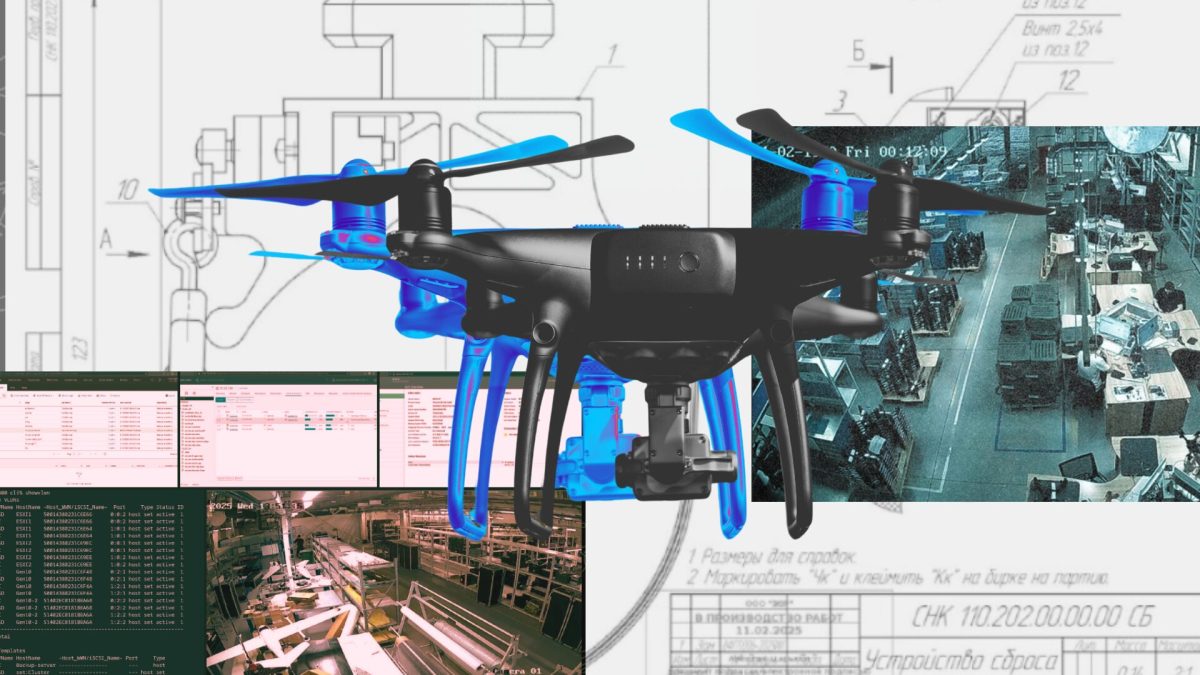
Les services de renseignement ukrainiens et des groupes de hackers alliés déclarent avoir mené une cyberattaque d'envergure contre l’un des principaux fabricants russes de drones militaires. Près de 50 téraoctets de données auraient été dérobés, notamment les plans de modèles de drones militaires en cours de développement.
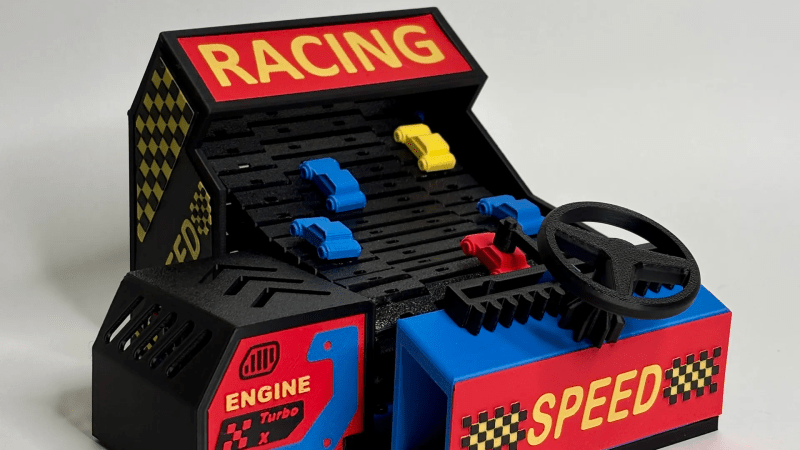
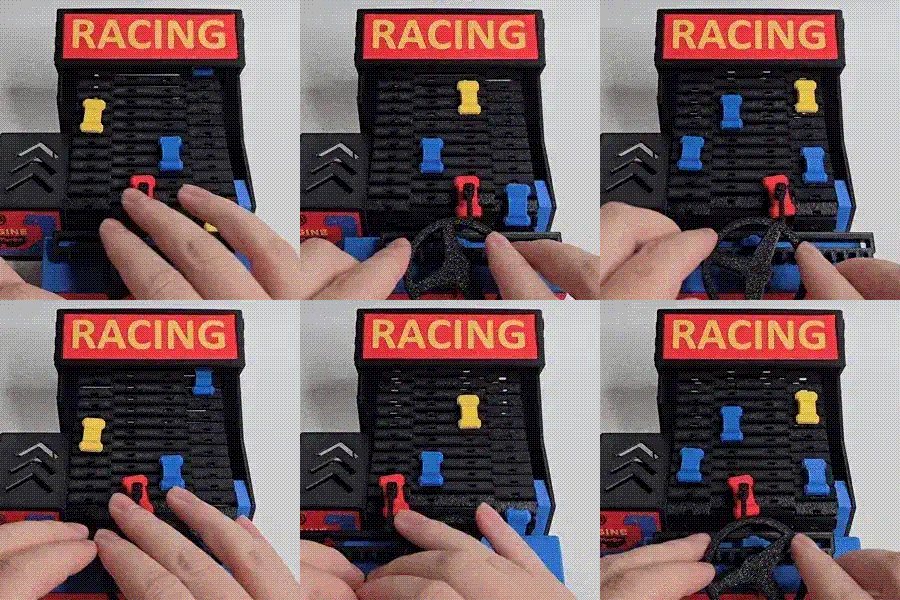
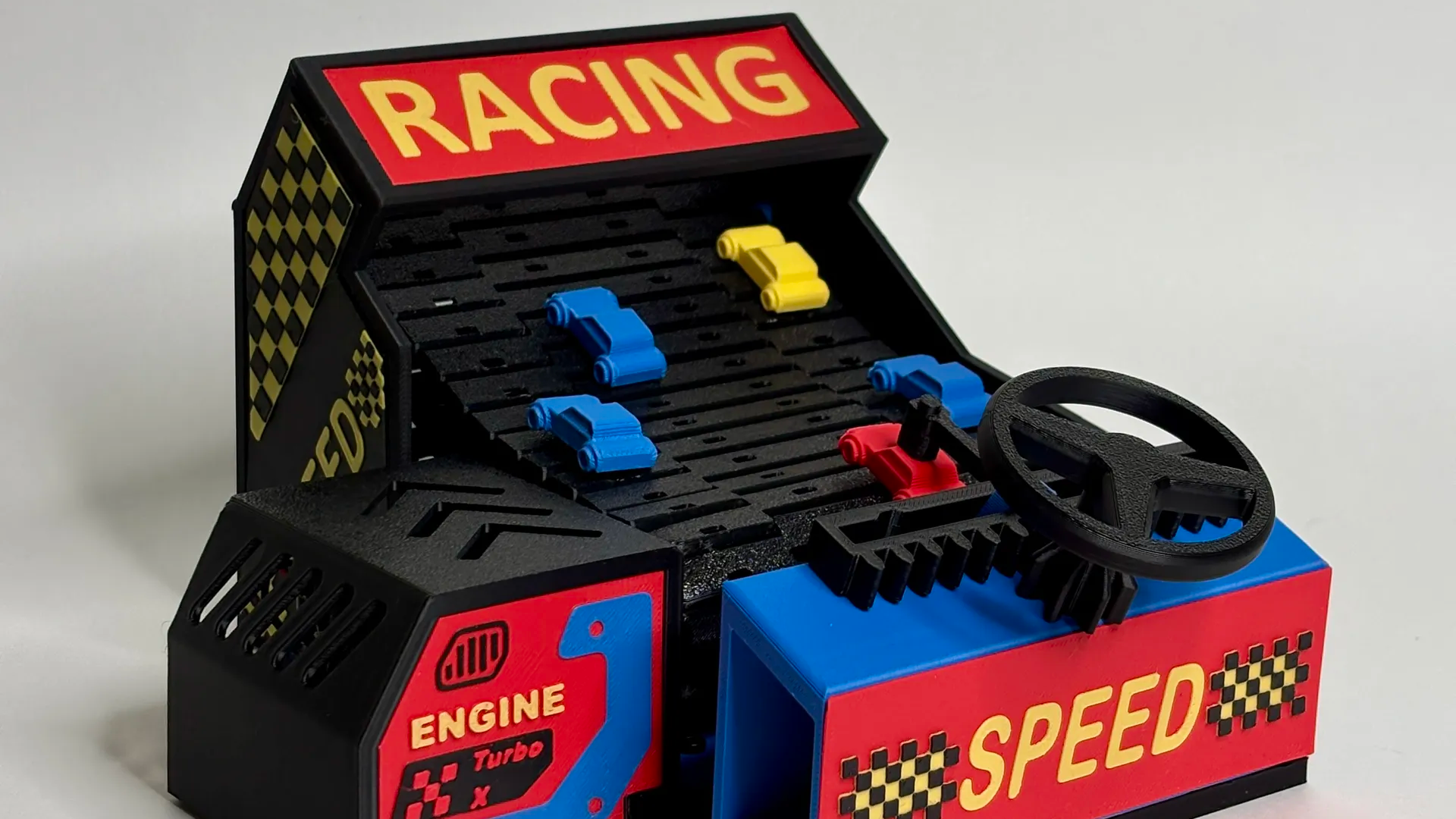
Quality 3D printing is a common hobbyist tool nowadays, and [wontonnn]’s mini arcade car racing game really shows off how 3D printing can bring parts from functional to fantastic. There are quite a few details we like in [wontonn]’s design, so let’s take a closer look.
The mini mechanical game is one of those treadmill-based car racing games in which the player navigates a little car between an onslaught of belt-borne obstacles. A little DC motor spins things up in a modular side assembly, and a hand-cranked option is available. The player’s car attaches via a magnet to a steering arm; if the player’s car gets knocked off the magnet, game over.
Treadmill belt segments print as large pre-assembled pieces, with ends that snap together without connectors. Belts like this are sometimes tricky, so this is worth keeping in mind should one ever need a similar part. Since there are no external fasteners or hardware to depend on, one could resize it easily to suit their own project purposes.
The finishing touches on the whole assembly look great. It used to be that the sort of colors and lettering seen here would come from a sticker or label, but [wontonn] gets clean lines and colors by raising (or sinking) different parts of the design. The checkerboard pattern, for example, has the light squares raised for printing in a different color.

 UploadVRDavid Heaney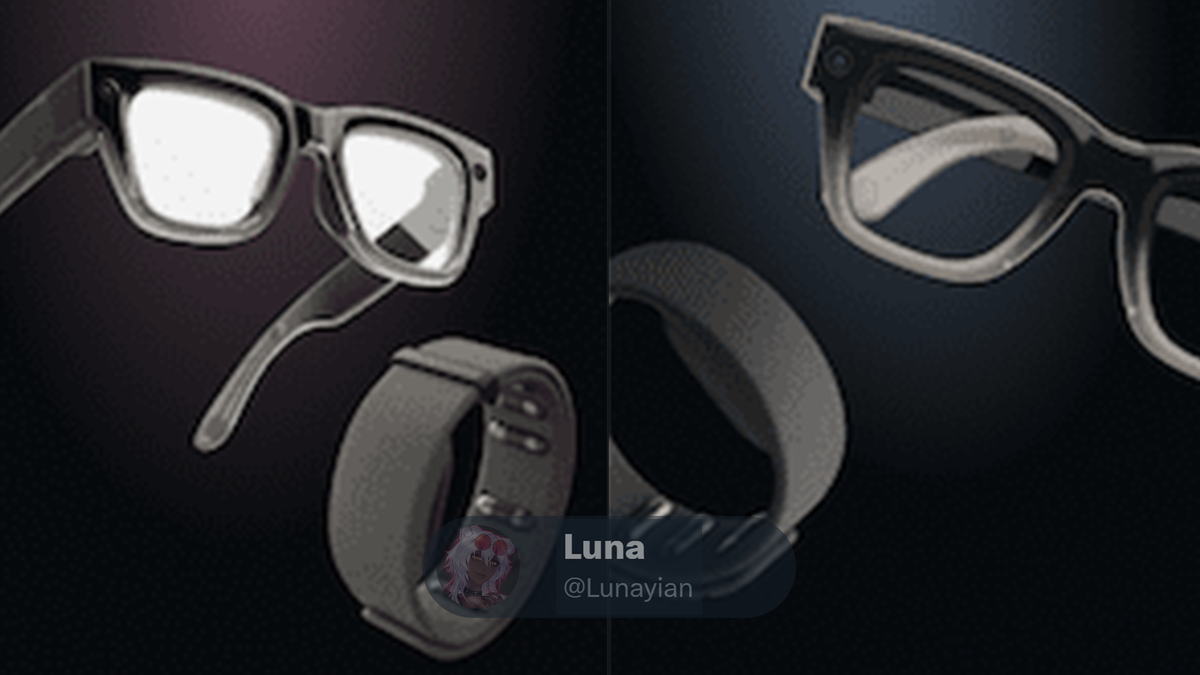










 UploadVRDavid Heaney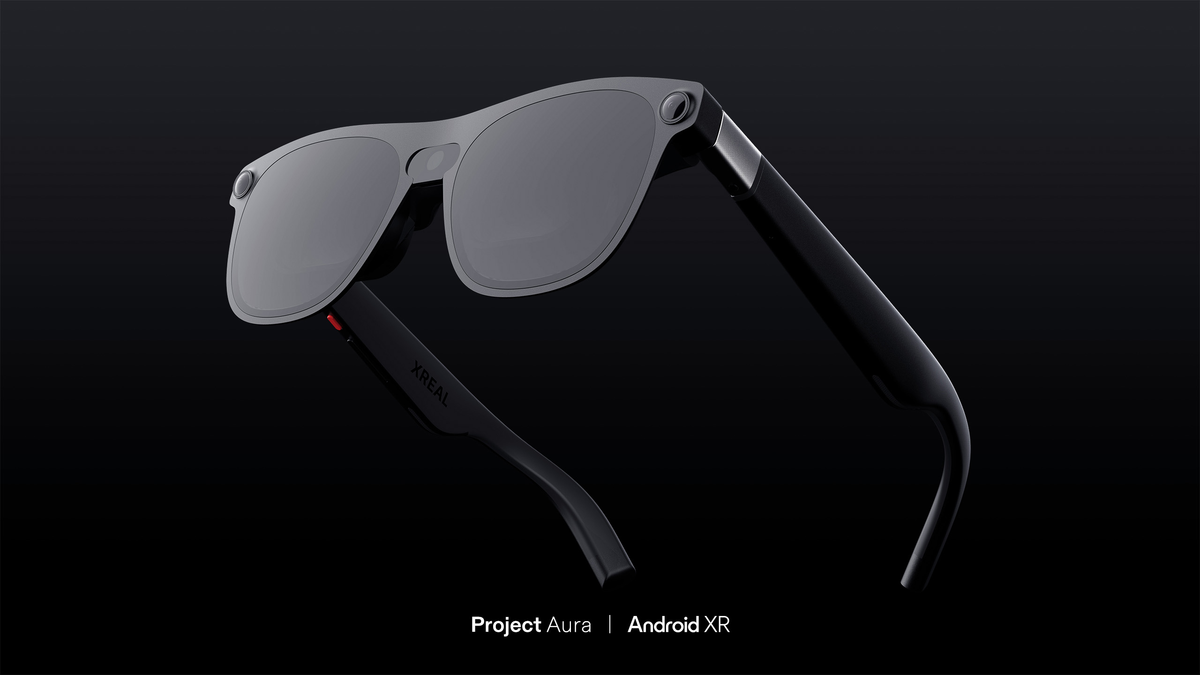






 UploadVRHenry Stockdale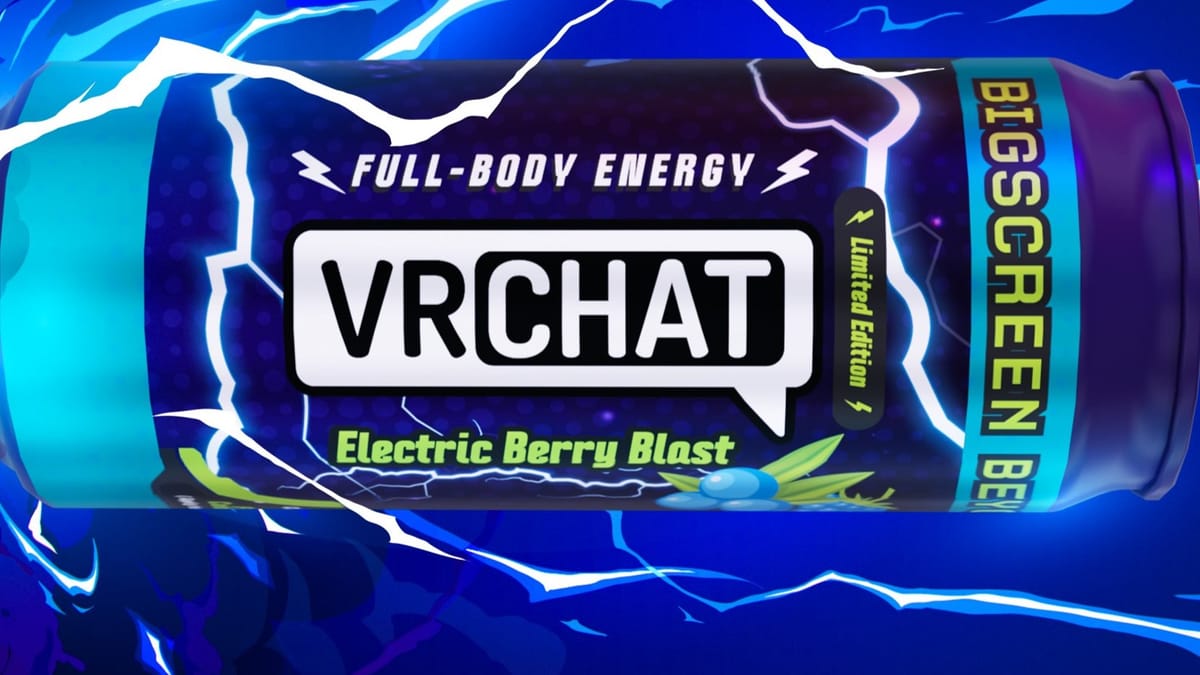
 UploadVRIan Hamilton