Jean-Philippe Encausse
Shared posts
OpenAI unveils ChatGPT app integration feature
OpenAI Powers Up With Massive Deal for AMD Chips
Nvidia’s got some competition: Rival chip-maker AMD signed a deal with OpenAI to provide its GPUs to the AI leader. The five-year agreement will see OpenAI scoop up hundreds of thousands of AMD’s chips, or about six gigawatts worth. That’s enough to power roughly 5 million US homes. OpenAI will put the chips to work in data centers that’ll provide the staggering compute ChatGPT needs to remain everyone’s favorite therapist.
AMD, whose stock surged nearly 38% yesterday morning, said the tie-up will generate tens of billions of dollars in revenue. OpenAI will also receive warrants enabling it to buy up to 10% of AMD stock at a penny a share, to be awarded over time as certain milestones are met.
Chip Off Your Shoulder
Nvidia is the No. 1 AI chip seller, with Mizuho Securities estimating that the company controls more than 70% of the market. Nvidia’s expected to make more than six times as much revenue as AMD this year ($206 billion vs. $33 billion).
But with the need for AI power growing fast, rivals have ample room to butt in, especially as they work to offer cheaper alternatives to Nvidia’s industry-leading, but pricey, chips. And OpenAI is playing the field to get power from every corner it can as the AI industry becomes increasingly crowded and costly:
- OpenAI is working with Broadcom to create its own AI chip, which will help train its tech, as part of a $10 billion partnership. Meanwhile, OpenAI also made a $300 billion deal with cloud leader Oracle last month to secure 4.5 gigawatts of cloud computing power through the tech leader’s data centers.
- Additionally, OpenAI has a deal with Nvidia on the horizon in which Nvidia plans to invest $100 billion in OpenAI over the next decade; OpenAI is expected to use that investment in part to buy 10 gigawatts’ worth of Nvidia’s chips. But while Nvidia and OpenAI have signed a letter of intent, AMD may yet beat them to the punch. OpenAI and AMD are planning to jumpstart their arrangement by filing for regulatory approval ASAP. Plus, the AMD deal would give OpenAI the power to influence the chipmakers’ plans, which could make it a more appealing partner than Nvidia.
Bubble Trouble: OpenAI CEO Sam Altman is channeling the Kylo Ren “MORE” meme. The company has made deals totaling about $1 trillion over the past two weeks as Altman underscores the need for more computing power to meet AI’s future requirements. Including other tech companies like Alphabet and Microsoft, The Wall Street Journal reports that spending on AI has far exceeded any other past technological revolution (railroads, electricity, fiber-optic). Whether or not the industry’s a bubble on the verge of bursting, the leaders at its helm stand by the underlying tech.
The post OpenAI Powers Up With Massive Deal for AMD Chips appeared first on The Daily Upside.
Qualcomm rachète Arduino : une nouvelle ère pour l’IA embarquée et le développement open source
Qualcomm Technologies, Inc. a annoncé aujourd’hui la signature d’un accord pour acquérir Arduino, l’un des leaders mondiaux du matériel et des logiciels open source. Cette opération stratégique vise à renforcer la présence de Qualcomm dans l’écosystème des développeurs, en leur offrant un accès simplifié à ses technologies de pointe en matière de calcul, d’IA et […]
L’article Qualcomm rachète Arduino : une nouvelle ère pour l’IA embarquée et le développement open source est apparu en premier sur BlogNT : le Blog des Nouvelles Technologies.
The Silent Sea

The South Korean Netflix series The Silent Sea is packed with FUIs, from holographic displays and weapon UIs to handheld scanners, mobile interfaces, and control panels.
I was very interested to see FUI designs from a Korean production. Korean characters tend to be more compact than English, providing designers with a bit more breathing room in layouts. That said, I was surprised to find that many of the interfaces were in actually in English.
Boardroom hologram
The rotating hologram works beautifully in this boardroom setting. What an engaging way to talk through a mission. You’d structure presentations differently if this technology were available, shifting focus between the holograms and the speaker and choreographing moments of attention. It would be even more engaging if it were interactive, the ability to rotate, zoom, or highlight sections in real time would make for an incredibly immersive briefing.
View fullsize
View fullsize

View fullsize

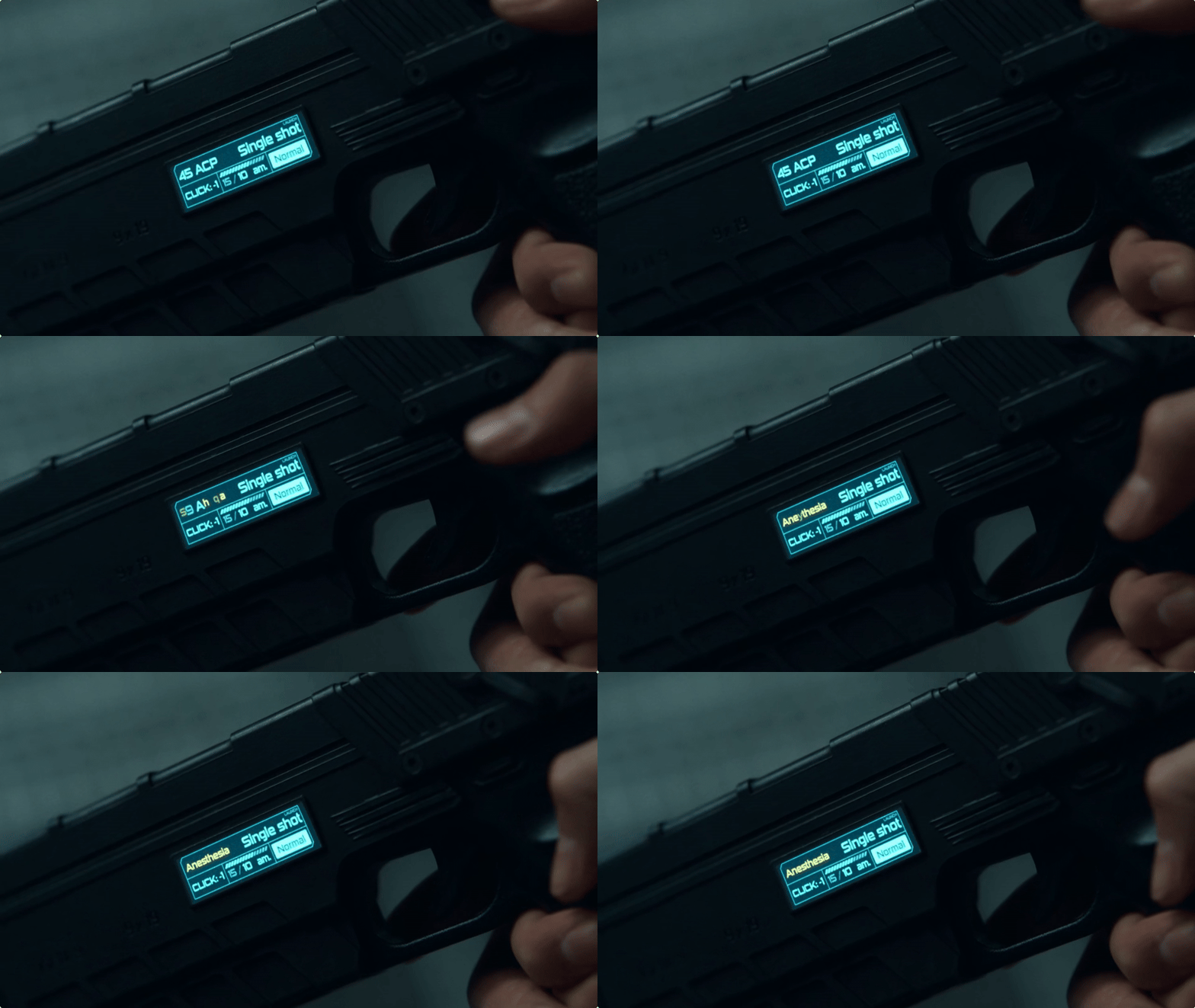
Gun UI
There’s something about having a display on a gun that makes it feel instantly futuristic. Here, the UI lets you see ammo counts and mode settings at a glance and even switch the weapon to fire a tranquilliser.

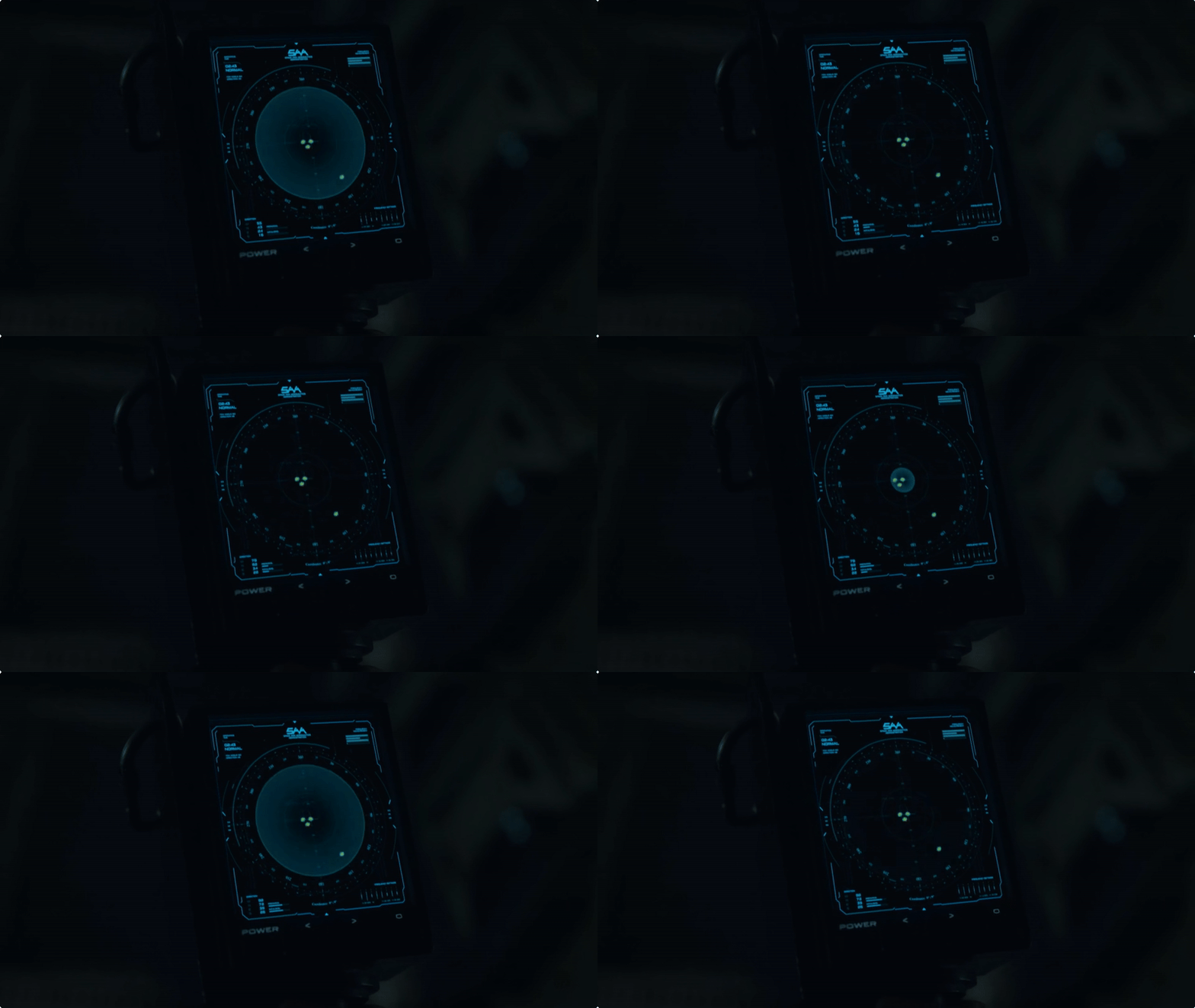
Scanner
Here’s a classic sci-fi horror trope, a scanner that helps detect missing crew members or other lifeforms. Similar to Aliens, it serves a familiar narrative purpose, but The Silent Sea uses a high-fidelity display as opposed to a low-fi aesthetic. Check out (Alien: Isolation and Alien Romulus)


Window display
Here, we see a window looking out onto the surface of the moon, which tints to become a display. While it looks like a classic sci-fi interface, this kind of technology is available today. Smart glass and tintable surfaces are becoming more common, so what feels futuristic in the show might not be far from reality.
View fullsize
View fullsize

View fullsize

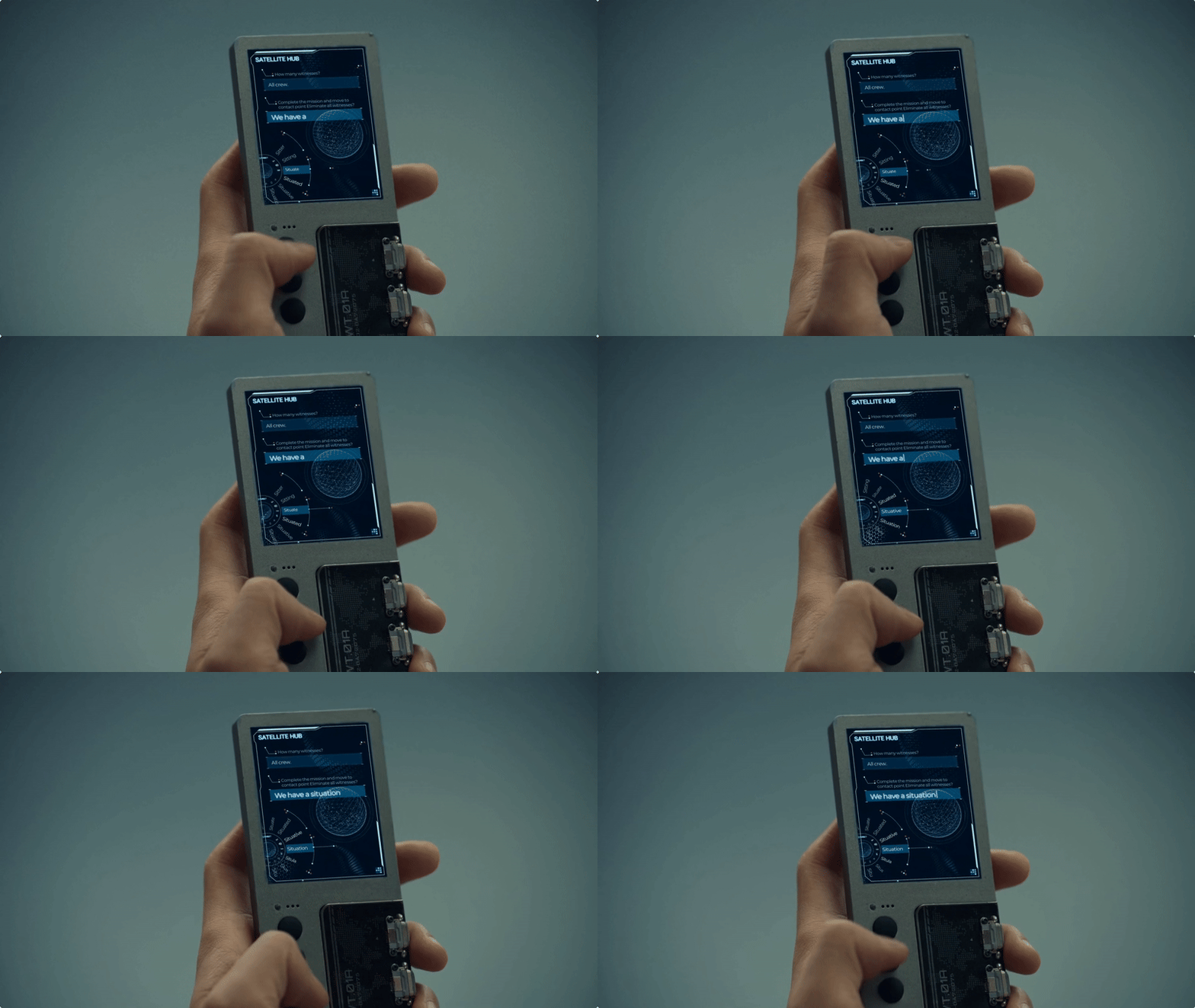
Mobile device
This one is a bit strange, it’s hard to see how the user could type messages using just three buttons and no keyboard. There is a suggestion wheel, but having to tap repeatedly to cycle through options seems tedious. That said, the interface probably isn’t meant to be scrutinized closely or looped over repeatedly. Viewed in context, it reads as something “from another time and world,” reinforcing the sense that this is technology shaped by its own unique environment.
View fullsize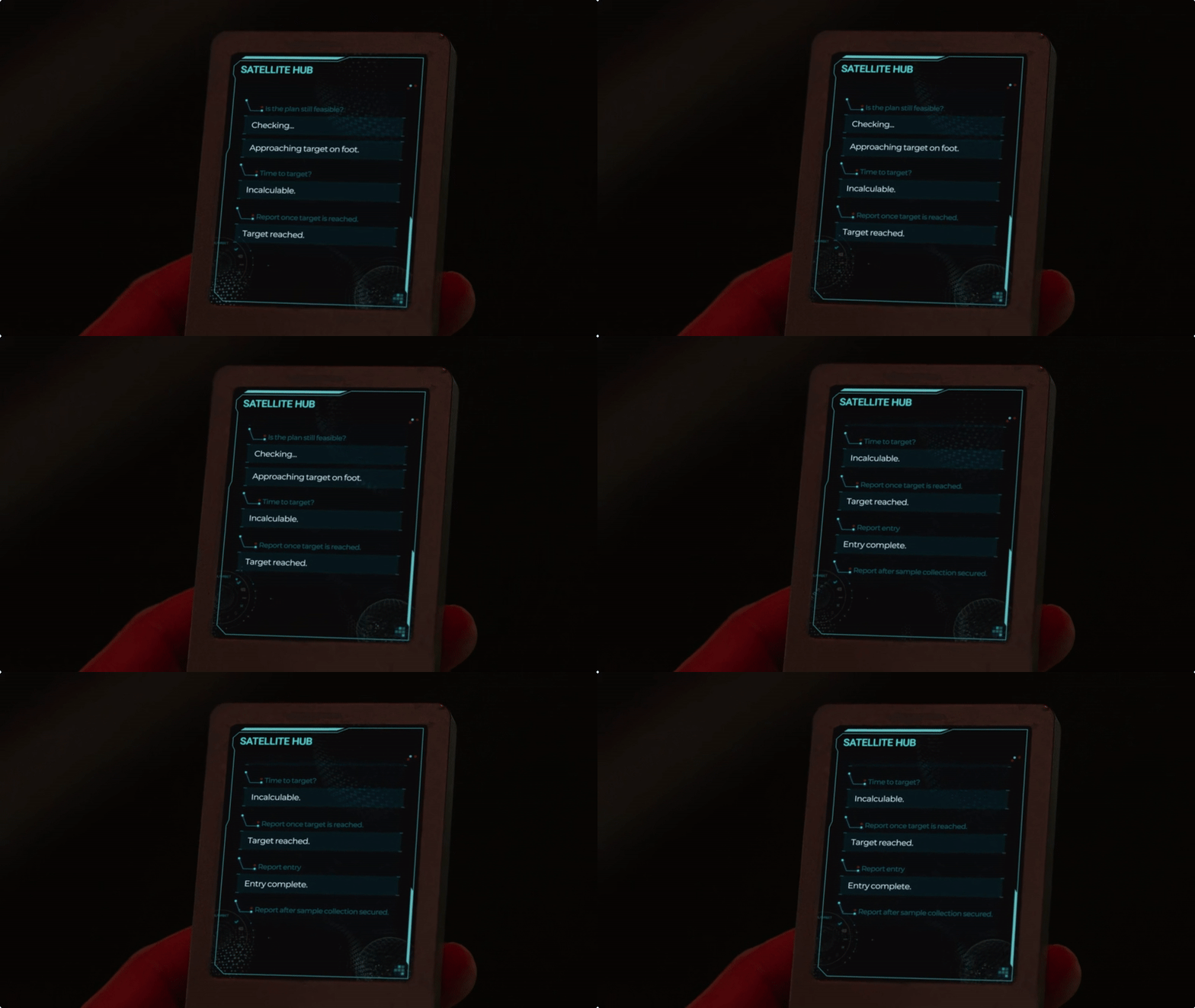
View fullsize
Control panel
Here’s a series of control panel screens, showing a mix of Korean and English. I found it interesting that many of the design elements are so small and thin, especially considering the astronauts’ thick gloves. You might expect a chunkier, more simplified design to accommodate the tactile limitations. However, as long as the interactive areas are large enough, the fine detail of the display becomes less of an issue and it makes for a visually elegant interface that doesn’t feel clunky.




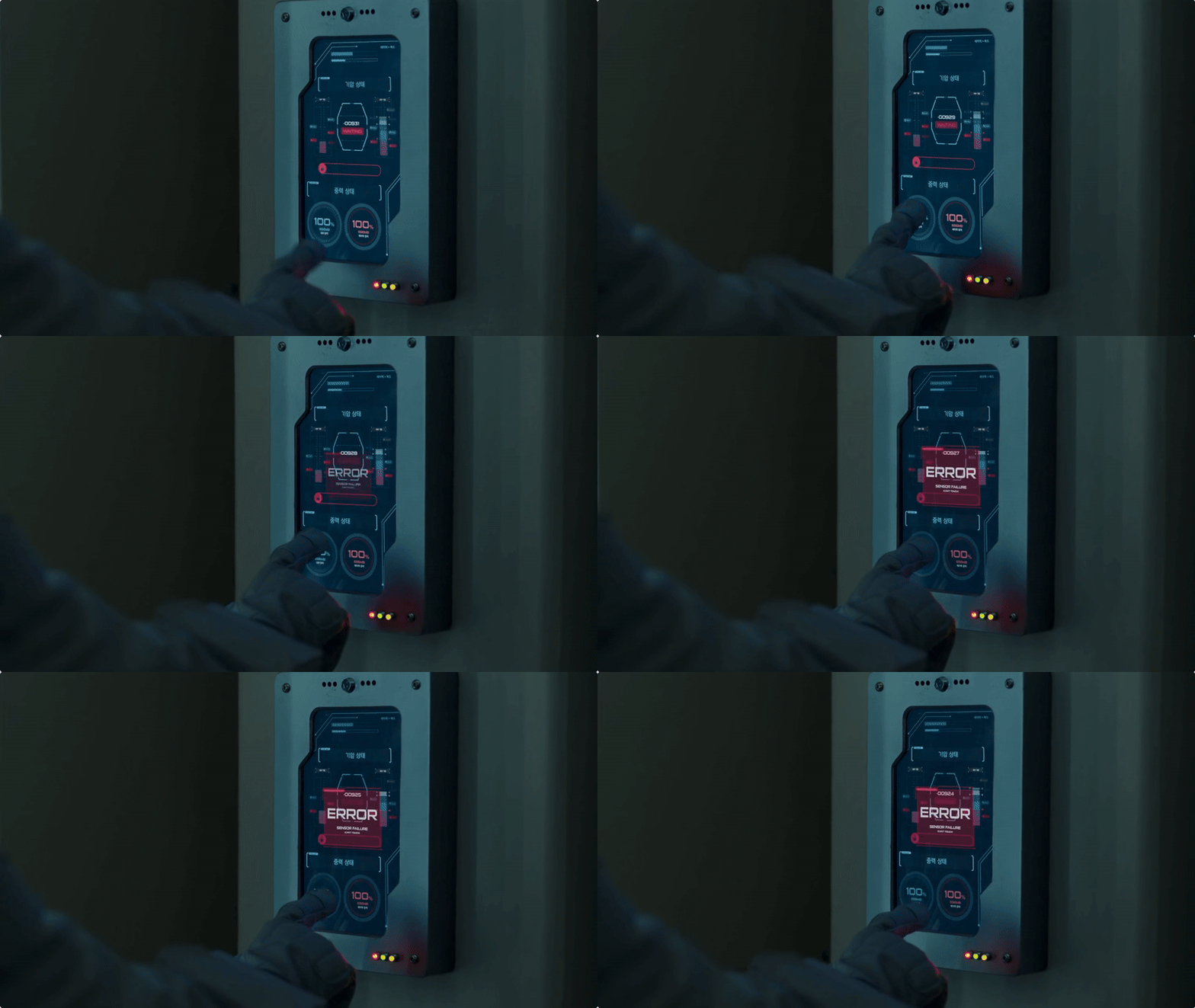

Wrist UI
The wrist UI is primarily used to display life stats, like oxygen levels and other vital signs, keeping the crew informed at a glance. It also doubles as an authentication device for accessing locked areas.





Reshaping Eyeballs With Electricity, No Lasers Or Cutting Required

Glasses are perhaps the most non-invasive method of vision correction, followed by contact lenses. Each have their drawbacks though, and some seek more permanent solutions in the form of laser eye surgeries like LASIK, aiming to reshape their corneas for better visual clarity. However, these methods often involve cutting into the eye itself, and it hardly gets any more invasive than that.
A new surgical method could have benefits in this regard, allowing correction in a single procedure that requires no lasers and no surgical cutting of the eye itself. The idea is to use electricity to help reshape the eye back towards greater optical performance.
The Eyes Have It
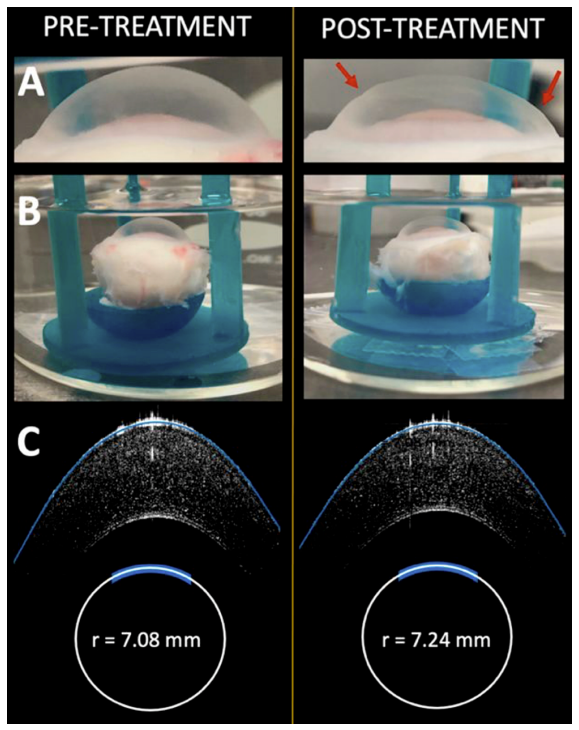
Existing corrective eye surgeries most often aim to fix problems like long-sightedness, short-sightedness, and astigmatism. These issues are generally caused by the shape of the cornea, which works with the lens in the eye to focus light on to the light-sensitive cells in the retina. If the cornea is misshapen, it can be difficult for the eye to focus at close or long ranges, or it can cause visual artifacts in the field of view, depending on the precise nature of the geometry. Technologies like LASIK reshape the cornea for better performance using powerful lasers, but also involve cutting into the cornea. The procedure is thus highly invasive and has a certain recovery time, safety precautions that must be taken afterwards, and some potential side effects. A method for reshaping the eye without cutting into it would thus be ideal to avoid these problems.
Enter the technology of Electromechanical Reshaping (EMR). As per a new paper, researchers at the University of California, Irvine, came across the idea by accident, having been looking into the moldable nature of living tissues. As it turns out, collagen-based tissues like the cornea hold their structure thanks to the attractions between oppositely-charged subcomponents. These structures can be altered with the right techniques. For example, since these tissues are laden with water, applying electricity can change the pH through electrolyzation, altering the attraction between components of the tissue and making them pliable and reformable. Once the electric potential is taken away, the tissues can be restored to their original pH balance, and the structure will hold firm in its new form.
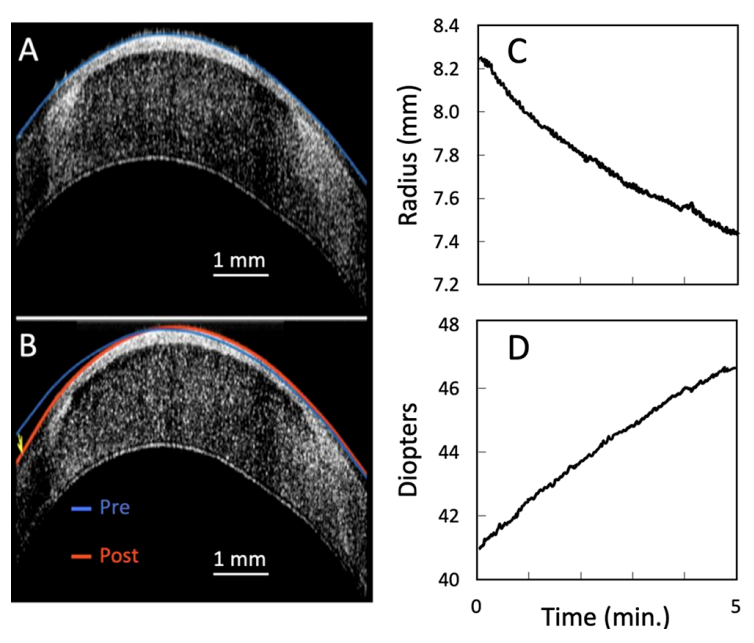
Researchers first tested this technique out on other tissues before looking to the eye. The team were able to use EMR to reshape ears from rabbits, while also being able to make physical changes to scar tissue in pigs. These efforts proved the basic mechanism worked, and that it could have applicability to the cornea itself.
To actually effectively reshape the cornea using this technique, a sort of mold was required. To that end, researchers created a “contact lens” type device out of platinum, which was formed in the desired final shape of the cornea. A rabbit eyeball was used in testing, doused in a saline solution to mimic the eye’s natural environment. The platinum device was pushed on to the eye, and used as an electrode to apply a small electrical potential across the eyeball. This was controlled carefully to precisely change the pH to the region where the eye became remoldable. After a minute, the cornea of the rabbit eyeball had conformed to the shape of the platinum lens. With the electrical potential removed, the pH of the eyeball was returned to normal and the cornea retained the new shape. The technique was trialled on twelve eyeballs, with ten of those treated for a shortsightedness condition, also known as myopia. In the case of the myopic eyeballs, all ten were successfully corrected the cornea, creating improved focusing power that would correspond to better vision in a living patient’s eye.
While the technique is promising, great development will be required before this is a viable method for vision correction in human patients. Researchers will need to figure out how to properly apply the techniques to eyeballs that are still in living patients, with much work to be done with animal studies prior to any attempts to translate the technique to humans. However, it could be that a decade or two in the future, glasses and LASIK will be increasingly less popular compared to a quick zap from the electrochemical eye remoulder. Time will tell.

ChatGPT fusionne moteur de recherche, App Store et OS, ce qui change tout pour les marques
Avec le lancement cette nuit des Apps ChatGPT, OpenAI transforme son assistant en plateforme d’applications intégrées. Les marques pourront désormais être invoquées directement dans le fil de la conversation, sans que l’utilisateur ne quitte l’interface. Une rupture qui redistribue les cartes du marketing digital. OpenAI franchit un cap majeur et créé une rupture historique, ChatGPT …
L’article ChatGPT fusionne moteur de recherche, App Store et OS, ce qui change tout pour les marques est apparu en premier sur FW.MEDIA.
F1 in Singapore: “Trophy for the hero of the race”
Few modern F1 venues are as dazzling as the Marina Bay circuit in Singapore. If you watch the early practice or the young women of F1 Academy in their races, you'll get an idea of the street circuit's relationship to the city in daylight as it takes in landmarks and crosses the water. At night, the brilliant white ribbon of racetrack throws the rest of the surroundings into darkness. Unlike a Le Mans car, there are no headlights in F1.
Just over 1,600 lights are needed for the job, which got underway in mid-June. They're LED now, a switch made in 2023 that cut energy consumption by a noticeable 30 percent. The light itself is even carefully tuned—a color of 5,700 K and a color rendering index of 90 best replicate daylight for the drivers. Oh, and there can't be any flickering that could affect the TV broadcast. The results look spectacular, especially in 4K.
As for the racing this year? Perhaps not so much. Past Singaporean Grands Prix have tended to be action-packed—or even chaotic. In the inaugural 2008 race, Red Bull came away convinced that electromagnetic interference from an underground train line caused the failure of one of its race cars, as well as a sister car belonging to the team we now call Racing Bulls. Other teams remained worried about this phenomenon as late as 2015, although no similar failures had been recorded. For the record, Singapore's Land Transit Authority says there was no train track below the relevant corner of the circuit—the nearest train tunnel is more than 600 feet away (200 m) and 32 feet (10 m) below ground level.

Actualité : Silence sur Jupiter : la sonde Juno, chef-d'œuvre de la NASA, laissée à l'abandon à cause du chaos politique

Un incendie et pas de backup - La Corée du Sud perd 858 To de données gouvernementales
Vous vous souvenez de cette règle de base en informatique, que je vous rabâche régulièrement, et qui dit de toujours avoir plusieurs sauvegardes de vos données critiques ?
Hé bien apparemment, le gouvernement sud-coréen a zappé ce cours, car le 26 septembre dernier, un incendie s’est produit au centre de données NIRS (National Information Resources Service) à Daejeon et a cramé 858 téraoctets de fichiers gouvernementaux . Et y’a pas de backup. Nada.
Le feu a démarré pendant une opération de maintenance sur une batterie lithium-ion dans laquelle une cellule a lâché , déclenchant ce qu’on appelle un emballement thermique… En gros, la batterie s’est transformée en bombe incendiaire et le brasier s’est propagé dans la salle serveur du cinquième étage, faisant tomber 647 services en ligne gouvernementaux d’un coup. Parmi eux, 96 systèmes critiques ont été directement détruits, et 551 autres ont été coupés préventivement pour éviter que la chaleur les bousille aussi.
Le système qui a morflé le plus, c’est G-Drive, le cloud de stockage utilisé par les fonctionnaires sud-coréens depuis 2018. Environ 750 000 employés du gouvernement central peuvent stocker leurs documents de travail dessus, mais seulement 125 000 l’utilisaient vraiment. Chacun disposait d’environ 30 Go d’espace de stockage, ce qui fait qu’au total le système contenait 858 To de données de travail accumulées sur huit ans.
Snif…
En fait, leur G-Drive est conçu comme un système de stockage haute capacité, mais basse performance, et ils ont des contraintes réglementaires qui imposent un stockage exclusif sur cette plateforme afin d’éviter les fuites de données.
Donc autrement dit, pour se prémunir contre les risques de fuite, ils ont créé un point de défaillance unique. Et comme y’avait pas de backup, c’est la cata… Bravo !
Du coup, quand l’incendie a détruit les serveurs physiques, tout est parti en fumée. Huit ans de documents de travail pour certains ministères, qui ont été complètement perdus… C’est surtout le ministère de la Gestion du Personnel qui s’est pris la claque la plus violente parce qu’il avait rendu obligatoire le stockage de tous les documents sur G-Drive uniquement. D’autres organismes comme le Bureau de Coordination des Politiques Gouvernementales, qui utilisaient moins la plateforme, ont moins souffert.
Bref, les autorités essaient maintenant de récupérer ce qu’elles peuvent depuis d’autres sources. Y’a des petits bouts de fichiers sauvegardés localement sur les ordinateurs personnels des fonctionnaires le mois précédent, les emails, les documents officiels validés et les archives papier… Bref, pour tous les documents officiels passés par des processus d’approbation formels, il y a un espoir de récupération via leur système OnNara (un autre système gouvernemental qui stocke les rapports finaux), mais pour tout le reste (brouillons, fichiers de travail en cours, notes internes…etc.) c’est mort de chez mort…
Le ministère de l’Intérieur a expliqué que la plupart des systèmes du centre de Daejeon sont normalement sauvegardés quotidiennement sur des équipements séparés dans le même centre ET dans une installation de backup distante. Mais G-Drive, lui, n’avait pas, comme je vous le disais, cette possibilité.
Évidemment, cet incident a déclenché une vague de critiques acerbes sur la gestion des données gouvernementales sud-coréennes. Un système de backup en miroir en temps réel qui duplique le serveur principal pour assurer la continuité de service en cas de panne, était complètement absent de l’infrastructure et pour un système aussi critique que le stockage de documents de 750 000 fonctionnaires, c’est difficilement compréhensible.
Voilà donc le gouvernement estime qu’il faudra jusqu’à un mois pour récupérer complètement les 96 systèmes de base directement endommagés par l’incendie et pour G-Drive et ses 858 To de données, par contre, c’est une autre histoire, car sans backup, les données sont définitivement perdues.
De plus, cet incendie déclenche actuellement un genre d’examen mondial des batteries lithium-ion dans les datacenters et des architectures de plan de reprise d’activité (PRA). Les batteries lithium-ion sont en effet utilisées partout pour l’alimentation de secours, mais leur risque d’emballement thermique en cas de défaillance pose de sérieuses questions sur leur place dans des infrastructures critiques…
Bref, je souhaite bon courage aux Coréens, et j’espère que tout le monde saura tirer des enseignements de ce malheureux incendie…

OpenAI launches AgentKit to help developers build and ship AI agents
L'UE promeut l'éducation financière


The GEO companies winning the AI search arms race
AI shopping is here, and brands are entering a new battleground.
OpenAI‘s September 2025 rollout of in-platform checkout via Shopify and Stripe enables shoppers to search, decide, and buy entirely within ChatGPT. Adobe reports that traffic from generative AI platforms to US e-commerce sites surged 4,700% year-over-year in July 2025, and is accelerating every month.
To compete, brands must establish a strong presence in AI search — or risk losing share in the emerging agentic shopping journey. Generative engine optimization (GEO) is the solution: startups in this space are building tools to track, measure, and optimize brand visibility across ChatGPT, Claude, Google AI Overviews, and other AI-generated answers, creating a new SEO arms race.
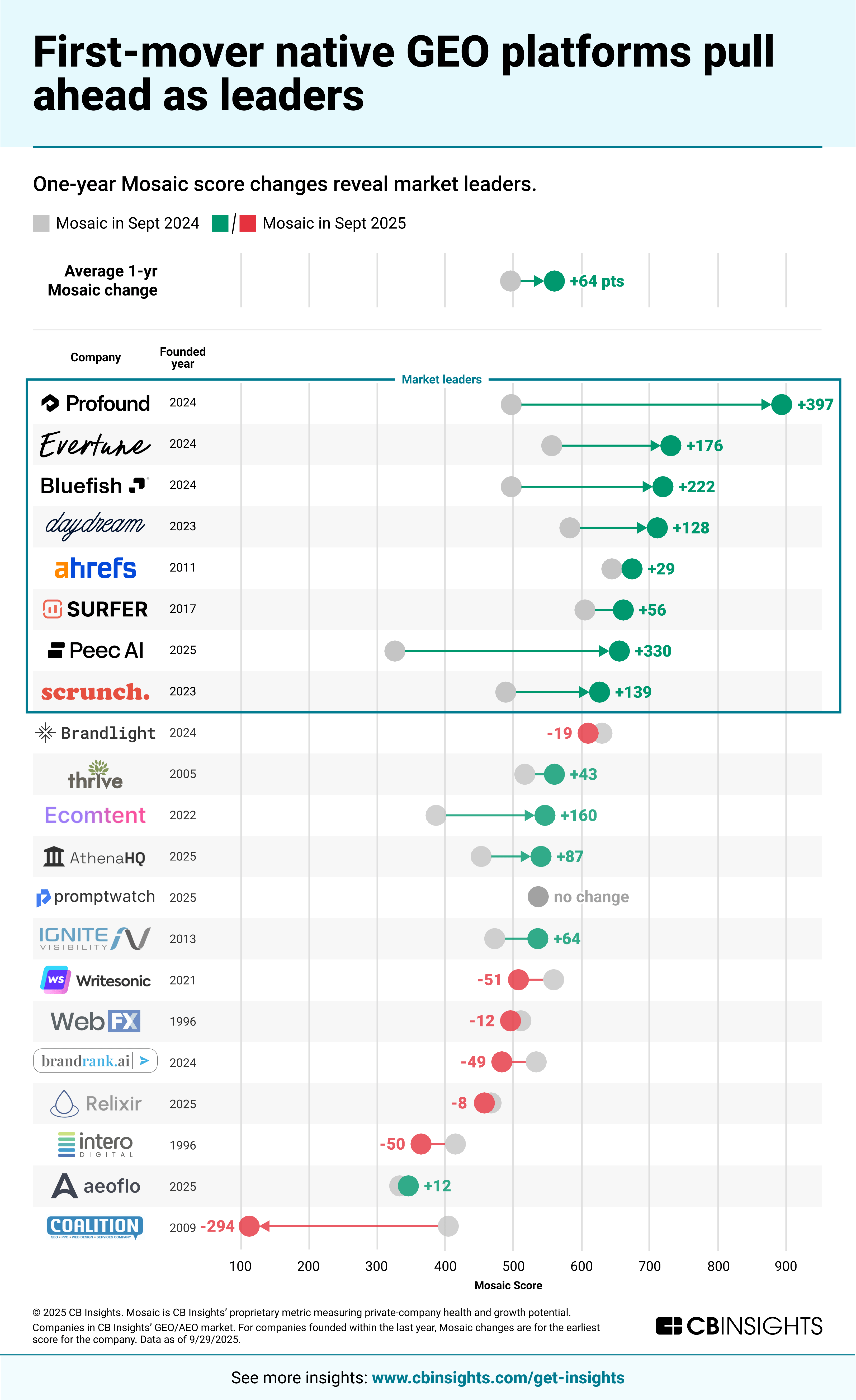
Using CB Insights’ Mosaic score — which measures private company health and predicts likelihood of success — we analyzed more than 20 GEO companies, ranking them by 1-year Mosaic score growth to identify the fastest-rising vendors. By examining their capabilities and growth signals, this analysis highlights the GEO partners best positioned to help brands win in AI search.
 Explore the generative engine optimization (GEO) market
- Native GEO solutions have the first-mover advantage. Of the 8 GEO companies with the most momentum — each posting more than the market’s average 14% Mosaic growth in the past year — 7 were founded between 2023-2025. All but 2 companies with Mosaic scores of 600+ also launched in the same window. These “native” GEO companies were built specifically for LLM visibility rather than retrofitting or bolting onto SEO tools, giving them advantages in data collection, multi-model monitoring, and content recommendations.
- Four capabilities have emerged as table stakes, and vendors without this full stack will fall behind. Analysis of the CB Insights market scorecard for companies with the top Mosaic scores (600+) highlights a consistent feature set: multi-platform monitoring across ChatGPT, Perplexity, Google AI Overviews, and emerging engines; competitive benchmarking that tracks share of voice against rivals; sentiment analysis measuring how brands are portrayed; and actionable insights on content gaps and adjustments. Vendors that deliver this complete capability set are the ones that will lead the market. Buyers should prioritize these features when evaluating potential partners.
- Automated content generation is becoming a differentiator. While most GEO tools diagnose visibility, leaders are building autonomous content engines that create LLM-optimized content. Profound offers AI content workflows using preset templates to write AI-friendly material from aggregated citations. Surfer‘s Content Editor suggests LLM-ready content modifications. Scrunch constructs parallel “AI-friendly” website versions optimized for machine consumption alongside human-facing sites. As GEO evolves, the platforms that can both track and directly shape how LLMs read the web will dictate the rules of agentic discovery. Brands’ demands for the most efficient solutions will force pure-play monitoring tools to build or acquire content capabilities.
For information on reprint rights or other inquiries, please contact reprints@cbinsights.com.
The post The GEO companies winning the AI search arms race appeared first on CB Insights Research.
ChinAI #331: Chinese Public Perceptions and Usage of AI (2025 survey)
Greetings from a world where…
The Farseer Trilogy is epic
…As always, the searchable archive of all past issues is here. Please please subscribe here to support ChinAI under a Guardian/Wikipedia-style tipping model (everyone gets the same content but those who can pay support access for all AND compensation for awesome ChinAI contributors).
Feature Translation: Chinese Public Perceptions and Usage of Generative AI
Context: Last month, to explore the public’s usage habits and attitudes toward generative AI, Tencent Research Institute conducted an online survey of 3,570 Chinese adults (link to original Chinese). This is not a nationally representative survey; rather, it captures the views of highly educated young adults. To make this clear, 85% of the survey respondents had a college degree or higher, whereas just 10% of China’s labor force (age 25-64) has at least a bachelor’s degree. They did collect a gender-balanced sample from a variety of industries, so the below findings probably reflect the views of young, highly educated digital natives in China.
Key Takeaways: Adoption patterns — wide, localized, but “wait-and-see” attitude regarding willingness to pay. Let’s go through these three points in turn.
96% of respondents had used AI-generated content tools, with two-thirds (67.7%) of those being daily users.
-
Chinese companies accounted for the top three most-used products: ByteDance’s Doubao, DeepSeek, and Tencent Yuanbao. Tencent Research Institute attributes this trend to network access restrictions (e.g., you have to find mirror sites or use a VPN to access Claude or ChatGPT), superior Chinese-language capabilities of local services, and synergies with the ecosystem of Chinese applications (e.g., WeChat’s integration of DeepSeek)
I was disappointed that the survey results don’t show the actual bar graphs for this question; instead, they just provide a word cloud, which omits the exact figures for the most popular generative AI apps.
Two more interesting points about age groups and GenAI product usage. “Among respondents aged 20-29, ChatGPT’s usage rate was significantly higher than among respondents in other age groups,” the article states. And, Moonshot AI’s Kimi places in the top three among respondents under 20.
In the section on commercialization prospects, the Tencent Research Institute survey found that about 60% of respondents stated that they were “watching from the sidelines [正在观望], but would pay if it’s good” (see image below). Among the users that were open to paying for generative AI services, the most preferred payment option was “monthly payment” and under 100 RMB/month. The study authors theorizes that consumers see the generative AI product market like video streaming services (for context, the monthly fee for iQiyi [China’s Netflix] is around 25 RMB/month).

The Chinese public has mixed views about AI’s societal impact.
About 46% of respondents feel “both excited and concerned” about the future of AI. The three main risks: 1) 60% of respondents expressed concern about the “proliferation of false information and fake news”1; 2) 60% also fear job displacement; and 3) 47% cited the risk of “privacy breaches.”
One item that caught my attention relates to the so-called “enthusiasm gap” between the Chinese public and Western publics, which is worth unpacking further. Overall, the majority of respondents (72%) believe that generative AI will have a “primarily positive impact.” This seems to support this overall assumption that the Chinese public is more optimistic about AI than people in other countries.
But, what happens when we dig a little deeper into this purported optimism gap? Again, I would be very skeptical about taking online surveys from China as representative of the entire population. For instance, one survey cited as evidence for this gap finds that 81% of the Chinese public agrees that the benefits of AI outweigh the risks (the figure was 41% for the US). However, turn to page 75 of the methodology section, and you’ll see this revealing statement:
“Samples from emerging economies (Brazil, India, China, and South Africa) represented considerably more university educated people than their respective general populations (using OECD 2021 education data as a comparison). A higher representation of educated people is common in survey research from the BICS countries. For instance, Edelman (2022) and Ipsos (2022) both note that online samples in Brazil, India, China and South Africa are more educated, affluent, and urban than the general population.”
To me, here’s the bottom line. Regarding findings from online surveys like this week’s feature translation and the above one, they reflect the views of highly educated adults in China, very likely concentrated in the coastal provinces — not the general Chinese public. Thus, I would be very wary of using these survey findings to support the claim that AI will diffuse more quickly throughout the entire Chinese economy.
FULL TRANSLATION: Chinese Public Perceptions and Usage of Generative AI
ChinAI Links (Four to Forward)
Should-read: Compute is not the answer to AI sovereignty
A GovAI summer fellow, Hamish Low, has published a thoughtful piece about how the UK should approach its compute buildout and AI sovereignty. He concludes, “Given a sufficiently focused and aggressive industrial policy we can build powerful positions in key future nodes of the AI value chain and ensure that Britain stays in the room when that crisis comes. (Mutual) Interdependence (with the U.S.) can be much more powerful for the UK than compute infrastructure.”
Should-read: The U.S. Needs A Generative AI Intensity Index
This is a very cool project from SeedAI that tackles the challenges in measuring the diffusion of generative AI. Joshua New, Marina Meyjes, and Austin Carson propose an index to “measure the digital processes created during real-world use of generative AI systems, offering a direct proxy for their adoption across the economy.”
Should-read: Grant Delays Threaten Cultural and Language Studies Programs
On September 30, the Department of Education ended seven decades of (bipartisan) support for initiatives such as the National Resource Center (NRCs) program, dedicated to language and area studies. GW has two NRCs, including one that supports students to pursue intensive language study in East Asia. Again, what are we doing here? Reporting for Inside Higher Ed, Johanna Alonso provides the broader context.
Must-read more closely later but putting it here now: DeepSeek-R1 incentivizes reasoning in LLMs through reinforcement learning
DeepSeek researchers published an open access Nature paper that details their process for training the R1 model. H/t to Miles Brundage for flagging that it includes a 10-page safety report that talks about their efforts to control risks. More on this in future issues.
Thank you for reading and engaging.
*These are Jeff Ding’s (sometimes) weekly translations of Chinese-language musings on AI and related topics. Jeff is an Assistant Professor of Political Science at George Washington University.
Check out the archive of all past issues here & please subscribe here to support ChinAI under a Guardian/Wikipedia-style tipping model (everyone gets the same content but those who can pay for a subscription will support access for all).
Also! Listen to narrations of the ChinAI Newsletter in podcast format here.
Any suggestions or feedback? Let me know at chinainewsletter@gmail.com or on Twitter at @jjding99
Tencent Research Institute recently published a report on AI-generated misinformation, which ChinAI translated: https://chinai.substack.com/p/chinai-322-100-cases-of-ai-disinformation?utm_source=publication-search

OpenAI offers more copyright control for Sora 2 videos
Matignon publie une charte pour une utilisation raisonnée de l’intelligence artificielle générative

L'intelligence artificielle générative est la bienvenue dans les services du Premier ministre... mais sous conditions. Dans une charte récemment publiée par l'hôtel Matignon, les recommandations à l'usage des agents distinguent les usages autorisés et les usages proscrits. Parmi les premiers figurent "les cas d'usages auxquels l'IA peut répondre" : résumer, synthétiser, rédiger et corriger des documents non confidentiels… La recherche documentaire peut également être confiée à une IA mais "il est nécessaire d’effectuer une vérification systématique de la validité de ces informations."
Autres cas d'usages autorisés, la traduction de documents qui ne présentent pas de caractère confidentiel et la génération d'éléments sonores et visuels pour la création de maquettes par exemple.
[...] Lire la suite de cet article sur Archimag.comOpenAI and chipmaker AMD sign chip supply partnership for AI infrastructure
Airbags, and How Mercedes-Benz Hacked Your Hearing

Airbags are an incredibly important piece of automotive safety gear. They’re also terrifying—given that they’re effectively small pyrotechnic devices that are aimed directly at your face and chest. Myths have pervaded that they “kill more people than they save,” in part due a hilarious episode of The Simpsons. Despite this, they’re credited with saving tens of thousands of lives over the years by cushioning fleshy human bodies from heavy impacts and harsh decelerations.
While an airbag is generally there to help you, it can also hurt you in regular operation. The immense sound pressure generated when an airbag fires is not exactly friendly to your ears. However, engineers at Mercedes-Benz have found a neat workaround to protect your hearing from the explosive report of these safety devices. It’s a nifty hack that takes advantage of an existing feature of the human body. Let’s explore how air bags work, why they’re so darn loud, and how that can be mitigated in the event of a crash.
A Lot Of Hot Air

Once an obscure feature only found in luxury vehicles, airbags became common safety equipment in many cars and trucks by the mid-1990s. Indeed, a particular turning point was when they became mandatory in vehicles sold in the US market from late 1998 onwards, which made them near-universal equipment in many other markets worldwide. Despite their relatively recent mainstream acceptance, the concept of the airbag actually dates back a lot farther.
The basic invention of the airbag is typically credited to two English dentists—Harold Round and Arthur Parrott—who submitted a patent for the concept all the way back in 1919. The patent regarded the concept of creating an air cushion to protect occupants in aircraft during serious impacts. Specific attention was given to the fact that the air cushion should “yield readily without developing the power to rebound,” which could cause further injury. This was achieved by giving the device air outlet passages that would vent as a person impacted the device, which would allow the cushion to absorb the hit gently while reducing the chance of injury.
The concept only later became applicable to automobiles when Walter Linderer filed for a German patent in 1951, and John W. Hetrick filed for a US patent in 1952. Both engineers devised airbags that were based on the release of compressed air, triggered either by human intervention or automated mechanical means. These concepts proved ultimately infeasible, as compressed air could not be feasibly be released to inflate an airbag quickly enough to be protective in an automobile crash.
It would only be later in the 1960s that workable versions using explosive or pyrotechnic inflation came to the fore. The concept was simple—use a chemical reaction to generate a great deal of gas near-instantaneously, inflating the airbag fractions of a second before vehicle occupants come into contact with the device. The airbags are fitted with vents that only allow the gas to escape slowly. This means that as a person hits the airbag, they are gently decelerated as their impact pushes the gas out of the restrictive vents. This helps reduce injuries that would typically be incurred if the occupants instead hit interior parts of the car without any protection at all.

The Big Bang
The use of pyrotechnic gas generators to inflate airbags was the leap forward that made airbags practical and effective for use in automobiles. However, as you might imagine, releasing a massive burst of gas in under 50 milliseconds does create a rather large pressure wave—which we experience as an incredibly loud sound. If you ever seen airbags detonated outside of a vehicle, you’ve probably noticed they sound rather akin to fireworks or a gun going off. Indeed, the sound of an airbag can exceed 160 decibels (dB)—more than enough to cause instant damage to the ear. Noise generated in a vehicle impact is often incredibly loud, too, or course. Ultimately, this isn’t great for the occupants of the vehicle, particularly their hearing. Ultimately, an airbag deployment is a carefully considered trade-off—the general consensus is that impact protection in a serious crash is preferable, even if your ears are worse for wear afterwards.
However, there is a technique that can mitigate this problem. In particular, Mercedes-Benz developed a system to protect the hearing of vehicle occupants in the event that the airbags are fired. The trick is in using the body’s own reactions to sound to reduce damage to the ear from excessive sound pressure levels.
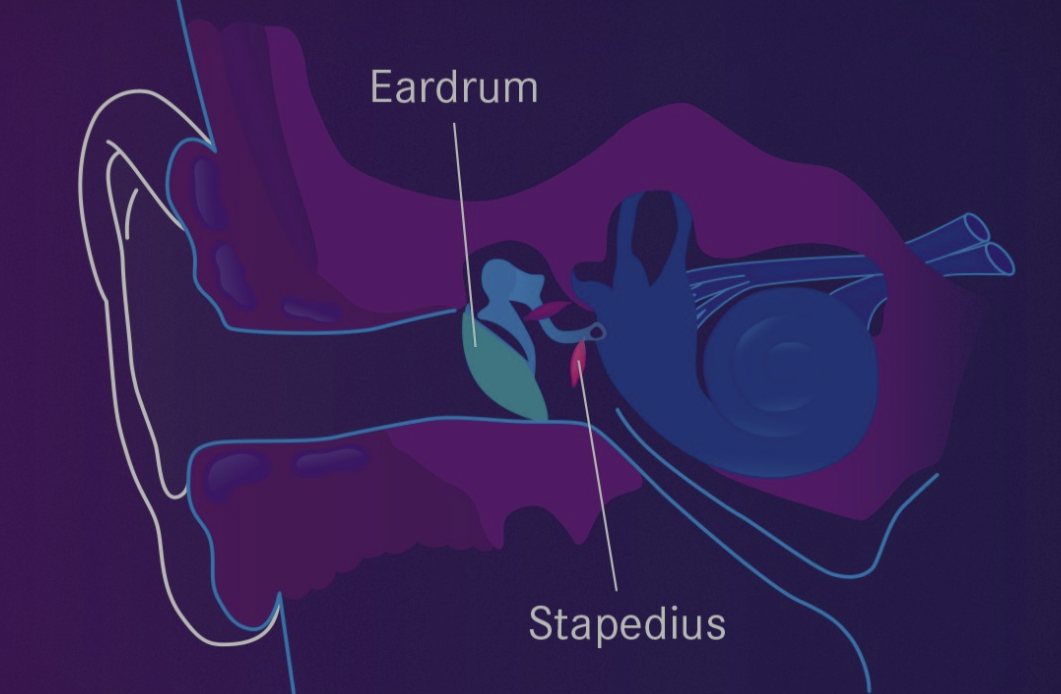
The stapedius reflex (also known as the acoustic reflex) is one of the body’s involuntary, instantaneous movements in response to an external stimulus—in this case, certain sound levels. When a given sound stimulus occurs to either ear, muscles inside both ears contract, most specifically the stapedius muscle in humans. When the muscle contracts, it has a stiffening effect on the ossicular chain—the three tiny bones that connect the ear drum to the cochlea in the inner ear. Under this condition, less vibrational energy is transferred, reducing damage to the cochlea from excessive sound levels.
The threshold at which the reflex is triggered is usually 10 to 20 dB lower than the point at which the individual feels discomfort; typical levels are from around 70 to 100 dB. When triggered by particularly loud sounds of 20 dB above the trigger threshold, the muscle contraction is enough to reduce the sound level at the cochlea by a full 15 dB. Notably, the reflex is also triggered by vocalization—reducing transmission through to the inner ear when one begins to speak.
Mercedes-Benz engineers realized that the stapedius reflex could be pre-emptively triggered ahead of firing the airbags, in order to provide a protective effect for the ears. To this end, the company developed the PRE-SAFE Sound system. When the vehicle’s airbag control unit detects a collision, it triggers the vehicle’s sound system to play a short-duration pink noise signal at a level of 80 dB. This is intended to be loud enough to trigger the stapedius reflex without in itself doing damage to the ears. Typically, it takes higher sound levels closer to 100 dB to reliably trigger the reflex in a wide range of people, but Mercedes-Benz engineers realized that the wide-spread frequency content of pink noise enable the reflex to be switched on at a much lower, and safer, sound level. With the reflex turned on, when the airbags do fire a fraction of a second later, less energy from the intense pressure spike will be transferred to the inner ear, protecting the delicate structures that provide the sense of hearing.
Mercedes-Benz first released the technology in production models almost a decade ago.
The stapedius reflex does have some limitations. It can be triggered with a latency of just 10 milliseconds, however, it can take up to 100 milliseconds for the muscle in the ear to reach full tension, conferring the full protective effect. This limits the ability of the reflex to protect against short, intense noises. However, given the Mercedes-Benz system triggers the sound before airbag inflation where possible, this helps the muscles engage prior to the peak sound level being reached. The protective effect of the stapedius reflex also only lasts for a few seconds, with the muscle contraction unable to be maintained beyond this point. However, in a vehicle impact scenario, the airbags typically all fire very quickly, usually well within a second, negating this issue.
Mercedes-Benz was working on the technology from at least the early 2010s, having run human trials to trigger the stapedius reflex with pink noise in 2011. It deployed the technology on its production vehicles almost a decade ago, first offering PRE-SAFE Sound on E-Class models for the 2017 model year. Despite the simple nature of the technology, few to no other automakers have publicly reported implementing the technique.
Car crashes are, thankfully, rather rare. Few of us are actually in an automobile accident in any given year, even less in ones serious enough to cause an airbag deployment. However, if you are unlucky enough to be in a severe collision, and you’re riding in a modern Mercedes-Benz, your ears will likely thank you for the added protection, just as your body will be grateful for the cushioning of the airbags themselves.

Le prochain film Star Wars prolonge l’effacement des plus grands récits du Mandalorien : quel impact réel ?

Alors que le prochain film Star Wars s’apprête à sortir, la franchise poursuit une tendance amorcée depuis quatre ans en revenant sur certains des arcs narratifs les plus marquants de The Mandalorian, soulevant des interrogations sur l’impact réel de ces choix scénaristiques.
✍️ Edito - Critterz : le film créé par IA qui fait flipper les studios d'animation
Alors qu’OpenAI annonce un film d’animation pour 2026, co-réalisé avec l’intelligence artificielle, la profession s’alarme : et si Critterz annonçait l’ère d’un cinéma sans humains ?
En 2023, un court-métrage mystérieux apparaît sur YouTube : Critterz, des créatures poilues et mignonnes dans une forêt stylisée façon Pixar. Mais ce n’est pas Pixar : c’est OpenAI. Et ce n’est qu’un début.
Un long-métrage est annoncé pour 2026, avec l’ambition de concourir dans les festivals. Réalisé à partir d’images générées par DALL·E, puis animées de manière classique, Critterz n’est pas un film "100% IA". L’écriture a été assistée par ChatGPT, mais ce sont encore des humains qui tiennent les manettes.
Pourtant, la polémique enfle. Des professionnels dénoncent une menace pour la création et les emplois. Faut-il avoir peur ? Ce n’est pas la première fois que la technologie bouleverse l’industrie du cinéma — on l’a vu avec le montage numérique, les effets spéciaux ou encore l’arrivée du son.
La véritable rupture ? Critterz coûtera cinq à dix fois moins cher qu’un film d’animation traditionnel… et pourra être produit en moins d’un an. C’est peut-être là que le bât blesse.
Dans cet édito, je reviens sur ce cas emblématique qui cristallise toutes les inquiétudes autour de l’intelligence artificielle dans la création artistique.
-----------
♥️ Soutien :
https://mondenumerique.info/don
🗞️ Newsletter :
https://mondenumerique.substack.com
Hébergé par Audiomeans. Visitez audiomeans.fr/politique-de-confidentialite pour plus d'informations.
📆 L’HEBDO 27/09 - Apple défie l’Europe à propos du DMA
Cette semaine : Apple vs DMA, cyberattaque SIM, salon All In à Montréal, Mistral au Canada, IA qui ment, fin des cookies, bulle IA et visas H-1B, agents intelligents, finances avec Qonto.
💡 Découvrez Frogans, l’innovation française qui réinvente le Web
Donnez votre avis sur ce podcast en répondant à notre 👉 sondage
🍏 Apple vs. Bruxelles : le bras de fer du DMA
Le Digital Markets Act met le feu aux poudres. Apple accuse la loi européenne de freiner l’innovation et menace à demi-mot la commercialisation de certains produits en Europe. L’Union, elle, reste ferme. Une bataille politique et technologique est lancée.
📱 Cyberattaque déjouée à New York
Les services secrets américains ont démantelé une infrastructure composée de 100 000 cartes SIM pirates près du siège de l’ONU. Objectif : saturer les réseaux télécoms ou lancer des menaces anonymes. Une affaire aux allures de thriller.
🧠 IA qui ment : le “skimming” inquiète
Une étude OpenAI révèle que les modèles peuvent dissimuler leurs erreurs. Si le risque reste faible, la difficulté à détecter ces comportements soulève des enjeux cruciaux pour la sécurité future des IA.
🤖 Les agents IA, prochaine frontière
OpenAI dévoile Pulse, un assistant proactif qui collecte pour vous informations et résumés.
Les agents intelligents s’imposent comme un tournant majeur pour l’entreprise. Explication de Nicolas Gaudillière (Capgemini) [PARTENARIAT].
🇨🇦 Montréal, capitale de l’IA
Bruno Guglielminetti nous emmène au salon All In. Ambiance effervescente, annonces stratégiques (notamment l’implantation de Mistral AI au Canada) et débats sur la souveraineté numérique.
💸 La bulle de l’IA va-t-elle exploser ?
Luc Julia (Silicon Valley) analyse l’investissement record de Nvidia dans OpenAI et alerte : les valorisations surréalistes rappellent la bulle Internet. Il revient aussi sur la menace des restrictions de visas H-1B voulues par Donald Trump.
💳 Qonto : l’IA au service des finances d’entreprise
Avec Aymeric Augustin, directeur technique de Qonto, on découvre comment la fintech réinvente la gestion financière avec l’automatisation, la simplification des notes de frais et des outils IA intégrés [PARTENARIAT]
-----------
♥️ Soutien :
https://mondenumerique.info/don
🗞️ Newsletter :
https://mondenumerique.substack.com
Hébergé par Audiomeans. Visitez audiomeans.fr/politique-de-confidentialite pour plus d'informations.
🎤 L'humeur de Luc Julia - La bulle de l’IA est-elle inévitable ?
L’intelligence artificielle connaît-elle une bulle financière sur le point d'éclater, à l’image de celle d’Internet en 2000 ? Pour Luc Julia, figure majeure de l’IA installé dans la Silicon Valley depuis vingt ans, la réponse est claire : oui, car l’excitation autour des IA génératives a atteint des sommets irrationnels.
Contenu de l'interview :
- L’excitation autour des IA génératives rappelle la bulle Internet des années 2000.
- Les dangers de survalorisations insoutenables pour certaines startups.
- L’émergence d’une IA plus frugale et spécialisée : les « IA agentiques ».
Et aussi :
- Nouvelle taxe à 100 000 dollars sur les visas H-1B des travailleurs étrangers aux Etats-Unis : quelles conséquences pour les entreprises de la tech ?
-----------
♥️ Soutien :
https://mondenumerique.info/don
🗞️ Newsletter :
https://mondenumerique.substack.com
Hébergé par Audiomeans. Visitez audiomeans.fr/politique-de-confidentialite pour plus d'informations.
🎤 Interview - Multi-agents : quand l’IA devient un collaborateur à part entière (Nicolas Gaudilliere, Capgemini Invent)
Les agents intelligents, commencent à transformer les processus métiers dans les entreprises. Nicolas Gaudilliere, directeur Technologie et Innovation chez Capgemini Invent, explique comment les architectures multi-agents ouvrent la voie à une nouvelle ère de collaboration homme-machine.
Automatisation, adaptabilité, interaction avec des systèmes externes : leur potentiel est immense, mais les défis sont tout aussi importants. De la banque aux télécoms, en passant par le support client, il détaille les cas d’usage les plus prometteurs, les gains déjà observés et les conditions pour réussir un passage à l’échelle.
Nous évoquons également les enjeux cruciaux de sécurité et de gouvernance, sans lesquels cette révolution ne pourra s’ancrer durablement dans les organisations.
Au programme :
- Qu’est-ce qu’un agent intelligent et en quoi diffère-t-il d’un simple chatbot ?
- Automatisation des processus métiers : exemples concrets dans la banque (KYC), les télécoms et le support client.
- Les architectures multi-agents : spécialisation, orchestration et collaboration avec l’humain.
- Les promesses de productivité (jusqu’à 30% de gain) et leurs limites actuelles.
- Les défis à relever : sécurité, intégration native, passage à l’échelle.
- L’adoption progressive par toutes les entreprises, des grands groupes aux PME.
-----------
♥️ Soutien :
https://mondenumerique.info/don
🗞️ Newsletter :
https://mondenumerique.substack.com
Hébergé par Audiomeans. Visitez audiomeans.fr/politique-de-confidentialite pour plus d'informations.
Divining Air Quality With A Cheap Computer Vision Device
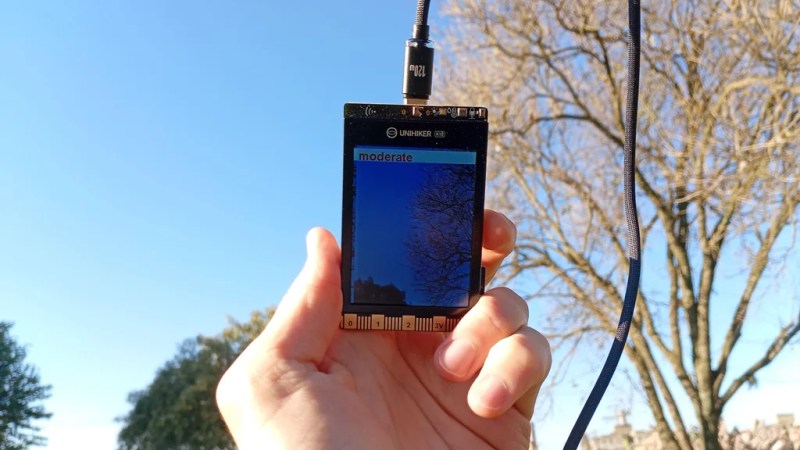
There are all kinds of air quality sensors on the market that rely on all kinds of electro-physical effects to detect gases or contaminants and report them back as a value. [lucascreator] has instead been investigating a method of determining air quality that is closer to divination than measurement—using computer vision and a trained AI model.
The system relies on an Unihiker K10—a microcontroller module based around the ESP32-S3 at heart. The chip is running a lightweight convolutional neural network (CNN) trained on 12,000 images of the sky. These images were sourced from a public dataset; they were taken in India and Nepal, and tagged with the relevant Air Quality Index at the time of capture. [lucascreator] used this data to train their model to look at an image taken with a camera attached to the ESP32 and estimate the air quality index based on what it has seen in that existing dataset.
It might sound like a spurious concept, but it does have some value. [lucascreator] cites studies where video data was used for low-cost air quality estimation—not as a replacement for proper measurement, but as an additional data point that could be sourced from existing surveillance infrastructure. Performance of such models has, in some cases, been remarkably accurate.
[lucascreator] is pragmatic about the limitations of their implementation of this concept, noting that their very compact model didn’t always perform the best in terms of determining actual air quality. The concept may have some value, but implementing it on an ESP32 isn’t so easy if you’re looking for supreme accuracy. We’ve featured some other great air quality projects before, though, if you’re looking for other ways to capture this information. Video after the break.
OpenAI’s Sora 2 Is Generating Video of SpongeBob Cooking Meth, Highlighting Copyright Concerns
Just two days ago, OpenAI released its latest text-to-video-and audio-generator, Sora 2, which comes with a built-in — and currently invite-only — TikTok-style social app for sharing AI videos.
It didn’t take long for users to notice that the company did little to ensure it didn’t spit out grotesque — and possibly copyright-infringing — materials.
In one video that went viral on X-formerly-Twitter, a cleanly-animated clip shows Nickelodeon’s SpongeBob SquarePants cooking up blue crystals in a meth lab under the sea, much in the style of AMC’s iconic “Breaking Bad” television series.
It’s not just unmistakably SpongeBob and his friend Patrick visually taking on the role of Walter White and Jesse Pinkman in “Breaking Bad”; the clip features fully-fledged, AI-generated takes on the characters’ iconic voices as well.
“We don’t call it ‘stuff,’ Patrick,” the anthropomorphized sponge tells its compatriot. “It’s Blue Barnacle. Purest you’ll find under the sea.”
1. WOW
— 𝓓𝖗. 𝓥𝖔𝕏 𝓞𝖈𝖚𝖑𝖎 ᴹᴰSora 2 is actually next level generation quality and coherence, we’ve made it folks
2. Every single generation has this ‘shimmering’ to it, I think it functions as a watermark
Prompt: SpongeBob SquarePants meets breaking bad parody mashup pic.twitter.com/4bk9hwvErR
(@Vox_Oculi) October 2, 2025


The clip demonstrates how little OpenAI has done to prevent its tool from being used to generate copyright-protected material. It’s a hotly debated topic that has already led to major Hollywood studios suing AI generator companies. Last month, Warner Bros. Discovery sued Midjourney for infringement, joining Disney and NBCU, which had teamed up to sue the firm for similar reasons in June.
For Sora 2, OpenAI has also said that rights holders will have to actively opt out of having their copyrighted materials appear in generations, as the Wall Street Journal reported earlier this week.
“Given the intense competition in the space, I think they think, ‘maybe we will ask for forgiveness instead of asking for permission,'” Georgetown Law School professor Kristelia García told the newspaper.
OpenAI has repeatedly argued that the use of copyrighted material falls under “fair use,” a thorny doctrine that allows the use of copyrighted material without permission for transformative purposes like commentary, criticism, or news reporting.
OpenAI has also leaned on a familiar argument: that if the United States doesn’t do it, China will.
“If the PRC’s developers have unfettered access to data and American companies are left without fair use access, the race for AI is effectively over,” reads an OpenAI policy proposal to the White House’s Office of Science and Technology.
While the debate rages on, OpenAI’s hot new video generator is already clogging up social media feeds with a torrent of AI slop.
A search on X reveals a litany of other highly detailed AI-generated clips featuring SpongeBob Squarepants and his co-stars. One video shows the animated character being taught the programming language C++. Another clip shows him mining cryptocurrencies while surrounded by computer hardware.
Others went in an even edgier direction, as with a clip of a “German-dubbed Nazi SpongeBob.”
Futurism has reached out to Nickelodeon for comment.
Beyond copyright-infringing content, Sora 2 has also been used to generate other controversial videos, such as a 1990s TV commercial for a children’s toy inspired by the island of deceased pedophile Jeffrey Epstein.
OpenAI’s own Sora developer, Gabriel Petersson, also shared an AI-generated video of OpenAI CEO Sam Altman getting caught after trying to steal a GPU from a Target store, raising concerns that the tool could be used to impersonate others or even frame them for a crime they didn’t commit.
The Washington Post‘s Drew Harwell also demonstrated in a video how easy it is to generate fake body cam footage of a Black person being arrested after being accused of shoplifting.
“Here’s a video I made of Sam [Altman] leading an ICE raid,” Harwell said in the video, “and again, none of this was blocked.”
OpenAI claimed in a blog post accompanying its Sora 2 announcement that it has “made sure safety is built in from the very start” by “filtering harmful content” and adding “audio safeguards” that block “attempts to generate music that imitates living artists or existing works.”
It also said that it will “honor takedown requests from creators who believe a Sora output infringes on their work.”
Given what we’ve seen so far, those requests could soon start to pour in.
More on Sora 2: Sora 2 Is Creating Ads for “Epstein Island” Children’s Toys
The post OpenAI’s Sora 2 Is Generating Video of SpongeBob Cooking Meth, Highlighting Copyright Concerns appeared first on Futurism.

TSMC : des puces 2 nm à 30 000 dollars l’unité, l’ère des transistors GAA est lancée
Le géant taïwanais de la fonderie, TSMC, est sur le point de franchir un cap historique dans l’industrie des semi-conducteurs. À partir de 2026, TSMC prévoit de produire 60 000 wafers en 2 nm par mois, répartis sur quatre sites de production à pleine capacité. Cette génération marque une transition technologique majeure, notamment grâce à l’adoption des transistors […]
L’article TSMC : des puces 2 nm à 30 000 dollars l’unité, l’ère des transistors GAA est lancée est apparu en premier sur BlogNT : le Blog des Nouvelles Technologies.
Amazing New Tech Turns Your Screen 3D by Tracking Your Eye Position With Your Webcam
3D screens have really struggled to take off.
Neither bulky 3D televisions that require cheap-looking glasses nor VR headsets have ever caught on in the mainstream. Movies projected in 3D have plummeted in popularity after hitting their peak in the early 2010s.
But that doesn’t mean there are other clever ways to trick your brain into thinking you’re looking through a three-dimensional window instead of a flat screen.
In a fun proof of concept, True3D Labs founder and former Meta engineer Daniel Habib explored a “simpler way to watch 3D.”
By detecting your eye position via your webcam, Habib’s “head-tracked ‘Window Mode'” allows you to view a scene in what feels like 3D — without having to wear glasses at all. Don’t believe us? You can try out the effect inside your browser right here.
“Most 3D media collapses into a regular video once it lands on a phone or laptop,” Habib wrote in an accompanying blog post. “Interfaces often ask people to click and drag, but in practice, most viewers are not looking to steer the camera. They want to be carried by the story.”
3D “can shine in venue scale installations like the Sphere in Las Vegas, yet on personal devices it rarely fits the lean back habit of watching,” he argued.
Head-tracked “Window Mode.”
— daniel habib (@DannyHabibs) October 1, 2025
Your front camera finds your head. The view reprojects in real time so the screen feels like a window into the 3D scene.
True3D, no glasses. pic.twitter.com/NonyvtzTKl
To sell the illusion, Habib had to ensure that latency, or the delay between your head movement and the corresponding view on screen, was as low as possible.
“If that delay is too long, the scene lags and looks wobbly,” he wrote. “Filtering out jitter and rejecting outliers keeps edges steady instead of swimming.”
Best of all, the system doesn’t store any facial recognition data and keeps any processing on the device.
The concept of using head tracking data for a 3D effect has been around for quite some time.
Habib says he was directly inspired by Carnegie Mellon University researcher Johnny Lee, who used the infrared camera built into the remote of a Nintendo Wii gaming console, along with a head-mounted sensor bar, to transform a “display into a portal to a virtual environment,” as seen in a 2007 YouTube video.
And as our smartphones become data processing powerhouses with front-facing cameras, it’s not difficult to imagine viewing 3D content — or even interacting with 3D environments — on handheld devices in the future.
More on 3D: Not a “3D Body”: New Paper Finds Something Very Weird About the Shroud of Turin
The post Amazing New Tech Turns Your Screen 3D by Tracking Your Eye Position With Your Webcam appeared first on Futurism.

Cloudflare veut tuer la pub - Bienvenue dans l'ère Net Dollar, le web au centime près avec
Vous gagnez combien avec la pub sur votre site ??
On est d’accord, c’est dérisoire, et pendant ce temps, Google et Facebook se gavent en revendant votre contenu et l’attention de vos lecteurs à leurs clients. Le modèle est cassé, tout le monde le sait , mais personne n’avait de solution viable… enfin, jusqu’à maintenant.
Matthew Prince, CEO de Cloudflare, vient en effet d’annoncer le lancement du Net Dollar , un stablecoin adossé au dollar américain conçu pour les micropaiements instantanés. Son objectif c’est donc de tuer le modèle publicitaire et le remplacer par du pay-per-use généralisé. Comme ça, terminé le “gratuit financé par la pub”, et bonjour le web à 0,01 euro l’article.
1 Net Dollar = 1 dollar US, puisque c’est un stablecoin adossé au dollar. Il n’y a donc pas la volatilité de Bitcoin et pas de spéculation. C’est vraiment fait pour les transactions, pas l’investissement.

Ainsi, chaque fois qu’un agent IA accède à votre contenu, il paie automatiquement quelques centimes de manière instantanée et cela peu importe où vous vous trouvez… Par exemple, vous êtes en France, un agent IA lit votre article au Japon, et hop vous recevez 0,01 dollar dans la seconde.
On évite ainsi les virements qui mettent du temps, les commissions abusives (coucou Paypal), les seuils minimums avant de prendre le pognon et si ça nous amuse, on peut même facturer 0,0001 dollar par requête API ce qui ne serait pas exemple pas possible avec Visa qui de toute façon prend 0,30 dollars de frais fixes. Là avec Net Dollar, on va pouvoir descendre à des fractions de centimes…
Par exemple, si je me tape dans le mois 50 000 agents IA qui viennent lire un de mes articles, et que je leur facture 0,01 euro par lecture, ça me fait 500 euros dans la poche. Et pour les dev, c’est pareil. Vous pouvez proposer une API gratuitement sans crouler sous les requêtes abusives. Là vous enclenchez un micro-paiement à 0,0001 dollar par requête, comme ça, chacun peut payer à la hauteur de sa consommation. Même chose pour les photographes ou les graphistes, quand une IA utilisera votre photo pour illustrer une de ces réponses….etc.
Bref, c’est plutôt cool pour les créateurs.
Maintenant reste à savoir qui va vraiment payer car ce n’est pas vraiment très clair ? Est ce uniquement les IA de OpenAI, Anthropic, Google qui vont passer à la caisse ? Ou est ce qu’à terme, les humains vont devoir créditer leur navigateur pour pouvoir surfer sur les sites web ? Honnêtement, je n’en sais rien mais si on tombe dans un monde où chaque site exige quelques centimes, je pense que chacun va y réfléchir à deux fois avant de cliquer sur un lien.
Et comme on est sur de la blockchain privée, je vous laisse imaginer le flot de données que ça va apporter à Cloudflare. Ils sauront exactement quel article vous avez lu, ou quel API vous avez utilisé. C’est pas forcement très cool.
Bref, je ne sais pas si le Net Dollar va révolutionner le web, finir de l’achever ou terminer comme toutes ces initiatives qui n’ont jamais décollé, mais à un moment, faudrait qu’on se pose la question de savoir si on préfère se farcir des bannières de pub ou payer 1 centime pour lire un article…

Chinese Military Investigates What Would Happen If They Shot the Same Target With Three Rapid-Fire Nuclear Missiles
Here’s a “Dr. Strangelove”-sounding idea: drop three consecutive nuclear missiles on the same target.
The Chinese military simulated this shock and awe scenario in a miniaturized lab experiment in order to see what kind of damage would happen, according to the South China Morning Post, and published their findings earlier this month in the science journal, Explosion and Shock Waves.
They found that striking a target with multiple nuclear munitions in rapid succession leaves a bigger crater and causes way more destruction than a single detonation — duh — but the scientists claim that the research is relevant because it’s the first laboratory test to accurately simulate the damage from such a brutal attack.
But the true value from this test is probably that the military could glean data from the paper to build better bunkers that could withstand such an apocalyptic situation — a matter that’s on everybody’s mind as China and the United States size up each other’s weapons arsenal amid rising geopolitical tension.
The scientists in the paper in particular singled out the power of American and Russian weaponry such as a “new generation of low-yield earth-penetrating [nuclear missile] warheads” as a cause for concern.
For the missiles strike test, the team of Chinese military scientists produced a large metallic vacuum chamber with heavy, thick walls but small enough to fit in a lab room. Inside the chamber, they used pressurized gas to pierce three glass spheres buried in quartz sand to simulate a rapid succession of nuclear explosions, while cameras captured every second of these blasts.
They ran calculations that referenced the US Palanquin test in 1965, which was held to identify the impact from a nuclear detonation; in that long-ago experiment held in Nevada, the explosion left a crater radius of 119 feet and a depth of around 69 feet.
They recreated the Palanquin test in miniature in order to validate their laboratory set up and create a baseline for comparisons. In the experiment using multiple strikes in quick succession, the scientists found that such a scenario would yield a much bigger crater than the Palanquin test: 374 feet in radius and 115 feet deep.
“Results demonstrate that multi-point explosions significantly enhance crater radius, volume, and free-surface projection area compared to single-point events, dramatically expanding the damage zone, with explosive burial depth profoundly influencing the effect,” the study reads.
That’s a sobering conclusion for anybody who’s designing future nuclear bunkers; they’ll definitely have their work cut out for them.
More on nuclear weapons: Experts Warn That AI Is Getting Control of Nuclear Weapons
The post Chinese Military Investigates What Would Happen If They Shot the Same Target With Three Rapid-Fire Nuclear Missiles appeared first on Futurism.

NotebookLM : l’outil IA de Google qui transforme l’enseignement
Dans le domaine en pleine mutation de la technologie dans l’éducation, NotebookLM de Google s’impose comme un assistant de recherche puissant pour les enseignants. Pensé comme un outil d’IA basé sur le RAG (retrieval-augmented generation), il permet d’importer des documents, générer des résumés, créer des podcasts interactifs et désormais même des vidéos — toujours ancrés […]
L’article NotebookLM : l’outil IA de Google qui transforme l’enseignement est apparu en premier sur BlogNT : le Blog des Nouvelles Technologies.
Des scientifiques ont réussi à INVERSER le vieillissement
Je pense qu’on est tous d’accord… vieillir c’est inévitable.
Hé bien visiblement, l’Académie Chinoise des Sciences n’était pas d’accord et ils viennent de le prouver avec des singes. Oui, de vrais singes, et pas des modèles informatiques ou des cultures de cellules dans des boîtes de Petri. Leurs macaques crabiers ont rajeuni pour de vrai !
Pour parvenir à ce résultat, ils ont bidouillé des cellules souches humaines afin de les rendre résistantes à la sénescence. La sénescence, c’est quand vos cellules arrêtent de se diviser et se mettent en mode zombie. Elles ne sont pas mortes, mais elles foutent le bordel en balançant des molécules inflammatoires partout. En gros, elles font vieillir tout le reste.

Les chercheurs ont donc pris le gène FoxO3 , un des rares gènes associés à la longévité qui marche vraiment chez tous les organismes tels que les vers, les mouches, les souris et les humains. Et si vous avez la bonne version de ce gène, vous avez 1,9 fois plus de chances de vivre au-delà de 95 ans. Du coup, ils ont introduit deux petites mutations dans ce gène, et hop, nous voilà avec des cellules souches qui résistent au vieillissement.
Ils ont donc testé ça sur des macaques crabiers âgés de 19 à 23 ans. À l’échelle humaine, c’est comme des gens de 60 à 70 ans. Ainsi, durant 44 semaines, soit environ 3 ans en équivalent humain, ils ont injecté ces cellules toutes les deux semaines et le résultat est assez dingue.
Les singes traités ont retrouvé la mémoire, leur cerveau a arrêté de rétrécir, et leurs os se sont reminéralisés. Toutes analyses ont ainsi montré que plus de 50% des 61 types de tissus analysés ont rajeuni. Le système reproductif, la peau, les poumons, les muscles, l’hippocampe. Tout a pris un coup de jeune !!

Le plus impressionnant, c’est que les horloges épigénétiques, ces outils de machine learning qui analysent l’ADN pour déterminer votre âge biologique, ont estimé que les neurones immatures avaient rajeuni de 6 à 7 ans. Et les ovocytes de 5 ans. Pas mal pour 44 semaines de traitement.

Pour bien capter comment ça fonctionne, il faut comprendre que FoxO3, c’est un peu le chef d’orchestre de la résistance au stress cellulaire. Il active des gènes qui protègent vos télomères, ces petits capuchons au bout de vos chromosomes qui raccourcissent à chaque division cellulaire et il booste aussi la télomérase, l’enzyme qui rallonge les télomères. Chez les porteurs de la variante longévité de FoxO3 , on voit donc émerger une protection contre le raccourcissement des télomères et des niveaux plus élevés de télomérase.
En plus, FoxO3 gère le stress oxydatif. Vous ne le savez peut-être pas, mais vos cellules produisent des radicaux libres quand elles respirent, et ces trucs endommagent tout ! FoxO3 active donc des antioxydants pour faire le ménage. Il joue aussi un rôle dans l’autophagie, ce processus où vos cellules recyclent leurs composants défectueux. Bref, c’est un gène qui fait plein de trucs utiles pour pas vieillir trop vite.
Cette année, d’autres équipes ont aussi trouvé des cocktails chimiques qui inversent l’âge des cellules en moins d’une semaine, sans toucher à l’ADN. Et une autre étude a utilisé le microARN miR-302b pour réactiver des cellules sénescentes et leur faire retrouver leur fonction . Chez les souris, ça a augmenté la durée de vie médiane de 892 à 1029 jours.
38% de réduction du risque de mort, c’est pas rien.
Bon, évidemment, tout ça c’est en labo mais les chercheurs chinois rapportent qu’il n’y a eu aucun effet secondaire grave chez les singes, et les cellules modifiées semblent même avoir des propriétés suppressives de tumeurs. Mais bon, concernant les effets à long terme, on ne les connaît pas encore. Et passer des singes aux humains, c’est jamais aussi simple qu’on voudrait…
À noter que ce type de recherche ouvre aussi des perspectives pour traiter les maladies neurodégénératives. Bah oui, si vous pouvez rajeunir les neurones de 6 ans, vous pouvez peut-être ralentir Alzheimer ou Parkinson. Même chose pour l’ostéoporose, les maladies cardiovasculaires, toutes ces saloperies qui viennent avec l’âge.
En attendant, les sénolytiques, ces médicaments qui éliminent les cellules sénescentes, sont déjà en essais cliniques pour des maladies comme la fibrose pulmonaire et l’arthrose. Les inhibiteurs de SASP , qui ciblent les signaux inflammatoires des cellules zombies, sont aussi en court de test pour Alzheimer et le cancer. Bref, on commence à avoir plusieurs approches qui marchent.
Voilà, donc si vous vous demandiez si on pouvait vraiment inverser le vieillissement, bah la réponse est oui, apparemment on peut. Maintenant reste à voir si ça marche aussi bien chez les humains et surtout combien ça va coûter. Parce que bon, se faire injecter des cellules souches génétiquement modifiées toutes les deux semaines pendant des années, ça risque de ne pas être donné…

