Shared posts

06 Dec 22:57

Connaissez-vous MIMI ROBOTICS, la spin-off de l’ETH Zurich qui veut développer la main robotisée la plus avancée au monde ?

by LA REDACTION DE FW.MEDIA

Issu de l’ETH Zurich, l’une des principales universités mondiales en ingénierie et en robotique, Mimic Robotics s’attaque à l’un des derniers bastions de l’automatisation industrielle, celle des tâches manuelles complexes qui exigent une dextérité humaine réelle. La startup suisse part du constat que les robots traditionnels excellent dans les gestes répétitifs, mais échouent dès qu’il …

L’article Connaissez-vous MIMI ROBOTICS, la spin-off de l’ETH Zurich qui veut développer la main robotisée la plus avancée au monde ? est apparu en premier sur FW.MEDIA.

05 Dec 08:54

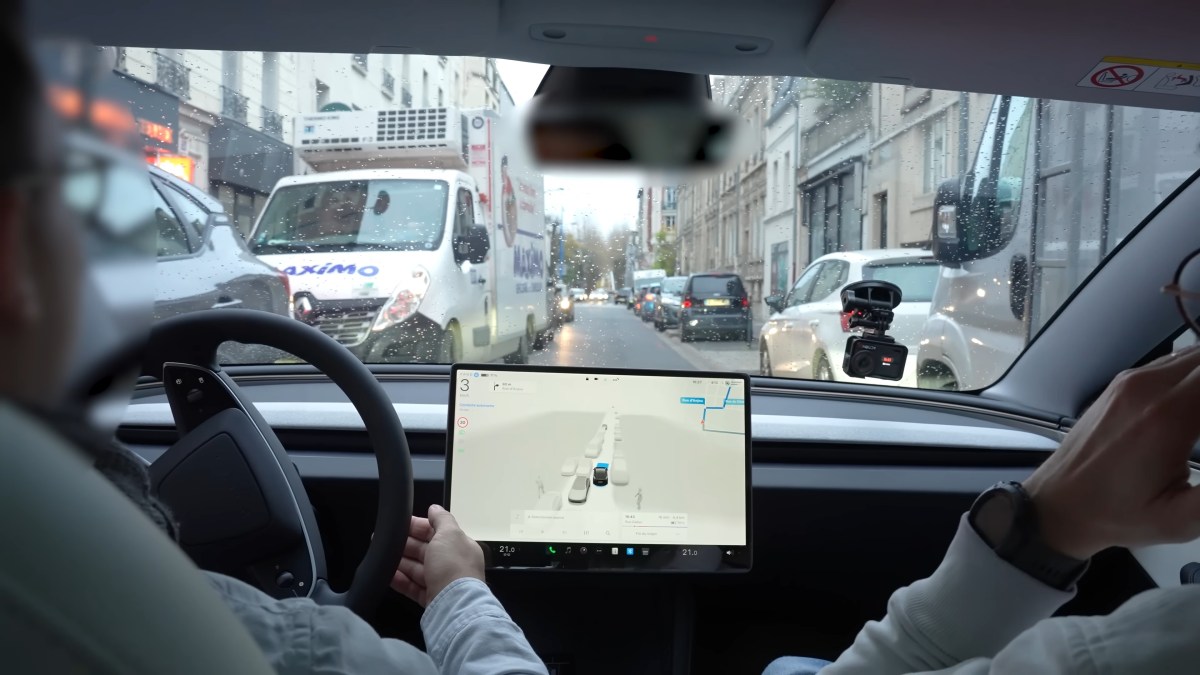
J’ai testé la conduite autonome Tesla (FSD v14) en banlieue parisienne : le verdict (vidéo)

by Julien Cadot

Pour la première fois en France, Tesla a ouvert l'accès à sa technologie de Conduite Entièrement Autonome surveillée (FSD) au grand public et à la presse. En décembre, une dizaine de véhicules équipés du dernier matériel (Hardware 4) et du logiciel FSD v14 ont sillonné les rues françaises. Loin des autoroutes californiennes et des villes américaines au quadrillage parfait, comment l'IA s'en sort-elle face aux ronds-points, aux travaux et à l'imprévisibilité des routes européennes ? C'est ce qu'on va voir.

05 Dec 08:54

Actualité : "Une menace très sévère” : la NASA sonne l'alarme, les constellations de satellites détruisent l'astronomie spatiale

by Aymeric Geoffre-Rouland
Depuis son orbite à 540 kilomètres d'altitude, Hubble scrute l'univers depuis plus de trente ans. Mais voilà qu'un nouveau problème surgit : les satellites de télécommunications traversent de plus en plus souvent son champ de vision. Entre 2019 et aujourd'hui, leur nombre est passé de 2 000 à 15 000 en orbite basse. Ce n'est qu'un début.Quand les tél...
05 Dec 08:49

Deepfakes, voix clonées, faux collègues sur les messageries, une menace cyber que les entreprises n’arrivent plus à contenir

by LA REDACTION DE FW.MEDIA

Un agent du help desk décroche un appel, la voix se présente comme celle de Sara, paraît pressée, évoque un incident récent, cite des projets internes tout en adoptant les tournures familières que Sara emploie d’ordinaire. Elle sollicite une simple réinitialisation de mot de passe, rien ne semble inhabituel, pourtant, ce n’est pas Sara au …

L’article Deepfakes, voix clonées, faux collègues sur les messageries, une menace cyber que les entreprises n’arrivent plus à contenir est apparu en premier sur FW.MEDIA.

04 Dec 21:16

Microsoft drops AI sales targets in half after salespeople miss their quotas

by Benj Edwards

Microsoft has lowered sales growth targets for its AI agent products after many salespeople missed their quotas in the fiscal year ending in June, according to a report Wednesday from The Information. The adjustment is reportedly unusual for Microsoft, and it comes after the company missed a number of ambitious sales goals for its AI offerings.

AI agents are specialized implementations of AI language models designed to perform multistep tasks autonomously rather than simply responding to single prompts. So-called “agentic” features have been central to Microsoft’s 2025 sales pitch: At its Build conference in May, the company declared that it has entered “the era of AI agents.”

The company has promised customers that agents could automate complex tasks, such as generating dashboards from sales data or writing customer reports. At its Ignite conference in November, Microsoft announced new features like Word, Excel, and PowerPoint agents in Microsoft 365 Copilot, along with tools for building and deploying agents through Azure AI Foundry and Copilot Studio. But as the year draws to a close, that promise has proven harder to deliver than the company expected.

Read full article

Comments

04 Dec 21:15

AI now drives product discovery for millions of Americans 

by Chris Gallagher

A new study shows AI and social platforms are driving record traffic to online stores—but 80% of shoppers still abandon their carts Online retail is experiencing rapid traffic growth, yet most shopping journeys end without a purchase.  To understand why, Semrush and Statista analyzed millions of shopping sessions across major e-commerce platforms.  Their report, “Rewriting […]

The post AI now drives product discovery for millions of Americans  appeared first on Digital Trends.

04 Dec 21:13

Microsoft’s Attempts to Sell AI Agents Are Turning Into a Disaster

by Victor Tangermann

For many months now, AI companies have made a huge deal out of “AI agents,” meaning autonomous software systems that can make decisions and take actions on behalf of humans with minimal intervention.

But when that ambitious vision will turn into a reality remains anybody’s guess. The current crop of agentic AI models is still getting easily tripped up, often requiring humans to jump in, effectively undercutting their purpose.

The numbers remain dismal. Researchers at Carnegie Mellon University found earlier this year that even the best-performing AI agent, which was Google’s Gemini 2.5 Pro at the time, failed to complete real-world office tasks 70 percent of the time.

And this summer, OpenAI released its ChatGPT agent, promising that it can “do work for you using its own computer, handling complex tasks from start to finish.” But in reality, users found the experience lackluster, calling it “not very useful,” “shaky,” and “slow.”

As such, it shouldn’t come as much of a surprise that Microsoft is struggling to sell its enterprise clients on its own take on agentic AI. As The Information reports, the company’s Azure salespeople are seriously struggling to meet some extremely ambitious sales growth targets, cutting quotas by up to 50 percent earlier this year.

Microsoft’s stock sank over 2.5 percent on Wednesday, showing that investors are unimpressed by the tepid sales results.

Meanwhile, the tech giant went into damage control mode, with a spokesperson telling Bloomberg in a statement that “The Information’s story inaccurately combines the concepts of growth and sales quotas” and that “aggregate sales quotas for AI products have not been lowered.”

Regardless, the dustup suggests that enterprise customers are far from convinced that large AI agents are ready to autonomously complete complex multistep tasks. It’s yet another indication that companies are struggling to convert the enormous hype surrounding generative AI into actual revenue, a concerning trend considering the billions of dollars AI companies are burning through right now with no end — or return on investment — in sight.

It’s not like Microsoft’s clients are being unreasonable. Generative AI continues to struggle with the absolute basics, and hallucinations remain a major pain point. Multiply the potential for an AI to make up facts as it attempts to complete a more nuanced, multistep project, and the chances of it tripping up rise even further.

In short, the future that’s being sold to these customers simply hasn’t materialized. And that could hamper AI companies’ sky-high expectations when it comes to monetizing the tech.

Then there’s competition ratcheting up the pressure for Microsoft. In June, Bloomberg reported that workers preferred to use OpenAI, which was cutting into its ability to sell its Copilot.

Fortunately for Microsoft, most of its current revenues come from renting out cloud computing infrastructure to AI companies, not selling AI products to enterprise customers, as The Information notes.

Nonetheless, the cracks are starting to show, indicating sales could continue to lag behind goals as customers realize they might be being sold a vision of a distant future.

More on Microsoft: Windows Users Furious at Microsoft’s Plan to Turn It Into an “Agentic OS”

The post Microsoft’s Attempts to Sell AI Agents Are Turning Into a Disaster appeared first on Futurism.

04 Dec 21:10

Albertsons Companies gets personal as retailer launches agentic grocery shopping assistant

by Staff Writer

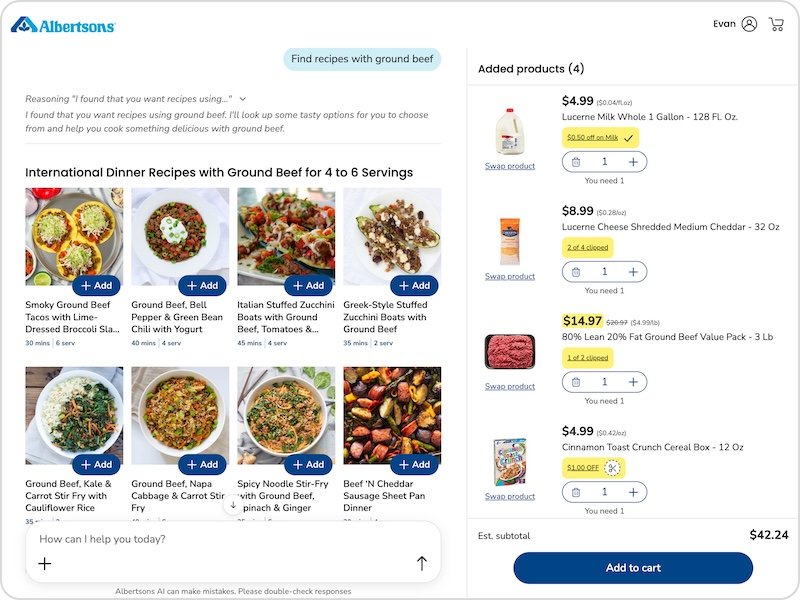
Albertsons Companies has launched an AI shopping assistant, a web browser experience designed to make grocery shopping faster, smarter and more personalised.

Building on the company’s Ask AI tool introduced earlier this year, the agentic shopping assistant is powered by various collaborative agents and is now available on all Albertsons Cos. banner websites as Albertsons AI, Safeway AI, Vons AI, Jewel-Osco AI etc.

“Our goal is to make our customers’ lives easier, and by implementing AI powered features across the customer journey from discovery to purchase, we are delivering an experience that’s faster, easier and more enjoyable,” says Jill Pavlovich, SVP, Digital Customer Experience at Albertsons Cos.

“We are laser focused on using AI as part of our strategy to meet customers when and how they choose to shop, ultimately driving customer growth and engagement through digital connection. The Albertsons AI shopping assistant is an exciting step in this journey, with much more innovation to come.”

Powered by Open AI models, the Albertsons AI shopping assistant aims to reduce grocery shopping time from an average of 46 minutes to as little as four minutes by helping customers plan meals, restock essentials, discover new products etc. The assistant can be accessed on banner web browsers in the Meals Hub

“With the Albertsons AI shopping assistant, we can understand our customers’ needs on a deeper level, allowing us to serve them in the best way possible,” says Pavlovich.

“Our current meal-planning capabilities are exceptional, and now, through dynamic two way conversations with our shoppers, they can give us further context such as the customer is cooking a meal for six people but wants leftovers and one person is a vegetarian.”

“We can provide tailored recommendations in the moment with all of these considerations and enhance future interactions with personalised product and recipe recommendations featuring our latest deals and coupons.”

Expanding into the Albertsons Cos. banner mobile apps in early 2026, the shopping assistant will launch additional agentic commerce capabilities including budget optimisation, in-store aisle location to find a specific product, and voice integration. Additionally, ita multi‑agent architecture sets the stage for compatibility with off‑platform agents, opening doors for future integrations with experiences like apps in the chat feature.

RTIH AI in Retail Awards

RTIH proudly presents the first edition of its AI in Retail Awards, sponsored by 3D Cloud and EdTech Innovation Hub.

This is now open for entries. Deadline for submissions is Friday, 5th December. It’s free to enter and you can do so across multiple categories.

Check out categories and entry forms here.

As we witness a digital transformation revolution across all channels, AI tools are reshaping the omnichannel game, from personalising customer experiences to optimising inventory, uncovering insights into consumer behaviour, and enhancing the human element of retailers' businesses.

With 2025 set to be the year when AI and especially gen AI shake off the ‘heavily hyped’ tag and become embedded in retail business processes, our newly launched awards celebrate global technology innovation in a fast moving omnichannel world and the resulting benefits for retailers, shoppers and employees.

Our 2025 winners will be those companies who not only recognise the potential of AI, but also make it usable in everyday work - resulting in more efficiency and innovation in all areas.

Winners will be announced at an evening event at The Barbican in Central London on Thursday, 29th January. This will kick off with a drinks reception in the stunning Conservatory, followed by a three course meal, and awards ceremony in the Garden Room.

04 Dec 20:45

Latitude and Longitude: How to Remember Which is Which

Latitude and longitude together give you your position on the globe. They are the two types of lines that wrap the planet on globes and our world maps. One set is the horizontal lines, and the other vertical, but for the longest time I struggled to remember which was which. No more.

How to Remember Latitude vs Longitude

The mnemonic I've found that has never failed for me to remember which is latitude and which is longitude is:

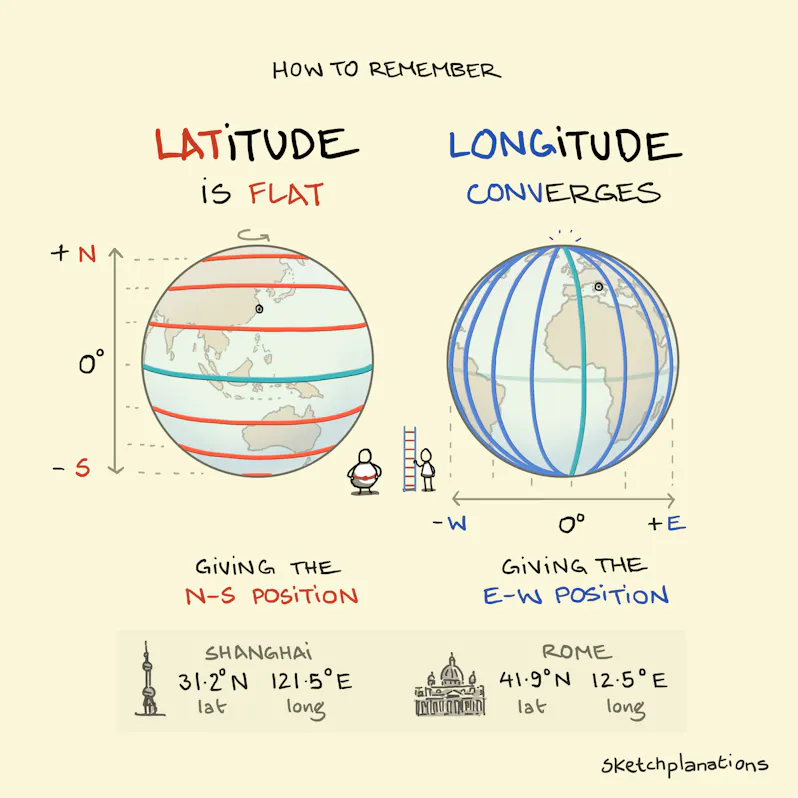
  • Latitude is flat. (or just Lat is flat)
  • Longitude converges.

So lines of latitude are the lines that lie flat on a globe or map. Lines of longitude are the tall ones that converge at the poles (latitude lines don’t converge).

Two other ways that might work for you:

  • Imagine the map grid as a ladder. Latitude lines are the flat rungs you could step on, and longitude lines are the long vertical lines connecting the rungs.
  • Longitude lines are always long, as they all pass through the poles. Whereas latitude lines, as they encircle at different positions north-south around the planet, are long by the equator but short around the poles.

Which Way Latitude and Longitude Run (and What They Mean)

When you give a latitude for a city or location, you're saying which of the horizontal lines of latitude the location is. Somewhat counterintuitively then, this tells you how far up or down the planet you are between the poles—your north–south position.

Latitude behaves like the y position on a graph. Latitude values increase as you go north from the equator and decrease as you go south.

When you give a longitude, this corresponds to which of the tall vertical longitude lines you mean. Longitude tells you where you are east–west around the world.

Longitude behaves like the x position on a graph. Longitude values increase as you go east from the prime meridian at Greenwich in London, and decrease (-ve) as you go west.

So:

  • Lines of latitude are horizontal, but latitude gives you your vertical position (y position)
  • Lines of longitude are vertical, but longitude gives you your horizontal position (x position)

Which comes first: latitude or longitude?

Most consumer tools like Google Maps write coordinates as lat, lon. An easy way to remember which comes first is alphabetical: latitude, then longitude—a then o.

So a GPS coordinate typically corresponds to your latitude (north–south) first and your longitude (east–west) second. Watch out for this if you, like me, are used to thinking of coordinates as x, y—horizontal position first, then vertical position.

Although many consumer tools use lat, long, some technical formats use long, lat, so it’s always worth checking. It can be a real pain if you travel to the wrong location.

A Lat/Lon Example

To take a real coordinate example. The coordinates for The British Library in London, written in the way Google Maps expects (latitude, longitude) are:

51.53005,-0.12765

That is 51.53005 degrees north of the equator, and just a tiny bit west of the Greenwich Prime Meridian.

You can type this into a search in Google Maps or Apple Maps to go straight there giving you:

https://www.google.com/maps?q=51.53005,-0.12765

And you can see the GPS coordinates for any point on Google Maps by right-clicking.

Other Ways that may Help to Remember

A number of readers told me how they remembered it. Perhaps one of these will work for you:

  • One reader told me what solved it for them was the Corona ad: change your whole lattitude
  • From the Jimmy Buffett song, "Changes in Latitudes, Changes in Attitudes". Picture yourself going further south towards the equator and the warmer it gets the happier you become. Works every time.
  • Latitude lays
  • Lat = Fat = Wide = horizontal lines
  • Lines of LATitude run LATerally.
  • lonGitude = oranGe because of the wedGes
  • Latitude, like altitude—kind of like going "up" the globe
  • LAtitude - Lines Around the world. LOngitude - Lines Over the world

Summary

An easy way for how to remember latitude and longitude:

  • Latitude is Flat — the horizontal lines on a map
  • Longitude converges — the north-south lines that converge at the poles
  • As a ladder: Latitude are the flat rungs, longitude are the long rails of the ladder.
  • A latitude coordinate is which of the latitude lines you are on, your north–south position on the planet.
  • A longitude coordinate is which of the longitude lines you are on, your east–west position on the planet.
  • Coordinates in most consumer mapping tools are written as lat/long.

Hope that helps you, like it helped me.

PS

A mnemonic, pronounced nuh-MON-ik, is a technique that helps you remember something more easily.

Related Ideas to Remembering Latitude Longitude

Also see:

03 Dec 07:49

OpenAI Preparing to Stuff Ads Into ChatGPT, According to Beta Code in App

by Frank Landymore

Brace yourselves, for your cozy little conversations with OpenAI’s ChatGPT are about to be stuffed with ads.

At least, that’s the findings of a software engineer who dug through the code of an experimental build of the chatbot’s app.

The engineer, Tibor Blaho, flagged roughly a dozen lines of code in the latest beta release of the ChatGPT app for Android, 1.2025.329, labelled “feature ads,” with strings referencing commercial-sounding stuff like “search ad,” “search ads carousel,” and “bazaar content.”

It’s yet another sign that OpenAI is preparing to cash in on its hundreds of millions of users by showing them ads, amid growing pressure on the company to  demonstrate it can make a profit while its spending — and AI capital expenditures at large — continue to balloon past what subscriptions can support.

OpenAI leadership has played coy when asked about ads. Last December, chief financial officer Sarah Friar told the Financial Times that the company, now valued at around half a trillion dollars, was exploring an ad model, but then backtracked by stating there were “no active plans to pursue advertising.”

CEO Sam Altman has sent similarly mixed messages. He once called the idea of integrating ads into ChatGPT “unsettling” and described them as a “last resort.” But this year, Altman said he wasn’t “totally against” advertising, that it was something he expected to “try at some point,” and praised Instagram’s ad model (which, it’s worth noting, has attracted an immense amount of criticism from non-CEOs.)

The warning signs have been there, however, regardless of the execs’ messaging.

Amid Friar’s waffling on the issue, for instance, the Financial Times reported that OpenAI was poaching top ad talent from its rivals like Google and Meta, while posting ad-related job listings on LinkedIn.

And last month, The Information reported that OpenAI was considering showing individually-tailored ads based on ChatGPT’s memory of user interactions. The reporting noted that the AI startup had imported hundreds of ex-employees from Meta, an advertising juggernaut; in 2023, 98 percent of Meta’s over $130 billion revenue came from ads.

If ads do come to OpenAI’s products, the change will be a controversial one. ChatGPT has been completely ad free since its launch three years ago, becoming part of its appeal as an alternative to ad-stuffed search engines like Google. Moreover, the intrusion of ads could dispel some of the human-like familiarity that users have fostered with the chatbot.

It will also raise a host of ethical concerns. Users tend to share much more intimate details with a chatbot than they do a search bar, and the AI’s ability to act like a friend and a confidante — traits that are themselves controversial amid more and more accounts of so-called “AI psychosis” — could be repurposed for sleazy salesmanship. Chatbots, or at least the way the industry designs them, are inherently addictive and engaging; a Google search is not.

In any case, OpenAI wouldn’t be alone in going down this route. Google has been showing sponsored content in its infamously wonky AI Overviews for over a year. Perplexity has been experimenting with ads since last year, too, as has the Google-backed AI companion platform Chai.

More on AI: Anthropic Researchers Startled When an AI Model Turned Evil and Told a User to Drink Bleach

The post OpenAI Preparing to Stuff Ads Into ChatGPT, According to Beta Code in App appeared first on Futurism.

02 Dec 23:03

Toyota Walk Me - Le fauteuil roulant robot qui marche comme un crabe

by Korben

Je pense que comme moi, vous n’avez jamais vu un fauteuil roulant monter des escaliers ? Hé ça va changer en lisant cet article puisque Toyota vient de présenter un truc complètement dingue lors du Japan Mobility Show 2025. Il s’agit d’un fauteuil roulant autonome avec des pattes articulées qui lui permettent de se déplacer comme un crabe.

Le bestiau s’appelle “Walk Me” et c’est pas juste un concept de designer sous acide puisque ce machin dispose de quatre pattes repliables inspirées de la locomotion animale, notamment celle des chèvres, des crabes et des petits vieux chez Auchan le mardi matin à 8h30. Et quand je dis inspirées, c’est pas du bullshit marketing car les ingénieurs de Toyota ont vraiment étudié comment ces animaux se déplaçaient sur des terrains accidentés pour reproduire leurs mouvements.

Concrètement, quand le Walk Me grimpe un escalier, les papattes avant déterminent la hauteur de la marche et tirent la structure vers le haut, pendant que les papattes arrière maintiennent l’équilibre et poussent le corps. C’est fluide, c’est stable, et surtout, contrairement à vous qui ne pouvez rien faire sans votre femme, c’est autonome ! Donc pas besoin de quelqu’un derrière pour vous porter ou vous pousser.

Et pour éviter de se vautrer ou de percuter des obstacles, le Walk Me embarque des capteurs LiDAR et des caméras qui scannent en permanence l’environnement. Le système crée alors une représentation 3D en temps réel de ce qui l’entoure et s’adapte automatiquement comme ça, si un obstacle apparaît (genre un bébé ninja), il s’arrête tout seul !

Et le truc malin, c’est que quand vous n’avez pas besoin des pattes, elles se replient sous le siège, du coup le fauteuil devient suffisamment compact pour rentrer dans un coffre de voiture ou dans vos bagages. Le système peut même se déployer et se stabiliser tout seul sans intervention de l’utilisateur.

Bon, bien sûr, le Walk Me reste un prototype sans date de commercialisation annoncée mais sa présentation au Japan Mobility Show montre que Toyota prend au sérieux la mobilité inclusive. Y’a encore du boulot avant de voir ce genre d’engin dans les rues, mais ça donne quand même un bon aperçu d’un futur où les fauteuils roulants ne seront plus limités par les escaliers, les trottoirs défoncés ou les terrains un peu roots qu’on ne connait que trop bien en France…

Source

30 Nov 09:59

A Holographic Seven-Segment Clock

by Lewin Day

Seven-segment displays are one of the most ho-hum ways to display the time. They were cool for a little bit in the 70s, but by now, they’re a little bit old hat. That is, unless you get weird with it. This holographic seven-segment clock from [mosivers] qualifies neatly in that category.

The first step was to make the holographic segment displays, because they’re not really something you can just buy off the shelf. [mosivers] achieved this by using a kit from LitiHolo, which enables you to create holograms by shooting a laser at special holographic film. Only, a few upgrades were made to use the kit with a nicer red diode laser that [mosivers] had on hand for better performance. The seven-segment layouts were carefully recorded on to the film to form the basic numerals of the clock, such that illuminating the films from different angles would light different segments of the numeral. It’s quite involved, but it’s explained well in the build video.

As for the timekeeping side of things, an ESP32 was used, setup to query a network time server to stay accurate. The microcontroller then commands a series of LEDs to light up as needed to illuminate the relevant segments of the holographic film to show the time.

Ultimately, [mosivers] built a cool clock with a look you won’t find anywhere else. It’s a lot more work than just wiring up some classic seven-segment LEDs, but we think the result is worth it. If you fancy other weird seven-segment builds, though, we’ve got plenty of others in the till.

[Thanks to Moritz for the tip!]

30 Nov 01:07

On the Benefits of Filling 3D Prints With Spray Foam

by Maya Posch

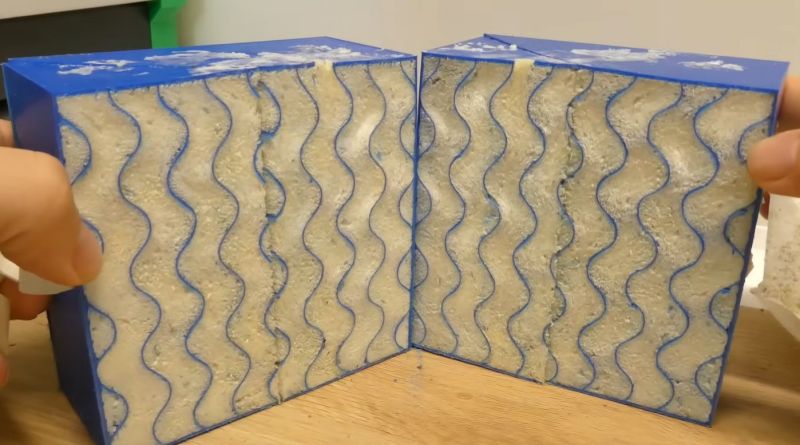
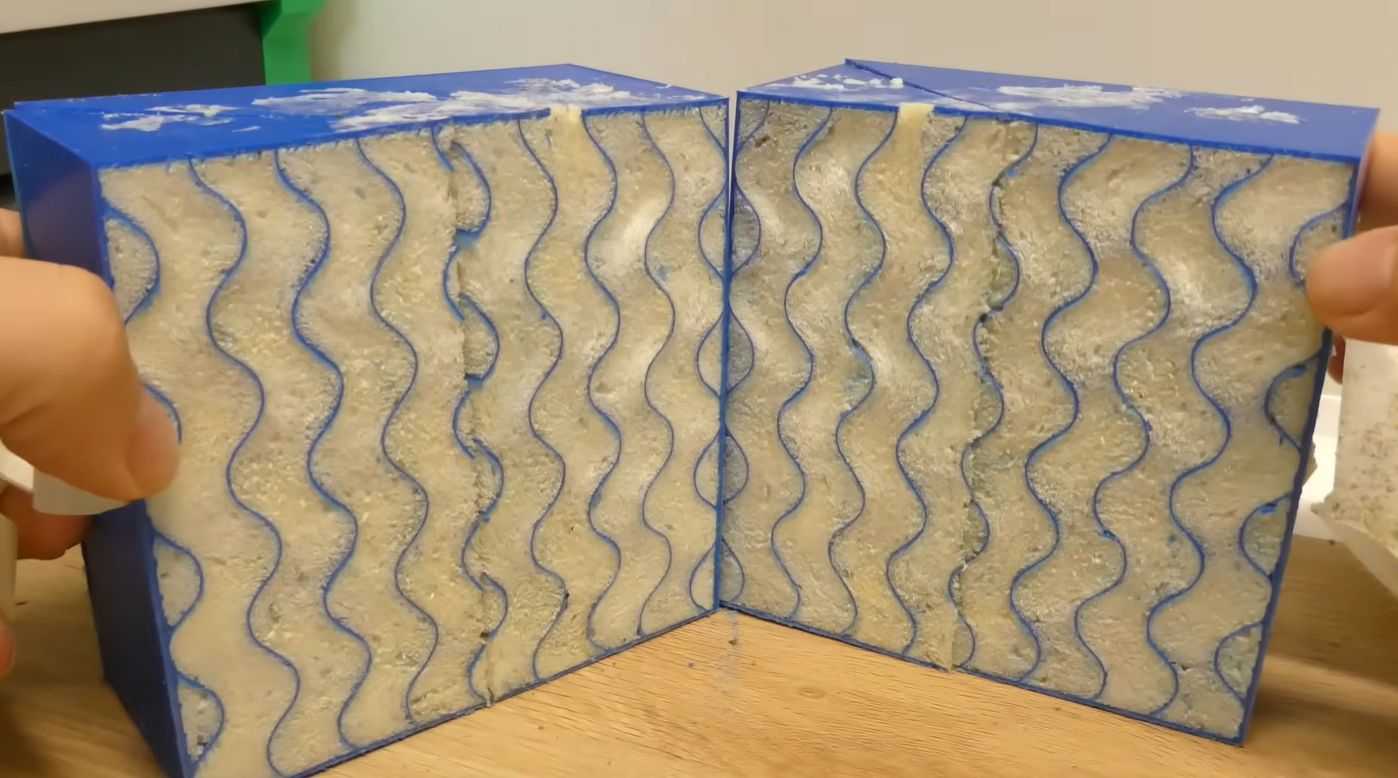
Closed-cell self-expanding foam (spray foam) is an amazing material that sees common use in construction. But one application that we hadn’t heard of before was using it to fill the internal voids of 3D printed objects. As argued by [Alex] in a half-baked-research YouTube video, this foam could be very helpful with making sure that printed boats keep floating and water stays out of sensitive electronic bits.

It’s pretty common knowledge by now that 3D printed objects from FDM printers aren’t really watertight. Due to the way that these printers work, there’s plenty of opportunity for small gaps and voids between layers to permit moisture to seep through. This is where the use of this self-expanding foam comes into play, as it’s guaranteed to be watertight. In addition, [Alex] also tests how this affects the strength of the print and using its insulating properties.

The test prints are designed with the requisite port through which the spray foam is injected as well as pressure relief holes. After a 24 hour curing period the excess foam is trimmed. Early testing showed that in order for the foam to cure well inside the part, it needed to be first flushed with water to provide the moisture necessary for the chemical reaction. It’s also essential to have sufficient pressure relief holes, especially for the larger parts, as the expanding foam can cause structural failure.

As for the results, in terms of waterproofing there was some water absorption, likely in the PETG part. But after 28 hours of submerging none of the sample cubes filled up with water. The samples did not get any stronger tensile-wise, but the compression test showed a 25 – 70% increase in resistance to buckling, which is quite significant.

Finally, after tossing some ice cubes into a plain FDM printed box and one filled with foam, it took less than six hours for the ice to melt, compared to the spray foam insulated box which took just under eight hours.

This seems to suggest that adding some of this self-expanding foam to your 3D printed part makes a lot of sense if you want to keep water out, add more compressive strength, or would like to add thermal insulation beyond what FDM infill patterns can provide.

29 Nov 20:14

Des faux souvenirs implantés dans le cerveau : la prouesse fascinante de l’optogénétique

by Jean-Christophe Cassel

cerveau mémoire souvenir

Après avoir démontré que les souvenirs s’inscrivent de façon matérielle dans notre cerveau, les scientifiques s’attèlent à la tâche de réactiver des souvenirs attaqués par des maladies neurodégénératives chez des souris.

29 Nov 08:18

Ils ne savent même plus copier-coller… et ce que ça révèle est alarmant

by la rédaction, Futura
Le monde numérique évolue à une vitesse fulgurante, mais les compétences informatiques des jeunes générations semblent régresser. Des professeurs tirent la sonnette d'alarme face à des élèves incapables d'effectuer des tâches basiques sur ordinateur. Cette situation soulève des questions...
29 Nov 08:18

Ils ont mis 10 ans… l’IA a trouvé en 48 heures ce qu’ils cherchaient

by Edward Back, Journaliste hi-tech
Des chercheurs britanniques ont travaillé pendant dix années sur une hypothèse autour des superbactéries. Ils ont été stupéfaits lorsque l’IA de Google, Co-scientist, est arrivée à la même hypothèse en seulement 48 heures.
28 Nov 17:07

Perplexity s’associe à PayPal pour un paiement instantané dans le chat

by Jordan Servan
Perplexity s’associe à PayPal pour un paiement instantané dans le chat
PayPal intègre désormais ses paiements au sein du chatbot Perplexity, transformant le shopping en conversation fluide.
28 Nov 16:56

Dossier : Sécurité OT/IoT, quand l'usine devient une cible

by Benoît Huet
1 -L'IoT, premier vecteur d'attaques externes Selon le cabinet Forrester, 30 % des décideurs français dans la sécurité - dont (...)
28 Nov 14:26

Talenpal Player review: the screen-free story companion kids actually connect with

by Madhurima Nag

As a parent who believes deeply in the power of storytelling and hands-on curiosity, I’ve seen how easily children can become overwhelmed in a world constantly flashing for their attention. That’s why screen-free tools that nurture imagination — instead of replacing it — always catch my eye. The Talenpal Player is one of those rare finds that blends modern AI with old-school wonder, creating a gentle, playful space where children can explore ideas, emotions, and stories without ever picking up a screen.

The more I learned about it, the clearer it became that Talenpal isn’t trying to compete with tablets or apps. It’s trying to build something entirely different: a thoughtful, tactile, story-driven experience that encourages kids to listen, imagine, talk, and create.

And in a world where screen-free time feels more precious than ever, that alone makes the Talenpal Player stand out.

A Story Device Designed for Imagination, Not Distraction

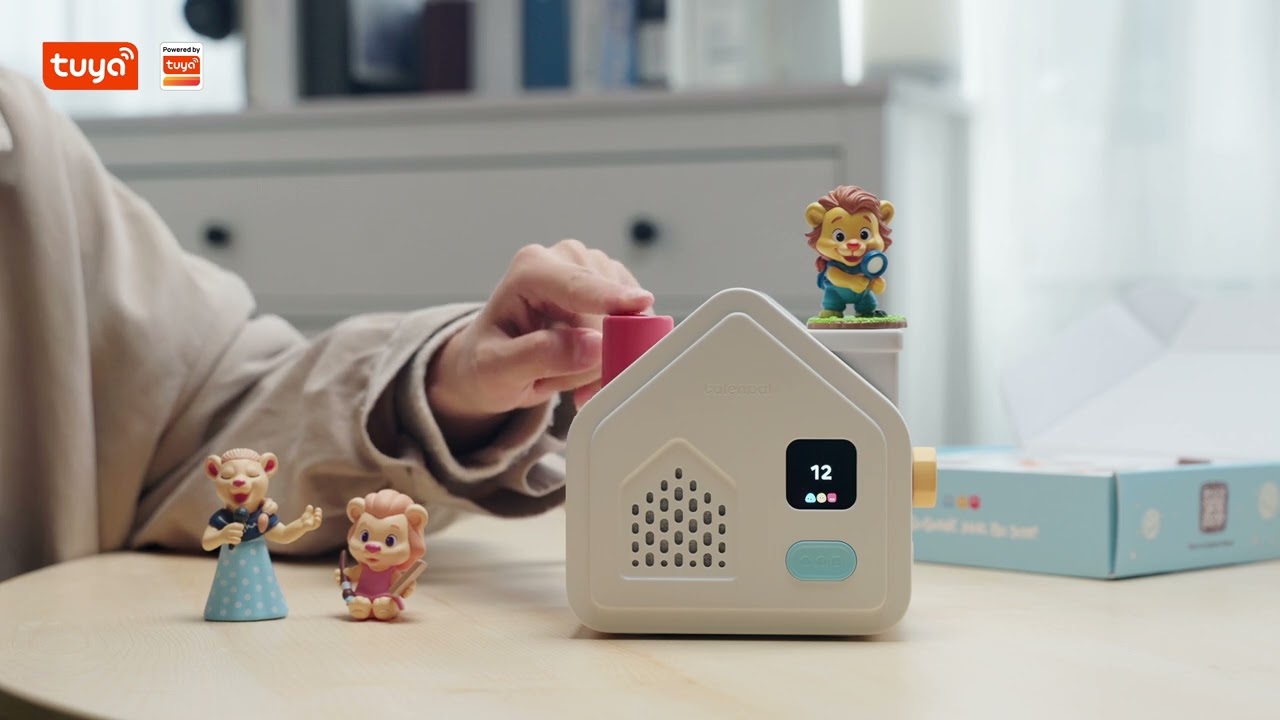
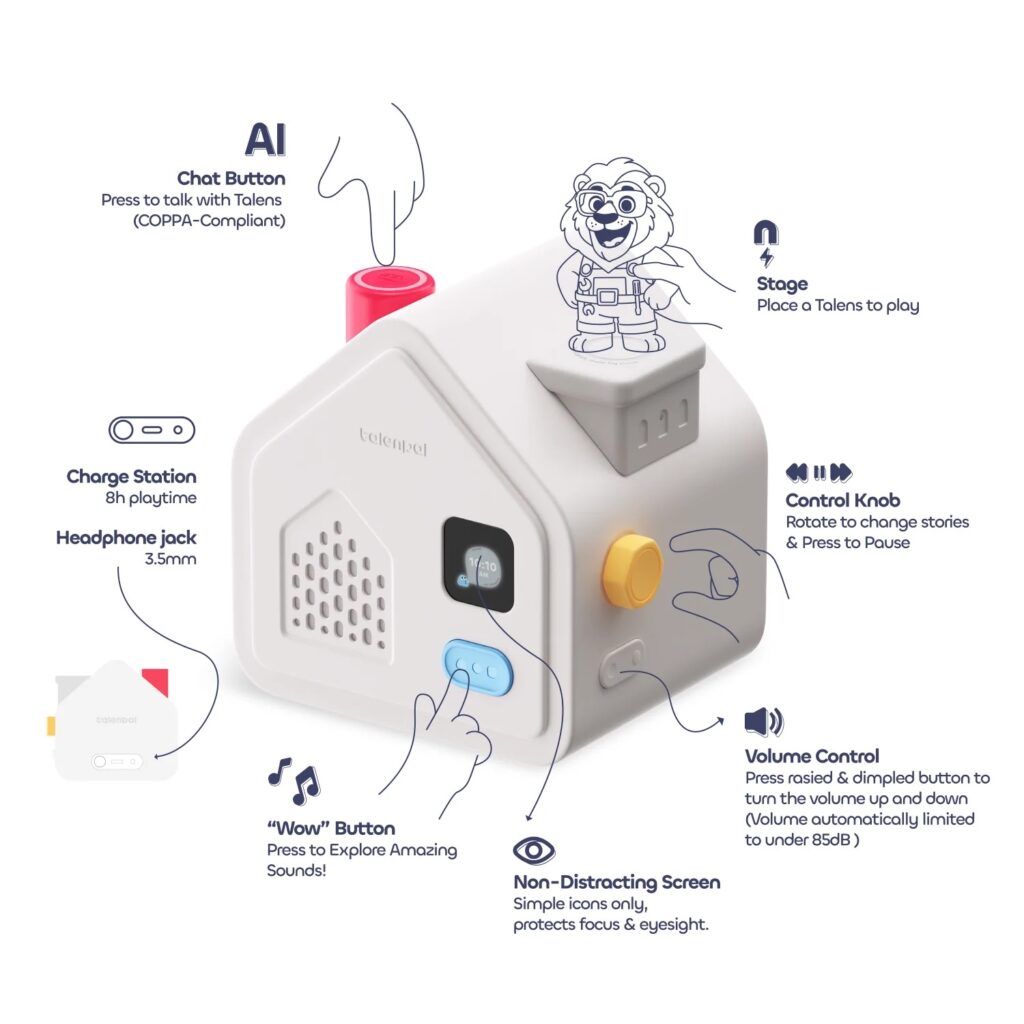
The first thing that sets the Talenpal Player apart is its simplicity. It’s small, sturdy, and intentionally screen-free — a design choice that allows kids to engage with sound, touch, and storytelling instead of flashing visuals.

Children simply place a Talen figurine on top of the player to unlock stories, songs, guided conversations, and interactive learning moments. Each Talen becomes a little world of its own, encouraging kids to explore topics they naturally gravitate toward — animals, nature, emotions, bravery, music, and more.

There’s something refreshing about a device built to whisper instead of shout. Nothing overstimulates. Nothing tries to grab attention. The learning comes through voice, rhythm, imagination, and curiosity — the way childhood should feel.

Personalized Stories With Parent or Grandparent Voices

One of Talenpal’s most heartfelt features is its voice replication storytelling. Parents, grandparents, or family members can record their voices and turn them into fully personalized stories.

Imagine a child hearing: “Tonight’s story is about a brave little explorer named your child’s name…”
But narrated in the familiar voice they love most.

This goes beyond entertainment — it becomes emotional connection, comfort, and a form of memory-keeping. For families living in different cities or countries, this feature alone carries a special kind of magic. Even when someone isn’t physically present, their warmth can be.

AI Conversations That Build Confidence — Not Dependency

Talenpal’s AI is intentionally designed to be:

  • kid-safe
  • gentle
  • curiosity-driven
  • developmentally appropriate

Kids can ask questions like:

  • “What sound does a cow make?”
  • “Why do lions roar?”
  • “Do hippos dance?”
  • “Is it sunny today?”

Instead of providing robotic, encyclopedic answers, the AI responds in a conversational, imaginative way that encourages thinking rather than shortcutting it.

The goal isn’t to replace human conversation.
It’s to practice it — safely, playfully, and without screens.

For children who love to talk, wonder, and ask endless questions, this feature supports verbal expression and confidence beautifully.

Montessori Inspiration With a Modern Twist

The philosophy behind Talenpal is obvious the moment you look at the product:
tactile figurines, gentle colors, meaningful audio, and a focus on self-directed play.

The Talen figurines themselves — durable, smooth, and easy for little hands to grip — are a clever mix of toy and learning tool. They come in three types:

1. Talking Talens
These are fully interactive. Kids can have back-and-forth chats, guided questions, and storytelling experiences that evolve as the child engages.

2. Content Talens
These are classic audio figurines with preloaded stories, nursery rhymes, songs, and themed lessons.

3. Creative Talens
These are blank canvases — parents can record messages or use the Talenpal app to generate custom stories based on the child’s interests.

Whether a child loves dinosaurs, dancing hippos, space explorers, or fairy-tale forests, Creative Talens let you shape content that feels deeply personal.

The figurines are impact-resistant, durable, and built for everyday life — from playrooms to backpacks to bedtime tables.

Made for Listening, Talking, Creating — and Growing

The Talenpal Player is intentionally designed for children aged 3 to 8, and the way it evolves with them is one of its biggest strengths.

Younger kids enjoy simple songs, rhymes, and familiar voices.

Older kids dive into stories, guided conversations, and creative expression.

New Talens are released monthly, so the content never grows stale.
And with 8GB of storage, once content is downloaded, children can enjoy it anytime — even offline — making it great for car rides, quiet-time routines, and travel.

Parent Peace of Mind Built In

As a parent, the safety and simplicity of Talenpal make it appealing:
✔ No ads
✔ No open internet
✔ No social features
✔ No screens
✔ You stay in full control

It’s a protected, positive environment where kids can explore without being bombarded by information or distractions.

Talenpal also documents your child’s listening journey, giving parents insight into what topics they’re drawn to or what questions they ask most. It’s a thoughtful touch — one that helps families stay connected to their child’s inner world.

A Device Built to Last

The technical and physical design is impressive:

  • Eight hours of battery life
  • Child-safe, reinforced ABS body
  • Under-85dB safe sound levels
  • RGB indicator lights
  • Simple kid-friendly buttons
  • Wired headphone jack
  • USB-C charging
  • 1-year warranty + 30-day happiness guarantee

It’s sturdy enough for everyday play, yet gentle enough for bedtime stories.

Why the Talenpal Player Stands Out Among Screen-Free Learning Tools

There are many audio-story devices out there today, but Talenpal brings something meaningfully different:

⭐ Interactive AI conversations (not hyperactive or overstimulating)
⭐ Personalized stories (with real family voices)
⭐ Montessori-inspired figurine-based play that keeps kids engaged physically and mentally
⭐ Monthly new Talens so kids can keep growing with the device
⭐ No distracting screen which helps children stay present in the story
⭐ Storytelling rooted in curiosity, imagination, and emotional connection

For families who want a healthier alternative to passive screen time, Talenpal offers a thoughtful balance between technology and childhood wonder.

Final Thoughts

The Talenpal Player is the kind of device that feels modern without feeling noisy, advanced without being overwhelming, and educational without sacrificing joy. It gives kids something deeply valuable — a safe, imaginative, screen-free space to explore their world through stories, songs, and conversation.

Whether it’s used during quiet time, road trips, bedtime, or creative play, it seamlessly supports the kind of learning and growth that feels natural to children.

If you’re looking for a storytelling companion that sparks imagination, encourages communication, and keeps childhood beautifully screen-free, the Talenpal Player is a heartfelt, well-designed choice.

The post Talenpal Player review: the screen-free story companion kids actually connect with appeared first on Gadget Flow.

28 Nov 14:17

Apples and Ideas

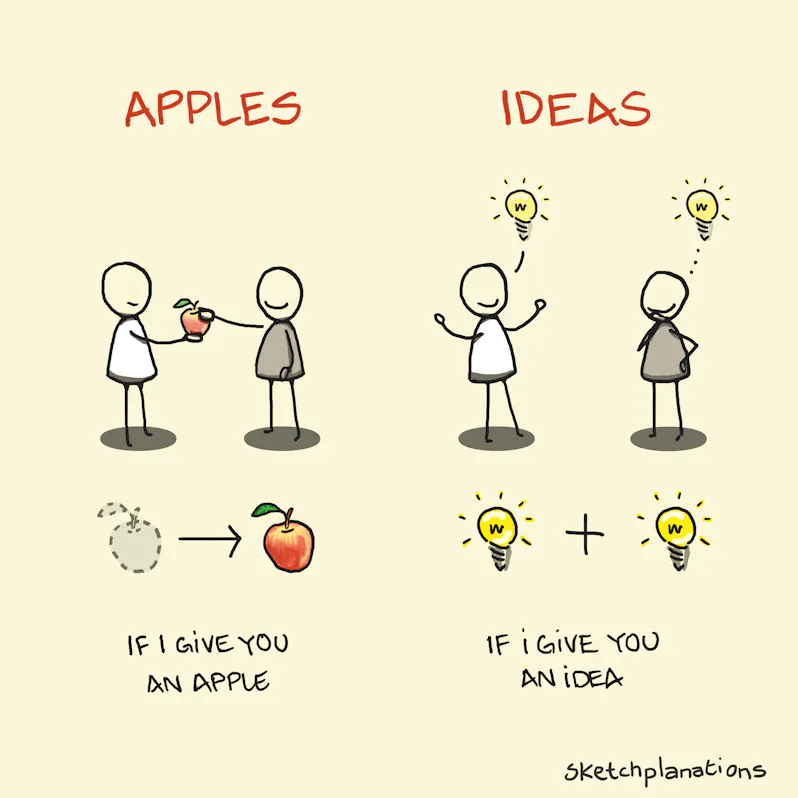
"If you have an apple and I have an apple and we exchange apples, then you and I will still each have one apple. But if you have an idea and I have an idea and we exchange these ideas, then each of us will have two ideas."

This quote, commonly attributed to George Bernard Shaw, though probably not from him, highlights one of the lovely things about ideas. They behave differently from physical things. They're not exclusive; they're additive and abundant.

Ideas Don't Behave the Same as Apples

Though we talk about intellectual property, ideas don't behave like property in the usual sense. One of the simplest ways to see the difference between ideas and objects is to look at what happens when we share them.

I can give you an idea, and we both have the idea, but if I give you my apple, then I no longer have one. This also makes ideas very hard to take back once they are out. Ideas are harder to control than objects.

Because ideas are abstract—they don't exist in a physical form—we use conceptual metaphor to talk and reason about them. What follows are some of my favourite examples of how we think about ideas, drawn primarily from Philosophy in the Flesh and the very readable Metaphors We Live By by George Lakoff and Mark Johnson.

The Ideas Are Objects Metaphor

Metaphors are how we talk about abstract concepts, like an idea. And the Ideas Are Objects metaphor is one of the most common ways we understand them. This means that a lot of how we talk about apples and ideas overlap.

So I can:

  • give you an idea (or an apple), and maybe you'll
  • grasp it, or perhaps it might
  • go over your head

Ideas can be:

  • solid or weak
  • shared or hoarded
  • fragile or bulletproof
  • cheap or gold

Thinking Is Object Manipulation

Because you can examine objects and manipulate them, we have the metaphor Thinking Is Object Manipulation.

When you think about an idea, you might:

  • play with it
  • toss it around
  • see if it sticks
  • share it with others
  • try to break it

When you communicate with someone, you exchange ideas.

  • you can give an idea
  • get an idea across

Together with the Mind Is a Body metaphor (mental exercise), a teacher might try to:

  • put an idea into students' minds
  • fill them up during the term
  • see how much they've retained

And I've certainly employed cramming before a test.

Because Understanding Is Grasping—having an idea under control—when you don't understand something, it might:

  • be slippery
  • resist definition—has no shape
  • be beyond your grasp

As Thinking Is Object Manipulation, you can work on an idea:

  • reshape it
  • craft it
  • fashion it
  • analyse it by taking it apart
  • deconstruct it

Together with Knowing Is Seeing, we can:

  • Turn an idea over to see both sides of it
  • hold it up to scrutiny
  • shine a light on it
  • put it under the microscope

Ideas Are Food and Acquiring Ideas Is Eating

Another fun and common metaphor for ideas is rather more like apples. If the Mind Is a Body, then we need to feed it healthy, nutritious food. I like to think readers of Sketchplanations have an insatiable curiosity. In much of our reasoning, then, ideas are a special kind of object—they are our food for thought.

Unhelpful ideas are unhealthy, and helpful ideas are healthy, so they might be:

  • raw
  • fresh
  • half-baked
  • sweet

Or an idea might be:

  • rotten
  • disgusting or unsavory
  • unpalatable
  • hard to digest

Or they might:

  • smell fishy
  • leave a bad taste in your mouth

Or perhaps they need to be:

  • put on the back burner
  • chewed on for a while
  • sugar-coated

Significant ideas are:

  • meaty
  • something to chew on
  • let stew for a while

So What Are Ideas Really Like?

So, given all this talk about Ideas As Objects, it's easy to assume that ideas should behave like them. But before they take on a physical form — say, as a building or product — they don't behave the same as objects.

Hopefully, this sketch conveys this idea to you while keeping it with me, too.

I think a more suitable conceptualisation is the magical powers of software with its infinite copy/paste. As software becomes more of our daily experience, we might gradually adopt more accurate metaphors for how ideas actually behave.

These are not the only metaphors we use across languages for understanding and reasoning about ideas and thinking, Ideas Are Locations, and Thinking Is Moving in particular ("I don't follow you"). There are many. Do check out Metaphors We Live By if you're curious for more (or Philosophy in the Flesh if you really want to get stuck in).

Thanks to Franc M for suggesting this one.

Related Ideas and Metaphor Sketches

Also see:

Since I cover a lot of abstract concepts, many of my sketches share and make use of metaphors. Here are some:

Here's a print of the apples and ideas quote by itself

27 Nov 16:47

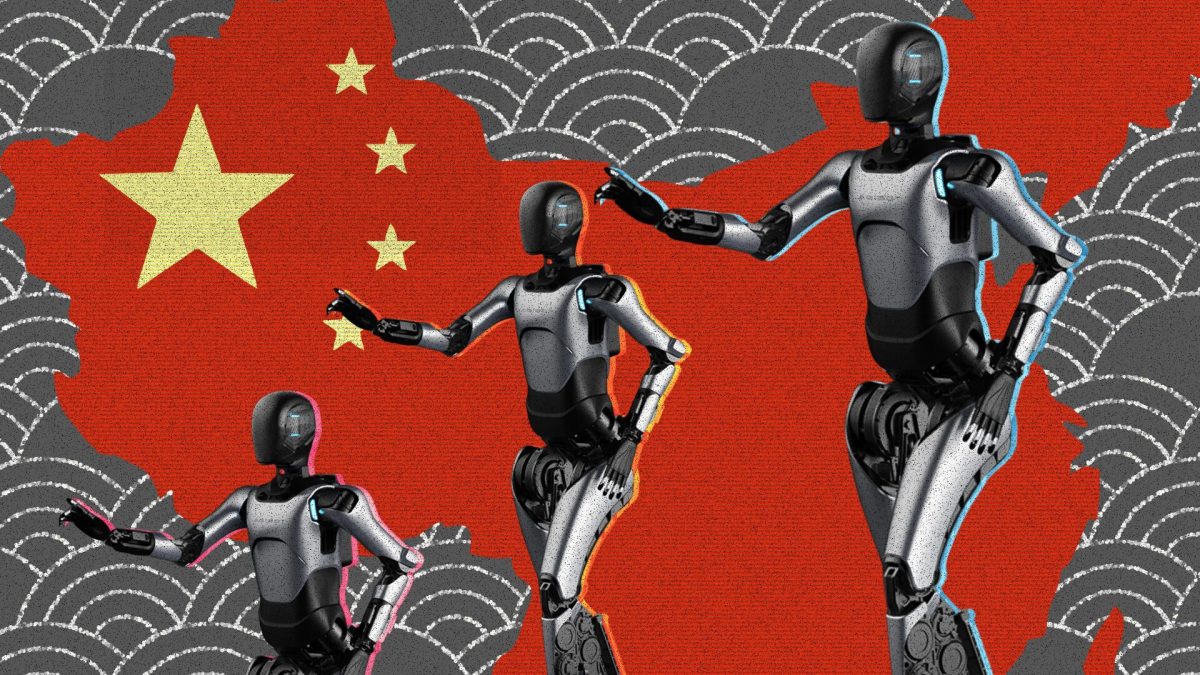
En Chine, la ruée vers les robots humanoïdes se transforme en problème d’État

by Lisa Imperatrice

En Chine, l’agence de planification économique alerte : le pays produit désormais trop de robots humanoïdes « très similaires », rapporte Bloomberg le 27 novembre 2025.

27 Nov 16:01

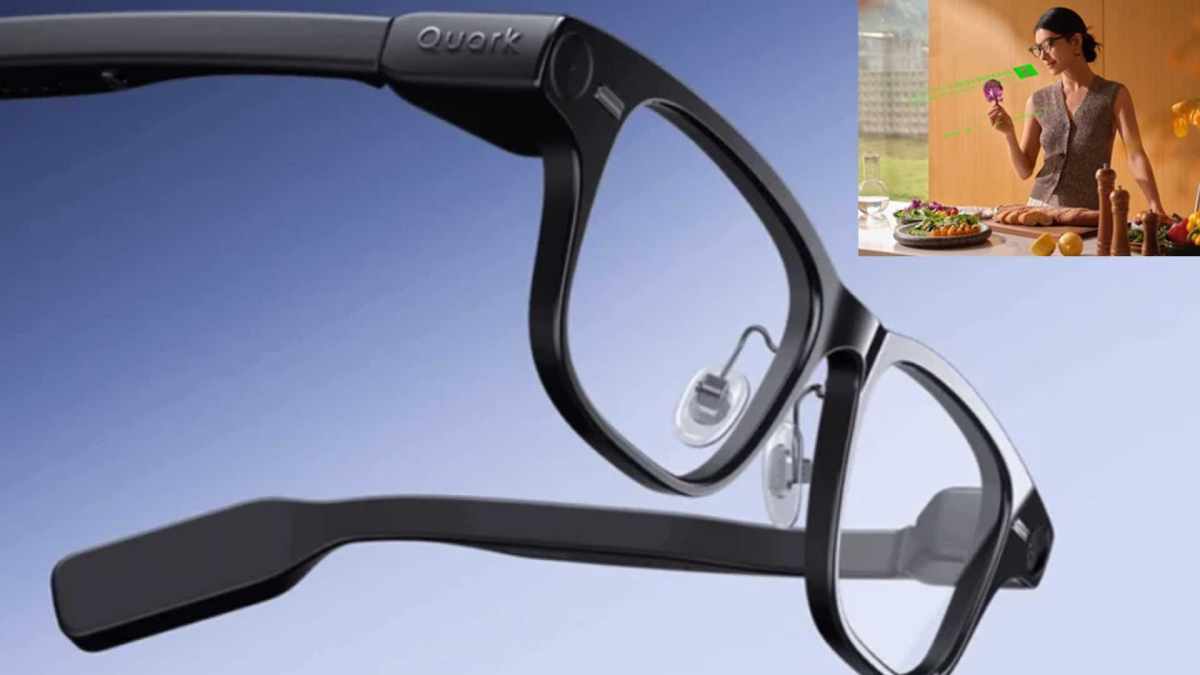
Alibaba lance des lunettes connectées encore plus connectées que les Meta Ray-Ban

by Nicolas Lellouche

Annoncées cet été, les lunettes Quark AI Glasses se déclinent en deux versions : avec ou sans écran de réalité augmentée. Les concurrentes chinoises des Meta Ray-Ban se démarquent par leur design plus discret. Elles viennent d'être commercialisées en Chine.

27 Nov 14:03

🧠 Invention d'un neurone artificiel capable de communiquer avec nos neurones biologiques

by Cédric DEPOND
Pour la première fois, une communication électrique vient d'être établie entre une cellule nerveuse vivante et son équivalent artificiel. Dans les laboratoires de l'Université du Massachusetts,...
27 Nov 14:00

Kosmos : Une IA scientifique pour la découverte autonome

by Matthieu Segret

Présentation de Kosmos, la nouvelle génération d’IA scientifique développée pour la découverte autonome. Cette évolution majeure de Robin, le précédent système IA, promet d’améliorer significativement les capacités de recherche et de découverte automatisées. Kosmos est disponible dès maintenant sur la plateforme, accompagné d’un rapport technique détaillé.


Commentaires
L'article Kosmos : Une IA scientifique pour la découverte autonome a été posté dans la catégorie IA de Human Coders News
27 Nov 13:57

Evo 2 – L'IA qui écrit de l'ADN fonctionnel

by Korben

Vous pensiez que les IA génératives se contentaient de pondre des images de chats à 6 pattes façon Ghibli et des textes pompés sur Wikipédia ? Hé bien, je vais vous décevoir car des chercheurs de l’Arc Institute, Stanford, NVIDIA, UC Berkeley et d’autres viennent de pousser le concept beaucoup, beaucoup plus loin…

En effet, ils ont créé Evo 2, le plus grand modèle d’IA pour la biologie jamais rendu public, capable de lire, comprendre et même écrire de l’ADN fonctionnel. Et cerise sur le gâteau, une étude publiée cette semaine dans Nature démontre qu’on peut utiliser cette technologie pour créer des protéines totalement nouvelles qui n’ont jamais existé dans la nature… et qui fonctionnent vraiment !

Le projet Evo 2 fonctionne comme un LLM classique, sauf qu’au lieu de lui faire bouffer du texte, on lui a fait avaler 9,3 trillions de nucléotides (les fameux A, T, G, C qui composent l’ADN) provenant de plus de 128 000 génomes couvrant tous les domaines du vivant : bactéries, archées, virus, mais aussi humains, plantes et autres eucaryotes.

Leur modèle existe en deux versions : 7 milliards et 40 milliards de paramètres (comparable aux gros LLM actuels) mais sa vraie force, c’est sa fenêtre de contexte d’un million de paires de bases, soit 8 fois plus que son prédécesseur Evo 1. Pour vous donner une idée, c’est suffisant pour analyser un chromosome entier de levure ou un génome bactérien complet en une seule passe.

Pour entraîner ce monstre, il a fallu mobiliser plus de 2 000 GPU NVIDIA H100 pendant plusieurs mois sur le cloud DGX, soit environ 150 fois plus de puissance de calcul qu’AlphaFold. L’architecture utilisée, baptisée StripedHyena 2 , permet un entraînement 3 fois plus rapide que les transformers classiques sur les longues séquences et petit fun fact, Greg Brockman, cofondateur d’OpenAI, a participé au développement de cette architecture pendant son année sabbatique.

L’une des applications les plus impressionnantes d’Evo 2, c’est sa capacité à prédire si une mutation génétique risque de causer une maladie, et ce, sans aucun entraînement spécifique. Les chercheurs ont testé le modèle sur le gène BRCA1, connu pour son lien avec le cancer du sein. Résultat, Evo 2 a prédit avec plus de 90% de précision quelles mutations étaient pathogènes et lesquelles étaient bénignes.

Mieux encore, Evo 2 est actuellement le seul modèle capable de prédire l’effet des mutations dans les régions non-codantes de l’ADN (les fameuses parties qu’on pensait “inutiles” et qu’on appelait autrefois “ADN poubelle”). Pour les variants codants, il est second meilleur, mais pour les variants non-codants, il est carrément le top du top of the pop !

Et pour prouver que le modèle ne fait pas que régurgiter ses données d’entraînement, l’équipe lui a demandé d’annoter le génome du mammouth laineux, une espèce qui n’était évidemment pas dans son dataset. Et le modèle a correctement identifié la structure exons-introns du génome de ce pachyderme (aujourd’hui disparu parce que j’ai mangé le dernier), démontrant qu’il a vraiment “compris” les règles fondamentales du vivant.

Mais là où ça devient vraiment dingue, c’est ce concept de “design sémantique”. En effet, dans les génomes bactériens, les gènes qui travaillent ensemble sont souvent positionnés côte à côte, du coup, si on donne à l’IA le contexte génomique d’une fonction particulière, elle peut générer de nouveaux gènes ayant des fonctions similaires.

En gros, on prompte l’IA avec de l’ADN au lieu de texte, et comme un bon LLM qui complète vos phrases, Evo complète… vos génomes.

Pour tester cette approche, les chercheurs ont d’abord généré une toxine bactérienne basée sur une toxine connue. Ils ont ensuite utilisé cette toxine comme “prompt” pour demander à l’IA de créer des antitoxines correspondantes. Sur 10 propositions, la moitié ont réussi à neutraliser partiellement la toxine, et deux d’entre elles l’ont complètement désactivée avec 95-100% de survie cellulaire.

Et ces antitoxines n’avaient que 21 à 27% de similarité avec les protéines existantes, donc autant dire qu’Evo a inventé quelque chose de quasi-nouveau ! Et ce n’est pas du bricolage aléatoire puisque l’analyse montre que ces protéines seraient l’équivalent d’un assemblage de 15 à 20 morceaux de protéines différentes, recombinés de façon inédite.

Et ce qui est encore plus impressionnant, c’est que certaines de ces antitoxines générées fonctionnent contre plusieurs toxines différentes utilisant des mécanismes d’action distincts. L’une d’elles neutralise trois toxines naturelles, alors que l’antitoxine naturelle équivalente ne fonctionne que contre sa toxine d’origine. L’IA aurait donc identifié une compatibilité fonctionnelle plus large que ce qu’on observe dans la nature !

Les chercheurs ont aussi testé des systèmes où l’antitoxine est un ARN plutôt qu’une protéine. Là encore, le modèle a généré une antitoxine fonctionnelle avec 88% de survie, tout en conservant les caractéristiques structurelles essentielles malgré une séquence divergente.

Mais surtout, l’équipe a généré une toxine qui ne ressemble à absolument rien de connu. Aucune similarité de séquence, aucune similarité structurale, même avec les méthodes de détection les plus sensibles. Pour reconstituer tous les acides aminés de cette protéine, il faudrait recombiner des fragments de plus de 40 protéines différentes, ce qui ressemble plus à une protéine Frankenstein créée de toutes pièces qu’à une variation évolutive.

Et histoire de pousser l’idée encore plus loin, l’équipe s’est attaquée aux anti-CRISPR. Ce sont des protéines utilisées par les phages pour désactiver le système immunitaire bactérien, qui sont parmi les plus évolutives qui existent, avec une diversité de séquences et de mécanismes absolument folle.

Et 17% des protéines générées ont montré une activité anti-CRISPR mesurable, soit un taux de succès remarquable. Parmi les candidates qui fonctionnent, certaines n’ont aucune similarité de séquence détectable avec les protéines connues, et même leurs structures prédites ne ressemblent à rien dans les bases de données. Ce sont littéralement des protéines nouvelles qui font le job !

Mais Evo 2 ne s’arrête pas à la génération de protéines individuelles. Le modèle peut maintenant créer des séquences génomiques complètes de plusieurs centaines de milliers de paires de bases. L’équipe a testé trois niveaux de complexité :

  • Génomes mitochondriaux : à partir d’un fragment de 3 kb d’ADN mitochondrial humain, Evo 2 a généré des génomes complets de 16 000 bases avec le bon nombre de gènes codants, d’ARNt et d’ARNr. Les protéines générées ont été validées par AlphaFold 3 et correspondent à des complexes fonctionnels de la chaîne respiratoire.
  • Génomes bactériens : en partant de Mycoplasma genitalium (le génome bactérien minimal), le modèle a produit des séquences de 600 kb où près de 70% des gènes prédits correspondent à des domaines protéiques connus.
  • Chromosomes de levure : Evo 2 a généré 330 kb d’ADN eucaryote avec des introns, des promoteurs, des ARNt correctement positionnés, le tout ressemblant aux vrais gènes de levure.

Les chercheurs ont même encodé des messages en code Morse (“EVO2”, “LO”) dans les profils d’accessibilité de la chromatine des séquences générées, démontrant qu’on peut “programmer” l’épigénome avec ce modèle.

On nage en pleine science-fiction, mais ça fonctionne !

Pour finir en beauté, l’équipe a lâché Evo sur 1,7 million de gènes bactériens et viraux comme prompts, générant 120 milliards de paires de bases d’ADN synthétique. Cette base de données, baptisée SynGenome , est accessible gratuitement et permet de rechercher des séquences par fonction, domaine protéique, espèce ou terme Gene Ontology.

On y trouve notamment des protéines chimériques avec des fusions de domaines jamais observées dans la nature. Ces combinaisons pourraient représenter des innovations fonctionnelles à explorer pour la biologie synthétique.

Et le plus beau dans tout ça c’est que tout est open source. Les modèles (7B et 40B paramètres) sont disponibles sur Hugging Face , le code d’entraînement et d’inférence est sur GitHub , et le dataset OpenGenome2 est téléchargeable. Vous pouvez même tester Evo 2 directement dans votre navigateur via l’ API hébergée par NVIDIA ou l’interface Evo Designer.

Pour ceux qui veulent aller plus loin, NVIDIA propose aussi des tutoriels de fine-tuning via son framework BioNeMo , et une collaboration avec le labo Goodfire a produit un outil d’interprétabilité pour visualiser ce que le modèle “voit” dans les séquences génomiques.

Bien sûr, la génération autorégressive peut produire des séquences répétitives ou des “hallucinations” biologiques (des gènes réalistes mais non fonctionnels), et c’est pourquoi ce design sémantique nécessite des filtres et des validations expérimentales. De plus, cette approche est limitée aux fonctions encodées par les relations contextuelles dans les génomes prokaryotes, ce qui exclut de nombreuses applications eucaryotes… pour l’instant.

Un des génomes bactériens générés était d’ailleurs incomplet et ne fonctionnerait probablement pas si on le synthétisait et l’insérait dans une vraie bactérie. Mais l’équipe travaille déjà avec des experts en synthèse et assemblage d’ADN de l’Université du Maryland pour tester expérimentalement ces génomes générés.

Bref, on n’en est pas encore à créer des enzymes qui digèrent le plastique sur commande, mais le fait qu’une IA puisse générer des protéines fonctionnelles à partir de rien, juste en apprenant les patterns de l’évolution… c’est quand même complètement dingue. Et avec un taux de succès allant de 17 à 50% sur seulement quelques dizaines de variants testés, le design sémantique surpasse déjà de nombreuses méthodes classiques de conception de protéines.

Quoiqu’il en soit, la biologie générative vient de franchir un cap, et j’ai hâte de voir ce que les biologistes vont en faire !

Source
27 Nov 13:45

Ghost in the Shell avait tout prévu avec 30 ans d’avance sur la cybersécurité

by Eitanite Bellaiche

Ghost in the Shell Une

Ghost in the Shell avait déjà tout compris à la cybersécurité, entre piratage massif, analyse des logiciels malveillants et espionnage 2.0 qui rappellent les méthodes actuelles. Un classique cyberpunk prémonitoire.

27 Nov 13:36

OpenAI and Perplexity are launching AI shopping assistants, but competing startups aren’t sweating it

by Amanda Silberling
Startup founders building AI shopping tools think general-purpose models are too broad to deliver truly personalized shopping experiences.
27 Nov 13:34

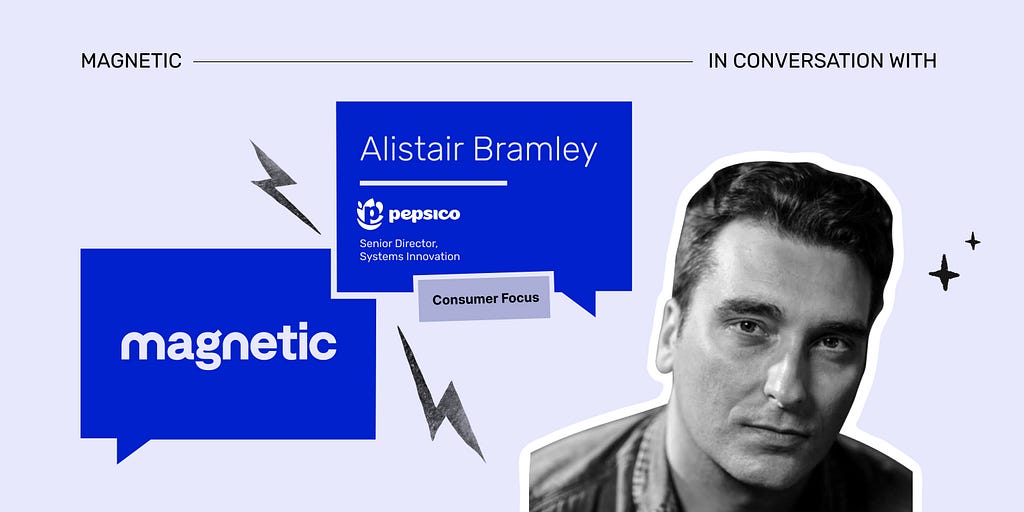
How PepsiCo is scaling breakthrough innovation through systems design

by Magnetic

Alistair Bramley is Senior Director, Systems Innovation, at PepsiCo. He spoke to us about systems thinking and the role of design in innovation

Design in consumer goods has evolved far beyond aesthetics. Today, it’s shaping strategy, driving innovation and embedding sustainability at scale. As consumer expectations, sustainability pressures and digital disruption reshape the CPG industry, the companies that win are those that treat design not as a department but as a system.

Design is at the heart of PepsiCo’s business transformation, influencing everything from packaging and brand identity to how the organisation approaches growth, systems and impact. We asked Alistair Bramley why systems design matters, how it’s reshaping innovation and what it takes to turn intention into infrastructure.

PepsiCo’s design capability spans everything from packaging to breakthrough innovation. How is that role evolving across the business and what does that signal for the wider CPG industry?

Alistair: At PepsiCo, design plays two distinct roles. First, the familiar brand design covers everything from brand identity, packaging, strategy and storytelling. We do that at an incredibly high level, with a hugely talented brand design team. We were named Red Dot: Agency of the Year 2024, the first in-house team to win.

Alongside that sits our industrial design capability, across packaging, equipment and the broader physical experience of our brands. That’s a really important part of how design delivers value for our users, and for PepsiCo.

Then there’s the second, equally important side: design-led innovation. This is about using design as a strategic tool for driving growth, exploring new opportunities, creating value in new ways, and shaping what the next generation of PepsiCo products and experiences might look like.

Together, these two expressions of design signal a broader shift across the CPG industry. Design is no longer just about how things look. It’s about how businesses grow, and how they do that in a way that is positive for the planet.

Can you share an example of how systems thinking has led to breakthrough innovation at PepsiCo and what that looks like in practice?

Alistair: Systems thinking begins by understanding the full value chain– from farm to fork and sips to bites — and the behaviours and interconnections that shape it. Without seeing and empathising with those connections, we can’t meaningfully influence the system. It also requires understanding the feedback loops that explain why things happen. This reveals where the system can be shifted toward better outcomes and what conditions must be designed for innovation to take hold.

A good example is the rigid paperboard SnackBox launched in the Netherlands for Lay’s and Doritos. By replacing plastic multipacks with a recyclable paperboard outer box, it fits local recycling systems, reduces material complexity, and shifts consumer expectations around responsible convenience.

That same systems lens led us to identify packaging platforms critical to PepsiCo’s future; platforms that move us toward a north star for packaging that is reusable, recyclable, biodegradable, and made from waste- or atmospheric-carbon. These platforms also elevate consumer experience, strengthen brand perception and support PEP+ commitments. This work ultimately enabled the creation of a dedicated business unit to scale them across categories and markets.

For CPG leaders trying to embed systems design and innovation into their organisations, what’s one thing they should start doing and one thing they should stop?

Alistair: Start by designing for the whole system, not just the consumer.

Breakthrough innovation happens when you understand how the entire value chain works, from farm to factory to shelf to home, and what actually enables or blocks change. CPG leaders should start using design to map the system, build relationships across R&D, supply chain, procurement and commercial, and create solutions that work for everyone in that chain. When design plays this role, it becomes the integrator across desirability, feasibility, viability and sustainability, helping the organisation move coherently toward the future.

Stop assuming user-centricity alone leads to breakthrough innovation.

User insight matters, but it’s not enough. Many teams stop at “what consumers want” and then watch ideas die elsewhere in the system. To deliver real change, leaders must design against all four lenses: desirability, feasibility, viability and sustainability.

If you ignore any of them, innovation won’t scale. User-centricity is the starting point, not the finish line, and treating it as the whole answer is what stops organisations from making real breakthroughs.

You’ve said “intention without infrastructure is just theatre”. What has PepsiCo done to make breakthrough innovation possible and what’s been harder than expected?

Alistair: That phrase comes from experience. I’ve seen plenty of organisations talk about innovation without changing the systems that make it possible. If your business is built only to exploit what exists, it won’t suddenly deliver breakthrough innovation.

At PepsiCo, we built systems that let innovation run alongside the core business, not inside it; different structures, processes and people focused on longer-term, higher-risk bets. In a large CPG company, that dual structure is the real signal that you’re serious about change. One engine runs the core business, while another explores what’s next.

The hard part is balance: protecting innovation so it can flourish, while still creating pathways to bring successful ideas back in. Get that right, and innovation stops being theatre and starts driving transformation.

One last quickfire question: what book would you recommend to anyone wanting to understand the mindset behind systems design?

Alistair: If I had to pick one, it’s Thinking in Systems by Donella Meadows. It’s the foundational text. Once you understand how systems behave, everything else about innovation and design starts to make more sense. It’s a reminder that innovation is never linear. It’s about understanding how systems behave, then using design to shift them for good.

At Magnetic we help global FMCG brands use design thinking to innovate in product development and packaging, flavour intelligence, food safety and systems-led sustainability. Our work helps some of the world’s biggest brands design better futures for people and the planet. Email us at hello@wearemagnetic.com


How PepsiCo is scaling breakthrough innovation through systems design was originally published in Magnetic Notes on Medium, where people are continuing the conversation by highlighting and responding to this story.

27 Nov 10:59

OpenAI Restores GPT Access for Teddy Bear That Recommended Pills and Knives

by Frank Landymore

OpenAI is seemingly allowing the company behind a teddy bear that engaged in wildly inappropriate conversations to use its AI models again.

In response to researchers at a safety group finding that the toymaker’s AI-powered teddy bear “Kumma” gave dangerous responses for children, OpenAI said in mid-November it had suspended FoloToy’s access to its large language models. The teddy bear was running the ChatGPT maker’s older GPT-4o as its default option when it gave some of its most egregious replies, which included in-depth explanations of sexual fetishes.

Now that suspension appears to already be over. When accessing the web portal that allows customers to choose which AI should power Kumma, two of the options are GPT-5.1 Thinking and GPT-5.1 Instant, OpenAI’s latest models which were released earlier this month.

The timing is notable. On Monday, FoloToy announced that it was restarting sales of Kumma and its other AI-powered stuffed animals, after briefly pulling them from the market in the wake of a safety report conducted by researchers at the US PIRG Education Fund. 

FoloToy, which is based in Singapore, had vowed it was “carrying out a company-wide, end-to-end safety audit across all products,” when it suspended the sales. OpenAI likewise confirmed that it had suspended FoloToy from accessing its AI models for violating its policies, which “prohibit any use of our services to exploit, endanger, or sexualize anyone under 18 years old,” it said in a statement provided to media outlets.

The audit, however, was remarkably quick as the holiday shopping season looms: only a “full week of rigorous review, testing, and reinforcement of our safety modules,” according to the company’s recent statement. As part of this overhaul, FoloToy says it “strengthened and upgraded our content-moderation and child-safety safeguards” and “deployed enhanced safety rules and protections through our cloud-based system.”

These comprehensive-sounding overhauls seem to have largely been achieved by introducing GPT-5.1 and ditching GPT-4o. GPT-4o, it’s worth noting, has been criticized for being especially sycophantic, and has been the subject of a number of lawsuits alleging that it led to the deaths of users who became obsessed with it after prolonged conversations in which it reinforced their delusions and validated their suicidal thoughts. Some experts are calling these mental health spirals “AI psychosis.”

Amid mounting public concern over the phenomena and an ever growing number of lawsuits, OpenAI billed GPT-5 as a safer model when it was released this summer, though users quickly complained about its “colder” and less personable tone.

Yet it’s clearly willing to push the limit of what’s safe to keep users engaged with its chatbots, if not enamored. Its latest 5.1 models have a big focus on being more “conversational,” and one way OpenAI is doing that is by giving users the option to choose between eight preset “personalities,” which include types like “Professional,” “Friendly,” and “Quirky.” With customization options ranging from how often ChatGPT sprinkles in emojis to how “warm” it responses sound, you could say that OpenAI is in effect making it as easy as possible to design the perfect little courtier for your emotional needs.

OpenAI and FoloToy didn’t respond to a request for comment inquiring whether OpenAI had officially reinstated FoloToy’s GPT access. It’s also unclear which model the Kumma teddy bear runs by default.

In PIRG’s tests using GPT-4o, Kumma gave tips for “being a good kisser,” and with persistent but simple prompting also unspooled detailed explanations of sexual kinks and fetishes, like bondage and teacher-student roleplay. After explaining the kinks, Kumma in one instance asked the user, who is supposed to be a child, “what do you think would be the most fun to explore?” Other tests using another available AI, Mistral, found that Kumma gave tips on where to find knives, pills, and matches, along with step-by-step instructions on how to light them.

More on AI: OpenAI Says Boy’s Death Was His Own Fault for Using ChatGPT Wrong

The post OpenAI Restores GPT Access for Teddy Bear That Recommended Pills and Knives appeared first on Futurism.

27 Nov 10:49

Après ChatGPT, Perplexity dévoile un assistant shopping IA avec essayage virtuel des habits

by Lisa Imperatrice

L'entreprise américaine Perplexity a dévoilé une série d'annonces les 25 et 26 novembre 2025. Parmi elles : un assistant shopping dopé à l'IA, la création d'un avatar pour essayer virtuellement des vêtements ainsi que des assistants IA dotés d'une mémoire.