Shared posts

29 Jul 03:03

The Failure of Racial Profiling

by Lisa Wade, PhD

Jay Livingston at Montclair SocioBlog discussed the two figures below (full report here).  The first shows that Black and Hispanic drivers are more likely to be stopped by Los Angeles Police than White drivers.  The second shows that, when stopped, if searched, police are more likely to find weapons and drugs on Whites than on either Blacks or Hispanics.  Conclusion: Blacks and Hispanics are being racially profiled by the L.A.P.D. and racial profiling does not work.  Data from New York City in 2008 tells a similar story.

The New York Civil Liberties Union reports that the NYPD stopped 161,000 people in the first quarter of 2011. A record number.  Eighty-four percent of those stopped were Black or Latino.  The Civil Liberties Union has filed a lawsuit, claiming that the practice is unconstitutional.

Originally posted in 2011. Re-posted in solidarity with the African American community; regardless of the truth of the Martin/Zimmerman confrontation, it’s hard not to interpret the finding of not-guilty as anything but a continuance of the criminal justice system’s failure to ensure justice for young Black men.

Lisa Wade is a professor of sociology at Occidental College. You can follow her on Twitter and Facebook.

(View original at http://thesocietypages.org/socimages)

29 Jul 02:54

The Death Penalty, Race, and the Victim

by Lisa Wade, PhD
There is much to be worried about when one considers the role racial discrimination plays in delivering the death penalty.  Scholars are newly looking to the way that the race of homicide victims, instead of the defendants, shape outcomes.  It turns out a disproportionate number of people who are executed under the death penalty have been convicted of murdering a white person (Amnesty International):

“[H]olding all other factors constant,” Amnesty International summarizes, “the single most reliable predictor of whether someone will be sentenced to death is the race of the victim.”

Originally posted in 2010. Re-posted in solidarity with the African American community; regardless of the truth of the Martin/Zimmerman confrontation, it’s hard not to interpret the finding of not-guilty as anything but a continuance of the criminal justice system’s failure to ensure justice for young Black men.

Lisa Wade is a professor of sociology at Occidental College. You can follow her on Twitter and Facebook.

(View original at http://thesocietypages.org/socimages)

29 Jul 02:42

Who’s Afraid of Young Black Men?

by Philip N. Cohen, PhD

In conversation, I keep accidentally referring to Zimmerman’s defense lawyers as “the prosecution.” Not surprising, because the defense of George Zimmerman was only a defense in the technical sense of the law. Substantively, it was a prosecution of Trayvon Martin. And in making the case that Martin was guilty in his own murder, Zimmerman’s lawyers had the burden of proof on their side, as the state had to prove beyond a reasonable doubt that Martin wasn’t a violent criminal.

This raises the question, who’s afraid of young black men? Zimmerman’s lawyers took the not-too-risky approach of assuming that white women are (the jury was six women, described by the New York Times as five white and one Latina).

“This is the person who … attacked George Zimmerman,” defense attorney Mark O’Mara said in his closing argument, holding up two pictures of Trayvon Martin, one of which showed him shirtless and looking down at the camera with a deadpan expression. He held that shirtless one up right in front of the jury for almost three minutes. “Nice kid, actually,” he said, with feigned sincerity.

Going into the trial, according to one analysis, the female jurors were supposed to have more negative views about Zimmerman’s vigilante behavior, and be more sympathetic over the loss of the child Trayvon. As a former prosecutor put it:

With the jury being all women, the defense may have a difficult time having the jurors truly understand their defense, that George Zimmerman was truly in fear for his life. Women are gentler than men by nature and don’t have the instinct to confront trouble head-on.

But was the jury’s race, or their gender, the issue? O’Mara’s approach suggests he thought it was the intersection of the two: White women could be convinced that a young black man was dangerous.

Race and Gender

Racial biases are well documented. With regard to crime, for example, one recent controlled experiment using a video game simulation found that white college students were most likely to accidentally fire at an unarmed suspect who was a black male — and most likely to mistakenly hold fire against armed white females. More abstractly, people generally overestimate the risk of criminal victimization they face, but whites are more likely to do so when they live in areas with more black residents.

The difference in racial attitudes between white men and women are limited. One analysis by prominent experts in racial attitudes concluded that “gender differences in racial attitudes are small, inconsistent, and limited mostly to attitudes on racial policy.” However, some researchers have found white men more prone than women to accept racist stereotypes about blacks, and the General Social Survey in 2002 found that white women were much more likely than men to describe their feelings toward African Americans positively. (In 2012, a minority of both white men and white women voted for Obama, although white men were more overwhelmingly in the Romney camp.)

What about juries? The evidence for racial bias over many studies is quite strong. For example, one 2012 study found that in two Florida counties having an all-white jury pool – that is, the people from which the jury will be chosen – increased the chance that a black defendant would be convicted. Since the jury pool is randomly selected from eligible citizens, unaltered by lawyers’ selections or disqualifications, the study has a clean test of the race effect. But I can’t find any on the combined influence of race and gender.

The classical way of framing the question is whether white women’s group identity as whites is strong enough to overcome their gender-socialized overall “niceness” when it comes to attitudes toward minority groups. But Zimmerman’s lawyers appeared to be invoking a very specific American story: white women’s fear of black male aggression. Of course the “victim” in their story was Zimmerman, but as he lingered over the shirtless photo, O’Mara was tempting the women on the jury to put themselves in Zimmerman’s fearful shoes.

Group Threat

But do white women really feel threatened by black men? That’s an old, blood-stained debate. In the 20th century there were 455 American men (legally) executed for rape, and 89 percent of them were black — most were accused of raping white women. That was just the legal tip of Jim Crow’s lynching iceberg, partly driven by white men asserting ownership over white women in the name of protection. But the image of course lives on.

In the specific realm of U.S. racial psychology, one of the less optimistic, but most reliable, findings is that whites who live in places with larger black populations on average express more racism (here’s a recent confirmation). Most analysts attribute that to some sense of group threat – economic, political, or violent – experienced by the dominant majority.

Because people inflate things they are afraid of, you can get a ballpark idea of how threatened white people feel by asking them how big they think the black population is. And since they don’t realize their racial attitudes are being measured, they aren’t as likely to shade their answers to appear reasonable.

The 2000 General Social Survey asked about 1,000 white adults to estimate the size of the black population. Both groups were way off, of course: 95 percent of white women and 85 percent of white men overestimated. But the skew was stronger for women than men: 69 percent of women and 49 percent of men guessed that blacks are more than 20 percent of the population (the correct answer at the time was 12 percent).

Here are those results, showing the cumulative percentage of white men and women who thought the black population was at or below each level:

1

Maybe white women’s greater overestimation of the black population is not an indicator of perceived threat. In the same survey white women were no more likely than white men to describe blacks as “prone to violence” (then again, there’s social pressure to say “no”).  Anyway, whether women feel more threatened than men do isn’t the issue, since the jury was all women. The question is whether the perceived threat was salient enough that the defense could manipulate it.

I don’t know what was in the hearts and minds of the jurors in this case, of course. Being on a jury is not like filling out a survey or playing a video game. But however much we elevate the rational elements in the system, emotion also plays a role. Whether they were right or not, Zimmerman’s lawyers clearly thought there was a vein of fear of black men inside the jurors’ psyches, waiting to be mined.

Originally posted at The Atlantic and Family Inequality.

Philip N. Cohen is a professor of sociology at the University of Maryland, College Park, and writes the blog Family Inequality. You can follow him on Twitter or Facebook.

(View original at http://thesocietypages.org/socimages)

29 Jul 02:40

“I Am a Man”: Black Men’s Claims to Humanity

by Lisa Wade, PhD

The Civil Rights movement contains some of the most hideous and the most beautiful examples of human evil and human possibility.  After emancipation in 1862, and until the mid-1960s, they lived under a series of laws that mandated segregation from whites.  The Civil Rights movement attacked these laws and their premise.

One of the slogans that would strike down legalized segregation was “I Am A Man.”  It challenged the centuries of dehumanization that had justified both slavery and Jim Crow.  The beautiful, simple slogan, and its delivery, is pictured here:

Borrowed from NPR, this photo features a group of sanitation workers marching in Memphis in 1968.  Photograph by Ernest Withers.

This post originally appeared in 2010.  Re-posted in solidarity with the African American community; regardless of the truth of the Martin/Zimmerman confrontation, it’s hard not to interpret the finding of not-guilty as anything but a continuance of the criminal justice system’s failure to ensure justice for young Black men.

Lisa Wade is a professor of sociology at Occidental College. You can follow her on Twitter and Facebook.

(View original at http://thesocietypages.org/socimages)

29 Jul 02:40

Who Would You Shoot?

by Guest Blogger Lauren McGuire

In 2002, a study by Joshua Correll and colleagues, called The Police Officer’s Dilemma, was published. In the study, researchers reported that they presented photos of black and white men holding either a gun or a non-threatening object (like a wallet) in a video game style setting.  Participants were asked to make a rapid decision to “shoot” or “don’t shoot” each of the men based on whether the target was armed.

They found that people hesitated longer to shoot an armed white target (and they were more likely to accidentally not shoot). Participants were quicker and more accurate with black armed targets but there were more “false alarms” (shooting them when they were unarmed). These effects were present even though participants did not hold any explicit discriminatory views and wanted to treat all targets fairly.

The effect we see here is a subconscious but measurable preference to give white men the benefit of the doubt in these ambiguous situations. Decision times can vary by a fraction of a second, but that fraction can mean life or death for the person on the other end of the gun.

A terrible reminder of this bias was brought back into the headlines on March 2nd when a black student in Gainesville Florida was shot in the face with a rifle by a police officer. The conditions surrounding the shooting are murky, as the police are extremely hesitant to release details.

It appears that Kofi Adu-Brempong, an international graduate student and teacher’s assistant, was in a stress-induced panic and was worried about his student visa. On the day of the incident, his neighbors heard yelling in his apartment and called the police. It has been suggested that he may have suffered from some mental health problems that related to his panics (although this is not known for sure) and that he had resisted police in the past.

Even so, when the police arrived they broke down his door, citing that they did not know if there was someone else in danger inside the apartment. Adu refused to cooperate and the situation escalated to the point where police tried to subdue him with a tazer and a bean-bag gun. Then a policeman shot him. Adu is now in the hospital in critical condition and has sustained serious damages to his tongue and lower jaw. The police claimed that Adu was wielding a lead pipe and a knife and started violently threatening them with the weapons.

In fact, there was no lead pipe and there was no knife in his hand. When the police approached Adu after he had been shot, the pipe showed itself to be a cane- a cane that Adu constantly used due to a case of childhood polio. And the knife they saw in his hand was actually sitting on the kitchen counter.

Instances like these are tragic reminders of the mistakes that can be made in split second decisions and how race can play into those decisions.

This post originally appeared in 2010. Re-posted in solidarity with the African American community; regardless of the truth of the Martin/Zimmerman confrontation, it’s hard not to interpret the finding of not-guilty as anything but a continuance of the criminal justice system’s failure to ensure justice for young Black men.

Lauren McGuire is an assistant to a disability activist.  She’s just launched her own blog, The Fatal Foxtrot, that is focused on the awkward passage into adulthood.  

(View original at http://thesocietypages.org/socimages)

29 Jul 02:38

People Are Happier When They Do The Right Thing

by Jeremy Dean
Communities that pull together in a crisis are happier.

The full text of the article is currently only available on the website. Please click through to PsyBlog.

29 Jul 02:33

Semi-constructive things to do with your anguish

Man! What a proud night in America it is! It’s so nice to know that not only are racist cops allowed to shoot black unarmed teenagers with impunity, but so are those who just really, really like to pretend that they’re racist cops.

The theme of this blog is being a grown-up, and grown-ups do something besides post angry Facebook statuses when they’re upset. None of us can magically End Racism Forever! but if you are horrified by what happened tonight, don’t let that just evaporate like seafoam in the sun. Do something.

1. Take some time to feel deeply angry and upset. This is deeply, deeply upsetting to reasonable people. But — remember that there are people out there, a lot of them, who are indeed working very, very hard to combat this ugliness, and you can help them. Going and spending some time on the Southern Poverty Law Center’s website is a good start.

2. If you live in a state that has a Stand Your Ground law or Castle Doctrine in effect (that would be — I believe — Alabama, Alaska, Arizona, California,  Florida, Georgia, Indiana, Iowa, Kansas, Kentucky, Louisiana, Maine, Massachusetts, Michigan, Mississippi, Missouri, Montana, New Hampshire, North Dakota, Ohio, Oklahoma, Pennsylvania, Rhode Island, South Carolina, South Dakota, Tennessee, Texas, Utah, West Virginia, and Wyoming) spend a few minutes Googling to see if there is an opposition group. If so, get involved.

If not, write to your state representative. I’m serious. There are some reasonable, non-gun-nut states on that list — California, Maine, Massachusetts, etc. — and if something is going to change, it has to change NOW. This will be forgotten in three weeks, at least in terms of actionable public sentiment.

3. If you do live in a progressive state (the kind where people pride themselves on their non-racism coughOregoncough) do not assume that this is something that only happens in the bad, bad, racist south.

There is nowhere in America untouched by institutional racism. It’s real and it’s everywhere and it shouldn’t take a sad, internally ugly man getting away with murder to demonstrate. Wherever you are, your city and your state need work and it will not be accomplished via social media statuses alone.

TL;DR: The way you feel tonight? It’s necessary, but doesn’t help anything. What will help is channeling that anger into meaningful action.


What am I missing?

29 Jul 02:32

Stand Your Ground Increases Racial Bias in “Justifiable Homicide” Trials

by Lisa Wade, PhD

We’re celebrating the end of the year with our most popular posts from 2013, plus a few of our favorites tossed in.  Enjoy!

Today a jury found George Zimmerman not guilty of second-degree murder. It is widely argued that Florida’s stand your ground statute, which was considered by the defense, and which Zimmerman previously studied in a criminal litigation course, was at play. The statute allows people to use proportionate force in the face of an attack without first trying to retreat or escape. More than 20 other states have such laws.

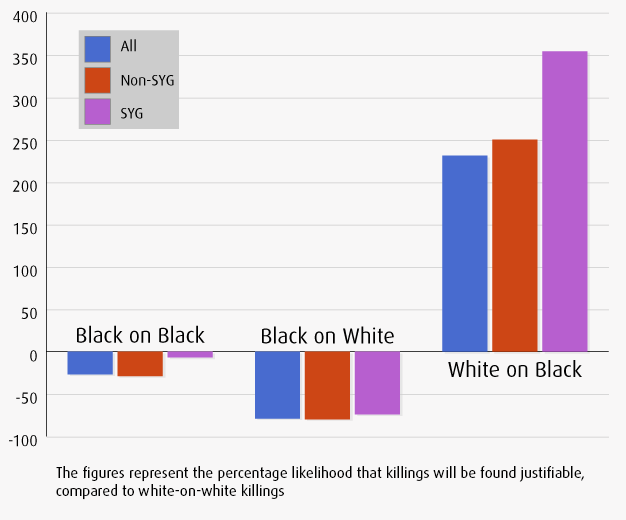
At MetroTrends, John Roman and Mitchell Downey report their analysis of 4,650 FBI records of homicides in which a person killed a stranger with a handgun. They conclude that stand your ground “tilts the odds in favor of the shooter.”  In SYG states, 13.6% of homicides were ruled justifiable; in non-SYG states, only 7.2% were deemed such.  This is strong evidence that rulings of justifiable homicide are more likely under stand your ground.

But which homicides?

Ones similar to the one decided in favor of George Zimmerman today.  A finding of “justifiable homicide” is much more common in the case of a white-on-black killing than any other kind including a white and a black person.  At PBS’s request, Roman compared the likelihood of a favorable finding for the defendant in SYG and non SYG cases, consider the races of the people involved.  The data is clear, compared to white-on-white crimes, stand your ground increases the likelihood of a not-guilty finding, but only when a person is accused of killing a black person.

1

Notice, however, that white people who kill black people are far more likely to be found not-guilty even in states without SYG and black people who kill whites are less likely to be found not-guilty regardless of state law.

It’s simple: We are already biased in favor of the white defendant and against the black victim. Stand your ground laws give jurors more leeway to give defendants the benefit of the doubt.  This increase even further the chances that a white-on-black homicide will be considered justifiable because jurors will likely give that benefit of the doubt to certain kinds of defendants and not others. Stand your ground may or may not be a good law in theory but, in practice, it increases racial bias in legal outcomes.

It is contested whether stand your ground played a role in this case, Media Matters offers strong evidence to suggest that it did. Cross-posted at Ms., PolicyMic, Pacific Standard, and Global Policy TV.

Lisa Wade is a professor of sociology at Occidental College. You can follow her on Twitter and Facebook.

(View original at http://thesocietypages.org/socimages)

29 Jul 02:23

Depp’s “Tonto” Costume Based on a Non-Native Artist’s Wild Imagination

by Lisa Wade, PhD

Johnny Depp is playing the character of “Tonto” in the movie re-make of The Lone Ranger.  Critics of the original series have observed that Tonto, the American Indian sidekick of the White hero, was a negative racial stereotype.  He was subservient to the Ranger, spoke poor English, and seemed generally dumb (his name translates into “stupid” in Spanish).  Depp has insisted that he wants to play a different kind of Tonto and reinvent the characters’ relationship.

So far so bad, as least according to recently released publicity photos revealing Depp’s costume and make up (coverage suggests that Depp himself is designing the character’s appearance).  Thanks to YetAnotherGirl and Dolores R. for sending in the tip.

Depp’s look was inspired by the art of a man named Kirby Sattler.  That’s Depp on the left; Sattler’s painting is on the right.

Sattler is famous for painting images of Native Americans, but has been criticized for stereotypical representations.  “Indian art” is a contentious issue: many non-Indian artists have made careers painting the “noble savage” and the “young girl with wolf.”  According to Native Appropriations, Sattler “…relies heavily on stereotypes of Native people as mystical-connected-to-nature-ancient-spiritual-creatures, with little regard for any type of historical accuracy.”  Sattler himself has written that his paintings come out of his own imagination or, as Native Appropriations puts it, “he makes these subjects up based on the (heavily stereotyped) images in his own head.”  Here’s a Google image search for the artist’s name:

This, unfortunately, is playing out an all-too-common story.  It goes like this:

  1. There are very few roles for non-White characters in Hollywood.
  2. When we have a non-White character, a White actor is cast into the role (e.g., The Last Airbender and Iron Eyes Cody, the crying Indian).
  3. That actor shows a lack of understanding of the real issues at hand. Depp, for example, has claimed a right to play the role because he has a little bit of Indian in him.  ”Cherokee or maybe Creek,” he says, because he doesn’t actually know.
  4. So, the portrayal is consistent with harmful stereotypes.  In this case, when deciding on a costume, Depp doesn’t choose to represent a tribe as they really were (“are” is out of the question), but instead draws on the work of an artist who admits that he makes up an idea of “the Indian” that appeals to him, a White man with no interest in true-to-life portrayals.

So, there you have it.  Again.

This post originally appeared in May 2012.  For more, see Representations of the “Primitive” Indian and Anachronism and American Indians.

Lisa Wade is a professor of sociology at Occidental College. You can follow her on Twitter and Facebook.

(View original at http://thesocietypages.org/socimages)

29 Jul 02:09

It's a strange and confusing world

by Shaun Usher


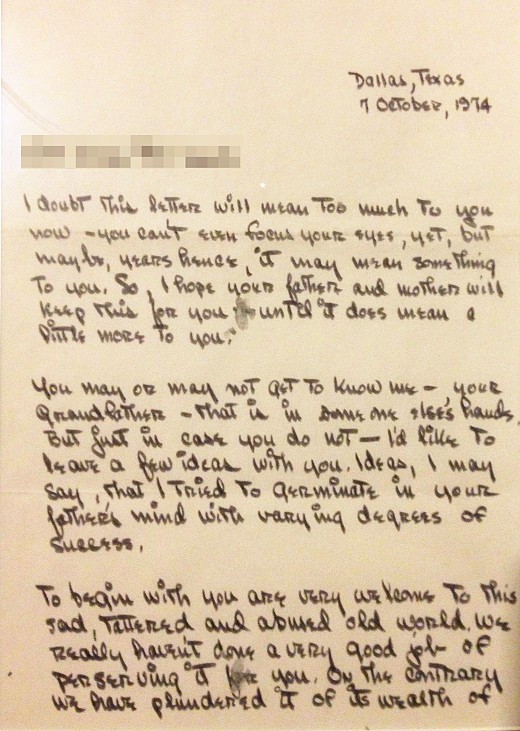
In October 1974, as he lay on his death bed at the end of a battle with cancer and reflected on his past, Clyde S. Shield (pictured above) wrote the following heartfelt letter to his 3-week-old grandson and offered some poignant advice for the road ahead. 30 years previous, Clyde had played a significant role in World War II, having first taken to the air immediately after the attack on Pearl Harbor in a valiant attempt to fight off the Japanese, and then, some time later, as lead test pilot during the Manhattan Project—a project during which the atomic bombs that ultimately devastated Hiroshima and Nagasaki, and ended the war, were developed. His military career was a particularly illustrious one.

His proud grandson said of the letter in 2011:
"It has meant different things to me at different times in my life [...] Anytime I am struggling, in tough times or having to make a big decision, it is something I always come back to."
Full transcript follows; images of the remaining pages are here.

(Source: imgur, as kindly recommended by Mark; Image above: Clyde S. Shield via ArmyAirForces.com.)


Transcript
Dallas, Texas
7 October, 1974

[Redacted]

I doubt this letter will mean too much to you now – you can't even focus your eyes, yet, but maybe, years hence, it may mean something to you. So, I hope your father and mother will keep this for you until it does mean a little more to you.

You may or may not get to know me – your Grandfather – that is in someone else's hands. But just in case you do not – I'd like to leave a few ideas with you. Ideas, I may say, that I tried to germinate in your father's mind with varying degrees of success.

To begin with you are very welcome to this sad, tattered and abused old world. We really haven't done a very good job of preserving it for you. On the contrary we have plundered it of its wealth of minerals and oils, polluted its streams and even the very air we depend on for the very breath of our lives – and we've done this with our eyes wide open and with the knowledge that we were doing it! How we explain this, I really don't know except to say that I, for one, am sorry for it.

We have not learned, even, to live with our fellow men. Instead we have perfected more means to annihilate him – to wipe him (and ourselves) from the face of the Earth.

We produce record crops of grains and other foodstuffs, but still much of the world goes to bed on empty stomachs and thousands starve to death every day.

It's a strange and confusing world we leave to you. I only hope you can do a better job with it than we have done.

But, in spite of what I've said, there is much, in life to enjoy – to relish. There is also much that can be done to make life worth while and living worth the "candle." There is a rich heritage of literature and music that awaits your investigation – it's there for the taking – in the libraries of the country and in the archives of the museums. There is poetry and prose – enough to fill all the hours you can spare to listen to them and more knowledge, on every conceivable subject, than you can assimilate in a lifetime. It's all there just waiting for you to ask for it or to seek it out. Don't overlook it or pass it up for less important or less meaningful pastimes.

Most important of all is ability to savor life, to taste of it in as many variances as you can – while you can. Life never looks so short as when you look back on it. Unfortunately you cannot do this until it has passed you by. So, as you go through life, don't overlook the "Lily in the Field," the newborn puppy, the fledgling bird – for they are as much (or more) of life as the tall buildings, the shiny automobiles and the possessions we tend to place so much importance upon. If you can do just this much – life will be more meaningful for you.

When your Dad was born I was busy playing soldier, World War II was history – but recent history – and in which I had a small part. But then I lacked both the knowledge and the wisdom that comes from experience. Now, at 56, I think of what I might have done – and didn't. But all of us are blessed with "20/20" hindsight.

If I could package (with ribbon) those gifts that I would most like to give you, I would. But how do you package integrity, how do you wrap honesty, what kind of paper for a sense of humor, what ribbon for inquisitiveness?

But, since there is no way I can give you any of those things, I can in this year of your birth, wish that you will find some wisdom and some guidance from these words, and, perhaps my wish for a bright new life for you will, eventually, come to reality. At least I hope so – with all my heart.

Love,
Grandad.


RSS Feed proudly sponsored by TinyLetter, a simple newsletter service for people with something to say.
29 Jul 00:28

What Can Self-Control Do For You? 10 New Studies Provide Surprising Answers

by Jeremy Dean

Post image for What Can Self-Control Do For You? 10 New Studies Provide Surprising Answers

Can self-control make you happy, willing to sacrifice for others, fairer, unethical or easy to hypnotise?

Nowadays it's hardly news that self-control is vital to success in many areas of life.

The studies bear this out with boring monotony in education, in health, in terms of how much money you earn, in personal relationships and even mental health.

Consciously or otherwise, people with low self-control know it's a disadvantage to be weak-willed. To make up for it they seek out others who do possess this magical property, both socially and as dating partners (Shea et al., 2013).

But, according to studies published in the last six months, a more subtle picture is emerging of the advantages and disadvantages of having, or lacking, self-control. These provide new answers to what self-control can do for you and what it can't.

1. Can it make you happier?

One stereotype of people with high self-control is that they are boring killjoys. After all, how much fun can you have if you're so in control all the time?

But, according to a new study by Hofmann et al., (2013), this stereotype is now being attacked. Their research showed that people with high self-control are happier because it helps them deal better with goal conflict.

Instead of agonising over whether to indulge in fattening foods, extra-marital affairs or cheap reality TV, people with high self-control find it easier to make the right choice. This is part of the reason they are happier. That and the fact they got better grades at school, earn more money, have better physical and mental health and so on.

2. Can it stop you lying?

Have you ever used a drug called 'clorovisen', also known as 'zens'? And how many times have you used the drug in the last month?

That's the question Meldrum et al. (2013) put to a group of 1,600 adolescents at a school in the US. Of these, 40 students admitted they had used the drug.

The weird thing is that the drug doesn't exist. The researchers had made it up to see if anyone would admit to using a totally fictitious drug.

Apparently some people just can't help lying and it's those who have low self-control that succumb to the temptation more easily, even if, as in this situation, there was absolutely nothing to gain from it. It was just lying for the sake of lying.

3. Can it make you willing to sacrifice for others?

The benefits of self-control have become so well-known that it's easy to overlook the disadvantages of iron self-control, because there are a few.

One comes out in neat research by Righetti et al., (2013) who found that in close personal relationships it was the people who had low self-control who were more willing to make sacrifices for their partner.

This is because sometimes that first instinctual reaction is to sacrifice your own interests to someone else. This happens before boring old self-interest kicks in.

But those lovely people with low self-control just can't help themselves. Before they know what they've done, they've done something nice.

4. Can it make you fairer?

Another advantage of people currently low in self-control emerged in a study by Halali et al. (2013): they are fairer. Or at least they acted more fairly in an economic game played in the lab called 'the ultimatum game'.

The findings took the authors by surprise. To explain them they think that those low in self-control acted more fairly because of fear of having less fair offers rejected.

Perhaps, but that's a rather weaselly explanation. Maybe it was like the last study: the first instinctual reaction is to act fairly and this is only tempered by later, more selfish thoughts.

Whatever the explanation, it seems in some circumstances people with low self-control act more fairly.

5. Can it help you quit smoking?

Sure, self-control is handy when you're trying to give up smoking, or any other long-standing bad habit. But how can you boost your self-control when it's been depleted by a long, stressful day?

One way of fighting back against low self-control is to use abstract thinking. When we are thinking abstractly we are more connected to our overall goals.

This was recently tested for people who were trying to quit smoking (Chiou et al., 2013). Participants who concentrated on why they were quitting smoking managed to smoke fewer cigarettes. This was because it boosted their depleted self-control.

(Find out more about self-control and abstract reasoning.)

6. Can it improve your mental focus?

One of the major benefits of self-control is it enhances mental focus and the ability to ignore anxious thoughts.

Just this process was seen in a study by Bertrams et al. (2013) who had participants trying to do maths in their heads while under pressure. Those with low self-control in the moment were more distracted by negative thoughts and performed worse in the task.

Much the same was true in another study on dart tossing (McEwan et al., 2013). Here participants whose self-control was depleted were less accurate and less consistent at throwing darts.

7. Can it stop you snooping on your partner?

Have you ever read your partner's email or text messages, or searched their pockets or been too inquisitive about where they were last night? It's pretty common, with one survey suggesting two-thirds of young adults have invaded their partner's privacy at some point.

Relationships without trust are hard. But perhaps it's about more than just trust, it's also about self-control. Maybe some people trust their partner, but can't restrain themselves from a little snooping.

Brand new research by Buyukcan-Tetik et al., (2013) found that, amongst married couples, snooping behaviours were only lower when a person both trusted their partner and was high in self-control.

So it seems that snooping on your partner doesn't necessarily mean you don't trust them, it might be that you can't resist (even though you don't expect to find anything).

8. Can it be replenished with sugar?

Perhaps you've heard of the studies which show that people's self-control is replenished by eating something, especially something sugary? The idea being if you're feeling low on self-control, a glass of orange juice will do the trick.

But the idea that there is some physiological connection has now been questioned, with some believing that really it's all about what you believe.

There's evidence for this in a new study by Hagger & Chatzsiarantis (2013) who used a glucose mouth rinse to try and boost the self-control of those who were feeling mentally weak. It worked. By contrast they found that using an artificially sweetened placebo did not work to boost weakened self-control.

So maybe it's not really the sugar that replenishes self-control, it's the idea of sugar. In other words self-control is much less about what's in your stomach than was previously thought.

9. Can it make leaders unethical?

Leaders are often under a lot of pressure to perform. This tends to sap their willpower meaning that under some circumstances it's hard to make the right decisions.

For those low in moral convictions, perhaps this makes them more likely to make unethical decisions.

Joosten et al. (2013) found that when leaders who had high moral standards were under pressure, they still generally did the right thing. But, for those leader whose morals were questionable, low self-control made it much more likely they would slip over the line into unethical behaviours.

So, low self-control can make leaders unethical if they've got low moral standards.

10. Can it make you easier to hypnotise?

You might imagine—I certainly did—that being hypnotised is all about giving up your self-control to someone else. That suggests it would be easier to hypnotise someone who has low self-control.

That's the theory Ludwig et al. (2013) had when they hypnotised 154 participants and also measured their self-control.

Contrary to their expectations—and mine—they found that having higher self-control made people easier to hypnotise.

The explanation they put forward is that people high in self-control try harder to 'do well' when they are hypnotised. People lower in self-control, however, get distracted and don't pay so much attention to the hypnotic induction so are less hypnotisable.

Image credit: RelaxingMusic

This site is written by psychologist and author, Jeremy Dean. It is completely free. Please help it continue by spreading the word. Thank you.


Making Habits, Breaking Habits

In his new book, Jeremy Dean--psychologist and author of PsyBlog--looks at how habits work, why they are so hard to change, and how to break bad old cycles and develop new healthy, creative, happy habits.

"Making Habits, Breaking Habits", is available now on Amazon.


27 Jul 03:39

Step 311: You have physical imperfections. Also, the sun is hot and someday, each of us will die.

One of the funnest* parts of book publicity are the emails and comments I get after every TV appearance. Here’s a very representative one:

It really is kind* of this stranger to take a moment out of her no doubt rich and fulfilling life to inform me of something I’d previously never noticed*. I definitely did not spend years of my life thinking that I’d be pretty if only it weren’t for my gap*, and never opening my mouth to smile so that it was this awkward grimace thing which immediately dropped off my face*.

(Note: everything marked with a * is a lie. Just so we’re all on the same page.)

I had braces, but the gap was more powerful. I thought about cosmetic work. I almost wrote a check for it. 

And then one day I woke up and said, fuck it. This is stupid. This thing is a part of you and if you spend one more second angst-ing about something that is not a problem and does not impact your life then that’s on you. How much time had I wasted on this already?

If you want to, you can spend your entire life picking out things to hate about yourself. You can find a new non-reality-based appearance concern to fixate on each and every day, if you want.

Or you can do your best to accept that it doesn’t matter to anyone but you, then actually smile in pictures.

26 Jul 04:09

The Oberlin–Wellington Rescue

by Greg Ross

On Sept. 13, 1858, ex-slave John Price was accosted on the streets of Oberlin, Ohio, by a U.S. marshal, who took him to nearby Wellington, hoping to return him to Kentucky as a fugitive. Ohio was a free state, but the federal government had committed to helping slaveholders retrieve their runaway slaves.

When word of Price’s abduction spread, a large crowd of Oberlin townspeople surrounded the marshal’s hotel and demanded his release, eventually breaking in to return him to Oberlin. Thirty-seven of the rescuers were indicted, including black abolitionist Charles Langston, who made this impassioned speech at his trial:

But I stand up here to say, that if for doing what I did on that day at Wellington, I am to go to jail six months, and pay a fine of a thousand dollars, according to the Fugitive Slave Law, and such is the protection the laws of this country afford me, I must take upon my self the responsibility of self-protection; and when I come to be claimed by some perjured wretch as his slave, I shall never be taken into slavery. And as in that trying hour I would have others do to me, as I would call upon my friends to help me; as I would call upon you, your Honor, to help me; as I would call upon you [to the district attorney], to help me; and upon you [to Judge George Bliss], and upon you [to his counsel], so help me GOD! I stand here to say that I will do all I can, for any man thus seized and help, though the inevitable penalty of six months’ imprisonment and one thousand dollars’ fine for each offense hangs over me! We have a common humanity. You would do so; your manhood would require it; and no matter what the laws might be, you would honor yourself for doing it; your friends would honor you for doing it; your children to all generations would honor you for doing it; and every good and honest man would say, you had done right!

This was met with “great and prolonged applause, in spite of the efforts of the Court and the Marshal.” Langston was convicted but given a reduced sentence of 20 days. His eloquence was hereditary, apparently — his grandson was Langston Hughes.

26 Jul 03:53

Orwellian Birthday: Party Hats Put on Public CCTV Cameras

by Urbanist
[ By WebUrbanist in Art & Street Art & Graffiti. ]

orwell birthday hat

To celebrate the 110th birthday of deceased British author George Orwell, famous for his dystopian visions of the future, Front404 roamed the streets of Utrecht adding colorful celebratory hats to all kinds of security and surveillance cameras.

orwell surveillance street art

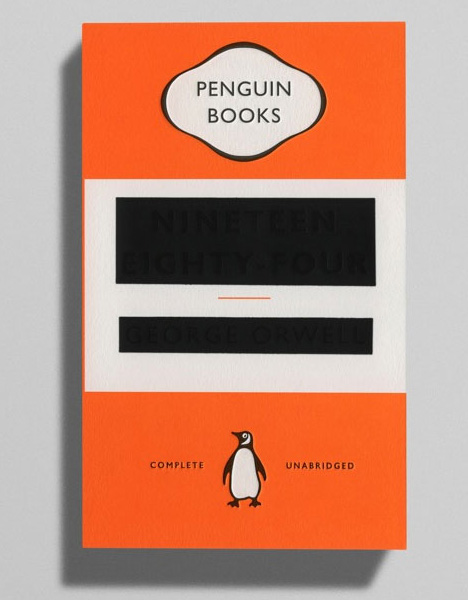
Recent news about the National Security Agency has prompted a record-breaking uptick in sales of one of Orwell’s most famous works, Nineteen Eighty-Four (1984), in which state monitoring reached terrifyingly deep into the everyday lives of citizens.

orwell book art cover

From the activist artists behind the project: “By making these inconspicuous cameras that we ignore in our daily lives catch the eye again we also create awareness of how many cameras really watch us nowadays, and that the surveillance state described by Orwell is getting closer and closer to reality.”

orwell part hat art

CCTV has long been a subject for street artists, including the infamous Banksy, particularly in places with lax laws regarding the monitoring of public spaces … which makes sense, considering their works are not always legal, but often caught on tape.

Share on Facebook

[ By WebUrbanist in Art & Street Art & Graffiti. ]

[ WebUrbanist | Archives | Galleries | Privacy | TOS ]


26 Jul 03:52

What Current Demographic Facts Do You Need to Know?

by Philip N. Cohen, PhD

Cross-posted at Family Inequality.

The other day I was surprised that a group of reporters failed to call out what seemed to be an obvious exaggeration by Republican Congresspeople in a press conference. Did the reporters not realize that a 25% unemployment rate among college graduates in 2013 is implausible, were they not paying attention, or do they just assume they’re being fed lies all the time so they don’t bother?

Last semester I launched an aggressive campaign to teach the undergraduate students in my class the size of the US population. If you don’t know that – and some large portion of them didn’t – how can you interpret statements such as, “On average, 24 people per minute are victims of rape, physical violence, or stalking by an intimate partner in the United States.” In this case the source followed up with, “Over the course of a year, that equals more than 12 million women and men.” But, is that a lot? It’s a lot more in the United States than it would be in China. (Unless you go with, “any rape is too many,” in which case why use a number at all?)

1

Anyway, just the US population isn’t enough. I decided to start a list of current demographic facts you need to know just to get through the day without being grossly misled or misinformed – or, in the case of journalists or teachers or social scientists, not to allow your audience to be grossly misled or misinformed. Not trivia that makes a point or statistics that are shocking, but the non-sensational information you need to know to make sense of those things when other people use them. And it’s really a ballpark requirement; when I tested the undergraduates, I gave them credit if they were within 20% of the US population – that’s anywhere between 250 million and 380 million!

I only got as far as 22 facts, but they should probably be somewhere in any top-100. And the silent reporters the other day made me realize I can’t let the perfect be the enemy of the good here. I’m open to suggestions for others (or other lists if they’re out there).

They refer to the US unless otherwise noted:

Description Number Source
World Population 7 billion 1
US Population 316 million 1
Children under 18 as share of pop. 24% 2
Adults 65+ as share of pop. 13% 2
Unemployment rate 7.6% 3
Unemployment rate range, 1970-2013 4% – 11% 4
Non-Hispanic Whites as share of pop. 63% 2
Blacks as share of pop. 13% 2
Hispanics as share of pop. 17% 2
Asians as share of pop. 5% 2
American Indians as share of pop. 1% 2
Immigrants as share of pop 13% 2
Adults with BA or higher 28% 2
Median household income $53,000 2
Most populous country, China 1.3 billion 5
2nd most populous country, India 1.2 billion 5
3rd most populous country, USA 315 million 5
4th most populous country, Indonesia 250 million 5
5th most populous country, Brazil 200 million 5
Male life expectancy at birth 76 6
Female life expectancy at birth 81 6
National life expectancy range 49 – 84 7

Sources:
1. http://www.census.gov/main/www/popclock.html
2. http://quickfacts.census.gov/qfd/states/00000.html
3. http://www.bls.gov/
4. Google public data: http://bit.ly/UVmeS3
5. https://www.cia.gov/library/publications/the-world-factbook/rankorder/2119rank.html
6. http://www.cdc.gov/nchs/hus/contents2011.htm#021
7. https://www.cia.gov/library/publications/the-world-factbook/rankorder/2102rank.html

Philip N. Cohen is a professor of sociology at the University of Maryland, College Park, and writes the blog Family Inequality. You can follow him on Twitter or Facebook.

(View original at http://thesocietypages.org/socimages)

26 Jul 03:50

The Weird New World of Girl Cheese

by Lisa Wade, PhD

In May we featured a block of cheese that inspired quite the response.  Riffing off the name “Monterey Jack,” a company was selling “Monterey Jill”: the same old cheese, but reduced fat.  It was an excellent example of the way dieting is feminized.

People — myself included — were pretty stunned to see gendered cheese; who knew this was going to be a thing.  In fact, Liam sent us an example of gendered string cheese with the exact same theme: there’s string cheese animated by a male character and reduced-fat string cheese animated by a female character.  Also, they’re surfing; aaaaaand I have no analysis of that.

Screenshot_1Thanks for reminding the ladies to be worried about their waistlines cheese people!  It’s not as if we don’t get that message absolutely every time we turn around!

Lisa Wade is a professor of sociology at Occidental College. You can follow her on Twitter and Facebook.

(View original at http://thesocietypages.org/socimages)

26 Jul 03:45

Live as well as you dare

by Shaun Usher


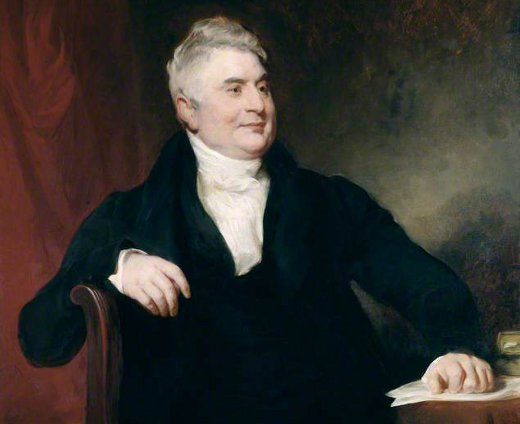
In February of 1820, on learning that his good friend, Lady Georgiana Morpeth, was suffering from a bout of depression, noted essayist and clergyman Sydney Smith sent her the following precious letter, in which he listed twenty pieces of advice to help her overcome "low spirits."

Two similarly helpful letters of advice—specifically on the subject of depression—spring to mind when reading this: one from Stephen Fry; the other, from Henry James. All three are wonderful. For more information about depression itself, the Mind website is a good place to start.

(Source: The Selected Writings of Sydney Smith; Image of Sydney Smith: Replica by Henry Perronet Briggs, oil on canvas, 1840 (1833) NPG 1475 © National Portrait Gallery, London.)

Foston, Feb. 16th, 1820

Dear Lady Georgiana,

Nobody has suffered more from low spirits than I have done—so I feel for you.

1st. Live as well as you dare.
2nd. Go into the shower-bath with a small quantity of water at a temperature low enough to give you a slight sensation of cold, 75° or 80°.
3rd. Amusing books.
4th. Short views of human life—not further than dinner or tea.
5th. Be as busy as you can.
6th. See as much as you can of those friends who respect and like you.
7th. And of those acquaintances who amuse you.
8th. Make no secret of low spirits to your friends, but talk of them freely—they are always worse for dignified concealment.
9th. Attend to the effects tea and coffee produce upon you.
10th. Compare your lot with that of other people.
11th. Don't expect too much from human life—a sorry business at the best.
12th. Avoid poetry, dramatic representations (except comedy), music, serious novels, melancholy sentimental people, and every thing likely to excite feeling or emotion not ending in active benevolence.
13th. Do good, and endeavour to please everybody of every degree.
14th. Be as much as you can in the open air without fatigue.
15th. Make the room where you commonly sit, gay and pleasant.
16th. Struggle by little and little against idleness.
17th. Don't be too severe upon yourself, or underrate yourself, but do yourself justice.
18th. Keep good blazing fires.
19th. Be firm and constant in the exercise of rational religion.
20th. Believe me, dear Georgiana, your devoted servant, Sydney Smith


RSS Feed proudly sponsored by TinyLetter, a simple newsletter service for people with something to say.
25 Jul 22:52

History Repeating Itself: Discriminatory Voting Laws

by Lisa Wade, PhD

Cross-posted at Pacific Standard.

Last week the U.S. Supreme Court struck down the part of the Voting Rights Act of 1965 that required states with a documenting history of discrimination to get federal approval before changing their voting laws.  When the law was passed in 1965, one of its main targets were “literacy tests.”

Ostensibly designed to ensure that everyone who voted could read and write, they were actually tools with which to disenfranchise African Americans and sometimes Latinos and American Indians.  Minority voters were disproportionately required to take these tests and, when they did, the election official at the polling place had 100% jurisdiction to decide which answers were correct and score the test as he liked.  The point was to intimidate and turn them away from the polls.  If this sounds bad, you should see the range of disturbing and terrifying things the White elite tried to keep minorities from voting.

The tactics to manipulate election outcomes by controlling who votes is still part and parcel of our electoral politics.  In fact, since most voters are not “swing” voters, some would argue that “turnout” is a primary ground on which elections are fought.  This is not just about mobilizing or suppressing Democrats or Republicans, it’s about mobilizing or suppressing the turnout of groups likely to vote Democrat or Republican.  Since most minority groups lean Democrat, Republicans have a perverse incentive to suppress their turn out. In other words, this isn’t a partisan issue; I’d be watching Democrats closely if the tables were turned.

Indeed, states have already moved to implement changes to voting laws that had been previously identified as discriminatory and ruled unconstitutional under the Voting Act.  According to the Associated Press:

After the high court announced its momentous ruling Tuesday, officials in Texas and Mississippi pledged to immediately implement laws requiring voters to show photo identification before getting a ballot. North Carolina Republicans promised they would quickly try to adopt a similar law. Florida now appears free to set its early voting hours however Gov. Rick Scott and the GOP Legislature please. And Georgia’s most populous county likely will use county commission districts that Republican state legislators drew over the objections of local Democrats.

So, yeah, it appears that Chief Justice John Roberts’ justification that “our country has changed” was pretty much proven wrong within a matter of hours or days.  This is bad.  It will be much more difficult to undo discriminatory laws than it was to prevent them from being implemented and, even if they are challenged and overturned, they will do damage in the meantime.

In any case, here are two examples of literacy tests given to (mostly) minority voters in Louisiana circa 1964.  Pages from history (from Civil Right Movement Veterans):

Louisiana circa 1964a Louisiana circa 1964bThanks to @drcompton for the tip!

Lisa Wade is a professor of sociology at Occidental College. You can follow her on Twitter and Facebook.

(View original at http://thesocietypages.org/socimages)

18 Jul 21:04

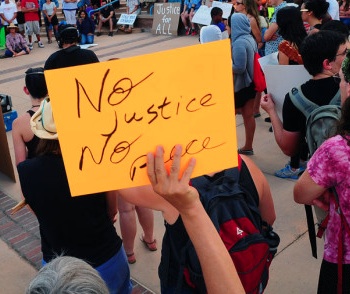
No justice, no peace

by Ben Zimmer

J.P. Villanueva writes:

I've been seeing the old "No justice, no peace" chant lately after the Zimmerman trial. It seems like people are lamenting that "there is no justice and there is no peace."

When I first heard the chant (during the Rodney King riots), I had understood quite clearly that "No justice, no peace" was a conditional statement… as in, "if you can't guarantee us justice, we will not let you have peace" in other words, it was a call to riot.

I'm sure the chant has a longer history, right? Has it always meant both things? or did I misinterpret back in the 90s?

A few years ago, Mark Liberman considered the "No X, No Y" construction and its potential for ambiguity. At the time, hackers had rigged highway signs on the Palmetto Expressway in Florida to read "No Latinos, No Tacos." While many interpreted the sign with a conjunctive reading — "(There should be) no Latinos (and) no tacos" — others discerned a conditional reading — "(If there are) no Latinos (there will be) no tacos." This latter reading echoes the "No justice, no peace" slogan that has been a staple of the U.S. protest movement, especially in New York City, since the late '80s.

In the '80s and '90s, as J.P. suggests, "No justice, no peace" was unequivocally understood as conditional, not conjunctive. I've found examples of the slogan going back to the aftermath of the Howard Beach incident in December 1986, in which Trinidadian immigrant Michael Griffith was killed by a mob of white youths. On Feb. 28, 1987, the New York Amsterdam News reported that "'No justice, no peace' has become the battle cry of the student led movement against racially motivated attacks on African peoples." The newspaper quoted protest organizer Viola Plummer as saying, "from the death of Michael Griffith on, we declare that if there is no justice there cannot be peace."

The following year, on May 11, 1988, the activist lawyer Ron Kuby testified before a hearing on racially motivated violence before the House of Representatives Subcommittee on Criminal Justice. Kuby stated:

In response to the increase of hate crimes by both the police and private citizens, a new civil rights movement has started to emerge in New York. The movement is broad and diverse, but has marched under the slogan "No Justice, No Peace," a slogan which summarizes the frustration and anger of New York's Black and Latino communities. "No Justice, No Peace" remains the solemn promise of an increasing number of people in an increasingly polarized city.

Kuby framed the slogan as a "promise" rather than a threat, but the conditional reading was still clear. After the killing of Yusef Hawkins in the Bensonhurst neighborhood of Brooklyn in 1989, the slogan again came to the fore. A May 13, 1990 New York Times article described protests in Bensonhurst that occurred on the same day as protests in Flatbush over allegations that a black woman had been roughed up at a Korean-owned grocery store. At the Flatbush protest, "No justice, no peace" was paired with the similarly conditional "No respect, no business," i.e., "(If you give us) no respect, (we will give you) no business." And at Bensonhurst, the slogan was rephrased as "Justice, then peace."

So what about now, with the protests over the Zimmerman verdict? Has the old threatening conditional turned into a more benign conjunctive, "(There is) no justice (and there is) no peace"? No doubt the slogan means different things to different people. As evidence of the range of interpretations, see the Huffington Post column by University of Pennsylvania chaplain Charles Howard:

To me the phrase "No Justice, No Peace" is not so much a threat as much as it is a cry of the heart. It is not simply a call to protest, but also a naming of the powers and what those powers have done.

Howard goes on to provide four of his own glosses on the slogan:

  • A lack of justice has resulted in a lack of peace.
  • Heavy hearts now lack peace because of the lack of justice in our nation.
  • No peace because of no justice.
  • We must work for both: To fix a broken justice system and a to fix the broken peace within our hearts and within our communities.

None of these readings pack the conditional punch of the original formulation — even when a cause and effect is stated ("No peace because of no justice") it is not a call to arms to disrupt "the peace" but rather an introspective reflection on how "peace within our hearts and within our communities" has been disrupted. His conclusion is a conjunctive one: "Let us work for both justice and peace." Perhaps the reanalysis of the old slogan is indicative of how the culture of protest over racial injustice has changed since the days of Howard Beach and Bensonhurst.

Update: On his website, Barry Popik has a page devoted to "no justice no peace" and provides a couple of examples from 1987 slightly earlier than the Amsterdam News quote given above:

22 January 1987. St. Petersburg (FL) Times, "4,500 march to protest racial attack in N.Y." by Dan Jacobsen, United Press International, pg. 11A:
NEW YORK – More than 4,500 black protesters chanting slogans to the beat of pounding drums marched in Manhattan Wednesday during a day-long demonstration of "outrage" against the Howard Beach racial attack.
With fists clenched in anger, they filled Broadway at 32nd Street, site of a city welfare hotel, then led a deafening demonstration down Fifth Avenue to Mayor Edward Koch's Greenwich Village home.
Chants of "No justice, no peace" and "Mayor Koch step aside, there ain't gonna be no genocide" echoed among the office buildings as police scrambled to line the route.

22 January 1987, Newsday (Long Island, NY), "4,000 March Against Racism But Impact Of Boycott Less Clear," pg. 3:
To the deafening beat of chants, a predominately black army of nearly 4,000 protesters marched down Fifth Avenue yesterday in a declared effort to defeat the notion that blacks will tolerate racial injustice.
The march highlighted "The Day of Mourning and Outrage" for Michael Griffith, who was killed by a car Dec. 20 while fleeing a gang of white teenagers in Howard Beach, Queens. (…)
Chanting "No justice, no peace," the five-block-long stream of marchers, some shaking clenched fists, set off from the Martinique Hotel, a welfare hotel on West 32nd Street. They marched to Mayor Edward I. Koch's Greenwich Village home, a 30-block walk that took an hour.

18 Jul 19:32

Down and Out

by Greg Ross

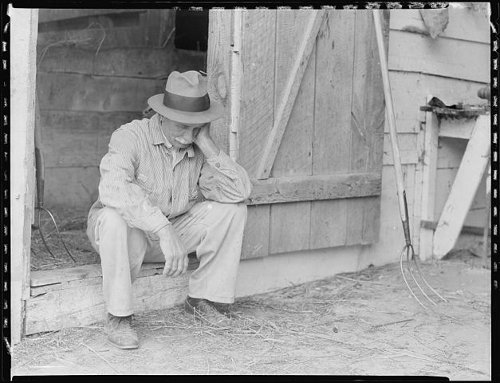
http://commons.wikimedia.org/wiki/File:Farmer_in_despair_over_the_depression_in_1932._-_NARA_-_512819.jpg

A letter received by the White House in February 1936:

Dear Mr. President:

I’m a boy of 12 years. I want to tell you about my family. My father hasn’t worked for 5 months. He went plenty times to relief, he filled out application. They won’t give us anything. I don’t know why. Please you do something. We haven’t paid 4 months rent. Everyday the landlord rings the door bell, we don’t open the door for him. We are afraid that will be put out, been put out before, and don’t want to happen again. We haven’t paid the gas bill, and the electric bill, haven’t paid grocery bill for 3 months. My brother goes to Lane Tech. High School. he’s eighteen years old, hasn’t gone to school for 2 weeks because he got no carfare. I have a sister she’s twenty years, she can’t find work. My father he
staying home. All the time he’s crying because he can’t find work. I told him why are you crying daddy, and daddy said why shouldn’t I cry when there is nothing in the house. I feel sorry for him. That night I couldn’t sleep. The next morning I wrote this letter to you in my room. Were American citizens and were born in Chicago, Ill. and I don’t know why they don’t help us Please answer right away because we need it. will starve Thank you.
God bless you.

In her “My Day” newspaper column on Dec. 30, 1935, Eleanor Roosevelt wrote: “I wonder if anyone else glories in cold and snow without, an open fire within, and the luxury of a tray of food all by one’s self in one’s own room?” A Columbus, Ind., woman responded, “I would give ten years of my life to be able to have the luxury of an open fire just one evening, as you write about in the Indianapolis Times.”

18 Jul 19:22

Psychology in Brief: 5 Things We Didn’t Know Last Week

by Jeremy Dean

Post image for Psychology in Brief: 5 Things We Didn’t Know Last Week

Meeting online = longer marriages--Internet banging--Suicides peak in spring--The power of cutlery--When uncertain we choose narcissistic leaders.

Five things we didn't know last week from the world of psychology:

Meeting online = (slightly) longer marriages

Did you know that one-third of people who get married in the US originally met online? And it seems these marriages are slightly less likely to fail. In this sample of almost 20,000 people in the US:

"...marriages that began on-line, when compared with those that began through traditional off-line venues, were slightly less likely to result in a marital break-up (separation or divorce) and were associated with slightly higher marital satisfaction among those respondents who remained married."

See: the internet isn't all bad...

Internet banging

...although, since all human life is online, a lot of stuff is quite bad. Just like everyone else, gang members now do a lot of their 'business' online. As a new paper entitled "Internet Banging: New trends in social media, gang violence, masculinity and hip hop" puts it: gang members now carry guns and Twitter accounts.

"Gang members now occupy two spaces: the “streets” and the internet. Data from the National Gang Threat Assessment suggest that gang members uses social medial to conduct drug sales, market their activities, communicate with other members, coordinate gang actions, recruit new members and to brag about acts of violence or make threats."

Suicides peak in spring

Very counter-intuitive this one because spring is the season of new life and new hope. Except it turns out that suicides peak in spring.

Although it's an established finding from around the world, going back centuries in some cases, we still don't really know why. Here are a couple of candidate explanations:

"One traditional candidate [..] is the “broken promise effect” — the sometimes crushing disappointment that spring fails to bring the relief the sufferer has hoped for. In addition, psychiatrists have long observed that for patients with bipolar disorder and depression, spring can create a manic agitation that amplifies the risk of suicide."

If you need emotional support, try Befrienders Wordwide.

The power of cutlery

There's too much emphasis on food nowadays and not enough on cutlery. Something as simple as cutlery has quite noticeable effects on taste perceptions:

"...when the weight of the cutlery confirms expectations (e.g. a plastic spoon is light), yoghurt seemed denser and more expensive. Color contrast is also an important factor: white yoghurt when eaten from a white spoon was rated sweeter, more liked, and more expensive than pink-colored yoghurt. Similarly, when offered cheese on a knife, spoon, fork or toothpick, the cheese from a knife tasted saltiest."

Throw away all those stupid cook-books and instead try experimenting with different coloured plates.

When uncertain we choose narcissistic leaders

As I've covered here before, narcissists seem to have a strange attraction for us. For a while at least we find ourselves drawn to their charm, their self-obsession and their entitled behaviour. Just the same effect is seen when people are looking for a leader, especially during times of uncertainty:

"...individuals were shown to be aware of the negative features of narcissistic leaders, such as arrogance and exploitativeness, but chose them as leaders in times of uncertainty, regardless. Thus, a narcissistic leader is perceived as someone who can help reduce individual uncertainty."

Image credit: dierk schaefer

If you value PsyBlog, please support it by spreading it to others through email, social networks or even old-fashioned talking! Thank you!


Making Habits, Breaking Habits

In his new book, Jeremy Dean--psychologist and author of PsyBlog--looks at how habits work, why they are so hard to change, and how to break bad old cycles and develop new healthy, creative, happy habits.

"Making Habits, Breaking Habits", is available now on Amazon.


18 Jul 05:00

Relax, “Breadwinner Moms” Do Not Portend a Coming Matriarchy

by Philip N. Cohen, PhD

Cross-posted at Family Inequality.

The other day when the Pew report on mothers who are breadwinners came out, I complained about calling wives “breadwinners” if they earn $1 more than their husbands:

A wife who earns $1 more than her husband for one year is not the “breadwinner” of the family. That’s not what made “traditional” men the breadwinners of their families — that image is of a long-term pattern in which the husband/father earns all or almost all of the money, which implies a more entrenched economic domination.

To elaborate a little, there are two issues here. One is empirical: today’s female breadwinners are much less economically dominant than the classical male breadwinner — and even than the contemporary male breadwinner, as I will show. And second, conceptually breadwinner not a majority-share concept determined by a fixed percentage of income, but an ideologically specific construction of family provision.

Let’s go back to the Pew data setup: heterogamously married couples with children under age 18 in the year 2011 (from Census data provided by IPUMS). In 23% of those couples the wife’s personal income is greater than her husband’s — that’s the big news, since it’s an increase from 4% half a century ago. This, to the Pew authors and media everywhere, makes her the “primary breadwinner,” or, in shortened form (as in their title), “breadwinner moms.” (That’s completely reasonable with single mothers, by the way; I’m just working on the married-couple side of the issue — just a short chasm away.)

The 50%+1 standard conceals that these male “breadwinners” are winning a greater share of the bread than are their female counterparts. Specifically, the average father-earning-more-than-his-wife earns 81% of the couple’s income; the average mother-earning-more-than-her-husband earns 69% of the couple’s income. Here is the distribution in more detail:

1

This shows that by far the most common situation for a female “breadwinner” is to be earning between 50% and 60% of the couple’s income — the case for 38% of such women. For the father “breadwinners,” though, the most common situation — for 28% of them — is to be earning all of the income, a situation that is three-times more common than the reverse.

Collapsing data into categories is essential for understanding the world. But putting these two groups into the same category and speaking as if they are equal is misleading.

This is especially problematic, I think, because of the historical connotation of the term breadwinner. The term dates back to 1821, says the Oxford English Dictionary. That’s from the heyday of America’s separate spheres ideology, which elevated to reverential status the woman-home/man-work ideal. Breadwinners in that Industrial Revolution era were not defined by earning 1% more than their wives. They earned all of the money, ideally (meaning, if their earnings were sufficient) but, just as importantly, they were the only one permanently working for pay outside the home. (JSTOR has references going back to the 1860s which confirm this usage.)

Modifying “breadwinner” with “primary” is better than not, but that subtlety has been completely lost in the media coverage. Consider these headlines from a Google news search just now:

Further down there are some references to “primary breadwinners,” but that’s rare.

Maybe we should call those 100%ers breadwinners, and call the ones closer to 50% breadsharers.

Philip N. Cohen is a professor of sociology at the University of Maryland, College Park, and writes the blog Family Inequality. You can follow him on Twitter or Facebook.

(View original at http://thesocietypages.org/socimages)

14 Jul 20:45

End of the Day Reflections on My Mother…And Being a Mother

by Isis the Scientist

Tomorrow is my mother’s birthday. It’s easy to lose track of the number of years that it’s been since she died.  It will be 15 this September.  Today when I realized that tomorrow is her birthday, I had to stop and think about how old she’d be.

She’d be 54.

Young Isis

Figure 1: That’s my mother at 24, posing with a then 3 or 4 year old not-yet-Dr. Isis.

While it’s hard for me to fathom how old she’d be, or what she’d look like at 54, I’ve found myself thinking about her more than usual lately.  I suspect that my reflections are the result of the big changes in my life that have happened recently. My uncle (her brother, who was mentioned in this previous post in which I said some tangentially crazy shit) died of a methadone overdose at 49 years old.  My drug addled stepfather died in April, also at 49 years old.  Long life has never been a common theme in my family.

I look very much like my mother, minus the enormous hair. Also, her eyebrows were superior.  I realize, in looking at pictures of myself now, and of her at my age, that it’s hard to picture myself old. Mostly, because I have no pictures of her old.   Up until recently, I could pull out a picture of her 10 years older than me and say, ‘That’s what I’ll look like in 10 years.” I can’t do that anymore because there aren’t 10 years from now left. I’m not far from the age she was when she died. There wasn’t grey in her hair and there weren’t lines on her face.

Mom and Michael

Figure 2: One of the last pictures of la Mama Isis before she died…

Not having that image of her (and many of the other people I’ve loved) aging has led me to occasionally entertain the notion that I might not age either.  That the Isises don’t age. That we burn hot early and then fizzle out just as early.  It’s allowed me to entertain the exceptionally fucked up notion that, if I were la Mama Isis, my life would be 85% over.

But, my memories of her are different this year, largely because I think my stepfather’s passing has liberated them. The last person with a real, vested interest in remembering her nothing but fondly is gone.  My mother did truly have a light in her – a humor that put people at ease – and that’s the side that so many have needed to remember and recount and rehash with me. Over and over.  But, that light was counterbalanced and eventually extinguished by an incredible darkness. Jealousy and self-doubt and anger and the constant need to fill a void that I never understood.

A major part of me has always realized that she wasn’t perfect and my childhood may have been less than ideal (see here and here), but I could always reflect on her with a hopefulness. Now that I am not surrounded by people who ask me to relive the happy memories of her, I find myself full of darker, angrier memories that I haven’t experienced in years.

On Saturday I took the Isis children to a local beach.

Tiny Diva at the beach

Figure 3: Tiny Diva does the beach.

Being pale children, I insisted on slathering them with sunscreen every hour. After his fourth application, Little Isis looked at me and said, “Mommy, why are you obsessed with this? And isn’t bringing three bottles of sunscreen a little excessive?”

In an instant, images of going to the beach at his age flashed through my mind. Not the images of us on the ferris wheel that I had remembered with my family.  Summers at the Jersey Shore where my mother would drink and pass out and forget to put sunscreen on us.  All the summers with sunburns so bad that our skin blistered and we were feverish and we vomited. Then the images of the houses we’d slept in while she hung out and got stoned with her friends.  Remembering how she’d get philosophical and slur to us about how perfect everything was and how happy she promised she’d make us.  Then the images of waking up in the middle of the night and seeing her passed out on the bathroom floor.

Memories of all the amazing musicians that came through our home, counterbalanced by memories of how many times we didn’t have utilities because the money for the electric bill had gone up someone’s nose. How often we didn’t have food because the grocery budget had been smoked.  How we lost more than one house because the money for the mortgage or rent had gone in someone’s arm. The paranoid yelling and screaming and bruises, followed by three days of exhausted, post-high slumber.

While these memories have always been there, burrowing into me and influencing what I do, I’ve operated mostly by boxing them away and forgetting they were there. Having them be so liberated this year has left me raw and probably feeling more vulnerable usual.  Each jolting, violent resurfacing is as shocking as a face full of ice water.  You think you can prepare yourself for it, but it still catches you off guard and makes you struggle to catch your breath.

Although I think I am coping pretty well, it’s making me a little neurotic about my children and harder on myself when I feel that I’ve failed them.  It makes me desperate to wrap my arms around the six-year-old boy who is waiting for me at home, itching to show me his Pokemon cards, and try with every ounce of myself not to fuck him up. It makes me hope that the biggest source of consternation in the baby’s life is I did not buy enough broccoli to satisfy her insatiable need for broccoli.

Mostly, it makes me realize that I still carry a lot of anger that I have never really examined or dealt with. I left home as a too young woman to get away from it and then I locked most of it away.  And it makes me realize that, if I am going to be a good mother to the two small people who count on me for so very much, walking away and remembering selectively was not enough.  I am going to have to find forgiveness. I am going to have to open all of the boxes I’ve hidden her in and let her go…


12 Jul 04:08

Rachel Jeantel’s language in the Zimmerman trial

by John Rickford

[Below is a guest post by John Rickford.]

The defense plans to rest in the Florida trial of George Zimmerman today, and arguments are raging about whether he will be found guilty of murdering Trayvon Martin or not.

In the case of Rachel Jeantel, however, the 19-year old prosecution witness whose testimony on June 26 and 27 went on longer (5 to 6 hours) and generated more commentary in the media than any other witness, the GUILTY verdict is already in.

On talk shows and social media sites, people castigated her "slurred speech," bad grammar and Ebonics usage, or complained that, "Nobody can understand what she's saying."

As was true in the wake of the 1996 Oakland Ebonics controversy (cf. the “Ebonics Humor” chapter in John R. and Russell J. Rickford, 2000, Spoken Soul), a torrent of invidious commentary was quickly unleashed, masquerading under the cover of wit and presumably-shared linguistic prejudice.

Some of it was translation humor: “Love to hear her give a Shakespeare recital. ‘To beez or nots to beez, dats wat I'zz bee saying, jack’.”

But a lot more involved grotesquely racist, misogynistic and dehumanizing attacks on this young woman, devoid of any sensitivity to the fact that she was testifying about the murder of a friend she had known since elementary school, and that she was racked by guilt that she’d been been talking to him by cell phone moments before he died but couldn’t prevent his murder.

In language even more vicious than that in the “Ebonics Olympic Games” of 1997 (Spoken Soul, p. 217-18), Jeantel was compared to “a junkie,” an “animal,” and “the missing link between monkeys and humans.” One commentator opined that “You could swap her out for a three-toed sloth and get the same witness value and response.”

Another, eager to demonstrate that ignorance and viciousness were equal opportunity traits, fumed that: “She has to be the most, ignorant, ghetto, uneducated, lazy, fat, gross, arrogant, stupid, confrontation Black bitch I've ever seen in my fucking life. Yes, I said it . . . and I'm Black.”

Not everyone was this negative, fortunately. In TV appearances and in a commentary on Times.com, linguist John McWhorter explained that Jeantel’s “Black English … has rules as complex as the mainstream English of William F. Buckley.” I tried to do the same in a short segment on the National Public Radio program, Here and Now. But you’ll notice from the comments on these sites that we both attracted critics and detractors.

There were linguistically positive and insightful blog posts by non-linguists too, like this one by Syracuse University professor of Rhetoric and Writing Kevin Browne,, and this one by writer Marina Bolotnikova.

For the record, Jeantel, like many working class African Americans, shows asymmetric linguistic competence. She does understand standard English, as she emphasized in an exchange with defense attorney Don West.

But she often speaks fluent African American Vernacular English (AAVE), or Ebonics, and the court stenographer, attorneys and jury members may have missed crucial elements in her testimony.

Jeantel complained to West, “You cannot hear me that well, and “You are having trouble hearing me.” And it wasn’t just because of her sometimes soft delivery. As she noted, “It’s how I speak.”

Speakers of AAVE and linguists who have studied this distinctive variety for more than 50 years, knew exactly what Jeantel meant when she used systematic AAVE features like:

– Stressed BIN, as in I was BIN paying attention, sir, meaning, “I’ve been paying attention for a long time, and am still paying attention.”
– Preterit HAD, ax, and inverted did in embedded sentences, as in He had ax me did I go to the hospital “He asked me whether I had gone to the hospital.” [The use of the pluperfect form where other varieties use a simple past or preterit was first discussed by Stanford undergrad Christine Theberge.]
– Absence of auxiliary IS: He ø trying to get home, sir.
– Absence of possessive and third present s, as in “He a momma ø boy” and “He love ø his family.”

Did these and other features cause lawyers and jury members to literally misunderstand her? It’s hard to tell, except in one case where the transcript of her April 2012 interview with prosecuting attorney Bernie De la Rionda has her saying that she “couldn’t hear Trayvon” saying “Get off,” while the testimony, played in court, sounds more like “I could, an’ it was Trayvon.” Jeantel’s subsequent remarks substantiate the latter interpretation. (The transcript of that interview is here, and you can see and hear courtroom cross examination about it here.)

This case aside, it’s more likely that Jeantel was understood as clearly as Moses Wright, the Mississippi sharecropper and preacher whose Chicago cousin Mamie sent her 14 year old son Emmett Till to visit Wright in Mississippi in August 1955.

Till was brutally murdered by J. W. Milam and Roy Bryant after going to a local store with friends to buy sodas and bubble gum. After their trial, Milam and Bryant brazenly and without prosecution published a full confession in Look magazine. 1/24/1956.

Asked in court if he could identify the man with a gun who took Emmett from his house, Rev. Wright said “Yes, sir!” and “with an act of courage and defiance … pointed a gnarled finger at white J.W. Milam and announced in a loud, clear voice, “Thar he!” (From Mark Gado’s riveting account).

Now Wright’s construction, with the copula missing in clause-final position, is ungrammatical in modern AAVE and every known variety of English today. (See, among others: Harold King, 1970, “On blocking the rules for contraction in EnglishLinguistic Inquiry 1:134-136, and William Labov,  1969, “Contraction, deletion, and inherent variability of the English copulaLanguage 45:715-762.) And one might, as with Jeantel’s testimony, wonder whether it was transcribed correctly.

But there is no question about whether it was understood. And Wright’s testimony, like Jeantel’s, demonstrates that the vernacular CAN be used to speak justice and truth, just as standard English can be used for injustice and lies. As James Baldwin noted in 1979 (in “Black English: A Dishonest Argument” in G. Smitherman, ed., Black English and the Education of Black Children and Youth):

We should not forget that it was in perfect standard English, in the Dred Scott decision, that the court said that Black people had no rights that the White man must respect.

Indeed, the fact that Jeantel’s testimony was so vernacular might itself be taken as evidence that it was likely closer to the truth, especially given this very apt comment (given that Jentel’s mother is a native creole French speaker from Haiti, and that she herself speaks Creole, Spanish and AAVE) from Robert Hall’s 1966 Pidgin and Creole Languages (p. 133):

For the normal, unpretentious Haitian, use of Creole is the symbol of truth and reality, and French is the language of bluff, mystification, and duplicity.

Note, however, that Wright’s 1955 testimony in the Emmett Till trial did not win friends or influence people in the courtroom. The all-white jury delivered a “Not guilty” verdict in the case, “some even stopping to shake hands or offer congratulations” as they filed past Milam and Bryant.

Despite the obvious improvements in the socio-political climate between the 1950s and today, it is not likely that Jeantel’s testimony will change the outcome of the Zimmerman trial either. Whether they understood her literally or not, Jeantel’s vernacular, her eye rolls, stares and palpable “attitude” may make it difficult for the jury to relate to and be convinced by her, as some media pundits have suggested.

Which would be sad, because this reluctant witness represents the closest proxy to testimony by Trayvon Martin himself—something we’ll never get to hear or pick apart.


In this already long post, I crave your indulgence to make a couple closing linguistic points and half of a literacy/education point that I’ll develop more fully in another time and (perhaps) place.

Much has been made of the fact that Jeantel, in her courtroom testimony, quoted Trayvon Martin as referring to George Zimmerman, of mixed White and Latino ancestry, as a nigga (“The nigga is still following me”), and a creepy-ass cracker. Defense attorney Don West, in particular, used these terms to show that it was Trayvon, not Zimmerman, who “introduced” racism into the altercation.

But Arthur Spears’ 1998 paper on “African-American Language Use: Ideology and so-called obscenity” (in Mufwene, Rickford, Bailey and Baugh, eds. African American English) rebuts West’s charge and is insightful with respect to both terms.

About nigga (as distinct from nigger), Spears observes (p. 239) that:

It is currently used by younger African Americans (roughly under 30) and some non-African Americans to mean ‘male’; it applies to males of any ethnicity in much the same way as does guy.

So, far from being racist (note that it was being used of Zimmerman), Trayvon’s use of nigga exemplifies the younger African American and broader use of the term without a specific racial coding, a use already previewed in Clarence Major’s 1994 Juba to Jive: A Dictionary of African American Slang, and in Geneva Smitherman’s 1994, 2000 Black Talk: Words and Phrases from the Hood to the Amen Corner.

And Trayvon’s use is clearly quite distinct from and preferable to the use of nigger by Emmett Till’s murderer J. W. Milam, who in 1956 told the Look reporter:

I like niggers — in their place — I know how to work 'em. But I just decided it was time a few people got put on notice. As long as I live and can do anything about it, niggers are gonna stay in their place. Niggers ain't gonna vote where I live.

While Jeantel’s testimony about the N-word in the Zimmerman trial has garnered a lot of public comment and attention, it isn’t generally recognized that creepy-ass cracker is part of a “productive morphological process” in what Spears characterizes as African American “Uncensored Mode.” Examples include: triflin’-ass woman, jive-ass fool, fine-ass muthafucka, pretty-ass self (from Marcyliena Morgan, 2013), and bottle-ass pine (from Richmond Wiley, Daufuskie Island, S. Carolina, in a 1970 story to me about “puttin’ on ole massa).

Of these “Ass words”, which Major’s (1994) Juba to Jive had simply described as “intensive” Spears (234-5) notes that while the element preceding –ass can be an adjective, noun, or other word-class (even a full VP like ain’t-got-no-rap-ass), it “must be followed by a noun” (jive-ass fool is fine but *He’s a jive-ass is ungrammatical). [(myl) For discussion of this construction's adoption into vernacular English at large, see "Hyphen", xkcd #37; Daniel Siddiqi, "The English intensifier ass", 2011; "Root haughtiness", LL 8/20/2011; "Is it a prosodic-ass constraint?", LL 8/25/2011.]

Spears also observes that the A-words (if we will) are not inherently negative or positive. They “are more about poetics, ways of positioning oneself in the world and emotive reactions and attitudes” (p. 237). But they do have some lexical as distinct from discourse meaning, and “that meaning is always carried by the formative to which -ass is attached." This explains why creepy-ass cracker comes across as negative to everyone (despite the Dictionary of American Regional English evidence that cracker is common in Florida, Georgia and the Carolinas but not everywhere), and pretty-ass self does not.

Finally, my half-point about literacy and education. Expressive though Jeantel is orally and in terms of facial expression and gestures (her cut-eyes/eye rolls sometimes constituted searing cross-examinations of West himself), her reading skills do appear to be considerably below grade level. This may have severely limited her ability to read the transcripts of her earlier interviews that West put before her in the courtroom, and contributed to the fierce attitude that simmered beneath her words and gestures.

The fault, however, must be placed primarily on the deficiencies of urban education in Florida and across the US, especially in school districts that are primarily made up of working class students of color. This was one of the larger implications of the Ebonics controversy in 1996-97 that the public never seemed to grasp or do anything about, and it’s a larger implication of the Zimmerman trial that dwarfs the issue of whether he walks or not.

Stay tuned for the other half of this point, which I’ll make with school statistics on reading and some comments about what I think linguists and other concerned scholars can do to help.

02 Jul 18:09

Hobson-Jobson, Definitively

by Allan Metcalf
mkvande

I'm going to call my next book A Book, by A Chap.

Henry_Yule

Col. Sir Henry Yule, colonial lexicographer

As my recent posts have reflected, I’m still basking in the afterglow of the meeting last month of the Dictionary Society of North America, a gathering of about a hundred people who make dictionaries, study dictionaries, or just enjoy words.

Since that meeting, I’ve argued that “Unabridged” is an odd name for a dictionary. But that’s nothing compared with Hobson-Jobson.

That’s the name given to a dictionary whose sober subtitle, in one edition, is A Glossary of Colloquial Anglo-Indian Words and Phrases, and of Kindred Terms, Etymological, Historical, Geographical and Discursive.

It’s an old dictionary, first published in 1886, so it’s in the public domain. You can find the full text of the 1903 second edition in Google Books.

And it’s a very scholarly dictionary on historical principles, much like the Oxford English Dictionary, whose first sections were beginning to appear in 1884. Traci Nagle, of Indiana University, talked about her research showing how closely Henry Yule, editor of Hobson-Jobson, cooperated with James A.H. Murray, editor of the OED, as both were at work on their books.

The OED was a much more massive enterprise, its first edition of 10 big volumes, comprising more than 400,000 entries, finally finished in its entirety in 1928. Hobson-Jobson was only one volume, of a little more than 2,000 entries. But for the words it contained, it was even more thorough in giving explanations and examples.

What it covers is the language spoken by the British who ruled India in the 19th century (and, indeed, until the mid-20th). And because it is not the standard English of the British Isles, Hobson-Jobson was helpful in clarifying communication between English and Indians.

It’s also a lesson in colonial attitudes, as the entry for the title word makes clear. British soldiers ignorant of Islamic ceremonies heard the shouts “Yā Hasan! Yā Hosain!” and put them into the English-sounding Hobson-Jobson:

“HOBSON-JOBSON, s. A native festal excitement; a tamāsha (see TUMASHA); but especially the Moharram ceremonies. This phrase may be taken as a typical one of the most highly assimilated class of Anglo-Indian argot, and we have ventured to borrow from it a concise alternative title for this Glossary. It is peculiar to the British soldier and his surroundings, with whom it probably originated, and with whom it is by no means obsolete, as we once supposed. My friend Major John Trotter tells me that he has repeatedly heard it used by British soldiers in the Punjab; and has heard it also from a regimental Moonshee. It is in fact an Anglo-Saxon version of the wailings of the Mahommedans as they beat their breasts in the procession of the Moharram—‘Yā Hasan! Yā Hosain!’ It is to be remembered that these observances are in India by no means confined to Shī’as. …” The explanation continues at considerable length.

But why should that term become the title of the book? Yule explains in the preface:

“A valued friend of the present writer many years ago published a book, of great acumen and considerable originality, which he called Three Essays, with no Author’s name; and the resulting amount of circulation was such as might have been expected. It was remarked at the time by another friend that if the volume had been entitled A Book, by A Chap, it would have found a much larger body of readers. It seemed to me that A Glossary or A Vocabulary would be equally unattractive, and that it ought to have an alternative title at least a little more characteristic. If the reader will turn to Hobson-Jobson in the Glossary itself, he will find that phrase, though now rare and moribund, to be a typical and delightful example of that class of Anglo-Indian argot which consists of Oriental words highly assimilated, perhaps by vulgar lips, to the English vernacular. …”

Indeed, Hobson-Jobson has developed another meaning, independent of that dictionary and its definition. “The law of Hobson-Jobson” has come to be a linguistic term, defined by the OED as “the process of adapting a foreign word to the sound-system of the adopting language,” like the name Picketwire from the French purgatoire.

A word, a book, a law. Pretty impressive, Hobson-Jobson!

02 Jul 18:03

Poverty in Suburbia: The Rise of the Outer City Poor

by Kara McGhee

Cross-posted at The Wild Magazine.

Poverty in the United States is stereotypically associated with racial minorities in urban centers. However, a closer look at social geography reveals a more complex situation: a majority of poor people are white and live in the suburbs. This makes sense when you consider that whites are the largest racial group in the U.S., making up 75% of the population, and that there are three times as many suburbanites than urbanites.

A majority of Americans are losing wealth, and we know it’s going straight to the top. This is not a conspiracy theory, but the economic arrangement of the last 40 years. The New Deal, which created the middle class and the American Dream, was systematically dismantled by elite interest. The revolving door, the shuffling of elites in top positions of power between the public and private sectors, made this possible. The New Deal was abandoned for neoliberal policy. As a result, the comfortable middle class lifestyle was replaced by unemployment and working class struggle.

Suburban poverty normally reflects the spread of metropolitan poverty, but in recent years, suburban poverty has been growing at a faster rate. From 2010-2011, poverty in America’s 100 largest metro areas increased by 5.9% overall. Suburban poverty grew at a rate of 6.8%, while urban poverty grew only 4.7%. In general, the poverty rates in urban areas are still higher (21%) than those in the suburbs (11%). Most notable is the rate of change in the suburbs, which can be attributed to increasing inequality, the housing market crash, gentrification, efforts to make low-income people more mobile, and public housing vouchers.

Screenshot_1

For the past decade, suburbanites commuted between suburbs rather than into cities for work. More affluent, nearby suburbs provide low-wage service jobs in food and retail. Poverty rates in suburbia are rising due to a crumbling middle class, but the poor are still mainly concentrated in inner-ring suburbs close to cities, and on the fringe — former rural areas consumed by suburban sprawl.

Poverty’s expansion to the suburbs is a symptom of an increasingly unequal society. The geographic isolation of the suburban poor in the inner and outer rings of suburbia troubles the validity of the claim that poverty moved to the suburbs. More accurately, people are getting poorer and more people live in the suburbs—or areas now designated as such. It’s plausible that economic inequality and leapfrog developments have changed the sociogeographic landscape. Low-income earners are displaced to the outskirts of the city (inner-ring of the suburbs) due to gentrification, and the rural poor are now more easily counted among the suburban poor due to suburban sprawl. Whatever the case, suburban poverty presents unique challenges to policy makers because federal antipoverty resources are tailored for densely populated urban areas. The stereotypical images of inner city poverty and suburban affluence are the ultimate fiction.

Kara McGhee is a PhD student in sociology at the University of Missouri specializing in culture, identity, and inequalities. She is a regular contributor for The WILD Magazine

(View original at http://thesocietypages.org/socimages)

19 Jun 13:49

Professors Join the Precariat

by Lisa Wade, PhD

While the stereotype of the college professor might still be an elbow-patched intellectual cozied up in an office, it might be more accurate to place him in his car.  A new report from the American Association of University Professors finds that more than 40% of college instructors are part-time, often driving from campus to campus to cobble together enough classes to enable them to pay rent.  These types of employees far outnumber tenured and tenure-track faculty, who make up less than a quarter.

1

This data suggest that the term “precariat” applies well to a significant proportion of college and university professors. Coined by economist Guy Standing, the term is meant to draw attention to the economic fragility of many lower wage workers in today’s labor market.  It’s a combination of the word “precarious” and “proletarian,” a word that is used to refer to the working class under capitalism.

Part-time faculty count as part of the precariat because their jobs are contingent (renewed semester to semester), low paid, and bring little or no benefits.  Let me put it this way.  I just finished my first year as a tenured professor after six years on the tenure track.  I teach five classes.  An adjunct at a public research university would have to teach more than twenty-three classes to earn my salary (average pay is $3,200/class); someone teaching at community colleges would have to teach more than thirty-three (at $2,250/class).  Of course, my salary also reflects research and institutional service, but my hourly wage is obviously far out-of-proportion to that of part-time faculty.  Plus I get a wide range of benefits; adjuncts usually get nothing.

When government funding of higher education shrinks, colleges and universities respond by cutting corners where they can.  Hiring adjuncts is one way to do that.  It’s important to remember, then, that funding cuts hurt not only students; they also hurt jobs.

See also How Many PhDs are Professors?  Via Jordan Weissman at The Atlantic.

Lisa Wade is a professor of sociology at Occidental College. You can follow her on Twitter and Facebook.

(View original at http://thesocietypages.org/socimages)

19 Jun 03:20

Global Attitudes toward Homosexuality

by Gwen Sharp, PhD

The Pew Research Global Attitudes Project recently released data on attitudes about homosexuality in 39 countries. Generally, those living in the Middle East and Africa were the least accepting, while those in the Americas, Europe, and parts of Asia (the Philippines, Australia, and to a lesser extent Japan) were most accepting:

PG_13.06.04_HomosexualityAccept_620

Generally, the more religious a country, the less accepting its citizens are of homosexuality:

2013-Homosexuality-03

The proportion of people who support social acceptance of gays and lesbians ranged from a high of 88% in Spain to a low of 1% in Nigeria:

2013-Homosexuality-05

Attitudes about homosexuality vary widely by age. There is a pretty consistent global pattern of more positive attitudes among younger people, with a few exceptions:

2013-Homosexuality-01

Thus far, legalization of same-sex marriage has been largely confined to the Americas and Europe; New Zealand and South Africa are the two outliers:

FT_13.05.31_gayMarriageMap

The Pew Center points out that of the 15 nations that have fully extended marriage rights to same-sex couples, 8 have done so just since 2010. In the U.S., we’re currently awaiting a Supreme Court’s decision, which should arrive shortly, to know if we’ll be joining the list sooner rather than later.

Thanks to Peter Nardi at Pitzer College for the link!

Gwen Sharp is an associate professor of sociology at Nevada State College. You can follow her on Twitter at @gwensharpnv.

(View original at http://thesocietypages.org/socimages)

13 Jun 18:07

Non-thematic entry

Can someone please set up a “Little-Known Neat Rape Facts!” single-topic tumblr? It would be so great to have a one-stop shop to compile what powerful, wealthy, straight men teach the rest of us about rape. They certainly seem to have access to a lot of information the rest of us don’t!

12 Jun 21:21

The Top 1% of U.S. Income Earners Receive 15% of Tax Breaks and Credits

by Jay Livingston, PhD

Cross-posted at Montclair Socioblog.

We got another reminder last week that despite complaints about federal government programs that give money to the poor, when it comes to taxes, the government is much more generous to the wealthy.  The news came from a report from the Congressional Budget Office on tax expenditures.

These are the ways that the government uses the tax system to give money to people. Some expenditures are tax credits, which can take the form of cash payments.  Others are tax breaks — taxing people less than the going rate. For example, if I am in the 35% tax bracket, but the government charges me only 15% on the $100,000 I made playing the stock market, the government is giving me $20,000 it could otherwise have had me pay in taxes. That’s an expense. The preferential rate for my luck in the market costs the government $20,000.

The justification for these expenditures is that they are a way the government can encourage people to do something that it wants them to do.  With tax breaks, the government is basically paying people by not charging them full tax fare — encouraging them to buy a house or give to charity or get health insurance at their work.  Similarly with the tax credits that go mostly to the poor. We want people to hold a job and to care for their kids.  The child tax credit gives people more money to care for their children.  The Earned Income Tax Credit pays them for working, even at jobs that pay very little.  By the same logic, the government is paying me to invest my money in companies — or put another way, to play the stock market.

This government largesse, however, benefits some people more than others:

1

About half of all tax expenditures go to the top quintile (top 20% of income earners).  The bottom 80% of earners divide the other half.  And within that richest quintile, the top 1% receive 15% of all tax expenditures (this distribution of tax breaks roughly parallels the distribution of income). Were you really expecting Sherwood Forest?

Here is a breakdown of the costs of these different tax expenditures:

2

The Earned Income Tax Credit, which benefits mostly the poor, costs less than $40B.  The tab for the low tax on investment income (capital gains and dividends) is more than twice that, and nearly all of that goes to the top quintile.  More than two-thirds goes to the richest 1%.

Dylan Matthews at the Washington Post WonkBlog regraphed the numbers to show the total amounts overall plus the amounts in each category for each income group:

3

The point? People complain about government payments to the poor, but tax breaks are also payments, though less obviously so, to the rich.  And those tax breaks cost the government a lot more money.

Jay Livingston is the chair of the Sociology Department at Montclair State University. You can follow him at Montclair SocioBlog or on Twitter.

(View original at http://thesocietypages.org/socimages)