Shared posts

16 Jan 12:50

Someone please cancel 2019 already?

by Charlie Stross

So last night a British government was handed the biggest defeat in modern parliamentary history (since the middling-late 19th century, at any rate) in its attempt to systematically disenfranchise three million EU citizens, violate the Good Friday Agreement, generate a requirement for a racist and invasive population tracking system (hint: that's an implicit corollary of the NI border backstop, and the Home Office has had a hard-on for a National Identity Register since the 1950s), and irreparably damage the British financial, services, and manufacturing sectors ... all in the name of preserving Conservative Party unity.

(Lest we forget, in a 2015 poll of how the public prioritized different political issues, EU membership came tenth out of a field of ten.)

In the USA, the Republican-induced shutdown of government spending has resulted in Coast Guards being paid out of a charity, Air Traffic Controllers being fed pizza paid for by the Canadian counterparts, and diabetic civil servants desperately rationing their insulin and just hoping to wake up in the morning. If it goes on much longer, a lot of those civil servants won't be around to come back to work: they'll have had to go looking for jobs elsewhere. And yet, the shutdown continues because the mafia shill in the big house desperately needs a distraction from the 17 different investigations into his crime ring, and "build a wall" rallies his party base.

It's almost like these were two sides of the same coin, isn't it?

I'm trying to remember if I said this on my blog some time over the last 20 years, but: one of my working principles is that the event horizon in politics in a democracy is no more than 5 years. (Or: the maximum time between elections.) Consider Germany in January 1934, and how outlandish and dystopian the situation would have sounded if you'd described it to a German citizen in January 1929. (30% unemployment! A dictator and a state of emergency! Concentration camps! Anti-Jewish laws!)

Here's a reflection: the value proposition of democracy is that it provides for a peaceful transfer of power, once an incumbent regime loses its political legitimacy. If you have a working democracy you don't need revolutions to get rid of incompetent leadership. As Enoch Powell said, "every politician's career ends in failure" (unless they die unexpectedly): in a democracy they agree to step down, and life goes on.

But when you get a faction, party, or regime that no longer subscribes to the idea of democracy and refuses to back down gracefully, you get back the old problems: pressure for change builds up and when it erupts the effects can be devastating and unpleasant--especially, as we've had a crash-course reminder in recent years, when the tools of communication make it really easy for dangerous demagogues to draw a following.

I think we can safely say that since 2013, the grip of the beige dictatorship on the western system has been broken. Unfortunately, we're now living through a period of turbulence analogous to that which followed the collapse of the Age of Monarchies in Europe, 1917-1919 (during which pretty much every monarchy in central and eastern Europe went down like a row of dominoes). It took until 1945 for the dust to settle and a stable, broadly social-democratic new order to emerge in the west: I just hope our current turbulence settles down before 2045, because otherwise our planetary climate and biosphere is fucked.

15 Jan 16:03

The right's triumph; the left's complicity

by chris

If I’d told you just four years ago that I was a Remainer, you wouldn’t have known what I was talking about. The fact that we now speak about little else reveals an under-appreciated fact about politics – that power consists not merely in getting your own way when conflict arises, but in shaping the agenda.

Back in 2015 less than 10% (pdf) of people thought relations with the EU were the important political issue – far fewer than cited the NHS, economy or crime. And yet a handful of cranks have succeeded in making Brexit (a word almost unheard in 2015) dominate politics to the exclusion of all else.

In fact not only have they succeeded in transforming the agenda, but they have also changed our very identities. I couldn’t have told you I was a Remainer back in 2015 because I wasn’t: I didn’t give the EU enough thought to have it influence my perception of myself. Today, though, we are almost all Leavers or Remainers. 

Most of us think of ourselves as autonomous individuals with minds of our own. And yet we have allowed others not only to determine what we talk about, but even how we identify ourselves. In this sense, we are prisoners of the right. 

This is one reason why many of us on the left have been loath to engage with the day-to-day minutiae of Brexit: we are reluctant to let ourselves be defined by the cranky right.

When Corbyn said last week that:

the real divide in our country is not between those who voted to Remain in the EU and those who voted to Leave. It is between the many – who do the work, who create the wealth and pay their taxes, and the few – who set the rules, who reap the rewards and so often dodge taxes.

He was rightly expressing a frustration with the fact that the right has dominated what we talk about and how we perceive the country and ourselves.

Brexit is, however, only the biggest example of how the right shapes the agenda. In the early 2010s, the Tories persuaded even the so-called impartial media that government debt was a big economic problem when of course it wasn’t. This shaped the political agenda in a way that wouldn’t have happened if people had looked at bond markets instead of blowhards.

We see other examples almost every day. The imbecilities of narcissists such as Young, Hopkins, Morgan and the moron-speak shows on the BBC determine what gets discussed.

Very often, of course, these are utter trivialities: the latest is an advert for razor blades FFS. Only very rarely are they about how the 1% have, to a large extent, captured our political system for their own purposes. Which only vindicates what Peter Bachrach and Morton Baratz wrote (pdf) in 1962:

Power may be, and often is, exercised by confining the scope of decision -making to relatively “safe” issues.

Not only has the left been too passive in the face of this, it has often been complicit – too willing to pile into irrelevant debates chosen by the right. Too many leftists are, to some extent, sheeple.

To reinforce my point, consider the alternative – that you decide what issues are important not on the basis of what some idiot says but according to your own expertise and experience. Such issues might include: the adverse effects of high inequality; austerity; the decade-long stagnation in productivity and real wages; the degradation of work; the spread of managerialism to the detriment of professionalism; adverse selection mechanisms in the political-media system that promote bullshitters and idiots; a lack of deliberative democracy; a tax system that’s excessively complicated and which under-taxes land; an overly-complex and under-generous benefits system. And so on, and so on.

A good example of what I mean is James Bloodworth’s Hired: his own efforts and experience got us talking about otherwise neglected issues of poor working conditions. The problem is that it takes sustained repetition to change the agenda, not just one man’s work. Aneil

When we talk about issues chosen by the right – be they Brexit or immigration or the provocations of narcissists, we are not talking about other issues: there is, remember, such a thing as opportunity cost.

And this creates a bias against the left, because we are fighting on terrain chosen by the right. The fact that it is complicit in this choice of agenda is perhaps the most grievous of the BBC’s biases.  

Now, there’s an obvious objection here: sometimes, we need to fight defensive battles.

This is true of Brexit – although we must realize (as I fear too many Remain fanatics do not) that even if Brexit is defeated the countless social, economic and political defects that contributed to it will stay in place.

I’m not so sure though, that it’s true of the endless “calling out” of the MorganYoungO’Neill brigade. Andrew Neil told us why when he tweeted the other day that the Spectator had gained subscriptions after Owen Jones had accused it of supporting Fascists. The problem is that a combination of biases – the backfire effect, attitude polarization and mere exposure – can cause such calling out to backfire. In attacking the Spectator Owen was giving it free publicity and causing rightists to jump to its support. It might be better – where possible – to ignore such provocations. Neil Morgan and suchlike get work because people watch them. Ignore them, and they’ll go away.

Even if I’m wrong on this, though, my main point holds. For too long, the left has been merely reactive to the right’s choice of agenda. It must become proactive and shape that agenda.

13 Jan 12:32

Yes, There’s a Point to Bad Reviews in 2019

by John Scalzi

Got a request:

So I read the piece. And here are some thoughts, informed by having been both a professional critic and reviewer, and a professional creative artist. These thoughts, perhaps not surprisingly, get longer as I go along.

1. The point of a bad review is to point out when something is bad, and give relevant context for that badness.

2. Some things are bad art. It doesn’t mean that the bad art can’t be popular, or enduring, or even, in time, a “classic.” “Bad art” means very generally that the creator(s) did not achieve in their art what that art was meant to be, or at the very least, what it was advertised to be by them to others. These failures happen (in my opinion) mostly for reasons of competence, or lack thereof. There are other definitions of “bad art” but this one works the most often.

3. It’s okay to call out what in your opinion is bad art, especially when your job description is “reviewer” or “critic.” And sometimes it is even necessary; someone has to point out when the emperor has no clothes.

4. Criticism itself is an art — the ability to gestalt someone else’s art and coherently, cogently, and persuasively comment on it is a skill, and a much more difficult skill to master than people often assume. Sometimes the criticism of the art is better (and sometimes arguably more important) than the art itself — Roger Ebert’s famous pan of North is a better piece of art than the film it criticizes, for example. I saw (and reviewed) the film. There is not a line in Ebert’s review that is inaccurate or undeserved, and his ability to so memorably and compactly assess the film’s flaws and shortcomings is why the review is remembered long after the film itself has been purged from the cultural memory.

Ebert was famously the first film reviewer to get a Pulitzer for criticism; there’s a reason for that. Ebert was an artist, whose medium was the film review. Other critics are artists as well.

5. Which means that their art is equally up for criticism! There are plenty of bad reviewers and critics and commentators out there, offering bad takes because they’re incompetent, or ignorant of the field or art which they choose to review, or poorly frame the context of their criticism, or are more interested in tweetable snark than cogent commentary, or whatever. Sometimes the frame for reviewing and criticism can be simple — “Is this film/album/art worth your actual money or time?” — and sometimes it can be more complex.

Critics and reviewers do not have to be artists in the field they are commenting on, but it helps immensely if they know about that field — and also, have a reasonable grasp of rhetoric and argument. Anyone can criticize, but not everyone can create good and useful criticism, the stuff that contextualizes the art in question.

6. There’s a difference between a “bad review” — a negative review of a work — and a poor review, which is a review that is poorly done. Bad reviews can be brilliantly done and useful to their audience; poor reviews can be negative or positive about the work in question but add no useful context or argument regarding the work. Poor reviews are bad art.

7. This is important: The critic does not work for the artist. The critic’s audience is (as examples) the readership/viewership of whatever media outlet they work for, a particular group with a specific aesthetic interest, future scholars of whatever medium the criticism focuses on, and so on. When I was a film reviewer, I was working for a newspaper and my audience was the readership of that paper. I was not writing for the filmmakers, or their studios, or their PR people (and most of the time filmmakers/studios/PR people understood this very well). I literally did not care what the filmmakers thought of the review; the review wasn’t for them. It was for the people looking for how to amuse themselves on a Friday night. I owed it to those people to say whether a movie was (in my opinion) worth their time and money.

8. This doesn’t mean that artist can’t or shouldn’t read reviews of their work — or have opinions about the particular reviews, or the particular reviewers — but I think it would be helpful to them to remember that reviews are almost never for them, and that a reviewer/critic/commentator has a specific fiduciary duty that is not in any way about them. And also: Sometimes a bad review can be good for you as an artist! Yes, it sucks to have someone review your work negatively, but it’s also useful to remember that a bad review isn’t always a poor review, and sometimes a negative review can cogently identify a bothersome issue that you yourself have not been able to put a finger on — and having identified it for you, you can now work to fix it in later work.

9. In the piece linked to above, there’s a bit where John Krasinski talks about mentioning to Paul Thomas Anderson that he didn’t think a new film (from a third director) was very good. Anderson tells him, basically, to keep it that to himself, realize that not everything is for him, and to support the other artist anyway, because it’s a tough field and all their compatriots need support.

And you know what? I don’t think that’s bad advice for artists generally. It’s very rare you will see me, as a science fiction author, write or otherwise publicly offer a negative review of work from other writers in the genre — I’ll tell you what I liked in the field, but I don’t go out of my way to tell you what I didn’t like. Because it’s a tough field, not everything is for me, and generally speaking I’m for helping out other people in my field even if their work isn’t something I’m personally excited about. I do this on the principles of paying it forward, and of a rising tide.

Can and should every artist do this? That’s for them to decide, and I’ll be the first to say that my position on the matter is more than a little informed by my position in my particular field, and the repercussions to me and others if I’m perceived to be “punching down” (note that both Krasinski and Anderson would be vulnerable to the same repercussions in their rather higher-profile field). It’s more to the point to say that there is a difference between the role of the artist in their community of peers, and the role of the critic, acting as a commentator and contextualizer of the field those artists inhabit.

10. Do bad reviews still have a point in 2019? Yes, obviously they do — there is still bad art out there, and it’s within the remit of reviewers and critics to comment on it, both for the sake of their direct audiences, and to help identify and explain the larger cultural context within which the work resides. The bad review runs the risk of hurting the artists’ feelings and/or enraging the admirers of that artist, but that’s their problem, not a problem for the critic.

What does the critic owe anyone? Competence, basically — the promise that a “bad review” is not a poor review. If the critic can’t manage that, then they’re as vulnerable as any other artist to justified criticism.

And that’s what I think about it.

12 Jan 13:07

No Word for Freedom

by LP

Ever since America, or at least as many Americans as it takes to determine the fate of the world under our flawless electoral system, ate the big one and decided that Queens-based self-publicist/casino swindler Donald Trump should be President, there has been a lot of hand-wringing about how he’s the worst person ever to occupy the White House. This is nonsense, of course; while there’s still plenty of time for Trump and his gaggle of half-witted frauds to plunge the world into ecological holocaust, many respected residents of the Oval Office have engaged in genocidal warfare, owned human beings that they used for unpaid labor, and stripped other nations of their wealth and population in pursuit of some economic self-enrichment or other. Trump isn’t even particularly awful by the standards of post-war Republican presidents.

What spurs most of this tortured breast-beating is Trump’s blatant unfitness for any kind of public role involving responsibility, decorum, or civility, not his lack of basic human decency. He is a crass, bumbling moron who does not care to play the game of pretending that he has any respect for the history or the politesse of his position; he also does not bother to lie in a convincing fashion, instead telling obvious falsehoods to a press corps that is used to being fed false information in a more respectable fashion. But while he very well might be the stupidest person to ever serve as President, and while he is definitely the person who cares least about acting like we think a President is supposed to act, even here he is not without precedent. He was very much set up for his role by one of the most beloved leaders in American history: Ronald Wilson Reagan.

Like Trump, Reagan was a dim-witted oaf who coasted to fame on the strength of his populist charisma, and who was largely known to the American public by virtue of his work in the entertainment industry. He, too, was a man of simple wisdom who had no real ideology — they both switched parties as they saw fit and were never part of any political establishment — and his devotees believed in him not because they believed a single thing he said, but because he said them in a way that they found sincere and convincing. They were both far past their prime (Trump surpasses Reagan as the oldest president in history) and they both surrounded themselves not with party operators, but with old cronies, crooks, opportunists, and hustlers who saw government as a means to fatten their wallets off the public tit. They both saw themselves forced to shed cabinet member after cabinet member who overstepped the levels of graft considered acceptable by the general public, and they both had a relationship to actuality that could be called distant at best and antagonistic at worst. My point is: whatever the sputtering outraged pundits tell you, we’ve been here before.

For example.

  • Reagan’s campaign conspired, during the 1980 presidential debate, to steal then-President Jimmy Carter’s briefing book so they’d know ahead of time what tactics he planned on using. (Reagan’s chief henchman in this endeavor was bow-tied nerd George Will.) When Reagan met with Carter to plan his transition to the White House, he refused to ask any questions or take any notes, and compounded his previous chicanery by just flat-out asking Carter to turn over his presentation.
  • Reagan claimed, repeatedly, throughout his presidency that there is no word in the Russian language for the word ‘freedom’.
  • Practically his first act in office was to negotiate the release of American hostages held for over a year in Iran. While he presented this as the result of his tough-on-terrorism stance, in fact, it was due to negotiations his party had secretly made with those terrorists in an attempt to prevent Carter’s re-election. Later, he would take the proceeds of his dealings with terrorists and funnel them to other terrorists, resulting in the worst scandal of his administration; he strenuously denied — or, to put it another way, lied about — this throughout his presidency.
  • Another of Reagan’s favorite bits, especially during the frequent periods of high unemployment during his years in office, was to hold press conferences in which he would publicly question how people could be out of work when there were so many want ads in the paper. Sometimes he would amplify this bit by holding up an actual newspaper.
  • Reagan oversaw SDI, the Strategic Defense Initiative, popularly known as the “Star Wars” program because it was entirely fictional. This defense technology, which cost almost $200 billion, was meant to be a system of orbiting satellites that would use lasers to shoot Soviet missiles out of the sky before they could detonate over American soil. If you’re wondering why we are not being protected by this wonderful system even today, it’s because it doesn’t work, it never worked, and his administration knew it wouldn’t work, but they spent nearly half a trillion dollars in 2018 dollars on it anyway as a payoff to their friends in the defense industry.
  • Speaking of nuclear weapons, at a time when many Americans were terrified of the real possibility of an atomic holocaust (in no small part due to the President’s belligerent attitude towards the Soviets), Reagan loved to make hilarious jokes about it in public, like one in 1984 when he told the gathered press corps that he had “outlawed Russia” and would “begin bombing in five minutes”. (Another favorite Reagan joke was about killing Muammar Gaddafi by giving him AIDS, because he was a homo. Get it?) In addition to this rib-tickler about global genocide, he insisted later in his presidency that nuclear missiles launched from submarines could be recalled — that is, stopped in mid-air and reeled back into their ballistic tubes like watching a movie in reverse — if they were triggered by accident.
  • Reagan despised the press and antagonized them at every opportunity. (When he told his boffo bombing-Russia joke, he blamed the trouble it got him in on the press for reporting it and not himself for saying it.) The modern gutlessness of the press corps can be directly traced to his administration’s habit of denying White House access to any reporter who didn’t ask the President softball questions. At one point, early in his first term, his contempt for the press reached its zenith: he chose who would get to ask him questions by having pick jellybeans out of a jar.

Truly a golden age of respect for the dignity of office. Something to remember, anyway.

12 Jan 13:05

Nancy by Olivia Jaimes for January 12, 2019

11 Jan 14:01

Nancy by Olivia Jaimes for January 11, 2019

09 Jan 18:00

Nancy by Olivia Jaimes for January 09, 2019

08 Jan 17:38

The death of right libertarianism

by chris

Right libertarianism is dead. It has ceased to be. It has expired and gone to meet its maker. It has joined the choir invisible. That is the inference to draw from John Redwood’s recent claim that Brexit is a “huge opportunity to…grow more of our food”, prompting Jonathan Portes to note that the man has gone from “economic liberalism in its purist form” to rebooting The Good Life. As Jonathan Calder says, the Tories are staging a headlong retreat from the free market.

This is not an isolated instance. Just before Christmas Norman Lamb’s proposal to legalize cannabis was opposed by prominent Brexiters such as Rees Mogg, Bridgen and Cash. Support for more liberal immigration policy is more likely to be found on the left than on the right. And the #MeToo movement – which is essentially an assertion of the libertarian ideal of self-ownership – has at best only tepid support from the right. Parrothqdefault

All these cases show that the right is not libertarian. Lefties love to ask the IEA and TPA “who funds you?” Doing so, however, misses the key point – that such thinktanks have to rely upon a small cabal of cranks and oligarchs* because their causes lack widespread support.

Now, this is not to deny that there are a few sincere libertarians out there such as Christopher Snowdon or Sam Bowman. But for every one of these there are, I suspect, many more shills for the rich, crypto-currency cranks, IQ fetishists or mindless contrarians. Right-libertarianism is no longer a serious political or intellectual force in the UK**.

Why? It has always been the case that libertarianism is unpopular with the public. Even when they were voting for Thatcher, less than 10% of voters wanted to cut taxes and reduce spending on health, education and welfare***. This might have been because, as Hayek said, the benefits of freedom are diffuse and unpredictable:

Since the value of freedom rests on the opportunities it provides for unforeseeable and unpredictable actions, we will rarely know what we lose through a particular restriction of freedom. Any such restriction, any coercion other than the enforcement of general rules, will aim at the achievement of some foreseeable particular result, but what is prevented by it will usually not be known....And so, when we decide each issue solely on what appear to be its individual merits, we always over-estimate the advantages of central direction. (Law Legislation and Liberty Vol I, p56-57)

Back then, though, there were men like Redwood who were economic liberals.

So what changed?

It could be that such claims to love freedom were insincere. Many on the right only used freedom as a stick with which to beat the Soviet Union: many were quiet about the crimes of Pinochet or apartheid South Africa, and they remain content with workplace coercion.

But there’s something else. It’s that one of the foundational beliefs of small-staters has been refuted by events. The idea that capitalism could thrive with only minimal state intervention was disproved the moment the government bailed out the banks in 2008.

That was a specific instance of a more general pattern. In his famous AEA presidential address (pdf) in 1968 Milton Friedman said:

Our economic system will work best when producers and consumers, employers and employees, can proceed with full confidence that the average level of prices will behave in a known way in the future.

This, he thought, would create a climate “favourable to the effective operation of those basic forces of enterprise, ingenuity, invention, hard work, and thrift that are the true springs of economic growth.”

Events have proved him wrong. Since the 1990s inflation has been stable. As Eric says, it “is truly dead, and policy makers don’t need to worry about it.” And yet the “basic forces of enterprise” have been weaker now: productivity has stagnated for years. The idea that governments only needed to provide price stability and low but stable regulation to unleash a dynamic economy has been proven wrong. The state must be more active than that. In this sense, the demise of right libertarianism is an example of evidence-based policy.

Perhaps, then, we should regard Brexit as a displacement activity: having realized that a small state is unachievable, rightists directed their energies elsewhere.

* Maybe they’d be not: I’d be happy to be proven wrong.

** No, support for the Singapore model does NOT make you a libertarian.

*** This isn’t as contradictory as it seems: Thatcher was not the small-stater of latter-day myth.

08 Jan 17:36

Nancy by Olivia Jaimes for January 07, 2019

08 Jan 17:36

Nancy by Olivia Jaimes for January 08, 2019

06 Jan 07:37

Nancy by Olivia Jaimes for January 06, 2019

04 Jan 13:44

Nancy by Olivia Jaimes for January 04, 2019

03 Jan 20:08

First Rant of '19

by evanier

My first real rant/commentary of 2019 is kind of a companion piece to this essay that I placed here last August. Go read it if you like but basically, it was about how at the age of 66, I'm sick of people around my age acting like we're all just waiting for the Grim Reaper…and by the way, have you noticed how old some of our friends are getting to be? I think it's healthy to accept how old you are but there's no reason why you have to surrender to it and start acting like the on-screen Burt Mustin…

That's a photo of Burt Mustin, who for years played the Old Man in every TV show or movie where they needed an Old Man. He passed away in 1977 and I suspect in his will, he left all those roles to Charles Lane. I'm not sure who Mr. Lane left them to. Maybe Betty White.

But I met Mr. Mustin in 1971 over at NBC Burbank on the set of a TV show called The Funny Side. He was 86 but he had the energy of a man of…oh, around what I am now. And apart from my knee problems, I'd like to think I don't act my age, however someone my age is supposed to act.

I've always loved the story from when Jack Benny did his screen test for the film of The Sunshine Boys. I wrote about it here at least once before…

At one point during the filming, Herbert Ross (who was directing) stopped the action and told Benny he was moving with too much energy. He said, "Remember, Jack, you're playing a 70-year-old comedian." There was a pause and then Benny replied, "But I'm an 80-year-old comedian."

In other words, "Don't act like you are. Act like society thinks you ought to be." Benny didn't live to make the film but if he had, I would have loved to see a reviewer say, "Jack Benny struck me as too young to play a 70-year-old comedian." Over at NBC that day in '71, I pretty much saw Burt Mustin given the same direction to move slower and act more like the cliché.  I think that too often in life, we give that same stupid direction to ourselves and to each other.

And this essay is also a follow-up to my piece the other day on why I didn't like the new movie, Stan & Ollie.  How so? Because another thing people my age do to make themselves older is to complain, in some cases almost incessantly, about how These Kids Today don't love what we loved.  My friends who loved Stan & Ollie are saying to me, "Hey, maybe it will cause These Kids Today to discover the wonders of Laurel and Hardy."

It might be nice if it did but I really don't care much if it doesn't.  I'm certainly not going to get emotional about it.  Too many of my contemporaries sound like parents after The Beatles did The Ed Sullivan Show, predicting or praying that These Kids Today (i.e., Those Kids Then) would outgrow that garbage, it would all disappear and T.K.T. would begin listening to "good music."  You know, like Perry Como or Mantovani. No generation ever embraces everything or even most things that their folks liked.

What I do care about, vis-a-vis Laurel and Hardy, is that their films (a) exist in the best possible form and (b) are readily available.  When I first became a true fan of Stan and Ollie, neither was the case.  If you wanted to see their films — and I sure did — forget about seeing them in a theater with a live audience. You had to scour TV Guide. Their films were shown a lot on TV…but not all of them. The silents? Almost never. Lucky for me, we had the Silent Movie Theater in Los Angeles but if you lived elsewhere, too bad.

The sound shorts were on Los Angeles television a lot, usually programmed like the Three Stooges shorts, meaning for children. Some of the features ran often and some never aired.

The prints were terrible: Missing scenes, splices right in the middle of speeches, poor video, commercial breaks inserted (literally) between the set-up of a joke and the punch line. The local CBS affiliate had a print of The Big Noise which apparently had its canisters mismarked because every time they ran it, they ran reel 5 before reel 4. And of course, you had to watch it when they wanted you to watch it. When I was twelve or so, I stayed up one night until 4 AM to see for the first time, Pack Up Your Troubles. It wasn't that good at that hour. No film is that good at that hour.

I fantasized about owning a complete collection of Laurel and Hardy movies. By age fourteen, that was less likely to happen than my concurrent fantasy about sleeping with Mary Tyler Moore. The fantasy without Mary would have involved a then-nonexistent room in my home, a sixteen-millimeter projector — they were a bitch to thread and operate — and a mess of 16mm prints that were then very expensive if they were even available. Most were not.

Flash seriously forward. Today, I have that complete collection and it's on DVD. Doesn't require a projector, doesn't require a room full of film canisters. It probably cost me about $100 to amass and I can watch any one of 'em or all of 'em any time I like. Best of all, the films have been restored as much as humanly possible. Some of the prints are gorgeous. Some contain scenes I never saw when I saw these films on TV.

I transferred a couple of my favorites to my computer. Right now, I could close this file, open another and within twenty seconds be feasting on a pristine copy of Sons of the Desert or Our Relations. It is a wonderful time to be a fan of Laurel and Hardy and if you want to start building such a collection for yourself, buying this DVD set is a great start.

All of this, of course, also applies to the Marx Brothers and Buster Keaton and Chaplin and Harold Lloyd and all my favorite dramatic films. There is very little that I could ever want to watch that I can't obtain. Most of it has been fully restored or will be, and it ain't expensive. Between hundreds of TV networks, streaming services, DVDs, Blu Rays, videogames, multi-screen cineplexes, anyone today who has a very modest amount of money has access to way more media than they can ever consume.

So when someone says, "These Kids Today haven't watched all the great movies of the past," I think, "These Kids Today can't even watch all the good stuff on Netflix. I sure can't."

This is why it doesn't bother me if T.K.T. don't know all my favorites. I don't know a lot of theirs, either. One of these days if/when I have the time, I may get around to watching that great show that you know and I don't, just as T.K.T. may discover the joys of Stan Laurel and Oliver Hardy. As long as the material is available, that's possible. And it's never been more available.

The post First Rant of '19 appeared first on News From ME.

03 Jan 18:02

Public Domain Day

by dwsmith

I Know… Copyright!…

But hang on, it’s interesting, honest, because for the first time in a lot of years, major works are entering the public domain.

Now granted, for some countries, this is a normal thing. For example, in Canada, any author who died in 1968 has works entering the public domain now because of life plus 50 year rule.

But the United States has had some pretty messed up copyright laws since it was founded and copyright was put in the Constitution. Now finally, everything from 1923 has dropped into public domain and that will continue to move forward each year, one year at a time, until it catches up with the life-plus seventy years law.

Of course, for the longest time, there were a lot of works that were in public domain since the author didn’t comply with some requirements, like copyright notice or 28 year renewal.

THAT IS ALL GONE NOW. Thankfully. I can’t imagine trying to train indie writers about what was needed for copyright under those old rules. I shudder at the thought since modern rules are easy, are automatic, and writers still don’t want to learn them.

So if you want a good overview of this topic, Duke Law did a clear one that most everyone can make sense out of . Here is the link.

Public Domain Day.

02 Jan 13:34

Nancy by Olivia Jaimes for January 02, 2019

01 Jan 21:23

Nancy by Olivia Jaimes for December 20, 2018

23 Dec 22:56

Lord Bonkers reads Paddy Ashdown's autobiography

by Jonathan Calder
The old boy is inconsolable this evening and blowing his nose very loudly, but I found this tribute to Paddy's memoirs that he wrote in 2013.

Advising an ambitious young correspondent, he wrote:
Once you have been adopted, however, there is only one volume that will do: A Fortunate Life: The Autobiography of Paddy Ashdown (which is by Paddy Ashdown, incidentally). 
I know of no book that sets out half so clearly what is needed to win an election campaign. I don’t mean the chapter on "The Winning of Yeovil" that was made available free on the electric internet recently, excellent though it is In Its Way: no, I am thinking about the section on jungle warfare in Sarawak where Ashplant explains how to mount patrols, the best way to lay an ambush and how to treat an open wound using red ants. It was no surprise to me when, armed with this knowledge, we took control of South Somerset District Council.
23 Dec 04:39

Paddy Ashdown

by Jen
My first proper Paddy Ashdown memory was in the 1992 election. Paxman was giving him a manifesto grilling about whether the voters of Yeovil were crying out for the abolition of section 28 and equalisation of the age of consent.

At a time when it was far from popular - the ink was still wet from Section 28 coming into law remember - Paddy put him back in his box as "we don't campaign for these things based on whether they are popular but because they are the right thing to do".

I already knew I was too left wing for Labour and the Tories, but it helped nail down which way to vote a couple of weeks later.
22 Dec 02:46

Why "just Google it" is now a synonym for "indoctrinate someone".

Why "just Google it" is now a synonym for "indoctrinate someone".
22 Dec 02:44

Dear developer, the Web isn't about you.

Dear developer, the Web isn't about you.
21 Dec 17:49

Brexit, & limits of empathy

by chris

“The trouble with you son” said Bill Shankly once to a struggling young player “is that your brains are all in your head.” The great man had a point, and not just about football.

What I mean is that there are some things which we recognise intellectually but which we just don’t get in our hearts or guts. There are limits, therefore, to how far we can empathize with others’ views, even if we try (which, of course, many people don’t). Shankly

For me, religion is like this: although I can, with effort, see that there could be an intellectual argument for the existence of God I don’t get what it means to have religious faith. I just cannot imagine having such a thing. I struggle therefore to empathize with those that do. 

I have the same trouble with Brexit. My brain tells me that there might be a case for trading off some prosperity for greater sovereignty, greater democratic control over our country’s affairs. But I don’t , in my heart, feel the attraction of such sovereignty. And I struggle to even imagine doing so.

IS the fault here mine, or Brexiters?

It could be mine. Coming from a poor background has caused me to value wealth highly – maybe to over-value it. It’s no accident, I suspect, that so many prominent Brexiters were raised on the other side of the tracks to me: Johnson, Banks, Farage, Rees-Mogg and so on. My education in economics might well have reinforced this bias. All professions are prone to deformation professionelle, and a tendency to overvalue the material world might be one of economists’ biases. (By the same token, this upbringing also blinds me to the attraction of “ever closer union” within Europe except insofar as this brings material benefits).

Also, sovereignty is a collective good; it’s something possessed by we, not me. My education into liberal individualism might well have biased me against seeing the value of collective goods and to prefer individual ones: Talk of a “national story” leaves me cold, as does the prospect of the UK being able to set its own regulations upon the manufacture of vacuum cleaners. I want to know what I am supposed to do with sovereignty – which is why I value personal autonomy more. But this could just be my materialist-individualist upbringing.

Or is it? Maybe I’m right and it is Brexiters who are over-rating sovereignty. Certainly, Lexiters are overstating the benefits of escaping limits on state aid. As Ewan McGaughey points out, such limits curb crony capitalism but not socialistic objectives such as infrastructure spending. Granted, EU rules also enforce capital mobility and market competition, but these aren’t incompatible with my conception of socialism.

Also insofar as sovereignty means more power for national governments it empowers our opponents as much as ourselves. The belief that it will be used beneficially, I fear, rests upon an optimism bias – the idea that the right side will win power.  

But again, I might be missing the point. Maybe sovereignty is an intrinsic good, valuable in itself even if it isn’t exercised.

Or perhaps there’s something else going on. Some people want some things not because of their intrinsic or instrumental value but for ego-gratification: think of bosses enforcing petty rules that don’t enhance productivity, or middle-aged men chatting up younger women or investment bankers wanting bigger bonuses than their colleagues. From this perspective, the mere fact that Brexit is wanted makes some Brexiters desperate for it.

All this leaves me puzzled. I don’t even know what type of good sovereignty is supposed to be, let alone whether or how it can be priced. And what’s more, I don’t know whether the fault here is mine or others. Which makes me wonder: am I really the stupidest participant in the Brexit debate?

21 Dec 17:44

My Xmas Story

by evanier

This is the most popular thing I've ever posted on this weblog. In fact, it's so popular that proprietors of other sites have thought nothing of just copying the whole thing and posting it on their pages, often with no mention of me and the implication that they are the "I" in this tale. Please don't do that — to me or anyone. By all means, post a link to it but don't just appropriate it and especially don't let people think it's your work. This is the season for giving, not taking.

Yes, it's true…and I was very happy to learn from two of Mel Tormé's kids that their father had happily told them of the incident. Hearing that was my present…
encore02

I want to tell you a story…

The scene is Farmers Market — the famed tourist mecca of Los Angeles. It's located but yards from the facility they call, "CBS Television City in Hollywood"…which, of course, is not in Hollywood but at least is very close.

Farmers Market is a quaint collection of bungalow stores, produce stalls and little stands where one can buy darn near anything edible one wishes to devour. You buy your pizza slice or sandwich or Chinese food or whatever at one of umpteen counters, then carry it on a tray to an open-air table for consumption.

During the Summer or on weekends, the place is full of families and tourists and Japanese tour groups. But this was a winter weekday, not long before Christmas, and the crowd was mostly older folks, dawdling over coffee and danish. For most of them, it's a good place to get a donut or a taco, to sit and read the paper.

For me, it's a good place to get out of the house and grab something to eat. I arrived, headed for my favorite barbecue stand and, en route, noticed that Mel Tormé was seated at one of the tables.

Mel Tormé. My favorite singer. Just sitting there, sipping a cup of coffee, munching on an English Muffin, reading The New York Times. Mel Tormé.

I had never met Mel Tormé. Alas, I still haven't and now I never will. He looked like he was engrossed in the paper that day so I didn't stop and say, "Excuse me, I just wanted to tell you how much I've enjoyed all your records." I wish I had.

Instead, I continued over to the BBQ place, got myself a chicken sandwich and settled down at a table to consume it. I was about halfway through when four Christmas carolers strolled by, singing "Let It Snow," a cappella.

They were young adults with strong, fine voices and they were all clad in splendid Victorian garb. The Market had hired them (I assume) to stroll about and sing for the diners — a little touch of the holidays.

"Let It Snow" concluded not far from me to polite applause from all within earshot. I waved the leader of the chorale over and directed his attention to Mr. Tormé, seated about twenty yards from me.

"That's Mel Tormé down there. Do you know who he is?"

The singer was about 25 so it didn't horrify me that he said, "No."

I asked, "Do you know 'The Christmas Song?'"

Again, a "No."

I said, "That's the one that starts, 'Chestnuts roasting on an open fire…'"

"Oh, yes," the caroler chirped. "Is that what it's called? 'The Christmas Song?'"

"That's the name," I explained. "And that man wrote it." The singer thanked me, returned to his group for a brief huddle…and then they strolled down towards Mel Tormé. I ditched the rest of my sandwich and followed, a few steps behind. As they reached their quarry, they began singing, "Chestnuts roasting on an open fire…" directly to him.

A big smile formed on Mel Tormé's face — and it wasn't the only one around. Most of those sitting at nearby tables knew who he was and many seemed aware of the significance of singing that song to him. For those who didn't, there was a sudden flurry of whispers: "That's Mel Tormé…he wrote that…"

As the choir reached the last chorus or two of the song, Mel got to his feet and made a little gesture that meant, "Let me sing one chorus solo." The carolers — all still apparently unaware they were in the presence of one of the world's great singers — looked a bit uncomfortable. I'd bet at least a couple were thinking, "Oh, no…the little fat guy wants to sing."

But they stopped and the little fat guy started to sing…and, of course, out came this beautiful, melodic, perfectly-on-pitch voice. The look on the face of the singer I'd briefed was amazed at first…then properly impressed.

On Mr. Tormé's signal, they all joined in on the final lines: "Although it's been said, many times, many ways…Merry Christmas to you…" Big smiles all around.

And not just from them. I looked and at all the tables surrounding the impromptu performance, I saw huge grins of delight…which segued, as the song ended, into a huge burst of applause. The whole tune only lasted about two minutes but I doubt anyone who was there will ever forget it.

I have witnessed a number of thrilling "show business" moments — those incidents, far and few between, where all the little hairs on your epidermis snap to attention and tingle with joy. Usually, these occur on a screen or stage. I hadn't expected to experience one next to a falafel stand — but I did.

Tormé thanked the harmonizers for the serenade and one of the women said, "You really wrote that?"

He nodded. "A wonderful songwriter named Bob Wells and I wrote that…and, get this — we did it on the hottest day of the year in July. It was a way to cool down."

Then the gent I'd briefed said, "You know, you're not a bad singer." He actually said that to Mel Tormé.

Mel chuckled. He realized that these four young folks hadn't the velvet-foggiest notion who he was, above and beyond the fact that he'd worked on that classic carol. "Well," he said. "I've actually made a few records in my day…"

"Really?" the other man asked. "How many?"

Tormé smiled and said, "Ninety."

I probably own about half of them on vinyl and/or CD. For some reason, they sound better on vinyl. (My favorite was the album he made with Buddy Rich. Go ahead. Find me a better parlay of singer and drummer. I'll wait.)

Today, as I'm reading obits, I'm reminded of that moment. And I'm impressed to remember that Mel Tormé was also an accomplished author and actor. Mostly though, I'm recalling that pre-Christmas afternoon.

I love people who do something so well that you can't conceive of it being done better. Doesn't even have to be something important: Singing, dancing, plate-spinning, mooning your neighbor's cat, whatever. There is a certain beauty to doing almost anything to perfection.

No recording exists of that chorus that Mel Tormé sang for the other diners at Farmers Market but if you never believe another word I write, trust me on this. It was perfect. Absolutely perfect.

The post My Xmas Story appeared first on News From ME.

21 Dec 16:09

An Interview With Santa’s Lawyer

by John Scalzi

Please state your name and occupation.

My name is Marta Pittman, and I’m a partner at Xavier, Masham, Abbott and Stevens.

And you’re Santa Claus’ lawyer.

That is correct. More accurately, I’m the partner in charge of our firm’s Seasonal Litigation and Clearances practice, which has as a client NicolasNorth LLC, Santa’s corporate entity.

I wasn’t aware that Santa needed to have his own corporation.

Of course he does. One, Santa heads a massive global enterprise, whose activities are spread over a wide range of areas. Having a corporate structure allows him a measure of organization and systematization. Two, Santa has a large number of employees, mostly elves, who have their own idiosyncratic employment issues and practices. The corporate structure simplifies hiring, benefits, and negotiation of labor disputes. Three, due to the nature of Santa’s work, he has immense exposure to liability. The corporate structure acts as a shield for Santa’s personal wealth and property.

Santa has liability issues?

Tons.

Can you give an example?

Obviously I can’t speak about current cases under litigation, but let me give a general example. As you know, a common way for Santa to enter single-unit dwellings is through a chimney.

I always thought that was artistic license.

No, it’s correct. Santa is usually entering from above and the chimney is the most direct route. “Quick in, quick out” is the keyword here. The important thing is, this point of Santa egress is well-known. And every year, immediately after Christmas, dozens of suits are filed against Santa, claiming property damage caused by Santa entering and leaving through the chimney. The usual allegation is that Santa’s body shape was a predicate cause.

Because he has a round belly that shakes like a bowl full of jelly.

Which is not true, by the way. I’ve seen Santa out of uniform. That dude is ripped.

He is?

Absolutely. Delivering packages to millions of children in a single night is a heck of workout. The thing is, people don’t know that, and so they file these fraudulent suits predicated on what they assume about Santa’s weight, based on his marketing.

I assume most of these suits get dismissed.

Usually with prejudice. And also the plaintiffs go onto Santa’s “naughty” list for the next year. Santa takes a dim view of fat shaming, especially for fraudulent purposes. But the point is, since Santa is operating as NicolasNorth LLC, even if one of these suits was successful, Santa wouldn’t lose his house.

At the North Pole.

It’s actually in Sarasota, Florida.

That’s… disillusioning.

It was on our advice. Anchoring a home on rapidly-dwindling polar ice is risky from an insurance standpoint.

And Santa’s Workshop?

Also not on the polar ice. Technically in Nunavut. We recently negotiated a 99-year lease near Cape Columbia. Which brings us to another aspect of our firm’s services for Santa: International law.

Right, because Santa delivers presents all around the world.

Yes, he does. And up until 2013 he had to negotiate clearances and flight paths with every single country on the globe. People think Santa works one day a year and then sits on the beach the rest of the time. In fact until recently he spent most of his non-Christmas time in meetings with mid-level bureaucrats, trying to make sure the toys he was delivering weren’t subject to import restrictions.

That doesn’t sound especially jolly.

It’s good if you’re racking up frequent flyer miles. But Santa flies his own aircraft, so he wasn’t even getting that.

What happened in 2013?

My firm negotiated a rider to the Bali Package at the Ninth Ministerial Conference of the World Trade Organization. As of December 7, 2013, Santa has automatic clearances in every WTO signatory state. Cut his annual paperwork 95%.

So now Santa gets to spend time on the beach.

There’s a reason he lives in Sarasota.

You mentioned elves before.

What about them?

What special employment issues do they have?

Well, before I get to that, I should state unequivocally that Santa is an equal opportunity employer, and seeks to create a diverse and welcoming work place for everyone at NicolasNorth LLC and all its subsidiaries and affiliates. He obeys all Canadian employment laws and requires all his sub-contractors and suppliers to adhere to the highest ethical business standards and practices.

That’s a very specific disclaimer.

There have been unfounded rumors of unfair employment and labor practices at NicolasNorth LLC by some of Santa’s business rivals.

Business rivals?

Let’s just say that someone whose name rhymes with “Leff Gezos” is going to be getting coal in his stocking until the end of time. And not, like, the good kind of coal. We’re talking the crappiest sort of lignite that’s out there.

All right, noted.

With everything above taken as read, the thing about elves is that they’re not actually human, so most labor and employment laws don’t apply to them.

If elves don’t qualify as human under the law, what are they?

Under Canadian law, they’re technically animals.

Animals.

Yes. Just like reindeer. And technically, under Canadian law, Santa’s Workshop qualifies as a federally inspected farm, the oversight of which is handled by Canadian Food Inspection Agency.

So, technically, Santa’s elves have as many rights as veal.

I’m offended at this comparison, and also, yes.

Okay, so, that feels icky in a whole lot of ways. Maybe Leff Gezos was on to something.

It’s obviously not optimal from the public relations point of view.

Now I’m imagining tiny elves in jaunty caps, making toys in crates.

It’s not like that.

Convince me.

Well, among other things, Santa’s Workshop is a union shop.

Really.

Yes. Affiliated with the Canadian Union of Postal Workers.

Postal workers?

The CUPW is a serious union. You cross them, they’ll mess you up.

And the CUPW doesn’t mind the elves technically aren’t human.

The elves pay their dues like anyone else. They’re good.

Santa’s okay with a union shop?

Santa believes in the dignity of labor, and wishes to avoid any potential elf uprisings.

That’s… good to know.

Seriously, elves are vicious. They look adorable, but get on their bad side just once and they. Will. Cut. You.

I’ll remember.

You better.

What other legal issues do you help Santa with?

Well, one major issue – probably the biggest issue, really – is policing Santa’s intellectual property.

Santa has IP?

Or course Santa has IP. In a larger, existential sense, it could be said that at his root, Santa is nothing but IP.

I always assumed Santa was in the public domain.

It’s a common misconception. In fact NicolasNorth LLC is the repository of numerous trade and service marks which we are obliged by law to vigorously defend.

So, Santa’s red suit –

The red suit device is trademarked.

And the red cap –

Covered as part of the red suit device and also legally its own trademark. So’s the beard, before you ask.

And the sleigh –

The sleigh and eight of the reindeer and also all of their names, trademarked.

Not Rudolph?

The issue of Rudolph is a matter of ongoing litigation and I can’t comment on it at this time.

You’re suing over Rudolph?

I’m sorry, I really can’t comment.

But –

Look, do you want coal this year? Because you’re heading that direction.

Sorry.

Let’s move on.

You say you have to defend Santa’s intellectual property, but I see red suits and beards everywhere.

Clearly it’s in Santa’s interest to have his trademarks be ubiquitous.

But if people are using your trademarks for free, aren’t you at risk for losing them?

Who said they’re using them for free?

They’re not?

Absolutely not. NicolasNorth LLC gets a licensing fee for every red suit you see.

How much?

It’s a sliding scale, based on several factors, including business income, charitable status, intended use of the trademark, and whether the person who is wearing the suit intends to be naughty or nice in it.

People are naughty in a Santa suit?

Some people are. Santa doesn’t judge people for their kinks, but he does expect them to pay for them.

And people pay without complaint.

Most do. Some don’t. Which is why Santa retains us.

And if they’re still balky after they talk to you?

We send in the elves.

One more question, if you don’t mind.

Not at all.

Santa is well known for making a list, and checking it twice.

For the purposes of appropriate gift distribution, yes.

It does raise questions of how Santa gathers that information in the first place.

I’m not sure what you mean.

I mean the idea of Santa as an all-knowing arbiter of right and wrong, knowing when someone is sleeping or awake and so on. Some might say that’s both judge-y and creepy.

Only the people who want coal in their stocking.

Well, see, that sounds like a threat right there.

I don’t see how, but all right. Let’s say that there were legitimate concerns about Santa’s methods. First, I would remind people that Santa’s services are opt in; you choose whether to have Santa part of your seasonal holiday experience.

I don’t remember opting in.

Well, you probably didn’t. But your parents did, on your behalf. And when they did, part of the user agreement was that Santa – which currently legally means NicolasNorth LLC – is allowed to collect data from various sources in order to make a determination of your gift worthiness, using what we in the industry call the “N/N Matrix”, a multi-dimensional tool using constantly updated algorithms for a precise and accurate placing of each person on the gifting spectrum.

That sounds complicated and not great, from a privacy standpoint.

I can assure you that NicolasNorth LLC does not share your information with third parties.

How does Santa collect this information in the first place?

In the old days, kids would write letters to Santa, and we also had strategically placed employees to personally evaluate children.

Spies?

Mall Santas.

But malls are failing left and right these days.

They are, and kids don’t send letters to Santa as often anymore. Those information avenues are closing. Fortunately Santa foresaw this problem, and made some key moves to assure a vast new data source.

The CIA.

Jeez, no. Talk about liability issues! And remember, this is supposed to be opt in. Fortunately there’s a place people go these days to voluntarily expose every aspect of their lives in a wildly promiscuous manner the CIA could previously only dream of.

Oh, God, you’re talking about Facebook.

Six percent owned by NicolasNorth LLC, by the way.

You’re saying Santa Claus is a tech billionaire.

Like I said, Santa made some key moves. And it wasn’t like he wasn’t a billionaire before.

What do you mean?

Where do you think Santa gets all that coal?

Santa is a coal baron?

He’s divested. Mostly. Our advice. Again, liability issues.

I’m still unsettled at the idea Santa is data mining my social media posts.

He’s legally allowed to. It’s right there in the user agreement.

I didn’t read the user agreement.

No one reads the user agreement. Doesn’t mean it’s not there.

Any final advice for people wanting to stay on Santa’s good side, legally speaking?

Pay your Santa suit license fees, drop hints about what your kids want for Christmas in your Facebook posts, and don’t blame Santa if you have a pokey chimney, that’s just basic home maintenance. And be good, for goodness’ sake.

And what about you? Have you been bad or good this year?

I mean, I’m a lawyer.

Point taken.

It’s fine. I could use the coal.

14 Dec 16:20

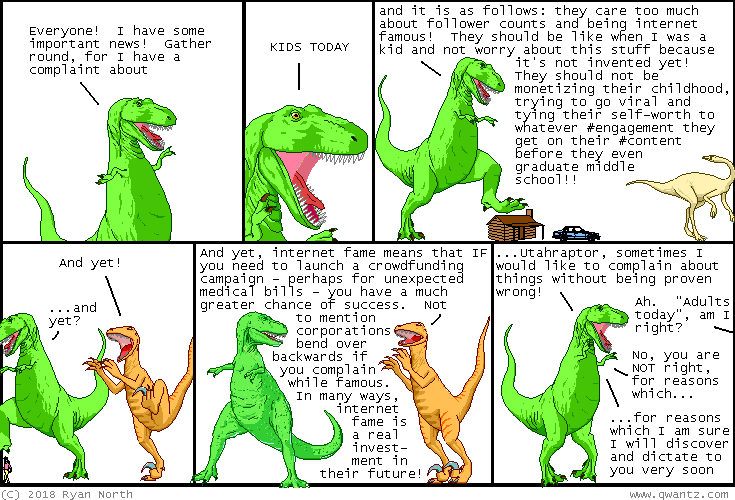
Utahraptor's pen name is the best pen name, and I hereby release it into the wild so that one day I can read the works of L. G. Beetie Hardbody III. ATTENTION UNIVERSE: DON'T LET ME DOWN

archive - contact - sexy exciting merchandise - search - about
← previous December 14th, 2018 next

December 14th, 2018: TIME TRAVEL BANDANAS HAVE ARRIVED!!

– Ryan

13 Dec 18:44

shout #out to #people who #make every #second word #a different #hashtag

archive - contact - sexy exciting merchandise - search - about
← previous December 12th, 2018 next

December 12th, 2018: TIME TRAVEL BANDANAS HAVE ARRIVED!!

– Ryan

12 Dec 00:50

Brexit's irrelevant cost

by chris

I can understand why some reasonable people want to leave the EU. What’s more puzzling is why so many think it is worth the bother. Is it worth dividing the country, triggering a political crisis worse than 2008, causing a “toxic period” in politics, and stealing all cognitive bandwidth from countless other issues?

In truth, though, there is an answer here. It is precisely because Brexit is proving to be so expensive that its supporters will continue to value it so highly.

One reason for this was discovered back in 1959 by Elliott Aronson and Judson Mills. They got female undergraduates to undergo initiation ceremonies (pdf) into a college sorority. For some, these ceremonies were mild, but for others they consisted in asking students to read out obscene words to the group (which was embarrassing for young women in the 1950s). They found that:

Subjects who underwent a severe initiation perceived the group as being significantly more attractive than did those who underwent a mild initiation or no initiation.

This corroborated their prior belief that “persons who go through a great deal of trouble or pain to attain something tend to value it more highly than persons who attain the same thing with a minimum of effort.” Locke-1024x576

Dan Ariely has called this the Ikea effect (pdf). If we go to the trouble of schlepping to Ikea and then assembling one of its bookcases, we value the product more. As he says in Predictably Irrational: “The more work you put into something, the more ownership you begin to feel for it.” John Locke’s idea that we come to own something by mixing our labour with it might be bad law and terrible history, but it’s beautiful psychology.

By the same token, the very fact that Brexit is proving so hard to achieve will cause its supporters to value it so much. Far from applying the very wise Cushnie principle - “it’s not worth the bother” – they are as determined as ever to see Brexit through.

Aronson and Mills thought that what goes on in these cases is a form of dissonance reduction – an attempt to reduce the conflict between two apparently conflicting beliefs. So, if you believe “Brexit is good” and “Brexit is hard to achieve”, you reconcile these two by thinking that Brexit is so valuable that it’ll be worth all the sacrifices.

As Robert Cialdini says in Influence, we have a huge desire for consistency – no only to hold consistent beliefs at the same time, but to have consistent beliefs over time:

Once we have made a choice or taken a stand, we will encounter personal and interpersonal pressures to behave consistently with that commitment. These pressures will cause us to respond in ways that justify our earlier decision. (Influence, p57)

Marketing departments, of course, know all this. Financial advice and university textbooks are expensive not only in an attempt to signal quality, but also to induce choice-supportive bias – to get us to think “this must be good: I paid so much for it.”

Critics of mainstream economics might see this as grist to their mill. Orthodox micro assumes that for individual consumers price and marginal utility are separate things. They are, for expected marginal utility. For experienced marginal utility, however, they are not: a high price can give us higher experienced marginal utility.

 This, though, is a side-point. The main point is a depressing one. The high cost of Brexit, far from being a reason not to leave the EU, is only entrenching Brexiters' opinions.  Which means that the divisions Brexit is causing will last for years.

09 Dec 22:25

when the gang chooses you: or how the puffin club turned me into a punk rocker

by mark sinker

[This post originally went up at my PATREON: subscribers get to read posts and hear podcasts early — and help offset costs and time and help me do more of this kind of thing. Please share widely and encourage participation in the comments!]

This is a lightly edited extract from a piece I wrote for Frank Kogan’s fanzine WHY MUSIC SUCKS (#11, pub.June 1997). The topic was “My First Record”; some of the tone is me not quite sure at that time who I am as a writer any more, especially in this context. All the square-bracket interpolations and footnoted annotations are new.
[…] The first LP I bought was almost certainly Slapp Happy’s Slapp Happy [in 1976]. It was on bargain offer in a local shop, and I remember the grins on the faces of the shop girls when I took it off their hands. But it was very nearly – which would have been hilarious – Metal Machine Music, which was in the same bargain bin. For some reason I decided against MMM. I think that I decided it was too popular: or – since this makes no sense – that someone I knew would have bought it, so I didn’t need to.

Between these points [i.e. 1967-76], ten years of what? [Footnote 1] Growing up in the depths of England’s rural midlands, isolated from kids my own age [2]. My parents aren’t puritans; I was forbidden nothing [3]; but living in the deep country I had no access, except to books, and no idea of what I was missing. I spent my time reading reading reading, till places like Narnia and Moominvalley seemed real and familiar, and the outside world grey, pale, without energy.

[When I got to secondary school] and began to hang out with kids who talked about rock, my solution to not being up to speed was straight out of Alien Nation [4]. The off-worlder studies the host culture’s ways diligently, committing all trivia to memory, just in case. Soon he can pass as human: or will some ridiculous detail be his downfall?

I bought a book in 1977: The NME Book of Rock, a chubby little pulp-encyclopaedia of pop [5], and read it cover to cover, committed it to memory, and turned myself into a little book-based expert [i.e. on records and in music I wouldn’t actually hear for years]. More importantly, though, I read in it that a man called Tony Palmer (a British TV director in the 60s) who’d heard no rock until 1967, when he read about Sgt Pepper in The (London) Times, had asked a friend for Ten Essential Albums, and become a professional national rock critic within the year. [6]

I decided to do the same. But I went further, polling maybe 30 people. NOT all in my immediate gang, and several not even close to being friends. I ended up with a list of maybe 100 records [7]: all LPs (a fact of significance, though I didn’t yet know this). I had no record player, but my sister did have a little tape-recorder/cassette player. Everyone played tapes then anyway – it was the era of the portable cassette-machine. I borrowed tape after tape, writing careful critical notes — subjective? ignorant? innocent? pure? — marking everything out of five. When they played stuff at school on their little machines, it had to be quiet (it was school). At home, I played things even more quietly. Some of this rock stuff sounded very nice; very little hit me particularly hard (all those touches of classical imitation). Three exceptions: Patti’s Horses, 666 by Aphrodite’s Child, Camembert Electrique by Gong.

Mainly there was a central cluster of Progressive Rock: the gang’s median taste, its mainstream: Pink Floyd, Yes, Genesis, Purple, Rainbow, ELP, Barclay James Harvest, Wishbone Ash. I was also now listening to John Peel – very very quietly – every night (on a tiny little radio, under the bedcovers), and reading the weekly rock papers, as assiduously as Talmud. There were then four in the UK: NME, Melody Maker, Sounds, and Record Mirror [8].

[From the four weeklies and Peel] I learnt that prog rock had gone out of fashion, very suddenly, about six months before I began this project. Just as I began my big daft quest, punk had invaded. Though mostly younger than me, the gang I had till then imagined hipper than me were already beached by history — and I was beginning to exchange this briefly desired companionship, of those to hand at my school, for the idea of a gang I knew was better. A virtual gang, an imagined community: a mass movement without local representatives (except for me, of course). This was easier than it may sound. [9]

Rock-paper language was just then full of praise for punk because it spoke “ordinary language” about “everyday, relevant things”. But urban rage wasn’t ordinary or relevant to my initial gang — nor to me [10]. This was a rhetoric my to-hand gang resisted: you could even say they saw through it. ’ But I loved it for its non-ordinariness, and bought straight into it. I entirely convinced myself that, as Simon Frith would say, reality was what happened elsewhere. [11]

My secret reason for finding punk both comforting and alluring was its yen for absolute moral conflict: when I gazed at grainy photos of dark rooms full of odd-looking people and occasional shiny gleaming things (guitars, mike stands, Siouxsie Sioux’s eyes), I was thrown straight back into a world I was already perfectly familiar with, and happy in. Children’s books are thick with absolute moral conflict, odd-looking people, occasional shiny gleaming things (swords, stars, Lúthien Tinúviel’s eyes).

I loved the idea that somewhere in the world, far away, were people whose “ordinary everyday” shared tone and texture with my utterly personal totally bookish world of moral quest and the innocent but determined defeat of evil, of small bands of small folks against the dark forces. Goblins didn’t exist, but Johnny Rotten did. I might even meet him [12].

However this gang-transfer did not happen immediately. [13] It was preceded, or in fact accompanied, by a failed transfer into a rival virtual community. One established less by reading than by listening; but again one that demanded I gravitate to the real, familiar energy of the imagined, and retreat from the pale grey failure of my immediate surroundings. [14]

The poll returns that intrigued me most even then were the ones that failed to fall into any pattern, the replies of those without group allegiance, the bands who the rock papers seemed to have little or no [current] attitude towards. Lone votes for Sabbath, Tull, Bethnal [15], Rory Gallagher, the Groundhogs. And beyond this, the eccentric – because so casual and so ill-considered – votes of a guy called Peter, who everyone called Tool. [16] He’d voted for the only three records he knew. He brought them to school, but he didn’t own them; they were his sister Nora’s: In Hearing of by Atomic Rooster, 100 Ton Chicken by Stan Webb’s Chicken Shack, Camembert Electrique by Gong. The first two were very minor BritBluesBoom groups, just as it began shading into Prog Rock (Christine Mcvie, then Christine Perfect, later of Fleetwood Mac, sang for Shack; co-founded by Carl Palmer, Rooster were an offshoot of The Crazy World of Arthur Brown, though Palmer had left for ELP by Hearing-time).

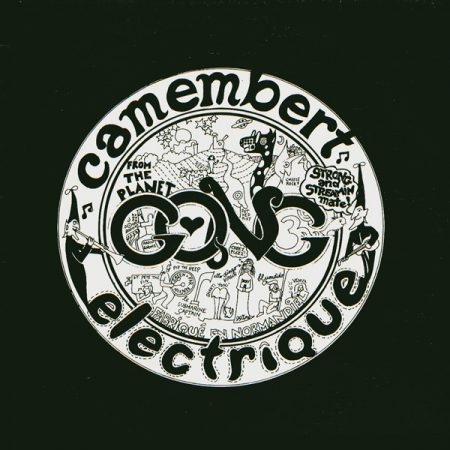
But Gong were completely different. For a while (c. 1971-72) France’s most popular avant-garde free-rock group, they were pluperfect Euro-hippy anarchists, playing disorderly spacerock that would have been jazz-rock if they hadn’t been so out of it. (Indeed, the more time passed, the duller and more jazzrocky Gong became.) They lived in a chateau-commune in rural France (there was a picture on the sleeve: it looked like a shabby mountain farm). They gave themselves cartoon names (sax and fluteplayer Didier Malherbe was Bloomdido Bad de Grasse: the only one I can remember), and there was some elaborate though never-explained mythology involving the moon, Tantric sex, weed, teapots, pixies, and the poet John Donne. Their bossman was an already aging Australian ur-beatnik called Daevid Allen, who had been buddies with minimalist tape-looper Terry Riley and also a founder of Soft Machine. This particular record you could find all over the place in those days: it sold for 99p only, when LPs were £3.99 or £4.99. I didn’t buy it at the time: we just played Pete’s copy (including playing frisbee with it and walking on it).

I never met Pete’s sister Nora. Her taste intrigues me.

With its black-and-white hand-drawn sleeve, handwritten song titles, fuzz of marginal jokes, Camembert Electrique was a fabulous detailed microworld to me: an explosive little 1968 in my own heart. It wasn’t the drug references, which meant nothing to me: it was the sense that this cartoon world was extended and internally consistent (as subsequent exploration proved it wasn’t) [17], that you could leave the beckoning dreary straight world, and make off into this alternative space. I wanted to hang around and do nothing and grow my hair really long and have a funny cartoon name in a Chateau in France. Under the paving stones, the Chateau.

Most of the record was formless, shapeless, draggy wandering, with funny little sound effects (a sort of chuggy clockwork object panned slowly across the stereo-image at one point). Allen couldn’t sing – he kind of spoke ‘poetry’ in a mimsy way. But there was also this one perfectly simple, hypnotic, unforgettable bassline, which I loved then, and love now (everyone loved it who heard it). I gave the record five out of five. No one seemed to understand why. (Even Pete didn’t like it that much. He voted for it because it was his, not because it was good.) I know why, now: I knew that one day I would love and understand as much as I did that bassline all the bits of the record that irritated and puzzled me. I wasn’t ready: but with study this understanding would come.

If people thought this polling project was weird at the time, they never said so. Of course, for years, I thought it was: I never spoke about it, never liked to think about it. It was proof that my rock roots were none too deep, and startlingly inauthentic. [18] The getting of wisdom demands that the mechanism of its attainment be rejected. […]
FOOTNOTES:

1: The 10-ish years covered the time from the first LP that mattered to me, though bought by my dad for my mum: Sergeant Pepper. Here’s a post on that.

2: Isolated by geography, not temperament: welcome to the countryside, where your closest schoolfriend lives 10 miles away.

3: This seems an odd thing to say: like they always inatantly bought me a pony and a sportscar and every double album I desired. What I mainly meant was they they didn’t at any point seem to disapprove of my interests and sense of life-direction as a writer. (And for “aren’t” read “weren’t”: mum died in 2005, dad in 2010, and I miss them.)

4: lol does anyone even remember this TV series, once salient and much-discussed? Probably a more exact reference for the thing I’m talking about is The Man Who Fell to Earth — at least people have actually seen it in living memory.

5: There were three editions of the NME Book of Rock: 1975 (Star Books, ed.Nick Logan and Bob Finnis); Feb.1977 (Star, ed.Logan and Bob Woffinden); Nov.1977 (Salamander, large format, ed.Logan and Woffinden). I own the second and third, now in terrible condition (no covers, some outer pages vanished). The late Bob Woffinden had a fascinating and exemplary second act to his career as a rock journalist.

6: Tony graciously agreed to participate in my Birkbeck conference in 2015, on an entertaining panel with Jonathon Green and Mark Pringle about how well or badly mainstream media tackled rock culture in the 1960s.

7: I wish I still had the documentation that went with this poll, not to mention the results, but it went missing long ago. A hundred seems a lot!

8: Those four weeklies in order of my engagement with them:

A: NME every week from August 1977 — I ended up writing for it and only stopped when I angrily quit in 1988 (a story I’ll tell properly another time) .

B: Sounds most weeks 1977-79: I was driven off by reviewers who seemed not to get post-punk, as it wasn’t yet called: mainly Garry Bushell and his quasi-political thuggishness, then still nominally leftwing, but also Dave McCullough’s bad review of the first Raincoats LP (grrrr). McCullough was actually an interesting writer, generally simpatico with things I liked then — The Fall — and I often wonder what became of him.

C: Melody Maker: dipped in for a while in 1977, only very occasionally thereafter. It was regarded as the most grown-up and serious, but to be honest (aged 17) I found it a bit of a chore, and its page design was pretty terrible. Bascially it had a bad punk wars and I largely missed its late 70s reflowering under Richard Williams.

D: Record Mirror: this by contrast I felt at the time was a little young for me and hardly ever looked at, which I now regret.

9: If this essay has a moral, it’s that this kind of identification can be much deeper, and more life-shaping, than the impact of the seemingly more immediate world around you (your school, your town).

10: We were rural or small-town middle-class kids. Not all my friends were middle-class — but the ones that weren’t mostly weren’t at that school.

11: This phrase was from memory, and as a result misquoted in this piece. It’s the final sentence of Simon Frith’s ‘Playing with Real Feeling: Making Sense of Jazz in Britain’ (collected in both Music for Pleasure and Taking Popular Music Seriously). The full passage is worth quoting: “To understand why (and how) the worlds of jazz (and rock) are young men’s worlds we have, for example, to understand what it means to grow up male and middle-class; the understand the urgency to ‘authenticity’ we have to understand the strange fear of being ‘inauthentic’. In this world, American music — black American music — stands for a simple idea: that everything real is happening elsewhere.” I knew this quote (and was alluding to it, even if I got it slightly wrong) because Frank Kogan had explored it in an earlier issue of Why Music Sucks. Versions of this discussion can be found in his book Real Punks Don’t Wear Black: Music Writing by Frank Kogan, in the three-page essay ‘The Trouble with the Sociology of Pop’ but also at the start of the epic 47-page (nearing 30,000-word) essay-memoir ‘Roger Williams in America / The What Thing’. Where too many present-day music-writers jump to scorn the notion of authenticity (as risible goal and reliable index of bad music), Kogan explores how the fear could be social and artistically useful and fruitful, and hence not “strange” all. There’s a reason we can’t shed it as a topic, and a reason it seems constantly to return in new form (see also footnote 18).

12: So far I never met him.

13: Since age 10 I had been a member on the distant edges of the Puffin Club. If I now began scouring NME and Sounds for details of how punk worked as group I belonged to, I was simply switching my habit away from Puffin Post, a magazine run by a children’s publisher, a monthly full of interviews and stories and competitions you could enter, and club picnics for members (which never took place in Shropshire). There was an extensive reviews section, in which insider kids got to detail in print the upcoming paperbacks they’d been given to enthuse about. I very badly wanted to be one of these insiders, and tell the world why a book I liked was good.

14: “pale grey failure…” With hindsight I’m a bit out of sympathy with this back-projecting sorry-for-myself flourish. I didn’t feel a failure as a teenager at all — I was excited and stubborn and quietly driven — and now I distrust this attempt at self-deprecation. I want to say that the late 90s is when I most felt a failure: certainly much more than the mid-70s. Probably I’ll change my mind about this too though.

15: Bethnal were a low-tier, now-forgotten pop-punk band, featuring one George Csapo on vocals and violin. Pete Townshend-approved, they made two LPs, Dangerous Times and Crash Landing. The voter in my poll also played violin.

16: This sounds mean, and how I continued it in the original makes it worse: “(because he was one”). In fact he was a sweet friendly somewhat dozy kid whose main defence mechanism was playing the clown. He was teased ruthlessly and seemed not to mind. I hope he actually genuinely didn’t mind.

17: In other words the kind of conceptual continuity that pulls people into Zappa’s world, or Pedro Bell’s cartoons on the Parliament and Funkadelic sleeves — though I never warmed to Zappaworld when I later encountered it.

18: “Startlingly inauthentic”. But startling to who? Inauthentic how? Looking back — halfway across my writing life, I guess — it’s maybe telling that this is the phrase I wave uneasily: “lol authenticity, lol young me?” What exactly is bundled up into it? What was the “unrealness” of musical and/or writerly understanding that I was claiming to find about my early anxious self, in this late-90s stab at describing my mid-80s anxieties about my 70s (teenage) self.

To wander off into a minefield of thinking aloud, it’s two things: the extent of my knowledge, and the mode of its arrival — as in, do writers ever actually understand anyone else?

(A): Was I the kind of obsessive record-collecting scholar I was surrounded by in the mid-80s? Well, no (impostor syndrome klaxon): I knew a lot, almost all gained by reading.

(B): how was this way into and what it means not just entirely at odds with the world of the cap-p Proper pop or rock or soul or jazz fan (black or white). Who had surely somehow directly absorbed the relevant language from their own local community or anyway their older siblings, or else from some bewitched engagement with “the music itself” on radio or (sometimes) TV? Or via obsessive gathering of 45s and 33s (despite 33s at this juncture being somewhat deprecated) 33?

In fact, of course (C): most strong music writers come to writing by reading. By my late teens something about it — the access it gave to something, something I still haven’t quite worked out — it had evolved into a passion, a commitment I couldn’t and didn’t sidestep. Aged 20 or so, it seemed all too belated, but being slow to get things (or to accept things?) isn’t something I’m faking, that’s for sure. In small doses with big gaps and often poor access, I’ve been listening to pop all my life.

As a teen, I wanted to know what it was about music that bound my acquaintances into groups, and could it work for me? In retrospect running a poll seems to me like a pretty smart way of tackling the not-knowing-much aspect — and as a one-off also not the worst stab at critical practice. Evidence if any were needed that being some sort of analyst of matters pop-cultural was already baked in — that it was actually what I was always meant to be. If I felt I was the wrong kind of person from the wrong kind of place back then, I stopped thinking this long ago: this is just who I am.

(D): The key for me here and now is the degree to which music-listening (and collecting and whatever other interaction is involved) bumps sideways into a world shaped by words and refashions it. A lot, a little? Does it challenge it or firm it up? Thee days I prefer always to argue for the former — the disjunction is what a critic shd be hunting for — but the latter remains common (because it seems more normal?) and this (for non-writers?) functions as “the real”. Of course Kogan’s argument here would be the value of the feeling of fakeness — the worry that as a rockwriter I’m not a real rockwriter — is that wrestling with it is what helps drive you towards superior work.

How real is “superior work” though?
No amount of politics or philosophy or theory or backstory or practical musical experience — knowing how to play the changes for ‘Giant Step’s, knowing what they “mean” — are going to resolve the issue of the Correctness the Mix you hit on realness (the genuine emotional or intellectual effects) versus imagined cosplay potential, in yr stance or method or self-presentation. After all punk really did exist, albeit not as I hoped, and ditto Gong and the puffineers. And they’d gone by the time I arrived on any relevant scene. But my dream version stuck around long after, affecting all kinds of other stuff. The abiding panic that you’re getting the mix WRONG is what helps the writer to be smarter or better or deeper or more ____________ or more ____________

(Puffin Club artwork and lettering is largely and very memorably by the late Jill MacDonald… )

If you like this post, please support my PATREON which will help me write more! Also let other people know that you think might enjoy it…

06 Dec 11:38

Business Musings: Generations

by Kristine Kathryn Rusch

I write books set in the 1960s, a time of such generational upheaval that it makes the changes happening now seem tame. Maybe the research for those books (and my memories of the time) have given me more perspective than I should have at 58. Or maybe, it was in the study of history that I learned about generational change. Or maybe it was because I was raised by parents old enough to be my grandparents.

Or maybe it’s just how my mind works.

The sf field is getting hit hard right now with a clash between generations. The clash isn’t a minor one: it’s over the future of sf. It’s about bringing in diverse voices, which sf failed to do (mostly through the gatekeepers who were [and some still are] bigoted against anyone who is not a white male). Some of the voices that are coming in are strident. Many are accusatory. A few are judgmental.

All have legitimate grievances. When you’ve been pounding on a door for years, and the door finally cracks open, you don’t say thank you. You say, What the hell? I’ve been trying to get in here for a long time. Didn’t you hear me?

Some of that generational conflict broke out on social media the morning that I’m writing this. A tone-deaf member of the older generation tried to defend himself, and failed miserably. Another member (in a different genre) has attracted national news because she was so overzealous in her real world job that she literally cost young black men decades of their lives. Her behavior back then (and now) is news to some of her younger fans. It had been so long ago that I never put the writer with the prosecutor. (I don’t think she’d been writing back then.) That terrible thing she had done is back in the news—and it should be.

That’s what some of her defenders miss. We should be discussing misuse of power and the harm we do, even as we think we’re doing good.

Anyway, that political stuff belongs in a political blog. I had scheduled this morning to write a blog about the writing business, but I can’t get this political stuff out of my head.

I went into my office and grabbed Emilio Estefan’s The Rhythm of Success, and Creative Quest by Questlove (with Ben Greenman), remembering that I wanted to analyze points in both of them. (I will be writing a year-end wrap up, but that will take time to finish the research, which I started just this week.)

As I touched the Questlove book, I remembered one of his points that I was going to examine further, one that’s relevant to today.

First, let me remind you that Questlove’s book is on creativity.  I recommended it in my Recommended Reading list in August, and mentioned it on a few previous blog posts. Creative Quest is one of the best books I’ve read this year. I’m still noodling some of the points he made.

Questlove is a musician who got his start in high school (at Philadelphia’s High School of The Creative and Performing Arts) in the late 1980s. The Roots officially formed in the early 1990s, and was part of an influential wave of musicians who did not have great chart-topping success (that would come later) but became major influencers at the time. Y’know, the hot new thing.

One of his final chapters focuses on success and failure (in the same chapter). There’s so much to unpack here that I set it aside, thinking I would deal with it later.

Later is today—at least for one tiny section of those chapters.

He deals with generational change. He expresses it in metaphor.  (which is probably why I like the book: I think in metaphor.)

Once, as a young man, he walked along a train track after a train had left and wondered how long he had before another train would mow him down. He moved that physical thought into the creative realm.

How long does an artist have alone on a track, heading to the future, before another artist comes up behind him, and takes his place?

Questlove knows that art isn’t a zero-sum game. He doesn’t mean that only one artist can be on that track at one time. He really is discussing being the cool, the new. The person creating the wave, or riding the crest of the wave. Being the cutting edge.

That’s the focus here.

Because being the cutting edge is addictive. And it makes an impression on our brains as artists. Some artists continue to chase being cutting edge (which puts them behind the cutting edge train, to use Questlove’s metaphor). Others loudly defend that they once were cutting edge. And some move quietly forward, learning and growing, and accepting that they can only be cutting edge once in their careers.

Judging from this book, Questlove and the Roots belong to the latter group. Yes, they’re still learning and growing, but they’re never going to be the hot thing again. They might become more popular than they were in the beginning, but they will never be that new, surprising voice again.

We only get one chance at that.

Questlove reports a conversation he had with singer, songwriter, and producer D’Angelo who got his start a few years after Questlove and was part of that group of influencers. They were discussing Donald Glover, but not in his acting/producing capacity, but as a musician. As a musician, he uses the stage name Childish Gambino.

The discussion was about competition, and usefulness, and—important here—influencers. Both D’Angelo and Childish Gambino had the same influences (Smokey Robinson, Curtis Mayfield, Prince) but D’Angelo felt that Childish Gambino wore those influences “like fashion.” D’Angelo felt that Childish Gambino was, in a word, copying him and did not deeply understand the influences he was referencing.

Questlove wrote:

I told D’Angelo that I agreed with him—but that he had to realize that he was an oldies act, too….His debut album was more than twenty years old. His hugely influential second album was more than fifteen years old. His innovations—the way he understood hip-hop, the way he arranged vocals, the way he moved through a melody—had been in place for a long time. If a new artist was imitating Smokey Robinson, they were also almost certainly imitating D’Angelo. [Creative Quest, Ecco, 2018 P. 266]

I’ve written before that very few artists (of any stripe—musician, writer, actor) maintain a career (once they’ve become known) for longer than ten years. Most of the reasons for that are business-related, and not relevant here.

But what is relevant here is that we often don’t discuss how it feels to be an artist who is no longer cutting edge. Because we’re still in our heads. We remember what it was like to be the hot new thing. We are also still growing and changing and improving as artists—or we can only hope we are.

This bit on D’Angelo and Childish Gambino comes in a section on success and failure where Questlove discusses competition. He adds this to the observations above:

[These new artists] are advancing the D’Angelo sound just like Childish Gambino is advancing the P-Funk sound. They are imitating, but not just imitating—they’re absorbing, digesting, and remaking, both representing and re-representing. And, because D’Angelo is still active, all this imitation is a form of competition. To me, that’s a good thing, and possibly a great one. It reminds us that we’re all on the same track, and that what goes around always comes around. Think about the trains. Never forget that they’re on their way. [Creative Quest, Ecco, 2018 P. 266]

I love that analysis. Not just because it’s warm and understanding, but because it captures the ambivalence that older artists have toward newer ones—and the way that newer artists behave.

The newer artists are absorbing what came before. Earlier in the chapter, Questlove wrote, “You don’t pick where your inspiration comes from.” [Creative Quest, Ecco, 2018 P. 265] You might not even know.

So as older artists, when we shout that we had done this, or we should be respected for that, our cries often fall on deaf ears. Worse, they seem more like a shaking of the fist followed by Get off my lawn.

Some generations do not respect the previous one. That’s what my history background and look at the 1960s showed me. The 1960s generation (who are in their 70s and 80s now) did not respect anything about their parents. And in sf, at least, that same attitude has come around. The new sf generation doesn’t respect the generations that came before, even as the work of the new sf generation builds on the tropes and stories that those generations told.

A lot of the work I’m reading from the hot new things can be seen as horribly derivative. Or it can be seen correctly (at least, I think correctly) as remaking old stories and telling them to a more diverse world. As Questlove said, They are imitating, but not just imitating—they’re absorbing, digesting, and remaking, both representing and re-representing.

And thus, art moves forward.

Where does that leave the still-active older generation of artists? Well, we can fight and say that our work still matters (Oh, and get off my lawn!) Or we can see this as a natural and healthy progression in art.

The best artists continue to learn and grow throughout their careers, accepting that they’ll never be new again in a cutting edge way. But they can be new to a new generation.

That doesn’t mean co-opting that generation and trying to tell their stories.

It does mean that the older artists need to continue to learn and grow. Older artists have a mastery that the younger ones will eventually acquire (if they continue to learn and grow). Older artists have a lot to say, not just to their generation, but to newer generations. As long as the older artist remains authentic, telling their truth.

As I was writing this, I took a break and scanned Entertainment Weekly from November 30, 2018. Leah Greenblatt’s review of Mariah Carey’s new album reinforces the point I just made (and made me chuckle at the serendipity). Here’s part of what Greenblatt wrote:

To say “a star is born” isn’t a story, it’s an intro. A thousand shiny comets have streaked across the Hot 100 before disappearing into the faraway ether of where-are-they-now; only a very few turn fame into a long game. Mariah Carey is one of those rare supernovas, with the stats to prove it….

…Carey is no longer at the white-hot center of the zeitgeist….but [the album] is a tart reminder that even when the new school rules, there’s still room for the classics.

Whether Questlove intended it or not, part of what he wrote here is a treatise on how to have a long-term career. I’m always studying artists who made it past that ten-year cutoff. (And it seems shorter for indie writers, maybe because they’re more in control of their finances so things implode faster.)

One artist I’ve watched in the past ten years is Tony Bennett. He still sings the standards, beautifully, in a way that no one else can. But he also works with younger artists. He worked with Amy Winehouse (and she broke his heart when she died). Then he worked with Lady Gaga. Their collaboration transformed both of their careers, not just in sales, but in the way they approach music.

In fact, at her residency here in Vegas in 2019, Gaga will perform her big stage show, and a few stripped-down jazz shows—jazz shows she wouldn’t have done without Tony Bennett.

There’s a value for the newer artists to embrace the older ones as human beings, but it’s not a requirement. Some generations don’t embrace, and some can’t—the divide is too big.

But the influences are there, whether they know it or not. They’re absorbing, digesting, and remaking, both representing and re-representing. And the older generation, if they’re smart, should take a leaf from Questlove’s book, and celebrate the changes.

The genre—the art—the music—those things will change with or without our permission. It’s better to listen and learn, to absorb the newness and not try to imitate it, but see it for what it is—the trains, moving forward on the track, the familiar track, that we all enter at one stage of our artistic lives—and stay as long as we possibly can.


I want to write that this blog post came courtesy of Twitter, but really, it comes from social media in general, and paper books (the Questlove) and paper magazines (EW) and online newspapers (the LA Times) and a conversation with a friend. Just the way the mishmash works in 2018.

Here’s the reminder, though, that my nonfiction blog is reader supported. I like interactions and shares and letters and (polite) comments. I also appreciate the donations that come my way.

If you want to donate regularly, go to my Patreon page. If you want to make a one-time contribution, use PayPal below.)

I know that the focus on donations makes some of you uncomfortable because you can’t afford to donate. I understand. I’ve had to make money stretch in my past as well. If it really bothers you, do me a favor. Go to your local library and request one of my books. That way, the books get into the library system and you’ll be supporting me in a different (and valuable) way.

Thank you all for the support, and for visiting every week. That means a great deal to me.

Click paypal.me/kristinekathrynrusch to go to PayPal.

“Business Musings: Generations,” copyright © 2018 by Kristine Kathryn Rusch. Image at the top of the blog copyright © Can Stock Photo / andrewgenn.

05 Dec 15:25

"Chaos" with Ed Miliband

by chris

David Cameron’s infamous 2015 tweet that we face a choice between stability and strong government under him or chaos with Ed Miliband has long become a joke – a cliché, admittedly, but a good one. In a sense, this is unfortunate because it contains some truth: from a Tory point of view, a Miliband government would indeed have been chaotic.

This isn’t because he too would have unleashed the Brexit clusterfuck. He wouldn’t. Back in 2015 less than 10% (pdf) of voters thought that the EU was the country’s most important issue. Cameron called a referendum not because there was mass pressure for one but to try to silence a handful of cranks in his own party. Miliband wouldn’t have needed to do that. CameronCm--ajmWIAAC2es

Instead, he’d have caused “chaos” in three other ways.

First, his administration would have seen policy mis-steps, poor administration and ministerial gaffes: all governments do. Because political reportage lacks perspective, hyper-ventilating reporters would exaggerate these into episodes of grave perils. What Michael Oakeshott wrote in 1962 is perhaps truer now than then: “political life is resolved into a succession of crises.” We’d thus have “chaos” even if it were only about the misuse of paperclips at the Department of Administrative Affairs.

Secondly, the purpose of politics in capitalist society is not to provide good administration. It is to ensure the power and prosperity of the rich. Labour would not have done this as well as the Tories. Its policies (pdf) to tax bank bonuses, clamp down on tax-dodging, support coops and give workers a say on bosses’ pay were all threats to the power of the rich. Of course, they were mild ones: but faced with any threat at all, the over-entitled rich cry like spoilt brats (see Digby Jones, passim).

Remember: the Tories think the 1970s were a time of crisis and chaos. But in fact real wages rose nicely then – by 1.8 per cent per year according to Bank of England data. So where was the crisis? It was in profitability and in militant workers challenging capitalist authority.  That’s what matters.

You might have an obvious objection here: doesn’t Brexit threaten profitability? It does. But no more than it threatens wages. Brexit will make us all poorer. For many, though, this doesn’t matter because income and wealth are positional goods (pdf). As Andrew Oswald has said (pdf): “what matters to someone who lives in a rich country is his or her relative income.” For many, Brexit is tolerable because it doesn’t much disrupt relative incomes. What would be intolerable is the threat to the relative incomes of the rich posed by even the mildest of social democrats.

Thirdly, the Tories don’t understand the left*: the fact that some believe Jeremy Corbyn is a Marxist tells us this. This fact alone means that a Labour government would create uncertainty. And we’ve known ever since the work (pdf) of Daniel Ellsberg that people hate uncertainty. A Labour government would thus appear chaotic to Tories even if it looked stable to Labour supporters.

This sense of chaos would be reinforced by something else – that fact that we never see counter-factuals: that’s why they’re called counter-factuals. A world in which Ed Miliband is three years into his premiership would not be one in which there was a Jim Bowen showing voters our current Tory government and saying “here’s what you could have won”. (And even if there were, nobody would believe him.) Nobody would therefore credit Miliband with saving from the Brexit clusterfuck. And the Tories would be able to pose as a credible alternative government. The contrast effect would thus make a Miliband government look bad.

So Cameron was right. A Miliband government would have been “chaotic”. This tells us a lot - although absolutely nothing about Mr Miliband.  

* The left doesn’t understand the right either, but that’s not my point here.

04 Dec 11:50

An Interesting Fact About The Consuming Fire

by John Scalzi

A psychedelic remix version of the Consuming Fire cover

Last night on Twitter someone recounted a convention panel he’d been to, where the panelists were (jokingly) annoyed with my writing speed and publishing frequency. To which I replied, “It’s a good thing they don’t know I wrote The Consuming Fire in two weeks. That would not help things.”

To which I got more or less the following response from other writers on Twitter and in email (and I paraphrase, here): “YOU FUCKING DID NOT.”

Readers: I most sincerely fucking did.

Specifically, nearly all of The Consuming Fire was written between June 4 and June 18 of this year, the latter date being when I turned the book in, at 7:30 in the morning, having written through the course of the night. I then tried to sleep but was too tired to do so, so I went to watch cartoons and then turned them off ten minutes later, because they were too complicated to follow. Krissy tells me that by her estimation it took a full week for my brain to get back up to full speed, and that in the interim I mostly shuffled around the house with a blank look on my face. This feels accurate to me.

Why did I write the book in two weeks? For many reasons, but the simplest reason is that I had no choice. The book had a drop-dead turn-in date of June 18, and as of June 4, I hadn’t really started on it, for various reasons, some reasonable and some really not. If years in journalism taught me anything it’s that you don’t blow a deadline. So that meant I had to write the thing in two weeks.

How did I write the book in two weeks? I turned off the Internet, hid from social media, asked Krissy to occasionally slip food underneath the door, and then set a goal of 8,000 words a day. Some days I hit that goal, sometimes I didn’t, and on the final day I wrote something on the order of 12,000 words. I didn’t sleep much. I looked a fright.

More generally, I was able to write a novel in two weeks because a) my journalism training prepared me to write quite a lot of words, relatively cleanly, at speed (not to mention writing here on the blog), and b) I had at that point written 14 novels, so the muscle memory, as it were, of pacing and formatting kicked in.

Also, and this is actually important, when I say I wrote the book in two weeks, it’s rather more accurate to say I typed it in two weeks. I had been writing the book — figuring out who was doing what to whom and how and why and when — in my head for close to eighteen months at that point. When I sat down to put it into a document, the majority of the story and plot beats were figured out. There were a few surprises as I was writing; a few things happened I didn’t plan for but which turned out to be really useful, which I chalk up to my brain figuring things out on a subconscious level and surfacing them when I needed them. Well done, brain! Sorry I abused you during the writing process!

(Oh, and before you ask, I did it pharmaceutically straight, with nothing stronger than Coke Zero in my system. But there was indeed a lot of Coke Zero in my system.)

Even if I was mostly typing during those two weeks, the experience of doing such a thing is, bluntly, just a fucking horrible miserable thing which I did not like. I mean, it’s nice to know I can write a novel — and not just a novel! A good novel! That’s popular with critics and readers and has sold really well! — in just two weeks if I have to. It’s nice to know that the writing skill is there to write at speed, cleanly and coherently. But I also never ever want to have to do it again. Sure, it’s fun to be all casual about it now, and to toss off lines joking about it on Twitter like it was no big thing. But it hurt, physically and mentally, both during and directly after the writing. I’m almost 50. I can’t being doing this shit on the regular.

More to the point, not only do I never want to do it again because it’s terrible for me, but I don’t ever want to do it again because it’s not fair to the other people who work on my books. Everything about The Consuming Fire production got crunched because I turned the book in at literally the last minute. Everyone involved came through like a champ, and novel came out when it was supposed to, and looks and reads great. But I don’t want to have “crunch” be the usual mode. I don’t want to be the problem child.

This is (among other reasons) why I don’t have a book out from Tor next year. I’ll be writing a book for Tor next year (almost certainly the next book in the Interdependency series), but it’ll come out in 2020, so we can have a nice, sane production process and also, have nice sane production processes for every book that follows. I don’t regret having two books out in 2018 — they both did very well, critically and commercially — but building in a better process moving forward is going to be the best for everyone.

So, yes: I wrote The Consuming Fire in two weeks. I’m glad to have had the experience! I wish not to have it again, if it’s all the same to everyone else.