Shared posts

14 Apr 10:06

Why Form Unions?

by Erik Loomis

This is one good reason:

This is what unions are for:

Alain Sherter reports that two unionized mine workers in West Virginia were very unhappy with a company-sponsored bonus plan that the union had opposed as unsafe. So the workers returned their (paltry) bonus checks to the company inscribed with special messages for CEO Robert Murray (pictured above): “kiss my ass Bob,” and “eat shit, Bob.”

They were fired.

But then their union appealed their firings and the National Labor Relations Board reinstated them, ruling that their words were legal “expressions of protest.”

If you want to tell your boss to kiss your ass, unionize.

Pretty much.

FacebookTwitterGoogle+Share

08 Apr 15:41

How to Tell Your Spouse About Your Day

by Scott Meyer

Amongst my most cherished memories of my career as a stand-up comic was the time I was working with a comedy juggler, and the stage turned out to have a 6’5” ceiling. A tall man would have had to duck. I could stand upright, but couldn’t put my hands above my head. The juggler had to do his entire show barely throwing the balls into the air at all, meaning that his act was much more difficult than usual and much, much less impressive to watch. Good times.

There was another enjoyable evening when I worked with a magician who forgot to load his jacket with all of his props. His entire act that night consisted of him introducing a trick, patting his pockets, apologizing for not being able to do the trick, then moving on to the next trick, which he could not do. The only problem was that I had to follow him, and there was no nothing I could say that would be funnier than what he’d done.


You can comment on this comic on Facebook.

As always, thanks for using my Amazon Affiliate links (USUKCanada).

07 Apr 14:39

The sugar conspiracy.

The sugar conspiracy.
07 Apr 14:17

Some notes on world building

by Charlie Stross

Last Sunday I gave a brief talk discussing world-building in SF/F at the Edinburgh International Science Festival.

I've been quiet since then because of a combination of work and a stomach bug. Meanwhile, here's the outline for my talk. (Yes, it's fully collapsible/expandable.)

07 Apr 11:36

Are the good times really over for good?

by Fred Clark

Country music legend Merle Haggard has died. He was 79. But then I think he was always 79.

“Haggard didn’t just sing about the life described in country songs,” CNN’s report says. “He lived it”:

His father died when Haggard was a child, and he ran away from home and later served time in prison. He drank — one of his best-known songs is called “I Think I’ll Just Stay Here and Drink” — and partied. He was married five times.

Haggard’s song titles were plainspoken and evocative. “I’m a Lonesome Fugitive.” “Sing Me Back Home.” “Branded Man.” “The Bottle Let Me Down.” “If We Make It Through December.” He may not have written all of his hits, but he sang them with a pure feeling that left no doubt of the pain — and the joy — inside.

He wrote and sang some terrific songs, and he collaborated and hung out with some of my favorite artists in the world of country music, but I had a hard time getting past Haggard’s angry right-wing tribalism (whether he meant any of that, or if he was just selling records, isn’t clear, but also doesn’t really matter). He spent too much time and energy drawing lines and peeing on trees to mark his territory for me to ever regard him fondly. He helped spawn the current brand of country music that’s about being country music — tribal boundary-keeping that masks the fact that most of it’s just pop-rock sung with a Southern accent.

KennedyCenter

Merle Haggard, Oprah Winfrey, and Paul McCartney were honored at the Kennedy Center in 2010. That may be the only possible sentence including those three names.

So I’ve never quite absorbed whatever it is that made Merle Haggard the favorite right-wing singer of so many progressives. The terrific 1990 New Yorker profile by Bryan Di Salvatore that Erik Loomis links to there discusses a similar frustration:

It is an unfortunate irony that Merle Haggard, probably the most musically diverse singer in country music, should be inextricably linked with a casual ditty — a passably catchy tune — that shifted attention from his musicianship, which is highly articulate, to his politics, which are not. …

Over the years, Merle’s explanation of the impulse behind “Okie” has varied, and his basic political orientation — an instinctive right-wing populism — has found expression as everything from stouthearted flag-waving to the maunderings of a day drinker down at the corner tavern. Merle doesn’t read much. … He has also said that his heroes, in addition to his father, are Bob Wills, Joe Louis, Bing Crosby, and Franklin Roosevelt, and that “evolution is a laughing matter for anybody that’s got a rational mind.”

It wasn’t just “Okie From Muskogee.” Haggard returned to those hippie-punching, white-patriot themes repeatedly. Again, maybe that was just an attempt to recapture the commercial success of “Okie,” but the effect matters more than the murky motive.

Last month, David Roberts offered a long, smart, insightful and empathetic discussion of “White working-class nostalgia, explained by John Wayne.” You should read the whole thing. Roberts, I think, does a terrific job of exploring the dreams and desires of the sort of angry white folks who are now rallying behind, of all people, Donald Trump and his call to “Make America Great Again.” (It parallels much of what I said — with less patience and sympathy — here.)

But if you haven’t got time to read the whole thing just now, watch this instead. This is Merle Haggard singing his 1982 song “Are the Good Times Really Over For Good?” in 2011:

Click here to view the embedded video.

Pay attention particularly to where the audience cheers. That’s what Roberts is talking about.

The real tragedy of that schlocky, tribal anthem, though, is that Merle Haggard was capable of so much else. He could have written a love song — or a divorce song — titled “Are the Good Times Really Over for Good?” and it surely would have been as haunting and heartbreaking as the unspoken resignation of “If We Make It Through December.” The man really could sing, when he wanted to.


07 Apr 11:10

KYLIE MINOGUE – “Can’t Get You Out Of My Head”

by Tom

#910, 29th September 2001

kylie head Between its two writers and its performer, “Can’t Get You Out Of My Head” is the sound of over seven decades’ pop experience. It’s better heard as distillation than prediction. Maybe its bright, brisk pop-dance sensibility comes from Cathy Denis. Maybe its moreish chunkiness, the crunchy stomp of its beats, comes from Mud’s Rob Davis. Its obvious comparison point, as a mantric, obsessive disco song, is Donna Summer’s “I Feel Love”. But “I Feel Love” risks goofiness in placing a wager on the future – I bet this isn’t a novelty record – while there is no risk of “Can’t Get You Out Of My Head” being anything other than a classic. As Kylie Minogue knew, the second she heard the demo.

“Can’t Get You Out Of My Head” is still sleek and clean, impeccably designed, full of beautiful textures. If “I Feel Love” was a kiss blown to an imagined future, “Can’t Get You Out Of My Head” is an engineer’s fond response now that the imaginary has come true, more pragmatic but just as heartfelt. Moroder and Summer’s song was a jet pack. Dennis, Davis and Minogue’s is a map of flight plans. It’s a crystal of a record, an omnihedron revolving gently at the centre of pop, refracting and reflecting the 20th century’s music. In a context of Atomic Kitten, DJ Otzi and Blue, you might weep for joy on hearing it. It’s so well-arranged, so uncluttered, so satisfying. But the joy is partly one of familiarity. Ever since “Telstar”, people imagined 21st century pop would sound a bit like this. “Can’t Get You Out Of My Head” isn’t futuristic, it’s the fulfillment of a promised future.

But these were hard times for promised futures. Between the song’s release to radio and its reaching number one, another 21st century was cancelled, just as we were getting used to it. It crumpled into ash and smoke and broken glass, live on every television. In Grant Morrison’s Zenith, from 1993, an acid house robot announced that “Kylie is Vera Lynn for Third World War!”. One of Morrison’s glibly perfect one-liners, I couldn’t get it out of my head. It stuck there like a song’s hook until one day I realised it had come true.

How does pop react to history? There’s a respectable way: the path of overt commentary, song as a response to events. Protest music. Charity records. “Ghost Town”. “Candle In The Wind”. But the world doesn’t pause for the appropriate song to come along and you find resonance where you can. So there’s a less respectable way too, where history meets pop furtively, leaves lovebites or punctures on its neck. It’s the way where once you listen enough you can start turning every hit from the late 60s into a song about Vietnam, where critical alchemists can draw mischievous connections, trace aetheric lines of influence between the turning wheels of history and the minutiae of pop.

September 11th stymied pop on the first, more formal level. “Who the fuck knocked our buildings down?” yelled Ghostface Killah on the Wu-Tang Clan’s “Rules” that November – but such blurts of early, honest confusion were quickly forgotten exceptions. Even when more sombre, measured responses emerged, they carried most weight in their makers’ histories: here’s Springsteen’s take on things. Here’s Green Day’s.

But on the second level, where pop threads itself into events unconsciously, the game was more open. It may seem ludicrous to talk about Kylie in the context of 9/11, but within a day or two of the attacks, people I know had groped their way to a response, that response being “let’s put on a club night to raise money.” And on that night, the UK’s number one single was played at least three different times, even though if you’re not Kylie it’s a slightly clumpy song to dance to. So Kylie was there, part of the context, swallowed by faraway events like everyone else. But also something normal, something to agree on while the world tilted: a great pop record. So why was it great?

Kylie’s voice had worked on the PWL records, a cheerful squeak, thin enough to flatten itself against the tinfoil production and slice through the radio. But as her material turned more to pastiche – the opulent pop of mid-90s Kylie, the model disco of Light Years – I found her voice a nagging weak spot, whose reediness the painstaking production only emphasised. Those tracks were houses too big for her to live in. Her voice isn’t exactly stronger on “Can’t Get You Out Of My Head”, but it’s far more versatile, clucking the opening lines, rising to the big “set me free” moment, and finding a breathy register for “forever and ever and ever” that’s half-bewitching, half-bewitched. This is not a song designed for a singer to dominate, more to explore, and marvel at as it unfolds: Kylie is perfect for it, singing the “la la la” hook like she’s just thought of it.

The song she’s wandering through is a stately home of disco: half palace, half museum. “Can’t Get You Out Of My Head” is never overdone – it chooses its sounds sparingly and each has a role. The string line accentuates the singer’s yearning. An electric piano wanders through the mix, quizzical and playful, a counter to the track’s unflappable rhythmic glide. And then there are the song’s keyboard lines, rigid to the point of being comical: stiffly ascending, tick-tocking away for a few beats then just as precisely descending. It’s alienating and comforting at the same time, like Kraftwerk robots playing “The Grand Old Duke Of York”. And it makes me think of one of the song’s antecedents, Daft Punk’s temple to repetition, “Around The World”.

Michel Gondry’s video for “Around The World” took the ‘dance’ in ‘dance music’ and smuggled ‘interpretive’ in, turning the abstraction of techno into figurative delight. The clockwork busywork of its costumed performers found a beauty in routine and an odd joy in loops. “Can’t Get You Out Of My Head” is that song’s cousin, its surreal phalanxes of dancers making Daft Punk’s bewildering abstract representational. Now the loops are about something – the unceasing lock-groove of obsession. Now the dance revolves around someone – impossible princess Kylie. But the loops and the dance are still beautiful – charming and soothing.

As a song about obsession, though, “Can’t Get You Out Of My Head” is deceptive. It threatens to take an easy but effective route, obsession as an undertow pulling you down to madness. “There’s a dark secret in me” – but this also seems like the song’s biggest lie. Where is the darkness? Nowhere you can hear. The song is a labyrinth with no centre and no minotaur. “Set me free” sings Kylie. In its maze of loops, the song inverts itself. “Stay forever and ever” sings Kylie. The obsessive stops being the singer, starts being the listener, the hooks swirling round their head. The substitution hardly feels unpleasant.

Outside Kylie’s dream city, George W. Bush was issuing pop culture with its draft papers. “Get down to Disney World in Florida,” he implored American families, “Take your families and enjoy life, the way we want it to be enjoyed”. The pleasurable was now political. After shuddering for a few weeks, the world economy took Dubya’s hint. The next few years of Popular, the fever years of a false boom, see pop at its most giddy and glitzy, its most shirt-rending and sanctimonious, its most cynical, and often its most divisive. From reality TV to blogosphere feuds, pop was a zone of argument. But “Can’t Get You Out Of My Head” stands apart from all that, everybody’s sweetheart and nobody’s cause. At once seductive, enigmatic and cosy, “Can’t Get You Out Of My Head” was a hit people could get lost in, complete in itself. An unshaken kaleidoscope.

07 Apr 09:48

Thursday Shaboganing

by Jack Graham

Bit of a loose collection of bits and bobs this week. I've been both sick and very busy.

Firstly, I was recently a guest on the excellent They Must Be Destroyed On Sight! movie podcast, chatting with hosts Lee Russell and Daniel Harper (who is also, as you all must surely know by now, the co-host of the Oi! Spaceman Doctor Who podcast, and an online mate of mine). Check out my episode here (and check out TMBDOS’s other episodes because they’re worth it). In my ep, we chatted about the 1983 Coen Brothers debut Blood Simple (thus making the podcast kindasorta another bit of Eruditorum Press’s now recurring but irregular ‘Minnesota’ series... even though Blood Simple takes place in Texas) and the 1986 David Lynch masterpiece/freakshow Blue Velvet.

Blue Velvet is 30 years old this year, and a restored print is currently enjoying a limited theatrical re-release. It’s almost as worrying, baffling, and brain-frying as it ever was, though obviously it now exists in the context of three decades of subsequent American cinema at least partly shaped by its impact.

On that subject…


Blue Velvet (Just Some Stray Thoughts I Wish I’d Been Able to Develop in the Abovementioned Podcast)

One line of criticism praises the film as an expose of the dark, secret heart of American life. Lynch opens the film with white picket fences and other evocations of suburban American dreaminess. Eventually, of course, we are drawn into much darker and deeper waters. Another line of criticism critiques the film for keeping the dark world and the light world so separate. There are areas of interpenetration, but generally all the evil happens in the seedy, slummy, dark places where disreputable, sleazy, criminal people live. The nice people from the nice neighbourhood nearby might be fascinated by the darkness, but it is fundamentally alien to them. They go to it; it comes to them… but the darkness is not of them, or of their world.

And it’s true, Blue Velvet is not about the hidden horrors of a small town per se. But nor is it quite true to say that the horrors are entirely alien to the middle class and suburban people who discover them. First and foremost, the ‘nice’ characters are irresistibly drawn to the ‘nasty people’. Secondly, they dabble in the same vices… just in their own prettied-up, gentrified, morally-secure, arguably hypocritical ways. Thirdly, they seem less alive than the people in the nasty side of town. Fourthly, they derive their fullest and deepest senses of self from their interactions with the darkness, and the darkness suffers at their hands... though Dorothy ends up better off for her contact with Jeffrey... but then that's part of the exaggeratedly happy, almost sarcastic, Sirk-esque happy ending.

There is a deeply-rooted ambiguity, much as there is in a film from which Blue Velvet obviously draws, Hitchcock’s Shadow of a Doubt. (Shadow of a Doubt, by the way, features Agent Jack Graham, coming to Cutesville, USA and loving it, much like Special Agent Dale Cooper coming to Twin Peaks.) In Shadow of a Doubt, ‘Uncle Charlie’ visits his sister and her family in about the sweetest little burby burg in America. Trouble is, he also happens [SPOILERS... for a film that must be getting on for 70 years old] to be a serial killer, who strangles old ladies to get his hands on their money… and also because he really, really hates women. He’s a Man Going His Own Way and, like all such men, he’s obsessed with women, and with how much he hates them. His niece – also ‘Charlie’ – starts to suspect him, and all sorts of tense goings-on ensue, spiced up with all sorts of incestuous and Freudian implications. The story is ostensibly about a nice version of American life invaded by an external evil… and yet ‘Uncle Charlie’ really is family. He is of the bright, cute, picket-fenced world. He left it and came back, but he still grew there.  His personality was formed by the same social millieu that formed his daffy, conventional, sweet-natured, domestic wife of a sister.  There’s nothing quite like that in Blue Velvet, but there is something in Shadow of a Doubt that is directly mirrored in Blue Velvet. At one point, Charlie and Uncle Charlie end up in a subterranean dive in the icky part of town, and Charlie is recognised by one of the waitresses - they’re the same age, presumably went to the same school, but one ended up underground while the other stayed up in the light. There's an uncomfortable moralistic edge to the way the aitress is portrayed as dopey, mopey, eyes unfocused, voice drawling, whole personality steeped in lassitude... yet there's a sense that Charlie's perkiness is almost in inverse proportion to the waitress's depression.  The falling of one is the rising of the other.  There’s a sense that the underground world has to be there, so as to swallow up all the people spat out by the world above. There’s a similar sense in Blue Velvet of the symbiosis of the two worlds. If Frank Booth and his cronies are the bugs in the undergrowth of the sunlit suburbs, then they have to be there so that the robins - the birds that Sandy prophecies will bring love back to the world - can feed on them. There is something going on in Blue Velvet that is far more uncanny than any idea of a ‘dark underbelly’. Dark underbellies are just hidden places that happen to be there. Unfortunate juxtapositions.  The classic liberal complaint.  Isn't it a shame that things happen to be this way.  Jeffrey himself gives voice to it in the film with his milquetoast whine of "why are there people like Frank?  Why is there so much trouble in this world?"  Blue Velvet implies that the two worlds are actually flipsides of one coin, unified in their separateness, and inextricable.... though the people in each are usually unaware of it, like the people walking on opposed dimensional planes in Escher pictures.  But as with those planes, you have to have one in order to have the other, even if they contradict each other. Civilisation entails barbarism, comfort entails misery, peachy keennes entails exploitation and squalor and vice, and vice versa. That’s actually a far more radical notion than any idea of mere hypocrisy.  Maybe even more realistic in some fundamental ways.  I don't doubt that the pretty suburbs contain their share of dark secrets.  That Mr Respectable of Acascia Avenue is beating his wife or downloading kiddie porn in secret.  But in the real world it is all too often true that the dark places which the light places depend upon are heavily segregated, even if they're right down the street.


Recommendations

I'm often asked why i don't write about more serious issues.  One answer is that I'm lazy.  Another is that there are already lots of clever, informed people out there doing it better than I could.

The biggest news story of the moment (not that you’d really know it from watching or reading most of ‘the News’) is, of course, the Panama Papers. For the bemused, here are two very good articles. Here’s something a bit deeper from the ever-reliable The Intercept.

Salvage Issue 3 is nearly here, and here’s an extract from the forthcoming issue, on the subject of some elections that are apparently happening in a place called ‘America’.

On that subject, here’s Richard Seymour’s latest Media Alert, this time on Bernie Sanders.

The latest video from Anita Sarkeesian and Feminist Frequency is one of their best, including a reasonable intro to the concept of the ‘male gaze’ and some of its wider implications. Of course, Anita will still get comments like “LIAR!!!!! HOW CAN YOU BE SURE IT’S ALWAYS A MALE GAZING AT THE SCREEN???!? OMG FEMINISM IS SO STUPID!” but with more uses of the c-word.

Monthly Review has a good article about the rightward slide of the BBC - here.

Paul Mason was recently very, very silly about Trident. Here’s Lindsey German at Stop The War explaining why he was silly.

Here’s Teju Cole on Facebook on Charlie Hebdo’s recent dropping of the mask.


Fooling

So, we just had April Fools Day. I don’t do April Fools Day. I don’t judge those who do. But I don’t. I think there’s something inherently cruel about the idea of tricking people and making them look and feel stupid. Of course, a lot of people do act kinda stupid a lot of the time… including me… but my question is: do we really need to go around deliberately showing them (us) up and publicly shaming them (us)? I don’t want to come over all Jon Ronson here… for a start I have no idea if he enjoys bukake… and secondly, I think his book about public shaming was pretty rubbish to be honest (a shame, coming from someone who has done good work in the past)… but I do wonder about the point of exploiting ordinary, normal, everyday human frailties like gullibility, bias, laziness about fact-checking, etc, which we all have to some degree, and then holding up someone’s lapses into such things for all to see while jeering like a circle of school children in pitchforks-and-flaming-torches-and-cameraphones mode, or like the old cast of Top Gear. Then there’s the other version of making a fool of someone, the somewhat more private but in many ways nastier version. The secret private trick that is just for your, the trickster’s, enjoyment. I won’t go into details, but this April Fools Day just gone, someone I know was sent an email offering condolences on the death in a car accident of someone very dear to them. The recipient was sceptical, but even so was worried and upset until they checked and made certain it wasn’t true. That strikes me as just plain nasty. Sadistic. The trickster has now been totally cut off by the trickee, and I don’t blame the trickee one bit.

But it did get me thinking about a few things. Firstly, my own online mistakes. First and foremost, I remember making Transphobic jokes at the expense of a member of a writers forum I used to be a member of. Nothing especially nasty, as I recall, but certainly ignorant, unwarranted, bigoted, sarcastic, and belittling. This was (terrifyingly) about fifteen years ago, and way before I knew any better (not that that’s an excuse), but I still think about it sometimes and shudder with shame and self-loathing. Then there was a far more recent incident (about three years ago, I think) when I suddenly, for reasons still obscure to me, took it into my head to screenshot something an online friend of mine said in a private forum and repost it to Facebook, complete with my insulting comments. Horrible, horrible behaviour. Cyberbullying. I was almost immediately called on it, and almost immediately deleted the post. I have apologised to the person I victimised and my apology has been graciously accepted, but still I occasionally remember it… and my skin crawls. I’ve tried to turn these things into motivations to do better, be nicer, think more carefully, etc. After the grovelling apology, that’s all you can do.

The other thing April Fools Day has made me think about is Donald Trump. Well, a bit more broadly, about political fools. I don’t just mean ‘people in politics who are foolish’. That’s a somewhat broad category. Broad in the same way that Valles Marineris on Mars is broad. No, I’m talking about people whose political persona is that of The Fool.

Remember that in King Lear, Lear’s Fool rails at his master for giving away all his power. The Fool is allowed to insult the king, to explain his own folly to him. The Fool’s job is to, if you’ll pardon the cliche, ‘speak truth to power’… but the king is no longer powerful. The Fool no longer has a potentate to satirize. Now he just has a helpless old man to rail at. The new rulers of his world won’t listen to him. He and the old man share a similar, hapless fate in a world gone mad. In some ways, Lear’s daughter Cordelia - the only one of the three who stands up to him - has already usurped the office of the Fool (fitting, since the same actor probably played both characters in Shakespeare’s company). Meanwhile, the other daughters have no one to keep them in check.

There was a not-entirely-bad article on Salon recently about Trump recently. Partly it complains about Trump controlling “the news cycle”, which is ironic given the avalanches of gubbins Salon publish about Trump. But it takes seriously the question of Trump’s clowning. The writer, Andrew O’Hehir, says:

We keep being told that Trump’s evident viciousness and venality, and his lack of anything resembling a coherent ideology or a policy agenda, will eventually bite him in the ass. We’re still waiting, while the asses of others continue to get bitten. It’s now become routine to say that those things are his strengths, because the people who vote for him are angry and ignorant, but it goes deeper than that. I called him a clown in the opening paragraph, and I think it’s a powerful metaphor. Trump seems only intermittently aware that he himself is ridiculous, which is one of the reasons he’s so dangerous. But he is keenly aware of his ability to make others look ridiculous, which is precisely the social role of the clown.

Remember that bit of Brewster’s Millions where Richard Pryor launches a ‘None of the Above’ campaign and nearly wins the election as a result? I’m not drawing direct parallels but I think there’s something there. You see it a lot on the populist Right. Trump. Glen Beck. Alex Jones. Ann Coulter. Sarah Palin. Berlusconi. In Britain there’s Boris Johnson, the floppy-haired dildo of a bumbling public school class warrior, who gets away with murder because he handles the murder weapons like a naughty schoolboy with a bag of gobstoppers raided from the tuck shop. And then there’s former MP and World’s Finest Living Auto-Satirist Louise Mensch. (You might wonder how I square such snark with my intention to be nicer... well, the people I'm snarking about now are powerful and, as Stavvers memorably observed, you can't shit up a pyramid.)  It’s moot how deliberately these people play the fool (some of them just are idiots), but the antic dispositions of all of them are also a vital part of their appeal (to the extent that any of them have any). The clowning is said to make them ‘relatable’ to ordinary people, and it’s certainly true that a great many ordinary people do get heartily and understandably sick of the utter phoniness of so much performed political rectitude, professionalism and slickness. It reeks of insincerity and deception, and of mediocrity and passionless devotion to Things As They Are. You hear it again and again that people enjoy Trump because he ‘says what he thinks’. The apparently unguarded spontaneity and forthrightness is appealing, and the mechanisation of politics has only itself to blame for this. (Of course, it also appeals to those who imagine that their frozen peaches have been taken away by the PC-Nazis.)

More broadly, these clownish Righties can look like anti-establishment radicals to people who are fed lots of form by the media but very little content. Trump certainly likes to present himself as a challenge to ‘the Establishment’, as have generations of populist Rightists. There are all sorts of technical problems with calling Trump a ‘fascist’, but it’s certainly true that populist courting of the discontent of the masses with ‘the establishment’ is an essential and perennial part of the fascist strategy, and of the Right-wing strategy generally. It’s the essence of such appeals that they combine a brutal defence of existing structures of hierarchy with a radical-sounding critique of them. Trump seems to have stumbled upon a formula that serves him well with the seething masses of the relatively privileged who nevertheless see their security and their standards of living being chipped away. It is one of the great achievements of the modern Right that they have managed to push the idea of the ‘elites’ as ‘liberal’.


BvS

I have next-to-nothing to say about Batman V Superman. It was bad, certainly. But if you think it’s especially or unusually bad then you’re fooling yourself.  Best thing in the movie was Gal Gadot's face during the big fight.  Wonder Woman was getting off on that rumble.


06 Apr 16:15

The DEA will decide whether to change course on marijuana by July

by Christopher Ingraham

Demonstrators carry a mock marijuana cigarette as they march for the legalization of marijuana outside the White House, in Washington, Saturday, April 2, 2016. (AP Photo/Jose Luis Magana)

In a lengthy memo to lawmakers, the Drug Enforcement Administration said it hopes to decide whether to change the federal status of marijuana "in the first half of 2016."

Marijuana is currently listed under the Controlled Substances Act as a Schedule 1 drug, meaning that for the purposes of federal law, the drug has "no medical use and a high potential for abuse" and is one of "the most dangerous drugs of all the drug schedules with potentially severe psychological or physical dependence." Marijuana shares Schedule 1 status with heroin, and it is more strictly regulated than the powerful prescription painkillers that have killed more than 165,000 people since 1999.

First set in 1970, marijuana's classification under the Controlled Substances Act has become increasingly out of step with scientific research, public opinion, medical use and state law. Citing marijuana's potentially significant therapeutic potential for a number of serious ailments, including chronic pain and epilepsy, organizations such as the American Medical Association and the American Academy of Pediatrics have called on the DEA to change the drug's scheduling status.

But the DEA has rebuffed numerous previous attempts at rescheduling, sometimes after decades of stonewalling, and in at least one case overrode the recommendation of its own administrative judge. The current petition before the DEA was initiated by then-governors Christine Gregoire of Washington and Lincoln Chafee of Rhode Island in 2011. In a previous letter to lawmakers, the DEA indicated it had all the information it needed to make the decision as of last September.

The current memo, written in conjunction with the heads of the Department of Health and Human Services and the Office of National Drug Control Policy, also provides a detailed look at how the federal government provides marijuana to researchers. Currently, the government grants a monopoly on marijuana production for research purposes to one program at the University of Mississippi. "Because of this monopoly, research-grade drugs that meet researchers’ specifications often take years to acquire, if they are produced at all," a Brookings Institution report argued last year.

According to the memo, in the years between 2010 and 2015, the government provided marijuana for research purposes to an average of nine researchers per year. Given the rapidly changing marijuana policy landscape, experts say that level of support is nowhere near enough to keep up with research demand.

"That number is totally insufficient to meet public health needs and to answer the number of [research] questions that pop up yearly," the Brookings Institution's John Hudak said in an interview.

Hudak said the small number of researchers working with marijuana in any given year is less a function of the government turning down applications, and more a function of an onerous, convoluted application process -- one that requires approval from multiple government agencies and deters academics from even pursuing this type of research. "People just aren't applying because of all the headaches involved," he said. "It's a huge disincentive for the academic community."

The bureaucratic hurdles also mean that colleges and universities are often hesitant to fund marijuana research for fear of running afoul of complex federal regulations. One ongoing study on the use of marijuana to treat veterans with PTSD has been struggling to get off the ground for more than five years, for instance.

Meanwhile, researchers say, families desperate for relief for loved ones' ailments are taking matters into their own hands, moving across state lines and turning to social media to answer complicated questions about marijuana dosing and treatment -- questions to which researchers themselves don't have the answers.

Still, Hudak credits the DEA, HHS and ONDCP for the thoroughness of their response to lawmakers' questions in this instance. In addition to detailed information about the quantity and type of marijuana the federal government makes available to researchers, the memo outlines the steps the government is taking to improve coordination among federal agencies on data quality.

06 Apr 16:14

San Francisco just became the first U.S. city to offer parents fully paid leave

by Danielle Paquette

Alphonzo Jackson, center, holds his six-month old son Isaiah as he speaks with San Francisco Supervisor Scott Wiener, left, before a rally supporting paid family leave at City Hall in San Francisco, Tuesday, April 5, 2016. The San Francisco Board of Supervisors is voting on whether to require six weeks of fully paid leave for new parents - a move that would be a first for any jurisdiction. (AP Photo/Jeff Chiu)

Following a national push for workplace policies that better support families, San Francisco just became America's first city to require businesses to offer new parents fully paid leave.

The measure, unanimously approved Tuesday by the city’s Board of Supervisors, will provide mothers and fathers six weeks of time off with sustained income — a rare benefit in the United States, available most often to high-income workers and those in the technology sector. The help, expected to take effect in 2017, would also be available to parents who adopt.   

“The vast majority of workers in this country have little or no access to paid parental leave, and that needs to change,” Supervisor Scott Wiener, a proponent of the rule, said at a news conference.

Supporters say the action tackles income inequality, since the country’s low-wage workers are among the least likely to have access to any paid time off. The measure will undergo another formal vote by the board next week and is expected to be signed by Mayor Ed Lee.

While some parents have expressed relief,  small business owners have complained the city mandate will hurt their bottom lines. The measure would apply to companies with at least 20 workers.

“They don’t necessarily have the resources,” Dee Dee Workman, vice president of public policy at the San Francisco Chamber of Commerce, told the Associated Press. “They can’t absorb the increases in cost.”

Just three states today provide partially paid family leave. California, New Jersey and Rhode Island supply four to six weeks of the benefits, financed through disability insurance programs. 

Since California passed the nation’s first paid leave law in 2002, workers in the state have since filed at least 2 million claims, applying mostly for days to spend with newborns. The law boosted wages of mothers with young children, researchers have since found, and bolstered their ties to the workforce. 

New Jersey, meanwhile, added the benefit in 2009. Most employees who requested paid leave applied for time after childbirth, a Rutgers University Study found. New mothers who used the benefit, researchers saw, were far more likely to return to work and, eventually, earn higher pay.

06 Apr 14:40

can we talk about why utahraptor is manifesting a HUMAN thumb, can we talk about that for a second

archive - contact - sexy exciting merchandise - search - about
← previous April 6th, 2016 next

April 6th, 2016: In actual psycholinguistic papers they draw their own shapes but *I* used default Photoshop shapes because I am a PROFESSIONAL ARTIST (just not the kind that draws).

– Ryan

06 Apr 13:45

Panama Laundry Detergent Magazine Advertisement (1976)

by Scarfolk Council

In the 1970s, husbands gave their wives weekly housekeeping allowances to maintain the household. Many housewives claimed they were buying pricey washing detergents such as Panama Automatic (see above), when in fact they were buying packets of a cheap alternative and refilling used Panama boxes at home. The money they saved was spent on vast amounts of gin, which was distributed via a secret, international network of trusted housewives.

Teetotal housewives hid the money in fake, child trafficking companies and used their own children to perpetuate the façade. The schemes were uncovered in 1979 when a Scarfolk pensioner, who had siphoned tax-free money from her housekeeping allowance for decades, tried to buy Wales. The woman claimed to know nothing about the money or the fake companies and insisted that they were all the dealings of her pet tortoise, Cammy, who had recently died.
06 Apr 10:04

Democracy: All I need is the air that I breathe

by Jock

Blog Categories: 

I’m sure everyone knows that I have what some would call an obsession with rent, of the economic kind rather than the Piccadilly kind frequented by politicians and the like :) It wasn’t always this way. I was once as ignorant as anyone else about the effects of rent on our economy and society. It crept slowly up on me, and even now I continue to learn and find connections between rent and social and economic problems.

But it worries me. Not once, for instance, unless it was mentioned by me, did “rent” as a concept come up in an entire undergraduate economics degree. Were Henry George, J S Mill, Adam Smith and others also completely bonkers about land and rent? Very early into my journey with Henry George and his followers I was asked “have you seen the cat yet”, after Dr Seuss’s cat in a hat. I have no idea whether Dr Seuss was a Georgist, but lots of fiendishly clever people have been, such as Albert Einstein, Mark Twain, Bertrand Russell and many others. And, well, I’ve seen the cat, and, once you’ve seen it, you do indeed see it everywhere.

Sometime at the turn of the twentieth century the Liberal Party, en masse, and the emerging Labour movement, had both seen the cat: I understand that all of Campbell-Bannerman’s parliamentary party of nearly 400 MPs had seen it and signed a motion supporting a move toward land tax, that ended, of course, in the ill-fated People’s Budget of 1909. Nearly 110 years later, a single line in the economy motion at Lib Dem spring conference could indicate a renewed enthusiasm for cats…

Disappointingly, however, it comes across as more of a sop to those of us obsessively banging on about Site Value Rating, rather than demonstrating a real understanding of whence many of our economic problems stem, from rebalancing the economy away from London and the service sector, to preventing asset bubbles, to higher rents and low wages and promoting “efficient” lending, and decreasing personal debt. Even describing it as “taxing wealth” betrays a perverse way of viewing it that is likely only to put people off the idea - another tax? No thanks! 

Now, I know, not many people talk about land, rent and expropriation. Even some of the most acclaimed economists don’t appear to understand it (Piketty, for instance, explicitly discounts the influence of land because we are no longer an “agrarian” land based economy - how wrong could he be!). What those of us who have seen that Georgist cat think is a silver bullet to a huge range of ills is barely mentioned by others. And yet Henry George’s Progress and Poverty was, reputedly, the most popular economics book in America when it was published. Fifty thousand pro-land reform leaflets were supposedly handed out in one day in Glasgow. Churchill made “speeches by the yard” about land reform. 

So I’ve been wracking my brains to find a thought experiment that might help to explain how what often happened centuries ago (though is still happening elsewhere in the world) still causes great economic and social trauma in virtually every community on the planet. So I wondered if thinking about it in terms of the air might make it easier. 

Air shares a lot of characteristics of what we usually think of as “land” - the ground under our feet, or the location of the ground under our feet. In fact, without wanting to confuse the issue so early, “the air” would be included in what economists think of as “land” - “all naturally occurring resources whose supply is inherently fixed” (Wikipedia: https://en.wikipedia.org/wiki/Land_(economics) ):

  • It is essential to the life of every being on the planet: try living without air, or without some connection to the ground - even Tim Peake has to have that.
  • It is (fairly) finite - certainly our atmosphere is finite - I’m told that if you stretched a rubber balloon tight over a globe, that would be about the depth of our atmosphere.
  • It can be created “artificially”, but it’s relatively very expensive and difficult.
  • We each need about the same amount of each to maintain a basic life.
  • There is, just about, sufficient for us all to have enough to maintain a basic life (there’s an acre, just of arable land, let alone other productive land uses around the world, for every human now alive). Just as with “the air” we are now discovering that as we mess with its composition through pollution and green house gases we are getting to the point where there may not be enough, in the correct mix, to sustain all the life we need to sustain.

There are some differences of course:

  • Most obviously “the air” is not fixed in space. It is fluid. Uncontained and unconstrained by borders and such human impositions. Though when we think of what makes “land” valuable, it tends to be its “location” combined with its physical characteristics, so we do find that concentrations of people make “the air” more precious.
  • We generally (probably because of the above physical fluidity) don’t commonly think of “the air” as something that can be “private property”. I’m sure there probably are some who might propose it could be privatised. But it’s a step further even than the idea of privately owned oceans.
  • We are beginning to come to a consensus that we ought to be paying for the use of air somehow. At least for its abuse. We recognise that it is pretty finite and that we have the ability to consume it faster than it can be replenished and still sustain life. So we are developing ways of making the biggest consumers of air quality (otherwise known as polluters) pay “rent” for its use. 

You’ll notice that most of the similarities are to do with the physical or life sustaining properties, whilst the differences tend to be about social attitudes to each - whether it has value, who should pay or receive that value and whether it can be private property or not. In essence what Georgists argue is that both should be treated the same socio-economically - that we should pay for its use but that we are all entitled to sufficient to survive, everything else being equal, that there are limits on the extent to which it can be fully private property, dictated ultimately by the fact that we each need some to survive.

If we imagine that “the air” had been treated socio-economically like land through human history, we can maybe better understand why our current treatment of land is so unjust and inequitable, and that it has not always been like this. It seems that, so long as we can trace back human societies, there have been many different conventions about who can use, and later own, land as property, and whilst changes happened at different rates in different places, and indeed are still going on in different respects in various places, in England, at least, most people trace a big change in the conventions relating to land use starting with the Norman Conquest, though as ever, it’s not quite as simple as that.

But imagine the Norman Bastard had come here, a land he had barely set foot in previously, if at all, and instead of saying the land was all his, and everyone his tenants, he said the air was all his. Initially, everyone can use just as much as they need to sustain life, but for that they owe him service. Imagine that if you wanted to do anything more than survive, to put more effort in and make something of yourself, you would need to exert more effort, breathe more air. But your ration is the same. If you need more, you have to pay this Bastard and his followers. He can, in effect, extract every penny extra you make by using “his” air. Why would you bother? Every extra effort to improve your lot goes to him, and not the family you think you are working for.

But it gets worse. This Bastard’s chums grow restless for their own growth. They persuade him and his successors that they should be able to use some of the air you have to survive on for their sheep, because it’s more profitable for them than their existing reciprocal obligations to ensure you have enough. So they put you in a situation where even the air you need just to survive you have to pay for. Your health is affected, your growth stunted, your children grow up suffocating. And even if the population were static the air you share gets squeezed by every every enclosure or you and your children have to pay for any extra you need to survive. Your ability to function as a community suffers as everyone is fighting for the smaller share of air available, because someone has stolen the rest.

And this goes on for generations. Eight hundred years so far of incessant enclosure, starvation of the means of survival. And all the while, the people who restricted your very right to breathe are using the money they get from their sheep, and from the bankers they get to finance your exclusion, to invent ever more ways of not needing you at all. They might even sell the air that was once yours to someone else, once they know they can get more for it than it costs them to continue doing what they stole it from you doing. And these new “owners” then get to charge you for what’s left, while they invest in ever more imaginative ways of making more from your air than you can give them.

If you are lucky, you might save enough up to go somewhere else and start stealing their air. If you’re very lucky and connected, the people who own your air back home might give you the right to control the air of new places they have never seen or set foot in, such as happened with William Penn and his “grant” of 29 million acres - nearly half of the country he left behind - by a king who had never seen the country he was “granting”.

If you are less lucky, and the air you are left where you once had freedom is no longer enough even to sustain life, and you are forced into the new industries that were created out of the air they stole from your forebears. You are now packed together as tightly as possible, having to labour in dirty, polluted conditions, in poor air, and even then, they can take everything you earn above what it takes simply to maintain a meagre sustenance for the bad air they let you have.

That is what has happened with the land. Those once stolen acres are used to generate money far beyond the needs of the people who stole it. They invest what’s left, sell some on, and squeeze us into ever smaller cramped spaces. 

And even then, it gets worse. Those new owners of the air inherit no “reciprocal obligations” from the original thieves. They do not feel an obligation to fund compensation programs for those displaced by previous owners. They find ways to pass that off onto you too. So not only are we paying for the air we need to survive, to the people who stole it and their successors, but they want us to pay for all the facilities that make their air accessible and valuable and attractive for others to come and pay them a premium for it. 

Then someone, perhaps with good intentions, perhaps just to conceal their crimes and those of their predecessors, has the bright idea of saying “let everyone participate”, give them a vote, so they’ll feel better about being taxed, since they’ll have agreed to it. But this comes only after their theft is virtually complete. Those who think they really have a democratic say in their country are deluding themselves. 

If we want a democracy, we need to unwind those centuries of theft. Else the generations currently squeezed into he putrid, thin air left to them will continue to atrophy. The market based way to do that it to tax the rent. They can keep the air they stole, but pay the rest of us to recognise that property, to prevent us claiming it back. This is the sine qua non of reversing centuries of deliberate theft and deprivation, of generations stunted by the actions of people who had no right to take what wasn’t theirs to take, that others needed to survive and attain their potential, to flourish and grow.

And if you think this simply fanciful, they even made a film to illustrate it - the “Total Recall” version with Arnold Schwarzenegger - you can bet that if they had the technology to restrict the air to subjugate the poor on earth, they would have used it, just as they have used the land to subjugate us for generations.

06 Apr 09:51

The Pogues: A Rainy Night In Soho

by Jonathan Calder


"This is Shane MacGowan before the shambling drunk routine took over completely," says Tom Conoboy.

In the comments below there is a debate about whether the song is about whisky, as Conoboy argues, or about romantic love as its surface suggests.

The truth, surely, is that it is both at once. Poems and songs can do that. It's why people write them rather than essays.
06 Apr 09:51

How Sherlock Holmes anticipated Lord Bonkers

by Jonathan Calder
A couple of years ago Lord Bonkers reminisced about an incident from the 1920s:
One bright April morning the 11:15 for Northampton Castle left Nottingham London Road Lower Level as usual, but it never reached its destination. It was seen to call at Melton Mowbray North, and there were unconfirmed reports of it reaching Clipston and Oxendon, but one thing is sure: it never arrived in Northampton. 
Extensive searches were undertaken and reports of sightings from as far afield as Bodmin Road and Leeming Bar were followed up, but not a trace of the train or its passengers was ever found.
What I didn't know then was that this is strangely reminiscent of a short story by Arthur Conan Doyle called The Lost Special.

It is not a Sherlock Holmes story, but he surely makes an appearance as the writer of a letter about the affair to The Times.

You can listen to a reading of it by David Schofield on the BBC iPlayer for the next four weeks.

A final thought... Can I be sure that Lord Bonkers was not pulling my leg?
06 Apr 09:49

"Only 1 per cent of new fathers are taking shared parental leave" WRONG

by Jonathan Calder
This morning's news was full of stories about the failure of Nick Clegg's pet policies when he was deputy prime minister: shared parental leave.

Here is an example from the Evening Standard:
Only 1 per cent of fathers have taken up the opportunity to share parental leave a year after the option was introduced, a survey of employers and parents has found. 
According to research by My Family Care - which advises businesses on being family-friendly - and the Women's Business Council, 55 per cent of women said they would not want to share their maternity leave. 
The survey of more than 1,000 parents and 200 businesses found that taking up shared parental leave ... was dependent on a person's individual circumstances, particularly on their financial situation and the paternity pay on offer from their employer.
But as the tweet above from Sarah O'Connor, employment correspondent for the Financial Times, shows, these stories were nonsense.
06 Apr 09:48

How to Seem Smart

by Scott Meyer

It has been suggested that Missy and I could easily create an effective Dr. Bunsen Honeydew and Beaker costume simply by shaving my beard, dyeing her hair red, and putting on lab coats.

I‘m still quite proud of the line “Heat, pressure, and time. The three things that make a diamond, also make a waffle.” It is absolutely true, mind-bogglingly profound, and totally meaningless.

Note from Missy: Meep.


You can comment on this comic on Facebook.

As always, thanks for using my Amazon Affiliate links (USUKCanada).

06 Apr 09:42

‘Christians have permission to laugh’ means ‘Christians NEED permission to laugh’

by Fred Clark

I’m grateful to my fellow Gannett survivor Bob Smietana for introducing me to The Babylon Bee, where Adam Ford displays a knack for Onion-style absurdity. The site is notable because it’s both sharply tailored to the white evangelical subculture and also often funny.

Nobody bats 1.000, but Ford does pretty well, especially with headlines:

• “Man Surprised To Learn He Gave His Life To Christ At NewSpring Church On Sunday

• “Context of Philippians 4:13 Officially Abandoned

• “Preacher Still Doing That Weird Thing With His Hands

• “Man Recommits Life To Christ Just To Put Altar Call Out Of Its Misery

• “Stone-Hearted Man Scrolls Past Jesus Meme Without Sharing It

• “Woman Still Waiting For Co-Workers To Ask About Her Faith

Probably should’ve been “Area Woman …” on that last one, but still. Not bad. And it looks good — Ford has a knack for stock-photo selection as well. Overall, it’s more piquant than what we usually encounter at evangelical humor sites (see, for instance, the sporadically funny LarkNews.com).

The political pieces at The Babylon Bee don’t tend to be as incisive — they lack the intimate familiarity he brings to jokes about the evangelical subculture. But some of those work, too — see, for example, “With No Teams Left In The Sweet 16, John Kasich Still ‘Confident’ He Can Win Office Pool.”

BabylonBee

Smietana’s article demonstrates why evangelicalism and comedy so rarely mix well — they’re not allowed to. The last big chunk of the article is thus dedicated to something like a spiritualized defense of the legitimacy of humor. He enlists Terry Lindvall and Jon Acuff to grant evangelicals permission to laugh at funny jokes. They understand their role in this humorless defense of comedy and gamely play along, saying things like “God invented laughter.” Ugh.

I appreciate the intention there — Smietana is an evangelical native and a good religion reporter, and he recognizes that many evangelical readers need this reassurance. They need to be told that theology permits comedy. But that’s still not right. Good theology shouldn’t permit comedy any more than it should permit art or beauty or learning.

Once humor becomes something that has been granted permission — something that requires permission — it slides into something more like propaganda. The governing question becomes “Is this edifying?” rather than “Is this funny?” And the answers to those questions will wind up being Yes and No.

But that’s not quite right either. “Christian comedy” that strives to be “edifying” will almost certainly fail to be funny, but it will also therefore likely fail to be edifying too.

That word “edifying” is an odd thing. It’s a Bible-word — a word used more by English translations of the Bible than in the English language as a whole, and thus a word shaped more by its use as churchy jargon than by any dictionary denotation. So it’s difficult to employ that word without importing all of those church-jargon connotations. Even so, to the extent that “edifying” actually means anything real, I think Groucho and Richard Pryor and Maria Bamford are more edifying than a thousand earnest “Christian comics” who set out to make “edification” their goal.

This whole outlook — that comedy is suspect unless its accompanied by a permission-granting theological affirmation of levity or a belabored conditional affirmation of mirth in the abstract — pretty much guarantees that the people thereby granted permission to laugh will never have anything to laugh about. That’s where we wind up with the sort of dismal “Christian comedy” that’s so busy earnestly invoking “the Joy of the Lord!” that it forgets to include a punchline.

Smietana also engages in another form of permission-granting when he applies to Ford the cliché that he is “an equal opportunity satirist.” Ugh, again. That over-used phrase is intended to reassure readers that Ford’s comedy is safe for partisan ideologues — as both-sides-do-it “balanced” as a Ron Fournier column. In practice, though, everyone who sets out to be “an equal opportunity satirist” winds up coming across as simply a jerk who doesn’t understand the difference between punching up and punching down. That makes them about as funny as a Ron Fournier column. And about as fresh, original and insightful as the phrase “equal-opportunity satirist.”

I’m new to the site, so I haven’t read everything there, but from what I’ve seen, The Babylon Bee is usually funny, and therefore not “an equal opportunity satirist.”

06 Apr 09:40

Rallings & Thrasher: LAB set to lose 150 seats in the May 5th locals

by Mike Smithson

Today it’s been the annual local elections briefing hosted by the Political Studies Association. As per usual Profs Rallings and Thrasher announced their predictions based on party performances in local by elections which take place almost every week.

They have a complex model and produce two main sets of data: their national equivalent vote share projection and their forecast of seats that the parties are expected to win and lose on May 5th.

The problem for LAB is that 2012, when most of the seats up were last fought, was a high point for EdM’s party taking place only weeks after George Osborne’s first omnishambles budget.

The LDs, no longer in coalition with the Tories, are projected to do better and this could be the first set of local elections in a few years when they come third both on seats and votes.

The progress, certainly in terms of votes, that UKIP saw in the run up to the general election appears to be over with their by-election vote shares at about half the level of a year ago. No doubt people will endeavour to make referendum predictions on how they do.

The Tories for all their current difficulties are expected to beat LAB on national equivalent vote – an extraordinary performance for a party a year from a general election.

Mike Smithson

Follow @MSmithsonPB

Tweet

05 Apr 17:52

The Doctor's visits to Earth

So, I got wondering the other night, what is the longest run of episodes in which the Doctor a) doesn't visit Earth and b) doesn't leave?

Possible answers to the first question:
  • The biggest gap between two episodes set mainly on Earth is 36 - the nine four-part stories between City of Death and Logopolis. Even if we break that run for the Tardis's brief visit to Brighton in The Leisure Hive, that's still 23 consecutive Earth-free episodes.
  • Close behind is the 22-episode, five-story interval between Image of the Fendahl and The Stones of Blood.
  • There are 18 episodes between The Stones of Blood and City of Death.
  • There are also 18 episodes between the second episode of The Three Doctors and The Green Death, if we don't count the Doctors' brief return to Earth after Omega is defeated.
  • There are 16 episodes between Fury from the Deep and The Invasion (The Wheel In Space, The Dominators, The Mind Robber), and also between The Seeds of Death and Spearhead from Space (The Space Pirates, The War Games).
If we are stricter, and look only at episodes set on near-contemporary Earth, there is a gap of 41 between the very first episode, "An Unearthly Child", and the first story of the scone season, Planet of Giants, and, if we don't count a fleeting visit to the Empire State Building, there are another 51 episodes between Planet of Giants and the TARDIS crew encountering the English police on Christmas Day, 1965.

Possible answers to the second question:
  • The first 39 episodes of the Pertwee era are basically set on contemporary Earth, though some of them on an alternate Earth and with some near-Earth space flight.
  • The middle stories of Season 5, five six-parters with 30 episodes, are all set on our Earth with some hopping around in time (The Abominable Snowmen, The Ice Warriors, The Enemy of the World, The Web of Fear, Fury from the Deep).
If we allow settings in space near Earth as well as those on our planet, the 29-episode run starting with the last season of Old Who, including the TV Movie and the entire Ecclestone era, and ending with the first Tennant episode, The Christmas Invasion, is also a close runner.

There, aren't you glad you know that?
05 Apr 17:50

Doing a Trick With Eyeballs

by Ovid

I couldn’t come up with a clever title for this story
(which was told in its original form by a Northern Cheyenne woman named Rachel Strange Owl)
because the original title is
“Doing a Trick with Eyeballs”
and just like that Apache story about a house full of vaginas
there’s not a lot I’m going to need to do to this one.

Okay so there’s this prick named Veeho
who is the quintessential try-hard piece of shit
like, if you’ve ever gotten picked up by a ride-sharing service
and your driver was trying way too hard to be your friend
laughing really loud at his own bad jokes
and being just a little racist
and you couldn’t wait to arrive at your destination
so you could stop smiling and nodding
and give him a four-star review and a passive-agressive comment
because maybe he means well and he’s trying so hard and this is his job
but also he’s incredibly slimy
well
that driver was Veeho.

So Veeho comes into an Indian village
desperately looking for a way to impress everyone
and he runs into this medicine man
and Veeho is like “HEY DUDE LOOK WHAT I CAN DO
YOU’VE GOT PRETTY DIRTY EARS
WHAT’S THAT YOU’VE GOT BACK THERE?
OH MY GOD IT’S A QUARTER HOLY SHIT”
and the medicine man is like “Bitch please
check this shit out:
YO EYEBALLS”
and his eyeballs are like “YEAH?”
and he’s like “GO HANG OUT IN THAT TREE OK?”
and his eyeballs are like “SURE”
and they fly out of his head and go hang out in a tree
it is fucking INSANE
and it looks PAINFUL
and then the medicine man is like “Ok eyeballs
I think we’ve made our point
come back into my eyesockets now”
and the eyeballs come back and burrow into his face
and Veeho is like “Oh
my
god
you have to show me how to do that”

Now when I first read this story
I’ll tell you what I thought was gonna happen
I thought the medicine man was just gonna say no
and Veeho was gonna punch him or something
and then problems
but the medicine man is just like “sure okay
i don’t need to have a monopoly on stupid eyeball tricks
boom
you can shoot out your eyeballs now
BUT
you can only do it 4 times per day
if you do it any more times
your eyeballs will get a taste for freedom
and they won’t come back.”

So Veeho is like “Shit yeah, i’m a freak now”
and he runs outside and he sees a fence
and he’s like “Eyeballs, jump over that fence”
and his eyeballs are like “Okay”
and Veeho is like “HAHA FUCK YOU FENCE”
and he summons his eyeballs back
and then he chucks them into a tree
and over a river
and onto a yak or whatever
the point is
he has very clearly exhausted his four uses for the day
and finally he gets to town
and he’s like “HEY GUYS I’M A WIZARD NOW
I CAN SHOOT OUT MY FUCKING EYEBALLS”
and everyone is like “bullshit, prove it”
and Veeho is like “Hmm
how many times have I shot out my eyeballs today?
four?
Nah, the first one was just practice
it can’t possibly count”
so he’s like “YO EYEBALLS, FLY INTO THAT TREE OVER THERE”
and his eyeballs are like “SURE WE LOVE TREES”
and everyone is like “WHOA THAT IS SO FUCKED UP
YOU SHOULD BE THE FRONT MAN FOR A METAL BAND”
but then Veeho is like “Okay eyeballs you can come back now”
but obviously they don’t
I mean come on
no eyeball wants to live inside a head that dumb
and then a bird comes and eats the eyeballs
which i guess the eyeballs find preferable to going back to Veeho
and everyone laughs at him and goes home.

so now he’s blind
and he’s wandering around bumping into shit
and he runs into a mouse
and he’s like “PLEASE MOUSE GIVE ME AN EYEBALL”
and the mouse is like “Yo dude my eyes are tiny, no way”
and Veeho is like “PLEASE”
and the mouse is like “Okay fine you can have one of my eye
I will straight up become a cyclops to shut you up.”
But the mouse is right
the eye is way too small
he can barely see a tiny point of light
but it’s better than nothing
so he keeps wandering around until he finds a buffalo
and he’s like “PLEASE BUFFALO GIVE ME AN EYEBALL”
and the buffalo is like “dude my eyes are like the size of your head”
but Veeho is like “PLEASE”
and the buffalo is like “FINE
I will actually disfigure myself just to make you go away”
so Veeho takes one of the buffalo’s eyes and stuffs it in his socket
but it’s way too big
and it makes everything look big
and that combined with the mouse eye gives him a WICKED headache
but at least he can see
so he staggers home
to his wife(?????)
and his wife looks at his ruined face
and is like “Hey maybe you should stop trying to impress everyone”
and Veeho is like “You know maybe you’re right”
and the story doesn’t explicitly say that Veeho’s wife leaves him
but I believe in happy endings.

So the moral of the story
obviously
is before you make any kind of magical pact
make sure you know how to count to at least 4
preferably higher.

The end.

05 Apr 17:16

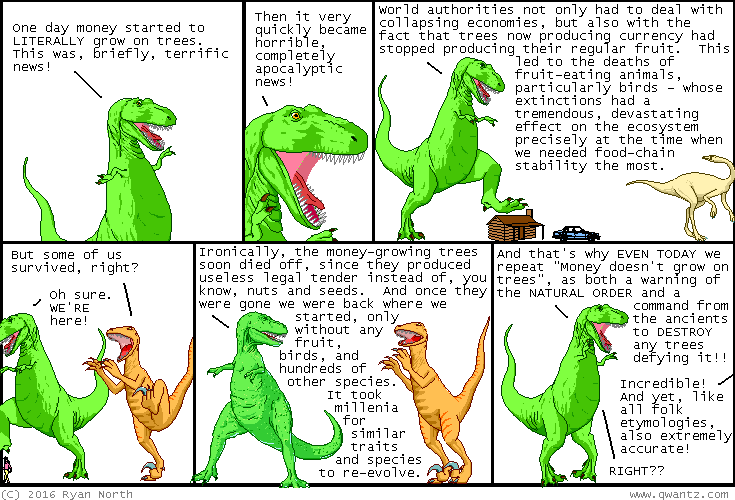
money doesn't grow on trees (*revs chainsaw*) not on MY watch

archive - contact - sexy exciting merchandise - search - about
← previous April 4th, 2016 next

April 4th, 2016: Sometimes facts really ARE incredible!!

– Ryan

04 Apr 15:33

The disintegrating establishment

by TSE

Houghton_House

In 2010, Britain was being wrestled over by two parties competing to portray themselves to the public as the natural party of government.  In his first conference speech, David Cameron returned repeatedly to the theme of “substance”.  He told his party:

“Real substance is about taking time to think things through, not trotting out easy answers that people might want to hear.  It’s about sticking to your guns.  It’s about character, judgement, and consistency.  It’s about policy, yes.  But it’s about getting it right for the long term.”

Two years later, Gordon Brown regained initiative telling his own party at their conference that it was no time for a novice.  Both parties were appealing to the voters’ innate caution, to the importance of politicians as steady, moderate and above all competent.

British politics has changed completely.  The establishment is under attack as never before, from insurgents on the left and right simultaneously.  

The Labour party has been taken over by a faction that has demonstrated no interest in appealing to competence or caution.  In his opening conference speech, Jeremy Corbyn made a virtue of not wanting to impose leadership lines at all times and of expecting real debate not message discipline at all times, of wishing to carry on being an individual activist.  He has been true to his word on all counts.  Blairites are as appalled by the style as by the substance of what he says.

Meanwhile, the insurgent right is currently consumed by the referendum on EU membership.  Without even a pretence of coherence, they campaign on running away from the complexities of multilateral engagement, variously on immigration, regulation, security concerns or whatever else flits across their minds (how leaving the EU is actually going to help on any of these fronts remains largely unexplored).  Their figureheads, Boris Johnson and Nigel Farage, campaign on charisma rather than competence.

With the Labour right in longterm internal exile and the Lib Dems obliterated, the sole repository of the flame of good administration at present is the current Cabinet.  Can they withstand the onslaught of the crazies?  You would think that offering competence in government as a USP would be a great vote-winner but everyone else seems to be having too much fun being irresponsible to make adult behaviour look enjoyable.

The wise commentators tell us that the public will be sensible in the votes that really matter.  Perhaps.  But isn’t democracy about giving the public a choice?  If in the foreseeable future there is space for only one responsible party, that doesn’t give much ideological choice for those who value good government.

And sooner or later, a solitary party of good administration will be defeated (probably by its own complacency, lack of direction or flatfootedness).  By default, if there is only one such party, the new government will not be anywhere near as interested in good administration.  It will be about then that the public would find out the virtues of dull competence.

Alastair Meeks

04 Apr 14:58

Review: The Black Archives (Dark Water/Death in Heaven)

by Phil Sandifer

It’s a small club, and more than anything it’s nice to see a quality new contribution. I’m not going to say that the world is lacking in studies of Doctor Who because it’s manifestly not, but the aca-fandom corner of things is, as fields go, not one where it’s hard to keep track of the major players. So welcome to Philip Purser-Hallard, editor of and contributor to The Black Archives, Obverse Press’s new line of short book treatises on individual Doctor Who stories. They launched just last month with four books, on Rose, The Massacre, The Ambassadors of Death, and Dark Water/Death in Heaven, the latter of these by Purser-Hallard himself, and the one Obverse Books sent me a review copy of. (They’ve got four more planned over the rest of 2016, including Andrew Hickey’s take on The Mind Robber and Lance Parkin’s on The Pirate Planet, incidentally; it’s a hell of an exciting line.)

Let me start by saying this is a brilliant idea; a perfectly considered level of granular focus that has loads of room to find new things to say about tired old stories without sacrificing readability or approachability. The obvious analogue is the 33 ⅓ series of short books on music albums, which provide similarly appealing balances of depth, breadth, and the potential for idiosyncrasy. These are the right books at the right time, and it’s genuinely a thrill to have them join the conversation.

That said, as a fellow traveler in the aca-fandom waters who has also written a book for the 33 ⅓ series, there’s not really a way for me to approach a book like this without immediately jumping to either ridiculous talking shop about critical approaches or early efforts to contextualize it in the larger discourse of Doctor Who criticism. I mean, this is the sort of book where my reactions include things like “oh, hey, he quoted Anna’s piece on Missy and trans issues.” (“Was it a good quote? Do I sound like an idiot?” Anna asked when I told her. She does not, unsurprisingly, though Purser-Hallard doesn’t buy her claim that the Master was dysphoric, historically. “Lol, I don’t either,” notes Anna. It also cites Jack for the claim that Revelation of the Daleks has vaguely implied necrophilia, incidentally.)  Neither of which is the natural fit for a book series that’s aiming at a general enough audience that it starts with an overview of the episode that includes transmission dates and a fairly detailed plot synopsis. And while I could try to turn all those instincts off and just enthusiastically review it as the interesting and compelling guide that it is, well, what’s the point in that? Especially when Purser-Hallard argues, quite brilliantly, in the book’s epilogue that “one day everything in this book will be wrong (if indeed it isn’t now, which is certainly a possibility). And that is the magic of Doctor Who.”

So let me instead pay Purser-Hallard’s Dark Water/Death in Heaven a much higher compliment than a mere “hey, this is worthwhile, check it out” and say that when the time comes to write the Capaldi stretch of TARDIS Eruditorum, I cannot imagine discussing this story without using it the way I used About Time so often in the classic series, which is to say pushing back against and expanding upon its conclusions. And then trust that you’ll recognize the subsequent discussions of why as an emphatically good review.

In particular, I stress this because what is to me the book’s biggest methodological weakness also gives rise to what is, for my money, its biggest insight. This is Purser-Hallard’s decision to limit its discussion of history and influence almost entirely to past episodes of Doctor Who. (And I should stress, this is a decision Purser-Hallard made for this volume, not editorial policy for the Black Archives line.) For most of the book this is an amusing perversity; a discussion of the implications of Missy’s gender that has several paragraphs on Eldrad while restricting its list of “literary SF whose scenarios involve mutable sex and gender” to a dashed off list in a footnote consisting of The Left Hand of Darkness, Triton, and Player of Games. This works in part, of course, because Purser-Hallard understands the game he’s playing there. The section is clearly written by someone who has not only read all three books but a wealth of other and far more experimental works about gender, including plenty that aren’t science fiction at all, and who is setting all of that knowledge aside to talk about The Hand of Fear. But equally, it feels like an almost deliberately incomplete discussion; obviously I’ve got some personal investment given who he chooses to cite, but the bits where Purser-Hallard talks about trans reactions to the episode feel vastly sharper and more insightful than the meandering through Doctor Who history, to the point where the latter becomes harder to justify.

Where the approach is more interesting is in its discussion of cyberpunk, which is most certainly a topic Purser-Hallard knows a lot about, and which he still introduces largely in Doctor Who terms with a brief historical jaunt over to Neuromancer. This ends up being a mixed blessing. On the one hand, it’s entirely appropriate; as Purser-Hallard ultimately concludes, Dark Water/Death in Heaven is not especially cyberpunk in its approach, and a far stronger case can be made for The Long Game being cyberpunk. (I’d say an even better one for Gridlock, which he also notes as cyberpunk-inspired.) It’s a point where an excessive dive into the influences would end up being a needless wind-up. And it’s an ultimately valuable point about Moffat’s work - for all its complexity, it’s also relatively low on influences. (Indeed, The Time Traveller’s Wife seems at times to be the only science fiction book in recent memory that he’s read.) This is both a challenge to the would-be Moffat critic and, in some real ways, a flaw in Moffat’s work, and perhaps part of why it is so enlivened on the occasions he lets his spikier and more pessimistic instincts roam free. And Purser-Hallard brings it to the fore better, I think, than anyone else has.

Indeed, Purser-Hallard is generally strong in his accounts of Moffat’s style, ribbing him a bit about some of his more recurrent tics and giving him an appropriate smidgen of stick over his gender essentialism (he makes an elegant distinction between sexism and misogyny here), but writing with clear appreciation of his work, and with strong insights such as his case that Moffat, contrary to many views, is a far less cynical writer than Davies. There are occasional stumbles - in particular, he’s oddly off-base with his account of Clara, making a completely unjustifiable claim that her control freak tendencies had been poorly set up prior to Dark Water/Death in Heaven - but it’s a strong case that deserves to be taken seriously.

Still, it’s hard not to wish Purser-Hallard had found a slightly broader vantage point to take on the story. If the book has one major flaw, it’s that the whole is somewhat less than the sum of its parts. Its six main chapters are, in effect, discrete essays on aspects of Dark Water/Death in Heaven, never quite managing to cohere to a singular perspective. The book’s afterword, in which Purser-Hallard muses on the superficiality of the oft-observed similarities between Moffat’s story and his own City of the Saved, only increases the sense of this as a near-miss.

But as I said, that’s the real thrill of the volume, and of the series. Were this the definitive take on Dark Water/Death in Heaven it would be a drab affair. No, this is something far more fun: the thing the rest of us have to unseat now. I can’t wait to have a go.

04 Apr 10:04

Action and Time

by Wesley

This is another post in a series on a style of genre prose that I dislike; I wanted to analyze why I dislike it, and it’s turning out quite long. It will probably make more sense if you’ve read the earlier posts, which I’ve just linked to and are all under the tag “Novelization Style.”

Action-Packed

Having bloviated at length about the transparent prose/close third person tag team, a question occurs to me: why don’t I struggle to slog through Lois McMaster Bujold’s novels as I did Leviathan Wakes? Because I just read her latest book, and raced through it in a couple of days. Bujold’s prose is straightforward[1] and she consistently sticks to close third person points of view. Why don’t I lump Bujold’s writing in with Novelization Style?

The difference is Bujold’s attention to her characters’ internal lives. The most important aspect of any scene is how her characters feel. They constantly analyze themselves, ruminating on ethics, fundamental goals, and underlying drives. They speculate on the goals, ethics, and drives of everyone around them. They apply what they’ve learned to general theories of human behavior. Many of Bujold’s most memorable lines are pithy observations on how people behave in the societies she’s created. The first page of a book hints at what it considers important. Novelization Style novels often begin with an action scene, or a prologue about a minor character stumbling upon the novel’s central conspiracy, or both. The first page of a Bujold novel introduces her protagonist and situates us in their mental world.

Novelization Style characters mostly think about what’s happening now. They react to what’s in front of them, focus on immediate goals. There’s less time for introspection. They save the realizations about underlying motivations and deep character for the climax. As I’ve said, Novelization Style is influenced by film and television. I gave it that name because reading it feels like reading a novelization of an imaginary movie. It emphasizes what movies and television are good at: action and dialogue. Novelization Style is about things happening.

For an example I’ll use Three Parts Dead by Max Gladstone, which unlike Leviathan Wakes is not bad. That’s what make it a better example for talking about structure: I finished it! But it took me longer to finish than I expected. I kept putting it down and not picking it up again. It took me a while to figure out why. Although Three Parts Dead is better written (and doesn’t consistently use the same point of view and prose), in places it’s structured like Novelization Style.

Here’s an example. In Three Parts Dead legal documents control magic; elaborate contracts create the gods who keep civilization running. Basically, wizards are lawyers. When the god of Alt Coulomb dies the church calls in a wizard firm to fix the contracts. In Chapter 11 junior lawyer Tara Abernathy is ready to argue her first case in front of a judge… and the book shifts into a magical otherworld where the trial plays out as a metaphorical special effects wizard battle action sequence.

Which is weird. A court case is an argument and novels are better at arguments than fight scenes. Not that novels can’t do action; talking is just more in their wheelhouse. When the courtroom drama switches out for a magical punch-up it feels like we’ve reached the part of an Agatha Christie novel where the suspects have gathered for the big explanation, but instead of monologuing Miss Marple shouts “MURDERVISION ACTIVATE!” and there’s a dazzle of colored lights and suddenly the suspects are watching the murder happen. But, just as Agatha Christie adaptations handle the big reveal by having the detective narrate flashbacks to the crime, if Three Parts Dead were a movie a metaphorical wizard battle might be exactly what you wanted.

Earlier Tara examines the contracts that constitute the dead god’s “body.” Unsatisfied with just describing how the contracts are the god’s body, and explaining what’s wrong with them, the book takes Tara into another alternate reality so she can literally walk around on a giant body and look at metaphorical wounds. And Three Parts Dead has other action set pieces that sit oddly in a magic legal thriller. The police raid is an important plot point, but the monster that chases a supporting character through the church feels like a set piece a Hollywood movie might include to fill time and supply exciting footage for the trailer. And although the novel’s climax takes place in another courtroom it is at heart a superhero fight.

Magic in Three Parts Dead is a metaphor for the laws and economics and civil engineering our civilizations depend on: understood by few, draped in mysterious rules and incantations. Another book might spend more pages exploring what this metaphor says about the infrastructure of a city. Here, philosophizing takes a back seat to action and suspense, conspiracy and murder.

This may relate to some common writerly advice: show, don’t tell. This means that if a story wants to claim something is the case, it should demonstrate it. Like, don’t tell us Fred has a sense of humor and then have him take everything completely seriously. Movies define the rule more strictly: they never tell us outright about Fred’s sense of humor, we just see him laugh off a minor problem and deduce it. This is also Novelization Style’s version of “show, don’t tell.” So it rarely stops to analyze very deeply what’s happening in a character’s mind. And scenes where the characters just sit and talk about ideas for pages, My Dinner With Andre style, are as rare in Novelization Style as in movies. Most dialogue is functional; plot-advancing conversations are leavened by the occasional wisecrack. Open Three Parts Dead at random and whatever dialogue you hit upon is likely to be question-and-answer exposition.

What I miss most in these books are parts where the story just stops to talk about something for a couple of pages. The way Russell Hoban’s Turtle Diary will start a chapter with a paragraph on briefcases, or Gerard Manley Hopkins. The way Kelly Link spends half of “Magic for Beginners” describing an imaginary TV series. For me the most memorable parts of a story are often embedded chunks of essay.[2] I’m among the few readers who enjoyed the nattering-about-whaling chapters of Moby-Dick. And I can enjoy books by people whose views I consider disconnected from reality if they’re up-front about them; at least they’re giving me something to argue with.

(This is one reason I like first person narrators. The character is telling their story for a reason. They want to convince you of something. So this inherently opinionated viewpoint naturally nudges the story towards essayish writing.)

A Matter of Timing

I’ve said Novelization Style is present-oriented–not just about things happening, but about what’s happening right now. This leads to a certain kind of pacing. Novelization Style mostly narrates at a moment-to-moment pace, the pace a scene would play out on video:

Bob glared at the shed. ‘Well, I guess I’d better shovel out that popcorn,’ he said. He picked up his shovel.

This is the way most novels narrate, most of the time, but they’ll also summarize long stretches of time: “Bob spent the next two weeks shoveling the popcorn out of his shed”. (Three Parts Dead does a lot of this in its first chapter before going to moment-to-moment pacing almost exclusively.) Or they’ll describe how things usually happen (as in the first chapters of Les Miserables, which spends its first hundred pages on the biography of a minor character; they alternate moment-to-moment anecdotes with descriptions of his habits). Novelization Style does these things, sometimes, but less often. Rather than summarize a long period of popcorn-shoveling it will skip over it with a chapter or section break. When Novelization Style summarizes, it’s usually immediately after one of these breaks, a way of getting back up to speed before returning to moment-to-moment pacing.

Most movies and TV episodes take place over a limited span of time–usually hours or days. Maybe weeks. Some movies cover more time, but it’s not common. It’s been a while since anyone cared about strict dramatic unity, but when individual shots are inherently paced moment-to-moment keeping the story to a limited time span just seems more natural. This is even more true of individual TV episodes… although an entire series, if it’s successful, covers years of the characters’ lives.[3]

Novelization Style’s steady pace can have different effects depending on whether the book in question stands by itself (the movie model) or is one volume in an ongoing soap opera (the TV model). Standalone novels, even when the page count is long, can feel overly spare and cut down. Like a movie that has to keep the budget and the run time from going overboard, they try to strip away any detail, incident, or line of dialogue that doesn’t advance the plot or reinforce the theme. They cut ambiguities, detours, and complications.

But in soap opera novels, the pace has the opposite effect. They seem to plod, skipping nothing no matter how unimportant, playing out events an omniscient narrator might choose to summarize. If Bob is shoveling popcorn out of a shed, and there’s no way to have that happen during a chapter break, we’re going to hear every detail of Bob’s popcorn-shoveling adventure, moment by moment.

A Song of Ice and Fire is notorious for dragging itself out (though there are other series that are far worse). I found an interview with George R. R. Martin on io9 in which he makes an interesting comment about what the wrong kind of pacing can do to a novel:

But when I actually got into writing them, the events have a certain momentum. So you write a chapter and then in your next chapter, it can’t be six months later, because something’s going to happen the next day. So you have to write what happens the next day, and then you have to write what happens the week after that. And the news gets to some other place.

And pretty soon, you’ve written hundreds of pages and a week has passed, instead of the six months, or the year that you wanted to pass. So you end a book, and you’ve had a tremendous amount of events — but they’ve taken place over a short time frame, and the eight-year-old kid is still eight years old.

Novels that feel free to vary the pace can deal with time in all sorts of ways–they can switch from overviews to anecdotes and back again. Novelization Style’s adherence to a certain kind of narration, and a certain kind of pacing, dumps a lot of those tools out of the toolbox.


I think I’ll have just two more posts in this series. Next time, more about the tics Novelization Style borrows from Hollywood storytelling. After that, a conclusion and summary of why Novelization Style doesn’t do much for me, and what I’m missing when I read it.


  1. Although I’d argue her prose is deceptively simple, as opposed to just simple. Bujold writes the sort of prose that gets called transparent but she varies her tone noticeably depending on what genre she’s writing–her science fiction novels have a contemporary sound, her Chalion novels are a little more elevated, and her Sharing Knife series, an fantasy series with a 19th-century American feel, is more folksy.  ↩

  2. I should acknowledge that what I’m describing comes close to a common failing of bad epic fantasy: long passages of invented history and myth are often terrible. That’s not inevitable, though; it’s because they tend to be indistinguishable from each other and disconnected from the story. I’ve just finished Sofia Samatar’s The Winged Histories. One of the things I love about that book, and A Stranger in Olondria, is how they weave in the history and culture Samatar created; Samatar’s worldbuilding is specific, and has a direct emotional connection to her characters.  ↩

  3. Television is casual about time in general. It’s often strikingly difficult to tell how much time is supposed to have passed during an episode of Doctor Who or Star Trek: The Next Generation. It’s just… a thing happens, and then another thing, and we don’t always have enough cues to work out how long it took.  ↩

04 Apr 09:59

Today's Political Musing

by evanier

Here's a question that, if only for my own amusement, I'd like to see interviewers put to the folks currently running for either the Democratic or Republican presidential nominations.

Each year before they get around to selecting their nominee, the parties debate, argue, fight, vote and then adopt a platform — a statement of what the party believes and what its goals are in terms of policy and legislation. Then they pick a nominee who pledges to run on and uphold that platform, and who then completely ignores it. I doubt any of them even look at it and I do recall Bob Dole admitting he never read it and expressing amazement that anyone thought he would.

So the question I'd like to see put to Clinton, Trump, Cruz, Sanders and Kasich is this: "Will you pledge to read and consider your party's platform and to either abide by it or issue a clear statement as to which parts of it you will not follow?" Because all five of those folks have taken stands that will probably be in opposition to their party's platform. Wouldn't it be nice if our politicians didn't pledge to honor promises they never read?

The post Today's Political Musing appeared first on News From ME.

04 Apr 09:52

2016 Prometheus Award Finalists

by Mike Glyer
Andrew Hickey

A good list. Even though I'm far from being a libertarian, I often find the Prometheus reflects my tastes better than the Hugo.

The Libertarian Futurist Society has announced the Best Novel finalists for the 36th annual Prometheus Awards. Golden Son, by Pierce Brown (Del Rey) Apex, by Ramez Naam (Angry Robot) Seveneves, by Neal Stephenson (William Morrow) The Just City, by Jo … Continue reading →
03 Apr 09:01

I'm aware of your hate.

by Neurodivergent K
It's yet another "autism awareness day". Or autism acceptance day if you run in my circles.

The rhetoric never gets better. We can tone it down taupe, red instead, light it up gold, burn it down beige all we want, but we don't control the narrative.

No matter where I turn this month, I am forced to be aware of one thing:

The well of your hate for me & mine is truly bottomless.

There's a slow trickle throughout the year. My Autistic siblings are murdered and the media reports naught but sympathy for the killers. Scary people are armchair diagnosed as sharing my neurotype, with no evidence but that you hate us all. People fundraise to get rid of us.

Epidemic. Emergency. Tsunami. Burden. National crisis. Tragedy.

Those words never stop echoing in my ears, not really, but I can pretend for whole hours at a time that you almost think I'm people, 11 months of the year.

But in April you won't give me that. It's 30 days of solid "we hate you. You should not exist."

It's not just the gush of threats of bodily harm. Those ebb more with current events than with the calendar, mostly. It's the 24 hours wall to wall endless rush of hate and resentment.

It's parents who admit to treating their kids worse than animals being treated as heroes.

It's people giving money to organizations that pay people to go on camera saying they want to drive kids off the bridge.

It's the endless barrage of people telling me  I don't know my experiences because of abilities they assume I have, damn the facts.

It's the other barrage of people telling me that my fear-driven anger with the narrative is unreasonable & a reason I'm too broken to live.

These same people are afraid of autism, but we may not be afraid of the consequences of their hate.

It's blue lights, because "blue is for boys and only boys have autism".

It's the legacy of little puzzle head.

It's the same fear based tactics since I was 16, & they get more frenetic rather than segueing to calming the hell down.

It's how calmly people tell me they don't blame my mom for her violence.

It's uncritical presentation of Indistinguishable from Peers as a good & damn the consequences.

It's the lauding of Good Autistics from rich white moderate backgrounds while ignoring or even taking steps to silence those of us born unrespectable.

It's the rain of infantiliaztion.

It's " do you want to donate money so we can prevent people like you from being born?"

It's the words that say more about you than about us:

Lacking empathy. Rigid. Unpredictable. Violent. In their own world. Perpetual child. Noncommunicative. Soulless. Stolen. Lost. Missing.

It's being reminded it's a tragedy that we have a normal life span. Except we don't. We die 30 years early. Even that is too long for you all.

Everywhere I look you remind me that you hate uhat you hate us. You want us gone. A word for the history books.

I'm aware of the meaning of 'awareness.' Are you?
03 Apr 09:00

[phrinkery, psych] FWD: Anorexia in The Atlantic

I found interesting this article in the Atlantic, The Challenge of Treating Anorexia in Adults, regarding a new (intensive, inpatient) treatment for anorexia, descended from the Maudsley approach.

The treatment has a prominent claim of being "neurobiology" based, which raises all sorts of neurobollocks red flags for me. But this actually seems to be using a hypothesis about neurotransmitters to guide treament in a promising direction (which is a reasonable thing) and not just to show patients meaningless pictures of brain scans as an argumentum ad verecundiam (more typical of "neuro"-anything in psychiatry). I'm in no position to evaluate the neurological science they claim it's based on.

Their theory is that anorexia is characterized by an excess of serotonin in the brain, which causes high levels of anxiety, and that people with anorexia are effectively attempting to self-medicate their anxiety/excessive serotonin by depriving themselves of dietary tryptophan, from which one's body synthesizes serotonin; the problem with reducing your brain serotonin this way is the consequent compensatory upregulation of serotonin receptors, i.e. you become more sensitive to serotonin:
the brain fights back, increasing the number of receptors for serotonin to wring every last drop out of the neurotransmitter that is there. This increased sensitivity means that the old negative feelings return, which drives the person to cut back even more on what they’re eating. Any attempts to return to normal eating patterns wind up flooding the hypersensitive brain with a surge of serotonin, creating panic, rage and emotional instability. Anorexia has, in effect, locked itself into place.
Now, this is a fascinating theory. It raises several questions and suggests several testable things:

• If ingesting tryptophan causes an aversive subjective experience subsequent eating, it should be possible to design a low-tryptophan diet to reacclimate anorexia patients to eating without fear, and possibly administer necessary dietary tryptophan in pill form at non-meal-times, so the anxiety spike isn't associated with the act of eating. Maybe that's what they're doing? I don't know.

• If anxiety is the problem, why can't we trivially treat anorexics with benzodiazepines?

• If excess serotonin is the problem, do SSRIs make anorexia worse?

• If excess serotonin is the problem, do anorexics hate Ecstacy?

I have some reservations about their model, not least because it doesn't seem to square with what my anorexic patients (all two of them, it's not a lot of data) told me, but it sure is a neat theory. Possibly a beautiful theory waiting to be slain by an ugly fact.

Clinicians who are interested in learning more, their manual is for sale. I'm not spending the money on it right now, so if any of you do read it, let me know what you think.
02 Apr 06:22

[meteo, new media] Best argument to learn Celsius ever

Weather.com shut down their xhtml WAP site, and I went looking for a replacement for their hour-by-hour forecasts. Thus it was that I learned about yr.no, and "Meteograms", which are really lovely and lucid data visualizations of the forecast.

Example: http://www.yr.no/place/United_States/Massachusetts/Cambridge/hour_by_hour.html


The bad news for Americans is that it's in Celsius, but I decided this is reason enough to convert. (Cheat sheet: 0C=hat and mittens, 5C=coat, 10C=jacket, 15C=light sweater, 20C=short sleeves, 25C=sun hat, 30C=stillsuit.)

If they would just add a second "feels like" windchill line, it would be perfect.
01 Apr 19:25

My reservation about Joining Up Your Information

by Mike Taylor

This morning I found this mailing in our hallway:

joining-up-your-information1

joining-up-your-information2

Most of this sounds very good and sensible. But I did have one serious reservation, so I took them up on the invitation to email them on mylocal.sharedcareinfo@nhs.net. Here’s what I wrote:

Dear Shared Care Info,

Thank you for the mailing that I received this morning about the Joining Up Your Information initiative. While this sounds eminently sensible, I have a concern about the first of the “Important facts” bullet points:

“Personal health and social care information will only by available to authorised local health and social care professionals and will never be passed on to anyone else unless we have your consent or it is allowed by law.”

I hope you will agree with me that the final clause is rather weaselly: “… or it is allowed by law”. I would hope it goes without saying that you would not pass personal information on if it is NOT allowed by law! But here you seem to be saying that whatever is legal, you reserve the right to do.

Given our present government’s rush to privatise every possible public service — the Land Register seems to be most recent one — this leaves me intensely concerned that t some point the law will quietly be changed to make it legal to give out our medical information, and it will then be sold to private corporations for whatever purpose they wish.

Do you share my concern? Because the present phrasing really does seem to be equivalent to “We won’t share your information at the moment because it would be illegal”.

Thanks for your thoughts,

Dr. Mike Taylor

(I don’t usually use the “Dr.”, but I thought it would be appropriate to pull rank in this case, in the hope that they” take my inquiry a bit more seriously — especially if they jump to the conclusion that I am a medical doctor!)

I’ll let you all know what response I get.