Shared posts

08 May 14:07

David Steel bigs up Tim Farron

by Jonathan Calder


On the New Statesman website, the former Liberal Party leaders praises the current Liberal Democrat leader as "the most under-rated politician in the UK today".

Sir David writes:
I have known and highly regarded him since I first met him as leader of the student Liberals at Newcastle University. 
In 2005 he defeated a right-wing Tory MP by just 250 votes. At the next election in 2010 he jumped to a 12,000 majority, much of which he retained in the debacle in 2015. 
Twice he has persuaded me to address his annual constituency fundraising dinner saying “it is just over the border” – actually more than a 200 mile round trip over Hadrian’s Wall. I was deeply impressed by his hold on the good people of Cumbria. 
Indeed his election as party leader against Norman Lamb, who had been an excellent minister, was partly because party members wanted someone less identified with the post-Coalition disaster. 
He is a committed Christian, which I regard as a plus, and I do not understand the fuss about his alleged views on homosexuality or abortion since we have always accepted that these are matters of conscience for individual MP’s not for party diktat. 
His track record as MP showed him willing to oppose some of the errors of the party, especially the student fees fiasco. He is vehemently anti-Brexit.
I prefer the slightly mischievous David Steel of today to the David Steel who led the Liberal Party when I joined it.
08 May 14:04

Forged in Steal

by evanier

As I've mentioned here a few times, there are a lot of phony sketches being sold these days in the original art market. I see dozens of them at any given time on eBay, often from sellers who have sold many fakes but still seem to have 100% positive comments about their many past sales. As noted, the greatest volume seem to be forgeries of Charles Schulz and Jack Kirby…and I probably should have mentioned Robert Crumb and Bill Watterson.

The fakers usually stick to deceased artists or to guys like Crumb and Watterson who maintain low profiles and don't seem likely to rise up and denounce the impersonations. A few impostors do get bold though and cobble up bogus sketches by folks who are around and visible. Neal Adams, I'm told, has gone after the sellers of Neal Adams sketches that he didn't do. Good for him.

How can you tell phony drawings from real ones? There's no easy way but here are some things to keep in mind…

  • Forgers almost never forge published covers or pages. They forge the kind of sketch that a cartoonist might do of one of his characters as a gift to some fan. If someone did go to the trouble to forge, say, a whole, published page from a Kirby issue of Fantastic Four, that would be a lot of work, what with all the drawing and lettering, and they'd have to fake the company's rubber stamps and editorial notes and such. And also you could put that piece of art against the printed book and see the differences. This kind of thing is done but not very often.
  • When artists do the kind of "fan" sketch we're talking about, they almost always sign them to someone. They write in the name of the recipient. A forger doesn't do that because he knows you'll be less likely to pay top dollar for a sketch signed "To my good friend Gustavo" if by some chance, your name is not Gustavo. So if you see an alleged Schulz drawing of Snoopy and it isn't signed to anyone, be very suspicious.
  • Also, Schulz seems to have signed most of his fan-type sketches with his full, cursive signature of "Charles M. Schulz," not with the easier-to-forge "Schulz" with which he signed the newspaper strips. And I'd be really suspicious of the Schulz sketches signed — and this occurs more often than you'd imagine — "Schultz."
  • That the drawing seems to be on old, aged drawing paper is not an indicator of authenticity. Old blank paper is not that hard to come by. Recently when I cleaned out my friend Carolyn's apartment, I found over 500 sheets of old blank drawing paper of a brand no longer made on which Walt Kelly never got around to drawing Pogo strips.
  • Forgers usually trace existing sketches. Last time I looked, there was a fake Captain America drawing up for eBay auction that was just a tracing of a real drawing Kirby did…and a bit of Google searching would show you the original one.  If you compared the two, the forgery becomes pretty obvious. And what if the facsimile is real close? Well, that should not make you think the one you can purchase is authentic and that Jack obviously did the same exact sketch twice. He didn't do that.
  • A forger will sometimes copy a published drawing — say, a Captain America pose that Kirby drew for the cover of some published comic. Then the claim will be that this was a preliminary sketch that Jack did for the comic, thereby accounting for the similarity. Kirby almost never did preliminary sketches and he certainly never did one in ink.
  • Most eBay sellers who sell fake drawings seem to have a lot of them and they all appear to be the work of the same forger. They have one or two fake Kirbys, a fake Dr. Seuss, a fake Walt Disney, a fake Schulz or three, a phony Watterson, a bogus Joe Kubert, etc. If someone has a lot of sketches by dead guys and none of them are signed "to" anyone, there's about a 90% chance all of them are frauds.
  • And lastly, use your head. If a never-published original Superman drawing by Joe Shuster has a minimum opening bid of twenty dollars, the ink is probably still wet on it.

Please don't write to me to ask if a particular sketch is real. I long ago made a policy of not doing that because it makes some people real mad to hear that they paid good money for a Wally Wood sketch done four years after Wally died. And though once in a while I make an exception for a "Jack Kirby" drawing that looks like Jack must have held the pencil in his teeth when he did it, I don't authenticate artwork unless I can hold it in my hands and inspect it in person…and I often don't do it at all.

But be suspicious. Be really suspicious.

The post Forged in Steal appeared first on News From ME.

08 May 14:01

Trans politicians election results: May 2017

by Zoe O'Connell

Unsurprisingly – given there were only three candidates standing versus ten last year – none of the openly trans candidates were successfully elected on Thursday.

I will be posting my list of General Election candidates after the nominations close on 11th May, and the notices of poll have been published.

Labour Sam Feeney
Cambridgeshire, St Ives North & Wyton
3rd place: 17.3% (New boundaries, so no %age change)
Mridul Wadhwa
Edinburgh, Craigentinny/Duddingston
6th in a 4-member division, 6.3% of first preference votes
Alex Bear
Derbyshire, Ripley East and Codnor
4th place: 2.2% (+2.2%)

The post Trans politicians election results: May 2017 appeared first on Complicity.

08 May 13:52

Is Theresa May planning on toppling Tim Farron?

by TSE

Could Tim Farron losing his seat be the shock of June 8th?

I found the above tweet fascinating, Jim Waterson of Buzzfeed analysed which seats the Tories are targeting by looking at the ad buys in local newspapers. The one that caught my attention was Westmorland and Lonsdale, the constituency of Tim Farron.

The symbolism of Tim Farron, the arch remainer and and advocate of another referendum, losing his seat on June 8th would  be yet another blow to those opposed  to (hard) Brexit, would appeal to both Mrs May and Sir Lynton Crosby.

It was said that the remoteness of Westmorland and Lonsdale, and the anticipated closeness of the 2015 general election were the only reasons David Cameron and Sir Lynton Crosby didn’t target the seat as part of their black widow strategy against their coalition partners.

With this general election much easier for the Tories thanks to Labour’s choice to fight it with Corbyn as leader, you can see them deciding to target Tim Farron’s seat this time, the newspaper ad buy might be indicative of that, simply because they don’t have to spend quite so much time and effort in the Con/Lab marginals.

If it does happen, there will be a certain symmetry, Tim Farron first won the seat in 2005 as part of the Lib Dem decapitation strategy aimed at senior Tories, where he defeated the well known Doctor Who fan Tim Collins, which as a Whovian I took very badly, the year Doctor Who returned as a series after a sixteen year hiatus.

I suspect by buying ads in the Westmorland Gazette, the Tories are targeting the Barrow and Furness constituency, but at the time of writing, several bookies were offering 8/1 on the Tories taking the seat, I’ve decided to place £50 on it.

It probably won’t win, Paddy Power are offering the best odds on Tim Farron holding his seat at 1/14 which tells you a lot, but with the national polling indicating the Tories have gone up around 10% and above since the last general election, whilst the Lib Dems are stuck on something close to their 2015 vote share, to my mind it does make sense. If the UKIP voters in the seat do switch to the Tories en masse, it would only require a Lib Dem to Con swing of just over 6% for the seat to turn blue.

To help win over Lib Dem voters in the constituency, I suspect Mrs May will highlight her own liberal attitudes to them and other voters, such as her introducing same sex marriage, in stark contrast to the long time Tim Farron took to explain his favoured position when it comes to gay sex.

TSE

08 May 13:43

The tide is high. How many Labour MPs will be holding on after 8 June?

by TSE

Everyone seems to agree: Labour are in for a pummelling at the upcoming general election.  The opinion polls, the local election results and the anonymous comments from politicians of all parties on the campaign trail all point in the same direction. Even the newspaper pundits, constantly looking for a new angle, are unanimously predicting a Conservative landslide.  Few, however, have tried to put numbers on the eventual outcome.

This fool is going to rush in.  I’ve been looking at the Labour defence and trying to work out what will be left after the general election.  Settle down; this is complicated.

Polling consistently shows that the Conservatives are doing especially well among Leave voters, gaining a much greater swing among them than among Remain voters.  You can argue which is cause and which is effect but for our purposes it doesn’t matter.  Wherever you find more Leave voters we can expect to find more swing to the Conservatives.

So we shouldn’t try to interpret the polls through uniform national swing without first considering how Leaveworthy the current Labour seats are.  Chris Hanretty has produced estimates of Leave percentages in each constituency and while these are not going to be perfect, they should be near enough for present purposes.

Any dividing line is going to be arbitrary.  A seat that divided for Leave 51:49 is unlikely to behave very differently from a seat that just came up short 49:51.  So initially I divided the Labour seats into three groups: those that were clearly Remain (which I defined as under 46%); those that were fairly evenly divided (which I defined as between 46% and 54%); and those that were clearly Leave (which I defined as over 54%).  You can argue with my definitions and no doubt some will.

And immediately we see a major problem for Labour.  130 of their seats won at the last election were clearly won by Leave.  We can expect the Conservatives to do better than usual in these.

But there’s a more subtle problem. 33 of the 63 Labour seats that were clearly won by Remain form part of the 100 safest Labour seats, while a further 11 are among the 25 most marginal Labour seats.  Very few seats clearly won by Remain are in the zone where Remain voters’ resistance to Conservative charms is likely to make a difference.

I then looked at the seats that were at one extreme or another.  And just seven of the 32 Labour seats where Leave scored under 35% of the vote fall outside the 25 most marginal Labour seats and the 100 safest Labour seats.  Four of those seven seats have the Lib Dems or the Greens in second place.  As chance would have it, the type of seat where Labour is best placed to hold off the Conservatives looks as though it isn’t going to be that relevant in this election.

At the other extreme, there are 75 Labour seats where Leave won more than 60% of the vote (yes, that’s asymmetric with the “extreme Remain” banding).  That’s more than all the Labour seats where Leave scored under 46%.  20 of the seats in the 51st to 100th most vulnerable Labour seats are in this category.  Another 10 seats in this category are in the 101st to the 125th most vulnerable Labour seats.

Anecdote, the tenth wave of the British Election Study (as analysed by Chris Hanretty) and ICM subsamples all suggest that the Conservatives are doing particularly well in Labour-held seats.  The distribution of the Labour Leave-leaning and Remain-leaving seats might well explain that.

What does that mean in terms of seat losses?  First, we need to work out what the likely swing from Labour to the Conservatives is likely to be and then adjust.  Working on the basis that often the polling at the beginning of the election campaign is what the final result ends up as, I’m assuming a swing of roughly 7.5%.

Then we need to decide how this will differ in different bands of seats.  I’m working on the basis that the swing will be 4% lower in extreme Remain seats, 2% lower in less extreme but clearly Remain seats, 2% higher in clearly Leave seats and 3.5% higher in extreme Leave seats.  This would result in 79 seat losses to the Conservatives.  On this model, Labour would hold Exeter and lose Don Valley. Allowing for other losses to the Lib Dems and other parties, this would leave Labour with just under 150 seats. 

Of course, this is all pretty arbitrary, with assumptions galore.  The polling might be a lot tighter (if the swing is only 5%, Labour would end up with somewhere around the 170 mark).  Or Labour might collapse much further (if the swing is 10%, Labour would end up with somewhere around 130).  I may have radically underestimated or overestimated the swing differential in different types of seats.  But I expect the result to be in this ballpark.

I note that Bet 365 offers odds of 9/4 on Labour getting 126 to 150 seats and 5/2 on them getting 151 to 175 seats, implying they will get in this band roughly 60% of the time.  I think the chances are more like 85%.  Or if you want to back just a single band, Betfair Sportsbook’s and Paddy Power’s 7/4 on 120-159 seats looks generous to me.  I’m on.

Alastair Meeks

Follow @AlastairMeeks

Tweet

06 May 20:30

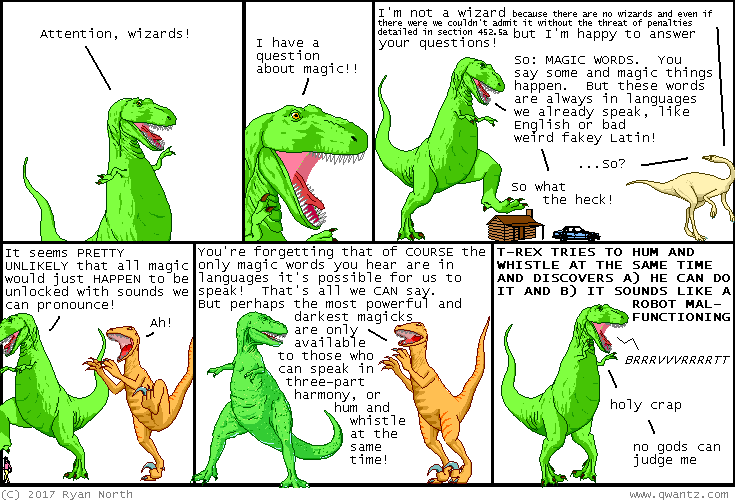
attention, whizdros

archive - contact - sexy exciting merchandise - search - about
← previous May 5th, 2017 next

May 5th, 2017: I realized I could do this YEARS AGO and forgot (or... the memory was erased from my mind by JEALOUS WIZARDS??) so anyway now it's public and only a CABAL of wizards could possibly put this genie back in the bottle!

– Ryan

06 May 10:41

I wrote to my Senator. #corpsesdontvote

by Neurodivergent K
This is what I emailed my senator earlier today, because only the senate can keep the ACA. CN for medical disasters, fairly graphic descriptions.
You get the cranky version of this because your staff won't even promise the most basic of ADA accommodations. Ironic given that I'm writing to you about health care and one of the conditions that requires said accommodations.
 
Like many Americans, I have chronic health conditions. Like many Americans, I need you and the whole democratic party to grow a spine and stand for me. I vote democrat because the other choices are unconscionable, but I am thoroughly unimpressed with the pattern of roll over and play dead. I need you to not be a doormat.

Here's some incentive: how I am going to die if the senate doesn't kill the republican death to poors bill.

My first chronic, life threatening medical condition is adrenal insufficiency. I do not make cortisol. Without cortisol, people's bodies cannot respond to the stresses of every day life. I take a daily corticosteroid pill and must inject myself with extra steroids if I am sick or injured. Without cortisol, the body cannot restore normal functions in times of stress. Have you taken a first aid class, Senator? Recall what you were told about shock. The heart doesn't pump effectively. Blood pressure crashes. Blood sugar crashes. Death can result. I am going to die from going into shock from a stubbed toe if you folks don't find some courage. It's scary. When your heart won't move blood, everything is /scary/. It's not a good death.

The other option, of course, is for me to die of epilepsy related complications. Because of a lack of health care in my youth, my epilepsy got pretty hard to treat--the more seizures you have, the more likely you are to have more seizures. They are harder to treat the longer they are allowed to go on--this is called kindling. As a result, my mostly-effective seizure meds are about $1000/month (if we lived in a real country with universal health care they'd have been stopped much sooner, but we don't. We live in the land of "the poor and disabled should die horribly". Your part in maintaining that status quo is very much noted).
I have 2 options for how to die if epilepsy related causes take me. The first is SUDEP, sudden unexpected death in epilepsy. The way to prevent SUDEP is to control seizures. SUDEP is probably not painful, but it's traumatic to the people who find the body, and it's a dead person who won't vote for you. Dead people don't vote. It's a lot of grieving people, all because the D doesn't stand for democrat, but doormat.

The other option is status epilepticus. You aren't going to like reading this. Since it's my fate, not yours, I don't actually care. Be brave. It'll be good practice for that spine growing thing.

Status epilepticus is a seizure that does not stop.The most commonly noticed status epilepticus is tonic clonic status, although partial complex and absense status also exist (and lead to all sorts of problems like subtle brain damage and getting hit by a goddamn car because you're only 25% aware of the world around you). This is not good.

Your body is not made for every muscle to be contracting at once for an extended period of time. Neither is mine. The muscles start to break down. This floods the body with waste. The brain fries itself. Like, literally. It cannot deal with the fallout of the electrical activity. It is not made for that. You can seize yourself into a persistent vegetative state. If you are me, your seizures will dislocate joints. Remember that adrenal insufficiency thing earlier? That is the sort of injury that leads to adrenal crisis, as is everything else about status epilepticus. Your heart gives out. Your kidneys can't cope. Your brain stops being able to not seize.

This is an awful way to die.

If you do not stand up to Republicans, you are choosing for me to die this way. And my loved ones will not forget it.

With health care, I am an involved member of my community. I participate in martial arts and assist children in accessing the activity as well (including children who, like me, need health care to be able to interact meaningfully with all that life has to offer). I am finishing a biology degree--I was going to be an ecologist until the republicans decided to destroy ecology, and no one stood up and said "nah bro you can't do that". I teach and judge gymnastics. Kids and cats love me. It's mutual.

Without health care I'm a corpse. And my blood will be on your hands.
06 May 10:17

#89 Dinah the Aspie Dinosaur and the Unremarkable Characteristics

by Dinah
06 May 10:15

The future’s not orange. The Lib Dems look set to miss out

by TSE

Pedants are quick to point out that for Labour to be decimated at the next election, they would need to lose only one in ten seats, while current polling shows them doing far worse than this. So in the interests of accuracy, I record that on 8 June I expect to see Labour crushed, marmalised and eviscerated.  With the Conservatives having established close to a two power standard in most of the polling, we can expect to see swathes of red seats turn blue.

Labour and the Conservatives are not the only participants, and each of the other parties is absorbed with their own ambitions, routines, worries and inherited craziness.  It is time to consider the prospects of the Lib Dems in this election.

I noted a couple of weeks ago that the markets seemed irrationally exuberant about the Lib Dems’ prospects and advised backing the unders markets on their seat counts when they were in the high 20s.  As at the time of writing, following local elections in which the Lib Dems seriously underperformed most prior expectations, William Hill price the midpoint at 18.5.  What a falling off was there.

What’s gone wrong?  Even the most enthusiastic Lib Dem would have to concede that the very limited airtime that they get could have been better used than discussing Tim Farron’s religious beliefs about gay sex and whether David Ward’s views should debar him from standing as a  Parliamentary candidate.  But more profoundly, it seems that opposing Brexit is going to be insufficient to give them much of a leg-up.  Lord Ashcroft summarised part of the findings of one of his focus groups as suggesting that the Lib Dems potentially appealed to unhappy voters who satisfied two conditions:

“First, they were still very much exercised about the referendum result. Second, they thought something could still be done to frustrate or reverse it:”

But as Lord Ashcroft noted, these do not seem to be sufficient.  The public thinks them irrelevant, doesn’t trust them and wants to know more about what they stand for.  The strategy is failing.

So how well realistically can we expect the Lib Dems to do?  My preferred approach is to look less at swing required (though in the tightest races obviously that’s important) and more at vote share at the last election.  In 2015, the Lib Dems got over half the vote in only one seat (Westmorland & Lonsdale), over 40% in only two more (Orkney & Shetland and Sheffield Hallam) and over 30% in just 31 seats.  I don’t intend to investigate more than a handful of seats beyond that level – the Lib Dems hold only one of them (Richmond Park).

We need to investigate Lib Dem seats of interest in batches.  They can be divided into the following groups: Conservative-facing in Leave areas; Conservative-facing in Remain areas; Labour-facing in Remain areas; Labour-facing in Leave areas; and Scottish seats.

The Lib Dems have a huge problem in Conservative-facing seats in Leave areas: the Conservative vote is going through the roof in such seats.  The challenge is less whether they can gain such seats but to make sure that they don’t lose any.  Carshalton & Wallington and Norfolk North both look like awkward defences and they could easily lose both.  The Conservatives are unaccountably odds against in St Ives and this is a mandatory bet.  The Lib Dems are far more likely to go backwards in such seats than go forwards.  The Conservatives are just doing far too well in these seats for the Lib Dems to make much progress.

They have better chances in some Conservative-facing Remain seats.  There are some very steamed-up middle class voters in these seats.  But there aren’t many such seats and in any case the Conservatives are gaining support even in Remain seats.  After Twickenham, Richmond Park and Kingston & Surbiton, the list of prospects rapidly dries up.  Cheadle?  Bath? Cheltenham?  Oxford West & Abingdon?  The Lib Dems might gain a couple, but even that’s fairly optimistic. And they need to watch their flank – with John Pugh retiring in Southport (on an already-low vote share) and the tactical Tory vote in well-heeled Sheffield Hallam likely to unwind, they might suffer losses in such seats as well as gains.  16/1 with Ladbrokes in Sheffield Hallam is probably fair value.

I’d rather be on the Conservatives in Southport at 4/6 with Betfair Sportsbook and William Hill than the Lib Dems at 11/10 with William Hill, despite the blue team’s long history of apparent ineptitude in this constituency.  The 11/10 on the Conservatives in Kingston & Surbiton with Ladbrokes is probably better value than any of these bets.  If you want to bet on the Lib Dems in such seats, the 10/11 in Richmond Park with Bet 365 is worth looking at – I can’t see Zac Goldsmith proving more attractive to this ultra-Remainian constituency than last year, especially since he looks so unprincipled in going back to the Conservatives after leaving them over the Heathrow decision.  Overall, the Lib Dems might have a net gain of a couple of such seats, but sweeping gains are for now unlikely.

Things look better for the Lib Dems in Labour-facing Remain seats, with Labour’s vote under so much pressure.  Cambridge and Southwark & Old Bermondsey must be strong chances, and the 4/6 on the Lib Dems with Ladbrokes in the latter seat looks great value to me.  But again, there aren’t many such seats.  The 7/2 with Ladbrokes on the Lib Dems in Manchester Withington is appealing.  I’m on them at 3/1 in Hornsey & Wood Green (the odds have shortened since).  But then where? The Lib Dems are hoping to build up a head of steam in the Remain redoubt of Vauxhall against hardline Brexiteer Kate Hoey but it must be firmly odds against, and considerably longer than the prices currently being quoted.  On a good day, the Lib Dems will be gaining a few seats from Labour.  But no more than a few.

The only Labour-facing Leave seat that the Lib Dems have serious chances in is Burnley.  They’re odds-on favourites there, which seems to be overstating their chances, even with the former MP Gordon Birtwhistle standing again for them.  The brave might well back Labour at 2/1 with William Hill or Bet 365.  I’ve been brave to small stakes.

Finally, to Scotland, where for a change the Lib Dems are better placed to sweep up tactical unionist votes in seats where they are the main challengers to the SNP.  They can reasonably hope to pick up Edinburgh West and East Dunbartonshire, and the local election results in Edinburgh West suggest that the 4/7 with Betfair Sportsbook is value.

In total, the Lib Dems look set to finish with something like 10 to 15 seats.  Bet 365 are offering 11-15 seats at 4/1 and while that’s a tight band, I’ve placed a sporting bet on it.  If you want a bit more leeway, the 2/1 on 10-19 with Ladbrokes also seems good value to me.

Those willing to take the risks involved in spread betting should still be selling them on Sporting Index at 21.  The nervous should consider that Tim Farron has named that number as his target.  The chances of them exceeding the named target can’t be all that high.  But before doing so, make sure you understand the risks.  If I’m wrong, it could be very expensive indeed.

Oh, and take that under 18.5 with William Hill.  It still looks on the high side to me.

Alastair Meeks

Follow @AlastairMeeks

Tweet

06 May 10:01

2017 General Election Diary Day 17: Projected National Screaming

by Nick

That’s the rehearsal election out of the way, now just five weeks to go as we wait for the real thing to happen. It’s very weird having a local election in the middle of a general election campaign. There have been time before (notably in the 80s) when local elections were happening in the knowledge that a general election was very likely to be called in the wake of them, but the last time there were simultaneous campaigns on was 1955, when the general election happened three weeks after the locals. That was a time when both local and national election campaigning was very different, and much less intense, than it is nowadays.

This time, we got to see the local elections being used as a test bed for the general election. There’s always an uneasy tension between national and local issues at local elections, with good local councillors from all parties losing their positions to what are sometimes just paper candidates because of a national swing against them, and this time we saw the Tories tilting that balance strongly towards the national. In England, several local newspapers in key seats had outside spreads extolling the virtues of Theresa May and her ‘local candidates’ to be strong and stable in the national interest, while in Scotland there was a very strong push to position them as the party against the SNP and a second independence referendum.

All of which is part of the extraordinary and febrile political times we live in. There’s a massive upending of the old rules of politics and elections underway, as we see the first Opposition ever to lose seats at three consecutive sets of local elections, while a party in its seventh year of Government makes extensive games. Meanwhile, rather than being slow to deflate, UKIP’s bubble has completely burst as they lost every councillor they got elected at the last set of these elections in 2013 (the one seat they now hold was actually a gain this year). Meanwhile the Liberal Democrats are up in the projected national share of the vote by 7% to 18% (the biggest gain of all the parties) buit actually lost seats.

What appears to have happened is a big shift from UKIP to Tory, driven by the fact that the Tories have taken on the main issue of UKIP – not just getting out of the EU, but an antipathy to anything European – and coupled it with an aggressive nationalism to bring together a strong coalition of voters on one side of the divide. Meanwhile, the other side is scattered and divided, and not co-ordinated as effectively, as people get used to the new electoral landscape, and so the party that was the effective opposition to the Tories in the 90s and 00s might not be any longer. Any co-ordinated strategy for the General Election needs the parties to look honestly at the results of these elections and recalculate accordingly, not just assume the old patterns hold.

On that note, things have shifted quite quickly in the past twenty four hours, with news of three Green Party candidates withdrawing and endorsing the Liberal Democrat candidate in their seats. Richmond Park, Twickenham and Oxford West & Abingdon are the first beneficiaries of this new approach, and may not be the last. I suspect now the issue of the local elections is out of the way, it will help to concentrate minds on making deals, especially as people have seen the potential size of the Tory landslide that could be coming their way in June.

I’m expecting a surge in General Election activity over the weekend, so Election Leaflet Of The Day will return tomorrow later today, and soon another old favourite from 2015 – Obscure Party Of The Day – may also be returning, once we start getting news of candidates.

Thirty-three days to go, and after France votes tomorrow there are no more distractions…

06 May 01:16

Clement Attlee's granddaugher to fight Yeovil for the Liberal Democrats

by Jonathan Calder


Mark Pack brings the intriguing news that:
Jo Roundell Greene, granddaughter of Labour Prime Minister Clement Attlee and deputy leader of South Somerset District Council, has been selected by the Liberal Democrats as the prospective candidate for Yeovil:
On a similar note, the Labour MP Lisa Nandy is the granddaughter of the Liberal MP and peer Frank Byers.
06 May 01:15

Greens stand down in Richmond and Twickenham

by Jonathan Calder


Those of us who wondered what the Lib Dem had received for standing down in Brighton Pavilion have received an answer.

The Richmond and Twickenham Times has announced that the Greens will not be fielding candidates in either Richmond Park or Twickenham.

The former is being defended by Sarah Olney after her victory in last year's by-election. In the latter Vince Cable is trying to regain the seat he held between 1997 and 2015.

The paper quotes Richard Bennett, Richmond and Twickenham Green Party co-chair:
"We are proud to be at the vanguard of a growing movement to create a new kind of politics. Progressive parties must work together to put country before party."
06 May 00:49

No True Bristolian

by Andrew Rilstone


I feel like I need to apologize for my essay on Bristol's Colston Hall kerfuffle.

I have a habit of writing in a light, semi-ironic, affable style. And this is appropriate for writing about comic books and children's television. If "well, last weeks Doctor Who was an embarrassing piece of fifth rate horse shit, wasn't it" mutates in the editing stage into "In the future, committed Time Lord followers may not look back on last week's story with feelings of unalloyed pleasure" no harm is done. But I am afraid I sometimes allow my tones of whimsical bemusement to permeate subjects which really matter.

Ursula Le Guin berates C.S Lewis and his contemporaries for writing as if from a high-church club which treats the rest of the universe with slightly amused disdain. That's probably where I got it from.

For the avoidance of doubt: the Colston Hall Kerfuffle is not one of those subjects which really matters. Twenty years ago, my position would have been broadly "If the name changes, jolly good; if it doesn't change, never mind." Contrary to what you may read in the Guardian, the people of Bristol are not in thrall to a Colston cult, any more than the people of Charing Cross are in thrall to the worship of Eleanor of Castille. You can't move in Bath for bakeries which sell the only original Bath Bun, and the recipe for William Oliver's extremely dull biscuits is a jealously guarded secret. But I had literally never heard of Colston Buns before the Great Kerfuffle started.

But the scheme to rebrand the Hall has brought a lot of very nasty arguments out of the woodwork; and it has revealed that some people hold some very nasty beliefs -- about history, about the city of Bristol and about the world in general. And this matters very much indeed.

I feel like I need to re-write that piece with an Obama style "anger interpreter" at my side.

Here is the entire text of a letter which was printed in the Guardian last week. It is a piece of writing which literally made me shake with rage. It has so many of the typical characteristics of this kind of "green inker" that I am tempted to wonder if I accidentally wrote it myself and submitted it to the Guardian as a wind up. But I fear it is quite real. 

Unlike many of the (mainly) students who campaigned to get the name of Colston Hall changed,  I am a Bristolian born and bred, and I am so incensed that the management has kowtowed to these so-called activists. I have to reluctantly agree for the first time with the former Bristol Conservative leader Richard Eddy that we cannot change history, and that place names give us a link with the past. Edward Colston gave the land on which the eponymous hall stands for the building of a school for orphaned and destitute boys. This is still thriving today, in a different part of the city. He also left money for almshouses for the poor, and with the residue of his fortune a girls’ school was founded (which, incidentally, one of the spokespeople for the anti-Colston name brigade attended, and presumably benefited from its excellent education).

Many cities and towns in Britain have monuments and buildings dedicated to people who were not 100% PC to our modern overtender sensibilities – leaders of industry in the north, who allowed children down mines, or forced them to crawl under looms. They did not all give part of their wealth to alleviate the lot of the poor of their cities as Colston did. Where does this nonsense end?

This is all about money. The management of Colston Hall is trying to attract sponsorship for its renovation and future preservation by offering corporate naming. So look out for the Tesco Hall or the McDonald’s Hall sometime soon. Silly, unnecessary, embarrassing to the city. I sincerely hope that Bristolians stop this in its tracks, keep the Colston name (while fully acknowledging the horrors of slavery) and leave history to the historians

Exegesis is what we do here, so let us exegize. 

1: "I am a Bristolian born and bred"
In the first sentence, we discover what the Great Kerfuffle is really all about. It's not about one theater or one historical person of dubious reputation. It's about nativism.

No-one in real life ever uses the word "Bristolian". (If you needed an adjective, you would just say "Bristol": "Blackbeard is thought to have been a Bristol sailor" or "The Bristol dialect is dying out.") No-one ever claims to be a Portsmouthian or a South Gloucesterani either. You might possibly say that someone was a Londoner, but you would just mean that they lived in London.

I know what it means to be born in Bristol, but who ever used the word "bred" of a person? You've never heard anyone say "Tolkien was born in South Africa, but bred in Oxford" or "Although he was bred in the United States, Bob Hope was actually born in Kent." Born-and-bred is one of those portmanteau words. It means "I have lived in this city all my life". It is only ever used to contrast "us", who were born-and-bred in Bristol and therefore have some kind of special status, with "you", who do not.

The writer thinks that only people who have lived in Bristol all their lives should have a say about what happens in the city; at any rate that born-and-bred-Bristolians have some special insight into what concert halls should be called that is denied to people who were bred here but not born here, or born here but not bred here, or people like me who were neither born nor bred here.

How long do you have to have lived in a municipality before you get a say in what happens here, do you suppose? I've lived in Bristol for twenty years. Do I have to travel back to London come local election time, like Mary and Joseph, or is there some process of naturalization?

Nativism is as foul when applied to a city as it is when it is applied to a country. It is about creating an "us", who are true Bristolians, real Americans, pure Germans and a "them" who just happen to live here. Sometimes, it may even happen, quite coincidentally, that "we", the natives, are mostly of one particular race (white, for the sake of argument) and "you", the incomers, are of a different race, perhaps (in some hypothetical case) black or Asian.

2: Kowtowed
You might think that a music trust would be quite capable of deciding for itself whether it wants to rebrand a building which it happens to own. You might think "We don't want to call it the Colston Hall any more because we feel the name is associated with the slave trade" was a perfectly good explanation for the rebranding, whether you agree with it or not. 

But in fact there is always some conspiracy at play. It always turns out that some nebulous Other has forced its will on Us Natives. In this case it turns out that the change of name is Us Bristolians making an act of ritual submission to a group of Non Bristolian Students.  

Former Conservative Councilor Richard Eddy makes this crystal clear. He describes the proposed change of name as:  

"a complete surrender to the forces of historically illiterate political correctness" 

and 

"pandering to the views of a tiny minority of non-Bristolians".

3: So-called activists. 
If the Non-Bristolian Students were trying to persuade the Bristol Music Trust to change the name of their hall, then they are, by definition, activists. If the letter writer is trying to persuade the Music Trust to reverse the decision, then they are, by definition, also an activist. That is what the word means. "So-called" is doing nothing in the sentence at all. It is a zombie word. The letter would be improved if we substituted "these pooey activists".

4: We cannot change history
The green inkers say this over and over again. You can't change history. You can't change history.

What does it mean?

No-one is traveling back in time and making it so that the sign outside Colston Hall already said Wilberforce Hall in the 19th century, although that would be an interesting premise for a Doctor Who story. No-one is denying, or trying to suppress the fact that some Victorian slavery apologists named a building after a slave trader, any more than anyone is denying that at one time Saddam Hussein was the ruler of Iraq, or that Jimmy Savile once worked for the BBC. We're just taking down some statues and some nameplates.

In 1867 the name plate was put up; in 2020 it was taken down. That's as much a part of history as anything else.

5: Edward Colston gave the land on which the eponymous hall stands for the building of a school for orphaned and destitute boys. 
Robinson Crusoe is the eponymous character in Daniel Defoe's novel (the book his named after him); although she is the eponymous character, Abigail does not actually appear in the play Abigail's Party. It is just possible that if you said that Colston Hall was the eponymous building in a novel called "Murder at the Hall", we would know what you meant. But in no possible sense can you call Colston Hall "the eponymous hall". Dropping four syllable jurisdiction words into the middle of phenomenon sentences doesn't improve an incorporeal argument.  

It is true that in 1708 Colston's school was intended to educate 100 poor boys, provided they were not Methodists. The school which now bears his name educates anyone of any gender or religion provided their parents have £13,000 a year to spend on school fees. 

6: Brigade
Green inkers always see everyone else as forming brigades. One wonders why it is never the "political correctness squadron" or the "health and safety corps"

7:  ...Presumably benefited from its excellent education.
People sometimes complain when a person who has been to grammar school argues that grammar schools are a bad idea; or when a person who went to private school says that private schools are unfair. "You have benefited from a grammar school education, now you want to deny it to others" they say. (The correct answer to this is "No, you mugwump, I want to ban second class carriages".) 

The writer seems to be creating a new argument based on the same template and ending up with word salad: "You have attended a school which was named after a slave trader and now you want to deny the right of a music venue to be named after a slave trader." What? 

8: ....not 100% PC to our modern overtender sensibilities 
And now it comes.

"PC" -- political correctness -- is a pejorative term for "politeness".

More specifically, it is what green inkers call the belief that you should avoid words like "wog", "cripple", "spastic" and "nigger" because they upset people. 

Even more specifically, it represents the belief that a group of so-called activists, very probably from out of town, and very probably organized into brigades, are actively preventing everyone else from using these words, as part of a plot to destroy western civilization. (So you should jolly well go out of your way to use bad words, otherwise you'll be kowtowing to the PC brigade!) 

I suppose that if I called someone "black" when the preferred term was "person of colour", or if I said "blind" to someone who thought of themselves as "visually impaired" you might say that I wasn't being 100% politically correct -- in other words, that I had inadvertently and unintentionally used a word which might possibly have given a small amount of offence. 

Buying and selling black people as if they were livestock is, in the mind of the person who wrote this letter, roughly comparable to inadvertently using a bad word. 

"Not 100% PC."

In fact, it is not even quite that bad. Buying and selling black people as if they were livestock is not, in itself, less than 100% PC; it is less than 100% PC only from the point of view of our "modern, over-tender sensibilities."

"Over-tender." 

We disprove of slavery because we are a little bit too gentle, too kind, too affectionate.

"Over-tender." 

How politically incorrect would buying and selling black people be if we were exactly the right amount tender? 

Oh, and it's only from the modern point of view that buying and selling black people like livestock is a bit like accidentally using a slightly bad word. From the olden days point of view it was even less bad than that.

I keep hearing this kind of thing. You can't judge the past by the standards of the present. People back then didn't realize that slavery was wrong.

Yes you can and yes they did.

Well, Mrs Miggins from the pie-shop who had never traveled outside her own village might, I suppose, just possibly, have honestly believed that negroes were a special kind of monkey and cruelty to them wasn't the same as cruelty to people, in the same way that she might have honestly thought that the world was flat and there were unicorns in India. But Bristol was a port town. Edward Colston lived in London. He had met black people, he had talked to black people. He had traded with black people. He knew that they were human beings, just like him. And he bought and sold them anyway.

Yes, free agricultural labourers worked longer hours than we would put up with today. 

Yes, it wasn't only slaves who were flogged, it was soldiers and sailors and kids and horse thieves too. 

Yes, there was a Star Trek story about a planet where the slave caste was treated quite well all things considered. 

Yes, if you honestly believed in witches then you might honestly believe in killing witches.

Be as culturally relativistic as you like.

Slavery. Was. Never. Okay.

9: – leaders of industry in the north, who allowed children down mines, or forced them to crawl under looms --
This form of not actually saying anything at all is known as "what-about-ery". If I say "here is a bad thing" you reply "here is another bad thing". If I say "let's do a sensible thing" then you reply "then you must do a stupid thing as well."

The logic of the position is "you cannot fix anything unless you can fix everything; you cannot fix big injustices unless you also fix small ones, you cannot fix small injustices unless you also fix big ones." If you think that it is in rather bad taste to open a pub in Whitechapel called "The Jack the Ripper" then you must logically want every pub and every building named for Henry VIII, who after all also killed two of his wives, to be taken down. If you allow women to vote, you'll have to allow farm animals to vote as well. If you allow gay people to get married, soon you'll have to allow hamsters and deckchairs to get married. 

Yes, it would be a good thing if there were no memorial to anyone who had ever made his fortune from human trafficking. Yes, it would be a good thing if there were no memorial to anyone who had ever profited from child labour. (*) This is where we happen to be starting.

A different green inker in the Guardian said that if we removed Colston's name from the theater, we would also have to tear the words of Amazing Grace out of every hymn book in the world, because John Newton was also a slave trader. This is a moronic comment at two levels. Firstly, and I don't know how many different ways it is possible to say this WE. ARE. NOT. PULLING. THE. BUILDING. DOWN. WE. ARE. JUST. CHANGING. THE. NAME. OVER. THE. DOOR. And secondly because John Newton, famously, was ashamed of being a slave trader. (*) John Newton thought that being a slave trader was wicked. John Newton thought that it was amazing that God still loved him even though he was a former slave trader. The clue's in the title.

10: They did not all give part of their wealth to alleviate the lot of the poor of their cities as Colston did. 
We've covered this. Using money to set up schools for poor white children (provided they are not Methodists) in England does NOT make it okay to have made the money by kidnapping black children in Africa. If anything, it makes it worse.

11: Where does this nonsense end?
It ends when there is no-one left in the world who thinks that being a slave trader was, all things considered, not really too bad.  

12: This is all about money. 
You have changed your entire argument mid-letter, you complete and utter dunderhead.

Your whole argument was that the management of Colston Hall were ritually abasing themselves before the non-Bristolian forces of Political Correctness. Suddenly it has nothing to do with incomers or activists or PC gone mad -- it's just a business decision.

Quite a sensible business decision, if you ask me. If the government is cutting spending on the arts, then the arts are going to have to seek private sponsorship. I wouldn't worry about Tescos Hall or McDonalds hall. Halls don't get named after supermarkets or burger bars: McDonalds wouldn't sponsor a hall that's already selling posh burgers and coffee, and their name is too famous already for it to be a good investment. But concert halls do get named after individual donors. By all means, take down the name of the nasty person who had nothing whatsoever to do with the founding of the hall in the 19th century, and replace it with the name of someone who has contributed some money to keep it going in the 21st.

13: I sincerely hope that Bristolians...
Real Bristolians? True Bristolians? People who were born in the city? Or people like me who just happen to live here? 

14: while fully acknowledging the horrors of slavery...
Now there's an idea.

I have been fortunate enough to have attended the Wagner festival in Bayreuth on two occasions. Bayreuth is another place which has to come to terms with its past. Richard Wagner's opinions about Jewish people were not 100% politically correct, and the place was frequently attended by Adolf Hitler, whose policy of gassing Jews would be unacceptable to our perhaps over tender modern sensibilities. 

The second time I went to the festspielhaus, there was an exhibition outside the building, memorializing every Jewish person known to have performed at the theater, from the time of Wagner down to the Nazi era.  (Wagner himself was quite prepared to hire Jewish musicians, it seems: only after he died was it discovered that only people born and bred in Germany could understand the master's music.) As you walked through the exhibition, you found that more and more of the performers had ended up in the concentration camps. This seems to be a positive way of dealing with the place's Nazi associations. You admit to the bad thing, you deplore the bad thing, you actively tell people about the badness of the bad thing. But under no circumstances do you say that the bad thing wasn't too bad, or was only bad by today's standards and that we shouldn't judge the past by the standards of the present.  

It helps that the good thing which Wagner did (compose the Ring Cycle) and the bad thing which Wagner did (hate Jewish people) are different and unrelated. (*)  It is possible to say "We condemn Richard Wagner for promoting anti-semitism; but we continue to celebrate him for composing Siegfried's funeral music." It would be harder to say "We condemn Jimmy Savile for molesting thousands of children, but we will continue to celebrate him for giving money to children's hospitals in order to gain access to children to molest."

Some Jewish people would say that you can't ever denazify Bayreuth: Wagner's music is irrevocably tainted by its connection with Hitler. I respect that point of view.

Instead of tearing down the kitsch Victorian statue of Colston in the center of Bristol, maybe we could have an exhibition along the lines of the one in Bayreuth? Perhaps we could commission a second statue, say of a slave, or of an anti-slavery campaigner, and put it right next to him... Maybe the slave statue could be positioned so that it was staring at Colston, accusing him in some way? Maybe there could be a permanent display about the Royal African Company? Maybe there could be some kind of memorial to the something like 100,000 people trafficked in Colston's lifetime, like the 127,000 shrouds that were put outside Bristol Cathedral to mark the Battle of the Somme. I bet that we even know the names of the some of the individual slaves. Their names could go on the memorial as well. 

Would the green inkers agree to that?

Or would they say that it was another example politically correct out-of-towners interfering with life in "our" city?

NOTE: 

1721 -- Death of Edward Colston
1807 -- Abolition of the Slave Trade
1833 -- Abolition of Slavery in British colonies
1863 -- American Emancipation proclamation
1865 -- End of American Civil War
1867 -- First theater named Colston Hall opened
1890 -- Colston Window installed in Bristol Cathedral
1891 -- Colston Girls school opened
1895 -- Statue of Colston erected
1898 -- Second theater named Colston Hall opened
1951 -- Present theater named Colston Hall opened
1973 -- Colston Tower opened

The Bristol Colston cult largely comes from the years after the end of slavery; very conspicuously, Colston Hall opened two years after the end of the American Civil War. The Victorians putting up the statues, the windows and the schools absolutely knew that slavery was not okay; but chose, for some reason, to retrospectively create a myth of the saintly slave trader. Why? 


(*)It's more complicated than that.


05 May 23:32

Getting High On Your Own Supply

by Scott Alexander

There’s a lot of debate over what Hillary did wrong in her campaign, and how the Democrats can change before 2018 or 2020.

Some of this revolves around policy positions. For example, should she have supported expanding Medicare to everyone? Should she have been tougher on immigration to preempt some of Trump’s support? These are tough questions, made tougher by the need to balance what’s right against what’s electable.

But other parts of the debate revolve more around her vision and way of looking at the world. Some common points here:

1. She focused too much on identity politics and ignored the white working class
2. She tried to reason with people (eg her performance in the debates) rather than appeal to their emotions
3. She proposed complicated wonkish policy schemes instead of simple things normal people understood like “tax the rich” or “build a wall”
4. She talked too much about managerial competence and not enough about her Soaring Vision
5. She was too “we’re all in this together” and not enough “us vs. them”, where the “them” is some combination of billionaires, political elites, and Republicans.

Advocates of these points usually end with some plea for Democrats to change their ways and approach these matters differently.

Consider two possible ways that Democrats might act on the first point (and for now we’ll ignore the part where “the Democratic Party” is not a single monolithic entity that can take direct action).

They might act superficially by eg telling the campaign worker in charge of TV commercials to make more commercials about the white working class, and fewer commercials about identity politics.

Or they might act deeply by changing the entire culture of the Democratic Party, so that Democrats think about identity politics less, identity politics activists are marginalized within party circles, white working class activists are promoted within party circles, party-aligned media sources focus more space on the plight of the white working class, et cetera.

Likewise regarding point 2, the Democrats could fire their old speechwriters and hire new ones who are better at writing emotional appeals. Or they could change the epistemic culture of the party, so that discussions of how to amend Section 421B of the tax code to be 2.4% more fair were met with eye-rolling everywhere from local meetings to DNC headquarters, but rousing speeches about Taking Back The Country were universally met with applause.

And the point I want to make is that the epistemic culture that makes you sound electable isn’t necessarily the epistemic culture that makes you competent.

It might be that appealing to the white working class really is the most important way to win elections, but that in the real world “identity politics” surrounding minority groups are a more important or more tractable issue, where government interventions can help far more people.

Or it might be that raving about your Grand Vision is the best way to get elected, but that most of the low-hanging fruit for helping people right now does involve wonkish tinkering around with very complicated parts of health care regulation.

Let me give an example of what I mean. The Republicans have an electoral strategy based on a Grand Vision talking about how the elites in Washington have become corrupt and sold out the country to Big Government. This has been very successful for them; no Republican can complain that they don’t win enough elections. But it’s also completely screwed up their party’s ability to govern. Their trouble repealing Obamacare seems like the most glaring example – there just wasn’t enough overlap between reality-based policies that made political sense, and policies that legislators could support without worrying about getting primaried by Tea Party types accusing them of selling out.

And this is just a rare (though increasing) example of a time when Republican dysfunction hurt the Republican Party. Most of the time it just hurts the country. Only time will tell exactly who the GOP’s dysfunctional presidential primary and subsequent nomination of Trump hurts, but I doubt Republicans will be happy with the results.

Of course, remaining epistemically pure and never winning anything isn’t much fun either, so whatever. I guess my only advice for the Democrats is: don’t get high on your own supply.

What do I mean by that? A while back, I discussed the recent trend in articles – mostly on the Left – explaining how using facts and reason don’t work and so we should switch to making emotion-based appeals. There was an article like this on Financial Times, and another one in Current Affairs.

So what I’m wondering is: are Financial Times and Current Affairs taking their own advice? That is, when I read one of their articles, am I reading somebody trying to rationally present their argument for my evaluation? Or am I reading an emotional appeal written by someone who thinks facts don’t matter? When a writer at one of these publications tries to decide which side of an issue to support, are they, within their own head, trying to obtain facts and reason about them? Or are they making emotional appeals to themselves?

The media – especially intellectual partisan media like National Review or Jacobin – are ideologies talking to themselves, processing information, and settling on opinions. The way they report is the way that their respective ideologies think. If a news source decides to report via emotional appeals rather than facts, their ideology’s thinking is taking place through emotional calculations and not factual ones.

Or to put this another way – a lot of the conversation assumes a divide between two natural categories – elites and the public. Elites are unmoved movers, who set strategies and policies based on their own omniscient knowledge of the political calculation. The public is unmoving movees, receiving information from the elites and voting based on which set of elites sounds more convincing.

But reality is more of a spectrum, down from party committee members reading internal bulletins, to party elites reading National Review, to informed people reading The New York Times, to random yahoos watching reality TV and catching campaign ads in the commercial breaks. Everybody is influenced by the prevailing media environment and helps influence it in turn.

If you optimize for the epistemic culture that’s best for getting elected, but that culture isn’t also the best for running a party or governing a nation, then the fact that your culture affects your elites as well becomes a really big problem. If focus groups tell you that your campaign ads need to be more emotional, more zero-sum, more simplistic, and more oriented to the white working class, it’s pretty scary if you don’t reflect before making your whole ideology’s culture more emotional, zero-sum, simplistic, and oriented to the white working class.

Luckily this has an easy solution. From the same Tim Harford article I cited earlier:

Last year, three researchers — Seth Flaxman, Sharad Goel and Justin Rao — published a study of how people read news online. The study was, on the face of it, an inquiry into the polarisation of news sources. The researchers began with data from 1.2 million internet users but ended up examining only 50,000. Why? Because only 4 per cent of the sample read enough serious news to be worth including in such a study. (The hurdle was 10 articles and two opinion pieces over three months.) Many commentators worry that we’re segregating ourselves in ideological bubbles, exposed only to the views of those who think the same way we do. There’s something in that concern. But for 96 per cent of these web surfers the bubble that mattered wasn’t liberal or conservative, it was: “Don’t bother with the news.”

If you’re online, your audience isn’t “the public”. Although I don’t have hard statistics on this, my guess is that if you’re writing for a magazine, or speaking at a conference, your audience isn’t “the public” either. You might as well say what you believe to be true, in the manner you think is most productive, and promote the epistemic culture you think is healthiest for the party and the country. And if you write an argument saying not to use facts and reason, maybe append something like “but our publication will continue to be factual and rational, and you should keep being factual and rational in anything with consequences other than public relations.”

If you’re a speechwriter, campaign commercial director, or TV producer, I assume everything you do is already tested via ten million polls and focus groups and meetings. You can keep doing that, except apparently you’re terrible at it and you should probably get much much better.

05 May 16:12

Today's Video Link

by evanier

This oughta be self-explanatory…

The post Today's Video Link appeared first on News From ME.

03 May 20:50

2017 General Election Diary Day 15: Creating new enemies every day

by Nick

So, I was preparing for this to be a bit of a quiet day on the election front today. Local elections tomorrow, so the parties would be getting their ducks in a row for that, and perhaps the media would be paying a bit more attention to them as well. (Which prompts a thought, how do polling day reporting restrictions affect general election coverage tomorrow) I mean, there might have been some mileage to be had out of David Davis having a Nicola Murray moment as he stood in front of the latest Tory election poster, but not too much beyond that.

Then Theresa May decided to mark her formal visit to the Queen for the dissolution of Parliament with a speech in Downing Street. Now, having just done a formal, essentially apolitical duty of the Prime Minister, one would expect that the following speech would be of a similar nature. But these aren’t normal times, and this isn’t a normal election so instead we got what would probably be called a rant in many other times in which she accused the EU of apparently timing the release of information to affect the election. An election that’s only happening because she sprung it on us two weeks ago. An election that’s only happening because she insisted we had to activate Article 50 before the end of March, regardless of whether or not the Government had a plan for what they wanted out of negotiations. And an EU that apparently tries to influence elections in Britain by leaking information to German newspapers, which take almost a day for anyone in Britain to notice.

It’s scary stuff because at the same time as she ramping up the nationalistic rhetoric, she’s also running what’s probably the most personal General Election campaign everywhere. ‘Conservatives’ has been relegated to an insignificant blob in the corner of posters, while ‘Theresa May’ is plastered in larger and larger letters, and she calls not for a vote for her party, but for her personally to negotiate with an EU she seems set to spend the next five weeks demonising in the sort of terms that even the most ardent UKIPper might have thought were going a bit overboard twelve months ago. And with five months to go, and the way elections consume rhetoric and demand new spins, we’re only going to see it get worse. How long till we get opponents of the government being denounced as traitors? They won’t jump straight there, but I can see someone dropping in a reference to ‘aiding foreign powers’ in an interview (which the interviewer will miss picking up on because they’re too focused on their own script, of course). That’ll be followed up by a few more similar references, a few tame columnists dropping the T-word into their bloviation and who knows where we’ll end up? The idea of a speech like May’s today would have been unthinkable only recently.

In the face of this sort of rhetoric, you’d think the opposition might come together and set aside their differences. And if you do think that, hello and welcome to what must be your first exposure to British political parties. After nonsense from Lewes Greens last week, I can now share equal-opportunity idiocy with these piece from Liberal Democrat Voice and Progress proving that the ridiculously bad takes on the concept of working together are equally spread across the parties.

So, here’s one last pitch from me to various people on the left (including those in France who really want to stop the fascism of Le Pen but aren’t willing to vote Macron to actually do it). We understand that politics is about trying to solve collective action problems, where people have to do things that may not be favourable to them or they may not like in the short term (pay more taxes, use less resources etc) to achieve something that’s good for everyone in the long term (better infrastructure, stopping climate change etc). So if we want people to do that on a larger scale, surely we should be able to set the example by doing that on a smaller scale in elections. It’s conservatives who are meant to be searching for a ‘moral justification for selfishness‘, not us.

And finally, Election Leaflet Of The Day where, stung into action by Keir Starmer yesterday, another big hitter is having his face stuck through letterboxes. Nick Clegg’s back on the campaign trail in Sheffield Hallam, taking aim at both Tories and Labour as he waits to see which one of them turns out to be his main opposition this time. Tomorrow’s the last day for the local elections, so we should likely soon be drowning in general election leaflets, allowing this part of the daily roundup to reach its snarking peak as the more bizarre leaflets will start appearing.

Good luck (and a good night’s sleep the night before) to all of you in the local elections tomorrow. You might even get a day off after them before having to go into full general election mode.

03 May 13:18

The Whoomins

by noreply@blogger.com (Paul Magrs)


The Whoomins

One purple morning the first snow began to fall in the Valley of Lungbarrow. It fell noisily and discontinuously and in a few hours everything was smudgy and overly complicated.
            Whoomintroll stood in the doorway and watched his whole world settle down to sleep out the Wilderness Years, as they were to become known. ‘Tonight,’ he thought, ‘We will sleep for a thousand years and we’ll have the most fabulous dreams.’


02 May 18:09

The EU is preparing for the UK to leave. Really. Somehow the UK side still fails to see this.

by Jon

In the period immediately after the Brexit referendum I often heard the line from pro-Brexit people in the UK that it would only be a matter of time before the EU would be begging the UK to somehow stay in the European Union, or at the very least that the EU would seek the closest possible relationship with the UK after Brexit. After all, these Brexiteers argued, the Irish had voted again on the Treaty of Lisbon and France and Netherlands had been accommodated after voting against the European Constitution. The last few days make me wonder if the UK side is still not fully disabused of this idea.

In reality, 10 months on from the referendum, the EU trying to keep the UK close is clearly not what has happened. There have been no such efforts from the EU side, and indeed quite the opposite – the EU position has hardened.

In the pre-Article 50 period the EU was resolute – there were to be no pre-negotiations. Those months allowed the EU to prepare its positions and build its negotiation team. The EU has then waited for Britain to come forward with some solid proposals for what it actually wants from Brexit.

The European Union has been clear about how the procedure to exit will work – three things (the exit bill, the exit terms, and citizens’ rights) have to be sorted first, before the terms of future trade can be agreed upon. If the UK does not go along with this then, tough, no trade deal, and Britain crashes out. This is exactly the line defended by Juncker at the infamous dinner with May and Davis last week in London.

This may all sound rather tough, but the EU side knows very well that a no-deal, crash-out Brexit, damages the UK far more than it damages the EU. 40-odd percent of the UK’s trade is with the rest of the EU, and about 8 percent of the rest of the EU’s trade is with the UK*. Plus in reputation terms Britain just walking away looks catastrophic to the rest of the world – if the UK leaves talks with the EU in a strop, then will the rest of the world actually really want to deal with it, trust it?

Crashing out of the EU might be an easy sell in the Daily Mail, but it will be a harder sell with Australia’s, New Zealand’s or India’s trade negotiators – countries that all trade more with the EU than they do with the UK, and see the EU as a serious and viable partner, not a crumbling mess as portrayed by UK tabloids. Also notable is that the UK seems to underestimate Juncker and Barnier – they may look dull and grey, and they may not do spin very well, but they definitely do know how to negotiate, a skill that seems lacking among the UK ministers responsible for Brexit.

Essentially the EU position towards the UK has switched since the referendum, but the British, even now, have not understood that. The May-Davis position is based on the idea that EU is going to try to hold the UK close, while the reality is increasingly that the EU is pushing the UK away. The UK left (see e.g. Paul Mason, and the Lewis-Maskell plan) seems equally confused.

To put it another way, rather than trying to douse every fire the UK caused by offering concessions and opt outs, as had been the case throughout more or less the whole of the UK’s membership, the EU’s strategy is now a different one – to build themselves a fire break between the UK and the EU to prevent further states daring to leave, and to protect the EU politically above all else.

This is the context in which Juncker’s dinner with May and Davis should be seen. The UK still assumes it can play the old game, to extract concessions, but after the Brexit referendum its leverage to do that is much reduced. When, I wonder, will that begin to dawn?

* – corrected. Initially it said EU in this sentence twice!

The post The EU is preparing for the UK to leave. Really. Somehow the UK side still fails to see this. appeared first on Jon Worth Euroblog.

02 May 12:25

#1308; Through the Eyes of Babes

by David Malki

She was, like, ALWAYS talking about how one's own self was essentially unknowable due to the inability of the human mind to perceive itself in contrast to anything outside itself, and I was always like, whatever. But like now, as an adult, I find myself doing that, like, ALL the time

02 May 00:40

The Last Star Wars Essay

by Tegan O'Neil

Part Nine of an ongoing series.
Catch up with Part One here.
Please consider joining my Patreon – now with subscriber exclusives,
including my new podcast Tegan Reads Wookieepedia!


I

So let me explain why Star Wars is cool . . .

I’m going to assume you know nothing about Star Wars. I’m going to assume, furthermore, that you may very well have negative associations with Star Wars. There is nothing whatsoever cool about Star Wars, after all. With neither the redeeming social messages of Star Trek nor the cult exoticism of Dr. Who, it instead reaffirms conventional family values and appeals to the lowest common denominator with whiz-bang special effects. The whole package, finally is gilded with populist New Age philosophical tripe.

Yet it lingers. It stuck. It stuck with aficionados and the general public. Even people who hate the movies know them. Most movies are disposable. Even a great director will only be remembered for a handful of truly great films, and most directors struggle their entire careers to find just one. Lucas will be remembered as a filmmaker long after most of his influences have been forgotten. Star Wars is ubiquity. The films will linger after much of the twentieth century is dust. They are the hegemon.

It’s different now. Star Wars was always going to be more than George Lucas intended. It’s never going to be the same, much as Spider-Man was never quite the same after Steve Ditko left. But Spider-Man lingered far past his expiration date due to being a popular idea owned by people who want to make a great deal of money.

I used to think it was important to specify that Star Wars wasn’t science fiction, and that it had little to do with science fiction other than the setting. It’s fantasy, so goes this argument. There’s no attempt to use the technology and environments in the films as anything other than tools and backdrops, to the degree that the same plots could be applied to any setting and remain legible. That’s intentional. Outer space works because it defamiliarizes the audience. We are told in the very first few frames, with those same ten words everyone knows by heart, that we are a long way from home, and that the events in this world have no possible resonance with our own. The existence of magic, then, takes the events one step further even from the already unfamiliar. We are in myth.  

Go one step further, though: we are told to suspend our critical faculties. We’re safe. No ideology here.

But follow me a moment: what if I was wrong? Accept the premise that the setting of Star Wars doesmatter. The setting is centrally important. It’s not incidental. Everything you need to know about galactic culture can be extrapolated from the attitude that galactic citizens have towards technology and history. In turn, everything you need to know about Star Wars can be extrapolated from understanding this galactic culture – including why the story has lingered in our culture when so much else falls away.

So, how do the characters within Star Wars feel about science and technology in their universe?

No one cares. No one stops to gawk at technological marvels. There is little scientific exposition. No one stops to explain how something works to another character – no attempts are made to provide the same kind of authentication devices that other sci-fi reflexively peppers into dialogue. What little there is describes immediate cause-and-effect – press a button and something happens. Power converters convert power, it can be assumed from context. Assumedly that’s a useful function.

Han Solo fixes the Millennium Falcon the same way car guys work on old cars: spitballs and bailing wire, whatever gets it on the road. If you asked him to explain the ins-and-outs of how his faster-than-light drive works he’d probably be able to tell you about as much as the average gearhead about the chemistry of the internal combustion engine. Maybe some, but it’s hardly a priority.

No one who sees the Death Star marvels at the incredible scientific acumen required to construct a mobile battle station so big. Everyone in the galaxy is accustomed to a high degree of scientific accomplishment as a fact of daily life. It doesn’t need to be interesting, it just needs to be scary. No one cares about the how, which leaves the story free to focus on the question of why.

The beauty of Star Wars is that so much care has been spent making the universe onscreen appear normal for the people who inhabit it. No one is awkwardly walking around a sci-fi movie set because it’s the future and in the far future people are stiff and self-conscious. People are sitting down to family dinner, hunched around an awkward meeting table and getting yelled at by the boss, playing video games with dirtbag friends in their basement apartment. Everyone has technology but most can’t afford the good stuff – or at least the new stuff – so things break. Such very specific details paint a picture of a lived-in world, a world where people have hobbies, listen to music, go to sporting events, and take drugs. People in Star Wars get drunk, talk shit, and are generally quite racist – even the good guys.

The conceit of Star Wars is that literally every character onscreen has a story. You don’t know that story. It entirely incidental to the plot. You probably don’t even know the character’s name. He looks like he’s been around, seen a few things. He adds nothing to the plot of the movie, but his presence sells the setting. When you watch a movie set in present day New York you take it for granted that an extra walking through the scene has a life and a story outside of the movie – obviously they do, they’re a person just like me and you. Likewise, extras in Star Wars get to be effectively interesting even covered in makeup and spray painted car parts. The camera lingers on “boring” verisimilitude that most other sci-fi doesn’t touch.

The galactic civilization in Star Wars is old enough that most people don’t need to know why technology works the way it does. Engineers are still quite popular, and necessary to design the latest ships and battle stations. But scientific breakthroughs have no immediate bearing on the story of Star Wars.

The characters are the inheritors of a very old universe. The technological infrastructure necessary to maintain a galaxy-wide civilization was constructed so far in the past that no one in these stories knows or cares. Who mapped the hyperspace lanes that allow near-instantaneous interstellar travel at speeds far exceeding “conventional” faster-than-light? No one gives them a second thought, and the lanes are regarded as a public utility. Who carved the crumbling fragments of Cyclopean masonry that dot the series? Every planet in the galaxy is ancient, with tens of thousands of years of mysteries waiting to be uncovered. But the populace is so inured to ancient mysteries that they carry little interest to anyone but the locals.

There must have been a time even longer ago, before the time of the films, when the Galaxy was not yet so tightly connected. Before hyperspace it had to have been as hard to get between planets as it is for us, now. Then the galaxy became interconnected and suddenly trade was possible, massive resettlements and immigration were possible, cultural exchange was possible. War was possible. The galaxy has been what it is for a very long time.

Star Wars doesn’t do a lot of things that other sci-fi does:

It doesn’t assume that planets have only one government and culture. Planets have civil wars and competing states.

It doesn’t assume that technological advancement naturally leads to civilized enlightenment. There are peaceful isolationist races and noisy belligerent civilizations operating at roughly the same level of technology.

It doesn’t assume that inequality won’t exist. Some planets do better than others. Some races are better suited to travel and commerce than others. Some planets have really fucked up political situations, some seem to operate without much in the way of organized politics. A giant chunk of the galaxy is owned outright by a cartel of near-immortal xenophobic slugs that don’t even regard bipeds as fully sentient. (Probably not great for anyone else in that part of the galaxy.)

Star Wars does, however, assume that even advanced technological civilizations could never fully escape corruption and inefficiency. It assumes that history is cyclical, with devastating conflicts recurring throughout history with alarming regularly. It assumes that children are wise to be skeptical of their parents. Intelligence is no guarantor of virtue in these stories, but ignorance is punished severely.

Most races in the galaxy seem content to simply be. It’s humans who create the most problems, humans who build Imperial war machines to set the galaxy on fire to satisfy their egos. Humans don’t even have a homeworld, they’re just there, everywhere across the galaxy from Coruscant to the depths of Hutt Space, prolific breeders without much in the way of natural gifts save for their adaptability. This is a tactical advantage over many other races, and their ubiquity makes them the single most powerful species in the galaxy through sheer weight. Other races, one imagines, say unflattering things about humans when humans aren’t around.

So why is all of this important?

Immersion is the key sensation of Star Wars. Everything feels real, carries authority that makes every frame seem like a portal into another world, perfectly plausible on its own terms. A galaxy of adventure left for the viewer to explore independently. For the first two decades of Star Wars’ existence, this sense of projection was vital to the survival of the franchise.   

It’s easy to forget, now, but Star Wars went away. After Return of the Jedi faded from theaters in 1983, attempts were made to expand the franchise with cheap spin-offs – the Droids and Ewoks cartoons, a pair of made-for-TV Ewok films. These didn’t take and without new movies on the horizon toy sales dried up. By the late 80s Star Wars was as dead as Star Trek had been in the early 70s. But just as generations of nerds learned Star Trek from seeing the original series on TV over and over again for decades, the Star Wars films never went away either. People loved them and watched them whenever they showed up on TV, which was a special event – but they were spoken of in the past tense. Star Wars was a thing that had happened.

Things used to go away and people took it for granted that they didn’t come back. Star Wars was very popular for a while, and then it wasn’t quite as popular anymore because it was gone. Even if everyone knew that Lucas had always spoke vaguely about the possibility of new films, no one ever seriously imagined it would happen. It was fun to talk about. Maybe someday.

In hindsight Star Wars really didn’t stay away for long. The property regained traction in the early 90s, expanding into a popular series of novels and returning to comics. There were a few years in the late 80s where the only new Star Wars material being produced were role-playing sourcebooks from West End Games. These books helped fan the waning embers of Star Wars fandom, ensuring there was still a core audience of die-hards left when Lucas ramped up production of new material set in the now defunct Expanded Universe.

I wasn’t paying much attention at the time. I didn’t care that there were new Star Wars novels on the shelves. I didn’t read Star Trek novels, and at the time I liked Star Trek better. There was a lot of Trek in the 90s. It fit the times. The 90s were optimistic. Everything was rotting under the floorboards but people were nevertheless pretty happy. In hindsight I wish I’d spent more time reading Star Wars paperbacks than watching Star Trek reruns.

The line I heard I few times when I was younger – not so much these days, I think, but definitely in the days when the first three films were the only canon that counted – was that Star Wars was about good and evil, and that good and evil is pretty basic. No nuance. Joseph Campbell and the Hero of a Thousand Faces – myth and superstition for an irreligious age. I heard it so much that I even tricked myself into believing it.

My opinion changed. I grew older. Rather than sharpening the nuance of my moral calculus years of hard luck simplified it, instilled the lesson that good and evil do exist. I see the proliferation of evil, evil beyond measure – but I also see a profusion of goodness, of hope despite the times. Cruelty is real. Kindness, too. We live with these facts as daily realities. They don’t lack nuance.

I think one of the reason the Prequels resonated so strongly with me was that the movies fixed the parts of Star Wars that had never sat well. It added a bunch of new stuff to the simplicity of the first three films. Some of it worked and a few things didn’t but overall every new addition to canon complicated, rather than simplified, the core ideas around which Star Wars coalesced. What the Prequels did that moviegoers could never forgive was make the main characters murky and complicated and even unpleasant, rarely defeated in open battle but undone by their own arrogance, ignorance, and corruption.

The newer movies had the temerity to point out that the classic good and evil set-up of the original was . . . not the whole story. Good and evil is what they tell pumped-up farmboys from Tatooine when they send them off to kill their fathers. What Yoda and Obi-Wan don’t talk about so much is how they worked closely alongside the Emperor for decades, helped him consolidate power, even saved his life dozens of times. They helped build the Imperial war machine. They have a lot of blood on their hands. Good and evil are real and solid things, and the people who have to navigate between them are small and fragile. 

It’s complicated. People don’t like complicated. I think it adds a great deal to see that the most powerful and righteous heroes in the galaxy were unable to detect evil in their midst. What are the Jedi, after all, but a galaxy-spanning law enforcement agency dedicated to enforcing parliamentary neoliberalism and economic norms? So committed were they to maintaining order as a singular virtue in and of itself that they neglected the menace in plain sight.

The Prequels hit a chord with me when they did because they mirrored the progress of my life, and national politics, through the timeline of their release. It’s not a good arc. It’s an arc from hope to despair, with very little on the other side but the idea that maybe, one day, things might be better. No promises. Everything is complicated and nothing ever really works out the way it’s supposed to. Sometimes that has to be good enough.

The key to understanding Star Wars, and its strange, grudging, but undeniable place of honor within the sci-fi canon, is that it’s neither a utopia nor a dystopia. It’s a place, like any other place, with lots of people just trying to get by and who are perfectly happy to look the other way so long as the bad things don’t happen here. The most “radical” notion proposed by Star Wars and its enduring popularity is that all the ancient splendor and inconceivable technology of a distant galaxy ultimately doesn’t change the proposition that humans can be and often are exceedingly cruel to one another for no reason whatsoever.

II

Here’s the thing about movies (and books, and music, and): they’re just there. They don’t talk back. They don’t think. If they speak it’s an idiot wind, and we hear the echoes of past lives speaking to us through the television. Star Wars doesn’t need defending. The movies exist, are quite famous, many people like them and many other people don’t. Trying to influence other peoples’ response to art diminishes it. You can’t tell someone how to react. Dictating the terms of their interaction is a good way to ensure the interaction is a negative one.  

I have no desire to dictate how to feel about Star Wars. Honestly? I don’t care if you love or hate Star Wars the movie or Star Wars the franchise. I tell you how I feel so that you can understand me. How I frame my narrative reveals everything about me and nothing about the film itself.

Star Wars is a big idea. Lingering insecurity is unnecessary. Lots of people watch Star Wars to help them deal with pain – it’s the kind of world into which anyone can project their own lives, their fears and hopes. It’s generic not in terms of facelessness but expansiveness. Fantasy or science-fiction? It’s both and neither. Star Wars is just Star Wars. After forty years of cultural dominance it’s sui generis, less a story now than a genre unto itself.

Four decades makes a big footprint. Many people are invested in making certain Star Wars is loved and appreciated for the foreseeable future. Star Wars will be around even after the economic order that made possible the creation of these resource-intensive mass entertainments has been swept into the dustbin of history. It will be remembered – and certainly someone in the far future will look back and say, “the twentieth century was pretty shit, but they had rock & roll and Star Wars, and that’s not nothing.”

III

Star Trek and Star Wars are such radically different ideas that their eternal “struggle” – if that is indeed the right word – for the hearts and minds of fandom has always confused me. There’s room for both. I grew up with both. There’s no conflict.

Star Trek was on every night, seven O’clock sharp, right before the movie. There were Trek movies too, and they were pretty good, but they were obviously not the core of the franchise – especially since the movies being made in the 1980s and 90s were texturally different from the late 60s reruns that my family watched every day. Then at a certain point not only were there repeats from the 60s and the occasional new movie, but new Trek on TV, weekly beginning in 1987 and running in some form for almost two decades, until the end of Enterprise in 2005. There hasn’t been a new Trek TV show in twelve years, although that is set to change soon.

Star Wars, on the contrary, was never on. The movies ran on TV at the holidays, or you could rent the VHS tapes. There were spin-offs, but they weren’t the real deal – Star Wars was Star Wars, spin-offs were never quite as solid. None of the spin-offs amounted to much, and all were quietly discontinued. People loved Star Wars, they never stopped loving it. But (at least back in the day) Star Wars wasn’t something you could obsess over for hundreds of hours – it was a finite experience, and the existence of off-brand Star Wars signified only dilution.

For those who loved Trek, the 80s and 90s were a bonanza. The same people who loved Trek usually liked Star Wars as well – and vice-versa, although the core of Star Wars fandom reaches a bit further beyond the constraints of the traditional sci-fi audience. (There are of course exceptions – nerds who grew up on Trek and see Wars as a junk bastardization. I mean, they used to exist. Certainly they still must? I used to hear about them all the time. Maybe, like cannibals, they’re always the tribe on the other side of the mountain.) Trek was ascendant throughout the period when Wars was in exile, and there were no grounds for direct conflict.

Star Trek is a big idea too, and has proven remarkably resilient. It’s a story about the future of the species with a happy ending, or at least a peaceful denouement. Human evolution is rough and leads inevitably to warfare and barbarism – but at some point the species gets its shit together and makes it to the stars. The parts of us that we send out into the empty universe are the best parts of us – our curiosity, our justice, our commitment to cooperation and useful pragmatism.

There is optimism at the core of Star Trek that places it slightly out-of-step with culture – people are attracted to Starfleet because it’s nice to believe that one day we might live in an egalitarian post-scarcity society where a functioning technocracy steers the greater destiny of humanity in the service of common goals and ideals. Put aside the fact that Gene Roddenberry’s own ideals were the product of his time, and that a series conceptualized as “Wagon Train to the stars” could never escape the inference of manifest destiny – or at least the 1960s humanistic version, complete with progressive anti-racist politics. People like Star Trek partly because it’s nice to believe that one day we’ll be able to leave all our shit behind and just go, somewhere else, and maybe be better at being ourselves than we are now.

The original Trek was an adventure story. Subsequent television iterations, however, were procedurals: every week the Enterprise NCC-1701-D under the command of the intrepid Captain Jean-Luc Picard encountered a new challenge – diplomatic, scientific, personal, or occasionally (very occasionally) even military. And in every instance there were rules to follow. The reason why Picard was such a reassuring figure is that he symbolized the ascension of the rational technocrat as a voice of moral authority at just the time when we needed someone like that in our culture. In a calm, comforting, and authoritative tone he assured us that no problem was insurmountable to a rational and compassionate civilization, or so difficult as to demand we abandon our ideals. He’d get along well with Yoda, and that’s not entirely a compliment. (Tellingly, the last in-canon appearances by both Picard and Yoda show them as forgotten and diminished figures, wise idealists betrayed by the inevitable pragmatism of time.)

The difference between Star Trek and Star Wars, then, is a difference between who we want to be and who we are. Sometimes it’s nice to believe we can be better, but it’s also exhausting to realize that we aren’t yet. Seeing the most vexing problems – from warp coil malfunctions to interstellar war – fixed by trained and amiable specialists in the space of an hour can be disheartening. Deep Space Ninecircumvented the problem by giving the show a stationary setting. Without the option of flying into the wild blue yonder at the end of every episode problems have a tendency to stick around, become sharper and more intractable. It was a darker and less reassuring show because it was premised on a most un-Trek idea: we can’t always get in our ships and leave after putting a Band-Aid on insoluble dilemmas.

One of Trek’s hallmarks is its deep bench of alien races. The franchise works partially by plucking out different facets of the human condition and extrapolating them onto different alien species as a means of commenting on and critiquing the present. In the original series, broadcast during the height of the Cold War, Klingons were belligerent and obsessed with violence, Vulcans cold and rational. In the Next Generation - a product of the age of Perestroika. The Ferengi symbolized avarice, the Borg automation, bugbears of late-stage capitalism without a serious external threat.

By contrast, aliens in Star Wars are just alien, with alien cultures, values, and virtues that exist outside of any clear allegorical relationship to human culture. What do the Rodians symbolize? Wookiees? Whereas Trek is concerned above all else with finding common ground and peaceful rapprochement with alien species, there’s little exploration in Wars. There’s diplomacy, but it’s not based around cultural understanding, it’s based around the same old banal concerns we’ve had for thousands of years of our own history – trade and warfare, maybe not in that order. There’s nothing novel about meeting a new species, because people meet new species all the time. Why, just the other day I ran into an asshole down at the spaceport with three arms, bastard stole my wallet.

(There’s not a lot to say about about alien races in Dr. Who. They mostly come in two flavors: genocidal monsters who have to be contained or destroyed, and, er, humans. The two categories are not mutually exclusive. That franchise, which it should be noted predates both Trek and Wars, is far more pessimistic than either of its American cousins.)

I still love Star Trek, but for too long now Trek has been a thing that has happened. For someone who grew up with the Enterprise and retains affection for all its incarnations, it’s difficult to see a franchise that was once practically a part of my family fallen into such disrepair. Paramount doesn’t seem to know what to do with it. Trying to turn it into a series of action movies was a terrible idea. Returning to TV is a good start. Trek needs the space of a talky medium to be able to discuss ideas and define characters and do the kind of deep-dive world building that the franchise requires. It’s not a universe you dip into and back out of for two hours at a time, it’s a frame of mind.

Oddly enough, considering which one is supposedly a fantasy story, Star Wars feels more real. It’s not a story about how good we could be, or even how awful we have been, but just how we are in the here and now. Flawed people having flawed adventures and fucking up quite a bit on the way to victories that often prove short lived. There’s a buy-in with Trek you just don’t have with Wars even if the latter might seem more distant from our own lives. The idea that the world might one day get better is far more radical and disorienting than the idea that it might not.

IV

I first saw Rogue One a day after it’s release in December of 2016. It was my last trip to the theater dressed as a man. The second time I saw Rogue One was the first week of January, and it was my first trip to the theater dressed as a woman. Also the first time leaving the house by myself dressed as a woman.

Far more than The Force Awakens – overhyped and occasionally pro forma – Rogue One makes good on the promise of a Lucas-less Star Wars. If there must be Star Wars without its creator (and it is apparent that there will be for a good long time to come) then let it be like this. The people who made this movie understand how Star Wars works, what the rules of this universe are, what does and doesn’t make sense in the context of a franchise built on the intersection of sci-fi and magic. The movie hangs together as a legitimate part of a canon where The Force Awakensstruggles, and ultimately is only able to do so thanks to the charisma of an excellent cast and the sentimental punch of seeing all our old favorites back on the screen. (Rogue One, of course, has Darth Vader, which is pretty cool too.)

After walking out of the theater in December, my first comment was that this is the Star Wars movie I’d waited my entire life to see. Nothing specific about the movie itself. Certainly I never imagined the story of the Death Star, other than what was already on film, from the revelation that it began as a rough blueprint developed by Geonosian separatists at the outset of the Clone Wars through to its maiden voyage in A New Hope. But that there was more to the story I never doubted. Because there’s always more to the story in Star Wars.

Star Wars was a surprise success. If you don’t know anything about the history of the franchise, it might come as a shock to hear that no one expected the movie even to make back its budget. There weren’t even toys when the movie hit screens. It proved to be sucha massive success that even though the film – released in May of 1977 – still didn’t have toys on the shelves in December of that year, the toy company made a killing selling IOUs for parents to put under the tree. Folks who got those IOUs are in their forties and fifties now, but regardless of how they feel about the current state of the franchise they all remember the undisguised glee of finally receiving the toys in the mail, as much as a year after the film premiered.

And that’s the point. The toys weren’t secondary to Star Wars, the toys weren’t a spin-off – the toys may even be Star Wars at its most primal. The movies? They last a couple hours. But the toys carry a promise of something more. Sure, everyone wants Han Solo or Darth Vader, but to really understand what I’m saying you need to find someone like Hammerhead. Hold him in your hand for a moment. Here’s a character who appears onscreen in the original Star Wars for literally a second, says nothing, does nothing, just sits there and looks interesting for less time than it takes for the viewer to register what they’re seeing. And yet he rates a 3 3/4” toy, a tiny plastic icon representing a character without even a name.

Now, of course, you can easily learn that Hammerhead’s real name is Momaw Nadon, and he is a native of the planet Ithor. But that doesn’t matter. Kids in 1978 didn’t know that, they just knew that he was one of the coolest looking aliens in the film. Because he didn’t do anything onscreen, that meant his story was yet to be told. But you could tell that story, you could tell any story you wanted, because that was Star Wars. You always want the camera to linger on details for a little longer than it does, but it’s always gone, moving on to the next bit of the plot – everything else on the margins is left for you to figure out on your own.

After the Expanded Universe officially began in the early 90s, every secondary, tertiary, and quaternary character in the series got a backstory. Some of it was good, some of it was bad, most of it was superfluous but much of it was enjoyable. Momaw Nadon now has an extended backstory, a culture, a home. Maybe it’s still canon, maybe it isn’t. It doesn’t matter. What matters is that thousands of kids in 1978 bought that toy and built entire mythologies just around that one guy, and they were all a thousand times more engaging and interesting than anything a professional writer could ever come up with, because that’s how being a kid works.

Rogue One gets that. Star Wars is a place where not only can any passing character in a movie have an interesting backstory, but you know they do. Maybe it hasn’t been written yet. Maybe he’ll get his own spin-off novel. Doesn’t matter. Characters in Star Wars are always introduced as if they have only just concluded the greatest adventure of their lives, and are chilling in the downtime waiting for their next adventure to start. You don’t know what Han Solo was doing in Mos Eisley before being approached by Obi-Wan, but you’re sure it was interesting. The only character you know for certain has led a boring life is Luke, because he tells us over and over again – but even then, a “boring” life of zooming around a distant planet in a hovercar, dodging Tusken Raiders, and haggling with Jawas for droid parts is still pretty interesting. And Tatooine has the best sunsets.

A good Star Wars story, then, is one that expands on everything you’ve seen before while always implying the existence of even more awesome stuff just around the corner. Of course the spies and guerillas who stole the Death Star plans have their own backstory. The first time you see Baze and Chirrut onscreen, you want to know everything about those guys. Gay warrior monks in space? Sign me up. Of course, you learn nothing about them in the movie itself. Everything you needto know about them is right there on the screen. One day someone will write stories about Baze and Chirrut – hell, someone is probably doing so right now. And if they’re any good – that is, if they’re Proper Star Wars – it will only leave you wanting more.

Star Wars exists in its most potent form in the space between what little the movies actually tell you and all the cracks you fill with your own imagination. It’s a sense of anticipation, being greedy for more details, more stories set in this endlessly immersive distant world. It’s to Lucas’ credit that after four decades his universe is sturdy, expansive, and interesting enough to accommodate not just the hundreds of stories told by Lucasfilm (and now Disney), but the hundreds of millions of stories told by fans in their living rooms and backyards and imaginations. It’s full to the brim, but there’s always room for more. 

V

I caught up with The Clone Wars TV show in the year leading up to the release of The Force Awakens. At the time of its release it hardly seemed necessary. After the Prequels finished, Star Wars seemed to be entering another period of hibernation – with more ancillary product than existed in the late 80s, certainly, but again no new movies on the horizon. Even if everyone knew that Lucas had always spoke vaguely about the possibility of new films, no one ever seriously imagined it would happen. It was fun to talk about. Maybe someday.  

In the back of our minds, most fans knew that Episode III couldn’t be the last new Star Wars film. Even if Lucas himself felt no desire to make them, eventually someone would. It was difficult to imagine a scenario where Lucas held the franchise fallow for the rest of his life out of a stubborn desire to maintain the succinctness of his finished six film arc. But Revenge of the Sith, even though technically speaking ending on a “To Be Continued,” felt strongly as if it were the end of whatever story Lucas himself wanted to tell. He had come full circle, from telling a story about a kid yearning to get away from his boring desert home, all the way back to that same kid coming home again for the first time. Perhaps there were more Star Wars stories to tell – but those six films were Lucas’ story, and he had told it.

Now there are two stories: Lucas’ Star Wars, Original and Prequel, one story from middle to end to beginning and back to the middle; and now Disney’s Star Wars. The former is over. The latter is just beginning – will continue forward for so long as the franchise makes money. Who knows what it will look like in ten or twenty or thirty years. Eventually the company will move away from strip-mining the original material and create something new. Rogue One is a step in the right direction: filling in a hole from the original films, yes, but doing so by introducing a number of new elements to the series, as well as providing a general blueprint for how future elaborations on the formula might work. Throw a stone in any direction in Star Wars – ten thousand years in the past or the future, you will find whole species and wars and dynasties and heroes and villains spanning an undiscovered galaxy. 

The Clone Wars was a singularly important artifact in the evolution of the franchise. The last major contribution to canon created with Lucas’ direct input, it points in the direction of how the main series might exist as an entity separate from the dynastic saga of the Skywalkers. It’s a fantastic show. Although there are certainly highs and lows throughout the run, when it hits – as with the Pong Krell arc in Season Four, or the Dathomir interludes scattered throughout – it is the best written and most effective Star Wars has ever been. The show’s final arc, featuring Yoda on a journey into the heart of the Force itself, sells the single most vexing character of the franchise as a frail and imperfect vessel, surprisingly unprepared for the responsibilities placed on his tiny shoulders – that is, presiding over the destruction of the Order to which he had dedicated much of his 900 years. For its last trick, The Clone Wars made Yoda human and real, a three-dimensional and flawed person with a rich interior life filled with, yes, doubt and fear that he works hard to overcome.

The series is eventually overtaken by paranoia and frustration. The war grinds on and the characters find themselves warped by the demands of constant battle. The Jedi Order finds itself changed, unrecognizable and dangerous, running ragged and cutting corners across the galaxy. Characters we come to know and love eventually fall apart. The invincible heroes for whom we waited our entire lives to see are . . . fallible. Their power limits them. Their rules leave them vulnerable. Sentiment and affection are necessary human functions, and cutting themselves off from love and friendship only weakens them – and has the direct consequence of empowering their worst enemies.

See, I get that.

Being a Jedi sucks, and it sucks because under normal circumstances you’re taken from your family as an infant and raised by strangers to regard attachment of any kind as anathema. We even see, at a few points, Jedi taking Force-sensitive children from their families, taking them out of their mothers’ arms before they can even speak. It’s hard to regard them as heroes after that.

What is it like to grow up believing emotions are dangerous, that repression is healthy, that falling in love and forming deep bonds of friendship are harmful? That’s why the council rejects Anakin: he’s already too old. He has already learned to love, and that makes him extraordinarily dangerous to an Order founded on the eradication of love as a necessary precaution against allowing passion to override reason and restraint.

Poor Anakin, he never had a chance.

What did people want? Did they want Anakin to be a grand and noble warrior brought low by – what? Pride? Trickery? Some sort of noble impulse betrayed? Anakin’s a kid. He’s a kid with the power of an atom bomb in his heart, desperate for some kind of education in how to be a man, how to be a husband – hell, just how to be a responsible human being. He gets by because he knows how to fake it just enough to get by, but no more. He’s smart as a whip and can pick up the surface tricks of peoples’ behaviors just enough to seem like he knows why he’s supposed to say jokes at certain times, or express affection in certain ways. He learns how to kill, but he doesn’t understand why.

Anakin fails because he’s a vulnerable kid who happens to fall under the sway of the most dangerous man in the galaxy, bent on grooming the child into a weapon. It’s not glamorous. It’s quite sordid and disturbing – but what do you expect from the embodiment of evil? That’s not some kind of fake space war conflict, that’s real life shit: insecure kids from broken homes are easy prey. Anakin needed a dad, he found a monster. Abused children often become abusers in their turn. 

Evil is real, but it isn’t simple.

Darth Vader is a mass-murderer and a thug. He’s irredeemable by any measure – and, very important, I’ve never believed that turning against the Emperor at the last minute was any kind of real redemption. He turned the rage and loathing he had directed at himself for two decades as a result of the Emperor’s abuse outward, to the one person in the universe who deserved it. He goes out on a high note, but it’s not enough to erase anything.

The paradox of the Prequels is that, after decades of actively encouraging fans to tell their own stories, to put their own imaginations into his vehicle, his own answers could never compare to whatever fans had imagined themselves. His version was unbearably sad. It was a story about failure and fear, about good men brought low by hubris and weak men broken by circumstances. Seeing Anakin snap and begin killing children seemingly at the drop of a hat – it’s hard to watch. But it doesn’t come out of nowhere, or at least it shouldn’t for anyone paying attention. The Force isn’t a beneficent extension of the Godhead, it’s a dangerous power that warps and breaks the people who are unfortunate enough to have been “blessed” with a high Midichlorian count. When Anakin finally cracks in the final act of Episode III, it seems to come as a relief. The power broke him, and he gives in to his absolute worse impulses with the enthusiasm of a recovering alcoholic throwing away ten years of chips to get shitfaced. He fought as long as he could. He wasn’t strong enough because the tools his elders gave him were insufficient to the task.

What the Prequels tell us is that good and evil do exist, but they don’t exist separate from ourselves. The Force is just power, power that can theoretically be used for either good or evil, but which in practice is best not used at all. This is the core of Jedi teaching, after all: restraint as the means of avoiding the temptation that naturally arises from the exercise of great power. The wisest use of power, the series says, is not to use power. Whatever the ontology of the Force itself may be, it can only ever be a reflection of the imperfect men and women who use it.

Watching The Clone Wars in the year leading up to the release of The Force Awakens rekindled my passion for the franchise – a passion that had never dwindled, but which certainly waxed and waned. It was something vital to which I could grab hold in the worst period of my life, the long months and years of paralyzing depression leading up to the revelation of 30 April 2016 that I am a transgender woman. Star Wars was there for me when I needed it the most. Nothing else made sense.

It may not have pointed the way out of the darkest period of my life, but I could hold onto it, a real and solid object that I could obsess over and with which I could distract myself while literally everything else around me began to crumble. George Lucas saved my life in a way that isn’t even slightly hyperbolic, gave me something I could carry from my earliest – literally, my very earliest childhood memories through to the present. I could look forward to new Star Wars even if I knew it would never be the same Star Wars. It was something to look forward to at a time when I had precious little else.

Of course, it’s all owned by Disney now, the same Disney that owns Spider-Man and Captain America, Buzz and Woody, Donald and Mickey – all those icons who never leave. If you think about it too much it’s quite disgusting that one company owns so much of our shared mental real estate. Our childhoods. Walk around Target today and you’ll see Star Wars plastered on everything from corn chips to underwear. These characters are icons, symbols of commerce and Hollywood, pax Americana writ large. But look under the hood and they’re also personal reflections of the cares and concerns of the man who made them, who directed their creation and oversaw their existence for three and a half decades. Scrub away the crap and you’re left with six profoundly weird movies, movies with unsettling themes and messages, powered by the profound and irresolvable dichotomy between childlike wonder at the endless possibilities of fantasy storytelling and a fatalistic belief in the frailty and corruptibility of human nature.

The Star Wars created and overseen by Lucas was a reflection, for better and for worse, of his own biases and neuroses. It was weird and idiosyncratic in a way that most people overlook because of the series’ popularity. I doubt Star Wars will ever be that weird or interesting again. But just because Spider-Man was never as weird after Ditko left doesn’t mean that it was never good. Just different.

Life goes on. Oh well.

VI

One more thing:

Star Wars isn’t meant to be seen on TV. It’s not designed to live on a plastic disc on your shelf.

The way to understand Star Wars is to go opening night. Used to be preview showings were at midnight, but in recent years they’ve expanded to Thursday evening. Whichever. It hasto be first showing.

It has to be first showing because it has to be packed. Every seat filled. I’m agoraphobic. I don’t like crowds. But you have to be in a crowd to see Star Wars. You have to be shoulder to shoulder with strangers from all walks of life, herded into tiny plastic chairs and waiting together in darkness.

It’s electric. There’s nothing else like it. No other movies command the same respect from an audience. You are assembled to witness for the first time something completely new that you will carry for the rest of your life. Instantly indelible.

The lights go down. Silence. You squirm through the previews. You roll your eyes en masse at the candy advertisements. Finally.

For a moment, everything is black. Then the words come up, those same ten words everyone knows by heart. There’s another moment, the most exquisite moment of anticipation, a single heartbeat that holds the collective weight of hundreds of moviegoers for an eternity of breathless excitement . . .


*
 Part Nine of an ongoing series

4. Someday We Will All Be Free
5. Trifles, Light As Air

Let's Talk About What We Talk About When We
Talk About Teaching Let's Talk About Love
6.  One - The Modern Age
7. Two - Slow Decay
8. Three - A Time To Be So Small

9. The Last Star Wars Essay


*
Word-of-mouth is the most effective advertising
Please share if you read and enjoy my writing

If you like my writing, please also consider joining my Patreon.
Subscriber-exclusive political essays are posted periodically,
along with episodes of my new podcast Tegan Reads Wookieepedia.

I'm looking for representation!
Literary agents, please contact me at tegan_oneil5000 @ outlook.com

*

01 May 17:36

Twenty years ago today

On the day of the 1997 election itself I was in Graz, Austria, buying furniture for our office in Bosnia. Anne was still (heavily pregnant) in Belfast. Even in Austria, CNN and Sky News were available so I was able to help an American colleague follow what was going on - the extraordinary thing was not just the huge scale of the Labour victory, but also the Lib Dems winning more seats, despite the lower vote. And then I woke up in the morning with this odd memory of a dream that Anne had phoned me in the very small hours to tell me that my sometime vague acquaintance from student politics, Stephen Twigg, had defeated leading Conservative Michael Portillo. Impossible, I thought, and went in search of a coffee...
01 May 17:35

Voters want May to negotiate Brexit and not Corbyn and that’s all you need to know

by Keiran Pedley


A new poll shows that UK adults overwhelmingly trust Theresa May rather than Jeremy Corbyn to negotiate Brexit by a margin of 51% to 13%. All else is secondary writes Keiran Pedley.

On this week’s PB/Polling Matters podcast (see below) I spoke to Chris Hanretty from the University of East Anglia about events in France and the prospect of a Tory landslide in June. As part of the show, I also unveiled some new polling from our Polling Matters / Opinium series that, in my view, tells you all you need to know about this General Election. It’s worth going over some of it again given the furore over YouGov ‘only’ showing a 13 point lead this weekend.

A Brexit election

Our poll surveyed a nationally representative sample of 2,006 UK adults and asked how closely they were following the election, what they thought the key issues were in deciding  how to vote and who they trusted most to negotiate Brexit. It is this latter question that I think is the most telling. UK adults trust May over Corbyn by a margin on 51% to 13%. The rest either don’t know or trust neither.

Who would you trust more to negotiate Britain’s withdrawal from the EU? All UK adults

Remain voters

Leave voters

Theresa May 51% 40% 69%
Jeremy Corbyn 13% 20% 7%
Don’t know 14% 13% 11%
Neither 22% 27% 13%

These numbers are striking. Not only does Theresa May lead Jeremy Corbyn on this measure by 62 points among Leave voters but she also leads among Remain voters by a 2:1 margin as well.  At a time when the EU is setting out its negotiating stance ahead of Brexit talks it is impossible to understate the importance of these numbers. The context of this election is that Brexit negotiations are about to begin and Theresa May is overwhelmingly the most trusted figure to represent Britain at those negotiations. In my view, all other issues are of secondary importance in this election and in our understanding of the eventual outcome.

If you need further evidence, we also asked respondents to choose the top three issues of most importance to them in deciding how they will vote. To be clear, we asked this question before the one above to avoid any question order bias. Here is what they said:

 Most important factors when considering how to vote in the upcoming General Election? All UK adults Remain voters Leave voters
Who will negotiate the best Brexit deal as Britain leaves the EU 38% 28% 53%
Which party I think will form the most effective government overall 37% 40% 36%
Which party has the best policies on the NHS 31% 36% 29%
Which party has the most policies I like 25% 30% 22%
Which party has the best economic policies 23% 31% 17%
Which party has the best policies on immigration 20% 8% 33%
Which party will promise to stop Brexit 14% 26% 2%
Whether Theresa May or Jeremy Corbyn will be the next Prime Minister 13% 11% 16%
Which party has the best education policies 9% 13% 6%
Don’t know 6% 4% 7%
I don’t plan to vote 4% 1% 3%
Something else (please specify) 4% 4% 4%
None of the above 3% 3% 3%

There are two clear winners here: ‘who will negotiate the best Brexit deal’ and ‘who will form the most competent government overall’.  We have established that May leads Corbyn on the former and although we didn’t specifically ask, I think we can safely assume she would win on the latter too (the two points are essentially related). In short, the issue of day, outside general perceptions of competence, is Brexit and May is the most trusted on this issue.

But hold on. Perhaps I am oversimplifying a little. There is some interesting nuance to mull over when we look at the results split by Remain and Leave voters. For Remain voters, stopping Brexit entirely is almost as important as negotiating the best Brexit deal, with the overarching question of competence and policies on the NHS the most important factors driving Remainers to the polls. However, for Leave voters, the Brexit deal is convincingly THE most important issue (by 17 points) alongside the competence question and policies on immigration (unsurprising given what we know about the Leave vote).

Why am I convinced the Brexit question matters most? Well, firstly because it comes out on top in the question above and secondly because we won’t be able to escape it in the coming weeks. As we approach polling day, I expect the Tories to increasingly focus on this idea of ‘who do you want to negotiate Brexit’? In my opinion, it is a far more effective message than this ‘coalition of chaos’ idea. It brings into sharp focus the prospect of Jeremy Corbyn being responsible for negotiating Britain’s withdrawal from the EU and I suspect that this will be enough to drive Conservatives to the polls. Meanwhile Remainers – unlike Leave voters – are not consolidating their support in one party.

Brits are of course concerned about other issues – not least the NHS – but given that Labour agrees that Brexit should happen, it is hard to see how the central question of this election is not therefore who leads that process. Voters clearly think that person should be May and not Corbyn, which suits the Tories just fine and is really all we need to know about what happens next aside from the scale of the Tory victory.

Keiran presents the PB/Polling Matters podcast and tweets about polling and public opinion at @keiranpedley

Listen to the latest Polling Matters podcast with Chris Hanretty here

About the poll: Opinium surveyed 2,006 UK adults online between 21st to 24th April, 2017. Tables will be on the website in the next 2 days.

01 May 14:38

The CON GE2015 target seat over-spending issue throws into question the mathematics of GE2017

by Mike Smithson

Keeping within the limits could make a difference

Becasuse so much of the effort to predict and analyse the next election is based on what happened in each seat at GE2016 we are in something of a quandary because of what we know now about the Conservative approach to constituency expense limits.

It is entirely possible that the Tories will be defending seats on June 8th that would not have been won if spending had been kept with the constituency limits.

Before GE2015 political scientists such as Prof John Curtice were predicting that the Conservatives would need a GB vote margin over Labour of 11% in order to achieve a majority. That they reached that target with a gap of just 6% was a remarkable feature of the election and how many punters got it so wrong.

Now thanks to the work of Channel 4’s Michael Crick and others we have a greater awareness of what went on in the election and this has been closely studied by the Electoral Commission which was very critical of the party.

    Thus we cannot now say with certainty that seat X requires a swing of Y% because the base figure, the GE2015 result, could have been different if spending limits had been kept to

What would have happened in that seat if expense limits had been adhered to and that is very much in the air.

This is all going to make betting on some single constituencies much more difficult and also raises questions the standard poll shares to seats calculations

If we do get news of action by the CPS before polling day that could also have an impact.

Mike Smithson

Follow @MSmithsonPB

Tweet

01 May 14:35

Twenty years ago today (been going in and out of style)

by Nick

Looking out of the window at a rather grey and cool day, I remember that the weather on May 1st 1997 was nicer than it was today. There’s every possibility that’s just the memory cheating on me, but I don’t recall it as being one of those election days where we spent it huddled in the committee room waiting for a break in the clouds, or where your hands started getting numb from cold after too much final hours door-knocking as the sun went down.

I was in Colchester, of course, having come here to work at the University the year before and only discovering after my arrival that it was a Liberal Democrat target seat – indeed, the Liberal Democrat target seat in the East of England. One thing that’s hard to get over today in a time of easily spread information – how many sites can give you a list of every party’s targets from the possible to the ridiculous in just a few seconds? – is just how little anyone knew about what was going on in the rest of the country. There was the just the little bubble of what was going on in your constituency, and I was just a foot soldier then, doing deliveries and the occasional evening of canvassing when I had the chance. From that little bit of voter contact, things felt good to me but it was the first General Election campaign I’d been involved in so I had nothing to judge it against. For all I knew, we could be ten thousand votes ahead or ten thousand votes behind.

I was up early on the morning of the election, delivering a bunch of bright yellow Good Morning leaflets along Mile End Road before the polling stations opened at 7am. That’s a good piece of exercise to get you going in the morning as the road goes up a hill and a lot of the houses are set back from the road putting them further up the hill, meaning I was going up and down a lot of stairs to get those deliveries done. That’s something that hasn’t changed much in the last twenty years – there’ll be people out doing the same this coming Thursday for the local elections, just as they will on June 8th for the general election. The rest of the day, though, was in something’s the changed completely in the last twenty years.

1997 was right on the cusp of technology changing elections. We were wowed by talk of how all Labour candidates had pagers to keep them in constant touch with party HQ (there was a probably apocryphal story about a Labour MP refusing to take part in a sponsored swim because he’d have to be separated from his pager for the duration). Desktop publishing meant leaflets were being designed and printed in-house and canvass cards were printed grids from EARS, into which all canvass data was entered. There weren’t enough resources or knowledge around, however, to enable all of the constituency’s polling day to be run by computer, so most of the constituency was still doing it the old-fashioned way. Every polling district had its own committee room, and in each of those rooms was a big table with a bunch of Shuttleworth lists stuck to it.

Shuttleworths are named for the printing company who used to produce them for the Liberal Party. (In the Labour Party, they’re known as Reading lists, because it was Reading Labour Party who popularised the use of them) They were several sheets of carbon paper in different colours (always the same order, though someone else will have to tell you what that was) onto which you’d print details of all the people you expected to vote for you, usually with one sheet per road. When telling sheets arrived from the polling station, the person in charge of the committee room would go through the numbers on the sheet, check them against the numbers on the Shuttleworths and cross through anyone who had already voted. Because they were all on carbon paper, a line drawn through on the top would cross them off all the sheets below. Then, when it was time for someone to go out and deliver to or knock up people who hadn’t voted yet, they would take the topmost sheet from each Shuttleworth and have an up-to-date list of who needed to be got out to vote, while the committee room still had list with people who had already voted crossed off. The different colours and the visibility of the lines crossing out voters enabled you to see quickly which areas were most in need of attention during the day, with the aim being that the only sheets remaining on the table at the end of the day would be the ones where all the targeted voters had been crossed off. There was an elegance and ritual to it all that had built up over the years to make it a very efficient system given the constraints of the time, but it’s not hard to see why this would be its last hurrah.

The day passed by through door knocking while carrying around sheets of carbon paper and then it was time for the count. On the surface that looked just like it does today: Charter Hall with two big squares of tables (one for North Essex, one for Colchester), lots of people wearing rosettes wandering around outside the squares while inside them a small army of council staff were verifying, sorting and counting ballot papers. The key difference was in the amount of information from outside that was getting in there. In counts now, there are TVs in the hall and almost everyone’s got a smartphone where every bit of election news is at their fingertips. Then, there were just a handful of phones and information came via a whispered telegraph as people who’d been out to their cars told of what they’d heard on the radio. ‘Landslide’ and ‘400 seats’ started circling the room, followed by names of Cabinet members reported to be in trouble, even an obviously crazy rumour that Michael Portillo might be in danger of losing his seat.

And amidst all that, the Colchester count was turning out to be agonisingly close. Every new set of votes to be verified or counted brought a rush of people to the relevant tables to watch and count, the information being totted up on calculators to try and calculate what was going on. As the night drew on, there were more names of fallen ministers, more talk of seats that had fallen to the Liberal Democrats – we might win over 30 seats, someone even said 40 was possible! – and more obviously ridiculous mentions of Portillo. Meanwhile, it became clear that Colchester was looking too close to call. There were three big stacks of bundled votes in the centre of the tables, the ones for Russell (Liberal Democrat) and Shakespeare (Conservative) were almost identical in size, both just a little bit bigger than the pile for Green (Labour). It was past 3am now, and ‘recount’ was being muttered in resigned tones as people eyed the last dozen or so bundles of counted but unchecked votes that would perhaps break the deadlock. They were brought over to the counters, triggering another rush of people to watch, looking to see how they all were split.

And all of the bundles were Bob Russell ones. Suddenly what had looked close was now a clear victory by over a thousand votes, no recount required. All that work had paid off, and we finally had a golden oasis in the East of England, one Liberal Democrat victory amidst the red and blue that made up the rest of the region.

After that, there was a private party in the Britannia pub – now a Gurkha restaurant, while the campaign’s HQ on North Hill is a Thai – where I saw a TV for the first time that night and saw that all the talk was true. There was a Labour landslide, Blair was heading for number 10 and a dejected looking Michael Portillo was there in Conservative HQ while John Major conceded defeat. A world where Bob Russell was going to be an MP and Michael Portillo wasn’t felt very different from the one I’d known for the past two decades.

I finally got home sometime after 6am, more than twenty-four hours after I’d got up the day before, but still not tired. There were results still coming in, Labour’s number still ticking up over 400, as the Liberal Democrat one went over 40 and the Tories stuttered and slumped well below 200. It was another sunny day, ‘Things Can Only Get Better’ was on a constant loop and Tony and Cherie were off to the Palace. It was finally time to catch up on sleep, and when I did, I didn’t dream of a future like this.

30 Apr 15:01

John Rentoul joins Tessa Munt on the doorstep

by Jonathan Calder


John Rentoul has been down to Wells to meet Tessa Munt as she campaigns to win back the seat she lost two years ago:
She won the seat in the first place by a remarkable voter-contact effort. With a clicker counter in her pocket, she says she spoke to 49,500 voters in the five years before the 2010 election. 
The day after she lost the seat in 2015, she was back out on the doorstep, talking to people and trying to win it back. She has been working for two years for an election in 2020: the Prime Minister has just brought the target date forward. 
I followed her around for a morning’s canvassing and, even allowing for her choosing favourable territory for the benefit of a journalist, the results seemed promising for her. 
The church-going woman, who was worried that Farron might be homophobic, was reassured by Munt’s liberalism, and possibly by her exclaiming, “Such a good church!” (I checked in the pub whether Munt thought gay sex was a sin – “I’m afraid I don’t, no; it’s been going on for ever, hasn’t it?”) 
We came across several people who had voted Conservative in the past but who said they would now vote Lib Dem. All this was recorded on Munt’s iPad, a technology upgrade from her clicker.
The figures, including the current opinion polls, make this a steep hill to climb, but as Rentoul says:
If anyone can make a spectacular Lib Dem comeback, I suspect Tessa Munt can.
29 Apr 13:21

On Duke Ellington’s birthday

by Michael Leddy
Here’s a wonderful scene from the first part of Richard O. Boyer’s three-part profile “The Hot Bach” (The New Yorker, June 24, 1944). It is night. Duke Ellington and Billy Strayhorn (aka Sweepea, or more usually Swee’ Pea) are composing on a train:
“I got a wonderful part here,” Duke said to him. “Listen to this.” In a functional, squeaky voice that tried for exposition and not for beauty, Duke chanted, “Dah dee dah dah dah, deedle dee deedle dee boom, bah bah bah, boom, boom!” He laughed, frankly pleased by what he had produced, and said, “Boy, that son of a bitch has got a million twists.”

Strayhorn, still swaying sleepily in the aisle, pulled himself together in an attempt to offer an intelligent observation. Finally he said drowsily, “It's so simple, that's why.”

Duke laughed again and said, “I really sent myself on that. Would you like to see the first eight bars?”

“Ah yes! Ah yes!” Strayhorn said resignedly, and took the manuscript. He looked at it blankly. Duke misinterpreted Sweepea's expression as one of severity.

“Don't look at it that way, Sweepea,” he said. “It's not like that.”

“Why don't you reverse this figure?” asked Strayhorn sleepily. “Like this.” He sang shakily, “Dah dee dah dah dah, dah dee dah dah dah, boomty boomty boomty, boom!”

“Why not dah dee dah dah dah, deedle dee deedle dee dee, boom bah bah bah, boom?” Duke said.

“Dah dee dah dah dah!” sang Strayhorn stubbornly.

“Deedle dee deedle dee dee!” Duke answered.

“Dah dee dah dah dah!” Strayhorn insisted.

Duke did not reply; he just leaned eagerly forward and, pointing to a spot on the manuscript with his pencil, said, “Here's where the long piano part comes in. Here's where I pick up the first theme and restate it and then begin the major theme. Dah dee dah, deedle dee deedle dee, boom!”

The train lurched suddenly. Sweepea collapsed into a seat and closed his eyes. “Ah yes!” he said weakly. “Ah yes!”
Duke Ellington was born on April 29, 1899.

Related reading
All OCA Ellington posts (Pinboard)

[Boyer’s profile is reprinted in The Duke Ellington Reader, ed. Mark Tucker (New York: Oxford University Press, 1993).]

You’re reading a post from Michael Leddy’s blog Orange Crate Art. Your reader may not display this post as its writer intended.

This work is licensed under a Creative Commons 3.0 License.
28 Apr 23:47

2017 General Election Diary day 10: In Particular Town, vote Conservative Candidate!

by Nick

So, here’s the Prime Minister not even knowing the name of the town she’s just done one of her speeches to the (carefully vetted and filtered to ensure no dangerous opinions are let in the room) public:


Will ‘this particular time’ become the Miliband’s bacon sandwich of this election campaign? Don’t be silly, ‘man looks a bit weird in one of the dozens of photos we’ve taken of him eating’ is much more important than ‘everything about the Prime Minister’s campaign is staged for the cameras’.

In other news, there was a big social media campaign for an event that told people if they backed it they could have an amazing time with all sorts of wonderful things from around the world coming to them. So, they backed it, and the event actually happened, only for it to dawn on people that the promises of amazing things were pretty hollow, there was no plan for delivering any of them, and now people had this thing they were told would be wonderful, they were going to be stuck on an island with no way to get off it.

Anyway, that was the Fyre Festival (aka all those ‘Santa’s Winter Wonderland was just a deer in a field’ stories you see ever November, but targeted at the ‘rich kids of Instagram’ demographic) which bears absolutely no resemblance to any of the issues around this election.

In other unrelated news, it turns out that when your national media neglects to mention that the Very Real Concerns and Economic Anziety candidate in an election is actually a fascist, people who vote based on Very Real Concerns and Economic Anxiety will back the fascist over the centrist.

Back to things that are definitely to do with this election and some good news for Theresa May as the circular firing squad forgets about the minor ceasefire prospect floated over the last few days and begins eagerly rearming. Lewes Green Party prove that the Greens have just as many ‘the good must be destroyed to allow the perfect to come forward, as that definitely always works’ types as the Liberal Democrats and Labour. While UKIP are withdrawing all over the place to help Conservative Brexiteers (and Kate Hoey) get elected, at least we’ll always have our wonderfully unsullied ideological purity to keep us warm at night.

Before I get too annoyed, let’s turn to Election Leaflet Of The Day, which yet again is a rotten borough with just one candidate put forward. Step forward Labour’s Andy Slaughter, MP for Hammersmith with this letter to constituents urging them to sign up for a postal vote. Standard election campaigning there, with nothing to mock, so I’m going to break my own rules and point to a Scottish local election candidate promising to work hard to get the local council to deliver services for his community. Nothing unusual there, you might think, until you see he’s a Scottish Libertarian Party candidate, and you think he’d be calling on the free market rather than the council to solve those problems.

Come back tomorrow when we’ll be searching for any Greens For Global Warming candidates.

28 Apr 19:26

#1307; In which Assets are leveraged, Part 2

by David Malki

Otto's sum knowledge of duck hunting is that when you miss, the dog laughs at you.

28 Apr 19:23

Hally MacHallface

by Andrew Rilstone

Near my old school there is a block of flats called Feline Court. The developers gave the flats that name because they are situated on Cat Hill. The Hill acquired its name because, as late as 1955, there was a pub called The Cat at the bottom of it. And the pub was called The Cat, not because of some association with Dick Whittington or even the Royal Navy, but because there had been a bridge called Katebrygge there in medieval ties.

From Katebrygge to Feline Court in barely half a millennium.

There was once a school teacher who, when asked by a pupil “Why is that flower called a daffodil?” always replied “Well, it had to be called something, and hippopotamus had already been used.” 

*

Edward Colston was a London based businessman. He was born in Bristol during the reign of the ill-fated Charles I and died in London during the time of George I. (He therefore lived through the English Revolution, the Restoration and the Glorious Revolution, and lived to see our first Prime Minister, Sir Robert Walpole.) So far as we know, he never went to sea or worked in the merchant navy; but he served and invested in a number of companies who traded in slaves, and in products like sugar which were produced by slave labour. 

You could say that any seventeenth century grocer who sold jam was implicated in the slave trade, as was any housewife or tea shop that bought a jar. Jam is made with sugar and sugar comes from Jamaica and the Jamaican plantations rely on slave labour. John Wesley told his Cornish flock to use less sugar as a protest against the slave industry, but not to stop using the stuff altogether. They stopped putting sugar in their tea (except with pasties) but still used it in their saffron buns.

Or you could say that by slave trader you mean someone who has personally put a manacle on a slave's wrist or personally wielded a whip — which Edward Colston certainly did not. Conceivably, he didn’t even quite understand the awful reality that lay behind the pounds, shillings and pence on his ledger sheets. 

What is incontestable is that Colston made a lot of money out of buying and selling black people; and what is equally incontestable is that he donated a lot of that money to charitable concerns in his home city. But it is possible to exaggerate and romanticize this. Edward Colston was not personally the founder of the girls' school which bares his name: it was founded in 1891 (170 years after he died) with money that he bequeathed to the Society Of Merchant Venturers. The statue of Colston which stands in the center of Bristol dates only from 1895.

Colston did personally set up a boys' school in 1708, using a building which had previously been a sugar warehouse. In 1867, the school was pulled down and a concert venue built in its place. The new building was given the name Colston Hall, presumably because it was on the site of Colston Boys School; not because the proprietors particularly wanted to honour the memory of Edward Colston. This theater burned to the ground in 1898, and again in 1945. The present building was put up for the Festival of Britain in 1951. It was not founded by Edward Colston himself, and not built with his money.

It is not at all uncommon for buildings to change their names. The Westminster Clock Tower is now the Queen Elizabeth Tower; Covent Garden’s Floral Hall is now known as the Paul Hamlyn Hall. This is particularly the case when a particular person falls out of favour: a number of buildings named in honour of Jimmy Savile were hastily relabeled after he was exposed as a child molester. This is not at all the same thing as expunging someone from history. It is fair to say that Adolf Hitler is still very well remembered in Germany, but I imagine that relatively few public buildings are named after him. 

It isn’t clear when it was first suggested that it would be better if Bristol’s main music venue were named after someone who didn’t make his fortune buying and selling black people. Since at least 2003 a popular pop band named Massive Attack have declined to play in Colston Hall because of its name. On the other hand, Billy Bragg, Steve Earle, Martyn Joseph, Reginald G Hunter and the JC4PM road show seem to have had no particular problem with it.

I used to be broadly against the scheme to rename the building. I tend to think that each generation bequeaths its memorials to the next generation and the fact that one century’s heroes are the next century’s villains is a lesson worth learning. There would be no argument for removing the statue of Charles Napier from Trafalgar square, whether he really made that joke or not. On the other hand, much of the Bristol Colston cult was not the creation of grateful townspeople in the 1700s, but of a Victorian revival dating only to the turn of the 20th century. And Colston is not a particularly important historical figure. How many other Georgian businessmen can you name? Who was the founder of your nearest private girls' school? 

Pointless symbolic gestures are sometimes necessary, providing they are pointlessly gesturing in the right direction. There was in my opinion no practical purpose in granting a posthumous pardon to Alan Turing. He was already nearly universally regarded as a national hero, and it was already nearly universally acknowledged that the law under which he was convicted was a stupid law. The only thing that could have been done to rectify that stupidity had already been done: the stupid law had been repealed. However, once the question of a posthumous pardon had been raised, the debate inevitably divided along partisan lines. Those who didn’t think he should be pardoned were almost entirely of the “I’m not homophobic, but…” persuasion; moderates and liberals all thought he should be. At which point the government had no choice but to issue the pardon to indicate which side of the line they came down on. 

For the past six months, the Bristol Post has been publishing letters about the Colston Hall question; and those arguing that the name should remain unchanged have been, almost without exception, racists and lunatics. Only last week someone asserted that if Bristol Music Trust changed the name of Colston Hall it would logically follow that the Egyptian Government would have to demolish the pyramids, since they were constructed by slaves. Someone went so far as to say that we would also have to ban Alice in Wonderland because they seemed to remember reading somewhere that Charles Dodgson had once met someone who was a slave trader. A steady stream of writers, presumably entirely unfamiliar with the writing of George Orwell, have queued up to say that changing the name of the building would be exactly like Winston Smith editing history at the Ministry of Truth, or else like Stalin airbrushing enemies from Soviet-era photographs, or else Hitler, or else political correctness gone mad. More worryingly, many of the letter-writers have said that we should keep the name because slavery wasn't really all that bad, and certainly nothing to be ashamed of. After all, "we" built railways and established hospitals in Africa as well. And “we” weren’t as beastly to our slaves as the Belgians were to their's. And "we" weren't the only country that did horrible things, and some Africans sometimes sold other Africans to slavers and in some parts of the world at some times in history white people have been slaves.

The most frequently made argument is that the evil men do lives after them while the good is oft interred with their bones and it should be possible to memorialize Colston as a philanthropist while deploring him as a slaver. The crime of kidnapping black people and taking them to places where they will be literally used like cattle is mitigated if you use some of your profits to set up schools and buy cottages for white people. This reminds one of the story of the man who murdered his mother and father and asked for mercy on the grounds that he was an orphan. 

If the question had never been raised, I would have said “leave the name as it is”. But the question has been raised, and if Colston Hall had remained Colston Hall, we would be coming down on the side of racist lunatics and people who being sentences "slavery was horrible, but..." 

And I don’t think we want to do that.

*

So: what should the new name be? 

Clearly it should be named after some respectable Bristol Citizen. Maybe it could simply become Colstons’ Hall in memory of the apostrophizer? Perhaps it could be called Banksy Hall, on the grounds that Banksy is almost as divisive a figure as Colston himself. Realistically, it could be named after an anti-slavery campaigner with some Bristol connection: the Hannah More Hall or the Thomas Clarkson Hall, perhaps. My preferred options would be to name it after a revered, beloved and treasured local member of parliament. The Tony Benn Hall has a certain ring to it. 

It never ceases to amuse me that if you were a York based Jehovah’s Witness you would have to give your address as:

Kingdom Hall of Jehovah’s Witnesses
Trinity Road…
York

There is a doubtless apocryphal tale about a place of higher education that was forced to write at the top of its correspondence:

Thames University
Polytechnic Road
London

After all this kerfuffle dies down, we are likely to end up with:  

The William Wilberforce Hall
Op Colston Tower
Colston Ave
Bristol

And so history will be well and truly expunged.

https://www.patreon.com/Rilstone


28 Apr 13:18

Who’d be best for Britian – Macron or Le Pen. YouGov finds LEAVE voters want the fascist

by Mike Smithson

The second round polls since Sunday

Wikipedia

The betting’s barely moving