| archive - contact - sexy exciting merchandise - search - about | |||
 |
|||
| ← previous | July 12th, 2017 | next | |
|
July 12th, 2017: I am Kickstarting a new book! It's called WILLIAM SHAKESPEARE PUNCHES A FRIGGIN' SHARK and/or other stories and it's gonna be great, in my not-at-all-biased opinion!! – Ryan | |||
Andrew Hickey
Shared posts
15 Aug 07:11
a batman implies the existence of a plant lady, therefore plant ladies exist. q.e.d.
23 Jul 09:45

Day Two
by evanier
Photo by Bruce Guthrie
The above photo is from one of the best panels I've done out of umpteen zillion at Comic-Con. It was called "Jack Kirby: Friends and Family." The "friends" were artist Mike Thibodeaux and, I guess, me. The "family" consisted of Jack's daughter Lisa and grandkids Jillian, Tracy and Jeremy. In the above photo, the back row is (L to R) me, Jeremy and Mike. The front row is Jillian, Lisa and Tracy. Despite the indifferent look on my face in the pic, I thought it went great with each person talking about what being related to or associated with Jack has meant to them. Lisa and Mike especially shared personal stories about Jack and his beloved wife Roz.
At the end of the panel, there was a special treat. I introduced David Glanzer, who is Director of Marketing and Public Relations of Comic-Con and he presented the convention's highest honor, the Icon Award, to Jack Kirby. This has never before been awarded posthumously but Jack was a guy who rewrote almost every rule he ever encountered so it seemed appropriate for the convention organizers to rewrite this one. His family was thrilled to accept it on his behalf.
Earlier in the day, I presided over another important panel. Eric Reynolds, Maggie Thompson, Scott Shaw! and my friend John Plunkett joined me to speak of Pogo, Walt Kelly and especially my dear Carolyn Kelly. I'll write a little more about this one after I return home. I was very pleased with how this one went, too. We not only announced that the much-delayed Volume 4 of The Complete Pogo is off to press, we even showed pages of it on the big screen.
I'm running out of time to write this post so I'll cut to the awards ceremony…a great time. The lovely Athena Finger (granddaughter of the man it was named after) joined me in presenting the Bill Finger Award for Excellence in Comic Book Writing. We gave one to Bill Messner-Loebs, who was present to accept it and who showed with his witty acceptance speech what a fine writer he was. The other went to Jack Kirby and to the delight of the audience was accepted by the above-named Kirbys. I believe Jack has now received every award he could possibly receive for this work so we'll have to invent some new ones.
I missed some of the show because I was backstage in the "green room," which of course was not green, talking with my fellow presenters. At some future convention, I would like to interview Jonathan Ross for an hour or so because he's one of the sharpest, funniest people I've ever known. Come to think of it, so is Wayne Brady, who was a surprise presenter there and so are Tom Lennon and Phil LaMarr and others who were back there at various times…Sergio Aragonés, Dave Gibbons, Paul Dini and Misty Lee, Phil LaMarr, Art Adams and I forget who-all-else. Jackie Estrada, who presides over the awards and the award show, did her usual fine job and I need to get in the shower if I'm going to make my first appointment this morning. More to come and I don't have time to proofread so if there are any tyops in here (like that one) I'll fix them later.
The post Day Two appeared first on News From ME.
21 Jul 15:45

Review: That's the way it crumbles, by M. Engel
by lynneguist
Those who follow the blog may remember that in February I was on BBC Radio 4's Word of Mouth, where fellow guest Matthew Engel and I debated the effect of American English on British English. Engel had written many newspaper columns on the topic, but at that point his book, That’s the way it crumbles: the American conquest of English, was yet to appear. What struck me in that radio conversation was how little Engel appeared to have to say about a topic he’d just written a book about. While he had some examples, he mostly seemed to repeat his claim that American English is "taking over" British English while offering little more than the experience-based perceptions of an Englishman in his seventh decade. He does have much more to say in the book, but he hasn't changed my mind about the topic. (You're not surprised, right?) I'm writing this on my way back from giving a conference paper on the research gaps and logical problems in British arguments that "American English is taking over". While I didn't discuss Engel's book there (my focus was on work by linguists—and media representation of that work), I wouldn't have had to change my argument if I had discussed it.
It's easy to suspect that the conquestin the book's subtitle was the work of his publisher's marketing
 department, since Engel states in the preface "Let’s get two things straight right now: this crisis is not the Americans' fault; and this book is not anti-American." (Some of his best friends are American…) Instead, the "crisis", as Engel has it, is mostly the fault of the British, and their "current self-imposed verbal enslavement" (p. 3). Chapter by chapter, the book takes a chronological tour of Britain's alleged "long journey towards subservience" (p. 109). I've written about this slavery trope in an earlier blog post. It seems a peculiarly post-imperialist way of understanding global relationships—if you are no longer the master, you must be the slave.
If Engel is not anti-American (and we do have to ask: is he the best judge of that?), we can still conclude he’s somewhat anti-linguist. A few linguists are cited in the book (mostly for popular-audience works), listed in the references list under the 19th-century-feeling heading "Philology, etc.". In recalling the path to the book (more on this below), he complains that his work
As for whether linguists and Americans (or, indeed, American linguists) have been civil in their conversations, well, if you start with fighting words, you get fighting conversations. For Engel, there is a contest between American and British words, and it is "no longer a fair one" (p. 66). Americanisms aren’t just words, they're culprits, invaders, garbage. And if you say that about my words, it feels like you're saying it about me.
The lexicographers were loud not just because of Engel’s opinions, but because the "facts" in his newspaper columns often misjudged what was actually British or American English. He has learn{ed/t} his lesson on that point and so starts the book with a "note on the text" in which he admits that there will be "honest errors" of categori{s/z}ation and that he's willing to receive "politely worded suggestions for amendments" (p. viii). Since I suspect that Engel and I do not share a common view of what "polite wording" is (maybe I'm the "online lexicographical community" to which he refers), I won't burden him with my (few) (orig. AmE) nitpicks about word origin in the book.
The issue for debate here is not whether Engel is entitled to an opinion; rather it's whether people are entitled to go unchallenged when they express opinions that show only partial understanding of the issues at hand. Engel has the opinion that Britons should fight against American English. But this opinion is based on various claims or assumptions
Engel’s book provides lots of interesting cultural history, rich with entertaining facts, quotations and stories of the famous and not-so-famous. It’s also very well written, with a sly sense of humo[u]r. But the claim for “loss of the British language” (p. 235) feels, at best, like a case of selective attention leading to a grumpy nostalgia for olden times (or vice versa). At worst, it comes off as disingenuous. Engel knows very well (as evidenced in the book) that British English has always been undergoing change and that exciting linguistic things are happening in Britain that have nothing to do with America. (He has a bit on Multicultural London English, which is not very American at all.) But he's got himself into an argumentative corner where he has to rely on hyperbole. "It would be totally impossible to write a coherent book in English without words imported from the United States" (p. 11). (Writers! The gauntlet has been thrown!) It also has irony. "I’m not prescriptive", he writes on page 13.
In the end, Engel proposes that Brits try to stop Americanisms with pressure groups, for instance emailing and Twitter-shaming the BBC whenever they hear life vest instead of life jacket. The thing that worries me is that when I analy{s/z}ed a list of complaints to the BBC about Americanisms, only half of them were Americanisms. But if you're going to base your linguistic crusades on nationalism, maybe you don't care about facts. Engel also proposes that "Ridicule can work wonders" (p. 238). Ah, so that's how "civil disagreement" works.
One gets the feeling in the book that Engel is not fully committed to the topic. That he’s got himself in a (BrE) one-way system and is having a hard time getting out. It’s not really the language he wants to complain about, it's modern life—and who doesn’t want to complain about that? In the acknowledg(e)ments, Engel recounts that the publisher had called to tell Engel he wanted his book. Engel replied "What book?". "I had already decided I did not want to write a book about Americanisms", Engel tells us (p 259). But he has written it.
Thank you to Profile Books for providing a review copy of this book. In fact, they sent me two. If you'd like my spare copy, please write a commenton the Americanism you're most grateful for in British English in which you indicate a word/phrase of American origin that has been usefully (to your mind) been borrowed into British English.
I'll put those responses into a hat on 31 July and draw one. If you win it, you can then tell me if you think this was a fair review! (Anonymous entries may have to be discounted if I can't find a way to contact you.)
It's easy to suspect that the conquestin the book's subtitle was the work of his publisher's marketing

If Engel is not anti-American (and we do have to ask: is he the best judge of that?), we can still conclude he’s somewhat anti-linguist. A few linguists are cited in the book (mostly for popular-audience works), listed in the references list under the 19th-century-feeling heading "Philology, etc.". In recalling the path to the book (more on this below), he complains that his work
reached the ears of the online lexicographical community, some of whom have not quite learned the niceties of civil disagreement and disputed my right to offer an opinion at all. One American said it was none of my business because I was not a 'qualified lexicographer'.This is one quotation whose source Engel doesn't cite, and which I’ve been unable to find in the "online lexicographical community". (I don't know what they'd think a "qualified lexicographer" is. Lexicographers generally have experience rather than qualifications—see the last book I reviewed.)
As for whether linguists and Americans (or, indeed, American linguists) have been civil in their conversations, well, if you start with fighting words, you get fighting conversations. For Engel, there is a contest between American and British words, and it is "no longer a fair one" (p. 66). Americanisms aren’t just words, they're culprits, invaders, garbage. And if you say that about my words, it feels like you're saying it about me.
The lexicographers were loud not just because of Engel’s opinions, but because the "facts" in his newspaper columns often misjudged what was actually British or American English. He has learn{ed/t} his lesson on that point and so starts the book with a "note on the text" in which he admits that there will be "honest errors" of categori{s/z}ation and that he's willing to receive "politely worded suggestions for amendments" (p. viii). Since I suspect that Engel and I do not share a common view of what "polite wording" is (maybe I'm the "online lexicographical community" to which he refers), I won't burden him with my (few) (orig. AmE) nitpicks about word origin in the book.
The issue for debate here is not whether Engel is entitled to an opinion; rather it's whether people are entitled to go unchallenged when they express opinions that show only partial understanding of the issues at hand. Engel has the opinion that Britons should fight against American English. But this opinion is based on various claims or assumptions
- about what English is in the US and UK. For example, though he's not southern in origin, the English he talks about is very much the south-eastern standard—take, for instance, the claim that pants meaning 'trousers' is American and trousers is British—a common oversimplification, but an oversimplification all the same.
- about the nature of the "Britishness" that he wants to protect.
- about how language changes, and how it is or is not changing in the UK and US. For example, what's the role of regional identity or social class [in bold because it's heavy] in how English changes in Britain?
- about the relationship between language and culture.
Engel’s book provides lots of interesting cultural history, rich with entertaining facts, quotations and stories of the famous and not-so-famous. It’s also very well written, with a sly sense of humo[u]r. But the claim for “loss of the British language” (p. 235) feels, at best, like a case of selective attention leading to a grumpy nostalgia for olden times (or vice versa). At worst, it comes off as disingenuous. Engel knows very well (as evidenced in the book) that British English has always been undergoing change and that exciting linguistic things are happening in Britain that have nothing to do with America. (He has a bit on Multicultural London English, which is not very American at all.) But he's got himself into an argumentative corner where he has to rely on hyperbole. "It would be totally impossible to write a coherent book in English without words imported from the United States" (p. 11). (Writers! The gauntlet has been thrown!) It also has irony. "I’m not prescriptive", he writes on page 13.
In the end, Engel proposes that Brits try to stop Americanisms with pressure groups, for instance emailing and Twitter-shaming the BBC whenever they hear life vest instead of life jacket. The thing that worries me is that when I analy{s/z}ed a list of complaints to the BBC about Americanisms, only half of them were Americanisms. But if you're going to base your linguistic crusades on nationalism, maybe you don't care about facts. Engel also proposes that "Ridicule can work wonders" (p. 238). Ah, so that's how "civil disagreement" works.
One gets the feeling in the book that Engel is not fully committed to the topic. That he’s got himself in a (BrE) one-way system and is having a hard time getting out. It’s not really the language he wants to complain about, it's modern life—and who doesn’t want to complain about that? In the acknowledg(e)ments, Engel recounts that the publisher had called to tell Engel he wanted his book. Engel replied "What book?". "I had already decided I did not want to write a book about Americanisms", Engel tells us (p 259). But he has written it.
Thank you to Profile Books for providing a review copy of this book. In fact, they sent me two. If you'd like my spare copy, please write a comment
I'll put those responses into a hat on 31 July and draw one. If you win it, you can then tell me if you think this was a fair review! (Anonymous entries may have to be discounted if I can't find a way to contact you.)
19 Jul 21:14

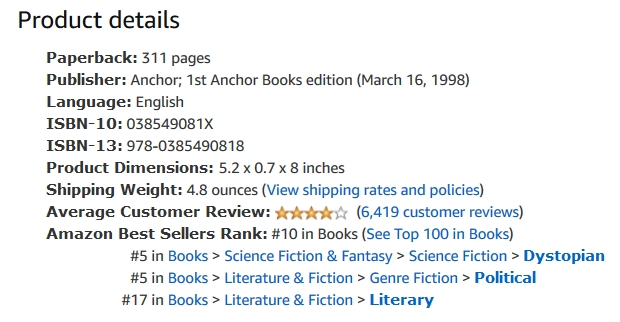
Offred of Dune.
by Peter Watts
For a writer who grew up in an age when his chosen genre was routinely derided in polite company— when even impolite company could be forgiven for thinking that SF boiled down to megablockbusters about snarky sapient raccoons and alien-punching fighter pilots— it doesn’t get much better than waking up to find that a big chunk of this year’s Emmy Awards comes down to a dust-up between two actual, non-escapist, serious and thought-provoking SF series.
Not fantasy. Not superhero adaptations. Science fiction.
It is a wet dream come true.
You ask me, this is the real Wonder Woman.
Both The Handmaid’s Tale (13 nominations) and Westworld (22!) are brilliant in their own utterly different ways. Westworld impressed me with its clinical dissection of SF tropes and neurophilosophy, with the erudition of its premise and the skill of its execution. Handmaid’s, on the other hand, was like a weekly hour-long kick in the gut, an ordeal you couldn’t look away from, a story from a universe not so much parallel to ours as converging on it. (Yes, I’m familiar with the claim that said convergence happened generations ago, that every one of Gilead’s horrors have already and repeatedly blighted this timeline. I don’t dispute this, but it’s not the whole story. Read on.) If Elisabeth Moss doesn’t win every fucking award on the planet— and I’m including the Nobel in Medicine, and the Golden Rhododendron for best floral arrangement, and Best North American Guppy Breeder in that lot— if she doesn’t take home every award there is, there should be rioting in the streets.
One series is cryosurgical, the other intensely visceral. Both inspired widespread, almost universal acclaim; both are undeniably science fiction.
Or are they?
You might know my opinion of Margaret Atwood’s notorious aversion to the “science fiction” label when applied to her work. (If not, here’s a refresher.) Even if you’re unfamiliar with my take, you probably know about her infamous “Beam me up, Scotty”, “chemicals and rockets”, “talking squids in outer space” definitions of the genre; her half-assed back-peddling when Ursula Le Guin sat her down and gave her a good talking to; her more recent (if still vaguely ambivalent) self-acceptance: Hi. I’m Peggy, and I’m a science-fiction writer.
What’s wrong with this picture?
And yet, watching the virtually-flawless Hulu adaptation of The Handmaid’s Tale— twice now— I found even myself plagued with moments of doubt. This is not a future world. It contains no advanced technology; if anything, it had the feel of a particularly nightmarish period piece. Maybe Atwood was right along.
Maybe this isn’t science fiction.
Nah.
*
I’m sticking to my story. I’m going all in, too. I’m not even going to take the easy way out, stick Atwood over with those Humanities soft-SF types who aren’t even interested in science or technology, who’d rather use aliens and dystopias as metaphors for Othering and Intersectionality and Heteronormative whateverthehells. Atwood herself eschewed that particular cop-out when she wrapped herself in the flag of “speculative fiction”: the thing that separated her writing from science fiction, she said then, was that her fiction was rigorously researched and based on Real Science. (I myself have always preferred William Gibson’s offhanded rejoinder that “All fiction is speculative.”)
No, I’m going to argue— after, admittedly, some serious moments of self-doubt— that The Handmaid’s Tale is science fiction in the pure sense: fiction designed to explore the societal impact of scientific and technological change. The All of this has happened before, all of this will happen again argument is true but irrelevant. The fact that Gilead is based on historical precedent does not get Handmaid a Get-Out-Of-SF-Free card.
Take, for example, the very reason Gilead was born in the first place, the catalyst that allowed the fundamentalists to seize power: a global collapse in human fertility, brought about by environmental catastrophes hinted at but never really explored. We know about “the Colonies”, places where the toxic waste is so ubiquitous your “skin falls off in sheets”. I seem to remember the novel talking about reactor meltdowns and high-rad zones. The apocalypse has already happened in that universe; Gilead smolders at the base of the same cliff that we, in this reality, still teeter on the edge of. The fact that it took place offstage, before the curtain rose, does not make it any less central; it set Handmaid‘s whole world in motion.
Environmental collapse. Imminent Human extinction due to pollution-induced sterility. A classic case of If This Goes On: the impact of technology, our birds come home to roost, sometime in the future.
Consider also the tactics used by the revolution: computer technology, used to disenfranchise half the population in an instant. Offred spells it out explicitly in the novel: “[T]hat’s how they were able to do it, in the way they did, all at once, without anyone knowing beforehand. If there had still been portable money, it would have been more difficult.” “All they needed to do was push a few buttons,” Moira remarks a couple of pages later.
Of course, computers and ATMs aren’t what you’d call futuristic technology. (In fact, Atwood’s references to “Compubanks” and “portable money” seemed quaint even in 1985 when the book came out; the term “ATM” never even appears in the text, although such machines were ubiquitous back then.) That hardly matters. Verne’s From the Earth to the Moon didn’t stop being SF when Apollo 11 touched down on the Sea of Tranquility. Brunner’s The Shockwave Rider didn’t turn into a historical drama with the coding of the first real-world computer virus.
If you want to be pedantic I could always roll out Offred’s cryptic references to “Feels on Wheels” and “Bun-Dle Buggies”— even the (incongruously optimistic) fact that Gilead is mainly powered by renewables, in the series at least— to plant this society clearly in a technological future. I could cite the presence of “pocket computers”, which were undeniably futuristic back in the day when amber-screened ATs with 8088 chips were the high end of personal computing. (The TV series, made in a time when the tech has surpassed that of Atwood’s original Gilead, just swaps in iPads and laptops and doesn’t sweat it.) Either way, Gilead arises via the manipulation and misuse of a particular kind of technology, inflicted on a society. It’s pretty much the textbook definition of the science-fictional thought experiment.
I admit, they had me going for a while. The lack of FX, the staid, almost Victorian setting, the overall undeniable low-key prestige of the thing had me wondering if maybe Atwood’s protestations might have more substance to them than the initially-diagnosed fear of SF cooties. This is certainly one of those shows that people who hate science fiction could watch without being any the wiser— maybe we could call it “Stealth-SF”. But SF it is: It describes a world compromised by one kind of technology, and a societal response enabled by another. I suppose, if you really wanted to, you could disqualify it on the grounds that those elements are never the thematic focus of the tale, that the real spotlight is on the way that people use religion as a means of social control.
Of course, if that’s the literary bed you want to make, you might find yourself waking up next to a guy called Atreides…
17 Jul 11:19

Martin Landau, R.I.P.
by evanier
Cartoonist Martin Landau
Sorry to hear of the passing of one of America's great actors, Martin Landau, at the age of 89. Obits like this one will tell you all about his acting career but they'll gloss over his first career. Mr. Landau started out to be a cartoonist and had great success in that field before deciding to try for another.
As you'll see below, Landau drew for newspaper strips, not comic books. At one point though, the belief spread across fandom that he had done the many comic books signed by an artist named Ken Landau. I had met both men so I kept debunking the story that there were one and the same and finally, back when I was writing for Comics Buyers Guide, I decided to settle it once and for all. I contacted Martin Landau and in October of 1998, did the following brief interview with him…
ME: Did you ever draw a comic book in your whole life?
ML: No. I loved comic books, of course. I loved strips and I loved comic books. I remember buying the World's Fair comic in 1939 with Superman, and I still have my copy of Famous Funnies #1. But no, I never worked in comic books, as Ken Landau or any other name.
ME: Do you remember what comics you liked? Books or strips?
ML: Well, Will Eisner was my favorite. The Spirit. He was the best of what we called the "wrinkle artists." These were the guys who drew a lot of folds in clothing and had a lot of texture in their work. Caniff was my other favorite. Those guys…they could create an entire movie on the page. Eisner's work was amazing. I've never seen a storyboard artist in Hollywood who could be as cinematic as what Eisner did on The Spirit. Is he still around?
ME: Still around, still drawing. I see him every year at the San Diego Convention.
ML: Well, when you see him, tell him Martin Landau loved his work. I don't know if that will mean anything to him but he was a terrific inspiration, not just to me but to everyone I knew who drew back then.
ME: Your main experience in comics was with Gus Edson on The Gumps…
ML: The Gumps, exactly. I started working at the News in New York doing illustrations in '47…or maybe it was '46. I was working for them while I was still in high school. Gus had a fellow working with him before me named Sam Hale. He was an old United Features cartoonist and he left. So after I'd been at the News for a few years, I became Gus's assistant. I started off lettering and doing backgrounds and in just a few months, I was drawing whole strips by myself, usually the Sunday page. Gus had a continuity on Monday through Saturday but the Sunday page was an entity unto itself, and he eased me into doing it. At first, he'd write it and maybe rough it out but pretty soon, I was doing the whole thing. I did it for about a year, maybe a little longer.
ME: At the time, did you envision moving on to your own strip some day?
ML: That was the goal, yes. That's what everyone wanted.
ME: But you got interested in acting instead?
ML: Eventually. I started getting that interest and I had to pursue it. But while I was at the News, I loved hanging out with the cartoonists. Some of them worked in the building and there were others who lived out of town but they'd come in once a month or every few months. I had a cubicle for a time right next to Bill Holman. Do you know his work?
ME: Smokey Stover. I have one of his originals on my wall.
ML: Marvelous stuff. Bill was quite a guy and he worked very hard. He had the worst eyesight of anyone I ever knew who made their living with their eyes. He had these Coke bottle glasses — they were the thickest lenses made and even with them, Bill had to get down, with his eyes about two inches from the Bristol Board in order to draw. You know, I have a few originals here. I have a few Terry and the Pirates by Caniff. I loved that work. I was heartbroken when George Wunder took it over. He was one five-hundredth the artist Caniff was. I have a bunch of Edson's Gumps strips, of course. I have a Smitty. I liked all their work. I loved Herriman and Roy Crane…Wash Tubbs. And Winsor McCay, especially.
ME: Do you still draw? When was the last time you drew something for publication?
ML: I draw from time to time. I was drawing this morning…I had a few minutes. I paint. I sometimes do caricatures. But no, I haven't drawn for money since — I don't know — around '51, which is when I left the News.
ME: So we can say with some certainty that you are not Ken Landau the comic book artist.
ML: As far as I know, no. I never drew for comic books. But you know, I had this happen before. When [the nightclub] Studio 54 was open, there was some altercation with some of the people involved. Some fellow who was mixed up in it told the police and told the reporters that he was my brother. They called me and I said, "I remember sisters around the table at home. I don't recall any brothers." I don't recall being Ken Landau the comic book artist, either.
I did convey Martin's regards to Will Eisner, who was very pleased to hear that Landau fondly remembered his work. Will asked me, "Do you know if he was any good as a cartoonist?" I said, "I don't know…but he couldn't have been that bad if he was drawing the Gumps Sunday page at age 22 or so."
Eisner said, "Then it's a shame we lost him to acting. There are a lot of great actors around but we could use more great cartoonists." I'm not sure fans of Landau's acting would all agree.
The post Martin Landau, R.I.P. appeared first on News From ME.
17 Jul 01:13
Today's Video Link
by evanier
D23 is going on this weekend. This is an annual convention that the Disney company runs for fans of All Things Disney and there are enough of them to stuff the Anaheim Convention Center to overflowing. The name, in case you're wondering, works like this: "D" for Disney, "23" for the year Walt founded the company in 1923.
I've never been to one of these. Every year, someone associated with the event calls a month or two prior and asks if I'm available to host a panel or two down there. I say yes. They say, "Great! We'll get back to you" and then, as I've come to expect, no one gets back to me…which is fine because I didn't expect them to. Were I not so busy at the moment prepping for Comic-Con (getting work done, writing premises for Quick Draw!, finishing my Harley Quinn cosplay costume, etc.), I might have accepted an invite to go as an audience member just to see this.
As mentioned, the Disney organization has named Jack Kirby a "Disney Legend." See here to read why I am pleased with this and not offended because, you know, Jack really didn't do any significant work for Disney. Since I met the King of the Comics in 1969, it has nagged at me so much that this wonderful man — wonderful as a creative talent, wonderful as a human being — was not properly recognized for his contribution. Most people knew he was a great artist but not nearly enough knew that it was rarely a matter of him drawing up someone else's ideas. Mostly, he drew his own or elaborated and expanded wildly on what he was given. I'm not sure Jack was even capable of just drawing what someone else thought of without adding in a whole lot of Kirby.
He did not live to see proper recognition for his work but we pretty much have it now. It may take time to propagate throughout the community but as you'll see in the video below, the folks who own the Marvel properties now speak of Jack as a creator or a co-creator. In fact, in some of what they've issued, it feels like they're making a special effort to say it as a way of flushing out old misconceptions. I cannot tell you how happy this makes me. It's like someone came and removed a little, unnecessary weight on my brain that's been sitting up there for decades. (I feel the same way when I now see Bill Finger's role in Batman being acknowledged. It's a smaller weight because I barely knew Mr. Finger and don't feel the same personal debt to him…but it's nice to have that one gone, too.)
This is video taken from the audience of the video shown at D23 about Jack. Some fans of his are upset because a few of the images of the characters are drawings not by Jack. That would be wrong if he was only being celebrated as an artist but he's more than that. He is, as he always was, a creator or co-creator. That contribution is reflected in a John Buscema drawing of the Silver Surfer. There's Kirby in any image someone draws of the Silver Surfer.
After the video, there's a lovely, perfectly-executed speech by Jack's son Neal, who was classy enough to offer the family's condolences to Stan Lee's family for the recent loss of Joan Lee. Stan was present to accept his own Disney Legend proclamation, which pleases me because of my belief that when one loses a loved one, one should get on with one's life and not be overcome by grief. His speech was a little shaky and is being faulted by some for some factual confusion…but come on. The guy is 94 and he just lost his life partner of 69 years. If ever there was a time to overlook getting his dates wrong, this is it.
The post Today's Video Link appeared first on News From ME.
17 Jul 01:11
The chart that shows general election campaigns don’t matter (usually)
by TSE
2017 election saw the biggest swing DURING an election campaign ever – uncertainty is the new normal pic.twitter.com/VVTCADtY0T
— Ben Page, Ipsos MORI (@benatipsosmori) July 13, 2017
One of the axioms of British politics is that general election campaigns don’t matter, and the stats in the above chart by Ben Page of Ipsos MORI does back that up, with sub margin of error changes during past campaigns but the 2017 general election campaign really didn’t stick to past conventions.
The question was 2017 an outlier or the beginning of a trend? My instinct is that at the next general election campaign the Tories couldn’t run a worse campaign than 2017 even if they tried, so 2017 was an outlier of a campaign in my view, though I’m assuming neither Theresa May nor the gruesome twosome Nick Timothy & Fiona Hill will be involved in the next Tory general election campaign.
TSE
16 Jul 12:02
Why people voted Labour or Tory at the general election
by TSE


YouGov have released some findings on why people voted Tory or Labour at the general election. After the Tory manifesto that was designed to annoy and upset every voter in the country it’s not surprising that Labour’s policies/manifestos scores higher than the Tories.
What I find intriguing is how many people voted against Corbyn (both in absolute numbers and relative to Theresa May) which should alarm the Tories. If Labour are led by someone who isn’t quite so polarising as Corbyn (or without the interesting backstory) then if all things are equal then Labour should end up as the largest party, maybe even with a majority, at the next general election, that is something David Davis (and anyone else who is trying to topple Mrs May) should be spending time focusing on.
TSE
15 Jul 18:05
Do Cheaters Prosper?
by evanier

I have this friend named Richard Turner who is one of the greatest handlers of playing cards in history. He bills himself as a "Card Mechanic" or sometimes as "The Cheat." Put simply, if he deals cards to you, you will get what he wants you to get and everyone else in the game will get the cards he wants them to get and there's no f'ing way you'll ever catch him controlling the deal. It's an amazing, seemingly-impossible skill and it would be impressive even if he could see what he's doing.
Oh, I guess I forget to mention: My friend Richard is blind.
He wasn't when I met him around 1981. He could see a little, though less with each passing year. Losing his vision completely has only caused one little snag in his act. Every now and then, he has to ask spectators to tell him if the cards are all facing the same way. You can check out Richard's skills in some of the videos I've embedded in this site. Or you can see him next Thursday evening on the Season 4 opener of Penn and Teller: Fool Us.
If you've never seen that show, it's on the CW Network. Each episode, several magicians perform feats and they win a prize of sorts if Penn & Teller are unable to figure out how they did what they did. This mostly means if Teller is unable to figure out how they did what they did.
Penn & Teller: Fool Us was originally a short-lived series produced in Great Britain. I played a part in the decision by the CW to acquire and revive it for American television and right at the start, I told them to get Richard Turner on it. Earlier this year, the folks at CW called and told me it was finally happening and they offered to fly me to Vegas for the "taping" — we still call them that though no tape is involved — which was in early April. Unfortunately, I was then dealing with Carolyn's situation and so I had to pass. You can see what happened when the show is broadcast this Thursday and in umpteen retransmissions after that.
The post Do Cheaters Prosper? appeared first on News From ME.
15 Jul 18:05
Toad in the Hole
by evanier
Just what we needed: A new controversy in this country. Steve Whitmire, who has played Kermit the Frog since the death of Jim Henson in 1990, is being replaced. Mr. Whitmire is not happy about this and says that the folks who have the power to make such a decision had two issues with his work, though he does not say what those two issues are. He also suggests that he was blind-sided by their decision and that he did not have a chance to discuss remedies prior to their decision.
I know nothing more about this than you do. I thought Whitmire did as fine a job in the role as anyone possibly could. The few times I've met him, he seemed like a nice fellow who was very, very happy to have the job and one who was well aware of the awesome responsibility that came with it. The fact that he has gone public with his side of the matter suggests to me he is not afraid to have the two reasons become public knowledge, though unwilling to reveal them himself. So I dunno what to make of it…
The post Toad in the Hole appeared first on News From ME.
15 Jul 17:34
Plus ça change, plus c’est la même chose
by TSE
So Andrea Leadsom might be keeping Mrs May in her job. https://t.co/61uAjuIJNx pic.twitter.com/1Z9HNwBYGV
— TSE (@TSEofPB) July 15, 2017
For the second year running Andrea Leadsom is ensuring Theresa May is Prime Minister.
Last night I observed the unofficial Tory leadership contest is increasing in its tempo and activity, today The Financial Times have more information on it.
Some speculate Mr Davis might be given a “coronation” as the leadership candidate best placed to deliver Brexit, but few Tory MPs believe that a transfer of power would be anything other than brutal and protracted. “There won’t be a coronation while Andrea Leadsom is alive,” sighs one Conservative MP, referring to the ambitious leader of the Commons who made a shortlived bid for the Conservative leadership against Mrs May last year.
Meanwhile, Tory MPs recount how other potential contenders are suddenly clearing their diaries to spend more time with colleagues. “[Chancellor] Philip Hammond had drinks the other night in his office,” says one Tory MP. “It’s not like him.”
Some MPs argue Mr Hammond might act as a stopgap leader — perhaps serving for two years to deliver Brexit before standing aside — but the idea of the Conservatives fielding three prime ministers in a single parliament is seen as bizarre by many. “What would be the point of Philip Hammond?” says one Tory MP. “It’s like deciding you want to change your Volvo and you come back from the garage with…another Volvo.”
So last year Andrea Leadsom effectively made Theresa May Prime Minister and one year on she’s still ensuring Theresa May continues to be Prime Minister because Mrs Leadsom still harbours ambitions to be Prime Minister and won’t allow a coronation. This also does tend to give credence to the reports that after the general election Mrs Leadsom wanted Mrs May to appoint her as Home Secretary or Foreign Secretary.
TSE
14 Jul 18:45


How to Screw Up a Triumphant Bestselling Debut
by John Scalzi
I’ll preface this by noting I think Milo Yiannopoulos is a real piece of shit human being who I’d be delighted to see tossed into the metaphorical oubliette of uncaring oblivion. But, when I saw some people having schadenfreude over Yiannopoulos’ book sales of Dangerous, which were reportedly only a fifth of his self-asserted sales numbers, I had a moment of “well, actually,” as in, “well, actually, that real piece of shit human being might not be lying about his sales.”
Here’s the deal: Yiannopoulos has asserted his book’s opening week sales were on the order of 100,000 copies. Contrasting this, Nielsen Bookscan, the service which tracks physical book sales via many (but not all) booksellers, including Amazon, has his first week sales as 18,268 in the US (and — heh — 152 in the UK). As most of us probably know, 18,000 is less than 100,000.
Or is it? Because here’s the thing about Bookscan — it doesn’t in fact track all sales of a book. It doesn’t track eBook sales, for example, nor does it track audiobook sales. Nor does it track sales from some small independent booksellers, who might have not signed up to be Bookscan-reporting retailers. As a result, depending on how much you sell in other formats, and where you sell your books, Bookscan can massively underreport your total sales.
I know this because that’s what Bookscan does with me. A couple of years ago I tracked the sales of the hardcover era of Lock In (which is to say, all the sales reported while the physical book was only available in hardcover). For the time it was in hardcover, Bookscan reported 11,175 hardcover sales in the US. However, overall the book sold about 22,500 copies in hardcover and about 87,500 copies across all formats (hardcover, ebook, audio).
In all, Bookscan recorded roughly 12.7% of my total sales. Which is not a lot! If Yiannopoulos were seeing a similar sort of ratio, based on his physical copy sales, he could indeed have sold something on the order of 100,000 copies of his book in the first week. He might not be lying.
With all that said, on further examination, this is why I very strongly suspect that Yiannopoulos has not, in fact, sold, 100,000 copies of his book in the first week:
One, my sales numbers included audio; cursory examination of Yiannopoulos’ Amazon book page shows he does not have an audio version of the book available — important because Audible, the major audiobook sales channel in the US, is owned by Amazon, and would definitely have the audiobook noted for sale on the Amazon sales page. That eliminates an entire sales channel.
Two, I suspect (but have no evidence) that Yiannopoulos is strongly relying on Amazon to sell his book, rather than having some large percentage of retail sales come through brick-and-mortar book sellers, and specifically does not have an advantage that I and other genre authors have, which is specialty bookstores selling our books. My Bookscan numbers skew low precisely because I sell a lot through indie and specialty book stores, which don’t report to Bookscan. If Yiannopoulos is relying primarily on Amazon — which would make sense, given the push to preorder there, the online nature of his alt-right audience, and the fact that it’s easier to set up sales through Amazon than through the distribution channels of physical book stores — then his Bookscan numbers would capture a far higher percentage of his sales than, say, it would of mine.
Third, there’s this comment from Yiannopoulos’s camp:
It’s true that the major booksellers only managed to ship out 18,000 copies to retail customers by the list cutoff. But that’s because they didn’t order enough ahead of time, and have been scrambling to play catchup ever since. The real news is that we’ve received wholesale orders and direct orders of such magnitude that our entire stock of 105,000 books is already accounted for.
This is a little bit of publishing inside pool which apparently Yiannopoulos is not aware of (or is trying to fudge), but: You don’t count wholesale orders because wholesalers will eventually return books if they don’t sell them. The publisher has to make them whole for that, either by shifting credit to other books (which in this case Yiannopoulos as a self-publisher of a single book does not have), or by refunding the money. Yiannopoulos may have shipped 105,000 hardcover copies of the book, but that’s not the same as having sold them. I don’t know in this case what “direct orders” mean — it could be sales to individual book buyers (in which case that would be a sale) or to individual booksellers (in which case they are probably returnable, as book stores are loath to stock anything on a non-returnable basis), or to organizations which are making a “bulk buy” for their own reasons, say, a conservative organization who wants to hand out copies to employees or on the street or whatever.
But however you slice it, by Yiannopoulos’ own words (and by his apparent lack of understanding of how bookselling works), he probably has not in fact sold all 100k of the hardcover books. Also, with regard to the wholesalers and other booksellers, I do hope someone in his organization is keeping money in reserve to deal with returns when they (inevitably) happen. I’m also curious as to how he as a self-publisher is dealing with long-term storage and shipping of the books; I really don’t see Yiannopoulos himself handling that. I don’t picture him as a detail-oriented person. Perhaps this will be a job for the interns.
With all of this said, and again with the reminder that I find Yiannopoulos a hot feculent mess of a person, sales of 18,000 hardcovers in one week is pretty darn good. It was enough to land Yiannopoulos at #3 on the USA Today list and at #4 on the New York Times Hardcover Nonfiction list (and #2 on the paper’s print/ebook combined list). He’s a legitimate bestseller. And those 18K sales don’t cover ebook sales, which given his audience demographics I suspect are pretty high. Most authors would be absolutely delighted to have 18k in hardcover sales in their first week. People exercising schadenfreude about all this are thus advised to temper their glee somewhat. The book is not a failure in any manner except in contrast to Yiannopoulos’ industry-specific hype, and also (if the professional reviews are to be believed) as a book worth reading.
(Incidentally, the first week sales also show that Simon & Schuster, who were to publish the book until they didn’t, had really rather accurately priced the book when they offered Yiannopoulous a $250,000 advance on it. An 18K first week would have put it on a sales track to zero out that $250k advance in a year or two, depending on eventual paperback sales. It would have made money for S&S, and possibly broke even for Yiannopoulos.)
Can Yiannopoulos sell 100,000 copies of his book? I suspect so in the long run, especially considering that Yiannopoulos can now have it as a rider for speaking events that whomever is having him speak will be obliged to purchase a certain number of the book in order to have him appear — and speaking events and appearances are the actual bread-and-butter for a creature such as Yiannopoulos, for which this book is mostly advertising.
Has he sold that many in the first week? I doubt it. The actual number, in all formats, across all retailers, is somewhere between 18,000 and 100,000 copies. Which, again, is not at all a bad number of books to sell in the first week. Had Yiannopoulos been smart, he wouldn’t have alleged selling 100K books in his first week at all, he simply would have taken those USA Today and NYT list rankings and waved them about happily, and built PR around those.
But apparently he’s not really that smart. Now most of the stories are about how he only sold 18,000 copies in his first week, rather than the 100,000 copies he alleged. Well done him.
11 Jul 10:23
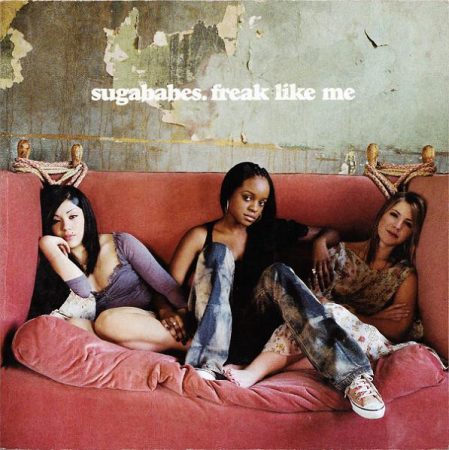
SUGABABES – “Freak Like Me”
by Tom
#924, 4th May 2002
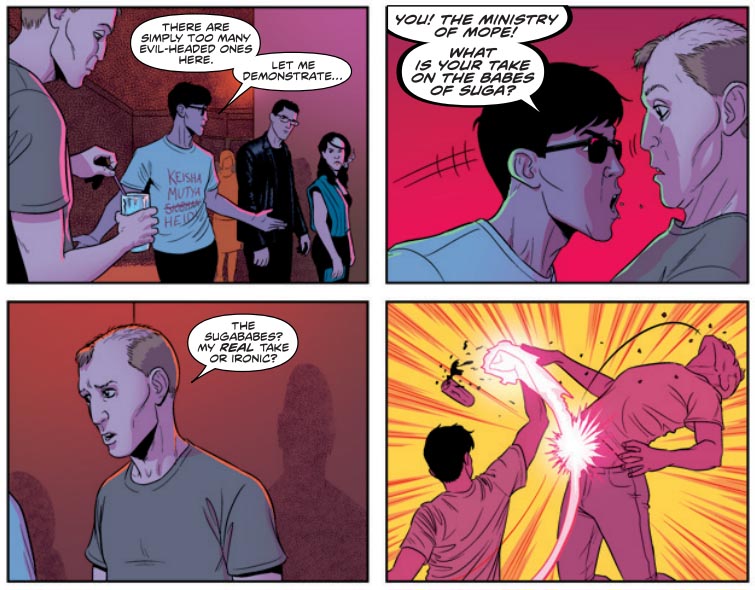
 At The Disco
A scene from Phonogram III: The Immaterial Girl, by Gillen, McKelvie and Wilson, published in 2015. It’s the early 00s, at a disco somewhere in the south of England. A group of people who love music so much it’s become their life and the tools of their craft – magic in the comic’s world; writing, DJing and blogging in ours – have been brought together to scheme and to dance. One of them is Seth Bingo, a skinny guy in a T-Shirt saying “Mutya Keisha Siobhan”. The final name is crossed out, with “Heidi” scrawled underneath. Bingo, affected but handsome in a gaunt sort of way, is talking to another thin white man, a morose husk of a creature called Indie Dave. “What is your take – “ Bingo asks – “on the Babes Of Suga?”.
“My real take?” asks Dave, “Or my ironic one?”. And so Seth Bingo lays him out with an uppercut, the art exploding in colour around the punch.
Pop as something worth fighting over, worth making wild gestures for: Seth Bingo wasn’t the only one who liked that idea. In real-world enclaves on and off the Internet, young critics were taking up cudgels in the name of pop. Sometimes we were as showy and insufferable as Seth Bingo. Sometimes we shouted louder and harder to try and silence the Indie Daves we still glimpsed in mirrors. Most of the time though we were trying to answer honest questions – what was great about pop, and what did it mean to love it? I’m still trying to answer those questions. Let’s take another shot.
The Babes Of Suga
Phonogram gets its casus belli right: people who loved pop music really loved the Sugababes. The original Sugababes were as close as the early 00s had come to a credible – perhaps ‘cult’ is closer – pop act, making low-key R’n’B out of a sweet blend of young voices. In a pop world split between a kids’ concept of being teenage and a teenager’s concept of being adult, the Sugababes were teenagers being teenagers: awkward, moody, braiding together anxiety and mutuality. The twining, circling arrangements of their songs celebrated teenage friendship and support. The reality of their working lives, sometimes painfully obvious in press photos, was closer to the darker side of adolescent relationships: tension, bullying, hostility. They were appallingly young.
They were also only marginally successful. Superb debut “Overload” went top 10, but later singles stumbled. Two of the group – the original schoolfriend unit of Mutya and Keisha – forced Siobhan out (she went on to make Ghosts, one of the best pop LPs of the 00s). They recruited new member Heidi Range, who had a stint in Atomic Kitten on her CV: you could hardly imagine a pedigree more at odds with the group’s carefully-established image of authenticity. Fans of the group – or at least, older fans like me – assumed the jig was up.
For “Freak Like Me” the Sugababes are a convenient brand name as much as a working pop unit. As a commercial move it’s a throw of the dice – a group with nothing to lose. It could have been their last single, and you doubt the label would have been too surprised. Instead it’s their rebirth. But musically it’s a rebirth that swerves dramatically away from their earlier sound, shredding the All-Saints-y chic of the debut LP and embracing producer Richard X’s soundclash aesthetics. “Freak Like Me” buzzes and crunches, sounds deliberately cheap. The lashed-together band are singing a lashed-together song, a cover version of two tracks welded into one with the joins purposely on show. And for those in the know, an extra layer: this contraption is itself a cover of a limited edition track put out by Richard X in his Girls on Top identity, called – how horribly apt – “We Don’t Give A Damn About Our Friends”.
Component Parts
Start with the foundation, then, released before any of Mutya, Keisha or Heidi were born. I’ve written about Tubeway Army’s “Are ‘Friends’ Electric” before, marking it too low. “Are ‘Friends’ Electric” is a pilot for the obliquity of early 80s pop, its love of expressionist, unresolvable lyrics. The song is a succession of riddling scenes with its singer’s loneliness the thread you follow. But it’s the music that X borrowed for the chassis of his mash-up: the bass synth riff marching its way round in circles, the treble pushing upward whenever the singer hits a moment of self-realisation (“I don’t think I mean anything to you”) and halts. These moments, in the Tubeway Army song, aren’t climactic: they fall back again into the song’s grind.
By Numan’s own admission, his enigmatic narrative lacked much of a vocal hook. So the topline of “Freak Like Me” comes from sixteen years later, and Adina Howard’s magnificent R&B track. Howard’s “Freak Like Me” rolls along under one of the 90s’ signature sounds – that lovely, high G-Funk whine, a chemtrail ribbon across a summer city sky. The music gives a lazy, friendly glow to a radical song. Howard’s lyric flips George Clinton’s old “dog in me” line to underline that this is a record entirely, explicitly about her desire. There’s no concession to R&B convention: this is not about a specific man, not about how she might spark desire in others, not about romance. “Freak Like Me” is about autonomy, and how autonomy is hot.
(Since I’m mentioning everything else, I’ll mention the marvellous cover by Tru Faith ft. Dub Conspiracy, which would have been fresher in the minds of “Freak Like Me”’s British audience in 2002. It speeds up Anita Howard’s track and transfers it to the silken surrounds of East London clubland at the height of UK Garage. The freakin’ here is, to be honest, a little too brisk and businesslike, but the backing track is a sublime checklist of genre tricks.)
Two songs become one: Richard X’s Girls On Top project put out a four-track EP of mash-ups in time to catch a late-2001 wave of excitement around the idea of ‘bootlegs’, remixed hits which took the vocal line from one track and the backing from another. Most were goofy, gleeful fun, subjecting vocals to Procrustean indignity in the attempt to get them to mash with the backing track. They weren’t a new idea – google “JT and the Big Family” for one originator – but they were having a moment.
Mash-ups were a by-product of an Internet era – sprawling song libraries on MP3, rising download speeds, an industry struggling to catch up with the pace of change and its legal issues. It was the sampledelic 80s replayed as frantic DIY panto. A lot of bootlegs were diverting junk. Some producers tried a little harder. X was one, working his way through a single idea across the Girls On Top EP: cold synth backing, fierce female vocals. “We Don’t Give A Damn About Our Friends” was its standout.
“You Got Good Taste”
Bootleg pop explicitly remixes history, looks for connections and relationships. It invites you to ask critical questions (it also invites you to dance to them). What do Gary Numan and Adina Howard have in common? What don’t they? What do the Sugababes covering a bootleg add to it?
The first questions, at least, are easy to answer. What both unites and polarises Tubeway Army and Adina Howard are sex and identity. The singer of “Freak Like Me” defines herself by desire, unleashes her desire but is always in control of it. The singer of “Are ‘Friends’ Electric” is sick from the loss of control, paranoid and seized by the doubt that even a possibly artificial being could want to be with him. Pushing these two together is a delicious opportunity: Philip K Dick in pursuit of dick.
But an opportunity isn’t a song. To make “We Don’t Give A Damn About Our Friends” work, Richard X has to play with its structure, turning the mechanical churn of “Are ‘Friends’ Electric?” into something positive, triumphant even, to match Howard’s proud self-assertion. He chops out the instrumental break between verses in the Numan song, letting Howard’s chorus hooks create variety instead, and turns the song into a march towards a climax, Adina Howard’s cry of “it’s all good to me!”. In her song, this is the cue for a male rapper to step forward as a suitor – Notorious B.I.G., happy for once to be a backing feature. In the reworked and fused track, her shout cues the Tubeway Army music’s soaring treble synth riffs. But here they act not as a failed catharsis, but as ferocious release.
Meanwhile “We Don’t Give A Damn” is collapsing even as it peaks, drowning in fuzz and digital distortion. Richard X doesn’t just fuse tracks, he tampers with them, taking artefacts destined to circulate as lo-fidelity MP3 files and making them sound like it. The audio experience of Girls On Top’s track is deliberately ugly and lossy – its synths corroded and hollowed out.
In 2001, this made the track fit its stylistic moment as well as either of its source songs had. The bare-wires fizz of “We Don’t Give A Damn”, with chunks of riff and keyboard feedback spattered like blobs of solder on the Numan track, locates it alongside another early 00s fad: electroclash.
Bootleg pop was electroclash’s nerdy kid brother. Both musics were club-led, knowingly retro, built on an aesthetic of salvage and novelty. Of course there were huge differences – electroclash was druggier and dressier, and bootlegs were – despite the impeccably po-mo means of creation – generally less caked in irony. Mash-ups were jolly and disposable – as pop, I rather preferred them. But the vibe Girls On Top created was where the two sounds met – making synth classics into a cheap glassy rush, and turning vocal divas cruel and aloof. X’s titles – “Being Nobody”, “I Wanna Dance With Numbers” and “We Don’t Give A Damn About Our Friends” itself – had a shade of electroclash’s performance-art callousness about them.
For record labels, bootlegs presented a minor dilemma. They had buzz, but were tough to cash in on – the best ones circulated via the online sharing economy or on burned CDs, and clearing any for release would have been a maze of permissions and publishing questions with no guarantee of return. But here was a potential test case. Richard X seemed to be, in the nicest possible way, a pop geek, keen to see what could be done within the machine. The Sugababes were a broken project in need of a relaunch, but one who had never quite hit their commercial potential in the first place. “Freak Like Me” must have looked like an acceptable risk.
Everybody Sing
Part of why I loved “Freak Like Me” so much in 2002 was its context. The two previous number ones, Gareth Gates and Oasis, offered a shabby contrast: pop enslaved by light entertainment, or a rock as a parade of zombie gestures. Confident mediocrity, wherever you looked. “Freak Like Me” was just as much in dialogue with pop’s history, but in a way which felt provocative and lively, not stillborn.
Approaching 30, I projected onto the record my own dreams and fears. A longing for pop as the electric spine of mass culture, for the charts as a bazaar where the underground and mainstream could haggle over ideas. And a dread not just that these moments had never really mattered as much as I wanted them to, but also that once upon a time they had, that older writers were right and the real good times were long past. Like Seth Bingo, I was prepared to throw my puny forearms into the fight, to defend the Babes of Suga.
So I wrote things like this:
“Sugababes I think aren’t just appealing to their old ‘pop’ audience, but have hooked onto a bigger, less obvious market, and have done so not by an appeal to authenticity but by making – or at least breaking – a unhealthily fresh noise. And next? Canny pop producers will have spotted an opportunity, a risk – even if it turns out not to be Sugababes’ to take
I could be entirely wrong. But meanwhile we have “Freak Like Me”, the best single to top the chart for a long time. I’d played the initial Girls on Top bootleg to exhaustion and I wasn’t expecting to fall for the same song twice – but I did, and it’s still maybe every tenth tune I play. Great number ones are rare too.
I bought the single before I took the bus back to Oxford last Monday morning. Every time the song hit its climax – “It’s all good for ME!” – I looked out the window and saw houses, tower blocks, shopping centers, and imagined the same song playing on the radios in them all. That feeling of community, the idea that I can have something glorious in common with people I’ve never met, is an illusion, maybe, but it’s one of the best feelings I know – it shapes what I write, what I listen to, how I vote.”
But that tells you more about me and my fantasies (of pop, of culture, of not working at a shitty start-up and feeling lonely all the time) than it does about the Sugababes record, how it sounds and feels. It keeps the structure of “We Don’t Give A Damn” – rearranging the song so it turns on that peak – but scrubs the bootleg down, scraping off the gunk and fuzz without making the track too glossy. What emerges from the clean-up is a strange, novel mix of glam, electro and R&B.
As we know now, this single is a freak itself – a track that revived a career while sounding very little like what came before or after it. The evolved Sugababes find their sound on their next Number One; Richard X moves on to a string of quixotic and brilliant near-misses. Bootleg pop becomes a footnote. In the band’s story, “Freak Like Me” is both crucial and a strange chrysalis phase.
You can get an idea of where “Freak” sits at angles to the group’s later sound by hearing the bonus version on their Overloaded singles collection – the “Maida Vale session”, performed live. Here the song is thoroughly de-X-ified, the grimy pulse of the Tubeway Army synth line turned into a rock backing track with occasional keyboard stabs. And the band rush the ending, going straight back into the chorus after “good for me”. It highlights something important about the single – how much in tension the Sugababes and the sound are. On their earlier and later records, the group and their vocal interplay are the focus. On “Freak Like Me”, there’s less room for harmonising: the song and the singers are a dam built against the backing’s electronic flood. At the end, it breaks.
But what makes this single so thrilling is that it’s the singers who break the dam themselves, who resolve the tension with that cry of “ME!”. It turns Adina Howard’s record from a song about the no-shit assumption of autonomy to a song about the rush of discovering and claiming it. That’s the element which lets “Freak Like Me” build as high as the records that forged it.
After The Disco
Seth Bingo’s punch, arsehole move or not, is a great Phonogram moment. But it’s not the story. That happens seven years later, and the older events are the great and stupid deeds the cast is living with, and living down. By then, in the real world, the Babes of Suga had become what they might have been if “Freak Like Me” had gone wrong: an embarrassing shell of a group. And the moment they had thrived in sat suddenly on the other side of a historical and economic fissure.
When you think about a historical moment, like the early 00s, you can’t help but underlay it with hindsight: the concerns and consequences of your own time are the backing track on which your recreation of an era rests. To write historically is to create mash-ups. Hindsight gives arbitrary associations sudden weight. A YouTube upload of Richard X’s “We Don’t Give A Damn About Our Friends” plays out to a still picture of Viv “Spend, Spend, Spend” Nicholson, mad-eyed and clutching her Pools-winning cheque. It’s so striking I wondered if it had been used by X himself, but no. Still, it was a shrewd and poetic choice, finding a link between desperate profligacy and the pick’n’mix excess of the bootleg boomlet.
From the vantage point of 2017, let alone 2009, 2002 seems like a champagne glass of bubbles: the madness of the credit boom, the New Labour liberal consensus it paid for, but also the CD era itself, and even the sense of the Internet as something whose creative force was essentially benign. The point of a bubble – in the metaphoric sense – is that it’s artificial but that its artifice is hard to detect: it feels natural when you’re in one, at least until it’s just about to burst. Then burst it does, and you see it was never natural at all. Where does that leave the pop music which emerged from that time?
One temptation might be to walk away, to give up on 00s pop as an enchantment that failed, the froth of a delusional culture. After all, Phonogram isn’t a story about turning pop into magic, it’s a story about when and how to stop doing that.
But that’s never been how pop or history works, for me. If the 00s looks like a decadent era right now then its pop reflects that as much as it reflected the hope and greed people felt in its urgent present. The pop music that for me still seems most resonant from that time is pop where the artifice breaks through the skin, where no real attempt is made to maintain a facade of naturalism. Pop like “Freak Like Me”, a Frankenstein of patchwork ideas and broken friendships, unease in its bones, shouting its life at the world anyhow.
11 Jul 10:04
A Brief Exchange
by evanier
A little while ago, Joe Scarborough tweeted…
Unfortunately, the infection has spread throughout the party. I became a Republican because of Ronald Reagan. This is no longer his party.
A littler while ago, Matt Ygelsias tweeted in response…
Reagan never would have made a shady deal with a hostile foreign power except that one time when he needed a slush fund for Nicaragua.
The post A Brief Exchange appeared first on News From ME.
10 Jul 00:21
Why people from Manchester are Mancunians, and other demonyms.
Why people from Manchester are Mancunians, and other demonyms.
09 Jul 01:45
Wonder Woman in Belgium
I went to see Wonder Woman last weekend in my local cinema. I haven't been following the DC movies recently — the last I saw was The Dark Knight Rises five years ago — and went into it pretty unspoiled with no expectations. I really enjoyed it, and heartily recommend it to everyone.
Spoiler alert!
I had no idea that the film is largely set during the closing weeks of the first world war, in November 1918, with almost all of the second half set in a fictionalised Belgium. Although we Belgians have contributed greatly to the comics tradition, we're not used to seeing our country in superhero movies.
The fictional Belgian village of Veld, typically for Flanders of the time, has shop signs in French but the villagers mainly speak Flemish to each other — and a frisson went around the movie hall as Wonder Woman spoke to them in their own language. Later in the film, the audience went very quiet at one point.
The resonances were pretty strong. The cinema I was sitting in (which committed a major faux pas on the film's opening night) was built on the site of buildings destroyed during the invasion of August 1914, close to the monument to the 272 civilians in our town killed during that terrible month. The movie's interrogation of the rationale for war hit very close to home.
And although it is (rightly) being noted that the portrayal of chemical weapons in Wonder Woman has an eerie similarity to what is happening in Syria right now, it remains the case that the Belgian military Service for the Removal and Destruction of Explosive material — which is based in the woods in our home village — is still finding 150-200 tons of first world war munitions every year, 5-10% of which is toxic, with no sign of that abating.
I'm glad to say that the century-old chemical weapons don't come near our local headquarters, but are kept in Poelkapelle, 150 km west of here. They are currently working through a significant backlog with their new disposal chamber, which started working only last April after the previous one got blown up in 2012.
Coming from where I do, I'm used to writers taking my own cultural heritage and mangling it horribly. I think Wonder Woman very successfully avoided this trap as far as Belgium goes (though the castle where the military gala ball takes place appears to be in a very un-Belgian landscape). (And I did wonder about Themiscyra apparently being within a day or so of both Turkey and London.)
It's fundamentally a funny, witty action film with a light approach to actual history; but it does the serious bits very well. As I said, strongly recommended.
08 Jul 11:35
Miriam Marx, R.I.P.
by evanier

Miriam Marx, daughter of Groucho, died June 29 at the age of 90. Her life was filled with struggles with drink and struggles with family turbulence. She and her brother Arthur (who passed away in 2011 ) were born from Groucho's first marriage, which was to Ruth Johnson. Ruth was a serious alcoholic and passed that condition on to her daughter. (Groucho was married two more times and had a daughter, Melinda, from the second marriage and none from the third. All three marriages ended in divorce.) Miriam collected many letters from her father in the 1992 book, Love, Groucho. It's a very honest, candid book about their relationship.
It was my pleasure to meet and talk with Miriam on two occasions, both when she turned out for a performance by her friend, Frank Ferrante. Frank, as any reader of this blog knows, is a fine impersonator of her father and he did much to take care of Miriam in her last years.
My impression of her was that she was a sweet, soft-spoken woman who was a little intimidated by all the folks who wanted to meet Groucho's Daughter and who perhaps expected her to be as verbally witty as her pop. We do that often to the children of famous, talented people, thinking that somehow they have failed their birthrights and family heritage by not being able to do everything their superstar parent did. Psychologists have built summer homes off the guilt that some kids feel when it turns out they can't immediately match the greatness of some parent. We ought to let those people live their lives, unpressured by near-impossible expectations.
Anyway, I liked her a lot. And I think she liked that when we talked, we talked about us — a lot about her, a little about me — and not exclusively about her dad. She had a good career as a writer and editor, and deserves to be recognized for that, and not just for who tucked her in at night and told her stories. Can you imagine what those stories must have been like?
Here's a good obit and overview in the Los Angeles Times.
The post Miriam Marx, R.I.P. appeared first on News From ME.

05 Jul 19:19
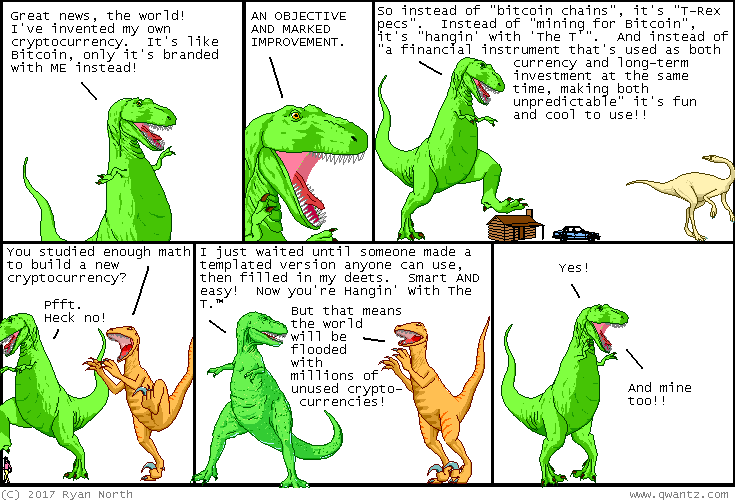
fun AND cool? sounds like my kinda scene
| archive - contact - sexy exciting merchandise - search - about | |||
 |
|||
| ← previous | July 5th, 2017 | next | |
|
July 5th, 2017: I am Kickstarting a new book! It's called WILLIAM SHAKESPEARE PUNCHES A FRIGGIN' SHARK and/or other stories and it's gonna be great, in my not-at-all-biased opinion!! – Ryan | |||
05 Jul 13:43
I hope this is not the first step in the state regulation of polling
by TSE
What the recently announced House of Lords Committee on political polling might be looking at. https://t.co/kQ1A1vvxnZ pic.twitter.com/rFF24KpcBZ
— TSE (@TSEofPB) July 5, 2017
The House of Lords announced last week they would looking into opinion polls, The Lords say
The results of political opinion polls have become an increasingly prominent feature of British politics, caused by parties reacting to changing economic and social trends, the media seeking more frequent measures of parties’ standing, and technological innovation and falling costs in the polling industry. In the period between the 2010 and 2015 general elections, over 2,000 voter intention polls were conducted by polling companies—on average more than one poll per day for five years. Meanwhile, as the use of social media and online sources have increased, their influence on political discourse has also grown.
There are a variety of ‘official’ ways in which the general public is encouraged to get online to influence political discussions in Parliament. In recent years, there has also been a growth in the number of independent websites and digital publications which encourage political dialogue and support online campaigns. While both political polling and social/digital media undoubtedly have an effect on political discourse, relatively little work has been carried out to assess the combined effects of both. An ad hoc committee might therefore wish to consider how the two factors interrelate, as well as how each issue affects politics on its own.
One of Lords involved in this is Lord Foulkes who has in the past ‘has tabled a private member’s bill bringing the multi-million-pound industry under the control of a state-appointed regulator rather than the current self-regulatory body, the British Polling Council. The state regulator would be empowered to consider whether polls should be banned in an election period.’
State regulation of polling is a huge concern for me, I fear it will lead to pollsters being unable to present their findings that turn out to be accurate, for example general election polling by Survation or YouGov’s model would be impermissible with this idea.
As for banning polls during an election period, that would likely lead to inaccurate and ill informed speculation and hints which would help nobody, least of all the voters or the political parties.
TSE
05 Jul 10:45
Of centrists, radicals and liberals
by Nick
 As the Liberal Democrat leadership election now appears likely to consist of just two stages – closing nominations, and announcing Vince Cable is the winner – attention now turns to what direction the party will head in under its new leader, with some declaring that the only way forward is for the party to become the herald of the ‘radical centre’. This is often linked to claims that what Britain needs is a new centre party and that Macron and Trudeau are examples the party should follow (click on the links to see what I wrote about those ideas before to save me from writing them out again).
The problem with the ‘radical centre’ is that it’s a phrase that’s effectively meaningless, a political buzzword that you invoke to get the nodding approval of your audience without any of you actually agreeing on what it means. Some hear ‘radical’ and think back to the radical reformers of the nineteenth century, imagining it invokes the spirit of the Chartists and others to overturn the structures of power, or they see the unfinished business of the early twentieth century to tax land and wealth, while others imagine it as a call to the spirit of Hayek and Thatcher to radically cut back the state and taxes. Meanwhile some see the centre as a nice safe place to be, just picking what they like from left and right, while others see it as merely a location of necessity on a scale they have no interest in. And all of them hear ‘radical centre’ and see something different from their neighbour whilst imagining everyone is thinking the same as them. (And I will admit to having used this empty signifier myself in the past)
And when you come down to it and ask for an explanation of what the ‘radical centre’ is you get something like this from The Economist. The exact policy detail may change between different ‘radical centrists’ but the intention is the same, wanting a centrism that “reconciles the left’s impatience at an unsatisfactory status quo with the right’s scepticism about grandiose redistributive schemes.” Or in other words, recognising that things are bad or very bad for some people, but there’s not much that can be done about it beyond a few tweaks. Despite the Economist’s claim to liberalism, there’s a strong element of small-c conservatism behind this position as it’s a belief that everything’s essentially all right and any changes that are needed to make things better are purely administrative rather than structural. Quite where the ‘radical’ applies in this centrism is anyone’s guess, and the liberalism it invokes is very much a conservative liberalism that often likes to ignore that left-liberalism exists.
One of the problems of discussing centrism in British politics is that the concept has become strongly linked with liberalism, but I think this is more by a historic quirk of the British party system rather than any ideological similarity between liberalism and centrism. British liberalism has always been a broad church movement, trying to bring together the various different strands of liberalism into one party which, in order to accommodate all these different beliefs has tended to split the difference between them and oscillate around the ideological centre. When we look to other countries we can see liberal parties that don’t anchor themselves in the centre, and we also see centre parties (especially those from the Christian Democrat tradition) that don’t define themselves as liberal but do see themselves as a bridge between left and right. While I doubt any of these parties would define themselves as radical, they do exist as centrist parties of varying levels of political success.
One train of thought I’m developing in my work on centre parties – and this is still quite nascent, so comments and thoughts on it welcome – is the concept of a political system having what I’m calling for now a ‘centrist moment’. That is to say, there’s a period of time where there’s tacit agreement of parties and electorate to agree upon a consensus politics of the centre which can either take the form of a centrist party being in power or an alternation between left and right that’s effectively about managerial differences rather than ideological ones. Systems move between a centrist moment and a polarized one (where differences are accentuated and ideology becomes more important) independently of any left-right ideological movement as they choose to accept or reject a consensus. In this view, Britain is actually exiting a two-decade long centrist moment, while France is entering one. We can’t have a British Macron, because we’ve already have one.
If we continue to conflate liberalism and centrism – whether it’s ‘radical’ or not – then we’re heading up a blind alley towards a liberalism that doesn’t challenge anything but is content to be brought out in defence of the status quo. It’s liberalism with the sharp edges filed off to make it safe and unthreatening to anyone with any actual power and of no hope to anyone without power looking in on the gilded centre from the outside. Just saying you’re radical doesn’t mean you are, no matter how many times people might say it.
05 Jul 01:24


How People Get to Whatever, 2017 Midyear Report
by John Scalzi
This is going to be a blog stats nerdery report, so you can skip it entirely if this sort of thing bores you.
At the halfway point of 2017, Whatever is on track to have the lowest number of direct site visits of any year since 2008, which is the year the site started being hosted by WordPress VIP. If current visitorship levels continue, the site will end up with around 4 million visits for the year. That number is nothing to sneeze at, but it’s also considerably off the eight million visits the site got in 2012, the highest-traffic year of the site.
So what’s going on this year that’s bringing the traffic down? I think there are a number of things going on.
The first chunk of things has to do with me. I’ve written comparatively less here this year than in other years, and there’s a pretty direct correlation between the number of posts and the number of visits. Write fewer posts and you’ll get fewer visits. This year there are have been 230 posts to date (231 with this one); in 2012 I posted 848 posts total, which means probably twice as many posts that year at this point than this.
Also this year I’ve had no post really “break out” yet — the massively-shared post that boosts readership at the site. Again, in 2012, I had a stack of those: the “Straight White Male” post, but also “A Fan Letter to Conservative Politicians,” “A Self-Made Man Looks at How He Made It” and “Who Gets to Be a Geek?” and a few others. Those are things you can’t plan for — you can try to make something viral, but there’s no guarantee it’ll work — and you just take them as they come. This year has had some widely shared posts, but nothing on that sort of scale.
Finally in this category, and largely explaining the first two, this year my focus has been elsewhere a lot of the year to date. Offline, I’ve been touring and traveling heavily, primarily to promote The Collapsing Empire, and working on writing Head On and doing a few other projects. All of those leave less time for writing longer-form thoughts here. This factor also means Twitter is in many ways more congenial to my schedule — it’s easier to dip in and out of when I have a snarky thought, which as most of you know is pretty often. Plus there is some stuff that I would write here that I now write over at the Los Angeles Times, because they pay me money for that, and I like money, and also the larger audience a major newspaper provides, online and off.
Basically that last point is: Hey, I got busy with paid and promotional work! Which was and is always the goal. But it also means longer posts here are often the first to get cut in the list of “things to do today.” Not always — sometimes I just have to say something — but usually.
So those are the reasons relating to me directly. Now for some of the things not relating to me directly:
First up, the general collapse of blogs, which has been happening for a couple of years now, really seems to have accelerated in the last year. I notice this anecdotally, first in that the number of personal blogs referring visitors to the site has dropped significantly, and secondly in that when I do the occasional Google search on “Scalzi,” filtering for the last 24 hours of references, very very few blogs show up anymore; its mostly book reviews and sites masquerading as pirate media servers in order to give the unwary a virus.
Now, if I’m writing fewer posts (and fewer long-term posts), there’ll be a drop because of that anyway, but I have a more stable metric for this stuff as well: The Big Idea posts, which I post regularly even when I don’t otherwise post, and which have stable (and nice!) visitor stats. Two years ago, a good number of personal blogs would link into Whatever to note Big Idea posts; this year, again, very few. Basically Twitter and Facebook have largely completed their digestion of the blogosphere at this point. This is also reflected in my stats: The two largest referrers to the site are these two. But there’s no way to parse out in my site stats where on either site the links originate. From a site stats point of view, they’re both black boxes.
(Which, incidentally, makes me sad. Back in my day, you could find a lot of interesting people and sites just by combing through your site stats and seeing who was linking to you, or by doing the occasional ego search. These days, again, the results are either opaque or just plain junk. There’s not a lot of there there anymore.)
So basically fewer people are getting to Whatever through the ways they used to. But — and here’s an salient point — I don’t think the content of the site is overall getting fewer readers, because there are other ways they read it now without directly visiting the site. For example, Whatever has (as of this very moment) 28,342 people who follow the site via WordPress, which means they see the posts not on the site, but through an RSS-like feed which they can scroll through. Whatever has another 12K or so subscribers via Feedly last I checked, and a couple thousand at least who get posts emailed to them. So that’s 40K+ people who get whatever I write here without ever having to come to the site unless they want to comment.
Then there’s stuff like Google’s AMP initiative, which, if you click a Whatever result on Google while you’re on a mobile device, presents you with an alternate “streamlined” mobile-friendly version of the post rather than taking you directly to the site (which, I will note, already presents a mobile-friendly version of the site). Those readers aren’t captured on my site stats either, as far as I can tell.
What this means, basically, is that for 2017, there’s something like 9+ million potential visits to writing on Whatever that aren’t being registered in the site stats (I say “potential” since not every post sent out via WordPress or Feedly is going to be read by an individual subscriber). Which is significant! And also suggests, again, that the issue is not fewer people having access to the writing on Whatever, but me not having access to the full numbers (or, more accurately, meaningful numbers). This is another example of how the Web has changed substantially, even in just a few years.
What does this mean for Whatever? Honestly, not too much. I don’t rely on Whatever for income, so the visitor stats, while they’re interesting for me (I mean, obviously), don’t have on effect on how I run the site. I don’t have to post clickbait-y pieces to drive traffic, and depending on my whim, I can post six pieces a day or none. Once again, “Whatever” exactly describes what the site is about; it’s whatever I have on my mind, how I wish to present it, when I have the time to do so.
On a personal level, I admit that this diffusion of Whatever readership is annoying to me; I liked it better when I had a better idea just how many people were reading my stuff at any one time, rather than having to guess. I’m kind of a stats nerd, it seems. I suppose if I wanted to splash out a lot of money and time I could probably find a stats program out there that could interface with everything and give me a more accurate picture, but: Money and time. I don’t really want to spend either.
And anyway, as much as I enjoy Twitter and other social media, sometimes I just want to write at length, and this is the place for that. The occasional tweetstorm (i.e., chaining multiple tweets on a subject together) is fine, but honestly if you’re going to write at length, just write a friggin’ blog post and link people into it. Also, and again, I own this site. Long after Twitter or Facebook is a memory, as long as I pay for this site, it’s here to stay.
So: However you’re reading this, thanks. I’m glad you are. Let’s keep going through 2017.
03 Jul 11:36


In Which I Trespass Against Dan Wells at Denver Comic Con, and He Exacts His Fitting Revenge, a Tale Told in Two Tweets
by John Scalzi
So no one came to my signing, and then @scalzi came to say hi, and then someone came with books BY HIM SO HE COULD SIGN THEM AT MY SIGNING. pic.twitter.com/q0AQxnIhSl
— Dan Wells (@TheDanWells) July 2, 2017
Revenge.@scalzi pic.twitter.com/kB6nW9YTtp
— Dan Wells (@TheDanWells) July 2, 2017
That’s fair.
In other news, at the airport to be on my way home. Thanks, Denver Comic Con and all who attended, for a fabulous time.
02 Jul 10:52
How the Corbyn surge has left the Lib Dems positioned largely as an anti-Tory party
by TSE
Labour aren’t in second place in any of the seats the Lib Dems hold, and Labour hold only 4 of the top 30 Lib Dem target seats
Looking through the results of June 8th I was struck by how much the Corbyn surge has left the Lib Dems as a Tory facing party. As we can see in above chart, in not one of the twelve seats the Lib Dems hold are Labour second, it is either the Tories or the SNP.
But if we look at at the chart below which shows the party which holds the seat in the top 30 Lib Dem target seats, so during this parliament and during the general election campaign the Lib Dem focus will be aimed predominantly at the Tories, this might help given Labour/Corbyn a free pass.
All of this makes we wonder if the Lib Dems are making a mistake in allowing Sir Vince Cable to become leader in a coronation. This is not meant as a slight on Sir Vince, but given his high profile role in the coalition and his role in tuition fees, I’m not sure he’s best placed to exploit the political environment he and the Lib Dems find themselves in.
Perhaps an MP such as Layla Moran who has no obvious links to the coaliton might better placed as she lacks the baggage of Sir Vince, a leadership contest, not a coronation might help the Lib Dems answer this.
TSE
01 Jul 13:24
What is it you believe in?
by Kat Tanaka Okopnik
Demo, the people. Kratos, power.”
Americans love to say we believe in the fundamental goodness of democracy. That we are proud to have been one of the first modern democracies. That our representative form of government is the best of all possible forms. That it is a fundamental goodness that the Pax America spreads democracy throughout the world.
But we also have an electorate (the group of people who are eligible to vote) with one of the lowest rates of participation in the world.
Helping guide how our towns, our states, and our nation is governed is one of our essential responsibilities as citizens. But many of us act like spoiled sons of privilege, letting someone else attend to the essential tasks. Yes, we are in a representative democracy, which means that instead of being directly involved, we are trusting a representative. But when we don’t do the due diligence of actually screening that representative, trusting instead to vague impressions or name recognition, we are in fact doing our part to continue the sort of nepotism and cronyism we claim to oppose.
We talk about “a jury of our peers,” but when we don’t make provision for jurors being compensated for their time, we create a system where only those with leisure and privilege sit on juries. We are seeding the jury pool with privileged viewpoints, and ceding justice.
When we shy away from difficult discussions at gatherings, we allow friends and family to vote and judge based on viewpoints that will continue the systemic injustice we are surrounded by.
I get asked, constantly, “but what can I do?”
You can decide how much time justice and oversight get in your life. You can push for reforms to voting systems. You can push for fair pay for jurors. You can push for a universal stipend for study time for ballot issues. You can push for more transparency and public discussion of ballot issues. You can push for better access to polling places.
And if you can’t do it personally, find someone else who can, that you trust. And/or pay an organization that works for those issues.
Because some of us don’t have that time. Some of us are working too many hours to try to make ends meet. Some of us have barely enough endurance to make it through each day. Some of us are unable to vote.
But none of us can really afford to ignore the issue. Except for the few that this current system works for.
01 Jul 13:23
Tactical voting didn’t win it for the Scottish Tories
by David Herdson

But genuine gains from the Lib Dems and Labour did.
Jeremy Corbyn would be prime minister today if the Scottish Tories had done as badly three weeks ago as they did in 2015 (or any of the previous four elections). Without the dozen gains north of the border, a deal with the DUP wouldn’t have given her the numbers and a deal with anyone else couldn’t have been done. It would have been game over.
Given the different nature of politics in Scotland, where the unionist-nationalist split is at least as potent as the progressive-conservative one, that raises the intriguing question as to whether tactical Labour and/or Lib Dem unionist votes – to keep the SNP out – had the unintended but very real effect of keeping Theresa May in.
In fact, no, they didn’t. Indeed, one unremarked feature of the Scottish results was how unchanged the Labour and Lib Dem shares were in the seats the Tories won. In more than half of the 13 constituencies, neither other unionist party put on or lost more than 5% in vote share. In these, the swing must have been dominated by direct SNP-Con switchers.
Of the six seats where there was a change of more than 5% in the Lab or LD share, the common feature is that the change was always a decline from the party which won in 2010 but which lost the seat in 2015. That might be evidence of tactical voting but more likely is that it’s simply the incumbency bonus unwinding. In a few cases – East Renfrewshire or Gordon, for example – there may well also have been an unwinding of a pro-Lab or pro-LD tactical vote from 2015.
In fact, in two of the three seats that went LD-SNP-Con, Labour also polled substantially better in 2017 than 2015 (where they lost, or came close to losing, their deposit), again suggesting a lack of tactical voting. Besides, in only one of the seats (Stirling) was the result particularly close. Even if some of the falls in the shares of the other unionist parties was down to tactical voting, it wouldn’t have been decisive.
In addition, the Conservatives won five of the thirteen seats from third. That’s not wholly indicative of a lack of tactical voting – the previous result is only one factor in determining who is best-placed as a challenger – but it strongly hints in that direction.
So a straight-forward swing on both independence and economic-social axes? Not quite. If we compare 2017 against 2010 rather than 2015, a different picture emerges. That both the Lib Dems and Scottish Labour have suffered disastrously since 2010 is hardly news. All the same, it’s notable that in every single seat the Scottish Tories now hold, both Labour and the Lib Dems have gone backwards, generally by large amounts. Across the 13 seats, the Labour and Lib Dem shares have fallen by at least 5% in 22 of the 26 instances, by double-digits in 14 of them and by at least 20% in seven instances. Both SNP and Tories have gained, roughly equally.
These seats are not, of course, a cross-section of Scottish opinion and we should be extremely wary of drawing general conclusions. All the same, the Tory share in them is up by at least 9% in every seat gained and by much more in most. These gains have come almost exclusively from the Lib Dem and Labour voters of 2010. It might not have been tactical and it might have been a positive vote for the union and against a second independence referendum, but the decisions of these ex-progressive alliance supporters of Gordon Brown and Nick Clegg still resulted in Theresa May rather than Jeremy Corbyn forming a government.
David Herdson
30 Jun 15:20
 I was once elected as a Liberal Democrat leader without a contest. Long term readers of this blog (I like to pretend there are some) or those few with memories of Colchester politics of more than four years will remember that I was leader of the Liberal Democrat group on the Borough Council in 2013-14, and when I was elected to that role it was without anyone else standing against me. It’s not an uncommon thing to happen in local politics (in all parties) as often senior positions within groups and councils are allocated on the basis of who has the time to do them, but it’s still uncommon in national politics. In recent years, only Michael Howard and Gordon Brown have become leader of a major Britain-wide party without facing any form of election, but now Vince Cable appears poised to join them as all his potential rivals for the leadership of the Liberal Democrats have now pulled out of the race.
Cable needs to speak up and answer questions before he gets crowned as leader
by Nick

‘Can I put these back in the garage yet?’
Some people appear to be relieved that we’re not going to be having a leadership contest, but I’m not one of them. Not only does it mean that we as members aren’t going to have a say on the future direction of the party, but it also means that Cable’s going to become leader without any real scrutiny or examination of what he wants to do as party leader. Now I know several of you are now muttering about how the leader doesn’t run the party, Conference is sovereign, and all that but the leader has huge power to create the image of the party in the eyes of the public. They get the bulk of the party’s media appearances, the decision about which questions to ask at PMQs and the content of the leader’s speech, which is the only bit of Conference that gets any significant media coverage. Their formal power within the party’s structures may be low, but their informal power inside and outside the party is huge, which is why we put a lot more effort and attention into party leadership elections than other internal contests.
Which brings me back to my time as a leader. When I decided to put myself forward, I sent out a message to my fellow councillors explaining why and what I wanted to do in the role. At the group AGM before I was confirmed in the role I did a further speech to them and answered a bunch of questions before being confirmed, and I then wrote to all the local members and did press interviews on what I wanted to do. The point is that even I didn’t face an election, people ha da pretty clear idea on my aims priorities for the leadership (whether I was successful in those aims is a debate for another time).
The problem we have now is that we don’t have anything other than the vaguest idea about what a Vince Cable leadership will mean for the Liberal Democrats, yet we’re now in a position where it’s almost certain to happen. We had an ‘I’m standing for leader’ statement on LDV but nothing more since. As far as I can tell, there’s not even a ‘Vince for Leader’ website and his official website doesn’t even mention he’s an MP again, let alone his leadership bid. It’s not just that his ambivalence on keeping freedom of movement is a problem, it’s the issue of how he’ll deal with press questioning on it if – as he should as leader – he now speaks up for party policy in favour of it and remaining in the EU.
Beyond that, we need to know what his focus as leader would be. Would it be on building his and the party’s media profile? Developing policy (and in which direction)? Reforming the organisation of the party? Going out on the streets to campaign on the doorstep with members? Touring the country giving speeches? Working with other parties in Parliament to defeat the government? There are many different styles of leadership – and we’ve seen most of them in the Liberal Democrats – and we need to know what sort of leader he sees himself as being, how he’d strike the balance between all those different tasks that are required of a leader. If he is going to be appointed by acclamation by the MPs, we need to know how he sees the job so we have targets and promises to hold him to.
I’m not calling for an MP to be dragooned against their will into standing against Vince, and I understand the personal reasons that have been given for not standing, but if he is going to become leader of the party in a few weeks time, he needs to be out there now putting forward his vision for the future of the party and answering the many questions members have about the future direction of the party. Expecting people who hold power to be accountable is a key principle of liberalism, and we need to know that Cable understands that he’s accountable to the membership and needs to have their support before he’s crowned as leader. Waving through his coronation in the hope that it’ll all work out fine is just about the worst thing we could do right now.
We can’t have an election, but that doesn’t mean we can’t give the only candidate for the job a thorough interview and set out what we want to see him do in the role before giving it to him.
28 Jun 07:42
Kirby Krusade
by evanier
The home page of Google often has these little graphics called Google Doodles that salute someone or something for a day. A movement has been started on the 'net to get Google to note Jack Kirby on August 28, 2017. That's the date Jack would have turned 100 years old if he was still with us.
I think (forgive me if I'm wrong) that this campaign was started by a writer-cartoonist named "Calamity" Jon Morris. He is urging Kirby fans to send an e-mail to proposals@google.com with the subject line of "Google Doodle for Jack Kirby – August 28, 2017." In the body of the message, explain why Jack deserves this honor. If you're the kind of Kirby fan who would take the time to do this, you probably can list fifty reasons. I wrote the following in my message to them…
Jack Kirby was one of the great creative geniuses of the 20th century, bringing us a whole visual language birthed in comic books, and co-creating characters like Captain America, The Hulk, The Avengers, The X-Men, Thor, The Fantastic Four, The Silver Surfer and countless others that will endure forever. Though widely celebrated within the comic book industry, he has not received nearly enough recognition outside that field. A Google Doodle on what would have been his 100th birthday would do much to rectify that oversight.
I don't know who crafts these things but whoever the Doodles Weaver is, I hope he or she realizes how deserving Jack is.
The post Kirby Krusade appeared first on News From ME.
27 Jun 23:48
Fifty years ago, reports the Shropshire Star's business section, the first withdrawal from a bank cash machine was made. In those days it was known as an ATM - automated teller machine,
And it was made at a branch of Barclay's in Enfield by the comedian Reg Varney.
He was even trending on Twitter today, nine years after his death, because of it.
But is this anniversary to celebrate?
In what is probably the greatest post in the history of blogging, Stumbling and Mumbling pointed out:
As the same post reminds us:
 That is surely right. As I once wrote myself:
How Reg Varney ruined Britain
by Jonathan Calder
Fifty years ago, reports the Shropshire Star's business section, the first withdrawal from a bank cash machine was made. In those days it was known as an ATM - automated teller machine,
And it was made at a branch of Barclay's in Enfield by the comedian Reg Varney.
He was even trending on Twitter today, nine years after his death, because of it.
But is this anniversary to celebrate?
In what is probably the greatest post in the history of blogging, Stumbling and Mumbling pointed out:
The invention of the ATM helped make it much easier to get cash out of the bank. This fall in shoe leather costs for technological reasons offset part of the normal cost of inflation, which helped make people less intolerant of it. Is it really a coincidence that inflation began to rise as the cash point machine, as popularized by Mr Varney, became more widely used? I think not.
There’s a second effect of its spread, however, which has only become appreciated in light of the rise in behavioural economics.
The easier availability of cash has reduced one constraint on our spending. Before Mr Varney used the cash point, impulse buying of good or sessions down the pub were constrained by the fact that cash was hard to obtain. After that fateful day, however, the constraint came down.But I am afraid Reg Varney's culpability does not stop there.
As the same post reminds us:
His portrayal of Stan Butler did much to perpetuate the image of the 1970s worker as a bone-idle work-dodger; we forget today just how enormously popular On the Buses was. And this in turn might subconsciously have contributed to the popularity of Thatcherism. How many of those who, when asked by Tories in 1979 whether the working class had become too big for its boots, conjured up a picture of Stan Butler and so voted for Thatcher?
Even at the time, Blakey was my favourite character. And I don't know if it is age, my experience of public transport or our post-Thatcher society, but I cannot help noticing today that the passengers counted for nothing in On the Buses.
Just at Alexander Mackenderick, the director of Whisky Galore!, sympathised with Captain Waggett, the representative of English officialdom who attempted to round up the whisky rescued from the wreck of the S.S. Cabinet Minister, so I now see Blakey as the hero of On the Buses and its spin-off films.
27 Jun 13:37
Conversation Deliberately Skirts The Border Of Incomprehensibility
by Scott Alexander
From lierdumoa.tumblr.com:
To my friends on the [autism] spectrum, let me explain to you an unspoken social rule that possibly nobody has ever explained to you before
If a neurotypical asks you, “What game are you playing?” they’re not asking you to describe the game.
They’re asking you if they can play too.
If a neurotypical asks you, “What are you watching?” they’re not asking you to explain the plot of the movie/tv show to them.
They’re asking if they can watch it with you.
When neurotypicals ask you “What are you doing?”
What you think they’re asking: “Please explain to me what you are doing.”
What they’re actually asking: “Can I join you?”Now here’s the really fucked up part. If you start explaining to them what you’re doing? They will interpret that as a rejection.
What you think you’re saying: [the answer to their question]
What they think you’re saying: This is an elite and exclusive activity for a level 5 friend and you are a level 1 acquaintance. You are not qualified to join me because you don’t know all this stuff. Go away.This is why neurotypicals think you’re being cold and antisocial.
IT’S ALL A HORRIBLE MISCOMMUNICATION.
I don’t think this is always true – and when it is I would describe it as more of an open-ended attempt to start a fun conversation than a demand for participation – but I agree that it’s not just a straightforward request for information.
And there was some interesting discussion about this on Autistic Tumblr, which centered around: why would someone do this? Why can’t people just say what they mean?
And the best answer I saw – sorry, I can’t find it right now – explained that people were trying to spare their friends the burden of rejecting them. Say Alice is reading a book, and Bob asks “Hey, do you want to talk about that book?” Maybe Alice doesn’t want to talk about it. But the following conversation…
Bob: Hey, you want to talk to me about that book?
Alice: No
…sounds really rude. So by Bob saying his line, he’s putting a lot of subtle pressure on Alice to agree. Bob is a good person and he doesn’t want to do that. So instead he asks “Hey, what are you reading?”
Bob: Hey, what are you reading?
Alice: Not much. Just some random novel.
Bob: Oh, well, enjoy!
Or:
Bob: Hey, what are you reading?
Alice: Oh! It’s really interesting! It’s this book where Apollo 8 crashes into the celestial sphere surrounding the world, and suddenly everything reverts to kabbalistic Judaism…
Bob: Sounds neat! What happens next?
Here Alice either has an opportunity to signal that she wants to continue the conversation, or to reject Bob while maintaining plausible deniability that she’s doing that.
(The beauty of this theory is ruined only by the fact that half the time this happens in real life and I say “Just some random novel,” Bob actually answers “Oh! What kind of random novel?” and then I say “Oh, nothing really”, and Bob says “Come on! Something has to happen!” and then I start despairing that anything about social interaction can ever work at all. I don’t know. Maybe Bob is autistic.)
What I find interesting about “plausible deniability” explanations is that Bob has to operate as close to the border of “inscrutable confusingness” as possible without crossing it. He wants Alice to know he wants to talk to her, but he doesn’t want Alice to know that he knows she knows he wants to talk to her (I’m being very deliberate in putting the word “know” exactly three times there rather than just using a vague phrase like “common knowledge”). As long as Alice doesn’t know he knows she knows he wants to talk to her, Alice can give a non-answer, pretending that she believes Bob will believe that she just didn’t realize he wanted to talk to her.
And this sort of weird common-knowledge-denial-process only works if you’re skirting the border of incomprehensibility, hitting a sweet spot where you think the other person will understand, but it’s also just barely plausible that the other person wouldn’t understand. If you say something the other person would definitely understand, then the game is up. Given some sort of natural variation in how good people are at understanding cues, your best bet is to send a cue that will fail a small but non-zero percent of the time.
But if there are people who are unusually bad at understanding social cues, like autistic people, then any cue calibrated to be on the exact border of neurotypical understanding is likely to fail for them more often than not.
I don’t know how common this pattern is. Making requests seems like a pretty good example. Flirting seems to be centered upon this kind of thing. I’m not sure what else is involved, but I bet it’s a lot.
A while ago I quoted a paper by Lawson, Rees & Friston about predictive-processing-based hypotheses of autism. They said:
This provides a simple explanation for the pronounced social-communication difficulties in autism; given that other agents are arguably the most difficult things to predict. In the complex world of social interactions, the many-to-one mappings between causes and sensory input are dramatically increased and difficult to learn; especially if one cannot contextualize the prediction errors that drive that learning.
And I was really struck by the phrase “arguably the most difficult thing to predict”. Really? People are harder to predict than, I don’t know, the weather? Weird little flying bugs? Political trends? M. Night Shyamalan movies? And of all the things about people that should be hard to predict, ordinary conversations?
And I think part of the answer might be: ordinary conversations are hard to predict because they’re designed to be so. Conversation norms are anti-inductive. Like Douglas Adams’ conception of the universe, any time people start to understand them too well, they have to get replaced with something a little bit less comprehensible.