Shared posts

04 Dec 16:11

Van Dyke Parks meets Merle Haggard

by Michael Leddy
As told by Kinky Friedman:
“Van Dyke was worried he’d get lynched because, well, he’s a sort of Noel Coward type,” Friedman says. “So he asked everybody, ‘How long have you known Merle?’ And every one of them would answer, ‘Ever since.’ ‘Ever since,' 'Ever since,’ ‘Ever since.’ So he asked me, ‘What does that mean, ever since?’ I told him, ‘Ever since prison, stupid!’ Stupid is one thing Van Dyke is not. But ever since prison.
Related reading
All OCA Van Dyke Parks posts (Pinboard)

[“A sort of Noel Coward type”? What?!]

You’re reading a post from Michael Leddy’s blog Orange Crate Art. Your reader may not display this post as its writer intended.

This work is licensed under a Creative Commons 3.0 License.
03 Dec 20:14

Things Tim Farron doesn’t understand: Atheism

by Nick

(Hopefully not the first in an ongoing series)

If you’ve seen more Liberal Democrats facepalming than usual this week, it’s probably thanks to Tim Farron’s speech to the Theos think tank in which he puts forward the argument that maybe it’s liberals who are the real illiberals. Featuring a variety of hoary old cod-philosophical chestnuts like equating freedom of speech with freedom from criticism, his speech goes on to argue that Christianity “is the essential underpinning of liberalism and, indeed, of democracy” which feels somewhat of a stretch. While I wouldn’t argue that it’s antithetical to either, for every Christian he cites on the side of social progress, there were others fighting against them, arguing that their particular brand of injustice was endorsed by the Bible. I don’t dispute that individual Christians have had an influence on the development of liberalism and democracy but to claim that Christianity itself is somehow fundamentally linked to them feels akin to claiming that you can’t use calculus without agreeing with the religious views of Newton and Leibniz.

It also misses out that saying ‘I am a Christian’ is similar to saying ‘I am a liberal’ in that the statement alone reveals very little about the person’s actual belief. Just as ‘liberal’ is used across almost the entire political spectrum, so ‘Christian’ can mean anything from fire-and-brimstone revivalists who think Trump’s a bit too moderate for their tastes to Quakers complaining Jeremy Corbyn’s a bit centrist. There are plenty of intersections between the two along those scales, but neither is fundamental to the other.

However, the bit of the speech where my raised eyebrow threatened to tear a muscle came near the end when he talks about atheism like this:

Well look, atheism is not the absence of belief, it is a belief in absence and therefore the absence of common values. It’s a belief in there being no unifying truth. But if there is no unifying truth then, by its own standard, the belief that there is no unifying truth must also be bogus. If you declare that there is no unifying truth then it stands to reason that this declaration isn’t true either. Ergo, atheism doesn’t exist. And I refuse to believe in something that doesn’t exist.

This is a somewhat bizarre interpretation of atheism, most notably regarding atheism as a belief in itself and thus somehow self-negating because it’s a belief in nothing. It also comes up earlier when he says it would be “silly…to make atheism the state religion”, which I would agree with, though we’re clearly using two different ideas of silly here. He thinks it’s possible to make atheism a state religion because it’s somehow a belief like a religion, while I think it’s silly because it’s the same as declaring you’re going to make a pumpkin your car.

There’s an old saying that Tim doesn’t seem to have encountered or understood: we’re all atheists, I just believe in one less god than you. I don’t believe in Tim’s God the same way he doesn’t believe in Vishnu, Ahura Mazda, Odin, the Tooth Fairy or Russell’s Teapot. However, not believing in a certain category of things does not mean not believing in all things, and it especially does not mean that atheists believe in an absence of common values. By a similar leap of logic I could argue that if there is no unifying truth there can be no unifying understanding, thus there can be no language, therefore you’re not actually reading this blog post right now because the language it’s written in doesn’t exist. That argument doesn’t actually make sense – all I’ve done is transposed the word ‘unifying’ from one context to another and claim it does – and it’s the same as suddenly reversing the words in your definition of atheism and claiming that’s also true.

Atheism does not mean believing in nothing, it just means not believing in a god or gods. Atheists can believe in universal truths and values, but ones that are revealed by natural action or human discovery, not by being handed down by divine writ from above. Some may not believe in unifying truths or common values, but there are plenty of religious people who do the same – some will live in heaven for eternity, while the rest of us are doomed to eternal damnation is hardly unifying, is it – so to claim it’s a special property of atheism, and one shared by all atheists, is simply misunderstanding the concept at a basic level.

I’m annoyed by this speech, not just because it feels like a real slap in the face for those of us who defended Tim a few months ago, but because it feels like little more than a compendium of Christian cliches about secularism, liberalism and atheism. It seems to be getting him some attention, but when Tim’s new admirers include people like Tim Montgomerie and Douglas Murray it’s hard not to be reminded of Dora Gaitskell’s comment when her husband basked in seeming triumph at a Labour conference: “all the wrong people are clapping.”

03 Dec 08:58

Open letter to the Democratic Party Re: Your Fundraising Emails.

by Neurodivergent K
Dear National and Local Arms of the Democratic Party,

Like many Americans, I get a lot of emails. Like many Americans who care about things, I get a lot of emails asking me for money. Like a lot of Americans, I get a lot of emails explicitly from you demanding my money and my action.

Democratic party, here's the thing: you send me emails that say "Don't let the GOP <do awful thing>" pretty much on a daily basis. And I am not the one letting the GOP do anything.

That's on you, friendos.

Even before the Democratic party establishment latched onto "they go low, we go high" as a failing-to-rally cry, the strategy of caving to Republican plans was very much in place. Democratic party, even if I had money--which I don't--I wouldn't give it for you for the purpose of fighting my battles. You won't fight them.

In my lifetime there's not a single battle I've seen the party truly fight, you see. The Overton Window keeps getting pulled right because the Democrats propose something, Republicans say "ha ha no" and you say "oh ok let's compromise."

Your compromises, Democratic party, are what have led us to a place where people with disabilities, who were already in deep poverty, are now likely to lose our healthcare and our freedoms. You let this happen. Your compromises, Democratic party, are why most of my generation is drowning in student debt and will likely never resurface. Your compromises are why education and health care disparities are so rampant. Your compromises are a big factor in having so many wars that we shouldn't have had, and in our returning veterans being abandoned when they get home. Your compromises contribute to voter suppression, which especially effects people of color.

You make choices, Democratic party, that screw over your base, again and again and again. You make compromises that will ruin, if not end, our lives, in this "appeal to the middle" fallacy. You aren't going to woo any Republicans, Democrats. You aren't. You know that; if you didn't you'd be asking them for money. You try to get blood from a turnip (that turnip being your base) after you already sold us out, and for what? So you can say you compromised? That you were a bigger person?

Time to stop being the bigger person, Democratic party. Time to do your damn job and look out for your constituents. "At least we aren't those guys" actually isn't good enough.

And you're going to have to do it without our money. You already took every dime and wasted it doing your best impression of a doormat.

Regards,
K
28 Nov 19:31

Unforeseen Consequences and that 1929 vibe

by Charlie Stross

So: me and bitcoin, you already knew I disliked it, right?

(Let's discriminate between Blockchain and Bitcoin for a moment. Blockchain: a cryptographically secured distributed database, useful for numerous purposes. Bitcoin: a particularly pernicious cryptocurrency implemented using blockchain.) What makes Bitcoin (hereafter BTC) pernicious in the first instance is the mining process, in combination with the hard upper limit on the number of BTC: it becomes increasingly computationally expensive over time. Per this article, Bitcoin mining is now consuming 30.23 TWh of electricity per year, or rather more electricity than Ireland; it's outrageously more energy-intensive than the Visa or Mastercard networks, all in the name of delivering a decentralized currency rather than one with individual choke-points. (Here's a semi-log plot of relative mining difficulty over time.) Credit card and banking settlement is vulnerable to government pressure, so it's no surprise that BTC is a libertarian shibboleth. (Per a demographic survey of BTC users compiled by a UCL researcher and no longer on the web, the typical BTC user in 2013 was a 32 year old male libertarian.)

Times change, and so, I think, do the people behind the ongoing BTC commodity bubble. (Which is still inflating because around 30% of BTC remain to be mined, so conditions of artificial scarcity and a commodity bubble coincide). Last night I tweeted an intemperate opinion—that's about all twitter is good for, plus the odd bon mot and cat jpeg—that we need to ban Bitcoin because it's fucking our carbon emissions. It's up to 0.12% of global energy consumption and rising rapidly: the implication is that it has the potential to outstrip more useful and productive computational uses of energy (like, oh, kitten jpegs) and to rival other major power-hogging industries without providing anything we actually need. And boy did I get some interesting random replies!

As viral tweets go, this one didn't get retweeted a whole lot—only about 200 times. (My all time record is over 5000 rts.) It attracted a lot of replies from folks who don't follow me and I've never heard of, all of them really contemptuous/insulting (as is often the case on twitter: thick skin recommended). Obviously, a lot of folks with BTC wallets are kind of attached to them and dislike the idea of losing them. What I wasn't expecting was the alt-right/neo-Nazi connection. Bitcoin isn't just popular among libertarians, it's popular among folks with green frog/Kek user icons and anti-semitic views. ("Are you a Jew?" asked one egg.)

One possible explanation, which looks quite reasonable as a first approximation, is that the US libertarian fringe has been assimilated by the neo-Nazis. After all, once you take one red pill, why not take another, and another, until you overdose on the bloody things? Alternatively, Bitcoin boosters are using the same twitter-based astroturf techniques as the alt-right to shout down anyone who publicly qustions or threatens their investment. But I didn't see the wave of obvious bots I'd have expected if the second explanation was correct: it looked to me far more like an angry human mob, with added political extremism on top.

Now, I'd like to remind you about an at-first-sight unrelated historical phenomenon: the collapse of the Papiermark in 1923 in the Weimar Republic, and the subsequent Beer Hall Putsch. The Nazis failed to take over at that time; the German economy was stabilized and the global economy in general wasn't as fragile as it would later become during the Great Depression. But the 1919-23 hyperinflation was a major driver for the initial rise of the Nazi party. Hitler's mass support wasn't motivated solely by his anti-semitism and revanchist imperialism: it was made all about the money supply. (In the 1929-33 period, mainstream politicians were discredited by the wave of mass unemployment triggered by withdrawal of US bank loans, and Brüning's policy of deflation. When nobody has any money to buy bread, and the bakers have no money to buy grain, but the bank mortgage on the bakery isn't getting any smaller, bad shit ensues.)

It's fairly clear now that since 2007/08 we're living in the dying days of the former neoliberal system. With disruption and collapse spreading throughout the developed world, the systematized recipe known as the Washington Consensus is being applied not only to client states but back home in the heartlands of the USA, UK, and EU members (where it's sold to the economically illiterate as "austerity"). It's also being used as cover for disaster capitalism, the systematic looting of public assets and social capital for the enrichment of small groups. Meanwhile, weaponized media (both social media and mass media owned by the oligarchs) is used to channel the sense of grievance felt by the immiserated population into acceptable directions, via slogans like "taking back control" or "make America Great again". Directions such as resentment towards immigrants, get-rich-quick schemes such as cryptocurrency bubbles or goldbuggery, and ritualized abusive denunciation of anyone who questions these attempts to divert attention away from the real problem—the way we're being conditioned for exploitation by our self-proclaimed masters.

So I now have two follow-on questions about BTC.

Firstly, what if BTC's supporters are right? That is: if BTC delivers what its supporters promise, then how will the oligarchs react? A working distributed cryptocurrency model is inimical to the interests of billionaire monopolists who want to get rich by imposing rent-seeking practices on the immobilized peasantry (ahem: I mean us ordinary folks). They won't go quietly, there will be a crack-down, and we may be seeing the first signs of the shape it will take in China (which is banning bitcoin excchanges). Distributed systems, contra received wisdom, can be banned: you just have to be sufficiently ruthless. (You criminalize possession, then enforce by imposing deep packet inspection at the network backbone level, apply criminal penalties for being caught selling goods or services in return for the currency, and make it impossible to run a legitimiate business taking BTC in payment.) If you can marginalize BTC so that it is only useful for child pornography, ransomware, and illegal narcotics, it's no longer a threat to the mainstream economy. So I see one possible outcome of cryptocurrencies threatening the existing banking system as being to hasten the shuttering of the open internet. (Not that the oligarchs have any great love for the open internet in the first place: we get rowdy and organize. They're a lot happier with it being a non-neutral channel for sedative YouTube videos and, er, kitten jpegs. Discussion fora, blogs, and activists not wanted on board.)

A second problem: if, as I think, BTC doesn't deliver, then the bubble will eventually burst. I called it a long time ago: and although BTC continues to follow an overall upward trend (there have been, ahem, fluctuations that would have ben recognized as a full-on collapse in any conventional currency) we're going to run out of new BTC to mine sooner or later. At that point, the incentive for mining (a process essential for reconciling the public ledgers) will disappear and the currency will ... will what? The people most heavily invested in it will do their best to patch it up and keep it going, because what BTC most resembles (to my eye, and that of Jamie Dimon, CEO of JP Morgan Chase) is a distributed Ponzi scheme. But when a Ponzi scheme blows out, it's the people at the bottom who lose.

The longer BTC persists, the worse the eventual blowout—and the more angry people there are going to be. Angry people who are currently being recruited and radicalized by neo-Nazis.

28 Nov 18:11

The politics of debt fetishism

by chris

One of the sillier sights of the last few days has been the media’s pestering of John McDonnell over the costs of government borrowing: I’m not just thinking of Andrew Neil’s childish “gotcha” question about current debt interest payments, but also the demand that McDonnell say how much extra a Labour government would pay in interest.

Such questions are a form of statistical fetishism – an obsession with numbers in the abstract whilst ignoring important realities.

What matters – insofar as they do at all - are the public finances as a whole, rather than any single line of them. It is possible that McDonnell’s extra borrowing will boost GDP and tax revenues, as 23 economists have argued (pdf).

Frankly, their claim is questionable. The Bank of England believes – maybe wrongly – that there’s little slack in the economy. It might well therefore respond to the incipient boost to GDP given by looser fiscal policy by raising interest rates. If so, the multiplier will be small and the 23 wrong*.

This, however, is what the debate should be about: how big is the multiplier? What exactly will we get with McDonnell’s extra borrowing? Reality-based journalism would ask these questions. The BBC, though, prefers statistical fetishism.

Let’s put this another way. How often have Tory chancellors been asked: “how much tax revenue are we losing because austerity is depressing economic activity? But this is the question that matters when thinking about the public finances. Debtint

There's something else. The fetish of debt fails to ask the question: who is suffering because of debt interest payments? The answer is: nobody, not least because they are low by historic standards.

Meanwhile, of course, real people are suffering real harm because of Universal Credit and austerity. In fact, it’s quite possible that people are dying because of the latter.

What we have here is a clash of two different types of politics – one that troubles itself with abstractions, versus one concerned with real lives and ground truth.

The point here, of course, is not confined to government debt. It’s a more general issue than that. Jonathan Parry complains that politics is

dominated by a “lumpen intelligentsia”: “earnest types who enthuse about ideas, simplify them and believe fervently that their crude and wholesale application will solve complex social problems.” 

It’s this mentality which gave us Brexit.

It’s from this perspective that we see the BBC’s bias. In obsessing about debt (and about many other things such as the ups and downs of ministers’ careers) whilst under-reporting real suffering**, the BBC isn’t just making a choice between left and right. It is prioritizing the politics of fetishism and abstraction over the politics of real people. And this is anything but impartial.

* Update: Simon Wren-Lewis on Twitter corrects me here. At negative real interest rates, infrastructure spending pays for itself even if the multiplier is zero.  

** The BBC’s decision not to report the BMJ paper which claimed that austerity has killed thousands – on the grounds that its “conclusions were “highly speculative” and should be treated with “caution” - is of course laughable. It has not always applied such high standards.

A clarification: I’m not complaining here about right-wing bias. I would much prefer the BBC to have an intelligent and honest bias to the right than what we have now, which is a perhaps unthinking bias towards stupidity.

28 Nov 12:31

Want to stop Brexit? Then stop fighting like it’s 2016

by Nick

Remainers, 48 percenters, proud Europhiles, gather round and listen to me when I tell you that if we’re going to stop Brexit, then we have to stop refighting the referendum.

There’s lots of people who seem to think there’s a short cut to stopping Brexit by invalidating the referendum. There are several reasons and ways presented for doing this, but it boils down to a simple argument: Because of (spending irregularities/lies on buses/it was only advisory/Russian trolls/insert your favourite argument here) the referendum was wrong, therefore we should all pretend it didn’t happen and stop doing Brexit. Unfortunately for people putting that forward, the possibility of any of those arguments, even in combination, persuading enough people of the desirability of memory holing the referendum is in the same region as Elvis turning out to be the Loch Ness Monster.

It’s not that I don’t understand the appeal of ‘if only’ arguments and the chance to have a do-over of something that you got wrong the first time. If we could just go back a couple of years then we could have a Remain campaign that wasn’t eye-meltingly incompetent, or develop a better way to counter bus-based propaganda, or have better weather on polling day or a million other things that would have absolutely, definitely changed the result. The problem, however, is when a political version l’esprit de l’escalier becomes a substitute for having policy that deals with the present.

The problem with a strategy of invalidating the referendum is that it looks to most people like an attempt to cheat or win on a technicality. It’s not a political win, where you persuade people by the strength of your ideas but a dirty one, where you manage to rig the system to your advantage. Unless you’ve got evidence of widespread and systematic vote fraud/tampering in the referendum (and I’m about as sure as I can be that there wasn’t) invalidation is not going to be a successful strategy. You don’t persuade someone to change their mind by telling them ‘you didn’t know what you were doing when you voted because of (insert nefarious force of your choice here)’ Even in the best circumstances, people are very unwilling to admit they might not be responsible for their own opinions (and we don’t have the budget to give everyone a detailed education in the mechanics of public opinion), so don’t expect them to be grateful someone who didn’t vote the way they did is telling them they’re thick.

Like generals, political campaigners are often only concerned with refighting the last war instead of developing the strategy and tactics they need to win the next one. If you want to stop Brexit, then you have to accept the world we’re in, which is one in which people voted for it in 2016 and aren’t going to be persuaded that something else happened then instead. This isn’t a ‘believe in Brexit and everything will be fine’ argument – I thought it was a bad idea in 2016, and I still do today – but a call to try and win the political battles of today, not the ones of eighteen months ago.

To win those arguments needs a change in the way arguments get phrased. There’s too much of a tendency to frame everything in terms of the referendum, coupled with the underlying assumption that we’re divided into political tribes of Leavers and Remainers. When news comes through it’s all too easy (and I’ve done it myself) to talk about it in terms of ‘see, this is why I was right in the referendum and you were wrong’. It makes us feel good and justified in what we’ve done, but consider how someone on the ‘other side’ might see it. For a start, you’ve drawn a line and made two sides, encouraging them to think of themselves as being on the Leave ‘side’. That means they’re now primed to deal with any news we get that’s not good for our side – we find reasons to dismiss or dispute it, to reinforce our notion of ourselves as being right and being fixed in our opinions. You’re not persuading someone to think about the future, merely to reinforce their view of themselves as someone defined by an action they took in the past.

There aren’t any time machines, memory holes or even obscure legal precedents discovered by some bloke on Facebook that are going to make it so the referendum didn’t happen. The only way to stop Brexit is through votes that are yet to take place. They might be in Parliament, in an election or even at another referendum, but if we want to win those votes then we need to be thinking now about how we persuade people to side with us when they come about. So when you’re sharing news about the Irish border, trade talks, GDP figures or whatever else, talk about what this means for the future of the UK and everyone living here. Don’t tell process stories about the referendum, instead tell meaningful stories about how we can do something different and improve people’s lives. Don’t get into fact-checking arguments on social media with hardcore keyboard warriors who aren’t going to change their minds, because all that’s doing is reinforcing the narrative of two opposing camps which just hardens opinions around the referendum. Don’t repeat their soundbites in the belief you’re correcting them – remember the old adage that if you’re explaining, you’re losing – but develop our own arguments instead. Start with ‘no deal is a bad deal’ and work from there with people who are better at coining pithy phrases than me.

Stop arguing against things and start arguing for things, and give people a reason to rally around the positive instead of just getting angry about things that can’t be changed. Those who want Brexit are happy to rehash the referendum arguments ad infinitum because they won that time. We need to move on and make the arguments that will win the next votes, not imagine we’ve got the power to change the past.

27 Nov 18:54

The rich as heroes

by chris

Here are three things I’ve read recently:

 - Phil describes how opposition to a citizens’ income is based in part upon a “cult of work” – the idea that work is virtuous even if it is mind-numbing and exploitative.

 - Kate says that Universal Credit is founded upon a “contempt for people in poverty”

The (highly misleading) idea behind Universal Credit (and its strict in-and-out-of-work jobfinding conditionaility) is that people only need a kick up the backside to get out of poverty. With Universal Credit, those kicks take the form of sanctions threats, constant reminders to find more hours in jobs that already pay almost nothing, and days on meaningless, fruitless, privately-provided “employability” courses. In other words – if you’re poor, stop being poor, or else. That’s it.

 - Jonn notes that some right-wingers profess to love free markets unless they hurt right-wing tabloids – as when a threatened consumer boycott caused Paperchase to withdraw a promotion in the Daily Mail.

There’s a common theme here. The link is a recent interview with Corey Robin in Jacobin.

Corey describes how many right-wingers regard the marketplace in the way that they used to regard politics or the battlefield - as an arena where great men reveal their heroic virtues. The successful entrepreneur is a part of an “economic aristocracy”, a “maker and breaker of how we do things, and transforms our world”. Although this view is associated with Ayn Rand, Corey shows that it is by no means confined to her. A paper by Olivier Fournot supports Corey’s point. He shows how bosses present themselves as Hollywood-type heroes.

From this perspective, the otherwise-odd views described by Jonn, Kate and Phil become much more understandable. There should indeed be a “cult of work” because work is the arena in which humans reveal their virtue and worth to others. Contempt for the poor arises because poverty is indeed a moral failing; in not making a living, people demonstrate their lack of worth. And a boycott of the Daily Mail is to be deplored because the poor should not fight back against the heroes who have been a success in the market economy.

As with any good theory, Corey’s explains a lot of things that otherwise don’t make sense, for example:

 - Why there has generally been little opposition on the right to the countless ways in which the economy is rigged in favour of the rich: restrictive intellectual property laws; planning restrictions; regulatory capture; corporate welfare, bank subsidies and so on. From the point of view of free markets, these things are deplorable. Perhaps instead we should regard them as our ancestors regarded honours and grants of land to successful generals – as prizes for revealing heroic virtues.

 - Why so many markets that could help spread risk do not in fact exist, or are relatively undeveloped: GDP futures, house price futures, insurance against social care costs and so on. The function of markets is not to allocate risk and resources, but to enable “great men” to make money and so reveal their heroism. This is why so much financial innovation has been downright dangerous rather than of the useful form Robert Shiller proposed.

 - Why we defer to successful businessmen. It’s because they have revealed leadership skills and virtues. Whether these skills are transferable, or whether business success was just dumb luck is not important.  We ask of business leaders what Napoleon asked of generals: I would rather have a general who was lucky than one who was good. It’s not just the hard right that does this. Gordon Brown forever praised “courageous” business leaders, and just listen to how the Today programme tends to fawn over them.

 - Why so many on the right are relaxed about inequality even though it often arises from market failure. It’s because success even in a rigged market is to be applauded. The general who wins a battle is seen as a hero even if the battle wasn’t fought on a level field. Why should things be different in other domains in which heroism is revealed.

In these ways, I find Corey’s theory illuminating. Maybe we economists have missed an important fact about markets. They are not just technical means for allocating resources. They are also freighted with moral meanings - though of course we cannot agree what these are. 

27 Nov 17:43

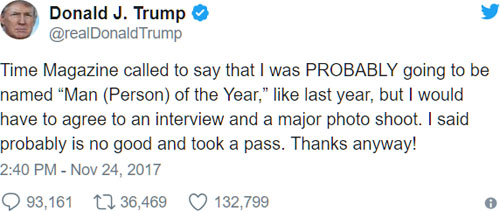
Trump Trumps Time…Maybe

by evanier

Donald Trump has long struck me as a guy who plays checkers, not chess — a man who doesn't have the ability to think 3+ moves ahead. He might not even see the value in doing that since time and again, he gets away with saying things that aren't true and pays little if any penalty for not being able to back them up.

But he may have out-strategized Time magazine on this "Person of the Year" thing. At first, he looks petty…

And then when Time tweets back, "The president is incorrect about how we choose Person of the Year," he looks petulant and self-obsessed, as he so often does. But notice they didn't deny that they'd contacted him…or that he's likely to be their guy.

By tweeting what the man done tweeted, Trump probably figures he's set up this situation: If Time does decide to scorn him for the "honor," he's got the perfect rejoinder — "Well, of course I'm the greatest newsmaker who's ever lived but I told Time I didn't want their silly title but I told them to shove it so they had to go pick someone else."

And if they do decide they want to slap his smug face on their cover, he'll have a bargaining position to maybe influence the story somehow…maybe force them to switch back to "Man of the Year." Last year, when they named him "Person of the Year," he griped about the "political correctness" even though it made him the top of a much larger group. The point is he can maybe make them do something that will enable him to go to his base and brag, "I made that lying magazine kiss my ass." If he sits for a special photo and interview, he can put conditions on it. If he doesn't, he can say, "They had to give me the honor even though I told them to go to hell."

I don't think Trump knows beans about the law or the constitution or health care or how to deal with foreign powers…but he's really good at manipulating the press. That's why he is where he is today.

So if we worked for Time and we wanted to out-strategize him, what would we do? Well, the first thing we'd do is something he probably never does, which is to understand the rules. Read this…

Person of the Year (called Man of the Year or Woman of the Year until 1999) is an annual issue of the United States news magazine Time that features and profiles a person, a group, an idea, or an object that "for better or for worse…has done the most to influence the events of the year."

There's probably no value in pointing out that it's not always an honor and that in 1938, it was Hitler and in 1939, Joseph Stalin. That doesn't help us because in this day and age, being famous is way more important than just about anything else, especially to a guy like Trump. And if Time follows their stated criteria, he's again the obvious choice. No single person in recent history has ever been talked-about more than Donald Trump. I have friends who love him and others who hate him, both kinds unable to go three minutes without mentioning his name.

I don't think there's another individual we could name who would qualify…and before you suggest Robert Mueller, I think next year's likely to be his year. But take another look at those rules. It can be a group. We could name the vast and growing forces of Americans who disapprove of Trump's presidency. It would be a way of saying, "Yes, Trump is the core of more news stories than anyone else but mainly because so many people think he's incompetent and/or corrupt."

That might be a bit of a win for Time but Trump would just crow that that was demonstrating the hostility and bias of the Lying Media and "the failing Time magazine" so here's my other thought…

Name as "Person of the Year" — and I don't know exactly how you'd phrase this — the many women who have come forth to complain about sexual harassment and assault. They've sure generated plenty of news, especially the last few months. And if there's anything Trump doesn't want right now, it's a focus on all the women who've reported his behavior.

The post Trump Trumps Time…Maybe appeared first on News From ME.

25 Nov 21:38

Lord Bonkers' Diary: "Just the sort of tomfool idea I would expect"

by Jonathan Calder
In which a former deputy prime minister enjoys a narrow escape.

Thursday

Whom should I meet in a London street but our own Nick Clegg? As so often, he has Freddie and Fiona in tow.

Clegg is full of his new book, telling me brightly: "It may seem odd for a former leader of the Liberal Democrats – and someone who has fought against the illiberal habits of Labour all my political life – to advocate joining the Labour party.”

“Not a bit,” I reply, “it’s just the sort of tomfool idea I would expect from you.”

Having foolishly travelled up to town without a horsewhip, I have to content myself with giving him a Hard Stare.

Lord Bonkers was Liberal MP for Rutland South West, 1906-10.

Previously in Lord Bonkers' Diary
25 Nov 21:18

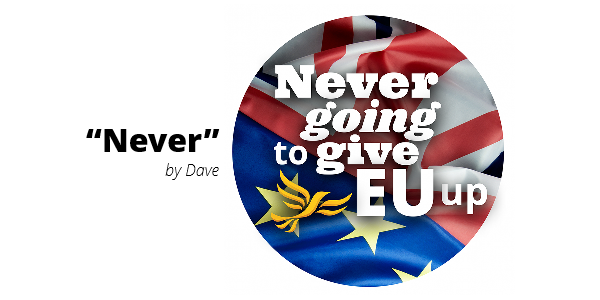
That new Lib Dem T-shirt does not reflect party policy

by Jonathan Calder
An excited email arrives from Lib Dem HQ:
Designed by Dave, this t-shirt represents the hopes and dreams of the tens of thousands of members who've joined our party since the EU Referendum - and our party's Internationalist values.
Nice work, Dave. But does this T-shirt reflect Lib Dem policy?

As Neville Farmer wrote in a guest post for this blog:
An unscheduled Sunday motion proposed that an elected Liberal Democrat government would reverse Article 50 without need for a further Brexit referendum. It was crudely drafted but it was strong and clear and answered Paddy Ashdown’s call for some party radicalism – "Put Vince in No 10 and we’ll end Brexit." Sounded good to me. 
When they heard that the planned and impotent Brexit 'consultation' had been changed to a debate, the party leadership flipped. A blocking amendment was tabled reverting to the 'first referendum on the facts' option, sweetened with votes for over 16s and expats. 
In the debate, the choice of speakers was skewed. Speakers for the motion included first-timers with off-subject anti-Brexit comments, while the amendment was backed by MPs and peers. 
Tim Farron said supporting the motion denied the will of the people, blocked the young and expatriated from a vote and showed an illiberal loyalty to first-past-the-post. Others claimed the motion would make us seem like a 'one-trick' party. 
The only party senior supporting the motion was brave former MEP Liz Lynne. 
The spoiler amendment passed by a mile and, instead of a shot in the arm for the party fortunes, we shot ourselves in the foot.
So Lib Dem policy is not to oppose Brexit: it is to hold a second referendum and abide by its result.

I am not sure there will even be time for a second referendum, given that agreement is always reached at the last possible moment in international negotiations and parliament has already agreed to a fixed Article 50 deadline.

Worse than that, our policy says that if there is a political earthquake and we come to power next year, a Liberal Democrat government would negotiate the best Brexit deal it could and then ask the people to vote against it.

Wouldn't it be simpler just to say we are against Brexit?

Still, it's a good design for a T-shirt and I get the Rick Astley reference.
24 Nov 20:04

Black to the Future

by evanier

Today is Black Friday, a good day to not go shopping because that's what everyone else is doing. While waiting three hours in line to check out, you might ponder the question of why this day is named like it's associated with some form of violent terrorism. Kevin Drum has an explanation.

The post Black to the Future appeared first on News From ME.

24 Nov 13:03

ares and sera never actually got started on their adventures on account of this ice cream / heated slurry thing, and it's too bad, because they were going to be both numerous AND interesting

archive - contact - sexy exciting merchandise - search - about
← previous November 17th, 2017 next

November 17th, 2017: HOLIDAY SHIPPING DEADLINES are coming up! If you want some COOL DINOSAUR COMICS STUFF for you and yours this holiday season, best not be caught sleepin'!!

– Ryan

24 Nov 13:03

folks,

archive - contact - sexy exciting merchandise - search - about
← previous November 20th, 2017 next

November 20th, 2017: HOLIDAY SHIPPING DEADLINES are coming up! If you want some COOL DINOSAUR COMICS STUFF for you and yours this holiday season, best not be caught sleepin'!!

– Ryan

23 Nov 20:52

The Electoral Commission’s investigation into Leave’s funding could halt Brexit

by David Herdson

The door to an exit from Brexit might just have opened

Butterflies are beloved of writers of alternate history and counterfactuals. The notion that but for the eddies created by the meanderings of an individual butterfly, a hurricane would (or would not) have developed is as old as it is misleading; there are many butterflies, there are few hurricanes and there is precious little connection from the one to the other.

It’s a curious example of an argument reduced to absurdity which is, nonetheless, taken at face value because the concept it embodies is so elegant.

And the concept is right: even the greatest of moments have, at their extremes, trivially insignificant beginnings. A hurricane may not be begun by a butterfly but its genesis does rely on cloud formation and wind patterns which, a fortnight before the storm becomes organised, are hidden unrecognisably deeply within that day’s weather.

On the human scale, there is just a chance of a new Brexit hurricane brewing. The announcement at the start of the month that the Electoral Commission was investigating Aaron banks’ role in funding the Leave campaign during the 2016 referendum is the butterfly. Like all butterflies, it is flimsy: as yet, we have little to go on other than that announcement and the update yesterday that the Commission isn’t getting the data it wants. On the other hand, all hurricanes start somewhere.

Why does this matter? Because unlike the claim of Russian interference via social media, which even if true, will have been of marginal importance given its limited scale, what the Leave campaign said and did was crucial to the referendum’s outcome.

We should at this point pause to note that there were two main Leave campaigns and Banks’ involvement was with the unofficial one. However, in terms of practical effects on the result, who received the designation wasn’t all that important. Indeed, the fact that there were two campaigns meant that internal contradictions in the Leave claims could be maintained more effectively. What did matter was the effect those campaigns had and – the pertinent point here – the impact the Banks leave.eu money had.

It should also be stressed that we’re dealing with a whole house of cards of contingencies here; a house built on shaky the foundations. As yet no rules have been proven to have been broken, nor any impropriety asserted. But given that there is an investigation underway, we must also consider the possibility that the Electoral Commission could conclude that there was. Those caveats noted, let’s do so.

The central point here is just how important was the referendum? That might sound a simple question and on one level it is – politically, Brexit could not have happened without it – but on the legal and constitutional planes, it becomes more complex.

The process question here returns to the limits of parliament’s sovereignty: are its actions entirely its own or are factors influencing it of sufficient import that its votes can be invalidated if the process in which they occurred were itself invalid? From the speeches of many MPs (including the PM), and from commitments the government made before the referendum, it’s highly likely that parliament voted to trigger A50 as it did because, and only because, of the referendum result. If parliamentary sovereignty is absolute then the referendum is irrelevant: it doesn’t matter whether Leave or Remain won, or whether any campaign finances broke any laws (on either side) because parliament could always have done what it ended up doing.

    To argue the other side is to overturn the constitutional theory of centuries. Nonetheless, if a major part of the Leave campaign, whether the official one or not, was found to be in breach of funding laws (and to reiterate, this remains hypothetical), to such an extent that it might have affected the outcome, then there would be an arguable case that not only was the referendum result invalid but that the political actions that flowed from it were unconstitutional because they were predicated on a flawed process.

There is a certain irony to this line of argument because it would mean that a lot of people who’ve been trying to claim that the referendum was only ‘advisory’ would now have to argue that it had not just great moral weight but real constitutional value – but at least they’d be right this time.

This matters because Article 50(1) states that “Any Member State may decide to withdraw from the Union in accordance with its own constitutional requirements”. If Britain’s notification wasn’t consistent with its constitutional requirements, then the notification would be invalid and Brexit would be off, for now at least.

As an aside, if the Supreme Court were to rule in favour of a challenge against the legitimacy of the notification, it’d also move it one step closer to the US situation of being able to strike down legislation – and for that reason, I think they’d be extremely wary of taking such a step. Further, if they were to accept such a challenge, it’d also embed the concept of popular sovereignty into the constitution and imply a convention binding MPs to a referendum’s outcome, barring exceptional circumstances.

For all those reasons, I think it’s unlikely that even if there is sufficient doubt cast on the Leave finances to justify a court case, the Court would deliver such a revolutionary decision: it would run counter to its opinion on the Gina Miller case and would open too many cans of worms that the constitution has taped shut.

There is a joker in the pack here though. What if the government, backed by parliament, were to argue its own notification should be invalidated? Given the difficulties it’s experienced trying to make progress, you could understand it grasping at any straw to give it more time or even make the whole thing go away. They would surely be powerful, probably clinching, considerations?

The inevitable consequence of a nullification of the notification would have to be a second EU referendum, so all that might happen could be a delay to Brexit if Leave were to win again. However, whether Leave would win again would be very much more up in the air than it is now. The most recent YouGov survey (7-8 Nov) to ask whether Britain was right or wrong to leave the EU – which is effectively asking people how they’d have voted if they knew then what they know now; not quite the same as how they’d vote in a second referendum – had ‘wrong’ with a four-point lead. The reason why that change of heart hasn’t had more impact on the debate is partly because the swing is only slight and partly because it’s hypothetical: it doesn’t challenge the mandate contained in the original vote.

In our real world, plenty of Remain voters still back Brexit on the basis of that referendum mandate. I think the most recent time this question was asked was the YouGov poll of 22-24 Sept, so the data’s quite old now, but less than one-third of Remain voters backed an outright abandonment of the process: the rest either supporting the government going ahead with Brexit in some form or wanting a second referendum (or don’t know). More than half of all those polled, or 62% if Don’t Knows are excluded, backed some form of Brexit.

Put simply, for as long as the mandate of the 2016 referendum holds, Brexit will follow. Political considerations will mean that there is no other option. However, if – and it’s a huge ‘if’ built on a castle of contingencies – if the government was looking for a way out, then claiming that the referendum, and hence the A50 notification, was invalid might provide it. The first flutterings of an exit from Brexit might just be detectable.

David Herdson

Follow @DavidHerdson

Tweet

23 Nov 20:04

Trying to understand why the Lib Dems aren’t doing better in the polls

by TSE


The Lib Dems are still paying the price for being hollowed out in local government during the coalition years.

One of the mysteries of current politics for me is how badly the Lib Dems are doing in the  polls. Since the general election every opinion poll bar one has the Lib Dems polling in the single digits when the current political terrain should be fertile for them.

With Brexit being so polarising I’d have thought the only staunchly GB wide anti-Brexit party coupled with the Tories and Labour being led by two flawed leaders would see the Lib Dems polling a lot better than they currently are, so why aren’t they, the chart above might explain it.

Like their MPs, since the Lib Dems entered the coalition their councillors were shellacked every May, that hollowing of the party sees the influence of the party weakened and perceived to be an irrelevance. My own feeling and experience is that a strong councillor base helps you win and hold Parliamentary seats, and that’s why the Lib Dems have lost so many MPs in recent years.

Earlier on this year the Lib Dems hit their highest ever membership numbers, so it isn’t all doom and gloom for them. Assuming the next general election is in 2022, that gives the Lib Dems four rounds of local elections to rebuild their local government presence.

If they can rebuild their footprint there, and undo the near two thousands council seats the Lib Dems have lost since they entered the coalition it might help them see an increase in the polls and the number of MPs they have.

TSE

23 Nov 19:43

The Last Star Wars Article

by Andrew Rilstone

Where do we go when we watch Star Wars?

We know where we go when we watch Doctor Who. No such place ever actually existed, but everyone claims to have been there. It was a very long time ago: everything was black and white. We were very small: small enough to fit into the interstices between walls and furniture. TVs were very big. Pieces of furniture in shared family spaces, not electronic toys in our private rooms. “Putting on the TV” was a positive choice. The pictures were both real and not real. We wanted to look at them and hide from them at the same time. Middle-class. Suburban. Domestic. Ubiquitous. Safe.

Modern Doctor Who has written about that space almost obsessively, but it has never remotely taken us there. 

Yoda voice: That is why it fails.

Where do we go when we watch Star Wars?


There are AT-AT Walkers: new AT-AT Walkers that walk on their knuckles and something in the background that might be a floating galleon but might only be an Imperial Shuttle.

The Walkers arrived in Empire Strikes Back. They were a replacement for the Death Star. Never quite as magical. But magical just the same.

There are white alien goats on a snowy background. I suppose if there are Walkers there has to be Snow. First films have Sand and Second films have Snow. The third film will go back to Jakku, you mark my words.

The Millennium Falcon is being chased through a fiery red cave by TIE Fighters; which makes us think of the wrecked Star Destroyer from part VII and the Death Star superstructure from part VI and the space worm from part V and coming out of hyperspace near Alderaan in part IV. This will come very near the beginning of the film, as a warm up, to tell us that Star Wars has started again and the toys are all intact.

There is Chewbacca on the flight deck, as if he was escaping from Mos Eisley, except that Han has been replaced by a Penguin. Every saga has a Jar Jar. Every trilogy has an Ewok. We complained about George's silliness but we missed it when it wasn't there. The Penguin will have a very small part. He may only appear in this one scene. Everyone will always have heard of him and he will even eventually have his own comic, but all he will actually do is shout “It’s a trap!”

There is battle with big space ships and TIE fighters and X-Wings and a stirring speech about lighting the flame that will become the spark that will burn the fascists down although we all know that the fascists won’t burn down until the last ten minutes of Episode IX. There is Po Dameron looking resolute and Finn fighting the shiny gold lady Stormtrooper officer with a a big glowy laser-chainsaw. This will happen at the end. Po and Finn will be blowing things up resolutely while the Proper Plot happens somewhere else.

The Proper Plot will be about Rey turning to the Dark Side, and Ren turning back to the Light. Or perhaps about Ren resisting the light side and Rey resisting the Dark. That is the Proper Plot of every Star Wars movie except Star Wars. Someone is tempted by the Dark. Someone is tempted by the Light. Indeed, that is the plot of every possible movie. (I think Joseph Campbell said that.)


We always knew that this moment would come. Not when he lit the torch at his Father funeral pyre but from the very first moment in the cave. I-was-once-a-Jedi-knight-the-same-as-your-father. There would always come a moment when stroppy James Dean teenage Luke Skywalker would be old. We need him to be old because we need him to be a Jedi Knight and Jedi Knights are old. Alec Guinness is the only and all Jedi Knights just as happens Leonard Nimoy is the only and all Vulcans.


The moment we imagined, when Luke Skywalker is a Jedi like Obi Wan and he is teaching other Jedi (including me, me, please, including me) — the moment when the Jedi actually Returned — has already happened and is already over, somewhere in the space between VI and VII. I suppose we should never see it, in the same way we should never have seen the Old Republic, because Luke Skywalker and the New Order of Jedi, is part of the happy-ever-after which was implied during the fireworks and the Ewoks. And it was not a happy ending. Of course it wasn’t a happy ending because everyone living happily ever after is how a story ends and there have to be more stories. So we get to see old Luke, but we don’t get to see Jedi Luke. We get to see Luke the Last Jedi.  


Episode VII finishes with Rey holding Luke’s lightsaber out to Luke, and us not knowing is Luke takes it or not. (Spoiler: No.) The Trailer finishes with Ren holding his hand out to Rey and us not knowing if she takes it or not. And that makes us think of Daddy Vader holding his hand out to Luke, which is why Great Big Hologram Leader Guy (who has got smaller) bellows “FULL…FILL…YOUR…DES…TIN…EE” in the trailer. (He is probably saying it to Kylo Ren, but he could just as well be saying it to Rey. Of course he might not say it at all. That sometimes happens with trailers.) This will happen in the middle of the movie. Rey will face a difficult time in her training when she is tempted by the Dark Side. Maybe she will break off her Jedi training with Luke because she sees a vision of Kylo torturing Po and Finn. Maybe when she is on the point of  turning to the Dark Side, Ren will say "No, Rey, I am your half-brother."

Ren has a shiny black Tie Fighter, just like Grandpa’s. As he whizzes around he looks for all the world like Anakin Skywalker in the cartoons. (But Anakin in the Cartoons is now the Real Anakin. Anakin in the Cartoons very nearly makes up for Anakin in the prequels. He is a, waddyacall, Redemptive Reading.) But he, Ray, can hear Snoke’s voice, just like Luke Skywalker heard Ben’s voice and it goes boom boom boom FULFILL YOUR DENSITY boom boom boom BECOME WHO YOU WERE MEANT TO BE boom boom boom. All films are always about becoming who you were meant to be. (I think Joseph Campbell said that.)  Carrie, god bless her is on the big ship (the same kind of ship that Mon Motha had) and Kylo is aiming his weapon at her. Luke’s big moment was to blow up the Death Star. Kylo's big moment is to kill Mum. (SPOILER: He has already killed Dad.) 

Maybe he will kill his Mum and go totally over to the Dark Side. Maybe he will not kill her an come back to the light. Maybe the Millennium Falcon will come over the hill at the last possible moment. 

One thinks of Locutus of Borg, possibly.

Luke says “I’VE SEEN RAW STRENGTH LIKE THIS ONLY ONCE BEFORE IT DIDN’T SCARE ME ENOUGH THEN IT DOES NOW” and Big Hologram Gollum Guy says “When I found you I saw RAW UNTAMED POWER”. I suppose Luke is talking to Rey about Kylo Ren and I suppose Snoke is talking to Kylo Ren about Ben Solo. I suppose Luke is going to refuse to train Rey in case he buggers it up and sends her to the Dark Side as well. Which will send Rey into the arms of Ren for help. Which will result in Ren’s ultimate redemption. 

Or else something completely different will happen.

To summarize: Rey and Ren are powerful Jedi and are going to be tempted in various ways and there is going to be a battle involving X-Wings and capital ships and walkers and a chase involving the Millennium Falcon.

Which is, I suppose, only like saying that this cowboy film will definitely have horses, a criminal, a sheriff, some native Americans and a big gun fight in a frontier town. Star Wars isn’t a saga. It’s a genre. (I said that.)

*

Where do we go when we watch Star Wars?

A flea-pit olden days 1970s cinema with fizzy orange juice and ice-cream. Or maybe some nuts. Or a big London movie house with posters and programmes and people selling knock-off merchandise outside? 

Or am I misremembering? Was Star Wars always something that we were watching again on DVD. Or VHS. Or just ITV?


The movie called Star Wars (there is only one movie called Star Wars) was great, and we have all seen it forty or fifty times and will see it another twenty, thirty forty times before we die. (I have measured out my life in coffee spoons.) But before there was a movie called Star Wars there were Star Wars toys. The original dolls were almost comically badly done: no-one even tried to model Mark Hamil’s face and the white plastic smock molded onto his body has only the most passing connection to the greying desert gear he wears in the movie. I almost wonder if the appeal of the figures wasn’t in the packaging: the shiny card with the Star Wars logo and a big colour picture of the iconic twin suns scene printed on it? The closet you could get to putting your hands on a bit of the film and keeping it? No-one could afford to buy them, obviously. We went on pilgrimages to toy shops to gaze at them enviously.


Isn’t that what the word “iconic” literally means? 

The idea of Luke Skywalker, the blond guy in white with a utility belt and glowy sword can somehow be contracted to three inches of barely articulated plastic and have endless battles with the idea of Darth Vader, a black masked villain with a cheap cellophane cape. How many millions of battles did Luke Skywalker have with Darth Vader on how many thousands of bedroom floors between 1977 and 1980? 

At least until their lightsabers snapped off.


We can now see that the action figures were insufficiently iconic: that they contained too much of the real Mark Hamil and the real Alec Guinness. Forbidden Planet will sell you brilliantly authentic replicas of Darth Vader costing hundreds of pounds but those are not for children to play with, they are for adults to put on the shelf and forget about. The real Star Wars; Star Wars stripped of all particularity and specificity, the pure idea of the Dark Side and the Light, is now surely the Lego figurine? (I am serious. Every child has seen thousands of Lego Stormtroopers before the Star Destroyer swallows up the Blockade Runner, and every child knows that Vader is Luke's father before they know who Vader and Luke are.) 


We can't watch Doctor Who again. We wouldn't physically fit behind that damn sofa. But perhaps we can crouch down on the bedroom floor one last time. There can't ever really be a new Star Wars story, and we wouldn't want there to be. (George Lucas never really understood this.) But we can take the Lego minifigs out of the box and play out our favorite scenes in a slightly different order. I'm pretty sure Joseph Campbell said that. 


23 Nov 15:41

Technical change and house prices

by chris

There’s much talk that Philip Hammond will use tomorrow’s Budget to address the problem of high housing costs.

I have little doubt that high housing costs are, on balance, a blight upon the economy. What’s less clear to me, though, is whether increased housebuilding alone is sufficient to greatly reduce them. I don’t think it is. Jonathan Eley and Ian Mulheirn agree with me, whilst Jonn Elledge and James Gleeson disagree.

So, what would cut house prices, especially in expensive areas?

Teleportation, that’s what. If we could beam ourselves from one place to another Star Trek-stylee, nobody would need to pay a fortune in rents in high-cost areas such as London or Cambridge. They could buy somewhere cheap and simply teleport to London for work or nights out. Houses in (say) Burnley would become close substitutes for ones in Brixton. Prices of the latter would thus slump. Problem solved.

Pedants will object that teleportation won’t be developed anytime soon.

True. But my point isn’t wholly fictitious. There’s a precedent. A team of German researchers estimate that house prices in south east England fell by a third between 1899 and 1938 – a path roughly matched in several other developed countries. In the 30s, impecunious writers and artists lived in areas of London that only oligarchs and hedge fundies can afford today.

A big reason for this fall was an improvement in public transport. The opening up of the Metropolitan line, for example, allowed houses to be built miles out of London. These became substitutes for central London homes, with the result that prices of the latter fell. Amersham

You could read this as a story of increased supply forcing down prices. But it’s also a story of how technical progress reduced prices. The availability of suburban housing meant workers no longer needed to live in central London, so prices there fell.

This poses the question: what chance is there of a repeat of this? I suppose it’s possible that HS2 might make Birmingham more feasible for commuters as the Metropolitan line made Amersham. A more obvious possibility, of course, is the internet. This allows me to – in effect – teleport my labours into London from Rutland. If enough people were like me, London property prices would have fallen as we sold up to telecommute.

But this hasn’t happened even years after it has been feasible.

Of course, it isn’t technically possible for everyone; baristas and chambermaids can’t work from home. I suspect, though, that there are other barriers to doing so, among them:

 - Agglomeration benefits. People need to live in London to benefit from knowledge spillovers. Personally, I’m conflicted here. I know the data is consistent with Londoners benefiting from such effects. But my experience of London is that the idea of cities as serendipity engines in which great ideas emerge from chance meetings in cafes is just bollocks.

 - Social capital. Young workers in particular need to build contacts so they learn of better job matches. They do this by physical proximity to others.

 - Uncertainty. Living near where there are lots of potential job opportunities gives you flexibility, which is necessary if your job is at risk. I on the other hand am tied to my job.

 - Domination. Even if working from home is technically feasible, bosses might block it because they want direct oversight of their underlings. As Stephen Marglin famously pointed out (pdf), capitalist hierarchies can emerge and persist because they benefit bosses rather than because of their technical superiority.

 - Time lags. Erik Brynjolfsson points out (pdf) that it can take decades for technical changes to affect working practices. For example although electric power was available in the 1890s most US factories did not make best use of it until the 1920s. This was because it only raised productivity once bosses learned that motors on every machine allowed them to re-organize production. Maybe we’re living through a time lag now, and telecommuting will eventually become more common. As it does so, London’s house prices should fall.

This, of course, is not really a story about house prices. It’s a story about technology. On the one hand, this has unintended effects: the builders of the Metropolitan didn’t intend to cut house prices. On the other hand, though, it’s effects upon the economy are constrained by social, institutional and cultural factors. Technology alone doesn’t determine our future.

22 Nov 20:57

David

by evanier

I received a number of messages asking me why I hadn't done an obit/remembrance/anything here on the passing of David Cassidy, who died the other day at the age of 67. "Surely, your paths must have crossed at some time since you got into show business," one wrote. No, they didn't. They crossed briefly around 1967 when we were both attending University High School in West Los Angeles. Apparently, we also co-existed at Emerson Junior High School before that but I only found that out years later when I got curious as to why my yearbooks sold for such high prices.

The one time we spoke: There was a talent show at Uni Hi and I was involved in producing it. David, who was a year or so ahead of me, asked to be a late entrant into the program but at that point, the rundown was already locked and it was too long so I told him no.

There. That's my David Cassidy anecdote. Not really worth the trip, was it?

Later, someone told me who his parents were and I would have liked to talk to him a little about them but we never spoke again. He was acting a bit at the time but this was a few years before The Partridge Family and his stardom. I do not recall having any particular feeling for or against that series or his records or anything else he did.

Around 1971, he was on the cover of every single "fan" magazine oriented towards teen-age girls and a few of them were published by a company that occasionally employed me to write this and that. One day, I casually mentioned to an editor there that I'd attended the same high school as Mr. Cassidy and instantly — don't ask me to explain why — I was offered the job of ghost-writing a column they ran called something like "David Cassidy Gives Advice." Teen-age girls were invited to write in and ask David for help with life and relationships and love and such, and he would tell them what to do.

Keep in mind that I've never been a teen-age girl. If I were one in 1971 and I had a problem in my life, I don't think I would have asked the guy starring on The Partridge Family for any wise, sage solutions. I'm just saying.

Then again, if I'd been the guy starring on The Partridge Family, I don't think I'd have given a teen magazine permission to run such a column, have some stranger write my replies and sign my name to them. But as it was explained to me, Mr. Cassidy had done exactly that. He didn't want to read the letters that came in, consult with the person answering them or apparently even read the column he allegedly authored.

In those days, I'd write anything for money. Those days should not be confused with these days when I'll write almost anything for money. I said, "Okay. Let me have the mail and I'll take a whack at it." The editor replied, "Oh, just write whatever you want" — meaning "Make up phony letters." She said the real mail they received for the column would be of no use to me.

I asked if I could see it if only to get some sense of what kind of advice the advice-seekers were seeking. She said, "I'll give it to you if you insist but they all ask the same question and it's a question you can't answer in the column." I was handed a sack of about 40 letters — that week's arrivals — and I went off into a corner to read.

About 25 of the letters did not ask "David" for any advice about relationships. They asked if they could meet him, if they could get an autographed photo, if he liked girls with bangs, if he was going to be in their city, etc. About 15 did ask questions about love and relationships but as the editor had warned me, they were all the same question about the same love and the same relationship. They all said, approximately…

I'm 15 years old and I'm really, really fond of this boy at school named Todd. We've gone out a few times and now he is telling me that he loves me but that I need to prove my love for him in a physical way…

They were all pretty much that letter and in more than a few, the name of the boy demanding sex was Todd. Either that given name makes guys especially horny or one kid named Todd was really getting around. I do not recall any letters about anyone in Alabama named Roy.

And of course, it was a letter I could not answer. The magazine could not condone underage females giving in to Todd-like demands, even if that's perhaps what David would have recommended. Meanwhile, a response extolling the wisdom of saving one's self for marriage would have sounded phony and parents would have complained if the magazine even addressed the matter.

So instead, I made up letters from "Jan" who wanted to know if she should wear her glasses to the high school dance even though they made her look less attractive, and from "Lisa" who wanted to know what do do about her boy friend's terrible table manners that caused food to fly in all directions. I — or rather, David — told Jan that she'd look darned unattractive stumbling and bumping into people, and he told Lisa to wear a plastic poncho to dinner one night and maybe he'd get the message.

I wrote two or three of these columns before I secured more interesting and better-paying work but it was an interesting experience…and an educational one. I've never for a second been interested in having children and I'm not sure I can explain why. But if I ever did and it was a girl, I at least knew how to be a responsible father: Never let your daughter go out with a guy named Todd. Any guy named Todd.

The post David appeared first on News From ME.

20 Nov 16:04

On the Brexit "divorce bill"

by chris

Robert Halfon says voters will “go bananas” if the government pays the EU a £40bn “divorce bill”. There might be a simple solution here.

Mr Halfon is right to think it unacceptable to fund the (say) £40bn payment by raising taxes or cutting spending. It is vanishingly unlikely that a fiscal tightening of 2% of GDP will be justified in the next couple of years.

Nor is it right that the bill be paid by borrowing, even though the government can borrow at negative real interest rates. Borrowing is deferred taxation. Even if we set aside considerations of Ricardian equivalence, as perhaps we should, it’s unacceptable that young people today will face higher taxes in future to pay for a decision taken by their elders. And it would be astoundingly hypocritical of a government that has justified austerity on the grounds that public debt imposes a burden on future generations to demand that they do so.

But there is, of course, a trivially simple alternative here. Quite simply, the bill could be paid by printing money. The Bank of England can print £40bn and hand it over to the government; in effect, we’d have another £40bn of quantitative easing.

This would not be inflationary, except to the extent that converting £40bn into euros would tend to weaken sterling: this would be a neat test of just how liquid the FX market is. This is because the £40bn is not being spent on domestic goods and services, and so will not raise aggregate demand. If you want to see this in MV=PT terms, the increase in M will be offset by a fall in V – so there’s no inflation.

There’s no reason therefore to get het up about handing over £40bn. Because we can print our own money, giving £40bn to the EU does not mean we have to sacrifice real resources. The analogy with a divorce bill is misleading. When a man pays to divorce his wife, he suffers a loss of real wealth – some of record collection and DVDs and so on. This need not be the case with leaving the EU.

Of course, I believe Brexit will make us genuinely poorer. But this is because we’ll have less favourable trading terms with the EU and tougher immigration restrictions. The “divorce bill” is (barring the impact on sterling) neither here nor there.

Which poses the question: why are the Tories making such a big issue of it?

Simple. It’s because creating £40bn in this way would raise the question: if the government can easily find £40bn for the EU, why couldn’t it find £40bn for the NHS?

In principle, there is a good reason. Spending an extra £40bn in the domestic economy could be inflationary, whereas giving it to the EU is not. The constraint upon government spending is inflation.

The Tories, however, cannot use this argument. For years, they have claimed that austerity was necessary because the constraint upon spending was the state of public finances. That was false. If they were to pay off the EU in a rational way, they therefore have to admit that austerity was largely unnecessary.

In this sense, the Tories’ past stupidity compels them into making even more mistakes.

18 Nov 23:52

Scenes from the Grantham girlhood of Margaret Thatcher

by Jonathan Calder
Embed from Getty Images

The other day I was chatting to someone who grew up in Grantham. He told me two tales he heard from older relatives:

  • When Alfred Roberts, Margaret Thatcher's father, was in charge of the post office counter he would throw the money on the floor if customers came in to cash unemployment cheques.
  • The young Margaret once attended a children's party and illicitly helped herself to a second piece of cake, which she concealed in her knickers.

And then there was Rotten Borough, the 1937 novel about corruption in local government in Grantham, that was withdrawn after threats of legal action.

In those days Alfred Roberts was chairman of the town council's finance committee.
17 Nov 23:17

Selecting for inadequates

by chris

“Why are Brexit’s political champions so unimpressive?” asks Janan Ganesh. Making the same point, Simon says:

The political system fails to select for competence, understanding or respect for wisdom and knowledge.

But why do we have such underwhelming politicians?

Here, we must guard against two errors. One is the tendency to believe that people are stupid just because they disagree with us. The other is a tendency to romanticize the past: it’s not that politicians were all giants years ago, but that we have grown up.

Nevertheless, I suspect Janan and Simon have a point. Looking just at Tories (so as to avoid the former error) I am less impressed now than I was in the 80s. No top Tory has the clarity of mind and purpose that Thatcher had: Thatcher inspired hatred on the left whereas May arouses only contempt - that's a big difference. Boris Johnson’s predecessors at the Foreign Office such as Carrington, Howe and Hurd had an integrity and seriousness of purpose which he wholly lacks. And – I’m showing my age here – even Nigella’s dad once had an intellectual credibility which is absent from most senior Tories now. DOoCFaTWsAIOP-5

This poses the question: what are the mechanisms which have selected for such mediocrities?

Politics has always been a profession where once can succeed through luck as well as merit (maybe even more than merit), and so attracts overconfident second-raters. But there might be other things at work. Here are a few theories.

 - Declining Tory party membership. The Tories were once a mass party; they had over two million members in the 50s. Today, they are a handful of “weirdos and oddballs” who are “apart from reality”, to use Richard Bridger’s words. This means that whereas Tory MPs were once selected for their ability to appeal to sane and reasonable folk, today one can become a Tory candidate by enthusing weirdos.

 - The rise of narcissism. The only thing we expect of politicians today is that they echo our prejudices, not that they exercise good independent judgment or promote the public good; the fact that there is a demand for referendums demonstrates a distrust of our elected representatives to do their job. We thus prefer the third-rate fanatic to the serious sober-minded man. The media, of course, is complicit in this. The right-wing press bullies independent-mined MPs, whilst the BBC – in its pursuit of balance – describes outright lies as “controversial claims”.  

 - The Tories' loss of contact with business. In backing Brexit and immigration controls, Tory policies are not business interests. Of course, relations between the Tories and business haven’t always been close: in 1980 CBI boss Terry Beckett threatened a “bare-knuckle fight” over monetarism. But the Tories then had links to corporate life which gave them roots in a reality-based community. Today, those roots are weaker.

 - Increased inequality. Financial rewards in finance or business are now higher, relative to those in politics, than they were in the 70s and 80s. People of even moderate ability are, therefore, more likely to stay away from politics. Why become a cabinet minister to be harangued by a bigot earning five times as much as you, when you can earn more, with more dignity, elsewhere?

 - The loss of public intellectuals. Thatcher could (and did) draw upon serious thinkers such as Popper, Hayek and Friedman. There are no equivalents of these today. The best Brexiters can manage are a bunch of cranks whose work doesn’t withstand scrutiny.

Of course, none of this is to say that intelligent public-spirited people are always weeded out: they are not. It's just that there are mechanisms which tend to select against such people. Nor is it the case that politics is unique in tending to select against honesty and merit. There are adverse selection mechanisms in many organizations. The point is, though, that we should not just decry the mediocrity of our political leaders, but ask what mechanisms give us such inadequates? And how, if at all, can these be changed?

17 Nov 23:15

The politics of death

by chris

Austerity kills. That’s the message of new research in the BMJ:

Spending constraints between 2010 and 2014 were associated with an estimated 45 368 (95% CI 34 530 to 56 206) higher than expected number of deaths compared with pre-2010 trends…. Projections to 2020 based on 2009-2014 trend was cumulatively linked to an estimated 152 141 (95% CI 134 597 and 169 685) additional deaths.

This is consistent with a point made recently by Danny Dorling:

For the first time in well over a century the health of people in England and Wales as measured by the most basic feature – life – has stopped improving…The most plausible explanation would blame the politics of austerity, which has had an excessive impact on the poor and the elderly; the withdrawal of care support to half a million elderly people that had taken place by 2013; the effect of a million fewer social care visits being carried out every year; the cuts to NHS budgets and its reorganisation as a result of the 2012 Health and Social Care Act; increased rates of bankruptcy and general decline in the quality of care homes; the rise in fuel poverty among the old; cuts to or removal of disability benefits. The stalling of life expectancy was the result of political choice.

It's also consistent with international evidence gathered by David Stuckler and Sanjay Basu; with Sarah O’Connor’s report of a “quietly unfolding health crisis” in deprived seaside towns such as Blackpool, and with the fact that benefit sanctions have driven people to suicide.

It’s obvious what the left’s reaction to this should be. But what about the right and centre’s?

There is an intelligent response. You could argue that all this is only part of the story. Christopher Ruhm, for example, has shown that austerity can improve health in other ways. If we’re not building houses, for example, fewer men die in accidents on building sites. Hard-up people can’t afford to smoke or drink themselves to death. And if we’re under-employed we’re less likely to suffer stress-related illnesses.

Alternatively, you could invoke the trolley problem. Maybe deaths from austerity are the lesser of two evils. If the alternative to austerity is higher taxes or higher debt, it could lead to lower future growth and hence less heath spending and more death in the long run. (I don’t believe this, but some Tories sincerely do).

Neither response, though, is what we get. Instead, when Aditya Chakrabortty said on Question Time last week that the government is “send[ing] disabled people to their deaths” the reaction was as if he’d spat in the church’s collection plate (9 mins in).

Which in a sense he had. Aditya had the bad manners to point out that politics is a matter of life and death - at least for the poor - thereby puncturing his audience’s illusion that it is just a cosy little debating game in which the only costs are that a few MPs move down the career ladder. I had hoped that the Grenfell disaster would destroy this illusion, but it seems the imbecilities of posh folk don’t die as quickly as do the poor.

Here, though, is the thing. The supposedly impartial BBC is complicit in this. Its politics coverage too often carries a matey undertone broken only when confronted by someone who has the temerity to challenge the privilege of the rich or to enter politics without being posh. And it gives disproportionate weight to inconsequential tittle-tattle. Priti Patel’s flight from Uganda last week was given the sort of coverage due to Churchill’s return from Yalta. I very much doubt if the BMJ’s report will get so much attention.

What we have here are two competing conceptions of politics: one which sees it as a serious matter of life and death, the other as a game among careerists. The BBC is not impartial between these, and therefore not impartial at all.  

16 Nov 03:04

Can one tweet change a person’s mind? No, but a barrage of them might

by Nick

To save time, I need to build a bot that finds the appropriate xkcd for a post.
There’s lots of annoying responses going around to the issue of social media bots, but one of the most annoying to me is the canard of ‘it’s all stupid, they can’t be influential because who’s going to change their mind on how to vote after seeing one tweet or Facebook post?’ It particularly irritates me because it’s conflating two bad ideas together. First, the idea that our political opinions are fixed and immutable things, near impossible to change, and secondly, ignoring that the sheer quantity of content produced by bots is important in itself.

The first issue is something I wrote about in more detail a while ago but in short if your view of people’s political opinions is that they’re entirely fixed, you’re generally wrong. Part of the problem here is that people with strongly held and developed political opinions of their own tend to assume everyone else is similar to them in their access to and desire to use information on which to develop their opinions. It’s people with high information levels about a subject assuming that everyone else has the same level of information, when in fact most people’s opinion towards most things is what Converse called a ‘nonattitude’, having so little knowledge of an area that any opinion they’re asked to give it on it is effectively random. Almost everyone has some issues on which they’re high information individuals – for some of us it’s politics, for others it’s sport, some know lots about art or cooking or construction or any number of issues where high information individuals might have huge disputes about something, while the rest of us would probably stare blankly at anyone who asked us for our opinion on it.

So while people might have an opinion built up over time about which party they support in political matters, they tend to gloss over the detail of policy, which means that when they’re asked to decide on a specific policy in an environment where their traditional party cues are meaningless – through the medium of a referendum, say – positions are going to be a lot less strongly held and much more subject to change. Our opinions on most issues aren’t a neatly organised filing cabinet, neatly organised and fully cross-referenced, they’re much more like piles of paper strewn across numerous shelves from which we tend to grab whichever looks best at the time. We can have multitudes of different considerations hanging around there, waiting for us to find the right context to consult them in and weigh them against each other.

This is why it is silly to say that one tweet can change the way someone thinks on an issue, in just the same way that it’s unlike that any one leaflet, poster, TV ad, newspaper article, or even blog post might decisively change someone’s mind for good. The aim of anything like that isn’t to change your mind there and then, but to get into your consciousness enough to form a consideration that you will later form an opinion on. Again, this isn’t about seeing something, going to your mental filing cabinet, pulling out a folder and rewriting it, but rather seeing something and sticking it on a shelf for future reference. One consideration alone might not be enough to make you act in a certain way, but a bunch of them developed over time and coming from a number of different sources could well be. It’s why companies don’t just broadcast their adverts once and figure everyone will see it, why billboards remain in place for weeks not hours, and why political parties deliver rainforests worth of paper during election campaigns. It’s not about changing minds so much as it is about getting people to have a balance of considerations that’s favourable to you in their head when they’re asked to make a decision – and once they’ve made that decision, human nature often means they’ll tell themselves that was their opinion all along, and there wasn’t any way they could have changed it…

15 Nov 00:28

Books from 1923 to 1941 Now Liberated

by PG

From Internet Archive Blogs:

The Internet Archive is now leveraging a little known, and perhaps never used, provision of US copyright law, Section 108h, which allows libraries to scan and make available materials published 1923 to 1941 if they are not being actively sold. Elizabeth Townsend Gard, a copyright scholar at Tulane University calls this “Library Public Domain.”  She and her students helped bring the first scanned books of this era available online in a collection named for the author of the bill making this necessary: The Sonny Bono Memorial Collection. Thousands more books will be added in the near future as we automate. We hope this will encourage libraries that have been reticent to scan beyond 1923 to start mass scanning their books and other works, at least up to 1942.

. . . .

If the Founding Fathers had their way, almost all works from the 20th century would be public domain by now (14-year copyright term, renewable once if you took extra actions).

Some corporations saw adding works to the public domain to be a problem, and when Sonny Bono got elected to the House of Representatives, representing Riverside County, near Los Angeles, he helped push through a law extending copyright’s duration another 20 years to keep things locked-up back to 1923.  This has been called the Mickey Mouse Protection Act due to one of the motivators behind the law, but it was also a result of Europe extending copyright terms an additional twenty years first. If not for this law, works from 1923 and beyond would have been in the public domain decades ago.

. . . .

But there is an exemption from this extension of copyright, but only for libraries and only for works that are not actively for sale — we can scan them and make them available. Professor Townsend Gard had two legal interns work with the Internet Archive last summer to find how we can automate finding appropriate scanned books that could be liberated, and hand-vetted the first books for the collection. Professor Townsend Gard has just released an in-depth paper giving libraries guidance as to how to implement Section 108(h) based on her work with the Archive and other libraries. Together, we have called them “Last Twenty” Collections, as libraries and archives can copy and distribute to the general public qualified works in the last twenty years of their copyright.

Link to the rest at Internet Archive Blogs and thanks to Dave for the tip.

15 Nov 00:18

WILL YOUNG – “Light My Fire”

by Tom

#929, 8th June 2002

will young fire It’s hardly unusual for a reality TV star to try and cement their precarious fame with a cover version. Will Young’s puckish take on “Light My Fire”, a cover of Jose Feliciano’s cover of Jim Morrison’s signature come-on, is particularly well-taken. His verse delivery is enjoyably arch, keeping a distance between himself and the hoary material, but he gives enough of an impression of losing himself in the chorus for it not to be a total mickey-take. The overall impression is of an unusually honest take on contractual obligation – “I know this is how the game is played, and I’m going to play it, but I’m not going to con you, so let’s make this as fun as we can.”

Which, if you’re a gay Marxist politics graduate who’s just won the love of the nation on a TV game show, is probably about as truthful and sensible a take on this rock monolith as could be hoped for. “Light My Fire” is ridiculous, like many Doors songs, but unlike many, it’s not just ridiculous: it’s also resilient. For the surviving Doors, this, more than anything else they wrote, is their pension. Within months of release, there were covers, then dozens of covers, latin and pop and soul and reggae covers, and they kept coming, though Will Young’s version sits wryly near the end of the line.

Listening to these covers is an education in how flexible the song is. On Inner Circle’s version, the digital reggae beat steps up the urgency, leaving the singer gasping and blue-balled. Shirley Bassey sings it as a challenge – light my fire… if you can. Al Green is Al Green, wandering smokily between the lines of the song, turning it into the ad libs. Minnie Riperton’s version is a breathy tease. Julie London sounds wistful and half-asleep. Erma Franklin, her version recontextualised on an album called Obama Victory Music, makes it a bracing call to arms. For Jackie Wilson it’s a soul man’s plea. Massive Attack, to the frustration of countless listeners, rub its mud over the face of their Protection LP with a live fragment where Horace Andy can barely remember the words.

What’s interesting to me is how little any of these covers owe to the original, beyond the solid-gold tune. They’ve all seen the huge potential in Morrison’s song without actually wanting to follow him down the interpretive path he’s laid out. Perhaps that isn’t surprising: Morrison plays the song cataclysmically straight, turning seduction into an primordial battle of man, desire, the elements – his growled command to “set the night on fire!” casts sex, or rather, Jim getting his rocks off, as a cosmic imperative.

If you’re a very handsome rock star you can make this Dionysian stuff work, at least to the point where you unleash the actual snake onstage. But it’s also a narcissistic dead end, with no real sense Morrison’s singing this stuff to anyone. (The funniest part in the album version is when he tetchily comes back in with “the time to hesitate is through” after his band has just held up proceedings with an enormous organ solo). With time and distance, the Lizard King’s whole persona doesn’t feel like a groundbreaking rock development, but a final spasm of the mid-century artistic cult of the Great American Man, the bloated inheritor of Hemingway, Brando, Kerouac.

In other words, the cover versions are a response not just to the greatness of the song, but to its cornier aspects, the ways its fervent masculinity was already out of date. This started with Jose Feliciano himself, whose seductive Latin routine is (frankly) just as corny but also much more gentle and playful, more convivial than the original. Once Feliciano had opened the song out, everyone could take it and find more and more in it, and the Doors’ version was left standing, an impotent classic.

This is the risk you take when you invoke Oedipus – before you know it you’re a father yourself, and since his death Jim Morrison has played the role well, becoming the secret Dad of Dadrock, the lightning rod for a generation’s rebellious scorn about rock’s pomp, its pretension, its cock-out masculinity. I was no exception – my teenage derision for The Doors was a St Christopher’s medal as I explored the canon’s byways and thoroughfares. Like a lot of teenagers and their Dads, I’ve come to a position of wary respect and accommodation: that organ solo is pretty rocking; “Peace Frog” is weird and great; loads of acts I do like are madly in debt to Jim, and so on.

But it’s still no surprise I enjoy Will Young’s joyfully absurd version a hell of a lot more than I enjoy The Door’s gloweringly absurd one. The arrangement – borrowed from Feliciano, canned and smoothed out – is feeble, but Young’s performance is a lot of fun. It’s the sound of someone exploring what his voice and persona can do, and what his public will enjoy, with delightfully exaggerated “mi-yahs” and “pi-yahs” deftly undercutting the lyric’s monumental tendencies. “Light My Fire” is no classic, but as a showcase for its singer and a pointer to his future, it’s more confident and sparky than anyone might have expected.

15 Nov 00:10

Long-term coffee consumption and risk of cardiovascular disease.

Long-term coffee consumption and risk of cardiovascular disease.
14 Nov 09:14

Andrew Hickey: The Basilisk Murders (A Sarah Turner Mystery). Good book, get it.

"I was already having a bad week, and then the murders started."

A tech journalist goes to a Singularity conference, full of transhumanists and "techbrolibertarians" -- the people from Silicon Valley who want to rewrite your life and "disrupt" your world. Then they start killing each other off.

This isn't a worldview-shifting literary steamroller. It's a light and enjoyable read that knows what it is, and does that well. It supplies a thoroughly readable cosy mystery with which you can enjoy playing detective and enjoy as a story on subsequent reads.

And it's also a shot aimed directly at the LessWrong "rationalist" subculture and its offshoots. I know this subculture entirely too well, and cackled my way through.

But you don't need to know the players to recognise the type, nor their big plans for everybody: "the type that doesn't like to believe there's anything that can't be ordered by a rational mind."

The Safe Singularity Foundation is based on the Machine Intelligence Research Institute, whose forum site LessWrong came up with "Roko's Basilisk", the most famous idea to be associated with them (even as MIRI repudiate it) that the "Basilisk" of the title is based on: the idea that the coming Artificial Intelligence to rule humanity will be so good for humanity that it will be ethically obliged to punish those who knew it was possible but did not contribute to its creation.

Andrew did spend some time on LessWrong:

Yeah, I was on LessWrong for quite a while, in a very low-key way. My period of time there basically went “These are people talking about interesting stuff. Admittedly they have a few odd beliefs like the cryonic thing, but interesting people.” “…apart from this virulent racist who keeps talking about IQ…” “…and all these people who keep talking about being ‘Pick-Up Artists’…” “my God, this place needs to be burned down and the earth salted!”

The ideas are the actual stuff from the subculture - e.g., the weird notions about AI that Elon Musk starts on when he isn't talking about cars or spaceships. None of this is exaggerated. And the story leverages the ideas well.

(He takes a moment to get stuck into Bitcoiners too.)

The book doesn't get bogged down in the abstruse concepts. You will be able to play detective on the first read, and enjoy the story on the second. I read and commented on an early draft (I'm in the acknowledgements), bought it the moment I saw it was available and am most pleased to have done so. I'm also looking forward to the second Sarah Turner mystery, where she find herself dealing with a reunited rock band who all hate each other.

It's on Kindle, Kindle Unlimited and Lulu paperback. UK, US.


comment count unavailable comments
13 Nov 12:56

Putin over reaches himself- but the West must respond.

by Cicero
In espionage the standard of proof is a variable measure. There are very few times that information can be said to be "beyond reasonable doubt". Nuances and circumstances acquire great significance and it requires an analyst with a deep sense of intuition to piece together an accurate narrative from small pieces of partial information. There may be much data, but to find the information it contains is like putting together a shattered mirror, where you do not know whether you have all the pieces. Thus intelligence can be a double-edged sword, and it is dangerous to rely purely on secret intelligence without bringing one's own sceptical biases into the equation.  Spies are much given to using two quotes from Sherlock Holmes: the first dictum is about positive truth: "once you eliminate the impossible, what ever remains, no matter how improbable, must be the truth". The second is "the curious incident of the dog in the night time" "the dog did nothing in the night time" "that was the curious incident". This second refers to how positive information can be determined by things missing or absent.

I point these things out because the growing awareness of Russian subversion and propaganda in the democratic world is being played out against a very strong background of secret services involvement.  Yet the Russian secret services are rather different from their rivals in the West. As we have seen from the Steele dossier, the primary purpose of MI6 is to acquire secret information from a variety of sources in order to build up an understanding of the direction of Russian actions. The document is written in the fairly standard format of MI6 reports, with as much cross referencing as may be available. By definition it is not a document intended to prove beyond reasonable doubt. Nevertheless the emergence of other source material has substantially corroborated the dossier. By the standards of secret intelligence the dossier is very strong evidence indeed. Where there are faults, they have tended to be the result of caution. For example, Steele writes of a five year business relationship between the Trump organisation and Russian money, the evidence now suggests that the relationship is both deeper and longer -as long as fifteen years- than first alleged.

The Russian security apperat: Internal FSB, external SVR, military GRU and SigInt SSSR, has two mandates. The first is the gathering of secret intelligence. The second is the active disruption and subversion of critical targets. Of course, Western agencies have attempted to disrupt certain targets: terrorist cells, for example, but the difference is that Russia has devoted substantial resources to the disruption of western democracy. This is no longer a matter of opinion: as the evidence grows of Russian government support for an army or information trolls, including millions for false Facebook posts, and the direct financial support for far-right political parties, this is not even a matter of reasonable doubt, it is a matter of fact. Russia is actively campaigning to undermine Western democratic values and norms.

There is now substantial evidence of Russian support for the election of Donald Trump. The fact that Donald Trump says that Vladimir Putin told him that there was no such collusion can be safely put into the "he would say that, wouldn't he" box of political scandals. In intelligence terms the evidence is extremely strong that Donald Trump's campaign self consciously accepted substantial Russian support and that he did this because a large part of his supposed wealth is in fact Russian money and the Russian intelligence services hold kompromat including personally and sexually compromising material on Mr Trump himself.

Meanwhile, it grows increasingly clear that the election of Donald Trump was not the only campaign waged from the Kremlin in the last two years. It is a matter of proven public record that Russian finance supported the election campaign of the far right Marine LePen in France.  The other, far more successful, Russian intervention in European politics was the British referendum vote of June 23rd 2016. Although there is some evidence that Russian money was involved in the Scottish referendum vote of September 2014, the evidence for the EU vote is much stronger. As with the US Presidential election an army or twitter-bots and Facebook propaganda was deployed in support of the Leave campaign. 

Nor was the support simply external to the UK. As we now beginning to understand about the Russian subversion campaign against the US, there were several agents of influence who provided secret back channels of communication and of finance. One of the leading financial backers of the Leave campaign, Arron Banks, has a Russian wife and has publicly praised the Putinist government in Moscow. More to the point, the sources of his apparent  wealth are not transparent. Insurance is a business where changing actuarial assumptions can allow significant changes in the financial position of the company.  Were Russia to wish to launder large sums into British politics, it could be a fairly easy way to do it. 

Although poo-pooed by the Brexit camp, the connections between Nigel Farage and Julian Assange, and his partner, suspected Russian agent, Edward Snowdon, are clearly suspicious in intelligence terms.  The inquiries now underway on both sides of the Atlantic have already proven the intent of the Kremlin to subvert the US and the UK. There is substantial circumstantial evidence that suggests they succeeded in their attempts.

So what now?  Putin played and he won.

Not so fast.

There are material differences between the shallow and weak rule of law in Russia and the entrenched strength of wealthy and powerful western democracies. The appointment of Bob Mueller as special counsel to investigate Russian interference in the Presidential election not only brings one of the world's leading figures in counter espionage to the inquiry; it also brings one of the straightest arrows in US law enforcement.  Mr. Mueller believes in the government of law, not of men, and he clearly considers it is patriotic duty to uncover the whole plot and clean the stables, no matter what. Although Mr. Mueller is working to the highest standards of proof: "beyond reasonable doubt",  it is becoming clear that, as with the substantial corroboration of the Steele dossier, such proofs do indeed exist, as the guilty plea by George Papadopoulos indicates.

The wheels of justice may grind slow, but they do grind fine and eventually, if Bob Mueller has his way, the truth will prevail.

What then?  Russia is already exposed as a hostile power, attacking the West directly or by proxy in Ukraine, Georgia, Syria and any other place they can. Russia has been waging a war directly on Western democracy, largely without the notice of all but those most closely involved.  However, as with Japan in 1941, it is very dangerous to launch a surprise attack. The election of Donald Trump and the subversion of the British referendum are, in my view, the equivalent of the burning battleships of Pearl Harbor. However, Russia is weak and poor, and getting poorer.  Even China is cautious about accepting such an unstable and disruptive ally. In Chinese eyes the model is not the Second World War, but the First, with Russia playing the role of Austria Hungary. 

Putin will not survive a determined push back from the West. He has drastically overplayed the hand of a weak, corrupt, poor and divided country: Nigeria with nuclear weapons.

The recent release of the Kennedy papers has shown one critical thing. That Lee Harvey Oswald kept in touch with his KGB handlers, and that the CIA hid this information in order to avoid emotional demands that the Soviet Union be punished, which in the aftermath of the Cuban missile crisis could have led to nuclear confrontation. It maybe that certain circles in Washington would like to avoid revealing the full scale of the possible involvement of the Trump organisation in what is, after all the most heinous of crimes: treason. This could be for reasons of national prestige or to avoid the threat of a similar nuclear confrontation as might have occurred in 1963.Nevertheless, it is clear that the much of America now clearly understands the direct threat of Putinism to Democracy.

The United Kingdom must now also understand what has been done to them and to respond accordingly.  Ben Bradshaw's request for an enquiry is only the beginning of a process that needs to clean the British stables of corrupt money and Russian influence. 

The circumstantial evidence that secret intelligence relies on already points to something a lot bigger than covert Russian funding of the Leave campaign.  There are significant issues of intelligence interest that demand answers even from serving ministers.  We cannot exclude collusion by figures well beyond the names that are in the public domain.      

            
11 Nov 19:29

LAB’s most successful election winner the latest to question why Corbyn’s party isn’t further ahead

by Mike Smithson

The record suggests that when LAB’s ahead the Tories are being understated

Tony Blair is the person of course, that people like Team Corbyn never like even to acknowledge even though he’s the one living LAB leader who has been an election winner. In fact he’s the only leader never to have lost a general election.

One of the points I like to highlight with red team supporters is that the last time a non-Blair led LAB won a sustainable working majority was Harold Wilson in 1966 – that’s more than half a century ago.

Before the last election there was a strong narrative from leading commentators that the polls just about ALWAYS overstate LAB thus even the substantial leads that many of the pollsters were showing for Team Theresa were an understatement.

That was rather dashed when the exit poll came out and supported the earlier Nate Silver analysis that the Tory understatement generally happened when they were behind in the polls.

Thus even Tony Blair went into the 1997 and 2001 elections with poll leads far in excess of what was achieved. That didn’t matter because he still won by big vote margins and was helped by the hugely efficient way the election system worked for the party.

Things have changed. Over the past two general election the Tories have been the prime beneficiaries of electoral bias thus reinforcing the main point of Blair’s latest observations. LAB leads needs now substantially higher then 2 or 3 points.

Remember in the run up to GE2015 EdM had many double digit leads but ended up with Cameron gaining a surprise majority.

Mike Smithson

Follow @MSmithsonPB

Tweet

09 Nov 22:42

Tories' austerity doublethink

by chris

The Tories have a problem. The political winds dictate that they retreat from fiscal austerity. But how can they do so without admitting that austerity was an error in the first place? On the Today programme this morning (2’35” in), Nick Boles tried. And failed. Not because of any deficiency on his part, but because he was attempting the impossible.

True, he said much to applaud: that the government must drop the target of achieving a budget surplus early in the next parliament; that the top priority must be to increase productivity and wages; that the government must borrow more to invest; and that increased borrowing is compatible with having the debt-GDP ratio fall over time.

All good stuff.

Except that he tried to reconcile this with the claim that austerity worked. I don’t think the two beliefs are compatible, for three reasons.

First, Boles claimed that increasing investment was ruled out earlier because:

When you have a deficit of ten per cent you cannot possibly splurge on investment because frankly people out there are wondering whether you are ever going to pay your money back.

This rewrites history. In 2009-10 – when PSNB hit 9.9% of GDP – longer-term index-linked gilt yields were at then-record lows of under one per cent of GDP. Such low borrowing rates tell us that “people out there” were not worried about the government’s creditworthiness. They were much more concerned with finding a safe place for their money in the midst of the same recession that caused borrowing to increase. The government could have borrowed more then.

Secondly, Boles says:

As long as you’re spending the money on investment then there’s a very good prospect it will generate a return in the economy that will enable you to pay that debt down.

This, though, is less true now than it was a few years ago. Back then, we had a large output gap: the OBR estimates it to have been between 2 and 3 per cent in 2011-14. That meant that some extra investment spending would not have raised inflation but merely closed the output gap faster. Which in turn means that the fiscal multiplier was probably large then – because there’d have been no offsetting monetary tightening. As the IMF said in 2012 (p43 of this pdf):

In today’s environment of substantial economic slack, monetary policy constrained by the zero lower bound, and synchronized fiscal adjustment across numerous economies, multipliers may be well above one.

Today, though, it’s likely that multipliers are smaller. Last week Bank Governor Mark Carney said (pdf):

The pace at which the economy can grow without generating inflationary pressures has fallen relative to pre-crisis norms. This reflects persistent weakness in productivity growth since the crisis and, more recently, the more limited availability of labour.

This means that any incipient rise in aggregate demand caused by a fiscal loosening will now be more likely to lead to higher interest rates than would have been the case in 2010-14. But this means fiscal multipliers will be smaller now because fiscal policy will be partly offset by tighter monetary policy.

If it is true today that extra investment spending will pay for itself, then it must have been even more true in 2010-14. By this standard, if fiscal loosening is correct today, it would have been more correct five years ago.

Which raises a third problem: why is productivity so weak? It’s at least possible that austerity is partly to blame (not wholly, but partly). As Simon says, weak demand and weak expected demand might have deterred firms from investing and innovating. Unless you rule this out completely – which is difficult - you must admit that austerity was an error.

Now, I don’t say this to argue against a loosening now. Quite the opposite. I still think there’s a case for a mix of looser fiscal and tighter monetary policy, not least because it would get us away from the zero bound. I therefore welcome the sinners that repenteth. But I don’t see that the case is much stronger now than it was a few years back.

Instead, I fear that Tory efforts to defend both austerity then and looser fiscal policy now are mere doublethink – the product of motivated reasoning. We might, though, be seeing a lot more of it. And given our supine media, it will not be sufficiently scrutinized.