Shared posts

27 Jan 16:55

A worry for LAB? The gloss could be coming off Corbyn’s appeal to young voters

by Mike Smithson

Perhaps the great hope of Corbyn’s Labour is that when the next general election comes, whenever that is, comes that the party will be able to repeat the GE2017 feat and secure huge backing from the youth vote. It was this, of course, combined with a much reduced turnout by the over-65s, that resulted in Theresa May GE17 gamble failing and the Tories losing their majority.

Maybe young voters will central again but there’s some evidence now that support from the youngest age group is not quite as strong as it was. Indeed the trend seen in the chart above looks a tad worrying for LAB.

The chart is based on the proportion of those in the youngest age group in all the Opinium/Observer polls since the general election who faced with a best PM choice of May or Corbyn have chosen the latter.

Maybe his appeal is dropping off a bit because he’s getting old or because the views of him and top aide Seumus Milne on Brexit are somewhat different to what younger voters think.

Maybe, as well, this is simply because outside formal general election campaign period the opposition leader usually finds it harder to get his/her voice heard.

Mike Smithson

Follow @MSmithsonPB

Tweet

26 Jan 15:28

On Workplace “Banter” and Sexual Harassment

by Sarah

I want to tell a story about workplace sexual harassment and “banter”. Back when I was 17, in the summer holidays I went and did some work experience for the small company my father worked at.

My parents had been divorced 8 years and I lived with my mum. I didn’t like my father: he was emotionally abusive and boorish. The man was racist, homophobic and a bully. I guess he still is but I haven’t spoken to him since 2006. Anyway, I wanted a computer monitor and he wanted a parts catalogue entering into a database on this new Amstrad word processor they’d just bought, so he paid me £20 a day to do it, which was a fortune to a kid in 1991.

The company maintained and serviced welding machines across the east midlands. They were based on a trading estate and had two employees: my father and his colleague, J. They were a subsidiary of a company that operated out of a larger unit on the same trading estate which did more generalised welding stuff. The parent company did all the HR and suchlike. It was a very male dominated environment, but the parent company had a female secretary, K, who wasn’t much older than me. The blokes, my father included, would sexually harass her whenever they saw her. At the end of the day they’d go home to their wives, my father included.

I don’t know if it ever got physical, but there were constant insinuations from these middle aged men to this 20 year old girl that they’d like to take her and fuck her. I guess to survive in that environment she learned to roll with it to an extent and appease these lecherous  advances until the men went away and stopped bothering her.

My father seemed to think my development into adult male-hood was stalling (I was a closeted trans girl, go figure), and he and J took it upon themselves to “educate” me. During the few weeks I worked there they sometimes took me on site visits to customers: usually factories full of industrial equipment full of girly posters on the wall and men communicating at each other in ways that used “fuck” as punctuation.

Two things stand out from this time. The first was coming back from a customer site, we drove past a woman walking on the street. J rolled down his windows and started literally barking at her, with his tongue hanging out. My father gave him a quizzical look. J said, “hey, I have needs don’t I?”. They both laughed, thought it was hilarious. I sat in the back in stony silence. It was clear I was expected to join in. The disappointment in my father’s eyes was palpable. I was appalled.

But the biggest thing I remember was around how they talked about K when she wasn’t there. She was a piece of meat to them. My father and J would talk (in front of my father’s 17 year old child, who they assumed to be a boy; more fool them) about the rape fantasies they had about K. Once again it was obvious they were trying to “complete my education”, as it were, and it just wasn’t taking. They seemed to think they were doing me a favour. I just wanted them to stop and was in no position to say so because this was my father, and my first bully, and I was terrified of him.

They got increasingly desperate in their attempts to get me to join in. One lunchtime they pretended to come in drunk and ask me what I’d like to do to K. They told me that I should go and say something to her because, in their exact words, “she’s a nymphomaniac”. I was lost for words and just said, “oh dear”.

J turned to my father and said, “I didn’t expect him (SIC) to say that. Did you?”

My father went white and agreed he had not. Later, when driving me home to my mother that evening he gave me a lecture on how I was “antisocial”, and how I wouldn’t make friends or get anywhere in life because I was “boring” to people and needed to “loosen up” and “join in”.

I not only had no idea how to behave the way they were behaving; I had no desire to learn. They all seemed to think it was normal to behave this way. For some reason they seemed to have a high turnover of secretarial and admin staff. I don’t think K had been there long, and I don’t think she was there long afterwards. I expect the stress of having to go along with their “banter”, and then be branded a nymphomaniac, a slit, filthy, for doing so probably caused her quite a bit of stress. If the men realised the impossibility and logical absurdity of the position they’d placed her in, they showed no signs of it, or of caring.

My father wanted me to learn about how the world worked, I guess, and in a way I did. I assume his disappointment at the conclusions I came to had a part to play in his eventual disowning of me. I wish I’d realised at the time that despite his constant assertions, I already had far better social instincts than he had.

26 Jan 15:26

Producer’s Guild of America Anti-Sexual Harassment Guidelines (and Me)

by John Scalzi

An email just showed up asking if I’d seen to the new Producer’s Guild of America anti-sexual harassment guidelines, and whether I’d endorse having them implemented on any film/TV production I’d work on, or which was based on my work.

For reference, here are those guidelines.

My thoughts: The guidelines seem reasonable and to the extent I will have any say in these things, I’d endorse them for any production I work on or which is adapting my work. I don’t think it’s onerous from an implementation point of view, and bluntly I don’t think it’s too much to ask for that any production of my work be as harassment-free as possible. So, yes, I’ll bring this to the attention of my current production partners (particularly those who are in the PGA), and any future ones. Given who I’ve chosen to partner with, I don’t expect much in the way of push-back.

Also, you know. Apparently Wonder Woman 2 is going to be the first production to adopt these guidelines. If it’s good enough for Wonder Woman, it’s good enough for me.

26 Jan 07:57

Hamilton in London

Anne and I went to see Hamilton in London on Tuesday night - tickets booked a year ago, which turned out to be absolutely lousy timing from the work point of view where things are exceptionally busy right now, but there you go.

The show really is fantastic. I was lucky enough to get to the Chicago run just over a year ago; I enjoyed that a lot, but I enjoyed London more (in fairness a couple of principals were absent the day I attended the Chicago show). I thought that London had dared to differ a bit more from the Broadway original, which is not a bad thing at all. My one complaint is that the sound mixing in London was not always good enough to hear all of the words properly; I had a similar complaint about Chicago but I think London was a bit worse in this regard. (There are three minor changes to the lyrics for the English audience.)

One bit of staging that I missed in Chicago - it may have been there but I wasn't alerted to it until Sarah Whitfield's lecture at Eastercon last year - is the strong suggestion that Hamilton and Laurens may be a bit more than best buddies. (As of this writing there are 66,587 Alexander Hamilton/John Laurens bookmarks in An Archive Of Our Own.) I think the London space is slightly bigger as well, though the ensemble filled it with whirling bodies.

There are a lot of strong performances, particularly:

Jamael Westman in the title role takes Hamilton on a very clear journey from awkward, hungry student to cocky right-hand-man to politician undone by his own hubris. He doesn’t dominate the stage as I imagine Lin-Manuel Miranda may have done; instead he is the leading character of a strong ensemble. He is the least experienced of the leads - only 25, in his first major role, more than a decade younger than Miranda - but we’ll hear more of him. Here he is, not throwing away his shot.


Giles Terera as Aaron Burr differed even more from the Chicago and Broadway performances. With his long face and lugubrious expression, he starts off as comic foil to Westman's Hamilton, only gradually darkening to become his nemesis. Anne got an extra bonus when Terera fixed her directly with his steely gaze when singing “Dear Theodosia”. (In the clip of the Schuyler sisters below, he is standing on the left at the start.)

Michael Jibson as King George carried off beautifully the nuance of portraying the character just a short walk from where the real George III lived, rather than in the country that broke away from his rule. He too used the performance space to interact electrifyingly with the audience. Jason Pennycooke is impressive as both Lafayette and Jefferson - not quite as show-stealing as Chris De'Sean Lee's Jefferson was in Chicago, but maybe a bit more thoughtful in implementation. Anne also thought that Obioma Ugoala was very good as Washington. It’s the one role where I felt the Chicago counterpart, Jonathan Kirkland, was better; which is not a complaint.


The three female leads, Rachelle Anne Go as Eliza, Christine Allado as Peggy/Maria and in particular Rachel John as Angelica were superb - I had forgotten how much of the narrative Angelica carries in the second half. There was a real feeling of character arc for her and even more for Eliza. And to single out one of the ensemble - Leah Miller is great as the bullet in the duel scenes. (In the two clips, she is the shortest of the dancers, with big hair, who comes into view immediately behind Burr at the start of the Schuyler sisters' song.)

I felt a real energy in the room - perhaps it all still seems new to the performers, barely a month into the run, and of course the audience all knew the sound track well but were excited by the live version. I was surprised (and pleased) by the fact that probably three quarters of the audience looked younger than us. (I think the last public performance I went to was a Mary Black concert in Brussels where I was perhaps a little below the average age...)

We stayed in an AirBNB just opposite Foyle's, over the Phoenix Theatre, and walked the two miles to the Victoria Palace Theatre and back - "Hamilton West End" is a bit of a misnomer; I booked the accommodation without checking where the show was actually taking place!

Anyway, in short, we loved it.
26 Jan 01:00

Art and Entertainment and Commerciality

by John Scalzi

Chad, who is an architect, sent me this question today, which I am answering publicly with his permission:

I read a repost on Tor.com this morning regarding Ursula K Le Guin (rest in peace) where she made several interesting comments regarding “the production of a market commodity and the practice of an art.” This is something that I constantly wrestle with in the work we do as well and, given that you have been outspoken about writing commercially successful (to make money even!) and accessible books, I wanted to get your take, if you are willing:

How do you balance the commercial viability of your work and stay true to yourself or your “art”? Do you see your work as “entertainment”, “art” or both?

I’ve answered this to some extent before, but it’s worth checking in again on this for those of you who don’t want to hunt through the archives.

To answer the first question, with regard to the work I do with Tor, and especially since I signed that long contract with them which pays me a significant amount of money that I know Tor hopes to get back through book sales, I recognize that the work that I publish with them is meant to be explicitly commercial — that is to say, meant to sell lots and lots of books. It’s a cornerstone of what I write for them.

The good news for me is that generally speaking this is not a huge imposition, or really an imposition at all. I like writing commercially appealing science fiction, and not just because (relatively speaking) it pays better than writing something aggressively abstruse and/or not commercially focused. Again generally speaking, the storytelling that appeals to me most frequently as a reader is of a commercially accessible sort. When I started writing my own fiction, it made sense that it would be a mode that I would follow into.

I don’t think writing commercially accessible work is particularly restrictive in terms of the topics one can address in the work; “commercially accessible” is a mode, not a limit. Nor do I think it limits what one can do in terms of artistry. I think you can make a strong argument that staying within the bounds of which is “commercially accessible” in any era means that you prioritize some elements over others and that the amount you can “stretch the envelope” is less (or perhaps better stated that you can stretch it in fewer simultaneous directions) than if you feel free to disregard a commercial imperative — that the art goes to where the audience already is more than it challenges the audience to follow. But I don’t think it makes it any less art, or that commercially accessible art can’t move and affect people with the same intensity as art that has less overt commercial intent.

And let’s also make sure to note that this isn’t a binary thing; art isn’t either “commercially accessible” or “obscure and difficult.” It’s not just a spectrum, either; it’s a multidimensional plot with several axes, and a lot depends on your intent, your expected audience and your aim.

(Also, of course, art meant to be commercial can fail at being commercial, and art that doesn’t give a shit about its commercial prospects can be wildly commercially successful. Ultimately no one knows anything — you just do a lot of guessing. If you’re smart, you pay attention to the market you’re playing in and your guesses are at least informed. But the ground can shift under your feet faster than you can respond, especially when there are months and sometimes even years between you turning something in and it being published. To Le Guin’s point, this is why a smart commercial publisher shouldn’t just go with “safe” work — you have to take chances not just to lead a market, but sometimes to make a market.)

I like writing commercially accessible work, but what about those times when I want to do something creative that I expect not to be commercial, or that I can’t even guess as to its commercial prospects, or that I have no intent for it to be commercial? Usually I just do it anyway, because I enjoy doing it and I feel fine from time to time just doing stuff  and not worrying if it’s something anyone else will dig. For me, my photography and music stuff easily fits here, but there’s occasional writing I do that doesn’t fit with everything else, too. Sometimes I’ll sell it (for example, The God Engines), sometimes I put it up here on Whatever, and sometimes (rather infrequently, but even so) I just keep it for myself. Maybe you’ll see that stuff later, or after I’m dead, or never. And that’s fine. You won’t miss what you never see.

As for whether I see my work as “art” or “entertainment” or both, the answer is “both,” with the understanding that I don’t find “entertainment” a belittling term nor do I find “art” an ennobling one. Art is a creative act; entertainment is an amusing one. Lots of things overlap. There’s bad art and life-changing entertainment; there’s great art and entertainment that fails. There’s lots inbetween in both cases. I aim to make good art and good entertainment, generally speaking, and usually at the same time. Whether I succeed will be a matter of taste. But at the very least, most of the time I like what I make, and I’m my own first audience. So that’s a start.

25 Jan 23:56

And Then I Took Some Of THESE

by Tom

Mark E Smith, 1957-2018. Some things to read.

My favourite ever piece or sequence of pieces on The Fall is our own Kat Stevens’ stint on One Week One Band. It’s very wide ranging, very funny, and especially perceptive about the different things different musicians brought to The Fall. It also gives the Brix Years their due, which I’m pleased about – it may not be the greatest era of The Fall, but it was where I jumped on.

Another writer who’s good on The Fall as musicians is Douglas Wolk – his review of their Peel Sessions box set is an excellent single-article history of the band’s development, making the argument that they were often at their best in the pressure-cooker environment of the BBC studios. Peel repeated a bunch of their sessions across two weeks in the summer of 1990, and I stayed in night after night to tape them. I don’t think any Fall recording on any format could be as berserk as the session version of “Container Drivers” that kicked off the C90.

Over the last decade or so there’s been renewed interest in Mark E Smith as a literary figure, though. The Quietus has an excellent long piece by Taylor Parkes discussing him as a crafter (and, crucially, performer) of short stories in song from “Spector vs Rector” on through most of the 1980s.

And then there’s the critic I most think about when I think about recent interest in The Fall: the late Mark Fisher, aka K-Punk. Fisher is an interesting critic of The Fall because he was devoted to them but in one specific aspect – he’s quite caustic about Smith’s decline as a visionary writer (the element he loved) and reification as a national Northern treasure. It’s a reading that de-emphasises a lot – mostly the man’s identity as a working musician, a James Brown style bandleader/martinet/monster. And the fact that – granny-on-bongos jokes aside – The Fall were always a collaboration between Smith and specific sets of musicians (or dancers/artists/etc) with specific talents, something that comes out in Kat’s writing. I quit listening in 2000 or so but there are surely great pieces to be written about his late lyrical approach in this punishing, gigging context. This conversation on Smith, Brian Clough and management, from K-Punk’s blog, is an interesting angle.

But there’s much that’s truthful about Fisher’s position as well as harsh. First off, Smith really was a unique, visionary creator – there’s nothing in English pop remotely like, to take one example, “Wings”, the SF yarn Fisher talks about in this essay. And second, there was certainly a Cult of Mark E Smith, of the cartoon curmudgeon and bully, the straight-talking prole with the difficult band and the endless catalogue. He played up to it – crafted it, even – but like all cults I doubt it did him (or anyone) any good.

25 Jan 22:40

When selection mechanisms fail

by chris

Gideon Rachman writes:

Mr Trump has a legitimate claim to three other kinds of “genius”: political genius, instinctive genius and evil genius. 

If this is a plea not to under-estimate Trump, it’s good. It might however be read as an example of a form of outcome bias – a tendency to infer from success that there was intentionality and skill behind it. This causes us to impute qualities to the rich and successful that might not be there.

Sharks and tapeworms are well-adapted to their environments. This is not because of any skill on their part. It’s because they have been selected to be so. Natural selection is a process whereby some blind undesigned and unintended mutations are selected for.

Markets are similar. They too are selection mechanisms. What’s more, as in natural selection, the winners or survivors might be just lucky. Three things tell us this: Paul Ormerod and Bridget Rosewell show that companies know little about the effect of their strategies; Jonathan Haskel and colleagues show that a lot of productivity growth comes (pdf) from entry and exit rather than incumbents upping their game; and Alex Coad shows how firm growth is largely random. All this is consistent with markets selecting among blind mutations.

Now, in the just-so stories which Econ 101ers tell, this doesn’t matter; markets select efficient firms which serve customers well even if that efficiency was dumb luck.

The problem is, though, that selection mechanisms don’t always work so nicely. My favourite example of this is 19th century patent medicines, which thrived (pdf) for decades despite being only placebos – for reasons which, as I’ve shown elsewhere, also explain the rise of populism. Markets can select for psychopaths, the irrationally over-confident, lucky but clueless risk-takers or mediocrities who fit in. The message of Steven Teles’ and Brink Lindsey’s The Captured Economy is that the US economy now selects for rent-seekers rather than public servants.

Politics is also of course a set of selection mechanisms. And these too have gone awry. Trump became president not despite his lack of intellectual or moral virtue but because of it. As Kevin Williamson has written:

It would never even occur to the low-minded to identify with anybody other than the bully. That’s what all that ridiculous stuff about “winning” was all about in the campaign. It is might-makes-right, i.e., the politics of chimpanzee troupes, prison yards, kindergartens, and other primitive environments. That is where the underclass ethic thrives — and how “smart people” came to be a term of abuse….[People] today are celebrating Donald Trump — not in spite of his being a dishonest, crude serial adulterer but because of it. His dishonesty [we are told] is simply the mark of a savvy businessman, his vulgarity the badge of his genuineness and lack of “political correctness,” and his pitiless abuse of his several wives and children the mark of a genuine “alpha male.” 

In this sense, I both disagree and agree with Rachman. I disagree that he’s a genius; you could carve a better man out of a banana. But I agree he must be taken seriously because he embodies a massive problem for western capitalism – that mechanisms in the economy and in politics that should select for at least adequacy now often select for the worst. 

25 Jan 18:11

If the Sun’s Harry Cole is right there are signs that a move against TMay might be imminent

by Mike Smithson

At least this takes the focus off the NHS

As we all, no doubt, know the rules of the Conservative Party state that a leadership vote of confidence amongst party MPs has to take place if 48 of them write privately to the chairman of the 1922 committee, Graham Brady, asking for such action.

There were rumours following the prime minister’s less than successful conference speech in October that such a move might be underway. That fizzled out when the blame was put on the former party chairman under David Cameron, Grant Shapps.

Today’s Sun’s Harry Cole is writing that something might be happening at the moment.

“.. One senior backbencher told The Sun the top Tory was “ashen faced” at the prospect of getting one more letter recently – which he has intimated could spark a bitter leadership election and plunge Brexit talks into chaos.

The party grandee’s terrified reaction suggests the number of letters he has already received may now have reached the mid 40s, as anger with “dull, dull, dull” Theresa May spirals on the Tory benches..”

If such a confidence motion was passed then Brady would have to call an immediate leadership election and under the rules the prime minister could not put herself forward as a candidate. IDS in October 2003 was booted out in such a move.

Clearly Theresa May has been in an extraordinary weak position since the day after the general election which she called and which resulted in the party losing its overall majority. But on the Monday after that Theresa May told backbench MPs that she had got the party into this position and she was going to get it out of it.

The view since then has been that Theresa May would not be allowed to fight the next general election but would be able to stay in place until the Brexit process had been finalised.

Once Brady has received the 48 letters the secret ballot has to take place within 24 hours which reduces the time for the whips to mount a campaign on the PM’s behalf.

Is this going to happen? I don’t know but something appears afoot.

On Betfair, as I write (0300), you can get 2/1 on TMay going this year. You can also get 8/1 that she’ll be out in Q1 2018.

Mike Smithson

Follow @MSmithsonPB

Tweet

25 Jan 18:08

Today's Political Theory

by evanier

Here's another of my silly theories about politics. Give this as much or as little respect as you think it deserves…

Every so often, an elected official does something that we as spectators can't understand. Like, let's say a Congressman comes out one day and announces he has information that a band of radical scientists has bred a mutated species of gopher that is capable of pressing the levers of a voting machine and they've already got thousands of them secretly registered to vote. He wants to hold Congressional hearings into the scandal he is now calling Gophergate.

This demand goes nowhere but for a time, analysts try to explain it. Some poll somewhere says that a certain voting bloc has a deep, tribal distrust of gophers so he's probably trying to appeal to them. Or maybe a rogue official within the C.I.A. has leaked information to the Congressman. Or maybe the Congressfella is confusing a now-defunct attempt to train gerbils to help register voters. They come up with all sorts of explanations for why he said such a wacky thing but they overlook the most obvious explanation. It involves a conversation over dinner in the past week…

CONGRESSMAN: So, my staff and I were hoping you could help us on our crusade with a small donation…or at least what would be a small donation to someone in your position. Maybe two million…

SCREWY RICH PERSON: Well, I'd like to help you because I like a lot of the things you're saying…especially that stuff about how it'll be better for the economy if screwy rich people like me don't pay taxes. But I haven't heard you address the single most important matter facing this country today…

CONGRESSMAN: Uh, which single most important matter facing this country today would that be?

SCREWY RICH PERSON: Gophers voting, of course.

CONGRESSMAN: "Gophers voting?"

SCREWY RICH PERSON: Of course. Don't tell me you haven't heard all about it! I thought you were the kind of representative who was on top of all these threats to our American way of life!

CONGRESSMAN: Oh, yes, yes. (lowering voice) It's just that some things are supposed to be, you know, top secret. I'm impressed that you heard about it. I guess I shouldn't be surprised, what with you being so perceptive and connected to everything that's going on in this country. Now, about that donation…

SCREWY RICH PERSON: I'm not donating a dollar to anyone unless I see they're doing something to stop those damn gophers. They're not only going to destroy democracy but my front lawn is full of holes.

CONGRESSMAN: Well, I guess it's safe to tell you that I've planned a major address about the problem next week. It's time to alert the public to this insidious menace.

SCREWY RICH PERSON: You're damned right it is. Way past time. I know for a fact that's how my dear friend Roy Moore lost that election down in Alabama. They say his opponent got 673,896 votes. Ridiculous! I know for a fact that more than 588,000 of those were cast illegally by gophers.

CONGRESSMAN: My sources tell me more than that…and it wasn't just gophers. Raccoons, too. I'm going to hold off dropping that particular part of the bombshell until I have more solid proof but I will be going public with what I like to call "Gophergate" next week.

SCREWY RICH PERSON: Good. I'll be watching for it.

CONGRESSMAN: I'll call you right after the speech because I'll want to get your reaction…oh, and maybe we can talk more about that donation. Before I go though, I'm curious. What else have you heard about the gophers?

I often think it must be something like that. We underestimate what even the politicians we like will do to extract support from one wealthy person. This is assuming the other possible explanation isn't true; that there really are mutant gophers voting. It would explain Trump.

The post Today's Political Theory appeared first on News From ME.

25 Jan 16:13

Business Musings: The Indie Publishing Lesson (2017 in Review)

by Kristine Kathryn Rusch

2017 began with a blow to indie writers and continued to prove what those of us who have freelanced forever learned the hard way: Never have your eggs in one basket, even if that basket is making you huge profits.

The year started with the collapse of All Romance Ebooks and OmniLit. ARe and OmniLit were big players in the early part of the ebook boom. They sold books on their site and they distributed to hard-to-get-to places, like iBooks (back when it was almost impossible to get into). A lot of writers, particularly romance writers, were making a fortune on ARe.

Then, on December 28, 2016, ARe, sent out an announcement that it was closing its doors. I wrote a quick blog about this, advising writers to pull their properties down—and, if they could, to eat the loss rather than go through a big lawsuit against ARe.

The reason? Life is too short. I, unfortunately, learned that the hard way years before.

Now, more than a year after ARe’s closure, I decided to see how the writers who were owed a lot of money from ARe faired. I could find dozens of blog posts about the crisis with ARe, but very little after March.

There was an active Facebook group (which I did not join, since I had no books at ARe by the time it closed), and I have no idea what’s on that group. I do know that a number of authors sued to get their money out of Lori James, who mismanaged the company into oblivion.

(A note: usually when someone mismanages something into oblivion, they spent all of the money too. That’s what it looked like with ARe, although I don’t know if that’s true. So, suing their asses might feel good, but it probably will cost more money than it nets. Just a rule of thumb.)

I finally found a late September blog and a post on the Kindle boards by romance writer Marilyn Vix. She too was wondering what was happening with the ARe writers, and did a lot of research (which I piggybacked on).

Here’s her summary of what she found in September:

According to a Facebook group that I joined for authors burned by the owner, Lori James, of ARe, some people have been paid the small amounts they were owed. Some people didn’t get their settlement. It seems to be pretty staggered on who got paid. Some got 1044s that were from earning in different years when they should have been for 2016. There also seems to be supposed burned readers asking authors to give them free copies of the books lost. Many authors and publishers were trying to make good for where Lori James failed….

Vix also had a link to the Florida lawsuit, which went nowhere, but gave me enough information to let me find it.  There was a ton of activity from January to August. (Note: Sometimes you have to search “status” and “Lori James” to see the case.) And then…nothing. Not a thing. Not a peep. Until a notice filed on December 22, 2017. The notice is a Notice of Voluntary Partial Dismissal Without Prejudice.

In other words, the case was settled, and if the parties don’t meet the terms of the agreement whatever they are, the case can be revived. So, a bunch of writers spent the better part of a year chasing this case in court.

I do hope the writers managed to get some writing done as well. Cases like these are time-consuming and nightmarish and never end up the way you want them to.

I don’t blame the writers for going after Lori James and ARe. Some writers were out tens of thousands of dollars, and a few even more than that. James wanted to settle last year at 10 cents on the dollar and from Vix’s note above, James didn’t even seem to manage that. We might never know how it all shakes out. Often, settlements like this contain a nondisclosure agreement as part of the terms.

So, essentially, we started 2017 with hundreds of thousands of dollars (collectively) vanishing from the pockets of writers, and ended 2017 the same way.

At the beginning of December, Patreon announced a new fee structure. For years, Patreon’s creators received 90% of the money pledged, with remaining 10% split evenly between fees and Patreon itself.

The change that Patreon announced would have charged each patron 2.9% plus .35 cents for each transaction. The creators would take home 95%, but the patrons would be charged a weird and sometimes incalculable amount every month. It hit the patrons who pledged tiny amounts the hardest. If a patron supported 100 different artists at $1 per month, that patron would have spent $138 in fees, rather than the $100. (If that same patron had supported only one artist at $100, they would have spent $103.25.)

Patrons who specialized in small support of a lot of people canceled pledges the moment the change was announced. Within a day, creators’ Patreon accounts lost tons of money. Patrons were upset too, unable to access content. Conspiracy theories abounded. No one knew what was going on—and the policy hadn’t even been implemented yet.

One week of social media shouting, phone calls to Patreon, letters, and media attention later, Patreon announced that it had made a mistake and would not implement the fees. But by then, the damage was done. The pledges were cancelled, writers and magazines and vbloggers and many others had lost a lot of income.

I lost a few supporters, but had many others up their pledges (for which I’m grateful), so my net sum went up a few dollars. But I was never on Patreon to make a living. My readers had asked me to go on Patreon, so that they had a second way to support the blog. Some objected to working with PayPal for political reasons after the U.S. election; others never wanted to deal with PayPal in the first place. Still others wanted a place to go for an annual payment.

But a lot of writers, particularly traditionally published writers, used Patreon to even out their monthly income. (Many traditionally published writers only got paid once or twice a year in huge lump sums.) These writers did a lot for their patrons, doing things like writing a story a month or more only for Patreon. Readers came on with small amounts mostly, just to be part of the community and to support their favorite writer.

The instant loss of income hurt. A lot. Patrons left immediately, canceling everything to do with Patreon.

And this wasn’t the first major change that drove people off Patreon in 2017. In October, Patreon expelled anyone they believed to be involved in porn or to have adult content, by changing its terms of service.  In fact, erotica writers, in particular, have had the somewhat unique experience of being kicked of various platforms, sometimes overnight, going from making thousands to making nothing at all, with no recourse.

Of course, every site has the right to manage its own content its own way. Some of the adult content crackdowns came as businesses grew and ran into problems with investors or libraries or (in one case) governments.

But the way that sites change and manage content has had a huge impact on individual creators in 2017.

YouTube changed its partner program in 2017, and a lot of people who made a living on YouTube didn’t know about the change until they stopped receiving payments. Now, you can say that these folks should have stayed on top of the changes, but sometimes the impact of a single decision made on a corporate level isn’t easy to spot. This article on Mobile Marketer sums up a lot of the YouTube changes pretty well, I think (at least, I hope, since I’m not deeply involved in the YouTube side of things).

Other changes brushed by me, and I know they had a huge impact on writers. Goodreads starting to charge for giveaways changed the way a lot of writers promote their books. The same with changes (or proposed changes?) to Facebook ads.

Amazon always toys with its algorithms. It seems that the minute Amazon-only indies know what Amazon’s doing, Amazon changes things again. The big fight that I’ve seen is over spikes in sales—even if those spikes are easily explained by some kind of major promotion. Amazon will (at times) remove a book’s sales rank, even if that rank is the direct result of a Book Bub or something else.

Some of these changes that major sites do are to get rid of pirates and scammers, and in the big sweep of the change, regular honest folks get swept in. Other changes came about because of investment, change of ownership, or new managers—things that happen in every business.

For eight years, I have told indie writers to go wide and to make sure they’re protected, legally and otherwise. Be cautious and conservative when you join new sites or new ventures. Make sure you understand the terms of service, and realize that with many companies, the terms of service are take it or leave it. When you have terms of service like that, your decision to take it had better be informed, and when you get bit on the ass, you should have known that the bite was coming.

I am not victim-blaming here. I’m trying to protect you folks going forward. My ass is full of bites, because I learned this the hard way decades ago. When you’re in business, someone will screw with you. If you want to stay in business, you make the choice that will allow you to keep working with a minimum of fuss.

If you have lawyers on retainer (and can afford them), then you might consider lawsuits. If not, you might consider writing off any losses on your taxes.

Yes, that means that you will incur huge losses sometimes. It also means that you might have to rebuild from scratch.

Please know that I am not saying that lightly. I have rebuilt, several times. It’s hard, and painful, and awful. I’ve had hundreds of thousands owed me, and not paid ever, and I know how infuriating it is to lose that kind of money—particularly when the people in question continued with their lives and businesses as if nothing went wrong.

Yes, I know. You believe you can’t change your behavior. Even wide, 90% of your income comes from one source.

You need to ask yourself what will happen if that single source suddenly closes shop, like ARe did a year ago. You need to plan for that. It might never come true, but it might.

You also need to expand your reach. Don’t decrease what you’re doing on your 90% platform. Expand your reach on other platforms. Grow them so that they become more of your income.

What I’m telling you to do is increase your income by expanding your cash streams. Then, a year from now, you might be earning as much or more from the current 90% platform, but instead of that platform making 90% of your income, it only accounts for 60%. Then in 2019, you might be able to make it 40% of your income—not by reducing what you do on that platform, but by adding in other platforms.

I hope that’s clear.

Because the biggest lesson for indies in 2017 is that it’s extremely dangerous to get all of your income from just one source. That source can go bankrupt, change its fee structure, ban your kind of content, or just ban you because…well…because.

And then what?

So plan for the worst by expanding your business in 2018. Investigate new cash streams. Figure out how to get your work into other channels.

Save your money. Don’t spend it all on ads. Don’t increase your expenses significantly.

If you do anything in 2018, expand your reach.

And, of course, write more.

***

What a dark and gloomy indie post. The only reason it is dark and gloomy is because I decided to divide up the indie posts. The next post will be on all of the great innovations in 2017. I expect more in 2018.

As Marie Force said in the comments last month, this is still the very best time ever to be a writer.

One of the most amazing parts about writing for me is this blog. You folks have consistently visited this website every Thursday since 2009 (with a small hiatus). Thank you! Your comments, interactions, questions, and inspiration keep this blog alive, as do your donations.

Thanks ever so much.

Click paypal.me/kristinekathrynrusch to go to PayPal.

“Business Musings: The Indie Publishing Lesson,” copyright © 2018 by Kristine Kathryn Rusch. Image at the top of the blog copyright © Can Stock Photo / fizkes.


patreon

24 Jan 02:31

Doomsday Clock #2

by Andrew Rilstone
The Comedian is alive and well and living in a parallel universe.

He tries to kill Ozymandias while Ozymandias is talking to Lex Luther.

Comedian still alive.

Ozymandias talking to Lex Luther.

Still alive. Comedian.

What.

Were.

They.

Thinking.


I remember Superman Versus The Amazing Spider-Man.

That was what it was called. Not “Superman and Spider-Man meet” or “Spider-Man vs Superman.” Superman Versus The Amazing Spider-Man. A huge over-sized thing, with a long title, costing ten times what a normal comic cost. 

I read it over and over, twenty or fifty times, the most times I have read a comic apart from Spider-Man Comics Weekly #5 or the Star Wars Treasuries.

Did I even know who Superman was? I suppose there were annuals, and second hand imports in markets, and a TV cartoon, voiced by your actual Bud Collyer, so I knew the basics. It was a smart piece of work: it knew what Superman Versus The Amazing Spider-Man had to deliver and by Rao it delivered it. Rather pointedly it started with a standard issue Spider-Man solo story of the period and followed it up with a standard issue Superman story so we could see how different the two guys were before we saw them together. Spidey sent Doctor Octopus back to prison and Superman sent Lex Luther back to prison and the two villains ended up in the same prison plotting a horrible revenge. When Peter Parker and Clark Kent both end up at the same newspaper conference there is a massive misunderstanding which results in Spider-Man punching Superman. Kryptonite becomes involved. But they make friends in time to join forces and foil their respective villains. Lois Lane and Mary Jane have a girly chat, and J. Jonah Jameson talks photographers and news reporters with Perry White in the bar. 

There is no reason why this kind of thing can’t be a lot of fun. Comic book universes thrive because we already know the characters: Spider-Man reminds us of every Spider-Man story we have ever read and Superman reminds us of every Superman story we have ever read so naturally if you put both of them in the same panel our fan-emotions run off the scale. All the writer really has to do is play up the differences between the characters — have Spider-Man behaving in as typical a Spider-Man way as possible and Superman being as much like Superman as possible and then stand back and allow the stylistic clashes to emerge. And when you are done, put everything back in the box. Spider-Man meeting Superman is a one-off for our entertainment, not a stage in his character development. Marvel didn’t have a concept of Imaginary Tales back then, but Roy Thomas shunted Superman Versus The Amazing Spider-Man off to a parallel universe in the very first issue of What If…? Superman and Spider-Man could never really meet: Spider-Man lives in a much more realistic story-world than Superman and Superman lives in a much more heroic story-world than Spider-Man. That is kind of the point of them.

I remember a 1970s cartoon in which Scooby Doo visited Batman and Robin in the Batcave. There was a whole series in which Scooby Doo met other celebrities and cartoon characters. Scooby Doo meets the Adams Family; Scooby Doo meets Laurel and Hardy; Scooby Doo vs Predator. I think even us kids could see that this was a silly idea. Scooby Doo and Batman don’t belong in the same story. Pretending that they do takes all the laughter out of Scooby Doo and all the excitement out of Batman.


The two criminals who the fake Rorschach sprung from prison last month rob a bank. One of them, the lady, Marionette, has an unspecified previous connection with Doctor Manhattan. While the bank robbery is in progress, Doctor Manhattan teleports in from the galaxy or universe where he has been staying. That is why Ozymandias needed the crooks: as bait for Doctor Manhattan. Ozymandias has retrofitted the Owl Ship into a TARDIS and worked out that when Doctor Manhattan teleports he leaves a trail of McGuffin Particles. So Ozymandias and fake Rorschach and the two crooks can follow the McGuffin Trail back to the universe and world where Doctor Manhattan has been hiding out since the end of Watchmen. The DC Universe, obviously.

There was a good TV series a while back in which a policeman from a modern cop show got sent back in time and had to work with policemen from a 1970s cop show. The methods and attitudes of modern day policemen, and the style and assumptions of modern cop shows are ironically contrasted with the methods and attitudes and styles and assumptions of 1970s cop shows. They also did a 1980s version but that was boring. Why they didn't bring Gene Hunt forward to the present day I never understood.

So it could have been fun to take the realistic, grim, dark superheroes from Watchmen and dump them inside a traditional four-colour comic book universe. Part of the point of Watchmen was that superheroes had escaped from the printed page and got into the real world -- metaphorically, at least --  so a story in which those same superheroes somehow got trapped inside a comic would have been in keeping with Alan Moore’s metaphysics. But so far as one can tell, the mainstream DC Universe is now indistinguishable from the Watchmen universe. It’s grim, it’s dark, everyone is talking about corporate take overs, there are anti-superhero riots going on and no-one trusts ther Batman. That’s also very nearly the plot of the Superman vs Batman movie, which is as far as I have got with the DC Cinematic Universe. Wouldn’t it have been more interesting if Rorschach had met the square-jawed Adam West version of Batman? Then Ozymandias could have met Lex Luther the gangster who stole forty cupcakes. Or even Gene Hackman.

There was a comic where Miles Morales met Peter Parker, wasn’t there? It didn’t do very much except establish that the Traditional Marvel Universe was now just as realistic as the More Believable Ultimate Marvel Universe and that the latter therefore had no good reason to exist. Miles and Peter both now live in regular Marvel Continuity. They get on just fine. 

So: Ozymandias and Rorschach go to look for the two smartest people on this new earth, namely Bruce Wayne and Lex Luther. Lex Luther seems to be part way between the corrupt businessman persona and the super-villain persona — he lives in a tower block and wants to buy out Wayne Industries, but he has minions who he keeps threatening to execute. I liked the Lois n’ Clark version better.

The real Ozymandias told Nite Owl that he wasn't a Republic Serial Villain. The line was changed to "I'm not a comic book villain" in the movie, presumably because most people wouldn't know what a Republic Serial was. Lex Luther actually is a comic book villain, but Doomsday Clock consistently encourages the reader to see him as the plausible figure and to see Ozymandias as a little absurd. “If you are the smartest person on your earth, I would hate to meet the dumbest” says Lex. The point of Watchmen is that Ozymandias creates a brilliant plan, but Rorschach (just possibly, we never know) spoils it by sending the confession to the conspiracy theorists. Everyone in Doomsday Clock seems to take it for granted that it was a bloody stupid plan from the beginning. (The plan is framed as “scaring everyone with an arse-faced squid”. No-one has grasped any of Alan Moore’s metaphors about fiction and reality and idea space.) This isn’t the wholesome proper traditional four coloured DC Universe fighting back against the much too dark, much too cynical Watchmen. It’s more like the DC Universe and the Watchmen Universe vying to see who can be more cynical. Watchmen is if anything the naive younger brother.

Meanwhile, Rorschach has found his way into Wayne Manner and discovered the secret entrance to the Bat Cave which rather charmingly is still hidden behind a grandfather clock. He goes down a long stone staircase rather than a bat pole. Batman still has Robin’s old costume in a tube and a gigantic American penny, but no dinosaur. Rorschach isn’t impressed by Batman’s collection of trophies. They eventually meet in the last panel.

Geoff Johns tries to imitate Alan Moore’s writing style, a little bit, sometimes. On the opening pages, Ozymandias monologues that if he succeeds in persuading Doctor Manhattan to save the world “we’ll all be heroes again” — and we cut to Marionette telling the staff in the bank not to try to be heroes. We watch the robbery on black and white CCTV while Ozymandias says that “nothing is black and white any more”. In Watchmen there was sort of a point to this kind of thing: Rorschach, Ozymandias and Doctor Manhattan all believed, in different ways, that there were connections between everything if you looked hard enough. In this context, it feels more like parroting a narrative tick.

There are several panels in which a psychiatrist tries to assess Bruce Wayne’s sanity using, you’ll like this, Rorschach blotches. The sequence very closely parallels (although, in fairness, it doesn’t directly quote) Dr Long’s interview with Rorschach in Watchmen #6. (The psychiatrist has a bow-tie like the prison guy, although his suit is plain brown rather than natty purple.) One of the blotches looks like a bat. One of them looks like the iconic “young Bruce looking at his dead parents” panel, although to be honest I didn’t spot this until Bruce has a flashback a few pages later. An one of them is possibly meant to look like the Comedian. Bruce says they all look like speedboats. This is reference for the sake of reference: a thing happens in Doomsday Clock which reminds us of a thing which happened in Watchmen. I suppose some of our memories of Watchmen are supposed to be transferred to Doomsday Clock; the one stealing the gravitas of the other. All it really does is piss us off.

The artist’s decision to stick with a 3 by 3 grid is trying to do something similar. It’s a big structural smoke signal that says “When you read Doomsday Clock, remember how good Watchmen was!” In fact, it mainly serves to remind us of how unlike Dave Gibbons’ Gary Frank’s art is. (I am prepared to concede that Brad Anderson colours a bit like John Higgins). Mercifully, Doctor Manhattan is wearing the same v-shaped thong he had on during the Vietnam sequences of Watchmen. (Marionette helpfully points this out.) Dave Gibbons slightly more cartoony art deftly sidestepped the problem of male nudity: we could see that Manhattan was stark naked without feeling that the picture was particularly indecent. I look forward to seeing how Gary Frank’s slightly more realistic art will deal with the Big Blue Penis Problem.

Everything now hangs on what Rorschach and Batman say to each other next issue.  Will we get a clever and witty scene in which both characters mutually critique one another? Or will they just endlessly quote lines from older, better comic books?

But honestly. The Comedian?


24 Jan 02:31

The crazy years

by Charlie Stross

The crazy years

Many, many years ago, in the introduction to my first short story collection, I kvetched about how science fictional futures obsolesce, and the futures we expect look quaint and dated by the time the reality rolls round.

Around the time I published "Toast" (the title an ironic reference to the way near-future SF gets burned by reality) I was writing the stories that later became "Accelerando". I hadn't really mastered the full repertoire of fiction techniques at that point (arguably, I still haven't: I'll stop learning when I die), but I played to my strengths—and one technique that suited me well back then was to take a fire-hose of ideas and spray them at the reader until they drowned. Nothing gives you a sense of an immersive future like having the entire world dumped on your head simultaneously, after all.

Now we are living in 2018, round the time I envisaged "Lobsters" taking place when I was writing that novelette, and the joke's on me: reality is outstripping my own ability to keep coming up with insane shit to provide texture to my fiction.

Just in the past 24 hours, the breaking news from Saudi Arabia is that twelve camels have been disqualified from a beauty pageant because their handlers used Botox to make them more handsome. (The street finds its uses for tech, including medicine, but come on, camel beauty pageant botox should not be a viable Google search term in any plausible time line.) Meanwhile, home in Edinburgh, eight vehicles have been discovered trapped in an abandoned robot car park during demolition work. This is pure J. G. Ballard/William Gibson mashup territory, and it's about half a kilometre from my front door. The world's top 1% earned 82% of all wealth generated in 2017 — I'm fairly sure this wasn't what Adam Smith had in mind — and South Korea has such a high suicide rate that the government intends to make organising a suicide pact a criminal offence.

Go home, 2018, you're drunk. (Or, as Robert Heinlein might have put it: these are the crazy years, and they're not over yet.)

Seriously: leaving aside the subject matter of "Accelerando" (half-baked singularitarianism), the technique I used to make it work has now been overtaken by our internet mediated news sources. It's not as if this sort of stuff wasn't happening before: history is full of utterly bugfuck, stranger-than-fiction source material. But these days we find out about it as it happens, and we find out about it happening in places our news agencies formerly had limited or no access to. Seven billion shaved apes generate a lot of weirdness in parallel, and these days it seems like they've all got keyboards: we shouldn't be surprised to get the Complete Works of William Shakespeare, Surrealist, delivered to our smartphones daily.

Which is why you aren't going to see me write another "Accelerando". Never mind the singularity, the basic storytelling mechanism I used is no longer viable in the post-smartphone broadband internet age. Stoning the reader with condensed, indigestible nuggets of future shock is no longer a viable worldbuilding method because social media have accustomed to it as the new normal. Guess I'm going to have to invent a new technique if I want to stay relevant ...

24 Jan 02:28

RIP, Ursula K. Le Guin

by John Scalzi

I’ve written a remembrance of Ursula K. Le Guin; it’s up at the Los Angeles Times.

As I wrote there:

“The speaking of her name and of her words goes on, and will go on, today and tomorrow and for a very long time now. As it should. She was the mother of so many of us, and you should take time to mourn your mother.”

23 Jan 19:16

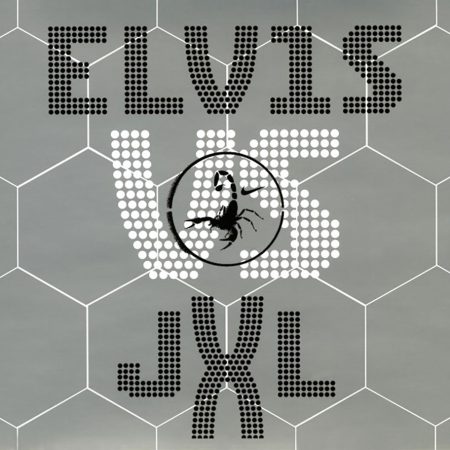
ELVIS VS JXL – “A Little Less Conversation”

by Tom

#930, 22nd June 2002

elvis jxl 2002 was the 50th anniversary of the charts, and Elvis had been dead for half those fifty years. The scale of the public reaction upon his death took media observers by surprise; the Elvis industry kept on rolling, turning a star back into an icon. By 2002 the name was still household, the face still instant, his life and death bywords for some kind of American promise, or tragedy, or comedy. What about the music? There, perhaps, was a problem. Was Elvis “relevant”?

“Who cares?” you might ask. To the people who stood to make money off it, that response was naive. But for some there was also a question of cultural propriety – Elvis was the first dead rock’n’roll icon whose work risked losing its audience, fading into a gentle twilight, respected but hardly heard. His partisans might not have put it so crudely, but the impulse was clear – Elvis mattered, and had to be seen to matter. The corpse must be re-powdered and kept on show.

Economic and cultural impulses diverged sometimes, converged sometimes. The 21st century has seen several projects of Elvis reanimation, some grislier than others. On Popular we’re spared the current slop of orchestral Presley versions, but in due time we’ll encounter the most emphatic of all the King’s posthumous headline-grabs. And then there’s JXL, whose “A Little Less Conversation” emerged from the same basic assumption as the current Philharmonic suet: Elvis’ music, without alteration, can’t do the job any more.

The original “Conversation” – Presley’s last US single recorded before the ’68 Comeback Special – is a bouncy, well-played trifle whose demanding come-ons have aged badly, but are at least undercut by the way the song accelerates into cartoon frustration near the end. Rediscovered as an Ocean’s 11 soundtrack cut, the song made its way to JXL with a certain amount of Presley Estate fanfare (the first official remix of the King’s work) and then went global after Nike got hold of it for their – admittedly magnificent – “Scorpion KO” advert featuring Eric Cantona as a referee of celebrity football matches held in a rusting offshore dreadnought.

Nike’s use of it drew the sting of the lyrics’ get-yer-coat-luv hustle, reframing the chorus as a sporting challenge – or simple consumer impatience for the 2002 World Cup to begin. Junkie XL’s springy, route-one beats were a natural fit for the fast-cut highlights-reel montages every football broadcaster was using to sell the game in the galactico era as faster, rushier, more full of tricks and shocks and big names. For sure, watching the World Cup that Summer was a delight, but that was more a novel trick of the time zones – football for breakfast! – than the marketing and staging. Little of its shine has rubbed off on JXL vs Elvis, which summons up the inane grabbiness of the sponsors and merchandisers, but not the game they were exploiting.

And considered as music now? As a track, “A Little Less Conversation” is a dumb-as-rocks interpretation of big beat, with a level of subtlety that makes Norman Cook sound like Brian Eno. But even though every percussion fill, whoop and scratch is calibrated for maximum goonish response, there’s none of the edge-of-disaster playfulness that made big beat bearable, none of the sense you got with Fatboy Slim that this music is being made by mates trying to entertain one another.

As for Elvis, pitched down in the mix and overrun by the party-hard production, he’s a presence here but not much more. “A Little Less Conversation” is a commercially huge dead end as far as the Elvis resurrection project went: it made the King sound like a sample, or worse, a mumbling old man hauled from the grave to MC a party he couldn’t possibly understand.

23 Jan 18:51

Peston suggests that Boris might be preparing the ground to flounce out of the cabinet

by Mike Smithson

Could this be BoJo’s Heseltine moment?

In an interesting Facebook post under the heading ““Is Boris preparing to flounce out of the cabinet?” Robert Peston ponders the question of whether we are seeing the Foreign Secretary prepare the ground for a bid at the leadership.

This is, of course, in the context of Johnson’s demand, reported in the Times this morning, for an extra £5bn for the NHS. Peston concludes:

“..If Johnson feels his best chance of becoming leader would be by first preparing the ground from the back benches, the principled reason for resigning – in order to win back the support of sceptical colleagues – would be because the prime minister is offering the wrong kind of Brexit.

And his personal manifesto pledge would be the late delivery of that £350m for hospitals!”

Certainly the longer that TMay remains at number 10 the bigger the challenge facing Johnson if he wants to go for the job. As time passes other names could come into the frame and strategically it is probably better for him if the challenge comes before Brexit has happened. It certainly makes sense in that context for him to be seen to be the one making the move.

Remember he was the strong favourite to succeed in the weekend after the election when TMay had lost the Tories their majority.

Ladbrokes have Boris at 5/1 for next Cabinet exit – Paddy Power offer 6/1.

Mike Smithson

Follow @MSmithsonPB

Tweet

21 Jan 14:37

Toby Young

by Mark Steel

I felt sorry for the Conservative Party, when it got in trouble for appointing Toby Young to a body advising universities. How could they have known he was unsuitable, or might be thought of as ‘sexist’ in some way? Apart from comments such as “Check out the baps on that” and “perfect knockers for an 18-year-old”, on a regular basis over a period of several years, he barely talked about women’s bodies. It goes to show, it’s always the ones you least expect isn’t it?

In any case, these comments were made in private, to close friends such as everyone with access to Twitter or a newspaper. And Toby has pointed out they were said in the past, so it’s not fair to judge him now on things he said back when we had different values, in 2016.
During the week in which he was under scrutiny, he deleted 46,000 tweets from his Twitter account, and this illustrates how ridiculous the complaints against him are. Who of us hasn’t, in our youthful forties, made the occasional 46,000 public comments that we might regret later. We’re getting to a point where no one dare say anything.

One of his articles complained about the disruption caused by the politically correct practice of installing wheelchair ramps in schools, and you can see his point, they are a major nuisance. They may make life easier for wheelchair users, but to cater for them, the silent majority who quietly walk without making a fuss, now have to walk down a three inch slope that would have been a step, just to accommodate the disabled. There might be a step as well, but that might be over there, and now I’ve got to suffer the inconvenience, of walking five or six steps over there, should I prefer a step to a ramp, and the sort of person prepared to point out the injustice of this is who we need in charge of educating kids.
I became fascinated by Toby Young when he wrote a review of the film ‘I, Daniel Blake’, about a builder trying to claim disability benefit after a heart attack. The difficulties the builder faced in the film “didn’t ring true”, he said, because although he didn’t know anyone who claimed disability benefit, “none of the characters gambled or smoked.”

And it is generally accepted, the person who knows most about something is the one who’s never experienced it. There should be a television show called ‘Toby Rings True’, and he can tell Usain Bolt what it’s like to break sprinting records. If Bolt says ‘it not like that’, Toby can correct him, saying ‘no it is because your story doesn’t ring true’.

Then he can tell Stephen Hawking what it’s like to study stars and finish by complaining ‘Now there’s a ramp in this studio because of you’.
I was honoured to be the subject of one of Toby’s irritation, when he complained that I’m on the BBC, despite “Supporting regimes that killed 110 million people.”

It might seem picky on my part, but I asked if he had any evidence for this, or whether it was alright to accuse anyone of anything you like, in which case it’s also a disgrace he’s on the BBC, seeing as he supported an attempted invasion of earth by the Daleks.
It’s fairly serious, to accuse someone of supporting the murder of 110 million people. It’s not just saying someone supported the murder of 105 million people, which can be easily brushed off.

So I asked him what he meant by this, but he hasn’t said. Maybe it’s taking so long because he’s writing out all their names.
Or maybe if it rings true that someone supports genocide, that’s enough, and to ask for details is political correctness gone mad.
I suppose he’s attributing to me all the deaths that took place in countries calling themselves communist, which is fair enough.
The only point in my defence is I always opposed and campaigned against the Soviet Union, and Communist China, and described their regimes as amongst the most ruthless dictatorships ever, but it would be easy to interpret that as support.

But how was he to know that? He hasn’t got time to check on Google whether someone did or didn’t support the murder of 110 million people before saying they did.

Because for Toby, facts don’t really matter, the main thing is to state things, and checking whether they’re right is over-rated. This is what makes him ideal to influence schools and universities. Then instead of being restricted, as they are currently, to teaching things assumed to be vaguely accurate, they will be free to teach stuff like ‘a fridge is a kind of aeroplane’ and ‘The Second World War started because Hitler wanted to marry Judi Dench but she wouldn’t let him’.

Maybe the main issue with Toby Young is how someone like that attains any influence. Possibly it’s because we’re in a time when posh stupidity is seen as refreshing maverick thinking.

You can shout the most ignorant abuse, made up statistics, wild accusations easy to disprove, but if you’re connected to the Spectator magazine and the Foreign Secretary, and use a few long words, you’ll be invited onto news programmes and placed on government boards.

There should be an app for drunk blokes who yell in parks, that translates their gibberish into posh maverick language, so instead of screaming ‘SEE him he’s a MURDERER he killed MILLIONS but we’re NOT ALLOWED to say because of the RAMPS it’s the fault of the RAMPS for the WHEELCHAIRS oy LOVELY tits darling’, it comes out as a Toby Young article, and alcoholics would be on Newsnight and on the board of the Bank of England.

But now we’ve been robbed of Toby’s expertise, such as when he set up a free school that collapsed, and became a Labour supporter to vote for Corbyn, as this would guarantee a huge majority for the Tories.

So he should be given more jobs. He could narrate wildlife documentaries, insisting ‘that lion hasn’t got a chance in a fight with a wildebeeste’, and commentate on the snooker ‘The winner was the one with the white gloves who kept saying the score’.

But his real talent is not just to be taken seriously by the establishment in spite of being devoid of any idea about anything, or the apparent ability to look anything up. His true contribution is despite being immensely privileged, he manages to retain such embittered malice, embroiled in perpetually foaming anger. He may be exceedingly comfortable, and connected to power for no discernible reason but it’s still NOT FAIR, because of the people who don’t like his tweets and the lesbians and people who are probably Communists, and unnecessary wheelchair ramps, that are a WASTE, because although I’ve never been in a wheelchair, I know wheelchairs can go down steps because it just rings true.
So he’s a perfect symbol for modern power, and deserves to be on the board of all our institutions.

21 Jan 14:14

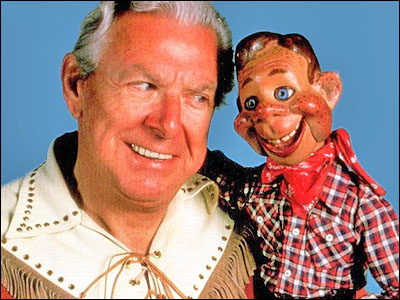
My Buffalo Bob Story

by evanier

It was in August of 2007 that I shared my Buffalo Bob story with all of you here…

Okay, here's my Buffalo Bob Smith story. It took place at the Licensing Show in New York in the early nineties, and I guess it helps make the point if I explain what happens at those events. The Licensing Show is a place where companies exhibit, either because they own great properties (famous characters, copyrighted designs, etc.) that someone might want to put on a t-shirt or lunch box, or because they license the rights to put great properties on those t-shirts or lunch boxes, or because they broker deals to make that happen…

Well, anyway, just understand that this is a convention about the marketing and licensing of identifiable properties and that most of those present are involved in some way with licensing. There are exhibits all over and many of the booths are filled with celebrities and freebees, the better to attract wanderers to the displays.

This particular year, Buffalo Bob Smith — star of the legendary Howdy Doody kids' show — was there to promote a new wave of Howdy Doody licensing from King Features Syndicate. He was appearing in the King Features booth and when I heard this, I decided to amble over and see if I could meet him. That was until I saw the line. It looked like about a three hour wait to meet Buffalo Bob, get one of the autographed photos he was signing and shake his hand. The line, filled wholly with folks in the proper age bracket to have watched Howdy Doody when they were eight, snaked through the entire hall, down past booths where you could get your photo with W.W.F. wrestlers or Playboy models or some suffocating person in a giant Snoopy costume.

The length of the queue caused me to pass. I mean, with a line like that, how much time could you possibly get to talk to the guy? Twenty seconds? So I took a look at him — older but still handsome in his Buffalo Bob jacket with the leather fringe — and I continued walking.

Later on as I walked past, the line was still just as long, if not longer, but I heard someone call my name. It was a friend who worked for King Features. She welcomed me into their exhibit space and we chatted for a while. Then she said, "Would you like to meet Buffalo Bob?" I said sure but there was that long line…

"You don't need to stand in line," she said and she led me over to Buffalo Bob. We came up behind him and she interrupted his signing to do introductions. He threw down his pen, turned around and got up to shake my hand, then we talked for two minutes or maybe three, I, of course, said all the geeky stuff everyone said to him about watching him when I was a kid and being happy to see him mobbed by fans, etc. And all the time I was saying such things, I was eyeing the line of people who'd been waiting half the afternoon for thirty seconds with him. Eyes were glaring at me with raw hatred and I could hear them all thinking, "Who's this rude clown who thinks he's so much better than us that he doesn't have to wait in line?" Well, of course. If I'd been there for 3+ hours, I'd sure have resented the hell out of me.

It made me nervous so I said to Mr. Smith, "Listen, I'd love to talk to you longer but you have all these people here waiting to meet you…"

He ignored that and went on talking to me about whatever we'd been discussing. The lady who introduced us had told him I did the Garfield cartoon show, and he was telling me how much Garfield merchandise he was seeing everywhere. Again, I said, "I shouldn't monopolize you like this. These people have been waiting all afternoon for your autograph…"

And I will never forget this — and so help, me this is verbatim: Buffalo Bob Smith, the King of Doodyville himself, pulled me to one side and he whispered to me, "You don't understand…my job is to keep the line as long as possible."

The post My Buffalo Bob Story appeared first on News From ME.

19 Jan 20:48

Marxism as anti-ideology

by chris

Sam Bowles has a nice piece in the FT on the case for pluralism in economics by integration – “marshalling the insights of differing schools of thought and academic disciplines into a common paradigm.” I’d add only that the points at which the marshalling should occur must be determined by the facts. We learn about economics from the real world, not just from schools of thought.

I want to suggest something that some of you might think paradoxical – that Marxists are well-placed to do this because we are, in a sense, less ideological than others.

Take, for example, the question: do higher minimum wages destroy lots of jobs? As a Marxist, I can accept either answer. If they do, we have (more?) evidence that actually-existing capitalism is incompatible with decent living standards. If they don’t then we have a way of making workers better off. Either way, I’m happy. I can allow myself to be guided by the evidence in a way that either free marketeers or their social democratic opponents might not be.

Or another example: could fiscal policy not just stabilize aggregate demand but increase trend growth? If it does, then fine: we’ve a way of making people better off. If not, then my prior that capitalism is prone to stagnation and crisis is strengthened.

Here’s a third example. Are financial markets informationally efficient or not? I can accept either answer. If they’re efficient, then fund managers are ripping people off and we have another example of the exploitative nature of capitalism. If they’re inefficient then we have another mechanism whereby capitalism can generate instability. (In fact, both might be true, as markets might well be micro efficient but macro inefficient). Being a Marxist has, I suspect, made me less bad at my day job than I otherwise would be.

A fourth example is Brexit. Being in or out of the EU is orthogonal to my Marxism. Again, therefore, I’m happy to be guided by the evidence on whether Brexit will make us better off or not.

There’s another thing here. As a Marxist, I haven’t invested my human capital in only one paradigm. Marxist economists must be pluralists simply because we must run our Marxism alongside the orthodox/mainstream/whatever economics we learn at university and in my day job. Integrating different perspectives – which might of course mean ditching large parts of some – does not therefore threaten the destruction of my human capital as much as it does specialists in one paradigm.

On a lot of issues, then, we Marxists can be intellectually flexible simply because there are a lot of fights in which we have no dog.

But, you might ask, if this is the case, isn’t your Marxism just an unfalsifiable pseudo-science?

No. There are some claims which – if true – would weaken my Marxism perhaps to the point of refutation, for example: if capitalism could deliver sustained full employment with good working conditions and satisfying jobs; if it could be shown that capitalism were non-exploitative; if the capitalist state were genuinely neutral; or if capitalistic relations of production were never fetters upon growth. These claims, however, have not been satisfactorily established.

I’ll turn the question around to centrists, Tories, libertarians or social democrats. What equivalent claims (if they could be established) would falsify your political position?

What I’m trying to do here is weaken the prior of many anti-Marxists. Many of you have traditionally seen Marxism as a fanatical ideology opposed to the cool-headed rationality of mainstream politics.

I’ll concede that there might be something in this: the worst advert for Marxism has often been those who profess to be Marxists.

For me, though, the opposite is the case: in some respects, Marxism takes the ideology and fanaticism out of some debates.

19 Jan 15:42

Outsourcing: a transactions cost approach

by chris

In all the reaction to Carillion’s collapse and the NAO’s report on PFI, one important perspective has for me been under-stated – that of transactions cost economics.

Let’s start with an important distinction – between private finance and private provision.

There is no justification for private finance of government projects. One thing the state can do better than the private sector is borrow cheaply. Private finance is the result of daft accounting rules described by Laurie MacFarlane rather than of economic rationality.

Private provision, however, is another matter. In principle, competitive tendering by private firms could bid down the cost to the tax-payer of government services.

But there’s a problem here. As Simon says, companies that win tenders by bidding low have an incentive to cut quality. The question is: is it possible to stop this happening?

It’s here that transactions cost economics enters. This perspective began with Ronald Coase’s famous essay, The Nature of the Firm (pdf). Whether we should do a job in-house or through the market depends upon the comparative costs. And, he said, “there is a cost of using the price mechanism.”

In our context, this cost is the difficulty or even impossibility of writing contracts which ensure good quality provision. As Oliver Hart put it:

It may be prohibitively expensive to write a contract that conditions quantity, quality and price…This is not just because some of the variables are privately observed, but also because, even if publicly observable, the variables are inherently hard to specify in advance. (Firms, Contracts and Financial Structure, p24)

Whether outsourcing is a good idea hinges upon whether this is the case or not. If a contract controlling outcomes adequately can be written, then outsourcing might work. But only might, because a contract demanding decent quality would be an expensive one. The NAO says (pdf):

Our work on PFI hospitals found no evidence of operational efficiency: the costs of services in the samples we analysed were similar…More recent data from the NHS London Procurement Partnership shows that the cost of services, like cleaning, in London hospitals is higher under PFI contracts.

And if we can’t write an adequate contract, the case for outsourcing is even weaker.

The answer here will differ from service to service. It should be possible to contract properly for building work, for example, because a competent inspector should be able to assess quality – though even this isn’t always the case. In other cases, though, quality isn’t so observable and controllable; this might well be true of social care (where much hinges upon the manner of the individual carer) or forensic science. 

But why might in-house provision be cheaper? One consideration here is the public service ethos. If people are motivated by an idea of public service, they’ll do good jobs without oversight or detailed contracts. Good culture is potentially a cheap solution to the problem of incomplete contracts.

But only potentially. Such an ethos should not be taken for granted. The Stafford Hospital affair – and perhaps the “failure of leadership at all levels” in the prison service – remind us that it is sometimes dangerously lacking. Martin Wolf makes an important point (in a different but applicable context) when he reminds us that nationalized industries “ treated users with indifference.”

Which brings me to another question that’s overlooked: how can we build a true public sector ethos in which workers are, in Le Grand’s words, knights rather than knaves? (The answer might well include less managerialism and more empowerment of workers and users.)

It might be a good idea to reduce the amount of outsourcing; that depends not upon ideology but a cool-headed assessment of transactions costs. Doing so, though, should be a means to a greater end, and not just an end in itself.

17 Jan 00:35

Blake’s 7 – Cygnus Alpha

by Alex Wilcock

Forty years ago tonight, the third episode of dystopian BBC sci-fi Blake’s 7 was broadcast. For me, Cygnus Alpha is both where Blake’s 7 becomes Blake’s 7 and where it definitively spoke to me.

This article is a mix of review of that episode and personal perspective on Blake’s 7. A tale of religion, freedom and BRIAN BLESSED. Of how human nature has to embrace a lot of contradictions while totalitarian systems have to deny them. And of Richard and me, and Stockport and London.

Blake’s 7 is remembered after all these years because it opened more bleakly than any other TV sci-fi and finished more bleakly still. But along the way, it’s somehow still immensely enjoyable. If you’re not familiar with the series, here’s the story so far:

The Way Back opens on a future Earth under a drably authoritarian Administration like 1984 slogging on to centuries later. Roj Blake is an apparently ordinary person who finds his life is a lie, his memory is a lie and the whole system is a lie, which then lies about him in the most horrible way to destroy his credibility as a political threat. From suddenly awakened political activist to convicted criminal, he’s transported to prison world Cygnus Alpha with, well, a bunch of criminals. In Space Fall, their prison freighter London encounters en route a mysterious abandoned spacecraft and prisoners Blake, Jenna and Avon board and take it, but this crew won’t be a clean-cut bunch in starched uniforms. No, the people in uniforms are the ruthless galactic Federation Blake’s fighting, while his allies are thieves and murderers who don’t necessarily share his revolutionary ideals. Cygnus Alpha sees him get used to his spectacular ship the Liberator – while Avon and Jenna have to decide whether it’s going to be his ship. And taking the Liberator to future-Botany Bay Cygnus Alpha itself in search of new recruits to his crusade, Blake finds from the start that even the most desperate won’t necessarily flock to his cause…


Cygnus Alpha and Omega


“Come. Follow us. God has prepared a place for you.”


There are at least a dozen episodes – as early as The Way Back, as late as Blake – that you could point to and say, ‘There. That’s it. That’s what makes Blake’s 7 really Blake’s 7’. Of all of them, while it may not be the most dazzling, the most deep or the most distinctive, the most practical single point at which Blake’s 7 comes together as a series is Cygnus Alpha.

Cygnus Alpha is where it all came together for me, too, and not just for the obvious functional reasons that by the end of the story Blake has in place a dysfunctional crew, a super-functional ship and a messianic mission statement, ready to start.

I had started watching Doctor Who aged three, at the beginning of 1975 and the beginning of Tom Baker (with 1963 and 2005, one of the three perfect moments so far to join the series). It captivated me instantly and has shaped an enormous amount of my life, from learning to read, to my politics, to introducing me to the man I love. So when three years later another BBC science fiction series came along, a little bit later in the evening, a little bit more grown-up, I was determined to see it. Wasn’t I twice as grown up now, and allowed to stay up a little bit later too?

I can still see in my mind’s eye – perhaps wholly hallucinatory, after four decades of unreliable memory – the grubby, grim Radio Times picture of Gareth Thomas and Robert Beatty on a tower block roof or car park to promote the series’ first episode, and remember wondering what it would all be about. My other most vivid memory of The Way Back was also one that involved Robert Beatty’s character, but with absolute certainty: a brutal massacre that both thrilled and shocked me, and provided at the time the most compelling answer to what Blake’s 7 would be all about. That, and the nature of the charges framing Blake, tell me in hindsight that my Dad watched the opening episode with my brother and me while my Mum was listening to the radio in the kitchen. Had she come into the living room for either detail, there would have been the inevitable cry of “The things you let them watch!” (my Mum’s superpower in my childhood being to sense the most ‘unsuitable’ moment of anything on the TV to make her entrance) and that would have been the end of it. Though, despite her disdain for all science fiction, I do remember Mum positively choosing to come through for a couple of minutes each week after that to see what frivolities Jenna was wearing.


Aside: I wrote the passage above about the Radio Times picture back in 2014. Since then, I’ve at last seen again what was almost certainly the original entry that my memory mangled over the years. It’s actually of Gareth Thomas and Michael Keating, which makes more sense, but I can understand how I’d have watched the first episode, been enthralled, and put the two most important characters in it together, even if one of them was quite unlikely to be a continuing cast member by that point.

The photo isn’t even in a particularly identifiable setting, but I was born in 1970s Stockport with plenty of concrete and car parks around and clearly read ‘vaguely urban and like the places I know’ into the shot. After many years away, since I wrote the original version of this article I’ve also been living back in Stockport again – though the way back was less hard work than Blake’s. I moved back there with my husband Richard, who (unknown to each other at the time) was also watching Blake’s 7 all those years ago, and not that far away…

One of the absurd moments in Cygnus Alpha comes when, faced with the alien technological marvel of matter transmission, Blake and Avon immediately grasp it because – by an unbelievable coincidence – they had both worked on the same failed Federation “Aquatar” teleport project. “Small world.” They didn’t meet each other then. “Large project.” Not until the start of this series, with both of them on the prison ship London. I remember scoffing at two people with such different skillsets and backstories both having worked on the same useless project, never meeting, just so that years later the concept could come in so expositionarily useful in understanding technology that no-one on any world they knew had ever mastered. Absurd! A decade and a half after we each watched Blake’s 7 as boys, Richard and I found each other through our fluency in that series, Doctor Who and other tongues while I happened to be staying for a few weeks (or so I thought) in the East End. Our ‘Aquatar moment’ came not on the Liberator but on the almost as shiny and exciting Docklands Light Railway. What an absurd coincidence it would be for us to have both grown up in the same town but only to find each other in… London.

The Radio Times picture was posted by the quite extraordinary Twitter account @MakingBlakes7, which is the most brilliant continuing documentary project I’ve ever seen on Twitter. You can see that Radio Times Tweet by clicking here.


“Prisoners? New souls for the Faith.”


For this episode, it helps that it all looks rather stylish. I’ll admit that I often find something of the ‘that’ll do’ about Vere Lorrimer’s direction in his later work for the series, but here the night filming is striking and the projected backgrounds (yellow moon, forbidding citadel) as fantastic an effect as the series ever delivers. But it’s my Mum and Dad’s influence that really primed me to love Cygnus Alpha, though they’d roll their eyes at quite why. They’re both deeply religious, and I grew up going to two churches every Sunday, Catholic and Baptist. Add two competing versions of the same faith and a bright boy who read a lot, and I became steeped in religion, but at the same time asking a lot of questions and curiously open-minded about different flavours that all claimed to be the one true faith. Perhaps that’s why I was just as happy with two ‘rival’ sci-fi shows.

Doctor Who had gone through a year of dark religion that’s still to this day my favourite just before Blake’s 7 came along, and Cygnus Alpha spoke to me in just the same way. This was my world! Religion in all its scary but fascinating glory! My strange personal mix of free-thinking and immersion in dogma meant I was always more compelled by terror in the pews than Yeti in the loos. So, as much as day-after-1984 dystopia had grabbed my attention, it was Cygnus Alpha that was speaking my language and told me this was absolutely my sort of series.


“My word is law. My followers obey without question.”


For all that the Federation, like communist regimes of the time, has banned religion, Cygnus Alpha’s theocratic society is the Federation in miniature (though distinguished by a greedily ambitious figurehead rather than a faceless bureaucracy, Vargas prefiguring über-villain-to-be Servalan). The script is full of parallels between them, from the cruder version of Blake’s show-trial in this world’s “SO PERISH UNBELIEVERS” to the subtler point that, for all his cowardice, it’s Vila who’s still by nature the most wary of going along with authority, whatever form it takes – or clever juxtapositions like “the place of rebirth” and “Berthing sequence automatic”.

Perhaps the unambiguous connection of this theocracy with that already established totalitarianism is what gives the attack on religion such force. Even by the standards of science fiction using other worlds to get away with social critiques that would provoke too many complaints in a modern-day setting, this one pulls no punches (though the institutional child abuse was the Federation rather than the Faith). It’s not a case of using religious trappings to save on money or world-building, using historical window-dressing to tell a different story. One of the reasons this so appealed to little religious me was, ironically, what I’d expect to offend other believers most. It was about the ideas, not just the imagery. Underneath all the monk-like robes, the blasphemous crucifixion, the cruel crusader bust, the Inquisition torture imagery and echoing chants familiar from Gothic horror films, the script really is making a bitter attack on the very concept of organised religion.


“So you and those before you built your power on fear and ruled them with it.”


We saw back on Earth that the Administration maintain their power by surveillance and brute force, fear and drugs, suppression of ideas and the Big Lie. That mirrored totalitarian regimes of the time; now this mirror of the Federation in turn mirrors religious power. If there’s ever a daytime on this world, we don’t see it. Cygnus Alpha is symbolically in the Dark Ages, and for generations its people have been kept in the dark of ignorance. Just like Earth under the Federation, on Cygnus Alpha under the Faith you are always watched. Literally by guards in both, but where the Administration uses cameras everywhere, the Faith uses its God, explicitly invented as a tool of social control.

My husband Richard points out that the constellation of Cygnus is also known as the Northern Cross: both a religious allusion in itself and a reflection of the Southern Cross which is the symbol of Australia, a striking setting for a theocratic space-Botany Bay.

This mini-Australian mini-Federation doesn’t just swipe at religion in general but, true to its Gothic trappings, is as specifically anti-Catholic as any fevered Gothic text. It’s not just taking the fear of an invented death for the fear of an invented hell and proclaiming that the Faith is your only salvation. The Saruman-like hand is one of the production’s few symbols that isn’t obviously Christian, perhaps deliberately to make you focus on a fictional symbol and not on the words and their meaning: “Only from this hand comes life” coupled with a priest handing you a small, round, white thing to swallow that claims to be salvation but is in fact nothing at all? Could it get any more blatant? To look at the “life” held out and see a Trebor mint is to miss the point, but perhaps the very cheapness and obvious solution helps distract and avert complaints. Later dystopia V For Vendetta offered one poisonously satirical communion wafer, but this is a gob-smacking polemic against the whole idea of transubstantiation.

And the Curse of Cygnus (a near-homophone for ‘sickness’) catechised as divine punishment on every wretched inhabitant of Cygnus Alpha – all deserving it as either criminals in their previous life or descended from offenders by birth – from which they can only be saved through the Faith? That’s Original.

After this story’s impact, there’s no real follow-up to the theme; Blake’s 7 is never this savagely critical of religion again. It’s background colour in a few more stories, but they don’t have anything that feels so real. Cygnus Alpha does act as a prototype for more generic Blake’s 7 stories, such as generally the Liberator turning up at a planet of the week and bringing down the regime (or, in this case, leaving it in chaos and having to run away) or more particularly the primitive planet with a primitive people and a twist about something more advanced, usually involving a quarry and a more interesting B-plot in which the crew bitch at each other. Modern BBC sci-fi watchers might call that the ‘Utopia style’, though Russell T Davies’ Blake’s 7 homage brought an altogether rougher beast for its second coming. Perhaps the real thematic legacy of this episode isn’t equating the fierce religion of Cygnus Alpha with the totalitarianism of the Federation, though. Fittingly for my own complicated view of religion as both good and bad, there’s a parable here that’s closer to home.


“The architectural style is early maniac.”


These days I wonder if the whole thing’s not a great big warning about Blake.


If aged six, getting into the series, Cygnus Alpha confirmed that it was my sort of show, I was delighted by how it grew when watching the whole TV series right through again in 2014, aged forty-two. It wasn’t an episode I often chose to watch when I felt like a bit of Blake’s 7 (though I always loved it more than I expected when I did), but I’d thought it was one of the ones I had the clearest picture of in my head: the end of the beginning, fabulous Pamela Salem and Brian Blessed, evil religion plot with a different tone to the rest of the show, entertaining but a bit cheesy. It may well be all those things, but with a more critical brain and knowing the show well enough to put the whole thing in context, I suddenly felt there was a lot more to it.

Blake’s the hero and Vargas is the villain, so they must be opposites, right? Except that it doesn’t play that way at all. If the society of Cygnus Alpha is a mirror of the Federation, the extent to which its leader was not a contrast to but an explicit counterpart to Blake seems so striking that it’s hard not to see it as deliberate (with all the implicit consequences should Blake ever get into power that that entails). Blake getting a messiah complex in Series Two? This story more than any other reads like he’s been off on one since the beginning. Vargas and Blake face off, Brian Blessed and Gareth Thomas with similar intensity, their demands incompatible because the two of them both want the same thing: souls as currency to spread their belief, the power of their word, across the galaxy. Blake takes up his special handgun for the first time; the first to use it? Vargas. Avon’s warning to Jenna about Blake? “He’s a crusader.” Vargas rules by the Big Lie and forced ‘conversion’; Blake tells his followers they have a free choice, but keeps the truth from his first, sceptical disciples (“Did you see anything while you were down there?” “Not much”) and like Vargas gives the next batch of converts the choice of his way or death:
“Only from this hand comes life.”
Three different characters this week all state that the prisoners have no choice, and in the end they don’t – whoever they follow, they’re still going to be followers.

Back on the London, Blake was willing to sacrifice himself so that his followers might live. Now we see the flip-side of that: if you’re not with him, you’re against him. He’s come to find new converts, but when they deny him in fear of the rival Faith, he rages at them instead: “You’re pathetic! …slaves! …I’m better off without you.” For all his rhetoric of freedom, Blake demands a positive choice to follow him – a leap of faith. Offering salvation to his own followers is one thing, but rather than sacrifice his messianic ideals he’ll let everyone else die. Vargas and Kara had watched the Liberator in the sky – a light in the darkness. They called it a sign, and it’s a guiding star heralding the new messiah, but we all know who that is, and it’s not the Blessed One whose hard certainty will be driving death after death in this series.


“A little more practice, we should be able to put you down with precision.”


In the context of the whole series, Avon’s appeal to Jenna that Blake would only use all the ship’s treasures to fight the Federation – though it turns out that Blake is never bright enough to realise how effective wealth would be as a weapon, and Avon is bright enough never to tell him – seems like foreshadowing.
“And he can’t win. You know he can’t win. What do you want to be – rich, or dead?”
From almost the very beginning, you can see in hindsight warnings, prefigurings, fetches of much later events in the series, and perhaps it’s appropriate that this religious episode seems the most prophetic. Avon even aims his gun at Blake first chance he gets (though it’s only once he’s become a believer that he’ll fire). But Avon needn’t have been foresighted enough to see Blake coming down the road. I realise this time that he could just have watched where Blake’s been, already fighting to the last drop of their blood. Consider…
  • Blake’s first rebellion, the series’ backstory: everyone else gets killed and he has his brain knackered.
  • Blake’s second rebellion, the series’ opening: he only has to turn up out of vague interest and everyone else is massacred (while several children have their brains knackered).
  • Blake’s third rebellion, last week: everyone’s rounded up and several of them get shot though, remarkably, most of them live. In chains.
  • This week, Blake’s fourth rebellion: they’re only up against knives and knuckles on Cygnus Alpha, but he still manages to be one of only three survivors who leg it.
  • Never mind the “Curse of Cygnus”; Blake is such a jinx that he only has to express a passing interest in a particular rebellion and 99% of them will die. On which subject, tune in next week…
And did I say there was no more religion as theme rather than window-dressing? The week after next it’s The Web, which combines killing God of a sort with at last a ‘successful revolution’ that suggests long before Star One that Blake may not have thought the consequences through.


“It didn’t answer any of your questions. More than that – it deliberately ignored them.”


There may be a certain irony in my having gradually given up belief in religion but gained a passion for politics in my teens, but I remain a free-thinker and just as ready to question my leaders as I was scriptures, and unlike Blake I’m more than wary of imposing my beliefs on others. For me, there was nothing like seeing how two competing church hierarchies that theoretically professed the same beliefs were both much more obsessed with control of individuals than individual belief to tip my own beliefs towards Liberal individualism, if not a hint of anarchism in observing that the best way to kill a belief is to set up a rigid structure to enforce it.

Though I wrestled with the theology for years afterwards, it was perhaps inevitably a confrontation with church authority which precipitated my eventual teenage crisis with religion. The surprise might be that it turned out to be with the smaller ‘free’ church rather than the more top-down hierarchy; the ‘Cygnus Alpha’ Baptists rather than the ‘Federation’ of Catholicism. Aged eighteen, I was teaching Sunday School for the kids; one Sunday I came in with a noticeable bruise and, asked what had happened by one boy, replied with the truth: I’d been walking down the road with my boyfriend and someone had hit us. The next week I found I wasn’t teaching Sunday School any more and that a tight-lipped “You know why” was the only explanation. My own moment of liberation came in realising not my fear, but theirs in their own repression; that they couldn’t bring themselves to talk to me, nor even do what a decent human being would do and ask if I was all right after I’d been attacked. The truth shall set you free, indeed, but not in the way they or I had expected it. That was the moment I lost all respect for that particular church because, after all, what was there to respect? And, fortunately, it wasn’t such a long walk back.


“That would have been very disarming if I didn’t know that you meant it.”


Zen and Jenna offer an intriguing alternative here, both a different angle on (explicitly non-Christian) religion and on what the series might have been had each of them kept such significant roles. How much does each affect the other when enigmatic ship’s computer Zen gets into its new pilot’s head? Jenna’s “to be completely known. It’s like – innocence” is more like a revealed religious experience than anything else in the episode, and without it, would she have hesitated to head off with Avon? Zen is characterised as a superior and evasive oracle with less obvious reactions – except one – but, taking its name and the ship’s from Jenna’s thoughts, does it make itself in her image?
“Wisdom must be gathered; it cannot be given.”
Zen is a very different religious text to the certainties of Vargas and Blake, but how much of Zen’s resistance to direct is inspired by its pilot’s resistance to being dominated, as “the Liberator” it plucks from her desires suggests?

The best piece of bitching among the crew is an understated one from Zen, as it says in turn to the three of them:
“Welcome, Jenna Stannis.”
“Welcome, Roj Blake.”
That is all.
It’s a masterclass in how to be an oracle while making it absolutely bleedin’ obvious what you think; Avon only gets a neutral reply when he prompts it. Clearly, it’s read his mind last week and Jenna’s here and decided it’s not going to like him well before he starts saying it’s “just a machine”. It’s a shame that Zen’s telepathy is lost to another crewmember long before it loses prime spot as ‘bitchy super-computer’. The series also swiftly drops this week’s attempts to pretend they know what they’re talking about on scientific ideas – Aquatar, negative hyperspace, the anti-matter interface – which is no great loss. It feels much more Blake’s 7 when the crew don’t know what they’re talking about, like Blake stumbling on using the teleport because he’s not used to it.

I do feel a little wistful about some of the other interpersonal dynamics that the story appears to set up: judging by Cygnus Alpha, there are now going to be three charismatic leads setting the direction, Jenna being the swing vote, with willingly violent killer Gan and his little friend Vila as wild cards, but it doesn’t work out that way… You can see here that Jenna has so much potential. Blake’s 7 began broadcast just as Star Wars first opened in Britain, so it’ll take a while for the film to start having any impact on the series, but compare and contrast even from the first the clean versus the dirty-handed rebels. One of this series’ great lost opportunities is still that its ‘Han Solo’ is a woman – which may be why she gets elbowed out of the way. But, still to come, Blake’s 7’s ‘Tarkin’ figure will be a woman too – and once she appears, their ‘Darth Vader’-equivalent won’t stand a chance.


“You’re a free man.”


In 2014 I watched Blake’s 7 right through with my beloved Richard. But much as we enjoyed the series all over again, we’ll always remember 2014 for something much more significant to our lives together. We went back, not to the Dome – there’s one just across the river from our flat in London – but to Stockport. On our twentieth anniversary together, we got married at Stockport Town Hall.

I’d say that this was my personal triumph of freedom over dark religion, but freedom won for me so long ago that religion was barely a footnote. Though I still find stories powerful when they make strong use of religion, for good or ill, it’s only as I write this that I realise Stockport Baptist Church is a couple of minutes’ walk from the Town Hall. It’s not something that crossed my mind on the day (though I probably quoted Blake’s 7 at some point). When we made the most important decision of our lives, we were surrounded by believers in several kinds of politics and faiths and in none, including my very proud and happy Mum and Dad, but we chose each other and we chose all the people we invited for love and belief in ourselves.


The Apocrypha: Trevor Hoyle’s Blake’s 7


“Hands reached up and pushed back the cowl to reveal Kara’s evil, haunting beauty – a face that was disfigured by a kind of lustful greed… a smile that was rapturous and yet somehow obscene…”


There’s another alternative world of Blake’s 7, and of Cygnus Alpha. I was already a voracious reader when Blake’s 7 turned up, but though my memories of Cygnus Alpha are thoroughly entangled in Trevor Hoyle’s first Blake’s 7 novelisation (like the first VHS release, compressing the first four episodes), I didn’t return to it as nearly often as Target’s Doctor Who range. Wondering why, I accompanied my 2014 rewatch by buying the audiobook versions, with this part now read by Paul Darrow… And, yes, I can understand why; Hoyle’s writing style tries to be hard-boiled and usually just about hits pedestrian. The CD readers liven him up, but the main interest is the differences from the TV versions – it seems that the first book is from early drafts of the scripts, and without having seen most of the actors, while the Liberator is described backwards. My guess is that these are unadulterated script writer Terry Nation, before script editor Chris Boucher came along; there are notably fewer sharp one-liners and a much smaller part for Avon. The biggest point of interest, unexpectedly, may be his take on Time Squad, for a very different backstory to both Gan and the assassins (though Zen is far less intriguing); the biggest wasted opportunity that Hoyle seems to stick too rigidly to the scripts rather than, say, establishing Arco and Selman with roles in the London rebellion now the actors don’t need paying for an extra episode.

The very ’70s stylistic tic that most sticks out today, though, is that suddenly we’re plunged into an alternate version of Blake’s 7 where (speaking of adultery) every woman is there to be leered at. Men get sexually neutral or ugly descriptions – let’s hope he’d not seen poor Michael Keating when Vila’s a “gargoyle” – but every woman is objectified at length and, if they’re baaad girls, all the more titillating! I suspect this may have put me off when I was a boy, but hearing Gareth Thomas and Paul Darrow having to read all this first made me wince, then laugh. Though I’ll give Hoyle the benefit of the doubt that there’s an earlier Gareth Thomas series in-joke in there, I did actually laugh aloud as Paul Darrow purred:
“Avon casually looked round and then sat up straight, his eyes popping out of his head. His first thought was to wonder how a beautiful and sexy star maiden had managed to get aboard the Liberator and it took all of ten seconds to realise that it was Jenna, attired in the most magnificent – and rather revealing – space-age costume.”
Or, ‘Why, Miss Jenna, you’re beautiful!’

Avon follows this by swallowing in “goggling admiration” and “real appreciation”, her with “impish seductiveness” as she’s “coyly” “posing for him”. Later, Cally will be a “young”, “stunning-attractive girl”, “incredibly beautiful”, “athletically supple”, and Blake will be unable to fathom why a “beautiful girl” should be wearing combat gear. Dear [ Blessed ]GOD![ /Blessed ] She will also have amazing eyes the like of which Blake has never seen but which the author won’t describe, so they might boggle out on springs for all we know. At least Blake won’t actually ask her what she’s doing in a place like this.

But where Hoyle really gets excited is the female villains, who are beautiful – but evil, but sexy – but evil! What a mix. And a minx.
“His companion turned towards him… and in the flickering firelight it was a face of evil, the lips twisted in a rapacious snarl, yet even so with a fascinating, hypnotic beauty.
“‘New souls for the Faith,’ said Kara in a throaty whisper, her eyes alight with sly rapture.”
Oh, put it away. The strangest thing is that the Terry Nation draft of the script forgets about her at – forgive me – the climax, and so bizarrely does Mr Hoyle. You’d think he’d have been faster to write her an unconvincing last moment than the one Chris Boucher seems to have stuck in. ‘Only the love of a good violent criminal she’s kissed once could free her from being the Sexy Nun of Evil…’

Paul Darrow clearly enjoys all this schlock too, as well as capturing Gareth Thomas’ intensity rather well for Blake and compensating for half Avon’s part not having been written yet with a compelling emphasis on his own character’s lines that makes his every. Word. Twice. As. Avonnn. The whole thing is hammy as hell but very entertaining, and far more so than the prose deserves.

So it’s a good job that the TV version was so absolutely perfect – not perhaps entirely perfect as a piece of television, but perfect to broadcast directly into my six-year-old world and open up a new one.


“Let’s all go! Er… No, on the other hand, let’s all stay.”


Last year I found that I couldn’t bear blogging any more. I wish I could say that, with the pressure off, I’ve been able to write plenty of articles for my own pleasure and that this is the herald of more to come. I’m sorry. I haven’t. It isn’t. So this is perhaps a coda – something I’ve not previously published, but which isn’t technically new.

Cygnus Alpha and Omega was first published in 2015 in the book Blake’s Heaven, a collection of personal perspectives on every episode of Blake’s 7. I was delighted to be a part of it and surprised I managed to write something, though that delight has since been marred by the horrible circumstances in which the book has been withdrawn and which I don’t want to think about. But with the fortieth anniversary of the series this year, I re-read my contribution and decided it was worthwhile enough not to go to waste. It’s more personal than most of my writing, and I found as I was putting it together the first time that how resonant the themes – and some of the coincidences – were to my life. Well, bits of it.

I’ve spent a ridiculous amount of time re-reading, re-watching and re-writing in tiny perfectionist polishes preparing for tonight, some of it no doubt procrastinating to avoid having to make the decision whether or not to put something else on my blog. I have. I hope you enjoy it.

I am, at least, enjoying Blake’s 7 all over again. For what it’s worth, though Cygnus Alpha has its own special place for me, my particular highlights of the series are:
  • Rumours of Death
  • Star One
  • Sand
  • The Way Back
  • Terminal
  • Orbit
And a happy-go-lucky bunch they are, too.

I’m sorry this isn’t my way back to blogging. For something cheerier, you might look up another great piece of BBC sci-fi; first broadcast on TV thirty-seven years ago this week – though, like this article, it had already done the rounds in other media – I find myself thinking of The HitchHiker’s Guide to the Galaxy Episode 3. Magrathea doesn’t properly revive from its long slumber, merely turning in its sleep to put a new spin on a previous work, but that too is about religion and, for all that I know how badly everything turned out, that it’s a cosmic joke and that the new beginning isn’t going anywhere, there is a moment at the end of that episode that still moves me more than almost any other piece of television. This piece of writing is nothing like that. But I am quite fond of the crinkly bits round the edges.


16 Jan 16:06

Genes & the left

by chris

Does intelligence or schooling matter? These are two questions raised by the recent furore over Toby Young’s now-rejected appointment to the OfS. Good people have fiercely opposed Young’s “progressive eugenics”, and rightly so. But I fear they haven’t sufficiently acknowledged the germs of truth in what he says.

One such truth is that IQ is heritable. One survey has found (pdf) that:

Correlations of IQ between parents and offspring range from 0.42 to 0.72.

These aren’t the words of right-wing nutjobs. They’re those of Sam Bowles and Herb Gintis, two of the greatest leftist economists.

The question is: so what? It’s here that people like Young go wrong.

For one thing, as Bowles and Gintis show, these correlations explain only a minuscule fraction of the intergenerational transmission of wealth, income and status. One reason for this is that plenty of things other than IQ explain earnings such as effort and social skills, which might or might not be inherited. Another reason, of course, is that rich parents don’t only give their children higher IQs: they also give them role models and networks.

This, though, is a minor point. What’s more significant for me is that higher IQ does not justify inequality. Young writes:

All things being equal, a country’s economy will grow faster, its public services will be run better, its politicians will make smarter decisions, diseases are more likely to be eradicated, if the people at the top possess the most cognitive ability.

That phrase “all things being equal” is doing too much work. Cognitive ability is no assurance of better policy. In fact, it’s possible that high IQ is a drawback as it might make one less able to get people on your side and more willing to pursue tricksy complicated policies than simpler ones. We’d be better off today if we’d had basic first-year undergraduate macroeconomic policy implemented by dullards rather than austerity implemented by cleverer people*. And many of us would prefer a simple basic income to Gordon Brown’s complex tax credits.

Leaders -in politics or business – must justify themselves by their day-to-day decisions and not by their score on some abstract IQ test. Intelligence is context-specific: the world is full of people who are brilliant in their fields but daft outside.

Above all, though, differences in IQ do nothing to justify inequalities of income, status or power. In any unjust hierarchical society men with high IQs might well do better than others; you needed cognitive skills to climb the USSR’s bureaucracy or to pass the civil service exam of medieval China. Maybe the correlation between IQ and status was higher in the USSR than it is in western societies today. But that does nothing to defend the USSR’s social structure.

Con-men are probably smarter than their marks. But that doesn’t justify fraud.

There’s something else Young says that’s plausible:

it is naïve to think schools can do much to ameliorate the effects of inequality. I don’t just mean socio-economic inequality; I also mean differences in intelligence.

Here, though, is another great leftist economist, John Roemer:

increased school spending is associated with, at best, rather small gains in adult earnings.

But what political ideas flow from this? Yes, this rules out “blank slate” romantic notions that every child is a potential Einstein if only they get sufficiently good education. And it tells us that equality of opportunity is a utopian sham.

But many of us lefties have never much believed in those ideas.

In fact, all this evidence actually strengthens one sort of leftism. To the extent that some people are poor because they’ve lost in the genetic lottery then their poverty is due to circumstances beyond their control. And equally, the success of the rich is beyond their control. Luck egalitarianism then mandates that these inequalities be eliminated.

To luck egalitarians, the more true it is that inequalities are due to genetics rather than to people’s own efforts, the stronger is the case for redistribution. In this sense, a belief in the importance of genetics actually strengthens some leftists’ positions.

The issue here is the validity or not of luck egalitarianism, not of genetics.

My point here is a simple one. Maybe it is the case that some people, by virtue of their genes, have more chance than others of being at the bottom of the social heap**. How unpleasant life is at the bottom of that heap is, however, a political choice.

* I leave aside the question of Osborne and Cameron’s IQs as utterly uninteresting.

** This is not to say they are destined to so be: the correlations are less than unity.

16 Jan 11:28

Jared O’Mara is what happens if your candidate is chosen by the party without a proper selection process

by Mike Smithson

The pressure mounts on the MP who’s never spoken in the Commons & hasn’t been there for three months

The politically influential Yorkshire Post has now got its teeth into Jared O’Mara – the Labour MP who was suspended in October after revelations of homophobic and misogynistic comments online. He’s being described with the prefix “Shamed“.

He was elected for Sheffield Hallam last June winning the seat from Nick Clegg but has yet to make a maiden speech or even speak at all in the House. When his comments were revealed LAB opened an enquiry and he was suspended from the party. That was back in October and still we don’t know what the outcome is going to be.

What is clear is that O’Mara did not become the Labour candidate in what was a key target for the party by going through a normal selection process. Because of the surprise nature of the last election LAB short-circuited the process in some seats in order to get candidates in place. Why this should have happened is far from clear given that other parties were able to have normal selections in the normal way within the extended time period of the campaign.

His absence from the House means that LAB has been one person short in the key votes which could have been critical giving how close some of the decisions have been. there are, of course, more of these to come given the precarious position of the Tory parliamentary situation.

Quite what LAB can do about him is hard to say you given that they can’t force O’Mara to resign his seat. If he stays in such a situation he will become a continuing embarrassment for Team Corbyn. The Yorkshire Post, for one, is not going to let this go.

Mike Smithson

Follow @MSmithsonPB

Tweet

15 Jan 16:44

Democracy in question

by chris

Nigel Farage and Arron Banks are starting to agree with many Remainers that there should be a second referendum. Both sides, of course, do so for the same motive – the belief they would win.

What this misses is that the first referendum was, as Robert Harris said, “the most depressing, divisive, duplicitous political event of my lifetime.” It was dominated by lies and by ignorance of basic facts. The result in effect went simply to the highest bidder. There’s no reason to suppose that a second referendum will be any better.

Worse still, the result conveyed very little information. What sort of Brexit did voters want? Why did they want it? Was it because they regarded increased sovereignty as an intrinsic good for which they are willing to sacrifice some income? Or did they believe that Brexit would make them better off? Or did they regard Brexit as a means of controlling immigration? If so, why did they want such controls. Was it as a means of raising wages in which case might there be better ways of achieving that goal? Or was it because of cultural concerns? If so, are these justified and are they worth paying for? Or was Brexit just a way of signalling discontent with elites? If so, are there more effective ways of getting elites to change, if change they should?

The referendum told us nothing about these questions, though opinion polls might have. We learned less from it than Tesco learns from a shopper’s most quotidian visit to one of its stores.

Before having a second referendum we should ask: how can decisions be better informed and more informative? This poses important questions. What organizational changes do we need to reduce plutocracy and achieve the democratic ideal of equal say? How can we get better decisions, informed by evidence? How can we ensure that experts are respected servants of the people rather than (seen as?) out-of-touch elites? How can we get a better media? (The BBC falls far short here, not just because it makes a fetish of a deformed conception of impartiality but because too many of its current affairs shows are merely the bantz of posh mediocrities – people who are the problem not the solution.)

And underpinning these questions is a deeper one: is healthy deliberative democracy even compatible with (actually-existing) capitalism?

With the very honourable exceptions of people like Paul Cotterill and Paul Evans, however, hardly anybody is asking these questions.

Politics has become like a game of football in which the only thing that matters is that our side wins and nobody cares about the quality or even basic honesty of the game. Most of us have forgotten that we are citizens as well as partisans.

In this sense, we are all neoliberals now. For me, one feature of neoliberalism is the elevation of what MacIntyre called external goods – power, wealth and fame – over internal goods of excellence. Almost everybody wants the external good of winning power to the neglect of the internal one of arriving at good decisions. Even many people who claim to oppose neoliberalism have, paradoxically, unthinkingly accepted one of its tenets.

The stakes here might be higher than generally supposed. As Steven Levitsky and Daniel Ziblatt point out, we cannot take the survival of democracy for granted. Democracies, they say, “die slowly, in barely visible steps.” Constitutions and institutions are insufficient protection against this. What we also need, they say, are “norms of mutual toleration.” These, though, are weakening. As Edward Luce writes, democracy “is only as good as the people who uphold it.” And we must question whether they (we) are good enough.

15 Jan 16:35

The coming West Tyrone by-election would only matter if the winner took his/her seat at Westminster

by Mike Smithson


Wikipedia

The seat will have land border with the Irish Republic and EU following Brexit

At last we have the first by-election of the 2017 Parliament. It is in West Tyrone in Northern Ireland where the sitting Sinn Fein MP has decided to resign following controversy over things that he posted on the internet.

Given that following his party’s normal practice he has never taken his seat at Westminster the margins from last June look so great that the coming battle seems largely irrelevant.

The only way that could change would be if Sinn Fein changed its boycott policy or else another Republican was allowed to stand. Clearly the numbers show that there is little potential here for the DUP or any of the protestant parties.

With Brexit getting closer by the day and the Irish issue looming large I wonder whether we could in fact see some other candidate emerge who would want to take up the seat at Westminster. Given the tightness of the Conservative position that could make things a little bit more pressured for Mrs May and her team.

It used to be that there was a range of nationalist MPs elected in Norther Ireland but over the years they have all been replaced by SF who don’t sit. The effect of this is that the Ulster Catholic community has been without a political voice in London for many years.

This could be the election to change that but I don’t think it will.

Mike Smithson

Follow @MSmithsonPB

Tweet

15 Jan 11:59

Doctor Who: Twice Upon a Time

by Andrew Rilstone
I have done my very best to like the Doctor Who Christmas Special. I truly have. But it won’t do. I’m sorry. It just won’t do.


In the 1950s, most children got smacked by their parents. I’m sorry but they did. Canon be damned, the First Doctor is Susan’s grandfather: he has been in loco parentis for a number of years. In the first episode of Dalek Invasion Earth she recklessly causes a bridge to collapse, blocking off the only route back to the TARDIS. You can see why the old boy might be a bit miffed, but we cringe when he threatens to spank her. Of course we do. We would like to believe that the remark was an unscripted interjection by William Hartnell. (All the bad lines in 60s Who were unscripted ad libs by William Hartnell, in the same way that all the bad lines in Shakespeare are interpolations by Middleton.) And it would have been better if Terry Nation had written “clip round the ear” or “thump” rather than “jolly good smacked bottom”. But the Doctor is more or less Susan’s father. When he gets cross with her, he talks like a tetchy, old-fashioned, embarrassing, late-1950s Dad. This was the kind of thing embarrassing Dads said in those days. I’m sorry, but it was.

The scene had a purpose within the overall structure of Dalek Invasion of Earth. Young people today may feel that it is not quite politically correct, or even decent, for stories to have overall narrative structures and for scenes to have points, but in those days everyone thought it was perfectly normal. The First Doctor was quite forgetful. The original series pitch used the word “senile”. He mixes up his companion's names and can’t remember how to operate the TARDIS. So at the beginning of the story, he treats Susan as if she is about twelve, even though she is seventeen. But at the end of the story, he treats her like an adult, even though she is only seventeen. You may think that shutting her out of the TARDIS at the end of the story is just as abusive as threatening to hit her at the beginning. But “How the Doctor came to see that Susan was no longer a little girl” is one of the things Dalek Invasion of Earth was about.

It is impossible to know how the First Doctor would have reacted to swearing. In one sense it's a meaningless question: no-one could possibly have said “bloody” or “arse” on 1960s TV. Mrs Whitehouse thought that even “bum” was crossing a line. But I imagine he would have said something like “Goodness gracious me! You will make me blush! I haven’t heard such words since I was on the lower decks of HMS Victory!”

To which Ian would have replied "Oh Doctor! If you had taught in a London secondary modern school, you would know that it is sometimes politic to go unaccountably deaf for a few seconds…"

And the Doctor would have gone "Hmm, hmm" and everyone would have laughed.

What I am confident that the First Doctor would not have done under those circumstances is threaten to spank a 28 year old stranger.

There is such a thing as fan lore and folk memory. Everyone knows that the Third Doctor used to say “Reverse the polarity of the neutron flow” a lot, even though in the actual scripts, he didn’t. But he did use a lot of pseudo-science and Jon Pertwee did tell a story about memorizing that particular phrase to the tune of "When I was a lad..." from H.M.S Pinafore. So although it's a myth, it’s a myth that stands in for a truth.

I struggle to think of examples of the First Doctor being particularly sexist. All the original Doctors were somewhat patronising to their companions. I recall the rebels on Dalek controlled earth asking Barbara if she could cook — but that’s not an unreasonable question for a group of male soldiers to ask a middle-aged lady. I recall the Second Doctor telling Polly to go away and make some tea but that was a plot point. I recall one of the UNIT soldiers announcing that Zoe was much prettier than a computer. But the Doctor thinking it was the job of his lady companions to dust the TARDIS? If the TARDIS got dusty I am sure there would have been an auto-cosmic-room-sanitizer-ray.

Why does Moffat wrench an admittedly terrible line out of context and somehow imply that this was the kind of thing the First Doctor said all the time? Weren’t there more interesting contrasts to be drawn between Olden Days Doctor and Current Doctor? Man of Science vs Man of Action is the one that comes immediately to mind. "Oh by the way, did you take three dimensional graph geometry at your school, hmm?"

But let's accept for the sake of argument that the First Doctor is the Sexist Doctor and the Twelfth Doctor is the Less Sexist Doctor. Who lore apart “A fairly liberal guy has to spend time with a previous, more socially conservative version of himself” is a perfectly good starting point for a story. But if that's your premise, for goodness sake, do something with it. Do the obvious thing and have the liberal guy show the conservative guy the error of his ways. Do the very slightly less obvious thing and have them both learn from each other. Ironically reveal that the chap who says “my dear” and “young lady” is deep-down a better feminist than the guy who uses the right-on language. Do something. Do anything. Don’t just point at the two characters and say “har har weren’t the olden days old fashioned."


Why does the First Doctor have such outdated social attitudes anyway? If Doctor Who made any sense -- if you were going to reboot it and start again, knowing everything we know now -- then the earlier versions of the Doctor ought logically to be much more alien and Gallifreyan and ill-at-ease with humans. The later incarnations would progressively take on the attitudes of their adopted home planet. In fact, William Hartnell's Doctor knew nothing of Gallifrey: the Time Lords were a gigantic ret-con, added to the series at the end of Patrick Troughton's tenure. But there is no reason why they couldn't have been a ret-con that made sense: Gallifrey could have been very fusty and old fashioned and patrician; a vast dusty Oxford common room full of old boys in Edwardian suits who say "school master" and "young lady" and threaten to smack people's bottoms. The kind of place where the First Doctor would have fitted right in. In fact, when we first met the Time Lords they were super advanced and godlike. Granted, the Doctor is meant to be a rebel, but how does being a rebel from their point of view equate to being a bit of an old fuddy duddy from our point of view?

This isn't news: we all know that Doctor Who, taken as a whole, makes absolutely no damn sense. But why are we drawing attention to its senselessness in this particular way. There is no in-universe reason for the First Doctor to be old fashioned compared with the Twelfth. There is no reason for the First Doctor’s Police Box to look different from the Twelfth Doctor’s Police Box. We all understand perfectly well that the BBC doesn't use the same prop in 2017 that they used in 1966. But why draw attention to this kind of  thing? You might as well say “Before The Great Time War all spaceships were made out of washing up liquid bottles and propelled through space on the ends of wires”. You might as well have someone shout out "It's only a model" and have done with it.

It is quite possible to imagine an episode of a TV series in which someone says “It’s only a model” in a genuinely striking and creative way. William Shakespeare broke the fourth wall all the time. Steven Moffat is no William Shakespeare.


A character called the Brigadier certainly appeared in about half the stories transmitted between 1970-1975 — in all but one story during Seasons 7 and 8, and a couple of times in each of Seasons 9-12. He made three further appearances between 1975 and the show’s cancellation — once in a special and twice in regular stories. He never appeared in the reboot at all although he did have a cameo in the children’s spin-off The Sarah Jane Adventures. Yet on Christmas Day 2017 a Captain-Darling-style World War One officer (hammed up to perfection by Mycroft Holmes) deliberately withholds his name from the Doctor and Bill Potts specifically so he can announce in the final scene that his name is Archibald Hamish Lethbridge-Stewart.

Your reaction to this I suppose depends on how big a Doctor Who geek you are.

NEVER WATCHED DOCTOR WHO BEFORE:   Who?

NOT AT ALL GEEKY:  Er…Wasn’t there someone in Doctor Who already called Lethbridge-Stewart?

JUST GEEKY ENOUGH: Oh. Okay. The Brigadier's grandpa.

TOO GEEKY: Oh joy! Oh rapture! What a Christmas Present! A Character who last appeared in 1989 has been referenced on screen!

MUCH TOO GEEKY: But…but…but…this means that the Lethbridge-Stewart novels are canonical! This is that very Hamish who slept with his brother’s wife while the latter was away at war and is thus the Grandfather of the Brigadier (although the Brigadier believes him to be his great uncle!)

For most of the Tom Baker era, Doctor Who was engaged in a Pol Pot level denial of its own history. Stories like Deadly Assassin and Destiny of the Daleks pointedly didn’t bother to check up on how the Time Lords or Regeneration had been treated in previous episodes. But every couple of seasons, someone would chuck in a reference to an old story to mollify the fans.

“The Daleks home planet is called Skaro”

“Drool, drool, they still love us, drool drool.”

Then of course John Nathan-Turner took over, there were back references in every episode, and the series went into a self-destructive spiral. New Who has consisted of nothing but internal references. I don’t need reassurance that Steven Moffat knows about Who history. I already know that Steven Moffat knows more about Who history than anyone else on the planet.

We are entitled to say that the Brigadier has greater significance in fan-lore than he ever had in the TV show. He started out as “that annoying soldier who the Doctor is sometimes allied with”; but he ended up as “the Doctor’s best friend”. And “How a Time Traveler met his former best friend’s non-canonical grandfather” is a perfectly good starting place for a story. That kind of thing happens to Time Travelers all the time. The Time Traveler usually inadvertently kills his friend's grandfather when he was supposed to live, or more problematically, saves his life when he was supposed to die. Sometimes he prevents his grandfather meeting his grandmother, becomes implicated in the curse of Fenric, or invents rock n’roll.

So why is Captain Darling Lethbridge-Stewart? So far as I can see, everything in this story, and in fact everything else in the history of the universe, proceeds exactly as it would have done if Mycroft had not been Lethbridge-Stewart but just some guy.

Are we meant to retrospectively think that when Colonel Lethbridge-Stewart turned up in the Second One With the Yeti, Doctor Patrick retrospectively thought “I had better been nice to him, he’s related to that guy I met for 20 minutes at the North Pole just before I regenerated.”

“No Luke. I am the non-canonical illegitimate grandfather of someone you once met.”

“O.K. I guess that’s quite interesting. Did we already know that the guy with the military background had family members in World War I?”

*

Captain Darling and the First Doctor are momentarily shocked when Bill Potts mentions that she is gay. And, once again, nothing follows. I don’t know what an actual World War I officer would have said if a young lady (a young black lady, at that) openly said that she was a hoh moh sexual. Would he have turned his back and averted his gaze in case he was morally contaminated by the sinner, or would he have said “Oh, I know all about that kind of thing m’gel, I was at Eton too don’t you know”. The First Doctor would I suppose have been Enlightened By the Standards Of His Day: “Hmmm.. Hmmm… well I dare say you are my girl I dare say you are, and it is entirely your own business but we really don’t need to mention it in mixed company, do we, hmmm hmmm?”

In fact we just establish that social attitudes used to be different and move on.

Remind me, why am I watching this thing again?


And then again again; the Christmas Truce.

The Christmas Truce seems to be something which actually happened in history. That is, for one night in 1914 and maybe again in 1915, the British and German armies stopped trying to kill each other. I think that this kind of thing was quite common in pre-modern conflicts: soldiers regarded war as a rather violent game and didn’t think it that odd to meet up in the pavilion at half-time and say “you fought awfully well today, sir.” That was one of the things which the First World War brought to an end. It wasn't an astonishing thing happening for the first time, it was a fairly normal thing happening for the last time.

But just as there is a folk memory of William Hartnell and a folk memory of the Brigadier, so there is a folk memory of the Christmas Truce. I think (like a lot of our memories of World War One) it largely comes from Oh What A Lovely War! It is basically a set of symbols: there are no characters.

Germans singing Stille Nacht! Heil'ge Nacht!

The English soldiers responding with Silent Night. Miraculously, they were all taught the same translation at school.

A few soldiers come out of the trenches, nervously, and shake hands.

More join in.

They show each other pictures of their sweethearts.

Some of them start kicking a football around.

They go back into their trenches.

One of them opens a box of Sainsbury’s Chocolate Biscuits. I may possibly have made that up.

The next morning, they carry on killing each other as if nothing had happened.

The Christmas Truce worked its way into the Christmas Special partly as a plot device: the Brigadier’s Grandfather and a German Officer are about to kill each other, but the Doctor moves them a few days forward in time so Peace breaks out before they can do so. But it’s mostly a detached, free floating image to make the audience feel vaguely warm and Christmassy.

Who was it who said that Dickens' Little Nell isn’t a character — she is simply an onion to make you cry?

It’s a scrap book approach to history. You take some cuttings — soldiers fraternizing in no-man's land, the first Doctor being embarrassingly tetchy at his granddaughter, an affectionately remembered 1970s character — and you hang them on a string like fairy lights. And that is all you do. “Christmas truce” makes you have a Christmassy emotion. “First Doctor says bottom” makes you have a superior emotion. Cameo by Wonderful Clara makes you have a sad emotion. Someone saying the Brigadier’s name makes you have a fan-squee emotion. And then you watch Strictly Come Dancing.


“Oh but Andrew I am sure if you went back and watched old Who you would probably find it had plot holes as well. If you moan every time you find a tiny little plot problem in what is after all basically just a kids show you will have to pull down ever pub in Bristol and pour salt over the ground.” 

Yes, Doctor Who frequently had plot holes. Doctor Who was frequently very silly indeed. It relied very heavily on super villains who did illogical things (hollow out the center of the earth? feed prisoners to an alien mind parasite? release dinosaurs in the middle of London?) for no better reason than it was the kind of thing a super villain would do. It relied very heavily (though not as heavily as the reboot) on heroes who could pull Special Baddie Defeating Devices out of their jolly good bottoms. We long ago admitted that this silliness was a big part of what made Doctor Who Doctor Who. But it always took place in the context of a story.

The Christmas special doesn't have plot holes. The Christmas special is a collection of holes without any plot to go round them.

I could never give up on Doctor Who. It is coded into my DNA more than anything except, I suppose, Spider-Man and Winnie-the-Pooh. (I love Star Wars, of course, but I had lived on this earth for twice seven years before Star Wars came into my life.) It is, as the fellow said, part of my personal mythology.

But I have wasted far, far too much head space searching for content in a series which has none; trying to find the story in a series which is only about surfaces; clutching at straws when it reminds me a little of the programme I used to like so much.

And it is now being handed over to a Peter Davison enthusiast who was show runner on the dreadful Torchwood.

Time for a  break, I think.

There are Big Finish CDs I haven’t listened to and New Adventures I haven’t read and Tom Baker DVDs gathering dust on my shelf.

Maybe I shall binge watch all 30 of Jodie Whittaker’s stories over Christmas 2020 and let you know if things seem any better.


15 Jan 11:06

UKIP voters are the only ones who think Donald Trump is more intelligent than average

by Mike Smithson

I doubt if the occupant of the White House reads the Observer or actually look at polling that is anything other than flattering him. But if he did he is his current apparent anger with the UK would have been reinforced.

One of the questions was whether British voters thought that Mr Trump was above or below average intelligence. The findings by party splits are in the chart above.

As can be seen overall there was an extraordinary low view of Mr Trump’s intelligence almost across the board. Just 18% of those polled thought that Trump was above average intelligence and even UKIP voters, the most favourable to the president, it was just 34%.

This is the context in which British politicians have to be aware of as they deal with Trump and US related issues. I thought it was wrong, for instance, for Boris Johnson to attack Labour over the cancellation of Trump’s visit.

Mike Smithson

Follow @MSmithsonPB

Tweet

13 Jan 14:55

Better Writing Begins with the Right Tools

by PG

From JSTOR Daily:

I have a theory that for writers, digital writing tools are just as influential as the mason’s choice of a particular compass or square.

Historian Lon Shelby wrote extensively about the building practices of the medieval masons behind the creation of such cathedrals as Chartres, iconic buildings that owe their creation and execution to the specific tools masons adopted for measurement and layout. “[U]ntil the history of their tools is adequately described,” Shelby writes, “the achievements of medieval masons cannot be properly evaluted from a technological point of view.” Shelby locates the geometry of these iconic buildings in the specific types of compass and square that masons had access to in the medieval era.

Is it really so different for current-day scribes? It’s not hard to goad writers into drawing virtual blood by asking them to expound on the relative merits of Ulysses and Bear, Markdown and rich text, or Microsoft Word vs Google Docs. And who isn’t a writer these days? From academics and students to corporate bloggers and analysts, there are few professionals who don’t spend at least some of their time cranking out paragraphs. Email alone ensures that most of us distribute more words per day than our grandparents might have sent forth in a year.

For all the time we spend cranking out words at a keyboard, however, we rarely stop to ask how all that keyboard time affects the way we write and communicate. It’s not just the keyboard that shapes our prose, of course; far more influential is the software in which we do our writing. That’s why it pays to think about what we want from our writing tools: not just as individual writers and communicators, but as readers and human beings with a stake in the ongoing evolution of our written culture.

The impact of our writing environment is on my mind because my writing process has just been transformed by Scrivener, an writing application I purchased several years ago but have only begun to properly use. I am a bit of a software junkie, so there’s nothing unusual about me trying out a new app as part of my endless quest for productivity perfection, or returning to an app I’ve tinkered with in order to take it for a more dedicated spin. I regularly cycle through new email clients, task managers, note-taking applications, data analysis tools, and image editors.

. . . .

If you’ve been using the same writing software for years and years, as I have, it’s easy to stop thinking about the impact your tools have on the day-to-day experience of writing. For the past decade, almost all my short-form writing has been drafted in Evernote, and for twenty-five years, all my long-form writing has taken place in Microsoft Word. I’m not giving up either of those tools, but spending the past month writing in Scrivener has reminded me that new tools enable new thoughts and new ways of working.

Because Scrivener makes it so easy to slice up and reorganize pieces of a document, it profoundly changes the process of writing and revision, and the balance between them.

. . . .

Matthew Kirchenbaum has written an entire book on the impact of word processing, the seeds of which appear in his article on how it transformed the work of John Updike:

Like many others [Updike] was at first captivated by the strange new device, declaring it “dazzling” more than once. Evidence of writers test driving their first word processor is a minor genre in their personal papers. One of the best known examples comes from Russell Banks when he was writing the novel that became Affliction: “STILL VERY MUCH LEARNING TO THINK ON THIS MACHINE,” he wrote in all caps at the beginning of a document that is a kind of stream-of-consciousness exploration of its capabilities. “STRANGE EXPERIENCE, UNFAMILIAR MIXTURE OF SPEED AND SLOWDOWN.” A similar page by Salman Rushdie survives in his collection at Emory University. Stephen King, meanwhile, wrote a short story, “The Word Processor,” which was published in Playboy and stands as the first extended fictional treatment of the technology.

The kinds of praise that many writers, students, and writing teachers lavished on the emergent technology of word processing points to the very particular ways it changed the practice of writing. In an anecdotal assessment of her college students’ use of word processing in her English, Dawn Rodrigues writes that

I observed various ways in which the computer was affecting my students’ progress. First of all, the computer seemed to help reduce the students’ writing apprehension. Students who at the beginning of the semester wrote (in early journal entries) of being nervous about writing showed no anxiety at all as the course progressed. For instance, one student who couldn’t even think of an idea for a journal entry on the second day of class blossomed when he began writing on the computer. He explained in his journal that he wasn’t afraid to express himself because he knew that he could immediately delete any sentences which embarrassed him. Another student said that he liked writing with computers because he forgot to worry about what he was saying. He just enjoyed seeing the words appear.

. . . .

I’m no stranger to doing large-scale edits in Word; there was lots of big-picture rearranging involved in writing my dissertation, and later, in writing my series of ebooks. But it was a painful process, because Word (like most word processors and text editors) is set up as if the complete article (or essay, or report, or book) is the fundamental unit of work. Sure, you can move stuff around by cutting and pasting, but you have very limited options for keeping the overall structure of your work in mind as you do. Word is fundamentally a tool designed to facilitate the modest changes described by Collier.

Scrivener, on the other hand, is set up to facilitate what Dave and Russell refer to as “global revision.” It encourages writers to slice their work up into the smallest viable units: not just chapters or even sections, but individual scenes, quotes or arguments. (To write this article in Scrivener, I imported each of the quotes you read above as individual documents, so that I could pull them in and rearrange them at will.) When you look at your work through the constant lens of its component parts, it’s much easier to undertake ambitious restructuring—not just technically easier, but conceptually easier, because you can see the parts that make up the whole.

Link to the rest at JSTOR Daily

PG still misses WordPerfect.

12 Jan 18:40

Trump is a Racist. Stop Pretending Otherwise.

by John Scalzi

A picture of Trump at a lectern. Text on the picture says "Not just racist. A racist."

Here in January of 2018, this is the deal: I’m gonna judge you if you can’t admit openly and without reservation that Donald Trump is a racist. Not just racist, which is to say, he has some defense in the idea that we live in a racist society so we all participate in its racism whether we like it or not, but a racist, as in, he’s actively prejudiced against non-white people and groups, as evidenced by his words and actions, both before he was president but especially since then. If you can’t admit this here in January of 2018, when the evidence of his racism is piled up grossly upon the floor in full view of everyone down to the cats, then I’m going to go ahead and judge you for it. It’s long past time, folks.

(He’s also sexist and religiously bigoted and transphobic and classist, among many other bigotries, but let’s go ahead and save those for another time.)

Mind you, people are still going out of their way to pretend that the president’s comments yesterday about “shithole” countries isn’t really racist (“Well, they are shithole countries, not that I know anything about them, which conveniently means I can elide the centuries of racist colonialism and exploitation countries including the United States have engaged in to help make them so”) or how immediately contrasting those “shithole” countries with Norway isn’t racist (“There are brown people in Norway too, just ask Anders Breivik”) or when all else fails trying to change the conversation to be about whether the word “shithole” was actually used (it was), rather than acknowledging Trump’s entire position in the conversation was racist and “shithole” was just the juicy soundbite.

But we don’t have to be those people. Trump said a racist thing and he wants to keep people from these “shithole” countries from immigrating to the United States (as opposed to people from Norway) because he’s a racist. There are other reasons he doesn’t want them here, to be sure (Trump also hates poor people, as an example, and many of the immigrants are liable to be poor when they arrive), but none of those mitigates or obviates the racism. That it’s there too doesn’t subtract or divide its vileness. It adds and multiplies it.

At this point, there’s nothing to be gained by pretending that Trump isn’t a racist. Rather, the opposite: The willingness to deny Trump’s active, obvious and unsubtle racism suggests not just passive complicity in his racism, but an active participation in it. Trump’s folks in the White House yesterday suggested that his “shithole” comment would resonate with his base, which to be clear, is an explicit acknowledgement by the White House that it considers his base to be just as racist as Trump himself. If you consider yourself part of Trump’s base, you now get the chance to indicate whether or not you are as much of a racist as Trump.

And maybe you are! We do know that while not all Trump voters consider themselves racist, nearly everyone who considers themselves a racist voted for Trump. Maybe you’re one of the people who celebrates Trump’s clear and unambiguous racism. But if you don’t in fact consider yourself a confirmed and unapologetic racist, now is a fine time to make that clear. Even if you supported Trump before, it’s not too late to get off that rapidly-derailing train and to tuck-and-roll yourself clear of the continuing association with the man and his active racism.

And here’s the first test of it: Do you believe Trump is a racist? At this point it’s really a “yes” or “no” question, with no waffling qualifications needed. If you answer anything other than “Yes,” to that, well. You should really ask yourself why. And in the meantime, expect to be judged. By me, as noted. But, I strongly suspect, by others as well.

12 Jan 12:07

Fundamental physics is frustrating physicists.

Fundamental physics is frustrating physicists.
12 Jan 11:57

Strange Obsessions

by Jen
The local paper reports a handful of danger-to-their-own-children type parents up in arms because Altrincham Grammar School for Girls has advised staff to call pupils "pupils", "students" or the like, rather than "girls".  The thinking being that it makes the place more accommodating for pupils who have been at the school for some time and then start to either question their gender identity or to come out as trans or enbee.

"But if they aren't girls, why do they want to go to a girls' school?" is the first silly question being knocked about. If you were starting out afresh as a prospective first year pupil and were male you'd be rather unlikely to apply, but if you are five years into your time at a school and about to sit your TGAUs, swapping schools and having to leave your friends and familiar spaces behind as well as dealing with your own gender vertigo may all be a bit much to cope with.

Persistent misgendering damages lives in many ways including those all-important-to-schools exam results, so it's in the school's enlightened self-interest to not have gender variant pupils under more stress than needs be the case.

It also has the fringe benefit of inculcating in the pupils a sense that they aren't "girls", the subtly belittling diminutive which gets used for women so much further into adult life than is the case for boys. So a bit of a boost for the cis kids too.

The other bloody stupid question being punted is: "but what shall they call the school?" This one carries on into extended drivel which boils down to:
"If it's now a school for girls and people who we thought were girls right up to the middle of their A levels and then found out we were wrong, and all of a sudden we've decided that people who are legally able to leave home and live independently, pay taxes, get married, have children or join the army and die in a war overseas are now also allowed to have an opinion as to what name they should be called, well, the sign on the front the school will have to be changed because PC Police."

I can't help but think that the schools I attended between 10 and 17 both had signs on the gates with "Saint" in them, and there was precious little in the way of saintly behaviour amongst the attendees be they staff or student. I suspect the students of AGSG will cope...