22 Aug 09:59
by Klaus Zollner, Paulo E. Faria Junior, and Jaroslav Fabian
Author(s): Klaus Zollner, Paulo E. Faria Junior, and Jaroslav Fabian
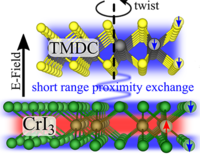
Proximity effects in two-dimensional heterostructures allow to transform nonmagnetic materials into synthetic magnets that do not involve magnetic ions. Based on density functional theory calculations, the present study predicts a sizeable proximity exchange interactions, induced by ferromagnetic CrI3, in transition metal dichalcogenides. Remarkably, the exchange coupling depends qualitatively on the twist angle, while being also tunable by an electric field. The authors establish the short-range character of the proximity effect and make specific predictions for the excitonic level splittings, due to the induced exchange coupling.
[Phys. Rev. B 100, 085128] Published Fri Aug 16, 2019
22 Aug 09:19
by Kenta Owada, Kosuke Nakayama, Ryuji Tsubono, Koshin Shigekawa, Katsuaki Sugawara, Takashi Takahashi, and Takafumi Sato
Author(s): Kenta Owada, Kosuke Nakayama, Ryuji Tsubono, Koshin Shigekawa, Katsuaki Sugawara, Takashi Takahashi, and Takafumi Sato
We have performed angle-resolved photoemission spectroscopy on a heterostructure consisting of topological insulator Bi2Te3 and iron chalcogenide FeTe fabricated on SrTiO3 substrate by molecular-beam-epitaxy technique. This system was recently found to show the superconductivity albeit nonsupercondu...
[Phys. Rev. B 100, 064518] Published Wed Aug 21, 2019
16 Aug 09:56
by J. J. Esteve-Paredes, Sahar Pakdel, and J. J. Palacios
Author(s): J. J. Esteve-Paredes, Sahar Pakdel, and J. J. Palacios
We predict that long-lived excitons with very large binding energies can also exist in a single or few layers of monochalcogenides such as GaSe. Our theoretical study shows that excitons confined by a radial local strain field are unable to recombine despite electrons and holes coexisting in space. ...
[Phys. Rev. Lett. 123, 077402] Published Wed Aug 14, 2019
16 Aug 09:54
by Doru Sticlet and Cristian Morari
Author(s): Doru Sticlet and Cristian Morari
Recent experimental studies have found that magnetic impurities deposited on superconducting monolayer NbSe2 generate coupled Yu-Shiba-Rusinov bound states. Here we consider ferromagnetic chains of impurities which induce a Yu-Shiba-Rusinov band and harbor Majorana bound states at the chain edges. W...
[Phys. Rev. B 100, 075420] Published Wed Aug 14, 2019
14 Aug 09:38
by H. Pfau, S. D. Chen, M. Yi, M. Hashimoto, C. R. Rotundu, J. C. Palmstrom, T. Chen, P.-C. Dai, J. Straquadine, A. Hristov, R. J. Birgeneau, I. R. Fisher, D. Lu, and Z.-X. Shen
Author(s): H. Pfau, S. D. Chen, M. Yi, M. Hashimoto, C. R. Rotundu, J. C. Palmstrom, T. Chen, P.-C. Dai, J. Straquadine, A. Hristov, R. J. Birgeneau, I. R. Fisher, D. Lu, and Z.-X. Shen
The momentum dependence of the nematic order parameter is an important ingredient in the microscopic description of iron-based high-temperature superconductors. While recent reports on FeSe indicate that the nematic order parameter changes sign between electron and hole bands, detailed knowledge is ...
[Phys. Rev. Lett. 123, 066402] Published Wed Aug 07, 2019
14 Aug 09:29
by Katsuaki Sugawara, Yuki Nakata, Kazuki Fujii, Kosuke Nakayama, Seigo Souma, Takashi Takahashi, and Takafumi Sato
Author(s): Katsuaki Sugawara, Yuki Nakata, Kazuki Fujii, Kosuke Nakayama, Seigo Souma, Takashi Takahashi, and Takafumi Sato
We investigated the electronic structure of monolayer VTe2 grown on bilayer graphene by angle-resolved photoemission spectroscopy (ARPES). We found that monolayer VTe2 takes the octahedral 1T structure in contrast to the monoclinic one in the bulk, as evidenced by the good agreement in the Fermi sur...
[Phys. Rev. B 99, 241404(R)] Published Tue Jun 18, 2019
14 Aug 08:28
by S. Leitherer, N. Papior, and M. Brandbyge
Author(s): S. Leitherer, N. Papior, and M. Brandbyge
Electronic current densities can reach extreme values in highly conducting nanostructures where constrictions limit current. For bias voltages on the 1 V scale, the highly nonequilibrium situation can influence the electronic density between atoms, leading to significant interatomic forces of the or...
[Phys. Rev. B 100, 035415] Published Fri Jul 12, 2019
14 Aug 08:11
by W. Jaskólski
Author(s): W. Jaskólski
We demonstrate that single-layer graphene exhibits the electronic structure of a bilayer when it is connected to two gated bilayers. The valence and conduction band continua as well as the energy gap characteristic of gated bilayer are induced in the single layer; the gap persists for distances sepa...
[Phys. Rev. B 100, 035436] Published Fri Jul 26, 2019
14 Aug 07:57
by Mikito Koshino and Young-Woo Son
Author(s): Mikito Koshino and Young-Woo Son
We study the in-plane acoustic phonons in twisted bilayer graphenes using the effective continuum approach. We calculate the phonon modes by solving the continuum equation of motion for infinitesimal vibration around the static relaxed state with triangular domain structure. We find that the moiré i...
[Phys. Rev. B 100, 075416] Published Mon Aug 12, 2019
09 Aug 13:23
by Alessandro David, Péter Rakyta, Andor Kormányos, and Guido Burkard
Author(s): Alessandro David, Péter Rakyta, Andor Kormányos, and Guido Burkard
We propose an interband tunneling picture to explain and predict the interlayer twist-angle dependence of the induced spin-orbit coupling in heterostructures of graphene and monolayer transition metal dichalcogenides (TMDCs). We obtain a compact analytic formula for the induced valley Zeeman and Ras...
[Phys. Rev. B 100, 085412] Published Thu Aug 08, 2019
09 Aug 13:15
by Huaqing Huang and Feng Liu
Author(s): Huaqing Huang and Feng Liu
We theoretically study the quantum spin Hall states in an Ammann-Beenker-type octagonal quasicrystal and a periodic snub-square crystal, both sharing the same basic building blocks. Although the bulk states show significant differences in localization and transport properties, the topological phases...
[Phys. Rev. B 100, 085119] Published Thu Aug 08, 2019
19 Jun 07:11
by Katsuaki Sugawara, Yuki Nakata, Kazuki Fujii, Kosuke Nakayama, Seigo Souma, Takashi Takahashi, and Takafumi Sato
Author(s): Katsuaki Sugawara, Yuki Nakata, Kazuki Fujii, Kosuke Nakayama, Seigo Souma, Takashi Takahashi, and Takafumi Sato
We investigated the electronic structure of monolayer VTe2 grown on bilayer graphene by angle-resolved photoemission spectroscopy (ARPES). We found that monolayer VTe2 takes the octahedral 1T structure in contrast to the monoclinic one in the bulk, as evidenced by the good agreement in the Fermi sur...
[Phys. Rev. B 99, 241404(R)] Published Tue Jun 18, 2019
18 Jun 07:21
by J. O. Island
Nature, Published online: 12 June 2019; doi:10.1038/s41586-019-1304-2
By enhancing the spin–orbit coupling in bilayer graphene using the proximity effect in a van der Waals heterostructure, band inversion occurs and an incompressible, gapped phase is produced.

06 Jun 12:19
by Heraclitos M. Lefcochilos-Fogelquist, Oliver R. Albertini, and Amy Y. Liu
Author(s): Heraclitos M. Lefcochilos-Fogelquist, Oliver R. Albertini, and Amy Y. Liu
Recent experiments have found that monolayer 1H−TaS2 grown on Au(111) lacks the charge density wave (CDW) instability exhibited by bulk 2H−TaS2. Additionally, angle-resolved photoemission spectroscopy measurements suggest that the monolayer becomes strongly electron doped by the substrate. While den...
[Phys. Rev. B 99, 174113] Published Thu May 30, 2019
06 Jun 12:14
by T. Wakamura, F. Reale, P. Palczynski, M. Q. Zhao, A. T. C. Johnson, S. Guéron, C. Mattevi, A. Ouerghi, and H. Bouchiat
Author(s): T. Wakamura, F. Reale, P. Palczynski, M. Q. Zhao, A. T. C. Johnson, S. Guéron, C. Mattevi, A. Ouerghi, and H. Bouchiat
We report a systematic study on strong enhancement of spin-orbit interaction (SOI) in graphene induced by transition-metal dichalcogenides (TMDs). Low-temperature magnetotoransport measurements of graphene proximitized to different TMDs (monolayer and bulk WSe2,WS2, and monolayer MoS2) all exhibit w...
[Phys. Rev. B 99, 245402] Published Tue Jun 04, 2019
27 May 10:22
by Luojun Du, Mengzhou Liao, Gui-Bin Liu, Qinqin Wang, Rong Yang, Dongxia Shi, Yugui Yao, and Guangyu Zhang
Author(s): Luojun Du, Mengzhou Liao, Gui-Bin Liu, Qinqin Wang, Rong Yang, Dongxia Shi, Yugui Yao, and Guangyu Zhang
We introduce a physical model to describe the influence of a perpendicular electric field on circular polarization (CP) and valley polarization (VP) in bilayer transition metal dichalcogenides. Our results uncover that electric-field-dependent CP and VP are quite distinct from each other. The depend...
[Phys. Rev. B 99, 195415] Published Fri May 10, 2019
27 May 10:20
by Oleg Yu. Vilkov, Eugene E. Krasovskii, Alexander V. Fedorov, Artem G. Rybkin, Alexander M. Shikin, Clemens Laubschat, Jorge Budagosky, Denis V. Vyalikh, and Dmitry Yu. Usachov
Author(s): Oleg Yu. Vilkov, Eugene E. Krasovskii, Alexander V. Fedorov, Artem G. Rybkin, Alexander M. Shikin, Clemens Laubschat, Jorge Budagosky, Denis V. Vyalikh, and Dmitry Yu. Usachov
Angle-resolved secondary electron emission spectra were analyzed for studying the electron transmission properties of graphene when it is tightly bound to a metallic substrate and when it is decoupled from the latter. As respective model systems, graphene/Ni(111) and graphene/Au/Ni(111) were conside...
[Phys. Rev. B 99, 195421] Published Mon May 13, 2019
27 May 09:54
by Anna Pertsova, R. Matthias Geilhufe, Martin Bremholm, and Alexander V. Balatsky
Author(s): Anna Pertsova, R. Matthias Geilhufe, Martin Bremholm, and Alexander V. Balatsky
We present the result of an ab initio search for new Dirac materials among inverse perovskites. Our investigation is focused on the less studied class of lanthanide antiperovskites containing heavy f-electron elements in the cation position. Some of the studied compounds have not yet been synthesize...
[Phys. Rev. B 99, 205126] Published Wed May 15, 2019
24 May 17:11
by Eun-Ha Shin, Hanchul Kim, and Yong-Sung Kim
Author(s): Eun-Ha Shin, Hanchul Kim, and Yong-Sung Kim
A triangular domain structure within hexagonal monolayer WS2 is found to be induced by edge polarization. Based on density-functional theory calculations, the local electrostatic potential over WS2 is investigated, and with the S-adatom and S2-addimer reconstructions at the W edges, the domains faci...
[Phys. Rev. B 99, 205427] Published Wed May 22, 2019
24 May 17:08
by Matthew D. Watson, Adam M. Beales, and Philip D. C. King
Author(s): Matthew D. Watson, Adam M. Beales, and Philip D. C. King
Resistivity measurements of TiSe2 typically show a pronounced and broad peak upon cooling, whose link with the much-studied charge density wave like transition that this material hosts has proved controversial. Here, the authors present quantitative simulations of resistivity using a simple model, but one whose parameters are strongly constrained from recent electronic structure measurements. It is shown that the prominent peak in resistivity, and its variation with doping, arise due to changing thermal carrier populations of a narrow-gap semiconductor, and that these are largely unrelated to the 200 K phase transition.

[Phys. Rev. B 99, 195142] Published Thu May 23, 2019
02 May 09:44
by Rahul Rao, Ahmad E. Islam, Simranjeet Singh, Rajiv Berry, Roland K. Kawakami, Benji Maruyama, and Jyoti Katoch
Author(s): Rahul Rao, Ahmad E. Islam, Simranjeet Singh, Rajiv Berry, Roland K. Kawakami, Benji Maruyama, and Jyoti Katoch
It is important to study the van der Waals interface in emerging vertical heterostructures based on layered two-dimensional (2D) materials. Being atomically thin, 2D materials are susceptible to significant strains as well as charge-transfer doping across the interfaces. Here we use Raman and photol...
[Phys. Rev. B 99, 195401] Published Wed May 01, 2019
29 Apr 14:35
by Line Jelver, Daniele Stradi, Kurt Stokbro, Thomas Olsen, and Karsten Wedel Jacobsen
Author(s): Line Jelver, Daniele Stradi, Kurt Stokbro, Thomas Olsen, and Karsten Wedel Jacobsen
Using density functional theory (DFT) calculations and the Greens's function formalism, we report the existence of magnetic edge states with a noncollinear spin texture present on different edges of the 1T′ phase of the three monolayer transition metal dichalcogenides (TMDs): MoS2, MoTe2, and WTe2. ...
[Phys. Rev. B 99, 155420] Published Wed Apr 24, 2019
29 Apr 14:20
by Hideaki Iwasawa, Pavel Dudin, Kyosuke Inui, Takahiko Masui, Timur K. Kim, Cephise Cacho, and Moritz Hoesch
Author(s): Hideaki Iwasawa, Pavel Dudin, Kyosuke Inui, Takahiko Masui, Timur K. Kim, Cephise Cacho, and Moritz Hoesch
Identifying the electron dynamics in CuO chains has been elusive in Y-Ba-Cu-O (YBCO) cuprate systems when using standard angle-resolved photoemission spectroscopy (ARPES); a cleaved sample exhibits areas terminated by both CuO chains or BaO layers, and the size of a typical beam results in ARPES sig...
[Phys. Rev. B 99, 140510(R)] Published Fri Apr 26, 2019
09 Apr 08:48
by C. W. Nicholson, M. Puppin, A. Lücke, U. Gerstmann, M. Krenz, W. G. Schmidt, L. Rettig, R. Ernstorfer, and M. Wolf
Author(s): C. W. Nicholson, M. Puppin, A. Lücke, U. Gerstmann, M. Krenz, W. G. Schmidt, L. Rettig, R. Ernstorfer, and M. Wolf
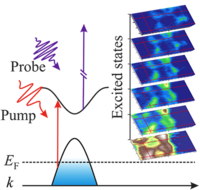
The electronic structure of a material can reveal a lot about its properties. Here, the authors map the electronic structure of the typically elusive excited states above the Fermi level throughout the full Brillouin zone in In/Si(111) nanowires. This allows for rigorous tests of current electronic structure calculation methods, and hints at a momentum-dependent excitonic coupling. In addition, extraction of the ultrafast population dynamics of these states and comparison with quasithermal modeling reveals a strongly nonequilibrium phonon distribution after photoexcitation.
[Phys. Rev. B 99, 155107] Published Wed Apr 03, 2019
14 Mar 15:48
by Akash Singh and Abhishek Kumar Singh
Author(s): Akash Singh and Abhishek Kumar Singh
Monolayer MoS2 is a promising two-dimensional material for electronic and optoelectronic devices. As-grown MoS2 is an n-type semiconductor, however, the origin of this unintentional doping is still not clear. Here, using hybrid density functional theory, we carried out an extensive study of the ofte...
[Phys. Rev. B 99, 121201(R)] Published Mon Mar 11, 2019
14 Mar 15:43
by Wouter Jolie, Timo Knispel, Niels Ehlen, Konstantin Nikonov, Carsten Busse, Alexander Grüneis, and Thomas Michely
Author(s): Wouter Jolie, Timo Knispel, Niels Ehlen, Konstantin Nikonov, Carsten Busse, Alexander Grüneis, and Thomas Michely
Scanning tunneling microscopy and spectroscopy are used to image the charge density wave at the surface of cleaved VSe2 and to probe its local density of states at 5 K. The main features in the spectrum are linked to the contributions of the p-like and d-like bands of VSe2 found in angle-resolved ph...
[Phys. Rev. B 99, 115417] Published Tue Mar 12, 2019
18 Feb 14:35
by J. J. P. Thompson, D. J. Leech, and M. Mucha-Kruczyński
Author(s): J. J. P. Thompson, D. J. Leech, and M. Mucha-Kruczyński
We study theoretically the electron current across a monolayer graphene/hexagonal boron nitride/bilayer graphene tunneling junction in an external magnetic field perpendicular to the layers. We show that change in effective tunneling barrier width for electrons on different graphene layers of bilaye...
[Phys. Rev. B 99, 085420] Published Fri Feb 15, 2019
14 Feb 11:43
by Ryo Noguchi
A weak topological insulator state in quasi-one-dimensional bismuth iodide
A weak topological insulator state in quasi-one-dimensional bismuth iodide, Published online: 11 February 2019; doi:10.1038/s41586-019-0927-7
Angle-resolved photoemission spectroscopy is used to characterize the surface states of bismuth iodide, providing experimental evidence of a weak topological insulator state that had previously been only theoretically predicted.

09 Feb 19:51
by M. A. Valbuena, P. Chudzinski, S. Pons, S. Conejeros, P. Alemany, E. Canadell, H. Berger, E. Frantzeskakis, J. Avila, M. C. Asensio, T. Giamarchi, and M. Grioni
Author(s): M. A. Valbuena, P. Chudzinski, S. Pons, S. Conejeros, P. Alemany, E. Canadell, H. Berger, E. Frantzeskakis, J. Avila, M. C. Asensio, T. Giamarchi, and M. Grioni
In materials with nearly commensurate band filling the electron liquid may spontaneously separate into components with distinct properties, yielding complex intra- and interunit cell ordering patterns and a reduced dimensionality. Polarization-dependent angle-resolved photoemission data with submicr...
[Phys. Rev. B 99, 075118] Published Fri Feb 08, 2019
28 Jan 15:05
by Karina A. Guerrero-Becerra, Francesco M. D. Pellegrino, and Marco Polini
Author(s): Karina A. Guerrero-Becerra, Francesco M. D. Pellegrino, and Marco Polini
We propose a protocol to identify spatial hallmarks of viscous electron flow in graphene and other two-dimensional viscous electron fluids. We predict that the profile of the magnetic field generated by hydrodynamic electron currents flowing in confined geometries displays unambiguous features linke...
[Phys. Rev. B 99, 041407(R)] Published Mon Jan 28, 2019

