23 Oct 10:07
by C. J. Sayers, H. Hedayat, A. Ceraso, F. Museur, M. Cattelan, L. S. Hart, L. S. Farrar, S. Dal Conte, G. Cerullo, C. Dallera, E. Da Como, and E. Carpene
Author(s): C. J. Sayers, H. Hedayat, A. Ceraso, F. Museur, M. Cattelan, L. S. Hart, L. S. Farrar, S. Dal Conte, G. Cerullo, C. Dallera, E. Da Como, and E. Carpene
1T−TaSe2 is host to coexisting strongly correlated phases including charge density waves (CDWs) and an unusual Mott transition at low temperature. Here, we investigate coherent phonon oscillations in 1T−TaSe2 using a combination of time- and angle-resolved photoemission spectroscopy (TR-ARPES) and t...
[Phys. Rev. B 102, 161105(R)] Published Thu Oct 08, 2020
23 Oct 08:21
by Zuowei Liang, Aiyun Luo, Mengzhu Shi, Qiang Zhang, Simin Nie, J. J. Ying, J.-F. He, Tao Wu, Zhijun Wang, Gang Xu, Zhenyu Wang, and X.-H. Chen
Author(s): Zuowei Liang, Aiyun Luo, Mengzhu Shi, Qiang Zhang, Simin Nie, J. J. Ying, J.-F. He, Tao Wu, Zhijun Wang, Gang Xu, Zhenyu Wang, and X.-H. Chen
Nontrivial band topology combined with magnetic order can lead to rich emergent phenomena, including quantized anomalous Hall effect and axion insulator state. Here we use scanning tunneling microscopy to image the surface Dirac fermions of the newly discovered magnetic topological insulators MnBi2T...
[Phys. Rev. B 102, 161115(R)] Published Mon Oct 19, 2020
04 Oct 14:17
by Antonio Rossi, Giacomo Resta, Seng Huat Lee, Ronald Dean Redwing, Chris Jozwiak, Aaron Bostwick, Eli Rotenberg, Sergey Y. Savrasov, and Inna M. Vishik
Author(s): Antonio Rossi, Giacomo Resta, Seng Huat Lee, Ronald Dean Redwing, Chris Jozwiak, Aaron Bostwick, Eli Rotenberg, Sergey Y. Savrasov, and Inna M. Vishik
WTe2 is a multifunctional quantum material exhibiting numerous emergent phases in which tuning of the carrier density plays an important role. Here, we demonstrate two nonmonotonic changes in the electronic structure of WTe2 upon in situ electron doping. The first phase transition is interpreted in ...
[Phys. Rev. B 102, 121110(R)] Published Wed Sep 30, 2020
25 Sep 09:15
by Nicolas Gauthier, Jonathan A. Sobota, Makoto Hashimoto, Heike Pfau, Dong-Hui Lu, Eric D. Bauer, Filip Ronning, Patrick S. Kirchmann, and Zhi-Xun Shen
Author(s): Nicolas Gauthier, Jonathan A. Sobota, Makoto Hashimoto, Heike Pfau, Dong-Hui Lu, Eric D. Bauer, Filip Ronning, Patrick S. Kirchmann, and Zhi-Xun Shen
Confinement of electronic wave functions is a well-studied phenomenon in nanoscale structures, such as quantum dots and thin films. These structures are typically grown to specific dimensions under controlled conditions. Here, in contrast, the authors observe quantum-well states, the spectral signature of confinement, in fractured single crystals. This result shows that thin film like structures can be obtained by fracturing hard crystals. Furthermore, the observed wave-function confinement provides insights about the three-dimensional electronic structure of the heavy-fermion material CeCoIn5.
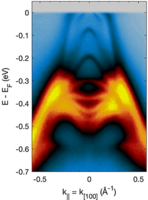
[Phys. Rev. B 102, 125111] Published Tue Sep 08, 2020
25 Sep 08:57
by R. Wallauer, P. Marauhn, J. Reimann, S. Zoerb, F. Kraus, J. Güdde, M. Rohlfing, and U. Höfer
Author(s): R. Wallauer, P. Marauhn, J. Reimann, S. Zoerb, F. Kraus, J. Güdde, M. Rohlfing, and U. Höfer
How fast is the charge transfer between two layers of transition metal dichalcogenides and where does it take place in momentum space? Two-photon photoemission using high-harmonic probe pulses can answer this question, as the authors demonstrate here for the topmost layers of MoS2. By tuning pump pulses below the topmost-layer gap, they excite electrons in deeper layers and probe only the topmost layer. GW-based tight-binding calculations support the experimental findings and explain why the electron transfer takes place at Σ¯.
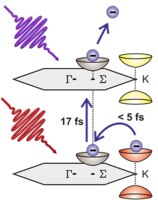
[Phys. Rev. B 102, 125417] Published Fri Sep 11, 2020
25 Sep 08:38
by Zheyu Lu, Stephen Carr, Daniel T. Larson, and Efthimios Kaxiras
Author(s): Zheyu Lu, Stephen Carr, Daniel T. Larson, and Efthimios Kaxiras
Intercalation of lithium atoms between layers of two-dimensional (2D) materials can alter their atomic and electronic structure. We investigate effects of Li intercalation in twisted bilayers of the transition metal dichalcogenide MoS2 through first-principles calculations, tight-binding parametriza...
[Phys. Rev. B 102, 125424] Published Mon Sep 21, 2020
25 Sep 08:26
by J. Krsnik, V. N. Strocov, N. Nagaosa, O. S. Barišić, Z. Rukelj, S. M. Yakubenya, and A. S. Mishchenko
Author(s): J. Krsnik, V. N. Strocov, N. Nagaosa, O. S. Barišić, Z. Rukelj, S. M. Yakubenya, and A. S. Mishchenko
Numerous angle-resolved photoemission spectroscopy (ARPES) studies of a wide class of low-density metallic systems, ranging from doped transition metal oxides to quasi-two-dimensional interfaces between insulators, exhibit phonon sidebands below the quasiparticle peak as a unique hallmark of polaron...
[Phys. Rev. B 102, 121108(R)] Published Tue Sep 22, 2020
25 Sep 08:22
by Guannan Chen, Sean T. Howard, Aniceto B. Maghirang, III, Kien Nguyen Cong, Rovi Angelo B. Villaos, Liang-Ying Feng, Kehan Cai, Somesh C. Ganguli, Waclaw Swiech, Emilia Morosan, Ivan I. Oleynik, Feng-Chuan Chuang, Hsin Lin, and Vidya Madhavan
Author(s): Guannan Chen, Sean T. Howard, Aniceto B. Maghirang, III, Kien Nguyen Cong, Rovi Angelo B. Villaos, Liang-Ying Feng, Kehan Cai, Somesh C. Ganguli, Waclaw Swiech, Emilia Morosan, Ivan I. Oleynik, Feng-Chuan Chuang, Hsin Lin, and Vidya Madhavan
Monolayer films of transition metal dichalcogenides can have very different electronic and structural properties compared to their bulk counterparts. Here, the authors stabilize different structural phases of VSe2 monolayer and bilayer films and study the effects on the electronic properties, charge density wave state, and magnetic properties, using a combination of techniques including scanning tunneling microscopy and first-principles calculations. They find that a new distorted 1T phase can be stabilized in the films that is not found in the bulk compound.

[Phys. Rev. B 102, 115149] Published Wed Sep 23, 2020
10 Jul 12:15
by Youngju Park, Bheema Lingam Chittari, and Jeil Jung
Author(s): Youngju Park, Bheema Lingam Chittari, and Jeil Jung
We investigate the band structure of twisted monolayer-bilayer graphene (tMBG) trilayers, or twisted graphene on bilayer graphene, as a function of twist angles and perpendicular electric fields in search of optimal conditions for achieving isolated nearly flat bands. Narrow bandwidths comparable to...
[Phys. Rev. B 102, 035411] Published Wed Jul 08, 2020
10 Jul 12:11
by Pavel Valencia-Acuna, Peymon Zereshki, Mohammad Mahdi Tavakoli, Ji-Hoon Park, Jing Kong, and Hui Zhao
Author(s): Pavel Valencia-Acuna, Peymon Zereshki, Mohammad Mahdi Tavakoli, Ji-Hoon Park, Jing Kong, and Hui Zhao
We report three-pulse photodope-pump-probe measurements on photocarrier dynamics in semiconducting transition metal dichalcogenide monolayers of MoS2, WS2, MoSe2, and WSe2. The samples are fabricated by metal-organic chemical vapor deposition and mechanical exfoliation techniques and characterized b...
[Phys. Rev. B 102, 035414] Published Thu Jul 09, 2020
30 Jun 08:09
by Dmitry V. Chichinadze, Laura Classen, and Andrey V. Chubukov
Author(s): Dmitry V. Chichinadze, Laura Classen, and Andrey V. Chubukov
Twisted bilayer graphene displays insulating and superconducting phases caused by flattening of its energy band. In the superconducting dome near hole half-filling, the threefold lattice rotation symmetry is broken, and the superconductor is also a nematic. The authors argue that superconductivity can be properly described by a patch model near twelve Van Hove points and show that there is nearly equal attractive interaction in two different superconducting channels. They go on to explicitly demonstrate that when both orders develop, the superconducting state is also a nematic.
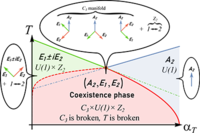
[Phys. Rev. B 101, 224513] Published Fri Jun 26, 2020
22 Jun 12:38
by Joseph A. Hagmann, Xiqiao Wang, Ranjit Kashid, Pradeep Namboodiri, Jonathan Wyrick, Scott W. Schmucker, M. D. Stewart, Jr., Richard M. Silver, and Curt A. Richter
Author(s): Joseph A. Hagmann, Xiqiao Wang, Ranjit Kashid, Pradeep Namboodiri, Jonathan Wyrick, Scott W. Schmucker, M. D. Stewart, Jr., Richard M. Silver, and Curt A. Richter
Scientists have long studied the physics of highly disordered conducting systems, seeking to understand the multitude of quantum phenomena that govern how electrons move through material systems. Recently, research into silicon-based quantum computing has made disordered conducting systems, such as ...
[Phys. Rev. B 101, 245419] Published Mon Jun 15, 2020
22 Jun 12:23
by Lukas Schwarz, Benedikt Fauseweh, and Dirk Manske
Author(s): Lukas Schwarz, Benedikt Fauseweh, and Dirk Manske
Higgs oscillations in nonequilibrium superconductors provide a unique tool to obtain information about the underlying order parameter. Several properties like the absolute value, existence of multiple gaps, and the symmetry of the order parameter can be encoded in the Higgs oscillation spectrum. Stu...
[Phys. Rev. B 101, 224510] Published Thu Jun 18, 2020
22 Jun 12:19
by Yulei Han, Junjie Zeng, Yafei Ren, Xinlong Dong, Wei Ren, and Zhenhua Qiao
Author(s): Yulei Han, Junjie Zeng, Yafei Ren, Xinlong Dong, Wei Ren, and Zhenhua Qiao
We numerically investigate the electronic transport properties between two mesoscopic graphene disks with a twist by employing the density functional theory coupled with the nonequilibrium Green's function technique. By attaching two graphene leads to upper and lower graphene layers separately, we e...
[Phys. Rev. B 101, 235432] Published Fri Jun 19, 2020
10 Jun 11:46
by Peng Rao and Maksym Serbyn
Author(s): Peng Rao and Maksym Serbyn
Multilayer graphene lattices allow for an additional tunability of the band structure by the strong perpendicular electric field. In particular, the emergence of the new multiple Dirac points in ABA stacked trilayer graphene subject to strong transverse electric fields was proposed theoretically and...
[Phys. Rev. B 101, 245411] Published Mon Jun 08, 2020
04 Jun 08:54
by Ruijuan Tian, Ruixiang Fei, Siqi Hu, Tianshu Li, Binjie Zheng, Yi Shi, Jianlin Zhao, Lijun Zhang, Xuetao Gan, and Xiaomu Wang
Author(s): Ruijuan Tian, Ruixiang Fei, Siqi Hu, Tianshu Li, Binjie Zheng, Yi Shi, Jianlin Zhao, Lijun Zhang, Xuetao Gan, and Xiaomu Wang
We report the full sequence of excitonic states in monolayer and few-layer black phosphorus (BP). High-quality BP samples are acquired by treating the silicon oxide substrate with a self-assembled monolayer hydrophobic molecule, which facilitates the access to their ground and higher-lying states of...
[Phys. Rev. B 101, 235407] Published Wed Jun 03, 2020
03 Jun 10:18
by Hongxia Hao, Antoine Georges, Andrew J. Millis, Brenda Rubenstein, Qiang Han, and Hao Shi
Author(s): Hongxia Hao, Antoine Georges, Andrew J. Millis, Brenda Rubenstein, Qiang Han, and Hao Shi
Layered perovskite ruthenium oxides exhibit a striking series of metal-insulator and magnetic-nonmagnetic phase transitions easily tuned by temperature, pressure, epitaxy, and nonlinear drive. In this work, we combine results from two complementary state-of-the-art many-body methods, auxiliary field...
[Phys. Rev. B 101, 235110] Published Tue Jun 02, 2020
03 Jun 10:18
by Daniel Shaffer, Jian Kang, F. J. Burnell, and Rafael M. Fernandes
Author(s): Daniel Shaffer, Jian Kang, F. J. Burnell, and Rafael M. Fernandes
We present a microscopic calculation of the phase diagram of the Ising superconductor NbSe2 in the presence of both in-plane magnetic field and Rashba spin-orbit coupling (SOC). Repulsive interactions lead to two distinct instabilities, in singlet and triplet interaction channels. While we recover t...
[Phys. Rev. B 101, 224503] Published Tue Jun 02, 2020
02 Jun 13:24
by Ankang Liu and Alexander M. Finkel'stein
Author(s): Ankang Liu and Alexander M. Finkel'stein
We discuss valley current, which is carried by quasiparticles in graphene. We show that the valley current arises owing to a peculiar term in the electron-phonon collision integral that mixes the scalar and vector gauge-field-like vertices in the electron-phonon interaction. This mixing makes collis...
[Phys. Rev. B 101, 241401(R)] Published Mon Jun 01, 2020
02 Jun 13:23
by J. G. Si, W. J. Lu, H. Y. Wu, H. Y. Lv, X. Liang, Q. J. Li, and Y. P. Sun
Author(s): J. G. Si, W. J. Lu, H. Y. Wu, H. Y. Lv, X. Liang, Q. J. Li, and Y. P. Sun
Transition-metal dichalcogenide 1T−VSe2 experimentally exhibits multiple charge density wave (CDW) orders, but its origin is still under debate. Using first-principles calculations, we investigate the origin of CDW orders in 1T−VSe2 and clarify the ground state of CDW in the freestanding monolayer. ...
[Phys. Rev. B 101, 235405] Published Mon Jun 01, 2020
27 May 11:17
by Sergej Krylow, Felipe Valencia Hernandez, Bernd Bauerhenne, and Martin E. Garcia
Author(s): Sergej Krylow, Felipe Valencia Hernandez, Bernd Bauerhenne, and Martin E. Garcia
The time evolution of the lattice structure in graphene after ultrashort laser excitation results in a complex dynamics of electrons and ions. In particular, a femtosecond laser pulse heats up the electrons, which then couple strongly to particular optical phonon modes, called SCOPs (strongly couple...
[Phys. Rev. B 101, 205428] Published Tue May 26, 2020
27 May 11:01
by Ryan Muzzio, Alfred J. H. Jones, Davide Curcio, Deepnarayan Biswas, Jill A. Miwa, Philip Hofmann, Kenji Watanabe, Takashi Taniguchi, Simranjeet Singh, Chris Jozwiak, Eli Rotenberg, Aaron Bostwick, Roland J. Koch, Søren Ulstrup, and Jyoti Katoch
Author(s): Ryan Muzzio, Alfred J. H. Jones, Davide Curcio, Deepnarayan Biswas, Jill A. Miwa, Philip Hofmann, Kenji Watanabe, Takashi Taniguchi, Simranjeet Singh, Chris Jozwiak, Eli Rotenberg, Aaron Bostwick, Roland J. Koch, Søren Ulstrup, and Jyoti Katoch
Integrating the carrier tunability of a functional two-dimensional material electronic device with a direct probe of energy- and momentum-resolved electronic excitations is essential to gain insights on how many-body interactions are influenced during device operation. Here, we use microfocused angl...
[Phys. Rev. B 101, 201409(R)] Published Tue May 26, 2020
26 May 12:34
by Matthew D. Watson, Igor Marković, Federico Mazzola, Akhil Rajan, Edgar A. Morales, David M. Burn, Thorsten Hesjedal, Gerrit van der Laan, Saumya Mukherjee, Timur K. Kim, Chiara Bigi, Ivana Vobornik, Monica Ciomaga Hatnean, Geetha Balakrishnan, and Philip D. C. King
Author(s): Matthew D. Watson, Igor Marković, Federico Mazzola, Akhil Rajan, Edgar A. Morales, David M. Burn, Thorsten Hesjedal, Gerrit van der Laan, Saumya Mukherjee, Timur K. Kim, Chiara Bigi, Ivana Vobornik, Monica Ciomaga Hatnean, Geetha Balakrishnan, and Philip D. C. King
We investigate the temperature-dependent electronic structure of the van der Waals ferromagnet, CrGeTe3. Using angle-resolved photoemission spectroscopy, we identify atomic- and orbital-specific band shifts upon cooling through TC. From these, together with x-ray absorption spectroscopy and x-ray ma...
[Phys. Rev. B 101, 205125] Published Mon May 18, 2020
26 May 12:32
by Fang Liu, Qiuyang Li, and X.-Y. Zhu
Author(s): Fang Liu, Qiuyang Li, and X.-Y. Zhu
Photoinduced charge separation in transition-metal dichalcogenide heterobilayers is being explored for moiré excitons, spin-valley polarization, and quantum phases of excitons/electrons. While different momentum points can be critically involved in charge separation dynamics, little is known directl...
[Phys. Rev. B 101, 201405(R)] Published Mon May 18, 2020
14 May 09:46
by Qiucen Wu, Zhongjie Wang, Yucheng Guo, Fang Yang, and Chunlei Gao
Author(s): Qiucen Wu, Zhongjie Wang, Yucheng Guo, Fang Yang, and Chunlei Gao
Charge density waves in transition metal dichalcogenides have been intensively studied for their close correlation with Mott insulator, charge-transfer insulator, and superconductor. VTe2 monolayer recently comes into sight because of its prominent electron correlations and the mysterious origin of ...
[Phys. Rev. B 101, 205105] Published Mon May 04, 2020
14 May 09:43
by T. Guillet, C. Zucchetti, A. Marchionni, A. Hallal, P. Biagioni, C. Vergnaud, A. Marty, H. Okuno, A. Masseboeuf, M. Finazzi, F. Ciccacci, M. Chshiev, F. Bottegoni, and M. Jamet
Author(s): T. Guillet, C. Zucchetti, A. Marchionni, A. Hallal, P. Biagioni, C. Vergnaud, A. Marty, H. Okuno, A. Masseboeuf, M. Finazzi, F. Ciccacci, M. Chshiev, F. Bottegoni, and M. Jamet
Topological insulators (TIs) hold great promise for new spin-related phenomena and applications thanks to the spin texture of their surface states. However, a versatile platform allowing for the exploitation of these assets is still lacking due to the difficult integration of these materials with th...
[Phys. Rev. B 101, 184406] Published Tue May 05, 2020
14 May 09:41
by Jing Li, Han-Bing Leng, Hailong Fu, Kenji Watanabe, Takashi Taniguchi, Xin Liu, Chao-Xing Liu, and Jun Zhu
Author(s): Jing Li, Han-Bing Leng, Hailong Fu, Kenji Watanabe, Takashi Taniguchi, Xin Liu, Chao-Xing Liu, and Jun Zhu
We report on Andreev reflections at clean NbSe2-bilayer graphene junctions. The high transparency of the junction, which manifests as a large conductance enhancement of up to 1.8, enables us to see clear evidence of a proximity-induced superconducting gap in bilayer graphene and two Andreev reflecti...
[Phys. Rev. B 101, 195405] Published Tue May 05, 2020
14 May 09:41
by Afsal Kareekunnan, Manoharan Muruganathan, and Hiroshi Mizuta
Author(s): Afsal Kareekunnan, Manoharan Muruganathan, and Hiroshi Mizuta
Berry curvature, which arises from the asymmetry in a system, is a paramount physical property that results in interesting phenomena such as valley Hall effect. There have been several experimental observations of valley Hall effect in hBN encapsulated bilayer graphene systems as well as hBN/single-...
[Phys. Rev. B 101, 195406] Published Tue May 05, 2020
13 May 10:17
by Yuehua Su and Chao Zhang
Author(s): Yuehua Su and Chao Zhang
Angle-resolved photoemission spectroscopy (ARPES) is one powerful experimental technique to study the electronic structure of materials. As many electron materials show unusual many-body correlations, the technique to detect directly these many-body correlations will play important roles in the stud...
[Phys. Rev. B 101, 205110] Published Thu May 07, 2020
04 May 10:11
by Pino D'Amico, Marco Gibertini, Deborah Prezzi, Daniele Varsano, Andrea Ferretti, Nicola Marzari, and Elisa Molinari
Author(s): Pino D'Amico, Marco Gibertini, Deborah Prezzi, Daniele Varsano, Andrea Ferretti, Nicola Marzari, and Elisa Molinari
Using accurate first-principles calculations based on many-body perturbation theory, we predict that two-dimensional MoS2 hosts edge excitons with universal character, intrinsic to the existence of edges and lying well below the onset of bulk features. These excitons are largely insensitive to edge ...
[Phys. Rev. B 101, 161410(R)] Published Wed Apr 29, 2020

