Chemistry of Materials
DOI: 10.1021/acs.chemmater.6b05365

A room-temperature perovskite material yielding a power conversion efficiency of 18.1% (stabilized at 17.7%) is demonstrated by judicious selection of cations. Both cesium and methylammonium are necessary for room-temperature formamidinium-based perovskite to obtain the photoactive crystalline perovskite phase and high-quality crystals. This room-temperature-made perovskite material shows great potential for low-cost, large-scale manufacturing such as roll-to-roll processing.
Photoinduced charge selective carrier extraction by linearly increasing voltage technique allows straightforward assessment of charge transport properties within planar and mesostructured perovskite solar cells with respect to light intensity and signal delay time. Charge sensitive device architecture is realized through implementation of insulating layer between the anode or cathode to prevent extraction of unwanted type of carriers. Resulting behavior of comparatively efficient mesoporous and planar solar cells exhibits well balanced charge transport with slight dependence of charge mobility on applied laser pulse fluence, for given pulse delay times. Very similar charge carrier mobilities are present within mesoporous devices, whereas holes trail approximately half an order of magnitude behind electrons in planar structured specimens. Moreover, dispersive transport is identified in the electron selective devices with titanium oxide electron transporter, suggesting considerable presence of trapping states at the perovskite interface, whereas no such behavior characterizes planar samples. Variation in delay time between laser pulse and extraction ramp only affects initial charge concentration present within the device, while transient outlay remains unchanged, indicating absence of film charging effect.

Charge selective extraction of photogenerated carriers by linearly increasing voltage is used to characterize planar and mesostructured perovskite solar cells. Inclusion of insulating layer into device structure prevents collection of unwanted carriers at corresponding electrode, provides valuable insight into charge transfer properties and pinpoints critical part of device responsible for trapping disorders.
Organometal trihalide perovskite solar cells (PSCs) have garnered recent interest in the scientific community. In the past few years, they have achieved power conversion efficiencies comparable to traditional commercial solar cells (e.g., crystalline Si, CuInGaSe and CdTe) due to their low-cost of production via solution-processed fabrication techniques. However, the stability of PSCs must be addressed before their commercialization is viable. Among various kinds of PSCs, carbon-based PSCs without hole transport materials (C-PSCs) seem to be the most promising for addressing the stability issue because carbon materials are stable, inert to ion migration (which originates from perovskite and metal electrodes), and inherently water-resistant. Despite the significant development of C-PSCs since they were first reported in 2013, some pending issues still need to be addressed to increase their commercial competitiveness. Herein, recent developments in C-PSCs, including (1) device structure and working principles, (2) categorical progress of and comparison between meso C-PSCs, embedment C-PSCs and paintable PSCs, are reviewed. Promising research directions are then suggested (e.g., materials, interfaces, structure, stability measurement and scaling-up of production) to further improve and promote the commercialization of C-PSCs.

Carbon-based perovskite solar cells without hole-transport materials (C-PSCs) are widely recognized to be the front runner to the market because of their obviously higher stability among various PSCs. The recent progress of C-PSCs is reviewed and their unique features are highlighted. Furthermore, some promising strategies are suggested to further promote the commercialization of C-PSCs.

A series of metal acetylacetonates produced by a full low-temperature (below 100 °C) process are successfully employed to obtain both “multistable” and high-performance planar-inverted perovskite solar cells. All the three kinds of champion cells in small area exhibit over 18% in conversion-efficiency with negligible hysteresis, along with a conversion efficiency above 16% for planar PSCs in an aperture area of over 1 cm2.

Metal halide perovskite thin films can be crystallized via a broad range of solution-based routes. However, the quality of the final films is strongly dependent upon small changes in solution composition and processing parameters. Here, this study demonstrates that a fractional substitution of PbCl2 with PbI2 in the 3CH3NH3I:PbCl2 mixed-halide starting solution has a profound influence upon the ensuing thin-film crystallization. The presence of PbI2 in the precursor induces a uniform distribution of regular quadrilateral-shaped CH3NH3PbI3 perovskite crystals in as-cast films, which subsequently grow to form pinhole-free perovskite films with highly crystalline domains. With this new formulation of 3CH3NH3I:0.98PbCl2:0.02PbI2, this study achieves a 19.1% current–voltage measured power conversion efficiency and a 17.2% stabilized power output in regular planar heterojunction solar cells.

A fractional substitution of PbI2 in the mixed-halide precursor (3MAI:PbCl2) has a profound impact upon the crystallization process and on the as crystallized film morphology and electronic properties. The “structurally improved” film delivers a J–V measured power conversion efficiency of 19.1%.
 Open Access
   This article is licensed under a Creative Commons Attribution 3.0 Unported Licence.
Organic–inorganic hybrid halide perovskites (e.g., MAPbI3) have recently emerged as novel active materials for photovoltaic applications with power conversion efficiency over 22%. Conventional perovskite solar cells (PSCs); however, suffer the issue that lead is toxic to the environment and organisms for a long time and is hard to excrete from the body. Therefore, it is imperative to find environmentally-friendly metal ions to replace lead for the further development of PSCs. Previous work has demonstrated that Sn, Ge, Cu, Bi, and Sb ions could be used as alternative ions in perovskite configurations to form a new environmentally-friendly lead-free perovskite structure. Here, we review recent progress on lead-free PSCs in terms of the theoretical insight and experimental explorations of the crystal structure of lead-free perovskite, thin film deposition, and device performance. We also discuss the importance of obtaining further understanding of the fundamental properties of lead-free hybrid perovskites, especially those related to photophysics.

Recent progress on lead-free perovskite solar cells (PSCs) in terms of the theoretical insight and experimental explorations of the crystal structure of lead-free perovskites, thin-film deposition, and device performance is reviewed. The importance of understanding the fundamental properties of lead-free hybrid perovskites is discussed. Greater effort is needed to explore high-performance lead-free PSCs.

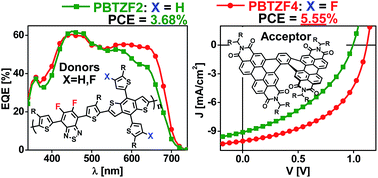
Using a “multifluorination” strategy, ambipolar donor–acceptor conjugated polymer with hole and electron mobility (μh and μe) up to 3.94 and 3.50 cm2 V−1 s−1, respectively, and unipolar n-type donor–acceptor conjugated polymers with μe up to 4.97 cm2 V−1 s−1 is synthesized with isoindigo as acceptor units.
Recently, organic–inorganic hybrid perovskite materials have drawn great attention for their outstanding performance in high-efficiency solar cells. Successful synthesis has been realized either in solution-based chemical deposition or vapor deposition. However, conflicts have never ceased among quality control, growth rate, process complexity, and instrument requirement, which have limited their development toward real applications. In this work, the first electrochemical fabrication of perovskite toward high-efficiency and scalable perovskite solar cells (PSCs) is established. The morphology and crystallization of the CH3NH3PbI3 film can be effectively controlled by simply modulating a few physical parameters. A detailed study on its optoelectronic properties reveals significantly improved film quality and interfacial conditions. Aided by this, the total process does not require standard annealing, which greatly reduces the total growth time from hours to minutes. Up to now, an efficiency of 15.65% has been achieved in planar PSCs under 1 sun AM 1.5 condition, with small hysteresis and efficiency loss under longtime exposure to air. Moreover, high efficiency (10.45%) can be easily attained for large cells (2 cm2). This result will hopefully facilitate research for applicable high-efficiency PSCs and other multicomponent materials as well.

The first complete electrochemical fabrication of perovskite has been achieved for perovskite solar cells, with a total time two orders of magnitude less than other presented solution-based methods. High efficiency is realized with large area with efficiency loss of 0.7% from a total of over three weeks' exposure in air, aided by modulation of just a few physical parameters without additional treatments.
The booming development of organometal halide perovskites has prompted the exploration of morphology-engineering strategies to improve their performance in optoelectronic applications. However, the preparation of optoelectronic devices of perovskites with complex architectures and desirable properties is still highly challenging. Herein, novel CH3NH3PbI3 nanonets and nanobowl arrays are fabricated facilely by using monolayer colloidal crystal (MCC) templates on different substrates. Specifically, highly ordered CH3NH3PbI3 nanonets with high crystallinity are fabricated on a variety of flat substrates, whereas regular CH3NH3PbI3 nanobowl arrays are produced on a coarse substrate. The photodetection performance of the CH3NH3PbI3 nanonet-based photodetectors is significantly enhanced compared to the photodetectors based on conventional CH3NH3PbI3 compact films. Particularly, the nanonet photodetectors exhibit a high responsivity (10.33 A W−1 under 700 nm monochromatic light), which is six times higher than that for the compact CH3NH3PbI3 film devices, fast response speed, and good stability. Owing to the two-dimensional arrayed structure, the CH3NH3PbI3 nanonets exhibit an enhanced light harvesting ability and offer direct carrier transport pathways. Meanwhile, the MCC template brings about larger grain sizes with enhanced crystallinity. Furthermore, the perovskite nanonets can be formed on a flexible polyethylene terephthalate substrate for the fabrication of promising flexible nanonet photodetectors.

Highly ordered CH3NH3PbI3 nanonets with high crystallinity are fabricated on a variety of flat substrates through a facile nanosphere lithography approach. When used as a photodetector, the perovskite nanonet exhibits significantly enhanced photoresponsive performance owing to the unique net-like architecture that is beneficial to light harvesting and charge collection.
The control of solution-processed emitting layers in organic-based optoelectronic devices enables cost-effective processing and highly efficient properties. However, a solution-based protocol for emitter fabrication is highly complex, and the link between the device performance and internal nanoscale features as well as three associated fabricating parameters (e.g., the employed solvents, annealing temperatures, and molecular concentration) needs to be understood. Here, this study investigates the influence of the solution-processing parameters on the nanostructure–property relationship in light emitters that consist of iridium complexes doped in polymer. The boiling points and evaporation rates of the selected solvents govern the nanomorphology of molecular aggregation in the as-processed state, and the aggregation is either needle-like, spherical, or even a mixture of needles and spheres. Furthermore, a direct observation via in situ heating microscopy indicates that annealing of emitters containing a needle-type aggregation promotes the associated molecular transport, leading to a substantial reduction in the surface roughness. Consequently, a nearly threefold increase in the current efficiency of the device is induced. These findings have important implications for the tuning of the aggregation of iridium complexes for emitters used in the new evolution of high-performance organic-based optoelectronic devices.

It is shown that the control of nanomorphology in solution-processed emitters in organic light-emitting diodes enables cost-effective processing and highly efficient properties. The selection of solvents governs Ir(ppy)3 aggregation in the as-processed state, needles, spheres, or both. An in situ heating microscopy technique reveals annealing-driven improvement in the current efficiency of the devices.