Shared posts

16 Apr 06:45

F-Substituted oligothiophenes serve as nonfullerene acceptors in polymer solar cells with open-circuit voltages >1 V

J. Mater. Chem. A, 2018, 6,9368-9372
DOI: 10.1039/C8TA02781A, Communication
Tainan Duan, Maxime Babics, Akmaral Seitkhan, Yuliar Firdaus, Ru-Ze Liang, Federico Cruciani, Shengjian Liu, Sergei Lopatin, Pierre M. Beaujuge
F-Substituted oligothiophenes were designed and used as nonfullerene acceptors in BHJ solar cells. With low-bandgap polymer donors, the solar cell devices reach PCEs of up to 4.5% and open-circuit voltages >1 V.
The content of this RSS Feed (c) The Royal Society of Chemistry
14 Apr 08:21

Flexible Electronics: Mechanical Strain‐Tunable Microwave Magnetism in Flexible CuFe2O4 Epitaxial Thin Film for Wearable Sensors (Adv. Funct. Mater. 10/2018)

Advanced Functional Materials, Volume 28, Issue 10, March 7, 2018.
14 Apr 05:43

[ASAP] Enhancement in Open-Circuit Voltage in Organic Solar Cells by Using Ladder-Type Nonfullerene Acceptors

by Zhengxu Cai, Donglin Zhao, Valerii Sharapov, Mohammad A. Awais, Na Zhang, Wei Chen, Luping Yu

TOC Graphic

ACS Applied Materials & Interfaces
DOI: 10.1021/acsami.8b01308
14 Apr 05:42

Low-temperature and facile solution-processed two-dimensional TiS2 as an effective electron transport layer for UV-stable planar perovskite solar cells

J. Mater. Chem. A, 2018, 6,9132-9138
DOI: 10.1039/C8TA01143E, Paper
Guannan Yin, Huan Zhao, Jiangshan Feng, Jie Sun, Junqing Yan, Zhike Liu, Shenghuang Lin, Shengzhong (Frank) Liu
In this paper, it is demonstrated that two-dimensional TiS2 nanosheets can be applied as an effective ETL in planar PSCs for the first time.
The content of this RSS Feed (c) The Royal Society of Chemistry
13 Apr 03:21

Dopant-free hole transport materials based on alkyl-substituted indacenodithiophene for planar perovskite solar cells

J. Mater. Chem. C, 2018, 6,4706-4713
DOI: 10.1039/C8TC00385H, Paper
Xiaoyuan Liu, Ehsan Rezaee, Haiquan Shan, Jiaju Xu, Yin Zhang, Yaomiao Feng, Junfeng Dai, Zhi-Kuan Chen, Wei Huang, Zong-Xiang Xu
The IDTC6-TPA backbone enables a tight molecular arrangement stacked by [small pi]-[small pi] interactions (3.399 A), and the device fabricated using IDTC6-TPA shows superior PCE (15.43%) and higher stability compared with that of the HTM spiro-MeOTAD with dopant (17.1%).
The content of this RSS Feed (c) The Royal Society of Chemistry
13 Apr 03:21

Self-assembling epitaxial growth of a single crystalline CoFe2O4 nanopillar array via dual-target pulsed laser deposition

J. Mater. Chem. C, 2018, 6,4854-4860
DOI: 10.1039/C8TC00774H, Communication
Gaokuo Zhong, Feng An, Yugandhar Bitla, Jinbin Wang, Xiangli Zhong, Mao Ye, Yi Zhang, Wenpei Gao, Xiaoqing Pan, Shuhong Xie, Jiangyu Li
Magnetic nanopillars are promising for a variety of technological applications, though the template-free fabrication of magnetic nanopillar arrays with good crystallinity and uniform distribution remains a substantial challenge.
The content of this RSS Feed (c) The Royal Society of Chemistry
13 Apr 03:18

Designing a ternary photovoltaic cell for indoor light harvesting with a power conversion efficiency exceeding 20%

J. Mater. Chem. A, 2018, 6,8579-8585
DOI: 10.1039/C8TA01728J, Paper
Hang Yin, Johnny Ka Wai Ho, Sin Hang Cheung, Roger Jie Yan, Ka Lok Chiu, Xiaotao Hao, Shu Kong So
A PCDTBT:PC71BM solar cell adopted by a ternary strategy with PDTSTPD achieves an overall PCE of 20.8% under indoor illumination.
The content of this RSS Feed (c) The Royal Society of Chemistry
13 Apr 03:17

BODIPY-diketopyrrolopyrrole-porphyrin conjugate small molecules for use in bulk heterojunction solar cells

J. Mater. Chem. A, 2018, 6,8449-8461
DOI: 10.1039/C8TA01291A, Paper
Leo Bucher, Nicolas Desbois, Emmanuel N. Koukaras, Charles H. Devillers, Subhayan Biswas, Ganesh D. Sharma, Claude P. Gros
Two small molecules denoted as BD-pPor and BD-tPor composed of a central BODIPY core surrounded with two DPP and two porphyrin units have been designed and synthesized.
The content of this RSS Feed (c) The Royal Society of Chemistry
13 Apr 03:17

Direct observation of cation-exchange in liquid-to-solid phase transformation in FA1-xMAxPbI3 based perovskite solar cells

J. Mater. Chem. A, 2018, 6,9081-9088
DOI: 10.1039/C8TA01642A, Paper
Yue-Min Xie, Binbin Yu, Chunqing Ma, Xiuwen Xu, Yuanhang Cheng, Shuai Yuan, Zhao-Kui Wang, Hrisheekesh Thachoth Chandran, Chun-Sing Lee, Liang-Sheng Liao, Sai-Wing Tsang
Organic-cation-exchange in liquid-to-solid phase transformation in FA1-xMAxPbI3 based perovskite solar cells.
The content of this RSS Feed (c) The Royal Society of Chemistry
13 Apr 03:13

[ASAP] High-Performance Organic Photodetectors from a High-Bandgap Indacenodithiophene-Based p-Conjugated Donor–Acceptor Polymer

by Cindy Montenegro Benavides, Petri Murto, Christos L. Chochos, Vasilis G. Gregoriou, Apostolos Avgeropoulos, Xiaofeng Xu, Kim Bini, Anirudh Sharma, Mats R. Andersson, Oliver Schmidt, Christoph J. Brabec, Ergang Wang, Sandro F. Tedde

TOC Graphic

ACS Applied Materials & Interfaces
DOI: 10.1021/acsami.8b03824
13 Apr 03:12

[ASAP] Compliance-Free Multileveled Resistive Switching in a Transparent 2D Perovskite for Neuromorphic Computing

by Mohit Kumar, Hong-Sik Kim, Dae Young Park, Mun Seok Jeong, Joondong Kim

TOC Graphic

ACS Applied Materials & Interfaces
DOI: 10.1021/acsami.7b19406
13 Apr 03:10

[ASAP] Efficient Approach for Improving the Performance of Nonhalogenated Green Solvent-Processed Polymer Solar Cells via Ternary-Blend Strategy

by Kakaraparthi Kranthiraja, Um Kanta Aryal, Vijaya Gopalan Sree, Kumarasamy Gunasekar, Changyeon Lee, Minseok Kim, Bumjoon J. Kim, Myungkwan Song, Sung-Ho Jin

TOC Graphic

ACS Applied Materials & Interfaces
DOI: 10.1021/acsami.7b19548
13 Apr 03:09

[ASAP] Reconstructing Space- and Energy-Dependent Exciton Generation in Solution-Processed Inverted Organic Solar Cells

by Yuheng Wang, Yajie Zhang, Guanghao Lu, Xiaoshan Feng, Tong Xiao, Jing Xie, Xiaoyan Liu, Jiahui Ji, Zhixiang Wei, Laju Bu

TOC Graphic

ACS Applied Materials & Interfaces
DOI: 10.1021/acsami.7b14698
13 Apr 03:08

[ASAP] Buried MoOx/Ag Electrode Enables High-Efficiency Organic/Silicon Heterojunction Solar Cells with a High Fill Factor

by Zhouhui Xia, Peng Gao, Teng Sun, Haihua Wu, Yeshu Tan, Tao Song, Shuit-Tong Lee, Baoquan Sun

TOC Graphic

ACS Applied Materials & Interfaces
DOI: 10.1021/acsami.8b02403
10 Apr 02:19

Efficient triplet utilization in conventional solution-processed phosphorescent organic light emitting diodes using a thermal activated delayed fluorescence polymer as an assistant host

J. Mater. Chem. C, 2018, 6,4800-4806
DOI: 10.1039/C8TC00587G, Paper
Dianming Sun, Zhongjie Ren, Shouke Yan
A TADF polymer COPO is used as an assistant host material to improve the performance of Ir(mPPy)3-based solution-processed devices.
The content of this RSS Feed (c) The Royal Society of Chemistry
10 Apr 02:03

[ASAP] Interfacial Energy-Level Alignment for High-Performance All-Inorganic Perovskite CsPbBr3 Quantum Dot-Based Inverted Light-Emitting Diodes

by Alagesan Subramanian, Zhenghui Pan, Zhenbo Zhang, Imtiaz Ahmad, Jing Chen, Meinan Liu, Shuang Cheng, Yijun Xu, Jun Wu, Wei Lei, Qasim Khan, Yuegang Zhang

TOC Graphic

ACS Applied Materials & Interfaces
DOI: 10.1021/acsami.8b01684
10 Apr 02:03

[ASAP] Boosting Light Harvesting in Perovskite Solar Cells by Biomimetic Inverted Hemispherical Architectured Polymer Layer with High Haze Factor as an Antireflective Layer

by Dong Hyun Kim, Bhaskar Dudem, Jae Woong Jung, Jae Su Yu

TOC Graphic

ACS Applied Materials & Interfaces
DOI: 10.1021/acsami.8b02987
10 Apr 02:01

Fine-tuning the side-chains of non-fullerene small molecule acceptors to match with appropriate polymer donors

J. Mater. Chem. A, 2018, 6,8586-8594
DOI: 10.1039/C8TA00764K, Paper
Meijia Chang, Yunchuang Wang, Yuan-Qiu-Qiang Yi, Xin Ke, Xiangjian Wan, Chenxi Li, Yongsheng Chen
Side-chain engineering of donor and acceptor materials is an important topic in the field of organic photovoltaics.
The content of this RSS Feed (c) The Royal Society of Chemistry
10 Apr 01:57

Narrow-gap physical vapour deposition synthesis of ultrathin SnS1-xSex (0 [less-than-or-equal] x [less-than-or-equal] 1) two-dimensional alloys with unique polarized Raman spectra and high (opto)electronic properties

Nanoscale, 2018, 10,8787-8795
DOI: 10.1039/C8NR00856F, Paper
Wei Gao, Yongtao Li, Jianhua Guo, Muxun Ni, Ming Liao, Haojie Mo, Jingbo Li
An improved physical vapour deposition for achieving ultrathin SnS1-xSex alloyed nanosheets with unique anisotropic Raman characteristics and good (opto)electrical performance.
The content of this RSS Feed (c) The Royal Society of Chemistry
10 Apr 01:57

Effect of dihydronaphthyl-based C60 bisadduct as third component materials on the photovoltaic performance and charge carrier recombination of binary PBDB-T : ITIC polymer solar cells

Nanoscale, 2018, 10,8483-8495
DOI: 10.1039/C8NR01969J, Paper
Shengli Niu, Zhiyong Liu, Ning Wang
A dihydronaphthyl-based C60 bisadduct (NCBA) acceptor was introduced as a third component material to typical binary polymer solar cells (PSCs).
The content of this RSS Feed (c) The Royal Society of Chemistry
10 Apr 01:23

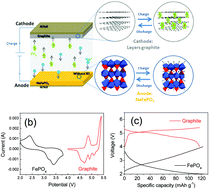
FePO4 as an anode material to obtain high-performance sodium-based dual-ion batteries

Chem. Commun., 2018, 54,4349-4352
DOI: 10.1039/C7CC09714J, Communication
Chao Li, Xiaohong Wang, Jiayu Li, Hongyu Wang
Herein, FePO4 was for the first time proposed to serve as an anode material (the sodium intercalation host), to obtain novel sodium-based dual-ion batteries.
The content of this RSS Feed (c) The Royal Society of Chemistry
10 Apr 01:21

Suppressing generation of iodine impurity via an amidine additive in perovskite solar cells

Chem. Commun., 2018, 54,4704-4707
DOI: 10.1039/C8CC02329H, Communication
Lin Hu, Tiefeng Liu, Lulu Sun, Sixing Xiong, Fei Qin, Xueshi Jiang, Youyu Jiang, Yinhua Zhou
An amidine additive (DBU) was introduced into the precursor to suppress the formation of iodine impurity for high-performance perovskite solar cells.
The content of this RSS Feed (c) The Royal Society of Chemistry
10 Apr 01:17

Light-induced lattice expansion leads to high-efficiency perovskite solar cells

by Tsai, H., Asadpour, R., Blancon, J.-C., Stoumpos, C. C., Durand, O., Strzalka, J. W., Chen, B., Verduzco, R., Ajayan, P. M., Tretiak, S., Even, J., Alam, M. A., Kanatzidis, M. G., Nie, W., Mohite, A. D.

Light-induced structural dynamics plays a vital role in the physical properties, device performance, and stability of hybrid perovskite–based optoelectronic devices. We report that continuous light illumination leads to a uniform lattice expansion in hybrid perovskite thin films, which is critical for obtaining high-efficiency photovoltaic devices. Correlated, in situ structural and device characterizations reveal that light-induced lattice expansion benefits the performances of a mixed-cation pure-halide planar device, boosting the power conversion efficiency from 18.5 to 20.5%. The lattice expansion leads to the relaxation of local lattice strain, which lowers the energetic barriers at the perovskite-contact interfaces, thus improving the open circuit voltage and fill factor. The light-induced lattice expansion did not compromise the stability of these high-efficiency photovoltaic devices under continuous operation at full-spectrum 1-sun (100 milliwatts per square centimeter) illumination for more than 1500 hours.

10 Apr 01:16

Origin of vertical orientation in two-dimensional metal halide perovskites and its effect on photovoltaic performance

by Alexander Z. Chen

Origin of vertical orientation in two-dimensional metal halide perovskites and its effect on photovoltaic performance

Origin of vertical orientation in two-dimensional metal halide perovskites and its effect on photovoltaic performance, Published online: 06 April 2018; doi:10.1038/s41467-018-03757-0

It is desirable to align the two-dimensional perovskite layers vertical to the electrodes to maximize device performance but the formation mechanism is unclear. Here Chen et al. reveal that the film formation starts at the liquid-air interface and is thus independent of the choice of substrates.
10 Apr 01:13

[ASAP] Extended Absorption Window and Improved Stability of Cesium-Based Triple-Cation Perovskite Solar Cells Passivated with Perfluorinated Organics

by K. M. Muhammed Salim, Teck Ming Koh, Damodaran Bahulayan, P. C. Harikesh, Nur Fadilah Jamaludin, Benny Febriansyah, Annalisa Bruno, Subodh Mhaisalkar, Nripan Mathews

TOC Graphic

ACS Energy Letters
DOI: 10.1021/acsenergylett.8b00328
10 Apr 01:12

[ASAP] Blade-Coated Hybrid Perovskite Solar Cells with Efficiency > 17%: An In Situ Investigation

by Yufei Zhong, Rahim Munir, Jianbo Li, Ming-Chun Tang, Muhammad R. Niazi, Detlef-M. Smilgies, Kui Zhao, Aram Amassian

TOC Graphic

ACS Energy Letters
DOI: 10.1021/acsenergylett.8b00428
10 Apr 01:07

[ASAP] Field-Assisted Exciton Dissociation in Highly Efficient PffBT4T-2OD:Fullerene Organic Solar Cells

by Andreas Weu, Thomas R. Hopper, Vincent Lami, Joshua A. Kreß, Artem A. Bakulin, Yana Vaynzof

TOC Graphic

Chemistry of Materials
DOI: 10.1021/acs.chemmater.8b00094
10 Apr 01:00

[ASAP] Disodium Benzodipyrrole Sulfonate as Neutral Hole-Transporting Materials for Perovskite Solar Cells

by Rui Shang, Zhongmin Zhou, Hiroki Nishioka, Henry Halim, Shunsuke Furukawa, Izuru Takei, Naoya Ninomiya, Eiichi Nakamura

TOC Graphic

Journal of the American Chemical Society
DOI: 10.1021/jacs.8b01783
10 Apr 00:58

[ASAP] Layered Halide Double Perovskites: Dimensional Reduction of Cs2AgBiBr6

by Bridget A. Connor, Linn Leppert, Matthew D. Smith, Jeffrey B. Neaton, Hemamala I. Karunadasa

TOC Graphic

Journal of the American Chemical Society
DOI: 10.1021/jacs.8b01543
10 Apr 00:48

Toward high-efficiency, hysteresis-less, stable perovskite solar cells: unusual doping of a hole-transporting material using a fluorine-containing hydrophobic Lewis acid

Energy Environ. Sci., 2018, 11,2035-2045
DOI: 10.1039/C8EE00036K, Paper
Junsheng Luo, Jianxing Xia, Hua Yang, Lingling Chen, Zhongquan Wan, Fei Han, Haseeb Ashraf Malik, Xuhui Zhu, Chunyang Jia
A fluorine-containing hydrophobic Lewis acid is employed as an effective dopant for PTAA to replace state-of-the-art Li-TFSI/t-BP in PSCs.
The content of this RSS Feed (c) The Royal Society of Chemistry