The journal Organic Electronics is proud to have sponsored the four “Best Poster Awards” at the Gordon Research Conference, Electronic Processes in Organic Materials in Lucca, Italy in June.
Ligang Yuan
Shared posts
10 Oct 01:04
High performance polymer solar cells employing a low-temperature solution-processed organic-inorganic hybrid electron transport layer

J. Mater. Chem. A, 2016, 4,16612-16618
DOI: 10.1039/C6TA06911H, Paper
DOI: 10.1039/C6TA06911H, Paper
Woosung Lee, Jae Woong Jung
The solution processed organic-inorganic hybrid electron transport layer (PEIE-LiQ) significantly improved the device performance of polymer solar cells.
The content of this RSS Feed (c) The Royal Society of Chemistry
The solution processed organic-inorganic hybrid electron transport layer (PEIE-LiQ) significantly improved the device performance of polymer solar cells.
The content of this RSS Feed (c) The Royal Society of Chemistry
08 Oct 12:42

Methylammonium lead iodide grain boundaries exhibit depth-dependent electrical properties

Energy Environ. Sci., 2016, 9,3642-3649
DOI: 10.1039/C6EE01889K, Communication
DOI: 10.1039/C6EE01889K, Communication
Gordon A. MacDonald, Mengjin Yang, Samuel Berweger, Jason P. Killgore, Pavel Kabos, Joseph J. Berry, Kai Zhu, Frank W. DelRio
In this communication, the nanoscale through-film and lateral photo-response and conductivity of large-grained methylammonium lead iodide (MAPbI3) thin films are studied.
The content of this RSS Feed (c) The Royal Society of Chemistry
In this communication, the nanoscale through-film and lateral photo-response and conductivity of large-grained methylammonium lead iodide (MAPbI3) thin films are studied.
The content of this RSS Feed (c) The Royal Society of Chemistry
Yongzhen Wu likes this
27 Sep 01:51
Photoinduced degradation of methylammonium lead triiodide perovskite semiconductors

J. Mater. Chem. A, 2016, 4,15896-15903
DOI: 10.1039/C6TA06497C, Paper
DOI: 10.1039/C6TA06497C, Paper
Xiaofeng Tang, Marco Brandl, Benjamin May, Ievgen Levchuk, Yi Hou, Moses Richter, Haiwei Chen, Shi Chen, Simon Kahmann, Andres Osvet, Florian Maier, Hans-Peter Steinruck, Rainer Hock, Gebhard J. Matt, Christoph J. Brabec
Photoinduced degradation mechanisms of CH3NH3PbI3 thin films under vacuum and in air are reported.
The content of this RSS Feed (c) The Royal Society of Chemistry
Photoinduced degradation mechanisms of CH3NH3PbI3 thin films under vacuum and in air are reported.
The content of this RSS Feed (c) The Royal Society of Chemistry
wangzhaowei likes this
27 Sep 01:50
Ambient air-processed mixed-ion perovskites for high-efficiency solar cells

J. Mater. Chem. A, 2016, 4,16536-16545
DOI: 10.1039/C6TA06912F, Paper
DOI: 10.1039/C6TA06912F, Paper
Kari Sveinbjornsson, Kerttu Aitola, Jinbao Zhang, Malin B. Johansson, Xiaoliang Zhang, Juan-Pablo Correa-Baena, Anders Hagfeldt, Gerrit Boschloo, Erik M. J. Johansson
A mixed-ion (FAPbI3)1-x(MAPbBr3)x perovskite solar cell was prepared under ambient conditions with an average efficiency of 17.6%.
The content of this RSS Feed (c) The Royal Society of Chemistry
A mixed-ion (FAPbI3)1-x(MAPbBr3)x perovskite solar cell was prepared under ambient conditions with an average efficiency of 17.6%.
The content of this RSS Feed (c) The Royal Society of Chemistry
wangzhaowei, xululu91 likes this
27 Sep 01:50
Enhancing the photovoltaic performance of planar heterojunction perovskite solar cells by doping the perovskite layer with alkali metal ions

J. Mater. Chem. A, 2016, 4,16546-16552
DOI: 10.1039/C6TA06851K, Paper
DOI: 10.1039/C6TA06851K, Paper
Jingjing Chang, Zhenhua Lin, Hai Zhu, Furkan Halis Isikgor, Qing-Hua Xu, Chunfu Zhang, Yue Hao, Jianyong Ouyang
Doping the perovskite layer with a small amount of alkali metal ions can enhance the photovoltaic efficiency of perovskite solar cells.
The content of this RSS Feed (c) The Royal Society of Chemistry
Doping the perovskite layer with a small amount of alkali metal ions can enhance the photovoltaic efficiency of perovskite solar cells.
The content of this RSS Feed (c) The Royal Society of Chemistry
traveler, wangzhaowei and 4 others like this
27 Sep 01:48
Enhanced electronic properties in CH3NH3PbI3via LiCl mixing for hole-conductor-free printable perovskite solar cells

J. Mater. Chem. A, 2016, 4,16731-16736
DOI: 10.1039/C6TA08021A, Paper
DOI: 10.1039/C6TA08021A, Paper
Yusong Sheng, Yue Hu, Anyi Mei, Pei Jiang, Xiaomeng Hou, Miao Duan, Li Hong, Yanjun Guan, Yaoguang Rong, Yuli Xiong, Hongwei Han
By mixing perovskite MAPbI3 (MA = CH3NH3+) with LiCl, an effective one-step drop-coating approach was developed to improve the performance of hole-conductor-free printable perovskite solar cells.
The content of this RSS Feed (c) The Royal Society of Chemistry
By mixing perovskite MAPbI3 (MA = CH3NH3+) with LiCl, an effective one-step drop-coating approach was developed to improve the performance of hole-conductor-free printable perovskite solar cells.
The content of this RSS Feed (c) The Royal Society of Chemistry
Lucy likes this
27 Sep 01:45
A novel one-step synthesized and dopant-free hole transport material for efficient and stable perovskite solar cells

J. Mater. Chem. A, 2016, 4,16330-16334
DOI: 10.1039/C6TA05254A, Communication
DOI: 10.1039/C6TA05254A, Communication
Xiaoming Zhao, Fei Zhang, Chenyi Yi, Dongqin Bi, Xiangdong Bi, Peng Wei, Jingshan Luo, Xicheng Liu, Shirong Wang, Xianggao Li, Shaik Mohammed Zakeeruddin, Michael Gratzel
A simple one-step synthesized hole transport material was developed for dopant-free perovskite solar cells with a PCE of 15.4%.
The content of this RSS Feed (c) The Royal Society of Chemistry
A simple one-step synthesized hole transport material was developed for dopant-free perovskite solar cells with a PCE of 15.4%.
The content of this RSS Feed (c) The Royal Society of Chemistry
27 Sep 00:41

New Organic Semiconducting Scaffolds by Supramolecular Preorganization: Dye Intercalation and Dye Oxidation and Reduction
by Lina Li, Yubao Zhao, Markus Antonietti, Menny Shalom
The assembly of melamine and 2,5-dihydroxy-1,4-benzoquinone results in new “sheet-like” supramolecular crystals that by controlled thermal condensation can be converted to photoactive materials at relativity low temperatures. The condensation temperature alters the materials properties from polymer-like to carbon materials alongside their morphology and elemental ratio. This new method opens the possibility for the synthesis of new organic, photoactive carbon–nitrogen based frameworks at low calcination temperatures with great simplicity. Photodegradation experiments of methylene blue reveal that the obtained materials can perform dye reduction photochemically with visible photons, while at the same time the photogenerated holes oxidize the dye toward small molecular fragments.

New photoactive materials with “sheet-like” morphology are synthesized at relativity low temperatures by controlled thermal condensation of supramolecular crystals. The condensation temperature alters the materials properties from polymer-like to carbon materials alongside their morphology and elemental ratio. This new method opens the possibility for the synthesis of new organic, photoactive carbon–nitrogen based frameworks.
Jiang Gong likes this
22 Sep 13:45
Fullerene-linked tetrabenzoporphyrins for solution-processed organic photovoltaics: flexible vs. rigid linkers

J. Mater. Chem. A, 2016, 4,15333-15342
DOI: 10.1039/C6TA06599F, Paper
DOI: 10.1039/C6TA06599F, Paper
Yuto Tamura, Daiki Kuzuhara, Mitsuharu Suzuki, Hironobu Hayashi, Naoki Aratani, Hiroko Yamada
A benzoporphyrin-C60 dyad with a flexible linker is superior to a rigid-linker counterpart as interlayer material in solution-processed p-i-n organic solar cells.
The content of this RSS Feed (c) The Royal Society of Chemistry
A benzoporphyrin-C60 dyad with a flexible linker is superior to a rigid-linker counterpart as interlayer material in solution-processed p-i-n organic solar cells.
The content of this RSS Feed (c) The Royal Society of Chemistry
22 Sep 00:52
Highly efficient CH3NH3PbI3-xClx mixed halide perovskite solar cells prepared by re-dissolution and crystal grain growth via spray coating

J. Mater. Chem. A, 2016, 4,17636-17642
DOI: 10.1039/C6TA06718B, Communication
DOI: 10.1039/C6TA06718B, Communication
Jin Hyuck Heo, Min Ho Lee, Min Hyeok Jang, Sang Hyuk Im
We fabricated highly efficient planar type CH3NH3PbI3-xClx (MAPbI3-xClx) mixed halide perovskite solar cells via spray coating with a controlled composition of the solvents.
The content of this RSS Feed (c) The Royal Society of Chemistry
We fabricated highly efficient planar type CH3NH3PbI3-xClx (MAPbI3-xClx) mixed halide perovskite solar cells via spray coating with a controlled composition of the solvents.
The content of this RSS Feed (c) The Royal Society of Chemistry
YXM likes this
22 Sep 00:46
Mg-doped TiO2 boosts the efficiency of planar perovskite solar cells to exceed 19%

J. Mater. Chem. A, 2016, 4,15383-15389
DOI: 10.1039/C6TA06879K, Paper
DOI: 10.1039/C6TA06879K, Paper
Huiyin Zhang, Jiangjian Shi, Xin Xu, Lifeng Zhu, Yanhong Luo, Dongmei Li, Qingbo Meng
Higher charge transport, collection and final efficiency of planar perovskite solar cells are achieved with a Mg-doped TiO2 compact layer.
The content of this RSS Feed (c) The Royal Society of Chemistry
Higher charge transport, collection and final efficiency of planar perovskite solar cells are achieved with a Mg-doped TiO2 compact layer.
The content of this RSS Feed (c) The Royal Society of Chemistry
22 Sep 00:43

Efficient vacuum deposited p-i-n and n-i-p perovskite solar cells employing doped charge transport layers

Energy Environ. Sci., 2016, 9,3456-3463
DOI: 10.1039/C6EE02100J, Paper
DOI: 10.1039/C6EE02100J, Paper
Cristina Momblona, Lidon Gil-Escrig, Enrico Bandiello, Eline M. Hutter, Michele Sessolo, Kay Lederer, Jan Blochwitz-Nimoth, Henk J. Bolink
The use of small molecular weight intrinsic and doped transport layers allows to obtain fully vacuum deposited, efficient perovskite solar cells.
The content of this RSS Feed (c) The Royal Society of Chemistry
The use of small molecular weight intrinsic and doped transport layers allows to obtain fully vacuum deposited, efficient perovskite solar cells.
The content of this RSS Feed (c) The Royal Society of Chemistry
zhouhuangshan, wangzhaowei and 5 others like this
20 Sep 03:13
The role of a few-layer TiOx surfactant: remarkably-enhanced succeeding radial growth and properties of ZnO nanowires

J. Mater. Chem. C, 2016, 4,9569-9575
DOI: 10.1039/C6TC03227C, Paper
DOI: 10.1039/C6TC03227C, Paper
Yiming Wu, Yukun Wu, Chao Ma, Yanbo Zhang, Huaiyi Ding, Nan Pan, Xiaoping Wang
Via coating a few layers of TiOx, the radial growth of ZnO NWs can be remarkably sped up with superior properties.
The content of this RSS Feed (c) The Royal Society of Chemistry
Via coating a few layers of TiOx, the radial growth of ZnO NWs can be remarkably sped up with superior properties.
The content of this RSS Feed (c) The Royal Society of Chemistry
20 Sep 03:03
Comparison of inorganic electron transport layers in fully roll-to-roll coated/printed organic photovoltaics in normal geometry

J. Mater. Chem. A, 2016, 4,15986-15996
DOI: 10.1039/C6TA06746H, Paper
DOI: 10.1039/C6TA06746H, Paper
Thomas R. Andersen, Furqan Almyahi, Nathan A. Cooling, Daniel Elkington, Lauren Wiggins, Adam Fahy, Krishna Feron, Ben Vaughan, Matthew J. Griffith, Attila J. Mozer, Chaiyuth Sae-kung, Gordon G. Wallace, Warwick J. Belcher, Paul C. Dastoor
Four different inorganic materials as electrode transport layers in fully roll-to-roll P3HT:ICxA organic solar cells were investigated.
The content of this RSS Feed (c) The Royal Society of Chemistry
Four different inorganic materials as electrode transport layers in fully roll-to-roll P3HT:ICxA organic solar cells were investigated.
The content of this RSS Feed (c) The Royal Society of Chemistry
18 Sep 01:36
Copper iodide as a potential low-cost dopant for spiro-MeOTAD in perovskite solar cells

J. Mater. Chem. C, 2016, 4,9003-9008
DOI: 10.1039/C6TC03077G, Paper
DOI: 10.1039/C6TC03077G, Paper
Peng Wang, Jing Zhang, Zhaobing Zeng, Renjie Chen, Xiaokun Huang, Liming Wang, Jie Xu, Ziyang Hu, Yuejin Zhu
Low-cost inorganic copper iodide (CuI) is introduced as a potential oxidizer for hole-transport material (HTM) in perovskite solar cells (PSCs).
The content of this RSS Feed (c) The Royal Society of Chemistry
Low-cost inorganic copper iodide (CuI) is introduced as a potential oxidizer for hole-transport material (HTM) in perovskite solar cells (PSCs).
The content of this RSS Feed (c) The Royal Society of Chemistry
18 Sep 01:30
Distribution of bromine in mixed iodide-bromide organolead perovskites and its impact on photovoltaic performance

J. Mater. Chem. A, 2016, 4,16191-16197
DOI: 10.1039/C6TA07647E, Paper
DOI: 10.1039/C6TA07647E, Paper
Yang Zhou, Feng Wang, Hong-Hua Fang, Maria Antonietta Loi, Fang-Yan Xie, Ni Zhao, Ching-Ping Wong
The bromine has the role of passivating defect states at grain boundaries and interfaces in mixed halide perovskite solar cells.
The content of this RSS Feed (c) The Royal Society of Chemistry
The bromine has the role of passivating defect states at grain boundaries and interfaces in mixed halide perovskite solar cells.
The content of this RSS Feed (c) The Royal Society of Chemistry
Bing Guo likes this
18 Sep 01:28
Critical factors governing vertical phase separation in polymer-PCBM blend films for organic solar cells

J. Mater. Chem. A, 2016, 4,15522-15535
DOI: 10.1039/C6TA06508B, Paper
DOI: 10.1039/C6TA06508B, Paper
Min Kim, Jaewon Lee, Sae Byeok Jo, Dong Hun Sin, Hyomin Ko, Hansol Lee, Seung Goo Lee, Kilwon Cho
This study presents an effective guide to vertical phase separation of polymer-fullerene blends based on systematic comparison of compatibility, crystallization, and processing conditions in observing the vertical morphology.
The content of this RSS Feed (c) The Royal Society of Chemistry
This study presents an effective guide to vertical phase separation of polymer-fullerene blends based on systematic comparison of compatibility, crystallization, and processing conditions in observing the vertical morphology.
The content of this RSS Feed (c) The Royal Society of Chemistry
18 Sep 01:14

Highly efficient and stable planar perovskite solar cells by solution-processed tin oxide

Energy Environ. Sci., 2016, 9,3128-3134
DOI: 10.1039/C6EE02390H, Communication
DOI: 10.1039/C6EE02390H, Communication
Elham Halvani Anaraki, Ahmad Kermanpur, Ludmilla Steier, Konrad Domanski, Taisuke Matsui, Wolfgang Tress, Michael Saliba, Antonio Abate, Michael Gratzel, Anders Hagfeldt, Juan-Pablo Correa-Baena
Low temperature planar PSCs are fabricated by SnO2 yielding stable devices and efficiencies ca. 21%.
The content of this RSS Feed (c) The Royal Society of Chemistry
Low temperature planar PSCs are fabricated by SnO2 yielding stable devices and efficiencies ca. 21%.
The content of this RSS Feed (c) The Royal Society of Chemistry
刘然然, zhouhuangshan and 4 others like this
14 Sep 12:34
Terminal moiety-driven electrical performance of asymmetric small-molecule-based organic solar cells

J. Mater. Chem. A, 2016, 4,15688-15697
DOI: 10.1039/C6TA07450B, Paper
DOI: 10.1039/C6TA07450B, Paper
Jianhua Huang, Shanlin Zhang, Bo Jiang, Yuxia Chen, Xinliang Zhang, Zhuxin Fan, Donghong Yu, Zhiyong Lin, Jiannian Yao, Chuanlang Zhan
With respect to the successes from symmetric small molecules, asymmetric ones have recently emerged as an alternative choice.
The content of this RSS Feed (c) The Royal Society of Chemistry
With respect to the successes from symmetric small molecules, asymmetric ones have recently emerged as an alternative choice.
The content of this RSS Feed (c) The Royal Society of Chemistry
14 Sep 03:13
Highly efficient polymer solar cells using a non-conjugated small-molecule zwitterion with enhancement of electron transfer and collection

J. Mater. Chem. A, 2016, 4,14944-14948
DOI: 10.1039/C6TA07349B, Communication
DOI: 10.1039/C6TA07349B, Communication
Ling Ai, Xinhua Ouyang, Zhiyang Liu, Ruixiang Peng, Weigang Jiang, Wang Li, Lei Zhang, Ling Hong, Tao Lei, Qian Guan, Ziyi Ge
A novel non-conjugated small-molecule zwitterion is designed and easily processed as a cathode interface for effective electron transfer and collection in PSCs.
The content of this RSS Feed (c) The Royal Society of Chemistry
A novel non-conjugated small-molecule zwitterion is designed and easily processed as a cathode interface for effective electron transfer and collection in PSCs.
The content of this RSS Feed (c) The Royal Society of Chemistry
14 Sep 03:13
High efficiency organic photovoltaic devices based on isoindigo conjugated polymers with a thieno[3,2-b]thiophene [small pi]-bridge

J. Mater. Chem. A, 2016, 4,16064-16072
DOI: 10.1039/C6TA07138D, Paper
DOI: 10.1039/C6TA07138D, Paper
Lei Zhu, Min Wang, Bowen Li, Chao Jiang, Qifang Li
We introduce a thieno[3,2-b]thiophene [small pi]-bridge into isoindigo and BDT units to construction conjugated polymers and achieve a PCE of 8.05%.
The content of this RSS Feed (c) The Royal Society of Chemistry
We introduce a thieno[3,2-b]thiophene [small pi]-bridge into isoindigo and BDT units to construction conjugated polymers and achieve a PCE of 8.05%.
The content of this RSS Feed (c) The Royal Society of Chemistry
13 Sep 14:02
Recent advances in one-dimensional organic p-n heterojunctions for optoelectronic device applications

J. Mater. Chem. C, 2016, 4,9388-9398
DOI: 10.1039/C6TC03280J, Review Article
DOI: 10.1039/C6TC03280J, Review Article
Qingyuan Li, Shang Ding, Weigang Zhu, Linlin Feng, Huanli Dong, Wenping Hu
Recent advances in various one-dimensional organic heterojunctions including their synthesis and optoelectronic applications are summarized in this MiniRev article.
The content of this RSS Feed (c) The Royal Society of Chemistry
Recent advances in various one-dimensional organic heterojunctions including their synthesis and optoelectronic applications are summarized in this MiniRev article.
The content of this RSS Feed (c) The Royal Society of Chemistry
13 Sep 13:39
Femtomolar sensitivity of bisphenol A photoelectrochemical aptasensor induced by visible light-driven TiO2 nanoparticle-decorated nitrogen-doped graphene

J. Mater. Chem. B, 2016, 4,6249-6257
DOI: 10.1039/C6TB01414C, Paper
DOI: 10.1039/C6TB01414C, Paper
Lei Zhou, Ding Jiang, Xiaojiao Du, Danyang Chen, Jing Qian, Qian Liu, Nan Hao, Kun Wang
Efficient charge transfer takes place by coupling nitrogen doped graphene with TiO2 and the charge recombination of the composites is significantly suppressed, resulting enhanced photocurrent responses than pristine TiO2.
The content of this RSS Feed (c) The Royal Society of Chemistry
Efficient charge transfer takes place by coupling nitrogen doped graphene with TiO2 and the charge recombination of the composites is significantly suppressed, resulting enhanced photocurrent responses than pristine TiO2.
The content of this RSS Feed (c) The Royal Society of Chemistry
13 Sep 13:11
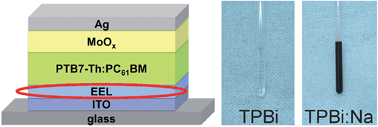
n-Doping of organic semiconductors for enhanced electron extraction from solution processed solar cells using alkali metals
J. Mater. Chem. A, 2016, 4,14703-14708
DOI: 10.1039/C6TA04770J, Paper
DOI: 10.1039/C6TA04770J, Paper
Tanja Schneider, Jens Czolk, Dominik Landerer, Stefan Gartner, Andreas Puetz, Michael Bruns, Jan Behrends, Alexander Colsmann
Organic solar cells: sodium-doped electron extraction layers processed from toluene solution.
The content of this RSS Feed (c) The Royal Society of Chemistry
Organic solar cells: sodium-doped electron extraction layers processed from toluene solution.
The content of this RSS Feed (c) The Royal Society of Chemistry
13 Sep 13:08

Surface charge self-recovering electret film for wearable energy conversion in a harsh environment

Energy Environ. Sci., 2016, 9,3085-3091
DOI: 10.1039/C6EE02135B, Communication
DOI: 10.1039/C6EE02135B, Communication
Junwen Zhong, Qize Zhong, Gangjin Chen, Bin Hu, Sheng Zhao, Xin Li, Nan Wu, Wenbo Li, Huimin Yu, Jun Zhou
A laminated cellular electret film with surface charge self-recovery property for reliable wearable devices was developed.
The content of this RSS Feed (c) The Royal Society of Chemistry
A laminated cellular electret film with surface charge self-recovery property for reliable wearable devices was developed.
The content of this RSS Feed (c) The Royal Society of Chemistry
huolang likes this
13 Sep 12:57

Progress, challenges and perspectives in flexible perovskite solar cells

Energy Environ. Sci., 2016, 9,3007-3035
DOI: 10.1039/C6EE01137C, Review Article
DOI: 10.1039/C6EE01137C, Review Article
Francesco Di Giacomo, Azhar Fakharuddin, Rajan Jose, Thomas M. Brown
A review and perspective on the development of perovskite solar cells on flexible substrates.
The content of this RSS Feed (c) The Royal Society of Chemistry
A review and perspective on the development of perovskite solar cells on flexible substrates.
The content of this RSS Feed (c) The Royal Society of Chemistry
xululu91, Yongzhen Wu and 4 others like this
13 Sep 12:56
 Open Access
   This article is licensed under a Creative Commons Attribution 3.0 Unported Licence.

Carrier trapping and recombination: the role of defect physics in enhancing the open circuit voltage of metal halide perovskite solar cells

Energy Environ. Sci., 2016, 9,3472-3481
DOI: 10.1039/C6EE01729K, Paper
DOI: 10.1039/C6EE01729K, Paper
Open Access  This article is licensed under a Creative Commons Attribution 3.0 Unported Licence.
Tomas Leijtens, Giles E. Eperon, Alex J. Barker, Giulia Grancini, Wei Zhang, James M. Ball, Ajay Ram Srimath Kandada, Henry J. Snaith, Annamaria Petrozza
We show that trapped electrons recombine with free holes unexpectedly slowly, on microsecond time scales, relaxing the limit on obtainable open circuit voltage.
The content of this RSS Feed (c) The Royal Society of Chemistry
We show that trapped electrons recombine with free holes unexpectedly slowly, on microsecond time scales, relaxing the limit on obtainable open circuit voltage.
The content of this RSS Feed (c) The Royal Society of Chemistry
xululu91, wangzhaowei and 2 others like this
13 Sep 12:52

The use of an n-type macromolecular additive as a simple yet effective tool for improving and stabilizing the performance of organic solar cells
Energy Environ. Sci., 2016, 9,3464-3471
DOI: 10.1039/C6EE02255C, Paper
DOI: 10.1039/C6EE02255C, Paper
Kwang Hyun Park, Yujin An, Seungon Jung, Hyesung Park, Changduk Yang
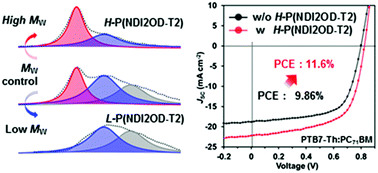
Introduction of an n-type macromolecular additive (P(NDI2OD-T2) polymer) in organic solar cells brings significant improvements in power conversion efficiency along with robust thermal stability.
The content of this RSS Feed (c) The Royal Society of Chemistry
Introduction of an n-type macromolecular additive (P(NDI2OD-T2) polymer) in organic solar cells brings significant improvements in power conversion efficiency along with robust thermal stability.
The content of this RSS Feed (c) The Royal Society of Chemistry
zhanglinncu@163.com, fen and 6 others like this
No more posts. Check out what's trending.