Last week, as North Dakota lawmakers debated whether or not to keep the state's "blue laws," a precious American meal (and an affiliated gender stereotype) was dragged into the dialogue.
Pete Souza was the official White House photographer under Barack Obama (as well as Ronald Reagan), and even if that name doesn’t ring a bell, you are definitely familiar with his work. He’s responsible for the vast majority of those pictures of Obama in office–from tense meetings to making funny faces at babies–that make your heart swell. Heck, without Souza, it’s quite possible we wouldn’t have any of those Biden/Obama BFF memes. The intimacy of his photographs is sometimes overwhelming, and for aspiring photographers, his Instagram is a must-follow, as he’s generous with advice and lessons from his long career.
In recent weeks, though, he’s also been giving out lessons in how to troll Donald Trump through art, making it a must-follow for everyone.
Souza has been posting some of his Obama-tenure photos to his Instagram, and many of them seem to be, let’s say, pointed. There are pictures of refugees–
And sure, maybe it’s a coincidence that he posted this picture of Barack Obama with Australia’s Prime Minister right after Trump’s embarrassing phone call with Turnbull.
I’m sure there was a time when I was not hairy, but I can’t remember it. I have an early memory from middle school where a doctor examined my sideburns, which stretched almost down to my jawline, and suggested some pills to slow the growth. She told me they were for people with a lot of facial hair, like me. I recall inspecting the black hairs on my legs with serious fascination; my mother would use sticky sugar to rip them out from their stubborn roots. “Beauty requires strength,” she would say, deploying an Arabic take on the more common proverb: Beauty is pain.
The regular removal of body hair is ubiquitous: More than 99 percent of American women voluntarily get rid of their hair. It’s also expensive. The American woman who shaves will spend more than $10,000 over the course of her life, and the woman who waxes will shell out more than $23,000. These habits cut across race, ethnicity, and region. They are also relatively recent.
It wasn’t until the late 1800s that non-native (mostly white) American women became concerned with body hair. In fact, as Rebecca Herzig explains in Plucked: A History of Hair Removal, “18th-century naturalists and explorers considered hair-free skin to be a strange obsession of indigenous peoples.” English colonists were surprised and disturbed by beardless Native Americans when they first landed.
How then, in the span of less than a century, did the unnatural state of hairlessness become the standard for American women?
The campaign against body hair on women originates in Darwin’s 1871 book Descent of Man, explains Herzig. Men of science obsessed over racial differences in hair type and growth (among other aspects of physical appearance), and as the press popularized these findings, the broader American public latched on. Darwin’s evolutionary theory transformed body hair into a question of competitive selection—so much so that hairiness was deeply pathologized. “Rooted in traditions of comparative racial anatomy, evolutionary thought solidified hair’s associations with ‘primitive’ ancestry and an atavistic return to earlier, ‘less developed’ forms,” Herzig writes. Post Descent, hairiness became an issue of fitness.
An important distinction in this evolutionary framework was that men were supposed to be hairy, and women were not. Scientists surmised that a clear distinction between the masculine and the feminine indicated “higher anthropological development” in a race. So, hairiness in women became indicative of deviance, and researchers set out to prove it. Herzig tells the story of an 1893 study of 271 cases of insanity in white women, which found that insane women had excessive facial hair more frequently than the sane. Their hairs were also “thicker and stiffer,” more closely resembling those of the “inferior races.” Havelock Ellis, the scholar of human sexuality, claimed that this type of hair growth in women was “linked to criminal violence, strong sexual instincts … [and] exceptional ‘animal vigor.’”
By the early 1900s, unwanted hair was a significant source of discomfort for American women. They desired smooth, sanitized, white skin. They wanted to be feminine. “In a remarkably short time, body hair became disgusting to middle-class American women, its removal a way to separate oneself from cruder people, lower class and immigrant,” writes Herzig.
As hemlines rose, threatening to reveal hairy limbs, women took extreme measures to remove hair.
In the 1920s and ’30s, women used pumice stones or sandpaper to depilate, which caused irritation and scabbing. Some tried modified shoemaker’s waxes. Thousands were killed or permanently disabled by Koremlu, a cream made from the rat poison thallium acetate. It was successful in eliminating hair, and also in causing muscular atrophy, blindness, limb damage, and death. Around the same time, X-ray hair removal emerged as another treatment option. Women would sit for three or four minutes in front of the invisible rays of a boxed X-ray machine, and the radiation would do its work. So great was the appeal of each hair withering away in its sheath that for nearly two decades women underwent dangerous radiation that led to scarring, ulceration, and cancer.
Disfigured and dying, but undeterred, women continued the war on body hair. Concurrently, Gillette had slowly been mastering its marketing of razors. During World War II, there was a shortage of the thick stockings that women wore to cover their hairy legs, and shaving—something that had previously been associated with men’s routines—became a common practice for women. By 1964, 98 percent of American women were routinely shaving their legs, embracing the repetitive swiping that defines modern hair removal. But alternate methods still proliferated in laboratories and physicians’ offices. In the 1960s and ’70s, doctors began prescribing hormonal drugs, like Aldactone and Androcur (which are now often used in male-to-female transitions), to combat hirsutism—the slippery and subjective condition of excessive hair growth in women. The side effects of this hormone therapy can include cancer, stroke, and heart attack, and its effectiveness in reducing hair growth is inconsistent.
Today, women still engage in risky, time-consuming, and skin-damaging practices to rid our bodies of hair. Laser hair removal can cause severe burns, blistering, and scarring. Waxing is painful and unsanitary. Bleaching can irritate and discolor your skin. And there’s a whole Reddit thread for what to do if you burn your vagina with Nair. These products are largely unregulated, as most cosmetics tend to be.
Hair removal, at its core, is a form of gendered social control. It’s not a coincidence that the pressure for women to modify their body hair has risen in tandem with their liberties, Herzig argues. She writes that the effect of this hairlessness norm is to “produce feelings of inadequacy and vulnerability, the sense that women’s bodies are problematic the way they naturally are.”
And yet, if you ask many women why they voluntarily shave or wax, they might say that it’s a method of self-enhancement. That they want to, it’s a personal choice, and they just feel better when everything is smooth. Hair removal as self-care might be one of the biggest lies women have bought into. It keeps us in an impossible loop, one in which we are constantly in pursuit of velvety limbs and the moral virtue of cleanliness.
A few years ago, I got my sideburns lasered, along with the rest of my face, my armpits, my back, my stomach, the back of my neck, and the soft expanse underneath my chin. I zapped the hair right at the follicle, before it even had the chance to break through my skin. It hurt, but the good kind, the kind of pain women are taught is worth it.
The Republican leader forced Warren to sit down for impugning Senator Jeff Sessions, President Donald Trump’s nominee for attorney general. Despite the huge uproar the incident created in social media, it was handled as calmly and procedurally as everything else in the Senate—and in keeping with the aesthetic favored by McConnell, who carefully maintains a dry demeanor even when wielding chamber rules like a scimitar. There was nary a raised voice—just a somewhat tense, drab exchange of parliamentary conventions, and then Warren sat.
The Senate is many things, but one of them is a classic old-style club, in which it doesn’t matter how disreputable one believes a fellow member is; the important thing is to maintain decorum and formalized respect.
The strangeness of Senate rules provides the broader backdrop for the entire fight over Sessions’s nomination. The Alabaman is all but certain to be confirmed, despite the objections of most Democrats, as well as many civil-rights groups, but when Sessions last came up for Senate confirmation, in 1986, he was soundly rejected for a federal judgeship—thanks in part to the very words that got Warren silenced Tuesday night. There are plenty of differences between the two nominations, but few are so salient as the fact that the Senate’s rules now protect Sessions, as a senator, from the same slights that sank him years ago.
“I am surprised that the words of Coretta Scott King are not suitable for debate in the United States Senate,” Warren complained Tuesday. Her phrasing was imprecise: It wasn’t that the words were unsuitable per se. Warren, a Massachusetts Democrat, was reading from a letter that the widow of Martin Luther King Jr. wrote at the time of Sessions’s nomination, opposing it. King laid out a devastating broadside, over the course of 10 pages, arguing he was unfit for the bench, and that his confirmation would undo her husband’s work. Coretta Scott King concluded:
I do not believe Jefferson Sessions possesses the requisite judgment, competence, and sensitivity to the rights guaranteed by the federal civil rights laws to qualify for appointment to the federal district court. Based on his record, I believe his confirmation would have a devastating effect on not only the judicial system in Alabama, but also on the progress we have made everywhere toward fulfilling my husband's dream that he envisioned over twenty years ago. I therefore urge the Senate Judiciary Committee to deny his confirmation.
Senator Strom Thurmond, the infamous former segregationist from South Carolina who chaired the Judiciary Committee did not enter the letter into the congressional record, meaning it was for a time lost, until The Washington Post’s Wesley Lowery resurfaced it earlier this year.
The letter was a central part of the successful effort to defeat Sessions’s nomination. The Judiciary Committee voted against recommending his nomination to the broader Senate, then deadlocked on whether to send the nomination on without a recommendation, effectively killing it. One pivotal vote was Alabama Senator Howell Heflin, a Democrat, who began as a Sessions supporter but changed his mind over the course of the testimony. Sessions’s nomination was withdrawn, even though Republicans, the party of President Reagan, held a majority that was one seat larger than the GOP’s edge today.
Warren read from the same letter from King on Tuesday, as well as another from the late Senator Edward Kennedy, who had called Sessions a “disgrace to the Justice Department,” when she was ruled to have breached decorum. McConnell charged that Warren had “impugned the motives and conduct of our colleague from Alabama.” Put differently, the very words that helped to mortally wound Sessions’s nomination 30 years ago, when he was merely a United States attorney had become anathema when Sessions joined the Senate in 1997—replacing Heflin, the man who had voted against him.
Like many ancient customs, the rule enforced against Warren was born out of a genuine concern: The prohibition against impugning a colleague was installed after Senator John McLaurin and Ben Tillman of South Carolina got into a fistfight on the floor in 1902. But like many century-old rules, this one produces peculiar results when applied today, such as the notion that King’s words, acceptable in 1986, are not acceptable now that Sessions is a member of the club.
This is one reason presidents like to name members of the Senate to Cabinet posts and other jobs that require Senate confirmation: They know that members are loath to vote against members of their own club, since it threatens their treasured decorum. The last current or former senator to be rejected for confirmation was John Tower, a Texan whom George H.W. Bush nominated for secretary of defense in 1989. Tower was said to be a heavy drinker and a womanizer. The New York Times starchily noted at the time, “After weeks of fierce debate, personal lobbying by the President and allegations of private misconduct by Mr. Tower that would never have been aired in an earlier age, the end came in a calm, ceremonial proceeding with all 100 senators gathered in the chamber.” Of course it was calm and ceremonial—it was, after all, still the Senate.
Even with Sessions headed toward likely confirmation, his nomination has posed a sharp challenge to the rules of decorum. The Warren-McConnell contretemps is not the first incident. Senator Cory Booker, a New Jersey Democrat, testified against Sessions’s nomination, the first time a member had testified against another member’s appointment.
The willingness of senators to flout these norms does not arise in isolation. They fit with, for example, Senator Rand Paul’s highly unusual filibuster of John Brennan’s nomination to be President Obama’s CIA director, or Senator Ted Cruz’s “fauxlibuster,” in which he spoke for hours in 2013, even though the speech had no role in actually preventing funding for the Affordable Care Act, his ostensible aim. That stunt earned Cruz, not for the first time, the disdain of some of his colleagues.
A common thread uniting each of these trespasses on decorum is that they make for great red meat for the respective senators’ bases. Cruz performed his opposition to Obamacare; Paul earned a massive amount of press, including adoring coverage from civil libertarians on the left; Booker’s testimony was heavily covered; and Warren’s fight with McConnell instantly turned into a viral moment. These senators are not speaking to their colleagues, and if they are, it’s as a secondary audience. The primary audience is the public, which is easier than ever to reach with smartly edited and quickly published social-media posts spotlighting the heroic senator’s stand. As a result, citizens can expect to see more incidents like what happened on Tuesday.
Warren may have been silenced on the Senate floor, but her voice was amplified widely elsewhere—and that’s likely to prove more alluring to members than upholding musty customs.
Ride in the right tire track of the right hand lane. “Be predictable.” Always wear a helmet. Thousands of people in North America are exposed to these rules of thumb in cycling training courses each year. But how good is the advice?
Kay Teschke, a public health professor at the University of British Columbia who specializes in bike safety issues, says she wouldn’t follow some of it.
Teschke and her colleagues reviewed Canadian bike and driver education materials in a comprehensive report released in 2012 [PDF]. They found that while some of the training provided to bicyclists in Canada comports with what scientific research finds to be safe practice, some does not. And in many cases there isn’t enough data to justify or disprove the guidance.
Common-sense suggestions like “behave predictably” are fine, says Teschke, but other tips don’t align with what researchers have observed in real-world situations.
For example, research has consistently found that the farther bicyclists ride from the curb, the closer drivers pass them. This flies in the face of some cycling training that originates from John Forester’s 1975 book Effective Cycling.
There clearly are situations where bicyclists should position themselves away from the curb, like on streets with parking lanes, where it’s very important to stay out of the door zone. But in other situations, hugging the curb is safer.
In a 2007 study, Ian Walker of the University of Bath rode hundreds of kilometers wearing special equipment that measured the buffer passing motorists gave him. He found that riding farther from the curb led to being passed at closer distances. (He also found, famously, that drivers passed closer when he was wearing a helmet.)
Other research backs up Walker’s finding, said Teschke, but it isn’t reflected in cycling training. In Canada cyclists are told to ride away from the curb.
“When I give the talk, I say the standard Effective Cycling rules probably will work fine on neighborhood streets,” Teschke said. “On a busy street, it’s not really clear that those rules are good for you.”
The League of American Bicyclists, which runs the “League Certified Instructor” cycling education program, the largest in the U.S., does advise cyclists to “take the lane” in situations where there isn’t enough space for safe overtaking. Andy Clarke, the former president of LAB, said that’s still sound advice. But cycling education materials are definitely in need of some updating.
Clarke thinks LAB’s “League Certified Instructor” training is valuable for some people, but it’s not “very populist.” In other words, it’s designed for very aggressive riders, who are more likely to be men at the peak of their physical fitness, very much in the Forester model of riding.
LAB has been working on modernizing the curriculum in recent years, but there is still work to be done. “The link to data and actual safety stuff is pretty tenuous,” Clarke said.
Forester emphasized that cyclists are most vulnerable at intersections, not from passing drivers. While it’s true that intersections are especially dangerous, the risk of getting struck from behind is still substantial. A 2014 review of every cycling fatality in the U.S. by the Bike League found that 40 percent were rear-end collisions.
For some situations, says Teschke, there simply isn’t enough research to draw conclusions about the safest behavior. Is it safer to signal a turn by pointing or with the traditional hand signals? That’s still an area where guidance is more a matter of faith than empirical data.
Teschke wants to see more emphasis on helping people make safer route choices. Drivers tend to pass closer in heavy traffic conditions, for instance, and on roads with two-way traffic. Data suggests streets with parked cars and heavy traffic are particularly dangerous for cyclists. People who are learning to bike on streets stand to gain a lot, she says, by identifying the least risky way to get from point A to point B.
Just as with the casting of Alec Baldwin as Donald Trump, Saturday Night Live struck gold last night with the casting of Melissa McCarthy as White House Press Secretary Sean Spicer.
It’s often been pointed out that this presidency is difficult to satirize, because the constant lies, poorly thought-out legislation, and frequent violations of basic diplomatic and democratic norms are not only self-satirizing, but dangerous enough that they aren’t particularly funny when reenacted. However, McCarthy brought her gifts for comic violence and sputtering, incompetent rage to the role, shouting lines like, “Stop writing that down!” and “I’m not here to be your buddy! I’m here to swallow gum, and I’m here to take names!” She also charged journalists with her podium, communicated White House talking points with childish props, and perfectly captured Spicer’s aggrieved ineptitude.
There can be a danger of leaning into transphobic jokes with cross-dressing roles, but thankfully, this skit doesn’t play that up. Instead, it leans into McCarthy’s natural comic talents for a very funny send-up of Spicer’s disastrous press conferences.
Want more stories like this? Become a subscriber and support the site!
Not only are you intimidatingly smart, many of you are professional experts in the topics we try to cover. Others are self-taught aficionados in urban planning or cartography—in other words, obsessive city-stuff superfans.
That may be the case with Michael Graham, who sent CityLab an actual snail-mail lettera few weeks back with a QR code linking us to his Spider Bike Maps page.
His cool idea: Make maps for bike infrastructure as if the lanes, trails, and paths constituted a connected transit system.
Graham became fascinated with London’s bus maps on a family vacation there in 2004. The bus route diagrams in London are sometimes referred to as “spider maps” and they are designed to help make bus routes as intuitive as the lines of the London Underground for the people that use them.
A simplified spider map of London’s bike trails. (Michael Graham)
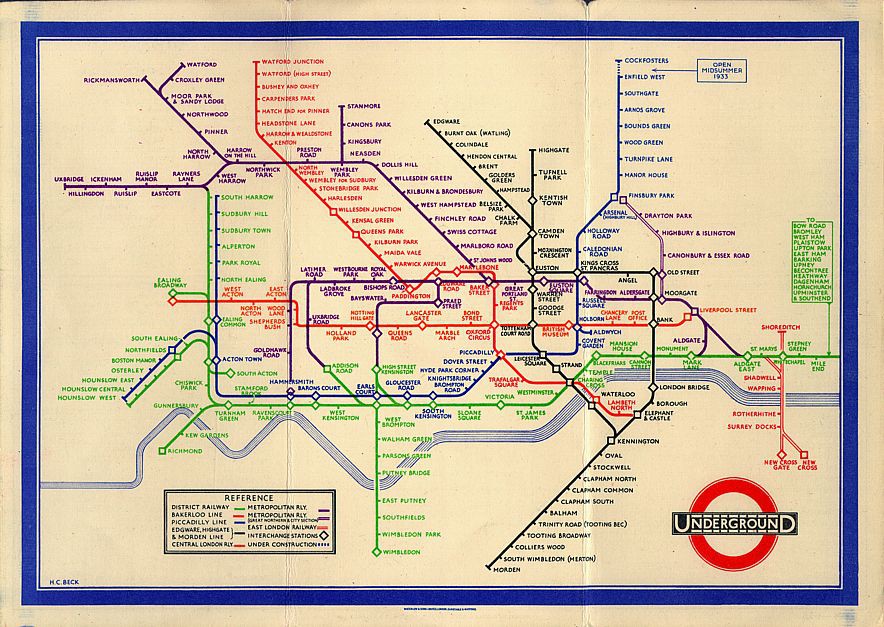
Later on, Graham learned all about Harry Beck, the draftsman who broke from geographic fidelity to devise a stylized map for the London Underground. Beck drew inspiration from an electrical schematic to create the prototypical transit map for the system in 1931. He used colors to represent different subway lines and made the lines intersect at either 45 or 90 degree angles. “The map of almost every subway system in the world has converged upon some approximation of Beck’s design,” Graham says. “I think people appreciate the simplicity; it makes complex information easier to understand.”
Harry Beck’s London Underground map, as published in 1933. (Wikimedia Commons)
Graham says the idea for bicycle spider maps came to him later, when he started working at a small financial regulatory agency near Washington, D.C., in 2008. His commute from southwest D.C. to McLean, Virginia, required numerous Metro and bus transfers. He realized he could switch to cycling when he found that bike paths covered almost the entire route to work. “I thought to myself,” Graham says. “I am a cycling enthusiast, and it took me too long to discover the bike routes near my home and office. What about the average person?”
Graham was struck by how much easier it was to use the H Street bus spider map compared to the information-dense cycling map of Washington.
A spider map of trails in the Washington, D.C. metro area (Michael Graham)
“Most urban bike maps are extremely detailed,” Graham says. “I love them, but I’m afraid the average person might find those maps overwhelming and inaccessible.”
He was also struck by a Wonkblog post that detailed the disconnectedness of city bike lanes. (Density is also important.) So Graham attended a Transit Tech workshop in Arlington, Virginia, hosted by Mobility Lab, taught himself to use Adobe Illustrator, and tasked himself with applying these concepts to bike maps for four cities: London, San Francisco, his hometown of Denver, and Washington, D.C.
To make these maps, Graham printed a Google Map with bike trails, traced the bike paths with a marker, picked landmarks along the way to use as subway-style stations, photographed it with his cellphone, and used that as the base layer for the digital map. He then substituted it with an OpenStreetMap for the final product.
This process produced the maps on right side of the slide tools below, which adhere to the trails with geographic fidelity. But he also made more conventional subway-style maps, which you’ll see on the left side of the slider.
LondonSan Francisco
Denver
Washington, D.C.
UPDATE: We've tweaked the map of the D.C. to include some previously omitted trails.
As Seattle’s light rail expands, so does it its ridership—and the bad habits they bring with them.
With two new Link stations opening up last year in the high-density Capitol Hill neighborhood and University District—and plans for further expansion overthe next six years—more and more Seattlites are expected to ditch their cars for mass transit. The region’s transit authority wants to make sure new and old straphangers in the famously passive-aggressive city don’t get on each other’s nerves, so they’ve been using cartoon animals to get a few key points across.
(SoundTransit)
“We were receiving comments every day about what it’s like to ride our system,” says the SoundTransit Public Information Officer Kimberly Reason. “’I keep getting hit in the face with backpacks!’ or ’People keep clustering at the doors!’ So we decided to use a graphic representation for what to do and not to do,” she adds. “As soon as the campaign took off, people loved it. Even outside of our service area.”
One poster politely suggests that if an octopus can keep all of his tentacles in one seat, a man can keep his legs confined, too. Another lets riders know that if two turtles can put their shells on the floor while standing in the aisle, a human can surely do the same with a backpack. “It was purposeful to use animals,” says SoundTransit Design Manager, Elizabeth Trunkey. “It keeps the message very neutral. All of our critters are friendly.”
(SoundTransit)
The etiquette campaign, SoundTransit’s first, launched in late 2014 and can also be found inside commuter trains. But the agency seems to get the most out of sharing the campaign on its social media accounts. “When we do get a complaint, we can respond by putting [one] up as a reminder,” says Trunkey.
They can modify the posters for special occasions, too. On the first workday morning after Seattle’s Major League Soccer team won a championship last December, SoundTransit sent out an image online of the aforementioned turtles wearing Sounders scarves to remind fans about backpacks on crowded trains. Courteous riders should feel like winners, too.
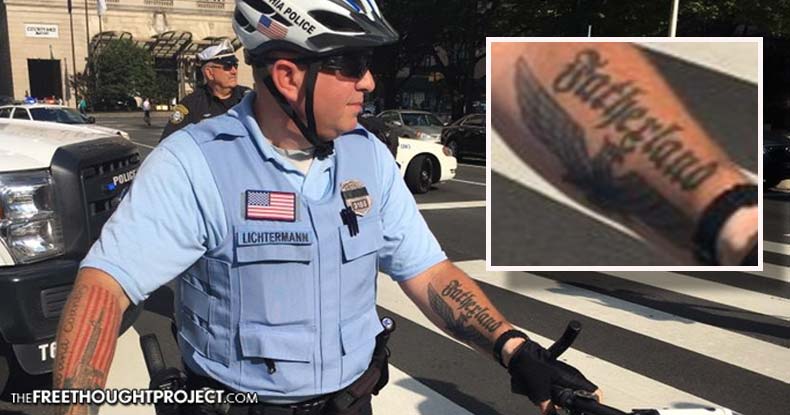
It won't surprise you to learn American policing has a racism problem. It may surprise you to know that the FBI has been quietly, systematically investigating the white supremacist infiltration of law enforcement.
“For some reason, we have stepped away from the threat of domestic terrorism and right-wing extremism,” Jones continued. “The only way we can reconcile this kind of behavior is if we accept the possibility that the ideology that permeates white nationalists and white supremacists is something that many in our federal and law enforcement communities understand and may be in sympathy with.”
Investigation is difficult:
Although officers have been fired for expressing hateful views — sometimes to be re-hired by other departments, as happens regularly with officers accused of misconduct — some officers have also challenged those dismissals in court. Robert Henderson, an 18-year veteran of the Nebraska State Patrol, was fired when his membership in the Klan was discovered. He sued on First Amendment grounds and appealed all the way to the U.S. Supreme Court, which declined to hear his case. Last year, 14 officers in the San Francisco Police Department were caught exchanging racist and homophobic texts that included several references to “white power” and messages such as “all niggers must fucking hang.” Most of those officers remain on the force after an attempt to fire several of them was blocked by a judge, who said the statute of limitation had expired.
No centralized recruitment process or set of national standards exists for the 18,000 law enforcement agencies in the United States, many of which have deep historical connections to racist ideologies. As a result, state and local police as well as sheriff’s departments present ample opportunities for white supremacists and other right-wing extremists looking to expand their power base.
Part of the problem: when the Department of Homeland Security released a study on extremism, Republicans railed against the unforgivable insult it represented against patriotic officers and veterans. This hindered further action against white supremacists throughout the Obama administration.
“I believe that because that report was so denounced by conservatives, it sort of closed the door on whatever the FBI may have been considering doing with respect to combating infiltration of law enforcement by white supremacists,” said Samuel Jones, a professor of law at the John Marshall School of Law in Chicago who has written about white power ideology in law enforcement. “Because after the 2006 FBI report, we simply cannot find anything by local law enforcement or the federal government that addresses this issue.”
Pete Simi, a sociologist who spent decades studying the proliferation of white supremacists in the U.S. military, agreed. “The report underscores the problem of even discussing this issue. It underscores how difficult this issue is to get any traction on, because a lot of people don’t want to discuss this, let alone actually do something about it.”
Yesterday, acting Attorney General Sally Yates stood up against Donald Trump’s travel ban/immigration ban/Muslim ban, and she was perhaps too predictably fired by Trump for doing so. In the meantime, while Trump eagerly awaits having Jeff Sessions, his AG pick, sworn in, he’s replaced Yates with another temporary assignment, but this video of Sessions questioning Yates at her 2015 confirmation hearing is all we can think about right now.
In it, Sessions is clearly badgering Yates from the standpoint that President Obama’s attorney general, Loretta Lynch, would do anything the Obama administration approved, whether or not she believed it was right. He wanted to know if Yates would behave similarly. Tellingly, Yates said that her duty was to the Constitution, not to the president.
Now, Trump is trying to brow-beat Democrats in congress into forcing Sessions through his confirmation process by saying they’re only holding him up for political reasons. That’s far from true, as there’s legitimate concern going around as to how Sessions’ personal beliefs would influence his actions as attorney general. However, it certainly seems that Donald Trump believes he has an ally in Sessions and needs him in place to help push his own agenda through.
The attorney general does serve at the will of the president, and Trump was fully within his rights to remove Yates, but that doesn’t mean it’s a good idea to go firing anyone who disagrees—especially since the confirmation vote on Sessions is this morning, making the firing seem more symbolic than anything else. The memo from the Trump administration on Yates’ firing was as inflammatory as you’d expect and asserted that she had “betrayed” the Department of Justice. For her part, Yates had put out a statement on why she told the Department of Justice not to legally defend Trump’s order, which seemed to allude to the fact that, after the order went out, statements from those in the Trump team (and Trump himself) made it quite clear that the order was intended as a Muslim ban, no matter its language.
(image via screengrab)
Want more stories like this? Become a subscriber and support the site!
Thousands of protesters were pouring into American airports Saturday in response to Donald Trump’s refugee ban, when suddenly light rail service skipped the Seattle-Tacoma airport. A similar scene unfolded in New York, where Port Authority police briefly barred people from getting to the protests at JFK via transit until Governor Cuomo intervened.
Zach Shaner at Seattle Transit Blog has this report on the SeaTac transit situation, where police also intervened. The incident raises serious questions about who controls access to transit in these situations, he writes:
Around 6:30pm, Link light rail operators were asked by the Port of Seattle Police Department to suspend service to SeaTac/Airport Station. Operators complied, and protesters and passengers were forced off at Tukwila Int’l Blvd station and forced either to catch crush loaded A-Line buses or walk the 1.5 miles to the terminal. The station is on Port property, and Port Police asked for the closure in order to buy time to get backup police to the airport, The Stranger reports. Within minutes, Sound Transit began taking a beating on Twitter, as by all appearances it had been they who ordered the closure.
But Sound Transit executives later indicated they were surprised by the closure, as it had already been implemented by lower-level staff. Once CEO Rogoff was made aware of the closure, he immediately worked to get service restored, and trains resumed service to SeaTac shortly after 7:00. Dow published a series of tweets thanking CEO Rogoff for restoring service, while also saying that Metro (who operates Link) and Sound Transit would meet beginning Monday to establish closure procedures that ensure that such an action won’t be taken again without being elevated to senior staff.
So while the closure was unfortunate and obstructed the rights of legal public demonstration, I think it’s appropriate to react gracefully in light of the multi-agency response. Saturday was a rightfully tense day at a multi-jurisdictional facility (CBP, FAA, DHS, Port, ST, KCM) concerning tragic matters of life, death, family, and national identity. The Port was supportive of the protest cause, and earlier in the day had released a statement condemning the executive orders. Port Commissioner Gregoire also repeatedly voiced support.
In light of the closure, riders deserve an answer to the question, “Who can order closures, and when?” But for its part Saturday, Sound Transit had successfully elevated the issue to the Executive level, taken reparative action, and issued a public statement, within 30 minutes. All things considered, that’s pretty damn good. It’s good to know that our agencies support the rights of protest, and understand the value of transit as a public utility that makes it possible.
More recommended reading today: Bike Portland reports on local bicyclists who’ve taken street sweeping into their own hands during the hazardous winter months. The Natural Resources Defense Council releases its vision for what a responsible $1 trillion infrastructure plan would look like. And World Streets reports from Bogota’s recent Car Free Day, which yielded some remarkable temporary public health improvements.
At a press conference where Paul Ryan defended President Trump's Muslim-targeting travel ban, someone within whispering distance of a hot mic muttered "waste of my fucking time" as the House Speaker walked off.
Ryan denies saying it; consensus is it was a "bored cameraman" lurking around the lectern after he exited.
On Sunday, as crowds gathered outside the White House to protest an executive order banning refugees and immigrants from seven predominantly Muslim nations, President Trump screenedFinding Dory for staffers and their families.
The Pixar movie tells the story of a character with an intellectual disability who travels across a polluted ocean to reunite with her family after a long and harrowing detainment at an aquarium. At the same time as the screening, families were kept apart across the nation as immigration officials detained 109 mothers, fathers, grandparents, children, fiancees, students, and scientists.
The irony was seemingly lost on our new president, who has mocked a reporter with a disability and announced plans to slash climate and water pollution regulations. Trump reportedly stayed at the screening for exactly one minute before a call with South Korea.
Ellen DeGeneres — the voice of Dory — had this to say about the ban:
For me, America is great because of all the people who came here. Not in spite of them. #NoBan
For the dozen years that I have been covering immigration politics and policy, the vast majority of Republicans I’ve interviewed in California, Washington, D.C., Colorado, Arizona, and New York have always avowed that they support legal immigration. In fact, many righteously insisted that they oppose illegal immigration because it is unfair to the people who “waited their turn” and “followed the rules.”
Where did those Republicans go?
On Friday, the Trump administration signed an executive order that betrayed hundreds of thousands of legal immigrants. All waited their turn, diligently applying for a Permanent Resident Card, which the U.S. gives “to individuals granted authorization to live and work in the United States on a permanent basis.” All followed the rules, paid the fees, and were granted their “green card,” which says this at the top:
uscis.gov
Then Donald Trump issued an executive order that threatens to bar entry to as many as 500,000 of those people––the ones from Iraq, Syria, Iran, Libya, Somalia, Sudan, and Yemen. If they were lucky enough to be in the United States when the order was issued, they’re fine, but if they leave they cannot necessarily return. If they were on vacation or a business trip or visiting family when the order was issued, their whole lives have been upended.
Trump upended their lives with a cruel stroke of his pen.
“It’s extraordinary cruel,” Stephen Legomsky, a former chief counsel to the U.S. Citizenship and Immigration Services, told Reuters. More than that, it is needlessly cruel. Charles C.W. Cooke, editor of National Review Online, explained the idiocy of the approach as only someone who has himself applied for permanent residency can:
...permanent residents are expected to live in America by default, and are in fact penalized if they don’t. By law and by expectation, this country is their home; their base; the ground in which their roots are planted. Because of this, permanent residents are able to purchase, own, and carry firearms; they are required to register with the selective service; and they are treated for tax and welfare purposes as are U.S. citizens. They can’t vote or serve on a jury, but, other than, they effectively enjoy all the liberties that natural born Americans enjoy. When they re-enter the country, the agent says “Welcome Home,” which is a big change from their visa days. They are not Americans, and they mustn’t pretend to be. But they are as close as one can get without being one.
And that’s fine. As a permanent resident myself, I don’t expect to be handed a passport or treated like a citizen (for what it’s worth, I like Josh Marshall’s conception of “thick citizenship”). But I do expect to be treated differently than a guy who just got off a plane for the first time — and not least because the process of obtaining a green card is tough. It took me a year from application to acceptance, and the vast majority of that time was taken up by the FBI. In addition to furnishing the government with my residential history, my employment history, and my criminal record (which is clean), I had to provide details of any clubs or societies to which I have ever belonged, to promise I wasn’t a terrorist or a Nazi or a communist, and to submit my fingerprints and a government-taken photograph on top. Which is to say: I had to go through the wringer before my card was issued. Because I was spotlessly clean my application wasn’t too involved, but I have friends whose days have been taken up by details of their parking tickets or their boyhood indiscretions or their penchant for getting fired. This is a tough nut to crack.
I bring this up not because I object to these strictures. I don’t. In fact, I’m hard-line enough to think that it would make sense to include some form of civics-and-language test prior to green cards being issued. Rather, I bring it up because I can’t work out how applying Trump’s rule to the holders of green cards makes any logical sense. As I have noted, these are people who have already gone through the vetting process; people who have been granted permanent residency; people who have made their lives here on the understanding that to fail to do so will incur penalties. What possible sense can it make to temporarily restrict their travel?
It makes no sense. It makes us no safer. It needlessly harms hundreds of thousands of rule-followers who are either barred from reentering their home or unable to leave and come back without going through an opaque, “case by case” screening process at a foreign consulate with no fixed procedures or timeline or any guarantee that they will be cleared, eventually, so long as they don’t actually pose any security threat.
This gravely harms the permanent residents with no benefit for other Americans. In fact, it harms the United States citizens who are their spouses, family members, friends, and employers. And it harms those of us who are ashamed of how our country betrayed them.
America’s behavior here is egregiously unfair. Republican politicians ought to be objecting.
Instead, most are silent, as the GOP becomes an anti-legal-immigrant party. They are silent even as the order shows the Trump administration to be incompetent or malevolent.
Rudy Giuliani told Fox News that the order sprang from a committee he formed for the purpose of constructing a Muslim ban in a way that would pass legal muster. He added that the ban eventually came to focus on countries where there was “substantial evidence that people were sending terrorists into our country.” Yet the order does not affect numerous Muslim-majority countries, including Saudi Arabia, home to 15 of the 19 September 11 hijackers; the United Arab Emirates or Egypt, home to other 9/11 hijackers; or Pakistan, where Osama bin Laden was hidden. In this sense, the order manages to be prejudicial and politically correct at the same time.
“The Trump White House has incurred all the odium of an anti-Muslim religious test, without any attendant real-world benefit,” my colleague David Frum argued.
“This document is the implementation of a campaign promise to keep out Muslims,” Ben Wittes wrote, “moderated only by the fact that certain allied Muslim countries are left out because the diplomatic repercussions of including them would be too detrimental.” This assault on legal immigrants from numerous majority-Muslim countries was carried out by an administration where this man is the vice-president:
Calls to ban Muslims from entering the U.S. are offensive and unconstitutional.
It was carried out in a country where Republicans control both the House and the Senate, and could take immediate action to protect legal immigrants if they wanted to do so. Senator Jeff Flake and Representative Justin Amash are among the exceptions who spoke out.
Democrats were more reliably vocal in opposition.
Many of the people doing the utmost to advocate for those harmed by the executive order were volunteer lawyers flocking to international airports on their day off, and protesters in liberal cities like Los Angeles, where hundreds gathered at LAX Saturday to sing the Star Spangled Banner and voice their support for the values that Trump is assaulting:
I met Siavosh Naji-Talakar downstairs at international arrivals. The United States citizen, a medical school student in Phoenix, Arizona, had flown to LAX that day to pick up his Iranian grandmother, who has a Green Card, for her regular visit to the United States. “She's very old. She had a triple bypass and other health problems. And I'm just worried about her health if they send her back,” he said. “It's a two day journey for her. I don't know if she can make it back for two days if they don't let her in here.”
When Trump was elected, “I took solace in the fact I'm a citizen,” he explained, “that at least I'm okay, even though I want to fight against injustice for everyone else. But right now I don't feel okay,” he said, tearing up. Security officials at the airport were giving him “conflicting answers” about the fate of his ailing grandmother.
Later Saturday, federal Judge Ann Donnelly of the Eastern District of New York granted a stay at an emergency hearing that prevented the government from deporting those detained in airports. The order appears to have allowed the medical student to reunite with his grandmother. “Hey, my grandma made it finally! Took her 10 hours,” he emailed me around 2 a.m. “They gave no reason, around 1 am people were starting to be released.”
The two had missed their connecting flight and would need to find a hotel.But even with their hours of needless suffering they were on the lucky end of the spectrum. Other elderly women with green cards will not be able to fly from Iran to visit their grandsons tomorrow. Still others will be kept thousands of miles away from spouses or children. The Trump administration would have us believe that outcome is dictated by a policy that is necessary to protect the United States of America. There is, however, no rational need for an executive order as sweeping and punitive as the one they’ve pushed. And their order is already causing many U.S. citizens to suffer.
If you’re affected, if you oppose this policy, or if you favor it, email conor@theatlantic.com with your stories. If you’re a Republican who believes that immigrants who “wait their turn” and “follow the rules” deserve to be welcomed, but you haven’t spoken out, why not?
Last year, we wrote about a bizarre situation in Germany, in which the incredibly thin-skinned Turkish President Recep Tayyip Erdogan, had discovered a little-used, mostly forgotten German law, saying that it was illegal to insult a foreign leader, and used it to go after a German comedian. Erdogan, of course, had been filing thousands of lawsuits within Turkey against people who mocked or insulted him, which resulted in people around the globe mocking and making fun of Erdogan. But the fact that he dug up this mostly forgotten law created a bit of a diplomatic mess at the time for German Chancellor Angela Merkel, who was trying to play nice with Erdogan diplomatically, for the sake of helping with the flood of refugees from the Middle East. The weak "compromise" was that Merkel allowed the case to move forward, leading to a sad ruling from a German court, barring the comedian from mocking Erdogan, though a federal investigation was later dropped for "lack of evidence."
However, part of the compromise suggested at the time was that Merkel would allow that case to move forward, but would work towards getting that law off the books later. And apparently, that time is now. The German cabinet has said that the law is being scrapped.
Justice Minister Heiko Mass said the law is "obsolete and unnecessary," Deutsche Welle reported. He said the concept "dates back to a long-gone era, it no longer belongs in our criminal law."
Mass added that foreign heads of state could still pursue libel and defamation cases "but no more or less so than any other person," according to the broadcaster.
Of course, given that this is happening less than a week after the Trump inauguration and the Merkel/Trump relationship is off to quite a rocky start, with Merkel now making very public digs at the new US President, some are trying to read more into the plan to dump this law. The timing is, most likely, more of a coincidence, but perhaps it will free up Merkel to come up with better insults for other world leaders.
Computers are everywhere, and lots of people don’t know very much about their inner workings. That creates an ample playground for scammers who use a combination of social engineering and scary-sounding words in order to bilk people out of money, or even sensitive data. The scammers are legion, and so, unfortunately are targets… but when one scammer recently tried to pull one over on a tech expert with time to kill, the tables were briefly turned.
These scams tend to work in a pretty predictable way: you get a call from “tech support,” asking you to take a certain series of actions with your Windows PC, including giving the scammer remote access to the machine, then demanding a large sum of money to “fix” a problem that doesn’t exist.
Folks who don’t know much about the workings of their computers, especially those who are kind of scared of or intimidated by their machines, can be susceptible targets. But this particular scammer, randomly dialing numbers, happened to hit an extremely knowledgable, experienced tech expert: Sean Gallagher, currently an editor for tech site Ars Technica.
Gallagher, both knowing his stuff and also being in a position to write stories about it, decided to have a little fun with the scammer who called him on Monday, and kept him on the line for two hours while pretending to be an easy mark.
“I was thrilled,” Gallagher opens, “displaying what my wife Paula felt was an inordinate amount of glee about getting the call. Over the next two hours, I subjected the scammers to such misery that Paula later told me she felt bad for them.”
The scammers first called merely to identify if the person on the other end of the line could be a potential mark. Gallagher identified himself as one by waiting for a “technician” to call him back when available. While waiting, he set up a recorder and Windows XP virtual machine. (That’s an emulated computer system, running on a different computer system in a contained way.)
The scammers called back and fed Gallagher a half-plausible line about “junk files” accumulating on his system and “decreasing the functionality of [his] computer day by day” while conducting ordinary activities online.
(Using a browser regularly does generate some temporary files on your machine — your computer has a cache, and it can fill up over time — but your entire hard drive is not flooded with them, and the amount of space they can take up is limited.)
That led to an exchange where Gallagher agreed that his “unsecured junk files” needed fixing, and the call took off from there.
First, Gallagher stalled the scammer while rebooting and pretending to reboot his machine a few times. “It must have been doing an update or something, I don’t know,” he told them.
Then they got into it in earnest. The scammer instructed Gallagher on how to execute a few very basic, ordinary Windows commands that make visible some system files and processes that can look complex if you have literally no idea what they are. This took some time; “Also, I was not helpful,” Gallagher gleefully adds.
While going through a lengthy rigamarole with the scammer, Gallagher was having some trouble actually accessing the files and sites the scammer told him to, so he took a moment to go find an old, Linux-running laptop from his basement. Using both, he was eventually to access the remote support tool the scammers wanted him to download.
But while he was installing the tool, he happened to use some of the correct terminology for what his computer was doing, and nearly gave up the game:
“Sir, you are not actually doing anything, are you?” the “technician” asked accusingly. “You know the reason why sir. You are acting like you are doing something. No. I understand sir, you took so much time to joke with me, you think you are very smart. You have some knowledge of your computer, and you are pretending that you are doing something but you are not doing anything, yes?”
Gallagher managed to keep them on the line a while longer, playing stupid.
The scammers managed to get their end of the remote-access tool running, and saw Gallagher’s whole screen. One of the scammers on the line asked him point-blank what operating system he was running, and he answered honestly: “Debian Linux. The Kali distribution.”
That was the beginning of the end, and the call wrapped up a few moments later.
Gallagher, however, wasn’t just having fun with some would-be scammers by keeping them on the line: he was able to use that time to capture information about everything they did.
Using packet tracing and a log of the session, the remote access tool was indeed able to pin the caller as using a free account, operating from India.
Gallagher was able to provide logs to the abuse teams at the remote access tool. He also sent information to Time Warner Cable’s (now Charter) abuse-reporting e-mail address, since the scam fraudulently took advantage of a RoadRunner residential account.
He also traced the phone number backwards, and found the company whose ID came up on the call. It is, indeed, a legitimate company using a VoIP phone system — but the company said that its phone system has not been infiltrated, and so the more likely answer is that the callers were spoofing the number.
Unfortunately, while this particular scammer might get its access to one particular tool taken away for a short while, taking them out is indeed basically a whack-a-mole game.
“If we’re really going to ever put a dent in these sorts of scams in a meaningful way,” Gallagher concludes, “it will instead take actual engagement — both with everyday computer users and with companies that may haplessly provide infrastructure that scammers can leverage to reach potential victims.”
You can read the full saga, with more of the technical details — or just listen to the condensed 27-minute recording of the two-hour call — over at Ars Technica.
Reports started coming out this morning that the new Trump Administration had told the EPA that it needed to stop doing anything publicly without first getting approval from the White House (in addition to freezing grants and contracts). According to a memo that was sent around to EPA staff:
If you can't read that, the key parts say:
No press releases will be going out to external audiences.
No social media will be going out. A Digital Strategist will be coming on board to oversee social media. Existing, individually controlled, social media accounts may become more centrally controlled.
No blog messages.
The Beach Team will review the list of upcoming webinars and decide which ones will go forward.
Please send me a list of any external speaking engagements that are currently scheduled among any of your staff from today through February.
Incoming media requests will be carefully screened.
No new content can be place on any website. Only do clean up where essential.
List servers will be reviewed. Only send out critical messages, as messages can be shared broadly and end up in the press.
It's possible to say that this is just the Trump administration hitting the pause button to figure out what's going on before moving forward again, but many in these agencies are quite worried that they're going to be muzzled for political reasons. Most of the people working in these agencies are civil servants, not political appointees, and their work is not at all political. The press releases and blog posts are generally to release new findings, research and data from taxpayer funded studies. This shouldn't be controversial or reviewed for political motives.
Of course, this kind of thing is hardly unprecedented. For many years, we wrote about the ridiculousness of then Canadian Prime Minister Stephen Harper gagging Canadian scientists from talking about factual research that was politically inconvenient (including a study on fish stock). This kind of gagging on "politically sensitive" but factual science was only lifted last year once Justin Trudeau came into office. Of course, just a few months before that, the UK similarly started muzzling scientists to stop them saying anything the politicians didn't like.
One hopes the Trump administration will not be putting in place similar policies.
Of course, if that is the plan, it should be a huge boon for investigative journalists. And they're already hunting for sources. As the reports on the gag order came out this morning, lots of reporters stepped up on Twitter with notes on how to contact publications with information:
So, perhaps this kind of gag order will lead to a golden age of whistleblowing. Unfortunately, it may also lead to further crackdowns on whistleblowers. Once again, as we've explained over and over again the past few years, the Obama administration was the most aggressive and proactive in cracking down on whistleblowers and the press, and they've now handed off that power and precedent to the Trump administration, which will have a pretty big opportunity to use it.
An intimate photograph of a father cradling his sick child in the shower has become the subject of a legal battle with the Arizona Department of Child Safety. If the DCS succeeds, photographer Heather Whitten, the child’s mother, will be convicted of “neglect” for posting the photo.
The photograph, which was taken in November of 2014, first made headlines in May of 2016 after Facebook repeatedly removed the viral image. The photo shows Whitten’s husband Thomas cradling their then-one-year-old son Fox in a cold shower. Fox had salmonella poisoning, and was suffering from both a high fever and diarrhea.
In May, our story was about how Facebook had censored the controversial image, but someone who saw the photo actually filed a complaint with the local authorities. The police said straight away that they would not bring any charges against the Whittens; however, Heather claims an investigator from the DCS took a very strong and negative interest in their case despite not having any real substantial claims against them.
“The only claim she was able to suggest be substantiated against me [and me alone] was that I neglected to supervise our children by allowing their images to be online and so put them at an unreasonable risk of harm,” says Whitten. “This goes against Arizona’s very definition of neglect and encroaches on my right as an artist to share my work with the public.”
If the claim is substantiated, Whitten will be added to Arizona’s Central Registry for 25 years, marking the end of her ability to adopt, foster, or even work with children as a photographer.
There is currently a Change.org petition with over 16,000 signatures in support of Whitten, and her day in court is coming up. The next step in the legal process—namely: whether or not the case will be thrown out—will be determined at an administrative hearing on February 3rd.
To support Heather or find out more about her story, click here.
Image credits: Photograph by Heather Whitten and used with permission.
The full trailer for Loving Vincent (previously here and here), a film examining the life of Vincent van Gogh, has finally been released after nearly six years of creative development. Each of the 62,450 frames for the feature-length film were hand-painted by 115 professional oil painters, and will integrate 94 of Van Gogh’s paintings into the animation. First captured as a live action film, the final oil paintings replicate each shot, recreating the entire film frame-by-frame. Loving Vincent is written and directed by Dorota Kobiela and Hugh Welchman, and produced by Poland’s BreakThru Films and UK’s Trademark Films. You look behind-the-scenes of the film in the video below, as well as keep up-to-date with release information on the film’s Twitter and Facebook.
Flickr sent out a message to followers of the White House account today that says, more or less, “Say a fond farewell to Pete Souza.” The account that Souza used to chronicle 8 years of the Obama Administration is changing hands. Starting today, the Trump Administration takes over.
Fortunately for Souza fans, 8 years worth of photography is not going to simply disappear into the ether. Those images—the whole account, in fact—has been moved to the Flickr username ObamaWhiteHouse. As of today, users who were following the WhiteHouse account still are, but they are also following ObamaWhiteHouse.
Here’s the email Flickr sent to users notifying them of the change:
You’re receiving this message because you currently follow the White House account on Flickr, which hosted photographs from the Obama Administration. These photos and this account will be updated and live on as the official National Archives and Records Administration (NARA) with the Flickr username ‘ObamaWhiteHouse’, managed by https://www.archives.gov.
Starting today the incoming Trump Administration will take ownership of the official ‘WhiteHouse’ Flickr account. If you wish to follow both accounts no further action is required. If you wish to unfollow one or both accounts simply go to the link(s) below and click Follow Button to select the ‘Unfollow’.
Flickr’s announcement is made all the more significant by the fact that President Trump has yet to select his own White House Photographer. According to TIME, it’s possible he might not appoint a photographer at all, breaking with a precedent established 40 years ago when Lyndon B. Johnson employed the first full-time civilian White House photographer, Yoichi ‘Oke’ Okamoto.
Okamoto accepted the job on the condition that he have full, unfettered access… and thus a tradition was born.
If and when Trump does appoint a White House photographer, the Flickr account is waiting for him. Currently it’s conspicuously empty, displaying only a default header image, the White House profile photo, and the message “The White House hasn’t made any photos public yet.”
On the last day of the Obama presidency, U.S. DOT announced it will investigate whether Maryland Governor Larry Hogan’s unilateral decision to cancel the Baltimore Red Line light rail project violates federal civil rights law. U.S. DOT will also look into whether the state’s overall transportation spending discriminates against people of color.
The investigation was prompted by a civil rights complaint from the local chapters of the NAACP and the ACLU. Baltimore officials had already sunk $230 million into planning for the $2.9 billion Red Line project, which would have served the low-income west side. But after Hogan was elected, he cancelled the project unilaterally in June, 2015, and shifted the spending to highway projects in more suburban, whiter parts of the state. As a consolation, he offered Baltimore $135 million for bus upgrades.
When the complaint was filed last December, the NAACP Legal Defense and Education Fund said Hogan’s decision was part of a “devastating history of transportation decisions that have disfavored African-American residents of Baltimore City.”
According to the complaint [PDF], 44 percent of households along the proposed path of the Red Line don’t own cars. Compared to current bus routes, the project would would have reduced travel times to some major destinations by about 50 percent. Using the state’s own model, the benefits of Hogan’s decision to instead spend the money on highways flowed overwhelmingly to white residents at the expense of black residents, according to a transportation economist hired by the civil rights groups.
If the civil rights review finds the state’s policies to have a “disparate impact” on disadvantaged populations, U.S. DOT can withhold funding until the problem is corrected. In 2000, or instance, U.S. DOT ruled against Wisconsin Governor Tommy Thompson in a similar situation, and the state was forced to set aside money for the Milwaukee streetcar. In 1996, LA County MTA agreed to spend more on bus service after a civil rights complaint alleged its subway spending overlooked people of color.
Notably, U.S. DOT is not limiting its investigation to the Red Line decision, but will examine transportation planning throughout the entire state, according to Curbed. That’s broader in scope than previous civil rights investigations, and could lead to some striking results.
Ajmel Quereshi of the NAACP Legal Defense and Education Fund told Curbed that the Red Line might not get built, but Maryland may have to direct more transportation resources to Baltimore. Despite the transition in the White House, Quereshi expects the investigation to proceed.
On Wednesday, President Donald Trump announced two executive orders to jumpstart his immigration agenda. In one of them, he asked “sanctuary cities”—jurisdictions that legally limit their local police from collaborating with federal immigration authorities—to stop doing so, or else, lose federal funds. Per the order:
Sanctuary jurisdictions across the United States willfully violate Federal law in an attempt to shield aliens from removal from the United States. These jurisdictions have caused immeasurable harm to the American people and to the very fabric of our Republic.
The harm the order refers to is a decline in public safety. But that decline doesn’t appear to exist. To the contrary: Sanctuary cities show lower crime and higher economic well-being, a new analysis published by the Center for American Progress and the National Immigration Law Center shows.
In the report, Tom K. Wong, an associate professor of political science at the University of California, San Diego, analyzed a sample of 2,492 counties from an Immigration and Customs Enforcement (ICE) dataset. In this sample, 602 were identified by ICE as “sanctuary” counties, where local law enforcement didn’t accept “detainers”—requests from ICE to hold suspected undocumented individuals in custody for extra time. Wong compared the crime rates and economic conditions in these counties with the ones that did comply with ICE, controlling for population and demographic characteristics.
He found 35.5 fewer violent and property crimes per 10,000 people in sanctuary counties versus non-sanctuary ones—“a result that is highly statistically significant.” Counties in large metros reported an even more dramatically difference, with 65.4 fewer crimes per 10,000 people.
Sanctuary counties also registered better economic conditions. On average, they had higher median incomes (by about $4,353), lower poverty (by 2.3 percent), and slightly lower unemployment rates (1.1 percent). These positive effects were exaggerated in the small counties, where the contributions of each individual immigrant were likely to have a larger impact.
Wong concludes:
The data support arguments made by law enforcement executives that communities are safer when law enforcement agencies do not become entangled in federal immigration enforcement efforts. The data also make clear that, when counties protect all of their residents, they see significant economic gains. By keeping out of federal immigration enforcement, sanctuary counties are keeping families together—and when households remain intact and individuals can continue contributing, this strengthens local economies.
Wong’s analysis is not the first to contradict this administration’s narrative on sanctuary cities. A previous study examined crime rates over time in these areas. Some, like San Francisco, experienced a rise in crime after the fact; others, like Baltimore, saw the opposite effect. On average, the researchers observed no “statistically significant effect” on crime after these cities enacted sanctuary-type policies.
There are mayors on both sides of the political aisle who argue that conflating policing with immigration enforcement leads to a breakdown in the community trust—a claim that research hasbacked up. They argue that “sanctuary cities” do cooperate with authorities, just in a way that doesn’t jeopardize the relationship local police have with immigrant populations. Wong’s findings support their case: Cities where immigrant communities trust authorities to report crime are safer and more productive.
A Strong Towns member recently sent us this infographic created by the UCLA Institute of Transportation Studies, in light of new toll roads in the Los Angeles area:
One of the goals of the graphic is to debunk the myth that toll roads disproportionately impact poor people. But the points made at the end are salient for reasons beyond that. As the graphic concludes:
Drivers don't pay for the roads they use. Not even close. Tolling is one way to get drivers paying for at least some of their use and shifting a little of the burden from the general public toward the main people who use the roads.
Drivers need to realize how much their roads cost and take responsibility for that cost. Tolling only covers a fraction of that cost and we have a long way to go before enough people understand the true costs of their roads. And yet, the tolling system begins to put responsibility for those costs on drivers.
Tolling can be used to adjust the amount of people driving at a given time, which in turn can decrease congestion and pollution, and encourage people to use other modes of transportation that are cheaper for everyone.
What do you think of this infographic? Does it make a compelling point?
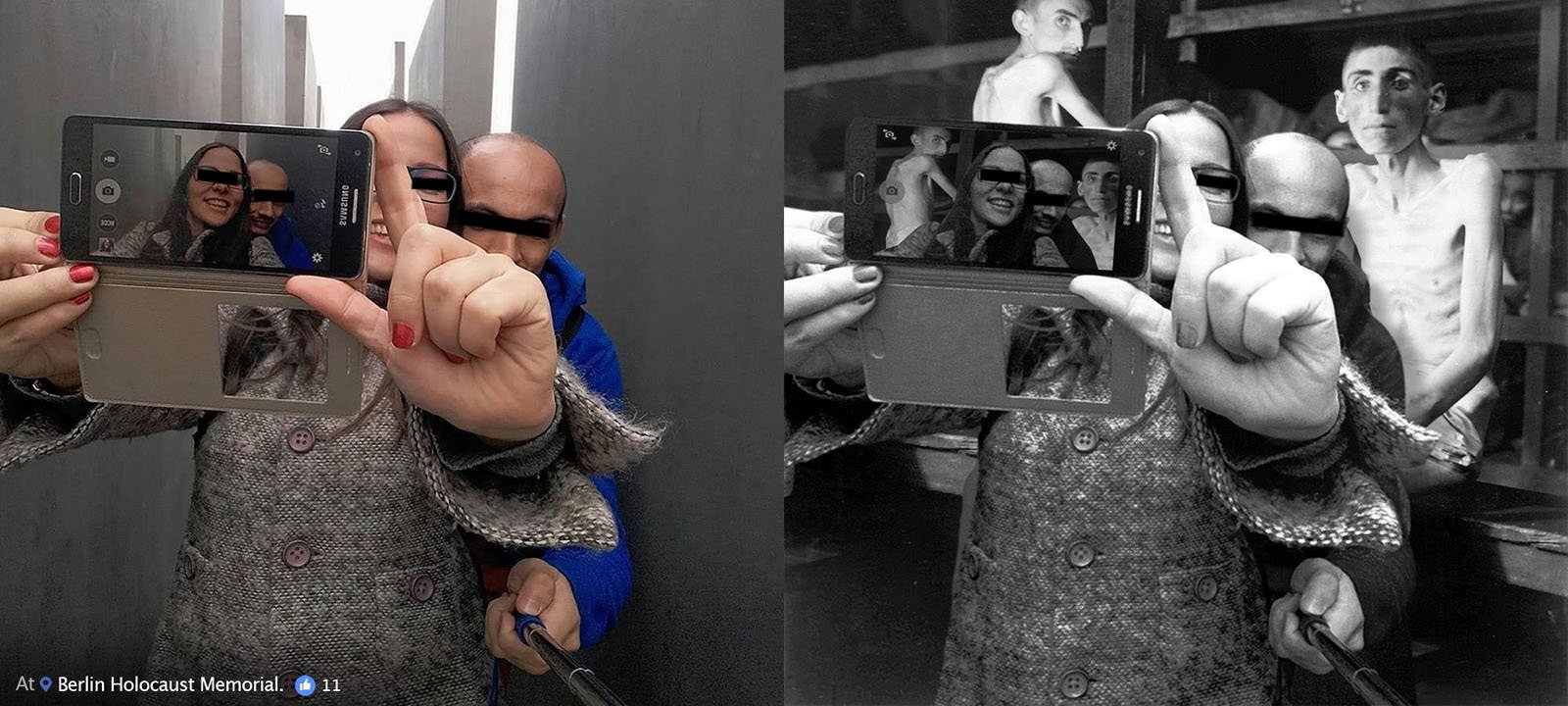
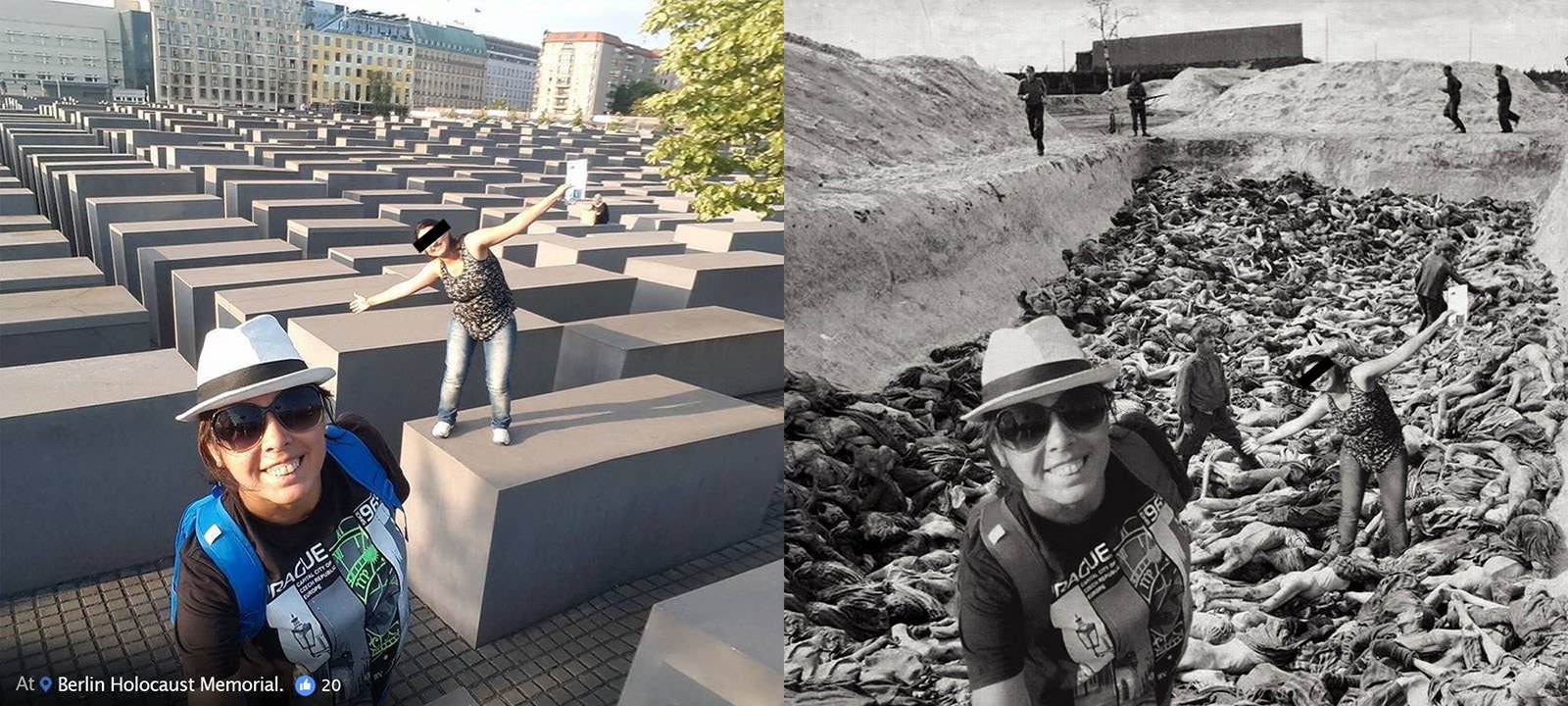
Holocaust memorials are somber places designed to honor the memories of the millions who lost their lives in the genocide, but tourists at the memorials can often be seen posing for lighthearted and disrespectful photos. Jewish artist Shahak Shapira has created a project called Yolocaust to speak out against this.
Warning: This article contains graphic photos of the Holocaust.
Shapira, a satirist based in Berlin, Germany, lives near “The Memorial to the Murdered Jews of Europe” in Berlin, which is a 4.7-acre space covered with 2,711 concrete slabs. It resembles a graveyard, but the designers say it’s an abstract memorial that is open to interpretation.
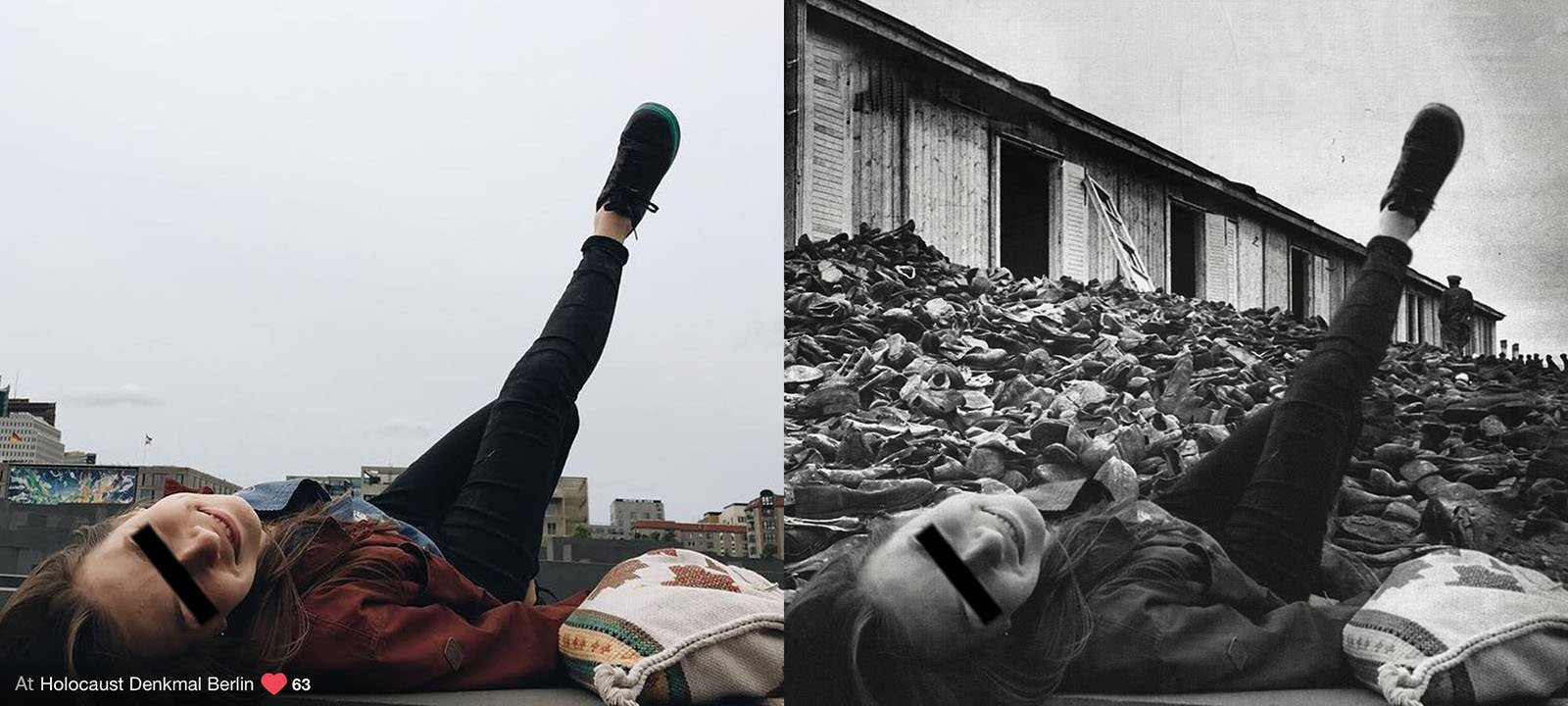
Visitors to the memorial, however, often use the space as a backdrop for all kinds of goofy selfies and photos. To show a different perspective of what these tourists are doing, Shapira gathered some of these photos and Photoshopped the subjects into actual historical (and horrific) photos from Nazi extermination camps.
After launching the project’s website a few days ago, traffic surged as the Photoshopped diptychs went viral, and the hundreds of thousands of visits took down his site for periods of time.
Shapira says he will remove anyone’s photo from his project — all they need to do is email him at undouche.me@yolocaust.de.
Once upon a time, TV’s nerds, geeks, freaks and “poindexters” were woefully confined to the positions of victim, underdog or comic relief, but as geek culture began to grow into its current golden age of mainstream credibility, the archetypal TV nerd has grown with it. Departing from our traditional understanding of alpha-male characters commanding social authority through physical prowess, the alpha-nerd’s dominance is asserted through intellectual superiority.
“Smart is the new sexy,” Stephen Moffat declared through Irene Adler’s mouth in the first season of Sherlock. Moffat’s retooling of Arthur Conan-Doyle’s brilliant detective is the full realization of the alpha-nerd 1.0 design he partially grafted onto The Doctor in Doctor Who, a direct reflection of Chuck Lorre’s Dr. Sheldon Cooper from The Big Bang Theory, and to a certain extent, Hugh Laurie’s Dr. Gregory House from House. Unfortunately, the alpha-nerd has inherited all of his ancestral bully’s bad habits: belittling his ‘inferiors’, equating emotional sensitivity with weakness, and poor treatment of women. It is these traits that expose the underlying toxicity of his sharp wit, making his prominence in otherwise fairly well written TV shows frustratingly off-putting.
First, lets get the ‘sick rather than a dick’ scapegoat theories out of the way. A whole heap as been written online about the possibility that characters like Sherlock Holmes’ and Sheldon Cooper’s socially dysfunctional temperaments are in fact down to undiagnosed disorders like autism and Asperger’s syndrome.
I’ll tackle Sheldon first. Though this reading is a fair one—and even applauded by some in the autism community—it was disproven all the way back in 2009 by co-creator Bill Prady. So, when Sheldon says horrible ‘hilarious’ lines like, “I never said that you’re not good at what you do. It’s just that what you do is not worth doing,” or “It must be humbling to suck on so many different levels,” it’s not because of a developmental disorder of the brain—he’s just a dick. Similarly, when he espouses that, “Sheldon Cooper does not cry,” or that “feelings” belong at a “hippy love-in”, it’s not because he can’t process his or others’ emotions, it’s just that he chooses not to, and uses this choice as a verbal stick with which he beats his underlings into submission.
Unlike Prady, Moffat is unafraid of labels, demonstrated by Sherlock’s self-diagnosis in the pilot: “I’m not a psychopath […] I’m a highly-functioning sociopath, do your research!” Okay, so he gets a free pass for dick-ishness, right? Nope. Someone who actually did her research is psychologist Mary Konnikova. “Psychopaths and sociopaths are the exact same thing,” she explained in an essay for i09. On Holmes’ apparent lack of emotion, she went on to say: “It’s not that he doesn’t experience any emotion. It’s that he has trained himself to not let emotions cloud his judgment.”
Whilst these empathy lobotomies allow for the quick-fire burns these characters are loved for, they still create an inconsistency between what we’re supposed to accept about them and their actions. If the benefit of masterfully controlling your emotions is increased analytical productivity, then why waste the mental on the quips and insults at all?
It’s because it’s not enough to be the smartest of the smart; an alpha-nerd has to constantly assert his intellectual dominance over his peers through degradation of their self-esteem, accomplishments and inability to control their emotions as effectively as he can. In the ‘Jock World’ of the traditional alpha-male, this would be the equivalent of picking smaller dudes up by the lapel and ramming them into lockers.
This makes the women of an alpha-nerd’s world, whom stereotyping dictates as the least able to keep feelings out of their analytical and decision-making processes, attract the most ire from the alpha. (See: most of Sheldon’s interactions with waitress Penny, and likewise for Sherlock with the much-maligned pathologist Molly Hooper.)
Unlike the traditional alpha-male who establishes power through sexual promiscuity, for the alpha-nerd, it is the suppression of these desires that feeds his superiority further. “I’ve always assumed that love is a dangerous disadvantage,” Sherlock tells Irene Adler in “A Scandal in Belgravia.” Yet, this commitment to non-commitment is always tested by a devilish seductress: the ‘mysterious woman’. Though versions of the trope pop up in fiction all over the place, in this context, mysterious women serve as singular female characters who can match or occasionally best the alpha-nerd’s brilliance, as well as try to nullify accusations of poor gender representation. Whereas intelligent men are challengers to the throne, the mysterious woman’s intelligence is at once threatening and alluring. Alluring because she has womanly bits. And she knows what to do with them.
This is where the ‘mysterious’ element lies. Sherlock can ‘read’ anyone to make astounding deductions, so in “The Sign Of Three,” Irene Adler [otherwise known just as “the woman”] confronts him for the first time in the nude, leaving him utterly speechless. Even with her clothes on, she continues to perplex him longer than his male adversaries, as if the absence of a penis is the missing piece of an unsolvable puzzle. This exact dynamic is oddly mirrored in a long-running gag in The Big Bang Theory, in which Raj Koothrappali (part of the ‘beta-nerd’ pack that alpha, Sheldon, hierarchically dominates) suffers from selective muteness in the presence of women. The undertone is that womanly bodies—Medusa-like—are bizarrely capable of bewitching men into stony silence, their intellectualism, normally expressed through their eloquence, rendered ironically impotent by what their bodies’ desire.
Though she is supposed to counter the alpha-nerd’s ‘quirky’ misogyny with antidotal strength and independence, the ‘mysterious woman’ is also disappointingly little else than a gender-flipped version of him. River Song (Irene Adler’s pre-watershed prototype) is part-Time Lord. Irene Adler is Sherlock Holmes if he turned criminal. TBBT’s Amy Farrah Fowler is basically Sheldon Cooper with more estrogen. (A biological difference that the show uses to slowly mutate its most intelligent female character into the ‘clingy girlfriend’ archetype.)
Everything they do centers around the alpha-nerd. That’s why Irene Alder can self-define as gay and still be in love with Sherlock. Or why River Song can travel anywhere in space and time but always end up by the Doctor’s side. Or why three women with nothing in common other than their nerd pack of boyfriends/husbands in TBBT (Penny, Bernadette and Amy) can magically become BFFs.
What may seem like a whole new breed of leading male protagonist on TV, born from the widespread assimilation of nerd culture into the mainstream, is little more than your average alpha-male with an IQ upgrade. Moffat and Lorre simply disguise old-fashioned chauvinism and macho-posturing as ‘endearing’ eccentricity. Sure, the razor-sharp insults might be funny, but as a female viewer, I just can’t bring myself to root for these misogynistic bullies any longer.
Want more stories like this? Become a subscriber and support the site!