Frontiers in Ecology and the Environment, Volume 11, Issue 10, Page 529-534, December 2013.
Despite rising global concerns over the potential impacts of non-native bumble bee (Bombus spp) introductions on native species, large-scale and long-term assessments of the consequences of such introductions are lacking. Bombus ruderatus and Bombus terrestris were sequentially introduced into Chile and later entered Argentina's Patagonian region. A large-scale survey in Patagonia reveals that, in 5 years post-arrival, the highly invasive B terrestris has become the most abundant and widespread Bombus species, and its southward spread is concurrent with the geographic retraction of the only native species, Bombus dahlbomii. Furthermore, a 20-year survey of pollinators of the endemic herb Alstroemeria aurea in northern Patagonia indicates that B ruderatus and B terrestris have replaced B dahlbomii, formerly the most abundant pollinator. Although the decline's underlying mechanisms remain unknown, the potential roles of exploitative competition and pathogen co-introduction cannot be ruled out. Given that invasive bumble bees can rapidly extirpate native congeners, further introductions should be discouraged.
Shared posts
17 Jul 06:36
Rapid ecological replacement of a native bumble bee by invasive species
by onlinepublishing@allenpress.com (Carolina L Morales et al)
15 Jul 17:09
Climate change is happening too quickly for species to adapt
A study has shown that the speed of evolutionary change is far outstripped by the rate of global warming, meaning many creatures will face extinction
15 Jul 17:08
Quebec forest management puts wildlife at risk: biologist
A prominent biologist says that nature can cope with the destruction of thousands of hectares of forest that have burned in northern Quebec in recent weeks but she's not so sure about the effects of human meddling.
15 Jul 17:08
Conservation in a Wicked Complex World; Challenges and Solutions
by Edward Game, Erik Meijaard, Douglas Sheil, Eve McDonald-Madden
Abstract
Most conservation challenges are complex and possess all the characteristics of so called “wicked” problems. Despite widespread recognition of this complexity conservationists possess a legacy of institutional structures, tools and practices better suited to simpler systems. We highlight two specific challenges posed by this mismatch: the difficulty of adaptive management where success is ambiguous and the tension between “best practice” and creativity. Drawing on research in other disciplines (including psychology, information systems, business management, and military strategy) we suggest practices that conservation could consider to better respond to complexity. These practices include, defining clear objectives, the use of scenarios, emphasis on pattern analysis, and ensuring greater scope for creative and decentralized decision making. To help illustrate these challenges and solutions, we point to parallels between conservation and military operations.
15 Jul 17:08
The anthropogenic influence on wildfire regimes: charcoal records from the Holocene and Last Interglacial at Ioannina, Greece
by I. T. Lawson, P. C. Tzedakis, K. H. Roucoux, N. Galanidou
Abstract
Aim
To characterize the changing fire regime of a Mediterranean landscape during the Holocene and the Last Interglacial and, by comparing the two periods, to improve our understanding of the extent and timing of human alteration of natural fire regimes.
Location
Lake Ioannina, north-western Greece (39°45′ N, 20°51′ E).
Methods
Using a long sequence of lake sediments, we measured the charcoal content of the sediment over the course of the Holocene and the Last Interglacial. We compared the charcoal data with pollen data for the same periods.
Results
Charcoal was present in all samples analysed. Charcoal influx was greater during interglacials, which at Ioannina were forested, than during glacials, when tree populations were small. Charcoal influx was greater and more variable during the Holocene than during the Last Interglacial.
Main conclusions
Fire was a persistent feature throughout the periods studied, under both glacial and interglacial conditions. Overall, more biomass was burned during interglacials than during glacials, and peak burning occurred at intermediate values of moisture availability. There is little evidence that the composition of forests significantly affected burning regimes. Enhanced burning during the Holocene relative to the Last Interglacial may reflect human impact, as well as climatic or vegetational differences between the two periods.
15 Jul 17:08
Species-based risk assessments for biological invasions: advances and challenges
by Sabrina Kumschick, David M. Richardson
Abstract
Aim
An increasingly important component of invasive species management involves the formal assessment of risks associated with particular species becoming invasive and causing impact. We evaluated recent developments in risk assessment (RA) for alien species, with special emphasis on species-based pre-border assessments for intentional introductions. Our aim was to identify important advances and key challenges.
Location
Global.
Methods
A literature review was done to determine which approaches have been developed and fine-tuned over the last two decades, which of these have worked best and which are most widely used. We identified priorities for improving our ability to assess risks.
Results
The review is divided into sections on various types and foci of RAs: invasion stage, taxon, ecosystem, assessment method and impact type. RAs for plants are the most advanced, with the Australian Weed Risk Assessment (A-WRA) being the most widely applied and tested protocol. Based on the history of the A-WRA, we highlight advances that have been made in assessing risk of alien species for pre-border control and identify remaining challenges.
Main conclusions
Currently available RAs have proven to be cost-effective, but there is room for substantial improvement. Further work is needed to separate likelihood and consequence more explicitly, and provide better and more objective means for assessing risks of impact. Types and levels of uncertainty need to be more effectively incorporated. Advanced RA protocols are needed for taxa other than plants and vertebrates. The latest insights from research in invasion ecology need to be incorporated, and advances in other fields must also be taken into account.
15 Jul 17:08
Niche conservatism constrains Australian honeyeater assemblages in stressful environments
by E. T. Miller, A. E. Zanne, R. E. Ricklefs
Abstract
The hypothesis of phylogenetic niche conservatism proposes that most extant members of a clade remain in ancestral environments because expansion into new ecological space imposes a selectional load on a population. A prediction that follows is that local assemblages contain increasingly phylogenetically clustered subsets of species with increasing difference from the ancestral environment of a clade. We test this in Australian Meliphagidae, a continental radiation of birds that originated in wet, subtropical environments, but subsequently spread to drier environments as Australia became more arid during the late Cenozoic. We find local assemblages are increasingly phylogenetically clustered along a gradient of decreasing precipitation. The pattern is less clear along a temperature gradient. We develop a novel phyloclimatespace to visualise the expansion of some lineages into drier habitats. Although few species extend into arid regions, those that do occupy larger ranges and thus local species richness does not decline predictably with precipitation.
13 Jul 20:39
Seed arrival in tropical forest tree fall gaps
by onlinepublishing@allenpress.com (Carolina Puerta-Piñero et al)
Ecology, Volume 94, Issue 7, Page 1552-1562, July 2013.
Tree deaths open gaps in closed-canopy forests, which allow light to reach the forest floor and promote seed germination and seedling establishment. Gap dependence of regeneration is an important axis of life history variation among forest plant species, and many studies have evaluated how plant species differ in seedling and sapling performance in gaps. However, relatively little is known about how seed arrival in gaps compares with seed arrival in the understory, even though seed dispersal by wind and animals is expected to be altered in gaps. We documented seed arrival for the first seven years after gap formation in the moist tropical forests of Barro Colorado Island (BCI), Panama, and evaluated how the amount and functional composition of arriving seeds compared with understory sites. On average, in the first three years after gap formation, 72% fewer seeds arrived in gaps than in the understory (207 vs. 740 seeds·m−2·yr−1). The reduction in number of arriving seeds fell disproportionately on animal-dispersed species, which suffered an 86% reduction in total seed number, while wind-dispersed species experienced only a 47% reduction, and explosively dispersed species showed increased seed numbers arriving. The increase in explosively dispersed seeds consisted entirely of the seeds of several shrub species, a result consistent with greater in situ seed production by explosively dispersed shrubs that survived gap formation or recruited immediately thereafter. Lianas did relatively better in seed arrival into gaps than did trees, suffering less of a reduction in seed arrival compared with understory sites. This result could in large part be explained by the greater predominance of wind dispersal among lianas: there were no significant differences between lianas and trees when controlling for dispersal syndromes. Our results show that seed arrival in gaps is very different from seed arrival in the understory in both total seeds arriving and functional composition. Differential seed arrival in gaps will help to maintain wind-dispersed, explosively dispersed, and possibly other understory species in the community of plants that regenerate in gaps.
Tree deaths open gaps in closed-canopy forests, which allow light to reach the forest floor and promote seed germination and seedling establishment. Gap dependence of regeneration is an important axis of life history variation among forest plant species, and many studies have evaluated how plant species differ in seedling and sapling performance in gaps. However, relatively little is known about how seed arrival in gaps compares with seed arrival in the understory, even though seed dispersal by wind and animals is expected to be altered in gaps. We documented seed arrival for the first seven years after gap formation in the moist tropical forests of Barro Colorado Island (BCI), Panama, and evaluated how the amount and functional composition of arriving seeds compared with understory sites. On average, in the first three years after gap formation, 72% fewer seeds arrived in gaps than in the understory (207 vs. 740 seeds·m−2·yr−1). The reduction in number of arriving seeds fell disproportionately on animal-dispersed species, which suffered an 86% reduction in total seed number, while wind-dispersed species experienced only a 47% reduction, and explosively dispersed species showed increased seed numbers arriving. The increase in explosively dispersed seeds consisted entirely of the seeds of several shrub species, a result consistent with greater in situ seed production by explosively dispersed shrubs that survived gap formation or recruited immediately thereafter. Lianas did relatively better in seed arrival into gaps than did trees, suffering less of a reduction in seed arrival compared with understory sites. This result could in large part be explained by the greater predominance of wind dispersal among lianas: there were no significant differences between lianas and trees when controlling for dispersal syndromes. Our results show that seed arrival in gaps is very different from seed arrival in the understory in both total seeds arriving and functional composition. Differential seed arrival in gaps will help to maintain wind-dispersed, explosively dispersed, and possibly other understory species in the community of plants that regenerate in gaps.
13 Jul 20:38
Long-term effects of fire severity on oak–conifer dynamics in the southern Cascades
by onlinepublishing@allenpress.com (Matthew I. Cocking et al)
Ecological Applications, Volume 24, Issue 1, Page 94-107, January 2014.
We studied vegetation composition and structure in a mixed conifer–oak ecosystem across a range of fire severity 10 years following wildfire. Sample plots centered on focal California black oaks (Quercus kelloggii) were established to evaluate oak and neighboring tree and shrub recovery across a gradient of fire severity in the southern Cascade Range, USA. Shrub and oak resprouting was strongest around focal oaks where conifer mortality was greatest. Linear modeling revealed negative relationships between California black oak sprout height or basal area and residual overstory tree survival, primarily white fir (Abies concolor). The two dominant competing species, California black oak and white fir, showed opposite responses to fire severity. Sprouting California black oak and associated shrubs dominated in severely burned areas, while surviving, non-sprouting white fir maintained dominance by its height advantage and shading effects in areas that burned with low fire severity. Our results indicate that high-severity fire promotes persistence and restoration of ecosystems containing resprouting species, such as California black oak, that are increasingly rare due to widespread fire exclusion in landscapes that historically experienced more frequent fire. We present a conceptual model based on our results and supported by a synthesis of postfire resprouting dynamics literature. Our results and conceptual model help illuminate long-term postfire vegetation responses and the potential ability of fire to catalyze formation of alternate vegetation community structures that may not be apparent in studies that evaluate postfire effects at shorter time-since-fire intervals or at coarser scales.
We studied vegetation composition and structure in a mixed conifer–oak ecosystem across a range of fire severity 10 years following wildfire. Sample plots centered on focal California black oaks (Quercus kelloggii) were established to evaluate oak and neighboring tree and shrub recovery across a gradient of fire severity in the southern Cascade Range, USA. Shrub and oak resprouting was strongest around focal oaks where conifer mortality was greatest. Linear modeling revealed negative relationships between California black oak sprout height or basal area and residual overstory tree survival, primarily white fir (Abies concolor). The two dominant competing species, California black oak and white fir, showed opposite responses to fire severity. Sprouting California black oak and associated shrubs dominated in severely burned areas, while surviving, non-sprouting white fir maintained dominance by its height advantage and shading effects in areas that burned with low fire severity. Our results indicate that high-severity fire promotes persistence and restoration of ecosystems containing resprouting species, such as California black oak, that are increasingly rare due to widespread fire exclusion in landscapes that historically experienced more frequent fire. We present a conceptual model based on our results and supported by a synthesis of postfire resprouting dynamics literature. Our results and conceptual model help illuminate long-term postfire vegetation responses and the potential ability of fire to catalyze formation of alternate vegetation community structures that may not be apparent in studies that evaluate postfire effects at shorter time-since-fire intervals or at coarser scales.
13 Jul 07:00
Relationships between grizzly bears and human disturbances in a rapidly changing multi-use forest landscape
Publication date: October 2013
Source:Biological Conservation, Volume 166
Author(s): Julia Linke , Gregory J. McDermid , Marie-Josée Fortin , Gordon B. Stenhouse
Grizzly bear (Ursus arctos) populations across their range are being threatened by anthropogenic development and associated increases in human-caused mortality. However, details surrounding the impact of cumulative human effects are not yet fully understood, as prior research has focused primarily on habitat selection of individual disturbance features, rather than the spatio-temporal dynamics of aggregated disturbance processes. We used grizzly bear relative-abundance information from a DNA population inventory alongside a GIS database of human footprint dynamics to gain insight into the relationships between human disturbance features and the spatial distribution of grizzly bears in west-central Alberta, Canada: a landscape experiencing heavy resource development. We used candidate model-selection techniques and zero-inflated Poisson regression models to test competing hypotheses about disturbance processes, neighborhood effect and landscape characteristics. The best model explained about 57% of the overall variation in relative grizzly bear abundance. Areas with lower ‘disturbance exposure’ (i.e. high mean distance to new disturbances over time), lower ‘neighborhood disturbance’ (i.e. disturbance density around those areas), and higher ‘availability of regenerating forest’, were associated with higher bear abundance. In addition, areas located further away from an adjacent protected area exhibited a higher probability of ‘excess absences’, accounting indirectly for the cumulative effects of disturbance and the history of human-caused mortality. Our results suggest that managing the spatio-temporal exposure of grizzly bears to new disturbance features may be an important consideration for conserving this species in rapidly changing landscapes.
Source:Biological Conservation, Volume 166
Author(s): Julia Linke , Gregory J. McDermid , Marie-Josée Fortin , Gordon B. Stenhouse
Grizzly bear (Ursus arctos) populations across their range are being threatened by anthropogenic development and associated increases in human-caused mortality. However, details surrounding the impact of cumulative human effects are not yet fully understood, as prior research has focused primarily on habitat selection of individual disturbance features, rather than the spatio-temporal dynamics of aggregated disturbance processes. We used grizzly bear relative-abundance information from a DNA population inventory alongside a GIS database of human footprint dynamics to gain insight into the relationships between human disturbance features and the spatial distribution of grizzly bears in west-central Alberta, Canada: a landscape experiencing heavy resource development. We used candidate model-selection techniques and zero-inflated Poisson regression models to test competing hypotheses about disturbance processes, neighborhood effect and landscape characteristics. The best model explained about 57% of the overall variation in relative grizzly bear abundance. Areas with lower ‘disturbance exposure’ (i.e. high mean distance to new disturbances over time), lower ‘neighborhood disturbance’ (i.e. disturbance density around those areas), and higher ‘availability of regenerating forest’, were associated with higher bear abundance. In addition, areas located further away from an adjacent protected area exhibited a higher probability of ‘excess absences’, accounting indirectly for the cumulative effects of disturbance and the history of human-caused mortality. Our results suggest that managing the spatio-temporal exposure of grizzly bears to new disturbance features may be an important consideration for conserving this species in rapidly changing landscapes.
12 Jul 18:31

Pulp feeders alter plant interactions with subsequent animal associates
by José M. Fedriani, Miguel Delibes
Summary
- Community context can alter the likelihood of interactions among community members and thus exert critical ecological effects with potential evolutionary implications. For instance, plant–animal mutualisms can be exploited by third species that usurp the resources and/or service that the mutualists offer, while delivering limited or no benefits in return.
- We experimentally revealed for the first time how exploiters of plant–disperser mutualisms (i.e. pulp feeders) alter the frequency of plant interactions with subsequent mutualistic (seed dispersers) and antagonistic (seed predators) animal associates. In doing so, we chose to study the endozoochore Pyrus bourgaeana, which interacts with a diverse assemblage of frugivores including exploiters (pulp-feeding rabbits), legitimate seed dispersers (mammalian carnivores) and seed and fruit predators (rodents and deer, respectively). We hypothesized that pulp feeders would render fruit barely rewarding, affecting subsequent tree–animal interactions.
- As predicted, pulp removal lessened tree dispersal success (i.e. lowered interaction frequency with seed dispersers) causing an indirect negative effect on its fitness. Furthermore, pulp feeders facilitated foraging by seed-eating rodents, leading to a negative indirect effect on seed survival. Nonetheless, these negative effects of pulp removal on tree fitness were partly counterbalanced by a noticeable decrease in fruit predation by deer. Because both seed dispersers and seed predators preferred large fruits, they exerted selection pressures on fruit size in opposite directions; thus, the net selection regime on fruit size experienced by the tree appeared largely contingent on community composition.
- Synthesis. Our results illustrate how interactions among functionally distinct frugivores can act synergistically or antagonistically and thus alter their ecological outcomes in ways that differ from those predicted by pairwise interactions. Further research on the relationships between fruiting plants and their consumers will certainly further our understanding of how community context can modify ecological and evolutionary outcomes of complex multispecies interactions.

We experimentally revealed for the first time how exploiters of plant-disperser mutualisms alter the frequency of plant interactions with subsequent mutualistic and antagonistic animal associates. We exemplify how fruiting plants and their consumers are valuable systems to further our understanding of how community context can alter ecological and evolutionary outcomes of multispecies interactions, opening up a new avenue of research.
12 Jul 18:30
Una nova eina virtual per descobrir les col·leccions del museu: Taxo&Map
by Cristi
Introducció
El museu disposa d’una eina genuïna per abocar les dades de les col·leccions a Internet. L’aplicació Taxo&Map projecta sobre un mapa del món l’origen de les col·leccions del museu alhora que la selecció del grup biològic a partir d’un arbre taxonòmic permet en tot moment practicar la cerca sobre les col·leccions documentades del Museu de Ciències Naturals de Barcelona.
Taxo&Map es presenta com una eina de consulta desenfadada, on es possible fer cerques per curiositat o per interès concret. No cal fer-se preguntes sobre què pot haver o no a les col·leccions del museu perquè les dades estan visibles en tot moment: només cal aprofundir o allunyar-se en el detall del mapa o del terme que defineix els organismes. Actualment s’hi projecten les col·leccions ja digitalitzades de zoologia i en breu s’espera poder-hi incorporar dades de la col·lecció de l’herbari i de paleontologia.
Taxo&Map és un projecte dels departaments de col·leccions, suscitat per una convicció. Assumim la responsabilitat d’aconseguir un ús el més eficient possible per part dels ciutadans, experts o no, de la informació que carrega el patrimoni de les col·leccions del museu.
Pel fet de tractar-se d’una aplicació sensible a les necessitats d’informació de la comunitat científica i de la resta de la societat en les diverses modalitats d’ús que això pot suposar estem oberts a la crítica i a la col·laboració.
Un nou model de cerca
Qui s’interessa pel sentit dels museus de ciències naturals acostuma a tenir una sorpresa: el fons de col·leccions d’aquests museus sobrepassa en molt i moltíssim la breu selecció de mostres que es poden exhibir a les sales d’exposició. Malgrat la sospita d’ocultació que es pugui deduir, aquest enorme iceberg té una fàcil explicació. Les col·leccions dels museus de ciències naturals obeeixen essencialment a criteris de metodologia científica per poder formar part del circuit d’elaboració del coneixement de la natura. Des d’aquesta perspectiva les sèries de mostres necessàries i les modalitats de conservació i d’estudi s’aparten del que són les exigències de les exposicions.
Hi ha molta vida als museus de ciències naturals més enllà de les exposicions. Un dels reptes que de forma més constant han d’enfrontar aquests centres és fer accessible el conjunt dels seus fons, per no reservar res del seu patrimoni al públic. A més de sol·licitar una consulta directa a les col·leccions el museu ofereix espais de consulta a Internet. En el disseny i profunditat dels serveis remots de consulta s’hi juga avui en dia el 95% de la raó de ser del patrimoni de col·leccions. Sense ús aquestes mostres no tenen sentit i sense difusió no poden tenir ús.
La fórmula més directa per facilitar la informació de les col·leccions consisteix en oferir un formulari de consulta. El MCNB va obrir aquest servei fa anys:
- Zoologia en línia: http://zoologiaenlinia.bcn.cat/eMuseumPlus
- Geologia en línia: http://geologiaenlinia.bcn.cat/eMuseumPlus
Les consultes adreçades a cercar elements particulars d’una espècie o un àmbit geogràfic definits són les més apropiades per ser resoltes en aquest model de formulari de cerca. Ara el museu disposa d’una altra forma de descobrir les col·leccions que consisteix en mostrar tots els registres i facilitar la immersió entre les dades. Els formularis de cerca responen amb resultats o amb silenci quan les condicions d ela cerca no coincideixen amb cap registre que les acompleixi.
En el model de cerca per immersió les dades estan sempre visibles i només cal aprofundir per localitzar les que puguin interessar. La consulta admet l’especulació, les proves no orientades, suporta visions de conjunt, en definitiva complementa la funció del formulari de cerca.
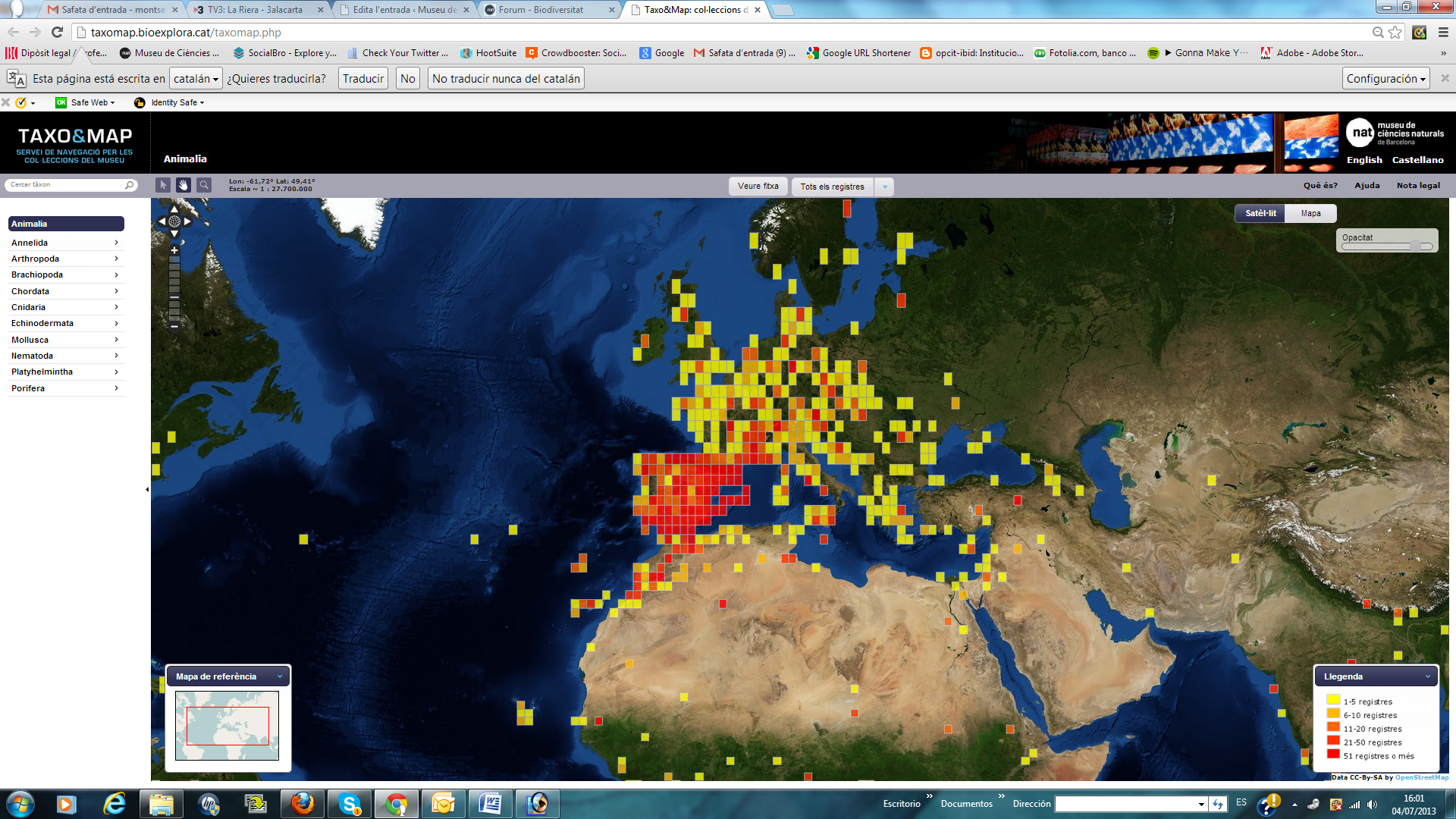
El desenvolupament de Taxo&Map
Des del propi museu s’han obert projectes per desdoblar les vies de consulta de les col·leccions amb l’objectiu sempre present de difondre la informació d’aquestes de tantes formes com sigui possible per convertir les col·leccions amb un instrument útil pel coneixement i d’aplicació oberta per part dels ciutadans.
L’aplicació web Taxo&Map [1] hereta l’experiència desenvolupada pel museu amb l’empresa Bestiario [2] l’any 2009 consistent en dos dispositius de consulta a les col·leccions segons el principi d’immersió en les dades. Cadascuna de les dues eines explotava un sistema de zoom i exploració de mapes de continguts: l’un el de la taxonomia zoològica i l’altre una capa cartogràfica de tot el món. La interactivitat i l’agilitat de desplaçament entre espais de significació donaven suport a consultes directes, intuïtives o purament a l’atzar.
El segon pas es va donar l’any 2012 en plantejar-se la combinació dels dos factors principals de cerca en col·leccions de ciències naturals com són el tipus d’organismes i la presència en en un mapa. L’empresa GeoData [3] escomet una renovació del model de consulta de col·leccions i aborda l’elaboració d’una eina web més tècnica sense perdre consistència les qualitats de cerca interactiva. Des de l’any 2011 el desenvolupament de Taxo&Map és fruit d’una molt fructífera col·laboració de Martí Pericay [4] amb el museu.
Les aplicacions de Bestiario van néixer a l’entorn de l’exposició “Exploradors” [5] en forma de dues versions: una per a Internet i una altra més reduïda per ser consulta en l’espai físic de l’exposició. Taxo&Map també pren aire de la doble intenció: una presentació a l’espai “Classificació i nomenclatura” de l’exposició plantada al Museu Blau i una altra versió molt més complerta per a Internet: http://taxomap.bioexplora.cat . Aquesta duplicitat és intencional i es mantindrà en el futur.
Taxo&Map ara mateix
Per a qui pugui tenir interès en característiques tècniques de més detall es disposa de documentació al respecte en condicions de ser distribuïda. Avancem ara alguns aspectes que donen personalitat a Taxo&Map:
- Es presenta en tres versions idiomàtiques: català, castellà i anglès.
- El mapa de fons prové del projecte OpenStreetMap [6], l’ autoanomenat “mapa wiki lliure mundial”.
- La base de dades interna segueix l’estructura de l’estàndard de disseminació de dades de biodiversitat Darwin Core [7].
- Les dades seleccionades es poden exportar per a una ràpida i eficient reutilització en format CSV (taula de dades), KML (Google Earth) o SHP (shape per a Sistemes d’Informació Geogràfica).
- Els components i el codi de la pròpia aplicació són oberts i estan publicats.
- Cada element del tesaurus de noms científics està vinculat a diversos serveis d’informació de biodiversitat de reconeixement mundial; per aquesta via el museu pretén crear successius recursos propis per ajudar a la cerca de dades per part de persones no expertes.
- S’han inclòs referències explícites a l’aplicació de llicències open data per a l’ús dels continguts consultats.
Taxo&Map en el futur
Taxo&Map representa un primer estadi de comunicació, però estem iniciant una segona trajectòria que ha de portar a poder fer-hi consultes a partir de més criteris: noms comuns, característiques morfològiques, etc.
Taxo&Map és una eina que té previst un llarg recorregut, on s’espera incrementar les fonts documentals de col·leccions del museu en paral·lel a l’esforç de digitalització que s’està realitzant de forma molt activa. També es preveu la incorporació de components de divulgació associats a recursos de visualització i de consulta que ampliïn la perspectiva dels tècnics o experts a tothom. Per últim, l’estructura de l’eina podria servir per visualitzar no només les col·leccions del museu sinó també de combinacions diverses d’institucions o de xarxes fins i tot de centres i museus.
Referències
12 Jul 06:28
Green economy would highlight full value of forests
As more developing countries plan to make the transition to a green economy-defined as "low carbon, resource efficient and socially inclusive"-the spotlight is turning on the "true" value of forests.
12 Jul 06:28
Conserving tropical biodiversity via strategic spatiotemporal harvest planning
by Benjamin S. Ramage, Elaina C. Marshalek, Justin Kitzes, Matthew D. Potts
Summary
- Tropical timber production forests have the potential to harbour many species, but landscape-level management strategies for minimizing extinctions are lacking.
- To develop relevant conservation guidelines, we investigated how harvest plans with different spatiotemporal patterns affected the persistence of sessile species with different traits and preharvest characteristics. We confronted this problem via an individual-based simulation model.
- We explored several harvest plans with different levels of spatiotemporal aggregation, but equivalent total harvest area, and found that extinction probabilities for each plan varied with species traits and predisturbance characteristics. Most notably, plans with large contiguous harvest units yielded particularly high extinction probabilities for dispersal-limited habitat specialists with clustered preharvest distributions. Differences between plans were small for some types of species, but highly aggregated plans yielded the highest extinction rates for all extinction-prone groups.
- Synthesis and applications. Our simulations suggest that reducing the size of contiguous harvest units, even while total harvest area remains constant, may reduce extinction rates in tropical production forests (assuming that road-related threats can be effectively managed). Our findings have important implications for tropical conservation efforts and also provide general insight into the compositional effects of disturbances with different spatiotemporal characteristics.
12 Jul 06:28
Impact of sea level rise on the 10 insular biodiversity hotspots
by Céline Bellard, Camille Leclerc, Franck Courchamp
Abstract
Aim
Despite considerable attention to climate change, no global assessment of the consequences of sea level rise is available for insular ecosystems. Yet, over 180,000 islands world-wide contain 20% of the world's biodiversity. We investigated the consequences of sea level rise for the 10 insular biodiversity hotspots world-wide and their endemic species. This assessment is crucial to identify areas with the highest risk of inundation and the number of endemic species at risk of potential extinction.
Location
Ten insular biodiversity hotspots including the Caribbean islands, the Japanese islands, the Philippines, the East Melanesian islands, Polynesia-Micronesia, Sundaland, Wallacea, New Caledonia, New Zealand and Madagascar and the Indian Ocean islands (i.e. 4447 islands).
Methods
We investigated four scenarios of projected sea level rise (1, 2, 3 and 6 m) on these islands. For each scenario, we assessed the number of islands that would be entirely and partially submerged by overlying precise digital elevation model and island data. We estimated the number of endemic species for each taxon (i.e. plants, birds, reptiles, mammals, amphibians and fishes) potentially affected by insular habitat submersion using the endemic–area relationship.
Results
Between 6 and 19% of the 4447 islands would be entirely submerged under considered scenarios (1–6 m of sea level rise). Three hotspots displayed the most significant loss of insular habitat: the Caribbean islands, the Philippines and Sundaland, representing a potential threat for 300 endemic species.
Main conclusions
With the current estimates of global sea level rise of at least 1 m by 2100, large parts of ecosystems of low-lying islands are at high risk of becoming submerged, leading to significant habitat loss world-wide. Therefore, the threat posed by sea level rise requires specific policies that prioritize insular biota on islands at risk as a result of near future sea level rise.
12 Jul 06:27
Integration of ecological and socio-economic factors to assess global vulnerability to wildfire
by Emilio Chuvieco, Susana Martínez, María Victoria Román, Stijn Hantson, M. Lucrecia Pettinari
Abstract
Aim
This paper presents a map of global fire vulnerability, estimating the potential damage of wildland fires to global ecosystems.
Location
Global scale at 0.5° grid resolution.
Methods
Three vulnerability factors were considered: ecological richness and fragility, provision of ecosystem services and value of houses in the wildland–urban interface. Each of these factors was estimated from existing global databases. Ecological values were estimated from biodiversity relevance, conservation status and fragmentation based on Olson's ecoregions. The ecological regeneration delay was estimated from adaptation to fires and soil erosion potential. The former was assessed by comparing actual land cover with fire-off simulations based on a dynamic global vegetation model (ORCHIDEE). The annual loss of ecosystem services was estimated with values transferred from other studies and loss coefficients. This was integrated throughout time by considering the regeneration delay. Value of houses was estimated at country level according to the market prices of real-estate and land, the level of economic development and the population density. Economic and ecological evaluations were merged through cross-tabulation logic to obtain qualitative ranks of fire vulnerability.
Results
The most vulnerable areas were found to be the rain forest of the Amazon Basin, Central Africa and Southeast Asia, the temperate forest of Europe, South America and north-east America, and the ecological corridors of Central America and Southeast Asia. The lowest vulnerability was observed in boreal regions, particularly those already affected by fires or having low biodiversity, agricultural regions of Australia, India, Latin America and Central Asia.
Main conclusions
This is the first attempt to produce a map of global fire vulnerability, based on a wide variety of factors related to the impacts of fire on ecological and socio-economic values. This product will help current efforts to model future scenarios of the impacts of biomass burning for different climate and land-use scenarios.
10 Jul 21:58
Using economic instruments to develop effective management of invasive species: insights from a bioeconomic model
by onlinepublishing@allenpress.com (Shana M. McDermott et al)
Ecological Applications, Volume 23, Issue 5, Page 1086-1100, July 2013.
Economic growth is recognized as an important factor associated with species invasions. Consequently, there is increasing need to develop solutions that combine economics and ecology to inform invasive species management. We developed a model combining economic, ecological, and sociological factors to assess the degree to which economic policies can be used to control invasive plants. Because invasive plants often spread across numerous properties, we explored whether property owners should manage invaders cooperatively as a group by incorporating the negative effects of invader spread in management decisions (collective management) or independently, whereby the negative effects of invasive plant spread are ignored (independent management). Our modeling approach used a dynamic optimization framework, and we applied the model to invader spread using Linaria vulgaris. Model simulations allowed us to determine the optimal management strategy based on net benefits for a range of invader densities. We found that optimal management strategies varied as a function of initial plant densities. At low densities, net benefits were high for both collective and independent management to eradicate the invader, suggesting the importance of early detection and eradication. At moderate densities, collective management led to faster and more frequent invader eradication compared to independent management. When we used a financial penalty to ensure that independent properties were managed collectively, we found that the penalty would be most feasible when levied on a property's perimeter boundary to control spread among properties. At the highest densities, the optimal management strategy was “do nothing” because the economic costs of removal were too high relative to the benefits of removal. Spatial variation in L. vulgaris densities resulted in different optimal management strategies for neighboring properties, making a formal economic policy to encourage invasive species removal critical. To accomplish the management and enforcement of these economic policies, we discuss modification of existing agencies and infrastructure. Finally, a sensitivity analysis revealed that lowering the economic cost of invader removal would strongly increase the probability of invader eradication. Taken together, our results provide quantitative insight into management decisions and economic policy instruments that can encourage invasive species removal across a social landscape.
Economic growth is recognized as an important factor associated with species invasions. Consequently, there is increasing need to develop solutions that combine economics and ecology to inform invasive species management. We developed a model combining economic, ecological, and sociological factors to assess the degree to which economic policies can be used to control invasive plants. Because invasive plants often spread across numerous properties, we explored whether property owners should manage invaders cooperatively as a group by incorporating the negative effects of invader spread in management decisions (collective management) or independently, whereby the negative effects of invasive plant spread are ignored (independent management). Our modeling approach used a dynamic optimization framework, and we applied the model to invader spread using Linaria vulgaris. Model simulations allowed us to determine the optimal management strategy based on net benefits for a range of invader densities. We found that optimal management strategies varied as a function of initial plant densities. At low densities, net benefits were high for both collective and independent management to eradicate the invader, suggesting the importance of early detection and eradication. At moderate densities, collective management led to faster and more frequent invader eradication compared to independent management. When we used a financial penalty to ensure that independent properties were managed collectively, we found that the penalty would be most feasible when levied on a property's perimeter boundary to control spread among properties. At the highest densities, the optimal management strategy was “do nothing” because the economic costs of removal were too high relative to the benefits of removal. Spatial variation in L. vulgaris densities resulted in different optimal management strategies for neighboring properties, making a formal economic policy to encourage invasive species removal critical. To accomplish the management and enforcement of these economic policies, we discuss modification of existing agencies and infrastructure. Finally, a sensitivity analysis revealed that lowering the economic cost of invader removal would strongly increase the probability of invader eradication. Taken together, our results provide quantitative insight into management decisions and economic policy instruments that can encourage invasive species removal across a social landscape.
10 Jul 05:44
Migratory and resident Blackcaps Sylvia atricapilla wintering in southern Spain show no resource partitioning
by José Luis Tellería, María Blázquez, Iván De La Hera, Javier Pérez-Tris
When different populations of the same bird species share non-breeding habitats, competition for food may promote resource partitioning. We studied food choice by resident and migratory Blackcaps Sylvia atricapilla in sympatric wintering grounds in southern Spain. Resident Blackcaps have a larger bill, which may allow them to feed on a broader range of fruit sizes, and they may know the distribution of food better than do migrants. Based on fruit and bird counts, we transformed both fruit crop and bird abundance to a common energy currency. During two winters with low and high fruit production, available energy from fruit in mid-January was estimated to be 80 and 1300 times, respectively, the daily requirements of Blackcaps. Furthermore, Blackcap numbers did not track between-winter changes in fruit abundance during 10 consecutive years of monitoring, further suggesting that fruit food is not limiting. Analysis of food items from 760 samples of 717 individuals showed that migrants and residents fed primarily on fruits of Wild Olive Olea europaea sylvestris, the most energetic fruit resource. There was no evidence that the larger bills of resident Blackcaps provided any foraging benefit. Migratory Blackcaps fed on Wild Olives and invertebrates, two resources with high energetic and structural value, more frequently than did residents. This food choice could be more important for migratory Blackcaps because they have lower body mass to reduce wing load. Our results suggest that the wintering grounds of Blackcaps in Iberia provide abundant food that is used by sympatric migrants and residents without resource partitioning. Slight differences in food choice suggest that migrants might benefit from feeding on more nutritive food than residents to counteract the energetic constraints associated with a smaller body size.
07 Jul 07:36

Determinants of extinction-colonization dynamics in Mediterranean butterflies: the role of landscape, climate and local habitat features
by Albert Fernàndez-Chacón, Constantí Stefanescu, Meritxell Genovart, James D. Nichols, James E. Hines, Ferran Páramo, Marco Turco, Daniel Oro
Summary
-
Many species are found today in the form of fragmented populations occupying patches of remnant habitat in human-altered landscapes. The persistence of these population networks requires a balance between extinction and colonization events assumed to be primarily related to patch area and isolation, but the contribution of factors such as the characteristics of patch and matrix habitats, the species' traits (habitat specialization and dispersal capabilities) and variation in climatic conditions have seldom been evaluated simultaneously.
-
The identification of environmental variables associated with patch occupancy and turnover may be especially useful to enhance the persistence of multiple species under current global change. However, for robust inference on occupancy and related parameters, we must account for detection errors, a commonly overlooked problem that leads to biased estimates and misleading conclusions about population dynamics.
-
Here, we provide direct empirical evidence of the effects of different environmental variables on the extinction and colonization rates of a rich butterfly community in the western Mediterranean. The analysis was based on a 17-year data set containing detection/nondetection data on 73 butterfly species for 26 sites in north-eastern Spain. Using multiseason occupancy models, which take into account species' detectability, we were able to obtain robust estimates of local extinction and colonization probabilities for each species and test the potential effects of site covariates such as the area of suitable habitat, topographic variability, landscape permeability around the site and climatic variability in aridity conditions.
-
Results revealed a general pattern across species with local habitat composition and landscape features as stronger predictors of occupancy dynamics compared with topography and local aridity. Increasing area of suitable habitat in a site strongly decreased local extinction risks and, for a number of species, both higher amounts of suitable habitat and more permeable landscapes increased colonization rates. Nevertheless, increased topographic variability decreased the extinction risk of bad dispersers, a group of species with significantly lower colonization rates.
-
Our models predicted higher sensitivity of the butterfly assemblages to deterministic changes in habitat features rather than to stochastic weather patterns, with some relationships being clearly dependent on the species' traits.

By applying multiseason occupancy models to 73 species' detection–nondetection data sets, this study provides insights about the roles of different habitat, landscape and environmental features on the extinction–colonization patterns of Mediterranean butterflies, thus providing useful information for the conservation of butterfly diversity in the Mediterranean region under current global change.
Tyson Wepprich likes this
06 Jul 09:19
Vulnerability of baobab species to climate change and effectiveness of the protected area network in Madagascar: Towards new conservation priorities
Publication date: October 2013
Source:Biological Conservation, Volume 166
Author(s): Ghislain Vieilledent , Cyrille Cornu , Aida Cuní Sanchez , Jean-Michel Leong Pock-Tsy , Pascal Danthu
Baobab species are representative of the high biodiversity and endemism rates that place Madagascar in the top three of the countries with the highest biodiversity in the world. In this study, we estimated the vulnerability of three endangered Malagasy baobab species (Adansonia grandidieri Baill., Adansonia perrieri Capuron and Adansonia suarezensis H. Perrier) to climate change and the effectiveness of the protected area network (PAN) for the future conservation of these species. To estimate the environmental niche of the species, we used an original data-set based on satellite image analysis to detect species presence and an ensemble modelling approach using three species distribution models (GLM, GAM and MaxEnt). We projected the species distribution in 2050 and 2080 using an ensemble forecasting approach combining the three species distribution models and three global circulation models for climate projections. Measures of connectivity were employed to assess the present and future effectiveness of the existing PAN. Among the three baobab species studied, two are severely threatened by climate change (A. perrieri and A. suarezensis), in part because the present PAN does not overlap with future species distribution areas. Recently, strong efforts have been made in designing an optimised PAN to conserve Madagascar outstanding biodiversity. Nevertheless, its future effectiveness is questioned by the potential shifts in species distributions due to predicted changes in climate. In the context of climate change, alternative strategies such as ecological restoration would also have to be adopted to conserve biodiversity in Madagascar.
Source:Biological Conservation, Volume 166
Author(s): Ghislain Vieilledent , Cyrille Cornu , Aida Cuní Sanchez , Jean-Michel Leong Pock-Tsy , Pascal Danthu
Baobab species are representative of the high biodiversity and endemism rates that place Madagascar in the top three of the countries with the highest biodiversity in the world. In this study, we estimated the vulnerability of three endangered Malagasy baobab species (Adansonia grandidieri Baill., Adansonia perrieri Capuron and Adansonia suarezensis H. Perrier) to climate change and the effectiveness of the protected area network (PAN) for the future conservation of these species. To estimate the environmental niche of the species, we used an original data-set based on satellite image analysis to detect species presence and an ensemble modelling approach using three species distribution models (GLM, GAM and MaxEnt). We projected the species distribution in 2050 and 2080 using an ensemble forecasting approach combining the three species distribution models and three global circulation models for climate projections. Measures of connectivity were employed to assess the present and future effectiveness of the existing PAN. Among the three baobab species studied, two are severely threatened by climate change (A. perrieri and A. suarezensis), in part because the present PAN does not overlap with future species distribution areas. Recently, strong efforts have been made in designing an optimised PAN to conserve Madagascar outstanding biodiversity. Nevertheless, its future effectiveness is questioned by the potential shifts in species distributions due to predicted changes in climate. In the context of climate change, alternative strategies such as ecological restoration would also have to be adopted to conserve biodiversity in Madagascar.
05 Jul 18:28
Biodiversity conservation funding can be better targeted, scientists find
Researchers identified the most underfunded countries globally for nature conservation in a study published in the Proceedings of the National Academy of Sciences (PNAS) this week.
04 Jul 05:44
Realising the full potential of citizen science monitoring programs
Publication date: September 2013
Source:Biological Conservation, Volume 165
Author(s): Ayesha I.T. Tulloch , Hugh P. Possingham , Liana N. Joseph , Judit Szabo , Tara G. Martin
Citizen science is on the rise. Aided by the internet, the popularity and scope of citizen science appears almost limitless. For citizens the motivation is to contribute to “real” science, public information and conservation. For scientists, citizen science offers a way to collect information that would otherwise not be affordable. The longest running and largest of these citizen science programs are broad-scale bird monitoring projects. There are two basic types of protocols possible: (a) cross-sectional schemes such as Atlases – collections of surveys of many species contributed by volunteers over a set period of time, and (b) longitudinal schemes such as Breeding Bird Surveys (BBS) – on-going stratified monitoring of sites that require more coordination. We review recent applications of these citizen science programs to determine their influence in the scientific literature. We use return-on-investment thinking to identify the minimum investment needed for different citizen science programs, and the point at which investing more in citizen science programs has diminishing benefits. Atlas and BBS datasets are used to achieve different objectives, with more knowledge-focused applications for Atlases compared with more management applications for BBS. Estimates of volunteer investment in these datasets show that compared to cross-sectional schemes, longitudinal schemes are more cost-effective, with increased BBS investment correlated with more applications, which have higher impact in the scientific literature, as measured by citation rates. This is most likely because BBS focus on measuring change, allowing the impact of management and policy to be quantified. To ensure both types of data are used to their full potential we recommend the following: elements of BBS protocols (fixed sites, long-term monitoring) are incorporated into Atlases; regional coordinators are in place to maintain data quality; communication between researchers and the organisations coordinating volunteer monitoring is enhanced, with monitoring targeted to meet specific needs and objectives; application of data to under-explored objectives is encouraged, and data are made freely and easily accessible.
Source:Biological Conservation, Volume 165
Author(s): Ayesha I.T. Tulloch , Hugh P. Possingham , Liana N. Joseph , Judit Szabo , Tara G. Martin
Citizen science is on the rise. Aided by the internet, the popularity and scope of citizen science appears almost limitless. For citizens the motivation is to contribute to “real” science, public information and conservation. For scientists, citizen science offers a way to collect information that would otherwise not be affordable. The longest running and largest of these citizen science programs are broad-scale bird monitoring projects. There are two basic types of protocols possible: (a) cross-sectional schemes such as Atlases – collections of surveys of many species contributed by volunteers over a set period of time, and (b) longitudinal schemes such as Breeding Bird Surveys (BBS) – on-going stratified monitoring of sites that require more coordination. We review recent applications of these citizen science programs to determine their influence in the scientific literature. We use return-on-investment thinking to identify the minimum investment needed for different citizen science programs, and the point at which investing more in citizen science programs has diminishing benefits. Atlas and BBS datasets are used to achieve different objectives, with more knowledge-focused applications for Atlases compared with more management applications for BBS. Estimates of volunteer investment in these datasets show that compared to cross-sectional schemes, longitudinal schemes are more cost-effective, with increased BBS investment correlated with more applications, which have higher impact in the scientific literature, as measured by citation rates. This is most likely because BBS focus on measuring change, allowing the impact of management and policy to be quantified. To ensure both types of data are used to their full potential we recommend the following: elements of BBS protocols (fixed sites, long-term monitoring) are incorporated into Atlases; regional coordinators are in place to maintain data quality; communication between researchers and the organisations coordinating volunteer monitoring is enhanced, with monitoring targeted to meet specific needs and objectives; application of data to under-explored objectives is encouraged, and data are made freely and easily accessible.
04 Jul 05:44
Considerable environmental bottlenecks for species listed in the Habitats and Birds Directives in the Netherlands
Publication date: September 2013
Source:Biological Conservation, Volume 165
Author(s): G.W.W. Wamelink , B. de Knegt , R. Pouwels , C. Schuiling , R.M.A. Wegman , A.M. Schmidt , H.F. van Dobben , M.E. Sanders
Many habitats and species have their existence threatened, especially in densely populated areas such as Western Europe. To stop the decline of biodiversity, the Natura 2000 network is being set-up. The ultimate objective is to get all habitat types (of Annex I of the Habitats Directive) and species (of Annexes II, III and IV of the Habitats Directive and Annex I of the Birds Directive) in a favourable conservation status. In the Netherlands a national ecological network has been set up for this purpose which includes the designated Natura 2000 sites. The current amount of atmospheric nitrogen deposition, acidification and desiccation were compared with limit values per habitat type for nitrogen deposition load, soil pH and spring groundwater table respectively and subsequently presented together in one map. Fragmentation was tested for 80 species.For two-third of the examined natural surface the critical load for nitrogen deposition is exceeded, desiccation is present in over 90% of the area of groundwater dependent nature. Problems with acidification are less pronounced. Fragmentation is present causing regional problems for up to six species. When the four pressures are combined, about two third of the areas suffer from at least one pressure. Many areas suffer from a combination of nitrogen deposition and desiccation.We conclude that environmental and spatial conditions are insufficient to meet the biodiversity target set by the European Union for the Natura 2000 network, habitat types and species.
Source:Biological Conservation, Volume 165
Author(s): G.W.W. Wamelink , B. de Knegt , R. Pouwels , C. Schuiling , R.M.A. Wegman , A.M. Schmidt , H.F. van Dobben , M.E. Sanders
Many habitats and species have their existence threatened, especially in densely populated areas such as Western Europe. To stop the decline of biodiversity, the Natura 2000 network is being set-up. The ultimate objective is to get all habitat types (of Annex I of the Habitats Directive) and species (of Annexes II, III and IV of the Habitats Directive and Annex I of the Birds Directive) in a favourable conservation status. In the Netherlands a national ecological network has been set up for this purpose which includes the designated Natura 2000 sites. The current amount of atmospheric nitrogen deposition, acidification and desiccation were compared with limit values per habitat type for nitrogen deposition load, soil pH and spring groundwater table respectively and subsequently presented together in one map. Fragmentation was tested for 80 species.For two-third of the examined natural surface the critical load for nitrogen deposition is exceeded, desiccation is present in over 90% of the area of groundwater dependent nature. Problems with acidification are less pronounced. Fragmentation is present causing regional problems for up to six species. When the four pressures are combined, about two third of the areas suffer from at least one pressure. Many areas suffer from a combination of nitrogen deposition and desiccation.We conclude that environmental and spatial conditions are insufficient to meet the biodiversity target set by the European Union for the Natura 2000 network, habitat types and species.
04 Jul 05:43
Landscape-based population viability models demonstrate importance of strategic conservation planning for birds
Publication date: September 2013
Source:Biological Conservation, Volume 165
Author(s): Thomas W. Bonnot , Frank R. Thompson III , Joshua J. Millspaugh , D. Todd Jones-Farrand
Efforts to conserve regional biodiversity in the face of global climate change, habitat loss and fragmentation will depend on approaches that consider population processes at multiple scales. By combining habitat and demographic modeling, landscape-based population viability models effectively relate small-scale habitat and landscape patterns to regional population viability. We demonstrate the power of landscape-based population viability models to inform conservation planning by using these models to evaluate responses of prairie warbler (Dendroica discolor) and wood thrush (Hylocichla mustelina) populations in the Central Hardwoods Bird Conservation Region to simulated conservation scenarios. We assessed the relative effectiveness of habitat restoration, afforestation, and increased survival and differed placement and levels of effort for implementing those approaches. Population projections of the two species confirmed the potential for large-scale conservation to sustain regional populations. For example, abundances of prairie warblers and wood thrush tripled under afforestation and increased survival scenarios, respectively. Furthermore, responses to conservation actions were driven by interacting local and large-scale population processes such as source–sink interactions and dispersal. Relying on randomly placed habitat conservation was ineffective and potentially counterproductive whereas strategic placements resulted in greater populations and viability of prairie warbler and wood thrush. These models offer a valuable advance in conservation planning because they allow an understanding of the effects of local actions on regional growth, which is necessary for translating regional goals into local actions.
Source:Biological Conservation, Volume 165
Author(s): Thomas W. Bonnot , Frank R. Thompson III , Joshua J. Millspaugh , D. Todd Jones-Farrand
Efforts to conserve regional biodiversity in the face of global climate change, habitat loss and fragmentation will depend on approaches that consider population processes at multiple scales. By combining habitat and demographic modeling, landscape-based population viability models effectively relate small-scale habitat and landscape patterns to regional population viability. We demonstrate the power of landscape-based population viability models to inform conservation planning by using these models to evaluate responses of prairie warbler (Dendroica discolor) and wood thrush (Hylocichla mustelina) populations in the Central Hardwoods Bird Conservation Region to simulated conservation scenarios. We assessed the relative effectiveness of habitat restoration, afforestation, and increased survival and differed placement and levels of effort for implementing those approaches. Population projections of the two species confirmed the potential for large-scale conservation to sustain regional populations. For example, abundances of prairie warblers and wood thrush tripled under afforestation and increased survival scenarios, respectively. Furthermore, responses to conservation actions were driven by interacting local and large-scale population processes such as source–sink interactions and dispersal. Relying on randomly placed habitat conservation was ineffective and potentially counterproductive whereas strategic placements resulted in greater populations and viability of prairie warbler and wood thrush. These models offer a valuable advance in conservation planning because they allow an understanding of the effects of local actions on regional growth, which is necessary for translating regional goals into local actions.
04 Jul 05:43
Global agricultural expansion and carnivore conservation biogeography
Publication date: September 2013
Source:Biological Conservation, Volume 165
Author(s): Ricardo Dobrovolski , Rafael D. Loyola , François Guilhaumon , Sidney F. Gouveia , José Alexandre F. Diniz-Filho
Global conservation prioritization must address conflicting land uses. We tested for spatial congruence between agricultural expansion in the 21st century and priority areas for carnivore conservation worldwide. We evaluated how including agricultural expansion data in conservation planning reduces such congruence and estimated the consequences of such an approach for the performance of resulting priority area networks. We investigated the correlation between projections of agricultural expansion and the solutions of global spatial prioritizations for carnivore conservation through the implementation of different goals: (1) purely maximizing species representation and (2) representing species while avoiding sites under high pressure for agriculture expansion. We also evaluated the performance of conservation solutions based on species’ representation and their spatial congruence with established global prioritization schemes. Priority areas for carnivore conservation were spatially correlated with future agricultural distribution and were more similar to global conservation schemes with high vulnerability. Incorporating future agricultural expansion in the site selection process substantially reduced spatial correlation with agriculture, resulting in a spatial solution more similar to global conservation schemes with low vulnerability. Accounting for agricultural expansion resulted in a lower representation of species, as the average proportion of the range represented reduced from 58% to 32%. We propose that priorities for carnivore conservation could be integrated into a strategy that concentrates different conservation actions towards areas where they are likely to be more effective regarding agricultural expansion.
Source:Biological Conservation, Volume 165
Author(s): Ricardo Dobrovolski , Rafael D. Loyola , François Guilhaumon , Sidney F. Gouveia , José Alexandre F. Diniz-Filho
Global conservation prioritization must address conflicting land uses. We tested for spatial congruence between agricultural expansion in the 21st century and priority areas for carnivore conservation worldwide. We evaluated how including agricultural expansion data in conservation planning reduces such congruence and estimated the consequences of such an approach for the performance of resulting priority area networks. We investigated the correlation between projections of agricultural expansion and the solutions of global spatial prioritizations for carnivore conservation through the implementation of different goals: (1) purely maximizing species representation and (2) representing species while avoiding sites under high pressure for agriculture expansion. We also evaluated the performance of conservation solutions based on species’ representation and their spatial congruence with established global prioritization schemes. Priority areas for carnivore conservation were spatially correlated with future agricultural distribution and were more similar to global conservation schemes with high vulnerability. Incorporating future agricultural expansion in the site selection process substantially reduced spatial correlation with agriculture, resulting in a spatial solution more similar to global conservation schemes with low vulnerability. Accounting for agricultural expansion resulted in a lower representation of species, as the average proportion of the range represented reduced from 58% to 32%. We propose that priorities for carnivore conservation could be integrated into a strategy that concentrates different conservation actions towards areas where they are likely to be more effective regarding agricultural expansion.
03 Jul 18:27
How comparable are species distributions along elevational and latitudinal climate gradients?
by Aud H. Halbritter, Jake M. Alexander, Peter J. Edwards, Regula Billeter
Abstract
Aim
Because climatic factors, especially temperature, show similar trends with elevation and latitude, it is often assumed that elevational gradients can be used as a proxy for understanding ecological processes along latitudinal gradients. We investigated the validity of this assumption for herbaceous plants, testing the hypotheses that (1) species reach the same climate limits, and (2) exhibit similar distribution patterns along both types of gradient.
Location
Swiss Alps and Scandinavia.
Methods
We recorded the occurrence of 155 ruderal plant species along an elevational gradient in the Swiss Alps and a latitudinal gradient, both reaching beyond the distribution limit of most species. Principal components analysis was used to summarize climatic variation in temperature and precipitation across these gradients and assessed the relationship across species between climatic limits along the two gradients. We used logistic regressions to compare how the probability of occurrence of individual species changed with climate along the two gradients.
Results
We found no correlation of species principal components analysis (PCA) values (climate limit) along an elevational and latitudinal precipitation gradient (PC1) but a positive correlation along a temperature gradient (PC2). Species reached a colder climate limit (on average 244 growing degree days lower) and decreased in occurrence more gradually along the elevational compared to the latitudinal gradient.
Main conclusions
We suggest that the differences in distribution patterns and limits along similar climatic gradients are mainly due to the much shorter dispersal distances along elevational than latitudinal gradients, although other explanations are also possible. We can therefore expect plants in mountains and lowland regions to respond differently to rapid climate change, and so caution must be exercised when using elevation as a proxy for latitude in studies of species distribution. Nonetheless, comparative studies along such gradients can yield important insights into the factors that limit species distributions.
Qiushiyun2009 likes this
03 Jul 18:27
Climate effects on amphibian distributions depend on phylogenetic resolution and the biogeographical history of taxa
by L. D. S. Duarte, C. Both, V. J. Debastiani, M. B. Carlucci, L. O. Gonçalves, L. Cappelatti, G. D. S. Seger, V. A. G. Bastazini, F. T. Brum, E. V. Salengue, J. S. Bernardo-Silva
Abstract
Aim
Disentangling the effects of climate and historical factors on biodiversity distribution remains a challenge for biogeographers. Here, we provide an analytical framework to discriminate the contributions of contemporary climate and the biogeographical history of taxa to the geographical distributions of phylogenetic lineages. Furthermore, we evaluate the constraint that the biogeographical history of clades exerts on the association between climate and clade distribution, i.e. the historical legacy of climatic effects. As a case study, we analysed the distributions of amphibian lineages across the Americas.
Location
The Americas.
Methods
We tallied the number of amphibian species per genus in each of 262 ecoregions. Each ecoregion was described by the composition of phylogenetic lineages using phylogenetic fuzzy weighting. The composition of amphibian genera and phylogenetic clades represented the distributions of shallow and deep phylogenetic nodes, respectively. We characterized each ecoregion by the biogeographical history of amphibian taxa and its current climate, whose influences on shallow and deep phylogenetic nodes were analysed using variation partitioning analysis.
Results
The association between climate and the distributions of deep phylogenetic nodes showed a strong historical legacy, although the distribution of amphibian genera was mostly associated with climate. Hyloidea were associated with a Gondwanan origin and higher annual mean temperatures, whereas other clades (e.g. Caudata) were related to a Laurasian origin and higher temperature seasonality. Microhylidae were related to occurrence in the Early Jurassic in Gondwana and recent occurrence in the Neotropics.
Main conclusions
Biogeographical patterns can be thought of as the net outcome of evolutionary, historical and ecological processes. Although temperature is likely to affect the ecology of amphibians, the effects of climate on the distributions of deep phylogenetic nodes were strongly constrained by the biogeographical history of clades. Nevertheless, local, climatically driven processes are likely to influence the distributions of shallow phylogenetic nodes. The historical biogeography of clades might help to explain the interplay between evolutionary and environmental processes in determining assembly patterns found elsewhere.
03 Jul 18:27
Climate-change-driven deterioration of the condition of floodplain forest and the future for the avifauna
by Ralph Mac Nally, Hania Lada, Shaun C. Cunningham, James R. Thomson, Erica Fleishman
Abstract
Aim
We used models of remotely sensed estimates of forest-stand condition (degree of die-back) with models of avian responses to stand condition to determine how the avifauna responded to a 13-year drought, and how the avifauna might respond to a predicted much warmer and drier climate in the next 60 years.
Location
Floodplain forests of the southern Murray–Darling Basin, Australia.
Methods
We selected 45 2-ha locations that spanned the full range of stand condition and conducted bird surveys and rapid assessments of breeding, which involved repeated measurements over the breeding season. These values were modelled as functions of stand condition and several other on-site predictors. We made hindcast estimates of the proportions of forest in different stand-condition classes. We developed a trajectory of change in these proportions under the regionally downscaled estimates of climate change under the A1F1 IPCC emission scenario, which were linked with patterns of change in drier, hotter extant forests. The hindcast and projected values were coupled with the results of the statistical models for the avifauna to provide future projections for the avifauna.
Results
Three avifaunal variables (measures of abundance, effective species richness and total breeding score summed for all species) were strongly related to stand condition. Hindcast estimates based on the assumption of original good condition suggested that the response variables had declined by > 25% since 1750. Projected declines in the response variables from 2009 to 2070 were > 29%, while differences between 1750 and 2070 were > 58%.
Conclusions
Stand condition strongly influences birds, so that reliable estimates of avifaunal change can be made by using remotely sensed estimates of stand condition. Given probable changes in forest condition under climate change, we project that the prospects for these avifauna are dire under the A1F1 or more extreme emission scenarios.
03 Jul 10:44
Moving to escape climate change
by Buckley, L. B., Tewksbury, J. J., Deutsch, C. A.
Whether movement will enable organisms to alleviate thermal stress is central to the biodiversity implications of climate change. We use the temperature-dependence of ectotherm performance to investigate the fitness consequences of movement. Movement to an optimal location within a 50 km radius will only offset the fitness impacts of climate change by 2100 in 5 per cent of locations globally. Random movement carries an 87 per cent risk of further fitness detriment. Mountainous regions with high temperature seasonality (i.e. temperate areas) not only offer the greatest benefit from optimal movement but also the most severe fitness consequences if an organism moves to the wrong location. Doubling dispersal capacity would provide modest benefit exclusively to directed dispersers in topographically diverse areas. The benefits of movement for escaping climate change are particularly limited in the tropics, where fitness impacts will be most severe. The potential of movement to lessen climate change impacts may have been overestimated.
Tyson Wepprich likes this
02 Jul 18:50
Carbon dynamics in the future forest: the importance of long-term successional legacy and climate–fire interactions
by E. Louise Loudermilk, Robert M. Scheller, Peter J. Weisberg, Jian Yang, Thomas E. Dilts, Sarah L. Karam, Carl Skinner
Abstract
Understanding how climate change may influence forest carbon (C) budgets requires knowledge of forest growth relationships with regional climate, long-term forest succession, and past and future disturbances, such as wildfires and timber harvesting events. We used a landscape-scale model of forest succession, wildfire, and C dynamics (LANDIS-II) to evaluate the effects of a changing climate (A2 and B1 IPCC emissions; Geophysical Fluid Dynamics Laboratory General Circulation Models) on total forest C, tree species composition, and wildfire dynamics in the Lake Tahoe Basin, California, and Nevada. The independent effects of temperature and precipitation were assessed within and among climate models. Results highlight the importance of modeling forest succession and stand development processes at the landscape scale for understanding the C cycle. Due primarily to landscape legacy effects of historic logging of the Comstock Era in the late 1880s, C sequestration may continue throughout the current century, and the forest will remain a C sink (Net Ecosystem Carbon Balance > 0), regardless of climate regime. Climate change caused increases in temperatures limited simulated C sequestration potential because of augmented fire activity and reduced establishment ability of subalpine and upper montane trees. Higher temperatures influenced forest response more than reduced precipitation. As the forest reached its potential steady state, the forest could become C neutral or a C source, and climate change could accelerate this transition. The future of forest ecosystem C cycling in many forested systems worldwide may depend more on major disturbances and landscape legacies related to land use than on projected climate change alone.