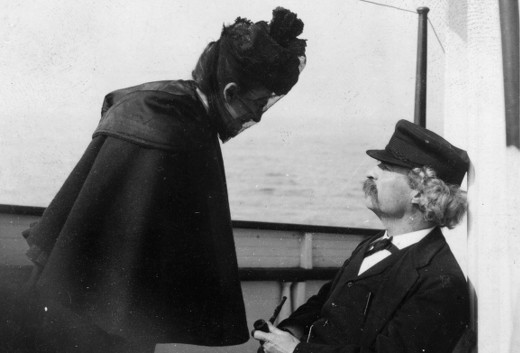
On November 27th of 1875, the great Samuel Clemens—known to most as Mark Twain—wrote the following love letter to his dear wife of almost 6 years, Olivia, on the occasion of her 30th birthday. They remained married until her death, 29 years later.
(Source: Complete Letters of Mark Twain; Image: Olivia and Samuel Clemens, via Courant.)
Hartford, November 27, 1875
Livy darling,
Six years have gone by since I made my first great success in life and won you, and thirty years have passed since Providence made preparation for that happy success by sending you into the world.
Every day we live together adds to the security of my confidence that we can never any more wish to be separated than that we can ever imagine a regret that we were ever joined. You are dearer to me to-day, my child, than you were upon the last anniversary of this birth-day; you were dearer then than you were a year before—you have grown more and more dear from the first of those anniversaries, and I do not doubt that this precious progression will continue on to the end.
Let us look forward to the coming anniversaries, with their age and their gray hairs without fear and without depression, trusting and believing that the love we bear each other will be sufficient to make them blessed.
So, with abounding affection for you and our babies, I hail this day that brings you matronly grace and dignity of three decades!
Always Yours, S.L.C.
RSS Feed proudly sponsored by TinyLetter, a simple newsletter service for people with something to say.
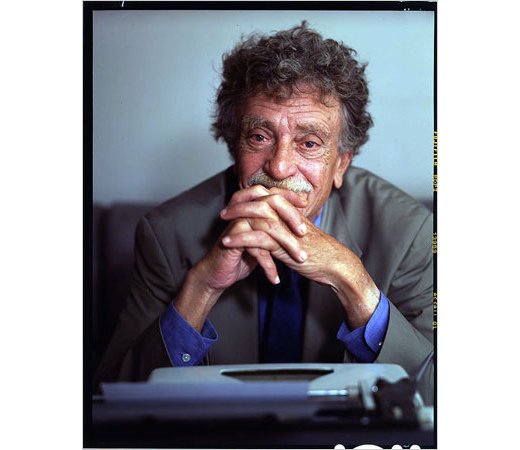
Back in 1988, as part of an ad campaign to be printed in Time magazine, Volkswagen approached a number of notable thinkers and asked them to write a letter to the future—some words of advice to those living in 2088, to be precise. Many agreed, including novelist Kurt Vonnegut; his letter can be read below.
(Source: TIME, 1988; Image: Kurt Vonnegut, courtesy of Mike Schroeder.)
Ladies & Gentlemen of A.D. 2088:
It has been suggested that you might welcome words of wisdom from the past, and that several of us in the twentieth century should send you some. Do you know this advice from Polonius in Shakespeare's Hamlet: 'This above all: to thine own self be true'? Or what about these instructions from St. John the Divine: 'Fear God, and give glory to Him; for the hour of His judgment has come'? The best advice from my own era for you or for just about anybody anytime, I guess, is a prayer first used by alcoholics who hoped to never take a drink again: 'God grant me the serenity to accept the things I cannot change, courage to change the things I can, and wisdom to know the difference.'
Our century hasn't been as free with words of wisdom as some others, I think, because we were the first to get reliable information about the human situation: how many of us there were, how much food we could raise or gather, how fast we were reproducing, what made us sick, what made us die, how much damage we were doing to the air and water and topsoil on which most life forms depended, how violent and heartless nature can be, and on and on. Who could wax wise with so much bad news pouring in?
For me, the most paralyzing news was that Nature was no conservationist. It needed no help from us in taking the planet apart and putting it back together some different way, not necessarily improving it from the viewpoint of living things. It set fire to forests with lightning bolts. It paved vast tracts of arable land with lava, which could no more support life than big-city parking lots. It had in the past sent glaciers down from the North Pole to grind up major portions of Asia, Europe, and North America. Nor was there any reason to think that it wouldn't do that again someday. At this very moment it is turning African farms to deserts, and can be expected to heave up tidal waves or shower down white-hot boulders from outer space at any time. It has not only exterminated exquisitely evolved species in a twinkling, but drained oceans and drowned continents as well. If people think Nature is their friend, then they sure don't need an enemy.
Yes, and as you people a hundred years from now must know full well, and as your grandchildren will know even better: Nature is ruthless when it comes to matching the quantity of life in any given place at any given time to the quantity of nourishment available. So what have you and Nature done about overpopulation? Back here in 1988, we were seeing ourselves as a new sort of glacier, warm-blooded and clever, unstoppable, about to gobble up everything and then make love—and then double in size again.
On second thought, I am not sure I could bear to hear what you and Nature may have done about too many people for too small a food supply.
And here is a crazy idea I would like to try on you: Is it possible that we aimed rockets with hydrogen bomb warheads at each other, all set to go, in order to take our minds off the deeper problem—how cruelly Nature can be expected to treat us, Nature being Nature, in the by-and-by?
Now that we can discuss the mess we are in with some precision, I hope you have stopped choosing abysmally ignorant optimists for positions of leadership. They were useful only so long as nobody had a clue as to what was really going on—during the past seven million years or so. In my time they have been catastrophic as heads of sophisticated institutions with real work to do.
The sort of leaders we need now are not those who promise ultimate victory over Nature through perseverance in living as we do right now, but those with the courage and intelligence to present to the world what appears to be Nature's stern but reasonable surrender terms:
Reduce and stabilize your population.
Stop poisoning the air, the water, and the topsoil.
Stop preparing for war and start dealing with your real problems.
Teach your kids, and yourselves, too, while you're at it, how to inhabit a small planet without helping to kill it.
Stop thinking science can fix anything if you give it a trillion dollars.
Stop thinking your grandchildren will be OK no matter how wasteful or destructive you may be, since they can go to a nice new planet on a spaceship. That is really mean, and stupid.
And so on. Or else.
Am I too pessimistic about life a hundred years from now? Maybe I have spent too much time with scientists and not enough time with speechwriters for politicians. For all I know, even bag ladies and bag gentlemen will have their own personal helicopters or rocket belts in A.D. 2088. Nobody will have to leave home to go to work or school, or even stop watching television. Everybody will sit around all day punching the keys of computer terminals connected to everything there is, and sip orange drink through straws like the astronauts.
Cheers,
Kurt Vonnegut
RSS Feed proudly sponsored by TinyLetter, a simple newsletter service for people with something to say.
“People wish to be settled; only as far as they are unsettled is there any hope for them.”
“Cut short of the floundering and you’ve cut short the possible creative outcomes,” Denise Shekerjian wrote in contemplating the capacity for “staying loose” that many MacArthur geniuses have in common. “Cheat on the chaotic stumbling-about, and you’ve robbed yourself of the raw stuff that feeds the imagination.” And yet part of the human paradox is that even in the face of overwhelming evidence for this uncomfortable truth, despite full intellectual awareness of it, we continue to seek certainty and resist change, stunting our personal growth with stubborn self-righteousness and staunch defiance of the very discomfort from which self-transcendence springs.
From Ralph Waldo Emerson’s Essays and Lectures (public library; free download) — the same indispensable volume that gave us the great philosopher on the two essential requirements of true friendship — comes a layered and immeasurably insightful 1841 essay titled “Circles,” exploring the pillars of personal growth and how we can learn to stop resisting the very things that help us transcend our self-imposed limitations.
The key to every man is his thought. Sturdy and defying though he look, he has a helm which he obeys, which is the idea after which all his facts are classified. He can only be reformed by showing him a new idea which commands his own. The life of man is a self-evolving circle, which, from a ring imperceptibly small, rushes on all sides outwards to new and larger circles, and that without end. The extent to which this generation of circles, wheel without wheel, will go, depends on the force or truth of the individual soul. For it is the inert effort of each thought, having formed itself into a circular wave of circumstance … to heap itself on that ridge, and to solidify and hem in the life. But if the soul is quick and strong, it bursts over that boundary on all sides, and expands another orbit on the great deep, which also runs up into a high wave, with attempt again to stop and to bind. But the heart refuses to be imprisoned; in its first and narrowest pulses, it already tends outward with a vast force, and to immense and innumerable expansions.
The balance of steadfastness and spontaneity that jazz legend Bill Evans saw as necessary for his art, Emerson sees as necessary for the art of personal development:
Let me remind the reader that I am only an experimenter. Do not set the least value on what I do, or the least discredit on what I do not, as if I pretended to settle any thing as true or false. I unsettle all things. No facts are to me sacred; none are profane; I simply experiment, an endless seeker… Yet this incessant movement and progression which all things partake could never become sensible to us but by contrast to some principle of fixture or stability in the soul.
In a sentiment that Bertrand Russell would come to echo nearly a century later in his ten timeless commandments of learning — “Do not fear to be eccentric in opinion, for every opinion now accepted was once eccentric.” — Emerson considers our resistance to change, both as individuals and as a culture:
Every ultimate fact is only the first of a new series… The new statement is always hated by the old, and, to those dwelling in the old, comes like an abyss of skepticism.
[…]
In nature every moment is new; the past is always swallowed and forgotten… Nothing is secure but life, transition, the energizing spirit. No love can be bound by oath or covenant to secure it against a higher love. No truth so sublime but it may be trivial to-morrow in the light of new thoughts. People wish to be settled; only as far as they are unsettled is there any hope for them.
Life is a series of surprises.
But Emerson’s most pressing point has to do with how this courage for embracing uncertainty and change — especially unwelcome change — is the foundation of what we call character:
The difference between talents and character is adroitness to keep the old and trodden round, and power and courage to make a new road to new and better goals. Character makes an overpowering present; a cheerful, determined hour, which fortifies all the company, by making them see that much is possible and excellent that was not thought of. Character dulls the impression of particular events. When we see the conqueror, we do not think much of any one battle or success… The great man is not convulsible or tormentable; events pass over him without much impression. People say sometimes, ‘See what I have overcome; see how cheerful I am; see how completely I have triumphed over these black events.’ Not if they still remind me of the black event. True conquest is the causing the calamity to fade and disappear, as an early cloud of insignificant result in a history so large and advancing.
He returns to the notion of life’s self-evolving circle:
The one thing which we seek with insatiable desire is to forget ourselves, to be surprised out of our propriety, to lose our sempiternal memory, and to do something without knowing how or why; in short, to draw a new circle. Nothing great was ever achieved without enthusiasm. The way of life is wonderful: it is by abandonment. The great moments of history are the facilities of performance through the strength of ideas… They ask the aid of wild passions… to ape in some manner these flames and generosities of the heart.
Emerson’s Essays and Lectures is a sublimely rewarding read in its entirety, full of enduring wisdom on discipline, language, love, beauty, ethics, illusion, self-reliance, and nearly every other substantial aspect of the human experience. Complement it with fifteen ideas for self-refinement through the wisdom of the ages, including one from Emerson himself.
donating = loving
For seventeen years, I have been spending hundreds of hours and thousands of dollars each month composing The Marginalian (which bore the outgrown name Brain Pickings for its first fifteen years). It has remained free and ad-free and alive thanks to patronage from readers. I have no staff, no interns, no assistant — a thoroughly one-woman labor of love that is also my life and my livelihood. If this labor makes your own life more livable in any way, please consider lending a helping hand with a donation. Your support makes all the difference.
newsletter
The Marginalian has a free weekly newsletter. It comes out on Sundays and offers the week’s most inspiring reading. Here’s what to expect. Like? Sign up.