This post has been featured on a 1000notes.com blog.
Shainaf87shut up Kathy Bates and Patti lupone on AHS!!!!
Ryan Murphy is evidently casting his spell on Hollywood because the next season of American Horror Story just got EVEN MORE star-studded!
Believe it or not, Gabourey Sidibe and Kathy Bates aren't the only one throwing their acting chops in American Horror Story: Coven's witchy cauldron!!!
Hollywood pros Patti Lupone and Angela Bassett were confirmed for the third season of the spooky hit show by the genius co-creator via Twitter.
Ryan tweeted:
Two legends are joining the cast of American Horror Story: Coven -- Oscar nominee Angela Bassett and Tony winner Patti LuPone!
— Ryan Murphy (@MrRPMurphy) May 12, 2013
It almost feels too good to be true!
The iconic leading ladies will join returning cast members Jessica Lange, Evan Peters, Lily Rabe, Frances Conroy, Sarah Paulson and Taissa Farmiga.
Could this cast get ANY BETTER??!
New Orleans, here we come!!!
[Image via WENN.]
It’s the ongoing obstruction of President Obama’s nominees by Senate Republicans, as Jonathan Bernstein explains.
Don’t think it’s a scandal? It’s pretty basic: Republicans, by abusing their Constitutional powers, are — deliberately, in several cases — preventing the government from carrying out duly passed laws.
The New York Times yesterday highlighted two of the more recent ways that Republicans have manipulated loopholes in Senate rules to delay confirmation of Secretary of Labor nominee Thomas Perez and Environmental Protection Agency nominee Gina McCarthy. It’s worth stepping back and realizing: what’s happening here is that Republicans are delaying these nominations beyond their eventual insistence that almost all nominees must get 60 votes. In other words, they’re filibustering on top of their own filibusters.
That’s just two examples. There are numerous others; again, with virtually all nominees required to have 60 votes, one can accurately say that Republicans are filibustering every nomination. But perhaps the worst are the “nullification” filibusters, in which Republicans simply refuse to approve any nominee at all for some positions — the National Labor Relations Board, the Consumer Financial Protection Bureau — because they don’t want those agencies to carry out their statutory obligations.
In doing so, Republicans are not breaking the rules of the Senate. They are, however, breaking the Senate itself, and harming the government.
 With their round, teddy-bear eyes and arms just made for hugging, baby sloths are liable to give you a case of cuteness overload.
Shainaf87cthulhu!
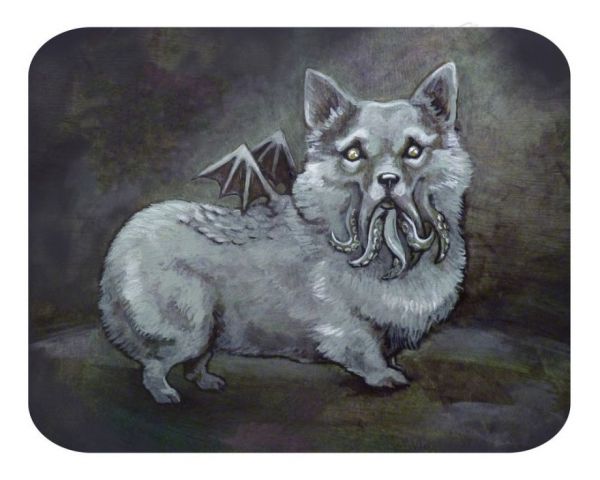
"In his house at R'lyeh, dead Cthulhu waits dreaming. Dreaming of belly rubs." But I'm scared of Jenny Fontana's monstrosity. Will I wake him from his slumber by petting him? Is that a risk worth taking?
Link -via Ian Brooks

Ypres, Belgium, stages the Festival of Cats on the second Sunday of May every three years. The festival harkens back to a time in which cats were tortured and destroyed because they were believed to be witches or incarnations of the devil. However, the modern festival is instead a celebration of cats, and no live cats are involved.
The centerpiece of the festival is the Cat Parade. The first parade was held in 1938 with music, a jester, and a bunch of altar boys carrying a bunch of plastic cats. They marched from the city hall to the belfry. Amid a concert of trumpet music and the carillon of bells, the jester climbed to the top of the belfry tower to throw the toy cats into the crowd below. This was based on how live cats were once thrown from the bell tower during the Middle Ages. These days it is soft plush cats that are tossed to the crowd below, perhaps mocking the awful brutality that is now thankfully left to the past. A mock witch burning also remains as a part of the festivities.
Kattenstoet would have been this weekend, but the festival was held last year and the next one will be in 2015. See plenty of pictures and a video of the parade at PetsLady. Link -via the Presurfer
(Image credit: Flickr user Cedric Dubois)

It's a marriage made in sugar heaven! The genius bakers over at Dominique Ansel Bakery have combined donut and croissant into a new culinary creation. Behold, the cronut (or if you want to appear more sophisticated, cwaahh-nut):
Each one of these puppies is made from pastry dough that's been sheeted, laminated, proofed, then fried like a doughnut and rolled in flavored sugar. But that's not all: Cronuts-to-be are also filled with a not-so-sweet Tahitian vanilla cream, given a fresh coat of rose glaze, and bedazzled with rose sugar. Got it? Good. Let's briefly examine the sheer implausibility and engineering genius that goes into each one of these things.
First off, call your friendly neighborhood pastry chef and ask him or her what happens when you try to fry croissant dough. It's not pretty. Even if the laminated layers don't separate instantly and part ways in the hot oil six ways to Sunday, chances are that yeast-leavened dough will have a lumpy, sad, and uneven ascent before it ever gets to the golden brown stage. Ansel says it took around ten recipes and adjustments to multiple variables of time and temperature before he found a special trick to sheeting the dough, then learning to fry it in grapeseed oil at one specific (and somewhat secret) temperature.
Hugh Merwin of Grub Street New York has more on this new culinary marvel: Link

Shainaf87need to see this asap. Saturday evening movie di?

    
|
 Two weeks ago, we gave you our favorite spots for drinking high in the sky. Now we're bringing it back down to street level with a list of our favorite bar patios from all over Chicago. [ more ⺠]


Shainaf87well, it did happen didn't it?
 “Springtime for Hitler” it wasn’t:
A modern version of Richard Wagner’s “Tannhauser” has been canceled in Germany after the opening-night audience complained about new scenes showing Jews being executed and dying in the gas chambers.
A spokeswoman for Duesseldorf’s opera house said there would only be concert performances without theatrical staging.
Monika Doll said producer Burkhard Kosminski had refused to tone down the disputed scenes, even though the Holocaust-related parts prompted several in the audience on Saturday to seek medical attention.

HAHAHAHAHAHAHAHAHAAHAHSHASJJHSJHJHDHDAASJAH XDDDDD
This post has been featured on a 1000notes.com blog.

You can make Twix bars at home! But Averie Sunshine went even further. Her recipe has the standard shortbread, caramel and chocolate. But it also has a layer of peanut butter mixed with confectioner's sugar.
Link -via Tasteologie
A dance band called Dur-Dur Band ruled the nightclub scene in 1980s Mogadishu, thanks to a unique sound made possible by access to Western culture and instruments.
Shainaf87is there a way to email these posts? arg!

Dancing dog! Omg….. really? She’s got the moves man!!
The post Dancing Dog appeared first on A Place to Love Dogs.
Juan Carlos Menacho has designed the Jardín del Asia restaurant as part of the Los Tajibox Hotel in Santa Cruz de la Sierra, Bolivia.

From the architect
CHALLENGES
Jardín del Asia restaurant is part of Los Tajibos Hotel, the most luxurious and important hotel in Santa Cruz de la Sierra, the largest urban center in Bolivia’s eastern region. This solution takes advantage, through a minor constructive intervention, of an old warehouse, located between the hotel’s Convention Center and parking lot. The structure is divided in three sectors: outside garden, dining area and service area. Located on an important avenue, the outside garden allows for a convenient independent and direct entrance to the restaurant, taking care not only of the guests but also the external clients. The kitchen, and supply areas enjoy the advantage of being directly linked to the hotel’s main service areas and corridors, leaving the urban front completely free of obstacles in order to present the entire proposal The tropical warm and humid climate of the country’s economic capital, conditioned both the conceptualization of the program as well as the morphology and technology that was used.The program demanded a restaurant where six microenvironments could develop simultaneously an in an integrated but subtly separated fashion, under the same roof: lounge, liquor bar, sushi bar, fusion tables, private areas for groups and teppanyaki tables. To meet the functional requirements of a restaurant for 150 diners, the symbolic demands expected from a facility oriented to serving the guests of a five star hotel had to be added. The public and private, the formal and informal, the festive and romantic, the individual, the couple or the group should be able to find – and appropriate – a corner, a niche, a sector of the dining area. In general, the response was to generate an atmosphere that was simultaneously artificial and natural, where spatial Asiatic concepts articulate technology and materials that are typical of the ‘pampa area’ and tropical forests of Bolivia’s Eastern region, through the integration of landscaping, urban, architectonical, cultural and technological concepts.
SOLUTION
The spatial intention to offer clients a warm alternative to escape from the pressures of daily life, became concrete with a proposal enriched with luminous hues, intimate jalousies, sceneries and symbolic suggestions, that harmonically build a landscape, which in spite of having been invented and cloistered, is perceived as natural and infinite. To attain greater emotional effectiveness, guidelines are established, paths are suggested, pauses are defined, and finally various sojourns are proposed under an artificial firmament; a scenography that as a whole produces an almost magical spatial confusion in the visitor, although intentional, that is translated into a virtual visit to a native village, in the middle of Bolivia’s Amazonian tropical jungle.A Zen garden, with a water mirror and tropical vegetation, strategically inserted between the street and the entrance, welcomes the guests while it sets the limits with the chaotic outside world. It motivates contemplation and releases tensions, the erratic swimming paths of multicolored carps and the breeze perceived in the water mirror is appreciated during the paused walk while crossing the wooden bridge that connects the sidewalk with the building. As the visitor approaches the entrance, it becomes evident that monumentality anticipates an imminent transition, which implies at the same time an end as well as a beginning, the end of the noise and the beginning of peace. The entrance reproduces the silhouette of a drop of water, a shape that anticipates upon entering the generating idea of the proposal. The first steps of this transition imply a second pause, generated by the warm welcome of a vault-shaped area built with chuchío reeds and jatata, which leads to a cubicle, that acts as the reception area, and in reality constitutes the third pause, the last one before concluding the transfer process. The aim of this complex transition that was carefully planned by the architect is to prepare the guest for the full enjoyment of an environment where peace, silence, time and solace reign.
The landscaping dimension of the inside is attained through a series of artifices generated from two metaphors, water, the source of life and by extension, a source of culture and traditions; and the firmament, a mystical expression of what is eternal, universal, as well as spiritual. Thus, under the light of the stars, from the somewhat elevated lounge the sinuosity that suggests a micro-valley is appreciated, which hosts the pond where three huts were built with intertwined chuchío reeds that simultaneously resemble water drops and native housing, imitating a village landscape whose backdrop is regularly disturbed by the intermittent fire from the three bar-tables destined to teppanyaki.
The oriental, in its Asian sense, is expressed and perceived not only with the suggested or concrete presence of the four natural elements: water, air, land and fire, but also the subtlety of indirect light, the furniture and most importantly, the atmosphere that is achieved. For its part, the oriental, in its Bolivian sense, is expressed in the tropical Amazonian vegetation composed by shrubs and palm trees, and materials such as wood, chuchío reeds and jatata, that are still being used nowadays by native cultures in the forests and pampa region of Chiquitos and Moxos.
To sum up, the freedoms allowed by this gastronomic fusion, have served as a pretext to establish a setting that blends landscaping, urbanism and tropical architecture, oriental and contemporary interior decoration and provides subtle perceptions that favor the enjoyment of the senses in a peaceful and harmonious environment. As pointed out at the beginning, architecture as a scenography to be experienced, complements the gastronomy and offers an integral and holistic environment that is characteristic of the flavors and odors that are typical of oriental fusion, this time, not only Asiatic but Bolivian as well.


Architect: Juan Carlos Menacho
Photography: Enrique Menacho
 It's really coming. We promise. [


 Like this Small Cool 2013 contest entry? Favorite it below!