The lawsuit from the Maryland-National Capital Park and Planning Commission accuses Prince George’s County of illegally retaining tens of millions of dollars meant for the commission. Instead, the county reportedly plans to use that money to support its budget. (Dave Leval / DC News Now, NBC4)
A pilot program will reduce speed limits from 25 mph to 20 mph on up to nine residential or business district roads. The program will start with three roads this summer that will be evaluated through early 2027. (Scott McCaffrey / FFXnow)
The publicly-funded 56-unit development at 950 Eastern Avenue NE finalized its financing, which includes $23.8 million in tax-exempt bonds. The five-story building will have 43 units for households earning 50% or less of the area median income and 13 permanent supportive housing units for formerly unhoused residents. (This article is behind a paywall.) (Alan Kline / Business Journal)
The County Board will vote June 17 on whether to create a historic district at a property in Aurora Highlights, undermining an approved five-story affordable housing project there. County Manager Mark Schwartz’s recommendation aligns with county staff but differs from the Historical Affairs and Landmark Review Board’s 7-4 vote for the district. (Scott McCaffrey / ARLnow)
The building’s current leaseholder bought the land and building at 1100 Pennsylvania Avenue NW for a reported $80 million. The building could go on to sell for up to $400 million. (Tracy Johnke / WTOP)
DC Water will soon start emergency repairs on part of the Potomac Interceptor sewer line in Potomac, Maryland after inspections found corrosion and exposed rebar. A spill at this location could harm Maryland and DC drinking water supplies. (Neal Augenstein / WTOP)
Towards the end of March 2024, I stumbled across a number of journals of the New Zealand Model Railway Guild. One of these, the March 2021 edition, included a pictorial article about J1211 North British 4-8-2 Locomotive No. 24534 of 1939. [6] The June 2021 issue included a history of the class [7: p13-15] and General Arrangement plans as originally carried in the Railway Gazette in 1940. [7: p22-24] Also in that journal are four photographs of J1211 in service between 1960 and 1970. [8]
40 No 4-8-2 locomotives which were built in 1939 by the North British Locomotive Company and became the New Zealand Railways (NZR) J class.
They were designed to provide a mixed traffic locomotive suitable for running on the lighter secondary lines of the NZR network, and for express passenger trains in major routes.
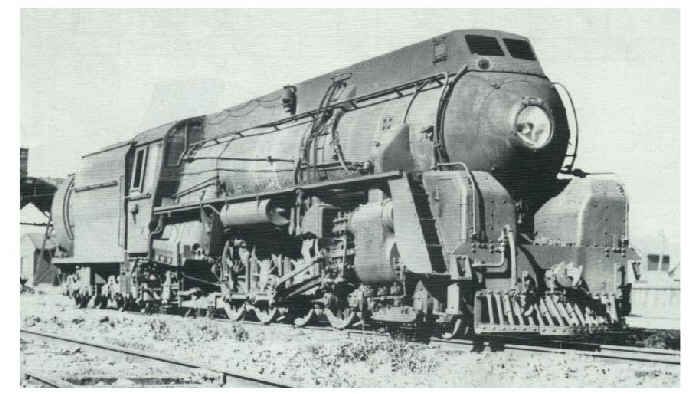
“The J class incorporated roller bearing axles, hydrostatic lubrication and twin Westinghouse brake pumps. … They had bar frames instead of plate frames and were equipped with Baker Valve-gear. The locomotives were attached to Vanderbilt tenders and were outshopped with distinctive bullet-nosed streamlining.” [1] The streamlining also encompassed the full length of the top of the boiler between the cab and the smoke box door and the area immediately beneath the smoke box door.
The J Class locos were out shopped with a distinctive streamlining from the cab to the top of the smoke box door and with a bullet-nosed smoke box door. [2]
New Zealand’s North Island benefitted from the first thirty of the class placed into service. The South Island hosted the remaining ten locomotives which apparently were used “The first 30 of the class in service were allocated to the North Island, with the remaining ten locomotives allocated to the South Island where they were used “on the hilly section between Dunedin and Oamaru. They were immediately placed into service on the main trunk routes in both islands in order to help move wartime traffic during the Second Word War. Although used on freight trains as well, the class was well suited to high-speed running on the passenger trains of the era.” [1]
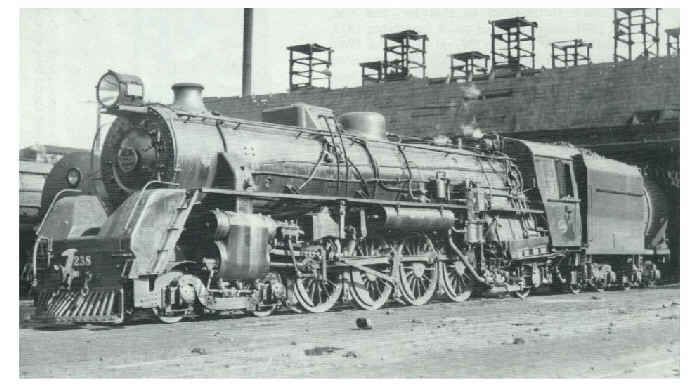
Apparently, the streamlining became “burdensome for maintenance and the skyline casing, which was open at the top proved to be a trap for soot from the locomotive’s exhaust. After a time, the skyline casing started to be removed from some examples of the class leaving them with just the bullet nose.” [1]
Ultimately the bullet nose was also removed from the majority of these locomotives.
The locomotives of the class had their streamlining removed in the war years. [2]
Members of the class “were generally considered to be a very reliable engine and well suited to their task. … They were capable of speeds of over 60 mph with a 300-ton express train. …. However, today surviving engines being used to haul excursion trains are restricted to 80 kph. … On favourable grades a single J could move a 1000-ton train.” [7: p14]
“The design was successful enough that NZR opted to build an improved variant … in its own Hillside workshops from 1946.” [1] These ‘Ja’ class locomotives were numbered 1240 to 1274 and became “the mainstay of the South Island rail services. Meanwhile North British were commissioned to build another 16, numbered from 1275 to 1290, also classified ‘Ja’, but they were oil fired and to be based in the North Island. … The sixteen ‘Ja’ from North British were the last steam locomotives to enter service with the NZR.” [7: p15]
Three J Class 4-8-2 are noted by Trainweb [2] as having been preserved:
J 1234, North British #24557/1939. For some time based at Glenbrook Vintage Railway, Auckland.. This locomotive is owned by Steam Incorporated of Paekakariki, and was leased to the Glenbrook Vintage Railway in 1998. The locomotive was returned to Paekakariki in June 2015. [4] It is now in storage awaiting a 2nd restoration at Paekakariki. [5]
J 1211 “Gloria”, North British #24534/1939. Mainline Steam Heritage Trust, Auckland (Operational). [3]
J 1236, North British #24559/1939. Mainline Steam Heritage Trust, Auckland (Being Restored). [2]