Shared posts

11 Jul 14:49

Is Detroit the Next Berlin? by Justin Fox

by Aaron M. Renn

[ Given the emergence of an artist movement in Detroit, the comparisons to Berlin are obvious. However, in this piece that ran over in Techonomy last year, Justin Fox argues the comparison is invalid. I'm glad to be able to repost it. And I'd also suggest that you might want to check out more of the material from Techonomy Detroit - Aaron. ]

After the fall of the Wall in 1989, Berlin had very cheap housing and industrial space, some in spectacularly grand old buildings. Years of division—with repressive communist rule on one side of town and isolation and economic stagnation on the other—had left the city depressed and underpopulated. Reunification initially only made things worse, as uncompetitive Eastern-side state-owned factories closed en masse.

This translated into, among other things, apartment rents much lower than in any other major Western European city. The low rents and post-industrial landscape drew artists and other bohemian sorts. Then low rents plus a burgeoning cultural scene drew young college grads who couldn’t find good jobs anywhere (German unemployment was high in the 1990s). They could get by in groovy, low-cost Berlin. This influx eventually translated into economic revival. Now Berlin is a boomtown, and everybody’s complaining about the skyrocketing rents.

Detroit’s roughly the same size as Berlin (measured by metro area population). It’s got a lot of cheap real estate, some of it spectacularly grand. It’s got abandoned factories. It’s got great cultural history (mainly on the music front). So … let the young bohemians come and the boom begin, right?

Uh … no. I’m moderating a panel at the Techonomy Detroit conference titled “Is Detroit the Next Berlin?” but I just don’t buy it. Sure, I’m rooting for Detroit’s revival. And the revival seems real, although still in its early stages. Studying and learning from the struggles and successes of other cities (as WDET did with its series on the Detroit-Berlin Connection) is never a bad idea. But the notion that Berlin could be a model for Detroit strikes this outsider as wrongheaded and a bit dangerous. It is an aspiration bound to be thwarted. Here’s what makes Berlin so different from Detroit (and vice versa):

1) Berlin is a political and cultural capital. The economic impact of becoming the capital of a reunited Germany in 1990 was actually a disappointment for Berlin at first, as some government agencies stayed away, and corporations did, too. But the reality of becoming the capital city of a major economic power, and the construction boom that went with that, eventually had a big impact. Berlin also was quickly able to regain its pre-World-War II status as the country’s artistic and cultural capital—thanks in part to massive federal subsidies. So it became Germany’s New York (minus finance and media) plus its Washington, D.C. (minus the huge defense and homeland-security industry). With super-cheap rents. That’s a lot of magnetic power, and by the late 1990s Berlin had become the default destination for creative, ambitious, educated young Germans. Detroit has none of these dynamics going for it except the real estate. Bringing in a few curious artists is great, but expecting a mass inflow of hipsters from all over America is crazy. It would already be a huge victory if lots of creative, ambitious, educated young Michiganders began moving to the city.

2) Berlin reunified. Detroit never had a Wall, but it’s been riven by its own division over the past half century, a stark racial and political separation between the city and the rest of the metropolitan area. There’s clearly been progress made in recent years, with new stadiums and other development downtown, and an apparent shift—born of shared economic desperation—toward more of a we’re-all-in-this-together regional attitude. But the divide is undeniably still there, and it means that even a successful revitalization will of necessity have to take a much different, less-centralized shape than in Berlin. Three quarters of metro Berlin’s 4.4 million people live within the city limits. In Detroit it’s the other way around; more than 80% of the 4.3 million inhabitants of the metro area live outside Detroit proper. Finding ways to tie city and suburbs together remains one of the area’s biggest challenges.

3) Berlin has good public transit. Yeah, its air connections have long been something of a joke, but that should improve dramatically with the opening next year of a new airport. The city is also linked by high-speed rail to the rest of the country’s major cities. Detroit’s got a great airport, but beyond that it’s built quite literally around the automobile. The millennials who would have to begin flocking to Detroit to make a Berlin scenario real don’t seem to like cars much. There’s no easy way around this: Detroit simply can’t afford to build a mass-transit infrastructure right now, and a Berlin-style, youth-oriented metropolis is almost inconceivable without such an infrastructure.

4) Detroit knows business. Yes, the city’s main business has been through a really tough time lately, but metro Detroit is full of private sector expertise—not just in automobiles—and seems to be growing a new entrepreneurial class. Berlin has a startup scene now, but that’s been driven mostly by newcomers. When its long, slow return to prosperity began it was a city of bureaucrats, former communists, and the long-term unemployed. Detroit has a huge advantage over Berlin here, an advantage that should be exploited and emphasized.

5) Detroit has better immigrants. Sure, now Berlin is attracting jet-setters from all over—and has attracted hard-working immigrants from Turkey and Eastern Europe for years. But Detroit, and U.S. cities in general, have two big advantages over their continental European counterparts in attracting ambitious, entrepreneurial newcomers from other countries: (1) we speak the global language, English, and (2) despite occasional problems we have a deserved reputation as a nation where newcomers can thrive. The Detroit area has of course already benefited from its status as destination No. 1 in the U.S. for immigrants from Arab countries, and any realistic comeback scenario for the area and the city proper has to include a big role for overseas immigrants.

There’s an echo here of the competing visions of urbanists Richard Florida and Joel Kotkin. Florida is of course the progenitor of the idea that a new, urban “creative class” is the key economic driver of our time—and that cities (like Berlin) that can attract young creatives will thrive. Kotkin argues that this simply won’t work for most American cities, and that messy, immigrant-filled, strip-mall sprawl is an equally vibrant and more realistic model. Florida, who married a Detroiter, has been talking up the creative-class link to the city’s revival. Kotkin, in a recent newspaper profile of Florida, scoffed that “There’s not enough yuppies on the planet to save Detroit.”

In the case of the Detroit area, they’re both right. Locavore restaurants and design studios aren’t going to bring back the regional economy. That’s going to require other, more mass-scale kinds of business success, and possibly some big-time government investment. At the same time, returning the city of Detroit to its rightful position as economic and cultural heart of the region—which seems like an essential prerequisite to any truly sustainable revival of metro Detroit—will take exactly the kind of building-by-building, restaurants-and-galleries-and-cool-little-creative-businesses entrepreneurship that Florida loves so much. Detroit is not the next Berlin. But it may still get a little bit of that Berlin spirit.

Justin Fox appeared at Techonomy Detroit in a session entitled ”Is Detroit the Next Berlin?” For complete coverage of the September 12, 2012, conference, click here.

This post originally appeared in Techonomy on September 11, 2012.


A production of the Urbanophile, Telestrian is the fastest, easiest, and best way to access public data about cities and regions, with totally unique features like the ability to create thematic maps with no technical knowledge and easy to use place to place migration data. It's a great way to support the Urbanophile, but more importantly it can save you tons of time and deliver huge value and capabilities to you and your organization.

Try Telestrian For 30 Days Free!

11 Jul 14:43

Purchasing Power Adjusted Incomes

by Aaron M. Renn

My latest post is online over at GoLocalProv, and while it’s titled there “Some Legitimately Good Economic News For Rhode Island,” there are national implications.

Per capita income is one of the key economic measures people use for states and cities. But the raw figures can mislead because the cost of living varies by region. The US Bureau of Economic Analysis has been releasing regional purchasing power indexes to try to capture this purchasing power variability for states and metropolitan areas, and they recently applied these to per capital incomes. My piece takes a look at that, with national maps for states and metros. Here’s the map of real, adjusted per capita personal incomes for metro areas in 2011 (data in thousands of dollars):

Check the whole piece for more.


A production of the Urbanophile, Telestrian is the fastest, easiest, and best way to access public data about cities and regions, with totally unique features like the ability to create thematic maps with no technical knowledge and easy to use place to place migration data. It's a great way to support the Urbanophile, but more importantly it can save you tons of time and deliver huge value and capabilities to you and your organization.

Try Telestrian For 30 Days Free!

11 Jul 14:30

Indianapolis Newspaper Working on Move to Mall

Jakienle

It's not a Target but I think this is a very creative use for the space and am excited to see the Simon folks thinking outside the box here.

The largest newspaper in the state could be moving its headquarters to the Circle Centre mall. Star Media, which publishes The Indianapolis Star, confirms it is in negotiations with Simon Property Group Inc. (NYSE: SPG) to move into a portion of the former Nordstrom space.
10 Jul 16:05

Citizens Energy Officials Grossly Overpaid

by Gary R. Welsh
The Indianapolis Star has provided an up-to-date online database of salaries paid to various public officials in Indiana. Fortunately, the database has included officials of Citizens Energy, the nonprofit public utility that operates gas, sewer and water utilities for Indianapolis consumers. The pay of top officials of the utility is outrageous. Citizen's CEO, Carey Lykins, is the highest earning public official in the state of Indiana, receiving a salary of $2.9 million. There are 16 top officials earning more than $250,000 a year. This is an outrage and the IURC should start scrutinizing their double-digit rate increases and asking why the top officials of the company are feasting at the expense of Indianapolis' utility consumers. Obviously, there is no body on the board of directors overseeing Citizens Energy who is the least bit concerned how inefficiently this utility is being operated or you wouldn't see so many employees earning outrageous salaries. Some of these positions are simply made up positions to provide a high-paying job to appease someone, which may or may not require any actual work or knowledge. Seriously, does Citizen really need to be paying someone nearly a half million dollars a year to be in charge of community relations or customer relations? What a joke.

Carey Lykins, CEO-$2.9 million
Margaret Richgreek, CAO-$1.4 million
John Brehm, CFF-$766,000
John Whitaker-Chief Legal Counsel-$706,000
Robert Hummel, VP, Human Resources-$642,000
Lindsay Lindgren, VP, Water Operations-$542,000
Jeffrey Harrison, VP, Engineering-$532,000
Yvonne Perkins, VP, Community Relations-$484,000
Michael Strohl, VP, Customer Relations-$460,000
John Lucas, VP, IT-$452,000
Aaron Johnson, VP, Strategy & Corporate Dev.-$369,000
Latona Prentice, VP, Regulatory Affairs-$355,000
Christopher Braun, VP, Energy Operations-$354,000
Kristine Kuhn, Director, Internal Audit-$268,000
Matthew Klein, Director, Resource Planning-$260,000
Blair Dougherty, Controller-$259,000

Curiosity got me to wonder who sits on the board of directors for Citizens Energy. Of course, it has not one but two governing boards, a 5-member board of trustees and a 9-member board of directors, both of which are described as "non-partisan." No surprises, here. Not a single person who could care less about how high your utility bills are.

Board of Trustees:
Dan Evans, IU Health Partners
Dennis Bland, President, Center for Leadership Development
Kathryn Betley, Civic Leader
Jackie Nytes, CEO, Indianapolis Public Library
John Krauss, Director, IU Public Policy Institute

Board of Directors:
James McClelland, President, Goodwill Industries
Daniel Appel, Gregory & Appel Insurance
Moira Carlstedt, President, Indianapolis Neighborhood Housing Partnership
Anita Harden, Retired President of Community East Hospital
Jeffrey Good, Director, Milestone Advisors
Anne Nobles, Retired VP of Eli Lilly
Phillip Terry, CEO, Monarch Beverage
Christina Hicks, VP, Human Resources, Wishard
J.A. Lacy, CEO, LDI
indiana politics civil rights law
09 Jul 16:44

Reconfigured 1950′s House in Beverly Hills

by Caroline Williamson

Reconfigured 1950′s House in Beverly Hills

Argentine architect Pablo Jendretzki was hired to reconfigure a 1950′s Hal Levitt house located in Beverly Hills. The main goals: to open up the cramped mid-century interior and create a connection between the interior and exterior of the house. With both goals accomplished, it has become a stunning 5,000-square-foot home in California’s most famous locale.

Reconfigured 1950s House in Beverly Hills in architecture Category

The wide wood planks of the deck contrast with the bright blue color that the pool gives off, while also providing ample space for laying out and enjoying the sun.

Reconfigured 1950s House in Beverly Hills in architecture Category

Reconfigured 1950s House in Beverly Hills in architecture Category

Reconfigured 1950s House in Beverly Hills in architecture Category

The first step with making the indoor/outdoor connection was installing the same wood that’s on the floors inside, outside on the deck. That way, when the large sliding glass doors are open, the space really expands.

Reconfigured 1950s House in Beverly Hills in architecture Category

Floor to ceiling sliding glass doors dissolve the separation of spaces, while at the same time filling the home with light and fresh air.

Reconfigured 1950s House in Beverly Hills in architecture Category

Reconfigured 1950s House in Beverly Hills in architecture Category

Room partitions were removed to make way for shelving units that provide storage while allowing light to pass through.

Reconfigured 1950s House in Beverly Hills in architecture Category

Reconfigured 1950s House in Beverly Hills in architecture Category

Reconfigured 1950s House in Beverly Hills in architecture Category

Reconfigured 1950s House in Beverly Hills in architecture Category

Reconfigured 1950s House in Beverly Hills in architecture Category

Reconfigured 1950s House in Beverly Hills in architecture Category

Reconfigured 1950s House in Beverly Hills in architecture Category

The pool is lit with fiber optic stars that mimic the stars in the sky.

Reconfigured 1950s House in Beverly Hills in architecture Category

Reconfigured 1950s House in Beverly Hills in architecture Category

Photos by Alejandro Wirth.


09 Jul 04:05

Video: Oladipo shines in NBA Summer League debut

by podcastonthebrink@gmail.com (Matt Dollinger, Justin Albers)
09 Jul 02:54

Going Medieval: Renovating The Middle Ages

by Zach Edelson

Jaureguia Tower (interior) by Apezteguia Architects Still coming off your Game of Thrones season finale high? Need to get your fix while transitioning from Westeros to boring-old Earth? We may have the perfect solution. Medieval European construction was simple and durable: thick load-bearing walls composed of massive stones, floors supported by old-growth timbers, small windows creating ...Continue Reading
03 Jul 13:23

Faces of the American Revolution

by Elizabeth D. Herman

The adoption of the Declaration of Independence—237 years ago today—can sometimes feel like an event not just from another time, but from another world. As depicted in John Trumbull’s now-iconic 19th-century painting of the founding fathers in Philadelphia, collectively creating the framework for the nation’s revolutionary political system, such an act of open rebellion by prominent, wealthy and established figures is literally inconceivable to most living Americans.

The Revolutionary War, raging at that time, saw men young and old answer the Colonies’ call to fight the British redcoats. In their allegiance to the ideals of liberty, these rough troops — illustrated in countless paintings and drawings known to history students everywhere — shouldered the monumental task of defending a nation that was, in many respects, not yet truly born.

But as alien as that epoch might feel, time and again we’re reminded that the past is not always as distant as it so often seems.

In fact, some veterans who survived the Revolutionary War prospered well into their eighties, nineties and sometimes even beyond 100, living long enough to not only witness, but become part of, the era of the photograph.

First daguerreotypes, and then glass-plate negatives became popular in the 1840s and 1850s; by 1853, some 70 years after the great and improbable American victory over the British, more than 3 million daguerreotypes a year were being produced in the United States alone.

As these photographic means developed, and the generation that experienced the Revolution firsthand continued to dwindle, a desire to document these men — a rapidly vanishing, living link with history — emerged.

Courtesy of Joseph Bauman

Courtesy of Joseph Bauman

A note by Rev. Smith pinned to the padding of his daguerreotype that reads “October 20 1854, A present to Lucy R. Fullen, by her Grandfather J. Smith, Born March 10, 1761”

“Possible now it will soon be impossible forever, and now neglected it would be forever regretted,” wrote Reverend E. B. Hillard, author of The Last Men of the Revolution. Published in 1864, the 64-page book stands as the only record of its kind, immortalizing Revolutionary War veterans in photographs alongside their tales from the fight for independence. In July 1864, Hillard, accompanied by two photographers, brothers N. A. and R. A. Moore, traveled across New England and New York State to interview and photograph all known surviving veterans, six in total. The images, made on glass plate negatives, were then printed on albumen paper and pasted into the book, along with colored lithographs depicting the veteran’s homes.

In 1976, Popular Photography featured the images of The Last Men of the Revolution in its issue commemorating the United States’ Bicentennial. One reader, a Utah-based journalist named Joe Bauman, was already an avid collector of antique photography when he came across the piece.

“I realized that if these fellows were still alive at the time when glass plate negatives were being made in the 1860s, surely there were plenty who were alive during the daguerreian era,” Bauman told TIME.

Using skills honed by a career of investigative reporting, Bauman sought out other portraits of Revolutionary War veterans. Given the breadth of the War, where most every man from age 15 to 45 was actively involved in one way or another, Bauman could cast a wide net, searching for daguerreotypes of men around the age of 80 or 90 at the time the images were taken.

Once he located daguerreotypes of men who fit the bill, Bauman used markings on the images and their cases to locate corresponding pension, tax, and other records in order to find what, if any, role these men played in the Revolution. In one such case, Bauman obtained an image of an elderly gentleman only marked with a note to his granddaughter, signed J. Smith with the date of the photograph, October 20, 1854, and his birthday, March 10, 1761. Bauman headed over to the Salt Lake City genealogical library, to dig through census records for all J. Smiths still alive in 1854 who would have been old enough to have served in the Revolution. After gathering a list of candidates, he began looking through pension documents until he came across one who signed his name J. Smith, in the same way as on the back of the daguerreotype. When he checked the date of birth he found exactly what he expected—March 10, 1761. He had found the match.

Thus began the historical digging—a process he repeated for all images collected.

His collection, which now includes eight daguerreotypes, took three decades of research to compile and is considered the largest known collection of Revolutionary War veteran daguerreotypes to date. Several years ago, Bauman published the images, along with histories of the men, in an e-book, Don’t Tread on Me: Photographs and Life Stories of American Revolutionaries, not only bringing to light images that had largely gone unseen, but that astonished — and still astonish — people who never imagined that such portraits even existed.

“It gives you a sort of a direct contact with a person who lived that very long time ago, and experienced these almost mythological-type days,” Bauman said.

Suddenly one critical part of America’s past, previously illustrated in our collective memory almost solely by paintings and drawings, was brought to brilliant life in the photographic present.

“A daguerreotype is a unique image — it isn’t a print, it isn’t a reproduction of any kind,” Bauman explained. “When you have a camera set up to take a daguerreotype and the sitter is in front of you, for example, one of these old men who actually looked and knew and talked to leaders of the Revolution … the light is coming from the sun, hitting his face, and bouncing off of his face through the camera and onto that very same plate.”

Light that shone on men who witnessed the birth of the United States endures, refracted and recorded via photography. Through these characters, that other world is now our own — a shared history made a little more accessible, told in a medium of our own time.

“As we look upon their faces,” wrote Hillard, “as we learn the story of their lives, [history] will live again and again before us, and we shall stand as witnesses of its great actions.”


Elizabeth D. Herman is a freelance photographer and researcher currently based in New York.


03 Jul 12:46

Tommy Dant wants to meet a style need in Indianapolis

by Jeremiah Williams

James Dant Indianapolis Pattern

I’m going to tell you a story.

After the menswear meetup last month, I had the opportunity to connect with some of the guys I met. One of those guys was Tommy Dant. He gave me the classic “elevator pitch” (which I hope all brands have handy and ready to go).

There are a lot of optimistic entrepreneurs who fall short of opening a brick and mortar store in Indianapolis. I have even pondered and sometimes still think about how nice it would be to open my own little box of fashion. Mr. Dant has such an idea.

I sat down with Tommy Dant to discuss more in detail his vision after graduation from Ball State University. Dant gives a good first impression. My sense is that he isn’t just an over zealous college grad with a business plan; he’s a young entrepreneur who is excited by the possibilities that Indianapolis offers to small businesses. With a little luck and a lot of hard work, menswear store James Dant will open its doors in Indy soon. Dant has his eyes on Mass Ave.

I’m not the only one who is impressed with Tommy Dant. I am a huge fan of Shark Tank, and the Entrepreneurship department at Ball State did a college version called The Birdcage. Dant’s idea won him a first place cash prize and title of  ”Best New Venture Plan.”

Will it come down to if Indy men are open to shopping outside of a mall, or if Dant has the fashion knowledge to make the right purchases? I’ll be riveted watching the story unfold.

Dant is currently looking for space and getting the last bit of the investment money needed to make a downtown men’s streetwear store a reality (he is planning to start a Kickstarter page to raise funds). James Dant will offer smaller, boutique-style brands to the men of Indianapolis. Dant has already made connection with brands to secure the product needed for the store. After previewing the store concept, I can testify that it will be a unique option for men in Indy.

Is the current culture of Downtown Indianapolis able to support a menswear boutique that is not a suit shop? There have been some shops that have offered such things, but for one reason or another they have closed.

A Tommy Dant success story would not only bring a much-needed fresh perspective to Indianapolis’ men’s fashion, but also serve as a message to other college graduates that Indianapolis is not a bad place to kick off your post college industry career.

02 Jul 22:34

Entertainment Weekly‘s 100 Greatest Albums Ever

by Michael Nelson

Here we are, end of June 2013, as appropriate a time as any to take stock of the entire history of popular music. Well not us, but Entertainment Weekly, who just published a double issue with “100 Best” lists of just about every artistic medium known to man. We’re just here to pick apart their choices! Naturally any list of the 100 Greatest Albums Ever is going to have one of maybe three possible Beatles albums in the top spot (unless it’s NME doing the list-making, in which case it’s either the first Stone Roses record or the first Oasis record); also to be expected in the top 10 are Pet Sounds and Nevermind and London Calling and Thriller and My Beautiful Dark Twisted Fantasy … sorry, come again? FIFTY ONE spots higher than Master Of Puppets? SEVENTY ONE spots higher than Zep 4? EW, why you gotta be such trolls? Also, where the heck is [insert OOP black metal obscurity that maybe 2,000 people have ever heard]? Check the list for yourself below; find reasons to feel outraged, reasons to feel vindicated; share those feelings in the comments.

Read More...

02 Jul 20:39

Woj: Pacers finalizing deal with David West

by Tom Lewis
169027507

Yet another Adrian Wojnarowski report from has the Indiana Pacers close to finalizing a deal to bring back free agent forward David West. YES!!!

Pacers are finalizing a three-year, approximately $36 million deal with David West, league source tells Y! Third year likely player option.

— Adrian Wojnarowski (@WojYahooNBA) July 2, 2013

It seemed like a foregone conclusion that West would return to make another run with the Pacers but it is always nice to see the deal come to fruition without any other teams drawing West's interest. The only question has been just what type of deal West would sign and for what he delivered for the Pacers a $2 million raise is more than fair. However, that number also bumps against the ceiling of what the Pacers could offer while still trying to upgrade their bench appropriately.

Assuming that C.J. Watson signed for the 2-year bi-annual exception of around $2.1 million per, the Pacers will need to decide on keeping Tyler Hansbrough or using their mid-level exception for a little over $5 million to finish their work this summer.

One thing is for sure, they won't be doing much shopping next summer with this deal in place and a big salary headed Paul George's way unless they can find a way to free themselves of Gerald Green's money.

But forget money for a minute and appreciate the fact that the most influential voice in the Pacers locker room will be back to assume his leadership role on and off the floor for the Pacers. That is outstanding news!

02 Jul 16:00

Indianapolis seeks Monument Circle historic district in Downtown's core

No single style defines Downtown Indianapolis' core.
02 Jul 14:34

How Skateboarders Can Save Your Neighborhood From Drowning

by Alex Garkavenko
Jakienle

Flood protection/skate park...I love scandinavians.


Rendering of the skate bowl at Rabalder Park by Søren Nordal Enevoldsen. Image via Wired. Accepting that we are living in a real-life Day After Tomorrow doesn’t mean that we can’t have some fun with it. In the face of climate change and increasing flooding concerns in Denmark, the Roskilde sewage department collaborated with skate-obsessed architecture ...Continue Reading
01 Jul 14:55

Where the Density Is

by Aaron M. Renn

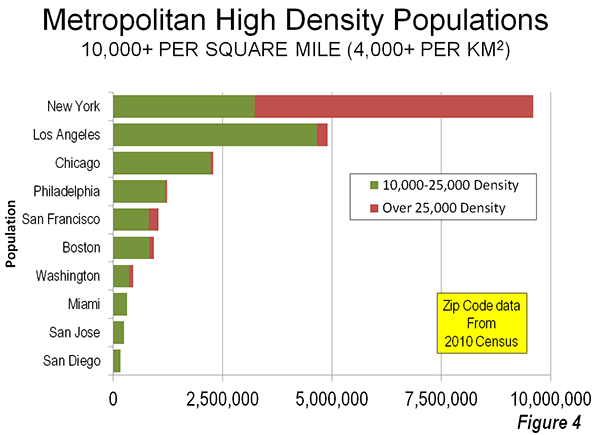
I’m sure many will not like or agree with Wendell Cox’s latest New Geography piece on transit and density. But if you’ll put aside preconceived notions for a moment, he has some very interesting charts about density in the United States. He measured density at 10,000 people per sq mi and 25,000 per sq mi at the zip code level and mapped to metropolitan areas. Here’s the breakdown at 10,000:

I’m sure someone will take this opportunity to ding pie charts, but you can easily convert that to a bar chart if you want. Speaking of bar charts, here’s one of total population at both 10K and 25K:

New York has 88% of America’s total population living at 25K/sq. mi. or higher.

And here’s a bonus infographic series. Nathan Yau over at FlowingData posted this graphic of grocery story geography in America. Click to enlarge.


A production of the Urbanophile, Telestrian is the fastest, easiest, and best way to access public data about cities and regions, with totally unique features like the ability to create thematic maps with no technical knowledge and easy to use place to place migration data. It's a great way to support the Urbanophile, but more importantly it can save you tons of time and deliver huge value and capabilities to you and your organization.

Try Telestrian For 30 Days Free!

01 Jul 14:52

If You Can Repeatedly Close a Freeway For Months At a Time, Do You Really Need It At All?

by Aaron M. Renn
Jakienle

Incredibly fascinating idea.

Ten years ago state highway officials closed I-65/I-70 in downtown Indianapolis for three months for a rehab project called “Hyperfix.” This was expected to cause a “carmageddon,” but as we’ve grown used to many times by now, the expected traffic disaster never materialized:

As the start date approached, INDOT and its partners implemented other precautions to ensure smooth traffic flow but soon discovered the additional efforts were unnecessary. For example, the State budgeted $100,000 in overtime for police, mainly to direct traffic downtown. But after 3 days into the project, motorists had adjusted to the detours and other factors, and the extra police presence was no longer necessary. Similarly, the city established an emergency communication center to handle traffic tie–ups or other difficulties but closed the center after 48 hours when the tie-ups never materialized.

Now the Indiana Department of Transportation is back, planning to close the same stretch of road again for three more months this fall to lower the pavement in order to increase overhead bridge clearances. The first question this is should prompt is why vertical clearance issues weren’t addressed the first time around.

But the more interesting question is this: If you can keep closing this stretch of interstate for three months at a time to work on it, do you really need it at all? Why not just close it permanently and save all this money?

That’s a very serious question I think should be considered. As we are seeing here, keeping this piece of roadway in operation is an expensive proposition and it will require expensive repairs in perpetuity to remain serviceable. Removing the only through interstate connection in downtown Indianapolis might seem, as it were, a bridge too far. But not only do I believe it may actually be feasible, it’s a potential game changer for downtown.

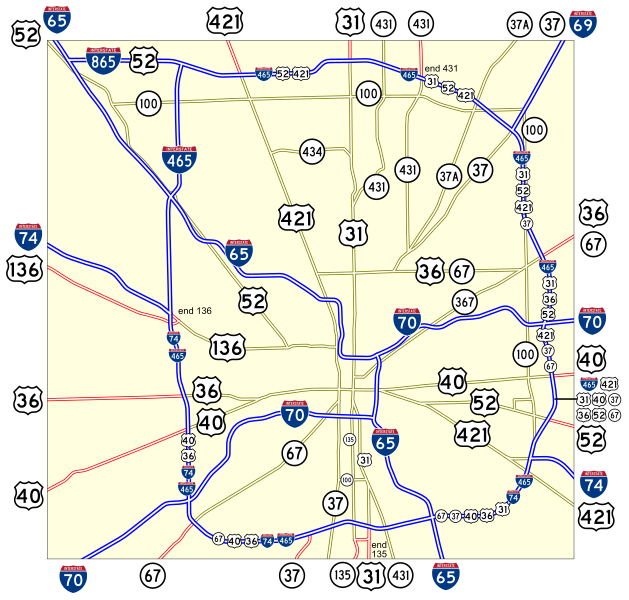
There is plenty of precedent for routing through traffic around the I-465 beltway. In fact, I-74 and the future I-69 do just this. For I-65, an I-465 routing is a similar distance to the downtown one. In fact, not that long ago that route was signed as an official alternate route one could choose (and still may be as far as I know). Similarly, because I-70 runs southwest out of downtown and the origin point of I-465 is shifted to the north of downtown, it’s not much of a detour for through traffic on I-70 either. INDOT, along with four other states, is already studying an I-70 truck-only lanes project, and the I-465 routing might make perfect sense for that as well. I might add that through hazardous cargo is already required to use I-465 and that Atlanta already has a through truck restriction for air quality purposes. So there are precedents for things like this.


The freeways of Indianapolis showing an I-465 through routing for existing I-74 and I-69, I-465 shifted to the north, and three sides of a downtown freeway loop that could be demolished. Image via Wikipedia.

In the removal scenario you route through traffic across I-465 and tear down the inner loop freeway around downtown. The interstate spurs remain to provide neighborhood access and access to and from downtown. The freeway barrier around downtown is removed, which permits fully restoring the street grid (especially important on the South Side) and reconnecting downtown to the surrounding neighborhods. The inner loop would be replaced with a surface parkway with much more limited capacity to aid in distribution within downtown. This parkway should be built by the city using state and local funds only to avoid the federal process mess and state highway standards that might result in another completely inappropriate urban street like West St. (This is similar to what was done for Keystone Parkway in Carmel, though this would be a surface street).

With the freeway gone there’s plenty of opportunity to re-purpose interstate right of way for development (putting it back on the tax rolls – w00t!), adding green space, or any number of things the city might want to do that don’t involve creating a massive barrier between downtown and the neighborhoods. It might even be possible to fund the demolition and rebuilding with some subset of the NPV of future freeway maintenance costs (relinquishment) plus TIF.

This also has big potential synergies with other mooted projects. There’s been a lot of discussion about relocating the rail lines through downtown (another huge barrier) to the old Indianapolis Union Belt, for example.


CSX main line through downtown (blue) and IU Belt (red). Also a closer view of the I-65/I-70 inner loop that could be removed. Image via Huston Street Racing


Crumbling freight rail viaduct on the CSX mainline downtown, creating a barrier at Washington St. and College Ave.

And there’s an old buried creek called Pogue’s Run that could conceivably be daylighted provided sewerage issues were sorted.


Pogue’s Run, before it gets routed into a storm sewer pipe. Image via Near Eastside Notes

The combo of a freeway removal, freight rail removal, and stream daylighting would be a transformational game-changer for downtown Indianapolis. The nice thing is that these are all discrete projects with independent utility. The stream daylighting would have to come last, but the other removals don’t depend on each other.

The chance anyone in Indy is going to actively consider this? Somewhere around zero, I think. Which is too bad. But when the forecasted traffic apocalypse fails to materialize yet again this fall, I hope people will at least consider why the state has to keep spending millions upon millions of dollars to maintain forever a freeway that may not even be needed.


A production of the Urbanophile, Telestrian is the fastest, easiest, and best way to access public data about cities and regions, with totally unique features like the ability to create thematic maps with no technical knowledge and easy to use place to place migration data. It's a great way to support the Urbanophile, but more importantly it can save you tons of time and deliver huge value and capabilities to you and your organization.

Try Telestrian For 30 Days Free!

28 Jun 13:45

Indiana office to promote startups, small business

Jakienle

Yeah Schpok.

Gov. Mike Pence has created the Indiana Office of Small Business and Entrepreneurship that he says will focus on consulting, specialty programming, and integrating universities, private businesses and government agencies.
28 Jun 13:43

IndyGo launches Northside Crosstown Route

by Curt Ailes
Jakienle

IT's about time.

IndyGo 86 (image credit: Curt Ailes)

IndyGo 86 (image credit: Curt Ailes)

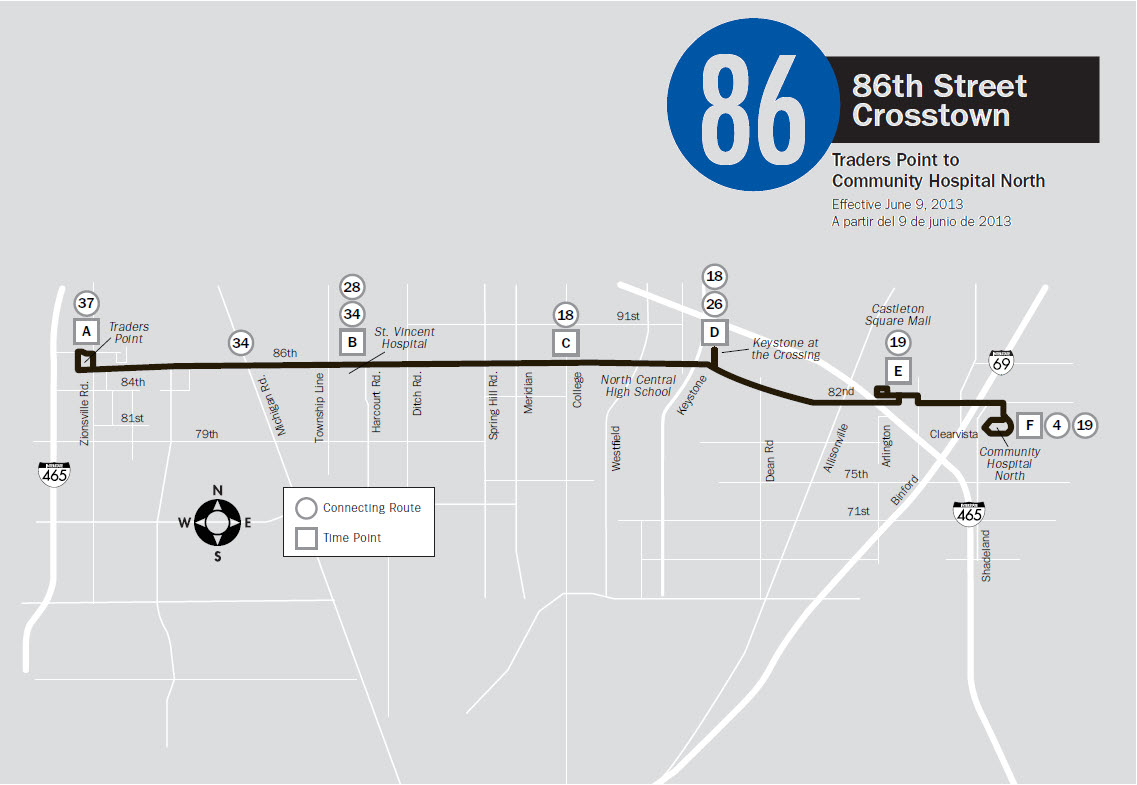
Today, IndyGo began service of the new crosstown along 86th street (click to open .pdf) on the north-side of Indianapolis. The service, one of the few of the fixed services which does not run through downtown, connects a number of north-side spoke routes along 86th street providing access to a multitude of jobs, medical facilities, grocery stores and other retail options. Additionally, the growing number of apartment complexes on the north-side now have a new option to get to and fro without having to fight automobile congestion which is rampant at most times during the day, whether it is rush hour or not.

The new service runs on 30 minute head-ways which is technically not frequent, but compares to most other routes in the system including the 7 routes which provide transfers. The 86 fills a much needed niche in the local transit network in that it connects north-side population centers with high intensity destinations without a lengthy trip downtown to do so.

IndyGo 86 Map

IndyGo 86 Map

The line’s design hits many check marks on the list of what would constitute a well designed transit line for the most part because it hits most of the destinations on the way, lies in a straight line and its designation, the 86, leaves little room to figure out where in the city it is located. In many ways this new service, designed to boost ridership, is an interesting experiment. Will the  north-side embrace more public transit in an already congested automobile arterial? I am anxious to see how ridership numbers trend on this new line.

10 Jun 21:07

Reducing the Corporate Tax Rate Could Stabilize Banks

by By VICTOR FLEISCHER
Jakienle

Definitely interesting in learning more about this and discussing sometime.

If Congress reduces the corporate tax rate from 35 percent to 25 percent, as many have suggested, it could help reduce systemic risk in the banking industry.
01 Jun 02:16

Dramatic rehiring as IRT fills Stolen spot

by lharry@ibj.com
Suzanne Sweeney has decided to stay at the Indiana Repertory Theatre as managing director, a few days before she was supposed to start a new job at the Indianapolis Symphony Orchestra.
01 Jun 01:56

Let's Get 'Cited': Citing Urban Dictionary Slang in Court

by Kelly Cheung
Move over Black's, there's a new dictionary in court and it's free. Urban Dictionary, an online slang dictionary, is a source that some lawyers and judges are relying on in court to define the latest in urban vocab. Words like...

Continue reading this article, and get more legal lifestyle & career news and information, at FindLaw.com.
01 Jun 01:44

8 Over 80: Lions Of The Architecture Industry

by jbartolacci
Jakienle

Waddup Indianapolis.


The John Hancock Tower in Boston, designed by the now-87-year-old Henry N. Cobb [photo via] In honor of Elder Appreciation Month, which ends today (yeah, gettin’ down to the wire here), we’ve decided to celebrate eight octogenarian designers (or, in some cases, octogenarian-plus!) whose work has inspired countless young architects and indelibly changed the face of the profession. These ...Continue Reading
31 May 19:56

The time where the City robbed me - and then sent me the bill.

YESTERDAY, 4:45 P.M.

Last night, some friends and I decided to meet for drinks after work. I left the office, drove to Mass Ave., and parked my car. I pulled out my iPhone, opened up the ParkMobile app (the app that allows you to pay for your meter parking), and punched in zone 1300 — my chosen spot. I paid for three hours of parking — more than enough time to enjoy a champagne cocktail and trade the latest gossip. The app confirmed my transaction with an optimistic (and retrospectively misleading) “Success!”

5:33 P.M.

My car is ticketed by the city for an expired meter. The police then call Last Chance Wrecker to tow my car. I am blissfully unaware of what is happening. I’m probably laughing with friends.

7:30 P.M.

I pay my tab, hug my friends goodbye, and exit the bar. I walk to my spot, but don’t see my car. I turn to Lucas, double checking my sanity. I did park here, right? And that’s not my car, right? Right.

7:40 P.M.

I realize my car has been towed. But wait — my meter hadn’t expired yet! Smartly, I open up the ParkMobile up to confirm my assumption. I’m right. The app says my meter is paid through 7:43 and 35 seconds. So why was my car towed? I take a screenshot of the app in case I need this later. I’m a genius.

8:00 P.M. 

I’m at the City County building where I’ve come to straighten this out. They tell me my car was indeed ticketed and then towed for an expired meter. I show them my screenshot. “See? I was towed when my meter was still paid.” They are not impressed. The clerk tells me the app sometimes has “network issues” and occasionally people are ticketed (and thus towed) erroneously. But apparently that is my problem. To get my car back, I have to fork over $385. But I’ll have to do that tomorrow morning, because my car isn’t in a lot yet. A friend drives me home.

The Next Day, 8:30 A.M.

I’m at the City County building, cash in hand, ready to get my car. But now it turns out my plates have expired, so I’m sent away to renew them. Fabulous.

1:00 P.M

I return to my now old friend at the Auto Desk with my receipt proving I’ve renewed my plates for the low, low price of $185. I pass the clerk my proof along with $385 in cash. Let’s get my Jetta back! But no. Not yet. You see, because my car was held overnight, my penalty has increased another $85. I sulk over to the ATM and retrieve the cash, sliding over a total sum of $470. This hurts. 

1:30 P.M.

I arrive at Last Chance Wrecker, the most miserable place on Earth, and claim my car. Like a Nicholas Sparks movie turned horror flick, it’s pouring rain. But, Jetta and I are reunited and it feels so good. They hand me my ticket - the one that caused me to be towed. My rage returns as I examine it — my ticket for an expired meter was issued at 5:33 P.M. — a full two and a half hours before my meter actually expired. I want to punch someone in the face. 

So, let’s recap:

1. The city towed my car for an expired meter, even though my meter was paid for another two and a half hours.

2. I have physical proof - a screenshot of my ParkMobile app — confirming that the meter was paid and valid at the time of my tow.

3. I have physical proof - my ticket — confirming that I was ticketed while my meter was indeed paid.

4. I have physical proof — the towing order — confirming I was towed for an expired meter, when my meter was not expired.

4. No one at the City, Last Chance Wrecking, or ParkMobile seems to think any of this is their fault.

5. I paid a grand total of $655.00 for someone else’s mistake.

Alright. Who’s going to help me fight this?

31 May 19:51

BMV orders Indiana Youth Group license plate reinstated

The Indiana Youth Group can start selling its specialty license plate again under a ruling in its favor from an administrative judge in the Indiana Bureau of Motor Vehicles.
31 May 19:24

So This Happened

by Josh Marshall
Jakienle

Holy crap I love the Japanese.

To greet African leaders arriving for conference in Japan, event organizers force group of Penguins to dress up in 'African' costumes ...


30 May 20:30

Senators Call For Shrinking Small, Overworked D.C. Circuit

by Joe Patrice

220px-Sen_Chuck_Grassley_official-RF

Republicans accuse President Obama of wantonly fulfilling his legal obligations.

Continue reading »


Follow Above the Law on Twitter or become a fan on Facebook.


Tags: Barack Obama, Charles Grassley, Chuck Grassley, Court Packing, D.C. Circuit, John Roberts, Judicial Conference, Judicial Nominations, Politics


30 May 20:16

Ind. Gov't. - "Plan to help retrace state border with Michigan"

by Marcia Oddi
Maureen Hayden reports today in the New Albany News & Tribune: INDIANAPOLIS — Pushed by its neighbor to the north,...
30 May 20:11

Pop-Up Hotel Concept Hopes To Solve Manhattan Real Estate Woes

by Aj Artemel
Jakienle

This is an intriguing idea. Those crazy Danes.


Images courtesy of Pinkcloud Midtown Manhattan combines millions of square feet of floor slab with tourist-choked hellholes like Times Square, which together create a recipe for economic success. This is why a 21% office vacancy rate in this same comes as a big surprise. It seems that, due to the Great Recession, Midtown’s glass-and-steel beauties ...Continue Reading
30 May 18:27

IRT's Stolen to exit in swell of arts group departures

by lharry@ibj.com
Managing Director Steven Stolen will leave the repertory theater for a position with Rocketship Education. Other local performing arts executives stepping down are John Pickett of the Indianapolis Opera and Kirk Trevor of the Indianapolis Chamber Orchestra.
30 May 18:14

Endowment assets soar $1.2B as Lilly shares climb

by adavis@ibj.com
Lilly Endowment awarded $230 million in 2012, mostly to Indiana groups. Its fortunes still are largely tied to the value of Eli Lilly and Co. stock, despite an effort to diversify the private foundation's holdings.
30 May 18:03

What It Means When 'Hip' Albums Top The Charts

What It Means When 'Hip' Albums Top The Charts

by Chris Molanphy

Daft Punk's album Random Access Memories sold 339,000 copies in its first week in stores, the second highest total for any new album in 2013.

Courtesy of the artist

This past week, the No. 1 album in America was by a polo-shirted New York band that has never had a hit single. Even alt-rock radio doesn't play them much.

This week, that band will be replaced at No. 1 by a French duo that only appears publicly in robot getups and, until a month ago, had never seen the inside of the Top 40.

This is notable activity atop a Billboard album chart that, in 2013, has been led by the likes of Taylor Swift, Justin Timberlake, Bon Jovi, Michael Bublé and Lady Antebellum.

Are Vampire Weekend and Daft Punk — our latest and next chart-topper — the hippest pair of acts ever to top the U.S. album chart back-to-back? Depending on how you define "hip," maybe. And does this chart-topping success make them instantly unhip? Maybe not.

As of last week, Vampire Weekend's third album Modern Vampires of the City led the Billboard 200, the music-industry bible's flagship album chart. Modern Vampires is actually VW's second straight No. 1; their sophomore disc Contra debuted on top, too, back in 2010. Disappearing for three years doesn't seem to have been bad for business — Modern Vampires rolled 134,000 in sales in its debut week, about 10,000 copies higher than Contra's first-week total.

But VW's solid six-figure sum looks like chump change this week. Daft Punk, who have been away from recording even longer, are replacing VW at No. 1 with Random Access Memories. Billboard just announced late Tuesday that the album rolled an eye-popping debut-week total of 339,000 copies.

That's not only more than twice what VW tallied; Random Access Memories' opening tally is the second-largest debut of the year to date, after Justin Timberlake's 968,000-album arrival in March. For Daft Punk, it's the biggest sales week of a two-decade career, and about two and a half times what the robotic duo's last studio album, 2005's Human After All, sold in total.

Daft Punk's album is benefiting from a savvy prerelease awareness campaign that's been months (even years) in the making. But the duo is also reaping rewards from the public as electronic-music godfathers, for helping to birth the sound that's been permeating the radio for about five years now.

In one sense, Vampire Weekend's debut is the more impressive — despite recording a raft of catchy songs, they can't rely on the radio. Ezra Koenig's jaunty, Paul Simon–esque foursome is selling largely based on buzz and hardcore fandom (a Saturday Night Live appearance two weeks ago didn't hurt).

YouTube

A perusal of Billboard's flagship singles chart, the Hot 100, shows a dearth of hits for VW. In the five years since their 2008 debut, none of their songs has peaked higher on the chart than 2010's "Horchata," which reached No. 102. That's not a typo — Billboard tracks songs that "Bubble Under" the Hot 100, many of which never make the leap onto the list. All of VW's singles have bubbled under the Hot 100, from 2008's "A-Punk" (No. 106) to the new album's "Diane Young" (No. 119). Essentially, Top 40 radio has largely ignored VW; and their fans seem to buy the albums, not the singles. Even on Billboard's Alternative Songs list (an all-radio chart), success for VW has been hard-won — 2010's "Cousins" stalled at No. 18, and current single "Diane Young" has fought its way to No. 11. These are modest chart results for a band with two No. 1 albums.

Daft Punk's pop profile is only moderately higher. Prior to this year, they'd only hit the Hot 100 twice: 1997's "Around the World" and 2001's "One More Time" each peaked, coincidentally, at a dismal No. 61. They've scored Top 10s and even No. 1's on the Dance Club chart before, but that's a tastemaker list, one of the few Billboard charts with no consumer or radio component at all.

This time, however, Daft Punk have an honest-to-goodness, booming-from-a-car-near-you U.S. hit: the Song of Summer frontrunner "Get Lucky," featuring producer–vocalist Pharrell Williams and legendary, should-damned-well-be-in-the–Hall of Fame–already Chic guitarist Nile Rodgers. A month ago, "Lucky" crashed onto the Hot 100 at No. 19, instantly becoming Daft Punk's first Top 40 pop hit, period. Last week, just as Random Access Memories hit stores, "Get Lucky" rose into Billboard's Top 10. An actual hit surely helps DP's U.S. momentum. But to a large extent, the radio gatekeepers are belatedly catching on to DP's deafening buzz and jumping on the bandwagon.

YouTube

So, given all this commercial success for VW and DP, just how hip are these two albums?

By chart standards, pretty hip. Flipping though 50 years of Billboard album-chart No. 1's, it's hard to find a pair of back-to-back chart-topping acts (not counting soundtrack albums or compilations) with such a heretofore low profile on Billboard's song and radio charts. No. 1 albums have occasionally reflected their era's hipper rock movements, something that was percolating just to the left of the singles charts; but it's near-unprecedented for two such albums to own the penthouse in a row.

For example, some classic-rock albums we now consider lugubrious dinosaurs were considered "hip" in their day. Pink Floyd's Dark Side of the Moon reached the album-chart summit in April 1973, a few weeks before the band had scored its first radio hit ("Money," which crossed from AOR radio to the Top 40). But Floyd's first chart-topping LP wasn't part of a hipster twofer — it was directly preceded in the No. 1 spot by an Alice Cooper album (already regular hitmakers by '73) and followed by an Elvis Presley album.

In the '90s, at the peak of alt-rock, several acts topped the album chart before crossing to Top 40 radio: Pearl Jam, Soundgarden, Alice in Chains. But all scored copious rock-radio hits beforehand, and there were no twofers — their runs atop the Billboard 200 were bookended by the likes of Snoop Dogg, Mariah Carey and Ace of Base. Alt-metal band Pantera were, in a way, even further out — they managed to top the chart in 1994 with Far Beyond Driven, without going near the Hot 100 or even the upper reaches of the rock charts, a truly rare feat at the time. But they were succeeded by a Bonnie Raitt album. (That's the fun of the album chart, where disparate discs take turns at the summit week after week.)

Hip-hop has also generated its share of up-from-underground successes. Back in the summer of 1996, Nas had yet to score any Top 40 pop hits or Top 10 R&B hits when he topped the album chart with It Was Written, the followup to his classic Illmatic. That album was succeeded at No. 1 by A Tribe Called Quest's Beats, Rhymes and Life — their only chart-topping disc in an acclaimed career with no major pop or R&B hits. But Tribe had by then scored plenty of top 10 hits on the Rap chart; so it would be a stretch to call them, in '96, singles-chart newbies.

In the 2000s, particularly in the last half-decade — as album sales have waned and the bar to top the Billboard 200 has lowered — we've seen some more overtly hipster-friendly bands top the chart. Among them have been Modest Mouse (March 2007, 129,000 in first-week sales), Death Cab for Cutie (May 2008, 144,000), Arcade Fire (August 2010, 156,000) and Jack White (April 2012, 138,000 — former band The White Stripes never reached the summit). During this period we've even had something close to a twofer: In February 2010, chamber-pop band The Decemberists topped the chart with The King Is Dead, selling a modest 94,000 copies; they were directly followed at No. 1 by adult-alternative guitarist Amos Lee, whose Mission Bell hit the top with just 40,000 copies (still a record for the lowest sales total ever atop the Billboard 200). Neither act had scored an appreciable Hot 100 or rock radio hit.

As for our current twofer, Vampire Weekend and Daft Punk are surely bigger cool-kid fetish objects than barista favorite Lee or even the twee Decemberists. Both Modern Vampires of the City and Random Access Memories have earned "Best New Music" reviews from online alt-music bible Pitchfork (9.3 and 8.8, respectively, on their 10-scale). At the same time, both acts are more established than almost any of the recent hipster chart-toppers — VW is on their second No. 1 album, and DP just rolled an opening sales number higher than either Britney Spears's or Rihanna's last albums.

So, Vampire Weekend and Daft Punk: the ultimate hipster chart-topping twofer? Or now terminally unhip pop acts?

You'll notice we've gotten this far in this discussion without using the shopworn term "indie."

When I tweeted last week the tidbit that VW and DP were going to succeed each other atop the album chart, I added the jokey hashtag #indieplatinum. That prompted NPR Pop Critic Ann Powers to tweet back, declaratively: "the final exhaustion of the usefulness of the category 'indie.'"

Indeed. That moniker, coined decades ago to denote music released by independent labels, has since the turn of the century replaced "alternative" as the idiom of choice for music loved by urbane cool-hunters. But the problem with "indie" is that it's not useful either as a designator of coolness nor as a sign of artistic independence.

Of the half-dozen "indie" artists listed above who topped the charts since 2007, only the Arcade Fire is on a fully independent label, Merge. Major-label refugee Jack White self-releases on his own label, Third Man — but distribution of his solo debut Blunderbuss was handled last year by Sony's Columbia label.

By any reasonable standard, Vampire Weekend's new album is an indie. The band's label, XL Recordings, is not directly affiliated with any major label. But even that status is a bit muddy; XL, part of the Beggars indie-label group, teams up with the majors quite frequently. VW's albums on XL are distributed by the Alternative Distribution Alliance, an arm of Warner Music. And another XL signee in the U.K. — a little artist you might've heard named Adele — is promoted in the States by Sony label Columbia.

According to Billboard, "Modern Vampires of the City is the 19th independently-distributed album to reach No. 1 since the Billboard 200 chart began using SoundScan sales data in 1991." But the record industry's definition of indie is technical and unintuitive. The roster of labels distributing those 19 No. 1 albums over the last 22 years ranges from N.W.A label Ruthless to, seriously, Walt Disney Records. (Bet you didn't know the Lion King and Pocahontas soundtracks were "indie" albums.) Even the effing Eagles are now considered "independent," in the sense that the veteran band self-releases its work — but their 2007 comeback album Long Road Out of Eden was launched via an exclusive release by Wal-Mart, that classic indie shop.

On the other hand, consider Daft Punk. None of their albums has been released on an indie label — their early classics Homework (1997) and Discovery (2001) were released by EMI subsidiary Virgin. Their new album Random Access Memories is DP's debut on Columbia, a more than century-old label that's about as un-indie as it gets.

But talk about independence: After taking their sweet time to record their new album for half a decade, the French duo signed a one-album distribution deal with the Sony label, with no promise of a followup — a far cry from the typical recording contract. Sounds rather ... indie.

If it's near-impossible, then, in 2013, to call any album "indie" by genre, can we still call a hit album "hip"? "Hipster" has become a virtual four-letter word in recent years. But hip is a more elastic concept, essentially meaning "something that appeals to a limited segment of the population." There's an idea of exclusivity attached to the word that makes it stick.

What was hip in, say, 1968? Janis Joplin and Jimi Hendrix, no doubt — and those two acts (the former with Big Brother and the Holding Company) topped the chart back-to-back in the fall of '68 with Cheap Thrills and Electric Ladyland. Each album spun off one hit, neither one a Top 10 smash: Big Brother's searing cover of the Erma Franklin single "Piece of My Heart," and Hendrix's definitive cover of Bob Dylan's "All Along the Watchtower." Janis and Jimi each died young and have since been merchandised to the hilt (especially Hendrix), but each remains fairly cool, even if their hip days as electric-blues avatars are long over.

In 40 years, are we going to think of either Modern Vampires of the City or Random Access Memories as "hip?" Probably not. They may not even sound that hip now — Daft Punk's unironic resurrection of '70s-era soft-rock schmaltz on its new album is, to some, either horrifically square or too hip for the room.

For chart fanatics and pop followers, however, there's nothing wrong with identifying a moment when the mainstream embraces something that was previously — literally — off the charts. Call it hip; call it alternative; call it indie, if you must. Whatever it is, it's pretty cool, and cool is eternal.

Copyright 2013 NPR. To see more, visit http://www.npr.org/.