Jakienle
Shared posts
Sarasota Scrambles to Save its Unique Brand of Regional Modernism
Football States
The NYT’s Upshot program features a lot of data visualizations and infographics. Here’s one they recently wrote about based on Facebook “Likes” of college football. This isn’t a map of specific teams like (though they link to one of those if you click through). Rather, it’s just overall interest in college football.
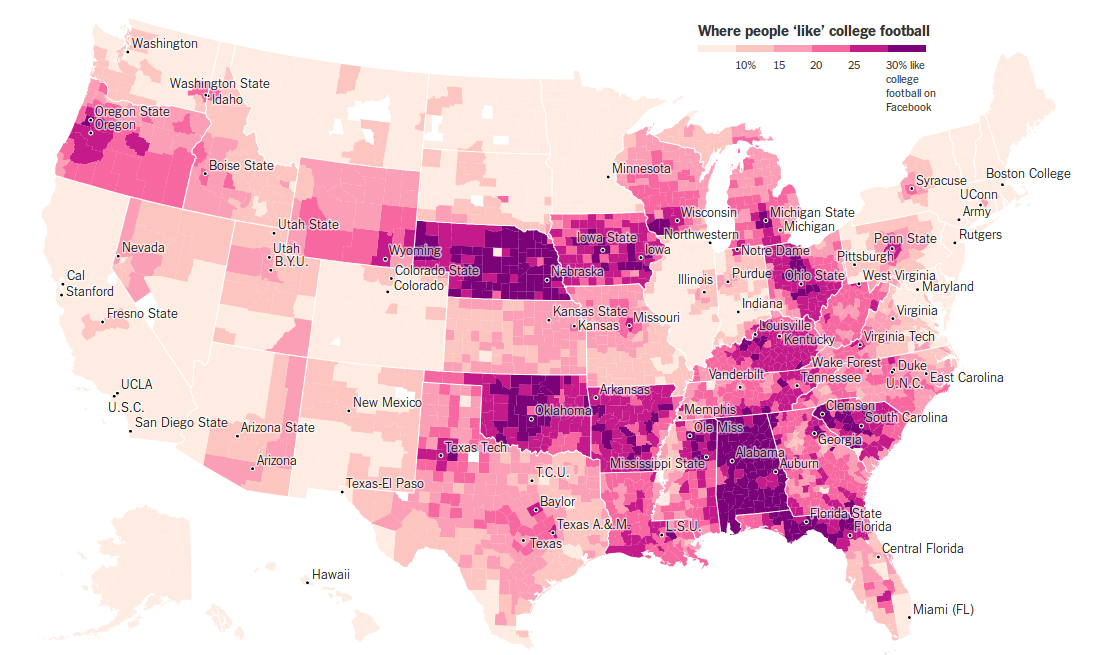
Why put this up? Because once again it shows how state borders matter. There are cultural items, commonalities, etc. that follow state boundary lines even when there isn’t an obvious reason for them to in the larger frame. Though we live in a global era of metro-centric economies, geographies like states still exert power not just legally, but also culturally.
 The Urban State of Mind: Meditations on the City is the first Urbanophile e-book, featuring provocative essays on the key issues facing our cities, including innovation, talent attraction and brain drain, global soft power, sustainability, economic development, and localism. Included are 28 carefully curated essays out of nearly 1,200 posts in the first seven years of the Urbanophile, plus 9 original pieces. It's great for anyone who cares about our cities.


DECA Financial Services Executive Faces Federal Fraud Charges
Wolfe is accused of filing false financial statements with BMO Harris bank in order to obtain an inflated line of credit from $1 million to $7.5 million, which he allegedly tapped for personal use. Wolfe is accused of using some of the money to make payments on his house, an automobile, personal credit card accounts and a lake house.
In June 2013, Wolfe allegedly sold $1 million worth of stock to an unnamed individual for a 5% stake in DECA, which he failed to provide to the stock purchaser. Wolfe allegedly used some of the money to purchase an Audi automobile for himself. Creditors forced Wolfe into personal bankruptcy earlier this year. The U.S. Attorney claims Wolfe's attorney represented to the bankruptcy court Wolfe had access to a $14 million living trust to help repay creditors. The actual value of the trust was $52,000, a misrepresentation the U.S. Attorney says delayed the appointment of an independent trustee to oversee DECA.
Wolfe could face up to a decade in prison and be liable for significant fines if found guilty of the charges. The U.S. Attorney's Office says the indictments against Wolfe were aided by a joint investigation of the FBI and the U.S. Bankruptcy Trustee.
Urban Meyer Sixth Highest Paid Coach in the Country
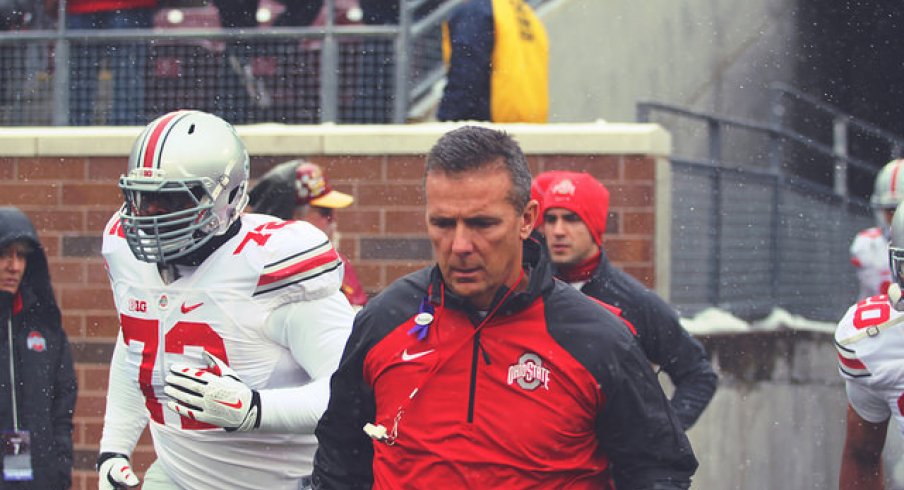
Urban Meyer is one of the nation's best coaches, and at ~$4.4 million per year, he may be underpaid. (Urban, for the record, received a $330,000 bump in salary earlier this year.)
USA Today released its always-fascinating head coaching salary database for 2014 today, and boy, how do I hire Kirk Ferentz's agent?
The whole thing is worth checking out in full, but here are the top ten coaches (and their salaries):
| COACH | SCHOOL | TOTAL SALARY |
|---|---|---|
| NICK SABAN | ALABAMA | $7,160,187 |
| MARK DANTONIO | MICHIGAN STATE | $5,636,145 |
| BOB STOOPS | OKLAHOMA | $5,058,333 |
| KEVIN SUMLIN | TEXAS A&M | $5,006,000 |
| CHARLIE STRONG | TEXAS | $5,000,270 |
| URBAN MEYER | OHIO STATE | $4,536,640 |
| LES MILES | LSU | $4,369,582 |
| JAMES FRANKLIN | PENN STATE | $4,300,000 |
| KIRK FERENTZ | IOWA | $4,075,000 |
| STEVE SPURRIER | SOUTH CAROLINA | $4,016,900 |
While some lower-tier Big Ten teams need to catch-up with the times, it's refreshing to see the Big Ten with four of the top ten highest-paid coaches in the sport. (Even if one of them is Kirk Ferentz, whose contract might be considered robbery in some jurisdictions.)
How about ol' Dino at No. 2, too? That one blew me away even more than Ferentz's salary.
At Your Leisure: Theater Under the Stars
Secret U.S. Cellphone Program – The Short Answer
Hey Guys, the Russians Aren’t Buying Pabst After All
Two Chicagos, Defined by Pete Saunders
[ Here’s another nice piece of analysis about Chicago from Pete Saunders. He originally did this earlier this year – Aaron. ]

Chicago skyline. Source: wikipedia.org
Fast forward twenty years. Chicago’s transition from Rust Belt Capital to Global City has been unparalleled. Where there once had been large swaths of middle-class, working-class and impoverished neighborhoods, with high-income enclaves, there are now nearly as many high-income neighborhoods as there are of the other three. Perhaps someone who moved to Chicago post-1995 and lives in one of the up-and-coming areas is vaguely aware of this, but anyone who was here before then is quite right to be astounded.
Despite Chicago’s transformation, it’s been pretty well-documented that not all parts of the city have benefited. The battle over the closing of nearly 50 schools, mostly located in the city’s poorer South and West side neighborhoods, brought this to light, as did Chicago’s high-profile murder and violent crime rates through 2013 (which, to date in 2014, have gone down dramatically). Inequalities and disparities became evident in both areas; University of Chicago graduate student and blogger Daniel Kay Hertz brought the disparities to light with his analysis of violent crime in Chicago. As he said in his piece:
Over the last twenty years, at the same time as overall crime has declined, the inequality of violence in Chicago has skyrocketed. There have always been safer and more dangerous areas here, as there are everywhere; but the gap between them is way, way bigger now than it used to be.
Over the last two decades a new but undefined paradigm has emerged, the one of “Two Chicagos”. This is probably best explained once again by Dan Hertz, who recounted an overheard conversation on the L:
I was on the train earlier this week, and two white men got on and asked their neighbors, who were two black women, how to get to a hotel. The women told them. And then began a sort of stock conversation that Chicagoans have with tourists: How do you like the weather, ha ha? The men, who were from Atlanta, did not like it. Have you been on a subway before? Yes, but not often. Would you come back? Oh, yes. We love Chicago, the men said.
The men reached their station, and left.
One woman said to the other: I hate it when people say that – I love Chicago. No, you don’t. You love downtown and the North Side. The other woman said, Uh huh.
That is a frequent sentiment of those who live on the other side of the invisible divide in Chicago. But what, exactly, is that divide? Where are the boundaries? Exactly how deep are the difference?
I took a stab at trying to figure this out.
I compared some socio-economic statistics for the 56 zip codes in Chicago against medians and averages for the entire Chicago metro area (Indiana and Wisconsin excluded). The differences are stark.
Let’s start by looking at maps of the areas of examination. Here is the seven-county Illinois portion of Chicago’s metro area, with Chicago etched in:

I gathered data for all suburban municipalities and all City of Chicago zip codes within this area, for five variables — population, non-white population percentage, median household income, and median home value, and bachelor’s degree or more for persons 25+. The data comes from the 2011 U.S. Census American Community Survey. After collecting that data, I established an “average of medians” or “average of averages” to get a baseline for the metro area, and an understanding of how jurisdictions or zip codes would compare to one another. One fairly big caveat — an average of medians or average of averages weighs all jurisdictions equally, skewing the numbers higher due to the number of small but well-to-do suburban municipalities. So while the 2011 actual median household income for the seven-county area overall was $61,491, the average of medians was $74,731. But since all data is expressed this way, differences are negated.
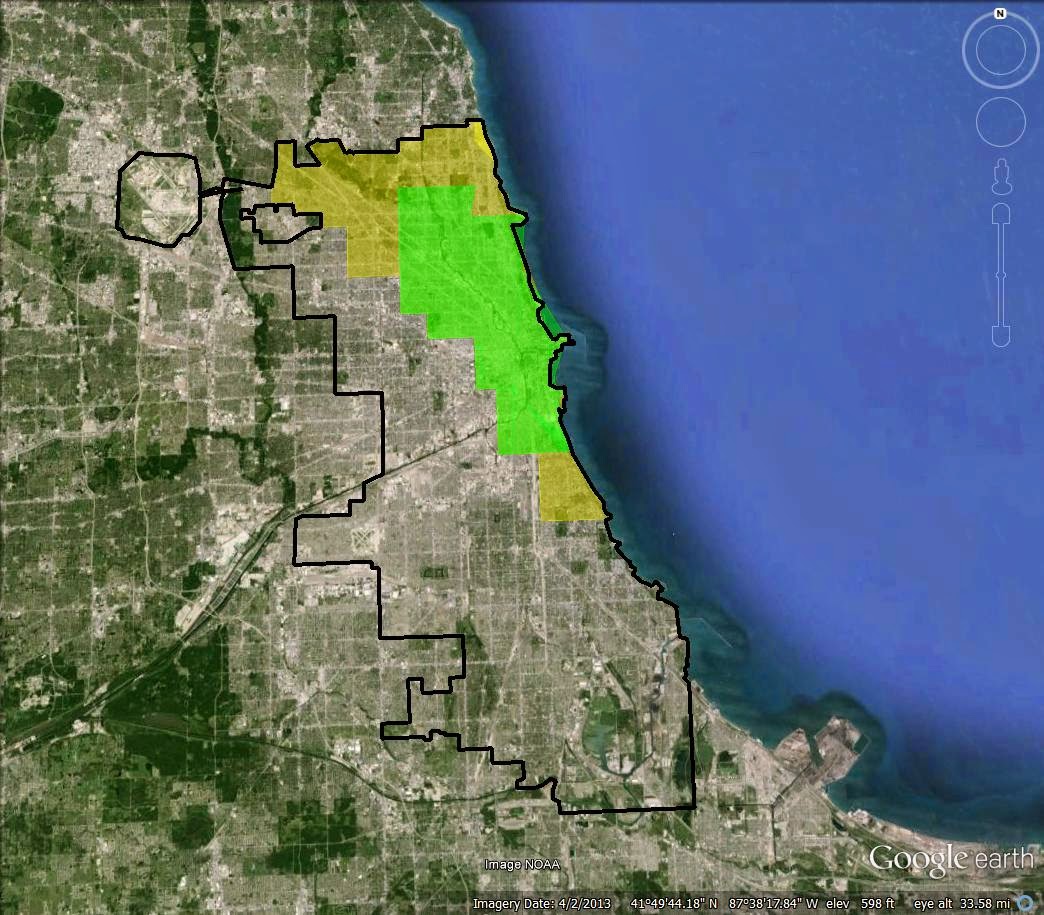
Next, I looked for Chicago zip codes that were above the metro area average in at least one of three categories — median household income, median home value, and bachelor’s degree or more for persons 25+. These are the higher income neighborhoods that can be called “Global Chicago”. Within the city, they look like this, in yellow:
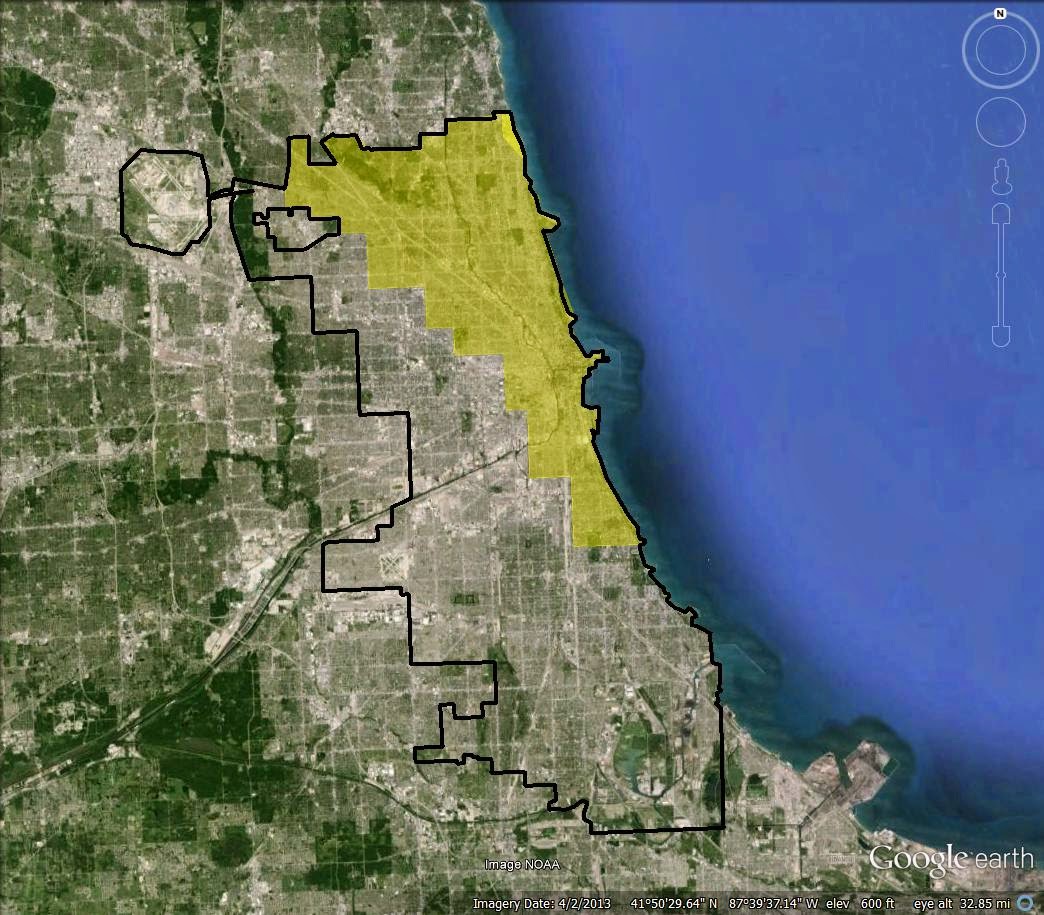
Most Chicagoans would recognize this as the wealthier parts of the city. It stretches from the far Northwest Side eastward to the lake, south to downtown and continuing south before ending in the Hyde Park neighborhood on the South Side. Again, I included all zip codes that were above the metro average for at least one of the three categories I examined, so not all communities are the same. Hyde Park, for example, is here because it has high educational attainment, but is below the average for income and home value. The same applies to Rogers Park and Edgewater on the city’s northern border with Evanston. Jefferson Park, Norwood Park and Sauganash, on the other hand, located on the Northwest Side, rank highly in home value but lower for income and educational attainment.
Taken together, you can see how “Global Chicago” compares with the Illinois portion of the metro area, the metro area excluding Chicago to give you Suburban Chicago, and the balance of the city beyond “Global Chicago” that I’ve called “Rust Belt Chicago”:
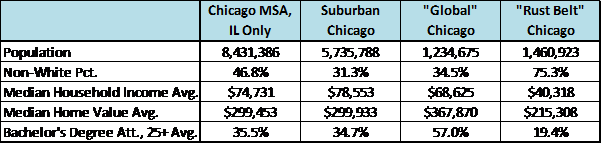
The differences are indeed stark. “Global Chicago” is on par with the Chicago suburbs and the metro area overall in terms of income, and has a lower percentage of minority residents compared to the metro area. Interestingly, “Global Chicago” has a much higher home value and educational attainment when compared to the metro area overall or the ‘burbs. Meanwhile, “Rust Belt Chicago” lags far behind. “Rust Belt Chicago” has a large majority-minority population, has an income nearly one-half as much as the suburban households, and has only one-third as many college graduates as “Global Chicago”.
I decided to take this analysis a little further and determine if there is a core to “Global Chicago”, and how it would compare to the rest of the city. I collected data for zip codes that exceeded the metro average in two or more of the three categories. That produced this map:
And this table:

Here, a “Super Global Chicago” compares favorably with the ‘burbs in terms of income, but far exceeds it in terms of home value and educational attainment. Including some of the peripheral areas of the previous “Global Chicago” with the previous “Rust Belt Chicago” to produce an “Average Chicago” leads to some gains, but it still lags far behind the other slices of the metro area.
Right now, the CNN series “Chicagoland” is doing its best to illustrate the “Two Chicagos” meme, highlighting blues festivals and Stanley Cup championship celebrations on one end of town and school closures and endless crime on another. However, these maps and tables may do a far better job of demonstrating the impact of past and current practices and policies on the city’s landscape. In fact, I think Chicago’s example is one that will serve as a model, for better or worse, for other cities across the nation.
In reality I see the “Two Chicagos” meme as overplayed. Chicago may be better understood in thirds — one-third San Francisco, two-thirds Detroit.
This post originally appeared at Corner Side Yard on March 18, 2014.
The Urban State of Mind: Meditations on the City is the first Urbanophile e-book, featuring provocative essays on the key issues facing our cities, including innovation, talent attraction and brain drain, global soft power, sustainability, economic development, and localism. Included are 28 carefully curated essays out of nearly 1,200 posts in the first seven years of the Urbanophile, plus 9 original pieces. It's great for anyone who cares about our cities.


Mike Davis all smiles in return to Bloomington
As Mike Davis prepared to walk onto Branch McCracken Court 12 minutes before tipoff on Monday night, the former Indiana coach looked up and smiled. The long, winding road the 54-year-old Texas Southern coach has endured had taken him back to Bloomington — the place where his head-coaching career began more than 14 years ago. His […]
The post Mike Davis all smiles in return to Bloomington appeared first on Inside the Hall | Indiana Hoosiers Basketball News, Recruiting and Analysis.
Grace Gets Three Michelin Stars in Latest Chicago Guide

The Earth Reverberating
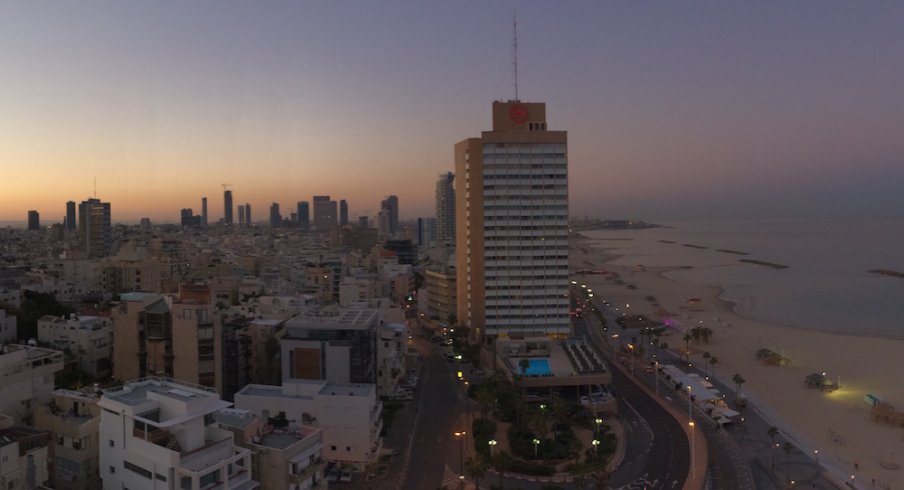
Ohio State’s game of the year in East Lansing happened to coincide with business travel I could not avoid. As a result I found myself in Tel Aviv last Saturday, where the Buckeyes and Spartans wouldn’t kick off until 3am Sunday morning.
Since weekends in Israel are Friday and Saturday this meant Ohio State would not only start playing during the normally dormant, pre-waking hours of a workday - the game would also overlap with the start of Sunday business. Outside of spotty cell phone updates during stubbornly planned fall weddings (clenches fists in rage) I had not missed a Buckeye football game in its entirety since Michigan in 1996; also due to being overseas.
[Yeah. Michigan in 1996. I still hold myself partially responsible for what happened that day. Nope, never going to watch it.]
Tel Aviv isn’t Chicago and this wasn’t a weekend or a soccer game. Therefore, my hopes were slim of finding a bar anywhere in the Middle East willing to open its doors and create a graveyard shift that doesn’t normally exist to serve ex-pats like me for whom a relatively niche sport like college football matters too much.
I wasn’t going down without at least trying, so I asked friends and acquaintances who had visited Tel Aviv to name a place that was fun, casual and catering to American sports tastes. It turned out to be a simple question; every single person responded with the same place: Mike’s Place.
Sounded casual enough, so I googled it to get the address which was the very first result. However, my eyes were immediately yanked into the words for the entry beneath it.
That’s because second result was Mike’s Place suicide bombing.
MIKE'S PLACE - APRIL 30, 2003
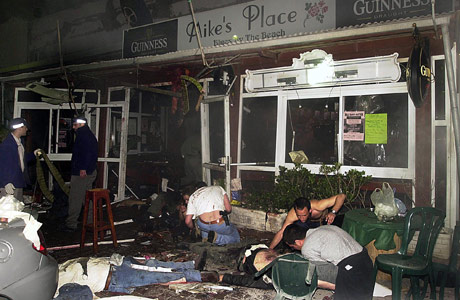
The attack happened during the normally dormant, pre-waking hours of a workday.
It was well after midnight on Wednesday during the bar’s weekly, well-attended Tuesday night jam session. Gal Ganzman, one of the owners who also happened to be tending bar described his personal experience that fatal evening:
I see a flash to my left just outside the bar and hear a high-pitched pop, like a firecracker. That's it - no heat or wind or anything like that…I immediately understood that something was not right, but I didn't know it was a bombing.
Everything is quiet. No noise. No screaming. A few people are getting up from the ground with bloody faces. Bodies are scattered about on the ground not moving. The row of cars I am used to seeing outside the bar looks different, black. It becomes clear that a bomb has gone off.
Inside, no one is hurt, but no one is moving. I only remember making eye contact with one woman as I made my way to the back….on the table in front of her are a couple of drinks, a beer mug, and what might have been a liver. She looks at me, confused.
The bomb was detonated by a 22-year old British national named Asif Muhammad Hanif. He arrived at the bar with Omar Khan Sharif, a 27-year old collaborator also from Britain. Avi Tabib was working the door that evening and thought the two men looked suspicious, so he blocked them from entering the bar as they attempted to force their way inside.
Tabib shoved the men out of the entrance right as Hanif detonated the bomb, which he had attached to his belt on his back side, likely to avoid suspicion. The explosion badly injured the bouncer and also wounded Hanif’s collaborator in the process. Sharif’s bomb failed to explode and he was startled by the blast, so he discarded it and fled the scene. His body washed up on the beach two weeks later.
Hanif’s bomb detonated at his waist, instantly decapitating his body and shooting his torso from the ribcage up skyward, slamming into the Mike’s Place sign above the entrance.
The owners refused shutter a place where people escaped daily life for music and sports.
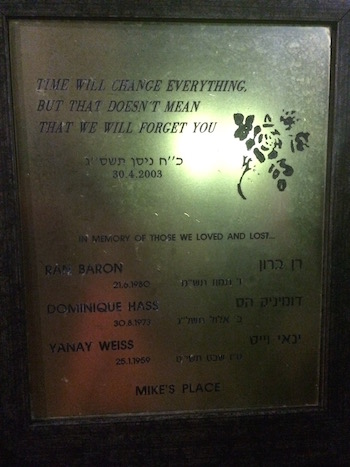
The blast killed Yanai Weiss - a guitarist and one of the spiritual leaders of those Tuesday night jam sessions that are still held at Mike’s Place today. Ran Baron, a bar regular and musician who had just finished recording a song that evening also died at the bar. Dominique Hass, an aspiring pastry chef who had just closed a deal to open a new cafe was bartending that night and died on the way to the hospital.
Sixty other patrons were injured. Had Sharif been able to enter the bar before detonating his bomb the casualties would have been significantly higher and the structural damage might have been catastrophic. As luck would have it, a film crew was at the bar that night filming a documentary and unexpectedly captured the entire attack.
Mike’s Place was still badly damaged, but Ganzman and his fellow owners refused to allow an act of terrorism to shutter a place where people escaped the rigors of daily life for music and sports. Their patrons relied on them; besides, succumbing to terrorism only helps empower it.
So while mourning, they swiftly made the necessary repairs to the building, restaurant and bar. Mike’s Place triumphantly reopened only a few days after it was bombed, on May 6.
That was not an insignificant date in Israel. It’s Independence Day.
MIKE'S PLACE - NOVEMBER 8, 2014
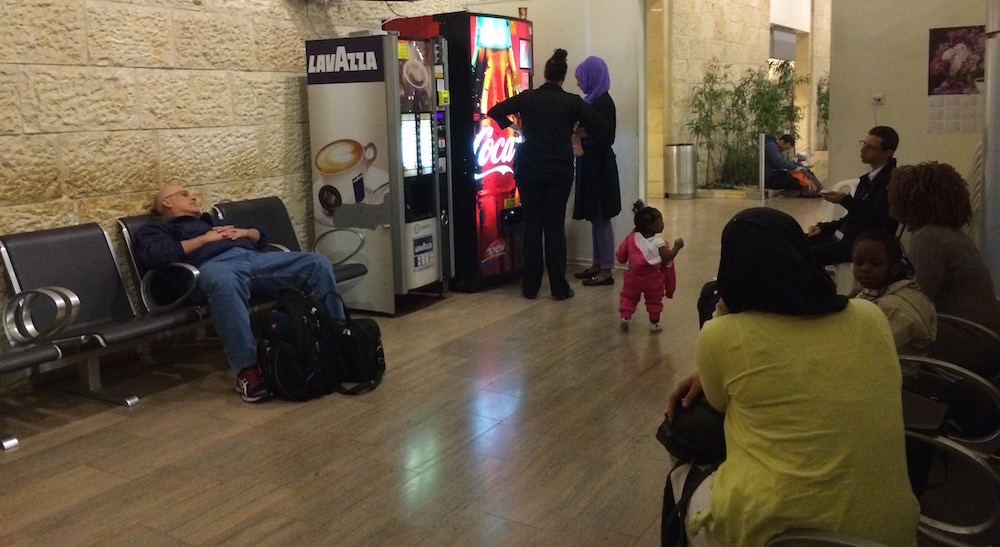
Unfortunately, I was unable to make it to Mike’s Place to see the Buckeyes and Spartans. As it turned out I barely made it out of the airport.
Sometimes things simply refuse to go as planned.
Border security at Ben Gurion airport is understandably rigorous. Almost 45 minutes after arriving from Rome and standing in the Foreign Passports line it was finally my turn to see an agent. He was only visible from the shoulders up, sitting inside of a small windowed kiosk equipped with monitors only visible to him.
He looked over my passport, asked me a few questions about my reasons for being in Israel and spent a couple of minutes examining those hidden computer screens. Then instead of handing me back my passport, he got up and exited the kiosk with it. A minute later he returned, empty-handed.
“You’re going to have to answer a few more questions,” he said, pointing behind me. “Go over there and you will be summoned.”
Over there was a roughly 40x20 waiting room equipped with a couple of beverage machines ($4 for a small bottle of water) and nothing else. One side of the room was occupied by people arriving from West Africa being screened for symptoms of the Ebola virus. The other side was everyone else who had apparently been told they, like me, needed to answer a few more questions.
There was no wireless and no electrical outlets. I turned on my phone and began catching up on Twitter and college football sites.
An hour later I was occupying the same chair. A few people had come and gone, but otherwise the only real action was a security guard occasionally lecturing other sequestered travelers for complaining about being detained. One family loudly pleaded it was about to miss a boarding a cruise ship.
Another hour later a woman came to the room and finally called my name. I popped up and followed her into a sequestered office. She had my passport on her desk and my name was already on her computer screen.
I sat down and she slid a piece of paper toward me. “Write down all of your telephone numbers and email addresses,” she said. “Write down your father’s name and his father’s name.”
Cool, I could definitely do that. If only all tests were this easy.
“You know, you have a *terrible* name in Israel.”
She asked me the same questions the agent in the kiosk had asked me earlier. Then she asked if there were any other phone numbers or email addresses I had failed to write on the paper. Then she asked me those same questions again, as if I hadn't just answered them.
I produced my business card, boarding passes, some work emails from my Israeli colleagues discussing my visit and anything else I figured could get me to Mike’s Place before the 3:30pm games reached halftime.
Our interview took about 15 minutes and she sent me back into the Ebola room, saying I would be summoned again shortly with a determination. About an hour later I caught sight of her leaving that office with her bag and her coat. She was going home.
It was now 5:30pm. I had been in Israel for two and a half hours, all in the airport. It was 10:30am in the States so I plugged my phone into one of the four batteries I travel with and began to track College Gameday from East Lansing (I was curious to see how accurate I was with predicting the script.)
An hour later I finally realized it might be a good idea to send some emails to my Israeli colleagues asking for some help. They apologized profusely and started dialing their phones with haste.
Two hours after that at 8:30pm a male agent emerged just as the female had several hours earlier and called my name. I popped up and followed him into a different office. He had my passport on his desk. I could not see his computer screen.
Once again, I was asked to write down all of my phone numbers and email addresses; my father’s name and his father’s name. I answered all of the questions about my occupation and the reasons for my visit, again, with a smile.
“Is there anything you aren’t telling me?” He asked the question with a thick Hebrew accent. “What would I find out about you if I looked you up on the Internet?”
That was the first question I couldn’t answer confidently. “Um, probably Twitter stuff, sports writing, and - “
“You’re a sports writer?” He asked. “What kind of sports?”
“Football,” I replied. “Um, I mean American football. American football. Not futbol. Well, I have written about soccer. But not usually. American college football.”
Then he cut right to the chase. “You know, Mr. Ramzy, you have a terrible name in Israel.”
There had to be something lost in the translation as I don’t think for a second he was purposefully trying to be a dick. My last name is quite common in the Middle East - so common that it’s even shared by a man who heads a notorious terrorist organization. Hooray!
“I understand that,” I said, “but it’s a coincidence. I don’t know and am not related to anyone terrible.”
“Not at all?”
“Not at all.”
He seemed satisfied for few seconds. As with the female interrogator before, I had produced my boarding passes and everything needed to justify my visit - except my passport, which he already had - and figured I might be close to finally leaving the airport.
“So then,” he said. “Tell me what else I would find if I looked you up.”
It suddenly occurred to me what I had failed to grasp during this constant string of questions, and frankly I felt like a complete idiot for not having realized it earlier.
Warriors isn’t a benign word in the Middle East, a region that’s been at war with itself for thousands of years. Conflict is part of the fabric of society there, whereas in America we casually use war metaphors when talking about sports. We routinely talk about wars on drugs, poverty, Christmas, whatever.
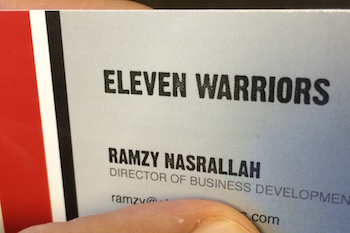
They don’t do that there. War is bloody, endless, violent, tragic, perpetual reality in the Middle East. In using Israel's vast resources to check my history (unexciting) citizenship (only one) aliases (none) and affiliations it was now clear they had seen but probably not fully understood that while Eleven Warriors might sound like an emerging jihadist organization…um, it’s not.
“Eleven Warriors,” I blurted out to him, with direct eye contact.
“Yes, please tell me about this,” he said.
I described the company to him in full and gave him the URL to check out for himself. He asked for my Eleven Warriors business card, which I produced. After a few more questions he sent me back out to wait, but his tone had changed significantly from the beginning of the interview. It was more conciliatory and almost apologetic, and he acknowledged how much time I had spent being detained at border security.
Despite feeling like I had been forgotten for most of the afternoon, he knew exactly how long I had been there to the minute. Not long after we finally discussed 11W, another agent emerged from the offices with my passport, an Israeli visa, my work business card and my boarding passes from the journey.
They returned every document I had given them in my defense, with one notable exception: They held onto my 11W business card.
I was now free to venture into Tel Aviv almost six and a half hours after first arriving. Minnesota thumping Iowa and following college football Twitter very likely salvaged my sanity last Saturday. No, I didn’t tell anyone what I was going through. That would have helped nobody stay calm.
My cab dropped me off at my hotel and I limped into my room while setting an alarm to wake up and watch the Big Ten's game of the year.
Which I eventually did on my phone with one eye open, from bed. Mike’s Place would have to wait another day.
ANGELS AND DEVILS
If you head south on the boardwalk from the bar and cross the street toward the sea you'll find the bombed-out remains of the Dolphinarium discotheque on the beach. It was destroyed in 2001 during the second Intifada which also spanned the Mike's Place bombing. Unlike the Mike's Place bombers, the perpetrator of this attack was from the region.
The Hounslow mosque in West London was the British base for an international Sufi Muslim group named LightStudy. That New Age movement, which is led by a Syrian cleric named Sheikh Muhammad al-Yaqoubi is viewed as an important ally against radical Islamic groups in that it is opposed to violence of any kind. The Chinese, Russian and British governments favor Sufism as a means of fighting against Muslim extremism.
Seven years before Mike’s Place was bombed in 1995, members of Al-Muhajiroun were permanently expelled from Hounslow for having radical views of Islam. If that group sounds vaguely familiar, it’s probably because FBI Agent Ken Williams famously noticed and reported suspicious activity involving Middle Eastern men taking flying lessons in Arizona in early 2001.
His report, which went largely ignored by his superiors until after 9/11 was subtitled Osama bin Laden and Al-Muhjiroun supporters attending civil aviation universities/colleges in Arizona.
Al-Muhajiroun may have been kicked out of Hounslow, but it didn’t exactly leave either. Hanif was an active, vocal and popular member of LightStudy, yet British intelligence tied both him and Sharif to Al-Muhajiroun well prior to April 2003 and failed to stop them as they used British passports to legally enter Israel multiple times that month.
His religious devotion and intentions, which served as central focus of his life, were duplicitous. Hanif’s worldview of Islam was being simultaneously shaped by an angel on one shoulder and a devil on the other. In death, his friends, family and neighbors were overcome with disbelief and grief. Conversely, Al-Muhajiroun celebrated him as a martyr for their cause.
The two men entered Israel for the final time on April 29th from the Gaza Strip and made their way north - with familiarity from previous, undisturbed visits - to the Tel Aviv promenade along the beach.
MIKE'S PLACE - NOVEMBER 9, 2014
Bombs smell like burning flesh and smoke.
They ruthlessly ignite everything unfortunate enough to be within their reach without discrimination - walls, cars, people, concrete, everything. People whom the explosions fail to kill are instead treated to that unforgettable scent in their nostrils. That’s how the rest of us know what bombs smell like.
Bars smell like alcohol, sweat and hot food. The ambient sound of a crowded bar carries the scents of fresh and rancid fun from one end to the other. The air is thick with amusement and it lingers for days.
Bombs smell like death. Tonight, Mike’s Place smells like life.
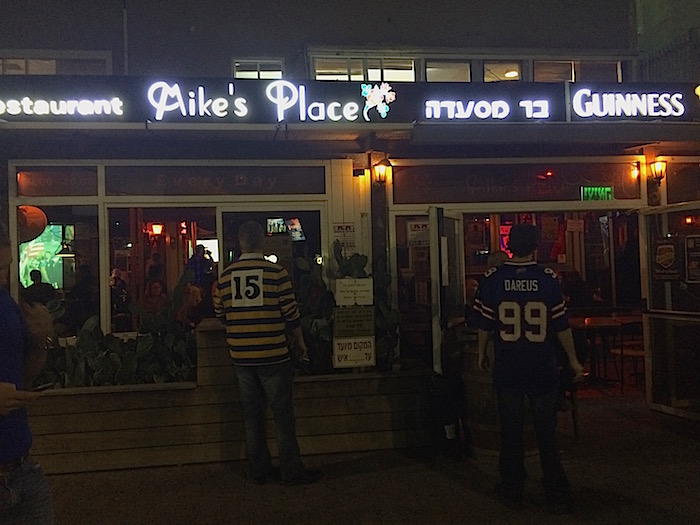
The bar faces the boardwalk that runs along the beach. It is the only building that shares a wall with the American Embassy, which you can probably imagine is one of the most fortified buildings in the world. It couldn't have been more than ten seconds inside the bar before I was able to pick up French and Arabic being spoken in addition to Hebrew and Scottish-accented English.
Once you pass the memorial to the 2003 bombing victims and uniformed security you’re greeted with a second layer of glass that I initially assumed was for security; later I found out it was set up as a barrier for the cooler weather that’s coming. The first NFL games were starting as I entered, at 8pm local time. The volume was turned up for American national anthem being played at the Jaguars/Cowboys game in London.
Bombs smell like death. Tonight Mike’s Place smells like life.
There are only two rules at Mike's Place: Politics and prejudice aren’t tolerated. I took an open seat at the bar next to a guy who had just quickly ordered four Jager bombs for himself right as the 2-for-1 happy hour was ending.
Taking his cue, I did the same and ordered a quadruple Bulleit, neat. The bartender informed me the drink would cost a mere 49 shekels and another patron at the bar immediately shouted, “yeah go Niners!”
I was still a bit wrecked from traveling, border security, waking up at 3am to watch the Buckeyes and a full day of work so I only stuck around for one half before cutting out - but it was excellent. I learned a few interesting things during that half of football: One, Israelis are almost uncomfortably acclimated to the constant threat of terrorism (a recent trend is deliberately taking selfies with incoming missiles approaching in the background)
Two, terrorism cannot prevent people from escaping the rigors of daily life to enjoy sports and loud music. The entire peace-loving world was represented in Mike's Place, and both the mood and the vibe - on a school night - were absolutely vibrant. Man, I would have loved to see the Buckeyes light up the Spartans there.
Alas, sometimes things simply refuse to go as planned.
Please refer to 11W commenting policy before attempting to make any references to politics or religion.
Indy Airport Boosting Nonstop Service
Obama to Nominate Loretta Lynch as Next Attorney General
Indy Mayor Won't Seek Re-Election
Downtown Indy Growing as Residential Destination
Indiana Beers on List of World's Best
Voters Split on Abortion and Guns in State Ballot Measures
Boston Layer Lapse
Here’s a unique take on the time lapse genre the creator labels “layer lapse.” Boston needed some love in this genre anyway. If the video doesn’t display for you, click over to Vimeo.” h/t Peter Brassard
The Urban State of Mind: Meditations on the City is the first Urbanophile e-book, featuring provocative essays on the key issues facing our cities, including innovation, talent attraction and brain drain, global soft power, sustainability, economic development, and localism. Included are 28 carefully curated essays out of nearly 1,200 posts in the first seven years of the Urbanophile, plus 9 original pieces. It's great for anyone who cares about our cities.


Why We Still Need True Dive Bars

By definition a dive bar has no definition.
If you ask someone to define a dive bar, their answer won’t be about a dive bar it will be about their dive bar. Whether it’s the drab basement bar where they first sucked down a one dollar High Life, or some one-light-bulb hole in the wall where they continue to drink away the post-work hours, everyone’s vision of a dive bar is inherently personal.
Emily Dickinson once wrote, “I can’t tell you, but you feel it.” I imagine Dickinson was describing love (or just as likely despair) with this line, but her sentiment is just as true for a dive bar. Yes, there’s a certain atmosphere that all dives share. The outdated decor, the dusty bottles, the stone-faced bartender, the stench of stale domestic beers, a dirt cheap prices (often because the beer is just so damn bad.) We’re all familiar with these dive bar tropes, but what really makes a bar a dive is a feeling. It’s the sense that the world outside has disappeared, and for however long you sit on that raggedy polyester stool everything else can wait. It’s just you, a sweating bottle of beer, and your compatriots. Even if those compatriots are just the thoughts in your head.
But is this something that I’ve actually felt myself or am I just pretending? Have I experienced this feeling or am I merely regurgitating some scene that I once saw in a movie? Is there even such thing as a real dive bar anymore?
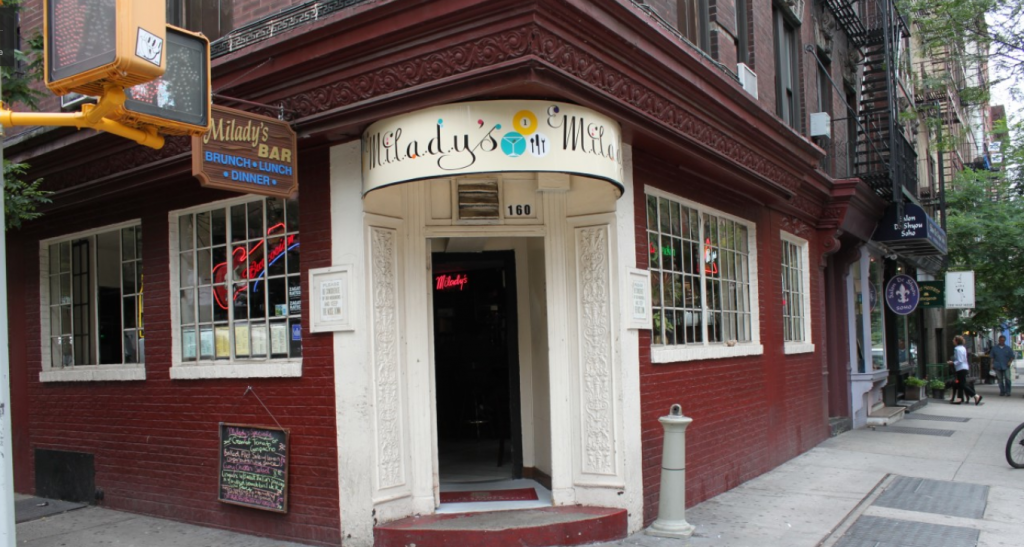
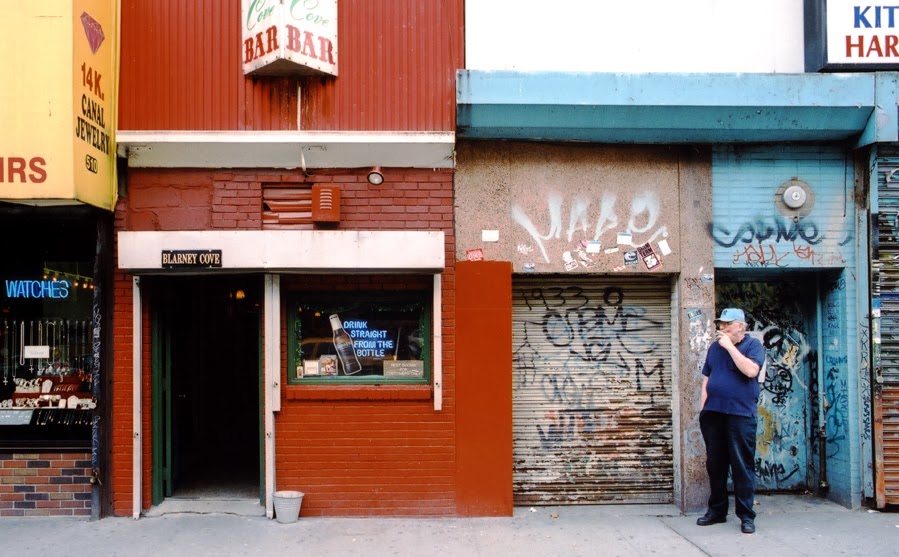
That final question is one that more and more bar-goers have been asking lately here in New York. In the face of rising rents and the general homogenization of the city, many of NYC’s most beloved dives have come under threat or been forced to shutter altogether. Mars Bar, Miladys, Blarney Cove, the Holiday Cocktail Lounge. And that’s just those that have actually closed for good. Max Fish was forced to relocate. Holland Bar was at risk in 2008, but managed to survive. And then there’s The Subway Inn which could seemingly close at any moment.
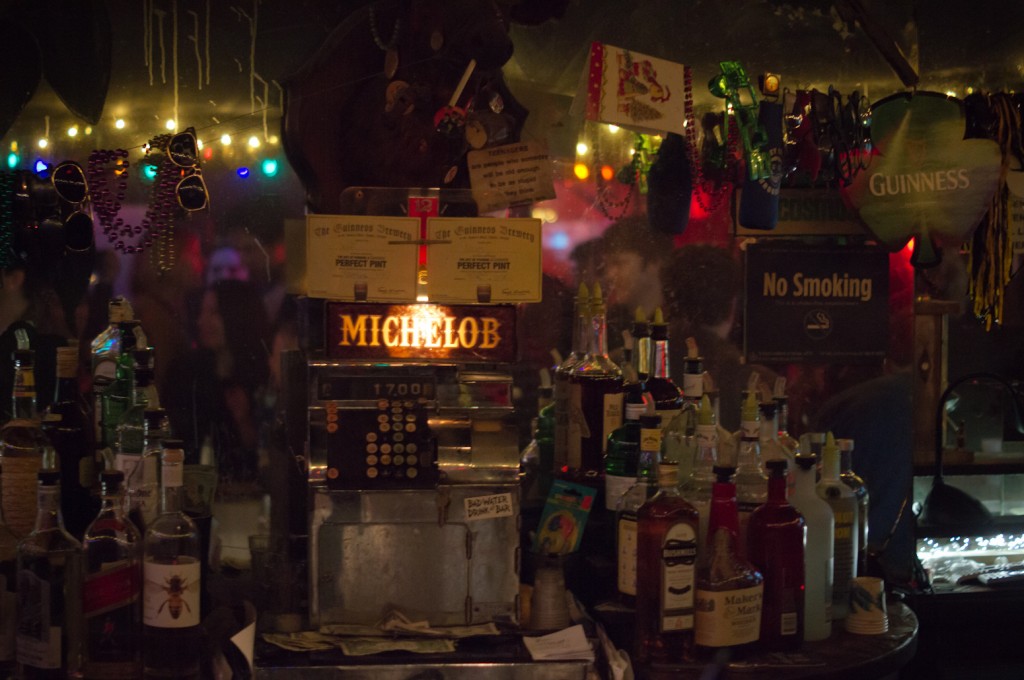
And yet, a search for “Dive Bar in New York” on Yelp reveals over four thousand listings. The disparity between actual dive bars, and the commoditization of dive bars gets back to the look vs. feel distinction. There are now countless bars, new and old, but mainly new, that masquerade as dives. Or rather, they masquerade as the sort of bars that people, primarily of my generation, mistakenly identify as dives. What we seek out now is a warped version of a dive bar, one that has been standardized until any semblance of actual grit or character has been washed away.
Call it the Instagramification of the neighborhood watering hole. Our notion of a local community bar has been contorted thanks to the expansiveness of the Internet. From upstart indie magazines to individual Instagram photos, the dive bar aesthetic has become a commodity. My generation (those who still have memories, albeit hazy ones, of their twenty-first birthdays) might relish dive bar look – the seventies pinball machines, the faded upholstery, the archaic jukebox, and any other kitschy ephemera that might garner a few more likes on Instagram – but we don’t realize that a bar’s character is less important than its characters.
This attitude is in line with our general push to Brooklynify everything. It might look pretty, but it’s all surface level, and along the way we’ve forgotten that too much of a good thing just makes us sick. Now, I should take a step back here, because I am not trying to come at this topic as some archaic curmudgeon or blind hater of Brooklyn. I’d be lying if I said I didn’t frequent craft beers bars and cocktail boutiques with denim aproned bartenders and Edison bulbs tuned just so. But, we’d all be lying if we didn’t pretend like this “Brooklyn aesthetic” (because yes, once someone opens a “Bed-Stuy Cafe” in Amsterdam it is a full-blown aesthetic) has become a stock template for all things tailored toward the young, urban-dwelling populace.
Woodsy furnishings. A copper bar. Cocktails with literary names. Mismatched chairs. Faux quirky accents like thrift store books or board games. It’s paint by numbers of a Brooklyn bar, and it’s trying so desperately hard to replicate the character of a dive bar. We even call these places dives. But this is not character, it’s the appearance of character. What a dive bar has, or really had, is character.
Bars like Milady’s and Mars were both the center of a community and a member of that community. They had this organic, palpable character that bars simply do not have today. A new bar might be able to mimic the Milady’s look, but they’ll never recreate the spirit of a Saturday night down on the corner of Prince and Thompson. The contemporary bar is designed more for a audience pleasing Instagram photo than a meaningful conversation. Truthfully though, I cannot imagine many twenty-somethings who would even be able to sit by themselves and have a drink without the aide of their cell phones. We’d rather refresh Twitter than talk to our neighbor these days, even if that neighbor is our best friend, and this is the real issue. We’re so glued to the world’s that exist in the palm of our hand, that we miss the world right in front of us.
And so the death of the dive bar might not phase most people my age, but it should, because we need dives. A dive bar allows us to escape, whether into our own heads, or into the arms of our friends. In a city like New York, with so many people, yet so little interaction, a dive bar should be a cornerstone of any neighborhood. Now more than ever, with the endless demands of this digital world, we need these places where you can shut down, and connect with someone on a real level. Sometimes you just need to leave the pretension behind, have a watery beer, and just shoot the shit with a stranger.
Or better yet, with your friends.
When one of the regulars at The Holland Bar died in ’96, his friends at the bar pooled their money for his cremation. They didn’t do it for any reason other than that they were friends, and they were friends because of the bar. It brought them together, as only a true dive could.
Indiana Soccer: The Real Gem of IU

Many people know it, but the team still sits at the back of a lot of student and alumni minds. Indiana Soccer beat #1 Notre Dame last night 1-0 and will likely be flirting with a top 5 ranking and national championship aspiration once again.
It really isn't fair. The team doesn't bring in a lot of revenue and their presence isn't huge on campus, but the IU Men's soccer team should get more love. With Devin's help in the past and then Ben picking up the reins, we've covered the soccer team sporadically throughout the years here, but they've never been a huge focus.
Despite living just outside of the public eye, the Hoosiers continue to be the class of the American Collegiate Soccer. You want to talk about a blue blood program with deep ties, it is Indiana soccer. They've won a national championship in every decade since the 80s and look primed to make a run at another one this season. With Todd Yeagley, son of legendary coach Jerry Yeagley, at the helm the Hoosiers have gone from unranked to a top 5 team this season with the defeat of #1 Notre Dame on their list of scalps as well.
Indiana hosted the top ranked Irish last night in Bloomington with a crowd of about 3,000 on hand to watch. Those 3,000 on hand got to see a dominating performance by the Hoosiers. It took 19 minutes for IU to tuck one through the Irish net on a Patrick Doody corner kick. After that the Hoosiers didn't need much else. Goalkeeper Collin Webb only had to record three saves in total last night. Meaning the Hoosiers defense was stout, the midfield controlled the ball and forwards applied pressure up top all night. Though they didn't get another goal on the evening it wasn't from a lack of good looks. Tanner Thompson just missed doubling up the score late with a shot that rebounded off the far post.
This game had shades of 2012, when the Hoosiers dropped the #1 ranked Irish on the way to a national championship run. Hopefully this squad can repeat the process this year. The team just keep getting better as the year goes on. There is little doubt they'll be an at large candidate at worst, but the Big Ten tournament is within their grasp. However, the Big Ten is stacked this year with four ranked teams and a fifth one on just the outside looking in. There are also 6 Big Ten teams in the top 30 of RPI at the moment. The conference is very good.
Right now the greatest show on turf in Bloomington isn't on the football field. It's over at Armstrong Stadium. I recommend you get over there to catch a game soon. The season is winding down and it's always great to say you got to see a national championship team in action. Especially when some of these players are likely to suit up for their country in the near future.
Milktooth
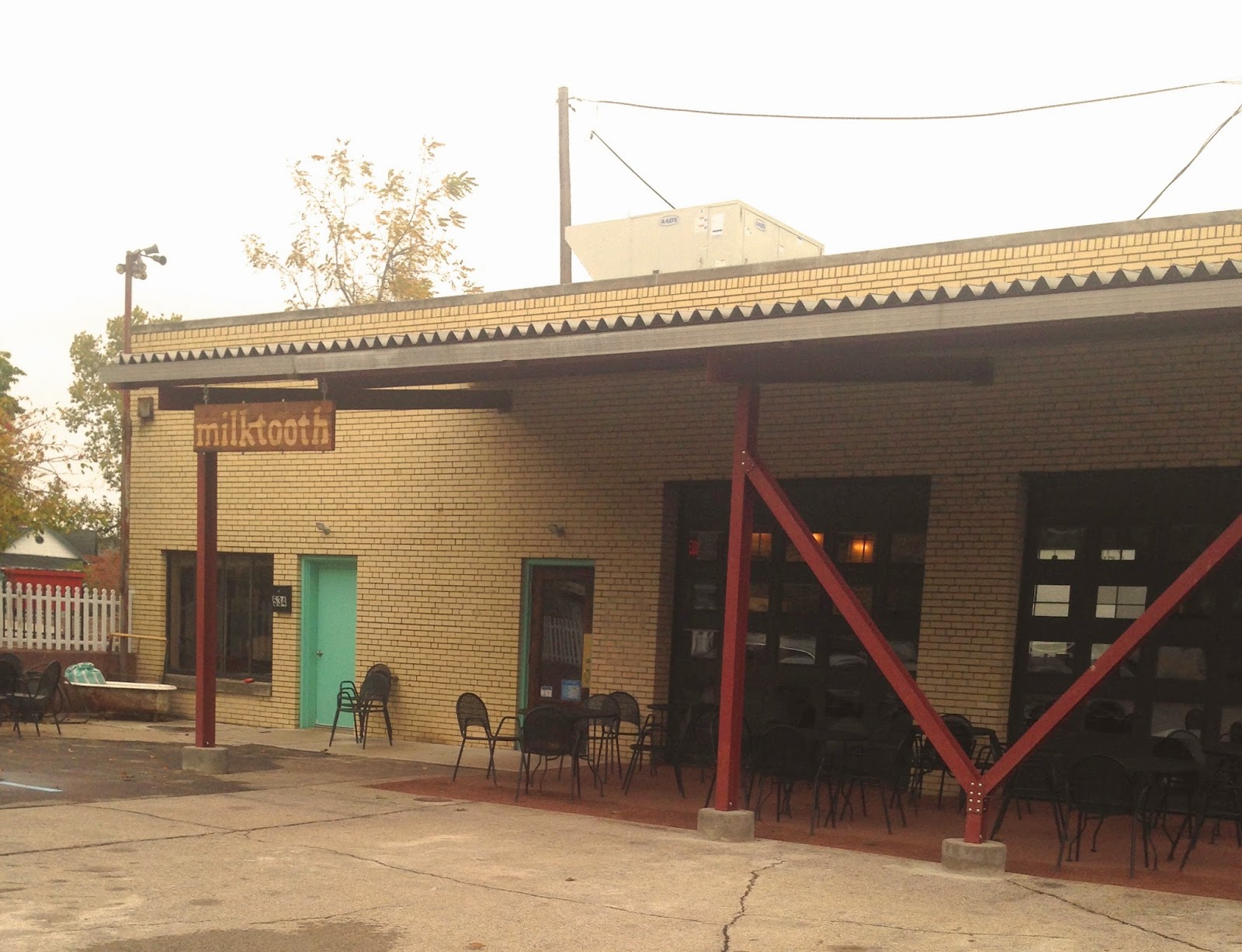
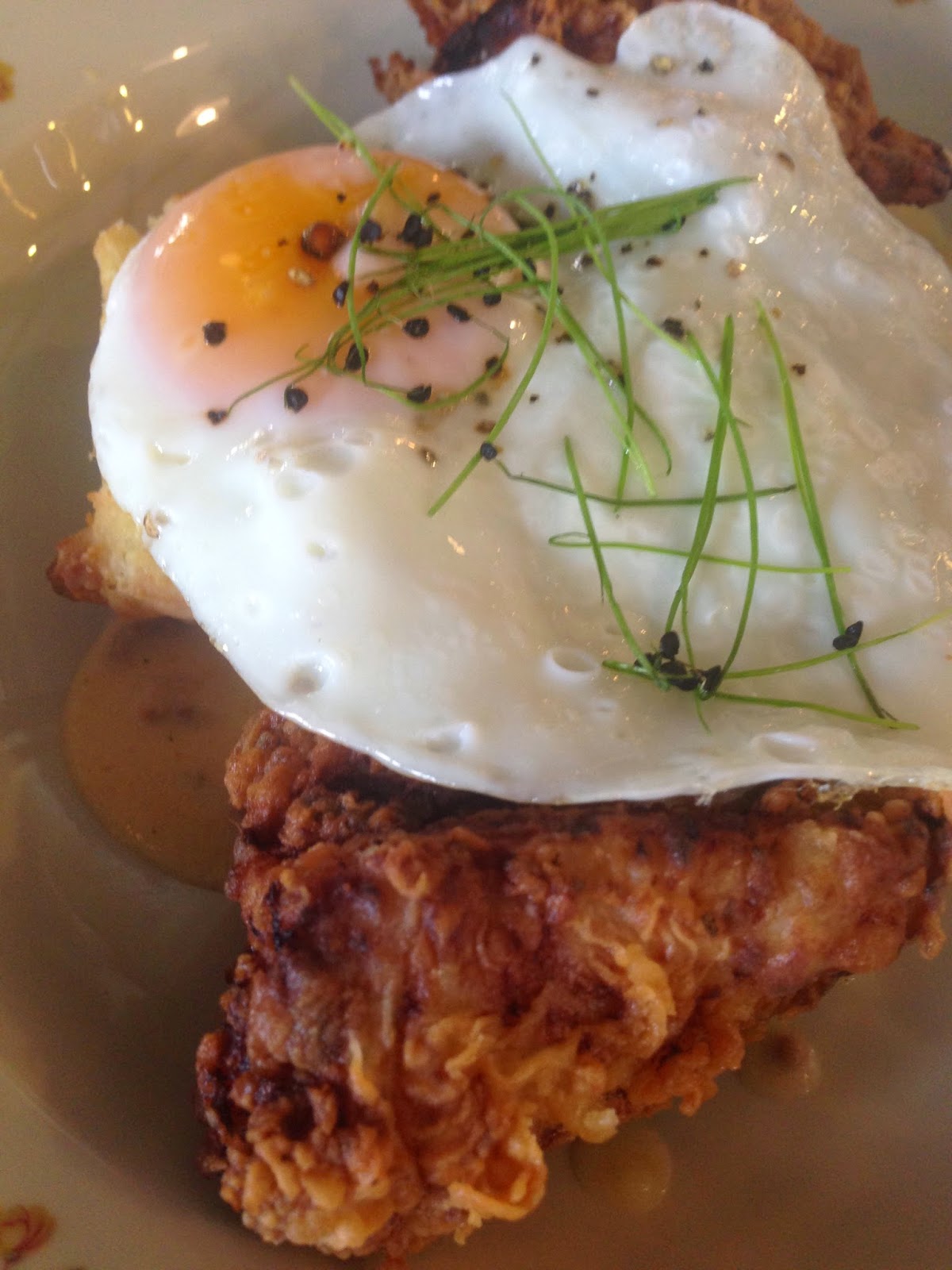
 Ok, this place lives up to the hype (and there has been a fair amount). Everything was good. Really good. If I had to choose a favorite, it was probably the fried chicken. So, here’s the set up: really good, chunky, chorizo gravy on the bottom of the bowl topped with a freshly made biscuit, several pieces of the fried chicken (my piece was a boneless thigh) and a perfectly beautiful sunny side up egg. The egg was seasoned well and the flavor of the chicken was so, so good. Rarely do I eat an egg and not want to season it a little. This needed nothing. The spices in the chicken were my favorite part and I wanted to dole out a little bit with every single bite. The biscuit was buttery and somewhat dense and the gravy gave it just the right moisture. It was all perfect together.
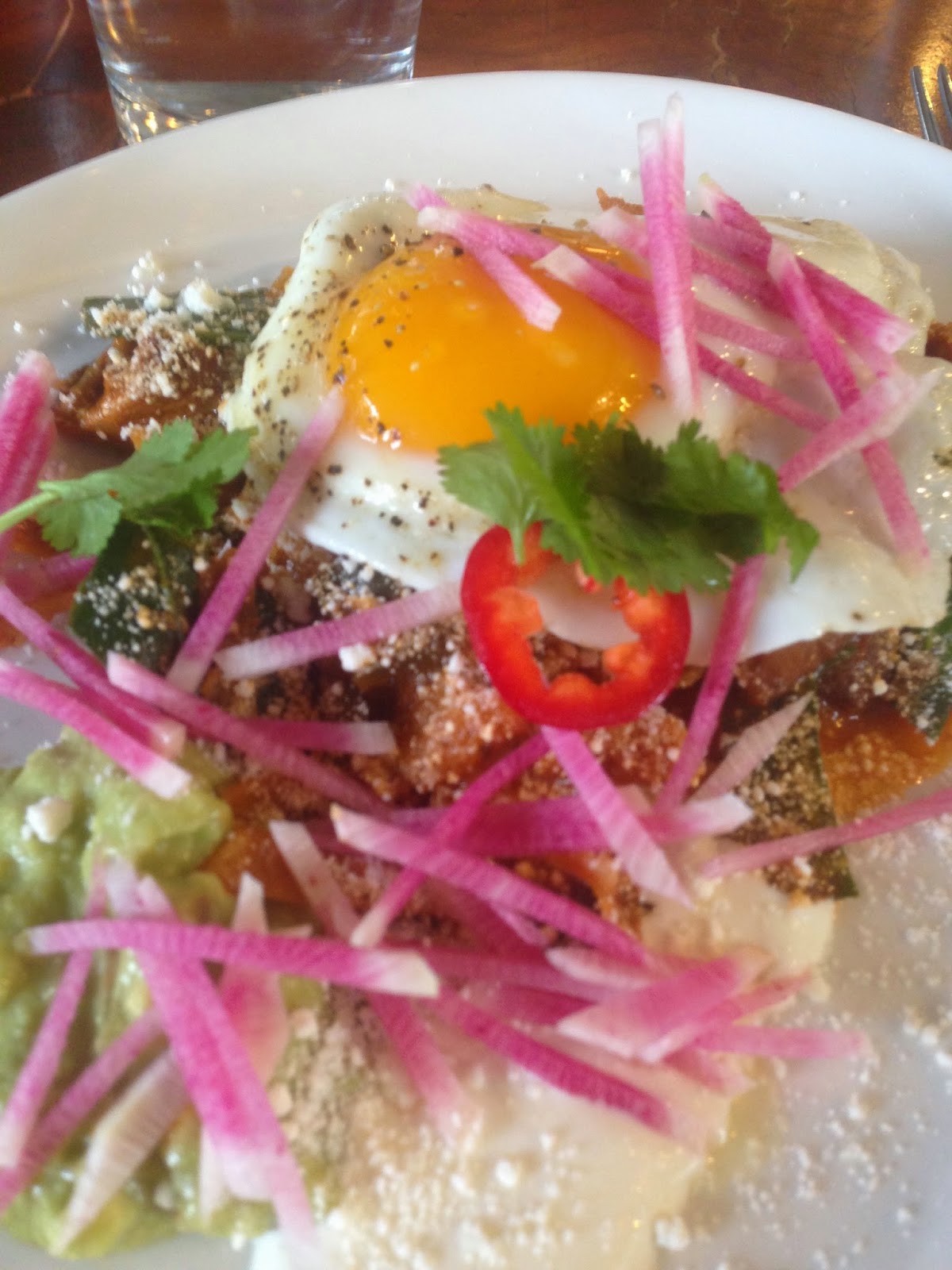
 We also had the chilaquiles, which were made up of hunks of lamb carnitas and collard greens. Normally when I have had chilaquiles in the past, crispy tortillas were part of the dish, and this was more of a saucy meat base, but quite good. I liked the slight bitterness from the collards mixed in and when you got just the right bite with the meat, some egg (another perfect sunny side up egg), a little of the guac and sour cream on the side and a few of those julienned (very lightly pickled perhaps?) radishes, it was a wonderful bite. I only wished for a bit more of the sour cream to go around with every bite. It was the kind of dish that could be very spicy, but this wasn’t. It had good spice flavors, but not in the hot kind of way.
 I am amazed at the amount of staff working here—they have got baristas making their special coffees (my macchiato was delicious although I did sorta want two sugar cubes vs. the one they brought me when I asked for sugar) and there was one person who looked like he spent most of the time pressing fresh OJ. We sat near the bar where you could watch every dish come out of the busy open kitchen and wish you had ordered that too. The place is lovely to look at and so is the food. And the flavors measure up to the presentation. I can see some people potentially complaining about the portion sizes being small though, although I found them just fine. I found the “modifications are politely declined” wording on the menu fine as well, but am a person who is happy to eat a dish the way the chef wants to prepare it. Others might be less so, but go in knowing this is not your average “2 eggs any style/choice of meat/choice of bread” kind of diner. Put yourself in their hands though, and I think you’ll be happy. I certainly was.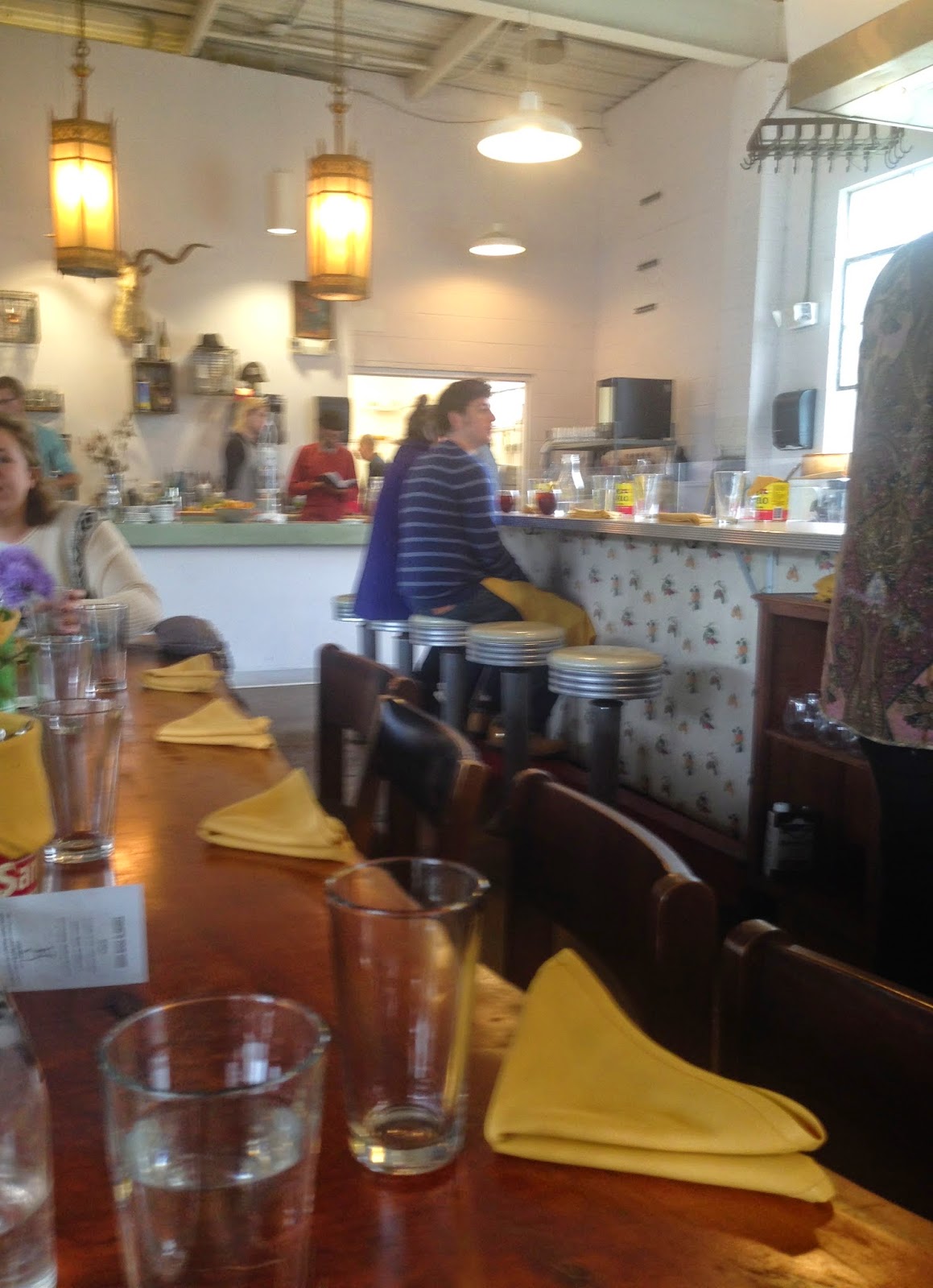

New Hilton brand coming to downtown's Illinois Building
Indianapolis Then and Now: National Surgical Institute / Imperial Hotel, Northwest Corner of W. Ohio Street and Capitol Avenue
JakienleWOMP.
“Learn the Rules then Break Them” feat. Ignacio Quiles
JakienleI love the uniqueness of this guy's style.
If style is the outward expression of an individual’s lifestyle and personality, then those with the most interesting style should also have the most interesting stories. This theory certainly holds true for my new friend Ignacio Quiles. If you’ve spent time in NYC’s East Village you might recognize him – his style cannot be duplicated.
We met up with Ignacio to kick it, talk style, and share a bit of his story with you.
“I am a native New Yorker – born in Harlem, raised in Brooklyn – and proud of it. My mother was a seamstress so I learned about sewing and tailoring from her. I loved thrift shopping then and still do now.
As for my career it has been a journey. I was a chef for thirty years, but my first passion was always fashion. My first job was working for Mr. Detulio in his bookbinding shop when I was a kid…that was where my sartorial aspirations begun. At that time I wanted to dress like the Rat Pack so I saved and saved. After a few months at the book shop I went down to Graham and Broadway where an Italian guy had opened a tailor shop in the hood… He sold these beautiful Italian Blythe Knits, and that is where I spent my savings.
My first real foray into fashion was designing belts for a company called Lee-Vic. Then in the early 80s I started importing fashions from Africa. But I was always working in restaurants, which left me less time to devote to fashion, but I always loved it. I kept my hand in the game selling at flea markets and such.
In 2010 – after building a 30 year career and earning a culinary arts degree – I had just come off a stint at Tavern on the Green in Central Park and I took it’s closing as a sign. I decided it was time to focus full-time on my fashion career. QP & Monty evolved from flea market to retail shop and now we’re working on manufacturing. Our goal within the next year is to produce our capsule collection starting with my own personal style signifiers: vests, fobs and chains. But we’re just at the beginning and always open to collaborate – it’s just exciting to be working at something you love so much.”
1. Classic Style from Classic Films

Ignacio is a pro at taking classic menswear items and spinning them on their head. For example, how about a double-breasted navy blazer and a pinstripe waistcoat with a white tee, silk paisley scarf and canary yellow chinos.
He also often wears a nice balance of old and new, like a vintage jacket with chinos from H&M.

“My style was always eclectic; a marriage of periods and styles forged through a long sartorial journey. I’ve tried – and failed – many styles. I’ve stumbled around in awkward footwear, sat uncomfortably in poorly designed slacks or ill-fitting jackets…you get the idea.
When I was a kid the ladies at the thrift shop would let me spend hours in the store, time traveling… If I wasn’t at school or the thrift shop I’d be home watching the million-dollar movie. They’d show the same movies on TV every afternoon for five days in a row – classics from the 30s and 40s. I’d watch them over and over. I’d watch for how things were worn then. I’d learn about fit and drape.
As a result I was that kid. I didn’t dress like a city kid. I dressed like I was from some other place. Or really from another time – a throwback to the 30s and 40s of old New York as viewed through a Hollywood lens. They used to call me a crazy mixed-up kid. Crazy because I’m Puerto Rican. Mixed-up because I dressed white and I’d hang out with all kinds of people. I hated cliques…even to this day I hate cliques. People liked me and wanted me to hang with their crew but I’d rather change it up and hang with all different kinds of people.”

“The hat is not straw, it’s actually plastic, and the shoes have rubber soles…this is a look I would wear in the rain.”
Take a close look at Ignacio’s use of accessories throughout this article. When it comes to styling, that’s often what separates the men from the boys.


Hat by Dobbs, DB blazer Vintage 1970′s no label, Slacks and Shoes by H&M. Eyeglasses Vintage 1960s French faux tortoiseshell, Key chain by Clear Metals
2. The Little Things

“At the bookshop I started reading about fashion and upping my sartorial knowledge. Around then I started to understand my body and developed a confidence in my choices… This can be true for anyone. Learning about fit and drape will enable you to make better choices when it comes to your sartorial selections.
I also started making some of my own clothes early on, inspired by my Mom. With her help I learned the rules of tailoring and started re-shaping my vintage finds (from my cowboy outfit to my hippie or safari style) to fit my skinny body.”


It takes a real confident OG to pull-off the tie bar without a tie. The same kind of OG who can button the top of a three-button jacket.


Shirt by Issey Miyake, Tie clip Vintage, Bracelets by Clear Metals and Chrome Hearts, Belt by Lanvin, Shoes by Testa, Suit by Loro Piana, Watch by Rolex 1980′s Jubilee
3. White Party, Year-Round

“Being presentable is important – it’s a necessity for getting ahead in life. But having style. For me it’s my lifeblood: working on my style and being inspired by other people’s style. But I don’t know… Can you attain style? You can obtain knowledge that will enable you to develop the skill set that will make you aware of the components of style. You can gain knowledge of what best works for you – what colors favor you, enhance you, showcase your assets. What shapes elicit compliments when you wear them, for example. But I do believe true style is innate – in my case it’s about having no boundaries between art and fashion for someone else it may be much more exacting.
My suggestion to someone just starting on this journey is to refine your sartorial selections. It’s always helpful to start by having an ill-fitting garment altered by a local tailor. After that you’ll want to make a custom suiting experience part of your journey forever.
The bottom line is that style is part good taste, part knowing the rules, and part taking the risk to make your own rules… Once you know the rules you can make your own choice to follow them or break them. My motto is: ‘Enjoy what you wear. Wear what you enjoy. Then go out and show the world exactly what you are made of.’”

“The all-white is my nod to the rule breakers out there. I say wear white whenever you want. The “don’t wear white after Labor Day” rule was created by the old money crowd to differentiate between them from the nouveau riche. I say old money, nouveau riche, no money, middle class – it’s all good.”

Look closely, inspiration is all around you. Try replacing your necktie with a sik scarf (or “long ascot”) on an open collar, or better yet, think about a high-waisted trouser with some pleat detailing.

Blazer by J.Press, Pants Vintage high-waist linen no label, Shirt by Issey Miyake, Shoes by J Crew, Socks and undershirt by Mack Weldon
4. Edwardian Chic

“While my personal style is always evolving (cultivated by my love of classic movies, 70s couture, and my eccentric nature) I have always been a searcher of rare and obscure fashion items like Victorian and Edwardian fobs and chains I collect… Also, my wardrobe has gone through many changes, but my favorite item has remained constant: a vest. A vest can be used to express your style and flair.
Finding personal style is trial and error. In my case it required daring and bravado and blunders and triumphs. Every guy will find his own path to spur his growth… It’s important to emphasize that sartorial growth can be accomplished regardless of your resources. People can look and feel good at all price points. Watching the big screen and consulting the library worked for me and these resources are available to everyone for free.
Most importantly, assemble your style team comprised of a tailor, a cobbler and a barber. Once you have these trusted experts to back you up you can do no wrong – sartorially speaking that is.”

If you’re a menswear enthusiast, you have to love tailored formalwear. It’s menswear at it’s finest. There are the most rules, and therefore the most ways to break them.
And, of course, it can always take it up a notch with accessories… What do you know about the lapel watch?!

And he closes the show with another vintage/modern mix…in these sharp Prada chelsea boots.

Hat Vintage Italian rolled brim fedora no label, Tie Vintage Silk,, Vest by Bergdorf Goodman’s, Jacket Vintage 1970s, Tuxedo pants 1940′s Vintage, Boots by Prada
Thanks, as always, for reading and special thanks to Ignacio for participating.
Yours in style,
TSBmen
Photography by Alex Crawford.
The Pour: 10 Manhattan Restaurants With Affordable Wines

Rating Chili Peppers On A Scale Of 1 To Oh Dear God I’m On Fire
As I traveled the country this summer in search of America’s Best Burrito, I heard time and time again that the chiles in the United States weren’t spicy enough. It was an odd complaint, given the headlines last year about world-record-setting peppers from South Carolina. A Mexican family in Kentucky complained they couldn’t make the food they had in Zacatecas. In El Paso, a restaurateur told tales of crossing the border to Juarez just to get a burrito that packed some heat. I wondered, why were certain peppers spicier in some places than others?
I’d been victim to dud chiles in the past. In New York, I’d purchased fresh grocery store jalapeños that turned out bland, spiceless chili, but found the same varietal in New Mexico set my mouth on fire. Why did the heat vary so much, and how could I be sure my future purchases packed the appropriate punch?
Beyond that, what did it mean that the hottest pepper on earth had a Scoville rating of more than 2 million? How do you quantify the spiciness of a chili pepper?
To put these questions about measurement in context, it’s helpful to know a little history.
Born somewhere in the Amazon, where the borders of Bolivia, Peru and Brazil meet,26 peppers were one of the first cultivated plants in the Western Hemisphere. Chile pepper remnants found at a pre-agricultural site in Peru are evidence that the pepper was the first spice used anywhere on Earth (side note: though often categorized as a vegetable, chiles are really a fruit, as evidenced by their seeds).
When Columbus set sail in 1492, he was likely exploring a route to India that would bypass the Portuguese-controlled waters extending down and around the Horn of Africa, leading the Spanish on a more direct path to the riches of the spice trade. When he landed in the Caribbean, he found that very “spice” native to the Americas that has since captivated global cuisine. Many of the modern-day chile varietals, including the serrano, guajillo and pasilla, were already an integral part of complex meals based on the distinct properties of each pepper.
Within 100 years, chile peppers would be found on every continent, dramatically altering cuisines everywhere. Varietals quickly spread through the world, and were easily adapted to suit local tastes: Paprika took hold in Hungary and spicier examples reigned in India, Indonesia and Thailand, while mild red peppers were favored in Spain. Today, chiles are nearly universal. In American supermarkets, they are found in the produce section, and the salsa aisle, generally in jars marked as “mild,” “medium,” or “hot.”
So what do those designations mean?
Until 1912, there was no widely used method for measuring the heat of a pepper. That year, a pharmacist working for Parke, Davis & Co. in Detroit published a “Note on Capsicums” in the Journal of the American Pharmaceutical Association. The author, Wilbur L. Scoville, outlined a method for rating pungency, which has since come to be known as the Scoville Organoleptic Test.
Here’s how it works: Capsaicin is the compound in chile peppers that makes them irritatingly delicious. A measured amount of capsaicin oil is extracted from a pepper using an alcohol solution. Five experienced human testers are gathered and sugar water is added to shot glasses of the capsaicin until three out of five panelists can no longer perceive any heat. The Scoville heat unit (SHU) rating is then assigned based on the quantity of dilution, with the ratings working on a linear scale: a 350,000 SHU habanero is 100 times hotter than a 3,500 SHU jalapeño.
In his 1912 publication, Scoville explained that a physiological test was best because it was more sensitive than the technology available at the time. The comparison between various peppers was what mattered (capsaicinoids were and are an important ingredient in many pain ointments), so the physiological reading was the most important measure, he said.
Still, the results of the method are about as accurate as could be expected from a five-person panel, producing wide-ranging heat designations for various peppers. There are several reasons for this variability.
For starters, the number of mouth heat receptors varies greatly among people. More heat receptors means greater sensitivity, which may explain the insanity of YouTube videos showing people eating moruga scorpions and chocolate bhutla (some of the hottest peppers on the planet) — these people likely have fewer heat receptors. More sensitivity, however, also makes for a better taster.
Paul Bosland, known as the “chileman,” is the founder of the Chile Pepper Institute at New Mexico State University and a professor of horticulture. He says people who are highly sensitive can taste the difference between peppers, differentiating the flavor of a jalapeño from a habanero with ease. Bosland told me he’s met three people in his career without any heat receptors at all, for whom ghost chiles, which have a SHU greater than 1 million, taste like bell peppers, which have a SHU of 0.
Then there’s the issue of “taster’s fatigue,” the loss of sensitivity that occurs after someone tests a few samples. This is not only a logistical challenge for testing, but also makes it difficult to compare multiple samples of the same pepper.
Multiple samples are necessary because the heat of a chile pepper varies dramatically by the conditions in which it is grown. More stress (like drought and high heat) allows for hotter chile peppers. One of the hottest known chile peppers, the Trinidad moruga scorpion, has an average SHU of 1.2 million, but individual plants can top 2.2 million.
CaJohn’s Fiery Foods is an Ohio company that sells seriously spicy products. Many of the creations use the bhut jolokia, which was the hottest known pepper in the world in 2007 (it has since been surpassed27). Owner John Hand explained to me that in Ohio, the peppers with potential for extreme heat like the bhut jolokia can’t be grown with anywhere near the firepower they have in New Mexico, where the plants that went on to world-record fame were grown.
For all these reasons, researchers and people in the industry now use a more reliable and accurate measurement, called high-performance liquid chromatography (HPLC). The fruit are dried and ground, then water is filtered through the remains like coffee to extract the capsaicinoids, which are placed in a machine to measure their exact quantities. There are at least 22 types of capsaicinoids; each type found in the given pepper is measured individually, and an overall total is reported in American Spice Trade Association (ASTA) units.28
Early on, there was debate over HPLC’s merits. “A computer can analyze, but only a human can taste,” one researcher told The New York Times in 1989. But the hottest pepper on record back then was the habanero, with 150,000-350,000 SHU. Today’s hybrids make that seem bland, with ratings leaping well over 2 million. The HPLC method is now widely preferred, at least among researchers and the spice industry, for its reliability and accuracy.
But it’s not without problems. First, there are compatibility issues. Bosland says researchers use dried samples, while growers often measure fresh pepper, which can be as much as 98 percent water. Similarly, hot sauce companies will often report the heat of peppers used in their products based on dry lab samples, not accounting for the dilution of the actual sauce the purchaser will consume.
And remember those 22 known types of capsaicinoids? Each has a unique flavor profile. The HPLC provides the quantity of each type, but doesn’t illustrate how they work in combination to produce a heat profile.
Bosland offered one example: Several years ago, New Mexico farmers exporting their peppers to Asia were told the quality of even their best peppers was poor. They finally realized that all but one of the New Mexican varietals has what Bosland describes as flat heat, as if someone has painted the heat around your mouth, as opposed to the sharp “pins and needles” heat that is common in Asian cuisine. The researchers then sent the Sandia pepper, the lone sharp variety grown in New Mexico, and it was warmly welcomed.
Bosland and his team at the Chile Pepper Institute have noted five characteristics that determine a chile pepper’s heat profile:
- How fast does the heat come on? Asian types of chile peppers produce instantaneous heat, while habaneros are known for a long delay.
- How long does the heat linger? Asian varietals tend to punch you in the mouth and diminish, while habaneros linger, the heat creeping up over several minutes. The lingering makes them taste “hotter,” even if they aren’t higher in parts-per-million of capsaicinoids.
- Is the heat sharp or flat? Peppers can produce a sharp pins-and-needles feeling or produce the sensation that someone has spread heat inside your mouth with a paintbrush.
- Where in the mouth do you sense the heat? Habaneros burn the back of the throat, while New Mexican varietals scorch the mid-palate.
- What is the amount of the actual heat? This is what is measured by the HPLC test.
While Bosland prefers HPLC and uses it regularly (his lab helps other labs equipped with HPLC testing calibrate their machines), he agrees that some of the nuance of human testing is lost.
When I asked John Hard of CaJohn’s how they rate their sauces, he told me they have a panel of secret testers from various cultural and ethnic backgrounds who help them. He said people get obsessed with Scoville ratings, but few are ever going to taste the most extreme peppers. “You can have a car with a top end of 160 miles per hour,” he said, “but driving the streets, when are you going to test its capabilities?”
Most of us eat peppers chopped, diluted, or otherwise subdued until the heat is not only palatable, but enhances its edible companions. The Scoville rating of the pepper alone is fairly meaningless without the liquid and other ingredients that are mixed in a chile-spiced product. And of course, CaJohn’s idea of “mild” and “hot” is vastly different from the Pace Picante Sauce you’ll find in just about any grocery store.
So in the end, I’m not far from where I started: If I really want to know how hot that pepper is, I’m just going to have to taste it.
The table below shows SHU ranges for some common peppers, sauces, and other items.29


Drink: Pastis and Ouzo: The Soccer of Liquors

A Shot and a Beer: The Boilermaker Stages a Comeback
