Jakienle
Shared posts
New psych hospital in Indy marks break with 'failing model'

City tapping TIF to fund $4M in IRT building repairs
Developer Alig to plead guilty to 2 felonies, pay restitution
Attorney Millard remembered as entrepreneurial champion

Chuck Williams, Founder of Williams-Sonoma, Dies at 100

Suburbs Start Figuring Out They Are Heading For Fiscal Crisis
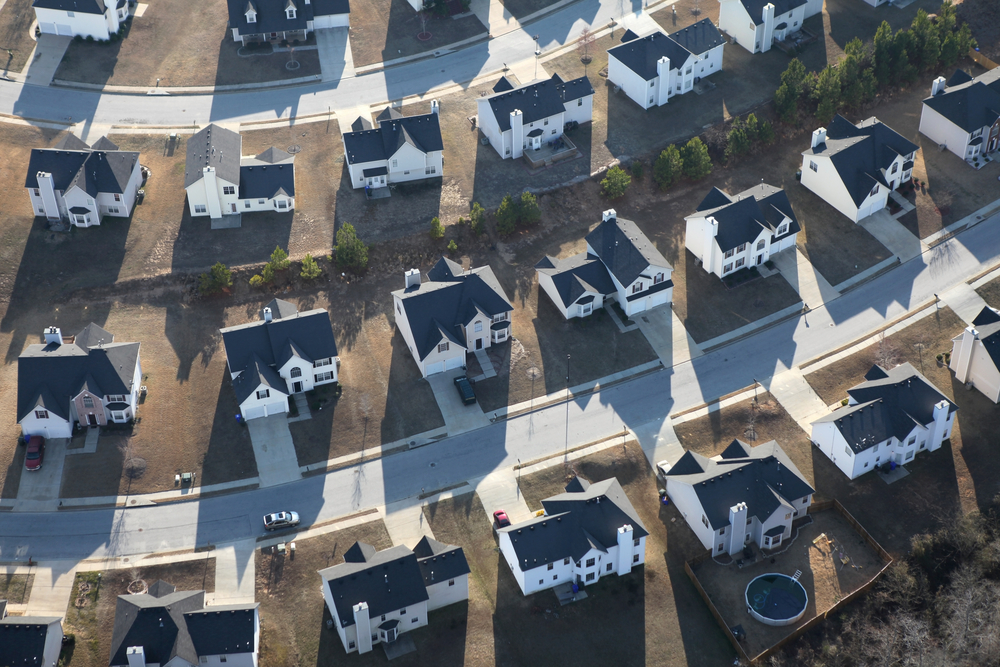
Image via Shutterstock
Some suburbs in Indiana are waking up to the fact at their pattern of development is unsustainable in the most important way – financially.
An article in the Indianapolis Business Journal describes the scene in booming, upscale Hamilton County:
Hamilton County officials are closely watching new-housing prices, knowing that local governments’ long-term financial security could depend on it.
If a residential development doesn’t promise homes with a high enough price tag, a municipality could end up losing money. That’s because, under the state’s property tax caps, lower assessed values might not generate enough tax to cover the cost of city services.
No one seems to know exactly what that break-even price is—estimates range from $250,000 to $450,000—but most developers and government officials agree anything below $200,000 is no longer worth approving.
This is presented as an artifact of tax caps, but those caps are simply doing the service of revealing early, while there is still time to do something about it, that the financial model of too much of suburbia is not sustainable on a long term basis.
Indiana caps property taxes at 1% of a home’s value. That’s all the property tax money local government has to work with to provide all the services on which that property depends.
Houses that are too cheap – and too cheap could mean as expensive as $450,000 – will not produce enough property taxes to sustain municipal services.
This means housing for working class people isn’t going to get approved. This requires no recourse to racism, elitism, etc. to explain. Lower cost housing simply has a negative ROI for these communities.
Maybe they can get away with building some lower cost housing that requires subsidies to support, but too much of this and a town will quickly be in real trouble.
The problem is worse than these leaders know. They are in a favored quarter region that is still rapidly expanding in population, and every town here has physical room for more development.
Cities that are newer or still in their growth phase experience artificially low costs because of the power of greenfield economics. Their building stock is new, liabilities are low, the population is well off, and by simple economies of scale alone they are becoming more cost efficient as they grow.
But when they reach maturity and stop growing, costs escalate rapidly. This is why so many older suburbs around the country (paging Ferguson, MO) are in such bad shape, financially and otherwise.
One way to solve the problem is to only build houses expensive enough to make the math work. That’s what Hamilton County seems to be doing. They are also smartly realizing that developers used to be able to offload infrastructure costs onto the municipality, and they are now making sure everything is paid for by the developer up front.
But even a place without tax caps would end up like too many East Coast cities. They might in theory have a housing stock that would sustainably support a wider range of incomes. But in these towns sky high property taxes keep the working class out. This type of development, once the lifecycle phase of cheap costs is over, will send taxes through the roof, which we see in many places.
These towns are ahead of the game in terms of coming to grips with the problem. Too many are not, however. They are simply approving developments pell-mell that are going to leave them saddled with massive future costs and a resident base that cannot afford to pay them.
Salvage shop rescues industrial, medical antiques

Veteran jeweler Thrapp retiring, closing shop
JakienleWOW, this has been a landmark in Meridian-Kessler/Butler-Tarkington for years.
Heft not enough to justify insurer deals, top DOJ lawyer says
The Norwegian Blue
JakienleSad day.
HI Mailbag: Tee Pee Restaurants
12 Ways to Map the Midwest
What is the Midwest? There’s been a lot of debate about this question among folks passionate about such thing. But it defies easy definition. Here are eleven ways various people have taken a crack at drawing the map.
Traditional Maps
1. The Northwest Territory
Start with the original Northwest Territory, now sometimes referred to as the Great Lakes region. This is the historic core of what we now think of as the Midwest.
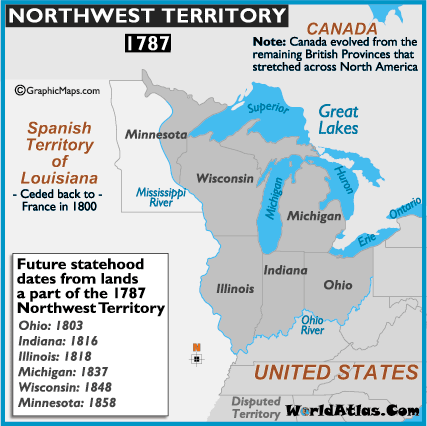
Image via WorldAtlas.com
2. Midwest Census Division
The Census Bureau has an official definition of the Midwest, which is one of four so-called “Census Divisions.” This is further divided into two “Census Regions” as in the map below.
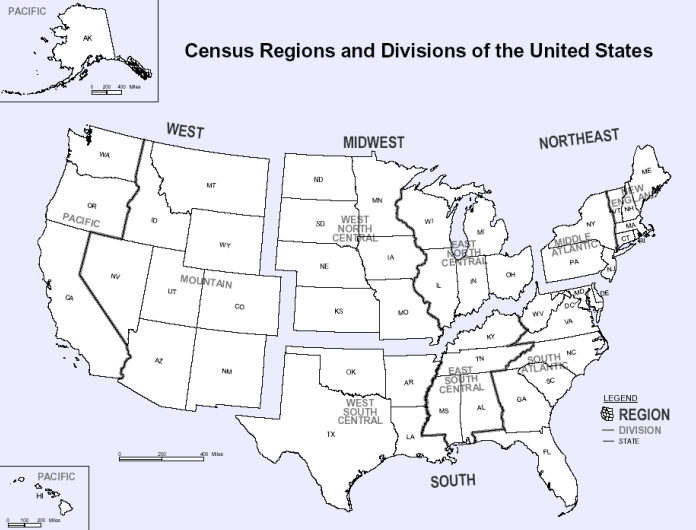
Census Divisions and Regions
Ethnic and Cultural Definitions
Others have attempted to draw maps based on shared ethnicity and culture. These tend to deny the existence of an actual Midwest as we think about it today.
3. Nine Nations of North America
One of the most famous of these is from Joel Garreau, who made a claim that there were actually nine nations on the North American continent.
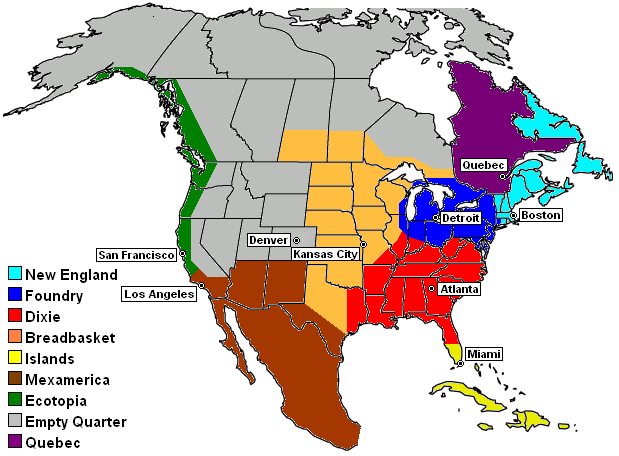
Joel Garreau’s Nine Nations
4. Eleven Nations of North America
Colin Woodard took this a step further and argued that there were really eleven nations in North America, which he identifies based on settlement patterns. You can see his writeup on this in an article in Tufts Alumni magazine.
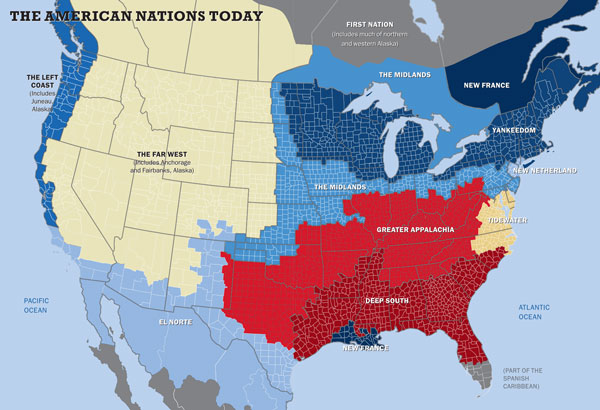
Colin Woodard’s 11 Nations
Economic Definitions
Other maps try to define a region based on shared economic characteristics such as industries.
5. The Rust Belt
Here’s a map of the Rust Belt that’s floating around the I found on a website about coal communities of all places. I’m not sure exactly where it originated.
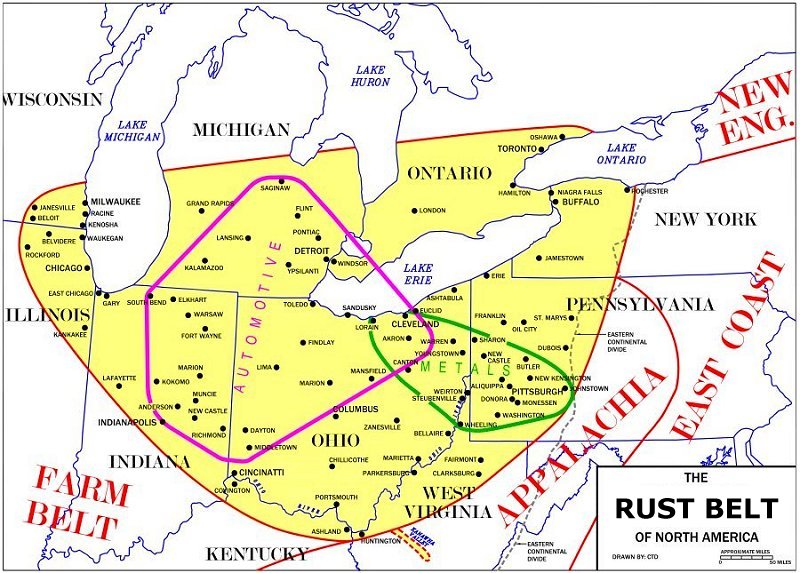
The Rust Belt
Hybrid Definitions
These maps attempt to use both shared cultural/historical and economic characteristics to define a Midwest region.
6. Richard Longworth’s Midwest
In his very important book Caught in the Middle: America’s Heartland in the Age of Globalism, Richard Longworth created his own bespoke definition of the Midwest. He notably excludes the southern regions of Missouri, Illinois, Indiana, and Ohio as extensions of the south (similar to the 9 & 11 nations map), and also the pure play Great Plains states along the western edge of the Census definition.
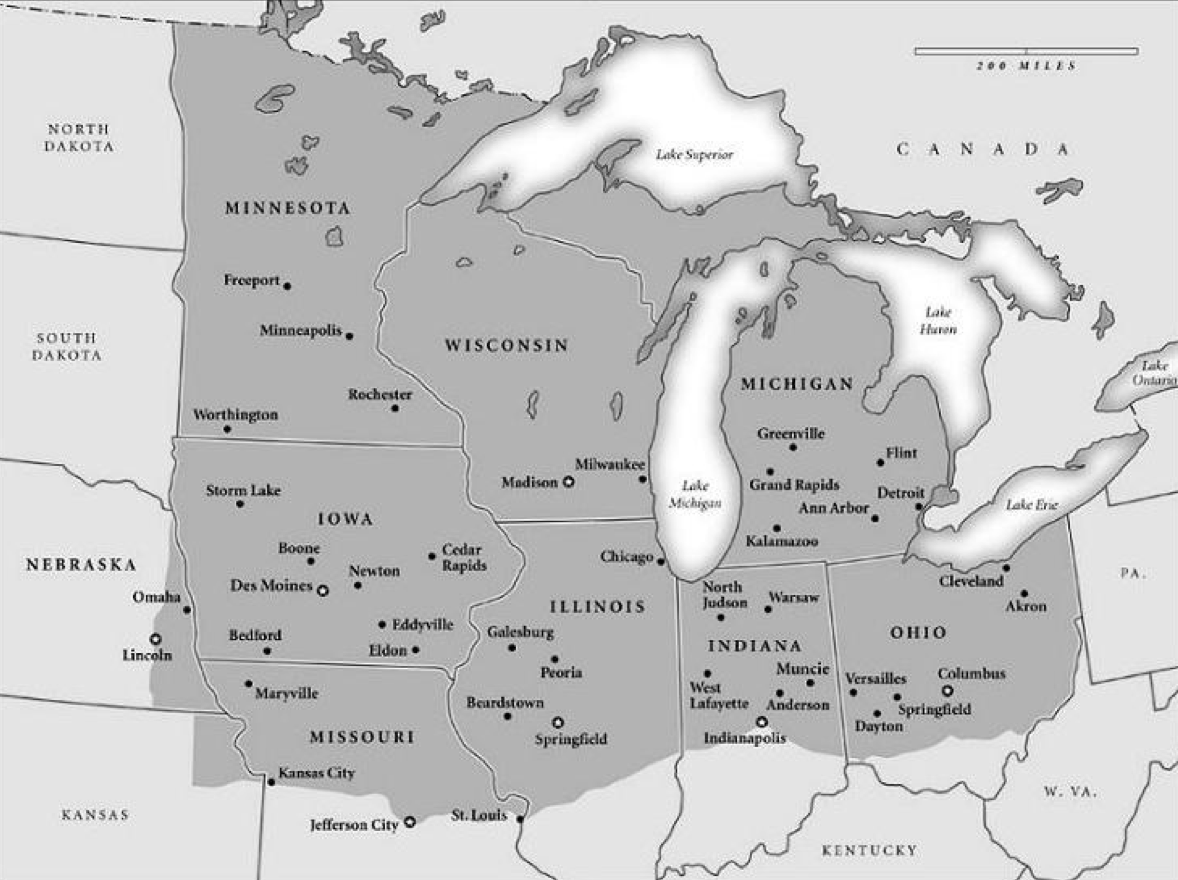
Richard Longworth’s Midwest
7. Pete Saunder’s Five Midwests
Pete combines the nations approach with the traditional Census definition of the Midwest in order to divide the Midwest into five sub-regions.
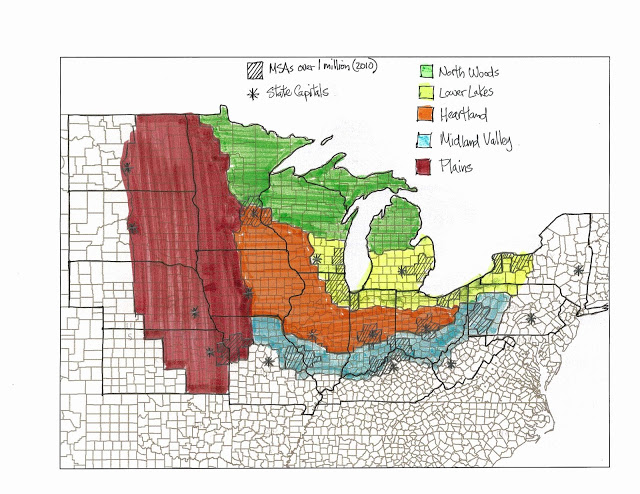
Pete Saunder’s Five Midwests
8. Kotkin’s American Regions and City-States
Joel Kotkin took a similar approach to dividing America up in Forbes magazine. His view also appears to be a hybrid of culture, economics, and history. He turns America into seven regions and three city-states (New York, LA, and Miami). The full map is too huge to blog, but an excerpt is below which you can click on to see the whole thing in a new window.
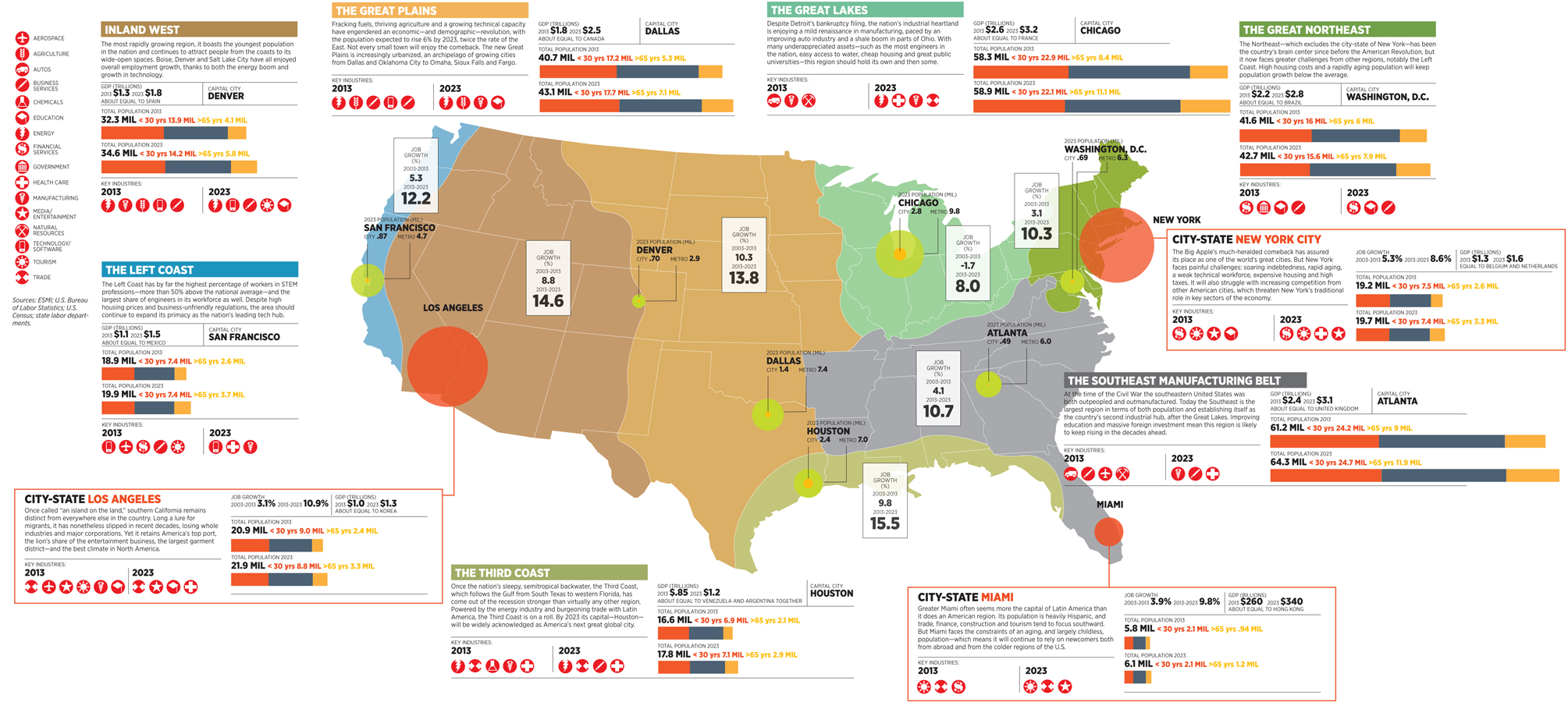
The Midwest in Kotkin’s map
Crowdsourced Maps
A couple of other people used crowdsourcing, in whole or in part, to define the Midwest
9. Walter Hickey/538 Map
Walter Hickey, writing at 538, conducted a survey with Survey Monkey to ask people which states they thought were in the Midwest. Here’s what he came up with.
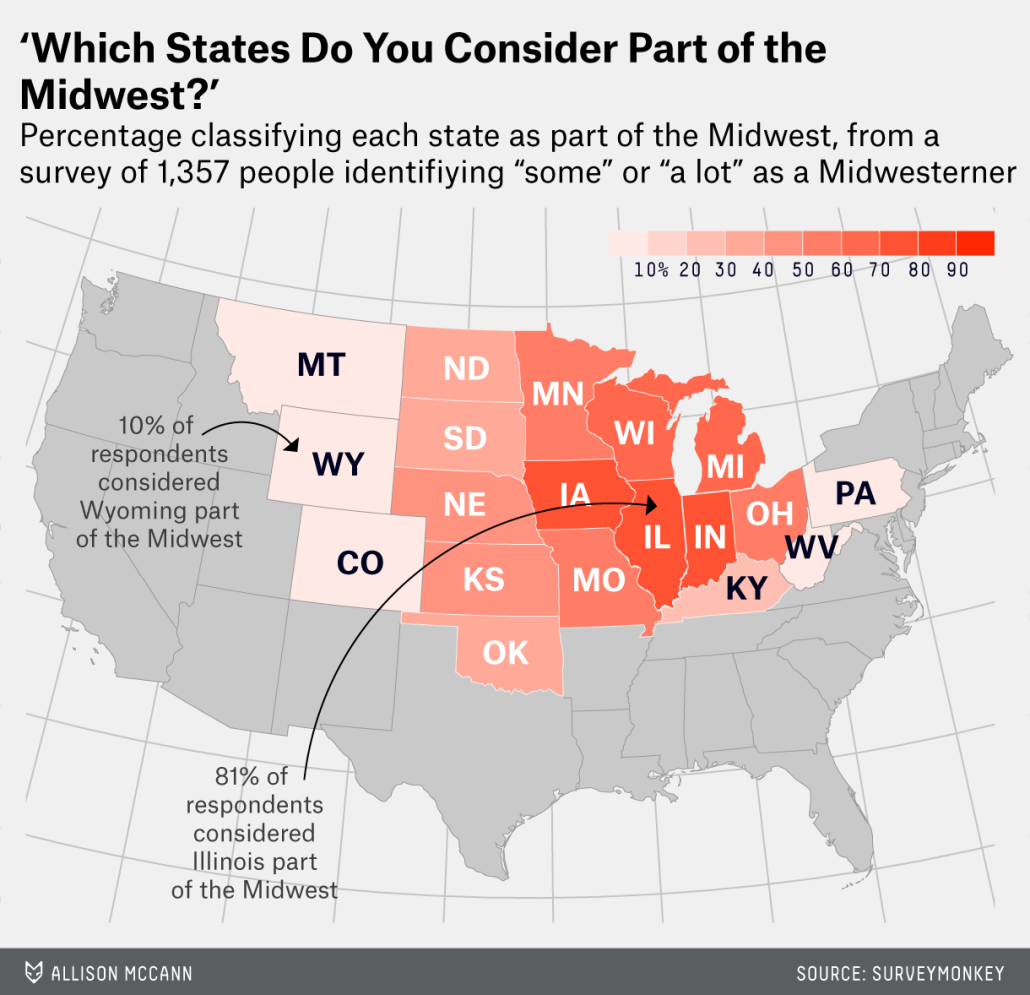
Walter Hickey/538 Map
10. miguecolombia’s Reddit Map
Here’s one that I found on a Reddit thread started by user miguecolombia. It appears to be his personal take on how to divide America, with a strong dose of crowdsourcing from Reddit.
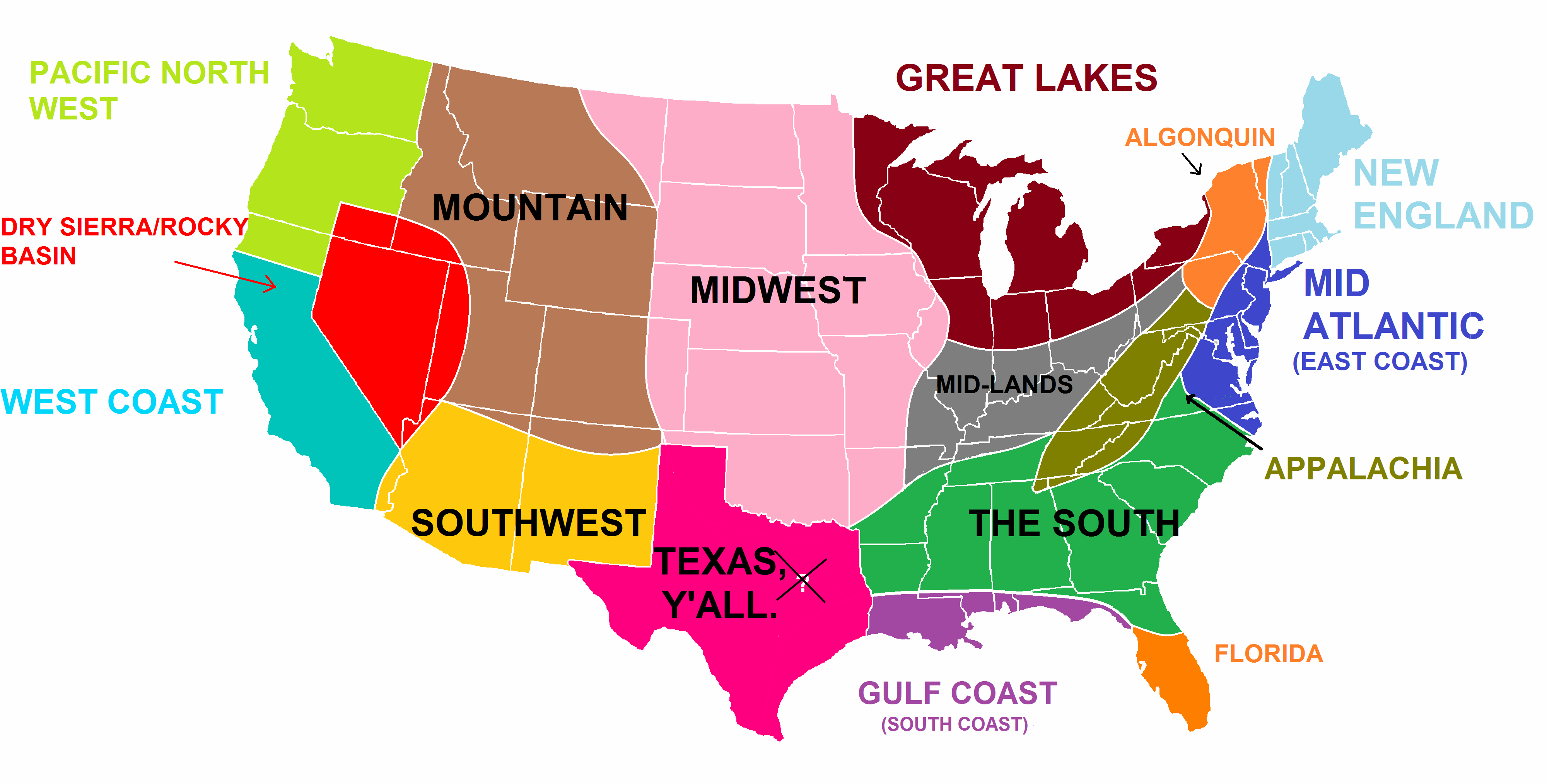
miguecolombia and Reddit’s map
Self-Defining Maps
And a couple maps that try to use statistical techniques to let the Midwest map itself.
11. Facebook Network Maps
Pete Warden took a look at Facebook profiles and connections to create clusters of regions. Most of what we’d think of as the Midwest he called Stayathomia, which also covers much of New England.
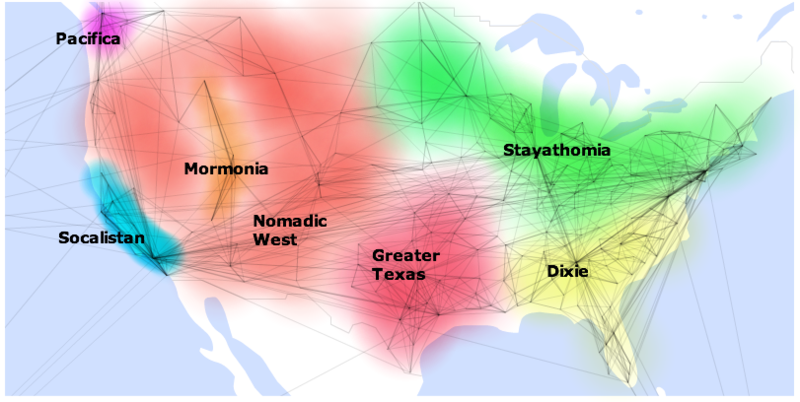
Pete Warden’s Map
12. Chicago Migration Map
Lastly, a special surprise – a map you’ve never seen before. This was created by someone named Daniel Jarratt, who emailed it to me back in 2012. Using Chicago as the capital of the Midwest, he used IRS migration data and a statistic technique called modularity to divide the US into regions based on affinity with Chicago. Darker red means more connection to Chicago and thus in a sense more Midwest.
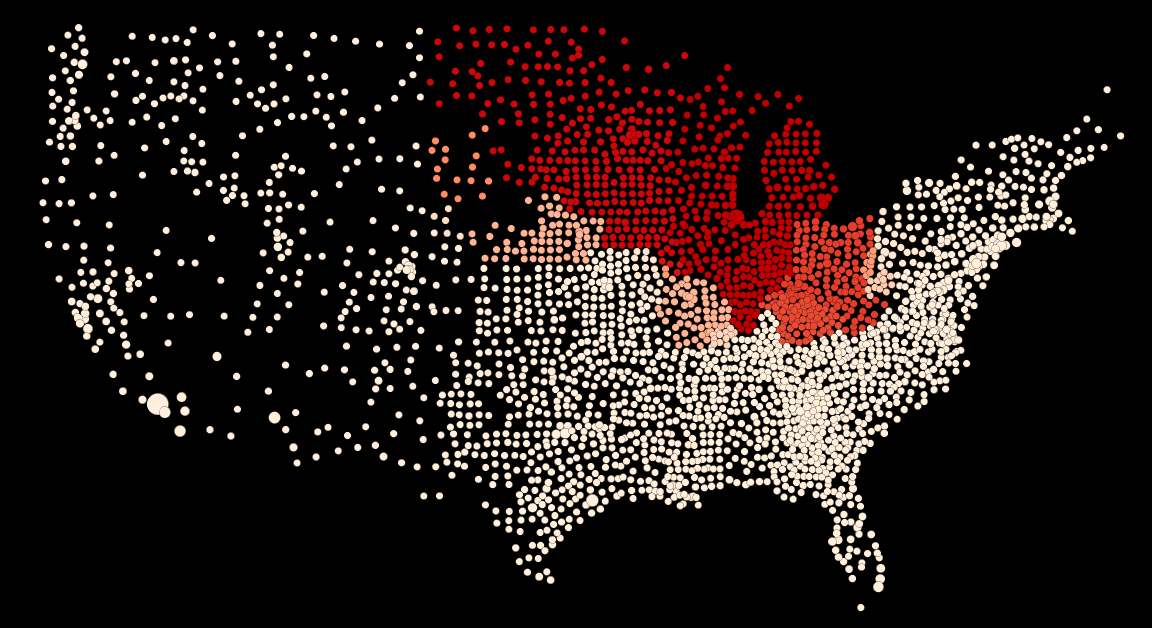
Daniel Jarratt’s Midwest
Ohio State Legend Eddie George to Make Broadway Debut This January as Billy Flynn in 'Chicago'
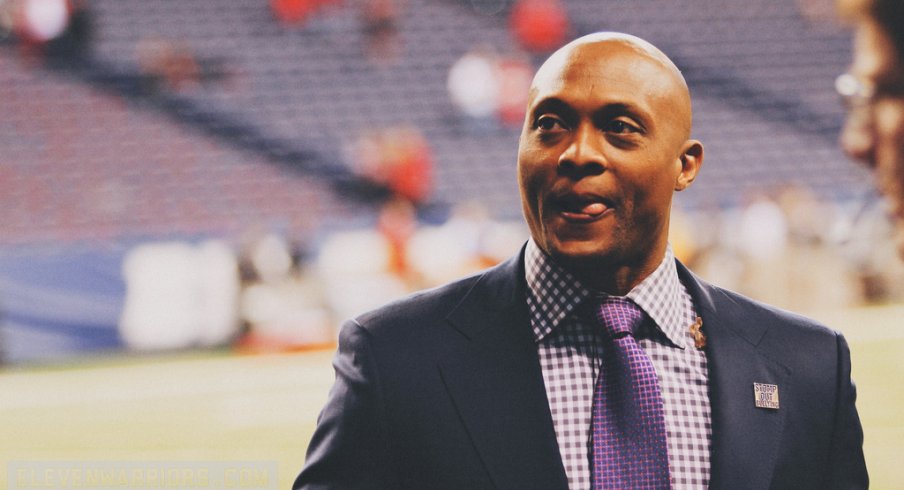
Eddie George is no longer terrorizing opposing defenses on the football field, but he's set to re-insert himself into the bright lights on an entirely new stage this January.
George, the former Ohio State legendary running back and 1995 Heisman Trophy winner, is slated to make his debut on Broadway Jan. 11, 2016, as Billy Flynn in the musical Chicago at the Ambassador Theatre in New York City, according to a press release.
The seven-week engagement runs through the end of February 2016, with shows every Monday, Tuesday, Thursday and Friday at 8 p.m. The musical is also set for performances Saturdays at 2:30 and 8 p.m., in addition to Sundays at 2:30 and 7 p.m., the release said.
George's move to Broadway helps put a final stamp on a complete career transition from college and professional football player, to television and radio analyst, to stage actor. The nine-year NFL veteran and four-time Pro Bowl selection also had roles in such works as The Whipping Man, Suzan-Lori Parks’ Topdog/Underdog and in the title roles of both Othello and Julius Caesar at the Nashville Shakespeare Festival.
George's also been featured on NBC's American Dream Builders and in film. He founded the Nashville-based group, Actors by George, in 2012.
Tickets are available through telecharge.com, by calling 212-239-6200 or in-person at the Ambassador Theatre (219 W. 49th St., New York) box office.
Visit chicagothemusical.com for additional information.
Notebook: Troy Williams the first player to ever win Hoosier Hysteria dunk and 3-point contests
As Troy Williams stood next to Yogi Ferrell and Nick Zeisloft on Saturday night as they argued over who is the team’s best shooter after a three-way tie in the men’s 3-point shootout, the Hoosiers junior had one comment. “I’m just here so I don’t get fined,” he said with a laugh. But after women’s basketball […]
The post Notebook: Troy Williams the first player to ever win Hoosier Hysteria dunk and 3-point contests appeared first on Inside the Hall | Indiana Hoosiers Basketball News, Recruiting and Analysis.
Editorial: Stirring Up the Restaurant World

Herron targets historic armory on White River for new high school
JakienleGreat reuse and a huge addition to the need for quality high schools in central Indianapolis.

Butler called lone exception to 'Field of Dreams' approach
The Koelschip bar opening by Goose in Fall Creek Place
The $9 Million Monsters of Monterey.
JakienleSome of my favorites!
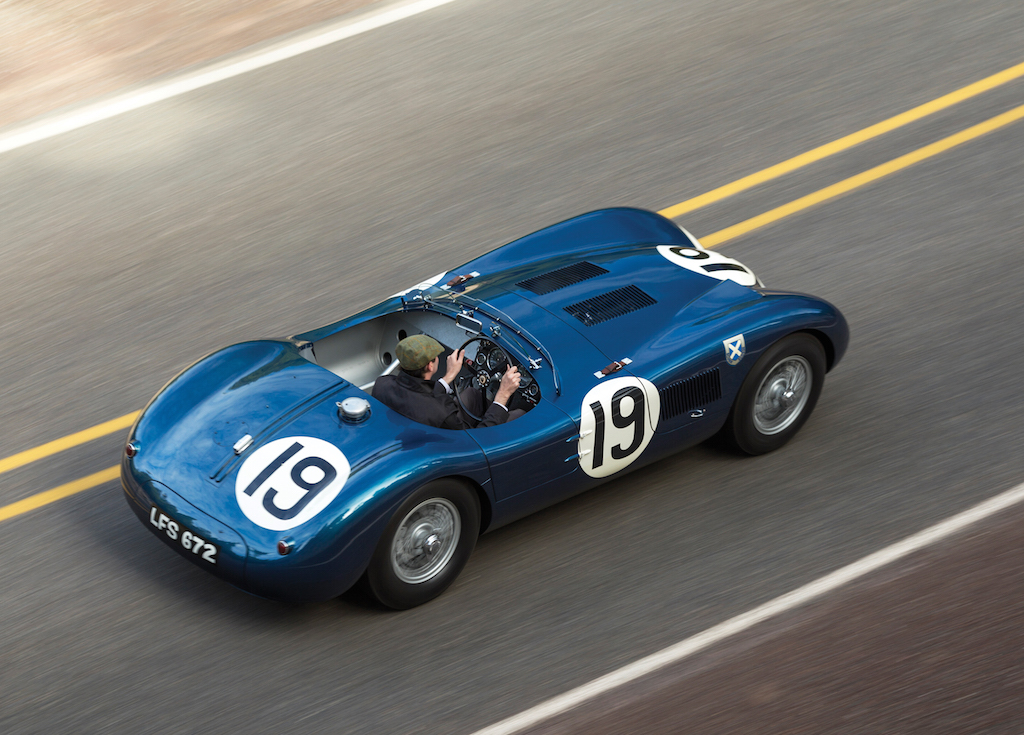
While lots of people come to gawk at the insanely gorgeous cars on the lawn at the Pebble Beach Concours d’Elegance every August, there are also plenty of men with very deep pockets who come to do some serious shopping. There are a few blue-chip auctions during Monterey Car Week, of which the headliner is the three-day event produced by RM Sotheby’s. This year they’re also staging an auction-within-an-auction, with one of the world’s best car collections, called the Pinnacle Portfolio, going up for sale. RM is billing it as “the most significant and valuable private automobile collection ever presented at a single-day auction,” including everything from early model Ferrari race cars to the final production Enzo, gifted to the late Pope John Paul II.
In addition to the 25 Pinnacle cars, which include both classic and modern machines, are some of the most expensive and desirable cars in the world are set to cross the auction block. Top of the class is a 1953 Jaguar C-Type Works race car (top photo), which finished fourth overall at the 24 Hours of Le Mans in 1953, and is the second of only three “Works Lightweight” cars ever built by Jaguar in thin-gauge aluminum. It’s expected to bring in $9 million or more, making it one of the world’s most expensive Jaguars. It’s easily the most beautiful car in the sale in our opinion, though the competition is fierce – the 1950 Ferrari 275S/340 America Barchetta by Scaglietti (below) isn’t exactly an eyesore either. It could fetch $8 million-plus, in case you were wondering.

1950 Ferrari 275S/340 America by Scaglietti / Darin Schnabel ©2015 Courtesy of RM Sothebys.
One of the most important competition Ferraris ever to be offered at auction, it started out as one of only two 275S Barchettas built, and was campaigned for the factory by legendary Italian racing driver Alberto Ascari in the 1950 Mille Miglia. There are dozens of Ferraris in the sale spanning several decades of production. Next to the 275S/340 America we’d place the bright yellow 1960 Ferrari 250 GT SWB Berlinetta Competizione from the Pinnacle stable. Prepared as a North American Race Team (N.A.R.T.) car, it competed in the ninth annual 12 Hours of Sebring in Florida just a few days after leaving the factory. RM calls it “the finest performing and best looking SWB in the world” – and this one could go as high as $17 million. It’s hard to choose favorites from the full roster of RM’s Monterey monsters, but we’ve waded in and done it for you, so scroll down for the rest.
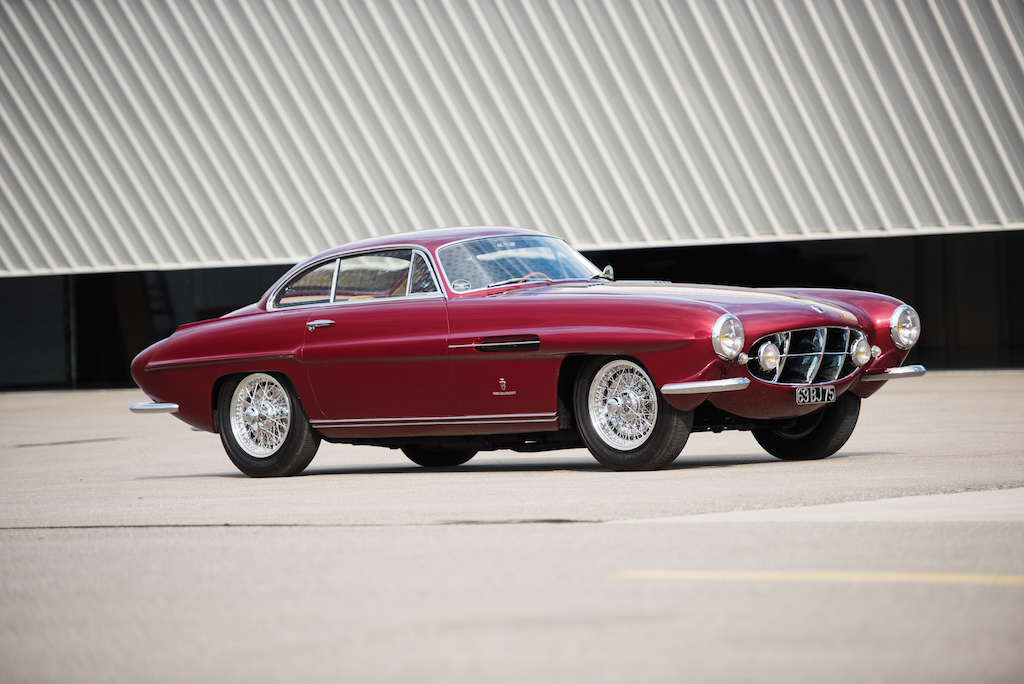
1952 Jaguar XK120 Supersonic by Ghia / Darin Schnabel ©2015 Courtesy of RM Sothebys.

1953 Jaguar C-Type Works Lightweight / Patrick Ernzen ©2015 Courtesy of RM Sotheby’s.
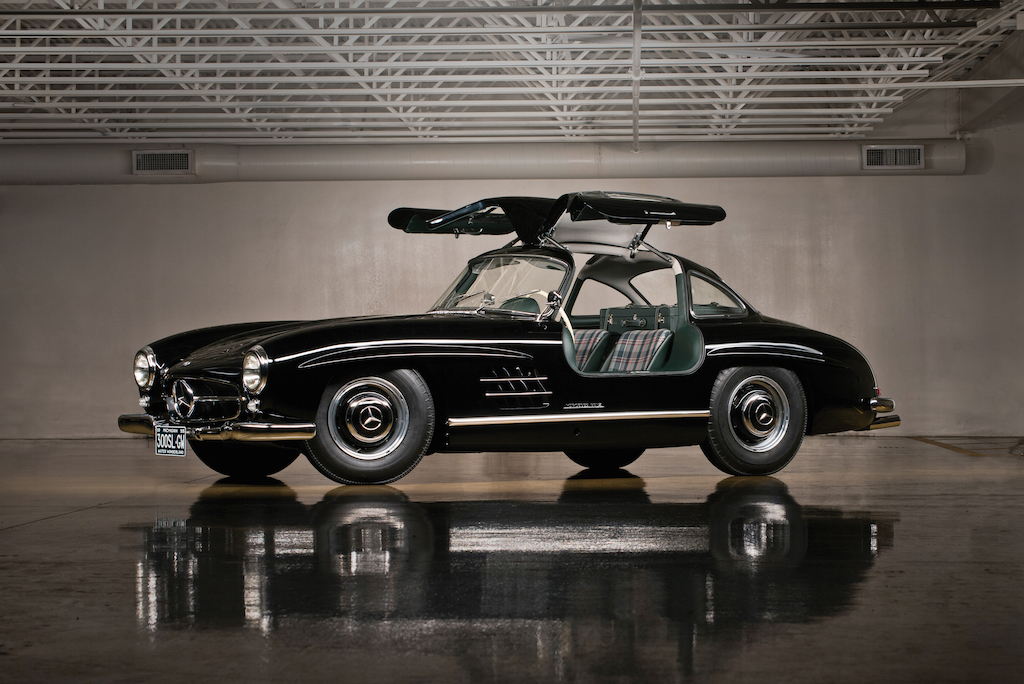
1954 Mercedes-Benz 300 SL Gullwing / Juan Silva ©2015 Courtesy of RM Sotheby’s.

1956 Ferrari 250 GT Coupe ‘Boano Prototype’ / Remi Dargegen ©2015 Courtesy of RM Sotheby’s.
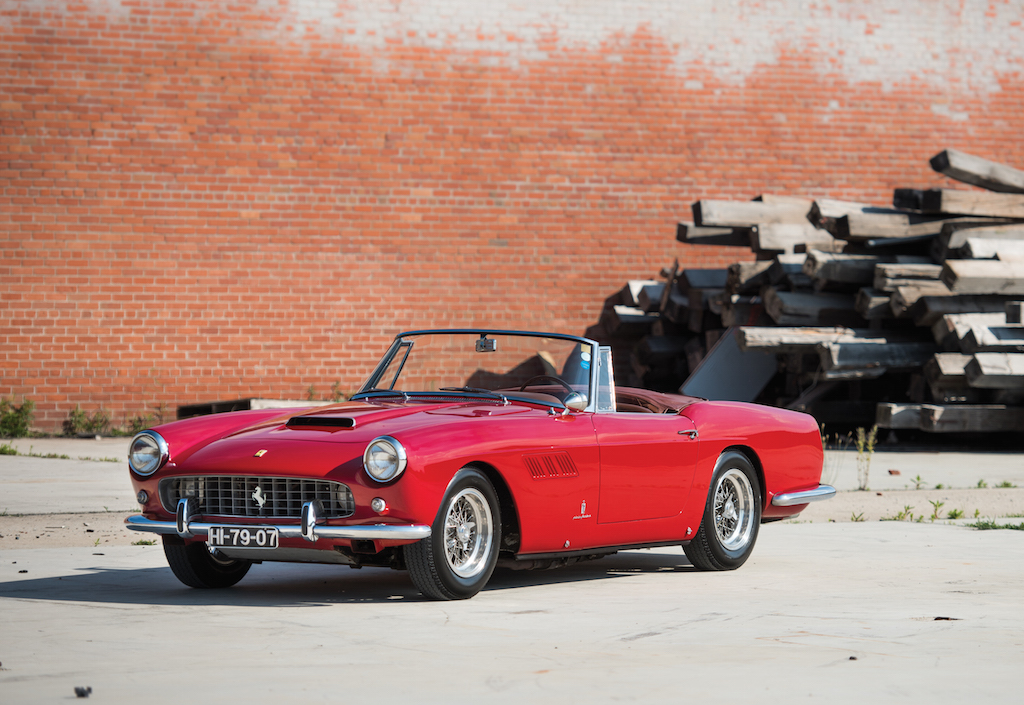
1959 Ferrari 250 GT Cabriolet Series II / Darin Schnabel ©2015 Courtesy of RM Sotheby’s.
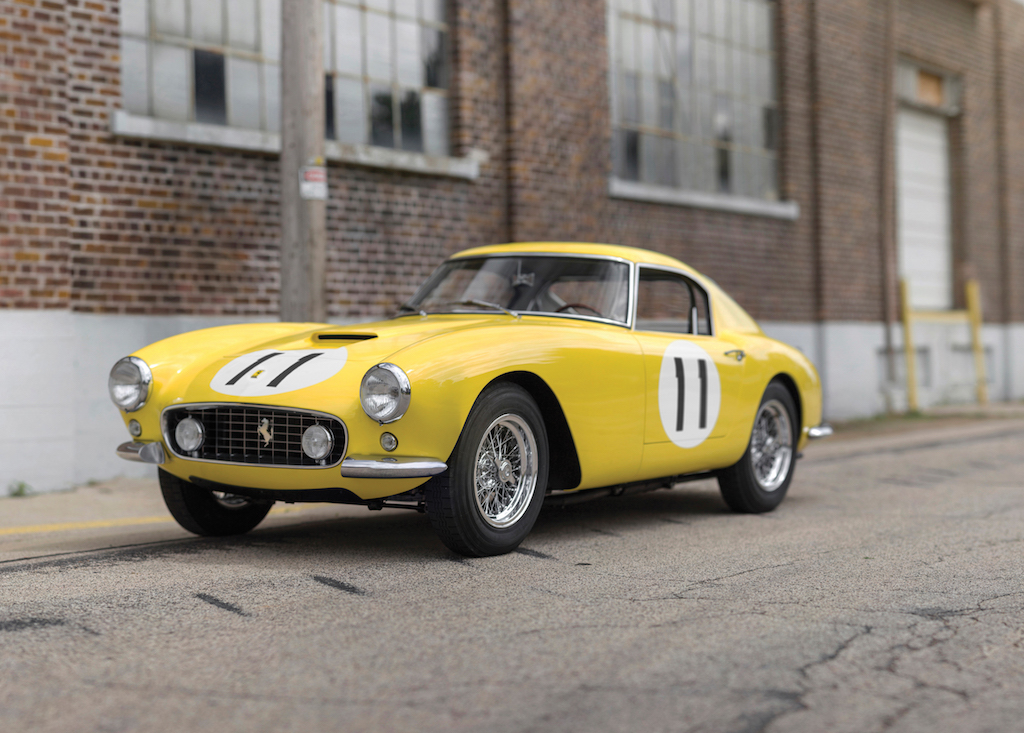
1960 Ferrari 250 GT Berlinetta Competizione / Patrick Ernzen ©2015 Courtesy of RM Sotheby’s.

1964 Ferrari 250 LM by Scaglietti / Patrick Ernzen ©2015 Courtesy of RM Sotheby’s.
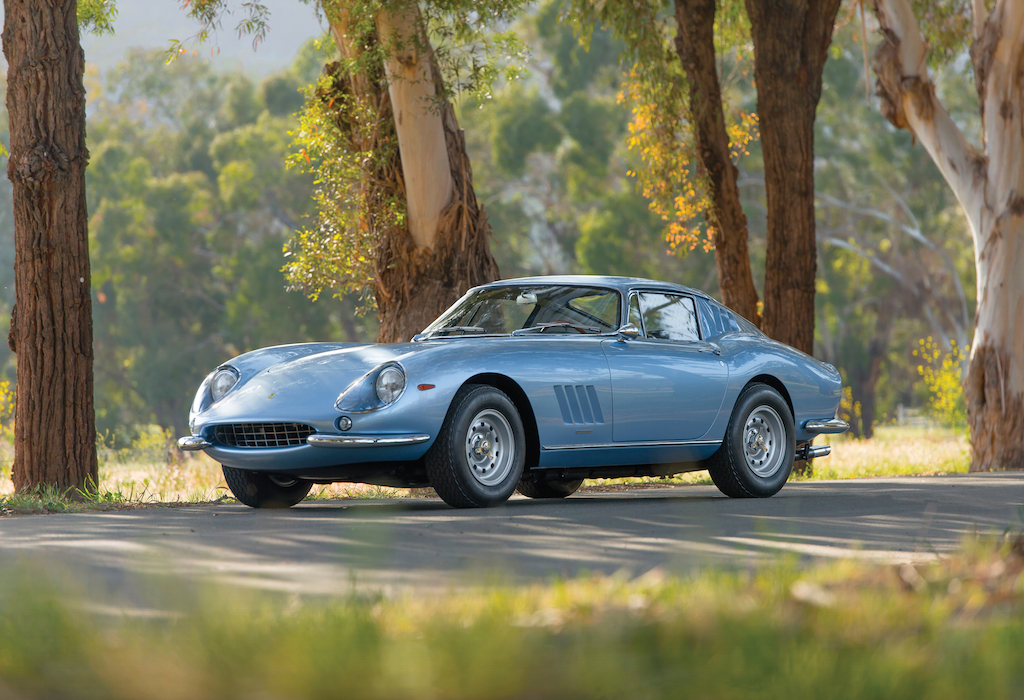
1966 Ferrari 275 GTB/6C Alloy by Scaglietti / Robin Adams ©2015 Courtesy of RM Sotheby’s.
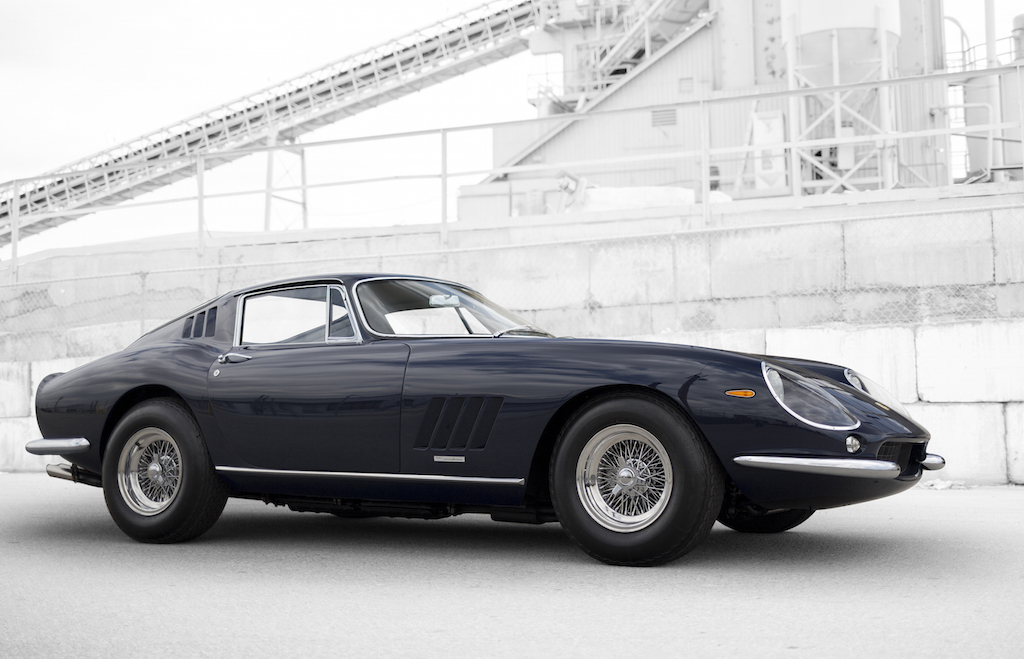
1967 Ferrari 275 GTB/4 by Scaglietti / Patrick Ernzen ©2015 Courtesy of RM Sotheby’s.

1967 Bizzarrini P538 / Tom Gidden ©2015 Courtesy of RM Sotheby’s.

1969 Ferrari 365 GT 2+2 by Pininfarina / Juan Silva ©2015 Courtesy of RM Sotheby’s.
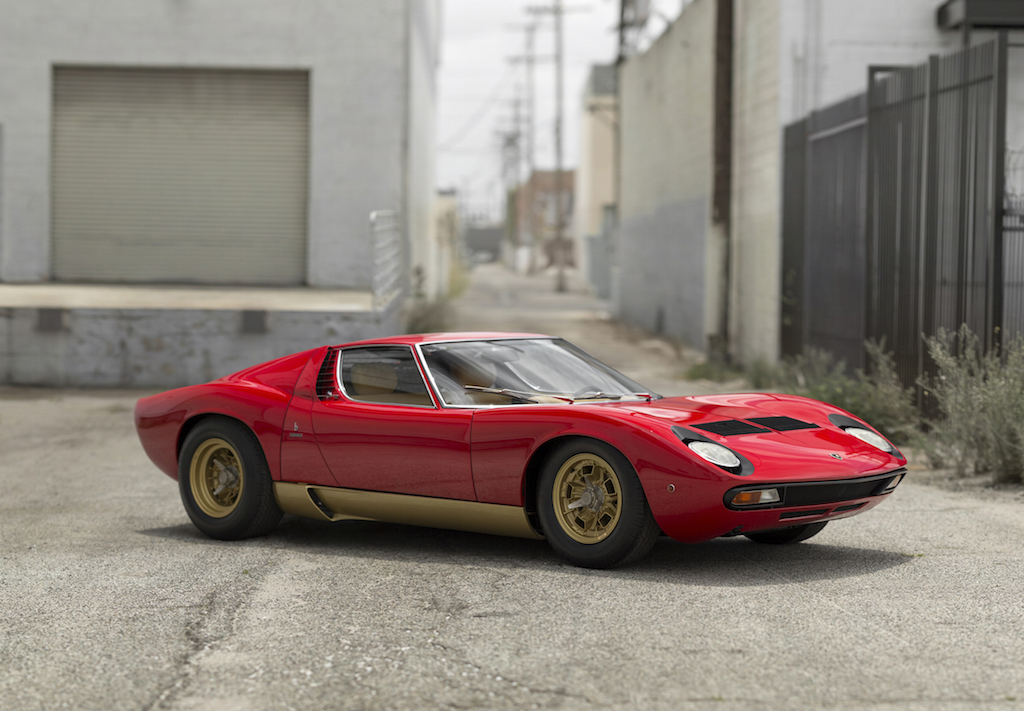
1971 Lamborghini Miura P400 SV by Bertone / Patrick Ernzen ©2015 Courtesy of RM Sotheby’s.

1973 Alfa Romeo Montreal by Bertone / Greg Keysar ©2015 Courtesy of RM Sotheby’s.

1973 Ferrari 365 GTB/4 Daytona Berlinetta / Robin Adams ©2015 Courtesy of RM Sotheby’s.

1974 Ferrari Dino 246 GTS / Patrick Ernzen ©2015 Courtesy of RM Sotheby’s.
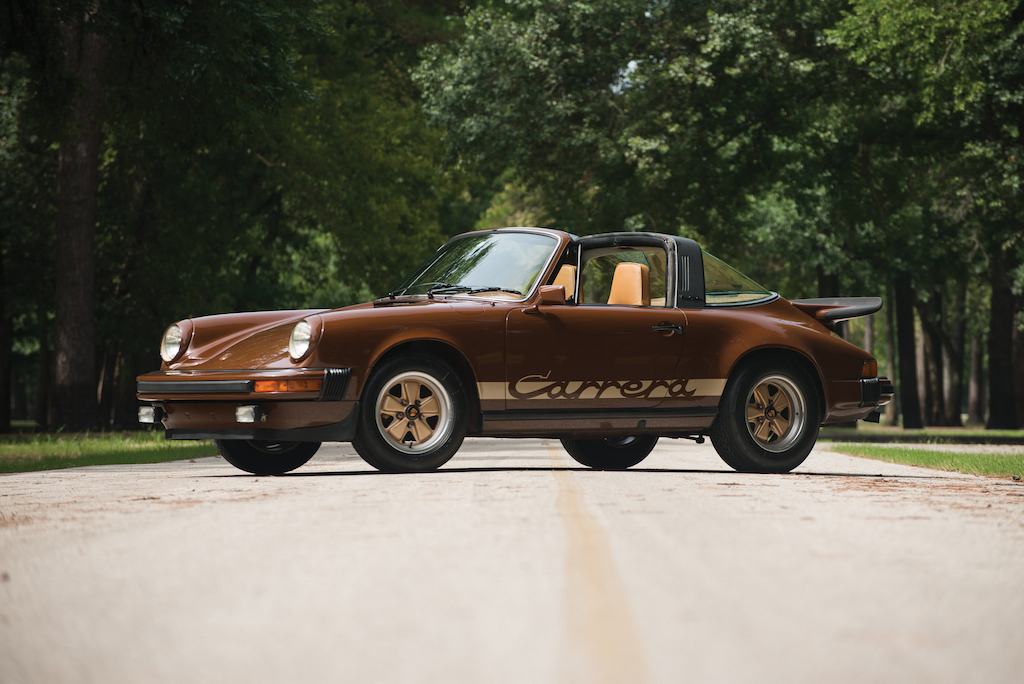
1975 Porsche 911 Carrera Targa 2.7 / 2015 © RM Sotheby’s.
Valentino….So Hot Right Now!!!!!

This morning at Valentino had to be one of the best runway moments of all time.
What a great way to bring Paris fashion week to a close!
If you haven’t seen the actual video scroll down and watch the live streaming we posted on the site earlier this morning. It still makes me laugh to watch the surprise at the end!!
Transparent SolarWindow Promises to Transform Every Skyscraper into a Solar Collector
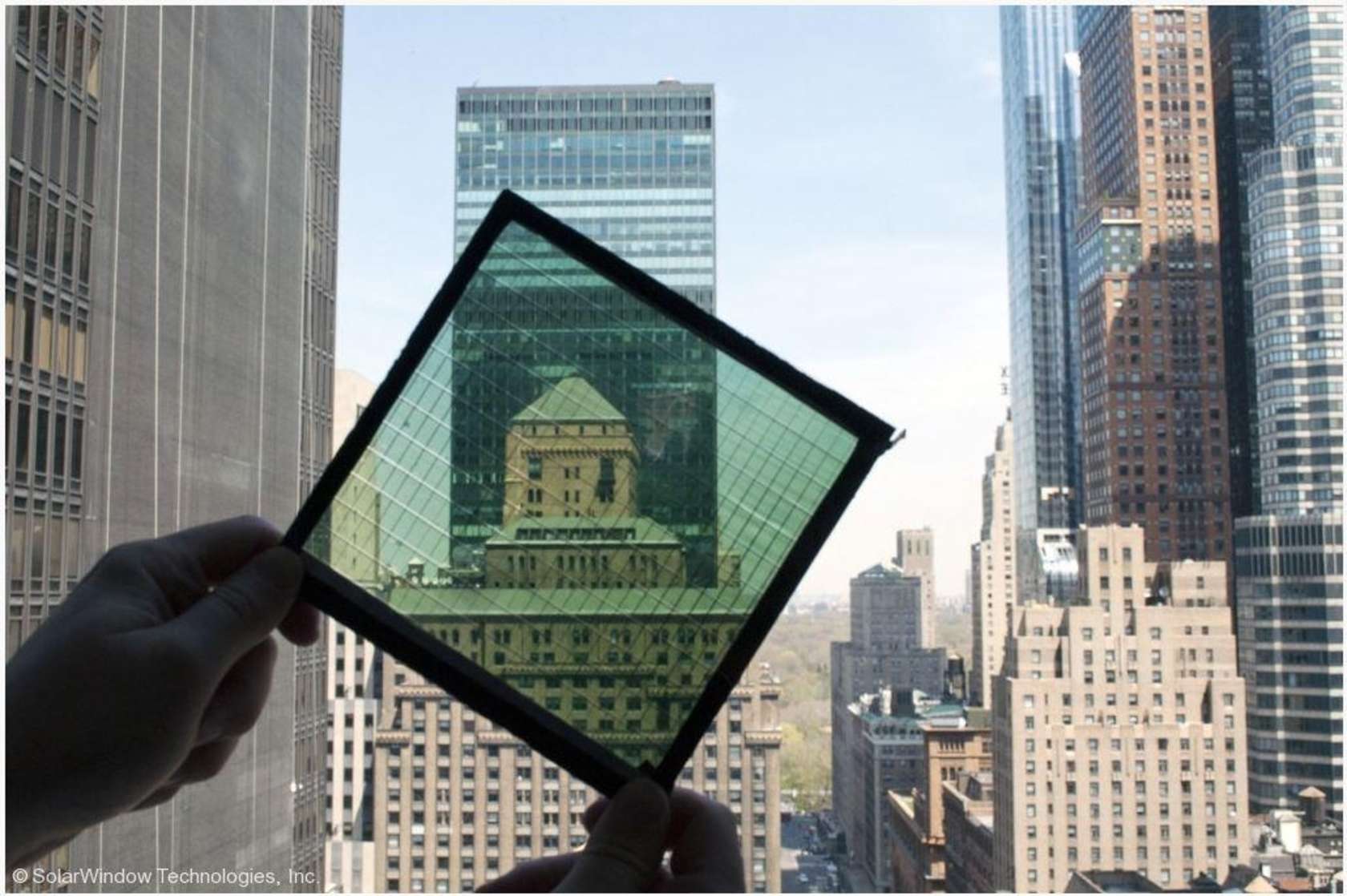 Columbia, Md.–based manufacturer SolarWindow Technologies recently unveiled their innovative solar technology that could turn every skyscraper into a solar collector.
Dad’s Style (Sort Of)

Is it too late for a Father’s Day post? Each year, Free & Easy dedicates an issue to what they call “Dad’s Style,” which is their way of referring to classic or traditional men’s clothing. Of course, when Free & Easy talks about classics, they mostly mean it in the hip sense. If your dad actually owns anything featured in this magazine, there’s a good chance you were conceived at Pitti Uomo.
Still, previous issues have featured men such as Bruce Boyer and Christian Chensvold, both of whom have genuinely classic (and good) taste. I also like some of the things they photograph. There are the usual things that Japanese style editors fawn over, such as Brooks Brothers jackets and Alden shoes, to more unusual items, such as vintage bags and raincoats from Arnys and Invertere. I also really like those split-toes from JM Weston (misleadingly described below as “u-tips”). They look like Edward Green’s Dovers on steroids, and possibly just the thing to wear with heavy cavalry twill trousers.
Granted, even among the genuinely classic pieces, I don’t know how much of this really reflects “dad style.” But if the last few weeks of menswear sales are any indication, Father’s Day isn’t really aimed at fathers anyway.


A Cool Weather Safari Jacket

Three years ago, when I visited Antonio Panico’s workshop in Naples, he showed me three safari jackets. One was constructed from linen, another from cotton, and a third, surprisingly, from a hefty cashmere. Together, they represented how you could wear the style three seasons out of the year. The jackets themselves were a bit too big for my skinny frame, but when Panico put them on me and belted them up, I can’t say I’ve ever felt cooler.
Since then, I’ve been wanting a safari jacket I can wear in the fall, just to go with the cotton and linen ones I sometimes use in the summer. The key to making these look good, I think, is to have the garment styled more like a jacket than a shirt (which shirt jackets like these can lean either way). That means a slightly slouchier fit, rather than something overly tailored, and details such as bigger buttons at the front, bellow pockets on the hips, and – possibly – even a separate side body panel, so that the jacket has a bit more shaping.
Heavy cashmere is too rich for my blood, but I’ve been thinking about getting one made from tweed or moleskin. The nice thing about shirt jackets is that, since there’s no interior construction, bespoke pieces are much more affordable than other kinds of tailored clothing (think, something around $750, which isn’t inexpensive, but a far cry from the ~$2,500 tailors charge for bespoke sport coats). You do need a custom shirtmaker who already has your pattern, however. If he or she has to create one from scratch, expect to pay a few hundred dollars more.
For ready-to-wear, check Holland & Holland, Westley Richards, and Ralph Lauren, or browse eBay for much more affordable vintage pieces from brands such as Willis & Geiger, Abercrombie & Fitch, and Banana Republic (when BR was a safari-themed outfitter, rather than an everyday mall brand). No Man Walks Alone will also be carrying some wool field jackets from Eidos this season – one made from a 21oz gray herringbone tweed; the other from a lighter weight, 12oz burgundy wool-blend hopsack. The Armoury also used to carry safari jackets from my shirtmaker Ascot Chang, although they’re currently sold out (I’m told they may return next summer). Lastly, check Anderson & Sheppard’s Clifford Street shop. Their ready-to-wear jackets are cleverly made with interior zip pockets, earphone loops, and detachable key rings, making them perfect for travel.
(Photos via The Armoury, The House of Majd, B&Tailor, A Suitable Wardrobe, Suits of James Bond, Anderson & Sheppard, The Rugged Museum, No Man Walks Alone, Where is the Cool, Kotmj, The William Brown Project, and Westley Richards & Co.)


The New Taiwan: Richard Meier’s Monument to Modernism Stands in Contrast to Taipei’s PoMo Past
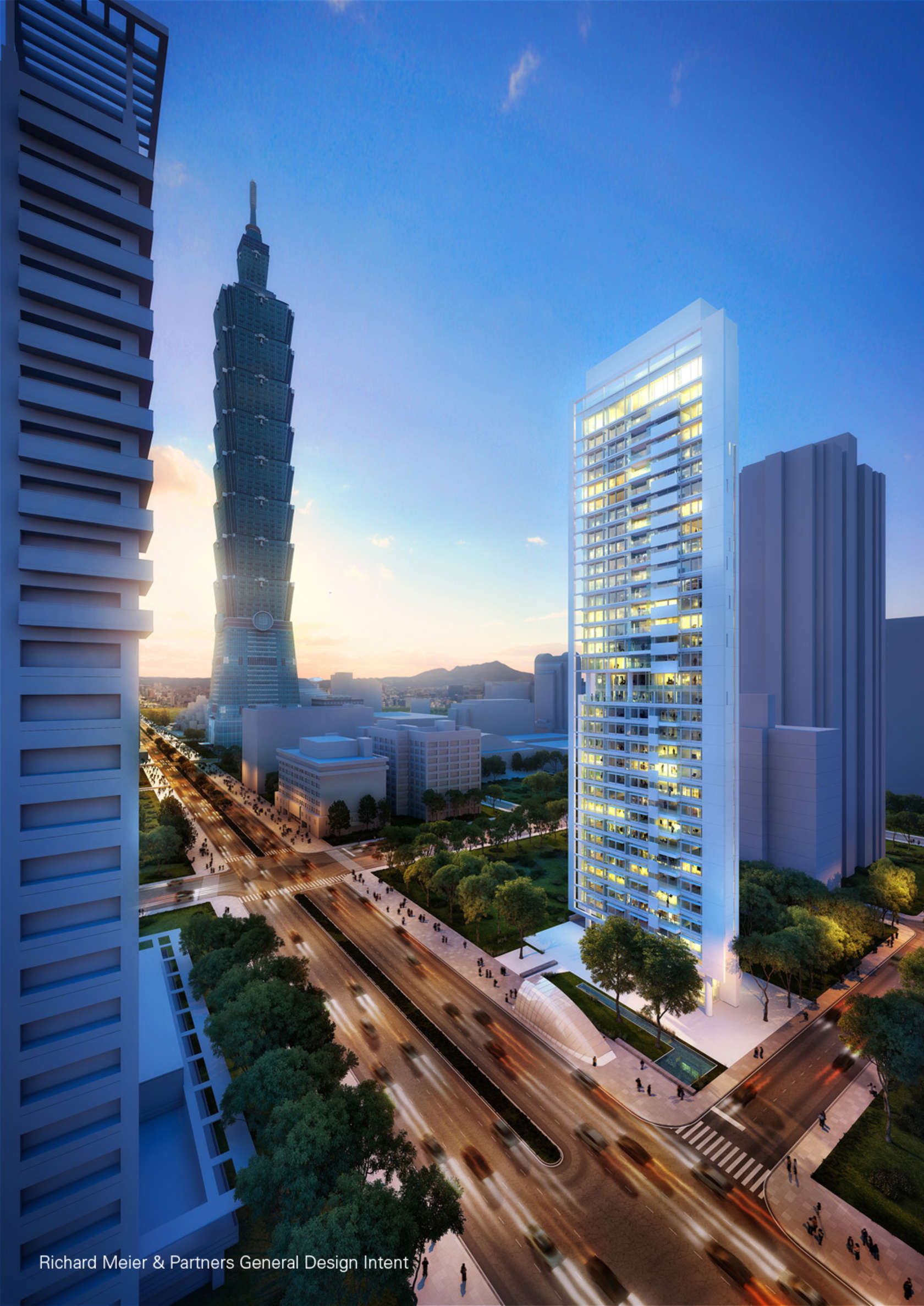 Blending the influences of Mies van der Rohe, Le Corbusier, and Frank Lloyd Wright, Richard Meier and Partners Architects could be considered the ultimate conduit of 20th-century modernism in contemporary practice. The American firm’s distinctive aesthetic is immediately recognizable and stands as a present-day ode to those modern masters in contrast with a plethora of styles constructed in the meantime. Nowhere is this more apparent than in the Taiwanese capital of Taipei, where Meier’s latest building is rising in the city’s eastern district. Commissioned by Continental Development Corporation, the Xin-Yi Residential Tower — otherwise known as “Timeless 55” — is being constructed just a block away from CY Lee’s soaring, postmodern skyscraper, the super-tall Taipei 101. The juxtaposition of these two buildings marries two divergent paths of thought in contemporary architectural theory, setting up a playful “battle of styles” in one of Asia’s most modern metropolises. C.Y. Lee’s 1,671-foot-tall tower — the tallest building in the world from 2004 to 2010 — is rich with symbolism, evoking the traditional forms of an Asian pagoda, a stalk of bamboo, and a stack of Chinese money boxes. Meanwhile, Meier’s residential skyscraper is entirely unconcerned with metaphor, driven instead ...
Wine School: Your Next Lesson: Gigondas
JakienleHow about that, was just saying how much I love Gigondas when he St. Joseph article popped up.

Wine School: Chinon, a Red With Attitude

Ice Miller opens New York office in Times Square
Love Handle

 Anyhow, Love Handle is a cute little place, maybe slightly on the sparse side décor-wise, but is not without its charm nonetheless. It’s certainly not a fancy place. We were there early for lunch, but they also serve breakfast, so we did a little of both and tried a couple of things. This place is all about the cured meats for sure, one of the chef/proprietors (Chris and Ally Benedyk) once worked at Goose the Market before opening a shop in Milwaukee and then back again in Indy. You’ll see lots of cured meat on the ever-changing menu for sure.
 Like I said, it was on the early side, so we also got the biscuits and gravy with crimini mushrooms and hatch chilis ($6), which I think is vegetarian. But we added bacon (+2) and a jellied egg yolk (+$2), thereby killing that aspect of it. It wasn’t a huge dish, but it had a lot of flavor. There was a lot of stuff going on in that little bowl. At the bottom was a fresh biscuit topped with the mushroom gravy. And that was all topped with pieces of slightly chewy bacon pieces and the egg yolk—which like something I have never quite had before. But it had a runny yolk in the center of the aspic-type substance, so I was content. Honestly it was almost too much to get the taste of everything. I would like to try the biscuits and gravy on their own but still get the bacon and egg on the side. Oh yeah, and it was all topped with pickled red onions, so again, happy.
 Two downtown office buildings hit the market
Wines of The Times: St.-Joseph: The Next Best Wine in the Northern Rhône
JakienleLove St. Joseph. One of the best Rhone appellations for solid values along with Crozes-Hermitage, and Gigondas and Vacqueyras in the Southern Rhone.
