Shared posts
26 Feb 03:50
Why your doctor should care about social justice | Mary Bassett
by contact@ted.com (TED Conferences LLC)
In Zimbabwe in the 1980s, Mary Bassett witnessed the AIDS epidemic firsthand, and she helped set up a clinic to treat and educate local people about the deadly virus. But looking back, she regrets not sounding the alarm for the real problem: the structural inequities embedded in the world's political and economic organizations, inequities that make marginalized people more vulnerable. These same structural problems exist in the United States today, and as New York City's Health Commissioner, Bassett is using every chance she has to rally support for health equity and speak out against racism. "We don't have to have all the answers to call for change," she says. "We just need courage."
26 Feb 03:31
 Frederick Brown/AFP/Getty Images
#OscarsSoWhite, #ForSoLong
by Gene Demby
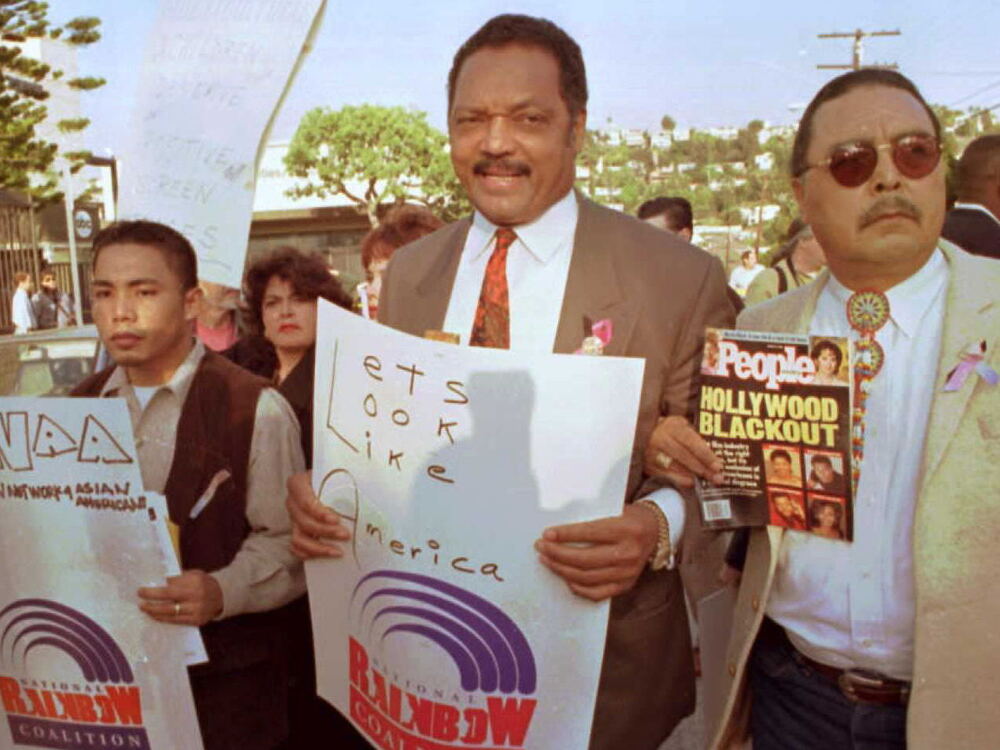
Jesse Jackson and members of the Rainbow Coalition protested the 68th Annual Academy Awards in 1996 for not producing more motion pictures with minorities.
You may have read something like this over the past few weeks, in the run-up to this year's hotly contested Academy Awards ceremony:
"The fact that there is an absence of African-American nominees at the awards this year is something I'm less concerned about than how that reflects on what's happening within the industry," [the film producer Preston Holmes told a reporter].
"We need more opportunities for African-American filmmakers and crafts people. There needs to be more of an African-American presence in the various unions and guilds."
Thing is, Holmes, who is black, said that way back in 1996.
Holmes gave that interview amid calls to boycott that year's Oscars for being devoid of nominees of color. The whiteness of that slate of nominees even made the cover of People magazine. Jesse Jackson asked black folks in Hollywood not to attend the ceremony.
Even that wasn't the first time black folks tried to protest an alabaster Academy Awards ceremony. The Oscars' trouble with racial representation feels like a fresh, contemporary controversy, a product of the social media megaphone, but it goes back almost to the beginning. At the 12th Academy Awards ceremony in 1940, Hattie McDaniel won a statuette for her role in Gone with the Wind, becoming the first black actor to win one. But before that happened, she was almost literally shut out of the ceremony, as strings had to be pulled to let her into the venue, which had a strict no-blacks policy. She wasn't allowed to sit at the same table as her co-stars, and was instead stashed away in a corner.
By the 1960s, black actors were starting to push back. According to Ellen C. Scott in the book Cinema Civil Rights, a modestly successful black actor named Caleb Peterson, who felt black folks were systematically denied onscreen and offscreen jobs in Hollywood, formed a group called the Hollywood Race Relations Board in 1962. They picketed at theaters, studios and that year's Oscars ceremony.
"Peterson recognized that although the Academy was not the institution granting jobs, it was the one defining success," Scott wrote at The Common Reader, a literary journal from Washington University in St. Louis.
In response to Peterson's protest, Wendell Corey, the Academy's president, said that that year's ceremony would feature a tribute to black actors. But that wasn't enough for Peterson, who showed up with 125 protesters on the red carpet. The police forcibly removed 12 of them and arrested them for trespassing. By the next year's Oscars, Peterson was feeling even more militant about the Oscars whiteout, writes Scott in her book:
"[He promised 500 pickets] starting days before the ceremony if the Academy failed to agree to their right to protest. 'They roughed up one or two of our boys last year and this year if they try it, they're in for a good fight. ...We lay the whole responsibility on the Academy, not the police. If they rough us, there will be violence. This is no Martin Luther King movement.' "
Jesse Jackson's attempt at a boycott in 1996 wasn't nearly as gully, but it proved to be just as polarizing, and not just among white folks. Whoopi Goldberg, who was hosting the show that year, was heated at Jackson for putting her in such an awkward position. Oprah Winfrey, who was the Oscars "official greeter" that year — because apparently that's a thing — angrily clapped back at Jackson, calling that year's event "the most multi-ethnic Oscar show anybody's ever seen."
Saturday Night Live, that reliable weather vane of middle-of-the-road American sentiment, dutifully lampooned Jackson's protest and played it as a joke. (SNL's take exhibited a cartoonish lack of self-awareness, since the cast's own overwhelming whiteness required putting Darrell Hammond in blackface to portray Jackson, because, well, you know.)
A few weeks ago, in the midst of the #OscarsSoWhite furor, SNL took up the issue of the monochromatic awards season once more. But 20 years after Darrell Hammond's goofy Jesse Jackson impression, this time around it was the Hollywood establishment that was being (gently) mocked. The weather vane appears to be turning.
YouTube
Copyright 2016 NPR. To see more, visit NPR.9())
23 Feb 00:05
Daily Feminist Cheat Sheet
by Alexandra Brodsky
AnjaJohn Oliver - great breakdown of current abortion fight for people who might not usually give a shit.
John Oliver gives the John Oliver treatment to abortion restrictions.
The most powerful voter this year in the U.S. is the single woman.
Georgia high school junior detained on her way to school.
John Kasich: women “left their kitchens” to support me.
How we failed to protect Kesha.
Speaking of which: Boycott Sony.
21 Feb 02:58
Daily Feminist Cheat Sheet
by Sesali B.
AnjaThe last story is the first positive thing I've heard from Hillary.
Some cops in Florida are refusing to work at Beyonce’s Formation Tour show in Miami. No one will miss them.
Republican South Dakota Governor, Dennis Daugaard agrees to meet with transgender high school students before signing into law a bill that would make it illegal for them to use the restroom that matches their gender identity.
Pope Francis suggests that in the midst of the Zika virus, contraception might be acceptable for Catholics.
Channing Dungey is the first Black woman to run a broadcast network.
Hillary Clinton proposes plan to address systemic racism.
19 Feb 03:16

My Trans Body as a State of Desire
by Colette Arrand
"My brain is lit like the map of a major metropolis at night. My body is, too. 'I am at one with a sea of sensations, glitter, silk, skin, eyes, mouths, desire,' Anaïs Nin wrote, and that's pretty much it. Or, put another way: I have found an affirmation of selfhood, and I haven't thought to immediately annul it."
The post My Trans Body as a State of Desire appeared first on Autostraddle.
19 Feb 02:45

Black Lives Matter Activist’s Mayoral Bid Elicits Praise—and Skepticism
by Kanya D'Almeida
DeRay Mckesson, the prominent Black Lives Matter activist who is running for mayor of Baltimore, has unveiled a campaign platform just over a week after announcing his bid.
From addressing racial disparities in the city’s public school system to overhauling its response to crime and ending the “war on drugs,” the DeRayForMayor website reads in many places like a manifesto for the movement itself—and highlights the ways in which Black Lives Matter has brought U.S. politics to a critical tipping point.
“I think [Mckesson’s bid] is a sign that Black Lives Matter is a movement not a moment, one of many examples of how the conversation about an alternative direction for this country is deepening,” Eugene Puryear, a Washington D.C.-based activist and author of Shackled and Chained: Mass Incarceration in Capitalist America, told RH Reality Check.
“The question before the movement is whether we are creating space only, or fighting to take power and change our lives. To the extent it is the latter, fighting in the electoral arena as well as the streets is going to be a necessary tactic,” added Puryear, who is also the 2016 vice presidential candidate for the Party for Socialism and Liberation. “No movement that truly wants to fight for the power to change things can avoid having people assume positions of some prominence.”
There is a long history of civil rights activists seeking public office: Black Panther Party co-founder Bobby Seale ran for mayor of Oakland, California, back in 1973. He lost, but the race brought out “more black voters than any other election in the city’s history,” according to the New York Times. And as Matt Ford notes in the Atlantic, “While Mckesson is the first civil-rights activist of his generation to seek higher office, he follows in well-worn footsteps. John Lewis, Julian Bond, Andrew Young, Marion Barry, and Jesse Jackson are among the most prominent figures in the civil-rights movement in the 1950s and 1960s to win major elections, and countless other activists of the era also sought transitions into governance.”
In entering the Baltimore race, Mckesson has squeezed himself into an already crowded room—he is one of 13 Democratic candidates out of 30 overall competing in the April 26 election to replace the outgoing mayor Stephanie Rawlings-Blake (D). If elected, he will join some 500 African-American mayors representing 48 million constituents across the United States.
Mckesson’s crowdfunding appeal has already secured over $115,000 from more than 2,100 donors, a testament to his popularity in the virtual realm—within a single year, the 30-year-old has grown his Twitter following from 85,000 to over 300,000. This he accomplished through a combination of providing real-time updates from sites of popular protest—including Ferguson, Missouri, in 2014 and his native Baltimore during the wave of unrest that followed the 2015 death in police custody of Freddie Gray—and sustained online commentary in the aftermath of protests about the growing movement to end police brutality.
His most recent endeavor, Campaign Zero, created jointly with fellow BLM activists Johnetta Elzie, Brittany Packnett, and others, offers solutions to the scourge of police violence. Among its ten proposed policies, the data-driven platform calls for ending “broken windows policing,” which disproportionately criminalizes low-income communities of color; ending for-profit policing by clamping down on civil asset forfeiture abuse, which has been known to disproportionately punish Black communities; and demilitarizing police departments.
His own campaign, a three-pronged approach involving youth development, community prosperity, and public safety, echoes many of the same sentiments. The mayoral hopeful wants to overhaul the Baltimore Police Department’s use-of-force policies, implement mandatory anti-racism training for law enforcement personnel, and enact an “ordinance making chokeholds and ‘rough rides’ (leaving a person unrestrained in a police vehicle) by police officers illegal.”
The latter is a direct reference to Gray, who died of spinal injuries sustained while being driven around, without a seat belt, in the back of a Baltimore police van on April 12, 2015. Gray’s death touched off a public outpouring of grief and anger over police brutality, which often saw Mckesson in the spotlight. In a widely watched interview with CNN’s Wolf Blitzer, Mckesson called the protests an expression of Baltimore residents’ “pain … and mourning”—a direct challenge to the mainstream media’s portrayal of the situation as a “riot.” When the CNN anchor pushed him to denounce the “violent” tone of demonstrations, Mckesson said, “You are suggesting that broken windows are worse than broken spines,” adding, “I don’t have to condone it to understand it.”
Mckesson claims his understanding of the beleaguered city runs deep. In a Medium article announcing his bid, Mckesson recalled a childhood immersed in the city’s joys and also its pain. He revealed himself to be the child of “two now-recovered addicts,” who has “lived through the impact of addiction” and who, like so many other residents, has “come to expect little and accept less.”
And although the city is currently nursing a 24 percent poverty rate, according to U.S. Census data, Baltimore is, in Mckesson’s mind, a place of “promise and possibility.”
“I am running to be the 50th Mayor of Baltimore in order to usher our city into an era where the government is accountable to its people,” Mckesson wrote. “We can build a Baltimore where more and more people want to live and work, and where everyone can thrive.”
His campaign website suggests to some locals that these are not empty words, but reflect a deep commitment to his native city. “After one week he has a better plan than a lot of the establishment candidates have after running for months,” Lawrence Brown, a Black professor at Morgan State University, reportedly told the Guardian soon after Mckesson released his platform. “It’s the craziest thing.”
In an interview with RH Reality Check, Rukia Lumumba, daughter of the late civil rights lawyer and Mississippi mayor Chokwe Lumumba, called Mckesson’s bid a “bold move.”
“It probably wasn’t an easy decision to make, and it won’t be an easy run,” Lumumba said in a phone interview. “But anytime a younger person steps up to represent [Black communities], especially someone who has a strong understanding of people power and human life and is capable of dreaming bigger than what our current government looks like, it signals a positive change.”
Lumumba, who has held numerous institutional posts and organized nationally in the field of criminal justice reform for over a dozen years, added, “One of the many things my father taught me is that the center of any human rights struggle is the will and the need of the people—whoever is running for office with the goal of building freedom and self-determination needs to remember that.”
When Mckesson officially entered the mayoral race at the 11th hour on February 3, he sparked a wave of speculation as to whether, or to what extent, he was truly in touch with the needs of his constituency.
Slate’s Lawrence Lanahan claims Mckesson’s bid drew “derision from … local black activists who were working in disinvested communities and drawing attention to racial inequity and police brutality before the deaths of Michael Brown or Freddie Gray.” (Mckesson himself deemed those deaths responsible for pushing him into full-time movement work.) Lanahan goes on to quote Dayvon Love, director of the local think tank Leaders of a Beautiful Struggle, casting doubt upon Mckesson’s ability to mobilize at the grassroots level: “It’s one thing to be able to show up to an event in a major mainstream media moment,” Love said, according to Slate. “It’s a different thing to get people from Baltimore to go to Annapolis for a hearing on police reform on a Tuesday at 1 in the afternoon.”
Shortly after Mckesson announced his bid, Dan Rodricks of the Baltimore Sun reported that one of the front-runners in the upcoming race, Sheila Dixon, had never even heard of the activist until he threw his hat in the ring. Whether Dixon’s claim was genuine or a political ploy aimed at deriding a newcomer into an already stiff contest, it goes to the heart of a larger critique among some Baltimore residents that an activist who has a bigger presence online than he does in the political establishment may not stand a chance at the polls.
Mckesson himself appears well aware of this critique, and even addressed it in the Medium post announcing his bid, when he wrote: “I have come to realize that the traditional pathway to politics, and the traditional politicians who follow these well-worn paths, will not lead us to the transformational change our city needs. Many have accepted that our current political reality is fixed and irreversible — that we must resign ourselves to accept the way that City Hall functions, or the role of money and connections in dictating who runs and wins elections. They have bought into the notion that there is only one road that leads to serve as an elected leader.”
Other commentators have noted that, though Mckesson has largely made a name for himself via social media and a number of appearances on popular talk shows, his résumé also displays several years of practical work. He has served as an administrator in Baltimore’s public school system and spent several years teaching at public high schools in East New York, experiences that have obviously informed his current campaign: His ambitious plans for strengthening Baltimore’s education system include scaling up public funding for pre-K education, investing heavily in after-school programs for middle and high school students, and expanding college and career support services in low-income communities.
While Mckesson is not formally tied to the official Black Lives Matter (BLM) network, which was founded in 2012 by three Black women with the aim of centering the leadership, lives, and voices of queer and trans Black women, his bid has elicited statements of support from other prominent voices within the broader BLM movement.
An article published by Black Youth Project, the Chicago-based organization that has been instrumental in heaping pressure on Mayor Rahm Emanuel for his administration’s role in covering up the police killing of 17-year-old Laquan McDonald, called Mckesson’s mayoral bid proof that “he’s not just another person looking to point out problems with no intention to fix them,” and New York Daily News correspondent Shaun King said he was “enormously proud to see [Mckesson] take the plunge,” adding: “Local politics impact real people in the most critical ways and we need young, energized leaders all over the country to do what DeRay is going to try to do.”
Image: CNN / YouTube
The post Black Lives Matter Activist’s Mayoral Bid Elicits Praise—and Skepticism appeared first on RH Reality Check.
15 Feb 04:51

25 Secretly Gay Vintage Valentines For A Very Special Valentine’s Day
by Riese
AnjaSince I know you're the only one who reads my RSS, I think you might appreciate these, especially #5, 12, and 13.
Can I PURR-SWADE you???
The post 25 Secretly Gay Vintage Valentines For A Very Special Valentine’s Day appeared first on Autostraddle.
13 Feb 23:20

Supreme Court Justice Antonin Scalia Found Dead
by Jodi Jacobson
AnjaIt's a V-Day miracle!
News reports out of San Antonio confirm that Associate Supreme Court Justice Antonin Scalia, 79, was found dead Saturday morning at the Cibolo Creek Ranch near Marfa, Texas.
His death is being attributed to natural causes.
The San Antonio Express-News reported on Saturday afternoon that “Scalia arrived at the ranch on Friday and attended a private party with about 40 people. When he did not appear for breakfast, a person associated with the ranch went to his room and found a body.”
Scalia was widely known for his deeply held Catholic beliefs and his often radically conservative views. He vociferously opposed reproductive rights and marriage equality, and often suggested that religion should play a wider role in public life.
In a statement, Texas Gov. Greg Abbott (R), called Scalia “a man of God, a patriot, and an unwavering defender of the written Constitution and the Rule of Law. He was the solid rock who turned away so many attempts to depart from and distort the Constitution. His fierce loyalty to the Constitution set an unmatched example, not just for judges and lawyers, but for all Americans.”
Scalia’s passing comes at a time just before the Court is set to hear highly anticipated cases on abortion, contraception, and criminal justice and policing cases, among others. It is presumed President Obama will nominate a new justice, a move that, with a GOP-controlled Congress, is almost certain to lead to additional drama during an already spirited election year.
Additional analyses on the implications of Scalia’s death for SCOTUS cases and appointments will be forthcoming.
Image: Wikimedia Commons
The post Supreme Court Justice Antonin Scalia Found Dead appeared first on RH Reality Check.

12 Feb 01:21

Justice Department Sues City of Ferguson Over Unconstitutional Policing
by Kanya D'Almeida
The United States Department of Justice announced Wednesday it was suing the City of Ferguson, Missouri, after the city council voted down a draft agreement aimed at curbing racially biased and unconstitutional policing and municipal court practices in the St. Louis suburb.
Wednesday’s civil rights lawsuit, filed in the District Court for the Eastern District of Missouri, comes a year and a half after Ferguson police officer Darren Wilson shot and killed an 18-year-old unarmed Black teenager, Michael Brown.
Brown’s death and the months of unrest and protest that followed, as well as sustained pressure from racial justice advocates, prompted the justice department to initiate a thorough investigation into Ferguson’s courts and policing policies, which residents have charged discriminate against Black residents, who comprise 67 percent of the city’s population of some 21,000.
The report was published last March, and spurred a months-long, closed-door negotiation between Ferguson city officials and the justice department in an attempt to reach an agreement on how best to reform the city’s codes and conduct.
That tentative agreement, called a consent decree, was made public in late January after seven months of talks, and, if finalized, would have allowed for an out-of-court solution. However, in a 6-0 vote on Tuesday night, the Ferguson City Council made its acceptance of the proposal conditional upon several amendments, including some that would limit the city’s estimated costs of enacting reforms.
In a statement released Wednesday, the head of the justice department’s Civil Rights Division, Vanita Gupta, said the council’s attempts to “unilaterally amend the negotiated agreement … creates an unnecessary delay in the essential work to bring constitutional policing to the city.” Shortly thereafter, the lawsuit was filed.
According to the complaint, Ferguson’s police department, municipal courts, and office of the city’s prosecuting attorney routinely engage in practices that deprive residents of their constitutional rights, including stops, searches, arrests, and use of force that violate the Fourth Amendment; a clampdown on freedom of expression in violation of the First Amendment; and discrimination “against African Americans in violation of the Fourteenth Amendment.”
The suit further alleges that it is “unlikely that the City will remedy these patterns and practices of unlawful conduct absent judicial mandate and oversight,” thereby necessitating a court order to “secure the declaratory and injunctive relief needed to ensure compliance with the Constitution and federal law.”
Much of the basis for the lawsuit lies in the department’s initial investigation, which revealed the deliberate targeting of African Americans by various arms of Ferguson’s municipal machine. For instance, the report found, nearly 90 percent of documented use-of-force cases by the Ferguson Police Department were against African Americans, while data covering the 2012-2014 period shows that Black people accounted for 85 percent of vehicle stops, 90 percent of citations, and 93 percent of arrests made by Ferguson police.
The justice department discovered that the municipality’s reliance on fines for revenue generation has “fundamentally compromised” the municipal court’s ability to serve as a neutral arbiter of the law, and has turned residents into a piggy bank for the city. These practices, the report found, “impose unnecessary harm, overwhelmingly on African American individuals.” One Black woman, whose case dates back to 2007, has twice been arrested, spent six days in jail, been charged with seven “failure to appear” offenses, and paid out hundreds of dollars in fines—all because of a single parking ticket.
In the draft consent decree, the justice department proposed such remedies as an overhaul of the police department’s use-of-force policies, removal of the “quota” system of citations and arrests, and a clampdown on “stop-and-frisk” activity, including stringent recording of police officers’ compliance with residents’ constitutional right to consent to or deny body searches.
According to news reports, an analysis of the projected costs of implementing these reforms turned up an estimated bill of $3.7 million in the first year alone, and an additional $3 million for each of the next two years—figures that Ferguson officials and some residents feared would bankrupt the city, which operates on a $14 million annual budget.
But federal officials reject this argument.
“There is no price for constitutional policing,” Attorney General Loretta Lynch said Wednesday. “The citizens and residents of Ferguson deserve what every American is guaranteed under the constitution—the right to be free from excessive force … from unconstitutional arrests, and from a fine system that was literally breaking their backs.”
The city has effectively saddled itself with the possibility of a double burden in its attempts to cut down on expenses.
“Ferguson now has two options,” Jeffrey Mittman, executive director of the Missouri chapter of the American Civil Liberties Union, said in an interview with Democracy Now! on Thursday. “They can engage in full-scale warfare and try to fight these allegations, which we all know are very well founded. [If they do], they will most likely lose in federal court and they’ll then be [faced] with attorney fees for fighting a losing battle plus the expense of implementing the resulting requirements.”
“Alternatively,” he said, “they can take a long hard look at their prior practices and the negotiated agreement and decide to do the right thing.”
Image: The Justice Department / YouTube
The post Justice Department Sues City of Ferguson Over Unconstitutional Policing appeared first on RH Reality Check.

11 Feb 02:55
 In the 1960s, pioneering French New Wave filmmaker Jean-Luc Godard introduced the world to a new cinematic lexicon, generated from his innovative, auteurist style. Between 1960 and 1967 alone, he made fifteen features (beginning with his . . .


Godard in Fragments
In the 1960s, pioneering French New Wave filmmaker Jean-Luc Godard introduced the world to a new cinematic lexicon, generated from his innovative, auteurist style. Between 1960 and 1967 alone, he made fifteen features (beginning with his . . .
11 Feb 02:06
Kevin Morby: "I Have Been to the Mountain"
by Evan Minsker
Symbolically, the mountain is a place of enormous spiritual heft. People don't say words like "I have been to the mountain" lightly—that's the beginning of a heavy story. Dr. Martin Luther King, Jr.'s famous "I've been to the mountaintop" speech looked toward a better tomorrow—a journey through hardship to eventually reach "the Promised Land." The day after he gave that speech, he was murdered in Memphis.
Kevin Morby doesn't have Dr. King's serenity or hope when he returns from his proverbial mountain trip. Like so many others, Morby was hit hard by the death of Eric Garner and the subsequent judicial injustice. And in a press release, he said "I Have Been to the Mountain" is "dedicated to and inspired by" Garner's death. The song finds Morby reflecting on Garner as a real person, someone who walked among us and no longer can: "That man lived in this town/ 'Til that pig took him down." He's haunted by Garner's final words, "the sound of a man stop breathing, pleading." Morby asks us to "destroy the destroyer."
Morby's message never feels self-righteous or preachy. "I Have Been to the Mountain" is laced with melancholy, but after Morby sings about a crowd of people demanding answers over acoustic minor chords, the song temporarily brightens. He's joined by joyous sounds—a triumphant horn section and beatific harmonies from three backup singers. It's an impressive arsenal, and one that does an excellent job of rounding out Morby's lovely and softspoken voice. If Morby, this seemingly meek guy, is going to return from the mountain to survey all the devastation, his band gives his words weight, authority, and context. That's the point, after all—only so much good can come from one person speaking quietly.
11 Feb 02:00
Video: UCLA Gymnast Sophina DeJesus Whips, Nae Naes And Slays
by Leah Donnella
YouTube
In 1996, when Dominque Dawes became the first black woman to win an individual gymnastics medal at the Atlanta Summer Olympics, critics said her look wasn't quite right.
In 2012, Gabby Douglas became the first black woman to win the title of individual all-around champion at the London Summer Olympics. She was then asked again and again to comment on critiques about her hair.
In 2013, Simone Biles became the first black woman to be world all-around champion at the gymnastics World Championship. Following her win, Italian Gymnastics Federation official David Ciaralli said there was "a trend in gymnastics at this moment, which is going towards a technique that opens up new chances to athletes of colour (well-known for power) while penalising the more artistic Eastern European style that allowed Russians and Romanians to dominate the sport for years." Ciarelli also said black people were unsuited to be field managers, general managers, or swimmers.
Black female athletes, especially the ones who make it to the very top, have faced a history of being criticized for their bodies, their hair and their strength. In performative sports, like gymnastics, figure skating and ballet, they're often subject to more elusive critiques about style and grace. The exact meaning of these comments can be hard to pin down, but they still send a clear message: This is not a black woman's sport. Black women don't belong here.
Which is part of what makes a video that went viral this weekend so exciting. It shows a young woman named Sophina DeJesus, a senior on the gymnastics team at UCLA who identifies as African-American and Puerto Rican, incorporating dance moves into her Saturday floor routine that are strongly rooted in blackness.
She whips, nae naes, and hits the quan while also expertly landing difficult tumbling sequences. The routine earned her a 9.925 from the judges, but the crowd was screaming for a 10. On Facebook, the video has been watched over 26 million times.
how can you not love black ppl? we lit 🔥🔥 #BlackHistoryMonth #BlackExcellence https://t.co/Z7p7dc2mdg
— 7 GOD (@iiBreakNecks) February 9, 2016
DeJesus' routine doesn't show an athlete dominating at a traditionally white sport despite her race. It was an athlete celebrating her race in the context of a traditionally white sport. In under two minutes, DeJesus — blue hair, hip-hop beats and all — showed that black bodies and black culture belong in gymnastics.
Nevertheless, that sensibility probably won't carry over to higher-level competitions, at least for now. In an interview with the New York Times, former Olympic silver medalist and Bruin Samantha Peszek said that "international judges seem to appreciate more traditional style of floor choreography" and that the strict Olympic requirements don't allow much room for "elaborate choreography."
But that doesn't mean you won't be able to get your fix of hip-hop-infused backflips. DeJesus' UCLA team competes again on Feb. 13 and every weekend after that until mid-April.
Copyright 2016 NPR. To see more, visit NPR.9())
10 Feb 00:23
Daily Feminist Cheat Sheet
by Jos Truitt
AnjaFor Julia Serrano's article.
Happy birthday Alice Walker!
Trust Black Women has released a statement of solidarity with Black Lives Matter.
Julia Serano places Ken Zucker’s clinic in historical context.
The CDC’s alcohol guidelines for women, updated for men.
Boko Haram is even deadlier than ISIS.
Chelsea Manning on trans sisterhood in prison.

03 Feb 18:57
 Araya Diaz/Getty Images
In Conversation About Diversity In Hollywood, Where Does Sundance Fit In?
by Monica Castillo
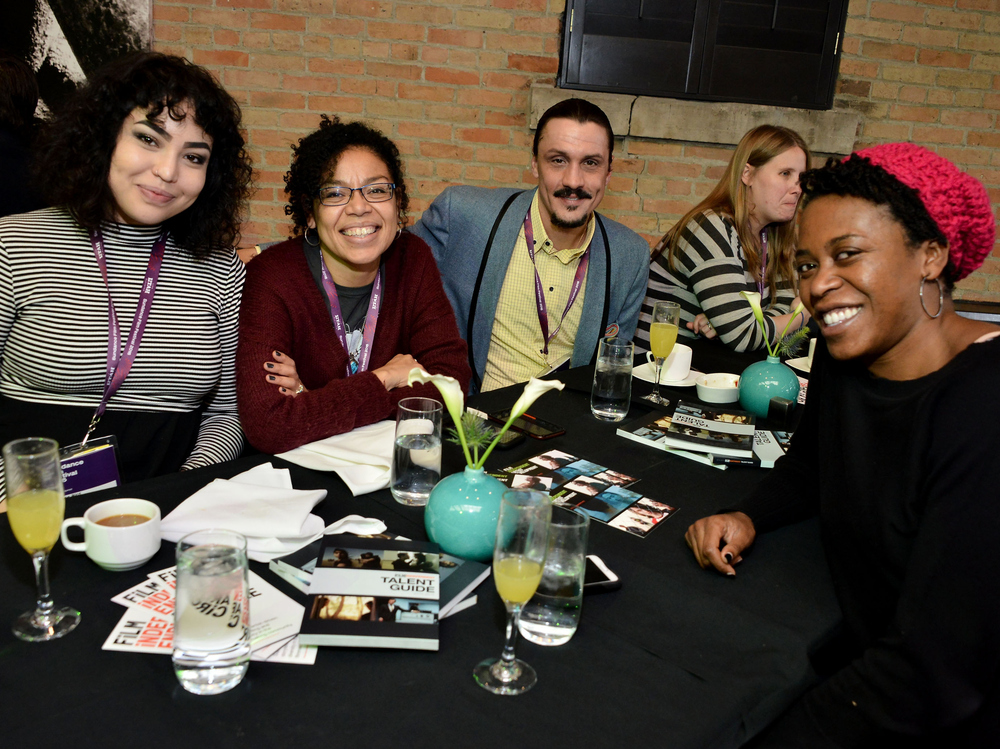
Guests attend the Film Independent Brunch during the 2016 Sundance Film Festival.
When the Sundance Film Festival kicked off last month, the subject of diversity was in the air. Just days after the Academy of Motion Pictures rekindled the debate on #OscarsSoWhite, thousands of filmmakers and journalists decamped to Park City, Utah's snowy mountains to discover new indie gems and meet the auteurs of tomorrow.
But with renewed attention on who's behind the camera, the debate turned to the festival itself, with questions on which kinds of movies tend to make it into the prestigious event, which don't and what role Sundance plays in the bigger picture of Hollywood diversity.
During Sundance's opening press conference, creator Robert Redford fielded the diversity question directly, saying "diversity comes out of the word independence. That's the principle word that we operate from." He pointed to greater support for independent creators outside the studio system — which is what Sundance aims to do — as one answer to the industry's lack of diversity.
Conversations with several filmmakers and critics of color during the festival suggest that while Sundance could never be a silver bullet in fixing Hollywood's diversity problems, it indeed has an important role to play.
Bird Runningwater, director of Sundance's Native American and Indigenous Program, says Sundance can point to three decades of experience championing and funding the works of marginalized filmmakers. After a lengthy career in philanthropy and nonprofits, Runningwater, a descendant of Cheyenne and Mescalero Apache peoples, became involved with the Institute's Native Lab, which helped to develop and workshop movies like Drunktown's Finest, Miss Navajo and Four Sheets to the Wind. Since the program began in 1981, about 300 Indigenous filmmakers have received grants, lab fellowships, training and mentoring.
Runningwater says the Sundance Institute (the company umbrella that includes festivals and various workshops) has always taken an interest in the work of diverse filmmakers. "The work with Native filmmakers actually precedes the Institute because of [Sundance co-creator Robert] Redford's work with Native communities early on in his career," he said. Part of the Native Lab's history can be traced to early Institute founders Larry LittleBird (Taos Pueblo) and Chris SpottedEagle (Houmas Nation). "When Sundance was founded, it was one of the threads of work that [Redford] wanted the Institute to serve," Runningwater said.
After launching its Native American and Indigenous Program, Sundance began experimenting with new career-building opportunities for a variety of communities often excluded by the Hollywood system. Now aspiring filmmakers can apply for the Latino Screenwriting Project, Asian American Feature Film Fellowship and the Women in Sundance Program.
"I think Sundance at the very least makes more of a concerted effort than many other festivals," says Huffington Post culture writer Zeba Blay. "We've seen films written and directed by black folk (Dear White People, Fruitvale Station and Dope) get lots of buzz and go on to do incredibly well after debuting at the fest." She said that the Sundance Institute "has explicitly defined diversity as one of its core values."
The buzz around this year's major Sundance offering The Birth of a Nation is even louder than last year's hype around Dope, culminating in a $17.5 million deal signed by Birth director Nate Parker and Fox Searchlight and a standing ovation in Utah.
But Sundance's efforts are just one piece of a much larger, very complicated puzzle, Blay cautions. "At the end of the day, the industry as a whole is still broken," she says. "The talent is there, but they have to work twice or three times as hard to generate the kind of interest that leads to distribution and further opportunities."
This was also a concern shared by Women & Hollywood blog editor Melissa Silverstein. "There's a huge disconnect for women and people of color," she said. "You can get into the competition, but as you move up the pipeline and the level of prestige increases, as the amount of money increases, and as business comes into the equation, you see less and less women and particularly, less and less women of color."
This year, Sundance showed 61 films by women and six from indigenous filmmakers. Stats for other filmmakers of color weren't readily available, which is one of the issues Runningwater and his team are working to address. "It's self-identification on the filmmaker side of things," he explained. "Some people don't want to answer the question because they think it will hinder their chances. Other people are excited to answer because they believe it's important to report the numbers." He estimated that there were about 30 filmmakers of color in this year's festival lineup of around 200 feature length and short films.
The increased attention on underrepresented filmmakers excites Sonita director Rokhsareh Ghaem. The Iranian director believes the digital revolution is behind the increase of female filmmakers from around the world. "Documentary filmmaking is now very cheap. In my country, there were few cameras for men who wanted to shoot on film," she said. "You can now buy or rent a camera easily or use your phone. It gave women a lot of freedom to tell their stories." Of course, technology has not erased female filmmakers' problems, she says. "There's still economic discrimination against women."
First-time director Maya Goded, whose film Plaza de la Soledad was showcased in the Sundance World Documentary Competition along with Ghaem's, said she prefers to work outside the Hollywood system to continue profiling the subjects she has worked with for more than 20 years. Her film follows a group of prostitutes in Mexico through their daily routines. She insists that stories like hers are meant for everyone at Sundance, not just a niche group. "My protagonists are Mexican, but I think the story is universal. The themes are universal," she said.
With an increased focus on storytellers from all backgrounds, there's greater potential that movies like Sonita and Plaza de la Soledad will find larger a audience. But according to Huffington Post's Blay, there is more behind-the-scenes work to do on every level of the industry. "In addition to equipping minority filmmakers with the tools and the resources to tell stories, I'd like to see more POC programmers, executives and buyers being included in figuring out a solution to the problem," she says.
Women & Hollywood's Silverstein agreed that although Sundance is diligent in its programming and fellowship efforts, it could do more. She urges all film festivals, not just Sundance, to better represent their communities' stories. "If your [film] roster is not reflective of the world out there, you need to go back and you need to try harder," she says.
Sundance's Runningwater is optimistic that the conversation around diversity will move into action from the studios. "We do our job to highlight the most interesting discoveries we're able to provide. How the industry responds to us is always a huge question," he says. "There are a lot of surveys coming out from all the guilds that are starting to do their own research and analysis about what makes it into the system and who gets hired, who has the privilege to work in that system. I'm hoping the industry will respond to that critique."
Monica Castillo is a writer and critic based in Los Angeles. She has traveled to several film festivals, met a few movie legends and has some great stories about hitchhiking to red carpet premieres.
Copyright 2016 NPR. To see more, visit NPR.9())

20 Jan 00:47
What I Would Have Said To You Last Night Had You Not Cum and Then Fallen Asleep
by Reina Gattuso
Alas, friend of mine, you have had an orgasm and are falling asleep. I have not had an orgasm and am not falling asleep, which means I am awake, which means I am now going to lecture you about feminism.
Who are you? (Big questions.) You are anyman, everyman, you are one of any number of lucky bastards with whom I have happened to roll into bed because baby, it’s been a few months and none of the cute activists are texting me back. Or maybe you are a cute activist who texted me back — in which case listen up, buddy, because this one’s for you, too.
Who are you? You’re a decent guy. You’re solid. I do not feel like you are going to rape me. (Yay! Let’s throw a party!)
No, you’re not a bad guy. The sex wasn’t particularly bad, either. And I know bad sex. I know sex that tastes like coercion and I know sex that tastes like endings and I know sex that tastes like hand sanitizer, which is a bad thing to put on your hands before you finger someone.
No, friend, it was not bad sex. It was normal sex. Normal, boring, vaguely dehumanizing hetero sex.
Which is precisely the point: The normalcy.
Believe me: I enjoy having someone mortar-and-pestle me for a few minutes as much as the next ornery bisexual. But friend, I feel that you can do better. I feel that we all can do better. Because there was something in the choreography of the whole thing that just struck me as, I don’t know — unsatisfying in a way only feminism can remedy.
Yup, I’m talking about the orgasm deficit.
Before we talk about orgasm, let’s talk about sex. What is sex?
Here, supposedly, is what you consider sex: We make out, you play with my boobs, I blow you, you do not go down on me even though I ask [*insert some bullshit on how “I only go down on women I’m in love with. Now put it in your mouth.”]. Penis goes in vagina, penis moves in and out of vagina, penis causes air to enter vagina and makes a lot of funny farting sounds, someone actually farts and pretends it is a funny vagina farting sound but it was totally a real fart, penis ejaculates.
You roll off of me, get up, take the condom off/pee/do whatever it is people with penises do in the bathroom immediately after they’ve come (world’s great, great mysteries), put your pants on, come back into bed, and fall asleep. Sex is now over. Sex is now over because you have decided it is over. You have decided sex is over because you are a man, and because this choreography that favors men with penises — man becomes erect, man penetrates woman, man ejaculates — is what we have been told sex is.
Because we’re brainwashed.
Ever heard of a thing called patriarchy? It’s a handy, fancy name feminists (we beautiful, beautiful people) have invented for systems of power (= societies) that favor men.
Bear with me now. Patriarchy is a system that works at every level. It structures not only overt instances of gender discrimination, but also the way we understand the world.
It affects the way we are taught to act and exist in the world. It affects our behavior. It affects our behavior at levels we can’t see or understand because we take them for granted. It sets a pattern of beliefs for how we understand and interact with the world. Thus we can say it comprises or structures our behavior.
Patriarchy, or a system that privileges men, is like food for our brains and hearts and social experiences: We ingest it in our homes, in public space, in school, in pop culture, in relationships, through the media. We digest it, and it becomes the building blocks of our thoughts, our behaviors, our beliefs about what is right and wrong.
It also structures sex.
There are a number of different ways in which this structure-favoring-men affects sex.
One big way in which this structures sex is in how we talk about consent and sexual violence — that is, the question of whether is sex is welcome at all. We’ve talked about this a lot at Feministing, and this is super important.
But it also structures consensual sex: It helps determine what we believe sex is, and how we experience it. It helps determine who feels entitled to sexual pleasure and who doesn’t, whose desires are met sexually and whose aren’t, whose desires are even assumed to exist. We’ve also talked about this a lot, and this is important, too.
So now, with this framework in place, we can talk about the orgasm gap.
The orgasm gap is a real thing, and it is what it sounds like: When it comes to men-women sex, men have orgasms a whole hell of a lot more than women.
Okay, disclaimer: Orgasms are fun. Orgasms are super fun! I am all for orgasms. I do, however, think it’s important to remember that for lots of people, sexual pleasure happens beyond the orgasm, besides the orgasm. Focusing only on orgasms makes sex frustrating for people who orgasm infrequently or never despite the best of everyone’s abilities. And focusing only on orgasm can promote a goal-oriented-ness that I think is part of the problem: The idea that sex is a race toward a goal, that goal being male ejaculation. I like the hippy-motivational-poster approach to sex: It’s about the journey, not the destination. A journey of a thousand nerve endings begins with one caress. That sort of thing.
But it’s important to think about the orgasm gap because orgasm, and specifically the male orgasm, is more often than not assumed to be the defining aspect of male/female sex. That is: We fuck until you come, I do not come, you do not ask if I would like to come or if you can help make me come, and then we’re done fucking, because you have decided we are done fucking, and everyone is supposedly happy.
By lecturing you about feminism well into the night (you’re welcome), I’m not only concerned with the orgasm itself. If I were so obsessed with orgasms I could go have one. More so, dear friend, I’m concerned with injustice. I’m concerned with the frustration and subtle dehumanization of a sexual system that is so overwhelmingly geared toward the pleasure of the structurally more powerful party (…men), the definition of sex itself is geared around your pleasure — all while easily disregarding mine.
We can think of several explanations for the orgasm deficit.
1. Penises and vaginas/vulvas are different, and maybe it just actually is biologically harder for vagina/vulva people (most of whom are ladies) to orgasm.
Yeahhh, that doesn’t cut it. We know that women tend to come less than men during sex, but we also know that — for example — women come more during lesbian sex than during heterosexual sex. This indicates that the problem isn’t vaginas, but what we do with them.
2. Penises and vaginas/vulvas are different, and the things people tend to do during men-women sex tend to be more compatible to male sexual pleasure.
This is more like it! To understand what I mean by this, we need to consider the fact that that definition I gave before of sex — this whole play with boobs/funny air farts/get up and do mysterious things in the bathroom business — is not inevitably what sex is. It’s not what sex is for many, many people; most of the time it’s not what sex is for me.
You see, when I’m not sleeping with numnuts like you, I’m usually sleeping with women. Lesbian sex and relationships have their own problems (oh buddy you better believe me they do), but we can think about the existence of lesbian sex (which often occurs without a penis or without the presence of a male) as disproving the idea that sex ends when men get off. One can have sex in ways that don’t inherently depend on male pleasure.
I don’t mention this because I think all women should just convert to lesbian, though by all means dear god do. I’m saying this because we need to know — you, human male lying next to me; you need to know — that the way you conceptualize pleasure and its choreography is not the way sex inevitably is. You can fuck differently.
You can fuck like a girl.
Because I don’t feel like the primary distinction between my lesbian sexual experiences and my hetero ones is a matter of anatomy. Rather, it’s overwhelmingly a matter of gender and the way we’re trained to get off. Women tend to be trained to think about other people more, to care for other people and to provide things to them, and to demand their own gratification less (this is why you think I currently sound like a selfish bitch for simply asking you to consider me your equal). The best partners I’ve had, of whatever gender (but step up your games, guys, because I mostly mean women) asked questions. They were creative. They were kind. They played with me. We collaborated. If one of us came and was so goddamn tired we needed to fall immediately asleep and could not bear to flick our wrists another moment, we said so, and that was okay, because it was not merely assumed as par for the course.
Dear friend lying next to me, drifting your pleasured way into dreamland, tomorrow I will leave your house.
Tomorrow morning I will take the metro home, and I will be very caught up in self-righteous orgasm anger and meanwhile there will be people all around me, laboring people, impoverished people. And it will feel ridiculous, then, to be a wealthy lady with freedom of mobility and an income and no pressure to marry whose biggest complaint is that dudes don’t give her enough sexual pleasure.
But here’s the thing: Gender ideologies, like other oppressive ideologies, work at every level. Because they structure or constitute our experiences of the world, we can see them in issues from basic right to food and shelter to these issues of sexual pleasure. We can understand them as affecting not only our right to life, but our right to beautiful life. Our right to pursue lives of richness, our right to embodiment, our right to lives wherein pleasure is possible.
Sexual equality is just one part of creating a world in which those with more power are trained to prioritize those with less power.
And now, if you will excuse me, I am going to go masturbate in the bathroom.
14 Jan 23:30
New York City Council Member Shuts Down Victim Blaming in Two Minutes Flat
by Dana Bolger
God grant me the eloquence, composure, and facial control to someday take down the patriarchy as succinctly as New York City Council member Laurie Cumbo did on CNN earlier this week.
When asked by CNN’s Pamela Brown to comment on a gang rape victim’s behavior the night of her assault, Cumbo — without missing a beat — explained:
That’s typical of just what I spoke about: that individuals often talk about the woman, they rarely talk about the individuals who actually committed the rape. Those are the individuals that need to be focused on right now [….] We shouldn’t talk about whether she was drunk, we shouldn’t talk about whether she was properly dressed, we shouldn’t talk about the time of evening that it happened. That is too typical of how we discuss rape in the city, the nation, and really the world. We need to focus in this situation on those five individuals that committed this heinous crime and what were the bad decisions that they made all throughout the day.
Cumbo goes on to speak eloquently about the systematic neglect and marginalization that Black folks — particularly Black women — suffer, and concludes with an affirmation that “whether you are on the Upper East Side or in Brownsville, all women matter, and we’re here to make sure that message is sent loud and clear.”
Transcript below.
—
Laurie Cumbo: There is a way that people respond to violence against women and it’s not appropriate. We feel that it needs to be stronger, it needs to be more effective, there needs to be legislation, there needs to be strategy, there needs to be implementation, as well as enforcement. Every woman in the city of New York should feel safe, whether they are coming home late at night, early in the morning, coming from a party, or going to work extremely late.
Pamela Brown: No doubt about that. But I have to ask you this, Councilwoman: law enforcement sources have told CNN that this alleged victim in this case was drunk, combative, and bit a police officer, and she initially refused treatment. What can you tell us about that?
Cumbo: I would say that that’s typical of just what I spoke about, that individuals often talk about the woman, they rarely talk about the individuals who actually committed the rape. Those are the individuals that need to be focused on right now. It does not matter…
Brown: We get that, we get that. That’s correct, it’s about the perpetrators.
Cumbo: And that’s who I think we should focus on. We shouldn’t talk about whether she was drunk, we shouldn’t talk about whether she was properly dressed, we shouldn’t talk about the time of evening that it happened. That is too typical of how we discuss rape in the city, the nation, and really the world. We need to focus in this situation on those five individuals that committed this heinous crime and what were the bad decisions that they made all throughout the day. Had they been drinking? Had they been smoking? What are their situations in terms of what would be put in someone’s minds to think that something like that was okay. And a lot of it is neglect. They’re in the Brownsville section of Brooklyn, New York. They’re thinking that because they’re black, she’s black, her father is black, they’re thinking that no one really cares about what we do in this community, there will be no repercussions. But we’re here, we’re discussing this matter, because we want to let individuals know: whether you are on the Upper East Side or in Brownsville, all women matter, and we’re here to make sure that message is sent loud and clear.
10 Jan 22:08
Celebrating a Decade of Black & Pink
by Black and Pink
www.blackandpink.org
Black & Pink is an open family of LGBTQ prisoners and “free world” allies who support each other. Our work toward the abolition of the prison industrial complex is rooted in the experience of currently and formerly incarcerated people. We are outraged by the specific violence of the prison industrial complex against LGBTQ people, and respond through advocacy, education, direct service, and organizing.
Black & Pink is an open family of LGBTQ prisoners and “free world” allies who support each other. Our work toward the abolition of the prison industrial complex is rooted in the experience of currently and formerly incarcerated people. We are outraged by the specific violence of the prison industrial complex against LGBTQ people, and respond through advocacy, education, direct service, and organizing.
01 Jan 14:26
Oklahoma Prisoners Develop Software which Could Save the State Millions
by Christopher Zoukis
Loaded on Jan. 1, 2016
by Christopher Zoukis
published in Prison Legal News January, 2016, page 58
Oklahoma Prisoners Develop Software which Could Save the State Millions
by Christopher Zoukis
Oklahoma legislators have estimated the state could save upwards of $20 million annually if a computer software program developed by two prisoners at the medium-security Joseph Harp Correctional Center is expanded statewide.
Authorities said the facility began using the program to track prisoners’ meals in the fall of 2011, according to Jerry Massie, a spokesman for the Oklahoma Department of Corrections (DOC). The creators of the software – whom officials refused to name other than saying one is a convicted murderer and the other a sex offender – have already expanded it to include a wide range of money-saving monitoring.
“It’s a pretty neat program. It’s all done by the direction of the supervisor (William Weldon), one of these guys who’s kind of, what do you call it, thinking outside the box,” said state Rep. Bobby Cleveland, chairman of the House Public Safety Committee, which has jurisdiction over the state’s prisons. “They built a system that could save the state millions of dollars. I want to get the state using this thing.”
Cleveland said the software is based on bar-coding technology and was initially used ...
17 Nov 02:27
Officers’ Unions’ Motions to Intervene in Federal Stop-And-Frisk Suits Held Untimely and Insubstantial
Loaded on Nov. 16, 2015
Filed under:
Police Misconduct,
Pat Searches,
Police Searches,
Appeals,
Intervention,
Racial Profiling.
Location:
New York.
Officers’ Unions’ Motions to Intervene in Federal Stop-And-Frisk Suits Held Untimely and Insubstantial
The United States Court of Appeals for the Second Circuit has affirmed a lower court’s denial of the officers’ unions’ motions to intervene in stop-and-frisk suits against the City of New York (“City”) and has granted the City’s motion to dismiss its appeals, among other holdings.
The U.S. District court for the Southern District of New York found the City liable of violating the Fourth and Fourteenth Amendment rights of plaintiffs in two class action suits based on the City’s conduct and practices in stop-and-frisks. The court entered orders for liability and remedies and the City appealed. Several police unions subsequently appealed and sought to intervene in the suits and the City’s appeals. Upon motion by the City, the suits were remanded to the district court and after the parties settled, the City moved to dismiss its appeals with prejudice. The district court then denied the unions’ motions to intervene in the suits based on untimeliness, the failure to assert a protected interest and prejudice to the parties. The unions appealed. On October 31, 2014, the appellate court affirmed the district court ...
11 Nov 15:04
Watch: Parody video skewers Dove-style ‘femvertising’ trend
by Maya Dusenbery
This parody promo for an ad company devoted to “empowering women through advertising,” created by Canadian agency John St., offers a funny, biting critique of the so-called “femvertising” trend — epitomized by Dove’s “Real Beauty” campaign — that has become so popular in recent years.
As we’ve explored before, as long as we live in a capitalist, consumer culture, there are things worth appreciating about this “girl power” trend in advertising. It’s certainly preferable to the slew of blatantly sexist ads that remain a staple of the marketing industry. I was glad, for example, that Always’s tear-jerking #LikeAGirl ad ran during the SuperBowl. And I’d be happy for the fictional “All hair is beautiful” campaign in the video to replace the real Veet’s “Body hair will literally turn you into a dude” one.
But as Alexandra has written of Dove’s brand of self-esteem boosting, such faux-empowerment may make you feel a little better about yourself today, “but doesn’t help create a better world.” And this spoof highlights how fine the line between empowerment and exploitation can be when companies are still relying on targeting women’s insecurities in order to “sell more stuff.” “They may not even know they have these insecurities,” one agency exec explains, “so it’s really important that we dig them up.”
If anyone has time to add a transcript in the comments, I’d be grateful!
27 Jun 03:19
 "Queer histories matter not only for our own sense of identity and pride, but because they impact our legal realities, too."
Queer Histories Matter: How Ancient History Played a Starring Role in the Marriage Equality Case
by Emily
"Queer histories matter not only for our own sense of identity and pride, but because they impact our legal realities, too."
24 Jun 18:20
 Stephen B. Morton/AP
Dispatch From Charleston: The Cost Of White Comfort
by Chenjerai Kumanyika
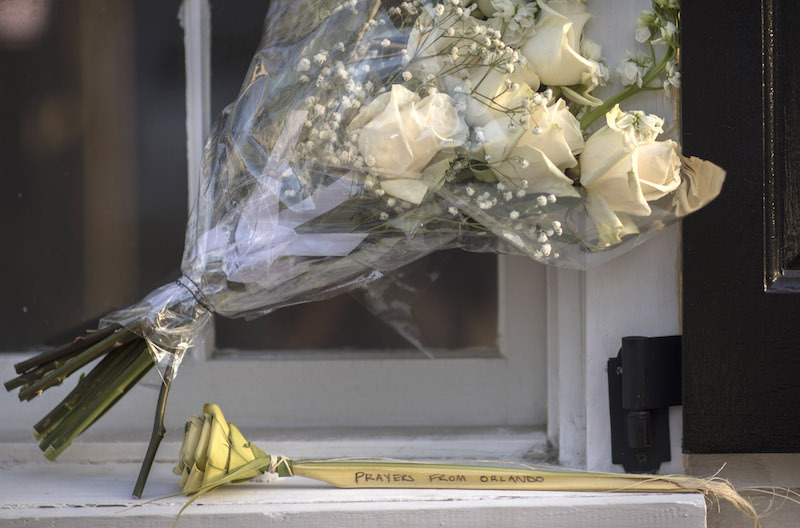
A palm rose with a message from Orlando, Fla., is placed near the front of the Emanuel AME Church just days after the shooting.
How hard can it be to hold hands with someone, even a stranger, if you know it's just for a couple minutes? For a few terrible moments in Charleston last week, I couldn't bring myself to do it.
It was Friday night, and I was at a city-sponsored vigil in an arena on the College of Charleston campus with 4,000 other mourners. I had driven down from Clemson, S.C., where I teach, the morning after the shooting. I made the same sad four-hour trip not long ago; in April, my wife and I came for Walter Scott's funeral, 10 miles up the road.
A reverend led a prayer for the Emanuel AME victims, asking people to take the hand of the person next to them and join in singing "We Shall Overcome." The person next to me was a kind-looking white woman with a small white rose pinned to her T-shirt; lots of people were wearing white ribbons in honor of the victims. She offered me a sad smile and a gentle nod, lifting her hand.
That's when I froze. I just couldn't bring myself to take this woman's hand, and I knew exactly why. It's because she was white.
Seriously, Chenjerai?! You're gonna do this now? The voice of one of my mentors, an older black man who ran a diversity program at my college, boomed in my head. Get over yourself and your racial baggage and support this community. You will hold this white woman's hand. Now!
My arm didn't move. I had no doubt that this woman was at the vigil because she cared and wanted to help. And, just like me, I'm sure she was hurting that night. As a college professor and activist on diversity issues, no one needs to convince me that there are genuine, engaged, committed white people in this fight. I've marched next to thousands of them over the years, I've worked through hundreds of tough conversations with them in workshops on race, and I get to know them every day in my classes.

I have reached across the aisle. I have broken bread. I fully believe we all need healing in these moments, and that night, the symbolism was clear: a white person and a black person holding hands in the face of horrific racial violence, singing songs of freedom. What could be more comforting?
But thanks to something I experienced the previous night in Charleston, I couldn't shake a paralyzing feeling: When black people and white people clasped hands in the arena that night, the comfort wouldn't be evenly distributed. The healing wouldn't flow both ways.
The night before, I was standing in front of Emanuel AME Church alongside three black men from Charleston, probably in their late 20s. Bright yellow police tape stretched across the front of the church, but they had stepped over the tape to get closer to the memorial, huddled there as though for warmth.
We got to talking — four black men uneasily sharing a space of recognition, helplessness, and reverence. One mentioned that, for kids growing up in this city, school field trips often involved visiting slave plantations. "They tell us, 'Look, that's your history.' And it be a picture of a man lynched ... hanging. Imagine you a kid and you standing right where it happened."
Black survival has so often depended on white comfort.
Right. Imagine taking a child to a place like that without considering how they were meant to sleep that night. And on a field trip.
It was about then that a husky white police officer in a bright yellow vest walked up. We all stiffened. The officer explained that he could smell marijuana, and that if we were carrying, we had better move along. We all glanced at each other, quick looks of offended amusement, and one of the Charleston men said, simply, "Naw, we good."
The officer shook his head and told us that he'd smelled weed when the wind was blowing, and repeated that if any of us had marijuana, we needed to clear out. One of the men responded, clearly getting irritated, "Yeah, but how you smell weed when ain't nobody got no weed?"
Sensing that the tension had just escalated, I started furtively looking for the officer's badge number, trying not to provoke him. He repeated himself again, and this time, no one spoke. We just nodded, and the officer moved on.
A few minutes later, the wind changed and we also smelled marijuana. It was coming from down the street, in the general direction of some white college students gathered there. We chuckled in that way you chuckle at things that aren't really funny. The officer circled back around to us, and the young man in the Geechie Squad hat called out to him. "We smell what you was talkin' bout, but it ain't coming from over here." We pointed up the street. The officer looked, then walked over to us with a bashful smile.
"Now that you guys smell it, you see what I was saying, right?" he said. "You see how I could have made that mistake, right?"
At that moment, I had to fight down two conflicting instincts. The first was to spit. (I didn't.) The other urge was to appease this white officer. To put him at ease. To make sure he felt validated and in charge and, above all, comfortable.
I had to fight down the urge to appease this white officer. To put him at ease. To make sure he felt validated and in charge and, above all, comfortable.
There's a long history to this urge. It's what my mother told me to do and what my father showed me how to do whenever he was pulled over. Shrink down into yourself around white people in command, make yourself small and quiet and do whatever it takes to keep them comfortable.
And it goes back much further. Survival for black folk during slavery, Jim Crow and well beyond necessitated thousands of small demonstrations of pleasant compliance toward white people. This didn't just mean crossing the street when a white person approached; it meant keeping your eyes down while you did it. It didn't just mean stepping off the curb for a white person; it meant smiling as you did it.
Today, it means that when I discuss these shootings with my white students and my heart is bursting at the seams with outrage and grief, I must keep my voice and gestures gentle and calm and validate my students' most hurtful comments so they don't feel personally indicted.
And it means not just acquiescing to unwarranted police interrogation and arrest. It means being friendly, even gracious, throughout the ordeal. Black survival has so often depended on white comfort.
In the arena the next night, I did, of course, finally take the hand of the woman by my side. She smiled gratefully, her face flushed. Just half a minute had passed, but it had been an awkward encounter for both of us. I joined in the singing — We'll walk hand in hand, we'll walk hand in hand. We'll walk hand in hand someday — but I was thinking about the heartbroken men I met in front of Emanuel AME Church the night before, who spent energy they did not have on appeasing yet another white police officer.
And I was thinking about a black woman I'd met earlier that day, a housekeeper at the Quality Inn where I was staying in North Charleston. It was 100 degrees outside, and we talked while she folded laundry in a barely air-conditioned room. She said she desperately wanted to take her family to church on Sunday but didn't know if it would be safe. What if other white supremacists were feeling inspired?
My father showed me how to do this whenever he was pulled over. Shrink down into yourself around white people in command, make yourself small and quiet, and do whatever it takes to keep them comfortable.
In a state where black people still have to drive down roads named for generals willing to spill rivers of blood — black and white — to keep their kin in chains, church is one of the few places that feel truly comfortable. And now, even that was taken away.
Looking out over the smiling, swaying, overwhelmingly white audience singing in the arena that night, I realized that with the simple act of extending my hand — literally, not even metaphorically — I could offer so many of them a heartfelt feeling of racial unity, the promise of healing. But what can I offer the black men and women I spoke to earlier that day? I can't promise them that things will change, that their sons and daughters will make it to happy, healthy adulthoods, that one day they won't have to work in brutal heat for insultingly low pay or that a police officer or angry young white man won't snuff out their happiness in a single instant. I could offer them a hand, too, but I can't offer real comfort.
A few moments after taking hold of my neighbor's hand, I let go again. That didn't feel good, but maybe we're not all supposed to feel good right now. Not yet.
Dr. Chenjerai Kumanyika is an artist, activist and scholar who holds an assistant professorship in Clemson University's department of communication studies and a creative professorship in the College of Architecture, Art and Humanities. His January 2015 article on whiteness and public radio voice was featured on NPR, The Washington Post and Buzzfeed, and it spawned a nationwide discussion on diversity and voices in public media.
Copyright 2015 NPR. To see more, visit http://www.npr.org/.9())
02 Jun 23:46
 The experience of getting a letter is one of the most important moments or feelings of connection to something.
5 Things You Should Know About Solidarity with Incarcerated LGBT People: A Conversation With Black and Pink
by Maddie
The experience of getting a letter is one of the most important moments or feelings of connection to something.
01 Jun 18:50
 "13. All feminist concerns are transgender concerns, period."
16 Ways to Make Queer Women’s Spaces More Trans Women-Friendly
by Mey
"13. All feminist concerns are transgender concerns, period."
29 May 15:42
 "God-insulting grannies."
Gal Pals In History: 8 Ways To Avoid Using The Words “Lesbian” or “Bisexual”
by Carolyn
"God-insulting grannies."
28 May 20:15
New “Men Who Rock” issue skewers sexist music journalism
by Maya Dusenbery
 What if media wrote as condescendingly about male musicians as they so often do about female musicians? Back in 2012, The Stranger published its satirical “Men Who Rock” issue — a play on Rolling Stone’s annual “Women Who Rock” issue — to brilliantly expose the difference. Now bandmates Emily Nokes and Bree McKenna of Tacocat are back with round two.
Here’s a taste of some of the babes profiled:
Sure, his glorious blond-streaked curls and big blue eyes peeking out from underneath chic statement glasses make him an 11 on the 1-to-10 babe-o-meter, but don’t write him off as just a pretty face! Kenneth Piekarski is the man behind avant-pop solo project Slashed Tires—an unconventional Seattle noise outfit that continues to wow the world, in part because this indie siren actually writes all the songs himself. Kenneth is working on a full-length Slashed Tires album that might be out this fall (but he always says that). Check out his work at slashedtires.com. Very much the male counterpart to the sexy/experimental sister group the Shaggs, Kenneth shakes things up by slipping a trombone into the mix. Women may listen to Slashed Tires for the clever, intricate noise music, but men tend to love him for his independent spirit of male empowerment.
Read the rest to learn more about these six up-and-coming male Seattle musicians who are not only hot but “also know how to play their instruments!” I know, can you believe it? They also have plenty of hair care and work-out tips to share.