Cropped and tapered trousers, black boots, puffer vest layered under a cardigan, tie, flipped-up sunglasses and the gloves (whether intentional or not)
I have to say this young man is the coolest mail carrier I’ve ever seen.
Cropped and tapered trousers, black boots, puffer vest layered under a cardigan, tie, flipped-up sunglasses and the gloves (whether intentional or not)
I have to say this young man is the coolest mail carrier I’ve ever seen.

Oh, it's definitely hot in here. Because of ~*lesbians.*~
The post Naughty Lesbian Scenes appeared first on Autostraddle.
By Mike Ludwig, Truthout
This story is the result of a nine-month investigation and part one of a multimedia series on deaf prisoners, as part of a reporting collaboration with the Making Contact radio program.
Use ASL? Click here to see a video interpretation of this story in American Sign Language.
Silent Voices is truly silent. The group's three members are doing what looks like a dance in the front of a classroom at a state prison near the banks of the Mississippi River, just south of Baton Rouge, Louisiana, performing their version of the song "I Believe" by R. Kelly. Instead of singing, the performers are interpreting R. Kelly's lyrics into American Sign Language, or ASL, the sign language most commonly used in the United States. ASL is an animated language. Gestures, facial expressions and even foot-stomping the floor to a beat allow ASL speakers to add context, detail and music to their conversations. The three men in Silent Voices are stunning in this way. The performance is part ASL, part gospel choreography and it's contagiously uplifting -- in stark contrast with the backdrop of armed guards and barbed wire. The classroom erupts into applause.
Standing at ...

"There’s nothing more I want to remember than every moment and sensation we shared. Our grinding hips at Queer Cumbia, feeling your drunken sweat drip onto my freshly implanted tits. The way we sloppily made out and smeared our red and burgundy lips all over our mouths, noses, forehead, and neck."
The post Queer Latinx Love is Resistance: A Collection of Vignettes appeared first on Autostraddle.

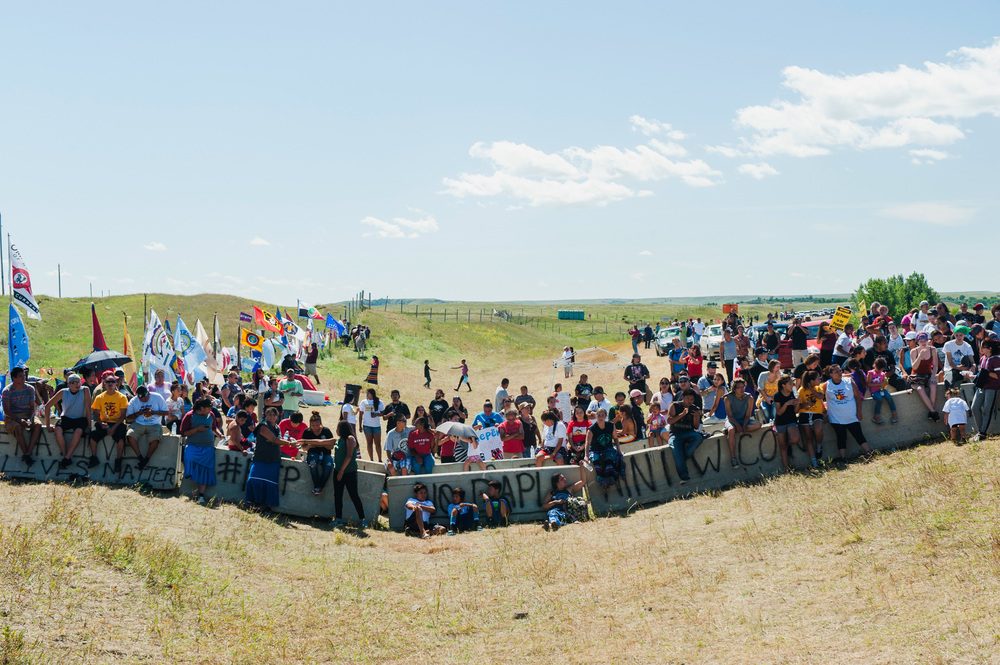
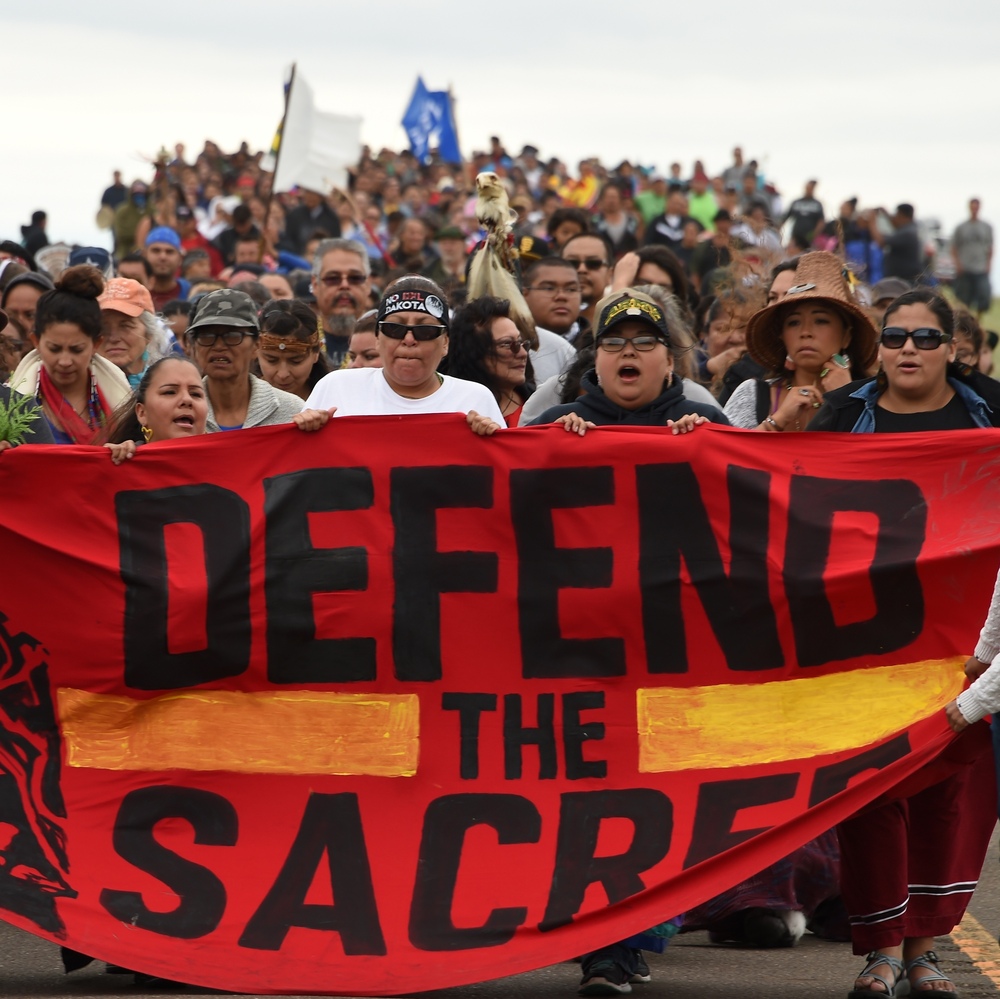
Native American protestors gather at a construction site for the Dakota Access pipeline to perform a daily prayer ceremony. Over 1,000 people, most Native American, have gathered at two prayer camps along the Cannonball River near its confluence with the Missouri in North Dakota to protest the Dakota Access pipeline.
The Camp of the Sacred Stone is full of all manner of people — kids, elders, lawyers, laid-back hippies, and representatives of several Native American tribes — all gathered alongside the Standing Rock Sioux Nation to resist construction of a controversial oil pipeline that would cut across the American heartland.
Since construction of the Dakota Access Pipeline brought protesters to the encampment in April, organizers say nearly 200 tribes have offered support. Celebrities, environmentalists, politicians, leaders of the Black Lives Matter movement and other activists have joined together to create one of the more unusual coalitions to back a cause.
Their efforts hit a roadblock on Friday when a federal judge denied the Standing Rock Sioux's request to stop construction of the 1,172-mile pipeline, which would stretch from North Dakota to Illinois. But the Justice Department, the Department of the Army and the Interior Department then blocked construction in the most contested areas of the planned pipeline, pending further discussion.
No matter what the government or courts ultimately decide, many of the people who call themselves "water protectors" coming together at the camp near Cannon Ball, N.D. have said they're prepared to continue the resistance despite the bulldozers.

Members of Native Descendents, an all-Indian motorcycle club from Southern California, hang the La Jolla tribal flag at a construction site for the Dakota Access pipeline.
"The spirit out there is incredible," said Ruth Hopkins, a reporter for Indian Country Today, who was born on the Standing Rock Reservation. "There's such a healing feeling."
The camp was started in early April by Ladonna Brave Bull Allard, who was joined back then by a handful of other tribal members. Over the past few months, the movement — branded #NoDAPL — has rallied support across racial, geographic and generational lines. Most notably, though, Native tribes have coalesced around this issue like none in recent history.
"Tribal leaders don't often get involved at the level they're getting involved in this resistance," said Kim Tallbear, a professor of Native Studies at the University of Alberta in Edmonton, and an enrolled member of the Sisseton-Wahpeton Oyate in South Dakota. "But then you've got all these activists on the ground who are looking to resist and critique through other channels."
Hundreds of people now gather at Sacred Stone each day, and the camp has gained both national and worldwide attention.
Last month, Black Lives Matter sent a delegation of supporters to the camp. In a statement on its website, the group links the threat of water contamination in North Dakota –- the Standing Rock Sioux worry that the pipeline will leak into the Missouri River -– to the lead-contaminated drinking water in Flint, Mich.

An encampment by the Missouri River where hundreds of people have gathered to join the Standing Rock Sioux Tribe's protest against the construction of the Dakota Access Pipe last week.
"We affirm our family's right to land and clean water," the group said. "The same companies that build pipelines are the same companies that build factories that emit carcinogenic chemicals into Black communities, leading to some of the highest rates of cancer, hysterectomies, miscarriages, and asthma in the country. Our liberation is only realized when all people are free."
Amnesty International and the United Nations have weighed in, and, during a town hall meeting in Laos on Wednesday, a Malaysian woman asked President Obama how he intended to ensure environmental justice for the Standing Rock Sioux.
It's the idea of a common cause that has brought together a unique coalition of Native tribes. In a way, it's also what distinguishes the tribes from many of those standing with them. Despite vast cultural differences, Native tribes see themselves as protectors of the land, said Hopkins of Indian Country Today. "This is part of a larger issue we face as Native people," she said. "It's something we've always faced...fighting for our lands and our survival."
9())


Incarcerated people across the nation are striking today to disrupt the profitability of the prison-industrial complex, California might end their statue of limitations on sexual assault, Airbnb announced new policies to address racial discrimination, and more news
The post Largest Prison Strike in US History Hopes to Expose Injustice and Suffering appeared first on Autostraddle.
AnjaFor the Soy Yo video.
Tiarah Poyau, a 22-year-old graduate student, was killed during the NYC West Indian carnival after telling a man to stop grinding against her.
In case you missed it, Ben Fields, the school resource officer who violently arrested a Black teenage girl at Spring Valley High School, will not be charged.
In a nod to Colin Kaepernick, U.S. women’s national soccer team player Megan Rapine takes a knee during the National Anthem.
Bomba Estéreo’s “Soy Yo” video is an ode to little brown girls everywhere.
Women human rights defenders often face violence and threats for their work. This online art campaign features their stories.
Bejan Matur and Maram al-Masri, a Syrian and Kurdish poet respectively, tell stories of chaos, carnage, and the civilians left behind to pick up the pieces.
Idaho’s health department is now sending patients seeking abortion care to fake clinics, also known as crisis pregnancy centers, thanks to a new Republican-backed law promoting free ultrasound providers.
The law, HB 516, amends an existing statute to require the state Department of Health and Welfare to compile a list of providers of free ultrasounds. The agency must also let pregnant people know they have the “right to view an ultrasound image and hear heart tone monitoring.”
The health department, however, doesn’t screen the providers, which “gives the false impression that this is a vetted list …when it’s actually not,” as Hannah Brass Greer, Idaho legislative director of Planned Parenthood Votes Northwest and Hawaii, told Rewire.
Getting included on the list simply requires contacting the health department, and all of the 11 providers now on it are anti-abortion facilities. As Brandi Swindell, CEO of Stanton Healthcare, which has two clinics on the list, told the Associated Press, “I’m 100 percent pro-life.”
When Rewire reached Sherry Bushnell at A Blessed Beginning, which is also included on the health department’s list, she said they actually don’t provide free ultrasounds right now because their ultrasound facility is “under construction.” She said they refer clients to Life Choices, in nearby Sandpoint, Idaho.
Like most anti-choice clinics, A Blessed Beginning espouses unscientific claims about the psychological risks of abortion care. Its website warns that abortion causes everything from eating disorders to suicidal thoughts, although peer-reviewed studies have found no link between abortion care and depression, anxiety, or post-traumatic stress disorder.
The health department issued the list August 1, and it includes facility names, addresses, contact information, and hours. One of the clinics is actually in Washington state, not Idaho. Planned Parenthood isn’t included because it does not offer free ultrasounds, though representatives from the organization told Rewire it does offer financial assistance to those in need.
Buried at the bottom of the four-page list is a small disclaimer that says, in part:
This information is not intended to constitute medical advice or the provision of medical services …. The Department of Health and Welfare does not inspect, certify, or endorse any of the providers listed and cannot be held liable for the action(s) of said providers.
“Adding that language was a way to let people know that we’re not saying this is going to be a great ultrasound experience,” health department spokesperson Niki Forbing-Orr told the Associated Press. “There’s no registry for this type of equipment in Idaho. Anyone can own and operate one.”
As Rewire previously reported, one of the clinics on the health department list is directly connected to Rep. Vito Barbieri (R-Dalton Gardens), who voted in favor of the legislation. In 2014, Barbieri was president of the board of directors of Open Arms PCC and Real Choices Clinic, which is included on the health department’s list.
The post Idaho Directs Pregnant People to Fake Clinics for Free Ultrasounds appeared first on Rewire.
Twitter vows to do better with online abuse after Leslie Jones deletes her account as a result of racist and sexist harassment on the platform.
A woman has started a social experiment site where people of color can post things they need and white people can post things they can offer. It’s called Reparations. *logs on to see what can be done about this student loan debt*
Medical negligence is suspected in a newly released report by ICE on the 18 migrants who died in detention.
LGBT and immigrant activists have created a new crowdfunding site aimed specifically at helping LGTBQ and gender non-conforming folks in hoped that more of them can post bail.
Transgender woman recreates Beyoncé’s LEMONADE video in “Lemonade Served Bittersweet”
Author and professor Marc Lamont Hill, and Mychal Denzel Smith, contributing writer for The Nation magazine, speak on Democracy Now! about police brutality and race discrimination, especially toward Black men.
The post Marc Lamont Hill and Mychal Denzel Smith Discuss State Violence Against Black People appeared first on Rewire.

"Can you talk in a whisper? I'm suffering from a bad Pride Hangover."
The post Saturday Morning Cartoons: Pride Hangover appeared first on Autostraddle.
AnjaFor The Negro Motorist Green Book and Black America’s Perpetual Search for Home.

Hey, you! Let's get some links.
The post Also.Also.Also: Undocumented Rural Queers and Other Stories for Your Whole Thing appeared first on Autostraddle.
By Aviva Stahl, VICE
Gilbert Greenfield sits upright in the chair, his body tense, a blood-pressure cuff attached to his left arm. A sensor is strapped around his chest, and two more cap his fingertips to measure how much he's sweating.
The polygrapher asks a question: "During the past year, have you fantasized about inflicting pain while having forced sexual intercourse with a female?"
"No," Greenfield responds.
The polygrapher prompts Greenfield again: "During the past year, have you masturbated to sexual fantasies about forcing a female to have sexual intercourse with you?"
"No," he replies.
When the test is over, Greenfield can breathe a sigh of relief—he passed. A court has ruled he's a sexually violent predator, and to go through the rehabilitative program, his treatment team must believe he is being open and honest about his deviant fantasies.
Greenfield is locked up in New Jersey for sex offenses he committed as a young man. At 14, he raped a woman by knifepoint, and at 20, he reoffended with a perhaps even more brutal crime. Armed again with a knife, he kidnapped a woman and raped her in the woods, then tied her to a tree, stabbed ...

RIP Bill Cunningham. An inspiration in his work and commitment to photography and fashion.
I always loved sitting across or near Bill Cunningham at a fashion show. If it was a more dramatic show like Vickor & Rolf he would look like a kid in a candy store!
While all the other editors carried a very studied nonchalance Bill was all smiles and almost physically snapping at the looks with his camera.
What Bills work meant to me wasn’t about perfect light or composition or edit but about the pure joy and energy he brought to doing the job. Bravo Bill!!
During his powerful acceptance speech after receiving the Humanitarian Award at the BET Awards 2016, actor and activist Jesse Williams spoke about police brutality against Black people, gentrification, and fighting for freedom.
The post Jesse Williams: ‘Just Because We’re Magic Doesn’t Mean We’re Not Real’ appeared first on Rewire.
In 1966, Ida Phillips, a single mother working as a waitress, sat down at her kitchen table and wrote a letter to then-President Lyndon B. Johnson. She told him her story: Despite her qualifications, Phillips had been told by a Martin Marietta employee not to apply for an assembly-line position at one of the construction-material company’s manufacturing plant. The job would have paid more than double what she was making as a waitress. It included a pension plan and insurance, benefits unavailable in most female-dominated industries at the time (and which since have only marginally improved.) The reason Phillips was turned away? She was a woman with a preschool child.
That letter, Phillips’ subsequent lawsuit, and her Supreme Court win would help spark a civil rights revolution in the workplace—one with consequences that reverberate today.
So opens Because of Sex: One Law, Ten Cases, and Fifty Years That Changed American Women’s Lives at Work, written by Gillian Thomas, senior staff attorney with the American Civil Liberties Union (ACLU) Women’s Rights Project. Despite its full title, though, Because of Sex goes beyond cases that helped shape workplace anti-discrimination policies, focusing on ten key women whose own lives changed the law.
Title VII of the Civil Rights Act of 1964 prohibits employment discrimination based on race, color, religion, sex, and national origin. And it was Phillips’ case, and the nine others profiled in the book, that would ultimately shape that law into one that, decades later, is an important tool in advancing gender and sex equality. As Thomas explained to Rewire in an interview, Title VII it is not just a foundational piece of civil rights legislation important for its historical effect on workplace equality. In the face of anti-transgender bathroom bills and statewide “religious liberties” legislation sweeping the country, it is a crucial tool for pushing equality forward.
Thomas’ book is organized along three key themes in employment discrimination law: pregnancy-related workplace policies, gender stereotypes in the workplace, and sexual harassment. Those themes act as an inroad toward thinking more broadly about how, in Thomas’ words, we achieve “substantive equality” in the workplace. They illustrate how early fights over promotions and workplace policies that kept women out of certain jobs due to concerns of harming their potential fertility foreshadowed the legal showdowns over contraception coverage in employee health-care plans in cases like Burwell v. Hobby Lobby and Zubik v. Burwell.
“The subject matter areas that I saw [as a researcher and employment discrimination litigator] were, number one, women’s capacity for pregnancy, and then their subsequent roles as mothers, which, historically, has played a huge role in their second-class status legally,” Thomas told Rewire. “Women of color have always been seen as workers, irrespective of whether they had children, so that’s not an entirely universal stereotype. But I think it’s pretty safe to say that generally pregnancy and motherhood have proven to be enormous conflicts in terms of what equality looks like when you have these distinct differences” in how race and gender are perceived.
Take, for instance, the case of Peggy Young and the question whether an employer can refuse to make on-the-job accommodations for pregnant employees when it does so for nonpregnant employees. Young, another one of the women featured in Thomas’ book, was a United Parcel Service (UPS) “air driver” who became pregnant. When Young told her employer she was pregnant, UPS told her they couldn’t accommodate the light-lifting recommendation made by Young’s medical providers. Instead, UPS told Young, she would have to take unpaid medical leave for the remainder of her pregnancy.
In March 2015, the U.S. Supreme Court ruled against UPS, vacating the Fourth Circuit Court of Appeals ruling that had supported UPS’ policy. The decision produced a new test for assessing pregnancy discrimination claims and sent Young’s case back to the lower courts for another look. Not long after the Roberts Court’s decision, UPS and Young settled the lawsuit, bringing an end to Young’s case.
The decision was a qualified win for advocates. The Roberts Court had accepted Young’s argument that UPS had no legitimate business reason for failing to accommodate her particular request, but the decision went short of ruling businesses must accommodate any pregnancy request.
But Because of Sex doesn’t stop at unpacking overt discrimination like the kind detailed in Young’s 2015 case or Phillips’ one in 1966. The book also takes a look at what the law has described as more “benevolent” kinds of discrimination. These include employment policies designed to “protect” women from endangering possible future pregnancies, such as prohibiting women employees from working jobs where they may be exposed to hazardous chemicals.
“It really all boils down to two issues that we are talking about in all these things,” Thomas explained, when discussing workplace policies that, employers have argued, were put in place to protect their female employees from potentially endangering a pregnancy. “One is [employers] ignoring hazards that apply to men and making women into baby-making machines. And number two is [employers] treating health effects or health hazards on the job as reasons for diminishing women’s opportunities, instead of arming women with information and assuming that they will make the right choice for themselves.”
This disconnect is most apparent in the case of United Automobile Workers v. Johnson Controls, Inc., another case Thomas highlights in her book. In 1982, the car battery manufacturer Johnson Controls sent a memorandum to all its employees that said “[w]omen who are pregnant or who are capable of bearing children will not be placed into jobs involving lead exposure or which would expose them to lead through the exercise of job bidding, bumping, transfer or promotion rights.”
The policy amounted to a demotion for many female employees and a closed door for others.
Title VII actually permits employers, in a limited context, to have employment policies that discriminate on their face, such as policies that permit churches to only hire members of the same faith. Johnson Controls argued its policy of keeping women out of certain positions due to employer concerns of health risks to future pregnancies fit within Title VII’s narrow window for permitting explicit discrimination.
The Supreme Court would eventually rule in 1991 that Johnson Controls’ policy violated Title VII because it forced female employees to have to choose “between having a child and having a job,” thereby rejecting the argument made by Johnson Control’s that a woman’s fertility—or infertility—can in most situations be considered a bona fide occupational qualification.
As Thomas noted in her book, “It was no coincidence that fetal protection politics were most prevalent in well-paid, unionized industries from which women historically had been excluded. Indeed they had been excluded precisely because they had been deemed physically unsuited for the dirty, sometimes strenuous work.”
But “in female-dominated fields, though, fetal protection policies made no business sense; they effectively would gut the workforce. That reality apparently trumped any hypothetical harm to employees’ future pregnancies,” Thomas wrote.
In other words, these policies didn’t exist in female-dominated fields.
Johnson Controls may have helped grant women the agency to determine how and when they earned a paycheck with regard to policies targeting their potential fertility, but it hardly ended the debate around when and how employers attempt to diminish women’s opportunities related to their roles as potential mothers. This has played out in the hundreds of lawsuits over the contraception benefit, for example.
In other words, if Johnson Controls had settled the question of whether a woman’s fertility was an appropriate grounds for discrimination, we would not have Hobby Lobby.
Because of Sex draws another connection between the historical fight over Title VII and the contemporary one: How do employers adjust workplace policies around shifting gender norms, and when is it discriminatory if they don’t?
The law asks, “What are women supposed to want to do?” said Thomas in her interview with Rewire. “What work are they able to do? What work do they want to do? [Given] assumptions and stereotypes that are about their abilities, their preferences, their interests and how [they are] conforming to [those] in terms of stereotypes about what femininity is—what [are] women … supposed to look and act like?”
Gender nonconforming behavior, and the manner in which employees experience discrimination as a result of that behavior, is a key component over the debate around transgender rights. But it would take a “shrill” woman and the birth of the notion of “workplace harassment” to get us and the law there first.
By every measure, Ann Hopkins should have been made a partner in the global accounting firm Price Waterhouse. She was smart. Ambitious. Worked hard and constantly outperformed her peers. But it was those very attributes that her male partners deemed “too aggressive” or as evidence that she needed “charm school,” and ultimately used to deny her a partnership that by every objective measure she had earned.
The Supreme Court would ultimately disagree. In 1989, it ruled Hopkins should have been made a partner and that the comments relating to her demeanor amounted to improper gender stereotyping, a violation of Title VII’s sex discrimination provisions.
If Hopkins was initially shut out of workplace advancement due to her defiance of feminine stereotypes, so too are women subjected to on-the-job harassment, as Thomas draws out in Because of Sex. “Sexual harassment didn’t even have a name in 1974, but was such a prevalent force driving women out of the work force, driving them into different jobs [and] subjugating them just generally in terms of the identity as sexual objects on the job,” Thomas further explained in her interview.
1974 was the year Mechelle Vinson first hired a lawyer to represent her in a case against her boss, who was chronically sexually abusing her on the job. But at the time, courts largely wrote off those kinds of complaints as a kind of chasing-around-the-office, and not sexual harassment, or in Vinson’s case, on-the-job rape. As described by Thomas in her book, “throughout the 1970s, many courts responded to complaints about abusive bosses with a collective shrug that conveyed, ‘You can’t blame a guy for trying.'”
“Sexual harassment was such a prevalent force driving women out of the workforce, driving them into different jobs, and subjugating them just generally in terms of the identity as sexual objects on the job,” Thomas told Rewire.
That “you can’t blame a guy for trying” attitude hasn’t completely gone away as far as the federal courts are concerned. After all, in 2013 the Roberts Court in Vance v. Ball State made it even harder for employees to bring workplace harassment suits, and employees still face losing jobs for “being too cute” or having their sexuality be a perceived threat to their employer’s ability to remain professional in the workplace.
Which is why, in the fight over transgender bathroom access in 2016, Title VII should be a powerful force in defeating these latest attempts to stymie social progress. The idea that “you can’t blame a guy for trying” has morphed into “how the hell can we police gender roles if we don’t know where you pee.” That’s thanks almost entirely to the manner in which the law has wrestled with gender stereotypes under Title VII, Thomas explained.
In 2012, the Equal Employment Opportunity Commission (EEOC), the federal agency charged with enforcing workplace anti-discrimination laws, issued the landmark decision Macy v. Holder, which held that employment discrimination based on transgender status was a form of unlawful sex discrimination under Title VII. Then in 2015, it issued a ruling stating that denying employees access to restrooms consistent with their gender identity is also a violation of Title VII. Meanwhile several federal courts of appeals have ruled that Title VII protects against gender identity discrimination.
But the Roberts Court has yet to weigh in.
“I think sexual orientation in a way is the sort of a final frontier” in Title VII litigation, said Thomas. “The court seems really fixated on this idea of analogizing very precisely from Hopkins. In other words, if you look or act in a way that doesn’t conform to gender stereotypes then, OK, [the courts] can understand that’s sex discrimination,” said Thomas. “But if your identity is not conforming to stereotypes in that you, you know, are romantically attracted to someone of your sex, that is harder for [the courts] to get, even though it’s obviously the most obvious manifestation of stereotype.”
This is, in many ways, a fight that started in the workplace—one that eventually got the backing of the Obama administration before becoming a flashpoint of conservative election-cycle politics. Thomas’ book doesn’t close on a prediction of what the next big Title VII fight will be per se, but it is impossible to finish it and not see the narrative threads of the historical fight for workplace equality woven throughout the the contemporary one. Sex. Gender. How the law understands and navigates the two. All this is what makes Thomas’ Because of Sex the closest thing to an assigned reading I can make.
The post The Modern Struggle Over Anti-Trans Bathroom Laws Has Its Roots in Decades of Title VII Fights appeared first on Rewire.
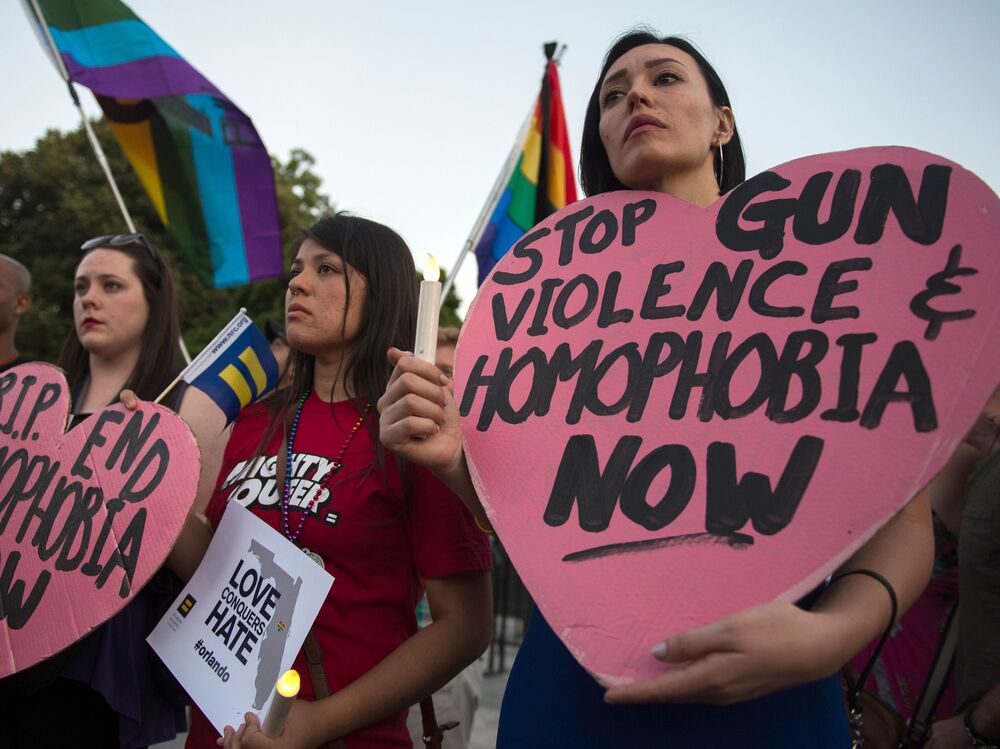
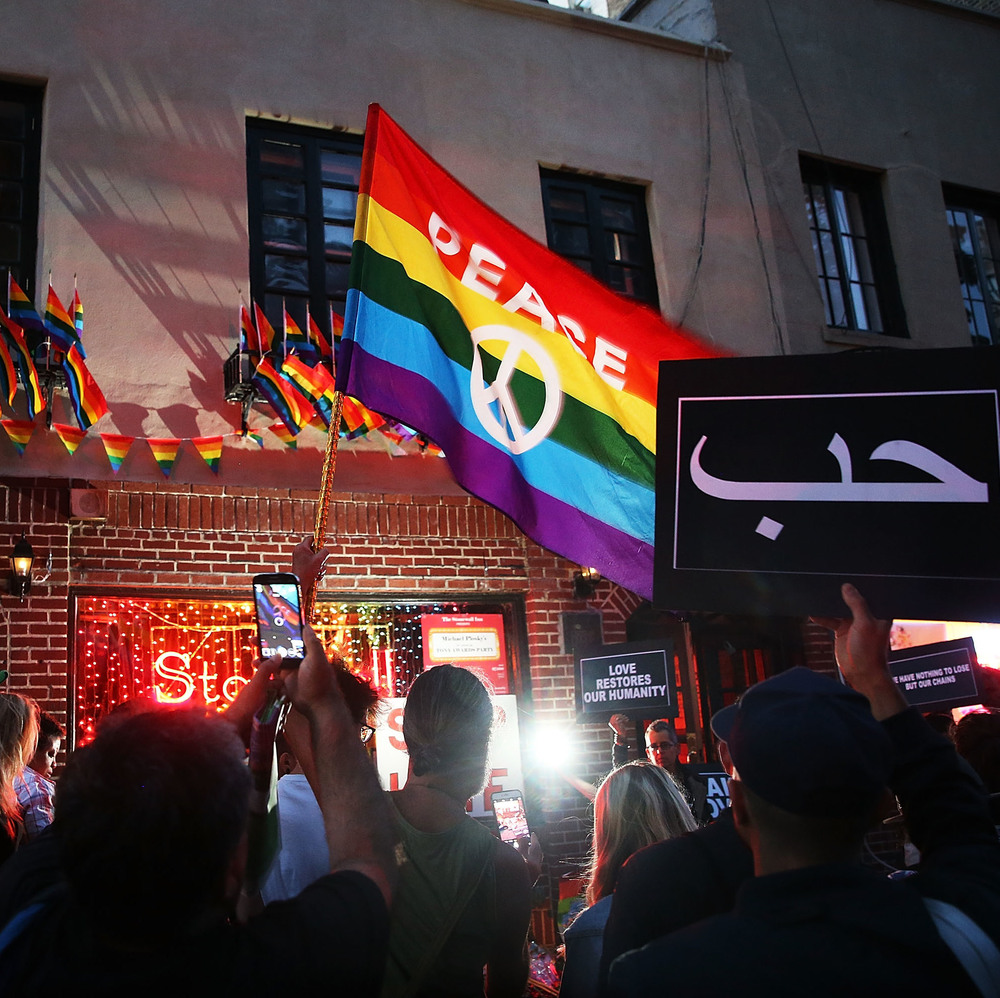
Mourners hold up signs during a vigil in Washington, D.C. in reaction to the mass shooting at a gay nightclub in Orlando, Fla.
In the wake of a mass shooting at a gay nightclub in Orlando that left at least 49 people dead and more than 50 wounded, queer Latino folks around the country are reflecting on the horror of the attack.
Many are speaking up about what clubs like Pulse, the site of the shooting, mean for queer and Latino communities. Others warn against the temptation to blame Islam for the violence, pointing out that there are many Latino Muslims. (The Pew Research Center estimates that Latinos make up four percent of the 3.3 million Muslims in America.)
We rounded up some of the sharpest, most poignant reactions to Sunday's mass shooting — the deadliest in American history.
Over at Colorlines, writer Miriam Zoila Pérez says places like Pulse, where queer people of color can gather and feel comfortable, are exceedingly rare. In her essay, titled "When the One Place That Feels Like Home is Invaded," Pérez writes about what happens when tragedy crashes into a "rare moment of queer joy and Latino belonging":
When bars, clubs, restaurants, swimming pools, parks, theaters, buses and subways, streets and sidewalks aren't for you, you hold on for dear life to the spaces that are. Only a few times a year do we claim enough space to unapologetically play our people's music, dance to the rhythms of our childhoods, and be in a space where all of our identities are seen ... Being queer and Latinx in the U.S. sometimes feels like it can be impossible to find our people. And now tragedy has found us.
At Philadelphia Magazine, writer Sabrina Vourvoulias says the shooting should be viewed against the backdrop of anti-queer and racist sentiments that have been a hallmark of this presidential election, calling the gun debate only a "partial answer" to the issues the shooting has raised:
This was a slaughter of LGBTQIA folks, many of them Latinos and people of color, during Pride month. We cannot, and should not, hide from these facts.
It seems no coincidence that this massacre takes place as the nation engages in an increasingly vitriolic argument about gender-neutral bathrooms which portrays trans people as predators; or during an electoral season in which one of the presidential candidates has shamelessly characterized Latinos as rapists and criminals. In fact, expressions of hate toward these two (overlapping) groups have become so normalized they're commonplace in tweets, Facebook posts and elementary school bully refrains.
Vourvoulias also quotes Louie A. Ortiz-Fonseca, founder of a storytelling project on Latino and Afro-Latino gay, queer and trans men known as The Gran Varones, on the role of dancing in the lives of both Latinos and queer folks:
We find community and sanctuary on the dance floor. As Latino gay men, we teach ourselves to break tradition so that we can take the hand of another man and dance. We do this to keep traditional. This alone continues to provide us space, even if the spaces are borrowed, for us to be and feel safe. This massacre was another reminder that we can be robbed of these spaces, robbed of our humanity and our lives.
Over at Fusion, Alan Pelaez Lopez, who identifies as an Afro-Latino gender-non-conforming immigrant, writes, "We are not all Orlando," referring to the ways in that different layers of identity can complicate one's reaction to Sunday's shooting:
As a Black body in Mexico, my worth and value as a human being has always been questioned. I cannot detach my Blackness, my femininity, my queerness, or my mental health from an analysis on what happened in Orlando.
Sunday's shooting cannot be blamed solely on Omar Mateen. In fact — and this is the critical, and risky part — we have to hold each other accountable in the ways in which we may participate in the oppression of people of color, the oppression of the LGBTQIA+ (Lesbian, Gay, Bisexual, Transgender, Queer, Intersex, Asexual +) community, the oppression of religious communities, and more.
We have to push the media and understand that blaming the Muslim community is perpetuating the fact that xenophobia teaches us to only celebrate and empathize with white immigrants.
In fact, we need to remember that Latinidad is a diverse culture and that many Latinxs are also Muslim — we cannot talk about them as separate identities.
9())
June 21 1958 marked the beginning of the summer where American lawns were first ornamented with Plastic Pink Flamingos. In 1957 Don Featherstone, a local art school graduate and employee of Union Products in Leominster, MA, sculpted two flamingo moulds inspired by photos from National Geographic. One bird stands upright while the other bends down to graze upon a lawn.
The ornaments were popular in Northern working-class suburbs as an affordable pastiche of ‘50s Floridian fascination – a weatherproof reminder of America’s exotic yet increasingly accessible tropical vacationland. As popularity grew, cultured elite labeled the flamingos the epitome of poor taste “kitsch,” disguising their distaste for the Working Class as merely patronizing aesthetic criticism.
In 1972 avant-garde director John Waters produced Pink Flamingos: An Exercise in Poor Taste, a film which shockingly embraced all things kitsch, thereby challenging and subverting conventional bourgeois aesthetic mandates. Sticking it to the Class Snob, the film’s cult following assumed a confrontational “we love it because you hate it” attitude towards taste-making privilege – one facet of farther-reaching forms of privilege and oppression. Plastic Pink Flamingos then became a powerful symbol for counter-cultural efforts, particularly the gay rights movement of the ‘70s & ‘80s. Faux flocks of flamingos fluttered about gay nightclubs and equal rights demonstrations; flamingo printed motifs and miniature accessories accented the flamboyant fashion of proud protesters and partiers.
By the late ‘80s the bourgeoisie had caught up to and co-opted counter-culture in many forms including the iconic Plastic Pink Flamingo, which was now sold at art museums and galleries. The “high culture” adoption of the tacky ornament stripped it of its subversive quality and it was largely abandoned as a revolutionary tool except as a nostalgic ode to more radical times.
Don Featherstone climbed the ranks of Union Products, eventually becoming company President. He retired in 2000 and currently resides in Fitchburg, MA with his wife Nancy.
Written by Neil Horsky
Art by Jennifer DeAngelis

A California Black Lives Matter activist who faced up to four years of jail time for “lynching” was sentenced Tuesday morning to 90 days in county jail, a sentence activists denounced as a “mockery of our justice system.”
“We’re living in Orwellian times when a Black woman in a peaceful protest is sentenced to jail time for attempted lynching,” Rashad Robinson, executive director of Color Of Change, said in an emailed statement after the sentencing.
Jasmine “Abdullah” Richards, 28, was convicted last week under a California statute known until recently as “felony lynching.” The law criminalizes “taking by means of a riot of another person from the lawful custody of a peace officer,” defining two or more people as a “riot.” Richards had been arrested and charged after trying to intervene in a woman’s arrest following a Black Lives Matter march last August.
“It is clear that they messed up. It is clear that they know they just messed up,” Richards’ attorney, Nana Gyamfi, said on the Pasadena, California, courthouse steps after the sentencing, referring to the prosecution. “I got calls from people all over the country and all over the world.”
Richards addressed the crowd via her attorney’s speakerphone after the sentencing, saying “Thank you guys,” and “I love everybody.”
Los Angeles Superior Court Judge Elaine Lu had recommended a sentence of probation only, according to activists outside the courthouse Tuesday. Prosecutors countered by calling for six months of jail time. The final sentence was 90 days in jail, with 18 days of credit for time served; three years of probation; and a year of anger management.
Called the first political prisoner of the Black Lives Matter movement, Richards is also the “first African-American ever to be convicted of the charge” of lynching in the United States, according to Pasadena Now.
Those at the scene reported that more than 200 activists rallied outside the Pasadena courthouse before the sentencing, clapping and chanting “Free Jasmine.” Online, the hashtag #FreeJasmine trended on Twitter Tuesday morning.
In an online petition urging Lu not to sentence Richards to jail time, activists had called Richards’ arrest a “perverse” application of a law “intended to stop lynch mobs from forcibly removing detainees from police custody and engaging in public murders of Black people.” The petition had gathered more than 80,000 signatures by press time.
“To take this law, that was used allegedly to protect Black people from being lynched, and to turn around and use this law against a Black person who is actually speaking about the lynchings, the serial lynchings, that are going on at the hands of police, not just in Pasadena, but all over this country, is more than ironic, it’s disgusting,” Gyamfi told Democracy Now! prior to the sentencing. “It is demeaning to what little integrity the criminal justice system may have.”
The charges stem from an incident at a peace march in a Pasadena park last August, when authorities said Richards tried to intervene as police officers apprehended a young Black woman in the park. Richards, founder of Black Lives Matter Pasadena, was a key organizer of a march that day demanding justice for Kendrec McDade, an unarmed 19-year-old Black teenager who was shot and killed by Pasadena police in 2012.
Video shows Richards and other activists trying to intercede with police; voices can be heard saying “she’s only 130 pounds” and “she’s a petite girl,” regarding the woman police were detaining.
Pasadena police Lt. Tracey Ibarra told Pasadena Now last September, “When the officers attempted to detain her [the suspect] then part of the Black Lives Matter protest group attempted to intercede.”
Richards was arrested two days after the march.
Richards was initially charged with inciting a riot, delaying and obstructing peace officers, child endangerment, and felony lynching; all but the lynching charges were dropped before last week’s trial.
Gyamfi said her client was convicted by a jury that was about half white. There were no Black jurors, she said, despite Black people making up 13 percent of the population in Pasadena and 8 percent in Los Angeles County.
“It was very clear that it was not a jury anywhere near of Jasmine’s peers,” Gyamfi said.
The post Black Lives Matter Activist Sentenced to 90 Days for ‘Lynching’ appeared first on Rewire.
NY rapper and television personality, Awkwafina, just released her newest music video, “Green Tea,” and it’s exactly as good as you’d expect – or maybe better. The NSFW-but-totally-worth-the-risk video also features none other than comedy pioneer, Margaret Cho.
From the tongue-in-cheek title, “Green Tea,” and the song’s opening line “Flip a stereotype, how an Asian bitch got concubines?” to the welcome and unapologetic refrain repeated throughout, “Yellow bitches in the driver’s seat, yellow bitches in the driver’s seat, yellow bitches in the driver’s seat,” the attitude and drive of the lyrics, visuals and the women themselves is clear. In the midst of various scenes, Margaret Cho’s multiple satirical costume changes, and Awkwafina’s precise delivery, the refrain sticks out as a moment utterly free of satire.
This video is timely. It comes at a moment when the social and political status, and the cultural positioning of the Asian-American and Pacific Islander community in the United States is being critically examined in a much more deliberate and mainstream way than it has in recent years. The beginning of May, which is also Asian Pacific American Heritage Month, saw the spread of the #whitewashedOUT hashtag on Twitter, which commented on Hollywood’s pattern of using white actors and actresses to play Asian roles and Hollywood’s general erasure of Asian and Asian American characters.
Before this came the absolutely absurd scandal with the 2015 edition of Best American Poetry, in which Michael Derrick Hudson, a white poet, deliberately participated in what many have called “literary yellow face” – a scandal that many Asian writers eloquently responded to. And more recently, Calvin Trillin’s poem in the New Yorker, blatantly exoticizing Asian foods.
It’s all a kind of “white-washing,” isn’t it? The thing that connects each of these issues is the way white supremacy and whiteness in general assumes space that doesn’t belong to it, in narratives that aren’t its own.
In “Green Tea,” Awkwafina and Margaret Cho turn that on its head, re-purposing age-old Asian stereotypes in a dynamic music video with their own voices, their own faces, and their own whole selves in the driver’s seat the whole damn time.
Aside from my own qualms about her use of “ratchet” in the following quote, I think Awkwafina’s comments about her collaboration with Cho are particularly powerful:
I remember watching Margaret Cho with my grandmother on TV. She was my hero, not only because she was funny, but because she showed me that it’s okay to be yourself, that it’s okay to be a brash yellow girl, and to be a strong and brave woman. To collab with her is a dream come true, but larger than that, there has rarely been two Asian AMERICAN WOMEN being ratchet together, or just being in a music video. This song is a tongue and cheek take on traditional stereotypes, with a strong underlying message for all young women of color to embrace their quirkiness, their sexuality, their inner-child and their creativity with passion. I love Margaret, and I hope some young girl (but not too young) watches this video and it inspires them somehow. Stay angry!”
Here, we learn that Awkwafina’s choice to collaborate with Cho was a deliberate one. And really, that makes a lot of sense. Witnessing other women of color struggle to define themselves, often within rigidly defined contexts, is how we begin to imagine doing the same for ourselves. For women of color especially, whose narratives are often pre-written, mishandled or ignored entirely, the struggle to stay “in the driver’s seat” of our own stories is a constant one. Awkwafina’s “Green Tea” and Margaret Cho’s trailblazing career are both examples of women of color embodying – and winning – that fight.
It surprises me how in the most liberal of feminist American spaces, there remains incredible discomfort — if not outright bigotry and discrimination — towards women who choose to wear a headscarf. As a Muslim woman who does not wear a headscarf and is often read as racially (and religiously) ambiguous, I’ve been around far too many self-proclaimed liberals and feminists who feel comfortable indulging their racism around me—commenting on how Muslim women are oppressed, naive, brainwashed, being beaten by scary brown and black men, and/or suffering from intense mind control by choosing to cover their hair. Other times, parents of white friends (or white friends themselves) will connect my lack of a headscarf to progressivism, labeling me as a “good” Muslim woman who is politically sharp enough not to adorn the hijab.
Well I do adorn hijab. Almost every day. I cover most of my legs, arms, and try to wear loose clothing. The Qur’an requires men and women to wear hijab—or dress modestly—but does not specify exactly what covering up looks like. Muslims are not a monolith (surprise!) and therefore differ on what modesty requires, meaning that there are a variety of practices in different cultures and countries: for some, including my family, hijab means a headscarf, for others like myself, it means wanting to wear a headscarf but not feeling safe enough to do so in their home country. For others it means a style of dress that includes a niqab (face covering), abaya (loose black gown), or none of the above.
Because patriarchy has existed in Muslim societies—just as it has in non-Muslim societies—rules around modesty have been applied unequally, with women in some communities being made to cover much more of their bodies than they might otherwise choose to. That being said, the overwhelming majority of Muslim women in the United States and many other countries who choose to wear some sort of veil wear it freely, as an expression of their spiritual commitments and often their political ones. As MuslimGirl.net explains:
[…] the headscarf is a religious garment just as much as a political one. For generations, it has been a powerful symbol of Muslim women’s defiance against the male gaze, colonialism, and Islamophobia as we know it today. It’s also become a politicized garment that represents Muslim women’s control and autonomy, and has been at the center of a tug-of-war between governments and the people for its reclamation.
Like many other tug-of-wars, the folks most impacted are also the ones most often erased. This is why the video MuslimGirl.net just released,“100 Years of Hijab Fashion in 1 Minute,” is so dope: it shows us the diversity in how women have donned hijab in various countries in the Middle East, North Africa and Asia throughout the last century, and it highlights the fact that women have often worn it not as a sign of submission but of powerful political defiance and as a way to connect themselves to anti-colonial, antiwar, and other liberation struggles that exist well beyond the headscarf.
During an era of immense anti-Muslim violence—from wars the United States has fought to “liberate” kill Muslim women to the daily violence women who are visibly Muslim experience in the workplace, from law enforcement, and on the streets—it is so important for non-Muslim folks to familiarize themselves with the hijab and uphold a commitment to the belief that Muslim women too have a right to bodily autonomy and freedom of expression—which includes choosing whether or not to wear a headscarf.
Check out “100 Years of Hijab Fashion in 1 Minute”.
She was fine. That’s what she told everyone, including herself. After filing a report with the Cleveland police and getting her rapist locked up, she was fine. Fine, fine, fine. Except she wasn’t.
In I Will Find You: A Reporter Investigates the Life of the Man Who Raped Her, reporter Joanna Connors realizes that she is most assuredly not fine during a college campus visit with her daughter.
Ignorance is caused by fear, Connors writes. And it is with this attitude that, 21 years after she was raped—she immediately reported her rape to the police, and her rapist was caught the next day—she begins the process of breaking through the fear to understand the man who raped her, the man she thought “would be the last human being [she] would see on this earth.” She had thought she was over it, but it wasn’t until breaking down during that college tour that she realized she was still afraid of her rapist and still terrified he would find her.
When Connors was 30, she went to a Case Western Reserve University theater where a rehearsal of a play that she was covering for her newspaper, Cleveland’s Plain Dealer, was taking place.
A man inside the empty theater—the actors had left by the time Connors arrived—beckoned her inside, saying that he was working on the lights. Then, brandishing a sharpened pair of scissors, he threatened to kill her if she didn’t do what he said and spent more than an hour raping her.
The chapter detailing her rape is chilling, as she describes the various acts performed, the way she went along with what her rapist told her to do, coaxing him on, hoping to make the ordeal end more quickly. By describing specifics of her rape, Connors is confronting and stripping away the shame she experienced by showing the reader the cold, hard facts of what a rape can be like.
Her words demonstrate how a person who was raped becomes a survivor. Even in her dissociative state, she didn’t want to die there at the hands of a man she didn’t know. She managed to convince him to stop and leave, and he kissed her goodbye outside, as if what had just happened was completely, utterly normal. Maybe, for him, a man whom she says was smoking menthols and who had a tattoo on his arm with his own name on it—”DAVE”—it was.
Connors found an eerie irony in that she was raped on a college campus before such rapes were more widely discussed. In recent years, there has been a rise in awareness regarding the frequency of rapes at institutions of higher learning. There are now websites dedicated to explaining the statistics as well as documentaries like The Hunting Ground, which explores the sexual violence that happens on U.S. college campuses and how students are pushing back against institutional cover-ups and injustices. Since Connors’ experience, society has begun to more broadly understand the terms “rape” and “sexual assault,” and there has been more discussion about the rapes and sexual assaults that happen within existing relationships; eight out of ten rapes occur between people who know one another.
It’s perhaps less common these days to find discussions of the other kind of rape: the kind that we’re warned about when we’re young and told not to take candy from strangers, the kind that makes us automatically cross the street when a group of men we find threatening happens to be walking toward us, the kind that happens when a complete stranger attacks us. This was Connors’ experience.
I Will Find You takes the reader through two distinct processes. The first is Connors’ discovery that her rapist may have been a sexual-violence survivor in his own right. The second, which carries the narrative, is how Connors came to terms with how being raped by David Francis, the “DAVE”-tattooed man, separated her life into a “before” and an “after.”
Before the rape, she was a reporter who lived largely without fear. Connors explains that she went into the theater, where her rapist, a young Black man, was beckoning her, for one reason: “I could not allow myself to be the white woman who fears black men.”
But after, she writes, “this new fear of black men shamed me more than the rape.” Connors explains she didn’t want to be the stereotypical white woman of privilege, who clutches her purse and crosses the street when she sees a Black man walking her way. As a woman aware of her socioeconomic and racial privilege, she didn’t want to participate in oppression.
But it wasn’t just Black men that she feared—it was everything:
I turned my life into performance art. I acted normal, or as normal as I could manage, all the while living on my secret island of fear. As time went on, the list of my fears continued to grow. I was afraid of flying. Afraid of driving. Afraid of riding in a car while someone else drove. Afraid of driving over bridges. Afraid of elevators. Afraid of enclosed spaces. Afraid of the dark. Afraid of going into crowds. Afraid of being alone. Afraid, most of all, to let my children out of my sight.
From the outside, my performance worked. I looked and acted like most other mothers. Only I knew that my entire body vibrated with dread, poised to flee when necessary.
Years after her rape, Connors tells her children about it—both were born after the living nightmare in the theater and are college-aged by then—and begins to confront the fact that she has never “gotten over” it, even though she’s told countless therapists that she has. It is then, despite her husband’s protests and her own fears, that she decides that she must also confront her ignorance regarding her rapist and find him, just as he once threatened that he would find her.
Connors’ investigation is difficult, as she finds out almost at once that her rapist died in a prison hospital some years before. This, however, doesn’t stop her: She begins to investigate his family, trying to find anyone who may have known him and could explain, perhaps, why he did what he did.
Connors regards what she finds out about her rapist with empathy. Connors doesn’t forgive and forget—rather, she forgives, in a sense, by remembering, by finding others who remember, by dredging up a past that is as unpleasant for her interviewees as it is for her.
She eventually gets support from her newspaper to research and write her own story. At every one of the interviews, she expresses discomfort with what she’s doing and almost backs off. Pushed on by her photographer co-worker—and her own need to know—she continues on what has become a journalistic mission. Connors knows she is intruding into people’s lives and realizes she’s coming from a place of privilege, but ends up relating to so much of their stories that she finds her rage toward her rapist fizzling.
It’s with great care, too, that Connors treats the racial tensions that arise during her investigation. Connors talks to women of color who, in 2007 when she conducted her interviews, had never reported their rapes: “I know about rape,” one of Francis’ relatives says. “I was raped myself. Three times. But I asked for it because I was on drugs and I was prostituting.” Connors tells the woman that she didn’t ask for it or deserve it, but the woman tells her the story of how one of her rapes happened and concludes with: “And besides that […] he was a white guy.” This woman felt that nothing would be done about it, even if she did report it.
Connors also writes that in her case, she served as the “perfect witness”; she explains that her rape “isn’t [hers] at all. It’s the state’s, as in The State of Ohio v. David Francis.” The prosecutor tells her: “You’re the ideal witness,” because she is “a journalist, trained to observe details and remember them.” She adds:
I know what he really means. To him, I’m the perfect victim because I happen to fulfill just about all the requirements of a woman accusing a man of rape, going back before the Civil War. I am white, educated, and middle-class. I resisted, and I have a cut on my neck, bruises still healing on my spine, and a torn and blood-stained blouse to prove it. I immediately ran to report the rape.
Needless to say, David Francis is the perfect defendant: black, poor, and uneducated, with a criminal record.
In fact, as she finds out during her investigation, her assailant was both Black and Native American, and spent his youth in and out of juvenile detention, starting at age 12. Connors looks at the racial disparity in prisons, at the rate of poverty in the areas of Cleveland that she visits, at the way socioeconomic status and race are interwoven, how violence and drug abuse feed into those factors as well, and how sexual assault and abusive environments are so often passed down through generations. Connors discovered fellow survivors in her rapist’s family—his sister Laura, with whom Connors is still in touch, described her mother’s boyfriend raping her in a church. His entire family, she discovers, have been survivors of one kind or another.
Connors believes that her rapist was likely raped himself. During her assault, she had a clear feeling that Francis was re-enacting something done to him. And after learning that rape was common at the juvenile detention center where Francis did many stints, she assumes that he had been abused there and during his time spent locked up as an adult.
What is most striking about Connors’ book is not its bravery—though it is brave—or its shock value, which exists. The book is valuable because Connors recognizes and conveys to readers the cyclical nature of abuse, its pathological nature, and one of its sources: in David Francis’ case, perhaps learning by example.
The post Breaking Through the Fear: How One Woman Investigated the Life of Her Rapist appeared first on Rewire.
The Massachusetts house on Wednesday overwhelmingly passed legislation that expands an anti-discrimination law giving transgender people protections in public spaces such as bathrooms, libraries, and hospitals.
Passage of the anti-discrimination measure comes as transgender rights have come under attack in Republican-held legislatures across the country.
Massachusetts’ Democratic-dominated house voted 116 to 36 to pass HB 4343, known as An Act Relative to Transgender Anti-Discrimination.
State Sen. Sonia Chang-Diaz (D-Boston) introduced SB 735, her chamber’s version of the legislation. Senators approved that bill in a 33-4 vote on May 12. State legislators will work to reconcile the differences between the anti-discrimination laws passed in each chamber.
Unlike the state senate version of the bill, HB 4343 includes a provision stating that the Massachusetts Commission Against Discrimination will adopt, amend, and make recommendations for the act, including when and how gender identity may be evidenced.
It says the state’s attorney general’s office, led by Maura Healey, should issue regulations or guidance for “referring to the appropriate law enforcement agency or other authority for legal action [for] any person who asserts gender identity for an improper purpose.”
House leaders said the measure was assurance that transgender people wouldn’t be burdened with proving their gender identity, according to a Boston Globe report.
Throughout the early afternoon and evening hours, lawmakers proposed dozens of amendments that often criminalized transgender people, according to social media accounts by the ACLU of Massachusetts and Freedom Massachusetts, a statewide anti-discrimination bipartisan campaign.
All of the amendments were struck down and lawmakers passed the legislation as it was introduced.
The law is slated to go in effect on January 1, 2017.
Massachusetts Gov. Charlie Baker (R) said in an interview with the Globe the day before the house vote that he would sign the house’s transgender public accommodations law.
Baker had maintained a more ambiguous stance on the bill and was even booed at an LGBTQ networking event after he refused to show outright support for the bill, according to the Globe.
Baker recently changed his mind.
“We’ve certainly listened to a variety of points of view from many sides and have said, from the beginning, that we don’t want people to be discriminated against,” Baker told the Globe. “If the house bill were to pass in its current form, yeah, I would sign it.”
Mason J. Dunn, executive director of the Massachusetts Transgender Political Coalition (MassTPC), said in an email to Rewire that the legislation is important for Massachusetts because it provides necessary protections for transgender people in public spaces, such as hospitals, restaurants, hotels, and parks.
“We know that trans people face disproportionate amounts of harassment and discrimination in these places. In 2014, we saw that 65 percent of surveyed trans people reported experiencing discrimination in public spaces,” Dunn said, adding that “this legislation will ensure that these incidents have legal remedies under Massachusetts law.”
Dunn said state lawmakers could improve the quality of life for transgender people by supporting another bill before the legislature that would prohibit conversion therapy.
Mass TPC, Dunn said, has organized community meetings, phone banks, and action events in collaboration with Freedom Massachusetts to push the transgender-friendly measures.
HB 4343 goes back about five years ago, when Mass TPC advocated for a law that would provide legal protections to transgender and gender non-conforming people in the areas of credit, housing, employment, and public education.
Advocates and transgender-friendly politicians had passed the bill in 2011, but the law did not include protections in public accommodations, or spaces open to the public. Last year advocates began pushing for gender identity to be included in the state’s law for public accommodations.
The ACLU of Massachusetts in a statement said the house’s historic Wednesday vote brings the state another step closer to protecting the rights of all residents and sends a powerful message that the state “is a place of equality, opportunity, and community.”
The post Transgender Rights Notch a Legislative Win in Massachusetts appeared first on Rewire.
iframe src="https://www.npr.org/player/embed/479733094/480194289" width="100%" height="290" frameborder="0" scrolling="no" title="NPR embedded audio player">

Subscribe to the brand-spanking new Code Switch podcast! Hosted by Gene Demby and Shereen Marisol Meraji.
At long last — the first episode of the Code Switch podcast! We decided to start off with a question we've been fixated on over the past few months: Why is it so hard to talk about whiteness?
As we were trying to work this stuff out, we asked folks on Twitter if they'd ever taken a critical whiteness studies class in college — and yes, that's a thing — and we got a hundred variations of the same joke:
I went to Indiana University — that whole experience was a graduate-level course in white people!
Or: Is that, like, a full semester dedicated to Wes Anderson movies?
Or even: And here I thought everything in American life is already about white people!
That response wasn't too surprising. Nell Irvin Painter, the historian and author of "The History of White People," once wrote that since we don't have very useful language around white identity, we mostly talk about it as a kind of empty space, defined by what it's not.
This episode, we spoke to:
"Whiteness is on a toggle switch between 'bland nothingness,' and 'racist hatred,'" she wrote. (Our own Kat Chow has made this point about the word "vanilla" — even metaphors for whiteness are, er, colored by the notion that they lack dimension or flavor, due to being so ubiquitous.)
So, let's all agree that it's really hard to grapple with whiteness, both due to the slipperiness of the concept itself, and also thanks to the almost visceral discomfort people have with talking about white identity.
The problem is, by shying away from talking about whiteness, we also fail to understand the profound ways that whiteness shapes our culture and politics. And right now, in a crazy election cycle when folks' feelings about their own white identities is a strong predictor of how they're likely to vote, that's especially dangerous.
And that, y'all, is what we're taking up on our inaugural episode: how we talk (and don't talk about whiteness), and why it's really important we figure out how.
9())