23 Dec 00:04
by Fangfang Cui, Cong Wang, Xiaobo Li, Gang Wang, Kaiqiang Liu, Zhou Yang, Qingliang Feng, Xing Liang, Zhongyue Zhang, Shengzhong Liu, Zhibin Lei, Zonghuai Liu, Hua Xu, Jin Zhang

Anisotropic 2D layered material rhenium disulfide (ReS2) with high crystal quality and uniform monolayer thickness is synthesized by using tellurium-assisted epitaxial growth on mica substrate. Benefit from the lower eutectic temperature of rhenium-tellurium binary eutectic, ReS2 can grow from rhenium (melting point at 3180 °C) and sulfur precursors in the temperature range of 460–900 °C with high efficiency.
23 Dec 00:04
by Bhakti Jariwala, Damien Voiry, Apoorv Jindal, Bhagyashree A. Chalke, Rudheer Bapat, Arumugam Thamizhavel, Manish Chhowalla, Mandar Deshmukh and Arnab Bhattacharya

Chemistry of Materials
DOI: 10.1021/acs.chemmater.6b00364

23 Dec 00:04
by Jaewoo Shim, Aely Oh, Dong-Ho Kang, Seyong Oh, Sung Kyu Jang, Jaeho Jeon, Min Hwan Jeon, Minwoo Kim, Changhwan Choi, Jaehyeong Lee, Sungjoo Lee, Geun Young Yeom, Young Jae Song, Jin-Hong Park

A high-performance ReS2-based thin-film transistor and photodetector with high on/off-current ratio (104), high mobility (7.6 cm2 V−1 s−1), high photoresponsivity (2.5 × 10⁷ A W−1), and fast temporal response (rising and decaying time of 670 ms and 5.6 s, respectively) through O2 plasma treatment is reported.
29 Jun 16:37
by Partha Bairi, Kosuke Minami, Waka Nakanishi, Jonathan P. Hill, Katsuhiko Ariga and Lok Kumar Shrestha

ACS Nano
DOI: 10.1021/acsnano.6b01544

29 Jun 12:23
Chem. Commun., 2016, 52,8231-8234
DOI: 10.1039/C6CC02072K, Communication
Wenqiang Li, Shiyong Gao, Lin Li, Shujie Jiao, Hongtao Li, Jinzhong Wang, Qingjiang Yu, Yong Zhang, Dongbo Wang, Liancheng Zhao
Self-assembly of two-dimensional (2D) nanosheets and one-dimensional (1D) nanorods into three-dimensional (3D) double-sided comb-like ZnO nanostructures has been successfully performed on Si and ITO substrates.
The content of this RSS Feed (c) The Royal Society of Chemistry

25 Jun 12:20
by Daisuke Kiriya, Peter Lobaccaro, Hnin Yin Yin Nyein, Peyman Taheri, Mark Hettick, Hiroshi Shiraki, Carolin M. Sutter-Fella, Peida Zhao, Wei Gao, Roya Maboudian, Joel W. Ager and Ali Javey

Nano Letters
DOI: 10.1021/acs.nanolett.6b00569

24 Jun 10:48
by Carl H. Naylor, William M. Parkin, Jinglei Ping, Zhaoli Gao, Yu Ren Zhou, Youngkuk Kim, Frank Streller, Robert W. Carpick, Andrew M. Rappe, Marija Drndić, James M. Kikkawa and A. T. Charlie Johnson

Nano Letters
DOI: 10.1021/acs.nanolett.6b01342

24 Jun 10:46
by Yao Wang, Shan-Shan Wang, Yunhao Lu, Jianzhong Jiang and Shengyuan A. Yang

Nano Letters
DOI: 10.1021/acs.nanolett.6b01841

21 Jun 12:41
by Gongxun Bai, Shuoguo Yuan, Yuda Zhao, Zhibin Yang, Sin Yuk Choi, Yang Chai, Siu Fung Yu, Shu Ping Lau, Jianhua Hao

A 2D system of Er-doped MoS2 layered nanosheets is developed. Structural studies indicate that the Er atoms can be substitutionally introduced into MoS2 to form stable doping. Density functional theory calculation implies that the system remains stable. Both NIR-to-NIR up-conversion and down-conversion light-emissions are observed in 2D transition metal dichalcogenides, ascribed to the energy transition from Er3+ dopants.
18 Jun 11:57
by Jason D. Fowlkes, Robert Winkler, Brett B. Lewis, Michael G. Stanford, Harald Plank and Philip D. Rack

ACS Nano
DOI: 10.1021/acsnano.6b02108

17 Jun 00:40
by Matin Amani, Robert A. Burke, Xiang Ji, Peida Zhao, Der-Hsien Lien, Peyman Taheri, Geun Ho Ahn, Daisuke Kirya, Joel W. Ager, Eli Yablonovitch, Jing Kong, Madan Dubey and Ali Javey

ACS Nano
DOI: 10.1021/acsnano.6b03443

16 Jun 21:51
by Di Zhao, Jinwen Qin, Lirong Zheng and Minhua Cao

Chemistry of Materials
DOI: 10.1021/acs.chemmater.6b00414

chen, 刘佳 and 2 others like this
16 Jun 21:48
by F. D. Brandão, G. M. Ribeiro, P. H. Vaz, J. C. González and K. Krambrock
MoS2
monolayers, a two-dimensional (2D) direct semiconductor material with an energy gap of 1.9 eV, offer many opportunities to be explored in different electronic devices. Defects often play dominant roles in the electronic and optical properties of semiconductor devices. However, little experimental information about intrinsic and extrinsic defects or impurities is available for this 2D system, and even for macroscopic 3D samples for which MoS2 shows an indirect bandgap of 1.3 eV. In this work, we evaluate the nature of impurities with unpaired spins using electron paramagnetic resonance
(EPR) in different geological macroscopic samples. Regarding the fact that monolayers are mostly obtained from natural crystals, we expect that the majority of impurities found in macroscopic samples are also randomly present in MoS2
monolayers. By EPR at low temperatures, rhenium donors and sulfur vacancy acceptors are identified as the main impurities in bulk MoS2 with a corresponding donor concentration of about 108–12 defects/cm2 for MoS2
monolayer. Electrical transport experiments as a function of temperature are in good agreement with the EPR results, revealing a shallow donor state with an ionization energy of 89 meV and a concentration of 7 × 1015 cm−3, which we attribute to rhenium, as well as a second deeper donor state with ionization energy of 241 meV with high concentration of 2 × 1019 cm−3 and net acceptor concentration of 5 × 1018 cm−3 related to sulfur vacancies.
10 Jun 22:43
by Soo-Yeon Cho, Youhan Lee, Hyeong-Jun Koh, Hyunju Jung, Jong-Seon Kim, Hae-Wook Yoo, Jihan Kim, Hee-Tae Jung

Superior chemical sensing performance of black phosphorus (BP) is demonstrated by comparison with MoS2 and graphene. Dynamic sensing measurements of multichannel detection show that BP displays highly sensitive, selective, and fast-responsive NO2 sensing performance compared to the other representative 2D sensing materials.
27 May 09:07
by Dianne J. Xiao, Miguel I. Gonzalez, Lucy E. Darago, Konstantinos D. Vogiatzis, Emmanuel Haldoupis, Laura Gagliardi and Jeffrey R. Long

Journal of the American Chemical Society
DOI: 10.1021/jacs.6b03680

22 May 10:37
by Jian Gao, Lu Li, Jiawei Tan, Hao Sun, Baichang Li, Juan Carlos Idrobo, Chandra Veer Singh, Toh-Ming Lu and Nikhil Koratkar

Nano Letters
DOI: 10.1021/acs.nanolett.6b01180

21 May 01:27
Chem. Commun., 2016, 52,7878-7881
DOI: 10.1039/C6CC03316D, Communication

Open Access
Naktal Al-Dulaimi, Edward A. Lewis, David J. Lewis, Simon K. Howell, Sarah J. Haigh, Paul O'Brien
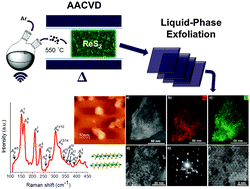
Bottom-up (aerosol-assisted chemical vapor deposition, AACVD) and top-down (liquid phase exfoliation, LPE) processing methodologies are used in tandem to produce colloids of few-layer thick rhenium disulfide (ReS2) in N-methyl pyrrolidone.
The content of this RSS Feed (c) The Royal Society of Chemistry

19 May 13:10
by Yongfeng Zhao, Lisa Detering, Deborah Sultan, Matthew L Cooper, Meng You, Sangho Cho, Stephanie L. Meier, Hannah Luehmann, Guorong Sun, Michael Rettig, Farrokh Dehdashti, Karen L. Wooley, John F. DiPersio and Yongjian Liu

ACS Nano
DOI: 10.1021/acsnano.6b01326

19 May 13:10
by Giovanni Altamura and Julien Vidal

Chemistry of Materials
DOI: 10.1021/acs.chemmater.6b00069

18 May 10:28
by Chaoqun Zhang, Daniel A. Mcadams, Jaime C. Grunlan
Through billions of years of evolution and natural selection, biological systems have developed strategies to achieve advantageous unification between structure and bulk properties. The discovery of these fascinating properties and phenomena has triggered increasing interest in identifying characteristics of biological materials, through modern characterization and modeling techniques. In an effort to produce better engineered materials, scientists and engineers have developed new methods and approaches to construct artificial advanced materials that resemble natural architecture and function. A brief review of typical naturally occurring materials is presented here, with a focus on chemical composition, nano-structure, and architecture. The critical mechanisms underlying their properties are summarized, with a particular emphasis on the role of material architecture. A review of recent progress on the nano/micro-manufacturing of bio-inspired hybrid materials is then presented in detail. In this case, the focus is on nacre and bone-inspired structural materials, petals and gecko foot-inspired adhesive films, lotus and mosquito eye inspired superhydrophobic materials, brittlestar and Morpho butterfly-inspired photonic structured coatings. Finally, some applications, current challenges and future directions with regard to manufacturing bio-inspired hybrid materials are provided.

Typical, naturally-occurring materials are reviewed, with a focus on chemical composition, nanostructure, and architecture. The critical mechanisms underlying their properties are summarized, with a particular emphasis on the role of material architecture. A review of recent progress on the nano/micro-manufacturing of bio-inspired hybrid materials is then presented in detail.
18 May 09:07
by Mai Nguyen, Nordin Felidj and Claire Mangeney

Chemistry of Materials
DOI: 10.1021/acs.chemmater.6b00230

17 May 20:37
by Maryam Hajfathalian, Kyle D. Gilroy, Spencer D. Golze, Ali Yaghoubzade, Eredzhep Menumerov, Robert A. Hughes and Svetlana Neretina

ACS Nano
DOI: 10.1021/acsnano.6b02712

gao, 张维新 and one other like this
17 May 09:26
by Sebastian Z. Oener, Jorik van de Groep, Bart Macco, Paula C. P. Bronsveld, W. M. M. Kessels, Albert Polman and Erik C. Garnett

Nano Letters
DOI: 10.1021/acs.nanolett.6b00949

17 May 09:23
by Wei Wei, Leith Samad, Jonathan W. Choi, Yongho Joo, Austin Way, Michael S. Arnold, Song Jin and Padma Gopalan

Chemistry of Materials
DOI: 10.1021/acs.chemmater.6b01453

17 May 09:07
by Thomas J. Whittles, Lee A. Burton, Jonathan M. Skelton, Aron Walsh, Tim D. Veal and Vin R. Dhanak

Chemistry of Materials
DOI: 10.1021/acs.chemmater.6b00397

14 May 16:53
by Soo Jin Kim, Junghyun Park, Majid Esfandyarpour, Emanuele F. Pecora, Pieter G. Kik and Mark L. Brongersma

Nano Letters
DOI: 10.1021/acs.nanolett.6b01198

14 May 16:52
by Seungyeol Lee, Seungmin Baek, Joong Pill Park, Ju Hyun Park, Dae Yeon Hwang, Sang Kyu Kwak and Sang-Wook Kim

Chemistry of Materials
DOI: 10.1021/acs.chemmater.6b00323

14 May 16:51
by R. Songmuang, Le Thuy Thanh Giang, J. Bleuse, M. Den Hertog, Y. M. Niquet, Le Si Dang and H. Mariette

Nano Letters
DOI: 10.1021/acs.nanolett.5b03917

09 May 20:25
by Y. Katagiri, T. Nakamura, A. Ishii, C. Ohata, M. Hasegawa, S. Katsumoto, T. Cusati, A. Fortunelli, G. Iannaccone, G. Fiori, S. Roche and J. Haruyama

Nano Letters
DOI: 10.1021/acs.nanolett.6b01186

29 Mar 11:05
by William M. Parkin, Adrian Balan, Liangbo Liang, Paul Masih Das, Michael Lamparski, Carl H. Naylor, Julio A. Rodríguez-Manzo, A. T. Charlie Johnson, Vincent Meunier and Marija Drndić

ACS Nano
DOI: 10.1021/acsnano.5b07388