Shared posts

02 Jul 16:24

Leadership Thought #479 – Leading A Business Is Hard Work

by Ed Robinson

If leading organizations and people was easy, then everyone could do it.  I’ve had a number of conversations lately with clients and colleagues who are complaining about how hard they have to work.  More often than not, the average age of these people is under 45.  I try my best to be understanding and empathetic while also trying to bring some realism into the discussion.  I am starting to feel that far too many people in positions of authority, think they can have it all and they can’t.  Life and leadership requires sacrifice and compromise.  What you want is often less important than what’s needed at any given point in time.  Sometimes you have to do the heavy lifting and suck it up.

I believe there is a big difference between a lifestyle business and a growth oriented more professional business.  As with all things you need to be true to yourself and your core personal priorities. Of course you need to do the personal reflection necessary to get clarity on your “why” and what truly drives you. Too many people who start businesses do what they think they should be doing rather than contemplating what they actually should be doing given who they are and what they value. Delusions of grandeur and aspirations of professional significance are your enemy not your friend in a lifestyle business.  As a colleague so aptly puts it.  “It’s important in life to know what you really want, but even more important to know the price your willing to pay to get it.”

In a lifestyle business you design your business around your life.  I know many people who have successfully done this.  The tradeoff is that the income you can potentially earn hits a ceiling much more quickly, the business can only handle a small number of employees (if any at all) so employee leverage is limited, and you sometimes get forced into doing things you’d rather not do because of operational capacity constraints.  This is definitely the better path for someone who wants to maximize work-life balance and live for today. Your work will typically come in spurts and you will need to be able to flex up and flex down your personal efforts as needed.  Accept this reality and move on. You just need to be realistic about the potential upside and keep your personal finances under control in a commensurate fashion.  Debt is not your friend nor is overreaching in other ways.  Keep it simple.

In a more traditional business, growth in many different categories is the expectation.  You are constantly challenging the status quo and stretching your capabilities.  Success will come with its rewards but also with its challenges.  Work-life balance is not a realistic expectation and quality will need to trump the quantity of your personal life expectations. You are building for the future rather than just living for the moment (although the journey should still be enjoyable). People issues will multiply and client demands will become more complex.   Your ability to understand basic business finance is essential because your math decisions can have significant investment consequences.  You can potentially build a great organization with an enduring legacy but it will come at some personal cost.  The needs of the business will be an omnipresent reality. You may limit your role with time but never eliminate it unless you sell the business or hand it off to a successor.

In either category, you will probably need to work harder than you want to and differently depending upon which route you take.  Being a boss of yourself or others is much more demanding than being an employee.  The buck will almost always stop with you.  Even though you may hire people to share the load, the tough decisions and actions almost always end up on your desk.  You may be able to delay but never fully ignore reality.  Your personal priorities especially in a growth business will sometimes need to take a backseat to other more pressing organizational issues.  I shudder when I read these magazine article that provide examples of seemingly uber-human leaders who appear to have it all.  Trust me they don’t.  You also often don’t fully get the details on the sacrifice and hard work it took to get them to that point.  It is assumed but rarely discussed.  Sure there are exceptions in life, but they are rare and most of us hover around average when it comes to accessing our ongoing potential.  They key is to look at the results you are getting and then be honest with yourself about the costs/requirements of any significant changes.

I’ll often give my beleaguered clients a hug and provide some positive encouragement at the end of our conversations.  Sometimes you just need to help get them centered.  However, I sincerely hope they also get the message that this is what they signed up for.  There rarely are any useful leadership shortcuts. Few people can outsmart conventional wisdom. Business fundamentals rarely change.  Your actions lead to consequences that you can live with or not.  Leadership IS hard work and the bar is not only constantly being raised, the target is also often shifting due to circumstances beyond your control.  Whining and self-pity are unattractive traits in children let alone adults who embrace leadership roles and all the ensuing responsibilities.  In a very simple sense, leadership is about doing what’s required when it is needed regardless of whether you like it or not.


The post Leadership Thought #479 – Leading A Business Is Hard Work appeared first on Capacity Building Solutions.

19 May 20:53

Americans’ views of women as political leaders differ by gender

by D’Vera Cohn
For the first time in history, a woman is the leading candidate for the presidential nomination of a major U.S. political party. As Democrat Hillary Clinton wages her campaign to be the first female chief executive, what do Americans have to say in general about the prospects and qualifications of female candidates for high political […]
12 Apr 18:22

Author Beverly Cleary turns 100 with wit, candour

by Blake
Topic: 
As she turns 100, the feisty and witty author Beverly Cleary remembers the Oregon childhood that inspired the likes of characters Ramona and Beezus Quimby and Henry Huggins in the children's books that sold millions and enthralled generations of youngsters. "I was a well-behaved little girl, not that I wanted to be," she said. "At the age of Ramona, in those days, children played outside. We played hopscotch and jump rope and I loved them and always had scraped knees."
From Author Beverly Cleary turns 100 with wit, candour | Entertainment & Showbiz from CTV News
22 Mar 13:58

Wherefore Art Thou Surveying?

by Jessica Olin
source

I try to start any endeavor at work by asking myself why I'm doing it. Sometimes, the answer is easy to find. Paying the ProQuest bill means continued access to a resource my community uses a lot. Building a circulating board game collection supports members of my community beyond the classroom (or even inside, depending on the professor). So you can be sure that when I decided to create a survey, I had very specific goals in mind. But probably not the ones you think.

Surveys seem easy to create and conduct, but they're not. Even if you can avoid leading questions, remember to align your Likert scale carefully, and design the survey in such a way to elicit a solid response rate, there's still so much you miss. You'll want to know why people answer certain questions the way they did, but also how important things are in context. Maybe someone thinks the library is super helpful, but they haven't been there since their freshmen year or since they got tenure or since they got a new job. 

And yet, I still run surveys semi-regularly. I don't expect to learn a lot from the surveys themselves; instead, it's about starting a conversation. I sent a survey out to the faculty of my school towards the end of last semester asking about research assignments and library resource use and outside resources. I do care that kinds of assignments and resources are being used, but I knew that - even with a desirable prize possible (a $10 gift card to Wawa) - the return rate wouldn't be that great. Survey fatigue and high teaching loads were conspiring against us. But it did exactly what I'd hoped: it gave me a new way to start discussions with faculty.

I sat down, one-on-one, with each of the respondents. Since there were fewer than a dozen of them, it was relatively easy for me to find the time. Even if there had been more, I would have figured it out because those conversations were invaluable to me. I've been, slowly & steadily, building relationships with the faculty at my institution - both adjunct and full-time faculty. It's true that the group who completed the survey was mostly made up of the same people who always respond to library requests, but there were a few with whom I'd only had passing conversations. Even better, although I predicted 90% of what the faculty said to me when we talked, in each conversation I learned one new thing that hadn't been part of my thinking previously.

Best of all, though, we got these faculty members thinking about the library as a resource for their teaching - not just for the students. We got them thinking about ways to improve the library. We got them thinking about the services and resources we provide. And we got them thinking about how the library can support the whole community. 

So, to bring this back to where I started: wherefore art I surveying? It's not assessment; it's marketing.

How about you? Have you ever used surveys for marketing? How so?
23 Jun 15:04

Books is Not Your Brand

by David Lee King

Businesses and organizations have some pretty recognizable stuff. McDonald’s has their hamburger. Nike has their swooshy logo and their “just do it” tagline. Google has their search engine. Apple has the iPhone.

These things – products, logos, and taglines – aren’t brands. They are products, consumables, and marketing projects. They are things the company produces.

But what’s a brand? Here are some definitions:

  • “A brand is a person’s gut feeling about a product, service, or organization” (from gist brands)
  • “… your brand is a story, a set of emotions and expectations and a stand-in for how we think and feel about what you do” (from Seth Godin)
  • “The perceived emotional corporate image as a whole” (from JUST Creative)

So when I hear someone say that a library’s brand is books, it irks me a bit. Because it’s simply not true. Yes, books are a very recognizable thing that libraries have; a major “product,” if you will. But having a collection of books is just one thing we do out of many.

And these days, you can get books pretty much anywhere: at Walmart, at the grocery store, or through a click on my Kindle app. Having access to a bunch of books isn’t really a unique thing anymore.

I love what Blackcoffee says about brands and products in their blog post, A Product is Not a Brand:

“Many companies fail to achieve their branding goals because they mistake their brand for their product, service or technology. Simply put, a brand is none of these! A brand is an experience that lives at the intersection of promise and expectation. Your products are a way to deliver upon that promise. Forget features, concentrate on the unique experience you can provide.”

Don’t mistake a major product – your book collection – as a brand. Because it’s not. Even better – go the extra mile (or two, or three) and work to define your library’s brand. Then see where that takes you!

More information on Branding:

Book image by Dawid Palen

20 May 16:43

a parent asks: what’s wrong with my daughter’s rude, frustrating interviewers?

by Ask a Manager

A reader writes:

My daughter has a music degree (actually two) and, music jobs being impossible to find, is willing to do just about anything. So why am I frustrated?

She had an internship all last year, and applied for a job there this spring. The CEO called her into his office, told her how glad he was that she’d applied as they liked to hire from within and that he’d heard very good reports of her. Did she even get a phone call from anyone in the hiring dept? No.

She’s worked in the HR dept at her school for the past several years (work/study). She’s interviewed for two jobs there, one of which would involve doing many of the same things she’s already been doing. This was mentioned in the interview, along with the fact that everyone likes her, and that training for her would be minimal because she already basically knew the job. But did she get the position? No.

(I’ve been through this myself. I applied for job after job at a non-profit where many of my friends work. The only position I every got a call about was the one I was least qualified for.)

So, what advice do I give my daughter? She’s completely frustrated and so am I! I know she presents herself well, and she’s intelligent and articulate, so I don’t get it. Are hiring managers really this out of touch with reality??

I wrote back to this letter-writer and asked:  What’s leading you to assume they’re out of touch with reality (versus just being flooded with great candidates)?

She replied:

Maybe out of touch with reality is the wrong word. I just don’t understand why, in an interview, they would tell her how great she is, how much they like her, how they know she can do the job, etc., and then toss her aside without even a personal phone call or face to face interaction. She got rejected by email from a person she’d seen a few hours before at work. Sure, they may have other great candidates, but why act this way with someone they know and with whom they have a relationship? Do hiring managers just not get the impact their words and actions have?

Why not just say “We know you could do the job but we have tons of other great candidates and some may have better qualifications than you, so we’ll have to wait and see. Although we really like you, we just don’t know if we’ll be able to hire you.” If a potential employee can be sent packing for a misleading resume or faking job experience, why don’t the hiring people have to follow the same rules? No, it seems they can say whatever they want and it’s fine.

To be fair, she was never promised the job, but she knows they did hire someone from a completely different department in the university who had no experience in this line of work and turned down two people who already work in the department and knew parts of the job. This makes no sense to me. This leads me to wonder what universe hiring people inhabit…

Sadly, what she is learning in this process is that doing a good job, being a good team player, being prepared for an interview, knowing people in the company, etc. mean nothing in the end. It’s all a complete crapshoot and the hiring people can pretty much say or do anything they want.

Well, it’s possible that there’s something your daughter is doing that’s making them less inclined to hire her. You, as her parent, aren’t especially well positioned to know if this is the case, which is true of anyone who doesn’t work with her. So one thing she might try is asking her managers for feedback on what she could be doing better, and how she might better position herself to be hired in the future. Yes, she seems awesome to you and she’s getting excellent feedback in her interviews, but interviewers aren’t always forthcoming about concerns they have about candidates, because it’s not their obligation to do that.

But it’s also possible that she is indeed a very strong candidate, but someone else was just stronger. That’s a very, very normal part of job searching. Great candidates get turned down all the time because someone else was a better fit. That’s just how it works. This is true even if you’ve already doing the work and everyone likes you. It’s dangerous to ever assume you have an in with a particular job, because you just can’t know who else they might be talking to or what they’re really looking for. (The same is true of you when you applied somewhere that many of your friends work. That’s just no guarantee that you’ll be the best fit of everyone they’re talking to — especially since hiring shouldn’t be about who you’re friends with.)

Also:

* Interviewers might tell you that you’re great and they like you because you’re great and they like you. But that’s not an indication that a job offer is coming. Thinking a candidate is great and liking her isn’t the same as deciding to offer her the job.

* It’s dangerous to feel that interviewers are “doing you wrong” when they tell you that you’re great but then don’t hire you. Not only is that a fundamental misunderstanding of how hiring works, but it can make you bitter. That’s not helpful to you or your daughter. It will make her job search more stressful, and it might make it longer, too.

* You’re right that hiring managers aren’t held as accountable for their words as candidates are. But no one lied to your daughter here. No one misrepresented anything (that we know of). They told her they liked her, that she was a strong candidate, and that they were glad she applied. None of that is proven false by not hiring her, and you’re doing your daughter no favors by encouraging her to be frustrated by this. Interest is not a promise. She’s going to be far happier — and have a less stressful job search — if she doesn’t read into this kind of thing, doesn’t take it personally, and sees it as a par-for-the-course piece of job hunting, because it is.

* You’re also doing her no favors if you encourage her to think things like this: “They did hire someone from a completely different department in the university who had no experience in this line of work and turned down two people who already work in the department and knew parts of the job. This makes no sense to me. This leads me to wonder what universe hiring people inhabit.” The fact is, you don’t know why they hired that person. Maybe that person had other skills they wanted. Maybe that person had a stellar reputation. Or maybe there was something about your daughter’s skills or professionalism or culture fit that gave them pause. You just don’t know. No good comes of speculating about stuff like this or feeling angry about it.

* You’re doing your daughter a disservice by encouraging her to think that job searching is “a complete crapshoot.” That’s the kind of belief that leads people to put forward lackluster effort in job searching and make bad decisions for themselves. It’s not a crapshoot. I can tell you from the hiring side of things that not once have I seen a hiring decision made without thought and reason. If it looks like a crapshoot to you, it’s because you’re not privy to all the reasoning that’s going into the hiring decisions — but you not seeing that part of it doesn’t mean that the process is illogical or random.

I get that this is hard and frustrating. But the advice you give your daughter should be that it’s tough to tell from the candidate side everything that an employer might be looking for, and that as qualified as she might be, someone else might simply be a better match — and that it’s not personal or something to be upset over.

If she can get the right outlook on this now, it’s going to serve her really well throughout her career.

28 Feb 17:16

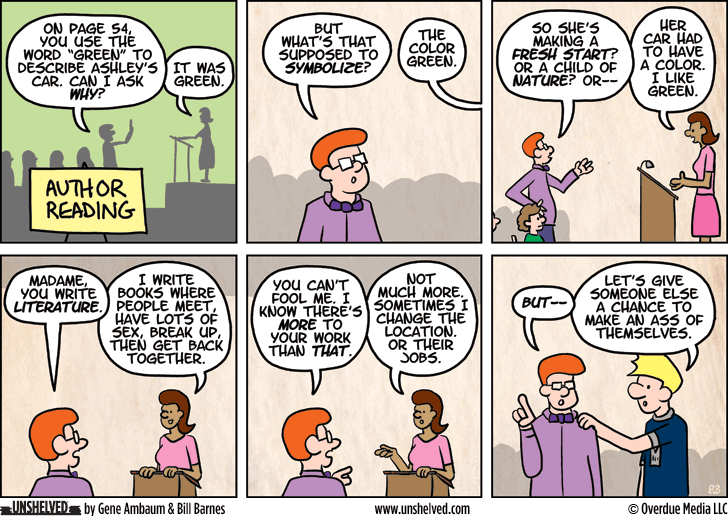
Unshelved on Thursday, February 27, 2014

HarperCollins at PLA
Unshelved strip for 2/27/2014
link to this strip | tweet this | share on facebook | email us | signed print

Library Ranger Badges available from the Unshelved store while supplies last