Cowboy Who?
Shared posts
Early voting in Houston area starts Tuesday for March 2026 primary elections
The Rev. Jesse Jackson, leader of Civil Rights Movement for decades, dies at 84

coworker reports small interactions to HR, protecting interns from office drama, and more
It’s five answers to five questions. Here we go…
1. Coworker reports the smallest interactions to HR
I have a new coworker, Fran, who has not been fitting in with the vibe at work. She seems to have very thin skin, and at any perceived slight, will report coworkers or leaders to HR.
Just today, I had an interaction that would have been standard and unmemorable with any other coworker. I was working next to Fran. She asked me a question, and I gave a very calm and direct answer. Fran said she hasn’t performed this particular task before, and to please give her some grace. I didn’t respond, and that was the end of the interaction. Not long after, I was pulled into the office by leadership because Fran had reported that interaction, and I was given a written warning.
This has become a pattern, with multiple of my coworkers reported to leadership or HR by Fran. I want to report to leadership/ HR that Fran is putting the staff on edge because we are all afraid of being reported by her. How do I do this in a way that doesn’t seem like I’m retaliating or picking on her? I’m also worried that my leadership won’t take the issue seriously.
Fran sounds like a pain in the ass, but it’s also true that responding with silence to someone who says “please give me some grace” could read pretty as fairly rude. It’s still absurd that she escalated it, but she sounds like someone where it’s better not to give them any excuse to complain about you; your life will probably be easier if you just make a point of being scrupulously professional.
As for reporting what’s happening to leadership or HR … don’t they know? If Fran is constantly reporting people to leadership or HR, they by definition are aware of it. That said, you could certainly talk to your boss about the chilling effect it’s having on team relations and the fact that it’s hard to work with Fran when you have to worry that innocuous comments will set her off.
2. Protecting interns from office drama
I’m part of the management team of a company of about 300 staff. I have a problem with Trinity, who is on the same team I’m on. I’m not her manager, but I am senior to her (because both her boss, Collins, and I report to the CEO).
There is some drama with Robby, a new senior exec who has joined, and Langdon, who he’s brought onto his team as his right hand. Langdon took over a big project with a really important client — the type of project that my team has spearheaded and has been very successful in managing — and is failing, badly, despite repeated offers of help and support (never even taking our offer to give an initial overview of our experience with these projects). So that’s a whole big problem and I’m trying to keep my head down from the drama, although I expect my CEO to ask for my perspective in the coming days.
But Trinity is a huge gossip. She’s telling everyone and anyone all about her issues with Robby and Langdon, she is openly at our table complaining about them, and whenever she notices anyone talking about it she comes up laughingly and is like, “Haha I wanna know, too, let’s talk,” etc.
In the past, she has rejected feedback from me, so I’ve given it sparingly. The team lead of the team we’re both on, Collins, despite being very competent in most areas and a good friend, doesn’t love giving negative feedback and I know that’s another issue.
But I also have two interns right now, and Trinity is openly gossiping with them around. I’ve asked her to please keep the interns out of the situation, and impressed upon her that I’d recommend we all keep our heads down in this situation, that Robby and Langdon have very senior positions (and political maneuvering skills) and it might backfire massively to talk to so many people about them. She didn’t seem to catch my point. In fact, when I asked her to keep the interns out of it she said, “Oh but with Whitaker I always laugh so much and we have such a good relationship.”
I plan to have a conversation with both interns along the following lines: “It’s my responsibility to show you work norms around tricky things like office politics. I am aware there is currently some office drama, and I want to assure you that none of it will affect our project or you, and want to advise to not take everything flying around at face value and, furthermore, to engage with it as little as possible. If you have any questions, you can always come to me.” Is that the right approach? Is there anything else I should do?
Yes, that’s exactly the right approach. If I were one of the interns, I’d feel reassured that someone was being thoughtful about how we might be experiencing this and letting us know we didn’t need to worry about it.
You should also tell Trinity’s boss, Collins, that you’ve asked her to be more discreet around the interns and she’s just laughed you off. Feel free to say, “Could you tell her that she needs to rein it in?” Since it sounds like Collins is a wimpy manager, she may or may not do that, but it’s a reasonable request to make — and simply making it highlights that there’s a problem she’s currently not dealing with.
3. What are my responsibilities when leaving a problematic team?
I recently took a short-term contract while looking for a permanent role. It is a small, busy team with a high workload. On my first day of work, I was informed that a coworker has stage 4 brain cancer and we needed to be careful about staying away from work when we were sick (generally good advice, and something I read as a green flag).
After a few weeks, it was evident that their illness was worse than initially disclosed. As a result of treatment, they aren’t able to read well and have significant vision impairments, impacted emotional regulation, and poor boundaries, including continually disclosing medical details while at their desk, or using voice-to-text to read medical records aloud. Coworkers were often expected to stop work to help this person do a simple task like re-set a password or find a file, and effectively the team is down one full-time staff member, which means the workload increases for others alongside other support work expectations.
I lost a parent to brain cancer, and decided to end the contract early for my own mental health (I have a new role starting in the next few weeks, and the resources to cover the time off).
In my exit interview, the manager disclosed that other employees have left because of the same issue, and that he is also dealing (secretly) with a brain tumor himself. I think this explains some of the “missing stair” behavior around the unsafe norms in that workplace.
What are my responsibilities here? I recognize there are some personal impacts for me which made the environment difficult, but I do not think it is a safe workplace for anyone.
You don’t have any responsibilities here! You were a short-term contractor, and you’re no longer there. Employees of that team are well positioned to raise it if they want to, but it’s not something you’re responsible for raising, nor do you even really have standing to raise it at this point. The exceptions to this would be if (a) you were brought in by someone higher up there who you had a pre-existing relationship with, in which case you could share with them what your experience was or (b) the issues were related to physical safety. But short of something like that, mentally wish them all well and just focus on moving forward.
4. Firing an employee on April Fools’ Day
Should managers avoid firing/laying off employees on April Fools’ Day so they don’t think it’s a cruel April Fools’ joke?
Managers should avoid being the type of manager where it would ever cross an employee’s mind that they’d fake-fire someone as a cruel joke. If there’s any risk of anyone wondering about that, it’s a sign that something already has gone terribly wrong. (And sure, in those offices they should avoid it — but that’s the least of their problems at that point.)
Related:
when giving good news, my boss first pretends to be upset as a “joke”
5. Will I have to pay back insurance premiums if I don’t return from maternity leave?
Can you walk me through what could happen in the event I don’t return from maternity leave? I plan to use both FMLA and short-term disability. I get 16 weeks off —12 paid (100% pay for the first eight weeks and 60% pay for the last four weeks) and four weeks unpaid. I plan to take my full maternity leave but due to child care costs, I am leaning towards being a stay-at-home mom.
I am on my employer’s insurance plan. Can they demand I repay them for their part of my insurance premiums? How should I go about asking them this?
If you take paid maternity leave and then don’t return, legally you can be responsible for repaying the cost of your health insurance from the period when you were on leave (unless you return for at least 30 days).
Whether or not your company will do that is up to them. Ideally you’d be able to find out for sure by consulting an employee handbook or other written policies, but if you can’t find it there, you could frame the question this way to HR: “I plan to return once my maternity leave is over, but I want to be realistic that people’s plans sometimes change. Can you fill me in on how our policies work both if I do and if I don’t return?”
The post coworker reports small interactions to HR, protecting interns from office drama, and more appeared first on Ask a Manager.
 ALT
ALTHey my publishers asked me to remind you that my stuff is available in their shop!
Hey my publishers asked me to remind you that my stuff is available in their shop!
Retired EV Batteries Scored a New Gig: Bolstering Texas’ Grid
By Arcelia Martin
In the midday hours, prices plummet. An excess of energy produced across Texas, largely due to the state’s solar and wind fleet, signals it’s a good time to buy. It’s then that 500 batteries, which once fueled General Motors’ electric vehicles, charge up.
my boss asked me to reflect on my conflicts with coworkers and I don’t want to
I’m off for the holiday, so here’s an older post from the archives. This was originally published in 2020.
A reader writes:
I’ve worked for four years in a research laboratory and my supervisor is an associate professor. Her husband is a professor and a director of the research group (and that’s how she easily got her position). As part of standard procedure, the university requires all employees to complete what is called a performance development review.
In our meeting, she highlighted two development goals. One was to improve individual conflict management skills by reflecting on all instances of conflicts and how those can be handled better. The second was to improve my skills in communication and dealing with feedback from other colleagues, especially staff members who are on a higher academic and professional level than myself, and to write and reflect on all instances where inappropriate responses were provided to queries by other staff members.
I replied that I disagreed that these should be listed in the development goals on my personal form, as the conflicts are common and have largely resolved by various means. Also, the conflicts were a thing of the past and I do not want to recall them. I agree that they can be improved on, but I do not want this to be on my permanent record, as it reflects badly on a HR record. For the second point I replied to her saying that I would have appreciated if private feedback was provided at the time rather than only bringing it up during the performance development review. (And to keep a long story short, I didn’t agree that my response was inappropriate. My [negative] response was based on the decisions made at that time.)
This was her response:
The development objectives will stay recorded in the PDR system because they are areas that I as your direct line of manager has identified that you need to DEVELOP in. The activities are activities created by me to make you reflect on some of these instances and identify ways you can mitigate future conflicts. They do not go into the online talent system. At the next PDR meeting, the report by me will be “have you achieved the goals set out by me pertaining to the activities or not?”
You can choose to go through with this PDR process set out by me as your direct line manager, or you can choose to ignore it. At the end of the day, I submit a report and that goes on the record.
My conflict management strategies in the past pertaining to all the complaints against yourself have been to work out the entire situation by listening to all parties, set up meetings and work it through with everyone including yourself. The example provided is just an example and not an isolated incident, nor is it only coming from a particular individual. It is simply the most recent example.
I just felt that it was very insensitive and bossy response, not to mention her already insensitive way of putting such items as “development goals.”
Oooooh, no.
You need to do what your manager is asking.
She’s clearly saying that if you don’t, it will be insubordination and likely have serious consequences for you.
When your manager tells you that you’ve had multiple conflicts with coworkers and you need to reflect on those incidents and figure out how to handle them better in the future, you cannot dismiss that by saying those conflicts are in the past and you don’t want to have to think about them. She’s saying clearly that she has determined that, in order to succeed in your job, you do need to recall them and work on alternate strategies.
There’s no option here to just say, “No, I don’t want to.” Or rather, it’s an option, but it means you’ll be putting your professional standing and your job in jeopardy. If you worked for me, that would put you far along the path to getting fired.
The multiple conflicts themselves are already a serious problem. Refusing to work on it when asked is a real F-you to your boss … and really reinforces that you’re a problem for the team. (In fact, it reinforces the very feedback she’s giving you.)
And make no mistake, based on your boss’s email to you (both the actual content and the clipped, frustrated tone), she already thinks of you as a pretty big problem, and she sounds ready to to act on that.
Now, should she have addressed issues with you as they came up? Yes. But that doesn’t mean she doesn’t have standing to address it now, and if you fight her on that rather than addressing the problems themselves, you’re going to look like you’re deflecting, missing the point, and continuing a pattern of combativeness that’s already been flagged as a problem. You’ll have much more luck if you first do what she’s asking and then later say you’d like to receive feedback in a more ongoing way, rather than hearing about problems for the first time in a formal review.
I’m not sure why you thought her response was insensitive (it was certainly direct, but in a context where that was necessary) or bossy (she is in fact your boss), or why you find framing this stuff as “development goals” to be insensitive. These are development goals, and there’s nothing weird or insulting about calling them that. It also seems to be the terminology your organization uses. Personally, I think it’s rather soft; I would call them “performance requirements” because they would be!
The best thing you can do is to drop your instinct to push back or defend yourself and just … do what she’s asking you to do: reflect on the past conflicts and how you could have handled them differently. That’s a reasonable thing for a manager to ask, and it sounds like it’s based in real necessity here.
The post my boss asked me to reflect on my conflicts with coworkers and I don’t want to appeared first on Ask a Manager.
company wants references from “coworkers you didn’t get along with”
I’m off for the holiday, so here’s an older post from the archives. This was originally published in 2016.
A reader writes:
I’m currently interviewing for a new position with a company that works remotely. Over the past two weeks, I’ve had 10+ video calls with every member of the small team, along with a bunch of unpaid work tests that have included everything from client proposals to personality tests. It’s starting to feel like a full-time job just interviewing with them. I was willing to do all of this because the company is one that I know well with a social mission that I really believe in. I was even willing to accept that they are paying a good $20k below what is normal.
I was told that it was down to me and one other person and they were planning on making a decision this week. Today I got an email asking me to send one to two references in each of five categories. One of those categories is “coworker(s) that you didn’t get along with.” They say they want all of these references to get a complete picture of who I am and how I work, but this feels like a weird ask to me. There haven’t been many coworkers that I’ve had problems with and most are far in the past (5+ years) and were fired from their jobs. They aren’t people I’d want talking to a potential future employer on my behalf, even if I did have a way to contact them and ask if they’d be willing. I have plenty of great “normal” references and a solid work history with a portfolio to prove it, which seems like plenty to base their decision on in addition to the many phone calls and tests.
Am I off-base for feeling uncomfortable with what they’re asking of me? Is there a way that I can provide standard references and address my concerns of feeling uncomfortable without turning them off too much? I’m worried that I might have wasted a lot of time with this whole process.
What the actual F.
Seriously, this is ridiculous. 10 video calls over two weeks is absurd — it’s disrespectful of your (and their) time, and it’s indicative of a company that has no clue how to hire — and not even enough of a clue to realize that Something Doesn’t Seem Right About What We’re Doing. And now five to ten references, over five different categories? And names of coworkers who you didn’t get along with?
No. That is not reasonable.
References are valuable. And sure, in theory I’d love to be able to talk to a dozen people who worked with a candidate, with a whole bunch of different vantage points. I’d also like to have a video reel of the highlights of their last two years of work, a transcript of every time they got frustrated with a manager or a coworker, and a live blog of their last performance review meeting.
I can’t have those things because hiring doesn’t work that way. You will never know absolutely everything that you could know about a candidate. You do your best, based on a reasonable number of interviews, work samples, observations, and discussions with a handful of references. If you don’t feel like you have enough to confidently move forward with someone after doing that, they’re probably not the right candidate — or you need to seriously revisit your hiring practices. It’s not okay to put the burden of weak hiring practices or shaky confidence in your own judgment on to the candidate, and make them pay the price in the form of dozens of hours of interviews and exercises and tests, or to ask them to place an unreasonable burden on people they know.
You can never look under every single rock. Asking to be put in touch with coworkers who you didn’t get along with is just … ugh, it’s just not okay. They have to know it’s going to cause you a tremendous amount of discomfort (and the coworker too, I’d assume), and since they have no way of judging what happened between the two of you, they have no way of knowing how much weight to give whatever that person might say to them.
And really, it’s so very unreasonable that it’s worth you refusing. This is not a company you should continue placating. I’d seriously consider telling them, “This seems like overkill to me. This is exponentially more information than I’ve ever been asked for before by an employer. We’ve already had 10+ video calls and I’ve completed numerous tests for you. These aren’t reasonable demands to make of job candidates. I was very interested in working with you, despite the below-market salary, but I’m alarmed enough by these practices that at this point I’m withdrawing my application.”
But if you are absolutely committed to continuing, then I suppose you could say: “Hmmm, I’ve never really had any significant problems with coworkers, but I’m providing names and contact information for a variety of people who can speak to my work.”
(Or maybe you can just give them my contact info as one of your references so that I can give them a piece of my mind? No? Fine.)
The post company wants references from “coworkers you didn’t get along with” appeared first on Ask a Manager.
Trump threatens more attacks on Nigeria unless their prince returns his money
WASHINGTON, DC – President Donald Trump recently took to his Truth Social media platform to warn Nigeria that it will be targeted with more airstrikes, unless “Prince Adewale Oluewesan returns the money”, which the president claims he sent as part of an agreement that the prince has not upheld. Last night on his Truth Social […]
The post Trump threatens more attacks on Nigeria unless their prince returns his money appeared first on The Beaverton.



A federal tool to check voter citizenship keeps making mistakes. It led to confusion in Texas
After a stunning Presidents’ Day, Houston will see some of its warmest weather so far this year
In brief: In today’s post we discuss temperature trends so far this year as we look ahead to the warmest weather so far of 2026. Also, we help readers with the proper way to spell Presidents’ Day in Texas. It varies from state to state!
A warming trend on tap
The warmest day of 2026 occurred just a single day into the new year, back on January 2, when the high temperature in Houston peaked at 84 degrees. If you’ll recall, the entire first week of January was extraordinarily warm before a series of fronts culminated in an exceptionally cold end to the month. February, on average, has so far run about 5 degrees above normal. But we have yet to experience any days this month with a high temperature above 80 degrees. That will change this week, thanks to a persistent southerly flow of warmer air. Just how warm we get will depend upon cloud cover during the afternoon, but most locations should reach the mid-80s for a few days.

Monday
A lot of people have work off today due to Presidents’ Day, a holiday originally intended to celebrate the life and contributions of George Washington, which is marked on the third Monday of February. Different states celebrate and even spell it differently (it is Presidents’ Day in Texas by law), but regardless if you’re off today you’ll have some fine weather at your disposal. After a chilly start around 50 degrees in most locations, we’re going to rise into the lower 70s today with partly sunny skies. Winds will generally be light, from the southeast. Low temperatures tonight will be warmer, in the upper 50s in most locations.
Tuesday
We’ll see a more pronounced southerly flow by Tuesday, and this will start to bring humidity levels up further. High temperatures will range from the upper 70s to about 80 degrees, with partly to mostly sunny skies. Afternoon winds may gust up to 20 or 25 mph. Lows will only fall into the low- to mid-60s.

Wednesday, Thursday, and Friday
These will be the warmest days of the week (Thursday likely the warmest of all) with high temperatures ranging from around 80 degrees into the mid- (and possibly even upper-80s) across Houston. Actual highs will depend on how far you are from the coast (warmer) and how much cloud cover there is during the afternoon hours (cooler). Anyway it’s going to feel fairly warm and humid, with mild nights in the 60s. Some sort of front may arrive by Friday or so, brining a chance of rain. We’ll see.
Saturday and Sunday
At some point we will see a decent front move in, perhaps with a delay in cooler and drier air afterward. Given uncertainty in the timing I can’t offer a firm prediction on this weekend’s weather yet. A reader mentioned that there’s a big custom car and truck show in Conroe this weekend, and I think the weather will generally be fair, with partly sunny skies, and highs in the 70s. At some point there may be a chance of rain associated with the front, although I don’t anticipate anything like we experienced with the storms that passed on Saturday evening. We’ll try to get you some better weekend details soon.
Next week
We should see a few cooler days to start next week, in the wake of this weekend’s front, before another warmup to around 80 degrees or so.

For many Texans, memories of deadly winter blackouts still linger
Baby Fails To Change New Father In Any Way
VERNON HILLS, IL—Lacking the ability to transform her father’s personality to the same extent as his leather couch or riding lawn mower, newborn baby Amber Gilroy reportedly failed this week to change new parent Eric Gilroy in any conceivable way. “Eric was always nice but just kind of floating through life, and then as soon as he had Amber you could really see how exactly the same he was,” said Gilroy’s sister Taylor, who revealed she noticed the amazing lack of growth from the moment Gilroy first held his daughter in his arms and shifted her to check on a DraftKings alert on his phone. “Look deep into his eyes, and you could tell this baby was just another random human being passing in front of him. We always suspected Eric had this well of love and emotion that was right beneath the surface waiting to burst out, and then Amber comes along and you realize, nah. He came back from the hospital and the first time my boyfriend talked to him he said Eric was just head-over-heels, going on and on about this new smoker he bought. For years, Eric was this punch-in, punch-out guy at work who mostly cared about the Bears, and now he does that stuff while also changing diapers sometimes. I asked him what it felt like being a new dad, and he just paused for a minute, as if searching for the words. But then I realized he hadn’t heard me and was concentrating on a Bud Light commercial.” At press time Gilroy was staring gratefully at his newborn daughter after starting to grasp that he could use his four-week paternity leave to take a hunting trip in Wisconsin.
The post Baby Fails To Change New Father In Any Way appeared first on The Onion.
Bookseller Scrambles To Hide All The Classics After Seeing Emerald Fennell Approaching Door
LONDON—Calling for all hands on deck as he seized an armful of paperbacks, local bookshop owner Colin Mueller was reportedly scrambling to hide the classics Monday after he spotted filmmaker Emerald Fennell approaching the door. “For the love of God, please, someone grab the Jane Austens!” said Mueller, who jumped on top of a chair and began shoving the beloved works into the drop ceiling tiles as cries of “Quick!” and “She’s here!” rang out among the store’s panic-stricken employees. “All other Brontë titles go into the safe now, do you hear me? Go! Go! Go! If she asks for Middlemarch, remember our training: Distract, delegate, delay! Or just toss her a copy of Tess Of The D’Urbervilles. No one likes that one anyway.” At press time, sources confirmed Mueller was on his hands and knees pleading with the Wuthering Heights director to check out their vast array of Colleen Hoover titles.
The post Bookseller Scrambles To Hide All The Classics After Seeing Emerald Fennell Approaching Door appeared first on The Onion.
Tips For Observing Lent
Catholics around the world will soon enter the Lenten season, an annual 40-day period of sacrifice, prayer, and repentance that ends on Easter Sunday. The Onion shares tips for observing Lent.
Try starting with something shorter like Yom Kippur and working your way up.
Check Google Maps for the nearest wanderable desert.
Remind your children that they’re fasting because of the Lord and not because you can’t afford groceries.
Don’t be too hard on yourself if you slip up and worship Baal once or twice.
God’s usually pretty busy on Wednesdays, so you can cheat all you want and He won’t notice.
Have an excuse ready for when your wife suggests giving up alcohol.
Remember that you’re not competing with anyone except God.
Convert to Islam before Lent starts, then convert back before Ramadan rolls around.
When it is almost over, think of something you haven’t done for the past 40 days and say that’s what you gave up.
Don’t give up your big cowboy hat. That thing rules.
The post Tips For Observing Lent appeared first on The Onion.
The Voracious Vine That ‘Ate the South’ Can Also Fuel Wildfires
By Jaylan Sims
Nearly every Monday morning, five restorationists with Conserving Carolina guide volunteers through the steep hills of Norman Wilder Forest in Tryon, North Carolina. Armed with chainsaws, thick gloves and a pickaxe-like mattock, the group goes hunting for a wily prey: kudzu.
Awkward Zombie - Name and Shame

New comic!
Today's News:
I realize we're talking about a Hideo Kojima game, but I cannot stress enough how much Tomorrow is not a name. It makes Die Hardman sound normal by comparison.
News Publishers Are Now Blocking The Internet Archive, And We May All Regret It
Last fall, I wrote about how the fear of AI was leading us to wall off the open internet in ways that would hurt everyone. At the time, I was worried about how companies were conflating legitimate concerns about bulk AI training with basic web accessibility. Not surprisingly, the situation has gotten worse. Now major news publishers are actively blocking the Internet Archive—one of the most important cultural preservation projects on the internet—because they’re worried AI companies might use it as a sneaky “backdoor” to access their content.
This is a mistake we’re going to regret for generations.
Nieman Lab reports that The Guardian, The New York Times, and others are now limiting what the Internet Archive can crawl and preserve:
When The Guardian took a look at who was trying to extract its content, access logs revealed that the Internet Archive was a frequent crawler, said Robert Hahn, head of business affairs and licensing. The publisher decided to limit the Internet Archive’s access to published articles, minimizing the chance that AI companies might scrape its content via the nonprofit’s repository of over one trillion webpage snapshots.
Specifically, Hahn said The Guardian has taken steps to exclude itself from the Internet Archive’s APIs and filter out its article pages from the Wayback Machine’s URLs interface. The Guardian’s regional homepages, topic pages, and other landing pages will continue to appear in the Wayback Machine.
The Times has gone even further:
The New York Times confirmed to Nieman Lab that it’s actively “hard blocking” the Internet Archive’s crawlers. At the end of 2025, the Times also added one of those crawlers — archive.org_bot — to its robots.txt file, disallowing access to its content.
“We believe in the value of The New York Times’s human-led journalism and always want to ensure that our IP is being accessed and used lawfully,” said a Times spokesperson. “We are blocking the Internet Archive’s bot from accessing the Times because the Wayback Machine provides unfettered access to Times content — including by AI companies — without authorization.”
I understand the concern here. I really do. News publishers are struggling, and watching AI companies hoover up their content to train models that might then, in some ways, compete with them for readers is genuinely frustrating. I run a publication myself, remember.
But blocking the Internet Archive isn’t going to stop AI training. What it will do is ensure that significant chunks of our journalistic record and historical cultural context simply… disappear.
And that’s bad.
The Internet Archive is the most famous nonprofit digital library, and has been operating for nearly three decades. It isn’t some fly-by-night operation looking to profit off publisher content. It’s trying to preserve the historical record of the internet—which is way more fragile than most people comprehend. When websites disappear—and they disappear constantly—the Wayback Machine is often the only place that content still exists. Researchers, historians, journalists, and ordinary citizens rely on it to understand what actually happened, what was actually said, what the world actually looked like at a given moment.
In a digital era when few things end up printed on paper, the Internet Archive’s efforts to permanently preserve our digital culture are essential infrastructure for anyone who cares about historical memory.
And now we’re telling them they can’t preserve the work of our most trusted publications.
Think about what this could mean in practice. Future historians trying to understand 2025 will have access to archived versions of random blogs, sketchy content farms, and conspiracy sites—but not The New York Times. Not The Guardian. Not the publications that we consider the most reliable record of what’s happening in the world. We’re creating a historical record that’s systematically biased against quality journalism.
Yes, I’m sure some will argue that the NY Times and The Guardian will never go away. Tell that to the readers of the Rocky Mountain News, which published for 150 years before shutting down in 2009, or to the 2,100+ newspapers that have closed since 2004. Institutions—even big, prominent, established ones—don’t necessarily last.
As one computer scientist quoted in the Nieman piece put it:
“Common Crawl and Internet Archive are widely considered to be the ‘good guys’ and are used by ‘the bad guys’ like OpenAI,” said Michael Nelson, a computer scientist and professor at Old Dominion University. “In everyone’s aversion to not be controlled by LLMs, I think the good guys are collateral damage.”
That’s exactly right. In our rush to punish AI companies, we’re destroying public goods that serve everyone.
The most frustrating bit of all of this: The Guardian admits they haven’t actually documented AI companies scraping their content through the Wayback Machine. This is purely precautionary and theoretical. They’re breaking historical preservation based on a hypothetical threat:
The Guardian hasn’t documented specific instances of its webpages being scraped by AI companies via the Wayback Machine. Instead, it’s taking these measures proactively and is working directly with the Internet Archive to implement the changes.
And, of course, as one of the “good guys” of the internet, the Internet Archive is willing to do exactly what these publishers want. They’ve always been good about removing content or not scraping content that people don’t want in the archive. Sometimes to a fault. But you can never (legitimately) accuse them of malicious archiving (even if music labels and book publishers have).
Either way, we’re sacrificing the historical record not because of proven harm, but because publishers are worried about what might happen. That’s a hell of a tradeoff.
This isn’t even new, of course. Last year, Reddit announced it would block the Internet Archive from archiving its forums—decades of human conversation and cultural history—because Reddit wanted to monetize that content through AI licensing deals. The reasoning was the same: can’t let the Wayback Machine become a backdoor for AI companies to access content Reddit is now selling. But once you start going down that path, it leads to bad places.
The Nieman piece notes that, in the case of USA Today/Gannett, it appears that there was a company-wide decision to tell the Internet Archive to get lost:
In total, 241 news sites from nine countries explicitly disallow at least one out of the four Internet Archive crawling bots.
Most of those sites (87%) are owned by USA Today Co., the largest newspaper conglomerate in the United States formerly known as Gannett. (Gannett sites only make up 18% of Welsh’s original publishers list.) Each Gannett-owned outlet in our dataset disallows the same two bots: “archive.org_bot” and “ia_archiver-web.archive.org”. These bots were added to the robots.txt files of Gannett-owned publications in 2025.
Some Gannett sites have also taken stronger measures to guard their contents from Internet Archive crawlers. URL searches for the Des Moines Register in the Wayback Machine return a message that says, “Sorry. This URL has been excluded from the Wayback Machine.”
A Gannett spokesperson told NiemanLab that it was about “safeguarding our intellectual property” but that’s nonsense. The whole point of libraries and archives is to preserve such content, and they’ve always preserved materials that were protected by copyright law. The claim that they have to be blocked to safeguard such content is both technologically and historically illiterate.
And here’s the extra irony: blocking these crawlers may not even serve publishers’ long-term interests. As I noted in my earlier piece, as more search becomes AI-mediated (whether you like it or not), being absent from training datasets increasingly means being absent from results. It’s a bit crazy to think about how much effort publishers put into “search engine optimization” over the years, only to now block the crawlers that feed the systems a growing number of people are using for search. Publishers blocking archival crawlers aren’t just sacrificing the historical record—they may be making themselves invisible in the systems that increasingly determine how people discover content in the first place.
The Internet Archive’s founder, Brewster Kahle, has been trying to sound the alarm:
“If publishers limit libraries, like the Internet Archive, then the public will have less access to the historical record.”
But that warning doesn’t seem to be getting through. The panic about AI has become so intense that people are willing to sacrifice core internet infrastructure to address it.
What makes this particularly frustrating is that the internet’s openness was never supposed to have asterisks. The fundamental promise wasn’t “publish something and it’s accessible to all, except for technologies we decide we don’t like.” It was just… open. You put something on the public web, people can access it. That simplicity is what made the web transformative.
Now we’re carving out exceptions based on who might access content and what they might do with it. And once you start making those exceptions, where do they end? If the Internet Archive can be blocked because AI companies might use it, what about research databases? What about accessibility tools that help visually impaired users? What about the next technology we haven’t invented yet?
This is a real concern. People say “oh well, blocking machines is different from blocking humans,” but that’s exactly why I mention assistive tech for the visually impaired. Machines accessing content are frequently tools that help humans—including me. I use an AI tool to help fact check my articles, and part of that process involves feeding it the source links. But increasingly, the tool tells me it can’t access those articles to verify whether my coverage accurately reflects them.
I don’t have a clean answer here. Publishers genuinely need to find sustainable business models, and watching their work get ingested by AI systems without compensation is a legitimate grievance—especially when you see how much traffic some of these (usually less scrupulous) crawlers dump on sites. But the solution can’t be to break the historical record of the internet. It can’t be to ensure that our most trusted sources of information are the ones that disappear from archives while the least trustworthy ones remain.
We need to find ways to address AI training concerns that don’t require us to abandon the principle of an open, preservable web. Because right now, we’re building a future where historians, researchers, and citizens can’t access the journalism that documented our era. And that’s not a tradeoff any of us should be comfortable with.
How a Planned Disney World Vacation Turned Into Four Months in Immigration Detention
This week, ProPublica published a story I wrote based in part on interviews with parents and children being held at the nation’s only operating detention center for immigrant families in Dilley, Texas. I had asked some of the parents to see if their children would be willing to write to me about their experiences inside. More than three dozen did.
One of those letters came from 9-year-old Maria Antonia Guerra Montoya from Colombia. Her letter was written on a piece of notebook paper. She decorated it with rainbows and hearts. And she drew a portrait of herself and her mom wearing their detention uniforms and government-issued ID badges.
I had initially met Maria a few weeks earlier, when I managed to get inside the Dilley Immigration Processing Center. It’s just south of San Antonio. Maria Antonia, her mother and more than 3,500 people, half of them minors, had cycled through there since the Trump administration reopened it early last year. I went in mid-January, before the facility burst into public view when Liam Conejo Ramos — the 5-year-old in a blue bunny hat detained with his father in Minneapolis — was sent there, with the aim of hearing about the conditions in which children were being held, from the children themselves.
After signing in, I passed through a metal detector and a series of locked doors to get to the visitation room. Maria Antonia and another girl her age were quietly playing fast-moving hand games, when her mother, Maria Alejandra Montoya, called her over to introduce me.
Maria Antonia, wearing her long brown hair in a ponytail, didn’t hesitate. She scooted forward to the front edge of her chair, pushed her thick white-framed glasses up on her nose and dove right in.
I asked her how she and her mom had ended up there.
Well, she said, we had a plan to go to “Disneylandia” but instead ended up in “Dilleylandia.”
Then she told me the story. She lived in Colombia with her grandmother and regularly traveled back and forth to the United States to visit her mother, who had been in the U.S. since 2018. (Maria Alejandra had overstayed a visa but since married a U.S. citizen and was applying for a green card.) In August, the whole family had vacationed together in Disney World. It was so fun, Maria Antonia said, that she begged her mom to go back for the park’s annual Halloween celebration.
They booked tickets for a 10-day vacation during her school holidays. She lit up telling me about how she had planned out a “101 Dalmatians” costume — she would be Cruella de Vil and her mom and stepdad the spotted dogs. The whole getup was so bulky it basically filled her entire suitcase.
But everything started going wrong as soon as she arrived at the Miami International Airport on Oct. 2. She was supposed to be dropped off with her mom by the flight attendant accompanying her. But she said was intercepted by immigration officers who took her into a room to be interrogated while her mother was taken to be questioned in a separate room. They were asking me all kinds of questions I had absolutely no idea how to answer, I recall her telling me (I was not allowed any notebooks or voice recorders inside the detention facility). I kept just saying over and over again: “I can tell you my name and my birthday and my mom’s name and her birthday and that I am from Colombia. That’s about it.” I didn’t know what else to tell them.
After what they both said were hours of questioning, they were put in a cold room together. Maria Alejandra’s phone was confiscated. They had no way to contact her stepdad, who was waiting for them in the airport. Maria Antonia said they had no idea why they were being detained if her mother was applying for a green card and she had a valid tourist visa.
Maria Antonia had learned English at her private school in Medellin. She overheard one immigration officer tell another that if she had been 10 years old, they would have been able to keep her separated from her mom. That, she said, is when the real fear set in.
Then it was 42 hours of waiting in the airport holding rooms. Eventually they were put on a plane — then a minivan — to the facility in Texas. Maria Antonia said she didn’t really understand where they were going until they saw the center out the window.
![A drawing on lined paper of an unsmiling woman and a girl wearing gray sweatshirts with long hair. The woman wears blue pants and the girl wears gray pants. Handwriting appears above and next to the drawing in Spanish: “No me dan mi dieta yo soy vegetariana, no como bien, no hay buena educacion y extraño a mi mejor amiga julieta y a mi abuela y a mi escuela ya quiero llegar a mi casa. Yo en dilei [Dilley] no estoy feliz por favor saquenme de aquí a colombia. Antonia.”](https://www.propublica.org/wp-content/uploads/2026/02/2026-ice-kids-dilley-letter-06_maxHeight_3000_maxWidth_3000.jpg?w=752)
By the time I met them, they had been detained for nearly four months. I asked Maria Antonia what being stuck in Dilley was like. She told me she had fainted two times since she got there; she is vegetarian and said she ate mostly beans. She felt like she had nothing to do all day and she missed her school, echoing concerns of many of the other kids I spoke with over the course of my reporting. She said she had made some new friends inside Dilley, but it was hard. She and her mom had been detained for so long that new people she met would often leave when they were released or deported.
Her mother, Maria Alejandra, had told me in long, vivid emails about some of more serious concerns about her and her daughter’s deteriorating mental and physical health during their prolonged detention. She said Maria Antonia would wake up in the middle of the night crying, fearful she would never leave detention or alternatively that she would be separated from her mom.
Read More

I asked the Department of Homeland Security and U.S. Immigration and Customs Enforcement, which DHS oversees, about what Maria Alejandra and Maria Antonia told me. In an email, they said Maria Alejandra overstayed her tourist visa and had been previously arrested for theft, a charge that according to court documents was dismissed. DHS said that during her time in detention, Maria Antonia was seen by medical professionals twice and also had weekly check-ins with mental health professionals, “where she stated she was calm and well-nourished.” DHS said everyone held at the facility is “provided with 3 meals a day, clean water, clothing, bedding, showers, soap, and toiletries” and “certified dieticians evaluate meals.” DHS also said “children have access to teachers, classrooms, and curriculum booklets for math, reading, and spelling” and no one is denied medical care. CoreCivic, which operates the facility, said it is subject to multiple layers of oversight and that health and safety are top priorities.
Soon we all said goodbye. But I remained in touch with her mother and stepdad and attorneys following the case. They shared documentation about what happened to them and their legal pleas to be released.
I learned an immigration judge had granted them “voluntary departure” on Jan. 6, allowing Maria Alejandra to pay their own way back to Colombia, avoid having a formal deportation order on her record and continue her green card application from abroad. But it wasn’t until Feb. 6 that they were finally sent back to Colombia.
A few days after they returned, her mother told me the first thing Maria Antonia wanted to do was throw out the government-issued sweatsuit she had been wearing for months. Then I received a video.
It showed Maria Antonia, wearing pink leggings and a T-shirt with a teddy bear on it, running to embrace her teachers one by one outside her school. One of the teachers leads her by the hand into her classroom: “Look who I brought you!” the teacher says. Another young girl, Maria Antonia’s best friend, leaps out of her desk to wrap her arms around her. Another friend rushes to join the hug. She was finally home.
The post How a Planned Disney World Vacation Turned Into Four Months in Immigration Detention appeared first on ProPublica.
Sir Andrew Lloyd Webber playing chess with Tim Rice?

Sir Andrew Lloyd Webber playing chess with Tim Rice?
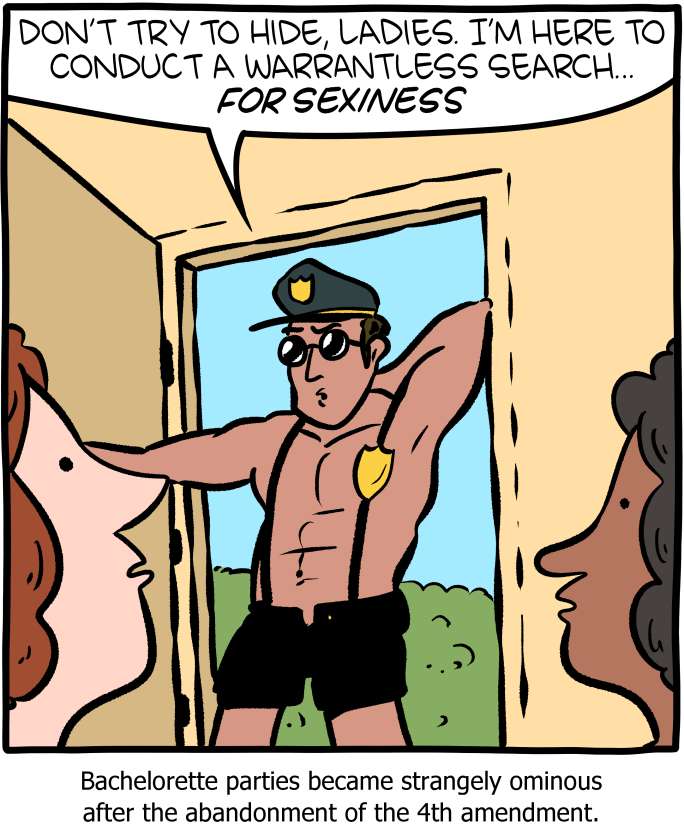
Saturday Morning Breakfast Cereal - Warrantless
Click here to go see the bonus panel!
Hovertext:
The bound and gagged stripper also gets weird after the first amendment goes away.
Today's News:

Saturday Morning Breakfast Cereal - Moral

Click here to go see the bonus panel!
Hovertext:
Why are Adam Sandler movies not perceived as moral cataclysms?
Today's News:
And Earl Anthony’s got a 7-10 split he’s got to pick up here…

And Earl Anthony’s got a 7-10 split he’s got to pick up here…
 ALT
ALTFinnish Ski Jumping Team Caught Tampering With Earth’s Gravitational Field
PREDAZZO, ITALY—Calling the incident a flagrant violation of both the rules of the event and the fundamental constants of the universe, International Olympic Committee officials confirmed Saturday that the Finnish ski jumping team had been caught tampering with Earth’s gravitational field in an attempt to gain a competitive advantage at the Winter Olympics. “During a routine equipment inspection, we discovered a number of small objects levitating around a strange, toaster-oven-sized device with a glowing core that appears to have been used during competition to favorably alter Earth’s rotation for Team Finland’s ski jumpers,” said IOC spokesman Mark Adams, noting that suspicions had also been raised after Finland’s Vilho Palosaari serenely floated for almost a mile during his jump in the first round of the men’s large hill finals, shattering numerous world records. “Further, our investigation found that the apparatus had been deployed in reverse against opponents, increasing gravitational forces so that athletes could only get several inches off the ground. Using supernatural technology to alter the laws of physics does not in any way align with the spirit of the Games, and we have therefore decided to disqualify the Finnish ski jumpers for the remainder of the Winter Olympics.” The Finns have denied any wrongdoing, claiming that the device was a traditional Finnish kitchen implement used to prepare rye bread.
The post Finnish Ski Jumping Team Caught Tampering With Earth’s Gravitational Field appeared first on The Onion.