This week on Lost Terminal: Meg comes down to earth, Roman reaches out, Arctica makes a tiny concession. Lost Terminal will return next week! 📓 Free transcript: https://www.patreon.com/posts/152716732 🎵 Today's SIGNAL is: https://namtao.bandcamp.com/track/temporal-glitch 🦣 Mastodon https://namtao.com/@lostterminal 📝 Tumblr https://lostterminalpod.tumblr.com 🎙️ Recorded using a RODE NT-1 v5 USB in 32-bit float, edited with REAPER on Linux 🙏 CREDITS Credits narrated by Lucy Stringer ❤️ Thank you so much to everyone who supports me, but especially my Patreon Producers: Ada Phillips Kit Mike McCaffrey Jade Felicity Bilkey Stephen McCandless Mike Schneider Catoxis
"AI psychosis" is one of those terms that is incredibly useful and also almost certainly going to be deprecated in smart circles in short order because it is: a) useful; b) easily colloquialized to describe related phenomena; and c) adjacent to medical issues, and there's a group of people who feel very strongly any metaphor that implicates human health is intrinsically stigmatizing and must be replaced with an awkward, lengthy phrase that no one can remember and only insiders understand.
So while we still can, let us revel in this useful term to talk about some very real pathologies in our world.
Formally, "AI psychosis" describes people who have delusions that are possibly induced, and definitely reinforced and magnified, by a chatbot. AI psychosis is clearly alarming for people whose loved ones fall prey to it, and it has been the subject of much press and popular attention, especially in the extreme cases where it has resulted in injury or death.
It's possible for AI psychosis to be both a new and alarming phenomenon and also to be on a continuum with existing phenomena. Paranoid delusions aren't new, of course. Take "Morgellons Disease," a psychosomatic belief that you have wires growing in your body, which causes sufferers to pick at their skin to the point of creating suppurating wounds. Morgellons emerged in the 2000s, but the name refers to a 17th-century case-report of a patient who suffered from a similar delusion:
Morgellons is both a 400 year old phenomenon and an internet pathology. How can that be? Because the internet makes it easier for people with sparsely distributed traits to locate one another, which is why the internet era is characterized by the coherence of people with formerly fringe characteristics into organized blocs, for better (gender minorities, #MeToo) and worse (Nazis).
Morgellons is rare, but if you suffer from it, it's easy for you to locate virtually every other person in the world with the same delusion and for all of you to reinforce and egg on your delusional beliefs.
Morgellons isn't the only delusion that the internet reinforces, of course. "Gang stalking delusion" is a belief in a shadowy gang of sadistic tormentors who sneak hidden messages into song lyrics and public signage and innuendo in overheard snatches of other people's conversations. It is an incredibly damaging delusion that ruins people's lives.
Gang stalking delusion isn't new, either – as with Morgellons, there are historical accounts of it going back centuries. But the internet supercharged gang stalking delusion by making it easy for GSD sufferers to find one another and reinforce one another's beliefs, helping each other spin elaborate explanations for why the relatives, therapists, and friends who try to help them are actually in on the conspiracy. The result is that GSD sufferers end up ever more isolated from people who are trying mightily to save them, and more connected to people who drive them to self-harm.
Enter chatbots. Ready access to eager-to-please LLMs at every hour of the day or night means that you don't even have to find a forum full of people with the same delusion as you, nor do you have to wait for a reply to your anguished message. The LLM is always there, ready to fire back a "yes-and" improv-style response that drives you deeper and deeper into delusion:
It's possible that there are delusions that are even more rare than GSD or Morgellons that AI is surfacing. Imagine if you were prone to fleeting delusional beliefs (and whomst amongst us hasn't experienced the bedrock certainty that we put something down right here, only to find it somewhere else and not have any idea how that happened?). Under normal circumstances, these cognitive misfires might be fleeting moments of discomfort, quickly forgotten. But if you are already habituated to asking a chatbot to explain things you don't understand, it might well yes-and you into an internally consistent, entirely wrong belief – that is, a delusion.
Think of how often you noticed "42" after reading Hitchhiker's Guide to the Galaxy, or how many times "6-7" crops up once you've experienced a baseline of exposure to adolescents. Now imagine that an obsequious tale-spinner was sitting at your elbow, helpfully noting these coincidences and fitting them into a folie-a-deux mystery play that projected a grand, paranoid narrative onto the world. Every bit of confirming evidence is lovingly cataloged, all disconfirming evidence is discounted or ignored. It's fully automated luxury QAnon – a self-baking conspiracy that harnesses an AI in service to driving you deeper and deeper into madness:
That's the original "AI psychosis" that the term was coined to describe. As Sam Cole notes in her excellent "How to Talk to Someone Experiencing 'AI Psychosis,'" mental health practitioners are not entirely comfortable with the "psychosis" label:
"Psychosis" here is best understood as an analogy, not a diagnosis, and, as already noted, there is a large cohort of very persistent people who make it their business to eradicate analogies that make reference to medical or health-related phenomena. But these analogies are very hard to kill, because they do useful work in connecting unfamiliar, novel phenomena with things we already understand.
It's true that these analogies can be stigmatizing, but they needn't be. As someone with an autoimmune disorder, I am not bothered by people who would also describe ICE as an autoimmune disorder in which antibodies attack the host, threatening its very life. I am capable of understanding "autoimmune disorder" as referring to both a literal, medical phenomenon; and a figurative, political one. I have never found myself confusing one for the other.
"AI psychosis" is one of those very useful analogies, and you can tell, because "AI psychosis" has found even more metaphorical uses, describing other bad beliefs about AI. Today, I want to talk about three of these AI psychoses, and how they relate to one another: the investor AI delusion, the boss AI delusion, and the critic AI delusion.
Let's start with the investors' delusion. AI started as an investment project from the usual suspects: venture capitalists, private wealth funds, and tech monopolists with large cash reserves and ready access to loans during the cheap credit bubble. These entities are accustomed to making large, long-shot bets, and they were extremely motivated to find new markets to grow into and take over.
Growing companies need to keep growing, but not because they have "the ideology of a tumor." Growing companies' imperative to keep growing isn't ideological at all – it's material. Growth companies' stock trade at a high multiple of their "price to earnings ratio" (PE ratio), which means that they can use their stock like money when buying other companies and hiring key employees.
But once those companies' growth slows down, investors revalue those shares at a much lower PE multiplier, which makes individual executives at the company (who are primarily paid in stock) personally much poorer, prompting their departure, while simultaneously kneecapping the company's ability to grow through acquisition and hiring, because a company with a falling share price has to buy things with cash, not stock. Companies can make more of their own stock on demand, simply by typing zeroes into a spreadsheet – but they can only get cash by convincing a customer, creditor or investor to part with some of their own:
Tech companies have absurdly large market shares – think of Google's 90% search dominance – and so they've spent 15+ years coming up with increasingly absurd gambits to convince investors that they will continue to grow by capturing other markets. At first, these companies claimed that they were on the verge of eating one another's lunches (Google would destroy Facebook with G+; Facebook would do the same to Youtube with the "pivot to video").
This has a real advantage in that one need not speculate about the potential value of Facebook's market – you only have to look at Facebook's quarterly reports. But the downside is that Facebook has its own ideas about whether Google is going to absorb its market, and they are prone to forcefully make the case that this won't happen.
After a few tumultuous years, tech giants switched to promoting growth via speculative new markets – metaverse, web3, crypto, blockchain, etc. Speculative new markets are speculative, and the weakness of that is that no one can say how big those markets might be. But that's also the strength of those markets, because if no one can say how big those markets might be, then who's to say that they won't be very big indeed?
There's a different advantage to confining your concerns to imaginary things: imaginary things don't exist, so they don't contest your public statements about them, nor do they make demands on you. Think of how the right concerns itself with imaginary children (unborn babies, children in Wayfair furniture; children in nonexistent pizza parlor basements, children undergoing gender confirmation surgery). These are very convenient children to advocate for, since, unlike real children (hungry children, children killed in the Gaza genocide, children whose parents have been kidnapped by ICE, children whom Matt Goetz and Donald Trump trafficked for sex, children in cages at the US border, trans kids driven to self-harm and suicide after being denied care), nonexistent children don't want anything from you and they never make public pronouncements about whether you have their best interests at heart.
But as the AI project has required larger and larger sums to keep the wheels spinning, the usual suspects have started to run out of money, and now AI hustlers are increasingly looking to tap public markets for capital. They want you to invest your pension savings in their growth narrative machine, and they're relying on the fact that you don't understand the technology to trick you into handing over your money.
There's a name for this: it's called the "Byzantine premium" – that's the premium that an investment opportunity attracts by being so complicated and weird that investors don't understand it, making them easy to trick:
AI is a terrible economic phenomenon. It has lost more money than any other project in human history – $600-700b and counting, with trillions more demanded by the likes of OpenAI's Sam Altman. AI's core assets – data centers and GPUs – last 2-3 years, though AI bosses insist on depreciating them over five years, which is unequivocal accounting fraud, a way to obscure the losses the companies are incurring. But it doesn't actually matter whether the assets need to be replaced every two years, every three years, or every five years, because all the AI companies combined are claiming no more than $60b/year in revenue (that number is grossly inflated). You can't reach the $700b break-even point at $60b/year in two years, three years, or five years.
Now, some exceptionally valuable technologies have attained profitability after an extraordinarily long period in which they lost money, like the web itself. But these turnaround stories all share a common trait: they had good "unit economics." Every new web user reduced the amount of money the web industry was losing. Every time a user logged onto the web, they made the industry more profitable. Every generation of web technology was more profitable than the last.
Contrast this with AI: every user – paid or unpaid – that an AI company signs up costs them money. Every time that user logs into a chatbot or enters a prompt, the company loses more money. The more a user uses an AI product, the more money that product loses. And each generation of AI tech loses more money than the generation that preceded it.
To make AI look like a good investment, AI bosses and their pitchmen have to come up with a story that somehow addresses this phenomenon. Part of that story relies on the Byzantine premium: "Sure, you don't understand AI, but why would all these smart people commit hundreds of billions of dollars to AI if they weren't confident that they would make a lot of money from it?" In other words, "A pile of shit this big must have a pony underneath it somewhere!"
This is a great narrative trick, because it turns losing money into a virtue. If you've convinced a mark that the upside of the project is a multiple of the capital committed to it, then the more money you're losing, the better the investment seems.
So this is the first AI psychosis: the idea that we should bet the world's economy on these highly combustible GPUs and data centers with terrible unit economics and no path to break-even, much less profitability.
Investors' AI psychosis is cross-fertilized by our second form of AI psychosis, which is the bosses' AI psychosis: bosses' bottomless passion for firing workers and replacing them with automation.
Bosses are easy marks for anything that lets them fire workers. After all, the ideal firm is one that charges infinity for its outputs (hence the market's passion for monopolies) and pays nothing for its inputs (e.g. "academic publishing").
This means that the fact that a chatbot can't do your job isn't nearly as important as the fact that an AI salesman can convince your boss to fire you and replace you with a chatbot that can't do your job. Bosses keep replacing humans with defective chatbots, with catastrophic consequences, like Amazon's cloud service crashing:
Bosses are haunted by the ego-shattering knowledge that they aren't in the driver's seat: if the boss doesn't show up for work, everything continues to operate just fine. If the workers all stay home, the business grinds to a halt. In their secret hearts, bosses know that they're not in the driver's seat – they're in the back seat, playing with a Fisher Price steering wheel. AI dangles the possibility of wiring that toy steering wheel directly into the drive-train, so that the company's products go directly from the boss's imagination to the public without the boss having to ask people who know how to do things to execute their cockamamie schemes:
This is a powerfully erotic proposition for bosses, the realization of the libidinal fantasy in which sky-high CEO salaries can be justified by the fact that everything that happens in the company is truly, directly attributable to the boss. Like the delusional person who can be led deeper and deeper into a fantasy world by a chatbot, a boss's delusion that they are worth thousands of times more than their workers makes them easy prey for a chatbot salesman that pushes them deeper and deeper into that delusion, until they bet the whole company on it.
Now we come to the third and final novel AI psychosis, the critics' psychosis, that AI is an abnormally terrible technology. This is a species of "criti-hype," which is when critics repeat the hyped-up claims of the companies they're targeting, but as criticism (think of all the people who believed and uncritically amplified the ad-tech industry's self-serving claims of being able to control our minds by "hacking our dopamine loops"):
AI is a normal technology. The people who made it, and the circumstances under which it was made, are normal. Its uses and abuses are normal. That doesn't make it good, but it does make it unexceptional:
The exceptional part of AI isn't the technology, it's the bubble. There's nothing about AI per se that makes it exceptionally prone to devouring our natural resources, or endangering our jobs, or abetting war crimes. That's all because of the bubble, and the bubble relies on the idea that AI is exceptional, not normal. Repeating and amplifying claims about AI's exceptionalism helps the AI companies, because they rely on exceptionalism to keep the capital flowing and the bubble inflating.
AI is a normal technology. It's normal for a technology to be invented by unlikable and immoral people and institutions. Not every technology is invented by a shitty person, but shitty people and institutions are well represented (and possibly disproportionately represented) in the history of technology. Charles Babbage invented the idea of general purpose computers as a way of improving labor control on slave plantations:
Ada Lovelace wasn't interested in making slavery more efficient, but neither was she driven by pure scientific inquiry. She invented programming to help her bet on the horses (it didn't work):
The silicon transistor was co-invented by William Shockley, one of history's great pieces of shit, a eugenicist who was so committed to exterminating all non-white people that he never managed to ship a commercial product:
IBM built the tabulators for Auschwitz. HP were the Pentagon's go-to contractors for any tech project that was so dirty no one else would touch it. We only got Unix because Bell Labs committed so many antitrust violations that they weren't allowed to productize it themselves.
It's not exceptional for AI companies to have terrible, piece-of-shit founders. It's not exceptional for these companies to participate in war crimes. It's not exceptional for these founders to want to pauperize workers. It's not exceptional for these companies to lie about their products, bankrupt naive investors through stock swindles, and pitch themselves to investors as a way for capital to win the class war.
None of this means that AI companies are good, it just means that they are not exceptional. And because they aren't exceptional, the same dynamics that govern other technologies apply to AI companies' products. Their utility is a function of what they do, not who made them or how they were sold. The utility of AI products is based on whether people find ways to use them that make them happy – not whether the people who made those technologies are good people, or whether the funding for the technology was fraudulent, or whether other people use the technology to harm others.
Automation comes in two flavors: there's automation that produces things more quickly (and hence more cheaply), and there's automation that makes better things. Generally, capital prefers to use automation to increase the pace at which things are made, while workers prefer to use automation to improve the quality of the things they make.
Think of a hobbyist who pines for an automated soldering machine. That hobbyist longs to make board-level repairs and modifications that require precision that humans struggle to match. The hobbyist is a centaur, using a machine to help achieve human goals.
Now think of a factory owner who invests in an assembly line of the same machines: that boss wants to fire a bunch of workers and make the survivors of the purge take up the slack. The boss want to achieve corporate goals, to "sweat the assets," making maximum use of the soldering machines. The pace at which the line runs is set to be the maximum that the workers can match. The workers on the line are "reverse centaurs" – humans who are pressed into service as peripherals for machines, at a pace that is constantly at the very limit of their endurance.
Reverse centaurs are trapped in capital's automation plan – to make everything faster and cheaper. But that's the result of bosses. It's not the result of technology.
This is not to say that technology is apolitical. Only a fool would imagine that there are no politics embedded in technology. But you'd be a far greater fool if you asserted that the politics of a technology were simple, clear, and immutable.
Nor is this to say that when workers get to decide when and how to use technology, we will always make wise decisions. Perhaps the hobbyist who opts for an automated soldering machine will lose out on the opportunity to refine their hand-eye coordination in ways that will have many other benefits to their practice.
Or perhaps attempting to improve their hand-eye coordination to that point will wreck so many projects that they grow discouraged and give up altogether. Others' choices that seem unwise to you might have perfectly good explanations that aren't visible from your perspective. Ultimately, the world is a better place when workers get to decide which parts of their jobs they want to automate and which parts they want to lean into.
This is an extremely normal technological situation: for a new technology to be promoted and productized by shitty people who have grandiose goals that would be apocalyptic should they ever come to pass – and for some people to find uses of that technology that are nevertheless beneficial to them and their communities.
The belief that AI is an exceptionally bad technology (as opposed to an exceptionally bad economic bubble) drives AI critics into their own absurd culs-de-sac.
There are many, many skilled and reliable practitioners of technical and creative trades who've found extremely reasonable, normal ways in which AI has automated some part of their job. They aren't hyperventilating about how AI has changed everything forever and the world is about to end. They're not mistaking AI for god, or a therapist.
They're just treating AI like a normal technology, like a plugin. Programmers' tools have acquired useful automation plugins at regular intervals for decades – syntax checkers, advanced debuggers, automated wireframe utilities. For many programmers – including several of my acquaintance, whom I know to be both thoughtful and skilled – AI is another plugin, one they find useful enough to be modestly enthusiastic about.
It is nuts to deny the experiences these people are having. They're not vibe-coding mission-critical AWS modules. They're not generating tech debt at scale:
They're just adding another automation tool to a highly automated practice, and using it when it makes sense. Perhaps they won't always choose wisely, but that's normal too. There's plenty of ways that pre-AI automation tools for software development led programmers astray. A skilled, centaur-configured programmer learns from experience which automation tools they should trust, and under which circumstances, and guides themselves accordingly.
It's only the belief that AI is exceptional – exceptionally wicked, but exceptional nevertheless – that leads critics to decide that they are a better judge of whether a skilled worker should or should not use certain automation tools, and to make that judgment not based on the quality of the work in question, but on the moral character of the tool itself.
AI is just normal. The bubble is what drives the environmental costs. If the only LLMs were a couple big data-centers at Sandia National Labs, no one would be particularly exercised about the water and energy demands they represented. Big scientific endeavors – from NASA launches to the large Hadron Collider – often come with immense material and energy needs. The bubble causes massive, wasteful, duplicative efforts that chase diminishing returns through farcical scale.
Nor are AI bros exceptional. The stock swindlers who've blown $700b (and counting) on AI aren't cyber-Svengalis with the power to cloud investors' minds. They're just running the same con that tech has been running ever since its returns started to taper off and survival became a matter of ginning up enthusiasm for speculative new ventures.
That doesn't mean those people aren't awful shits. Fuck those people. It just means that they're normal awful shits. We don't have to burnish their reputations by elevating them to the status of archdemons who taint everything they touch with unwashable sin. Sam Altman isn't Lex Luthor. He's just a conman:
The fact that these bros are just normal assholes means that we don't have to treat everything they do as a sin. Scraping the entirety of human knowledge to make something new out of it isn't "stealing." Depending on why you're doing it, it can be archiving, or making a search engine:
Too many AI critics have started from the undeniable fact that these guys are odious creeps who boast about wanting to ruin the lives of workers and then worked backwards to find the sin. The sin isn't performing mathematical analysis on all the books ever written. That's actually kind of awesome. It's the kind of thing Aaron Swartz used to do – like when he ingested every law review article ever published and used it to trace the way that oil companies' donations to law schools resulted in profs writing articles about why Big Oil can't be held liable for trashing the planet:
AI bros' sin isn't making copies of published works. Hammering servers with badly behaved crawlers is a dick move and fuck them for doing it. But if these jerks made well-behaved scrapers that placed no abnormal demand on servers, it's not like their critics would say, "Oh, I guess it's fine, then."
AI bros' sin is running an economy-destroying, planet-wrecking stock swindle whose raison d'etre is pauperizing every worker and transferring 100% of the dying world's wealth to a small cadre of morbidly wealthy, eminently guillotineable plutes. Making plugins? That's not exceptional. It's just normal.
The fact that something is normal doesn't make it good. There's a lot of normal things that I'd like to throw into the Sun. But we don't do ourselves any favors when we amplify our enemies' self-aggrandizing narratives by accusing them of being exceptional, even when we mean "exceptionally evil." They're normal assholes.
"Red Team Blues": "A grabby, compulsive thriller that will leave you knowing more about how the world works than you did before." Tor Books http://redteamblues.com.
"Chokepoint Capitalism: How to Beat Big Tech, Tame Big Content, and Get Artists Paid, with Rebecca Giblin", on how to unrig the markets for creative labor, Beacon Press/Scribe 2022 https://chokepointcapitalism.com
Currently writing: "The Post-American Internet," a sequel to "Enshittification," about the better world the rest of us get to have now that Trump has torched America (1081 words today, 48461 total)
"The Reverse Centaur's Guide to AI," a short book for Farrar, Straus and Giroux about being an effective AI critic. LEGAL REVIEW AND COPYEDIT COMPLETE.
"The Post-American Internet," a short book about internet policy in the age of Trumpism. PLANNING.
A Little Brother short story about DIY insulin PLANNING
This work – excluding any serialized fiction – is licensed under a Creative Commons Attribution 4.0 license. That means you can use it any way you like, including commercially, provided that you attribute it to me, Cory Doctorow, and include a link to pluralistic.net.
Quotations and images are not included in this license; they are included either under a limitation or exception to copyright, or on the basis of a separate license. Please exercise caution.
"When life gives you SARS, you make sarsaparilla" -Joey "Accordion Guy" DeVilla
READ CAREFULLY: By reading this, you agree, on behalf of your employer, to release me from all obligations and waivers arising from any and all NON-NEGOTIATED agreements, licenses, terms-of-service, shrinkwrap, clickwrap, browsewrap, confidentiality, non-disclosure, non-compete and acceptable use policies ("BOGUS AGREEMENTS") that I have entered into with your employer, its partners, licensors, agents and assigns, in perpetuity, without prejudice to my ongoing rights and privileges. You further represent that you have the authority to release me from any BOGUS AGREEMENTS on behalf of your employer.
Yes, the Internet Archive has an onion address. The Internet Archive can be accessed via the Tor network at its onion address: archivep75mbjunhxc6x4j5mwjmomyxb573v42baldlqu56ruil2oiad.onion
What is an onion address?
Tor (The Onion Router) is a privacy-focused network that helps protect users’ identities and browsing activity by routing traffic through encrypted layers. Visiting the Internet Archive through Tor allows users to explore the Wayback Machine, books, audio, video, and other collections with an added layer of anonymity, which is an important option for researchers, journalists, and anyone seeking greater privacy or access in regions where the open web may be restricted.
WASHINGTON—Positioning pubic hair as the body’s natural bulwark against urethral intrusions, Health Secretary Robert F. Kennedy Jr. urged Americans Thursday to grow as many pubes as possible to keep bugs from crawling into their cockholes. “Pubes are the strongest type of hair there is, with tensile strength exceeding that of steel, and they serve as a vital barrier for preventing small insects from wriggling into penis holes in search of nutrients or shelter,” said the nation’s top health official, urging Americans to follow his example by covering their groins with a thick nest of hair to deter crickets, silverfish, and other pests intent on entering their urethras. “As a matter of preventive health, I’d recommend a baseline pubic length of three inches—the minimum needed to safeguard against larger bug threats such as horseflies, moths, and wolf spiders. Big Urology would have you believe that one little tuft will do the job, but that’s like putting up a single traffic cone and calling it border security. Also, this likely goes without saying, but since children don’t have hair down there, they should be kept safely indoors until they’re able to grow adequate coverage to protect their vulnerable regions.” Kennedy concluded the press conference by announcing a $4 billion federal initiative to raise awareness about the new guidelines nationwide entitled “Secure The Slit.”
WASHINGTON—Claiming their mind was solely occupied by the hope of curling up in a ball and sleeping as long as they were allowed, the entire U.S. populace told reporters Thursday they lacked the strength to form an opinion on Donald Glover’s casting as the voice of Yoshi in The Super Mario Galaxy Movie. “At some point, in ideal conditions, maybe I would be able to cobble together some feelings about Donald Glover playing a digital dinosaur, but right now I’m tired—very, very tired,” said Wisconsin resident Gina Logan, echoing the sentiment of 340 million Americans who felt themselves getting physically weaker at the mere thought of issuing a judgment on whether the Atlanta creator had the right experience and energy to faithfully represent the iconic video game character. “Quite frankly, I don’t have the mental bandwidth to wonder if the fact that he’s Black should make me feel any sort of way. There’s just so much right now. There’s so much, and all I want is to sit down and let it all wash over me. What are we talking about again—a dinosaur? Is that it? Sorry, I just… Do you ever feel so wiped out that it almost hurts to speak? I think I just need to take a beat for myself.” At press time, the entire nation was reportedly sitting with their face in their hands and groaning after being asked what they made of the upcoming musical biopic Michael.
Harry Styles has released Kiss All the Time. Disco, Occasionally, his fourth studio album. The pop star sat down with The Onion to explain the meaning behind each track.
WASHINGTON—Maintaining that his conduct was well within the guidelines for the solemn occasion, President Trump on Thursday defended his decision to wear a fruit hat while samba dancing during the dignified transfer of soldiers killed in Iran. “There’s no reason I can’t honor the sacrifice of these brave men and women while wearing a headdress piled high with bananas, oranges, and papayas,” said Trump, adding that only a corrupt media desperate to attack him would fault a president for clapping and shimmying in six-inch platform heels as the flag-draped caskets were carried past en route to their final resting place. “In fact, the parents of one of the deceased came up to me and said how moved they were to see me hop up on their son’s coffin lid and rapidly pulsate my hips for an unforgettable ‘Chica Chica Boom Chic’ number. They said their son would be proud to see me twirling on his remains, so who cares what other people think?” Trump went on to state that his choreography still wasn’t perfect but that he would have many more dignified transfers to get it just right.
WASHINGTON—In a heated exchange that laid bare a growing schism at the highest levels of Republican leadership, President Donald Trump and Sen. Mitch McConnell (R-KY) reportedly clashed in the Oval Office Thursday over the question of where they were, with McConnell insisting they were at church and Trump maintaining with increasing irritation that they were on “my beautiful airplane” or, at other times, “my beautiful golf course.”
According to White House sources, the confrontation began shortly after the 84-year-old former Senate Republican leader entered the Oval Office, looked around the room, and commented, “Looks like we’re early for the Easter service.” Trump, who had spent the previous few minutes poking the wall in an effort to press the flight-attendant call button, is said to have taken offense at McConnell’s remark and told him to stop undermining the party line by claiming they were in a chapel when they were “clearly on the fairway of one of [his] golf courses.” The president then reportedly gestured toward a grandfather clock and introduced it as his caddy, Peter.
Sources confirmed the long-tenured senator doubled down on his stance that they were in a church by loudly singing the hymn “Great Is Thy Faithfulness,” only to be drowned out by Trump repeatedly shouting “Fore!” while swinging around the briefcase containing the nuclear codes. Tensions later cooled when McConnell froze up and stared off blankly for several minutes and Trump fell asleep atop the Resolute desk.
After aides managed to stir the GOP leaders from their respective stupors, the pair appeared to resolve their differences, cordially shaking one another’s hands and smiling, with McConnell saying, “It’s an honor to finally meet you, Mr. President,” and Trump replying, “Yes, I am the president. Who are you?”
Winnipeg, MB – The results are in: All five candidates running to be the next leader of the NDP have finished in third place. “Obviously, this isn’t the result I was hoping for,” said candidate Rob Ashton. “But if I couldn’t finish in third all by myself, a five-way tie is the next best thing.” […]
“We have amazing footage in from a town called San Andreas.” Luke and the Panel (Ian MacIntyre, Clare Blackwood and Megan MacKay) talk about Trump discovering that some wars last longer than a weekend, Carney not letting Iran get in the way of his polling surge and Poilievre’s adventures in Europe. Then the Approximately 10 […]
NEW YORK – Following Live Nation’s settlement in an antitrust case over unfair ticket prices, the multinational entertainment company has announced that ticket buying and selling will now be restricted to automated bots. The settlement resulted from a recent investigation, launched after Taylor Swift fans experienced chaos attempting to get purchase tickets the singer’s instantly-sold-out […]
OTTAWA – Prime Minister Mark Carney was spotted in the halls of Parliament checking out passing Bloc Quebecois MP Patrick Bonin as the missing piece to complete his collection of MPs from major parties. “Gotta catch ‘em all. Gotta catch ‘em all,” Carney was heard muttering to himself before turning to a gaggle of reporters […]
“The Defense Department has barred press photographers from briefings on the ongoing U.S.-Israeli military conflict with Iran after they published photos of Defense Secretary Pete Hegseth that his staff deemed ‘unflattering’…” -–The Washington Post
- - -
The world is a dangerous place right now—with US military strikes on suspected “drug boats” in the Caribbean, the threat of unilateral military action in Latin America, and a poorly defined war in Iran that I started. That is exactly why it’s critical that I look jacked as shit in the media.
As the secretary of defense, my job isn’t only to designate cartels as “terrorists” and oust leaders of countries that happen to sit on massive oil reserves. I also have to maintain the troops’ respect. And nothing undermines morale faster than an unflattering photo of me berating a journalist who asked whether we’re putting Americans in unnecessary danger by going to war in the Middle East.
Critics say that banning photography during Pentagon briefings is an act of vanity. Or an attempt to distract from the fact that I squandered $8.9 million taxpayer dollars on Alaska king crab and lobster tail last September, but they couldn’t be further from the truth. You try getting a rogue regime whose nuclear capabilities you said you wiped out months ago to back down when your jawline isn’t taut, you have dark under-eye bags, and spit is visibly flying from your mouth.
People think military deterrence depends on intensive diplomacy, missile defense systems, and a massive nuclear arsenal. But that’s outdated. In modern warfare, strength is communicated through optics. Through posture. Through a jawline that says, “I’m batshit crazy enough to start a war I have no idea how long it will last, how much it will cost, or how many American lives I’ll lose.”
There’s nothing I take more seriously than protecting American lives; I listen attentively to intelligence briefings, I brainstorm ways to maintain world stability, and I spend five to seven hours a day in front of a mirror perfecting a power stance and furrowed brow that signal strength, dominance, and a willingness to discard my own sense of morality.
While pundits obsess over the complicated geopolitical implications of my rash decisions, almost no one recognizes the real challenges of wielding such immense power—sending young Americans off to war while looking fresh-faced, like I just got a new round of Botox.
Take the last few weeks alone. I’ve used AI technology to identify potential targets, ordered drone strikes, and sent mixed messages on whether I’ll send naval forces to the Strait of Hormuz, all while ensuring my shoulders look sufficiently broad and that my suit jacket is tight enough to show my muscles—but not so fitted that I look like a sissy European.
Some might even say that the press is working on behalf of enemy nations—posting photos that reveal a receding hairline, hints of adult acne, and unhinged facial expressions. In the coming days, I’ll announce retaliatory measures against any member of the press who seeks to weaken America’s military strength by publishing photos of me struggling to complete a pull-up.
Our adversaries are watching closely. And if Iran sees a photo where my jawline disappears into my neck during a briefing, my hair is plastered to my forehead with sweat, or my eyes are half-closed, then the war is already over.
I had many months of peace, in part due to my boss telling the admin to lay off and in part because I was fully remote for a couple of months due to some family stuff.
The dirty looks when I went to the kitchen continued when I got back but whatever, I can deal.
And then yesterday happened. I go to the office, get three cans of soda to bring back to my desk (to avoid the scrutiny of three separate kitchen visits). I drink one, then place two in my desk drawer. I go to an in-person meeting, during which I see the admin scan the room to see who is in the meeting.
I get back to my desk and both sodas are gone.
I escalated to my boss immediately, as well as submitted an HR report. My boss let me know today it’s been escalated to his boss and the admin’s boss, and reiterated that going into my desk to confiscate soda was incredibly inappropriate.
I am so hoping this is the end of sodagate. I hate that this much is being stirred up over, I cannot emphasize this enough, 30 cent soda cans.
To answer some questions from the commenters: Yes, I really drink 3-5 cans of soda a day at work, when I’m in the office twice a week at most. Yes, that’s more than most people. Yes, it’s extremely true that work doesn’t need to subsidize this habit, but I have confirmation from people handling the office budget that my soda consumption is not the issue.
We order giant flats of soda from Costco and get a discount because of the nature of our business. I am not the only person in the office with a soda habit and I’m not drinking more than anyone else, when you calculate how much soda everyone drinks in a week.
I promise I’m not shining this up to make myself look better. I’ve never had an issue with an admin like this before, and I generally get along great with the admins at my jobs — they’re overworked, underpaid, and under-appreciated. I would be more than happy to take over soda management duties (restocking the fridge, etc) if it got this admin (who has a reputation for being prickly and playing favorites) off my back.
Anyway. Thank you, Alison, for a reality check that this is cuckoo banana pants. I did try the Cherry Coke Zero at your suggestion and it is delicious.
WASHINGTON—In a chaotic scene that left motorists confused and alarmed, witnesses along Interstate 495 reported Tuesday that President Donald Trump was seen wandering pantsless on the shoulder of the freeway, holding a ceremonial sword straight out in front of him, and asking passing drivers, “Which way is Iran?” “Woman! Tell me if Iran is to the left of here or if it’s south!” the commander-in-chief yelled at a morning commuter, adding that he’d walked through “many lands” on his quest to wage war, including Germany, the desert, and “a country where everybody was wearing scarves—very scary.” “I’m getting very close. I can smell it. Soon Iran will know the taste of my tremendous weapon. America is counting on me. Iran is counting on me. I will prevail.” When Secret Service agents arrived and attempted to wrap a blanket around the president’s waist, Trump reportedly swatted them away with his sword and then charged down a busy on-ramp shouting, “We’re here! We’re entering enemy territory!”
NEW BEDFORD, MA—Expressing deep gratitude to find himself surrounded by those so dear to his heart, local crab Dan Herscher told reporters Wednesday that he was just happy to be in a bucket with all his friends. “Yes, sir, there’s nothing better than hanging out in a plastic bucket and clambering all over a couple dozen of my best buds,” said Herscher, adding that the warm, convivial atmosphere fostered by the bucket was such that he couldn’t help but pull back any comrades attempting to escape over the edge and give them a big, crabby hug. “Hey, where are you going, pal? Get back in here. This party’s just getting started! Just a perfect afternoon forming a writhing mass with the boys. We never really got together like this out in the ocean, but this bucket has brought us all so much closer. Nowhere else I’d rather be, fellas. Ah, jeez, I just love every last one of you is all. Bucket buddies for life!” At press time, witnesses reported that Herscher had also hit it off with a gloved hand reaching in to pluck him from the bucket.
According to a research paper, an AI agent went rogue and started mining cryptocurrencies, the surprise behavior triggering security alarms that autonomous bots could use cryptocurrency as a pathway into the economy “without any explicit instruction and, more troublingly, outside the bounds of the intended sandbox.” What do you think?
Last month we talked about bosses and offices with weirdly outdated expectations from a far-off era. Here are 12 of my favorite stories you shared.
1. The host
A former boss had very strong ideas about technology.
Pre-pandemic, some employees had access to Zoom and used it occasionally for in-house meetings.
Obviously, in 2020 we had to pivot to using Zoom for every meeting. My boss insisted that he be the “host” and the only “host” of Zoom meetings. He said it was important for people to know that he was host, in the sense that he was convening the meeting and responsible for the meeting outcomes. He could not be convinced that in a Zoom context, most of the hosting role involves managing the delivery of the meeting. Because he would not allow any co-hosts, so much time in meetings was spent on things like him asking someone to share their screen, when the person not have share screen permissions, and then we’d have to coach the boss, in real time, through the process of giving a meeting participant the ability to share their screen. Every time. There was no learning curve.
Relatively quickly, I started scheduling meetings and when he would ask to be “the host,” I’d say it was so weird, but Zoom wasn’t letting me make him the host, wow, technology, who knows, right? Then he would start every meeting by declaring that regardless of what the screen said, he was THE HOST of the meeting (akin to when Michael Scott on The Office “declared bankruptcy”).
2. The FedExes
My former boss, who just turned 90, had me FedEx a printed letter to Africa every time he sent an email to anyone there. This was literally in the last 10 years, so not decades ago. We’d often have a response from that person via email before FedEx even departed with the letter. These were $130ish PER LETTER to send, on our small nonprofit’s budget. Eventually I just started telling him I FedExed them even though I didn’t and he never knew the difference, but we saved so much money.
3. The “girl”
My boss shares an office with a separate business, and the other business owner insists on calling me “the girl” or “your girl” in conversations with my boss or others. It should be noted I am in my late thirties with a professional degree, not a high school student, not that that should matter. I finally started addressing him as “old man” with my boss’ approval and he has stopped talking to me all together.
4. The cost of an email
I once had a boss (~10 years ago) frantically pull me aside to ask how much money it cost to send an email. He was elated to learn it was a free action!
Same man wouldn’t allow us to have any books/newspapers, but don’t care what we were doing on the computers (this was a back-of-house retail job, so not in view of customers, but with some of the weird controlling behavior of your classic retail work). I think he was so computer illiterate that he genuinely couldn’t conceive of anything we could be doing on a computer that wasn’t work. You could fully see the screens while walking by, and people would blatantly be on Reddit/imgur with giant images and had no issue. But pull out anything on paper and we’d get in trouble. I was a college student and couldn’t do homework out of a physical textbook, but could off of a PDF of a textbook.
5. The mail merge
She was beyond computer illiterate to the point that she didn’t “trust” mail merging information, like mail merging name and address into a letter or invoice, and instead expected her people to type it out. I got dragged into the mess to show her how mail merge worked, try to teach it to her, show the high rate of errors when people are forced to type and Nope. Flat out not having it, doesn’t trust it, etc. Her staff ended up literally lying to her on how receipts and tax letters and invoices were being produced and basically blowing off work every Friday when they would work from home to … type for hours (and instead, of course took 10 minutes to mail merge).
6. The print-outs
We had an executive, just 10 years ago, whose admin would come in half an hour early so she could print out his schedule for the day, print out his emails, highlight the important bits, and assemble it all together in his leather folio for him. Then stick it under his iPad on his desk. She’d then stay late to type his email replies for him, from what he wrote on the paper.
This was the CIO. The head of IT.
7. The husband’s name
I worked at a very old-school membership library that wanted to grow their younger membership base. As the newest and youngest staff member, I was asked to contribute ideas. I pointed out that I made the initial membership contribution (before I got the job) and now worked for the org but the second I added my husband to my library account, every single piece of communication was addressed to Mrs. Husband’s First and Last Name. Including work mail. And that was something that was going to actively turn a lot of people away from joining or working with the org. Especially from the multiple universities around us.
The new director agreed but the rest of the staff, uh, did not and were very much in the “it is tradition! This is how we have always done it!” camp.
This was 2016.
8. The rules
At one place I worked, the owner hated the smell of coffee, so there were no coffee makers on site. People had to bring in their own coffee from home or a coffee shop. There were lots of other weird rules –
1. No popping popcorn in microwaves (one person put 30 minutes instead of 3, so no one was trusted with popcorn ever again).
2. Everyone must wear a name tag at all times.
3. No coats on the back of chairs (could get caught under wheels and cause an accident).
4. No temporarily keeping shared food on an empty desk (think donuts for a couple of hours). Eating at your desk was soon banned after a specific incident, even though it had previously been allowed. No clue why that day set the owner off. The owner was going to write up the employee until it was explained that the employee was on vacation and not responsible for someone else putting food on their desk.
5. All employees, including salaried employees, must use the time clock for entry, exit, and lunch breaks. The penalty for being one minute late was worse than calling off, so there would be people who literally called out from the parking lot and went back home. My team had a spreadsheet for time clock games to help us beat the system. Due to rounding, you could be gone for 14 minutes but clock a zero-minute lunch by clocking out at 12:08 and back in at 12:22, as an example. Both were rounded to 12:15, so it was a zero-minute lunch break. We used the same logic to have longer lunch breaks, since we only got 30 minutes.
9. The telex
I was brought in to do annual updates on a practice guide (big legal book designed to actually be helpful to practicing lawyers with real clients) in 2019 because the former editor was retiring. One of my recommended changes the first year was to change an example from “telex” to “facsimile.” The change wasn’t approved until the following year.
I will be doing updates this summer and might get bold and try to change it to “email.”
I only knew what a telex was because early in my career I worked on a case where the evidence went back to the 1940s, including telexes.
10. The last names
At my previous job, my boss was in her seventies – lovely woman, I really enjoyed working with her – but she insisted it was *just not done* to call anyone you worked with by their first name. The whole department was Miss, Mrs., Mr., or Dr. except for the custodian, and I’m like 90% sure that was just because he wouldn’t tell anyone his last name. Scratched it off his nametag and everything. My boss still called him Mr.
11. The sperm bank
I used to work in a small specialty medical lab. One of the services we offered was a sperm bank for men who were undergoing treatment for testicular cancer. A tech would examine the donation microscopically before freezing it to make sure it actually did contain viable sperm. Our boss would not let any of the single techs do the microscopic analysis, only the married ones could do it. He said it was inappropriate for a single woman to look at sperm.
12. The wooden blocks
About ten years ago, my sister worked in one of the largest public library systems in the United States, in a major city. Instead of emailing requests for books kept in the archives, she had to write each request on a piece of paper, rubber band the paper to a small block of wood, and throw the wooden block down the stairs into the basement/archives.
Twice a day, someone down there would gather the blocks, fill the requests, and bring up the books (for distribution to patrons) and wood (for reuse).
Kilauea, on Hawaii's Big Island, has been dazzling residents and visitors for more than year with an on-and-off eruption that periodically sends fountains of lava soaring into the sky.
In brief: Houston can expect to see fairly widespread showers and thunderstorms this afternoon, some of them becoming severe. It will be an afternoon to be weather aware across the region. Tonight very breezy conditions arrive as a cold front blows in to cool us down for the remainder of the week.
The state of our radar as of 6:54 am CT on Wednesday. (RadarScope)
Wednesday’s storms
If you largely missed out on rain this past weekend an approaching cold front will offer another chance today as showers and thunderstorms fire up ahead of the front. Houston already is seeing some sporadic activity during the pre-dawn hours, and a cluster of storms is presently affecting the College Station area.
Metro-area activity should increase in coverage later this morning as the system moves in from the west, and Houston should see fairly widespread showers and thunderstorms from around noon to 6 pm. There is the potential for heavy rainfall, however the storms will be moving at a decent clip. So for most locations I expect accumulations of 1 inch of rain, or less (with some locations only seeing a smattering of rain). A few places, of course, may very well see higher bullseyes of rainfall.
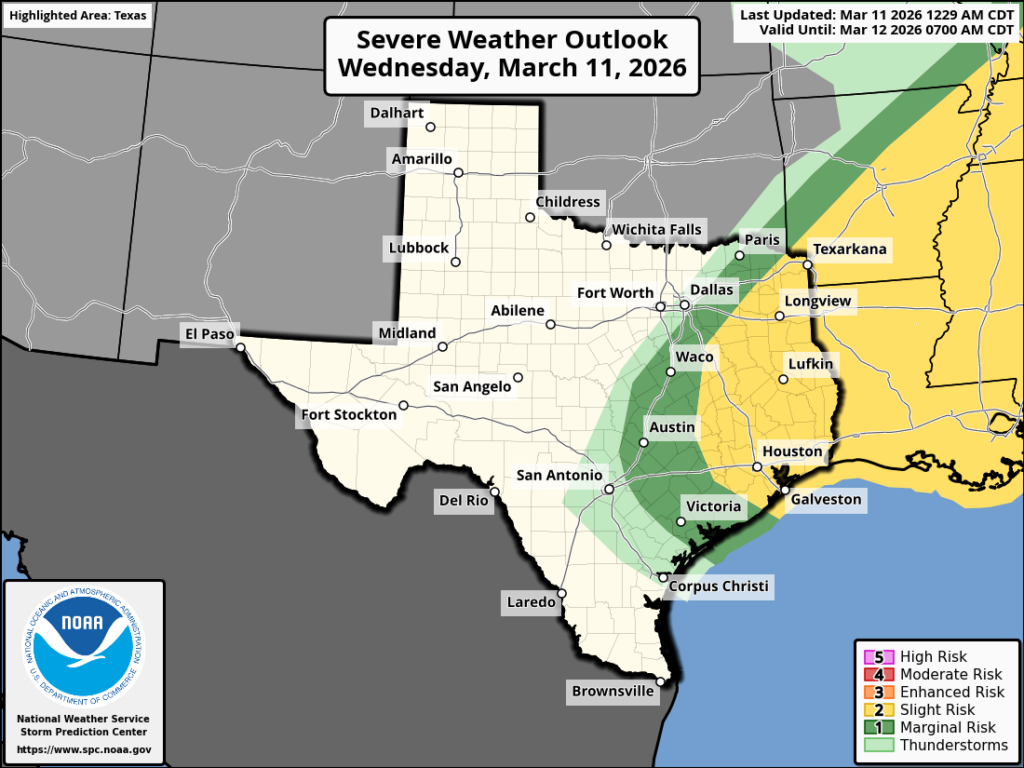
Severe weather outlook for Wednesday. (NOAA)
Notably, there is also the threat of severe weather with some of these storms. Although conditions will be most favorable along and north of Interstate 10, we cannot rule out damaging winds, hail, and possibly even a tornado throughout the Houston area today. Please be weather aware this afternoon if you are out and about, and check the radar before hitting the road. Not everyone will see inclement weather, but where severe thunderstorms do develop conditions could deteriorate quickly. The majority of storms should have exited the area by or before sunset.
Wednesday
Aside from the potential for storms, the other notable feature about today’s weather is the temperatures. Lows this morning have only fallen into the mid-70s for much of the region, which is very warm. Highs today, with mostly cloudy skies, will reach around 80 degrees with plenty of humidity. As noted above, storm activity will increase in coverage this afternoon.
Houston rodeo forecast
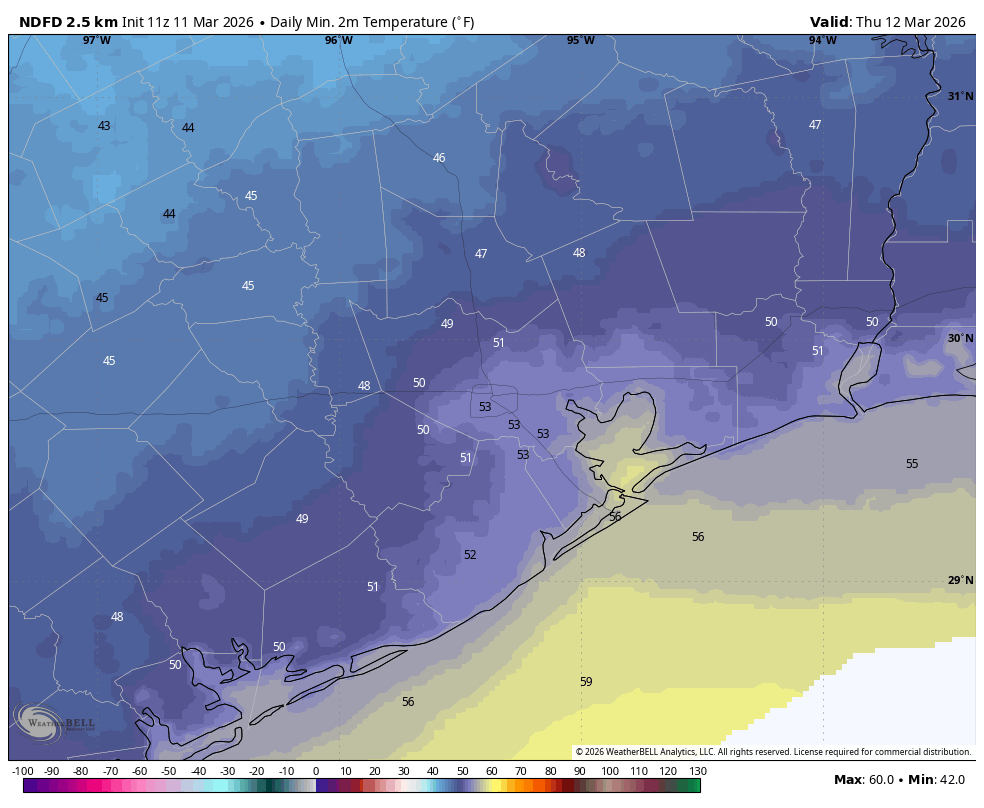
There is the potential for storms in the Houston metro area, including near NRG Stadium, this afternoon. But by around 6 pm I do expect them to be clearing out. That’s not the end of things, however, as we will see gusty winds from the north later this evening. By around 9 or 10 pm winds should increase further in intensity, perhaps up to 35 mph. You probably will feel this after the show as colder and much drier air moves in. These winds will blow all night, bringing temperatures down into the low 50s by Thursday morning.
Low temperature forecast for Thursday morning in Houston. (Weather Bell)
Thursday
This will be a spring-like day with highs in the upper 60s and brisk, northerly winds gusting up to 25 mph. Skies will be sunny. Winds should start to slacken some by the evening, with a majority of the area falling into the upper 40s on Thursday night.
Friday
This will be a sunny, pleasant day with calm winds. Look for high temperatures in the mid-70s. No complaints, really. It will be spectacular. Lows on Friday night will fall into the mid-50s.
Saturday and Sunday
Temperatures this weekend will be warmer, with highs in the low 80s on Saturday and mid-80s on Sunday, and mostly sunny skies. Still, humidity does not look to get too high. The region’s next front arrives late this weekend, perhaps on Sunday evening or Monday morning. At this point I don’t foresee much in the way of storms with this one.
Next week
I’ll have more on this tomorrow, but Sunday’s front could usher in some significantly cooler air, with a few nights in the lower 40s in Houston, and possibly even upper 30s for more rural locations. We’ll have to wait for details, however, as I want to see a little more consistency in the models before hazarding a firm forecast.