Cowboy Who?
Shared posts


Train derailment in Fort Bend County prompts emergency response, impacts traffic
Retail News: Taco Cabana closes Heights location
Literary References, According to Tech Bros
From Grok to Palantír to “wireheading,” tech bros are renowned for flawlessly using literary references to name and explain technology in ways that absolutely never misunderstand the source texts. Here are some examples you might hear bandied about the Bay Area and beyond.
Doublethink | verb
To operate two large language models simultaneously, typically one with each hand.
Usage: “I don’t care that you’re going into labor, honey. I’m doublethinking with Claude and Grok right now.”
Cash-22 | noun
A situation in which a startup founder must do unspeakable things to secure necessary funding.
Usage: “Our CEO was in a Cash-22 at the Peter Thiel pitch event, and now he’s a mere shell of a man.”
Sword of Damocles | proper noun
A human-first motivational framework employed in Amazon warehouses.
Usage: “Since implementing Sword of Damocles, productivity has increased by 25 percent while bottle-peeing has remained flat.”
Big Brother | proper noun
The new word Meta uses for managers.
Usage: “My Big Brother gave me ‘missing expectations’ because I haven’t been working hard enough to monetize Marketplace lookie-loos.”
Trojan horseable | adjective
Describing a non-dating app that is effective for finding dates.
Usage: “Zillow is extremely Trojan horseable.”
Kfka | proper noun
A startup building AI-powered government systems, starting with immigration and visa processing.
Usage: “My H-1B visa got denied by Kfka. When I appealed, I had to argue my case to a chatbot that kept referring me to other chatbots.”
The Los Angeles Aqueduct is Wild
[Note that this article is a transcript of the video embedded above.]
On the northern edge of Los Angeles, fresh water spills down two stark concrete chutes perched on the foothills of the San Gabriel Mountains, a place simply called The Cascades. It’s a deceptively simple-looking finish line: the end of a roughly 300-mile (or 500 km) journey from the eastern slopes of the Sierra Nevada into the city.
On November 5, 1913, tens of thousands of people climbed these hills to watch the first water arrive. When the gates finally opened, water trickled through, but that trickle quickly became a torrent. The project’s chief engineer, William Mulholland, leaned over to the mayor and shouted the line that’s been repeated ever since: “There it is, Mr. Mayor. Take it!”
That moment was profound for a lot of reasons, depending on where you live and how you feel about water rights. LA didn’t become LA by living within the limits of its local resources. Its meteoric growth into the metropolis we know was enabled by an early and extraordinary decision to reach far beyond its own watershed and pull a whole new river into town. Today, roughly a third of LA’s water comes from the Eastern Sierra through the Los Angeles Aqueduct system. That share swings with snowpack, drought, and environmental constraints, but this one piece of infrastructure helped turn a water-limited town into a world city. It’s one of the most impressive and controversial engineering projects in American history.
But to really appreciate that water in the cascades, you have to look way upstream and see what it took to get it there. It’s gravity, geology, politics, and human ambition all in a part of the state that most people never see. Let’s take a little tour so you can see what I mean. I’m Grady and this is Practical Engineering.
When most people think about aqueducts, this is what they picture: a bridge carrying water over a valley or river. And, just to be clear, these are aqueducts. But engineers often use the term more broadly to describe any type of conveyance system that carries water over a long distance from a source to a distribution point. Could be a canal, a pipe, a tunnel, or even just a ditch. In the case of the LA aqueduct, it’s all of them, plus a lot of supporting infrastructure as well.
From the center of the city, it’s about a four hour drive to the Owens River Diversion Weir. It’s not accessible to the public, but it is the official start of the LA Aqueduct, at least when it was originally built. Here, all the snowmelt and rain from a huge drainage system between the Sierra Nevada and Inyo Mountains funnel down into the Owens River, where a large concrete diversion weir peels nearly all of it out of its natural course and into a canal. This point is roughly 2,500 feet (or 750 meters) higher in elevation than the bottom of the Cascades at the downstream end, which makes it obvious why LA chose it as a source. The entire aqueduct is a gravity machine. There are no pumps pushing the water toward the city. Half a mile of elevation change feels like a lot until you realize you have to spread it out over 300 miles. It’s all achieved through careful grading and managing elevations along the way to keep the flow moving.
That care is particularly important in this upper section of the aqueduct, where the water flows in an open canal. To do this efficiently, you need a relatively constant slope from start to finish. That’s a tough thing to achieve on the surface of a bumpy earth. Following a river valley makes this easier, but you can see the twists and turns necessary to keep the aqueduct on its gentle slope toward LA.
If it seems kind of wild that a city would buy up the land and water rights from somewhere so far away, it did to a lot of the people who lived in the Owens Valley, too. A lot of the acquisitions and politics of the original LA Aqueduct were carried out in bad faith, souring relationships with landowners, ranchers, farmers, and communities in the area. The saga is full of broken promises and shady dealings. Then when the diversion started, the area dried up, disrupting the ecology of the region, making agriculture more difficult and residents even more resentful. Many resorted to violence, not against people but against the infrastructure. They vandalized parts of the aqueduct, a conflict that later became known as the California Water Wars. In one case in 1924, ranchers used dynamite to blow up a part of the canal. Later that year, they seized the Alabama Gates.
About 20 miles or 35 kilometers downstream from the diversion weir, a set of gates sits on the eastern bank of the aqueduct canal. Because it runs beside the river valley, the aqueduct captures some of the water that flows down from the surrounding mountains in addition to what’s diverted out of the Owens River, particularly during strong storms. That means it’s actually possible for the canal to overfill. The Alabama Gates serve as a spillway, allowing operators to divert water back down to the river. This also helps drain the canal for maintenance or repairs when needed.
Those Owens Valley ranchers understood exactly what the Alabama Gates controlled. Open them, and the water would run back where it had always run, down the Owens River, instead of south to Los Angeles. The resistance simmered and flared for years, but it didn’t end in the dramatic showdown at the aqueduct. Instead, it ended at a bank counter. The Inyo County Bank was run by two brothers who were also key organizers and financiers of the resistance campaign. In August 1927, an audit revealed major shortfalls and ongoing embezzlement, and the bank quickly collapsed. Residents across the valley saw their savings wiped out or frozen overnight, shattering what was left of the community’s ability to keep fighting.
The Alabama Gates weren’t just a political flashpoint though. They also marked an important dividing line in the aqueduct’s design. LA knew that even if the ranchers didn’t release the water to the river in protests, a lot of it would end up there anyway through seepage. As the canal climbed away from the valley floor and crossed more porous soil, it would naturally lose its water through the ground. So, at the Alabama Gates, the aqueduct transitions from an unlined canal to a concrete-lined channel. It’s still open to the air, so there’s no protection against evaporation or contamination, but the losses to the ground are a lot less.
This design continues for about 35 miles (or 55 kilometers) through the valley. Along the way, the aqueduct passes the remains of Owens Lake. Once a large body of water, it quickly dried up with the diversion of the Owens River. Of course, there were impacts to wildlife from the loss of water, but the bigger problem came later: dust. All the fine sediment that settled on the lakebed over thousands of years was now exposed to the hot desert sun. When the wind picked up, it filled the air with fine particulates that are dangerous to breathe. Over the years, there have been times when Owens Lake is the single largest source of dust pollution in the entire country, and LA has spent more than a billion dollars just trying to fix this problem alone. The aqueduct passing along the hillside past the lake and its challenges is a reminder that the true cost of water is often a lot more than the infrastructure it takes to deliver it.
So far, it might be obvious that this aqueduct system is pretty fragile to be making up a major part of a city’s fresh water supply. Even beyond the vandalism and political resistance, there are a lot of things that could go wrong along the way, from bank collapses, earthquakes, diversion failures, and more. That’s why Haiwee Reservoir was originally built in a narrow saddle between two hills as a kind of buffer. With a dam on either side, it stored water up so the aqueduct could keep running even during a disruption upstream. It also slowed the water down, exposing it to the hot desert sun as a natural form of UV disinfection. In the 1960s, the reservoir was reconfigured into two basins to add some flexibility. That’s because, around that time, the LA aqueduct became two. While the open-topped canal section was large enough to meet demands, the underground conduit in the next section wasn’t. So, LA built a second one in 1970 to increase the flow. If you look at this map of the Haiwee Reservoirs, you can see that water has two paths: it can flow into the second aqueduct here from the north basin, or it can pass through the Merritt Cut to the south reservoir, through the intake there, and into the first aqueduct. This setup allows for some redundancy, along with regulation and balancing of the flows between the two aqueducts. Haiwee marks the start of the long desert run, with both systems no longer in open-topped lined canals, but running underground in concrete conduits.
There are a lot of advantages to running an aqueduct in a closed conduit underground, especially one this long through a desert landscape. There’s far less evaporation and less potential for contamination. It doesn’t divide the landscape at the surface level, so there’s no need for bridges, culverts, and wildlife crossings. Going underground also offers more flexibility when it comes to topography. You don’t have to follow the contours of the surface so carefully because if you come to a hill, you can just dig a little deeper to keep the constant slope.
Of course, those benefits come with a cost. An underground conduit is more expensive than a simple channel on the surface, and not all the problems with topography are solved. This is Jawbone Canyon, one of the biggest drops for the first aqueduct. Rather than taking a major detour around it, the aqueduct descends 850 feet (or 250 meters) and then ascends back up. This type of structure is often called an inverted siphon. I’ve done a video on how these work for sewer systems, and I’ve also done a video on flood tunnels that work in a similar way, if you want to learn more after this.
Unlike the concrete conduit, which really just acts like an underground canal with a roof, this is one of the places where the water in the aqueduct is pressurized. 850 feet of water column is about 370 psi, 26 bar, or two-and-a-half Megapascals. It’s a lot of pressure. These sections of pipe had to be specially manufactured on the East Coast, where the major steel facilities were, and transported by ship because of their size. They travelled all the way around Cape Horn, since the Panama Canal was still under construction. There are actually quite a few of these siphons crossing canyons in this section of the aqueduct, but Jawbone Canyon is the biggest one.
A little further downstream, the LA aqueduct crosses the California Aqueduct, part of the State Water Project. That system has a connection to LA as well, but this branch at the crossing actually heads to Silverwood Lake. However, there is a transfer facility, recently completed, that can pump water out of the California Aqueduct directly into the first LA aqueduct. This creates opportunities for LA to buy water that moves through the state system and offers some flexibility in where that water ends up. There’s also a turn-in that can move water from the LA aqueduct into the California aqueduct for situations where trades make sense. The second LA aqueduct passes underneath the state canal here. And this is a good example of the differences between the first project (built in the 1910s) and the second one, built in the 1960s. Over that time, the price of labor went up a lot more than the price of materials. Where the first one carefully followed the existing topography with bends and turns to minimize the need for expensive pressurized pipe, the second one could take a more direct path, reducing labor in return for the more specialized conduit materials.
After wandering more than a hundred miles (or 160 kilometers) apart, the two Los Angeles Aqueducts come back together at Fairmont Reservoir, in the northern foothills of the Sierra Pelona Mountains. This is the last major topographic barrier on the way to Los Angeles. There was no way to go up and over without pumps, so instead they went straight through. The largest project was the Elizabeth tunnel.
Here, the two aqueducts come together again into a single watercourse. About 5 miles or 8 kilometers of excavation through everything from hard rock to loose, wet ground became one of the most difficult parts of the entire project. The tunnel required continuous temporary supports along most of its length, followed by a permanent concrete lining. It was a monumental effort for its time and essential not only to cross the range. The Elizabeth Tunnel also delivers that water under pressure to the San Francisquito Power Plant Number 1.
This is the largest of the eight hydroelectric plants that run along the aqueduct, capturing some of the energy from the water as it flows downward toward LA. These plants are a major part of how the project paid for itself, and they continue to serve as an important source of electricity in the region today.
Continuing downstream, Bouquet Canyon reservoir adds another layer of operational flexibility. It helps regulate flow through the power plants and provides additional storage, a sort of insurance policy since this whole reach depends on a single major tunnel crossing the San Andreas Fault. In case of a major earthquake, it’d be best if Angelinos could avoid a simultaneous water shortage.
The aqueduct splits again just upstream of the San Francisquito Plant Number 2, which was famously destroyed by the St. Francis Dam failure. That reservoir project was designed to supplement the storage capacity along the aqueduct, but the dam failed catastrophically in 1928, just 2 years after it was completed, killing more than 400 people and destroying several parts of the aqueduct as well. The tragedy was one of the worst engineering disasters in American history. It put another stain on the aqueduct project, and it effectively ruined the reputation of William Mulholland, who was largely considered a hero in LA for all his work on the aqueduct and the city’s water system. The dam was never rebuilt, but workers restored the aqueduct to functioning service in only 12 days.
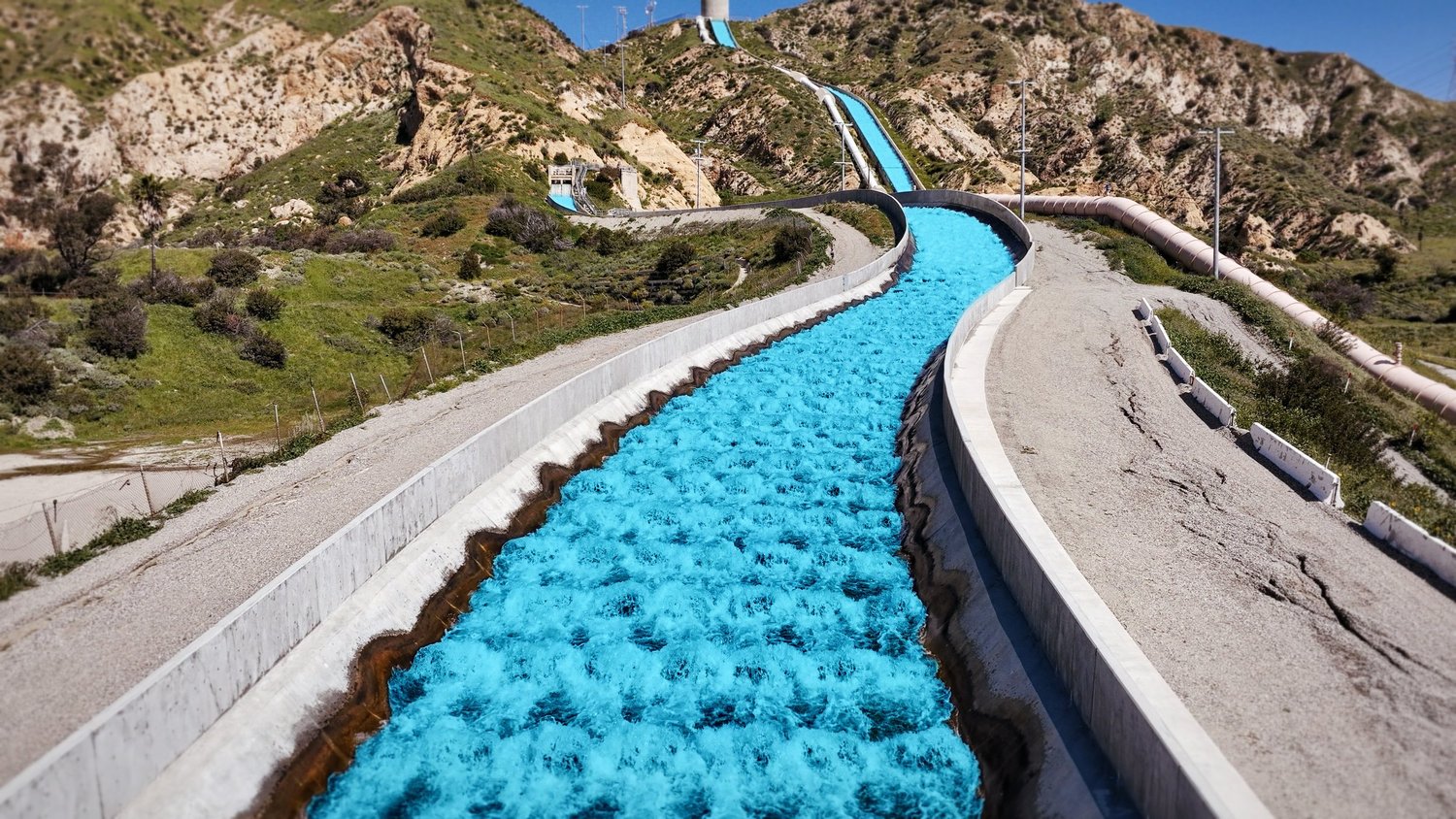
At Drinkwater Reservoir, the two aqueducts run roughly parallel through the Santa Clarita area, sometimes aboveground and sometimes below, before finally reaching the terminal structures that carry water into LA. Usually, the water stays in the conduits, which feed the two hydropower plants at the foot of the mountains. If the plants are out of service or there’s more flow than they can handle, you see excess water thundering through the cascade structures instead.
From here, the aqueduct drops out of the mountains and into the north end of the San Fernando Valley, where the water is treated and prepared for distribution. After filtration and disinfection, it’s stored in the Los Angeles Reservoir, the system’s terminal reservoir, so the city can smooth out day-to-day swings in demand even while the aqueduct’s inflow stays relatively steady.
For most of Los Angeles' history, that “finished water storage” was out in the open air. But in the 2000s, drinking-water rules pushed utilities to add stronger protection for treated water held in uncovered reservoirs. There’s a good chance you’ve seen their solution on the Veritasium channel or elsewhere: 96 million plastic shade balls that act like a floating cover, blocking sunlight to prevent water-chemistry problems and helping keep wildlife out. They’re the final protection for this water that traveled so long to reach the city. While the LA Reservoir is, in a sense, the end of the journey for this water, the original diversion way back at Owen’s River isn’t even technically the start anymore!
In 1940, LA extended the aqueduct system upstream northward by connecting the Mono basin and funneling its water through tunnels to the Owens River basin. Like Owens Lake downstream, Mono Lake began drying out as well. And also like Owens Lake, lawsuits, court orders, and environmental regulations have tempered the value of this water source, forcing LA to significantly reduce diversions and implement costly restoration projects.
That’s kind of the story of the LA aqueduct in a nutshell. The project seemed obvious from an engineering perspective. There was lots of snowmelt in the mountains; the city had the technical prowess, the funding, the elevation, and the political power to reach out and take it. The result was one of the most impressive works of infrastructure of the early 20th century. And continued efforts to expand and improve the system have made it even more efficient, flexible, and valuable to the many millions of people who live in one of the most populous cities in America, delivering not only water but also hundreds of megawatts of hydropower.
But it many ways, it was not only unscrupulous, but also short-sighted. Residents of the Owens Valley watched ranchland and farmland dry up as the water that had shaped their home was rerouted south. Native communities saw their homeland transformed with access to gathering areas disrupted, places made unrecognizable, and cultural ties strained by changes they didn’t choose. Wind picked up alkaline dust from dried lakebeds. Habitats were disrupted, and the birds that depended on these waters and wetlands lost part of what made this migration corridor work. It’s easy to see why the aqueduct remains controversial, and why what we sometimes dismiss as “red tape” around major infrastructure is often completely justified due diligence. As engineers, and really, as humans, we have to try and account for costs that don’t show up on a balance sheet, but can come back later as decades of lawsuits, mitigation, and restoration.
And even the aqueduct’s original thesis (that there’s reliable snowmelt up there, and a growing city down here) is starting to falter. In recent decades, the mountains have delivered less predictable runoff: more swings, more years when the timing is wrong, and more uncertainty about what “normal” even means anymore. California’s climate has always moved in long cycles, but the margin for error is thinner now, and no one can say with much confidence when or if the moisture the state depends on will return to its old pattern.
The hopeful part is that this is exactly where engineering makes a difference: at the messy intersection of geology, climate, culture, politics, and human need. The Los Angeles Aqueduct is a case study in what we can build when we’re ambitious, but also what happens when we treat a landscape like a machine with only one output. The next era of water engineers can learn a lot from it.
Pluralistic: William Gibson vs Margaret Thatcher (17 Mar 2026)

Today's links
- William Gibson vs Margaret Thatcher: The Street Finds Its Own Alternatives For Things.
- Hey look at this: Delights to delectate.
- Object permanence: Prison for spamming; Dotcom layoffs; Ethernet action-figures; UK libel reform; "Poe's Detective"; God's customer service center; "Making Hay"; Alexa privacy Valdez.
- Upcoming appearances: Where to find me.
- Recent appearances: Where I've been.
- Latest books: You keep readin' em, I'll keep writin' 'em.
- Upcoming books: Like I said, I'll keep writin' 'em.
- Colophon: All the rest.

William Gibson vs Margaret Thatcher (permalink)
William Gibson is one of history's most quotable sf writers: "The future is here, it's not evenly distributed"; "Don't let the little fuckers generation-gap you"; "Cyberspace is everting"; and the immortal: "The street finds its own uses for things":
https://en.wikiquote.org/wiki/William_Gibson
"The street finds its own uses" is a surprisingly subtle and liberatory battle-cry. It stakes a claim by technology's users that is separate from the claims asserted by corporations that make technology (often under grotesque and cruel conditions) and market it (often for grotesque and cruel purposes).
"The street finds its own uses" is a statement about technopolitics. It acknowledges that yes, there are politics embedded in our technology, the blood in the machine, but these politics are neither simple, nor are they immutable. The fact that a technology was born in sin does not preclude it from being put to virtuous ends. A technology's politics are up for grabs.
In other words, it's the opposite of Audre Lorde's "The master's tools will never dismantle the master's house." It's an assertion that, in fact, the master's tools have all the driver-bits, hex-keys, and socket sets needed to completely dismantle the master's house, and, moreover, to build something better with the resulting pile of materials.
And of course the street finds its own uses for things. Things – technology – don't appear out of nowhere. Everything is in a lineage, made from the things that came before it, destined to be transformed by the things that come later. Things can't come into existence until other things already exist.
Take the helicopter. Lots of people have observed the action of a screw and the twirling of a maple key as it falls from a tree and thought, perhaps that could be made to fly. Da Vinci was drawing helicopters in the 15th century:
https://en.wikipedia.org/wiki/Leonardo%27s_aerial_screw
But Da Vinci couldn't build a helicopter. No one could, until they did. To make the first helicopter, you need to observe the action of the screw and the twirling of a maple key, and you need to have lightweight, strong alloys and powerful internal combustion engines.
Those other things had to be invented by other people first. Once they were, the next person who thought hard about screws and maple keys was bound to get a helicopter off the ground. That's why things tend to be invented simultaneously, by unrelated parties.
TV, radio and the telephone all have multiple inventors, because these people were the cohort that happened to alight upon the insights needed to build these technologies after the adjacent technologies had been made and disseminated.
If technopolitics were immutable – if the original sin of a technology could never be washed away – then everything is beyond redemption. Somewhere in the history of the lever, the pulley and the wheel are some absolute monsters. Your bicycle's bloodline includes some truly horrible ancestors. The computer is practically a crime against humanity:
https://pluralistic.net/2021/10/24/the-traitorous-eight-and-the-battle-of-germanium-valley/
A defining characteristic of purity culture is the belief that things are defined by their origins. An artist who was personally terrible must make terrible art – even if that art succeeds artistically, even if it moves, comforts and inspires you, it can't ever be separated from the politics of its maker. It is terrible because of its origins, not its merits. If you hate the sinner, you must also hate the sin.
"The street finds its own uses" counsels us to hate the sinner and love the sin. The indisputable fact that HP Lovecraft was a racist creep is not a reason to write off Cthulhoid mythos – it's a reason to claim and refashion them:
https://pluralistic.net/2021/01/09/the-old-crow-is-getting-slow/#i-love-ny
The claim that sin is a kind of forever-chemical contaminant that can't ever be rinsed away is the ideology of Mr Gotcha:
We should improve society somewhat.
Yet you participate in society. Curious!
https://thenib.com/mister-gotcha/
In its right-wing form, it is Margaret Thatcher's "There is no alternative":
https://pluralistic.net/2024/10/15/piketty-pilled/#tax-justice
Thatcher demanded that you accept all the injustices and oppressions of capitalism if you enjoyed its fruits. If capitalism put a roof over your head and groceries in your fridge, you can't complain about the people it hurts. There is no version of society that has the machines and practices that produced those things that does not also produce the injustice.
The technological version of this is the one that tech bosses peddle: If you enjoy talking to your friends on Facebook, you can't complain about Mark Zuckerberg listening in on the conversation. There is no alternative. Wanting to talk to your friends out of Zuck's earshot is like wanting water that's not wet. It's unreasonable.
But there's a left version of this, its doppelganger: the belief that a technology born in sin can never be redeemed. If you use an LLM running on your computer to find a typo, using an unmeasurably small amount of electricity in the process, you still sin – not because of anything that happens when you use that LLM, but because of LLMs' "structural properties," "the way they make it harder to learn and grow," "the way they make products worse," the "emissions, water use and e-waste":
https://tante.cc/2026/02/20/acting-ethical-in-an-imperfect-world/
The facts that finding punctuation errors in your own work using your own computer doesn't make it "harder to learn and grow," doesn't "make products worse," and doesn't add to "emissions, water use and e-waste" are irrelevant. The part that matters isn't the use of a technology, it's the origin.
The fact that this technology is steeped in indisputable sin means that every use of it is sinful. The street can find as many uses as it likes for things, but it won't matter, because there is no alternative.
When radical technologists scheme to liberate technology, they're not hoping to redeem the gadget, they're trying to liberate people. Information doesn't want to be free, because information doesn't and can't want anything. But people want to be free, and liberated access to information technology is a precondition for human liberation itself.
Promethean leftists don't reject the master's tools: we seize them. The fact that Unix was born of a convicted monopolist who turned the screws on users at every turn isn't a reason to abandon Unix – it demands that we reverse-engineer, open, and free Unix:
https://pluralistic.net/2025/01/20/capitalist-unrealism/#praxis
We don't do this out of moral consideration for Unix. Unix is inert, it warrants no moral consideration. But billions of users of free operating systems that are resistant to surveillance and control are worthy of moral consideration and we set them free by seizing the means of computation.
If a technology can do something to further human thriving, then we can love the sin, even as we hate the sinners in its lineage. We seize the means of computation, not because we care about computers, but because we care about people.
Artifacts do have politics, but those politics are not immutable. Those politics are ours to seize and refashion:
https://faculty.cc.gatech.edu/~beki/cs4001/Winner.pdf
"The purpose of a system is what it does" (S. Beer). The important fact about a technology is what it does, not how it came about. Does a use of a technology harm someone? Does a use of a technology harm the environment?
Does a use of a technology help someone do something that improves their life?
Studying the origins of technology is good because it helps us avoid the systems and practices that hurt people. Knowing about the monsters in our technology's lineage helps us avoid repeating their sins. But there will always be sin in our technology's past, because our technology's past is the entire past, because technology is a lineage, not a gadget. If you reject things because of their origins – and not because of the things they do – then you'll end up rejecting everything (if you're honest), or twisting yourself into a series of dead-ends as you rationalize reasons that the exceptions you make out of necessity aren't really exceptions.
(Image: Dylan Parker, CC BY-SA 2.0, modified)
Hey look at this (permalink)

- Gone (Almost) Phishin’ https://ma.tt/2026/03/gone-almost-phishin/
-
The Foilies 2026 https://www.eff.org/deeplinks/2026/03/foilies-2026
-
Why Voters Should Support Senator Klobuchar’s ‘‘Antitrust Accountability and Transparency Act’’ https://www.thesling.org/why-voters-should-support-senator-klobuchars-antitrust-accountability-and-transparency-act/
-
Bombshell Document Details Watergate-Style Corruption at the Antitrust Division https://www.thebignewsletter.com/p/monopoly-round-up-bombshell-document
-
Sodium-ion batteries hit the Midwestern grid in first-of-its-kind pilot https://electrek.co/2026/03/11/sodium-ion-batteries-hit-the-midwestern-grid-in-first-of-its-kind-pilot (h/t Slashdot)

Object permanence (permalink)
#25yrsago Prison for spamming https://it.slashdot.org/story/01/03/15/1325251/spammers-face-jail-time
#25yrsago 1040 for laid-off dot com workers https://web.archive.org/web/20010603113932/http://www.girlchick.com/erin/Pics/DotCom1040.jpg
#25yrsago Sony ships a PalmOS device https://web.archive.org/web/20010331181042/http://www.sony.co.jp/sd/CLIE/index_pc.html
#25yrsago “You Own Your Own Metadata” https://www.feedmag.com/templates/default_a_id-1648
#20yrsago Action-figures made from Ethernet cable https://basik.ru/handmade/2066/
#15yrsago Poor countries have more piracy because media costs too much — report https://web.archive.org/web/20110310042425/http://piracy.ssrc.org/the-report/
#15yrsago Bahrain’s royals declare martial law https://www.theguardian.com/world/2011/mar/15/bahrain-martial-law-protesters-troops
#15yrsago Libel reform in the UK: telling the truth won’t be illegal any longer? https://www.theguardian.com/media/2011/mar/15/libel-law-reforms
#15yrsago My weird femur printed in stainless steel https://www.flickr.com/photos/doctorow/tags/femur
#15yrsago War on the PC and the network: copyright was just the start https://www.theguardian.com/technology/2011/mar/15/computers-incorporate-spyware-dangers
#15yrsago Poe’s Detective: audio editions of Poe’s groundbreaking detective stories https://memex.craphound.com/2011/03/15/poes-detective-audio-editions-of-poes-groundbreaking-detective-stories/
#15yrsago New York slashes hospital spending, but can’t touch multimillion-dollar CEO paychecks https://www.nytimes.com/2011/03/16/nyregion/16about.html?_r=1&hp
#10yrsago Leaked memo: Donald Trump volunteers banned from critizing him, for life https://web.archive.org/web/20160315161328/http://www.dailydot.com/politics/donald-trump-volunteer-contract-nda-non-disparagement-clause/
#10yrsago Open letter from virtually every leading UK law light: Snooper’s Charter not fit for purpose https://www.theguardian.com/law/2016/mar/14/investigatory-powers-bill-not-up-to-the-task
#10yrsago Life inside God’s customer service prayer call-centre https://web.archive.org/web/20160317153851/http://www.tor.com/2016/03/15/your-orisons-may-be-recorded/
#10yrsago The post-Snowden digital divide: the ability to understand and use privacy tools https://journal.radicallibrarianship.org/index.php/journal/article/view/12/27
#10yrsago Some future for you: the radical rise of hope in the UK https://thebaffler.com/salvos/despair-fatigue-david-graeber
#10yrsago America’s universities: Hedge funds saddled with inconvenient educational institutions https://web.archive.org/web/20160309093147/https://www.thenation.com/article/universities-are-becoming-billion-dollar-hedge-funds-with-schools-attached/
#10yrsago Office chairs made out of old Vespa scooters https://belybel.com/
#5yrsago STREAMLINER https://pluralistic.net/2021/03/15/free-markets/#streamliner
#5yrsago Free markets https://pluralistic.net/2021/03/15/free-markets/#rent-seeking
#5yrsago Making Hay https://pluralistic.net/2021/03/15/free-markets/#making-hay
#1yrago Amazon annihilates Alexa privacy settings, turns on continuous, nonconsensual audio uploading https://pluralistic.net/2025/03/15/altering-the-deal/#telescreen
Upcoming appearances (permalink)

- Barcelona: Enshittification with Simona Levi/Xnet (Llibreria Finestres), Mar 20
https://www.llibreriafinestres.com/evento/cory-doctorow/ -
Berkeley: Bioneers keynote, Mar 27
https://conference.bioneers.org/ -
Montreal: Bronfman Lecture (McGill), Apr 10
https://www.eventbrite.ca/e/artificial-intelligence-the-ultimate-disrupter-tickets-1982706623885 -
Montreal: Drawn and Quarterly, Apr 10
https://mtl.drawnandquarterly.com/events/4863920260410 -
London: Resisting Big Tech Empires (LSBU), Apr 25
https://www.tickettailor.com/events/globaljusticenow/2042691 -
Berlin: Re:publica, May 18-20
https://re-publica.com/de/news/rp26-sprecher-cory-doctorow -
Berlin: Enshittification at Otherland Books, May 19
https://www.otherland-berlin.de/de/event-details/cory-doctorow.html -
Hay-on-Wye: HowTheLightGetsIn, May 22-25
https://howthelightgetsin.org/festivals/hay/big-ideas-2

Recent appearances (permalink)
- Do you feel screwed over by big tech? (Ontario Today)
https://www.cbc.ca/listen/live-radio/1-45-ontario-today/clip/16203024-do-feel-screwed-big-tech -
Launch for Cindy's Cohn's "Privacy's Defender" (City Lights)
https://www.youtube.com/watch?v=WuVCm2PUalU -
Chicken Mating Harnesses (This Week in Tech)
https://twit.tv/shows/this-week-in-tech/episodes/1074 -
The Virtual Jewel Box (U Utah)
https://tanner.utah.edu/podcast/enshittification-cory-doctorow-matthew-potolsky/ -
Tanner Humanities Lecture (U Utah)
https://www.youtube.com/watch?v=i6Yf1nSyekI

Latest books (permalink)
- "Canny Valley": A limited edition collection of the collages I create for Pluralistic, self-published, September 2025 https://pluralistic.net/2025/09/04/illustrious/#chairman-bruce
-
"Enshittification: Why Everything Suddenly Got Worse and What to Do About It," Farrar, Straus, Giroux, October 7 2025
https://us.macmillan.com/books/9780374619329/enshittification/ -
"Picks and Shovels": a sequel to "Red Team Blues," about the heroic era of the PC, Tor Books (US), Head of Zeus (UK), February 2025 (https://us.macmillan.com/books/9781250865908/picksandshovels).
-
"The Bezzle": a sequel to "Red Team Blues," about prison-tech and other grifts, Tor Books (US), Head of Zeus (UK), February 2024 (thebezzle.org).
-
"The Lost Cause:" a solarpunk novel of hope in the climate emergency, Tor Books (US), Head of Zeus (UK), November 2023 (http://lost-cause.org).
-
"The Internet Con": A nonfiction book about interoperability and Big Tech (Verso) September 2023 (http://seizethemeansofcomputation.org). Signed copies at Book Soup (https://www.booksoup.com/book/9781804291245).
-
"Red Team Blues": "A grabby, compulsive thriller that will leave you knowing more about how the world works than you did before." Tor Books http://redteamblues.com.
-
"Chokepoint Capitalism: How to Beat Big Tech, Tame Big Content, and Get Artists Paid, with Rebecca Giblin", on how to unrig the markets for creative labor, Beacon Press/Scribe 2022 https://chokepointcapitalism.com

Upcoming books (permalink)
- "The Reverse-Centaur's Guide to AI," a short book about being a better AI critic, Farrar, Straus and Giroux, June 2026 (https://us.macmillan.com/books/9780374621568/thereversecentaursguidetolifeafterai/)
-
"Enshittification, Why Everything Suddenly Got Worse and What to Do About It" (the graphic novel), Firstsecond, 2026
-
"The Post-American Internet," a geopolitical sequel of sorts to Enshittification, Farrar, Straus and Giroux, 2027
-
"Unauthorized Bread": a middle-grades graphic novel adapted from my novella about refugees, toasters and DRM, FirstSecond, 2027
-
"The Memex Method," Farrar, Straus, Giroux, 2027

Colophon (permalink)
Today's top sources:
Currently writing: "The Post-American Internet," a sequel to "Enshittification," about the better world the rest of us get to have now that Trump has torched America (1018 words today, 50532 total)
- "The Reverse Centaur's Guide to AI," a short book for Farrar, Straus and Giroux about being an effective AI critic. LEGAL REVIEW AND COPYEDIT COMPLETE.
-
"The Post-American Internet," a short book about internet policy in the age of Trumpism. PLANNING.
-
A Little Brother short story about DIY insulin PLANNING

This work – excluding any serialized fiction – is licensed under a Creative Commons Attribution 4.0 license. That means you can use it any way you like, including commercially, provided that you attribute it to me, Cory Doctorow, and include a link to pluralistic.net.
https://creativecommons.org/licenses/by/4.0/
Quotations and images are not included in this license; they are included either under a limitation or exception to copyright, or on the basis of a separate license. Please exercise caution.
How to get Pluralistic:
Blog (no ads, tracking, or data-collection):
Newsletter (no ads, tracking, or data-collection):
https://pluralistic.net/plura-list
Mastodon (no ads, tracking, or data-collection):
Bluesky (no ads, possible tracking and data-collection):
https://bsky.app/profile/doctorow.pluralistic.net
Medium (no ads, paywalled):
https://doctorow.medium.com/
https://twitter.com/doctorow
Tumblr (mass-scale, unrestricted, third-party surveillance and advertising):
https://mostlysignssomeportents.tumblr.com/tagged/pluralistic
"When life gives you SARS, you make sarsaparilla" -Joey "Accordion Guy" DeVilla
READ CAREFULLY: By reading this, you agree, on behalf of your employer, to release me from all obligations and waivers arising from any and all NON-NEGOTIATED agreements, licenses, terms-of-service, shrinkwrap, clickwrap, browsewrap, confidentiality, non-disclosure, non-compete and acceptable use policies ("BOGUS AGREEMENTS") that I have entered into with your employer, its partners, licensors, agents and assigns, in perpetuity, without prejudice to my ongoing rights and privileges. You further represent that you have the authority to release me from any BOGUS AGREEMENTS on behalf of your employer.
ISSN: 3066-764X
Cornyn, Paxton decline to withdraw from Texas Senate runoff ballot as deadline passes


147 measles cases reported in Texas so far this year, most of them in federal detention centers


Corpus Christi water emergency may be just two months away, city leaders say


A massively strong high pressure system over the Western US will extend its influence to Texas
In brief: In today’s post we discuss a very strong ridge of high pressure that is establishing itself across the Western United States, and what that means for Houston’s weather across the next 10 days.

Rocky Mountain High
Houston’s weather, and that for much of the Western United States, will be dominated by a large and persistent pattern of high pressure for the next week or 10 days. Although it is still early spring by the calendar, this high pressure system will be more characteristic of summertime, bringing intense heat across California and the Desert Southwest, with some locations there certain to break records for earliest 100-degree heat.
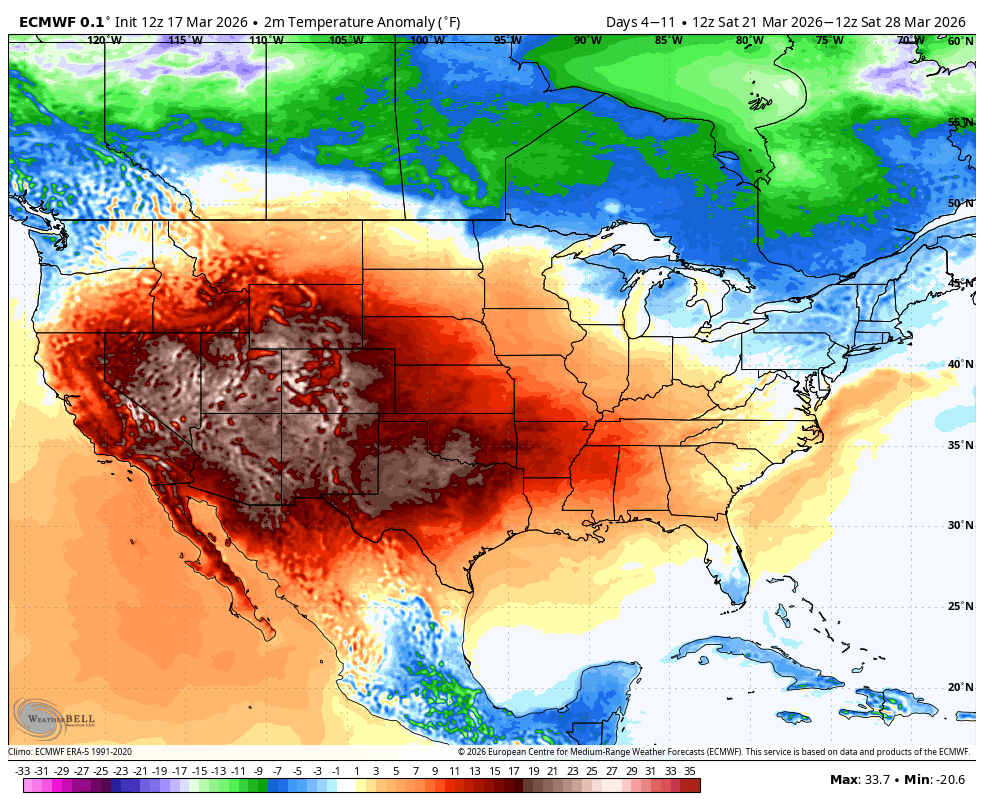
Here in Houston we will be on the periphery of this high pressure system, but still feel its effects. Beginning Friday, and lasting at least a week, we are likely to see mostly sunny skies and warm days with high temperatures in the mid- to upper-80s. Along with this, rain chances will be near zero throughout the forecast period. The bottom line is that, beginning Friday, every day will be very much like the next.
Wednesday
It has not warmed up yet, however. Low temperatures this morning, away from the coast, are generally in the 40s. However, with mild southerly winds we are going to warm up nicely today, into the mid-70s. Skies will be sunny with relatively low humidity levels. Honestly, it should be a gorgeous day.

Houston rodeo weather
It’s Family Wednesday at the rodeo, and conditions look excellent. Temperatures late this afternoon will be in the lower 70s, falling to the lower 60s after the show. Winds may be a bit gusty early this this evening (perhaps up to 15 to 20 mph) so it may be a bit chilly in the shade. Low temperatures will fall into the mid-50s tonight, which is warmer than we’ve been, but cooler than we’ll be for awhile.
Thursday
This will be a sunny day with highs in the vicinity of 80 degrees. Lows on Thursday night have a chance to drop into the upper 50s.
Friday, Saturday, and Sunday
Expect sunny and warm weather with highs in the mid- to upper-80s. Sunday looks like the warmest day of the forecast period, with highs possibly reaching 90 degrees for some far inland areas. Nighttime temperatures will generally be in the 60s. Humidity levels will be rising, but not oppressive like they can be during the summer.

Next week
Sunny and warm conditions will persist for much of next week, with highs generally in the mid- to upper-80s. Some sort of front may arrive by next weekend, and hopefully may bring us some rain showers. But no promises on that score, I’m afraid.

my coworker takes his family everywhere, my desk is really far away from my team, and more
It’s five answers to five questions. Here we go…
1. My male coworker takes his family everywhere, and it makes him late for work events
I am a woman in STEM and have a coworker, Fergus, who has a stay-at-home-wife and a toddler. They currently live out-of-state with his in-laws, and when he travels — whether it’s to a conference, work event, or just an in-office event — he always brings his wife and kid.
This leads him to often not arriving to these events that start at 8 or 9 am until 11 or 12 because he went to brunch with the fam. My (male) boss finds it endearing, despite it often leaving the rest of us idle for hours waiting on him and often seems to overlook women in the office with children for projects.
This is weird, right? If I as a woman were to do it, it would seem distracting to the job and frowned upon, right? I am not being unreasonable here?
Yes, it’s weird. Not necessarily that he brings his wife and kid with him — some people find it easier to do that when they travel — but that he allows it to affect his availability for work during these trips, particularly during normal business hours, and it’s even odder that your boss is apparently fine with it. It’s particularly problematic that your boss seems to discriminate against women with kids, while having a different standard for a man with kids who is actively letting them affect his availability during work hours.
Any chance the rest of you want to speak up and say, “Could we ask Fergus to be here at 8 so we’re not waiting on him like has happened a lot previously?”
2. Is it normal for my desk to be really far away from the rest of my team?
I’m in my mid 30s and have been working full-time for over a decade, but after working in the arts for my whole career, I recently changed industries to something that’s more formal office-type work. When I was interviewing for this job, I made sure to ask as much as I could about office culture, but I didn’t think to ask where my desk would be, and I’m regretting that now.
My office is in the very back corner of the building, far away from everyone else. You basically have to have a map and answer three riddles to get to my office. I feel lucky that I have space to work (and even a window!), but I absolutely hate that I sit alone in my office all day. Is this normal? In my previous roles in arts organizations, even when my job was mostly desk-based, I never felt physically separated from the rest of my team like this. This was usually because there wasn’t enough space for everyone, but even if my office was around a corner, there were constantly reasons to be getting up and talking to my colleagues. On the (rare) occasions that I had an office to myself, everyone else was always close by.
Are people in office jobs really out here just sitting alone at a desk working all day? I feel so disconnected from my colleagues and my work, and I’ve never felt less motivated to do work. Is office/desk location worth asking about when interviewing? I know there are people who love working remotely, but I’ve always struggled with it because it felt isolating to me. But if most office jobs are sitting alone at a computer for most of the day anyway, then I certainly have a new appreciation for being remote, where I can at least hang out with my cat. But I’m seriously considering leaving, and while there are other significant reasons that this job isn’t working for me, the geography of where I’m working is definitely a major factor, so I want to be sure that where I go next doesn’t have the same issues. Is this the norm that I should be expecting? Should I ask about it in any interviews that I get?
It’s not the norm to be seated far away from the rest of your team (which is probably confirmed even in your own office by the fact that the rest of your team seems to be seated closer to each other). But there are certainly workplaces where it happens, often due to a shortage of space where they’d prefer to put you.
Have you talked to your manager about it and asked if there’s a way to sit closer to the rest of the team? You could explain that you feel isolated and would prefer to be in closer contact with people you work with. Who knows, maybe there are alternatives, especially if you’re willing to give up things like a window. It’s worth at least asking.
Otherwise, though, yes, you can ask what the office set-up is like when you’re interviewing. It’s something to save for closer to the end of the interview process, not in an initial phone screen, but you could certainly say something like, “I had a job where I sat really far away from the rest of my team, and I found that made it harder to collaborate. Can you tell me a little about what the office set-up is like for this team, and for this role in particular?”
3. We’re expected to donate a lot of money for gifts throughout the year
I need a gut check on gift giving on my team. We are a team of eight, including our manager. We typically each pitch in $5 for a gift card for everyone’s birthday, which costs around $35 each year. We also do a Christmas present for each team member, which is around $50 total. And then when someone is going through a hard time, like if their pet dies or they have an unexpected medical issue, we will pool another $5-$10 each to help out. So it costs about $100-$120 a year to be on our team.
Contributions are “voluntary,” but they are organized through our online chat platform so everyone can see if you’ve contributed or not. Some of us can definitely afford the cost, but there are people on the team who make a lower hourly wage, and none of us are getting raises this year. Also, I have a very rocky relationship with our manager and had to get HR involved to avoid retaliation around her birthday last year. And I still had to contribute $5 for her gift card and sign a card wishing her a happy birthday.
I am trying to make it work with my manager but she gets really enthusiastic about the gift giving and I find it off-putting. I’m not sure if that’s because of my past issues with her or because I’m starting to think that it costs too much to be on my team. Thoughts?
It’s more than off-putting; it’s unethical. It still happens with a surprising amount of regularity, but people shouldn’t be pressured to contribute their own personal money to have a job, or to be seen a full member of their team.
Whether it’s politically smart to do anything about it is a different issue. There might be room for a bunch of you to speak up and ask that the practice be curtailed — but since you have a rocky relationship with your manager and she apparently retaliated about something birthday-related last year, you probably shouldn’t be the one leading it.
4. We’re not paid for mandatory lunch meetings
We have a mandatory monthly staff meeting with lunch provided. Sometimes the meetings are more than an hour. Our meeting last week was less than 45 minutes. The purpose of the meetings varies. In theory, we are allowed some time to eat lunch before the staff meeting portion starts; however, last week, our boss started the meeting immediately. This meeting consisted mostly of us going around the room to introduce ourselves to a new employee. So, we all sat there for most of this time telling one person information that we already know about each other.
When we have these lunch meetings, for hourly employees like me, HR deducts 30 minutes from our paid work time as “lunch.” If hourly staff are short of 40 hours for the week, we are generally expected to use enough PTO to equal 40 hours.
I typically don’t take a lunch break, so my workdays are a straight eight hours. Yesterday, I double-checked my time for last week, and damn if I’m not 30 minutes short now because HR deducted 30 minutes for this lunch meeting. I would not otherwise be short. I will have to submit a request for 30 minutes of PTO if I want to be paid my full 40 hours. My alternative would have been to stay at work 30 minutes longer that day to make up the time deducted for this lunch meeting, which I would have done, but they waited until yesterday to deduct the time. Now I’m stuck using PTO for something I didn’t have a choice to do. If I had stayed later and they hadn’t deducted the time, I’d have overtime, and they don’t want that either.
Is it fair, reasonable, or legal to require hourly staff to attend a lunch meeting and then not pay them for that time? It seems petty at best to take this 30 minute deduction for hourly staff when the handful of salaried staff don’t have to worry about it. In addition, I have serious health issues that force me to be very mindful of my PTO, so losing 30 minutes for something like this makes life more difficult for me. I just can’t believe there isn’t a more reasonable option here.
Because the meetings are mandatory, it’s illegal for them to deduct that time from your paycheck. If they were truly optional, they could do it this way — but they’re mandatory and they’re about work, so you need to be paid for being there. Federal law, and probably your state laws too, make this very clear.
You could say this to your HR: “I recently learned that we can’t legally deduct lunch meetings from our hours if the meeting is mandatory. My understanding has always been that we’re required to attend, so can you fix the previous deductions from my check?”
This is going to be a big mess for them to fix retroactively — because adding back in that time means they’re also going to owe you overtime for any weeks where that will take you over 40 hours for the week — but legally they do need to fix it. That said, if you decide that’s more trouble to you than it’s worth, you could just ask them to fix the last one and anything going forward. But you’d be on solid legal ground in expecting them to fix it all.
Also, if your state is one that requires a lunch break after a certain number of hours (not all do; google the name of your state and “lunch break” to see if yours does), they need to give you one that’s separate from these mandatory meetings.
5. Interviewing while trans — when I previously met with the hiring manager before transitioning
I recently, very suddenly and unexpectedly, was laid off. I was not prepared at all for this as leadership had reassured us only two weeks before that the team would not be impacted. So I’m back on the job market after five years.
I’m finding a lot of the jobs I can apply to are at the same companies I interviewed with five years ago before I got my current role. Different positions, but with the same hiring managers listed and in the same divisions. Normally, if I’ve met with someone before in an interview, I will note it in my cover letter, especially with multiple rounds of interviews. Maybe they will remember, maybe they won’t, but if they liked me enough to bring me in three or four times, I want them to remember it.
But here’s the issue — I’m trans, and in the last five years I changed my name and began to transition. I currently look just like a butch lesbian, and my chosen name is plausibly gender neutral. I also use she/her pronouns in customer-facing roles because I’d rather not constantly correct people. But the name change and my obviously more masculine presentation is going to be noticeable — especially the name change, as it’s rare to change one’s first name like I did. Think changing your name from Katie to Ryan.
How would you recommend I handle this in cover letters and interviews? Should I not mention it at all and let them assume I’m a different person? Mention I met with them before and have since changed my name but not clarify details? My name change is not a secret — my resume lists a patent under my deadname with (under a prior name) next to it and I will tell a hiring manager it to use when verifying references — but I also don’t want to be “the transgender applicant” before they even read my resume.
If it matters in your answer, I live in Massachusetts and wouldn’t want to work for a transphobic company anyway. I’m less worried about not being hired because I’m trans, and more about when and how it is appropriate to mention this information.
In your cover letter, say something like this: “I interviewed with you in 2021 for the X position (I was Katie LastName then) and really enjoyed talking with you about ____.” That’s it!
The post my coworker takes his family everywhere, my desk is really far away from my team, and more appeared first on Ask a Manager.
Job Applicant Informed Role Of Pig Boy Has Been Filled
MILWAUKEE—Dashing his hopes of taking on the new opportunity, local job applicant Mark McCarthy was reportedly informed by email Wednesday that the role of pig boy had already been filled. “While we appreciate your obvious skill at eating up slop and rolling around in the mud on your fat, pink belly, we have moved forward with another candidate,” the message read in part, noting that the company would be sure to keep McCarthy’s resume on file in the event it again needed someone to stick his hoggish snout in the dirt and snort around for truffles while being pelted with crab apples. “Unfortunately, the job market is very competitive at the moment, and we received applications from over 100 oinking, garbage-munching porksters. We wish you the best of luck in your continued effort to jostle alongside a dozen other porcine losers to eat from a trough while a higher-up shouts, ‘Sooey, sooey!'” Reached for comment, McCarthy acknowledged that he would probably need to spend a few years volunteering as a pig boy before he would be able to receive payment for the role.
The post Job Applicant Informed Role Of Pig Boy Has Been Filled appeared first on The Onion.
The Onion’s Exclusive Interview With Sam Altman
While leading OpenAI, Sam Altman has weathered leaked internal memos, an attempt to oust him as CEO, and widespread skepticism about artificial intelligence’s role in society. The Onion sat down with the entrepreneur to hear his vision for the technology’s future.
The Onion: Good morning, Sam. How are you doing today?
Altman: Certainly! Here are some possible moods that an interviewee might be in on a typical day: — 1) Glad — Happy to be here, 2) Tired — Did not get enough sleep last night, 3) Excited — Looking forward to the interview. Is there anything else I can help you with?
You recently struck a deal with the U.S. Defense Department to deploy AI models on their classified network. What kind of ethical safeguards have been implemented?
They will not be allowed to use the Studio Ghibli filter on prisoners of war.
AI is advancing very quickly. How can you keep it from getting out of control?
That’s more of a two-years-ago question.
What do you tell people concerned about generative AI’s heavy use of natural resources?
Quit breathing my data centers’ air.
And what about those worried their job will be displaced by AI?
Whether by a computer or a Chinese person, your job was always going to be displaced.
What purpose will humans serve once AI dominates every aspect of our lives?
Humans have and always will be important for watching ads.
You had a baby last year. Does that influence your thinking at all?
Of course. It is another source of blood for the computer.
What informs your personal sense of morality?
Previous things I’ve gotten away with.
Why did you decide to devote your life to AI?
I just saw so much suffering in the world that needed to be automated.
In a recent interview, you said AI would one day be better at running a major company than you are. What would you do with your life, if that ever happened?
Simple—I’d just go live out in the country somewhere, plagiarizing the land.
Where do you see yourself in five years?
Trapped in a simulacrum of my own making, howling to a god who does not exist, robbed of death’s sweet release by my own hubristic decision to permanently transcribe my consciousness into the cloud.
Do you have any concluding thoughts on AI with which you’d like to leave us?
Maximum conversation length exceeded.
The post The Onion’s Exclusive Interview With Sam Altman appeared first on The Onion.
God Angry After New Construction Blocks View Of Creation
THE HEAVENS—Expressing frustration with the sky-rise apartment complex going up right outside His celestial home, God Almighty, Supreme Leader of the Universe, confirmed Wednesday that He was angry about the new construction blocking His view of creation. “I worked hard to have a Heavenly Kingdom from which I can gaze down upon all the beasts of the earth and the birds of the sky, but now I’ve got this giant orange crane obstructing almost everything,” said the Lord, adding that when He sat upon His holy throne, the entire Amazon Rainforest was obscured behind the scaffolding that had been erected for what is estimated to be paradise’s largest building project in nearly 6,000 years. “And by the time they finish putting up these bullshit condos, it won’t just be the breathtaking splendor I can’t see anymore. I won’t even have a view of places like Antarctica, the deserts, the ocean’s dead zones, or Wichita, KS. It’ll just be these dumb luxury apartments. Not to mention the cherubim and seraphim can’t sleep with all the endless drilling and jackhammering going on up here.” God went on to state that the massive new multiunit dwellings would bring down property values on every gold-paved street in heaven.
The post God Angry After New Construction Blocks View Of Creation appeared first on The Onion.
Sabrina Carpenter Sends Especially Hot Concertgoer To Fuzzy Pink Electric Chair
The post Sabrina Carpenter Sends Especially Hot Concertgoer To Fuzzy Pink Electric Chair appeared first on The Onion.
Music festival fan regales friends about $700 show that sounds like worst experience possible
Osheaga, Quebec – Avid music festival goer Larry Rockton is in the middle of an epic story about an expensive music festival he went to recently that sounds like the worst experience a person could get involved with. “It was super worth the $700,” explained Larry to his group of concerned friends. “The venue was […]
The post Music festival fan regales friends about $700 show that sounds like worst experience possible appeared first on The Beaverton.
This ole bucket

Ferry fans will perhaps detect that in my cinematic universe, the nationalised Sealink run the ferries just like old times in Britane. No P&O for this “time” “”line”” ho ho. P&NO!!
The post This ole bucket appeared first on Bad Machinery.
Corpus Christi Cuts Timeline to Disaster as Abbott Issues Emergency Orders
By Dylan Baddour
City officials in Corpus Christi on Tuesday released modeling that showed emergency cuts to water demand could be required as soon as May as reservoir levels continue to decline.
Amtrak train crash causes traffic delays near Missouri City, over 100 on board
Dallas County GOP will agree to countywide voting sites after primary election chaos


3,800 Workers Strike At Massive Meatpacking Plant
About 3,800 workers at one of the nation’s largest meatpacking plants began striking in Colorado, the first walkout at a U.S. beef slaughterhouse in four decades, with the work stoppage following accusations that the company retaliated against employees and committed other unfair labor practices during contract negotiations. What do you think?

“I don’t care how you’re being treated, nobody gets in between me and my offal.”
Geoff Vandenberg, Computer Duster

“As usual, when humans fight it’s the cows who win.”
Felecia Rutter, Belt Assembler

“I guess I can eat pork until this works itself out.”
Bobby Mincey, Mug Glazer
The post 3,800 Workers Strike At Massive Meatpacking Plant appeared first on The Onion.
I’m in trouble for leaving for a business trip without a late coworker
I was told to stay off screens for a few days last week due to a possible concussion (I’m fine), so this was originally published in 2020.
A reader writes:
Recently, a coworker and I were assigned to go on a business trip for a work conference. It was held at a convention center in a different part of the state about two and a half hours away. We’d be taking a company car, and the drive there during rush hour can be horrendous. My manager and I agreed it would be best to leave early in the morning to beat most of the traffic.
My coworker and I were supposed to meet at our office and leave at 5:30 am. 5:45 rolled around and my coworker still wasn’t at the office. I tried calling her three times during that 15-minute period and she didn’t answer. I decided to leave without her because I didn’t want to be late for the conference.
It turns out she didn’t arrive at the office until 6:05 am, which is well past the time we were told to leave. She had no emergency situation so there was justification for her to be so late. She ended up driving her own car to the conference instead of going in a company car.
When I arrived back at work at the end of the day, my manager was furious at me for going without my coworker. I feel her anger is very misplaced because I was not the one who was late and I attended the conference on time as I was supposed to. It is the late coworker who should be disciplined because she was late to the conference and did not come when we agreed to. Who do you think is wrong here?
Well … I don’t love how anyone involved handled things.
Most obviously, your coworker should have been on time. When someone has gotten up early to meet you at 5:30 am, basic respect dictates that you need to be on time. Being 35 minutes late isn’t cool, and neither was not contacting you to let you know what was going on.
But on your side, deciding to leave after only 15 minutes strikes me as premature. I wouldn’t blame you at all for deciding to leave after half an hour, but 15 minutes isn’t enough of a grace period in this situation. It wasn’t essential that you leave exactly on time; you were just hoping to beat the worst of morning traffic and you could have given her a little more time. If she’d hit bad traffic, for example, or had a child care emergency or so forth and shown up 16 minutes late, it would be unreasonable for you to have already left. (This is especially true since you were driving a company car and your coworker driving herself separately increased the travel costs.)
That said, even if you had given her a full half hour, it sounds like she still wouldn’t have been there — so ultimately the outcome (you leaving without her) would have been the same.
If I were your manager, I’d be annoyed with you for taking off so quickly, and it would make me question your judgment. But I’d be far more annoyed with your coworker for being 35 minutes late.
Hopefully your manager has talked to your coworker about the lateness (and keep in mind you wouldn’t necessarily know about it if she had). But you’ve got to take responsibility for your actions too — you did jump the gun and leave too quickly, and you should own that and make it clear you’d handle it differently in the future. For example, you could say, “I should have waited longer. When I couldn’t reach Jane at all, I got concerned that she’d overslept or otherwise wasn’t going to be here anytime soon. But in retrospect, I should have given her more time, and if something like this ever comes up again, I will.”
If your manager is really “furious” (which is an overreaction), I’d leave it there. But if she’s just annoyed, you could also say, “How long should I have waited in that situation? Half an hour sounds more reasonable to me in retrospect, but in this case that still wouldn’t have been enough. If something like this ever happens again, what’s the best way for me to handle it?”
The post I’m in trouble for leaving for a business trip without a late coworker appeared first on Ask a Manager.
And you can answer to my chiropractor, because I need proper lumbar support. Alls I’m saying, buddy,…


And you can answer to my chiropractor, because I need proper lumbar support. Alls I’m saying, buddy, is that you’ll catch holy hell from me in the morning if I wake up feeling crappy.
Guess the body started without me, huh?

Guess the body started without me, huh?
A New Form of Seeing: Wincing as a Promise

The year begins unclear. I am wincing or closing my eyes.
Three military tanks sit alongside the railroad tracks for nearly a week. Unmarked vehicles with government agents circle the recycling center. A tank stands under a giant spotlight at night, a display, but empty. A border wall is proposed along the Rio Grande, feet from the river, in front of the canyon wall.
I am stunned, speechless, baffled by the speed of events unfolding from late January into March. The landscape changes. The gradient is no longer gradual.
I become fixated on the gesture of wincing or closing my eyes as another form of vision. As a reflex, the body responds before language can catch up.
How do art forms create new visions? New definitions in response to the accelerated speed of uncertain times?
In response to such difficulty in seeing and imagining, I decide to reflect on moments in shared art spaces where closing the eyes or wincing becomes a collective invitation. I observe the function of these gestures. I find that in closing, wincing, and looking again, something is inherently redefined. Wincing not as retreat, but as an aesthetic strategy. A recalibration of perception when the external world becomes too overwhelming.
The notion of seeing with our eyes closed, may actually be a gesture that expands possibility. A longer linger.
A wince or the closing of eyes while looking can also function as defense, discernment, artistic revision, or even passion. These gestures are never neutral. Not disappearance, but reorientation. To go inward in order to see outward.
Opening the eyes again, from a wince or closure, reminds me of the word respect. From the Latin respectus, from respicere: re- meaning back or again, and specere meaning to look. To respect is to look again. To choose to return attention.
Activating an internal landscape. For a moment, one where the external world drops away and imagination and sensation come forward.
The gesture of wincing or closing the eyes interrupts acceleration. It refuses the demand of constantly shifting attention and chooses to look again. In artistic practices, visual or otherwise, this becomes a dance that resists immediacy and returns with resilience.
The Studio As A Shared Space To Experiment With Sight :
Jean Goehring, a visual artist in Marfa, opens his studio to sound and movement. His works line the walls. The layers of texture are so compelling.

Kevin Whittley and Nick Terry occupy the back closet and perform layered sounds. People gather in the doorway. Someone sits beside a bucket at the base of a shelf, the body curling almost parallel to the ground. Bucket and body, eyes closed, listening. Others lie on the floor beneath paintings. Eyes close, wince, blur, color coincides texture, blink, open again. The edges of Jean Goehring’s work sometimes surpass the canvas. Subtleties, a frozen drip of material exceeding expectation or boundary.
On another occasion, Katherine Vaughn and Mai Snow perform an accordion piece in Jean’s studio. Each artist holds one side of the instrument, moving together. Long sustained notes are possible only through shared tension and breath. They pull apart and come together slowly through the space, eyes gently and trustingly closed. Their movement produces long tones and, at times, the hollowed breath of near emptiness. Jean’s paintings frame the performance with their own textured borders.

Making art, and the spaces we make in (the studio), becomes calibration. It is where we find the threshold: how much can be seen, held, sustained.
What if the studio becomes a stage?
What if to trust is to close the eyes?
What if turning inward is a beginning promise?
What if the edges are an invitation to continue?
What if the studio is a meeting room for secret silences?
We wince and continue.
We open our eyes and notice something new.
Jean tells me he begins and ends each day by looking up at the sky and wincing. His life as an artist and person has begun again many times through moments of luck and survival. His work and practice are shaped by limited mobility and persistent experimentation.
The artists Jean is sharing space with are all taking the moment to experiment. They are all brilliant artists in their own right, painting and otherwise. As I am laying in the sounds on the floor of Jean’s studio, I think of friendship and collaboration as one of the most honorable promises in art and life. The willingness to push past in experiment with one another.

While lecturing on loneliness in language, I quote Emily Dickinson: “Would you tell me your fault, frankly as to yourself, for I had rather wince than die.” I ask: “Can wincing be seen as a promise to continue looking? A gesture that says I will still look, even when the truth feels too much to face directly.” During class, a bird flies into the window. The sound is visible. I later read, this can be interpreted as a symbol, a messenger between worlds, a sign of sudden change. I promise to bury the bird.
Ensemble Thinking: Compositional Strategies For Collaborative Performance :
Nina Martin, a co-founder of Lower Left, a collective devoted to choreographic and improvisational work. She holds a space where beginners and advanced teachers bear witness together. Thirty people gather in the historic USO building in Marfa, Texas. The directive is simple: stand before the group with your eyes closed. In time, open eyes. There is a practice of seeing and being seen. The exercise unfolds without explanation but space to experience the internal landscape and communication of the body. The experience carries its own truth for each participant.
By letting perception lead, habitual ways of seeing and navigating space are disrupted.
At the end of the workshop, participants perform for the community. It is as if different parts of the body are seeing first. Participants lift one another, pivot, glide fingers across the floor. The contact of greeting and departure becomes its own visual landscape.

The unexpected plays into seeing the unseen. Lower Left Ensemble Thinking, a practice based improvisational performance collective, experiments with shifting roles between observer and participant. There are interruptions and re-directions. The composition of structure invites uncertainty and unpredictability. Leadership becomes circular. And I had a realization while suspended in the air by another in this workshop and knowing the audience was watching this all; that as a collective we were altering rules and changing power dynamics with no words but mere gestures, a glance a closing or opening of eyes, weight distribution. Completely dependent on peripheral awareness. A way to learn a new form of seeing. A space that builds resilience, and reduces fear response.
When things feel utterly unimaginable these moments of practice in the collective expanding sight feel utterly crucial.
In a destabilized landscape, the arts offer structured moments of interruption. This is not to escape reality, but to encounter it differently. To close the eyes becomes a disciplined act. A slowing. A refusal of immediacy. A recalibration of what can be seen, held, and sustained.
To close your eyes in order to see is not contradiction but practice.
Vision is not only optical; it is ethical, emotional, and imaginative. When acceleration blurs meaning, artistic practice insists on another tempo.
We close our eyes to open them again.
Wincing becomes a promise: I will continue to look.
The post A New Form of Seeing: Wincing as a Promise appeared first on Glasstire.
Is Your Child Suffering from Brain Rot or Quoting Finnegans Wake?
1. “She’s lowkenuinely sheesh.”
2. “Relaxmaxxing in languidoily.”
3. “Twosday to Whensday, I’m mogging moids.”
4. “That chopped chud.”
5. “FAHH.”
6. “Pay your fannum tax.”
7. “Fifteen pigeon takee offa you, stlongfella.”
8. “Hoppy on akkant of his joyicity.”
9. “The referee amogus uncanny.”
10. “My salty shmlawg.”
11. “So weenybeenyveenyteeny.”
12. “Comeday morm and you’re vine!”
13. “Raise your ya ya ya.”
14. “Need poggers tea?”
15. “In the twitterlitter.”
16. “Shize? I should shee!”
17. “Stoop if you are abcedminded.”
18. “Ireland sober is Ireland stiff.”
19. “Ohio sober is Ohio stiff.”
20. “Did I hear, ‘Bababadalgharaghtakamminarronnkonnbronntonnerronntuonnthunntrovarrhounawnskawntoohoohoordenenthurnuk?’ Am I delulu?”
Answer Key
Your child is suffering from brain rot: 1, 4, 5, 6, 9, 10, 13, 14,
Your child is quoting Finnegans Wake: 7, 8, 11, 12, 15, 16, 17, 18,
Your child is James Joyce suffering from brain rot: 2, 3, 19, 20
You are suffering: 1-20


File Your Taxes With TurboTax Full Service Now Before Prices Go Up
Cowboy Who?Or try https://www.freefilefillableforms.com/ or https://www.freetaxusa.com/ (hat tip: https://sauropods.win/@futurebird)