In brief: Today’s post discusses the subtle change in our weather pattern that will control our region’s conditions over the next week or so. Houston is still going to be warm, but not sizzling hot. Rain chances return to the forecast, but overall they remain fairly low. And when are we getting the next front?
A little cooler, a little more humid
After today, Houston’s flow will become more easterly in response to a trough of low pressure offshore. This will mean an increase in winds, perhaps gusting up to 20 mph or higher during the afternoon. In recent weeks the daily winds have been quite a bit less than this for the most part. We are also going to see dewpoints rise from about 60 degrees during the afternoon to the upper 60s (at least) by this weekend, and this will make afternoon temperatures feel more humid.
By Saturday there will be a fairly pronounced easterly flow off the Gulf. (Weather Bell)
However this increase in atmospheric moisture will cause daily highs to be a few degrees cooler, and produce a few more clouds. By Friday we should see the possibility of some light showers returning to the forecast, but overall chances will still only be on the order of 20 percent. We will remain in this new pattern for about a week, at least, before the chance of a front to shake things up.
Thursday
As mentioned today will be a little bit hotter, with sunny skies, modestly drier air, and northeast winds. Highs will be in the lower 90s in Houston, with mid-90s possible to the west (and possibly north) of the city. Rain chances are near zero. Lows tonight will drop into the low- to mid-70s.
Friday, Saturday, and Sunday
With a more easterly flow in place, these will be more humid days, with highs in the upper 80s to lower 90s. There will be a few clouds, and a slight chance of some afternoon showers. Winds may also turn a bit gusty from the east-southeast, up to 20 or 25 mph.
The European AIFS model says there’s a chance of a front toward the end of next week. (Weather Bell)
Next week
The pattern for this weekend more or less remains the same for the remainder of the coming work week. If you squint at the ensemble models there appears to be a decent chance for some kind of front by Thursday or Friday of next week, with the AI version of the European model among the more bullish solutions. At this point I’d lay odds of 30 to 50 percent of seeing a cooler and significantly less humid turn in our weather by next weekend. So at this point it is something to hope for, rather than bank on.
I spoke to a few colleagues about the enneagram activity, and many agreed and felt this was a strange work activity. I shared with my boss and those in charge of the retreat, and they heard some other feedback as well.
While the activity still happened, it seemed some steps were taken to water down or soften how it was presented to minimize the weight of the activity. Overall it was not too bad, and was amusing to talk about the “types” so long as we were not talking about individuals or the more personal elements. I have a feeling they will gather more feedback before doing a similar activity next time. Thank you for validating my gut reaction!
I asked earlier this summer about whether peer reviews ever a good idea and shared insight about my dysfunctional company launching VP peer reviews.
Ironically, the day you ran my question is the exact day I spent pulling the data from the peer reviews and beginning to format the results. I was so in the weeds that I didn’t get to reply to any of the commenters, but it was really interesting to read the comments!
One commenter asked, “What does a group of 6 EVPs do if they don’t manage their 10 VPs? That seems like a lot of salary dollars concentrated in one spot.” Most of them are managing the owner :) It is an absurd amount of salary dollars and makes me want to crawl into a corner and cry.
One commenter said, “I suspect the EVPs are all family members who get paid a lot with low expectations on their work” and that is pretty much correct.
We didn’t actually do these on pen and paper — that was a bad way to explain it — I meant that we didn’t do these in any sort of formal performance review or HRIS system. We did them electronically through a survey-based platform with four blocks of rating-scale-based questions along with open text boxes to provide examples, so I still had to pull the data and manually sort everything. The data pulling, sorting, formatting, synthesizing took me about 50 hours to complete.
However, it was incredibly fascinating and I actually really enjoyed it. I had never done anything like this before and it was a great learning experience for me.
When it was announced to the VP group that they would be required to do the peer reviews, there was a lot of resistance, naturally. However, they all complied, completed the reviews, and some of them actually said that it was a good experience that made them reflect on themselves quite a bit.
Once we closed the reviews, I created two different reports per VP — one version for our CEO that included the full responses, ratings, etc. (the VP group was aware of this before we launched the survey). The second set of reports that I created were fully anonymized for each VP — it gave their overall scores/ratings and a general summary of the comments and common themes. This was actually well received and the VPs had a lot of positive feedback. There was only one negative reaction and that came from the person who had very low peer ratings in all categories.
The CEO and EVPs took this exercise seriously and have (surprisingly) recommended added headcount for some departments, executive coaching, or workshops/conferences for various VPs. Overall, everyone was pleasantly surprised with the entire exercise. I’m still a little in disbelief!
Now, we can only hope that the positive reactions continue and that the EVP group actually follows through on the recommendations.
Thank you very much for addressing my letter and I also read the comments with appreciation. I have subsequently terminated the employee in question — quite soon after I wrote to you, actually. The commenters noting that I was lax in defining my “must haves” and susceptible to charm are spot on. I appreciate the graceful notes about learning and not being too hard on myself, as well.
I have done a lot of reflecting and will not be in a rush to hire again until I am much more clear on exactly what I am looking for in terms of skills and experience, and wiling to be patient to find the right fit. Thank you again for answering.
Saint John, New Brunswick – Initial excitement over the latest entry in Disney’s sci-fi Tron franchise was ruined when it was discovered it also stars Jared Leto. During a recent family movie night, after several commercials for banking products and before the main attraction, a trailer for Tron: Ares was shown. “I thought it looked awesome […]
Canadians are a friendly bunch, famous for our warmth and approachability. Despite this reputation, many of us find interactions with strangers painfully awkward. Among the worst kind is when our thoughtless, selfish kids make friends at the playground, putting us at risk of eye contact or small talk with other children’s parents. But don’t despair, […]
Public librarians are shaping the future of the historic record. As experts in community knowledge dedicated to serving local information needs, these librarians are uniquely positioned to preserve and provide access to their community’s stories. Since 2017, Internet Archive’s Community Webs program has provided training, support, and services to empower public libraries to preserve local digital heritage.
For rural public libraries, this crucial work may be particularly challenging. While a range of cultural heritage institutions may play a role in local preservation initiatives focused on larger communities, the public library may be the only organization engaging in this work in a rural area. Resource constraints, however, make it difficult for rural libraries to take on new initiatives and they may lack access to tools, training, and technology to support these efforts. Yet documenting how history is happening in these communities is essential for ensuring a more complete historic record. Without participation from rural libraries, these local stories may go untold, unheard, and undocumented.
Librarians from rural and small librarians across the country gathered in Albuquerque for a workshop hosted by Internet Archive’s Community Webs program.
In response to these challenges and opportunities, Internet Archive has recently focused on recruiting rural libraries into the Community Webs program, providing them with access to web archiving and digital preservation services as well as training and support at no cost. On September 20th, a group of these program members from across the country came together to learn about practical methods and accessible resources that can be used to document, preserve, and share local history in rural communities. Hosted in conjunction with the Association for Rural and Small Libraries Conference in Albuquerque, New Mexico, the event was an opportunity for participants to work with Internet Archive staff and their peers from similar institutions to develop plans for implementing community-focused preservation initiatives.
A screenshot from a website captured by workshop participant Belen Public Library. Belen, New Mexico is south of Albuquerque with a population under 8,000.
Over the course of the workshop, participants learned strategies for developing community partnerships, providing access to digital collections, and ensuring long term preservation of digital assets. Participatory preservation initiatives such as community scanning days and oral history programs were also covered. Particular attention was paid to the preservation of web-based local content. From the websites of community organizations to local news sites to neighborhood blogs, web archiving is critical for libraries working to preserve their community’s story as it unfolds. Attendees learned how to use Archive-It to both preserve and provide access to web archive collections. They then brainstormed about what local online information possessed enduring value for their current and future community members. Many attendees cited local newspapers that had moved to online-only distribution, town or county government webpages, and online information about community resources and services as content they would include in their web archives.
Internet Archive will continue to offer support through the Community Webs program for these libraries as they take what they learned in this workshop and begin to apply it locally. Thank you to the Mellon Foundation whose support allows our team to host events like this and continue to expand the Community Webs program. We also wish to thank all of the libraries that participated in our recent workshop:
Asotin Public Library (Washington), Belen Public Library (New Mexico), Cairo Public Library (New York), Charlotte Public Library (Vermont), Dodge Center Public Library (Minnesota), Hillsboro Community Library (New Mexico), Holbrook Public Library (Massachusetts), Jemez Springs Public Library (New Mexico), Kendall Young Library (Iowa), Middlebury Public Library (Indiana), Milltown Public Library (New Jersey), Mount Pleasant Public Library (Texas), Randolph County Public Libraries (North Carolina), Salem-South Lyon District Library (Michigan), Scott County Library System (Iowa), Smithville Public Library (Texas), Sweet Home Public Library (Oregon), Van Horn Public Library (Minnesota), Westford Public Library (Vermont), and Yavapai County Free Library District (Arizona)
Since strangers will call the police if kids in the Goon Docks wander around on their own, the boys don’t get a chance to search for One-Eyed Willy’s gold. Instead, they compete in a Mr. Beast challenge in hopes of winning enough money to save their parents’ home.
Say Anything
Lloyd Dobler stands outside Diane’s window holding up his phone. He prompts Siri, “Play ‘In Your Eyes’ by Peter Gabriel.” Siri streams “Private Eyes” by Hall and Oates, right after playing a thirty-second Geico ad.
Stand by Me
Because the missing body of Ray Brower is found with a Life 360 app, Gordie, Chris, Teddy, and Vern end up spending Labor Day Weekend defeating the Ender Dragon.
Ferris Bueller’s Day Off
When Ferris tells his mom he is sick, she says he can stay home but needs to log into his classes on Zoom. After setting up an avatar, he heads to Chicago. He is almost caught when a video of him titled “Rizzler Sausage King Sings Danke Schoen” goes viral, but he successfully convinces his parents it was just an AI deepfake.
Breakfast Club
After Claire catches John looking up her skirt, she starts a feminism club to talk about the objectification of girls at the school. Allison becomes the VP. John eventually sends out an apology on social media, drafted in his phone’s Notes app that reads, “Sorry, but people screw up all the time, the world is an imperfect place.”
Nightmare on Elm Street
The nursery rhyme “One, Two, Freddy’s Coming for You” turns into a viral TikTok dance challenge.
Footloose
“I see you are feeling oppressed,” says Reverand Shaw, a gentle parenting advocate, to his daughter Ariel. “You want to ‘cut, footloose’— that’s a big feeling. Help me understand how this obscene rock and roll music, with its gospel of easy sexuality and relaxed morality dancing, will make you feel less tempted by Satan.”
Dead Poets Society
After the boys at Welton Academy can’t look up from their phones and laptops to discuss poetry, John Keating stands on top of his desk to get their attention. “Why do I stand up here?” he asks. When one student starts typing “Why would a teacher stand on a desk in the middle of class?” into ChatGPT, Keating quits his teaching job and moves to a sheep farm in New Zealand.
E.T.
Elliott luring E.T. into his home with Reese’s Pieces is caught on the doorbell camera, immediately alerting his parents to the alien’s presence. When his mom posts the video online and it goes viral, E.T. becomes a Reese’s Pieces influencer and opts not to go home.
National Lampoon’s Vacation
Clark Griswold tells Ellen that he wants to take a family trip to Wally World in July, but when Ellen looks up the park information, she discovers it will be closed during that time. She spends hours researching possibilities for completing the trip at a reasonable price, considering the kids’ summer camps and sports schedules. When she realizes that it isn’t feasible, Ellen heads to an all-inclusive spa for an emotional labor break.
Weird Science
A documentary about teenage boys creating AI companions with Grok.
The number of simultaneous bookstores under construction is the highest it has been in Houston in years, with six new stores currently planned across the city. The stores consist of an even split of locations by Books-A-Million and Barnes & Noble. This push into the city would more appropriately be labeled a push into the suburbs, as all but one of these stores lack a Houston address. BAM is making its second attempt to expand ...
Many federal employees are required to continue working without pay, though furloughs — or the usual uptick in workers calling in sick — could disrupt some services.
In brief: Today’s post starts out with lyrics from Green Day, which should say something about the invariability of our weather in the days ahead. But anyway, September has ended, October is here, and our eternal watch for fall-like weather continues.
September ends
Summer has come and passed The innocent can never last Wake me up when September ends
Those are the opening lines of Green Day’s iconic song “Wake me up when September ends.” It actually has nothing to do with summer or weather (it’s about the death of the singer’s father), but the lyrics were running through my mind yesterday. In Houston you very well know August is always going to be scorching. You know September is going to be hot too, but with one or two fleeting fronts there is some hope for slightly cooler nights.
By October, well, that is when we can have some expectation of starting to see real cold fronts that knock nighttime temperatures into the 50s. Some days in the 80s with dry air. Alas, here we are on October 1, 2025. And there is no sign of such a front. In fact, the first 10 days of the month look very much like September. So maybe go back to sleep for awhile longer, everyone.
High temperature forecast for Wednesday. (Weather Bell)
Wednesday and Thursday
These will be fairly hot and sunny days, especially for October. We are unlikely to set high temperature records, but the city will flirt with them. In central and southern areas, highs should reach the lower 90s, but for inland areas north and west of downtown, highs could reach the mid-90s. This is partly because afternoon dewpoints should fall to around 60 degrees. So it will be a slightly drier heat, as we’ve seen the last couple of days. Winds will be light, from the north at about 5 mph. Lows will be in the lower 70s. Rain chances are basically zero.
Friday, Saturday, and Sunday
With a more easterly flow setting up for this weekend we will see humidity levels increase somewhat. We are not going to feel summertime humidity levels, but it will still be sticky compared to what we’ve experienced the last several days. This increased moisture level should take a little bit of the top off of daily highs, with the region reaching the upper 80s to lower 90s. Skies should be mostly sunny. Nights will be slightly warmer, in the low- to mid-70s. And there will be some slight rain chances on Friday and Saturday, perhaps getting up to 30 percent or so by Sunday. Basically, if you live south of Interstate 10 there’s a puncher’s chance of a passing shower, with the best odds right along the coast. If you live further north, you may be better off playing the lottery.
NOAA rain accumulation forecast for now through next Tuesday. (Weather Bell)
Next week
To be honest, not much appears to change for the majority of next week. What you see this weekend you’re likely to see for much of next week. Maybe that begins to change toward the end of next week. But also, maybe not.
From deftly handling a hostile Donald Trump to securing real economic gains for workers, Mexican president Claudia Sheinbaum ends her first year in office with a remarkable 80% approval rating. Now the real fight for Mexico’s economic sovereignty begins.
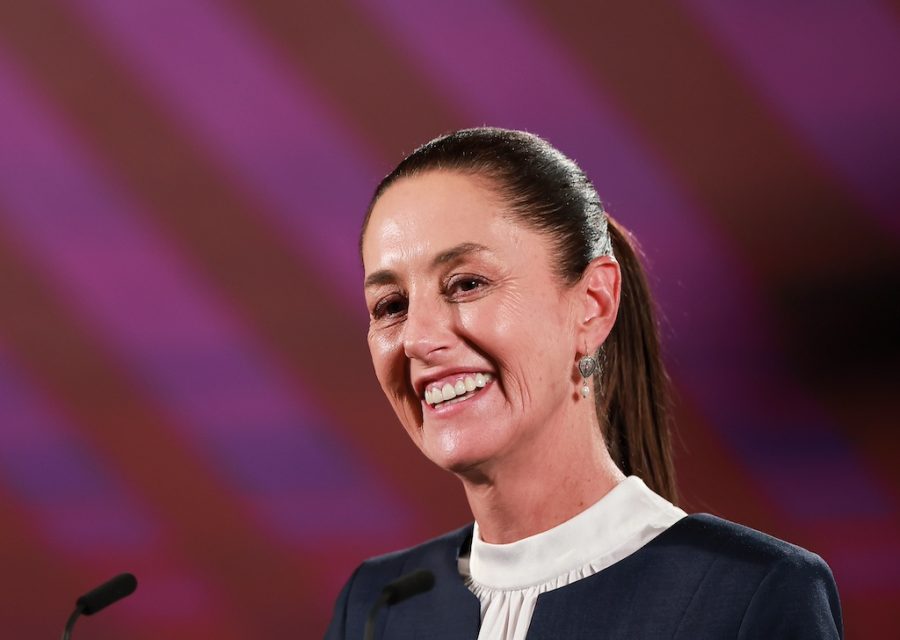
For 80 percent of Mexicans, President Claudia Sheinbaum’s first year in power has been a remarkable success.(Hector Vivas / Getty Images)
On September 15, Claudia Sheinbaum — the first woman president in Mexico’s history — stepped onto the balcony of the National Palace to perform the ritual grito, or cry of independence.
In keeping with her government’s drive to recognize overlooked female figures in Mexican history, she included among the familiar pantheon of independence heroes names such as Josefa Ortiz Téllez-Girón, who tipped off insurgents that their plan had been discovered; Leona Vicario, who provided them with both intelligence and financing; and Manuela Molina, who fought directly in their forces as La Capitana.
At each mention in the list of vivas, the packed crowd in the Zócalo, Mexico City’s central square, roared in approval. For them, President Sheinbaum’s year in power has been a remarkable success.
Continuity and Innovation
The ceremony capped a heady two weeks in which the Sheinbaum administration rolled into its one-year anniversary in office with a full head of steam. On September 1, the presidenta delivered her first informe, Mexico’s equivalent of the State of the Union address, after which she hit the road to deliver parallel informes in each of the thirty-two states. There was plenty of good news to report.
According to the most recent statistics, 13.4 million Mexicans were lifted out of poverty during the term of her predecessor, Andrés Manuel López Obrador (AMLO), while the Gini coefficient, measuring income inequality, has decreased from 0.426 to 0.391. Her first year has seen the passage of key laws and constitutional reforms, including a judicial reform providing for the direct election of the federal judiciary; recognition of greater autonomy for indigenous and Afro-Mexican peoples; a “Mexican ERA” for women’s rights; strengthened public control over the energy sector; statutory approval for the public provision of internet, over 2,000 miles of train tracks (including two long-distance lines to the US border), and 1.8 million housing units; a first-in-the-world app law providing benefits for rideshare drivers; and a ban on the planting of GMO corn, though the nation is still forced to import it from the United States following a loss at a USMCA (United States-Mexico-Canada Agreement) dispute settlement panel.
Macroeconomic numbers are solid, despite perennially looming tariff threats that Sheinbaum has maneuvered Donald Trump into postponing three separate times. In some areas, she is building on initiatives begun under AMLO, such as maintaining annual minimum wage raises, continuing the groundbreaking daily press conferences known as the mañaneras, lowering the public-pension age for women down to sixty, extending stay-in-school scholarships to all grades, and establishing public “well-being stores” to sell staple goods procured from small producers.
In other areas, she is striking out on her own, including an in-home health outreach program for seniors; development projects for a satellite, semiconductors, and an electric mini-vehicle; and the creation of a cabinet-level Department of Women’s Affairs and Department of Science, Humanities, Technology, and Innovation. All of this together, crucially, with a 25 percent drop in Mexico’s murder rate. In this light, it is not surprising that she has maintained a consistent approval rating at or around 80 percent, placing her among the highest-ranked leaders in the world.
And where AMLO, with his folksy ways, knack for an anecdote or a nickname, and an endless ability to wind up self-absorbed elites, was the great communicator to the Mexican people, Sheinbaum has given the Fourth Transformation a much-needed international projection. Case in point, the promotional videos accompanying her State of the Union address that circulated widely on US social media, allowing substantial sections of the public — including some on the Left — to discover, after seven years, that something interesting is indeed happening in Mexico.
El Plan México
But a strong first year alone will not stymie the bullying or deranged bombing threats emanating from the White House and other quarters of the national security state, nor will it automatically adjust Mexico to the rapidly changing realities of a multipolar world. To accomplish this, Sheinbaum has launched the Plan México: an industrial-planning and import-substitution initiative designed to leverage state leadership in strategic areas such as energy to foster a Mexican-centered model of sustainable national development.
The idea is to link AMLO’s push for sovereignty and self-sufficiency with a greater emphasis on science and technology, potentiating infrastructure such as trains and ports while building out a welfare state based on constitutionally enshrined social rights rather than here-today-gone-tomorrow entitlements. The plan also embraces the urgent issue of market diversification in order to reduce the nation’s dependence on its northern neighbor (some 80 percent of Mexican exports continue to go to the United States), as exemplified by the recent Mexico-Brazil trade summit.
On paper, this looks like exactly what Mexico needs. In practice, there are causes for concern. Memories are still fresh of the massive expansion of the maquiladora model in the 1990s, which fed on the tariff advantages of NAFTA and the tax breaks provided by successive neoliberal governments to set up a seamy realm of low-wage, assembly employment in the designated border zones.
Then, in 2016, Institutional Revolutionary Party (PRI) president Enrique Peña Nieto attempted to import the Chinese model of special economic zones (SEZs) into four of the nation’s poorest states; the project, with its costly focus, again, on tax breaks rather than actual benefits for the communities hosting them, was such a failure that AMLO quickly dispensed with them once he came into power. Instead, he pivoted to what became known as the development poles, which sought to balance tax incentives with social-development goals in housing, training, and the bringing of local providers into supply chains. Results so far have been uneven.
And here is where the Plan México comes in. It is fundamental that the plan place a genuine emphasis on local development in the form of knowledge, production, patents, and intellectual property. The aim is for foreign direct investment (FDI) to be targeted and in keeping with the overarching goals of industrial policy, anchoring local industries strategically and ensuring technology transfer that goes beyond simply employee training. And rather than a “simple” process of public infrastructure for private behemoths, governmental intervention needs to facilitate a process of greater local complexity.
In practice, however, early efforts appear to be too narrowly focused on FDI for FDI’s sake, allowing foreign multinationals such as Coca Cola or Nestlé to simply place the “Made in Mexico” label on their domestic production and chalking it up as a win. A model, in short, that veers dangerously close to the failed experiments of the past.
Policy or Pressure?
Then there is the China issue. In the spring, the Sheinbaum government imposed an initial set of modest tariffs on textiles, apparel, footwear, and select consumer goods. The rationale was to protect domestic manufacturing against high-volume, low-priced imports, an understandable measure in light of Mexico’s difficult experience in grappling with a similar phenomenon from the United States for decades.
The second round, announced on September 10, however, was much higher and more sweeping, hitting over 1,400 products including electronics and automobiles with tariffs of up to 50 percent. While the Sheinbaum administration was at pains to insist that the policy is directed at all countries that do not have a free-trade agreement with Mexico, it is abundantly clear that China was the primary target. It would be truly ironic if, with the purported objective of fostering national development under the Plan México, the tariff policy wound up cutting off Mexican businesses from Chinese industrial components, manufacturing equipment, and green technology in the form of solar panels and electric vehicles, yoking it even closer to the United States precisely at a moment when, under Trump, the country is lurching full-speed backward in terms of the energy transition.
The question has to be raised: How much of the decision arose out of legitimate industrial-policy concerns and how much was an attempt to placate anti-China bullying coming from the United States? If the latter, Mexico has to know by now that the United States will never be satisfied with any concessions but will always come back for more. And as consultations for the USMCA get underway in the run-up to the 2026 review-and-adjustment period, Mexico would be well advised to have this realization front and center more than ever.
Back to the Zócalo
On October 5, the Zócalo will once again fill with people for the official celebration of President Sheinbaum’s one-year anniversary in office. There is much to celebrate. In dark historic times, Mexico is not only making impressive strides in combining development, rights, and social welfare, but it is also showing that such a project can be electorally popular, even dominant.
In so doing, it is acting as a beacon against the encroachment of an international neofascism that, through showy displays of aggression and violence, attempts to portray itself as inexorable. In Sheinbaum, moreover, Mexico has an able leader in both the political and technical spheres, heading a movement that remains motivated and mobilized.
The challenge, now, will be to take the necessary steps toward a genuine economic sovereignty that matches the rhetorical pronouncements. And that may require a still more difficult layer of decisions that cannot be postponed much longer.
Disney’s decision to temporarily ban comedian Jimmy Kimmel for no coherent reason came with some very real costs for the Mickey Mouse club. According to journalist Marisa Kabas, Disney lost an estimated 1.7 million subscribers across Hulu, ESPN, and Disney+ due to public backlash and cancellations.
SCOOP / UPDATE — Disney saw more than 1.7 million total paid streaming cancelations during the period 9/17-9/23, a Disney source confirms to me. The total includes Disney+, Hulu and ESPN.
Disney and ABC, hand in hand with right wing broadcast affiliates, recently tried to appease our dim authoritarian king by putting his least favorite comedian on hiatus. The claim was that Kimmel had said something insensitive about the the killing of right wing race-baiting propagandist Charlie Kirk; the real reason is the companies are lobbying Trump to eliminate the last remaining media consolidation limits.
Meanwhile Disney, like most major streaming companies, can’t help but descend down the rabbit hole of enshittification. With streaming growth saturating and streaming executives fresh out of any sort of innovation or new ideas, major media companies are looking to cut corners, embrace more pointless mergers, raise prices, and otherwise nickel-and-dime existing customers to goose stock valuations.
That’s not just included higher prices, but a steady erosion in popular feature set and an unpopular crackdown on things like parents sharing their passwords with their college kids, which the industry supported for years to goose market share.
The result is creating a streaming TV industry that’s looking increasingly like the traditional cable giants they once disrupted. Disney had already been struggling with streaming defections due to a series of relentless price hikes. The company lost 700k subscribers earlier this year due to hikes; and recently imposed another wave of hikes that made them particularly sensitive to the Kimmel backlash.
Disney’s parent company ABC is particularly keen to eliminate media consolidation limits that prevent the big four networks (ABC, CBS, NBC, and FOX) from merging, an ask past administrations wisely refused. The things customers really want (lower prices, better programming, improved feature set, better customer service) erode stock prices, while mergers goose earnings and create tax breaks.
But helping authoritarian assholes trample the First Amendment clearly came with some real-world challenges feckless Disney executives were simply too dim to consider. And if recent history holds, they’ll learn absolutely nothing whatsoever from the experience.
With wealth inequality and billionaire control over American society growing ever more obscene, it’s well past time to implement a maximum wage limit.
Linking minimum wages with maximums incentivizes companies to improve conditions for workers at the same time it encourages them to reign in runaway compensation for executives. (Zach Gibson / Bloomberg via Getty Images)
In the first year of President Donald Trump’s second term, the power of the extremely wealthy over public policy has never been more evident. As Sen. Bernie Sanders (I-VT) has asserted, “Trump has . . . said it loudly and clearly: we are a government of billionaires.” The troubling extent to which we are ruled by the rich is hardly debatable. The real question is: What can we do about it?
One solution that has been proposed in the past is implementing a “maximum wage.” Such a cap would limit the amount any individual can earn over a given period.
There are a couple different ways that this limit could be accomplished. One way would be to use tax policy: We could simply levy a 100 percent tax rate on income over a particular level. President Franklin D. Roosevelt proposed such a measure during his administration in the 1940s. Although he did not reach his goal, the US Congress passed the highest ever federal tax rate of 94 percent on top earners during World War II, and it kept the rate above 90 percent for the two decades that followed. (This is a far cry from the reality today, when the highest tax rate is 37 percent, and when few mainstream Democrats have supported Rep. Alexandria Ocasio-Cortez’s (D-NY) proposal to raise the tax on the top bracket to 70 percent.)
Another approach to creating a “maximum wage” would be to implement regulations that set an acceptable ratio between the salary of those at the top of a business and those at the bottom. These measures might say, for example, that a CEO can only make ten times the amount of the lowest-paid worker at a firm, lest the business face penalties. If the lowest-paid workers at a business were making $35,000 per year, the maximum salary for the boss would be $350,000.
A 10:1 ratio might still sound like an extreme gap between rich and poor. But, in fact, even a 100:1 ratio would serve as a major restriction on CEO pay. A new “Executive Excess” report released by the Institute for Policy Studies in August revealed that, among the hundred S&P 500 companies with the lowest median worker pay, the CEO-to-worker pay gap reached 632:1 in 2024. The worst ratio belonged to Starbucks, whose CEO, Brian Niccol — who brought home $95.8 million in annual pay that year — made 6,666 times the pay of an average barista.
For these CEOs, reaching 100:1 would either require a huge pay cut or a big raise for those at the bottom. And that’s the point. Linking minimum wages with maximums incentivizes companies to improve conditions for workers at the same time it encourages them to reign in runaway compensation for executives.
Back in December 2018, Whirlwind Institute codirector Mark Engler interviewed veteran labor journalist and Institute for Policy Studies associate fellow Sam Pizzigati about the publication of Pizzigati’s book The Case for a Maximum Wage. The book highlighted some instances where activists have successfully pushed for maximum-wage laws — both in the United States and abroad. As one example, Pizzigati pointed to Spain’s Mondragón worker cooperatives, which capped the pay ratio between top managers and workers at 6:1 at their start in the 1950s and have since kept limits in place: “A key part of the [Mondragón] success story is this idea that they are not going to let the gap between executive and workers widen to an atrocious degree,” the author explained.
Could the United States Follow This Lead?
The most prominent example of a “maximum wage” in the United States — or at least a step toward it — comes from Portland, Oregon, which in 2016 became the first city to pass a CEO pay-ratio tax. This measure charges businesses a 10 percent surcharge if CEOs earn a hundred times more than the median worker, and it imposes a 25 percent penalty if the ratio is 250:1 or more.
Portland, Oregon happens to be my hometown, and I came of age during the Occupy protests there. Because of this, I was curious to find out what has happened since then. How has the measure held up? Have other cities, states, and countries attempted such policies?
Looking at Portland’s 2016 ordinance, I was struck by the manifesto-like tone of the document, which opens with a reference to French economist Thomas Piketty and makes a rousing case for the importance of taxing the rich. The measure estimated that the surtax would increase city revenue by up to $3.5 million annually, money which could be used to assist Portland’s unhoused community.
Since then, Oregon Public Broadcasting has reported that the tax has exceeded expectations and actually raised an average of $5 million annually. When the tax first passed in Portland, the city commissioner who proposed the measure, Steve Novick, remarked, “I’m hoping we start getting calls from cities, counties, and states, and a year from now many other jurisdictions will have done the same thing.”
In 2020, San Francisco became the second city to pass a CEO-to-worker pay-ratio tax. Similar to Portland, companies are taxed proportionally to their pay ratio: ranging from 0.1 percent on gross receipts for the 100:1 bracket all the way up to 0.6 percent for a bracket of more than 600:1, with businesses also facing additional payroll taxes. During the 2022–2023 fiscal year, the tax generated about $137 million annually on a prorated basis, according to city data — not bad!
There are some differences between the measures in the two cities. The one in Portland was passed by the city council, while in San Francisco the public voted on the proposition, which passed with 65 percent of the vote. Another difference is that while Portland’s law only applies to public companies, San Francisco includes public and private businesses, a difference made possible because San Francisco requires businesses to release payroll information to the city.
At the federal level, there have been repeated attempts to pass a pay-ratio tax. Most recently, in August 2025, California congressman Mark DeSaulnier reintroduced his CEO Accountability and Responsibility Act — a measure he had previously brought forward in 2020. Citing Portland and San Francisco as precedents, the act proposes to increase the corporate tax rate on companies with extreme CEO-to-worker pay ratios, while also offering positive incentives to companies with pay ratios below 50:1.
“While Republicans bend over backwards to help their CEO friends . . . I’m countering their misguided efforts . . . [and working] to put an end to excessive corporate greed that is eroding the middle class and threatening our democracy,” DeSaulnier said in a press release.
Disclosure as a First Step
Short of implementing actual maximum-wage laws, an important first step is to pass disclosure laws that require companies to publicly share the salaries of CEOs and employees. This is information that corporations would prefer to hide — making it impossible for the public to even know the pay ratio at their businesses.
The 2010 Dodd-Frank Act made significant strides in this direction, requiring that companies begin making this information available. When that provision took effect in 2017, a surge in media coverage on income inequality followed.
A 2018 study by the Society for Consumer Psychology reported that when consumers are aware of such data, they avoid buying from firms with higher ratios. India passed disclosure laws in 2013, and the Hindu Business Line subsequently published an editorial claiming that: “These disclosures drive home the point that income inequality is alive and well in corporate India — a trend that may need reining in by policymakers and organised workers’ unions.” Australian Labor Party leaders proposed disclosure laws in 2018, and disclosure laws even stronger than those in the United States came into effect in 2020 in the UK. (British firms are to answer pointed questions about their compensation policies, explaining “whether the company believes that [the pay ratio] is consistent with the company’s general employee pay, reward and progression policies and, if so, why.”)
Today the disclosure provision in the United States is being threatened by Trump-nominated Republican members of the Securities and Exchange Commission (SEC). Republican chairman Paul Atkins, nominated by Trump following the 2024 election, called the CEO pay disclosure regulations a “Frankenstein patchwork of rules,” while Republican Trump-appointed commissioner Mark T. Uyeda stated that the SEC should “refrain from expanding its rulebook simply because some may think that executive compensation is too high.”
International Momentum
While the maximum wage concept has so far gained only limited political traction domestically, it has become a hotter issue abroad.
In the summer of 2024 in France, the leftist coalition Nouveau Front Populaire won 182 deputy seats out of 577, making it the largest bloc in that country’s National Assembly. While the Left still falls short of holding a majority, the shock victory revived the progressive electoral prospects and went far in legitimizing their demands. One of the party’s most prominent voices, former French presidential candidate Jean-Luc Mélenchon, repeatedly made an executive pay cap part of his platform during runs in 2017 and 2022. “I believe that there is a limit to the accumulation [of wealth],” he has stated, “If there are any who want to go abroad, well, goodbye!”
Mélenchon’s ideas have worked their way into the mainstream. In 2022, after the CEO of French-Italian multinational car company Stellantis made headlines the previous year for earning 298 times more than his employees, incumbent president Emmanuel Macron and far-right candidate Marine le Pen both spoke out against excessive pay, parroting their leftist rivals. Macron, a former business executive and no friend of the working class, even felt pressure to call for an executive pay cap. Understood as largely symbolic, his words nevertheless showed a shifting window of opinion in his country. As for then — Stellantis CEO Carlos Tavares, when asked about his salary, he simply said: “Make a law, I’ll respect it.” Perhaps Macron should listen.
Beyond reigning in astronomical executive earnings, a maximum wage represents a step toward limiting the influence of the ultrarich in politics. In other words, it not only pays economic dividends, but democratic ones as well. Almost a decade after the city implemented its groundbreaking ordinance, Portland has demonstrated that it was well ahead of its time. Lawmakers from across the country should be eager to copy its success.
MESA, AZ—Gleefully describing the inevitable day when society would collapse and digital files would become unusable, local physical media collector David Campbell confirmed Wednesday he was “absolutely pumped” for the downfall of humanity. “When it all goes down, there’s only going to be one place to watch the Tomb Raider movies in their entirety with all the deleted scenes, and that’s going to be my bunker,” said Campbell, his eyes reportedly shining as he described how the end of organized society and the dissolution of government would make his cherished stockpile of Blu-rays even more valuable. “No one will be mocking the CDs I’m still holding onto when the internet goes dark forever and the only way to listen to music is through boom boxes we trade canned goods for. And I’m definitely one of the only people who has a region-free DVD player and all three seasons of Father Ted plus the Christmas special, so I’ll essentially be a king. I can’t wait.” At press time, Campbell was grinning as he purchased the 50th anniversary edition of Jaws in 4k, which he anticipated would give him full control over the drinking water supply in the event of a nuclear winter situation.
I care deeply about my students’ learning, but with all the new technologies available to help them cut corners, I worry that they’re not doing the deep thinking necessary to learn. That’s why I’ve been prompting AI to create lesson plans and assignments for me that will engage my students.
Students are using AI because they want their papers to be perfect. But I don’t care about their final product; I just want them to engage in an intellectually stimulating process. So I’m using AI to ensure I create the perfect lesson plans and assignments.
Because I want students to value the writing process, I had AI generate a series of lesson plans walking them through brainstorming and reflection exercises to demystify writing and make each step manageable. But then my students utilized generative AI to complete all the preliminary exercises and write the final paper.
I guess I just didn’t prompt the AI well enough.
That’s why I’ve concluded that instead of teaching students to read and write, I should be teaching them how to prompt AI better. If only I’d had a better education in AI prompt writing, I’d be able to get AI to create more AI-proof teaching materials for me.
Plus, AI promises to be the great equalizer. Right now, some students read and write well, some not as much. We should throw out our former curriculum, which emphasized developing students’ reading and writing skills, and instead invest all our time and resources in AI-prompting education. As technology changes the world, we can’t leave our struggling students behind.
With AI, all students, not just high-achieving ones, will be able to produce equally good results. However, one problem I’ve encountered so far is that some students understand how to prompt AI effectively and can discern whether the text generated by AI is of high or low quality, while others struggle to prompt AI well or understand its output.
Because I’m not a good enough AI prompter, I can’t figure out how to prompt AI to tell me how to help all students become better AI prompters.
The other issue I’m having is that my stronger students are very, very bored. I asked AI how to further engage them with AI prompting. Now, those advanced students are working on prompting AI to come up with ways to refreeze the glaciers their AI prompting has melted.
Other students have objected to being forced to use generative AI. They claim AI is immoral because it uses human writing in its training, without paying the human writers and for the express purpose of replacing human writers. So, I prompted the AI to devise a lesson plan that explains why students need to become proficient in prompting AI—so they can land writing jobs in the future, where they will spend their days prompting AI.
This technology that is ruining education has incredible potential to save education, if only I could figure out how to use it better to improve my students’ education. Once I get better at prompting AI to write my lesson plans and assignments, students who currently have trouble reading and writing will be able to prompt AI to create writing indistinguishable from what the stronger students can prompt AI to produce.
And once all students have fully adopted the voice of AI, we’ll know we’ve finally experienced educational equality.
When you do something with conviction, you do so with full confidence that you are correct.
But what is the verb that means “To be fully confident that one is correct”?
At Microsoft, it is often backformed into the verb convict (stress on second syllable).
This backformation typically happens in speech, so it’s hard to find written citations, although I did find a few.
We will never know for sure, but I continue to remain highly convicted that we are on the right track here.
Be convicted about where you’re heading, and that you are doing the most important things.
There are rumors that Bob is not super-convicted about this plan.
I cannot find dictionary support for this usage of convicted, but then again, I didn’t search the big guns like the Oxford English Dictionary.
From what I can tell, the English verb corresponding to conviction is simply convince. The word conviction apparently comes from the Latin convictionem, which is the accusative form of convictio, meaning “proof”, which is in turn the past participle of convincere, which means “to convince”. So at least that lines up.
But saying “I continue to remain convicted that we are on the right track here” sounds more forceful than simply “I continue to remain convinced that we are on the right track here.”
That’s probably why the word survives. It just sounds more powerful.
Bonus chatter: This backformation strikes me as odd whenever I hear it, because I think the person is saying that they have been convicted of a crime.
The Taliban imposed a near-total internet blackout across Afghanistan, cutting off both local communication and foreign access while suppressing dissent. What do you think?
“Ah, that’s why the Taliban subreddit has been so quiet.”
Sebastian Narvaez, Detail Scrutinizer
“Who do they think they are, Utah?”
Olivia Maile, Corporation Acquirer
“Eh, good call. I mainly use it for immoral stuff.”
PALO ALTO, CA – Across the United States and Canada social media users have noticed a recent trend of influencers heartily endorsing a system of landowning elites extracting service and labour from rent-paying serfs. “What up you guys! It’s your girl Macie K here with another makeup tutorial that I have SO MUCH more time […]
Riyadh, Saudi Arabia – Silver Lake Partners, Saudi Arabia’s sovereign wealth fund, and Jared Kushner were shocked when they found out their $55 Billion buyout of EA did not include the new, downloadable content. “We should have seen this coming,” stated Kushner. “It’s a classic EA move, the base purchase is never enough without the […]












 ALT
ALT