Shared posts

12 Jan 01:24

When You’re Feeling Self-Doubt & a Lack of Motivation

by zenhabits
By Leo Babauta

This morning I didn’t feel like doing anything. It’s a combination of overtiredness from a few days of hard work, and a lack of sleep last night.

I couldn’t motivate myself to do anything important this morning, which is a rare thing for me. And I just felt bad in general. I started to doubt myself, and wonder whether anything I do is worthwhile.

I sat here in this funk and wondered how to get out of it. Should I just forget about today? Should I just give up what I do, because I’m not as good at it as I thought I was?

That was definitely what I was considering. But I knew this mild depression was temporary, and so I thought about possible solutions. And then some of them actually worked — little tricks of the mind that can have a real effect on reality.

Here’s what I did that worked, in hopes that it might help you if these feelings ever come up..

1. I stopped being so self-centered. I think we all have the tendency to put ourselves at the center of the universe, and see everything from the viewpoint of how it affects us. But this can have all kinds of effects, from feeling sorry for ourselves when things aren’t going exactly as we’d like, to doubting ourselves when we aren’t perfect. So instead of worrying so much about myself, I thought about other people I might help. Finding small ways to help others gets me out of my self-centered thinking, and then I’m not wallowing in self-pity anymore — I’m starting to think about what others need. I’m not doubting myself, because the question of whether I’m good enough or not is not the central question anymore. The central question is what others need. So thinking about others instead of myself helps solve self-doubt and self-pity.

2. I loosened my identity. We all have this picture of ourselves, this idea of what kind of person we are. When this idea gets threatened, we can react very defensively. People can question whether we did a good job, and this threatens our idea of ourselves as competent — and so we can become angry or hurt at the criticism. Someone can accuse you of lying and this threatens your idea that you’re a good person, and so you can get angry and attack the other person. My identity of myself as someone who is motivated and productive and has good ideas and so forth … this was getting in the way this morning. When I wasn’t productive, it made me despair because then I was worried I wasn’t who I thought I was. My solution was to realize that I’m not one thing. I’m not always productive — sometimes I am, but sometimes I’m lazy. I’m not always motivated — sometimes I am, but other times I don’t feel like working. I don’t always have good ideas. I can be many things, and so this identity of mine becomes less fragile, more antifragile. Then it doesn’t matter if someone thinks I didn’t do a good job — because I don’t always do a good job. I make mistakes, I am less than perfect. And that’s perfectly OK.

3. I remembered that this day counts. I only have so many days left on earth. I don’t know how many that is, but I do know it’s a very limited number. I know that each one of those limited days is a gift, a blessing, a miracle. And that squandering this miracle is a crime, a horrible lack of appreciation for what I’ve been given. And so, I reminded myself this morning that this day counts. That I should do something with it. That doesn’t mean I need to work myself into the ground, type until my fingers are mere nubs, but that I should do something worthwhile. Sometimes taking a break to nourish yourself is a worthwhile activity, because that allows you to do other worthwhile things, but just sitting around in self-pity isn’t helpful, I’ve found. So I got up and did something.

4. I created movement. It can be hard to get moving when you are stuck. This is how I felt in 2005 when I couldn’t change any of my habits. It was really hard to motivate myself when I didn’t think I would succeed, when I felt horrible about myself. But I took one small step, and it felt good. That’s what I did this morning — I took the smallest possible step. Just opening up a document, just starting a list, just getting out a notebook. These are so small as to be insignificant, and yet so easy as to be possible. And it showed me the next step was possible, and the next.

I’m still feeling tired, and so I’ll take a nap later. But I’m feeling better, because I took these steps.

I know some of you feel the same way from time to time, maybe more often than you’d like to admit. That’s OK. We all do. We are not machines, perfectly oiled and constantly charged up and ready to fire on all cylinders. We are human, which means we falter, we doubt, we feel pain.

And this too shall pass.

‘Self-pity is our worst enemy and if we yield to it, we can never do anything wise in this world.’ ~Helen Keller

12 Jan 01:03

Comprehensive, nonsurgical treatment improves pelvic floor dysfunction in women

Researchers have demonstrated that a comprehensive, nonsurgical treatment significantly improves symptoms in women with pelvic floor dysfunction, a range of symptoms which include bladder and bowel problems as well as pelvic pain.
12 Jan 01:01

Who Needs Ayn Rand? America Has Already Gone John Galt

by Roger L Simon

Tell all your “Objectivist” friends and the libertarian gang at Reason magazine to break out the champagne. Americans may have skipped the movie of Atlas Shrugged, nor have many read any of Ayn Rand’s works, but they have taken the author’s advice anyway and gone John Galt, quitting the work force in record numbers.  According to Zero Hedge, the latest figures show the labor participation rate at 35 year low.

Realistically, it’s even more than 35 because that figure reflects an employment bump when larger numbers of women joined the work force in the seventies and eighties.  (They’re gone now, with or without Gloria Steinem.)

Currently a record 91.8 million Americans are no longer looking for work. That’s almost one and a half times the entire population of France.

Although I admit to libertarian tendencies, I don’t think any of us can celebrate because of this.  It’s an economic disaster that should be blowing even Chris Christie off the front pages.

In fact, it’s much worse than that. It’s a human emotional disaster.  Freud may have been wrong about a number of things, but he was right about this. Two mainstays that get us through life, other than religion, which Freud didn’t cotton to,  are “love and work.”  I don’t know about love,  but the work part of our lives has been brutally kicked out from under us in the Obama years.

12 Jan 01:00

The Curse of Complexity

by Richard Fernandez

The administration delivered a resounding judgment on its claim that Obamacare’s website problems were over by firing the prime contractor, CGI Federal. The Washington Post, reporting the contract cancellation, explains that  ”as federal officials and contractors have been trying to fix various aspects of the Web site in the past few months, about half of the new software code the company has written has failed on the first try, according to internal federal information.”

They might have guessed the failure rate from the start. In an earlier article, the Washington Post noted that CGI Federal was “filled with executives from a company that mishandled at least 20 other government IT projects, including a flawed effort to automate retirement benefits for millions of federal workers, documents and interviews show.”

Now make that 21.

Yet the malfunctions of the website mattered less than one would think. Even if it worked perfectly its intended audience is as perplexed by it as travelers from England at the sight of hieroglyphics. A survey by Enroll America showed that 68% of the uninsured never even logged on to the website. Terms like subsidies, deductibles, plan this or plan that were too much for some, a fact that was anticipated by the creation of a class of Navigators created and funded by Obamacare itself.

They knew that the target audience would be baffled. The Navigators were created in the knowledge that insurance would have to be provided where basic literacy was no longer to be taken for granted. Recently a bank robber made the news when he handed a holdup note to a teller, only to have the teller unable to read it. In a recent, high profile murder trial the star witness proved unable to read her own declaration when questioned on the stand.

At least some of the uninsured will be in similar case. The Navigators have to fix this problem. Their job, not to put too fine a point on it, is to fill out the form for those who can’t fill it out themselves, nor in fact be able to understand the form in the first place. Time Magazine’s Detroit Blog described the effects of the best union provided public education that malfeasance can buy. Those fine institutions of learning posted the worst math scores in the 40-year history of the National Assessment of Educational Progress test.

“These numbers are only slightly better than what one would expect by chance as if the kids had never gone to school and simply guessed at the answers,” said Michael Casserly, executive director of the Washington-based Council of the Great City Schools, which represents large urban school districts. “These numbers … are shocking and appalling and should not be allowed to stand.”

Shocking, but not surprising. The Navigators are a testament to that. At least no more surprising than the performance of CGI Federal.

This can create security problems and not a few misunderstandings, such as people thinking they are covered when in fact they are not.  How could they tell if they don’t know what the terms they are agreeing to means? The sad sight of people being turned away from hospitals they had entered believing they were entitled to  healthcare is a symptom of this. It is little wonder that “dozens of House Democrats broke ranks with President Obama on Friday to support legislation that would require people to be notified of security breaches under ObamaCare.”

Security breaches are going to happen and they want to distance themselves from it.  Readers will recall the president himself symbolically enrolled in a Bronze plan in Hawaii by instructing aides in Washington to fill out the forms in person.

This does not sound like a vote of confidence. Indeed much of the Federal Government has exempted itself from Obamacare. Combine a website half of whose code is dead on arrival and a cadre of Navigators who are resisting state rules requiring them to submit to criminal background checks and what do you get? You get what you’ve got.

The administration is trying to fix the original complexity of Obamacare by transforming the the intially screwy design into other systems with the same level of unsolvability. Take a set of rules many times longer than the Bible and turn it into millions of lines of defective code? Not working? Now take an army of Obamacare Navigators and get them to fill in the forms for those who can’t make it out.

That will fix things, won’t it?  It will not. As I have written before, the problem is in the complexity of  the business rules;  in the actuarial characteristics of the system;  in the lack of money to fund a system that is more expensive than the one it replaces. But the idea is that if we transform a complex problem into other complex problems of the same degree then we have simplified things. Good luck on that.


Did you know that you can purchase some of these books and pamphlets by Richard Fernandez and share them with you friends? They will receive a link in their email and it will automatically give them access to a Kindle reader on their smartphone, computer or even as a web-readable document.

The War of the Words for $3.99, Understanding the crisis of the early 21st century in terms of information corruption in the financial, security and political spheres
Rebranding Christianity for $3.99, or why the truth shall make you free
The Three Conjectures at Amazon Kindle for $1.99, reflections on terrorism and the nuclear age
Storming the Castle at Amazon Kindle for $3.99, why government should get small
No Way In at Amazon Kindle $8.95, print $9.99. Fiction. A flight into peril, flashbacks to underground action.
Storm Over the South China Sea $0.99, how China is restarting history in the Pacific
Tip Jar or Subscribe or Unsubscribe

12 Jan 00:55

HOW’S THAT HOPEY-CHANGEY STUFF WORKIN’ OUT FOR YA? (CONT’D): Dollar stores are now getting too exp…

by Glenn Reynolds

HOW’S THAT HOPEY-CHANGEY STUFF WORKIN’ OUT FOR YA? (CONT’D): Dollar stores are now getting too expensive for many Americans.

12 Jan 00:55

LABOR-FORCE DROPOUTS: Your Scary-Ass Chart Of The Day. (From The Federalist.) …

by Glenn Reynolds

LABOR-FORCE DROPOUTS: Your Scary-Ass Chart Of The Day. (From The Federalist.)

12 Jan 00:55

CAN I GET THE TAR-AND-FEATHERS CONCESSION? Europe: Peasants Restless, Nobility Concerned….

by Glenn Reynolds

CAN I GET THE TAR-AND-FEATHERS CONCESSION? Europe: Peasants Restless, Nobility Concerned.

12 Jan 00:50

MEGAN MCARDLE: Marriage Makes You Rich And Stupid. I mean, I used to know where I kept my batter…

by Glenn Reynolds

MEGAN MCARDLE: Marriage Makes You Rich And Stupid.

I mean, I used to know where I kept my batteries and old documents. But when we got married, my husband, who is much tidier than I am, took over organizing the house. Now, unless it’s a piece of my clothing or kitchen equipment, I have no idea where we keep anything. And while I’m pretty sure I used to be able to put up shelves, now all I know how to do is ask my husband to do it.

On the other hand, he has no idea how much money we have, or in what accounts. And he can’t do the grocery shopping, because he doesn’t know what we consume. Individually, we are less competent to survive on our own. But collectively, we eat better, and we have a tidier house and better-managed finances. And our shelves don’t fall down so often.

Obviously, child-rearing is a major area of specialization. One interesting thing I’ve heard from gay parents is that they find themselves falling into roles that you might describe as “Mom” and “Dad,” even though this is obviously not some pre-programmed gender destiny. It just doesn’t make sense to try to jointly manage a kid 50-50; one parent keeps the social calendar and decides what kids Junior can play with, because two parents trying to do it actually makes the task take a lot more time, as both people have to learn about all the friends and the birthdays and the parents, and then negotiate what Junior does with her time. I’m not saying this happens with every gay parent. I’m just saying that gay parents I know report considerable benefits to specialization.

Specialization also allows for external income gains — perhaps one reason that married men make a lot more than single ones do and married households are richer than single ones. Some of that is selection effect, of course — stable, responsible men are probably more likely to get married, especially in this day and age.

Well, possibly.

12 Jan 00:48

Obamacare Scandals, Oregon Edition

by John Hinderaker
(John Hinderaker)

Oregon is one of a number of states (Minnesota is another) where state officials tried to set up their own Obamacare program and web site, called Cover Oregon. In Oregon, as elsewhere, the effort has been a disaster, as not a single person has been able to sign up on the state’s web site. The fiasco has become a political liability for Governor John Kitzhaber, who is running for re-election this year. There is also a bit of scandal brewing:

[Carolyn] Lawson was responsible for the technical development of the Cover Oregon website, a state-run online marketplace where Oregonians could find and purchase health insurance. She resigned for “personal reasons” in November. Rocky King, the exchange’s executive director, submitted his resignation last week. …

[A]n email sent in December 2012 from state Rep. Patrick Sheehan (R) to the governor’s legislative director, warned of problems with Lawson. Sheehan, a member of the legislative oversight committee for Cover Oregon, accused Lawson in the email of presenting fraudulent testimony in a legislative hearing and speculated about her ties to the company building the website. Kitzhaber denied having seen the email, even though his legislative director responded to it, and claimed he didn’t know of problems with Lawson until late last year.

On Thursday, a local television station scored an interview with Governor Kitzhaber, but the governor walked out when he was asked about the Sheehan email:

Governor Kitzhaber was a college friend of mine. He is a few years older, and was a charismatic guy even then. He became a doctor, and I was astonished when he was elected Governor in 1994; when I knew him in college, he had little interest in politics and was anything but a liberal. Kitzhaber has been wildly popular in Oregon. He was term-limited after eight years in office, ran again and was re-elected in 2010. But he is obviously feeling the heat over Obamacare.

We can draw several lessons:

1) Democratic governors, as well as senators, who are up for re-election this year are running scared where they have tried to implement a local version of the disastrous law.

2) While the real problems with Obamacare have barely begun to emerge, web site problems alone are enough to create serious blowback. Something similar is going on here in Minnesota.

3) It isn’t entirely fair to compare Kitzhaber’s situation with that of Chris Christie, but there are some obvious parallels–most notably, a smoking gun email which the governor says he never saw (even though, in Kitzhaber’s case, it was directed to the mailbox that is used by legislators to communicate with the governor). That Kitzhaber’s problems haven’t become an all-consuming national news story reflects, among other things, the advantages of being 1) a long way from New York City, and 2) a Democrat.

12 Jan 00:45

News You Can Use

by Stephen Green

PASTAFARIAN

Details here.

I know some real-life Pastafarians, and they’re laid back and pretty cool and I can totally picture any of them doing this.

12 Jan 00:43

Australian Teen Reports SQL Injection Vulnerability, Company Calls Police

by timothy
FuzzNugget writes with an excerpt from Wired, which brings us the latest in security researcher witch hunts: "Joshua Rogers, a 16-year-old in the state of Victoria, found a basic security hole that allowed him to access a database containing sensitive information for about 600,000 public transport users who made purchases through the Metlink web site run by the Transport Department. It was the primary site for information about train, tram and bus timetables. The database contained the full names, addresses, home and mobile phone numbers, email addresses, dates of birth, and a nine-digit extract of credit card numbers used at the site, according to The Age newspaper in Melbourne. Rogers says he contacted the site after Christmas to report the vulnerability but never got a response. After waiting two weeks, he contacted the newspaper to report the problem. When The Age called the Transportation Department for comment, it reported Rogers to the police.'"

Share on Google+

Read more of this story at Slashdot.


12 Jan 00:42

Your ♡bamaCare!!! Fail of the Day [Saturday Edition]

by Stephen Green

FRANKLIN

Full story:

As an employer, I felt like a failure when I saw the cancellation notice. As any leader would, I feel an obligation to the men and women who come into my office and work tirelessly every day because they believe in my cause. It’s not enough for me to pay these people a salary – I want them to thrive. I want them to be proud to work for my organization, and I feel frankly ashamed that I can no longer offer them the health insurance plan that they rely on.

But my feelings of shame have given way to anger, because I’m not the leader who failed my employees. Rather, it’s Washington’s failure – and it stems from Obama’s hubris.

In all fairness, there’s plenty of that.

12 Jan 00:42

THIS IS COOL: Chewbacca Actor Peter Mayhew Shares Treasure Trove Of ‘Star Wars’ Set Photos On Twitt…

by Glenn Reynolds
12 Jan 00:41

The Collar of Money

by Richard Fernandez

Q: When is bad news good news?

A: When it kicks the can down the road.

The New York Times gives an example of how this works. “WASHINGTON — The surprisingly weak December jobs report might have strengthened Democrats’ hand in the current fight over emergency jobless benefits for the long-term unemployed even as it weakened the party in the larger midterm election battle.”

On Friday, the Labor Department said that the unemployment rate dropped to a five-year low of 6.7 percent. But the economy added only 74,000 jobs, and for every American who found work, five disappeared from the labor force. … Democrats have tried to harness middle-class families’ frustrations with the pace of economic growth by accusing the slow recovery in part on Republican recalcitrance….

Democrats have promised to continue to push for the extension, saying that millions of jobless workers still need the government lifeline. “The safety net has been just ripped away,” Mr. Reid said at a news conference this week. “The economy’s improving, but not for everybody.”

Rather than the jobs report being bad news, it’s good news. Now if only the can can be kicked past the larger midterm election battle all would be swell. But the real danger is one that the New York Times is beginning to fear. What happens if the government runs out of road? What if … for mercy’s sake … you can’t kick the can down the road indefinitely?

The AP says economists have pronounced themselves baffled by the declining rate of labor participation. Despite record stimuli by the administration, three million adult Americans have stopped looking for work.  What in the name of John Maynard Keynes is happening?  Relax. The economists tell us the noise we heard in the dark is just the random noise and not the face of disaster we imagined leering in at the window. Nothing to be worried about.

So what happened in December? Economists struggled for explanations: Unusually cold weather. A statistical quirk. A temporary halt in steady job growth. “The disappointing jobs report flies in the face of most recent economic data, which are pointing to a pretty strong fourth quarter,” said Sal Guatieri, an economist at BMO Capital Markets.

Whatever happens the libs have got the Money Press and the conservatives have not. So there’s nothing to worry about.

But do they have the Money Press still? What is perhaps of greater interest was reluctance by Federal Reserve officials to immediately reach for the bond market to fix this latest setback. “Another cut to bond purchases appears in the offing this month despite data that showed U.S. jobs growth slowed sharply in December, two top Federal Reserve officials said on Friday.”

“I would be disinclined to react to one month’s number,” St. Louis Fed President James Bullard told reporters after speaking at an Indiana bankers event. “For now we’re on a program where we’re likely to continue to taper (asset purchases) at subsequent meetings.” …

Jeffrey Lacker, the hawkish head of the Richmond Fed, said it would take a “couple of quarters” of bad news to change the U.S. economy’s improving trend.

“It takes a lot more than one labor market report to be convincing that the trend has shifted and in my experience one employment report rarely has an effect by itself on monetary policy,” said Lacker, who has been an opponent of bond buying from its start.

Maybe the Money Press Sentry Guns are running out of bullets. Jeffrey Dorfman, an economist at the University of Georgia has an interesting idea that explains why. He says that deficit spending doesn’t really boost the economy. It simply distorts it. He writes:

Deficit spending financed by borrowing does not create stimulus because the money that the government borrowed would have been borrowed by someone else and then spent by them. Money is just being shifted from the private sector to the public sector. Moving money from your left pocket to your right does not make you richer.


media

In fact, government spending will generally add less value to the economy than if the money had been left in the private sector. If people get to spend their own money, they will do so in a way that maximizes the benefits they get from that spending. When government spends money at best they can manage to perfectly anticipate what we want, thereby matching the benefit we would have gotten from our own spending, or they can do worse.

In other words massive government spending programs fueled by premium increases, mandates, taxes and fees don’t really increase jobs. They just make it impossible for the taxed businesses and entrepreneurs to creat them. Giant spending programs like those embarked upon by the Obama administration create massive distortions in the economy in pursuit of political goals and just cripple it.

One example of how government spending can actually destroy industries became evident when health insurance companies admitted they are going to lose money by participating in Obamacare. The health insurance companies were initially drawn to the Obamacare because it seemed to guarantee new business.

In fact, hidden within the December jobs report is a significant details. Many of the job losses were in the healthcare industry. The Washington Post notes: “as it turns out, construction wasn’t the biggest contributor to the disappointing results. That would be the education and health-care sector”.

CNN Money has more details: “the hardest hit areas were nursing homes, which jettisoned 3,900 jobs, and home health care, which lost 3,700 positions. Hospitals got rid of 2,400 jobs, while physicians’ offices reduced staff by 1,200. … Several notable hospitals, including the Cleveland Clinic, reported layoffs last year as the federal government cut reimbursement rates and patient care shifts more to outpatient and urgent care clinics. In fact, outpatient care centers were the only part of the health care sector to boost jobs last month, adding 3,600 positions.”

The health insurance company Humana has revealed what the administration has so far resisting revealing. It’s the mostly old and infirm who have been joining the president’s flagship program. The company “now expects the risk mix of members enrolling through the health insurance exchanges to be more adverse than previously expected.”

Translation: it stands to lose its shirt and may seek a government bailout. Obama isn’t “helping” the health care industry. From all indicators he’s destroying it.  Marco Rubio just released this statement.

This week, insurance companies began making material filings to the Securities and Exchange Commission (SEC) regarding projections for their ObamaCare risk pools.

Already, one company has disclosed that “as a result of the December 2013 federal and state regulatory changes allowing certain individuals to remain in their previously existing off-exchange health plans, the Company now expects the risk mix of members enrolling through the health insurance exchanges to be more adverse than previously expected.”

“American taxpayers should not be on the hook for bailing out health insurers, especially because ObamaCare is not working the way it was sold,” said Rubio. “Congress should take an ObamaCare bailout off the table by passing legislation I’ve introduced to repeal the so-called risk corridor provision under the law.

“If ObamaCare can only survive through a taxpayer bailout of insurers, it’s yet another clear sign that it can’t survive and isn’t worth saving,” he added.

This is where Rubio is mistaken. The collapsing “risk corridors” only means they have to be propped up in same way that unemployment insurance has to be extended. Once “free money” — the deficit spending Dorfman spoke is introduced like a drug into the voters veins it will prove nearly impossible to withdraw.

In the world of demagogues you create failure then you reinforce it because you benefit from failure by demanding more power. The ruin of insurance companies will be used to the same effect that three million labor force dropouts have had. It will “strengthen the Democrats’ hand” in their “fight” for more spending.


Did you know that you can purchase some of these books and pamphlets by Richard Fernandez and share them with you friends? They will receive a link in their email and it will automatically give them access to a Kindle reader on their smartphone, computer or even as a web-readable document.

The War of the Words for $3.99, Understanding the crisis of the early 21st century in terms of information corruption in the financial, security and political spheres

Rebranding Christianity for $3.99, or why the truth shall make you free

The Three Conjectures at Amazon Kindle for $1.99, reflections on terrorism and the nuclear age

Storming the Castle at Amazon Kindle for $3.99, why government should get small

No Way In at Amazon Kindle $8.95, print $9.99. Fiction. A flight into peril, flashbacks to underground action.

Storm Over the South China Sea $0.99, how China is restarting history in the Pacific

Tip Jar or Subscribe or Unsubscribe

12 Jan 00:38

A REALLY EXCELLENT PIECE BY KEVIN WILLIAMSON: Welfare’s Devastating Effect in The White Ghetto of A…

by Glenn Reynolds

A REALLY EXCELLENT PIECE BY KEVIN WILLIAMSON: Welfare’s Devastating Effect in The White Ghetto of Appalachia. “In effect, welfare has made Appalachia into a big and sparsely populated housing project — too backward to thrive, but just comfortable enough to keep the underclass in place. There is no cure for poverty, because there is no cause of poverty — poverty is the natural condition of the human animal.”

Robert Heinlein said something about that.

15 Dec 22:10

POLL: ObamaCare Has Lost The Uninsured. “Let that sink in: What that means is that regardless of h…

by Glenn Reynolds

POLL: ObamaCare Has Lost The Uninsured. “Let that sink in: What that means is that regardless of how bad the old system—the system that for whatever reason left them uninsured—was, a majority of people without health coverage now think that Obamacare makes it worse.”

15 Dec 22:07

If I Can Fake It There, I’ll Fake It Anywhere

by Richard Fernandez

Professionals, artists and intellectuals in New York City, after years of struggling to obtain favorable terms from the health insurance industry,  now find their efforts negated by Obamacare.  Anemona Hartocollis relates the plight of the Big Apple’s elite in the New York Times.

Many in New York’s professional and cultural elite have long supported President Obama’s health care plan. But now, to their surprise, thousands of writers, opera singers, music teachers, photographers, doctors, lawyers and others are learning that their health insurance plans are being canceled and they may have to pay more to get comparable coverage, if they can find it.

They are part of an unusual, informal health insurance system that has developed in New York, in which independent practitioners were able to get lower insurance rates through group plans, typically set up by their professional associations or chambers of commerce. That allowed them to avoid the sky-high rates in New York’s individual insurance market. …

But under the Affordable Care Act, they will be treated as individuals, responsible for their own insurance policies. For many of them, that is likely to mean they will no longer have access to a wide network of doctors and a range of plans tailored to their needs. And many of them are finding that if they want to keep their premiums from rising, they will have to accept higher deductible and co-pay costs or inferior coverage….

The predicament is similar to that of millions of Americans who discovered this fall that their existing policies were being canceled because of the Affordable Care Act. The crescendo of outrage led to Mr. Obama’s offer to restore their policies, though some states that have their own exchanges, like California and New York, have said they will not do so.

These developments have precipitated a mini-cultural crisis in this exclusive set. How could this happen to us?

“We are the Obama people,” said Camille Sweeney, a New York writer and member of the Authors Guild. Her insurance is being canceled, and she is dismayed that neither her pediatrician nor her general practitioner appears to be on the exchange plans. What to do has become a hot topic on Facebook and at dinner parties frequented by her fellow writers and artists.

“I’m for it,” she said. “But what is the reality of it?”

“Ms. Meinwald, the lawyer, said she was a lifelong Democrat who still supported better health care for all, but had she known what was in store for her, she would have voted for Mitt Romney.”

Had she but known? But she must have known. People at this level of talent must have suspected the reality from the first, though some part of their psychology prevented them from facing it. Unlike low-information voters, they can add. Simple arithmetic would have shown that from the beginning Obamacare, in order to work, needed access to a source of funds that would enable it to pay for the uninsurable or those unwilling to buy insurance.

Meinwald and her friends had those funds.

When Obama announced he was inviting people who could not or would not pay for healthcare to the feast, that necessarily meant the bill would have to be stretched over those with money in their pockets.  And the NYC elite made the cardinal mistake of having some jake in the first place. The fact that they were successful doomed them. It meant that their fund — and all other well-managed enterprises — would have to be raided to subsidize the failures.

This is called a transfer payment. This is called redistribution. You may want or not want it, but you cannot pretend that redistribution does not redistribute.

If Ms. Meinwald wanted to avoid getting slugged, her group should have imitated Detroit. When you’re bust, you’re off the hook. No stash, no tab. Or, as classic Marxian theory puts it, from each according to his ability, to each according to his need.  Of course the modern Democratic Party has rewritten the slogan slightly to “from each according to his gullibility, to each according to his greed,” but that’s a mere detail; that’s progress for you.

What Meinwald may get is intangible. She’ll get first-class illusion. Illusion, Nathan Glazer once wrote, is sometimes a damned fine thing. Responding to Richard Herrnstein and Charles Murray’s argument that humans are unequal in The Bell Curve, the Harvard sociologist argued in the New Republic that “some truths may not be worth knowing. Our society, our polity, our elites, according to Herrnstein and Murray, live with an untruth. I ask myself whether this untruth is not better for American society than the truth.”

15 Dec 21:53

KATHY SHAIDLE: Finally: A Comedian Who Refuses To Apologize….

by Glenn Reynolds
15 Dec 21:46

VIDEO: Glock’s Fantastic Pro-Gun Commercial Is Sure To Offend A Liberal, And Make Conservatives L…

by Glenn Reynolds
15 Dec 21:42

Good Doggie, Good Cop

by Stephen Green

OFFICER WAZ

I know I run my share of Bad Cop stories, so how about a good one for a change? This isn’t a new story, but it’s new to me — so here you go:

The Baltimore Humane Society honored Officer Dan for compassionate service this week for his actions in rescuing a Pit bull after responding to a call about a “vicious” dog on the loose this past May.

For those that don’t know his story, Officer Dan arrived on the scene and and saw a Pit bull being chased by kids who were throwing glass bottles at him. He called the dog over to him, and the Pit bull came over, sat next to him and began licking him affectionately. After taking the dog to the Baltimore Animal Rescue & Care Shelter (BARCS), he ended up adopting the dog a few days later and named him Bo. The Baltimore Police Department interviewed Officer Dan this week and he recounts his and Bo’s first meeting in detail (see the video below).

Officer Dan told WBALTV News, “I’ve always been a dog-lover. I’ve had dogs all my life, so coming across him was no problem,” Officer Dan said. “He didn’t need to be like euthanized or anything like that. He just needed somebody to basically love him.”

I’ll be back later. There’s something in my eye.

15 Dec 21:39

IT’S POLITICS ALL THE WAY DOWN WITH THESE PEOPLE: WaPo: White House delayed enacting rules ahead o…

by Glenn Reynolds

IT’S POLITICS ALL THE WAY DOWN WITH THESE PEOPLE: WaPo: White House delayed enacting rules ahead of 2012 election to avoid controversy.

The White House systematically delayed enacting a series of rules on the environment, worker safety and health care to prevent them from becoming points of contention before the 2012 election, according to documents and interviews with current and former administration officials.

Some agency officials were instructed to hold off submitting proposals to the White House for up to a year to ensure that they would not be issued before voters went to the polls, the current and former officials said.

The delays meant that rules were postponed or never issued. The stalled regulations included crucial elements of the Affordable Care Act, what bodies of water deserved federal protection, pollution controls for industrial boilers and limits on dangerous silica exposure in the workplace.

The Obama administration has repeatedly said that any delays until after the election were coincidental and that such decisions were made without regard to politics. But seven current and former administration officials told The Washington Post that the motives behind many of the delays were clearly political, as Obama’s top aides focused on avoiding controversy before his reelection.

Obviously, they want babies to die. I mean, that would be the headline if it were the GOP delaying stuff like this. . . .

15 Dec 21:38

SIGN UP FOR OBAMACARE, have money “erroneously” debited from your bank account. But it’s easy to ge…

by Glenn Reynolds

SIGN UP FOR OBAMACARE, have money “erroneously” debited from your bank account. But it’s easy to get this straightened out, right? Not so much: “Washington Healthplanfinder emailed the Bruners a few days ago telling them to log in to view their invoice, something they couldn’t do because the website has been down. The Bruners haven’t been able to get through on the helpline either. They finally contacted Healthplanfinder administrators by posting a message on their Facebook page.”

15 Dec 21:35

The Purge in Pyongyang

by Spook86
***UPDATE/17 December***

ABC News reports that Kim Jong-un's aunt, Kim Kyong-hui, is missing from the latest official potrait of DPRK leadership, taken this week at a ceremony marking the two year anniversary of Kim Jong-il's death.  Her absence suggests she has met the same fate as her husband, Jang Song-thaek, who was tried and executed earlier this month, for alleged crimes against the regime. 

If confirmed, the significance of Kim Kyong-hui's demise cannot be overstated.  She was the sister of Kim Jong-il and the only daughter of Kim Il-sung, the founder of the North Korean state.  It was tantamount to a member of Britain's royal family being tried for treason, and summarily executed.   

With the (apparent) elimination of Kim Kyong-hui, leadership in Pyongyang has coalesced around Kim Jong-un.  It is a stunning turn of events; when he was named as his father's successor, there was open speculation that the younger Kim would be unable to hold the reigns of power, or would be something of a figurehead, with Jang and his wife serving as the real power behind the throne.  Two years later, there is no doubut about who is calling the shots in North Korea.

But winning the power struggle doesn't mean that Kim Jong-un is fully prepared to run his country.  North Korea's economy remains a mess and there are genuine concerns that the third-generation dictator, brimming with over-confidence, may provoke another confrontation with South Korea and the United States.  ROK Defense Minister Kim Kwan-jin described the execution of Jang as "the most important turning point" in North Korean history, and said there is a "high possibility" of North Korean provocation between January and March of next year. 

Mr. Kim did not choose those months by accident.  That period coincides with the peak of the Winter Training Cycle (WTC) by the DPRK military.  It's the time of year when North Korea's armed forces conduct the bulk of their training, culminating in a nationwide defense exercise in late March. 

The South Korean defense minister's comments suggest that analysts are expecting a busier-than-normal WTC this year.  As we've noted in the past, the WTC receives virtually no coverage in the U.S. media, which speaks volumes about the current state of national security coverage.  Perhaps someone in the Pentagon press corps will ask about those troubling comments from Seoul, and what the United States is prepared to do when that provocation comes.

*****            

It looked like something out of Iraq, shortly after Saddam Hussein seized power: a high-ranking official, accused of countless crimes, being dragged from his seat before other assembled dignitaries.  The public humiliation was quickly followed by a trial and execution, reminding all who had gathered in that hall that they served--and lived--at the dictator's discretion.

Except this episode didn't take place in Saddam's Iraq in the 1970s.  It occurred in recent days in North Korea, where the uncle of the third-generation tyrant, Kim Jong-un was sacked and put to death for a long list of alleged crimes against the state.

Jang Song-thaek was more than an apparatchik who married well (his wife is the sister of the late dictator Kim Jong-il and a powerful figure in her own right).  When Kim Jong-il suffered a debilitating stroke in 2008--and began to face his own mortality--he turned to his sister and her husband to guide Kim Jong-un during the transition period that would follow his death.

At the Weekly Standard, Korea scholar Dennis Halpin describes the critical role Jang played in mentoring his nephew--and maintaining relations with China, the ally that ultimately guarantees the survival of North Korea:

Jang’s elevated status in the new regime was confirmed when, as vice chairman of the National Defense Commission (NDC), he was dispatched in August 2012 on an official visit to China, isolated North Korea’s sole ally and guarantor. Kim Jong-un himself, in contrast, has yet to garner such an invitation to Beijing as the new leader of North Korea, although South Korean president Park Geun-hye was invited within six months of her assumption of office. Using convenient excuses, such as the Chinese leadership transition, Beijing has repeatedly rebuffed Kim Jong-un’s request to travel there. The Chinese leadership is apparently piqued by his erratic and provocative behavior, including a series of missile launches and even a nuclear test, which has embarrassed Beijing and severely disrupted Six-Party diplomacy.

But it was more than a diplomatic snub that prompted the purge of Jang Song-thaek.  Some of the charges against him (including corruption) were probably true; but Jang is one of hundreds in the DPRK's ruling plutocracy who has enriched himself at the state trough.  The ruling Kim dynasty has accumulated a family fortune that totals more than $1 billion dollars, a remarkable feat considering the economic ruin they have foisted upon North Korean, including the infamous famine of the mid-1990s that killed more than one million peasants.

Consider the example of Kim Jong-un's older brother, Kim Jong-nam.   He is best known as a high-roller customer in the casinos of Macau and for being deported from Japan, when he tried to enter that country on a forged Dominican passport.  The older Kim lives in China, sends his son to an exclusive school in Bosnia and enjoys a lavish lifestyle, despite having no apparent job.  There's every reason to believe that Kim Jong-nam is living off the spoils of the family enterprise, but there have been no calls to return him to DPRK for the same sort of reckoning that Jang Song-thaek received.  Apparently, blood is thicker than water.

So why get rid of uncle who helped secure your grasp on power?  For starters, Jang Song-thaek was reportedly estranged from his wife, Kim Kyong-hui, the paternal aunt of Kim Jong-un and a general in the North Korean Army.  Obviously, the marital tiff didn't improve Jang's standing in the family.

Then, there was Uncle Jang's reputation as China's man in Pyongyang.  According to Mr. Halpin and other analysts, Beijing saw Mr. Jang as a conduit into the highest levels of North Korean government, someone who could convey the PRC's instructions to its troublesome ally.  Getting rid of Jang was a not-so-veiled message to Beijing: Kim Jong-un is calling the shots in North Korea and resents attempts at interference.  Traditionally, the DPRK has been very careful in conveying such messages; without China's economic support and other forms of assistance, North Korea would quickly collapse.  Officially, Beijing had no reaction to Jang's execution, but Chinese military units staged an exercise near the North Korean border, just hours after the purge was announced.

Jang's demise also affirms Pyongyang's intent to continue with its failed economic policies.  Kim Jong-un's late uncle was one of the few senior leaders in the DPRK who was open to the idea of Chinese-style economic reforms.  China has been trying to goad North Korea into following its lead for more than 20 years, hoping that actual economic growth in the worker's paradise will reduce the massive subsidies Bejing pays to keep its neighbor afloat.  In the wake of recent events in Pyongyang, hopes for economic reform are as dead as their leading patron.  So, China must be prepared to keep writing those checks, or reduce the subsidies and worry about what Kim Jong-un might do next.

Ultimately, the purge of Jang Song-thaek was little more than the removal of a potential threat by a dictator consolidating his hold on power.  Jang was useful during the transition stage, but with Kim Jong-un now feeling more secure in his position, there was little reason to retain a powerful potential rival, with established ties in the military and political establishment.  More of Jang's allies will be liquidated in the coming weeks, allowing Kim Jong-un to fill their positions with individuals loyal to him.  SOP in the world's only hereditary communist regime.  There was a similar purge when Kim Jong-il took control in 1994, and the same thing will happen again when his son departs the world stage.

The danger, of course, lies in the havoc that Kim Jong-un might create in the years before that happens.  Eliminating his uncle--and other rivals--was a predictable step, though it occurred well before many observers believed it would happen.  Now the question is how far North Korea's new ruler may carry the purge.  The two-year anniversary of Kim Jong-il's death is fast approaching and there will be a state ceremony in Pyongyang.  It will be interesting to see if Kim Kyong-hui, the only daughter of Kim il-Sung and Kim Jong-un's "other" designated mentor will be on the reviewing stand. 

And beyond that, the world must contend with a youthful tyrant who is feeling his oats, and may be suffering from an extreme case of misplaced self-confidence.  Couple that with a fading America on the global scene and you've got an explosive situation in northeast Asia, one that won't change anytime soon--unless Beijing decides to reign in its client in Pyongyang.                      


15 Dec 21:33

THESE PEOPLE NEED TO EMBRACE DIVERSITY: The Upper West Side Recoils From Trailer Park Invasion.

by Glenn Reynolds

THESE PEOPLE NEED TO EMBRACE DIVERSITY: The Upper West Side Recoils From Trailer Park Invasion. “It just sort of creeps me out that somebody is living in a parking space, and this may give rise to other people thinking that it’s a cheap way to live on the Upper West Side, where the rents are high. Is Manhattan going to become a trailer park?”

15 Dec 21:32

“REMEMBER WHO THE REAL ENEMY IS:” There’s a popular feeling in the air that America has become de…

by Glenn Reynolds

“REMEMBER WHO THE REAL ENEMY IS:” There’s a popular feeling in the air that America has become decadent. Contrasting Harry Potter to the Hunger Games shows what a difference a decade can make.

Of course, you must read my colleague Ben Barton’s piece on the libertarian roots of Harry Potter. “Rowling’s scathing portrait of government is surprisingly strident and effective. . . . Her critique is also particularly effective because, despite how awful Rowling’s Ministry of Magic looks and acts, it bears such a tremendous resemblance to current Anglo-American government. Rowling’s negative picture of government is thus both subtle and extraordinarily piercing. Taken in the context of the Harry Potter novels and the personalities of the bureaucrats involved, each of the above acts of government misconduct seems perfectly natural and familiar to the reader. The critique works because the reader identifies her own government with Rowling’s Ministry of Magic. . . . Rowling may do more for libertarianism than anyone since John Stuart Mill.”

15 Dec 21:27

HIGHER EDUCATION BUBBLE UPDATE: If you’re good-looking, you’re more likely to complete college….

by Glenn Reynolds
kenlacrosse

Them as has, gets.

15 Dec 21:25

Your ObamaCare Fail of the Day

by Stephen Green

OOPS

If there’s good news to report, it’s that so few people have actually bought insurance through the exchanges that the size of the Get Mistakenly Screwed Over pool is still quite small. For example, Washington state’s exchange is supposed to be one of the better ones, and yet has signed up only 18,131 out of a goal of 340,000. So, really, they’re just getting started.

It was before my time that we allowed the feds the power to take directly from our paychecks, but now we’re letting them dip directly into our bank accounts.

This ought to be fun.

15 Dec 21:24

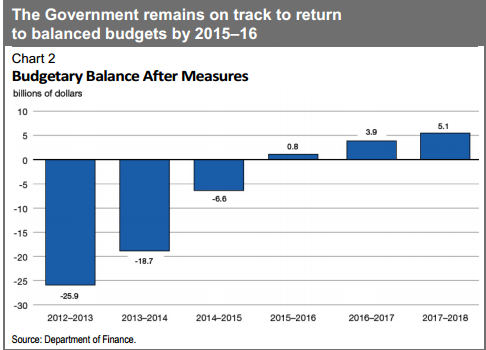
Canada spends about the same as the US for government but has universal healthcare, mostly balanced budgets and less than half the debt per person

by noreply@blogger.com (brian wang)
Canada got a hold of its government spending problems during the 1990s.

The charts below show that Canada has federal government spending at about 14% of GDP and the US is at 24% of GDP.
Canada's debt to GDP ratio is about 33% vs 75% for the USA.
Canada has a government deficit this year of about $6 billion vs $600 billion for the US and had deficits of $25-40 billion during the crisis while the US had over $1 trillion deficits each year. Even if multiplying by nine times for population adjustment Canada is still way lower in terms of spending and deficits.
Canada has universal healthcare at the provincial level.

The US has plenty of financial strength to turn things around.
The military spending could go from 5% down to 2% of GDP with no chance of not having enough military to handle any terrorist threat or any issues with countries like Pakistan, Afghanistan, Iran or North Korea. China, Russia and the US will not have a shooting war. If there was the US still would have way more military and can get some help from NATO. In that kind of war the US could mobilize and scale up as needed. Also, the military spending that the US has now is on equipment for something like World War 2 or Vietnam. Any future war between big powers would be more cyber war and other new kinds of conflict.


Read more »
10 Dec 02:35

K-12 IMPLOSION UPDATE: 10-year old Johnny Jones suspended for shooting imaginary arrow….

by Glenn Reynolds
10 Dec 02:35

NOTHING SHADY ABOUT THIS: NPR: Report Details ATF’s Use Of Mentally Disabled In Gun Stings. The…

by Glenn Reynolds

NOTHING SHADY ABOUT THIS: NPR: Report Details ATF’s Use Of Mentally Disabled In Gun Stings.

The Milwaukee Journal Sentinel just : Based on court records, police reports and dozens of interviews, the paper details how the ATF used “rogue” tactics — including providing underage youths with alcohol and allowing them to smoke pot — to run storefront gun and drug stings across the country.

In our estimation the most explosive allegation made in the report is that the agents with the U.S. Bureau of Alcohol, Tobacco, Firearms and Explosives used mentally disabled people to run their stings.

The country’s in the very best of hands. Here’s the original report.