EXPIRATION DATE: “There is no future left for Jewish communities in Europe.” “The fact is that while intellectually one can distinguish anti-Israeli fervor from anti-Semitism, in reality, on the streets of Malmö and Paris, and elsewhere in Europe, they are one and the same.”
Shared posts
20 Aug 04:04
EXPIRATION DATE: “There is no future left for Jewish communities in Europe.” “The fact is that whi…
by Glenn Reynolds
kenlacrosse likes this
20 Aug 04:01
MAYBE INSTEAD OF A GENERATOR I SHOULD HOLD OUT FOR ONE OF THESE: Redox Power Plans To Roll Out Dish…
by Glenn Reynolds
MAYBE INSTEAD OF A GENERATOR I SHOULD HOLD OUT FOR ONE OF THESE: Redox Power Plans To Roll Out Dishwasher-Sized Fuel Cells That Cost 90% Less Than Currently Available Fuel Cells. “The promise is this: generate your own electricity with a system nearly impervious to hurricanes, thunderstorms, cyber attacks, derechos, and similar dangers, while simultaneously helping the environment.”
kenlacrosse likes this
20 Aug 03:45
VICTOR DAVIS HANSON: Obama Bets Against Human Nature—and Usually Loses. “What is the common deno…
by Glenn Reynolds
VICTOR DAVIS HANSON: Obama Bets Against Human Nature—and Usually Loses. “What is the common denominator to his failed foreign policy initiatives — reset with Russia, a new, kinder gentler Middle East, supposed breakthroughs with China, outreach to Iran, Cuba, and Venezuela — and his domestic catastrophes: Obamacare, deficits, huge debts, or chronic unemployment? In a word, he doesn’t seem to know much about human nature, whether in the concrete or abstract sense. Obama either never held a menial job or ran a business. In lieu of education in the school of hard knocks, he read the wrong, if any seminal, texts at all.” Unlike George Bush, Obama’s not much of a reader. Prefers to watch sports, I understand.
kenlacrosse likes this
20 Aug 03:43
POLICING: “We’re Building A Domestic Army.”…
by Glenn Reynolds
POLICING: “We’re Building A Domestic Army.”
kenlacrosse likes this
20 Aug 03:38
NEWSPAPER THAT ENDORSED OBAMA ADMITS THE TEA PARTY WAS RIGHT: Chicago Tribune: How President Obama…
by Glenn Reynolds
NEWSPAPER THAT ENDORSED OBAMA ADMITS THE TEA PARTY WAS RIGHT: Chicago Tribune: How President Obama is flouting Obamacare: More reasons to delay and rewrite this ill-conceived law. “Granted, any president may decline to enforce statutes he believes are unconstitutional. But Obama is making no such claim here. Basically, he is admitting that parts of law are impossible to enforce on the deadlines imposed by Congress — deadlines he signed into law. He’s also admitting he doesn’t want to have Congress make these changes, for fear that if lawmakers get their mitts on this unpopular program, they would at least debate far more extensive changes than he’d like.”
kenlacrosse likes this
20 Aug 03:37
WALTER RUSSELL MEAD: Bambi Meets Godzilla In The Middle East. President Obama has had a rude awa…
by Glenn Reynolds
WALTER RUSSELL MEAD: Bambi Meets Godzilla In The Middle East.
President Obama has had a rude awakening in the Middle East. The region he thought existed was an illusion built on American progressive assumptions about the way the world works. In the dream Middle East, democracy at least of a sort was just around the corner. Moderate Islamists would engage with the democratic process, and the experience would lead them to ever more moderate behavior. If America got itself on the “right side of history,” and supported this hopeful development, both America’s values and its interests would be served. Our relationships with the peoples of the Middle East would improve as they saw Washington supporting the emergence of democracy in the region, and Al Qaeda and the other violent groups would lose influence as moderate Islamist parties guided their countries to prosperity and democracy.
This vision, sadly, has turned out to be a mirage, and Washington is discovering that fact only after the administration followed the deceptive illusion out into the deep desert. The vultures are circling now as American policy crawls forlornly over the dunes; with both the New York Times and the Washington Post running “what went wrong” obituaries for the President’s efforts in Egypt, not even the MSM can avoid the harsh truth that President Obama’s Middle East policies have collapsed into an ugly and incoherent mess.
Yeah, that’s how it looks.
kenlacrosse likes this
20 Aug 03:24
YA THINK? Christina Hoff Sommers: School Has Become Too Hostile To Boys. Girls occasionally run…
by Glenn Reynolds
YA THINK? Christina Hoff Sommers: School Has Become Too Hostile To Boys.
Girls occasionally run afoul of these draconian policies; but it is mostly boys who are ensnared. Boys are nearly five times more likely to be expelled from preschool than girls. In grades K-12, boys account for nearly 70% of suspensions, often for minor acts of insubordination and defiance. In the cases of Christopher, Josh and Alex, there was no insubordination or defiance whatsoever. They were guilty of nothing more than being typical 7-year-old boys. But in today’s school environment, that can be a punishable offense.
Zero tolerance was originally conceived as a way of ridding schools of violent predators, especially in the wake of horrific shootings in places like Littleton, Colo. But juvenile violence, including violence at schools, is at a historic low. The Bureau of Justice Statistics reports that in 2011, approximately 1% of students ages 12 to 18 reported a violent victimization at school. For serious violence, the figure is one-tenth of 1%. It does no disrespect to the victims of Columbine or Sandy Hook to note that while violence may be built into the core of a small coterie of sociopathic boys, most boys are not sociopathic.
On the other hand, millions of boys are struggling academically. A large and growing male cohort is falling behind in grades and disengaged from school. College has never been more important to a young person’s life prospects, and today boys are far less likely than girls to pursue education beyond high school. As our schools become more risk averse, the gender gap favoring girls is threatening to become a chasm. . . .
.Across the country, schools are policing and punishing the distinctive, assertive sociability of boys. Many much-loved games have vanished from school playgrounds. At some schools, tug of war has been replaced with “tug of peace.” Since the 1990s, elimination games like dodgeball, red rover and tag have been under a cloud — too damaging to self-esteem and too violent, say certain experts. Young boys, with few exceptions, love action narratives. These usually involve heroes, bad guys, rescues and shoot-ups. As boys’ play proceeds, plots become more elaborate and the boys more transfixed. When researchers ask boys why they do it, the standard reply is, “Because it’s fun.”
According to at least one study, such play rarely escalates into real aggression — only about 1% of the time. But when two researchers, Mary Ellin Logue and Hattie Harvey, surveyed classroom practices of 98 teachers of 4-year-olds, they found that this style of play was the least tolerated. Nearly half of teachers stopped or redirected boys’ dramatic play daily or several times a week — whereas less than a third reported stopping or redirecting girls’ dramatic play weekly.
One reason for this is that teachers are overwhelmingly female. That’s why we need Title IX-style legislation to narrow the educational gender gap. . . .
kenlacrosse likes this
20 Aug 03:18
BEAUTIFULLY SAD PHOTOS of a dying airline. UPDATE: David Kirkham emails: “I saw those photos of…
by Glenn Reynolds
BEAUTIFULLY SAD PHOTOS of a dying airline.
UPDATE: David Kirkham emails: “I saw those photos of LAB and those photos were eerily identical to what I saw in Poland 18 years ago. Socialists ultimately destroy everything they touch. See Detroit and our school systems.”
kenlacrosse likes this
20 Aug 02:27
YA THINK? Revelations Hint At NSA Ducking Oversight….
by Glenn Reynolds
kenlacrosse likes this
20 Aug 02:23
CHARLIE MARTIN: Buddha And The Elephant….
by Glenn Reynolds
CHARLIE MARTIN: Buddha And The Elephant.
kenlacrosse likes this
20 Aug 02:22
ANYTHING YOU CAN DO I CAN DO META: Dave Chappelle Is On The Cover Of Prince’s New Single….
by Glenn Reynolds
ANYTHING YOU CAN DO I CAN DO META: Dave Chappelle Is On The Cover Of Prince’s New Single.
kenlacrosse likes this
20 Aug 02:11
THE PERILS OF OVERDIAGNOSIS: What If What You ‘Survived’ Wasn’t Cancer?…
by Glenn Reynolds
THE PERILS OF OVERDIAGNOSIS: What If What You ‘Survived’ Wasn’t Cancer?
kenlacrosse likes this
16 Aug 17:27
“SMART DIPLOMACY:” Spengler: America’s Problems In The Middle East Are Just Beginning. “America
by Glenn Reynolds
“SMART DIPLOMACY:” Spengler: America’s Problems In The Middle East Are Just Beginning. “America’s credibility in the Middle East, thanks to the delusions of both parties, is broken, and it cannot be repaired within the time frame required to forestall the next stage of violence. Egypt’s military and its Saudi backers are aghast at American stupidity. Israel is frustrated by America’s inability to understand that Egypt’s military is committed to upholding the peace treaty with Israel while the Muslim Brotherhood wants war. Both Israel and the Gulf States observe the utter fecklessness of Washington’s efforts to contain Iran’s nuclear weapons program.”
kenlacrosse likes this
16 Aug 17:25
Quote of the Week
by Stephen Green
“Whatever economics is, it is not a science.” -Louis Woodhill, for Forbes.
Here’s more:
In 1930, the most popular car was the Ford Model A, which had 40 horsepower and a top speed of 65 miles per hour. The fastest any human had ever traveled was 357.7 mph (in a Supermarine S.6 seaplane). Connecting a phone call from New York to L.A. could take 20 minutes.
And, in 1930, a severe economic contraction began that economists did not see coming and did not know what to do about after it arrived. The period of economic distress lasted 12 years and was later named “The Great Depression.”
In 2007, the most popular passenger vehicle was the Ford F-150 pickup truck, a 300 horsepower behemoth with air conditioning and a CD player. Men had traveled at 24,790 mph (in the Apollo 10 command module). And, anyone could call anywhere on earth within seconds by speed dialing from their iPhone.
And, in late 2007, a severe economic contraction began that economists did not see coming and did not know what to do about after it arrived. This period of economic distress has lasted almost six years to date. Let’s call it “The Pretty Good Depression.”
Let’s be blunt. Whatever economics is, it is not a science.
It’s a scathing piece and I loved it. Read the whole thing.
kenlacrosse likes this
13 Aug 00:43
Trifecta of Fail
by Stephen Green
No, not the show on PJTV — it’s the links this morning on all over my aggregators. Devastating stuff. Let’s start overseas and then bring it on back home. First up, Janet Daily in The Telegraph on the not-quite-so-over War on Terror:
In May, Mr Obama gave a triumphal speech in which he declared the War on Terror officially over.
That was then. This is now: over the past week, 19 US embassies in the Middle East and North Africa had to be closed for a week, and diplomatic staff evacuated from Yemen because of “specific terrorist threats”. So who exactly is on the run? When the embarrassing contrast between this mass exit of the American presence and the “War on Terror (End of)” speech was pointed out, White House spokesmen clarified – as government spokesmen like to call it – what the president had said: it was al-Qaeda in Pakistan and Afghanistan that had been all but defeated, not its franchise in Yemen, which was clearly still alive and kicking.
This clarification was followed shortly by the evacuation of diplomatic staff from Lahore in Pakistan due to – a specific terrorist threat.
The thing of it is, we were the one knocked back on our heels and out of 19 countries. And for what? Maybe the threat was “specific,” but it certainly never materialized. Was it just a ruse, designed to shame us on the world stage while revealing our security protocols? Did Obama neutralize a really very real threat by tucking tail? Did we end the threat with drone strikes? Have we always been at war with Eastasia?
Nobody seems to know, and the ones who might know aren’t saying. I’m reminded most of Jimmy Carter holed up ineffectively in the White House for the length of the Iran hostage crisis. But to give Obama credit where it’s due, he’s holed up at a multimillion dollar luxury palace at Martha’s. Or on the links. He certainly know how to do nothing, with style and grace.
Tact, maybe not so much, which brings us to our second report. This time it’s the National Post’s Conrad Black and Obama’s narrower problem with Putin:
The Snowden affair is an embarrassment from every possible angle. He was only a contractor, and it is shocking that he was able to download and remove and give away as much secret American surveillance information as he did; it makes a Swiss cheese of American national security confidentiality. And the cavalier manner in which the Chinese and Russians have given the backs of their hands to American attempts at extradition illustrates again the declining influence of the United States in the world. President Nixon or Reagan almost certainly would have been able to find something to trade those powers that did not affront American national integrity, in exchange for the return, or at least denial of asylum, to Snowden.
Well, maybe that’s not such a narrow problem after all. Our President has been content to abandon Iraq, phony up a surge in Afghanistan, turn its back on our old ally Britain and our new allies in Central Europe, reverse course twice in Egypt, dither in Syria, lead from behind in Libya, neglect sub-Saharan Africa, lock down one of our carriers in a domestic spat with Republicans, and attempt to “pivot” to the world’s biggest ocean while refusing to commit to enough resources even to maintain the size of our current fleet.
And we’re supposed to be shocked that Putin can leave Obama twisting in the wind? Obama ran himself up that flagpole for all to see. It’s not Putin’s fault for smacking a gift horse in the mouth.
So, yes, it does all come down to one SCoaMF of a man, now described by John Steele Gordon in Commentary:
Barack Obama is, by far, the most viciously partisan president in American history. Other presidents have been partisan, often deeply so, but were careful to take the high road so as to keep open lines of communication with the other party, without which governance cannot be successful in a democracy. Not Barack Obama. His incompetence in everything political except winning elections is now costing him (and, inevitably, us) big time.
That partisanship makes for lousy domestic politics. The problem is, it’s all Obama knows — and it plays even worse on the world stage. In foreign policy, Obama doesn’t have David Axelrod’s electoral club to whack his opponents over the head. Come to think of it though, Obama doesn’t have that to use anymore in domestic politics, either.
No wonder everything has been turning to crap for him since January.
13 Aug 00:35


How to save a water-damaged cell phone
by Alex Colon
Cell phones and water: Not a good mix. Yet as phones become more and more a part of our everyday lives, it seems like we keep coming up with new and creative ways to damage them. A dip in the pool, perhaps? Or an unexpected trip into some salty water at the beach? I actually have a friend who unknowingly floated around the Dead Sea with a phone in her pocket. Then, of course, there’s that other famous body of water phones just can’t seem to stay away from — the toilet bowl.
No matter where you drop it, it’s never a happy moment when your phone first learns to swim. But try not to panic. Just because your phone got wet doesn’t mean it’s gone for good. Follow these steps and you have a pretty decent shot at bringing it back to life.
-
Take your phone out of the water. NOW.
This should be pretty self-explanatory, but the longer your phone spends submerged, the greater chance there is of water seeping into open ports and really mucking things up. But just because you accidentally spent the entire day at the beach with your phone in your pocket doesn’t mean it can’t be revived. There’s still hope. Just less. -
Don’t press any buttons.
I know it seems tempting, but pressing a button on your phone can let any residual moisture seep through, increasing your risk of damage.
-
Dry the outside of the phone off.
Quick. Grab some paper towels. Reach for the ShamWow. Roll a bunch of toilet paper into a ball or take the shirt off your back. Basically, do whatever you need to do to dry the phone off as thoroughly as possible. -
Remove the internal components.
If your phone has a removable pack banel, take it off. Grab the battery, your SIM card, and/or your microSD card and dry them off completely. After all, even if you can’t save your phone, hopefully you’ll be able to save some of the valuable information you had stored inside. Place the components on a dry paper towel and put them off to the side. -
Give it a few shakes.
There still might be some water hiding in the headphone jack or beneath any physical keys. Gently shake the phone to dispel as much of it as you can. -
Stick it in some rice.
Now that you’ve gotten rid of all the water on the surface, it’s time to suck out the rest of the moisture you can’t see. Your best bet for doing this is a product like the Bheestie Bag, which is filled with tiny balls (pictured below) that are designed to absorb and retain water more efficiently than even silica. But you probably don’t have a Bheestie Bag just lying around (though if you do, kudos). In that case, reach for the nearest bag of rice. Pour the rice into a container, and bury the phone and components somewhere in the middle. Move the phone around every couple of hours, just to make sure gravity is doing its thing.
-
Wait. Continue waiting. Then wait some more.
The best thing you can do at this point is to give your phone time to dry. The longer you wait, the greater the chance your phone will live to make another call. The minimum amount of time you should wait is a full 24 hours. You’re better off giving it 48 hours, or even 72, if you can hold out that long. It’s going to feel really strange being without a phone for so long. Use this time to catch up on all those things you’ve been meaning to do. Read a book. Rewatch season three of Mad Men. Or better yet, get outside for a little. -
The moment of truth.
Take your phone out of the bag or remove it from the bowl of rice. Dust off any starch, put all the pieces back together, and try to power it up. Hopefully your phone will turn on. If it doesn’t, you can try putting it back into the bag/rice for another day or so. But after that, if it still doesn’t I’m afraid you’ve got a dead phone on your hands. But check to see if the SIM card and/or microSD card still work if you have access to another phone. Hopefully you’ve managed to save at least something. -
Go to the books.
I can’t verify this, but the chances of you winning the lottery are probably greater than your phone’s warranty covering water damage. Still, it can’t hurt to locate the original paperwork and check it out. -
Planning for the future.
So how can you prevent this from happening again? Easy. Stop taking the phone into the bathroom. If that’s simply not an option, you can always purchase a waterproof case. Nowadays you can find one for just about every type of smartphone there is, though there aren’t many out there for feature phones. And if this is the sort of thing that happens to you a lot, you may want to think about getting a water-resistant smartphone. You still won’t be able to go deep sea diving with it, but it’ll almost certainly bounce back from a quick dip in the pool.
Related research and analysis from GigaOM Pro:
Subscriber content. Sign up for a free trial.
- Survey: How apps can solve photo management
- Sector RoadMap: Social customer service in 2013
- Analyzing the wearable computing market
21 Jul 23:10
JIM TREACHER: “I’d like to hear from some representatives of the Hispanic community. How do they …
by Glenn Reynolds
JIM TREACHER: “I’d like to hear from some representatives of the Hispanic community. How do they feel about President Obama driving a wedge deeper and deeper between blacks and Hispanics? Is he just arrogant enough to think that the Democrats can count on their votes in 2016, no matter what? Is he right? Why is it okay to make a Hispanic guy an Enemy of the State for defending his own life against an attacker?”
kenlacrosse likes this
21 Jul 23:08

China: The Watermelon Revolution
by John Robb
We've seen two events over the last couple of days that could trigger mass (open source) protest in China.
The first is a watermelon street vendor that was beaten to death with his own scale by a city militia.
The second is a wheelchair bound man that was blew himself up (after warning people to back away), at the Beijing airport. He was crippled by an urban militia for running an informal taxi service with his scooter.
Both incidents have been accelerated by social media -- blogs and a short message service like Twitter -- due to widespread public disatisfaction with the militia system called Chengguan.
Chengguan militias were set up in Chinese cities in 2001 to enforce urban codes (a Chinese variant of "broken windows" in US cities). They are run by local officials with little central oversight.
They mainly harrass the informal economy in Chinese cities and are known for corruption ("confliscation") and brutal enforcement.
That corrupt brutality is widely resented, particularly now. Why now?
Chinese economic growth is slowing and people are turning to the informal economy in desperation only to run into a brutal, corrupt local militia armed with batons.
So, will these two incidents serve to ignite an open source protest that will sweep China -- a watermelon revolution?
Millions of people hitting the streets and blogs under one simple banner: no more corruption!
Perhaps. From afar, these protests look like excellent triggers.
If it doesn't happen now, it will. Remember, China is operating on borrowed time.
It's run by a government without any basis for legitimacy other than fast economic growth.
To maintain power, that needs to be true, and it's not true anymore.
kenlacrosse likes this
21 Jul 23:06
DETROIT’S PROBLEM: Detroit’s situation seems almost unprecedented, and it’s not clear how the…
by Glenn Reynolds
DETROIT’S PROBLEM:
Detroit’s situation seems almost unprecedented, and it’s not clear how the city can best respond to it. The unions’ biggest problem is that Detroit simply cannot pay their pension claims without destroying city services. Detroit doesn’t have the money to provide even minimal services to its current population while paying off the large numbers of retired workers, many of whom hail from times when the city was larger and richer.
Because there is no money, there is no solution that gives the unions the relief they seek. Total obedience to the state constitutional mandate might not be possible, and that’s a problem. The government can pass a law saying that everyone has a constitutional right to a free trip to the moon, but if it doesn’t build the spacecraft that can get you there the right is void.
While the principle that federal law trumps state law on most issues is pretty clear, there are real arguments on both sides in this complicated case. But if the state constitution is unenforceable as well as being in conflict with federal law, it would be that much harder for the state constitution to block the execution of federal bankruptcy law.
However the courts eventually decide, decades of misgovernance, the criminal corruption of the Democratic Party in Detroit, and the depraved indifference of politicians at every level as crooks and hacks conspired together to loot and wreck a great American city have brought us to a place where Detroit’s problems seem almost beyond solution. The saddest part of this story is that there is still much, much more pain to come for a lot of people. Both the residents of current day Detroit and the cops, teachers, firefighters and others who trusted in the promises of Detroit politicians and union officials face a world of hurt.
Something that can’t go on forever, won’t. Debts that can’t be repaid, won’t be. Promises that can’t be kept, won’t be.
kenlacrosse likes this
19 Jul 00:54

The March of the Dinosaurs
by Richard Fernandez
After noticing that the Gmail inbox had changed yet again, a friend asked “why does Google keep switching things on me?” I replied that somebody at Google felt he had to earn his salary and, in the absence of any pressing bug, busied himself with improvements. “So it’s been improved, whether you like it or not.”
That recalled an situation some years ago at a company which I visited, in which the IT manager kept asking their database administrator why he was so idle only to receive the reply, “because I’ve set things up so that things don’t break down.” They should have put him to working diddling with code that worked. Then he would be busy.
This is a problem shared by firemen and the military. They mostly do nothing if they do their jobs right. And by and by they will get their budgets slashed. It’s the screwups who experience eternal growth because the pot of gold is always on the other side of the hill.
It never occurred to the IT manager that if his subordinate was actually perpetually busy saving the company data it was a sure sign that he had to be fired. And nowhere is the imperative to substitute activity for achievement so endemic as in government. Daniel Henning at the Wall Street Journal argued that Obamacare was failing because it had become too big to actually do anything. Government just grows and grows and grows. Because that’s the nature of the beast.

Sinclair Dinosaurs are transported on the Hudson River to the 1964 World’s Fair.
If the ObamaCare meltdown were a one-off, the system could dismiss it as a legislative misfire and move on, as always. But ObamaCare’s problems are not unique. Important parts of the federal government are breaking down almost simultaneously. … a dweeb like Edward Snowden could download the content of the NSA’s computers onto a thumb drive and walk out of the world’s “most secretive” agency. Here’s the short answer: The NSA has 40,000 employees. (Some say it’s as high as 55,000, but it’s a secret.)
Echoing that, when the IRS’s audits of conservative groups emerged, the agency managers’ defense was that the IRS is too big for anyone to know what its agents are doing. …
It is hard to imagine a more apolitical federal function than the nation’s weather satellites. The ones we have—to predict hurricanes and such—are about to wear out and need to be replaced. Can’t do it. The National Oceanic and Atmospheric Administration, NASA and the Pentagon have been trying to replace the old weather satellites, since 1994….
The State Department missed signs of the Arab Spring’s insurrections in late 2010 despite warnings from outside groups. Egypt is in flames, in part, because State for years has been mainly a massive, drifting bureaucracy. Little wonder Hillary Clinton spent four years in flight from the place. …
Excepting the military’s fighting units, the federal government has become a giant slug, like Jabba the Hutt, inert but dangerous. Like Jabba, the government increasingly survives by issuing authoritarian decrees from this or that agency.
The Examiner summarizes the problem succinctly: Obamacare is a 19th-century answer to a 21st-century question. “Rather than imposing a top-down, command-economy, welfare-state health care model with roots in Otto von Bismarck’s Germany of 1881, a 21st-century government would ask what is needed to apply to health care access the Internet’s boundless capacity to empower individual choice.”
But of course that’s not going to happen. Recently Leo Linbeck III proposed a consumption tax to replace the supergiant labyrinthine tax system. Whatever its merits it has one undeniable virtue: it requires far less energy to operate than the current gigantic IRS. It’s much smaller than the monumental reptilian monster than we have now.
And small systems do something counterintuitive. They let you find the button to retake control over your life.
Today individual choice is a checkbox buried in a 500 page form. It is a setting concealed deep within the preference menu of whatever software you use, a setting that will buried even deeper still when the next generation of developers adds features to your application. But it’s not choice if you don’t know it’s there.
You’ll never find the button you need to press because all that bandwidth has to cram itself into an increasingly small pipe. On a public policy level this manifests itself as pixelated vision. The feedback loops of the immense bureaucracy can only be perceived through the low-res imaging of the mainstream media. The only thing we see is what the Narrative lets us see, so that basically we have the visual acuity of Mr. Magoo.
Recently the New York Times did a retrospective of the Tawana Brawley case. “Revisiting a Rape Scandal That Would Have Been Monstrous if True”. What was monstrous was that nobody could tell until much later that it was untrue.
But, as the meticulously researched Retro Report points out this week, it was all a hoax. After seven months, 6,000 pages of testimony and 180 witnesses, a grand jury found Ms. Brawley’s story to be a lie. Neither the police officer nor the district attorney accused by Ms. Brawley and Mr. Sharpton had been involved in any way, the report concluded.
A Sharpton associate told the news media at the time that Ms. Brawley’s lawyers, C. Vernon Mason and Alton H. Maddox Jr., and Mr. Sharpton were “frauds from the beginning.”
And about six months after the hoax, Ms. Brawley’s former boyfriend told Newsday that she had invented the allegations, apparently to avoid a beating by her mother’s boyfriend after running away from home for four days.
Last week, Retro Report interviewed Mr. Sharpton and asked whether, 25 years later, he felt that any crime had occurred at all.
“Whatever happened,” he answered, “you’re dealing with a minor who was missing four days. So it’s clear that something wrong happened.”
It’s tempting to think of the Brawley incident as a conspiracy. On one level it was exactly that. But on another level it was just bad signals being amplified by a pitiful saurian media brain that had become far too inadequate for the new and gigantic body that it had to serve. People just stampeded themselves into a fix.
Sharpton was unintentionally right. The Brawley affair was something that just happened, a spasm that ran through the dinosaur. Is it is his fault if he just happened to be around to catch pennies from heaven? Just one of those things whose provenance no one knew nor cared what became of it later. And if weren’t Brawley it would be something else.
What is remarkable about the misfortunes overtaking the Obama administration is they are just cumulative. It’s like standing in front of a maniac baseball pitching machine without a bat. Nothing gets solved. The don’t even bother to swing. They can’t even keep count.
The public only gets a momentary glimpse a huge problem before it gets buried in the avalanche of something else. Recently it has come to light that government has been tracking “photographs of your car in their files, noting where you were driving on a particular day, even if you never did anything wrong.”
Using automated scanners, law enforcement agencies across the country have amassed millions of digital records on the location and movement of every vehicle with a license plate, according to a study published Wednesday by the American Civil Liberties Union. Affixed to police cars, bridges or buildings, the scanners capture images of passing or parked vehicles and note their location, uploading that information into police databases. Departments keep the records for weeks or years, sometimes indefinitely.
But so what? This new scandal has got to get in line behind the IRS, Benghazi, the North Korean Missiles in Panama, Syria, Egypt, economic bad news, Bernake, Zimmerhoo and Zimmerhaw. It ain’t never going to get attended to. I honestly expect the car monitoring scandal to buried in a week, tops. Nobody even has time to notice that the administration has been selling ambassadorships or that the IRS snooper wasn’t even an IRS employee — just a political donor.
In a manner of speaking this means there is nothing to worry about. There is no point being outraged at Jesse Jackson’s demand that the United Nations investigate the Zimmerman case. Why? Because if the UN actually tried to do something it would be forgotten in a week, simply overwhelmed by news from Syria or a meltdown somewhere else. Besides the UN never actually does anything, which is why it is so widely admired by liberal ideologues.
It used to be a bad sign when events got inside your OODA loop. The modern bureaucratic state has gotten inside its own OODA loop. Nobody knows what’s going on. So they’ll start a committee …
Is that cause for celebration or just another “oh s**t” moment? Don’t hesitate now. Make your choice, rush out and buy a beer. Dinosaurs really can’t afford to spend too much time thinking about any one thing when they cover the best part of an acre.
Did you know that you can purchase some of these books and pamphlets by Richard Fernandez and share them with you friends? They will receive a link in their email and it will automatically give them access to a Kindle reader on their smartphone, computer or even as a web-readable document.
The War of the Words for $3.99, Understanding the crisis of the early 21st century in terms of
information corruption in the financial, security and political spheres
Rebranding Christianity for $3.99, or why the truth shall make you free
The Three Conjectures at Amazon Kindle for $1.99, reflections on terrorism and the nuclear age
Storming the Castle at Amazon Kindle for $3.99, why government should get small
No Way In, a novel at Amazon Kindle $8.95, print $9.99
Storm Over the South China Sea $0.99, how China is restarting history in the Pacific
Tip Jar or Subscribe or Unsubscribe
kenlacrosse likes this
19 Jul 00:51
A problem from hell revisited
by Scott Johnson
(Scott Johnson)


President Obama’s nominee to serve as our ambassador to the United Nations is the vile Samantha Power, Pulitzer Prize-winning author of A Problem From Hell. I think the title of her book is a case of projection.
At her confirmation hearing today, she was questioned about a statement from her 2003 New Republic article in which she wrote that American foreign policy needed “a historical reckoning with crimes committed, sponsored or permitted by the United States.” It is a statement that is perfectly consistent with Power’s book and indeed her career as a public intellectual.
Senator Rubio asked Power a few questions about this statement at the hearing today. She simply would not give a straight answer to the question and was allowed to slither away. Fox News summarizes the exchange as follows:
“‘I would categorize the Rwanda situation as a crime,’ the words you used, ‘permitted by the United States.’” Rubio began, quoting Power. “Which ones did the U.S. commit or sponsor that you were referring to?”
“Again sir, I think this is the greatest country on Earth,” Power responded. “We have nothing to apologize for.”
Rubio wasn’t placated with the nebulous reply, pressing her to explain further, saying, “So, you don’t have any in mind now…”
“I will not apologize for America. I will stand very proudly, if confirmed, behind the U.S. placard,” said Power.
Just when it appears the exchange may be over … think again. Rubio trudges onward. “I understand,” he says, “but do you think the U.S. has sponsored crimes…?”
“I believe the U.S. is the greatest country on earth,” Power reiterates.
As I say, Power’s statement perfectly represents the essence of her views. The problem from hell is that Power in this respect and others Power perfectly represents her boss. Fox News includes video at the link, along with great commentary on Power by Monica Crowley.
kenlacrosse likes this
18 Jul 22:03
Google Engineers could be among the first for life extensions technologies in the next decade hints Google Director of Staffing
by noreply@blogger.com (brian wang)
Here's Google's recruitment slogan from the future: "Come work at Google and live longer. It's a Singular Experience!"
How can other companies compete?!
Google can make sure its engineers have a seat on the Singularity bus. It already has the driver of the idea in Ray Kurzweil, and the Singularity will require the world's largest, most powerful computer system, which is exactly what Google is building.
Earlier this week, at a Commonwealth Club Inforum event on the topic of HR and what Silicon Valley companies such as Twitter, and Cisco Systems are doing to attract the best people, panel member Todd Carlisle, Director of Staffing at Google, had the last word, by teasing a possible future scenario.
He asked, what if a perk of working at a company was that it extended your life? He said that people would likely never leave, they would be incredibly loyal.
Read more »


How can other companies compete?!
Google can make sure its engineers have a seat on the Singularity bus. It already has the driver of the idea in Ray Kurzweil, and the Singularity will require the world's largest, most powerful computer system, which is exactly what Google is building.
Earlier this week, at a Commonwealth Club Inforum event on the topic of HR and what Silicon Valley companies such as Twitter, and Cisco Systems are doing to attract the best people, panel member Todd Carlisle, Director of Staffing at Google, had the last word, by teasing a possible future scenario.
He asked, what if a perk of working at a company was that it extended your life? He said that people would likely never leave, they would be incredibly loyal.
Read more »
kenlacrosse and -1 others like this
18 Jul 22:03
Changing processing has made far stronger carbon nanotube based reinforced polymer fiber
by noreply@blogger.com (brian wang)
Marilyn Minus, an assistant professor of engineering at Northeastern, has developed a type of carbon nanotube based polymer fiber that is stronger than the first kevlar, spectra and—even in its first generation—closely approaches the strength of the fourth (Zylon). It’s the crystallization process that drives the remarkable properties recently reported. In their research, Minus and her colleagues showed that they could easily turn these properties on or off. By changing nothing but the pattern of heating and cooling the material, they were able to increase the strength and toughness of fibers made with the very same ingredients. In the current research, Minus and her colleagues worked out the recipe and process for one particular polymer: polyvinyl alcohol. “But we can do this with other polymers and we are doing it,” she said.
From carbon black powder to metallic particles, a variety of materials can guide the formation of specific crystal types in a process called nucleation. But before carbon nanotubes, Minus said, “we’ve never had a nucleating material so similar to polymers.” This similarity allows the nanotubes to act likes skates along which the long polymer chains can slide, perfectly aligning themselves with one another.

Macromolecular Materials and Engineering - Forming Crystalline Polymer-Nano Interphase Structures for High-Modulus and High-Tensile/Strength Composite Fibers
Read more »


From carbon black powder to metallic particles, a variety of materials can guide the formation of specific crystal types in a process called nucleation. But before carbon nanotubes, Minus said, “we’ve never had a nucleating material so similar to polymers.” This similarity allows the nanotubes to act likes skates along which the long polymer chains can slide, perfectly aligning themselves with one another.

Macromolecular Materials and Engineering - Forming Crystalline Polymer-Nano Interphase Structures for High-Modulus and High-Tensile/Strength Composite Fibers
Read more »
kenlacrosse likes this
18 Jul 22:02
Aubrey de Grey donates $13 million of his own wealth to SENS life extension
by noreply@blogger.com (brian wang)
Aubrey de Grey's mother died in May 2011. He was her only child. He inherited roughly $16.5 million. He assigned $13 million to SENS. His donation will be spent over a period of about five years, and it roughly doubles the budget they had previously, from $2 million annually to $4 million. The number one external donor remains Peter Thiel. Additionally, another internet entrepreneur, Jason Hope, has recently begun to contribute comparable sums.
Readers can donate to SENS life extension through the repair of damage caused by aging at this link
Aubrey has great confidence that our outreach efforts will bear fruit in that time. His hope is that five years from now we will be big enough that the expiry of my donation will go relatively unnoticed.
Aging is not a risk factor for disease. Aging is the CAUSE of the diseases of old age, and we need to start saying so.
Life Extension Foundation interviewed Aubrey and got an update on SENS research
Read more »


Readers can donate to SENS life extension through the repair of damage caused by aging at this link
Aubrey has great confidence that our outreach efforts will bear fruit in that time. His hope is that five years from now we will be big enough that the expiry of my donation will go relatively unnoticed.
Aging is not a risk factor for disease. Aging is the CAUSE of the diseases of old age, and we need to start saying so.
Life Extension Foundation interviewed Aubrey and got an update on SENS research
Read more »
kenlacrosse and -1 others like this
18 Jul 21:57

Steering stem cells with magnets
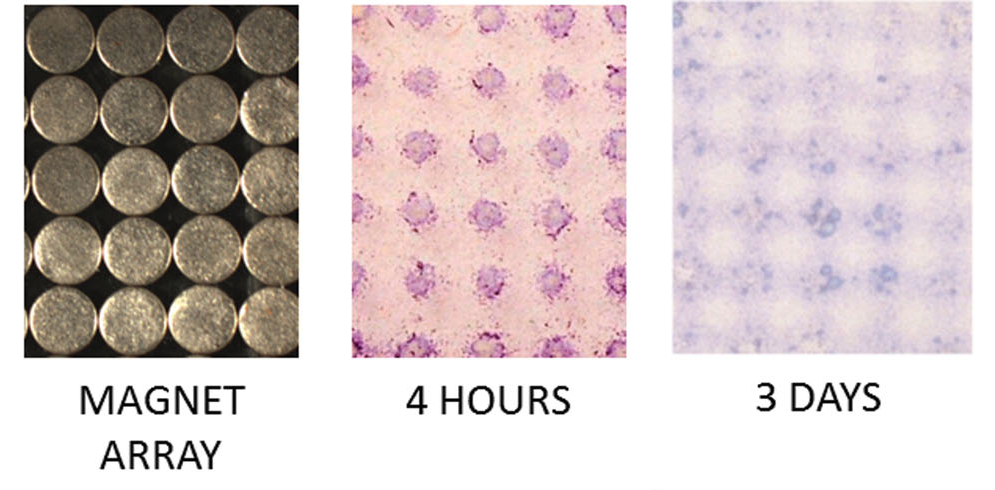
Magnets attract stem cells labeled with red fluorescent dye to desired tissue (credit: N. Landazuri et al./Emory University)
By feeding stem cells tiny particles made of superparamagnetic iron oxide nanoparticles, scientists at Emory and Georgia Tech can then use magnets to attract the cells to a particular location in a mouse’s body after intravenous injection.
The type of cells used in the study, mesenchymal stem cells, are not embryonic stem cells. Mesenchymal stem cells can be readily obtained from adult tissues such as bone marrow or fat. They are capable of becoming bone, fat and cartilage cells, but not other types of cell, such as muscle or brain. They secrete a variety of nourishing and anti-inflammatory factors, which could make them valuable tools for treating conditions such as cardiovascular disease or autoimmune disorders.
Magnetized iron oxide nanoparticles
Magnetized iron oxide nanoparticles are already FDA-approved for diagnostic purposes with MRI (magnetic resonance imaging). Other scientists have tried to load stem cells with similar particles, but found that the coating on the particles was toxic or changed the cells’ properties. The nanoparticles used in this study have a polyethylene glycol coating that protects the cell from damage. Another unique feature is that the Emory/Tech team used a magnetic field to push the particles into the cells, rather than chemical agents used previously.
“We were able to load the cells with a lot of these nanoparticles and we showed clearly that the cells were not harmed,” Taylor says. “The coating is unique and thus there was no change in viability and perhaps even more importantly, we didn’t see any change in the characteristics of the stem cells, such as their capacity to differentiate. This was essentially a proof of principle experiment. Ultimately, we would target these to a particular limb, an abnormal blood vessel or even the heart.”
The particles are coated with the nontoxic polymer polyethylene glycol, and have an iron oxide core that is about 15 nanometers across. For comparison, a DNA molecule is 2 nanometers wide and a single influenza virus is at least 100 nanometers wide.
The particles appear to become stuck in cells’ lysosomes, which are parts of the cell that break down waste. The particles stay put for at least a week and leakage cannot be detected. The scientists measured the iron content in the cells once they were loaded up and determined that each cell absorbed roughly 1.5 million particles.
Test of magnetic attraction of treated stem cells
Once cells were loaded with iron oxide particles, the Emory/Tech team tested the ability of magnets to nudge the cells both in cell culture and in living animals. In mice, a bar-shaped rare earth magnet could attract injected stem cells to the tail (see photo). The magnet was applied to the part of the tail close to the body while the cells were being injected. Normally most of the mesenchymal stem cells would become deposited in the lungs or the liver.
To track where the cells went inside the mice, the scientists labeled the cells with a fluorescent dye. They calculated that the bar magnet made the stem cells 6 times more abundant in the tail. In addition, the iron oxide particles themselves could potentially be used to follow cells’ progress through the body.
“Next, we plan to focus on therapeutic applications in animal models where we will use magnets to direct these cells to the precise site need to affect repair and regeneration of new blood vessels,” Taylor says.
The research was supported by the National Heart Lung and Blood Institute’s Program of Excellence in Nanotechnology.
The paper was a result of collaboration between the laboratories of W. Robert Taylor, MD, PhD, and Gang Bao, PhD. Taylor is professor of medicine and biomedical engineering and director of the Division of Cardiology at Emory University School of Medicine. Bao is professor in the Wallace H. Coulter Department of Biomedical Engineering at Georgia Tech and Emory University. Co-first authors of the paper are postdoctoral fellows Natalia Landazuri, PhD, and Sheng Tong, PhD. Landazuri is now at the Karolinska Institute in Sweden.
kenlacrosse likes this
18 Jul 21:57


Elastic electronics: best stretchable gold conductors yet
Polyurethane studded with gold nanoparticles can conduct electricity even when stretched to more than twice its original length. Stretchable electrodes pave the way for flexible electronics and gentler medical devices. (Credit: Joseph Xu)
Networks of spherical nanoparticles embedded in elastic materials may make the best stretchy conductors yet, engineering researchers at the University of Michigan have discovered.
“Essentially, the new nanoparticle materials behave as elastic metals,” said Nicholas Kotov, the Joseph B. and Florence V. Cejka Professor of Engineering. “It’s just the start of a new family of materials that can be made from a large variety of nanoparticles for a wide range of applications.”
Finding good conductors that still work when pulled to twice their length is a tall order — researchers have tried wires in tortuous zigzag or spring-like patterns, liquid metals, nanowire networks, and more. The team was surprised that spherical gold nanoparticles embedded in polyurethane could out-compete the best of these in stretchability and concentration of electrons.
“We found that nanoparticles aligned into chain form when stretching. That can make excellent conducting pathways,” said Yoonseob Kim, first author of the study published in Nature on July 18 and a graduate student in the Kotov lab in chemical engineering.
Left: an electron microscope image of the gold nanoparticles in a relaxed sample of the layer-by-layer material. The nanoparticles are dispersed. Right: a similar sample stretched to a little over twice its original length, at the same magnification. The nanoparticles form a distinct network. (Credit: Nicholas Kotov)
To find out what happened as the material stretched, the team took state-of-the-art electron microscope images of the materials at various tensions. The nanoparticles started out dispersed, but under strain, they could filter through the minuscule gaps in the polyurethane, connecting in chains as they would in a solution.
“As we stretch, they rearrange themselves to maintain the conductivity, and this is the reason why we got the amazing combination of stretchability and electrical conductivity,” Kotov said.
The team made two versions of their material: by building it in alternating layers or filtering a liquid containing polyurethane and nanoparticle clumps to leave behind a mixed layer. Overall, the layer-by-layer material design is more conductive while the filtered method makes for extremely supple materials.
Without stretching, the layer-by-layer material with five gold layers has a conductance of 11,000 Siemens per centimeter (S/cm), on par with mercury, while five layers of the filtered material came in at 1,800 S/cm, more akin to good plastic conductors.
Brain implants
The eerie, blood-vessel-like web of nanoparticles emerged in both materials upon stretching and disappeared when the materials relaxed. Even when close to its breaking point, at a little more than twice its original length, the layer-by-layer material still conducted at 2,400 S/cm. Pulled to an unprecedented 5.8 times its original length, the filtered material had an electrical conductance of 35 S/cm — enough for some devices.
Kotov and Kim chiefly see their stretchable conductors as electrodes. Brain implants are of particular interest to Kotov. Rigid electrodes create scar tissue that prevents the electrode from working over time, but electrodes that move like brain tissue could avoid damaging cells, Kotov said.
“The stretchability is essential during implantation process and long-term operation of the implant when strain on the material can be particularly large,” he said. Whether in the brain, heart or other organs — or used for measurements on the skin — these electrodes could be as pliable as the surrounding tissue.
They could also be used in displays that can roll up or in the joints of lifelike “soft” robots.
Flexible semiconductors
Because the chain-forming tendency of nanoparticles is so universal, many other materials could stretch, such as semiconductors. In addition to serving as flexible transistors for computing, elastic semiconductors may extend the lives of lithium-ion batteries. Kotov’s team is exploring various nanoparticle fillers for stretchable electronics, including less expensive metals and semiconductors.
Kotov is a professor of chemical engineering, biomedical engineering, materials science and engineering and macromolecular science and engineering.
The work is funded by the STX foundation in Seoul, South Korea; U.S. Department of Energy’s Office of Science; Defense Advanced Research Projects Agency; Air Force Office of Scientific Research; and National Science Foundation. U-M is pursuing patent protection for the intellectual property and seeking commercialization partners to help bring the technology to market.
kenlacrosse likes this
18 Jul 21:55
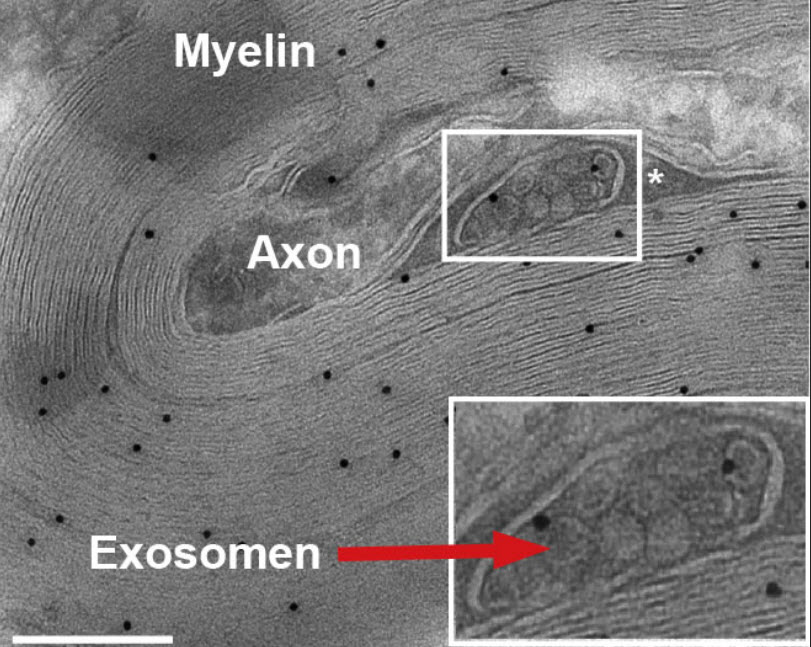
New mode of cellular communication discovered in the brain
Exosomes (“exosomen” in German) are small vesicles that contain proteins and nucleic acids. They are commonly present in close proximity to nerve cell axons, where they are ideally positioned to supply protective substances. Scale bar: 50 microns. (Credit: Institute of Molecular Cell Biology)
Johannes Gutenberg University Mainz (JGU) researchers have discovered a new form of communication between neurons and neighboring of a specific type of glial cells: a transfer of protein and genetic information, protecting neurons from stressful growth conditions.
Oligodendrocytes, a type of glial cell, serve several functions.
They form an insulating myelin sheath around the axons of neurons. If this support becomes unavailable, axons can die off. This is what happens in many forms of myelin disorders, such as multiple sclerosis, and it results in a permanent loss of neuron impulse transmission.
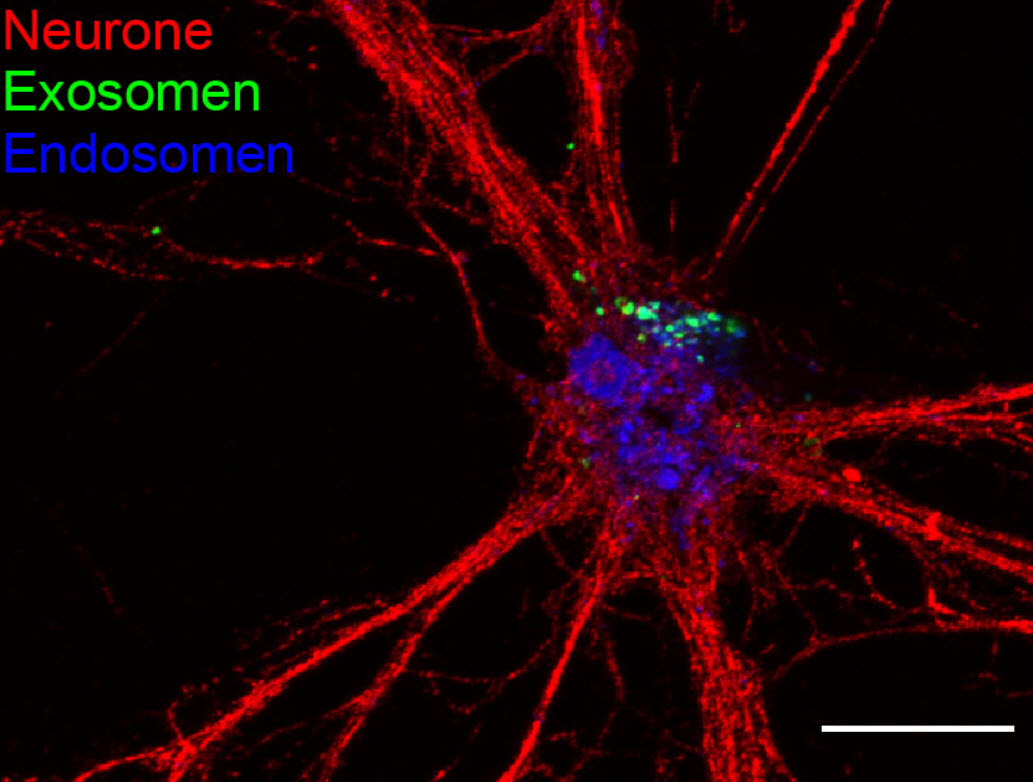
In addition, they secrete small vesicles (membrane-enclosed transport packages) called exosomes that contain ribonucleic acids (genetic information), in addition to lipids and proteins. In response to neuronal signals, these exosomes are taken up by the neurons and their cargo can then be used for neuronal metabolism.
The release of exosomes is triggered by the neurotransmitter glutamate. By labeling them with reporter enzymes, the researchers demonstrated that the exosomes are absorbed into the interior of the neurons.
“The entire package of substances, including the genetic information, is apparently utilized by the neurons,” said study leader Dr. Eva-Maria Krämer-Albers. If neurons are subjected to stress and are aided by the exosomes, they subsequently recover. “This maintenance probably also leads to de novo synthesis of proteins.”
Among the substances present in the exosomes are protective proteins such as heat shock proteins, glycolytic enzymes, and enzymes that counter oxidative stress.
In the future, the researchers hope to develop specific exosomes that could be used in the treatment of nerve disorders.
An exosome absorbed into a neuron (becoming an endosome), where it helps protect neurons against stress. Scale bar: 20 microns. (Credit: Institute of Molecular Cell Biology)
Pierrer, kenlacrosse likes this
18 Jul 21:53
A Look at the Two Sides of Oxidative Stress
by Reason
Damaging reactive oxygen species (ROS) and other free radicals are generated within your cells, largely as a result of the day to day operations of mitochondria, the power plants of the cell that produce chemical energy stores used by cellular processes. Too many free radicals produce the state called oxidative stress, in which a cell struggles to keep up with the repair of its protein machinery. Oxidative stress increases with age: this is thought to be due to increasing dysfunction in mitochondria, and to be a root cause of degenerative aging.
It's not quite so simple, however, as the presence of oxidative molecules in our biology is vital to life. Evolution eagerly uses and reuses every cog, nut, and bolt that happens to be to hand, and so ROS are involved in a range of essential cellular mechanisms. Low levels of ROS are usually beneficial and necessary, while high levels are usually damaging and bad. (Unless you are a naked mole rat, in which case high levels seem to be business as usual and something to be shrugged off in the course of living for an exceedingly long time). Biology is a complex business, and it is always the case that the details matter: you can't just talk about ROS levels, but have to talk about where, when, how they change, and their interaction with other processes.
Under normal physiological conditions, reactive oxygen species (ROS) serve as 'redox messengers' in the regulation of intracellular signalling, whereas excess ROS may induce irreversible damage to cellular components and lead to cell death by promoting the intrinsic apoptotic pathway through mitochondria. In the aging process, accumulation of mitochondria DNA mutations, impairment of oxidative phosphorylation as well as an imbalance in the expression of antioxidant enzymes result in further overproduction of ROS. This mitochondrial dysfunction-elicited ROS production axis forms a vicious cycle, which is the basis of mitochondrial free radical theory of aging. In addition, several lines of evidence have emerged recently to demonstrate that ROS play crucial roles in the regulation of cellular metabolism, antioxidant defence and posttranslational modification of proteins.We first discuss the oxidative stress responses, including metabolites redistribution and alteration of the acetylation status of proteins, in human cells with mitochondrial dysfunction and in aging. On the other hand, autophagy and mitophagy eliminate defective mitochondria and serve as a scavenger and apoptosis defender of cells in response to oxidative stress during aging. These scenarios mediate the restoration or adaptation of cells to respond to aging and age-related disorders for survival.
In the natural course of aging, the homeostasis in the network of oxidative stress responses is disturbed by a progressive increase in the intracellular level of the ROS generated by defective mitochondria. Caloric restriction, which is generally thought to promote longevity, has been reported to enhance the efficiency of this network and provide multiple benefits to tissue cells. In this review, we emphasize the positive and integrative roles of mild oxidative stress elicited by mitochondria in the regulation of adaptation, anti-aging and scavenging pathway beyond their roles in the vicious cycle of mitochondrial dysfunction in the aging process.
kenlacrosse likes this
18 Jul 19:39
ALL IS PROCEEDING AS I HAVE FORESEEN: As ‘Higher Education Bubble’ Accelerates, Alternatives Em…
by Glenn Reynolds
ALL IS PROCEEDING AS I HAVE FORESEEN: As ‘Higher Education Bubble’ Accelerates, Alternatives Emerge.
kenlacrosse likes this
18 Jul 19:37
MORE ANTI-TEA-PARTY ACTIVITY: IRS Admits It Leaked Christine O’Donnell’s Tax Records To Opposition …
by Glenn Reynolds
MORE ANTI-TEA-PARTY ACTIVITY: IRS Admits It Leaked Christine O’Donnell’s Tax Records To Opposition Day She Announced:
On March 9, 2010, the day she revealed her plan to run for the Senate in a press release, a tax lien was placed on a house purported to be hers and publicized. The problem was she no longer owned the house. The IRS eventually blamed the lien on a computer glitch and withdrew it.
Now Mr. Martel, a criminal investigator for the Treasury Department’s inspector general for tax administration, was telling her that an official in Delaware state government had improperly accessed her records on that very same day.
Beyond that, Ms. O’Donnell and Senate investigators who have tried to help her have run into a wall of silence, leaving more questions than answers about whether abuses of the IRS system extend to private individuals and not just the tax-exempt groups already identified as victims.
Seems like a lot of the “bad luck” that affected some Tea Party candidates wasn’t bad luck at all. Examples must be made to ensure that this doesn’t happen again. Name, shame, and sue.
Related: House Holds Hearing Today on The IRS’ Systematic Delay and Scrutiny of Tea Party Applications.
kenlacrosse likes this