Shared posts

23 Feb 05:00

Audit the Fed

by James_Hamilton

Senator Rand Paul (R-KY) has gathered significant bipartisan support for the Federal Reserve Transparency Act of 2015, his proposal for more audits of the Fed. I’ve been trying to understand why any sensible person would think this is a good idea.

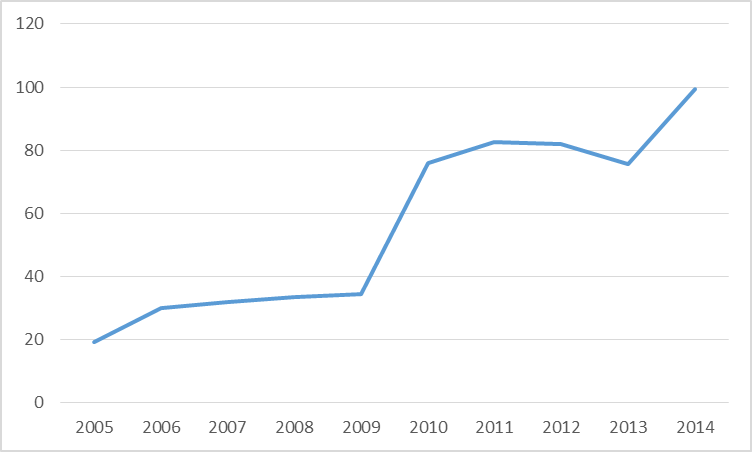
Jim Guest says the bill would serve Americans’ “right to know where their tax dollars are going.” Perhaps he meant to say Americans’ right to know where the Treasury’s revenues are coming from rather than where tax dollars are going. The Federal Reserve’s net contributions to the U.S. Treasury have averaged +$83 billion per year since 2009. Last year’s federal deficit would have been almost $100 billion bigger if it had not been for the net positive revenue contributions from the Fed.
treasury_fed_receipts_feb_15

Net receipts of the U.S. Treasury from the Federal Reserve, fiscal years 2005-2014. Data source: Treasury Bulletin.

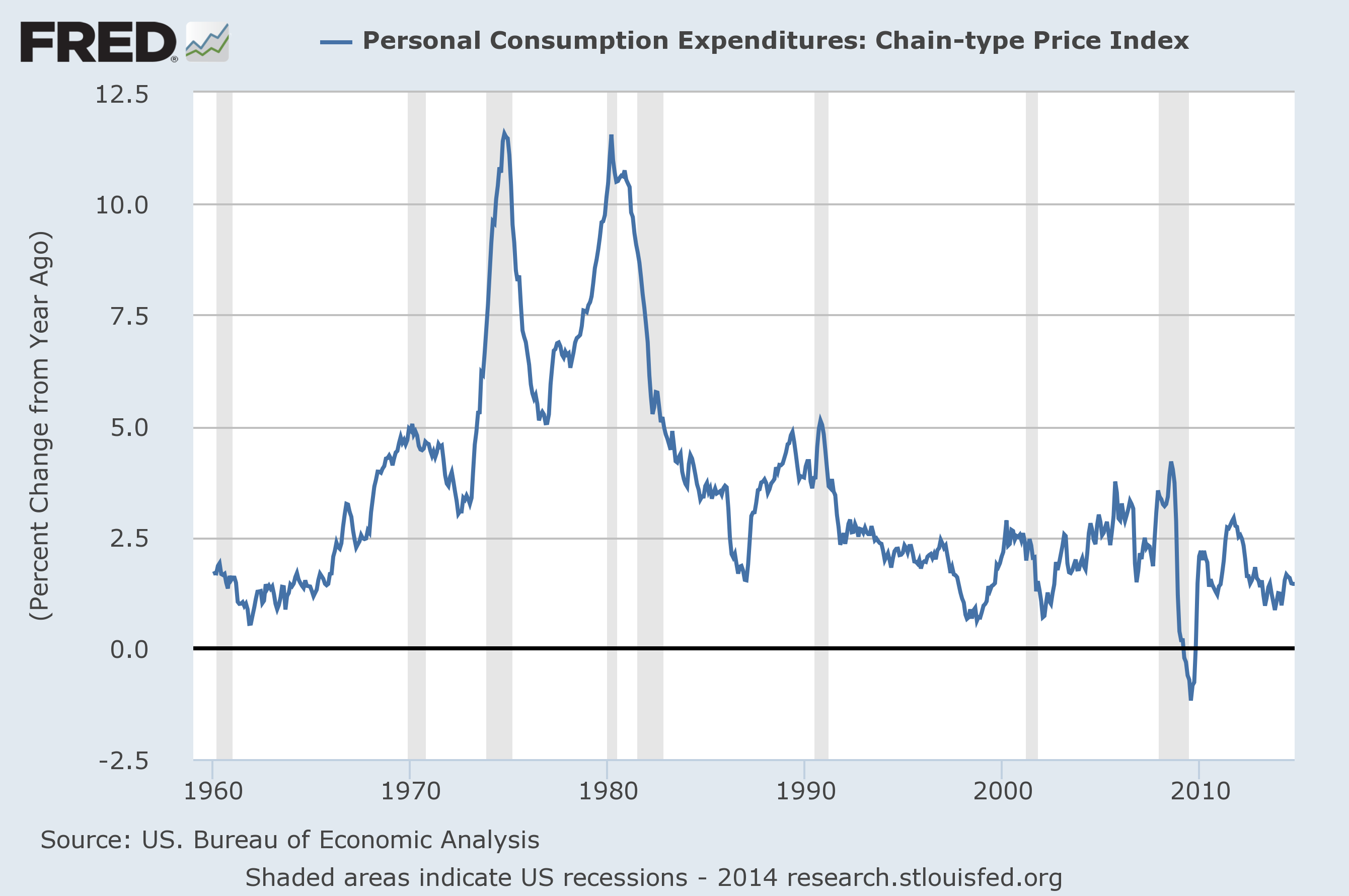
John Tate thinks the bill would help address “the silent, destructive tax of monetary inflation.” But inflation as measured by the consumer price index has averaged under 1.8% over the last decade. That’s the lowest it’s been since the 1960s.
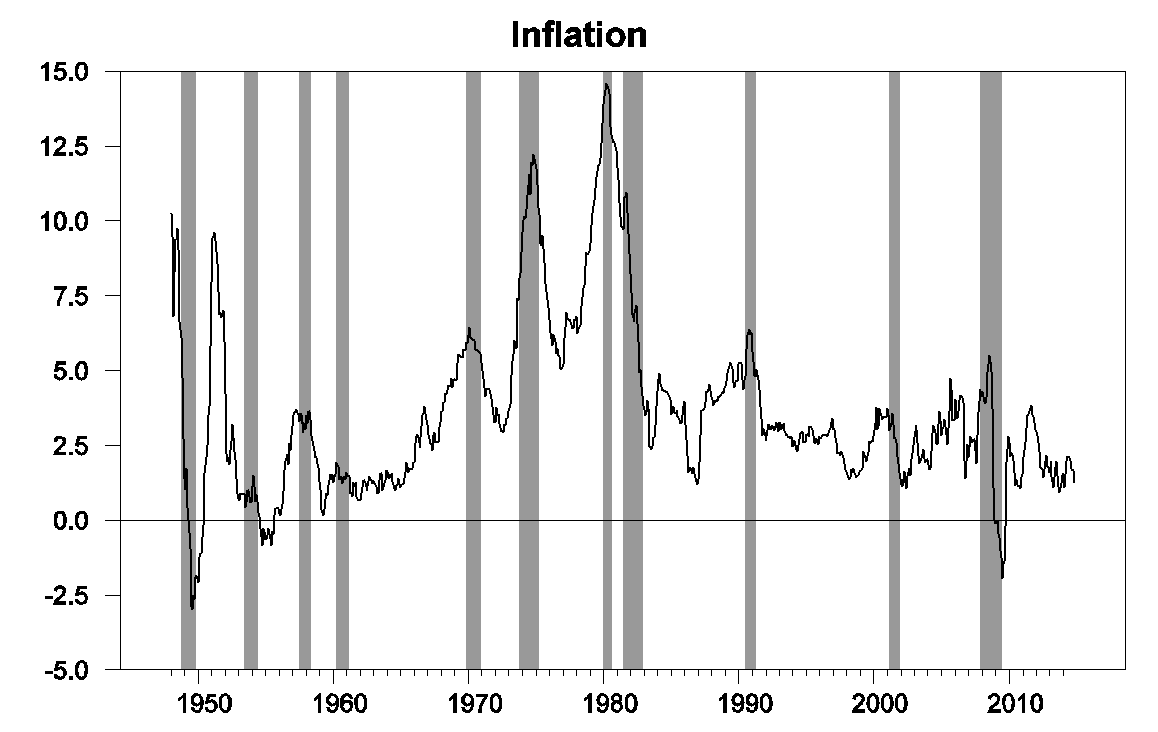
Year over year percent change in consumer price index.

Year over year percent change in consumer price index.

Of course, many of the same people who favor Senator Paul’s bill distrust government-collected inflation data like the CPI. So suppose you look at the private Billion Prices Project, which mechanically collects a huge number of prices each day off the internet. According to BPP, inflation over the last year has been if anything lower than the official numbers.
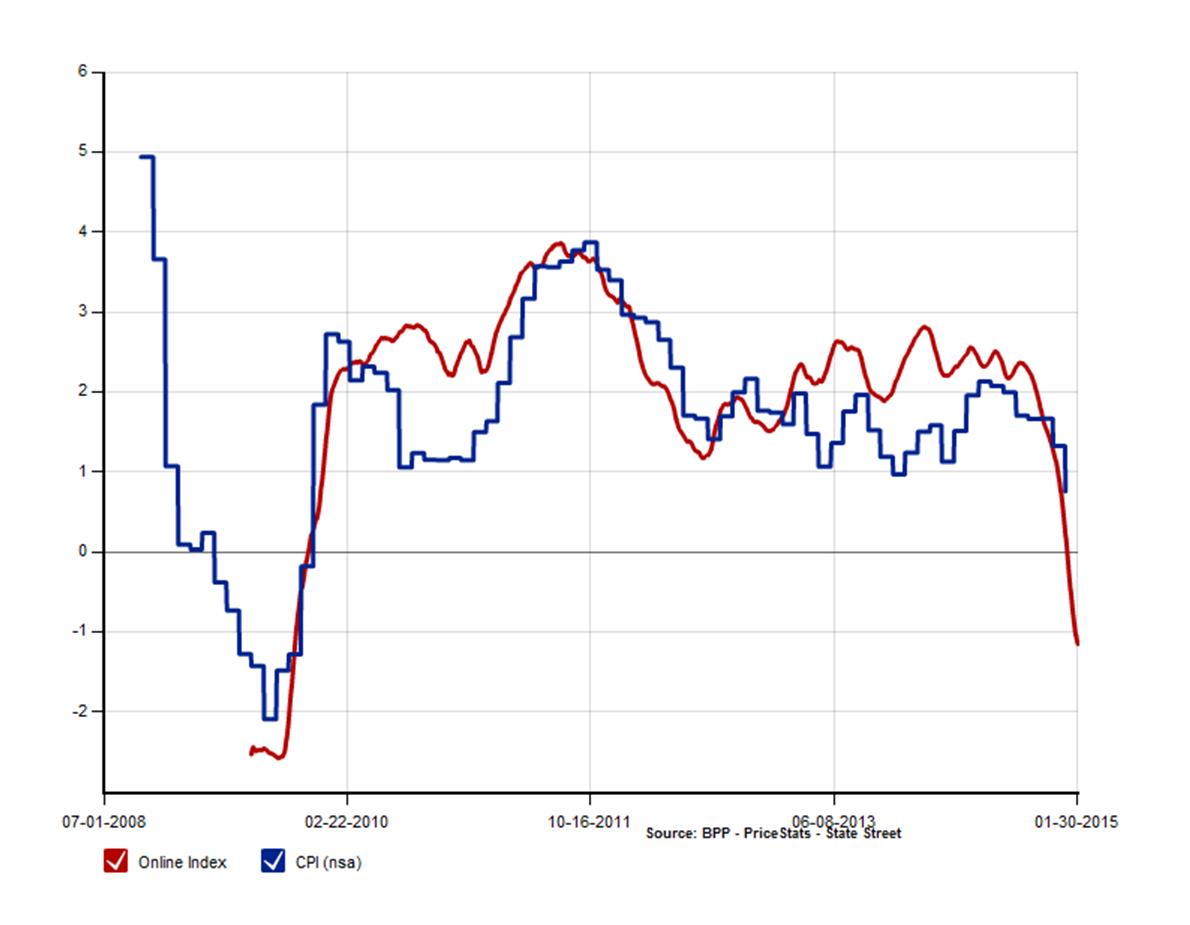
Year-over-year U.S. inflation rate as estimated by BPP (red) and CPI (blue).  Source: Billion Prices Project.

Year-over-year U.S. inflation rate as estimated by BPP (red) and CPI (blue). Source: Billion Prices Project.

Others may take the view that more transparency in and of itself is a good thing. But the Fed is already audited; you can read the audit yourself here. You can examine the Fed’s assets directly down to the level of CUSIP, if you like. Here at Econbrowser we’ve been reporting detailed graphs of the Fed’s assets and liabilities for years using publicly available sources like the weekly H41 statistical release. Cecchetti and Schoenholtz note this conclusion from Richard Fisher, president of the Federal Reserve Bank of Dallas and one of the FOMC’s outspoken critics of quantitative easing:

We are– I’ll be blunt– audited out the wazoo. Every Federal Reserve Bank has a private auditor. We have our auditor of the system. We have our own inspector general. We are audited. What he’s talking about is politicizing monetary policy.

The Wall Street Journal’s David Wessel elaborates:

In 2009, Congress changed the law to allow GAO audits of loans made by the Fed to a single company, such as Bear Stearns or Citigroup, but only when the Fed invoked Section 13(3) of the Federal Reserve Act. (That’s the provision that allows the Fed to lend to almost anybody under circumstances it deems “unusual and exigent.”) The Dodd-Frank law of 2010 further widened the GAO’s authority, allowing it to review the Fed’s internal controls, policies on collateral, use of contractors and other activities—but the GAO is still blocked from reviewing or evaluating the Fed’s monetary-policy decisions.

The Audit the Fed bill would change the law again, and allow the GAO to examine and criticize all monetary policy decisions without restriction.

If we did want to see a lot more inflation for the U.S., Paul’s bill would be the way to get it. The main effect of the bill would be to give Congress an additional tool to exert operational control over monetary policy. The political pressures will be very strong not to raise interest rates when the time does come to start to worry again about inflation. And when the Fed does get to raising rates, it will mean extra costs for the Treasury in paying interest on the federal debt– Congress isn’t going to like that. The primary effect of the legislation would be to give Congress one more stick with which to try to beat up on the Fed when the Fed next does need to take steps to keep inflation from rising.

In fact there’s a pretty dependable historical correlation– the more political control over monetary policy that a country gives to the legislature and the administration, the higher the inflation rate the country is likely to get.
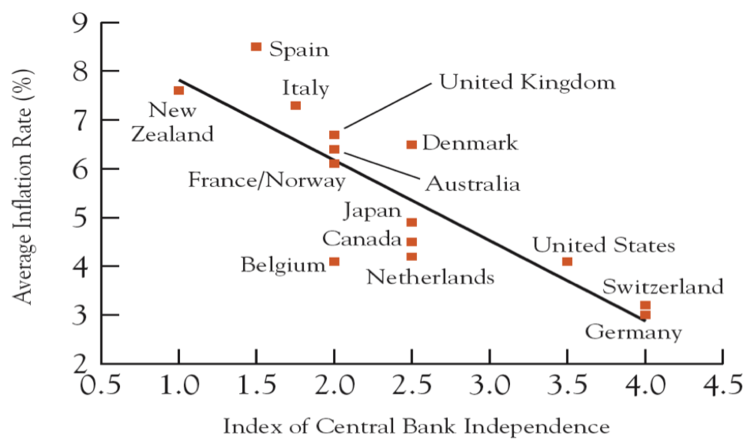
Source: Alesina and Summers (1993) via Cecchetti and Schoenholtz.

Source: Alesina and Summers (1993) via Cecchetti and Schoenholtz.

Senator Paul’s bill is unambiguously a bad idea.

17 Feb 05:47

Peak What?

by tmurphy
I’ve been maintaining “radio silence” for a while—mostly on account of an overflowing plate and several new new hats I wear. All the while, I have received a steady stream of e-mail thanking me for Do the Math, asking if … Continue reading →
16 Feb 22:16

Honesty in groups: Gender matters

by Gerd Muellhauser, Andreas Roider, Niklas Wallmeier

Many nations and corporations strive to raise female membership in decision-making bodies.  This column discusses new experimental evidence suggesting that there is more lying (and more extreme lying) in male groups and mixed-gender groups than in female groups. Moreover, group decision-making exacerbates men’s tendency to lie while the opposite is true for women. This suggests that the gender composition of decision-making bodies is important when the goal is to limit the scope of unethical behaviour.

11 Feb 18:39

Don’t read the comments—they can make you mistrust real experts

by Cathleen O'Grady

In the wake of the recent measles outbreak in California and with the threat of more to come, it's clear that existing efforts to encourage vaccination and promote public health aren't enough. We need to understand why the message isn’t sinking in where it’s most needed—why people believe what they believe and how they discover information they trust.

A recent paper in the Journal of Advertising suggests that online commenting may sway people as much as public service announcements (PSAs) from health authorities. Depending on who's doing the commenting, comments may sometimes be even more influential than PSAs.

While it may seem ludicrous that people could trust online comments as much as PSAs, it’s important to remember that online comments have an important advantage: they’re seen as coming from an unbiased source. This is why product reviews by consumers online and other “electronic word-of-mouth” communications are often seen as a trusted resource.

Read 12 remaining paragraphs | Comments

10 Feb 01:00

Does Russia want Donetsk, or just to keep the conflict going?

by Alex Harrowell

The other day, someone on twitter said it felt like the news was working up to an end-of-season finale, a big finish for the longest running of TV shows. On Thursday, as Yanis Varoufakis and Wolfgang Schäuble were failing to agree on whether or not they agreed in Berlin, Angela Merkel and Francois Hollande were heading in their respective Airbus A310s to Kiev and then Moscow. Diplomats must be delighted at times like this; suddenly the job is as important as they spend their time making out it is.

As it turned out, Merkel and Hollande‘s mission only resulted in agreement to look at a draft ceasefire implementing the Minsk agreement from last year, a document widely considered to be a dead letter. The new content in it seems to have been more concessions of territory to the pro-Russian side.

All this diplomacy was triggered by the Americans floating the idea of providing Ukraine with modern armaments. Back in Germany, Merkel was rather sceptical about the idea at the NATO security conference in Munich, saying variously that there seemed to be plenty of weapons around and that no amount of them would impress Putin. (There may be plenty of AKs, tanks, and artillery, but the US proposal focuses on communications and electronic warfare, and perhaps anti-tank guided weapons.)

In general, the level of anxiety about the situation seems to have spiked in the last few days. Hollande has been saying that he fears total war. You might well ask what on earth is happening in the Donbass if it’s not war, but the fear is that it might get worse, moving from a so-called hybrid conflict confined to the area around Donetsk to a full-scale Russian invasion of Ukraine. Carl Bildt thinks it is possible; Anders Fogh Rasmussen thinks it is possible; former NATO deputy supreme commander Sir Richard Sherriff thinks so, and wonders where the British prime minister has got to. (Good question.)

Here’s a question. Hollande and Merkel are working from the assumption that handing over a bigger area of territory to the separatists would end the conflict, and that their territorial control reflects the wishes of the population. On the other hand, though, they are also working from the assumption that it’s not the separatist leadership who decides. Hollande and Merkel didn’t address themselves to Alexander Zakharchenko in Donetsk, but rather to Vladimir Putin in Moscow. In a real sense, they clearly believe that it’s Putin who decides what happens there.

If the Ukrainians were to accept such a proposal, and offer to give up the whole Donbass, would Putin accept it? I am not sure he would.

A DNR entity of real size and contiguity, a Republic of Novorossiya, would be disturbingly big and independent, and likely to make trouble. It would, however, still be small enough that the Ukrainians might hope to take it back one day. It would also set a precedent Putin would hate – as well as orange-clad protestors occupying city squares in the hope of joining Europe, he would have to worry about sovok or natsbol types with AKs hoping to join the Soviet Union, as it were, by setting up their own novorossiyas. Insurgency would have become an option for his own constituency. Annexing it to Russia would be massively provocative and would pose the question of how to demobilise and disarm the DNR.

Further, if you want to join NATO or the European Union, the rules are clear – you have to leave your irredenta at the door. The precondition of membership is that you wind up any geopolitical conflicts you have open. Nobody wants to attach the trigger of the NATO air forces to a checkpoint dispute outside Luhansk – it’s too risky. So long as the conflict in Ukraine is not resolved, Ukrainian membership of NATO is ruled out. The little green men are the guarantee. On the other hand, a Ukraine reeling from the loss of the Donbass would be very likely to do anything at all to get under the NATO security guarantee for the rest of the country.

Just keeping the conflict going, however, suits Russian interests rather well. Anyone who has an interest in the matter has to go to Moscow first. Ukrainian NATO membership is ruled out. The DNR stays deniable, but also dependent, so the level of violence can be turned up or down as is expedient. As some people from Transdniestria turned up in Crimea, it could act as a pool of proxy fighters for use elsewhere, in the Caucasus, the Baltics, or against Russian dissidents. And the horse may sing; the option of a counter-Maidan movement based there is kept open, although the chances of that happening must be minimal now.

Polling seems to suggest that a solution keeping the Donbass in Ukraine has strong public support, including in the rebel zone, although it’s not obvious to me how they surveyed it. If it’s a matter of a form of words that grants Donetsk what might be termed devo-max within Ukraine, though, I can’t help doubting anyone would fight for that so tenaciously, or with such means – main battle tanks, artillery in such quantity that the shells are delivered by the trainload. And such a deal has been on the table for months. Clearly, it’s the conflict that matters, not any particular political arrangement, and it seems there is only one man who can call a halt.

On the other hand, arming the side fighting against what looks more and more like the Russian regular army is a frightening prospect. No-one should doubt that for a moment, and I imagine the Russians will take care to remind us on a regular basis. Also, we need to think hard about getting the Ukrainians some money before they run out of foreign exchange completely.

07 Feb 05:53

Only 2 Ways to Fight Gentrification (you’re not going to like one of them)

by Adam Hengels

Tompkins Square Riots in 1988

Gentrification is the result of powerful economic forces. Those who misunderstand the nature of the economic forces at play, risk misdirecting those forces in ways that exasperate city-wide displacement.  Before discussing solutions, it is important to accept that gentrification is one symptom of a larger problem.

Anti-capitalists often portrays gentrification as class war, painting the archetypal greedy developer as the culprit:

Gentrification has always been a top-down affair, not a spontaneous hipster influx, orchestrated by the real estate developers and investors who pull the strings of city policy, with individual home-buyers deployed in mopping up operations.

Is gentrification a class war?  In a way, yes.  But the typical class analysis mistakes the symptom for the cause, and ends up pointing the finger at the wrong rich people.  There is no grand conspiracy concocted by real estate developers, though its not surprising it seems that way.

Real estate developers would be happy to build in already expensive neighborhoods where demand is stable and predictable.  They don’t because they are typically not allowed to.  Take Chicago’s Lincoln Park for example.  Daniel Hertz points out that the number of housing units there actually decreased 4.1% since 2000 and the neighborhood hasn’t allowed a single unit of affordable housing to be developed in 35 years. The affluent residents of Lincoln Park like their neighborhood the way it is and have the political clout to keep it that way.

Given that development projects are blocked in upper class neighborhoods, developers seek out alternatives. Here’s where “pulling the strings” is a viable strategy for developers. Politicians are far more willing to upzone working class neighborhoods. These communities are far less influential and have far fewer resources with which to fight back. The end result is that rich, entitled, white areas get down-zoned, while less-affluent, disempowered, minority areas are up-zoned. Politicians appease politically influential neighborhoods through limited growth, and then appease developers who see less influential neighborhoods as the only viable place for new construction.

Too often, the knee-jerk response is to fight development in these gentrifying neighborhoods. The consequences of this are two-fold. First, economics 101 tells us that capping supply will only cause prices to rise. Instead of newcomers filling newly-constructed units, they will quickly flood the existing stock of housing, quickening gentrification. Second, thwarting development shuts the release valve that alleviates housing price pressures that caused gentrification in the first place. Since not building is not an option, politicians would prefer to funnel new construction into disadvantaged neighborhoods instead of letting it happen where there is market demand. Development suppressed, gentrification swiftly captures the neighborhood and moves on to the next neighborhood in its path.

When considering gentrification, we must accept the fact that rich people don’t just vaporize by prohibiting the creation of housing for them.  If housing desires cannot be met in upscale neighborhoods, the wealthy can and will outbid less affluent people elsewhere.  With that in mind, there are only 2 solutions to stem the tide of gentrification.  The first solution is widespread liberalization of zoning.  This is particularly needed in already desirable locations where incumbent residents have effectively depopulated their neighborhoods over several decades.  The only other solution is to eradicate rich people altogether. This, I hope, is not what people have in mind when they declare class war.

Whether you are a class warrior or Market Urbanist, here are some tips to more effectively fight gentrification:

  • The battlefield is not in the gentrifying neighborhoods.  It is in the more wealthy neighborhoods where empowered residents fight to keep new people out.
  • The enemy is not the gentrifiers or developers trying to serve them.  It is the rich people who use their influence to thwart development in their neighborhoods.  The more they fight to depopulate desirable neighborhoods, the more people are left seeking alternative neighborhoods.
  • The mechanism of gentrification is not development.   It is zoning, and other regulations that thwart development in currently desirable areas.
  • The solution is not to fight development in currently gentrifying areas.  It’s to call for radical liberalization of zoning in already wealthy areas, and to stand up to neighborhood groups who try to abuse zoning to prevent that.
  • The reason people gentrify is not to disrupt ethnic or economically-challenged neighborhoods.  It is likely because they have been priced out of the neighborhood they desire.


06 Feb 19:31

Craigslist personals associated with 16 percent boost in HIV infections

by John Timmer

One of the things the Internet has fundamentally altered is the personal ad. Rather than a mystery of short text descriptions and a long wait for mail to be exchanged, personal ads now provide photos, profiles, and near-instant gratification. There's been a blossoming of services that promise to match people with their best prospect for long-term happiness, as well as apps that offer a quick hookup.

A new study focused on the role of something that's a bit of a hybrid between old and new school: Craigslist classifieds, which have also become a popular way of arranging hookups. By comparing areas before and after the arrival of a local Craigslist, Jason Chan and Anindya Ghose found that the availability of these classifieds are associated with a 16 percent increase in new HIV infections.

The study was prompted by a couple of well-described phenomena. One is that people are using the convenience and relative anonymity of the Internet to find partners; interviews with users of various services show that they post ads not only for what the authors term "no-strings-attached relationships," but they're also looking for more diverse sexual experiences, and part of that includes having multiple partners (not necessarily at once).

Read 8 remaining paragraphs | Comments

02 Feb 03:43

House prices, local demand, and retail prices

by Johannes Stroebel, Joseph Vavra

Rising prices have long been a concern of monetary policymakers due to wealth effects on spending. This column presents evidence that local demand effects from  house price increases result in significant local price inflation. Households living in locations with rapidly increasing real estate prices will also face rapidly increasing costs of goods purchased in local stores.

27 Jan 18:09

Are US Military Boots On The Ground In Ukraine?

by War News Updates Editor
allendd

Even if he is American, it could be mercenaries (who in turn could be there on the dime of either the US or the Ukrainian government). Definitely an interesting find, but not proof of American government involvement.

From Zero Hedge: Amid the devastation of yesterday's Mariupol artillery strikes which killed or wounded dozens, which was promptly blamed by both sides on the "adversary" - and has been proclaimed by both 'sides' (more on that later) as more violent than before the truce - an 'odd' clip has emerged that appears to provide all the 'proof' a US intelligence officer would need to surmise that US military boots are on the ground in Ukraine. As the following clip shows, a Ukrainian journalist approaches what she thinks is a Ukrainian soldier (since he is wearing a Ukrainian military uniform and is carrying an AK) and asked him as they run through the battlezone, "tell me, what happened here?" His response, which requires no translation, speaks for itself.

Forward to 2:36 for the 'Ukrainian' soldier's response:


Update #1: American Soldiers Caught on Tape in Mariupol, Ukraine? -- Sputnik
Update #2: Military-clad English-speakers caught on camera in Mariupol shelling aftermath -- RT

WNU Editor: This clip is making the rounds on Russian media and in social media as proof that U.S. military personnel are involved in the Ukraine conflict .... as to what's my take .... so he spoke good English (at least in that one sentence) .... it does not necessarily mean that he is a U.S. soldier/mercenary/intelligence operative. I should know ... because that soldier could have been me. Russian is my first language, Ukrainian is second, English is my third, French is my fourth, and I know a little Chinese and Korean. I have been speaking English since I was ten years old .... good teachers, private lessons, demanding parents, etc. .... if you hear my English today you would think that I was either from Canada or from the U.S. .... you would never "paint me" as someone whose nationality is Russian ... until I start speaking Russian. And I am not the only one who can speak colloquial English .... there are many other Russians and Ukrainians who can do the same. My weakness is writing in English .... which is one of the reasons why I started this blog in the first place .... to practice my English. As to my French .... sadly .... even though I now live in the french province of Quebec in Canada .... it is still a work in progress .... but I am getting there.
26 Jan 19:34

Race as a choice

by Emily Nix, Nancy Qian

Race is usually treated as a fixed, exogenous characteristic in academic studies and policy discussions, but a growing body of evidence calls this assumption into question. This column presents evidence from historical US census data that more than 19% of black males ‘passed’ as white, around 10% of whom later ‘reverse-passed’ to being black. Passing was associated with geographic relocation and with better political-economic and social opportunities for whites relative to blacks, providing prima facie evidence that passing was endogenous.

30 Dec 05:20

“Forced Coexistence and Economic Development: Evidence from Native American Reservations,” C. Dippel (2014)

by afinetheorem

I promised one more paper from Christian Dippel, and it is another quite interesting one. There is lots of evidence, folk and otherwise, that combining different ethnic or linguistic groups artificially, as in much of the ex-colonial world, leads to bad economic and governance outcomes. But that’s weird, right? After all, ethnic boundaries are themselves artificial, and there are tons of examples – Italy and France being the most famous – of linguistic diversity quickly fading away once a state is developed. Economic theory (e.g., a couple recent papers by Joyee Deb) suggests an alternative explanation: groups that have traditionally not worked with each other need time to coordinate on all of the Pareto-improving norms you want in a society. That is, it’s not some kind of intractable ethnic hate, but merely a lack of trust that is the problem.

Dippel uses the history of American Indian reservations to examine the issue. It turns out that reservations occasionally included different subtribal bands even though they almost always were made up of members of a single tribe with a shared language and ethnic identity. For example, “the notion of tribe in Apachean cultures is very weakly developed. Essentially it was only a recognition
that one owed a modicum of hospitality to those of the same speech, dress, and customs.” Ethnographers have conveniently constructed measures of how integrated governance was in each tribe prior to the era of reservations; some tribes had very centralized governance, whereas others were like the Apache. In a straight OLS regression with the natural covariates, incomes are substantially lower on reservations made up of multiple bands that had no pre-reservation history of centralized governance.

Why? First, let’s deal with identification (more on what that means in a second). You might naturally think that, hey, tribes with centralized governance in the 1800s were probably quite socioeconomically advanced already: think Cherokee. So are we just picking up that high SES in the 1800s leads to high incomes today? Well, in regions with lots of mining potential, bands tended to be grouped onto one reservation more frequently, which suggests that resource prevalence on ancestral homelands outside of the modern reservation boundaries can instrument for the propensity for bands to be placed together. Instrumented estimates of the effect of “forced coexistence” is just as strong as the OLS estimate. Further, including tribe fixed effects for cases where single tribes have a number of reservations, a surprisingly common outcome, also generates similar estimates of the effect of forced coexistence.

I am very impressed with how clear Dippel is about what exactly is being identified with each of these techniques. A lot of modern applied econometrics is about “identification”, and generally only identifies a local average treatment effect, or LATE. But we need to be clear about LATE – much more important than “what is your identification strategy” is an answer to “what are you identifying anyway?” Since LATE identifies causal effects that are local conditional on covariates, and the proper interpretation of that term tends to be really non-obvious to the reader, it should go without saying that authors using IVs and similar techniques ought be very precise in what exactly they are claiming to identify. Lots of quasi-random variation generates that variation along a local margin that is of little economic importance!

Even better than the estimates is an investigation of the mechanism. If you look by decade, you only really see the effect of forced coexistence begin in the 1990s. But why? After all, the “forced coexistence” is longstanding, right? Think of Nunn’s famous long-run effect of slavery paper, though: the negative effects of slavery are mediated during the colonial era, but are very important once local government has real power and historically-based factionalism has some way to bind on outcomes. It turns out that until the 1980s, Indian reservations had very little local power and were largely run as government offices. Legal changes mean that local power over the economy, including the courts in commercial disputes, is now quite strong, and anecdotal evidence suggests lots of factionalism which is often based on longstanding intertribal divisions. Dippel also shows that newspaper mentions of conflict and corruption at the reservation level are correlated with forced coexistence.

How should we interpret these results? Since moving to Canada, I’ve quickly learned that Canadians generally do not subscribe to the melting pot theory; largely because of the “forced coexistence” of francophone and anglophone populations – including two completely separate legal traditions! – more recent immigrants are given great latitude to maintain their pre-immigration culture. This heterogeneous culture means that there are a lot of actively implemented norms and policies to help reduce cultural division on issues that matter to the success of the country. You might think of the problems on reservations and in Nunn’s post-slavery states as a problem of too little effort to deal with factionalism rather than the existence of the factionalism itself.

Final working paper, forthcoming in Econometrica. No RePEc IDEAS version. Related to post-colonial divisions, I also very much enjoyed Mobilizing the Masses for Genocide by Thorsten Rogall, a job market candidate from IIES. When civilians slaughter other civilians, is it merely a “reflection of ancient ethnic hatred” or is it actively guided by authority? In Rwanda, Rogall finds that almost all of the killing is caused directly or indirectly by the 50,000-strong centralized armed groups who fanned out across villages. In villages that were easier to reach (because the roads were not terribly washed out that year), more armed militiamen were able to arrive, and the more of them that arrived, the more deaths resulted. This in-person provoking appears much more important than the radio propaganda which Yanigazawa-Drott discusses in his recent QJE; one implication is that post-WW2 restrictions on free speech in Europe related to Nazism may be completely misdiagnosing the problem. Three things I especially liked about Rogall’s paper: the choice of identification strategy is guided by a precise policy question which can be answered along the local margin identified (could a foreign force stopping these centralized actors a la Romeo Dallaire have prevented the genocide?), a theoretical model allows much more in-depth interpretation of certain coefficients (for instance, he can show that most villages do not appear to have been made up of active resistors), and he discusses external cases like the Lithuanian killings of Jews during World War II, where a similar mechanism appears to be at play. I’ll have many more posts on cool job market papers coming shortly!


29 Dec 08:06

Access to higher education and the value of a university degree

by Nicola Bianchi

Governments sometimes promote reforms that increase access to education for a large share of the population. These reforms may lower the returns to education by altering returns to skills, education quality, and peer effects. This column examines a 1961 Italian reform that increased enrolment in university STEM majors among students who had previously been denied access. The reform ultimately failed to raise their incomes.

29 Dec 06:13

U.K. Conducts Defense Review Of The Falklands After Learning That Russia Will Sell Long Range Bombers To Argentina

by War News Updates Editor
Photo: Russian-built Sukhoi Su-24 jets made available to Argentina.

EXCLUSIVE: Falklands Defence Review After Military Deal Between Russia And Argentina -- Express

DEFENCES on the Falklands are being reviewed after it emerged Russia plans to offer Argentina long-range bombers.

The aircraft, which Moscow will swap for beef and wheat, would be able to mount air patrols over Port Stanley.

Ministry of Defence officials fear Buenos Aires would take delivery of the planes well before the deployment in 2020 of the Navy’s 65,000-tonne aircraft carrier HMS Queen Elizabeth and its F-35B fighters, leaving a “real window of vulnerability”.

Defence cuts have left the Falklands with just four RAF Typhoon fighters, Rapier surface-to-air missiles and fewer than 1,200 troops, supported by a naval warship that visits throughout the year.

Read more ....

Update: London concerned as Russian military jets available to Argentina -- Merco Press

My Comment: The U.K. supports Ukraine .... Russia responds .... and now the ability of the U.K. military contingent in the Falklands to deter any Argentina aggression is being openly discussed.
24 Dec 19:10

Study: Police Body-Cams Reduce Unacceptable Use of Force

by Soulskill
An anonymous reader writes: Incidents like the Michael Brown case have recently put police body-worn cameras into the public consciousness, but they're not a new idea to criminology experts. In fact, researchers at Cambridge began a study in 2012 using law enforcement in Rialto, California as a test bed. Their results are now in: "The experiment showed that evidence capture is just one output of body-worn video, and the technology is perhaps most effective at actually preventing escalation during police-public interactions: whether that's abusive behavior towards police or unnecessary use-of-force by police." The simple knowledge that both parties are being watched puts a damper on violence. "During the 12-month Rialto experiment, use-of-force by officers wearing cameras fell by 59% and reports against officers dropped by 87% against the previous year's figures." This was enough for the city of Rialto to decide it wants to move forward with body-worn cameras; hopefully the study will encourage other police departments as well.

Share on Google+

Read more of this story at Slashdot.


24 Dec 09:09

Christmas economics: Challenging some common beliefs

by Laura Birg, Anna Goeddeke

Christmas may be not so merry as we hope. Economists have argued that gift giving is an inefficient way to allocate resources, and it is widely suggested that Christmas brings a peak in prices and the number of suicides, or even disrupts the business cycle. This column discusses some conventional wisdom about Christmas and shows that economic research in fact runs counter to some of these common beliefs.

22 Dec 15:23

Do falling oil prices raise the threat of deflation?

by James_Hamilton

The spectacular drop in oil prices means that inflation is going to fall even further below the Fed’s 2% target. Does that raise any new risks for the economy? I say no, and here’s why.


Year-over-year percent change in the monthly deflator for personal consumption expenditures.  Source: FRED.

Year-over-year percent change in the monthly deflator for personal consumption expenditures. Source: FRED.

In economists’ theoretical models, inflation usually is often thought of as a condition in which all wages and prices move up together by the same amount. For a given nominal interest rate, the lower inflation, the higher is the real cost of borrowing. With the short-term nominal interest rate still stuck at zero, a decrease in inflation could discourage spending, something the Fed would rather not see happen in the current situation. Or so the theory goes.

But typical consumers often have something very different in mind when they talk about inflation. Many people think of inflation as a condition where the cost of the goods and services they buy goes up but their wages do not. Not so surprising then that while the Fed says it wants more inflation, most consumers say they do not.

What’s happened to oil prices this fall looks more like the average Joe’s version of reality than the Fed’s. The average U.S. retail price of gasoline right now is about $2.40 a gallon. Last year American consumers and businesses bought 135 billion gallons of gasoline at an average price of $3.60 a gallon. If gasoline prices stay where they are and if we buy the same number of gallons of gasoline this year as last, that leaves us with an additional $160 billion to spend over the course of the year on other items. If we restate the total savings for U.S. consumers and businesses in terms of the 116 million U.S. households, that works out to almost $1400 per household.

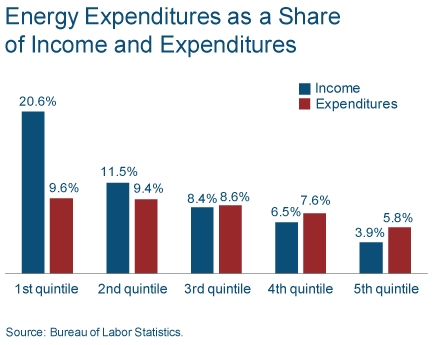
It’s a particularly big deal for the lower-income households, who spend a much higher fraction of their income on energy.

 Source: Daniel Carroll.

Source: Daniel Carroll.

Historically consumers have responded to windfalls like this by becoming more open to the big-ticket purchases that play a huge role in cyclical economic swings.

So no, any deflation associated with the gasoline price drop is not going to discourage aggregate demand. What it does do, however, is give the Fed a little more time to be patient before it needs to worry about raising interest rates.

22 Dec 14:27

The riddle of Argentina

by Nauro F Campos

Argentina is the only country in the world that was 'developed’ in 1900 and ‘developing’ in 2000. Various explanations highlight the roles of trade openness, political institutions, financial integration, financial development, and macroeconomic instability. No study has so far attempted a quantitative assessment of the relative importance of each of these competing factors. This column presents new evidence suggesting that financial development and institutional change are two main factors behind the unusual growth trajectory of Argentina over the last century. 

18 Dec 02:15

Making Internet service a utility—what’s the worst that could happen?

by Jon Brodkin
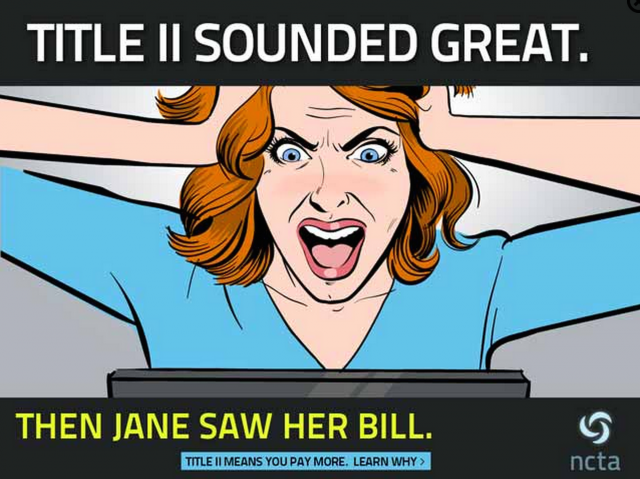
The cable industry takes a subtle approach to anti-Title II advertising.

The cable industry takes a subtle approach to anti-Title II advertising. (credit: National Cable & Telecommunications Association)

Update: It's 2020, and a coronavirus pandemic has underscored how crucial broadband service is to the lives of Americans for work, entertainment, and school. Internet service is a necessity, and yet it isn't regulated as a utility the way services like water and electricity are. But back in 2014 (when this story was originally published) and 2015, there was a hot debate over whether the Federal Communications Commission should treat broadband service like a utility—or, more precisely, as a Title II common-carrier service—in order to impose net neutrality rules.

We're resurfacing this article from December 2014, which examined the cable industry's argument that utility-style regulation would hurt broadband users and broadband providers. Ultimately, the FCC did reclassify broadband to enforce net neutrality in 2015, but never imposed strict utility regulations like price caps or network unbundling. Broadband users enthusiastically supported the rules and ISPs admitted to investors later that the extra regulation didn't harm their businesses. But FCC Chairman Ajit Pai deregulated the broadband industry anyway, eliminating net neutrality rules and other consumer protections such as a prohibition on hidden fees. Since Pai's decision, the top ISPs have been decreasing network investment despite operating in the mostly regulation-free environment they sought, and the FCC has relied on ISPs' voluntary promises instead of real rules to keep customers online during the pandemic.

There seems to be nothing the broadband industry fears more than Title II of the Communications Act.

Title II gives the Federal Communications Commission power to regulate telecommunications providers as utilities or "common carriers." Like landline phone providers, common carriers must offer service to the public on reasonable terms. To regulate Internet service providers (ISPs) as utilities, the FCC must reclassify broadband as a telecommunications service, a move that consumer advocacy groups and even President Obama have pushed the FCC to take.

Read 63 remaining paragraphs | Comments

16 Nov 04:21

The career prospects of overeducated Americans

by Brian Clark, Clement Joubert, Arnaud Maurel

There are large rewards of higher education in terms of earnings. However, a sizeable fraction of workers hold occupations that not require as much schooling as they have. This column considers the effects of being overeducated on future employment and wages for a representative cohort of Americans. Around 38% of the college graduates in the sample have higher education than the typical worker in their profession. Rather than transitory, the bulk of overeducation persists in the long run. Even if workers manage to transit to better jobs, they experience wage penalties similar to those after unemployment. 

15 Nov 22:02

“What Do Small Businesses Do?,” E. Hurst & B. Pugsley (2011)

by afinetheorem

There are a huge number of policies devoted toward increasing the number of small businesses. The assumption, it seems, is that small businesses are generating more spillovers than large businesses, in terms of innovation, increases in the labor match rate, or indirect welfare benefits from creative destruction. Indeed, politicians like to think of these “Joe the Plumber” types as heroic job creators, although I’m not sure what that could possibly mean since the long run level of unemployment is constant and unrelated the amount of entrepreneurial churn in whatever economic model or empirical data you wish to investigate.

These policies beg the question: are new firms actually quick-growing, innovative concerns, or are they mainly small restaurants, doctor’s offices and convenience stores? The question is important since it is tough to see why the tax code should privilege, say, an independent convenience store over a new corporate-run branch – if anything, the independent is less innovative and less likely to grow in the future. Erik Hurst and Ben Pugsley do a nice job of generating stylized facts on these issues using a handful of recent surveys of firm outcomes and the stated goals of the owners of new firms.

The evidence is pretty overwhelming that most new firms are not the heroic, job-creating innovator. Among firms with less than 20 employees, most are concentrated in a very small number of industries like construction, retail, restaurants, etc, and this concentration is much more evident than among larger firms. Most small firms never hire more than a couple employees, and this is true even among firms that survive five or ten years. Among new firms, only 2.7% file for a patent within four years, and only 6-8% develop any proprietary product or technique at all.

It is not only in outcomes, but in expectations as well where it seems small businesses are not rapidly-growing innovative firms. At their origin, 75% of small business owners report no desire to grow their business, nonpecuniary reasons (such as “to be my own boss”) are the most common reason given to start a business, and only 10% plan to develop any new product or process. That is, most small businesses are like the corner doctor’s office or small plumbing shop. Starting a business for nonpecuniary reasons is also correlated with not wanting to grow, not wanting to innovate, and not actually doing so. They are small and non-innovative because they don’t want to be big, not because they fail at trying to become big. It’s also worth mentioning that hardly any small business owners in the U.S. sample report starting a business because they couldn’t find a job; the opposite is true in developing countries.

These facts make it really hard to justify a lot of policy. For instance, consider subsidies that only accrue to businesses below a certain size. This essentially raises the de facto marginal tax rate on growing firms (since the subsidy disappears once the firm grows above a certain size), even though rapidly growing small businesses are exactly the type we presumably are trying to subsidize. If liquidity constraints or other factors limiting firm entry were important, then the subsidies might still be justified, but it seems from Hurst and Pagsley’s survey that all these policies will do is increase entry among business owners who want to be their own boss and who never plan to hire or innovate in any economically important way. A lot more work here, especially on the structural/theoretical side, is needed to develop better entrepreneurial policies (I have a few thoughts myself, so watch this space).

Final Working Paper (RePEc IDEAS) which was eventually published in the Brookings series. Also see Haltiwanger et al’s paper showing that it’s not small firms but young firms which are engines of growth. I posted on a similar topic a few weeks ago, which may be of interest.


11 Nov 07:16

World War I: Why the Allies won

by Stephen Broadberry

In the massive circumstances of total war, economic factors play the deciding role. Historians emphasise size in explaining the outcome of WWI, but this column argues that quality mattered as well as quantity. Developed countries mobilised resources in disproportion to their economic size – the level of development acted as a multiplier. With their large peasant sectors, the Central Powers could not maintain agricultural output as wartime mobilisation redirected resources from farming. The resulting urban famine undermined the supply chain behind the war effort.

10 Nov 18:13

Immigration and public finances

Data on social attitudes show that the perceived burden of immigration on a nation’s public finances is one of the strongest economic concerns associated with hostility to immigration. Yet recent official reports suggest an important positive role for immigration in the long-run health of public finances. This column argues that there can be no general conclusions applicable in all circumstances about whether immigration is favourable or unfavourable for public finances. But evidence is emerging on particular cases through studies of immigrant composition and use of services, and the effects of immigration on native outcomes.

06 Nov 05:15

China Killed 180k Dogs to Trade for Russian Su-27 Fighter Jet

by Joe

su-27-doge-pelts

Chinese netizens react in disbelief to a recent claim made by military expert Du Wenlong on Yunnan TV regarding the slaughtering of 180,000 dogs to make dog pelt coats to trade for Russian-made Su-27 fighter jets. The reality is that in the early 1990s, 70% of the costs of the first shipment of Su-27s were paid for using industrial and consumer products under ”Project 906“.

From Sina Weibo:

@凤凰网: Russian Fighter Jets Traded to China for Dog Pelts, China Killed Dogs in 3 Provinces to Meet the Demand — Military expert Senior Colonel Du Wenlong: Back when China was requesting to buy Su-27s, the terms set by the Russians was to trade using 10,000 dog pelt coats. 10,000 dog pelt coats created a lot of pressure/difficulties for us. It takes 18 dogs to make one coat, so that winter we killed all the dogs from the three provinces of Henan, Shandong, etc. in order to trade for Su-27s.

china-killed-180k-dogs-to-trade-for-russian-su-27-fighter-jets-01

Full statement from the expert:

”Back when we were importing Su-27s, Russia was also having economic difficulties. They only wanted three things: One, flashlights; two, vacuum flasks; three, dog pelt coats. 10,000 dog pelt coats, that created a lot of pressure/difficulties for us. It takes 18 dog pelts to make one dog pelt coat. So that winter we killed all the dogs in the three provinces of Henan, Shandong, etc. in order to trade for Su-27s. So dogs in China had made significant contributions to China’s military and weapons modernization.”

Comments on Sina Weibo:

酒仙迷踪:

So is this the real reason behind the beating of dogs?

成都企业法律顾问:

If this is true, then of the 180k dogs, how many were loyal Hachikos, how many seniors lost their only companions, and how many children lost their childhood friends. To make this kind of deal is no different than trading your soul to the devil, and even the most despicable words cannot describe it. After all, one Su-27 means little to a great nation in comparison.

蹬山队: (responding to 我真不一定是好人)

Before 1994, dog pelt coats were the main exports to Russia, I personally sold over 1,000, but compared to the China National Native Produce and Animal By-Products Import and Export Corporation (CNNPABIEC), I’m nothing. They exported millions of dog pelts to Russia each year, so much that there weren’t enough dogs in the countrysides to kill. Later, the Russians changed their living habits and started to wear sable, so dog pelts lost its market, and people stopped raising those dogs.

海德拉巴的搬运工:

Now we can kill 50 cent dogs, in exchange for jet engines.

Hitting_on:

Poor doggies. Vicious evil humans. Such evil will definitely face retribution [karma].

牛牛很忙虎虎虎:

Such a ridiculous request. Now when we buy Su-35s, are we supposed to send over some excess stock of melamine-tainted cheese?

DJ老重:

After skimming the comments, most of them are jeering~ and I’m too lazy to say much tonight. This isn’t news on military forums. When the Soviet Union collapsed, there was a critical shortage of many commodities, not just dog pelts but also many light industrial products.

Terrific:

Why does this feel like I’m watching a show from Taiwan?

Stevp:

China, you sure are cruel.

BalanceX:

The first batch of Su-27s were traded with material goods. Material commodities made up a significant portion of the payment.

姿势改变命运:

Doggies sacrificed their lives for the nation.

陈大人英明啊:

I personally think we should turn these experts into leather coats…

叫我厂长啊啊啊:

This is quite believable. The civilian goods economy in the Soviet Union was rubbish at the time, and they often traded military hardware for foreign civilian goods.

海柳云烟:

Good thing Tsarist Russia didn’t ask for human pelts.

病入腠理:

Actually, Du Wenlong is really a great speaker. Every time I watch his analysis, I feel as if our Heavenly Kingdom is about to take over the world.

警视听kito:

Yuling Dog Meat Festival can’t be considered a festival anymore. The Su-27’s nickname should be the dog slaughter fighter.

熊摇熊滚熊:

When the Soviet Union collapsed, the Russians were so poor that they lacked everything, with the only thing left over being a bunch of weapons from the Soviet era. You could’ve offered them cabbage and they would’ve traded, let alone coats.

04 Nov 20:50

Internet Archive offers 900 classic arcade games for browser-based play

by Kyle Orland
Just 30 or so of the 900+ games available on The Internet Arcade.

As part of its continuing mission to catalog and preserve our shared digital history, the Internet Archive has published a collection of more than 900 classic arcade games, playable directly in a Web browser via a Javascript emulator.

The Internet Arcade collects a wide selection of titles, both well-known and obscure, ranging from "bronze age" black-and-white classics like 1976's Sprint 2 up through the dawn of the early '90s fighting game boom in Street Fighter II. In the middle are a few historical oddities, such as foreign Donkey Kong bootleg Crazy Kong and the hacked "Pauline Edition" of Donkey Kong that was created by a doting father just last year.

The site's new arcade offerings are the work of curator Jason Scott, who has previously archived thousands of classic console and PC games as part of the Internet Archive's software collection. Like that previous work, the Arcade collection is built on top of JSMESS, a version of the open-source Multi Emulator Super System project designed to run in Javascript-compatible browsers. Adding MAME-based arcade game support to the Internet Archive's JSMESS environment "turned out to be easy. Very, very easy," Scott writes on his personal blog.

Read 2 remaining paragraphs | Comments

03 Nov 00:56

Pianist Asks Washington Post To Remove Review Under "Right To Be Forgotten"

by timothy
Goatbert writes with word that pianist Dejan Lazic, unhappy with the opinion of Post music critic Anne Midgette, "has asked the Washington Post to remove an old review from their site in perhaps the best example yet of why it is both a terrible ruling and concept." It’s the first request The Post has received under the E.U. ruling. It’s also a truly fascinating, troubling demonstration of how the ruling could work. “To wish for such an article to be removed from the internet has absolutely nothing to do with censorship or with closing down our access to information,” Lazic explained in a follow-up e-mail to The Post. Instead, he argued, it has to do with control of one’s personal image — control of, as he puts it, “the truth.” (Here is the 2010 review to which Lazic objects.)

Share on Google+

Read more of this story at Slashdot.


21 Oct 19:29

Why No One Drives to Work in Hong Kong

by Jeff Fong

Need to get 4 million people to the office every day? Hong Kong has you covered.

The Mass Transit Railway (MTR) is a rail system in the city of Hong Kong, currently managed by the Mass Transit Railway Corporation Limited (MTRL). The system opened in 1979 and now operates over 135 miles of track as well as more than 152 stations in Hong Kong. The average trip costs somewhere between .50 cents and $3 USD, and the system makes back 186% of its operational costs on fares alone.

Hong Kong Metro

Much of the system’s success can be attributed to urban density. Denser development means people live, work, and play in smaller geographic areas, meaning that more people are travelling between a fewer number of points. This is a huge plus for a fixed-route system like a railway. The MTR, however, hasn’t been a passive beneficiary of its environment.

The MTR owns real estate around each station in the system and integrates rail and property planning so that the development of one supports the development of the other.

Construction around each MTR station is incredibly dense, so it can put as many potential riders as close to a station as possible. Over 41% of the population in Hong Kong (2.78 million people) lives within a half-mile of a station. Additionally, the company’s real estate strategy emphasizes walkability; some residents of MTR owned properties can walk from their homes to a station entrance without ever even going outdoors. Clustering potential riders around each station–and making sure passengers have an easy time getting there–helps support high levels of ridership.

While fares cover the costs of operations, it’s really property development that pays for maintenance and expansion. The rail line, in turn, increases the property values of parcels adjacent to each station. This augments the land rents which are siphoned off to cover capital costs.

Ultimately, building effective mass transit is all about embedding the system within a friendly urban environment. High-density, mixed-use development is a must, but so is the ability to leverage land values as a means to finance capital investment and outlays.

Part 1 of 2 covering the policies and institutions behind mass transit in Hong Kong

20 Oct 22:34

People think their opponents are hate-filled—unless you pay them money

by John Timmer

Is it possible to appreciate the motives of the people on the opposite side of a conflict? In some of the more intractable, compromise-free conflicts of our time—think Republicans vs. Democrats, Israelis vs. Palestinians—there's widespread belief that the opposition has motives that are, put simply, not very nice. There's also a sense that your opponents are generally bad people, which undoubtedly contributes to the conflict.

But according to a new study being released by PNAS, it's possible to get people to think more positively about their opponents. All it takes is a small cash payment to get people to step back and think. And with a more positive understanding of the opposition, people become willing to think that compromise is possible.

While all that sounds fairly simple, its consequences are profound. "Ideological opponents risk the health of their economies and their planet because they are unable to make political compromises," the authors of the new paper write. "Ethnic and religious groups across the world engage in mass acts of violence, rejecting solutions of mutual benefit that involve sharing power, land, or religious sites."

Read 9 remaining paragraphs | Comments

19 Oct 21:42

Soda Pop Damages Your Cells' Telomeres

by timothy
BarbaraHudson writes Those free soft drinks at your last start-up may come with a huge hidden price tag. The Toronto Sun reports that researchers at the University of California — San Francisco found study participants who drank pop daily had shorter telomeres — the protective units of DNA that cap the ends of chromosomes in cells — in white blood cells. Short telomeres have been associated with chronic aging diseases such as heart disease, diabetes and some forms of cancer. The researchers calculated daily consumption of a 20-ounce pop is associated with 4.6 years of additional biological aging. The effect on telomere length is comparable to that of smoking, they said. "This finding held regardless of age, race, income and education level," researcher Elissa Epel said in a press release.

Share on Google+

Read more of this story at Slashdot.


16 Oct 15:52

Parents, television, and cultural change

by Esther Hauk, Giovanni Immordino

Given a large body of evidence that television influences cultural attitudes, the fear that foreign content erodes local culture may be justified. Such reasoning is often cited in support of the cultural exception that the audiovisual industry routinely receives. This column introduces an economic model of cultural transmission and viewer choice to argue that a competitive TV industry is the best way to ensure cultural survival.

16 Oct 04:31

Regret and economic decision-making

by Philipp Strack, Paul Viefers

Regret can shape preferences and thus is an important part of the decision-making process. This column presents new findings on the theoretical and behavioural implications of regret. Anticipated regret can act like a surrogate for risk aversion and could deter investment. However, once people have invested, they become attached to their investment. This commitment is higher with better past performance.